A/31/PV.46 General Assembly
THIRTY-FIRST SESSION
52. Policies of apartheid of the Government of South Africa : (a) Report of the Special Committee against Apartheid; (b) Report of the Secretary-General


The decision to debate in plenary meetings the item on the policies of apartheid of the Government of South Africa is~ in the view of the Tanzanian delegation, indicative of the concern the United Nations attaches, to recent develop- ments in southern Africa and in particular to the deterio- rating situation in South Africa. We also view this decision as a symbol of the solidarity of this Organization with the oppressed people of South Africa. We welcome the decision as a positive contribution to the search for peace and tranquillity in southern Africa.
2. South Africa is a country in turmoil. This turmoil results from the practice of a system that the United Nations General Assembly has rightly condemned as a crime against humanity. In apartheid South Africa, the world witnesses the worst forms of human oppression and exploitation. It is in South Africa that thousands of people from all walks of life languish in gaol simply for demanding an end to apartheid.
3. This debate takes place against a background of developments of far-reaching repercussions in southern Africa. It takes place at a time when the racist regime of Vorster has demonstrated its inhuman and barbaric nature by cold-blooded and indiscriminate massacres of school- children, students, women and many innocent people in Soweto, Langa and other townships in South Africa.
4. We welcome also the invitations extended to the representatives of the national liberation movements of South Africa, namely the African National Congress of South Africa and the Pan Africanist Congress of Azania to participate in this debate. As the authentic representatives of the majority of the people of South Africa, they have a right to be heard by this Assembly as it deliberates the
NEW YORK
problems of apartheid. But equally important is that their presence and participation will directly convey to this Assembly the feelings of the millions of oppressed people in South Africa.
5. The situation in South Africa indicates that the patience of the oppressed people in South Africa has been stretched to its limits and is now exhausted. This should not be difficult to understand. Indeed, the reason why it has taken so long for that country to plunge into the flames of racial conflagration is part of the subject of our investigation in the course of this debate.
6. This Organization was born as a result of a ghastly world war which was unleashed by racial prejudice in the form of nazism. Among other things, this Organization was created to restore the respect and dignity of man and thus to eliminate from world society one of the major under- lying eauses of-war.
7. The membership of the United Nations wall aware of the practical difficulties of achieving this goal at once, but a determined start was made and the foundation laid. In the case of fundamental human rights, they were not only embodied in binding terms in the United Nations Charter itself but, soon after the signing of the Charter, the Universal Declaration of Human Rights was adopted and a Commission to monitor and wage war against their violation was created.
8. On the question of racial discrimination, a number of resolutions and instruments are devoted to efforts for it" abolition. While the practice of racial discrimination is now outlawed, apartheid has been declared a crime against humanity, punishable in the same way as the practice of slavery and the slave trade, war crimes and other crimes against humanity.
9. Admittedly, racial discrimination is still practised in many parts of the world. No country is immune from this indignity. It is more prevalent in some countries than in others. But everywhere it is recognized as an evil which has to be fought vigorously. In South Africa, however, the situation stands out in stark defiance of the purposes and principles of the Charter of the United Nations and th- mores of the world community. Right from 1948, the early days of the United Nations, the whole con.:11t of human rights has been rejected and regarded with contempt hy South Africa. A country which was itself a founder Member of the United Nations ignored the terrible lessons of the then just-ended world war and brazenly declared as its national philosophy and policy the treatment of its nationals on the basis of colour. Accordingly, South Africa proceeded to decree one law after another to entrench and put into practice this weird philosophy.
11. In South Africa, each person is classified as either white or non-white. If you are white, you govern and have licence to live from the exploitation of the non-whites. If you are non-white, you are governed and are condemned from birth to death to satiate the lusts of the whites.
12. In every sphere of national life, the non-whites are discriminated against and subjected to the status of slaves. Education is the right of the whites. Non-whites are given a different type of education which is geared to creating and maintaining perpetually in them a sense of inferiority and a resignation to the status imposed on them. Mixing, even in public places, is prohibited. Public facilities are segregated. There are separate hospitals, ambulances, trains, taxis, places of entertainment and entrances to public offices. But always the facilities for the non-whites are grossly inferior, in quantity and quality, to those for the whites. Wages are paid not according to qualifications or input but according to the pigment of the skin-the whites always receive higher wages, even if the non-whites may be more highly qualified or may perform a better job.
13. South Africa has a total of 475,000 square miles of land. Of this the whites, who constitute only 19 per cent of the population, have taken for themselves 414,000 square miles and left to the non-whites, who account for 81 per cent of the population, a mere 59,000 square miles, most of which is inferior land.
14. With all these forms of torture and humiliation, there could not but develop among the non-whites hatred for the system. But there is no platform to express it peacefully, for all political and trade-union organizations among the non-whites are banned. And to tighten the foreclosure of any political expression among the non-whites, there are the so-called Suppression of Communism Act and the Terrorism Act and other similar measures calculated to stifle any public opposition to the system. Under these so-called laws, the racist regime has conferred upon itself powers to act brutally against any person or group of persons found or suspected of acting or uttering anything in opposition to the system.
1S. This, in a nutshell, is apartheid, what it means in theory and practice, and how it preserves itself. The Soweto massacres of June 1976, and the many others which have followed since, demonstrate beyond all doubt that the racist regime of South Africa is prepared and ready to perpetuate apartheid by every means available to it. It will engage in wholesale massacres to achieve its objectives. It will intimidate and ruthlessly repress those who oppose it. Yet, the fact that, despite these massacres and this intimidation and repression, the demonstrations which started in Soweto have continued up to this day is sufficient proof of the determination of the African people to liquidate apartheid. Even on the basis of the figures of
16. The African people of South Africa are tired of verbal condemnation of apartheid. They need practical support for their cause. We cannot deny them this support if we are committed to the search for peace in South Africa.
17. The struggle for freedom, racial equality and human dignity in South Africa has reached the cross-roads. One road leads to the total liquidation of apartheid with a minimum of human suffering. The other leads to a bloody racial holocaust. There is no middle road. And certainly there will be no going back to the period of capitulation and perpetual domination of the African people by minority white regimes. That period is history in Mozam- bique and Angola, thanks to the gallantry of the national liberation movements of the Frente de Libertacao de Mocambique [FRELIMO] and the Movimento Popular de Libertacao de Angola [MPLA], and it will soon be history in Zimbabwe, Namibia and South Africa itself. For South Africa, however, the question is not when but how that period will become a historical fact: will it be by uncontrolled destruction of life and property, or will it be by orderly transition?
18. Does the United Nations intend to wait until such time as a racial war has erupted in South Africa before it takes appropriate and necessary measures under Chapter VII of the Charter? Does any Member of the United Nations believe that, under the present circumstances in South Africa, a racial war could fail to extend beyond the borders of South Africa? We still believe such a war could be avoided. But it can be avoided only if the international community, particularly the Western allies of the racist regime of South Africa, act now to prevent it by taking practical and effective measures for the total liquidation of apartheid.
19. Whether apartheid will be liquidated with a minimum of human suffering or not will depend largely upon the policies and actions of the major Western Powers, such as the United States of America, the United Kingdom of Great Britain and Northern Ireland, France and the Federal Republic of Germany. The collaboration of these countries with the racist regime in the political, economic, military as well as nuclear fields is a known and well-documented fact. Through such collaboration, the South African regime has been able to acquire some of the most sophisticated weapons in use today, which it has already actually used for both internal repression of the African people and external aggression against independent African States, mainly Angola and Zambia. It is the arms, and the technology to make them, that South Africa has received from these Western countries which have given the racist regime the strength and courage to state publicly that it will intervene in any African country south of the equator, and to pass the Defense Amendment Act of 1976, by which the South African defence forces are empowered to cross the borders of independent African States for the purpose of carrying out military operations. Do the Western Powers intend to be accomplices in these aggressive and criminal acts of the
21. In this connexion, the collaboration of France with South Africa is, indeed, appalling. France is now the major arms supplier of South Africa. Furthermore, France is now supplying nuclear reactors to that regime, in addition to the collaboration which exists between the two countries in the production of the Crotale missile system. France has already distinguished itself as the greatest' supporter of apartheid and the defender of the racist regime. France must understand that it cannot continue to enjoy the friendship of Africa while it supports the arch-foes of African freedom and dignity.
22. At this juncture, the Tanzanian delegation would like to thank the Norwegian Government, which has refused to buy the Crotale missile system. We also thank all the other countries which have followed the example of Norway. We are, however, deeply perturbed by the fact that the Crotale missile system continues to find markets even in countries which we have always considered to be on our side. We should like to say to these countries that we know them and we are greatly concerned at their actions. We find their actions incomprehensible.
23. We are also appalled by the attitude of the French people to the question of freedom, equality and htiman dignity in South Africa. The French people, by and large, seem absolutely unconcerned at the support which their Government gives to the racist regime of South Africa. The anti-apartheid movement in France is still very weak. The trade unions in France have yet to come out and oppose the sale of arms to South Africa by France. The universities in France, as well as the intellectuals, have yet to be heard opposing the policies of their Government in southern Africa. We are forced to ask them exactly where they stand in this struggle.
24. This attitude of the French people stands in sharp contrast to the attitudes of the people-as distinct from the attitudes of the Governments-of the United Kingdom, the United States of America and the Federal Republic of Germany. In these countries, the people, the trade unions and the intellectuals have at least spoken out against the policies of their Governments. In several cases, trade unions have refused to load cargo for ships going to South Africa. We take this opportunity to thank them all for their role. We regret very much that we cannot extend the same thanks to the French trade unions.
26. likewise, we are not unaware of the numerous private social, cultural and economic activities that are also earned on by private individuals and groups of people between South Africa and many countries.
27. To both Governments and private persons who still maintain any form of relations with the racist regime of South Africa or any part of its establishment in that country, we would like to point out and stress that any such relations are direct or indirect support for the racist regime in its oppression of the non-whites in South Africa. To maintain such relations is to continue to be accomplices in the crime of apartheid and hence to participate in the injustices, inhumanities and torture of the non-whites in that country. It is indeed to contribute to an evil whose continued existence is sure to lead to a breach of international peace and security. Every single act that helps South Africa is a stab in the back of the 18 million non-whites, "and every benefit one derives and enjoys from South Africa is participation in feasting on human exploita- tion. Such actions cannot escape the condemnation of the suffering non-white South Africans. They must be con- demned by the world community no less than the principal perpetrators of the crime itself.
28. Having said that, Mr. President, allow me now to touch very briefly on the question of the so-called independence of the so-called bantustan of the Transkei. We are opposed to the so-called independence of the Transkei, as well as to the independence of any bantustan in South Africa, for two main reasons. First, we oppose it because the people of South Africa as a whole oppose it. They know it to be a manoeuvre by the captains of apartheid to perpetuate their domination of the African people by a cheap policy of Balkanization. They want to create and perpetuate bantustans as sources of cheap black labour for the white economy of South Africa. Further- more, the racist regime hopes to swindle the black population out of participating and enjoying the over-all wealth of the country. It is a fraud. The argument by Vorster that the African people have demanded the independence of their bantustans is absurd, to say the least. Since when did Vorster and his henchmen start listening to the wishes of the African people: Is it not true, on the contrary, that every time Africans have presented any demands to the Vorster regime, they have either been brutally massacred, as happened at Sharpeville and Soweto, or have been sent to Robben Island for life prison terms? In any case, the problem in South Africa is not the independence of one part of that country. It is apartheid, which must be liquidated so that all the people of South Africa can enjoy their rights as equals. Hence, the so-called independence of Transkei must be opposed by all.
29. There is a second reason for our opposition to the independence of the Transkei. South Africa is not a
30;' The United Nations has a, big role to play in the struggle against apartheid. The overwhelming majority of the membership of the United Nations has persistently demonstrated its rejection of apartheid, not only through the numerous resolutions of the United Nations, but also by its collective, systematic campaign to isolate South Africa both from United Nations activities and in other spheres. But for the Western permanent members of the Security Council, South Africa wouldhave been completely expelled from the Organization. Indeed, but for these very members, the United Nations would have taken more effective measures under the Charter against the racist regime in South Africa. Nevertheless, this should not prevent the rest of the Members of the United Nations from takingother measures against South Africa.
31. In this connexion, my delegation believes that the Programme of Action formulated by the International Seminar on the Eradication ofApartheidand in Support of the Struggle for Liberation in South Africa,held in Havana, Republic of Cuba? in May this year [A/31/104, annex /I}. not only points out and analyses the factors whichhelp to sustain the system of apartheid in South Africa but also draws up an effective strategy to liquidate apartheid in that country. Among the measures it recommends are calling upon those three permanent members of the Security Council to recognize that the apartheid situation in South Africa constitutes a threat to international peace and security and therefore to enable the Security Council to impose mandatory sanctions on South Africa and to apply the relevant provisions in Chapter VII of the United Nations Charter. The Seminar also recommended a cam- paign to end all collaboration with South Africa; assistance to the South African liberation movements in their struggle, and recognition of the right of the oppressed people to engage in armed struggle; the severance of sports links; trade-union action against apartheid; the dissemination of information on the evils of apartheid and on the need for everyone to help the fight against ,it; and the convening of a World Conference for Action against Apartheid.
32. This Programme of Action has already been fully endorsed by the Council of Ministers of the Organization of African Unity [OAUI 1 and the Fifth Conference of Heads of State or Government of Non-Aligned Countrles.s We therefore believe that this session of the General Assembly will have taken an important step further in the fight against apartheid if it adopts this programme of action and endorses the relevant resolutions of the OAU Council of
1 See document A/31/196 and Corr.I, annex, resolution CM/ Res.490 (XXVII). 2 See document A/31/197, annex IV, resolution NAC/CONF.S/ S/RES.I.
33. As an immediate step in the implementation of the Programme, the General Assembly at this session should also, we would like to recommend, at the very least call upon the Security Council to imposea total and mandatory arms embargo against South Africa-although that Council has just failed to do so, due to the veto exercised by the three Western permanent members. The arms embargo should be comprehensive in scope so as to include the provision of licences and patents for arms production, the transfer of technology or military information to South Africa, and the use of third States for the indirect supply of equipment to South Africa.
34. The General Assembly should also call upon its member States to deny the racist regime all facilities which it uses for propaganda purposes. Private "front" organi- zations which have mushroomed over all the Western countries and are working for South Africa in member States should be outlawed. Above all, it is for all States Members of the United Nations to accept their responsi- bility and to take all steps necessary effectively to isolate the racist regime from the international community.
35. In this context, the Tanzanian delegation wishes to express its appreciation to those countries which have severed all sporting links with the racist regime. Tanzania, like OAU, does not accept the argument that sports can be separate and distinct from the policies and practices of apartheid. On the contrary, sports serve to give a respect- able image to the racist regime. Throughout history, Fascists and racists have used sport to enhance their philosophies. Tanzania will continue to work with all countries committed to the liquidation of apartheid to boycott sportsmen and sportswomen not only from South Africa but also from countries which decide to have sports links with South Africa, contrary to the resolutions of the United Nations and of OAU. Africa has already initiated the boycott of such countries. This boycott will stay until those Governments change their policy of having sports links with South Africa. For we are committed to the total isolation of South Africa.
36. As we gather here in the United Nations, 17 million people are held victim of the wicked policiesof apartheid in South Africa in blatant violation of the most basic principles of the Charter. Through their determined opposi- tion to that inhuman system, they have managed to shake the bigoted racist regime and to attract the attention of the world community. They are prepared to continue the struggle at any price. They call upon this Organization and the world community as a whole, in the name of the Charter, to fulfil our obligations in pursuit of the ideals, purposes and principles of the Charter. We cannot afford to let them down. We must come to their assistance-which, after all, is indeed our responsibility under the Charter. And we must act seriously. To do otherwise is to betray the principles of the Charter and to condemn the millions of suffering people in South Africa to sufferingand indignity, which we undertook to stamp out from the face of this earth. If the situation in South Africa is allowed to persist, it may well lead to a war whose proportions we may not have envisaged. We believe we can minimize the bloodshed


There is something rotten in the State of South Africa. The racial policies of that Government which bear the hateful name of "apartheid" have been condemned in the strongest possible terms in all the organs of the United Nations, year after year, in the various Committees, in the Economic and Social Council, in the Security Council and in the General Assembly itself.
38. My country, Pakistan, was admitted to the United Nations in September 1947. When it participated for the first time in the debates of the second session of the General Assembly, Pakistan joined the majority of the Members of the United Nations in denouncing apartheid as a crime against humanity. Pakistan spoke as a directly involved party, since a large number of persons of Pakistani and Indian origin who had settled down in South Africa had been subjected to the degradation of apartheid. Ever since 1947 we have been participating in the discussion of this question and offering consistent support. to all efforts aimed at hastening the eradication of this evil. We have been regularly making our humble contribution to the United Nations Trust Fund for South Africa ever since it was established in 1970, and we are glad to serve as a member of the Committee of Trustees established to administer this Fund. Pakistan never established diplomatic relations with South Africa. Pakistan imposed a complete trade boycott on South Africa. Pakistan does not grant landing and passage facilities to South African aircraft. It has closed its ports to vessels flying the South African flag. Pakistan has no cu.ltural, educational or sports exchanges with South Africa.
39. How else could Pakistan, with its Islamic moorings, react to a policy which discriminates between one person and the other solely because their complexions differ? Fourteen centuries ago, the Prophet of Islam, may peace be on him, declared that there should be no discrimination whatsoever between man and man on grounds of colour, caste or place of birth. "The Arab", he declared, "is not superior to the non-Arab". How can any follower of the Prophet then tolerate cpartheid?
40. We have studied with much attention the report of the Special Committee against Apartheid [Aj31j22 and Add.1-3] and endorse the appeal by its able Chairman for quick and concrete action on the part of the General Assembly. We also listened with interest to the statements of Mr. Oliver Tambo, who spoke on behalf of the African National Congress of South Africa, and Mr. DavidM. Sibeko who is the spokesman of the Pan Africanist Congress of Azania {41st meeting]. Mr.Tambo and Mr. Sibeko described the atrocities committed on unarmed groups of young students who were dispersed by soldiers and policemen, not by tear-gas,but by machine-guns. They stated that the number of dead was far in excess of the figures givenby the South African Government.
41. My delegation had wished to become a sponsor of draft resolution A/31/L.5, introduced by the representative of Nigeria. Inadvertently, the name of Pakistan was omitted
"I cannot foresee such a day at all, and I repeat that {it] is our right to be here on the land we occupy. We did not take away from black people {anything] whatso- ever."
One could ask Mr. Vorster what his regime has left to the black people of South Africa, having deprived them of their land, their liberty, their honour and their dignity. If Mr. Vorster cannot see the writing on the wall, all we can say is that there are none so blind as those who will not see.
43. The position of Pakistan on the question of the South African Government's policies of apartheid is well known. Early this year in his message for the International Day for the Elimination of Racial Discrimination, observed in Pakistan on 21 March 1976, our Prime Minister, Mr. Zulfikar Ali Bhutto, said:
"Pakistan was among the first to raise its voice against racism and apartheid in the United Nations. In recent years we have sought to make concrete and tangible contributions to the advancement of the legitimate aspirations of the African peoples. This consistent sup- port is a spontaneous expression of our belief in the equality and dignity of man and our solidarity with all the peoples seeking to exercise their right of self- determination in accordance with the United Nations Charter. On this day, Pakistan again pledges its support to all those engaged in the struggle against racism and oppression in Africa and elsewhere."


Mr. President, allow me first of all to reaffirm from this rostrum the full support and solidarity of the people and Government of Egypt with the heroic struggle of the people of South Africa to regain their inalienable right to self-determination and self-government and to put an end to the inhuman and hateful crimes which are still being committed by the white minority regime in the south of our African continent. We should also like to welcome and express our appreciation of the struggle of national liberation movements which have embodied the struggle of the people of South Africa and have faced all manner of
46. An international community which wishes to base its relations on justice, equality and freedom and to organize its dealings in terms of the principles of law and human values instead of prejudice, violence and hatred and which wishes to uphold human rights and ensure respect for them cannot ignore the continued struggles against a hateful racist regime which bases its authority on discrimination between a minority which arrogates to itself powers and sovereignty for no other reason but that it comes from a race which is different from the race of the majority of the indigenous population of the country. Perhaps coming generations will be unable to explain this contradiction in our quest to establish a world imbued by peace and the failure of our international community until now to put an end to one of the worst forms of racial discrimination, which runs counter to all human values and all concepts of justice and equality.
"The Arab Republic of Egypt strongly condemns the crimes perpetrated by the racist colonialist regime of Vorster against the African people in the south of the continent through the bloody massacresit is organizing in order to maintain its domination and impose racial discrimination. The farce of establishing the so-called independent State of Transkei is nothing but a practical and Machiavellian application of the evil system of racial discrimination which is embodied in the bantustan system and which is aimed at ensuring the continued exploitation of more than 17 million Africans. The Arab Republic of Egypt cannot accept this farce. It cannot accept this flagrant challenge to Africa and to all the forces of peace in the world and cannot recognize this usurpation of the lands and homes of a brotherly African people. Today Egypt would like to join its sister independent African countries, which unanimously decided at the thirteenth summit conference of the Organization of African Unity held in Mauritius last July to reject and refrain from recognizing this atrocious conspiracy. We cannot but appeal to all other countries and organizations in the world to refrain from recognizing the so-called State of Transkei and from establishing any direct or indirect links with it. In this connexion, we cannot but endorse the decision taken by some countries not to recognize Transkei and appeal to the other countries which have not yet done so to condemn this State and to declare their rejection of it. Let the supporters of apartheid and the usurpation of lands know that the blood which has been shed will be of no use to them and that time is not on their side. We in Egvpt would like to renew our pledges to our brothers who are struggling against racist and colonial regimes; we promise to grant them moral and material assistance and would like to hail the martyrs and all those struggling for freedom and against colonialism and racism in all its forms."
47. For 30 years and at all levels, our Organization has been discussing the possibility of putting an end to this inhuman political crime, and since the General Assembly's adoption of resolution 1761 (XVII), it has been clear that the will of the international community has turned towards the necessity of adopting diplomatic and economic meas- ures against the Government of South Africa to force it to abandon its policy of apartheid. A Special Committee was established to follow up the efforts exerted in this connexion and in May 1960 the Security Council recog- nized in its resolution 134 (1960) that the situation in South Africa was one that had led to international friction and if continued might endanger international peace and security. The Security Council in 1963-that is to say, 13 years ago-adopted resolution 181 (1963), in which it called upon all States to cease the sale and shipment of arms and ammunition of all types to South Africa. Since then numerous resolutions have been adopted by the General Assembly and the Security Council reaffirming the gravity of the situation and of the continuation of the policy of apartheid pursued by the racist regime and calling for the adoption of effective measures to force the racist regime of Pretoria to abandon this policy, which is causing many stresses and which is incompatible with the move- ment of history and the increased trend to popular revolutions and their drive to achieve freedom.
45. While expressing our pride 'in the struggle of the people of South Africa today, the great sacrifices made by that people during their long and arduous struggle and their firm resolve to continue along the path leading to national liberation serve to confirm what we have repeatedly maintained-namely, our firm conviction that the will of the people cannot be conquered and that their continued struggle for their freedom has become a historical inevi- tability and a well-acknowledged right, which has been borne out by all international documents and by the facts, and has been upheld by all peace-loving forces in the world which are supporters of freedom and justice. An analysis of recent developments makes us sure that in future the international community will have to choose between two clear alternatives: either it must work very seriously and
48. Some people have wrongly imagined that the resolu- tions of the United Nations are nothing but ink on paper which are not going to change the actual situation as long as the current regime uses force to impose its presence. Some have ignored all warnings and have tried to consolidate their relations and ties with the racist regime in South Africa, sometimes arguing special economic interests and some- times the pointlessness of continuing international pressure
49. Egypt was one of the countries which have repeatedly drawn attention to the danger of the continuation of unjust conditions in South Africa and on all occasions we have underlined the grave situation created by allowing such conditions to exist. Wehave therefore extended all possible aid and assistance to the representative of this brotherly people and to their national liberation movement. In all international forums, we have called for the need to speed up the adoption of effective measures to enable this people to recover their full rights. This has been Egypt's position, whether in the Arab sphere or within the framework of OAU or in the meetings of non-aligned countries. This will continue to be our objective at the summit conference of African and Arab States which is going to be held in Cairo during March next.
50. Our African peoples had expressed their resolve to end all forms of hateful racial discrimination in South Africa during the twenty-ninth session of the General Assembly, when the majority of the membership of this Organization had announced its refusal to recognize the representative of the racist Pretoria regime as the representative of the South African people. At the same time they have welcomed the invitation extended to the representatives of the national liberation movements in South Africa to participate in the deliberations on this item when it was taken up by the Special Political Committee. We had great hopes then. Great hopes were entertained then by the majority of peace-loving countries and States Members of our Organi- zation that the Security Council, as the main machinery concerned with the maintenance of international peace and security, would be able to adopt measures and assume full responsibility for arriving at a just solution by which the actual authority in governing the country would be transmitted to its rightful owners. But the Security Council in 1974 failed to carry out this responsibility and it has been failing to carry out this responsibility in view of the position taken by some forces which are still creating pretexts to justify their attitudes towards the racist regime that has been condemned and denounced by all peoples and countries. This failure by our Organization to adopt a just solution and an acceptable formula to end all forms of apartheid and racial discrimination had its natural reaction among the peoples of South Africa, who had no alternative but to declare their revolt and their impatience and to make all possible sacrifices to reaffirm their dignity and their right to freedom and equality. Egypt, as an African country, takes pride in the fact that it belongs to the peoples of this free and struggling continent and it thinks that the winds of freedom which are blowing on this militant continent will.never stop until Africa is completely liberated and all its peoples have recovered their inalienable rights.
52. If we want to hail the heroic people of Soweto and the population of the other territories in South Africa for their courageous stand in the face of these cruel circumstances, we would also like to express our denunciation and our clear condemnation of the Vorster regime and of the crimes perpetrated by the racist regime in South Africa against our brotherly African people. The barbaric crimes committed by the racist regime in South Africa actually made explicit the fact that this system feels that its end is near. If we examine the criminal invasion carried out by the Pretoria regime against Angola on the eve of its independence in a desperate attempt to check the tide of liberation and to extend racist persecution outside the boundaries of South Africa and Namibia, and if we then consider the attempts made by this regime to maintain its domination through its policy of the creation of so-called bantustans which has borne fruits in the declaration of the so-called indepen- dence of Transkei-denounced by the international com- munity as a manoeuvre aimed at consolidating the usurpation carried out by the racist regime of the resources of South Africa and forcing the millions of people of this country to become aliens in their homeland-the resolution of the General Assembly adopted on 26 October [resolu- tion 31/6 A] is seen to be the best reply to all these attempts.
53. If we examine this situation and if we add to it the effective and increasing support given to national liberation movements in South Africa, our confidence is going to increase and we shall feel that what we are witnessing today is actually the beginning of the end for the Pretoria regime as well as all other racist regimes that are still trying to impose their usurpation and domination of the peoples of our African continent.
54. In spite of all this, peace-loving countries were able to render the United Nations an effective tool for exposing the actual dimensions of the crime of apartheid and en- lightening all free peoples as to the depths of this crime and the need to intensify efforts in order to put an end to it. Consequently the Organization has intensified and sup-
55. The documents issued by the Committee were the best evidence of the real danger posed by the continuation of the racist practices of this system, and by the fact that certain States were continuing to violate resolutions of the United Nations and to defy the will of the international community by maintaining relations with the racist regime in Pretoria and by deepening and increasing those relations. I must draw attention to the important document issued bj the Special Committee against Apartheid and submitted to the General Assembly and to the Security Council on 13 September 1976 concerning relations between Israel and South Africa [A/31/22/Add.2].
56. Egypt has always drawn attention to the danger of the strengthening of relations and mutual interests between the racist regime in South Africa and its counterpart in Israel. Our fears were based on purely objective considerations, and firstly the fact that both regimes are keen on stockpiling weapons and seeking by all means to acquire the largest quantity and the most up-to-date and most destruc- tive of these weapons. In our appreciation, the prevalence of this huge stockpile of destructive weapons in both the south and north of this continent will no doubt be directed one day against our African peoples and consequently it will continue to represent a threat to the security of our continent and the security of our peoples, because the common target of the co-operation of these military regimes will certainly be the peoples of the continent themselves. Perhaps the aggression launched against the sovereignty and security of Mrican countries by both regimes is clear evidence of the dimensions and objectives of this military co-operation. This co-operation has assumed new dimensions by the launching of external aggression against Angola and against Uganda and is no longer confined to imposing domination and usurpation of the people's rights by force. This is nothing but an attempt to impose the white policeman's rule practised by the white minority regimes in the south of the continent and in which they are co-operating with Israel. All this has a great impact on peace and security in the world.
57. Secondly, the real danger in co-operation between Israel and South Africa is evidenced by the fact that both regimes continue to usurp the lands and rights of peoples
58. The measures to which the African people are sub- jected in Soweto, Langa and other townships and the measures to which the Palestinian people are exposed on the West Bank and inside Israel are real warnings of how events could develop in the near future if the situation remains as it is and if the international community allows this kind of co-operation between Israel and South Africa to continue, because that would mean overlooking factors which pose a threat to the safety of Africa and to international security in general.
59. Thirdly, economic and trade co-operation between the two regimes, which is growing and increasing, actually represents an attempt by both Israel and South Africa to emerge from the economic isolation in which they find themselves and to provide an outlet for the consolidation of the potentials of both regimes, to continue to challenge the resolutions of the United Nations and the intemational will, and to forge ahead with their aggressive policies. There. is also another dimension to this growing co-operation in the field of trade between the two regimes, namely that they are trading in the wants and resources of peoples whose rights were usurped and whose wealth was plundered. They continue to plunder these resources in order to consolidate their potential and to maintain their domination over these peoples. Actually this is the real fact as regards the danger of these relations. "'<'r~el claims that it is not the only country which is de \. J with South Africa, but this claim is misleading and untrue. For what matters is not the volume of trade in itself. What is really important and dangerous in these dealings is that they are taking place between two similar regimes which are trading in the resources and wealth of other peoples whose land was usurped and who were subjected to an illegitimate occupa- tion. We can convince ourselves of the danger of increasing economic co-operation between the two regimes if we follow the growth of these relations and their development, for we notice that they always redouble and grow stronger in the wake of each war which flares up in the area. The document cited before has said that the figures concerning trade exchanges have doubled in the wake of the June 1967 aggression and have also greatly risen after the October 1973 war. This reveals the real dimensions of this increase, because it represents the close link between the aggressive intentions harboured by both regimes against the peoples of the continent and the increase of their co-operation whenever the security of the area is exposed to a threat.
60. Fourthly, the growing co-operation between the racist regime in South Africa and the Government of Israel entered a new phase in April 1976 when Prime Minister Vorster visited Israel and concluded agreements concerning
61. Perhaps the comprehensive information contained in document A/31/22/Add.2 concerning the development of relations between Israel and South Africa, as well as previous documents in this connexion, clearly demonstrate the special impact of this co-operation as regards the threat it poses to the security and safety of our African continent, and consequently the threat it poses to international peace and security. The international community's attention was no doubt drawn to these dangers because, in addition to the repeated resolutions adopted by the United Nations in this connexion, there were other resolutions adopted by DAU which reaffirmed these dangers. Suffice it here to refer to the resolution adopted by the Council of Ministers of OAU at its twenty-seventh session held in Port Louis, Mauritius, from 24 June to 3 July 1976, entitled "Resolution on the Soweto massacres in South Africa" which interalia further deplored: "... the intensified collusion of Apartheid South Africa with Zionist Israel, backed by international impe- rialism and colonialism, as part of its global strategy" aimed at imposing foreign occupation in South Africa, Palestine and the other occupied Territories.s
62. When the Heads of State or Government of non- aligned countries held their Fifth Conference in Colombo in August 1976, it was clear that there was a growing consciousness of the danger of co-operation between the two regimes which had entered a new phase that called for adopting effective and collective measures. This was ex- pressed in the first political resolution adopted by the Conference, which was attended by 86 member States of the non-aligned movement. This resolution concerning South Africa provided for the following:
"Strongly deplores the continued political, economic, military and other collaboration by a number of Western Powers, as well as some other States, particularly Israel, with the South African regime".s
63. The Conference once more drew attention to the danger of this conspiracy in its resolution on the Middle East, where it condemned:
"... the collusion between Israel and South Africa confirmed by the similarity of their policies of aggression and racism as well as their collaboration in all fields with a view to threatening African and Arab security and independence."5
64. The International Seminar on the Eradication of Apartheid, held in Havana in May 1976, arrived at the same conclusion. After a complete study, the Seminar denounced
3 See document A/31/196 and Corr.I, annex, resolution CM/ Res.476 (XXVII). 4 See document A/31/197, annex IV, resolution NAC/CONF.5/ S/RES.!. 5 Ibid., resolution NAC/CONF.5/S/RES.8.
65. In short, there is ·clear evidence of the danger of continued and growing co-operation between the racist regime in South Africa and its counterpart in Israel. Moreover, international circles have reaffirmed the need to be on the alert for the dangers of this co-operation. It only remains for the international community to adopt effective measures leading to the elimination of this threat, some- thing that cannot be accomplished unless the people of South Africa and the Palestinian people are enabled to recover their inalienable rights in their homeland and to put an end to all forms of foreign occupation in the south and in the extreme north of the African continent, as well as in all occupied Arab lands.
66. Our objection to the crime of apartheid practised in South Africa and our rejection of the recognition of the so-called bantustans does not stem only from our belief that this crime of apartheid is hideous; it is also due to our confidence that the continuation of the racist regime in South Africa represents a continuous threat to the African continent and consequently to the international com- munity as a whole. This is so because the cause of peace is indivisible and the racist forces in the world today are all working together against the wishes and wills of peoples, and they live by plundering the rights and resources of these peoples. Unless these regimes are forced to renounce their racialist policies and to restore the rights in full to 'the rightful owners, we cannot expect peace or justice to be established in our international community. But in spite of the long and arduous path and in spite of all the sacrifices borne by the people of South Africa, there is still no way for any racialist regime based on force to be confident of being able to remain in power unless it responds to the wishes of the people and renounces its racialist policies and restores rights and resources to the rightful owners.
67. Egypt, as it denounces and condemns all forms of racial discrimination, is at the same time committed to give all possible assistance and aid to the people ofSouth Africa and as much as possible in order to confederate the legitimate armed struggle and to reaffirm the legitimacy of their national liberation movements. Therefore Egypt fully supports its sister countries which are situated on the front line and which are confronting the racialist policies on our continent.
68. Once more we emphasize the need to speed up the adoption of effective and decisive measures against racist regimes and the need to implement all resolutions of the United Nations. We also demand that compensation be given for material and human losses sustained as a result of the aggressive wars launched by these regimes. We also car, for concerted international efforts to ensure respect for the resolutions of our international organizations and to sup- port the struggle of the people of South Africa by all means and the struggle of all peoples still suffering under the yoke of racism and illegitimate occupation of their lands and
69. In the light of its national experience, Egypt thinks that the time is approaching to adopt all necessary international measures, including the application of the provisions of Chapter VII of the Charter, so that racist regimes may come back to their senses, give up their policies and try to understand events before they are overtaken by them. Then our world may be reassured that peace will be realized and it will then forge ahead with the achievement of other gains and greater victories for humanity, free from any hatred or malice.


The proclamation on 26 October 1976 of the so-called independent State of Transkei gives our debate a particular urgency, because the creation of that bantustan, the ultimate expression of the policies of apartheid, shows the inadequacy of the measures we have adopted and the ambiguous nature of our collective reactions. We cannot afford to let South Africa go from defiance to defiance, and the task of the United Nations, as an Organization entrusted with safeguarding the interests of people sub- jected to foreign domination and oppression and, abov« all, entrusted with safeguarding the unity of these peoples and the territorial integrity of their country, takes on a new dimension.
71. As far as the Transkei itself is concerned, tne Assembly of Heads of State and Government of the OAU, at its thirteenth session in Mauritius, has already taken the decision not to recognize it and to deny it any form of co-operation or collaboration. We reiterate here the com- mitments made in that regard.
72. The concern to give the greatest possible impact to our protest regarding the creation of this new entity was certainly an element in the decision by the African group to bring this debate to the General Assembly rather than to the Special Political Committee. A further concern is to
73. International public opinion is becoming increasingly aware of the urgent need to put an end to the tragedy of the non-white population of South Africa and looks to our Organization to ensure that the rules of international morality and the principles set out in the United Nations Charter and the Universal Declaration of Human Rights prevail in that country. The question therefore is whether we will be able to meet that expectation, pervaded as it is by impatience and anxiety justified by our inability to go beyond an appearance of unanimity concerning the con- demnation of the policy ofapartheid.
74. This inability is not due solely to the existence of a constitutional obstacle resulting from the fact that it is possible in the Security Council to ignore- the clearly expressed will of the majority. At other times, in other circumstances, this obstacle has been bypassed, and there is no reason to believe that it cannot be bypassed again.
75. The difficulty that prevents us at present from making progress stems particularly from differing analyses of reality rather than the facts themselves; what is involved has to do with subjective views, hypocrisy, bad faith and errors of appreciation, deliberate or not, which affect this analysis.
76. What are we to 'say, for instance, when certain Powers insisted at the twenty-ninth session or. having the creden- tials of the South African regime accepted, whereas according to the criteria of their own form of democracy this regime cannot claim to be in any way representative, as it was set up by an electorate of European origin?
77. What are we to say when the same Powers, in the name of falsely universalist principles, do their best to maintain within our Organization a regime which has been condemned not only for its discriminatory and repressive practices but also for its repeated aggression against neighbouring African countries and which has thus lost any right to claim particular consideration, because it has bypassed our Charter and even our Organization?
78. It is difficult for us to avoid the conclusion that the steps I have just mentioned are aimed only at maintaining the fiction of legitimacy and respectability of the South African regime. But how is it possible to confer any legitimacy whatsoever upon a regime which bases its existence on and justifies its political aims on racism, which reveals its obscurantist philosophy by professing the ideology of racial superiority, which scorns the human dignity of the non-white majority, and which, in order to remain in power, systematically resorts to terror, to the
80. The Fascist regime of Pretoria has no more right to exist than its European predecessors which we have also fought. This "counter-democracy" cannot have any legal existence and could at best only be considered a de facto authority. Th.is is the meaning, in our view, of paragraph 6 of resolution :'411 G (XXX), which "reaffirms that the racist regime 0 South Africa is illegitimate and has no right to represent the people of South Africa ...". The same paragraph reaffirms that "the national liberation move- ments are the authentic representatives of the over- whelming majority of the South African people".
81. The merit of this resolution is fully to reflect the question we have always asked ourselves, that is, Who is to hold political power in South Africa? The decadent regime which has lost its legitimacy, as others have lost theirs, could not claim it, and it should therefore be replaced by a government representing the majority and embodying a more progressive political awareness.
82. My delegation believes, for its part, that the revolu- tionary tenets of this resolution should be reaffirmed at the present session and our unity strengthened on this basis, the only one that can give our future action more vigour, logic and clarity.
83. The action of our Organization has for too long encountered all kinds of obstacles created bv the apologists for a certain civilization that could carry the seeds of apartheid and that has not hesitated to plunge into colonial adventures based on slavery, racism and profiteering. We have no right to permit such influences to continue to oppose the desire of the majority to take to its logical conclusion the action undertaken in the area of decoloniza- tion and thereby to frustrate the hopes placed in our Organization by the non-white population of South Africa.
84. Our first duty is to reject the approach that has prevailed so far in our work and which has been shown to be incomplete and inadequate to deal with the problems before us. This approach, which tends to confine the debate solely to the need to restore the human rights of the populations concerned, is based on the following line of thinking: first, the prosperity of the South African regime should be safeguarded in all respects, because the economic and social advancement of the non-white majority depends on it; secondly, in order to maintain and strengthen this prosperity, the Pretoria regime will be induced gradually to relax its system of apartheid, if not give it up immediately; thirdly, if in South Africa there is to be a change favourable to the non-white majority, the transition should take place gradually and in an orderly manner.
85. Of course, we should not be satisfied with such an analysis, which forgets that apartheid was set up precisely to prevent its victims from developing economically and socially, all the dice being loaded to l'revent this from ever
86. The approach we suggest stems, first, from our knowledge of the illegitimate nature of the Pretoria regime. It stems, secondly, from the requirements of the struggle to be undertaken to restore legitimacy in South Africa and to return authority to the hands of the non-white majority, whose just claims we have always supported. It thus meets the concern to put an end to injustice, to oppression, to the direct or indirect subjugation of the African by imperialist and capitalist interests. It meets the need to restore to the non-white majority the responsibility for its own political and economic destiny and thereby to restore the human dignity of those who have known only persecution and humiliation at the hands of the racists.
87. The approach whose principles I have just referred to follows the following logical sequence: the need to outlaw the de facto Pretoria authorities; the need to weaken those authorities to the extent that our Charter permits, short of being able to destroy them; the need to assist their adversaries, the authentic representatives of the South African people, grouped within the national liberation movements; and the need to prepare the latter to assume power.
88. To outlaw the de facto Pretoria authorities, to withdraw from that regime the recognition it enjoys at present and to draw all the international legal consequences there from, all this would be simple if it were only a question of the political bodies of this entity, the essence of its powers and the use it makes of them. It is less easy for the imperialist Powers, which are historically incapable of choosing between justice and exploitation, between people seeking freedom and the forces of oppression. The present position of the Pretoria regime recalls the events of the wars in Algeria, Cambodia, Viet Nam and Angola, when the same imperialist Powers, not knowing which way the wind of history was blowing, until the eleventh hour stood by the challenged authorities and against the popular forces demanding their freedom and independence.
89. This inability to choose in time, this tendency to acknowledge the merits of a popular struggle only after its victory, has always served to prolong and sometimes to exacerbate conflicts. In the present case, it is responsible for the unjustified continuation of South Africa as a Member of our Organization. It prevents effective measures from being taken to assist the liberation movements and to isolate completely this illegal entity. It prevents the resolutions classifying apartheid as an international crime from being fully effective. It is responsible for the slow pace at which the Western countries have signed the International Convention on the Suppression and Punish- ment of the Crime of Apartheid fresolution 3068 (XXVIII)]. In short, it has become a form of protection which heightens the responsibility of the coun- tries concerned in the drama which is at present being played out in South Africa.
91. Just as there should no longer be a division between two groups of States, one of them co-operating and the other not co-operating with South Africa, so there should no longer be a division without our Organization between the General Assembly, which at its twenty-ninth session rejected the credentials of the South African delegation, and the Security Council, which has constantly rejected the specific proposals put before it under ChapterVII, none of whose provisions have so far been implemented in the struggle against apartheid.
92. Unity of action should be the rule, and we are ill disposed to accept from now on that the unanimity acquired in the area of principle should be called into question on points of method. Otherwise, we should consider well founded the widely shared suspicions con- cerning the interest of some in strengthening the imperialist domination of southern Africa. These suspicions concern the determination of the Powers concerned to safeguard their sphere of influence in this region and in the Indian Ocean in order to contain international revolution, even at the price of leaving the apartheid system in place. These are legitimate suspicions which do not belie the importance of the covert but decisive role played by foreign economic and financial interests without whose support the survival of the racistregime would not be possible.
93. To revert to sanctions, we, for our part, believe that the problem of the applicability or non-applicability of Chapter VII will no longer arise and, if by chance it were to, it should be dealt with by taking into account not only immediate, but also long-term and permanent threats to peace. The inevitability of a violent racial confrontation in southern Africa is, in our view, a long-term threat rendered feasible by the current development, or rather lack of it, of the problem.
94. The well-known aggressiveness of the Pretoria regime vis-a-vis the neighbouring African countries, the law it has adopted regarding the dispatch of expeditionary forces to all points south of the Sahara, its imperialist nature and its readiness to lend itself to the game of international capitalism and imperialism-all these are permanent threats to peace and security in Africa which willonly be removed by the overthrow of the de facto authorities in Pretoria.
95. All these reasons lead us to make the firm recommen- dation that sanctions should be decreed against South Afrlca-eappropnate sanctions, global in their scope and universal in their application, which should include the following measures, classified without priority or prefer-
96. If this were still the time for hesitation, for half- measures and for partisan division, I would have hesitated to advance such proposals. They seem to us today undeniably legitimate takinginto account the clarity of our aims and the need for decisive international action which can ensure the success of the action undertaken by liberationmovements.
97. It is true that only a combination of armed struggle for the liberation of the individual African and of the international struggle against apartheid can yield positive results. The eradication of this scourge can only be brought about by the international community's unconditional support of the liberation movements, which we should not only materially assist but also integrate into the interna- tional movement of co-operation and understanding. In this connexion, we are motivated not at all by sentimental reasons but rather by our conviction, on the one hand, that we must fully realize our duty to encourage Africans to take responsibility for their own affairs and, on the other, that the representatives of apartheid no longer have any role to play in southern Africa, especially not in deter- mining its destiny. Any attempt to sttrlbute such a role to them wouldbe necessarily worthy of condemnation.
98. Turning to another subject, brandishing the scarecrow of anti-communism, the Pretoria regime sows confusion the better to oppose the claims of the majority. This is tantamount to giving to the problem a scope that it neither has nor should have. If ideological questions must neces- sarily be introduced kt an already emotionally loaded debate, it is rather Vorster who should be accused of having accepted the role of puppet of a super-Power to preserve his apartheid system and the immoral prosperity of foreign economic and financial interests with which he has made common cause.
99. It is easy to see that the ::~al problemlies elsewhere. It lies in Vorster's desire to perpetuate the present situation which benefits him; it lies in hJs far-fatched idea of projecting his image asa victim rather than as an oppressor. It lies ultimately in his concern to lirm; the international repercussions of liberation movements.
100. The international community will not be deceived. It will be able to draw lessons stemming from the revolu- tionary situation currently prevalent in southern Africa. We shall be able to go beyond,as !':: indeed our duty, the simple condemnation of the apartheid system and we shall consequently support the emergence of popular liberation movements, the only force capable of defeating apartheid through revolutionary Violence. This is unfortunately the only language intelligible to international imperialists and capitalists.
102. The problem before our Organization is the choice between action and inaction, between reluctance to adopt certain resolute but effective methods, and the need to respond without hesitation to Vorster's defiance. The triumph of justice and equality can only be effected through a coherent approach including legal, economic, political and even military measures. The responsibility of the Security Council is, in our view, clearly defined: it is to proceed urgently but wisely to assemble the measures proposed during this debate in order to ensure their acceptance and implementation by the entire international community.


The inhuman policies of apartheid of the racist regime in South Africa continue to be a matter of serious concern to the Government of Malaysia. Last year, we had joined other delegations in voicing our fears that unless there was a change in the inhuman policies of the apartheid regime in South Africa, we could expect to see the escalation of a violent racial confrontation in that part of the world. Our fears were indeed borne out by the traumatic events that had led to the barbaric massacre of innocent schoolchildren in Soweto in June this year. Surely, this cannot be the end of the matter. That infamous incident has brought to light the inevitable horrors that must come in the wake of more repressive measures by the racist regime to entrench its white apartheid rule in South Africa.
104. Indeed, the General Assembly is taking up the item on the policies of apartheid this year at a most crucial stage in the struggle of the oppressed people of South Africa against the racist regime. If recent developments are anything to judge by, they should serve to make one thing very clear and that is that time is running out on the South African regime and that, unless it heeds the call of the international community for a change in its inhuman policies and allows the people of South Africa to exercise fully their basic human rights, it itself will be solely responsible for the consequences of the racial ccr.flagration that will inevitably follow. The mounting tide of resistance to the apartheid regime cannot be stopped by mere threats of more repressive measures and will certainly continue in greater intensity until justice, freedom and human dignity are restored to the oppressed people of South Africa.
105. The international community, thanks to the effective work carried out by anti-apartheid movements and in particular the United Nations Special Committee against Apartheid, cannot be blind to the gravity of the situation in South Africa, which has reached such dangerous dimensions as to threaten the very fabric of international peace and security. During the course of this year, our attention has been drawn to several repressive and brutal measures that are deliberately and systematically calculated to perpetuate the continuation of white racist minority rule in South Africa, to deny the people their inalienable rights to
107. The continued defiance of the racist regime in South Africa can only mean that it has no intention whatsoever of abandoning its apartheid policy. Such defiance that is manifested by way of the brutal repression of the legitimate protests of the people of South Africa can only be met by mounting resistance and violence. It is regrettable in this connexion that some countries continue to defy world opinion by co-operating with the racist South African regime in the economic and military fields. They fail to see the imperatives of complying with United Nations resolu- tions in a concerted move to arrest the escalation of increased violence that could bring about untold miseries to the people of that part of the world. Such support given to the racist regime by certain countries has certainly enabled it to lgnore United Nations resolutions with bolder and bolder impunity and what is more serious is that they have enabled the racist regime to build up the potential of its military machine to such a level as to threaten the sovereignty and territorial integrity of neighbouring African States. In the wake of such a situation where the peace of Africa is seriously threatened by naked aggression, it is regrettable that the Un'ted Nations cannot act with full effectiveness because of the fact that some countries are not giving their full co-operation and sincerity in imple- menting various United Nations resolutionswhich, had they been fully implemented, would have forced the South African regime long ago to bring an end to apartheid. Instead we have to occupy ourselves year in and year out with this problem while the situation in South Africa goes from bad to worse.
108. In the circumstances, my delegation is convinced that the time has come for more effective and much stronger international action in the economic, political, social and cultural fields to isolate the regime further and force it to change its inhuman policies. The Special Committee against Apartheid, of which Malaysia is a member, has in this connexion submitted constructive proposals for interna- tional action particularly in regard to the urgent need to intensify international action to end all forms of collabora- tion with the racist South African regime. My delegation believes that this is the crux of the apartheid problem since
109. In the firm opinion of my delegation, any form of collaboration in effect constitutes a hostile act against the "oppressed people of South Africa and againsthumanity and decency, and represents a contemptuous disregard of the United Nations and the international community. We would strongly urge all those countries that have been giving support to the racist regime to desist immediately from doing so and instead to give their fullest co-operation to the United Nations in its efforts to put an end to the dastardly policy of apartheid of the South African regime.
110. Finally, my delegation hopes that the racist regime in South Africa will soon come round to accepting that there can never be peace in that part of the world until it abandonsapartheid and seeks through peaceful negotiations to restore to the oppressed black people of South Africa their legitimate rights to freedom, equality and indepen- dence. Malaysia on this occasion would once again like to reaffirm its support to the oppressed people of South Africa in their struggle to achieve their legitimate rights.

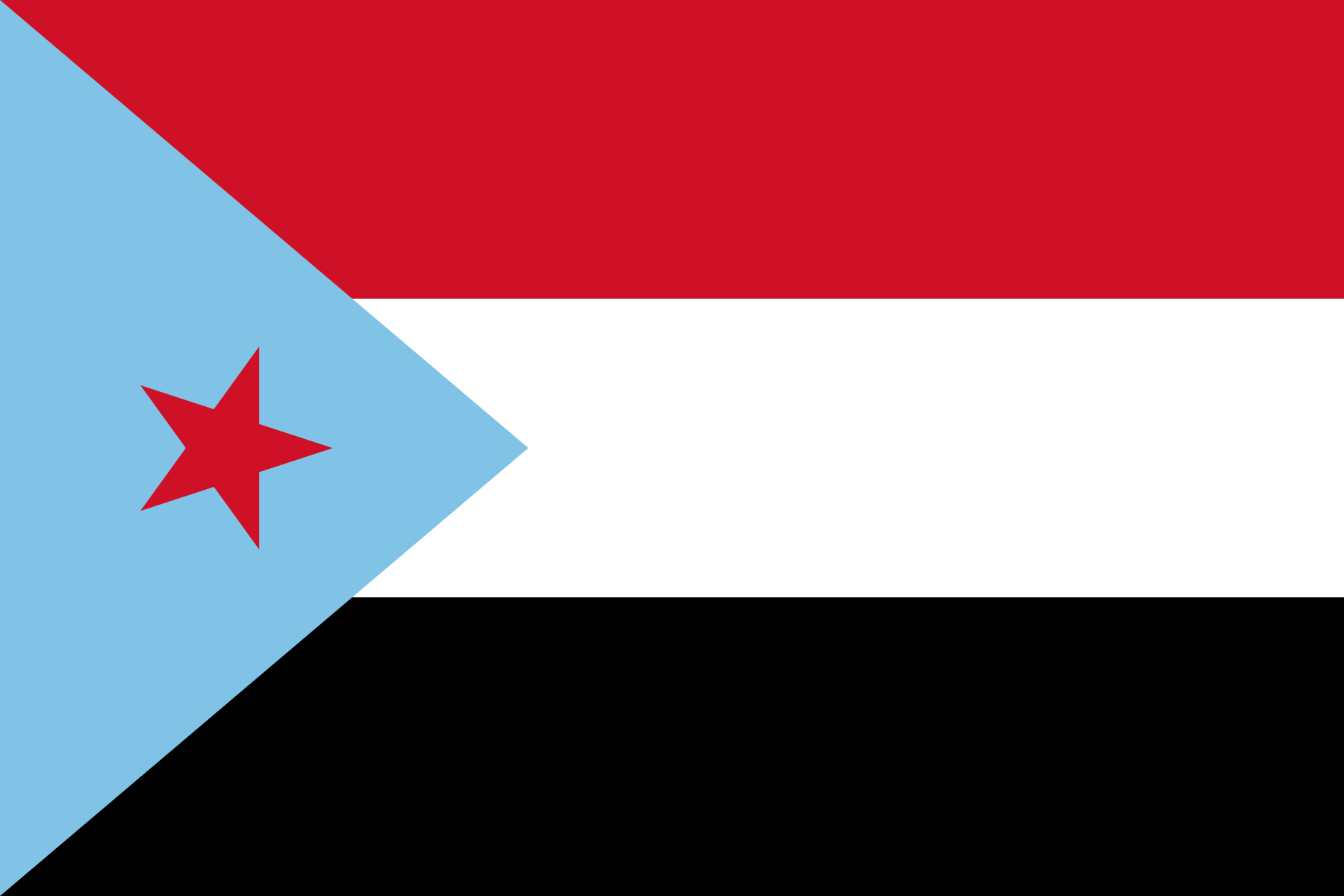
May I first of all, on behalf of my delegation welcome the representatives of the African National Con- gress of South Africa and the Pan Africanist Congress of
Azania, who represent the two liberation movements in South Africa. I should also like to express our satisfaction at the provision made by Member Statesfor the invitations extended to these representatives enabling them to come here to make political statements explaining the existing situation and the sufferings of their African. brothers as a result of the policy of apartheid pursued by the white minority Governmentin Pretoria.
112. Colonialism was not content with dividing the African continent and its people, but also resorted to the creation of a political racist regime which would serve its military, strategic and economic interests, so that it might act in its place and ensure the continuation of its domination and exploitation of the wealth of the African people. What it did in Africa, it also did in Asia and in the Arab world in particular.
113. With the increasing awareness on the part of the African peoples of the need to achieve their independence and restore their legitimate rights to freedom, the political, social and economic pressures exerted against them were also increased and took the form of a racialist policy based on colour. This awareness has turned into disobedience and rebellion and has developed into an armed revolution and, whether such disobedience led to the massacre at Sharpe- ville in 1960 or whether rebellion culminated in the events of Soweto in June 1976, all this is indicative of the fact that the African people have chosen the path of armed
114. The racist system in South Africa would not have succeeded had it not been for the collaboration and support of the world imperialist forces. The former system served economic interests in the African land by ensuring the continued exploitation of the enormous wealth of the African people, constituted by gold, uranium and dia- monds. Consequently, the African people were forced to work at low wages and to face numerous dangers by working in the mines in order to help run the factories in France, Britain or the United States. The output of these factories reverted to the African citizen in the shape of guns, missiles or aircraft in the event that the African workers were slow in carrying out the work or rose to demand their political, economic and social rights-as if wealth was the exclusive right of the white man and poverty was the exclusive lot of the black man, who was the rightful owner of the land. It is here that the imperialist Powers have played a role in supplying the racist regime with weapons, and this has created mutual interests between the racists and the imperialists.
115. Therefore, it is not at all surprising to find that those three countries used their veto powers in the Security Council last week in order to block a draft resolution aimed at enforcing an embargo on the sale of arms to the racist Government until the latter complies with the United Nations resolutions calling upon it to abandon its occupa- tion of Namibia. The justification given by these countries for having used the veto was that the resolution would have impeded peace negotiations, but the main reason actually was the concern that one day these monopolistic interests would be placed 1 the hands of African nationalists.
116. The sources of political and military backing for the racist Government in South Africa to kill the African people are the same,sources which are supporting Zionist Israel politically, militarily and economically and enabling it to km the Arabs in occupied Palestine. They are also hatching conspiracies in order to wipe out the Palestinians. These countries are also the main promoters of the creation of military, nuclear and economic relations between two r 'mes which do not enjoy the respect of the States Members of the United Nations and which are not committed to the provisions of its Charter or its resolu- tions. If the United Nations has recognized that zionism is a form of racism, this is a fact which is evidenced by documents of the United Nations,the last of whichwas the report of the Special Committee againstApartheid on the behaviour and conduct of Zionist leaders.
117. The white minority Government in South Africa is still pursuing its racist policy, which is aimed at depriving the South African people of the right to citizenship. This policy is also known ~n-i is being carried out in the establishment of the bantustans: its last manifestation was the declaration of the sham independence of Transkei on 26 October 1976. This was an attempt to consolidate the inhuman policy of apartheid and to ensure the continuetion of white minority supremacy through the appointment of puppet tribal chiefs and their isolation from the rest of the
118. We have to take very seriously what wassaid by one of the representatives of the African people in South Africa as regards the ambitions of the imperialist States to establish a military base in Transkei. All the diplomatic initiatives aimed at providing a peaceful solution to the problem of Zimbabwe and Namibia were not aimed actually at recognizing the right of the African people to direct their affairs but stemmed from the concern of foreign monopolies that their economic interests might be threatened. The proposal for the establishment of this base was therefore designed to prevent any threat that is likely to 'be posed to these monopolies. It was alsointended to be a strong arm in the hands of the racist rulers against the national African liberation movements, However, this would never be able to defeat the will of the people and it will never put an end to the conflict that isgoing on now in the African continent, particularly in Zimbabwe, Namibia and South Africa, despite all the attempts at sowing seeds of discord between African liberation movements with a view to protecting their monopolies.
119. The New York Times of 24 October 1976 stated:
"It is believed that Mr. Kissinger, with the help of intelligence data, showed Mr. Smith that his position had become hopeless and that the guerrilla war against his regime would soon escalate and probably shatter any chances for it working out an arrangement with the blacks."6
120. Political and information support is continuing for the African struggle day after day and Democratic Yemenis among those countries which have provided in their constitution and in their unified political organization an attitude of support. The head of the Presidential Council stated this position at the Fifth Conference of Heads of State or Government of Non-Aligned Countries in Co- lombo. This was also reaffirmed by the statement of the Foreign Minister of our delegation at the current session {17th meeting]. All these positions are a true expression of principles in which we have faith, since our country wasat one time exposed to colonialism for long years.


At the outset of my statement, I should like on behalf of my Government to welcome the participation of two liberation movements in South Africa at the meetings of the General Assembly and in the deliberations on the item concerning the policies of apartheid of the Government of South Africa.
122. We believe that the mere expression of our concern and sorrow has become repetitive anu useless, and the
123. But I find it incumbent on me and necessary to explain the position of my Government concerning some important matters.
124. First, as regards the farce of bantustans, we believe that this conspiracy is doomed to failure. If the terrorist Vorster believes that by resorting to this cheap trick he is going to give some legitimacy and permanence to the apartheid policy, he is actually deceiving himself. It is clear that this plan is aimed at dividing the majority 'of the people in order to extinguish the flames of the popular revolution, whose impetus we have witnessed and are still witnessing in Soweto and in other areas of South Africa during the past few months and at present. It is clear that the Pretoria regime aims at forcing the majority of the people of South Africa to live on one eighth of the area of land-an area also which is the poorest in natural resources-and by this criminal plan, the apartheid regime hopes to keep the majority of the people of South Africa under the yoke of economic slavery and dependence through the exploitation of cheap manpower. On the other hand, he also wants to create political satellites which are ostensibly independent but in truth are mere puppets for the regime. If the sham independence given to the so-called Transkei is indicative of anything at all, it is of the insolence of the Pretoria regime which is insulting the intelligence of the international community. The Govern- ment of my country declares its full adherence to the resolutions adopted by the meeting of non-aligned coun- tries in Colombo and by the United Nations General Assembly concerning the non-recognition of the ban- tustans, including the so-called Transkei.
125. While we notice that the Zionist entity spares no effort to remind Western people of Nazi crimesand exploits their guilt complex with a view to practising economic, military and political blackmail, at the same time we note that this Zionist entity is one of the strongest allies of a former supporter of Hitler,namely,Vorster. This once more reveals the common essence of racism and zionism and the common link between apartheid and nazism. In other words, nazism, zionism and apartheid are only different names for the same unhealthy phenomena whereby a group of people claim for themselves superiority over other peoples. The people of South Africa and the Palestinian people are actually fighting the same terrorist alii-nee whichhas one pole in Tel Aviv and the other in Pretoria.
126. My Government would like to expressits resentment and disappointment as regards the position taken by some Western countries in the Security Council in seeking to obstruct any solutions likely to deter the Pretoria regime and the Zionist entity. We have found additional evidence of this position during the Security Council discussion of the Namibia issue last week. We all know how some members of the Council messed up this question and. enabled the Pretoria regime to emerge triumphant from these discussions. We cannot but feel very bitter because of the continued position taken by some permanent members of the Security Council towards the Zionist entity on the
127. In addition to extending material and moralsupport to the African liberation movements, the United Arab Emirates, considering that it is an oil-exporting country, had imposed a comprehensive ban on the export of oil to South Africa and Rhodesia. It has also imposed a com- prehensive ban on all kinds of dealings with them. As regards the proposals of the Special Committee against Apartheid in South Africa, they enjoy the full support of my Government.


I shall be speaking on behalf of the nine countries of the European Commu- nities.
129. While solutions for the serious questions of Southern Rhodesia and Namibia may no longer be so far away, the issues and problemsof the apartheid policy of the Republic of South Africa are still very far from being solved. Thisis even more regrettable when we realize that at this moment there are as yet no indications that the situation will improve. Under that degrading system, the vastmajority of South Africans do not enjoy basic civil and human rights. The nine countries of the European Communities have stated time and again, not only in this forum but also in official declarations of their Foreign Ministers, that they reject the policy of apartheid, which is in violation of the principles of freedom and democracy for which they stand. The South African Government has been made well aware of our position.
130. Our countries have condemned all forms of apartheid, including the so-called petty apartheid which is a daily insult to millions of people. The peoples of our countries are feeling growing emotion and indignation that this system of institutionalized segregation still exists. We condemn and reject the concept of totally separate commu- nities for different races and deplore the refusal of the South African Government to take the road to a truly multiracial society, which we consider the only realistic and decent solution for the problems of that country.
131. We can only conclude that the real objective of the homelands or bantustans is to perpetuate the system of apartheid. As I had the honour of declaring to the General Assembly on 26 October{42nd meeting}, the countriesof the European Communities do not intend to recognize the Transkei.
132. If the inherent dangers of the apartheid system might so far not have been sufficiently clearto the South African Government, they must certainly be extremely clear now. What has happened in Soweto cannot be explainedas mere "rioting" but must be seen as a popular protest against
133. Our nine countries were appalled that, after the recent incidents, even more people were imprisoned and detained for their opposition to apartheid. We fear that this has only brought newhatred and distrust.
134. At this point, I may remind the Assembly of the appeal of the nine countries of the European Communities to South Africa on the Day of Solidarity with South African Political Prisoners-I 1 October-to grant uncondi- tional release to all those imprisoned or interned for voicing their opposition to apartheid.
135. I should, however, like to state emphatically that our countries cannot support language suggesting that the white population in South Africa merely be regarded as colonial settlers who haveno right to stay there. All the inhabitants, whatever their race or colour,should have an equal right to be in South Africa and to participate on an equal footingin the civil and political, economic and cultural insitutionsof the country. It should be possible to create in South Africa a society where all inhabitants can live in harmony.
136. The situation in South Africa is becoming more critical. There is a danger of more confrontation and clashes, which in turn may bring about more suffering for everybody concerned. We must bear in mind that there are many people in South Africa from all backgrounds that have a genuine wish for peaceful change and want to bring an end to this situation. They are deserving of all the help and encouragement they can receive from the world community.
137. For all these reasons, the nine countrieshave decided that it is their duty and responsibility to keep open a channel of communication and to continue to make their views known to the Government and people of South Africa so that the policy of apartheid may finally be brought to an end.


Though the hour is late, the subject wehave been discussing overthe last two days is one of such urgency, importanceand relevance that I do not apologize to this Assembly if I take up a few minutes of its time to speak on behalf of my Government and, as representative of the current Chairman of the Group of Non-Aligned Countries, now numbering 86, on behalfof them as well. I am speaking today without notes, for I do not think that the subject of human dignity requires a preparedtext, and I speak frankly and candidly.
139. This subject has been engaging the attention of the international community since 1947. The policy of apart! lid practised by the Government of South Africa ill a SUbject on which no reasonable human being can find himself divided from any other human being claiming to represent in this Assembly the civilized Governments of the world. It is not an issue of politics, of strategy or of the economic restructuring of world society. It is to our
"We the peoples"-not the Governments and certainly not the representatives-"of the United Nations, deter- mined to save succeeding generations from the scourge of war, which twice in our lifetime has brought untold sorrow to mankind, and to reaffirm faith in fundamental human rights, in the dignity and worth of the human person, in the equal rightsof men and women ...".
140. That is what we have met here to discuss under item 52 of our agenda-the very openinglinesof the Preamble of the Charter. We are discussing the worth and dignity of the human person and we have been compelled to do this annually for the last 30 years almost, simply because a Government has institutionalized and is continuing to practise by systematic means a calculated policy, a doc- trine, which cannot but be repugnant to the very opening lines of the Charter of the United Nations.
141. We have sat here and listened to many delegations from around the world, from all continents, showing equal abhorrence at the conduct of this solitary Member of our community. There have been gradations in the cnti..ismof that conduct. But we should like to ensure that our sympathy with the sufferings of the black people go beyond the eloquent phrases which roll out so easily from some of the silver tongues which we are accustomed to hear in this room.
142. On 16 June of this year, the press of the world literally from China to Peru, gave manifest evidence of some of the most horrible perpetrations by a Government, claiming to be civilized, against its people and particularly its young people, We of the delegation of Sri Lanka are grateful to have had the opportunity of having heard from the representatives of the African National Congress of South Africa and the Pan Africanist Congress of Azania, Mr. Tambo and Mr. Sibeko, respectively, some harrowing descriptions of what was taking place. No longer is the venom of the South African Government directed at adults or at armed men or at so-called guerrillas; it is now being turned against 8- and f O-year-old children. Even their funerals are not sacred, Even the dead are not left in peace if their skinsare black.
143. Is this the state of a world in which we have set foot on the moon, a world in which other planets are being brought within our ken? What does the United Nations stand for if not for the moral values that have enabled the human race to move so far forward in its history? We must not forget that the world regards us as the repositories of the moral conscience of mankind. Where is this moral conscience if we can sit by with arms folded and take refuge in eloquent intentions, cautious reservations, main- taining "channels of communication"-a lovely phrase? Of what use are these channels of communication if messages do not get through, if there is no response? The time has
145. I do not stand before this Assembly to suggest that nowhere but in South Africa is there any denial of human rights. But what I do stand here to proclaim is that South Africa is the only land on this planet where the denial of human rights is based simply on the natura! fact of the colour of your skin. South Africa's repugnant policy is as contrary to the laws of nature as to the laws of man and what we see here is a direct, a regular and a consistent perpetration of what later, some years after its inception, the world came to know as fascism. On this very soil, scarcely 500 miles from the city of New York, 200 years ago, an American leader gave vent to a heart-felt cry: "Give me liberty, or give me death!" As this nation today celebrates the two hundredth anniversary of its foundation, 10,000 miles or more away that cry has been raised. And who are those among us who did not gain our liberation and our liberties by following the inspiration of our leaders? Those who today rejoice with such slogans in their territories must be careful not to cast aspersions on others in other lands who are doing precisely the same but in far more serious circumstances, because the liberty that they are being denied is being denied to them because they are black and not white.
146. Of the 4 billion human beings inhabiting this planet, over three quarters are not of the white complexion and what weare talkingabout today is not the possiblereaction of this or that group of nations of the West or the East or the North or the South, but an emotional reaction which will produce a surge of outrage across the planet regardless of whether vour skin is black or white or brown or yellow provided that they feel as deeply as we do about the dignity of a human being.
147. The Prime Minister of South Africa has on successive occasions unashamedly and unabashedly publicly :)1'0- nounced that he was protecting Western civilization by his policies. We would like the leaders of that civilization publicly to disavow that statement and to show by. their actions, more than by their words, that what the South African Government claims as a bulwark of Western civilization is nothing but a travesty and a mockery of the finer parts of the Western tradition. We of the Sri Lanka delegation, and indeed of all of the 86 delegations representing the non-aligned countries, cannot but question the silence of the leaders of the Western traditions-silence not in words but in deeds, when the banner of Western civilization that is being flaunted in southern Africa is something which, as I said earlier, is repugnant to the human spirit. We have heard here statements sympathizing
148~ I must here pay a tribute to the group of Nordic countries who are also the products of Western civilization. Bytheir. speeches at the highest political levels in this hall at this session, by their actions, by the contributions of funds on behalf of the suffering people, the Nordic peoples have redeemed the more worthy traditions of Western civiliza- tion and I think the rest of those who claim that inheritance must owe a debt' of gratitude to those nations, who have shown that they at least are principled, are genuine and are prepared to stand,up for the finest and the best in their cultural inheritances.
149. I have spoken, if you like, with emotion. We of the third world are sometimes indicted for being too emotional over measures. I for one am not ashamed of becoming emotional if my emotions are outraged and aroused by something worthy of that outrage. Who in this hall can picture children of 8 and 10 clubbed and shot to death for no other crime than the colour of their skin and their demonstrating to be taught in their own indigenous language? Who in this hall can fail to be aroused In such a situation, unless the blood nn his veins has become! water? Blood is not black or white, blood is red, and wherever it is spilled it must cause emotion. Let me in this context quote my Prime Minister, Mrs. Sirimavo Bandaranaike, who from this very forum in her address to the General Assembly on 30 September spoke as follows:
"The fight against injustice cannot but be emotional, and it will help mutual understanding if this simple truth is remembered.
"Southern Africa is one area where the circumstances fully justify resentment and impatience.
"The peoples of Africa have many hard-won victories against imperialism and colonialism to their credit. Yet, they have to contend today not only with the outmoded) inhuman and abhorrent practices of apartheid and racism, but with threats to their newly-won independence and their territorial integrity in the form of aggression from the same sources which now challenge their dignity and their self-respect.
"The message from Colombo, as far as it concerns southern Africa, is also directed to the nations which are continuing to collaborate with these regimes, thereby giving them a false sense of security and a semblance of respectability to which they are not entitled.
"
"All initiatives towards a just solution of these prob- lems are naturally welcome as long as they are genuinely designed to expedite the transition from obduracy to reason. At the same time, I should make it clear from this forum that if reason were to fail and the peoplesof Africa were forced to resort to the ultimate solution through armed struggle, every non-aligned nation would stand solidly behind them." [11th meeting, paras. 19-23 and 25.J
150. That sums up what in our view is the crisis to which the racist policies of the Government of South Africa is taking not only South Africa but the neighbouring terri- tories of Namibia and Zimbabwe.
151. Let me in conclusion say this. We, as representatives of the international community dedicated to the ideals of the Charter, we as the representatives and the repositories of the moral conscience of mankind, should frankly hang our heads in shame that, while we are waiting here, while we are introducing, amending, passing and sometimes abstaining in the vote on resolutions, black people are being killedsimply because,they are black.
152. As I leave this forum, I hope the message that will go forth from this hall of nations will be a message of deep collective commitment on the part of all of us to the achievement of the aspirations of those people who, after all-black, white, yellow or brown-are our human brothers and sisters, and a message of deep compassion for those whose sufferings we watch from afar; and, may I say, of even deeper compassion for those who, directly or in- directly, enable these policies to be continued, because they will need our compassion much more in the long run than will their own victims.
The meeting rose at 6.30p.m.