A/31/PV.54 General Assembly
THIRTY·FIRST SESSION
52. Policies of apartheid of the Government of South Africa : (a) Report of the Special Committee against Apartheid; (h) Report of the Secretary-General


As I am speaking towards the end of the debate on agenda item 52, I am fully aware of the various contribution ~ made by all preceding speakers. My delegation, however, is pleased that, though the item has been included many times on the agenda of the General Assembly without any results, for the first time it has been given higher priority by being discussed in plenary meet- ings. We are equally pleased that the General Assembly adopted the important decision of allowing the represen- tatives of the African National Congress of South Africa and the Pan Africanist Congress of Azania to participate in the debate.
2. Over the years the situation in South Africa has not improved but has worsened as the racist regime intensified repressive legislation and used the police and the army to murder and maim people in attempting to safeguard the privileges of the white minority. The year 1976 has been the worst year for the oppressed peoples of South Africa, particularly since 16 June 1976, when the police charged defenceless schoolchildren who rejected apartheid and its entrenchment through teaching in the medium of Afri- kaans. Many people were killed or injured, while others were bundled off to prisons or detention centres. Whatever number of persons unaccounted for, unidentified or dead the Government of South Africa may supply or the commission of inquiry conjure up, the actual number runs into the hundreds,
3. It is against the background of these tragic events, that were triggered off on 16 June, and of subsequent events and of the speeches made by the white South African leaders that we must view our action during this session.
4. All without exception have deplored the situation in South Africa. But that i. not new. ThAt has always been
Wednesday, 3 November 1976, at 3.30 p.m.
NEW YORK
done in the past, but apartheid is still being pursued and intensified. The benefits of the system of apartheid continue to accrue to those who are involved directly or indirectly with their vested interests in the country, having been attracted by its wealth, its strategic location and the I benefits which the system provides. Soothing words and verbal condemnations as well as fmancial hand-outs to the victims only serve to minimize the effect, and 40- nothing to eliminate the cause of the misery.
5.. The Special Committee against Apartheid, under the able leadership of its Chairman, Ambassador Leslie O. Harriman, has done a commendable job, as always in the past, with the increasing support and participation of many States Members of this Organization, specialized agencies, international organizations and non-governmental organiza- tions. More work remains to be done in the year ahead and in subsequent years until apartheid has been totally eradicated and the people of South Africa can live in freedom, equality and justice. We congratulate the Special Committee for its activities and join in its appeal for intensified and co-ordinated efforts towards the total elimination ofapartheid.
6. I am equally conscious of the valuable assistance given by Member States, international organizations and private individuals through their contributions to the United Nations Trust Fund for South Africa and by rallying to the assistance of the victims ofapartheid and their dependents, We fully share the concern of the Committee of Trustees of the Trust Fund expressed in the appeal of its Chairman, Ambassador Rydbeck, that in view of the increasing repression and persecution the Fund needs more pledges to enable it to maintain its service'S [41sf meetingj. We support that appeal for generous contributions to keep the Fund going.
7. My Government views with deep concern the con- tinuing aggressive nature of the racist regimes and their adventurous incursions into the neighbouring countries of Angola, Botswana, Mozambique and Zambia. We strongly condemn those irresponsible acts, which violate the territo- rial integrity of those sister States and which result not only in the loss of property but in the loss of human lives. The support for the peoples of Zimbabwe, Namibia and South Africa is equally shared by my country. The people of Lesotho have also been victims of similar manoeuvres by South African agents, and no country in the region can remain unresponsive to the commitment to fight colo- nialism, foreign occupation and apartheid.
8. In lts frantic efforts to avoid self-destruction, the racist regime has not been alone either morally, politically, diplomatically, economicaHy or militarily. With increasing military co-operation and trade in military hardware and
9. The activities of the police are proof of the lengths to which South Africa is prepared to go to avoid meeting the legitimate demands of the people and to counter the activities of schoolchildren. The same guns-whether im- ported or manufactured under licence In South Africa- continue to be used to defend white interests and to enrich countries whose companies are engaged in the arms trade directly or through third States, and this has resulted in Increased numbers of. people killed, both South Africans and my own people, as was the case in 1960 at Sharpeville, 1973 at Carletonville and 1976 in Soweto, and in many other isolated incidents within South Africa and along our border.
10. The Soweto demonstrations, which soon spread to other cities and townships, added to the numbers of persons whom their relatives and parents cannot account for and of persons who may now be languishingin gaols or detention centres. Bvery year the international community observes 11 October as the Day of Solidarity with South African Political Prisoners. Widespread calls and appeals for the release of these prisoners have been made, all to no avail. Every day the number of persons under detention or in prisons or of those who have been forced to flee across South Africa's borders increases.
11. Apartheid has not loosened its grip on many sectors of South African life. Instead, that grip now seems to be tightening. When the South African Government intro- duced Bantu education it was widely opposed by many and some were forced to seek educational facilities and limited resources with people from South Africa, Rhodesia, Namibia and other countries of southern Africa. Evenafter Lesotho's independence my Government continued this policy at all educational levels. This remains a cardinal point of my Government's policy, although, with the current student unrest in South African universities and secondary schools, an increasing number of students are seeking admission to educational institutions in Lesotho. It is becoming more and more difficult to accommodate these increasing numbers both in universities and at lower educational levels, and my Government, in order to overcome this difficulty, has had to launch an appeal to all Member States and international organizations to enable it to continue this assistance. .
12. On 26 October a new element was added to the over-all picture in South Africa when the Transkei was given so-called independence. The international community took an important decision in a General Assembly resolu- tion [resolution 31/6 AI, and the overwhelmingnumber of delegations which sponsored the draft resolution and voted for it was an encouraging further sigh of the rejection of apartheid. However, time will tell whether that common stand will be maintained or whether the appetite for wealth willdictate political expediency.
14. The map of southern Africa changed in 1975 with the independence of Angola and Mozambique, and this gene- rated hitherto unknown interest in some quarters, once the backdoor of the laager was broken down. It would therefore not be surprising if there were new developments in the coming year; but, whether they come from within or from without, they need to be viewed with growing interest.
15. In conclusion, I wish to reaffirm the support of the people and the Government of Lesctho for those in South , Africa who have long been denied their rights in their own land and who are persecuted because they are demanding justice, freedom and social and economic betterment -whether they are in South Africa under restriction, or in exile-so that they may participate in a free and united South Africa.


The Members of the United Nations agreedwith the proposal made earlier in this session that the present item should be discussed in plenary meetings, since it was our common belief that the decision to do so would be both wise and opportune. In making this gesture, the United Nations demonstrated the overriding importance it attributed to this item and ex- pressed mankind's grave concern at the persistence of the policies of racial discrimination and racial separation in South Africa. The fact that a very large number of delegations felt encouraged to speak during the debate on this item and that every one of them firmly rejected such policies is in itself sufficient evidence of the universal rejection ofapartheid.
17. Over the years the policies of the Government of South Africa have remained basically unaltered, despite new developments both in that country and in the southern African region as a whole. As a system designed to ensure the control and exploitation of the autochthonous popula- tion of South Africa by the white minority, apartheid has over a period of years been the object of universal condemnation by the outside world and is now being met with open and growingresistance by its victims,
18. Our abhorrence of the policies ofapartheid and similar practices has its roots in the Brazilian historical heritage and intrinsic cultural values. The history of Brazil is one of building a nation on the basis of racial integration. Different ethnic groups have come to Brazil to learn not only to live together side by side but to merge as one people without distinction as to origin, religion, race or colour. This social fact is reflected in our legal system, as the principle of racial equality is enshrined in our Constitu- tion and is effectively enforced in ordinary legislation. Acts of racial discrimination, which are the law in South Africa, are criminal offences in Brazil.
20. That being the case, it should come as no surprise that the Brazilian delegation gave its support"to all the resolu- tions on apartheid adopted by the General Assembly at its last session.
21. For its part, Brazil warmly welcomed the new steps along the road of decolonization and promptly established diplomatic relations with the newly independent States, while maintaining lis condemnation of theapartheid policies still in force elsewhere and strictly observing the mandatory sanctionsimposedon Southern Rhodesia.
22. Opening the general debate at the present session, the Minister of External Relations of Brazil referredto African issues before the General Assembly in the following terms:
"Southern Africa, where racial oppression persists, is today not only seized with unrest and fear, but also devastated by violence and slaughter. In the face of recent events, the items now on our agenda concerning the problems that afflict that region have taken on unprece- dented importance. Brazil has always been in favour of peaceful solutions for those problems and has always been convinced that there was no time to be lost in arriving at them. Our opinion, repeatedly stated overthe years, was that unless solutions were promptly reached, the region would be irresistably drawn into open conflict. Unhappily we have no reason to revise our diagnosis, but we should still like to believe that the unanimous international repudiation of the injustices committed will serve as a grave warning to those that consider it possible to continue to maintain racial oppression. It is our hope that the peoples of Zimbabwe and Namibia, who still have not achieved their independence, may soon.be able freely to exercise their true national will". {5th meeting, para. 16.}
23. Despite Brazil's stand on African issues, ill-advised comments have been published to the effect that the
Brazilian Government, together with other Governments, has been engaged in negotiations for the establishment of a security treaty with South Africa. On many occasions, the latest being on 30 September of this year, spokesmen for the Brazilian Government have categorically denounced such allegations as absolutely unfounded and untrue, since Brazil does not maintain, nor doesit entertain any thought ofestablishing, military linkswith South Africa.
24. This year has been marked by widespread violence against opponents of apartheid, and above all by the killing of Afr~cans in Soweto. Immediately after that terrible event, acting on instructions from my Government I sent a letter to our Secretary-General expressing Brazil's endorse- ment 0 .... resolution392 (1976) unanimously adopted by the Security Council on 19 June 1976. I added in that letter that the Brazilian conscience was deeply shocked by the incidents in South Africa in which the lives of so many vict!ms ofapartheid had been lost.
2S. This year, as in previous years, Brazil took an active part in the observance of the International Day for the
"In the United Nations and other international bodies where the tensions and antagonisms engendered by racial segregation in its death throes have their loudest repercus- sions, Brazil has not limited itself to a condemnation of ' these vestiges of the past that try desperately to survive in a world that rejects them. Brazil not only has repudiated all forms of racial discrimination but also has contributed in an active way in order that the international commu- nity might co-operate objectively and efficaciously to put an end to this painful and archaic chapter of relations between peoples. The Brazilian Government will never deviate from this line of conduct, since it is the one which best corresponds to international realities and, above all, is the one that best expresses our vocationasa multiracial nation" .
26. More than one year has elapsed since the Brazilian Government had the pleasure of receiving the visit of a mission of the Special Committee against Apartheid. The consultations held during that visit proved to be most fruitful and encouraging. Their beneficial effects are still being felt today, Brazil will contribute with renewed vigour to the struggle against apartheid.
27. One aspect of the position of the Brazilian Govern- ment on the issue is its commitment of fmancial support for the Trust Fund for Publicity against Apartheid, the United Nations Fund for Namibia and the United Nations Trust Fund for South Africa. We have been regularly honouring these pledges.
28. The creation of bantustans in, South Africa is one of the most disturbing facets of the racistpolicies imposed by the South African authorities on the blackmajority of that country. The position of the Brazilian Government on this issue, which has recently come under close scrutiny by the international community and prompted its overriding rejec- tion of the sham independence of Transkei, is clear-cut and needs no elaboration. We voted in favour, without reserva- tions, of the resolution adopted by this Assembly on 26 October. We cannot but condemn the efforts by the South African authorities to consolidate racist policies under the guise of separate development, in contravention of the political aspirations black people in that country and the collective voice of this Organization.
29. I should like to conclude by stating once again that the Brazilian Government continues to view with concern the deterioration of the situation in southern Africa. We believe that the growing tension and instabilityin that area is directly related to the persistence of the policies of apartheid. Timeand again the Members of this Organization have unanimously demanded that South Africa yield to urgent change. We whole-heartedly join the efforts of the lJJilted Nations to bring to an end the iniquitoussystemof


I can add practically nothing to what previous speakers have said about apart- heid in condemning South Africa for adopting a continuous policy of racial discrimination in consistent defiance of the United Nations Charter and the International Convention on the Elimination of All Forms of Racial Discrimination {resolution 2106A (XX), annex].
31. The disapprobation of South Africa's obdurate atti- tude' is amply reflected in the various draft resolutions submitted to this Assembly. Those draft resolutions could be summed up in a few preambular and operative para- graphs to the effect that the international community should no longer, and will no longer, tolerate the defiance of South Africa.
32. We have now reached the cross-roads: either the Government of South Africa will forthwith change its policies or it will face complete isolation andsegregation by the United Nations.
33. I have detected in this Assembly a genuine desire on the part of many Western and Western-oriented States to adopt drastic measures to deal with this anomalous situa- tion. We can no longer afford to be patient with the Government of South Africa, for, I venture to say, the whole world is astir and nothing can quiet the crushing majority of States Members of the United Nations. We can no longer accept spurious promises that steps will even- tually be taken to prevail on South Africa to execute an about-face regarding its apartheid policies. Indeed, we have reached the point of no return.
34. How should the United Nations proceed in order to find a permanent and not merely a makeshift, evanescent solution to whatneed nolonger beanintractable problem? Perhaps I might engage in a briefanalysis of the possibilities that are open to us for eradicating apartheid in South Africa. Dispassionately, and from the vantage point of objectivity, I believe that there are four or five possibilities that we are bound to consider in searching for a final solution for the problem of apartheid.
35. First, the United Nations should issue a last warning -and I mean a lastwarning-that, if South Africa refuses to introduce clear-cut legislation to abolish apartheid, the Security Council and the General Assembly will take prompt action to expel South Africa from the United Nations for having repeatedly defied the Organization to such an extent that the whole world has been aroused and expects nothing short of drastic action to be taken by us herein the United Nations.
36. Secondly, if that warning is not heeded by Sout'i Africa, then we, especially those States which have strong economic and financial ties with SouthAfrica, will have no choice but to apply sanctions and embargoes. I am not going to mention those States byname because nothing can be gained from my doing so;theyknow who they are.
38. I must bring it to the attention of the Assembly that our black African brothers are at the endof their patience, as are the Asians and the South Americans; so also are the whites of most European States and the whites of the northern countries in both hemispheres.
39. Notwithstanding all I have mentioned, we may be told . that the leaders of South Africa may tell the whites they have no alternative but to fight even if they have to fight with their backs to the wall. Certain humanitarians may tell us that there may develop a white psychosis making it impossible for the whites to mix with coloured people, be they African or Asian.
40. It is still South Africa's privilege to choose the course of defiance, andif it didnot mind sacrificing the whites and the blacks then we may easily envisage a holocaust in Africa.
41. Therefore, there is still another possibility which I might bring to your attention: it is for the United Nations to devise a prompt political solution that wilt take into account the psychosis of the leaders of white South Africa in order to abolish apartheid. I venture to say that this prompt political solution should revolve around dividing South Africa into several multiracial provinces or cantons. Legislation would then be undertaken by each province or canton to ensure respect for the rights of themajority and of the minority in each province. Some whites might be in the minority in certain provinces; they should abide by the legislation of the majority and vice versa: there mi8l'tt be some black enclaves in the white provinces, anc'i the blacks-or coloureds, since it seems that the psychosis of the South African leaders leads them to feel that anyone who is not snow-white, or at .least white, is not one of them-in that case also should abide by the laws of the municipality, canton or pnvince, as the case may be. And then it would be one State, not an artificial monstrosity like the Transkei, where the whites of South Africa have already implemented their plan to divide up the blacks of South Africa into provinces with implanted puppetgovern- ments. Foreign affairs and defence will be the responsibility of the central Government of a confederated, multiracial State.
42. If all these possibilities are cast by the wayside, what may we expect South Africa's future to be? War, in all its manifestations. Blood will run profusely-the blood of whites and blacks alike-human blood, which, ironically, is of only onecolour, regardless of race. The situation may be likened to a volcano about to erupt: the lava does not have any choice; it will cover and burn whites and coloureds alike. And the innocent will suffer, regardless of the colour of their skin. Emotions will runhigh, andthe repercussions will fuel racial hatred and animosity outside South Africa -the whole world over, I dare say. Animosity and hatred will be aroused in various countries where whites and coloured people are trying to live in harmony with one
43. Mercenaries will be recruited to enter the melee, not only in South Africa but wherever there are people of diverse racial origin. And who will be happy? Who will be jubilant? No one except the merchants of death, the arms manufacturers, who will reap a bonanza of profits, as they already do, in many areas of the world.
44. That is the alternative. Should that happen? Can the United Nations afford to stand with folded arms, or will rifts between Members here in the Assembly create unbrid- geable chasms and emotions sway the behaviour of Member States of thisOrganization? Those are the choices: they are clear-cut.
45. I have not engaged in vituperation; nor have I cast aspersions. I feel sorry for the leaders of the whites in South Africa, because they are sick and have to be treated. If they arc sick, let us find out and give up hope that we can follow the path of reason. If they are not sick, let us prevail on them without any more procrastination, and not let anyone who has material, economic or financial interests with South Africa say, "Give them more time for a step-by-step solution." That kind of solution is no longer valid. We have but one lifetime, our generation and those who are younger, alike. If we follow such confusing step-by-step solutions we will get nowhere.
46. I remember how in my region during the British Mandate over Palestine, when the incursions of the Zionists grew year after year, the British sent Royal missions such as the Peale mlssion-jhey had all kinds of names depending on who was chosen to negotiate. Between 1922, when trouble erupted in Palestine, and the advent of the Second World War, several missions were sent. This would be tantamount today, after the partition of Palestine, to a step-by-step solution. This step-by-step approach is bank- rupt. Either the United Nations has to obey the Charter and pay heed to justice or this Organization will go down the drain,as the League of Nations before it went down.
47. I remember how, in the 1930s in Geneva, the late Hailc Selassie pleaded in the League of Nations for his country. And what did the Members do? They did nothing. Eath one was trying to see how the balance of powerwould shift and adopted a self-seeking attitude. What did this end in? The Second World War. We cannot afford to have this Organization, which is the only safeguard for maintaining peace, end the same way.
48. But I close by wanting all the Members here that the United Nations will go down the same path as the League of Nations if its policies are not predicated on justice. There are a couple of Arabic proverbs which express the quintes- sence of the millennia of Middle Eastern history, to the effect that anything that is based on a foundation that is not solid-and here, by "solid" we mean based on justice-
49. I end by saying that we are at the cross-roads. We have reached the end of OUi patience. If South Africa means well, it will without delay liberate Namibia. If it does not do that within a short period of time, then who can hold a brief for South Africa? No one Member State is perfect, but we have never persistently established a policy of racial discrimination that touches the dignity of man. Dignity is not for sale, and we reject all those excuses which we hear once in a while from some of our friends that still dealwith, South Africa, who say, "Be patient with us". Our patience isat an end.
50. If those who make money by trading with South Africa or strengthening it with arms persist in doing so, then we know that those who exercise power do not mean to abide by the purposes and principles of the United Nations. Let them say so; we will excuse them if their excuses are valid. But if they believe-as I am sure that in their innermost hearts they do-that from a practical point of view it would be the better part of wisdom to prevail on South Africa once and for all to change its attitude, then we will have faith that those who exercise world powerwill abide by the purposes and principles of the Charter.
51. A last warning: next year may be too late. It is up to the members of the Security Council dispersed in this Assembly hall to send a warning to South Africa, telling them that this is the last warning, to abolish apartheid or . .. I need not say what follows "or". It will be bloodshed; it may be that there will be a great deal of racial dissent outside South Africa and that is something abhor- rent which we have spent 30 years here trying, by various declarations on human rights Rnd covenants, to dissipate and to abolish.
52. Justice should not be a word that is merely pro- nounced;it should be put into practice.
,

My delegation is speaking towards the end of this debate, in the course of which more than a hundred countries, through their representatives, have made it abundantly clear that they reject and condemn the apartheid regime. The delegations which have spoken before me have analysed the situation of the South African people, painting a picture that is characterized by the hateful exploitation of millions of individuals by a regime
founded on systematic and official aggression and exploita- tion.
54. About 30 years ago the United Nations took up the question of apartheid and analysed the crimes of a country that is a Member of the United Nations. That country. by its philosophy and acts, is in total opposition to the fundamental principles that gave birth to our Organization.
55. Officially set forth 28 years ago, the theory of apartheid emerged from the ashes of nazism, whose destruction was paid for by the greatest sacrifices of mankind. The apartheid ideologists, with their Nazi past and present, are the sorry proof that the sacrifice of
56. In spite of universal condemnation, the apartheid regime not only survives, but is becomingeverstronger in a number of areas, particularly in the economic and military areas.
57. To understand the reason the system of apartheid has survived is properly to understand the colonialistnature of / the system. Apartheid is an.expression of the desire to dominate and exploit peoples. For that reasonit enjoys the support of the imperialist forces, whichsee in the system an effective way of exploiting the resources of southern Africa.
58. No one is unaware of the real intentions of those who systematically have made it impossible for effective and concrete action to be taken in the United Nations against the minority racist regime in Pretoria. Verbal condemnation of apartheid and appeals for calm and patience from those who, by their actions, strongly support apartheid not only are a cruel offence to the intelligence of the African peoples who are directly suffering the effects of the system, but also constitute a serious challenge to our Organization.
59. It is high time our Organization took more effective action to prevent the growing collaboration of Western and other countries with South Africa. An end must be put to the shameful situation we have witnessed, which is charac- terized by the duplicity of South Africa's allies, who in words condemn apartheid but at the same time give it whateverassistance it needs to survive and grow stronger.
60. We know that the United Nations will not solve the problem of southern Africa. The liberation of the South African people will come about thanks to the struggle of the people, guided by their national liberation movements, to which we pledge, here at this rostrum, our entire support. Whatever racist oppression may exist, the South African people, we are convinced, will sooner or later, as a result of their consistent struggle, destroy the unholy alliance ofapartheid and its traditional allies.
61. The evolution of the situation in South Africamerely reflects the dominant features of a process taking place throughout our continent. That process is characterized by the victories of all those who have fought decisively for self-determination. .
62. The struggle of the South African people is part of the resistance movement of all the African peoples which have won their freedom after many sacrifices. Our desire to see in South Africa a peaceful transition to majority rule free of racial prejudice is unfortunately thwarted by the lack of goodwill on the part of the current leaders in Pretoria and their allies. This leaves the South African people no choice but to fight with everymeans available to them.
63. The brutal expression of the peaceful demonstrations by South African citizens protesting the exactions of the apartheid regime are not something new. From SharpevilIe to Soweto, the aspirations of the South African peoplesfor a non-violent transition have been systematicallyfrustrated
64. In view of the considerable foreign investments in South Africa there is much to be feated from a possible widespread armed conflict in southern Africa, with all the risks it would entail for international peace. The case of Angola, whose people were the victims of joint repression by international mercenaries and racist South Africa, heavily supported by foreigners, is but an example of what could happen in South Africa on a broader scale and with far more seriousconsequences.
65. Referring to the sham independence of the Transkei, we wish to reaffirm our rejection of that shameful acceptance of the apartheid regime by a group of puppets. While it is impossible to destroy the dignity of an oppressed people, there is always within an oppressed people some individuals whose dignity is not strong enough to resist the existing situation and because of that they lend themselves to all sorts of bargaining with the oppressors. The group of individuals who, betraying the aspirations of their people, have agreed to play a part in the comedy of the sham independence of the Transkei, orchestrated by Pretoria, deserve the kind of scorn that has been heaped on them by the international community. Matanzima will suffer the same fate as the Thieus, the Lon N0\s, the Holden Robertos, the Salimis and other traitors who, despising their own people,have allied themselves with those who are pitilessly exploiting their brothers. South Africa'splans for bantustanization in South Africa are but a product of apartheid in the sense that they used tribalism to divide the South African people to reduce them to the status of aliens in their own land.
66. While our work has been proceeding-to be specific, the day before yesterday-the people of Mozambique were once again victims of an aggressive attack by the armed forces of the racist minority regime in Rhodesia. In the course of an operation which lasted more than 24 hours, the Mozambique border was violated in a number of places and the people living near the border were savagely attacked. As a result dozens of men were killed and many were wounded. This new crime of Ian Smith has special significance now that in Geneva there are negotiations between the true representatives of the Zimbabwe people and the representatives of the rebels.
67. We should like to stresshere the flagrantcontradiction between the two situations and to draw the attention of the Assembly to the true intentions of lan Smith. We appeal to our Organization to condemn vigorously the repeated acts of aggression committed against Mozambique by the
68. The appeals and proposals that my delegation wishes to put forward in this Assembly may be found in the draft resolution on this subject which were distributed by the Secretariat yesterday {A/31/L. 7-14/. My delegation is a sponsor of those draft resolutions and can only express the hope that, since they reflect the nature of this important debate, most countries here will support them.


For the first time the General Assembly is considering in plenary meetings the question of the policy of apartheid practised by the minority racist
regime of South Africa. This decision is something for which my delegation is grateful, since it does not merely meet our wishes but reaffirmsonce again the urgent need to dismantle the diabolical machine that has generated apart- heid, the Vorster regime, which has institutionalized terror and repression over more than 18 million innocent and defenceless human beings.
70. The many resolutions adopted by the General Assem- bly and the Security Council and the many recommenda- tions made by the Special Committee against Apartheid and the United Nations Council for Namibia, as well as by other committees and bodies within the United Nations system, together with the eloquent and concise statements made in this Assembly by Mr.Tambo and Mr. Sibeko from the African National Congress of South Africa and the Pan Africanist Congress of Azania respectively {41st meeting], are so clear, firm and relevant as to make it unnecessary for my delegation to add anything to them.
71. A gang of racists, inspired by the segregationist ideas of Vorster and Smith, have seized power in the African territories of Azania and Zimbabwe, thus jeopardizing the destiny of millions of indigenous Africans, so as to exploit ruthlessly, in co-operation with their Western imperialist alli...s, their vast and immense natural resources.
72. The regimes of Pretoria and Salisbury, not content with imposing the inhumane policy of apartheid within the territories which they occupy and administer by a system of repression, have also found it necessary to adopt the imperialist system in order to regionalize the condemned system of apartheid. Hence the illegal occupation of Namibia-a Territory under the exclusive administration and jurisdiction of the United Nations-by the racist and Fascist regime of South Africa, which has transformed it into a springboard for attacks and military incursions into independent nelghbourr-g countries of the region namely, Angola, Mozambique, the United Republicof Tanzaniaand Zambia,to mention but a few, in their desperate attempt to curb the advance of the liberation movements, unfortu- nately forgetting that machine-guns and bombers have neversilenced the cry of liberty.
73. The minority regime of South Africa must understand that it is not worth while for them to continue playing deaf. The uprisings of 16 June 1976, to which the racist authorities of South Africa replied with the massacres in
74. History is irreversible. The bombers yvhich slaughtered millions of Kampuchean, Lao and Vietnamese freedom fighters only ensured the independence and freedom of those countries, which they now enjoy.
75. After 30 long years of long debates which haveled to energetic condemnation and total rejection of the policy of apartheid practised by the racist and Fascist regime of the white minority in South Africa and in spite of the manoeuvres of certain Western imperialistPowers, unfortu- nately the conclusion has been reached that only through armed struggle-which the liberation movements in south- ern Africa are so valiantly waging-is it possible to do away with the regimes in Pretoria and Salisbury. That was stressed by His Excellency the President-for-Life of the Republic of Equatorial Guinea in a statement made on 29 September 1976:
"With regard to the situation prevailing in southern Africa, there is no alternative but to encourage the liberation movements to continue the armed struggle that they have l..mdertaken since, because of the futility of efforts to fmd a peaceful and equitable solution which could be attained by dialogue, Mr. Vorster has reminded us that independence and liberty are nevergiven, but have to be conquered."
76. Nevertheless, the international community, for its part, has its responsibilities and a task to perform so that the oppressed people of South Africa can be free. In this context, it is worth reminding representatives of the General Assembly's commitment, undertaken in its resolu- tion 3411 C ( XXX),which it proclaimedthat:
"... the United Nations and the international commu- nity have a special responsibility towards the oppressed people of South Africa and their liberation movements, and towards those imprisoned, restricted or exiled for their struggle againstapartheid. "
77. The Special Committee against Apartheid has made recommendations to the thirty-first session of the General Assembly {see A/31/22, chap. Il/ which my Government has accepted as just and right, and we hope that they will be so accepted by the other Members of this Organization. Those recommendations constitute, in the view of my delegation, the sole messages of condolence and encourage- ment which the oppressed people of South Africa expect to get from this Assembly.
78. like the Governments of Africancountries within the framework of the Organization of African Unity, the Heads of State or Governmentof the great non-aligned movement, meeting recently in Colombo,' reaffirmed their unswerving policy with regard to the minority racist regimes of southern Africawhen they said:
1 Fifth Conference of Hcads of State or Government of Non- Aligned Countries, held at Colombo from 16 to 19 August 1976.
"... the total eradication of apartheid and the exercise by the people of South Africa of their inalienable right of self-determination is an urgent and imperative need at the present time." {See A/31/197, annex I, paras. 56 and57./
79. Much to our alarm and dismay there has been a recurrence of the situation in the Security Council of the United Nations in which there was a triple veto by the United'States, the United Kingdom and France.
80. Once again the veto has been used to fulfil a purpose having nothing in common with the purposes of the United Nations Charter. This time it was used to condone and perpetuate slaughter and massacre by the racist minority regime of Vorster of the black majority of South Africa, from Sharpeville right up to Soweto and other parts of South Africa.
81. The right of veto, granted to certain Members of this Organization in the light of their responsibility for the maintenance of international peace and security, has once again been exercised to defend and support the apartheid regime which the users of the veto claim to condemn, on the pretext that what is happening in South Africa cannot be considered a threat to international peace and security.
82. But, whatever path is chosen, Azania, Namibia and Zimbabwe will be independent, in spite of the triple veto. The Western imperialist countries must realize that to arm the minority regimes of southern Africa is to spell the doom of those regimes and their succeedinggenerations.
83. The'delegation of the Republic of Equatorial Guinea cannot conceal its satisfaction at the solidarity and support shown by almost all the Members of this Organization on 26 October 1976 in response to the appeals of the Headsof State or Government of non-aligned countries and of the members of the Organization of African Unity categori- cally, unanimously and unequivocally condemning the creation of the bantustans which the apartheid regime is establishing in southern Africa, thus rejecting the declara- tion of "independence" of the Transkei imposed by the racist regime of South Africa.
84. In conclusion, we appeal to .the international commu- nity represented here to show its support for the oppressed people of South Africa by giving it now £~i the necessary material, political and moral support it needs so that it can put an end once and for all to the campaign. of murder which the apartheid regime is pursuing in South Africa.


With understandable interest and growing indignation, international public opinion in the last few days has been considering a subject which for 30 yearshas been included in the agenda of the General Assembly, an item which was included at the initiative of Mrs. Pandit of India, when she warned us with prophetic words here in this Organization of the consequences for mankind of the outrageous policy of apartheid, the odious system of racial
86. Because of the intransigence of the South African leaders in refusing to comply with the decisions of the world Organization, instead of these peaceful procedures, the oppressed black majority has had to resort to other means in order to be able to exercise its inalienable and legitimate rights. This reaction constantly results in harm to innocent people who are struggling in their desperation to achieve their longed-for freedom.
87. Colombia, faithful to its institutional traditions, has respected and continues to respect all its commitments undertaken in this international body, and, in the case of the brutal repression carried out by the white minority of South Africa, we repeat our energetic rejection of that heinous policy. Similarly, my delegation, which is the authentic spokesman of the thoughts and feelings of the Colombian people, wishes here to reaffirm its adherence to the Universal Declaration of Human Rights as the basic premise of an unchanging pursuit of the principle of peaceful coexistence among peoples of whatever race, colour, religion or political ideology. The attitude of my Government could not possibly be any different. Notwith- standing the similarity of aspirations and the affinities which bind us to African countries, our conduct of this debate is not subordinate of political attitudes. Mycountry, a representative democracy of long standing in this con- tinent, is a proud multiracial society which practises and defends the Christian principles of freedom, equality and the dignity of the human person. At the very dawn of our independence, in 1821 to be precise, at the initiative of Jose Felix de Restrepo, Colombia began the process of the liberation of what were called the black slaves. In 1851, the President of Colombia, Jose Hilario L6pez, completed that task and granted total freedom to the slaves. But it must be pointed out that in Colombia there was never any racist policy, and still less anything at all like apartheid.
88. We should like to pay a public tribute here to the outstanding work done by the Special Committee against
89. The arrogance of the South African Government in refusing to allow the United Nations Council for Namibia to administer that Territory, which is illegally occupied by the racist regime, is a matter of obvious gravity and a further challenge to the authority of this Organization. My delegation supports the proposal to hold free elections in Namibia under United Nations supervision, which would guarantee to the Namibian people their self-determination, freedom and independence.
90. The examination of this question makes it necessary for us to refer briefly to the bloody oppression which has been inflicted on the people of Rhodesia. We should like to express here in this Assembly the solidarity of the Government and people of Colombia with the valiant patriots who are so heroically fighting in that country for their independence. The delegation of Colombia expresses the hope that the talks which are now taking place in Geneva will be successful.
91. Conscientiously having cast its vote in this debate, my country condemns the policy of "bantustanization" of South Africa, which is obviously one more farce designed to consolidate domination by the minority through anti- democratic means. It is a monstrous form of massive segregation diabolically conceived to deprive black South African citizens of their privileges and rights. African countries can rest assured that Colombia will never recog- nize the so-called independent Transkei or indeed any other artificial State, because that would be perpetuating the lowest form of treason, namely, apartheid.

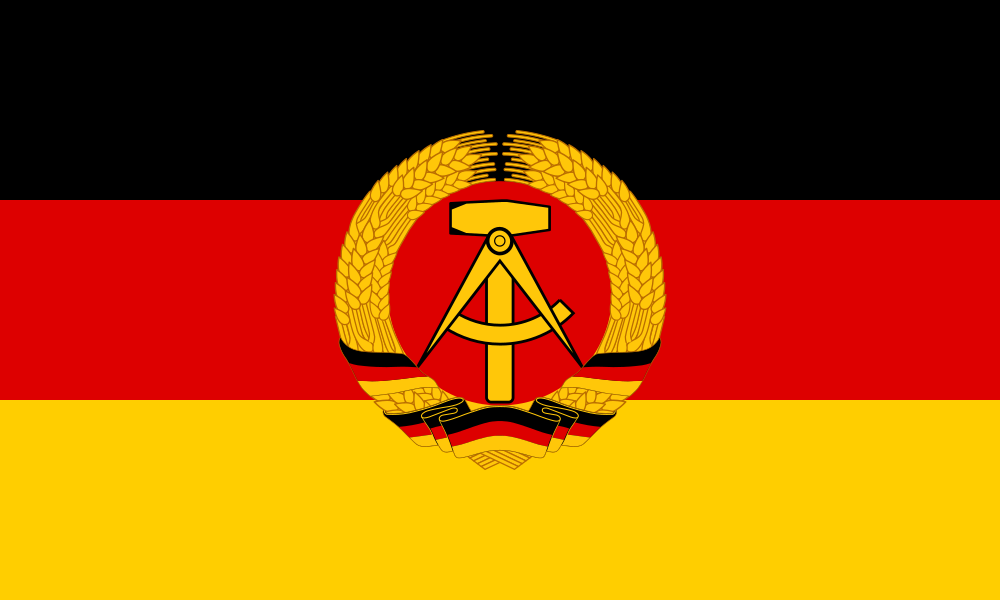
The debate on the item on the policies of apartheid of the Government of South Africa has assumed, as one might have expected, the character of clearcut condemnation of the Fascist regime of Pretoria. The policy of apartheid, which has deprived millions of people of their most fundamental rights, has meant murder and terror and is a crime against humanity. The racist regime of apartheid constitutes a serious threat to peace and security. Unfortunately, certain States continue to support it, although in words they reject the policy of apartheid.
93.. The delegation of the German Democratic Republic is of the same view as the overwhelming majority of States Members of the United Nations, which at this rostrum have called for an intensification of the struggle against apart- heid.
94. The German Democratic Republic has consistently called for the elimination of colonialism and racism and has displayed active solidarity with the peoples struggling for the exercise of their right to self-determination and
95. The General Secretary of the Central Committee of the Socialist Unity Party of Germany and the recently elected Chairman of the Council of State of the German Democratic Republic, Erich Honecker, a few days ago once again confirmed this fundamental principle of the foreign policy of our socialist State. The Chairman of the Council of Ministers of the German Democratic Republic, in his keynote speech on the policy of the Government, which was formed after elections to the People's Chamber of the German Democratic Republic on 17 October this year, stressed:
"The policy of strengthening and expanding the anti- imperialist alliance with the national -liberation move- ments and co-operation with States of Asia, Africa and Latin America which have attained their independence is being pursued consistently. We are bound to them by common goals and interests in the struggle for peace and against imperialism, colonialism, racism and apartheid. "
96. The German Democratic Republic is a member of the Special Committee against Apartheid Its representatives have always been in favour of exposing the apartheid regime, revealing its protectors and intensifying world-wide protest against the racist regime of Pretoria and support for the national liberation movements of fighting Africa. This is a course which we shall continue to follow.
97. In the last few weeks and months we have seen in the Western press allegations of so-called substantial changes in the policies of the racist minority regimes in southern Africa and their fundamental base, the apartheid regime in Pretoria. Similar statements have also been made in the Security Council in the course of the recent debates on Namibia. But what is actually happening?
98. The oppressive methods of the apartheid regime have become even more brutal. The campaign of terror is being stepped up. The bloody atrocities committed against the people of Soweto have aroused the indignation of the whole world. The Security Council has condemned the actions of the apartheid regime, but this condemnation is still being disregarded by the apartheid regime. The Fascist nature of that regime is revealing itself more and more openly. A number of laws, as is shown by a recent publication of the United Nations Centre against Apart- heid» have been borrowed directly from the arsenal of German fascism. The apartheid regime is at the same time stepping up its efforts for the bantustanization of the country. The granting to the Transkei of so-called inde- pendence is a demagogic manoeuvre on the part of the racists designed to deceive world public opinion.
3 See A. Kum'a N'dumbe, "Relations between Nazi Germany and South Africa" in Notes and Documents of the Centre against Apartheid, No. 12/76 (May 1976).
100. Not confining itself to oppressing the people of South Africa the Vorster regime is displaying even greater ambition for expansion. Abusing the illegally occupied Territory of Namibia, South African military units, with the support of mercenaries, have carried out armed attacks against the young People'8 Republic of Angola and the Republic of Zambia. The supplementary Defence Amend- ment Act of 1976 is an attempt to justify in advance the aggressive actions of South Africa, which are aimed very far north-even as far as the equator. The escalation of terror and acts of aggression is being accompanied by forced militarization, Military expenditures are constantly on the increase. Western companies and enterprises are taking a decisive part in arming the apartheid regime's army. The imperialist, fascist and racist forces believe it to be their task to support the Pretoria militarists. For example, Israel is making new deliveries to the South African navy, and officers of the South African navy are taking part in military training in the Chile of the Fascist junta. NATO countries are continuing to equip the South African army with weapons and armaments. The Western press has reported the granting of licences for the manufacture of rockets. Those and other facts are contained in the report of the Special Committee against Apartheid. This no doubt explains why three permaner.t members of the Security Council are still stubbornly opposing an embargo on the delivery of arms to South Africa. The report of the Special Committee against Apartheid [A/31/22J refers in para- graph 249 to a naval communication complex known as the "Advokaat" system at Silvermine, a strategic base, which certain businesses such as AEG,4 Siemens and others have grown rich in equipping. One of the resolutions of the Fifth Conference of Heads of State or Government of Non- Aligned Countries in Colombo describes that base as a dangerous source of a far-reaching military threat. People have long been aware that the NATO codification system is being used in the arming of the apartheid regime. Nuclear co-operation with South Africa on the part of certain Western States increases even further the danger from South Africa. Just a few days ago, that co-operation was once again categorically condemned in the Fourth Com- mittee at this thirty-first session of the General Assembly. In the light of this, we entirely share the concern expressed by the Conference of non-aligned countries in Colombo and support the demand that the Security Council immediately
101. One might ask, Why are certain imperialist States and their military organizations making such efforts and em- ploying so many resources to strengthen the apartheid regime in Pretoria? It is not difficult to answer that question. The large monopolies do not want to stop exploiting the people of South Africa and the natural resources of that country; they do not want to give up their large profits.
102. Many transnational corporations meet in South Africa itself. This is reflected, too, in trade statistics. It is no secret which Western countries have the greatest economic ties with Pretoria. The Banker, published in London, provides information on this.
1q.3. A Hamburg publication on export questions, "Ubersee Rundschau, stresses in its issue of 3 May 1976 that in South Africa not a single foreign corporation has been nationalized so far. It states that that is why firms of the Federal Republic of Germany are very happy to use South Africa as a base for production, marketing and assembling in Africa, and a large part of the Western world can use the vast potential of the natural resources.
104. During this session of the General Assembly certain representatives of major Western States or groups of States have made some assertions that are certainly not very new or original. They have alleged that their Governments are unable to prevent comprehensive, and particularly eco- nomic, co-operation with the apartheid regime' and its still-born offspring, the Transkel, Are those Governments really so helpless? The People's Republic of Angola, the People's Republic of Mozambique and other African States, as well as Cuba, Vietnam, the Chile of Salvador Allende, the Arab States, and the socialist States, including the German Democratic Republic, can on the basis of their own experience prove the falsity of that assertion at any time.
105. The Governments of Western States, along with the major monopolies, have repeatedly attempted to exert economic pressure on the countries I have mentioned. An embargo was placed on a number of goods, and blockades were even proclaimed. But we did not hear the allegation that trade has nothing whatsoever to do with politics.
106. Under international law States bear responsibility for the actions of their citizens and organizations on their territory. It is worth reminding the Assembly that every State, when it becomes a Member of the United Nations, in the persons of its duly and properly authorized represen- tatives, assumes, in accordance with the United Nations Charter, binding obligations that are the basis of our activities as a world Organization.
107. How are we to assess the policy of countries whose representatives talk of the need for peaceful solutions while their compatriots, at the same time, are providing the racist regime with means whereby that regime is attempting to ' extend its political domination? How long do eertein States intend to support that regime and supply it with weapons ,~ith which it can suppress the fight against the violation of the most elementary human rights and with
109. The debate on this agenda item, which is concluding today, has made obvious the need for decisive measures to combat the inhumane apartheid regime. We support the appeal to all States to adhere to the International Con- vention on the Suppression and Punishment of the Crime of Apartheid [resolution 3068 (XXVIII), annex]. We are convinced that the World Conference for Action against Apartheid, to be held next year in Lagos,capital of Nigeria, will provide further incentive for the mobilization of world public opinion in support of the struggle against apartheid and for the isolation of that inhumane regime. In this regard we welcome and warmly support the documents produced by the International Seminar on the, Eradication of Apartheid and in Support of the Struggle for Liberation in South Africa, held in Havana, which are reflected in the report of the Special Committee against Apartheid to the thirty-first session of the General Assembly.
110. It would no doubt be a vain hope to expect the apartheid regime and the political, economic and military groupings which stand behind it voluntarily to renounce racist and colonialist oppression and exploitation of the people of South Africa. It would also be illusory to expect that the representatives of those groupings would seriously give up the bases of exploitation and oppression-that is, that they would agree to change the balance of force and the power structure in favour of the peoples of struggling Africa. .
111. The peoples of the world know that the problems of southern Africa can be resolved only by eliminating the apartheid regime and its offshoot in Salisbury. Resolution 3411 (XXX) outlawed the apartheid regime of Pretoria, which still disregards and completely ignores all resolutions of the General Assembly of the United Nations. In the last few weeks various diplomatic and political manoeuvres have been attempted in order to help that regime to emerge from the international isolation in which it found itself as a result of the efforts of most States and the active work of broad sectors of international public opinion. The primary pur- pose of those manoeuvres was obviously to hold off the inevitable collapse of that regime, to preserve the influence of imperialism and thus continue to prevent the peoples of that part of the world from determining their own fate by exercising their sovereignty in freedom from intervention. These manoeuvres are also designed to divert the attention of the peoples of Africa from their interests, to pit them against each other and to divide them from their natural allies. These manoeuvres constitute flagrant intervention in the affairs of the peoples of Africa.
112. We whole-heartedly share the view set forth on 26 October by the Acting President of the African National Congress, OliverTambo, who stressed:
113. In the view of the delegation of the German Democratic Republic, and on the basis of our own experience with German imperialism, there is only one possible answer to the apartheid regime and its accomplices, and that is the strengthening of the militant alliance of all forces consistently in favour of the exercise of the right of all peoples including the peoples of southern Africa to self-determination, and in favour of the elimination of the apartheid regime. A new balance of forces in the interna- tional arena is having a favourable effect in southern Africa, among other places, And in that part of the world too, in spite of the ambitions of the apartheid regime and its supporters, the situation has changed. In this regard permit me to express the satisfaction of the delegation of the German Democratic Republic at the fact that here in the plenary meetings of the General Assembly of the United Nations representatives of the national liberation move- ments of South Africa have had an opportunity to speak. This represents an important contribution by the world Organization to the struggle for the elimination of the apartheid racist regime.
114. We are firmly convinced that Africa will continue to hold the initiative. The days of the apartheid regime are numbered. In the world of today there is no longer a place for colonialism and racism. Those fighting for this new era can always count on the support of the German Democratic Republic.
Mr. Illueca (Panama), Vice-President, took the Chair.


As the General Assembly debates the question of apartheid at this critical time in the history of the problem, it is worthy of note that ever since its inception this body has never ceased its efforts to end one of the greatest evils of our times. The General Assembly's opposition to the virulent racial discrimination practised in South Africa has continued unabated in spite of the strenuous efforts by a small but powerful minority of Member States and an intensive propaganda campaign to mislead international public opinion. These efforts sought to minimize the evil of apartheid, to deny that apartheid posed a grave danger to international peace and security, and to discredit and undermine measures against apartheid approved and adopted by the majority of Member States.
116. This body can continue, however, to take pride in the fact that it has never failed to respond appropriately to the challenge posed by South Africa's racist policies. In order to keep apartheid before the conscience of the world, the General Assembly embarked on its campaign to isolate South Africa from the community of nations until the minority regime accepted the most basic principle of human rights-namely, the common humanity of all men. To make the campaign more effective, it established and continued to strengthen the Special Committee against Apartheid and its supporting unit in the Secretariat. The valuable and impressive work of these bodies continues to be essential to the successful prosecution of the interna- tional campaign.
1l§. Today the General Assembly faces new challenges and new opportunities in pursurt of its aim to eliminate apartheid, and it is meeting those challenges and opportu- nities. The establishment of the first bantustan in the Transkei represents the final stage in the implementing of apartheid and shows the minority regime scaling the heights of its injustice to the non-white people of South Africa. This arrangement has been justly condemned by the majority of the people of South Africa, including the traditional leaders, and has been condemned in the strongest terms by this Assembly. It aims to secure forever the privileges of the white minority. It would remove the right of the majority to full citizenship in their native land and to the full enjoyment of the wealth of their country, and would relegate them to enclaves of poverty, a source of cheap labour that could be tapped.
119. The General Assembly's uncompromising rejection of the so-called independence of the Transkei, and the decision of members to deny it any form of recognition and to take effective measures to prevent their nationals from having any dealings with it, constituted a remarkable example of international unanimity and decisive action.
120. We are now considering the question of apartheid. against a background of rapid and dramatic change in the situation in southern Africa-a change brought about by the successful struggle of the peoples of Guinea-Bissau, Sao Tome and Principe, Angola and Mozambique, by the continuing liberation struggle of the peoples of Zimbabwe and Namibia and by the wide-spread opposition to apart- heid within South Africa itself.
121. However, although the situation in southern Africa has changed, the purpose of the long international struggle against apartheid has not changed, and indeed the validity of the campaign must now be apparent to all States, for every danger and every injustice that has been predicted as an outcome ofapartheid is now in evidence.
122. The determination of the Vorster regime to forge ahead with the separation and alienation of the African people of South Africa lends a new urgency to our efforts.
123. At the present time we are seeing also the long- predicted eruption of the oppressed and frustrated victims of apartheid. The spectre of a race war comes even closer with the rising tide of bloodshed and violence in South Africa. Hardly a day passes without reports of the latest mass demonstration against apartheid and the murderous retaliation of those in power. Who can doubt that the
124. The stage is set for a struggle which will not take place in isolation. Recent events in Angola have shown the dangers which South African imperialism presents for Africa and the threats it poses to international peace, in particular to the settlement of the problems of Zimbabwe and Namibia. These problems must of course be attacked with speed and vigour, but the situation in South Africa has equally grave implications for regional and international peace and security, and it must not be left to deteriorate to a point at which international or bilateral efforts could only be too little and too late.
125. The General Assembly has already taken the signif- icant step of proclaiming that the United Nations has a special responsibility towards the oppressed people of South Africa and their liberation movements and towards those imprisoned, restricted or exiled for their struggle against apartheid. It has also declared that national libera- tion movements are the authentic representatives of the overwhelming majority of the South African people. The response of the international community to these provi- sions will indicate whether the new challenges posed by apartheid are being taken up by all Member States or if this inhuman policy will continue to fester in the body politic of Africa and, indeed, of our world civilization.
126. Much can be done through increased support for the national liberation movements of South Africa and through generous contributions to the fund for aid to the victims of apartheid.
127. The continued expression by Member States of their solidarity with South African political prisoners, and the enforcement of the International Convention for the Suppression and Punishment of the Crime ofApartheidwill give important moral and legal backing to the international campaign against apartheid.
128. My Government has always supported and will continue to support all the measures adopted by the United Nations for the economic, social, cultural and diplomatic isolation of South Africa. Webelieve that the arms embargo against South Africa must be made mandatory and that the Security Council should take further action under Chapter VII of the Charter in the form of an embargo on the supply of petroleum and other strategic raw materials to South Africa. My delegation was deeply concerned when the Security Council, in its recent discussion of the question of Namibia, was prevented from imposing a mandatory arms embargo by the vetoes of France, Britain and the United States. That action, motivated by the material considerations of those Powers, was, to say the least, reprehensible in view of the threat to peace posed by the related questions of apartheid and the Namibian situation.
130. The question which arises now, as it has done at every critical stage of the development of apartheid, is whether the measures adopted by the United Nations will be supported and implemented by South Africa's allies and trading partners, notably the United States, France, the United Kingdom of Great Britain and Northern Ireland, the Federal Republic of Germany and Israel, as well as others. The most influential of those countries are permanent members of the Security Council. Will those States show a new and sincere determination to co-operate with the international community on the question of apartheid? Will they respond to the call of the General Assembly for effective measures under Chapter VII of the Charter aimed at resolving the grave and dangerous situation in South Africa? Let us hope.
131. As we know, the arms embargo against South Africa has been scandalously flouted in the past, particularly by France, which has even been prepared to provide the South African regime with material and technology that would enable it to acquire nuclear-weapon capability. In addition, the military collaboration of NATO Powers with South Africa and South Africa's involvement in the over-all strategic plans of NATO are steadily increasing. Israel, not content with being an international lawbreaker on many counts, has further demonstrated its contempt for the United Nations and its own racism by engaging in close military and diplomatic collaboration with South Africa's racist regime.
132. The General Assembly, as it has always done, has taken note of new developments in South Africa and has approved or formulated measures to deal with a policy that has long been described as a crime against humanity and which is patently a danger to regional and international peace and security. The evil and dangerous nature of apartheid cannot be minimized at the present stage of the history of this inhuman policy, nor can the validity of the international campaign against it be questioned. South Africa's allies and trading partners must therefore face this moment of truth. They cannot continue their collaboration with South Africa and maintain credibility, leadership or respect in the international community.
133. My country will join with other Member States which have faithfully observed United Nations resolutions against apartheid in redoubled efforts in support of the international campaign. We hope that, if moral considera- tions will not suffice to bring about a change of heart on the part of South Africa's allies and lead to their co- operation in the important task of eliminating apartheid, they will be influenced by the recognition of apartheid's dangerous potential for regional and international conflict.


Events in South Africa demonstrate once again the inexorable truth that racism and exploitation and their most potent manifestation, apartheid, cannot withstand the irresistible tide of history.
135. The continued struggle against apartheid must there- fore be viewed essentially in a dual context: the human rights dimension and a basically political framework for action. The two components, humanitarian and political, as
~ightly emphasized by the Special Committee, cannot be divorced or viewed in isolation; they are indeed indivisible. To emphasize a humanitarian solution only would be incompatible with the existing situation and might indeed give credence to South Africa's belated attempts to make some minimal concessions in lessening the stranglehold of racial discrimination, concessions seized upon by countries sympathetic to the racist regime to offset the increasing demand for meaningful political action. It is therefore with particular pleasure that we welcome in our midst the representatives of the African National Congress of South Africa and the Pan Africanist Congress of Azania, who are the true representatives of the majority of the people of Africa. Their participation in the Assembly's deliberations underscores the real dimensions of the problem, an integral element of which is the legitimacy of the struggle of the oppressed people of South Africa to secure their inalienable rights, including their right to self-determination.
136. The human rights dimension of the problem needs no elaboration. Notwithstanding specific commitments in the Security Council to move away from racial discrimination, South Africa continues blatantly to add to its catalogue of crimes. The massacre of innocent men, women and children in Soweto and other areas in the recent past; the passage of even more repressive legislation to dampen and suppress resistance against apartheid and its most heinous manifesta- tion, bantustanization; and the persistence of a reign of terror through harassment, intimidation, torture and sup- pression are but some of the examples this year.
137. South Africa's past record constitutes one of the bleakest chronicles in human history; for the conscience of mankind, it is a permanent blemish. The anguish and the unequivocal condemnation of the international community cannot be appeased by anything short of the total eradication of this abhorrent policy. In a world increasingly characterized by the interdependence of all nations, apart- heid remains as a permanent obstacle to international co-operation. Peace without justice is ephemeral. The condonation of aparthefd seriously jeopardizes the moral and intellectual fabric of our global society and will undermine all that we are striving for.
138. While humanitarian considerations demand the total eradication of apartheid, we also firmly believe that politically its continued existence constitutes a grave threat
139. .As is well known, South Africa's aggressive acts are not limited only to its own territory but have repeatedly spilled over its borders, constituting a direct threat to peace and security in the entire region of southern Africa. Not content with its illegal occupation of Namibia and the sustenance provided to the illegal minority regime of Ian Smith, the Pretoria regime launched armed aggression against Angola on the eve of its independence, and the Security Council itself in its resolution 393 (1976) of 30 July was to condemn South African aggression against Zambia. Meanwhile, abetted by its economic and military collaborators, South Africa continues to bolster its armed might through massive increases in its military budget. It has spurned with impunity all attempts to arrive at a peaceful solution, which were mooted as early as 1970 when the Lusaka Manifesto on Southern Africae sought to stem the growing tide in favour of violent upheaval by proposing a workable framework, including a declaration of amnesty for all political prisoners, negotiations with the liberation movements, the abandonment of bantustans and an extension of fundamental rights on the basis of the United Nations Charter. These conditions still remain pertinent today but have been flatly rejected by the racist regime. The only alternative that remains is the option of struggle by all available means, including armed struggle, with all the explosive consequences this entails for South Africa itself, southern Africa and the world as a whole.
140. The need for this world body to take urgent collective action has become all the more imperative. Bangladesh fully endorses the recommendations for action proposed by the Special Committee againstApartheidin its report to this Assembly contained in document A/31/22 and Add. 1 to 3. We have conveyed our desire to become a sponsor of draft resolution A/31/L,6. We should also like to place on record that Bangladesh fully subscribes to and endorses the resolution adopted on "the so-called inde- pendent Transkei and other' bantustans" {resolution 31/6 A}, on which, because of an unfortunate mischance, we were unable to record our formal vote.
141. Mr. .LOaO (Mozambique): At this stage of our debate it seems that there is nothing new or substantial which my delegation could add in describing the most notorious and repudiated racially discriminatory policy of apartheid.
142. The representative of the African National Congress of South Africa, Mr. Tambo, in his speech on 26 October {41st meeting}, carefully and extensively elaborated on the
143. In regard to this item, the Mozambique delegation would like first of all to express our appreciation to the President of the Assembly for the fact that a decision was made to allow the leaders of the liberation movements of South Africa to address the General Assembly from this rostrum. The militants of the national liberation move- ments of southern Africa are our comrades-in-arms, who struggled alongside of us and with whom we established fraternal and indestructible relations of solidarity through- out the years of our struggle for national liberation. The delegation of Mozambique fully associates itself with the statement of the representative of the African National Congress of South Africa who came to the rostrum on the first day of the debate on this item.
144. The People's Republic of Mozambique is and always will be against South Africa's policy of apartheid, and we vehemently denounce the so-called independence of the Transkei, proclaimed on 26 October of this year.
145. It is our belief that apartheid must and will be eradicated once and for all from South Africa, because by its nature it has proved to be an enemy of human dignity. For many years there has been opposition to the racist apartheid policy of South Africa among the international community. Today we are very much encouraged at seeing throughout this debate that more and more countries are taking an active part in condemning this inhuman system.
146. South Africa's use of force to defend the apartheid system is an act of provocation and a violation of the human dignity of the oppressed people under its domina- tion. The practice of apartheid is a violation of human rights and of the- United Nations Charter as well. The existence of this racist apartheid regime constitutes, in our view, a threat to international peace an, \"ity. More- over, the very existence of apartheid in OJ constitutes an insult to the whole of humanity.
147. The recent events in Soweto and other parts of South Africa and the bloody methods this racist regime applied to crush the people's uprising are eloquent evidence of the nature of apartheid. Soweto will go down in history. The peoples of the world have noted with profound concern the brutal methods used by the minority racist Government of South Africa.
148. At this time, the people of Mozambique hail the struggling people of South Africa who have courageously stood firm to say "No" to the apartheid policy. The South African racist regime may use guns, tear-gas, police dogs and soldiers in an attempt to subdue the cry for justice of the people, but the truth is that the people will never settle for less than justice itself.
149. To quote my President, His Excellency Mr. Samora Molses Machel:
151. The so-called independence of the Transkei lies within the coloniallst scope of strategy, so we strongly denounce and vigorously condemn it. The so-called inde- pendence of the Transkei is a racist manoeuvre which cannot deceive anyone.
152. The enslaved people of the Transkei know exactly where the frontier lines of their country extend; they know perfectly well that their country stretches from the Indian Ocean to the Atlantic Ocean and from the Cape to the frontiers with Rhodesia. Those people know very well that the name of their country is South Africa, not Transkei. The idea of making South African citizens f.oreigners in their own land is unacceptable to the People's Republic of Mozambique.
153. Before concluding, I should like to seize this oppor- tunity to express our appreciation to the representatives who have so kindly shown their concern at the prevailing situation in southern Africa, where the struggle for national liberation is still continuing.

Before calling on those representatives who have asked to speak in exercise of the right of reply, I should like to recall that the General Assembly, at its 4th plenary meeting, decided that speeches in exercise of the right of reply should be limited to 10 minutes.


I do not intend to answer all the remarks made by the Arab representatives in reply to me. It is quite obvious that I have uncovered a very touchy nerve and the violent, obsessive reaction of some of the Arab delegations to my remarks is indicative of how very vulnerable they are. As I said in my speech[49th meeting] , the more vehement they are in their attacks on Israel, the more vulnerable they are on the issue in question.
156. It mayor may not be a coincidence-I leave that for representatives to judge-but the day after my speech to this Assembly revealed details of the Kuwaiti royal family" involvement as the major shareholders in the Lonrho Corporation, or, to give it its full name, the London and Rhodesia Corporation, two of the Kuwaiti directors re- signed from the Board. Reading from yesterday's edition of
The Times of London:
"News of the resignations of Sheikh Nasser Sabah al Ahmed, son-in-law of the Emir of Kuwait, and Dr. Khalil Osman Mahmoud, Managing Director of Gulf Interna- tional, one of the companies controlled by the Kuwaiti royal family, was released well after the London Stock Exchange had closed.
157. The main issue before us is that, once again,the Arab States have stepped into an issue which,is vital to the African world and have converted it into a Middle Eastern debate. Again, I turn to my African brothers and ask, How long will this political neo-colonialism be allowed to continue? How long will they permit this situation in this body, where they cannot raise any issue of their own without the Arab States injectingtheir own hatred, rivalries and enmities into it and turning it once again into a free-for-all on the Middle East? Is it not time that the African States asserted their independence and resistedthis inevitable infringementof their national sovereignty?
158. During the first month of this session my delegation declared in several committees of the Assembly that we will not remain silent while the exercise of selectivity and double standards continues unabated in the United Nations. If this Organization is to be based on truth, justice and equity, then there is no room in it for such hypocrisy.
159. It is known to all representatives that Israelhas been singled out for special treatment, not because of its proportionately miniscule trade with SO!Jth Africa, but because the Arabs will use each and every opportunity at their disposal to attack Israel. The quotation from the publication West Africa which I cited in my last statement [ibid., para. 109/ could not have been more accurate, and I repeat: "... the Arabs identify with the black Africans only because of their votes in the United Nationsand other conferences."
160. In the case of the Arabs and South Africa, the saying "Persons who live in glass houses should not throw stones" could not be more appropriate. These two-facedindividuals carry on a flourishing and ever-increasing trade with South Africa and then come to this rostrum and preach to all of us, and tc Israel in particular.
161. Israel has nothing to hide; our books are open for all to see. We are not hypocrites like our Arabcolleagues, who speak out of both sides of their mouths. All delegations have heard how one Arab representative after another has risen in this Assembly and not spared any adjectives in condemning any ties with South Africa and professing "sincere" support for black Africa. These representatives dwelt at length on Israel-undoubtedly out of deep concern and support for black Africa.
162. And while all this show is going on the Arabs continue to expand their ties and trade with South Africa. They announce an oil boycott, but in fact continue to supply South Africa with oil. They have attempted to conceal their ties with South Africa, particularly the question of oil supplies. The Lebanese newspaper Al-Jladaf revealed an interestingfact in its issue of 24 April 1976:
"... [the Ar' bs] met with maximum success in their attempts to conceal the fact that South Africa is receiving Arab oil, reciprocating African support for the Arabs... [with] the flow of oil to Black Africa'smajor... enemy."
164. Several Arab representatives were so eager to quote Prime Minister Vorster. Let me quote him. In a dispatch from United Press Internationalin The New York Times on 11 April 1976, Mr. Vorster said: "He did not think this would harm South Africa's relations with its Arab oil suppliers."
165. We have not yet reached the ultimate of Arab hypocrisy.
166. While out of one side of their mouths they pour out denunciations of the bantustans, in the United Nations out of the other side of their mouths they offer to underwrite the bantustans. Yes, the Arabs have offered to finance homeland governments in South Africa. I refer represen- tatives tc an article under the headline "Arabs offer R 100 million to two new homelands" in the Sunday Express of 15 June 1975. The article reads:
"Arab financial interests have offered loans of more than R 100 million to homeland governments in South Africa.
"The Deputy Minister of Bantu Development, Mr. Braam Raubenheimer, yesterday confirmed that agents acting for the Arabinvestors approachedhim with the offer earlierthis year.
"Mr. Raubenheimer told me he had requested the agents, the Real Estate Development and Research Company of Capetown, to approach the homeland governments and the Bantu Investment Corporation with a view to drawing up specific projectsfor the investment.
"
"He added that the loans the trust was offeringwere for 10 to 20 years at a rate of less than 10 per cent. He considered this good in view of the fact that it was 100 per cent financed overa 20-year period.
"Said Mr. Mort: 'It is not surprising that they should show an investment interest in the homelands.'"
167. As I have said,I couldgo on and on, but I am limited by time and t shall conclude. However, I cannot close without drawing the Assembly's attention to the despicable
168. The representative of Kuwait characterized me as, of all things, a belly dancer. Beyond an academic interest in the subject I cannot claim any special expertise in it. On this subject I would defer to my Kuwaiti colleague, who is obviously the most qualified to hold forth on this subject.


On one thing I find myself capable of agreeing with the representative of Israel, namely, that the personal abuse to which he refers is beneath the dignity of this forum. I hope that the verbatim record of the statement that he made on Monday and of his statement today will be comparedwith the verbatim record of my statement to see who has engaged in personal abuse.
170. The representative of Israel said that his statement must have touched a sensitive nerve in the Arab delegations. No, it is not the statement of the representative of Israel, but the actions of the Government of Israel, that have touched a sensitive nerve. Whenever collusion develops between one racist regime and another and whenever one racist regime seeks to break the quarantine imposed by the lnternetional community on another racist regime, that touches a sensitive nerve with us. Whether or not the representative of Israel had spoken in this debate, my delegation would have spoken in exactly the same way about the activities of Israel in promoting its ties with South Africa precisely at a time when the international community has been trying to isolate South Africa.
171. The representative of Israel once again said that Kuwaitis are the major shareholders in Lonrho, Ltd. I am authorized to state that that is not accurate. That is not true. Kuwaitis do not have the major shareholJings in Lonrho.


We arc accustomed to listening to lies and accusations from the representative of the Zionist entity. Of course he is a past master in that field. If we have accused the Zionist entity of co-operating with South Africa and have identified that entity with the racist regime in South Africa, it is on the basis of irrefutable documen- tation and a number of excellent reports from the Special Committee against Apartheid, as well as on press reports from South Africa and Israel. It wasalso based on repeated condemnations by our Organization of co-operation with
"There is no gainsaying the signal nature of Mr. Vorster's triumph this week. By achieving a publicly announced economic, scientific and industrial pact with Israel he has done far more than merely formalize bonds that have, in any case, been growing stronger. He has, in fact, acquired for South Africa a public friend, an avowed ally, at a time when this country confronts an in- creasingly hostile world and an increasingly aggressive black Africa."[A/31/22/Add.2, para. 32.J8
173. If he wishes to refute these accusations, he need only declare in the General Assembly that the press in his country and in South Africa have distorted the facts and print lies.
174. What we have said about Mr. Herzog, the former Governor of the West Bank, who visited South Africa, is alsobased on the press in South Africa itself.
I wish merely to refer to the disclaimer made by the representative of Kuwait to this body.
176. I have two documents here: one is an excerpt from Africa, No. 56, dated April 1976, in which, on page 98, there is a detailed analysis of the Kuwaiti involvement in Lonrho, Ltd.; the other is The Times of London of 2 November 1976-yesterday.
177. The Times article mentlons that:
"... Shaikh Nasser, apart from being the son-in-law of the Emir,is also the son of the foreign minister.
"He joined the Lonrho board in December, 1974, after the Kuwaitis had raised their stake in Lonrho to 14 per cent. Further major holdings were acquiredlast year, and
8 Quoted in English by the speaker.
"Confusion surrounded the future of the near 23 per cent Arab holding in Lonrho, the' overseas trading conglomerate...". •
I do not want to go into any details; I merely wished to draw the attention of representatives to these items.
178. An Arab scholaronce wrote:
I "The Arab is fascinated with criticism of foreigners, of fellow-countrymen, of leaders, of followers, always of the other and seldomof oneself, whichis the product of basic dissatisfaction and general discontent rather than of positive convictions and allegiances and standards."
179. The Arab scholarwho wrote these words ishere with us. He is none other than the representative of Kuwait himself, and his words could explain better than I the statement he made here this morning.
I am grateful to the representative of Israel for confirming what I said when he stated that, after all his research, he found that Kuwaiti interests account for 23 per cent of the capital of Lonrho, which is certainly not what he said on Monday when he used the words "the principal shareholder" and later "Kuwaiti-controlled company".
181. I am also grateful to him for reading the right kind of literature. I only wish that he would read it in the right way. I certainly plead guilty to being self-critical in one of _my writings of my t~uth, and I am further grateful to him for having reminded me that even in my youth I was capable of criticizing myselfand my own nation. Therefore, when I criticize others it can certainly not be attributed to personal ill will but to tile same objectivity with which I criticize even myself.
The meetingrose at 6.25 p.m.