A/33/PV.18 General Assembly
THIRTY-THIRD SESSION
33. Thirty years of the Universal Declaration of Human Right3: international co-operation for the promotion and obselV- ance of civil, political, economic, social and cultural rights

Before calling on the first speaker for this afternoon, I should like to inform the General Assembly that we have received additional messages from the Heads of State or Government of the following States: Egypt, Greece, Italy and the Netherlands. Those messages will be reproduced in an official document of the General Assembly.t They are also being issued as press releases.

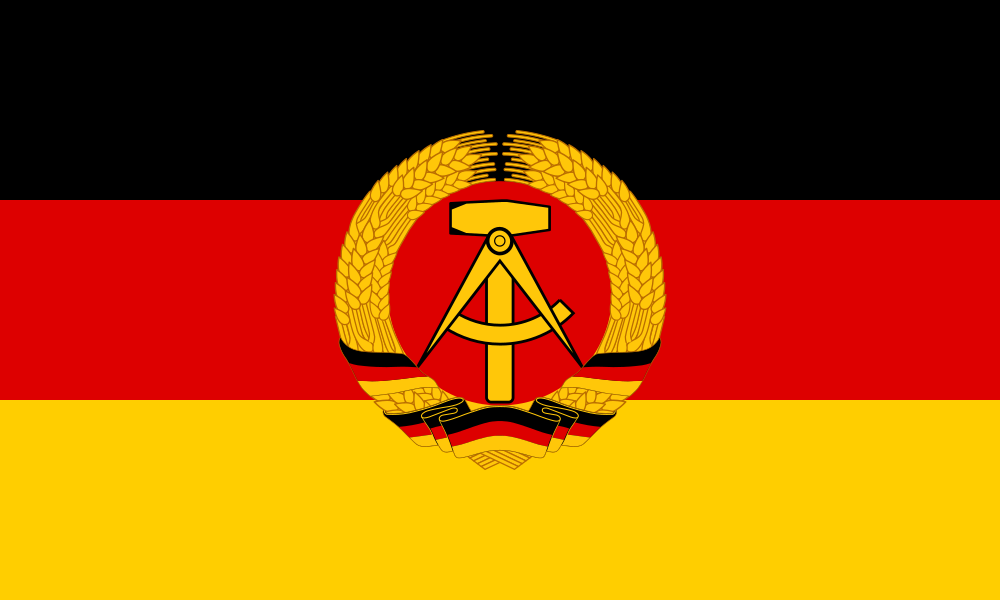
R~solution 32/123 of the General Assembly and resolution 3 (XXXIII) of the Commission on Human Rights,2 concerning the commemoration of the thirtieth anniversary of the adoption of the Universal Declaration of Human Rights {resolution 217A (Ill)], were welcomed with great interest in the German Demo- cratic Republic. In accordance with the recommendations contained in those resolutions, various measures have been adopted to give appropriate significance to this anniversary. The German Democratic Republic has already sent informa- tion on this que~tion to the Secretary-General of the United Nations.
3. In the view of the German Democratic Republic, the thirtieth anniversary of the Universlll Declaration of Human Rights should be an occasion for all States to draw llF a balance-sheet of the achievements in the field of human rights and to increase their efforts in order, in the words of resolution 3 (XXXIII) of the Commission on HUman Rights:
"... to promote international understanding, co- 'operation a."d peace and the universal and effective respect for human rights ...".3
1 Subsequent!y circulated ItS document A/33/467. 2 See Officiol Records of the Economic and Social Council, Sixty·second Session, Supplement No. 6, chap. XXI, sect. A. 3/bid.
Monday, 11 December 1978, at 3.20p.m.
NEW YORK
4. The anniversary of the Universal Declaration of Human Rights falls in a period when intensive preparations are ' under way in the German Democratic Republic to com- memorate the thirtieth anniversary of its founding. When the United Nations adopted the Universal Declaration of Human Rights, tile foundations were being laid for social development in the territory of what is today the German Democratic Republic, a process which led to the creation of the first socialist State on G;~rman soil. Thus, after 1945, the people made use of the historic opportunity which existed as a result of the military defeat 'of German imperialism and eliminated once and for all the conditions of imperialist power which in themselves entailed in- humanity and lack of freedom and which also threw other peoples of the world into two devastating wars in thespace of a century.
5. Of special significance in this development process is the fact that all the Nazi war criminals were appro,llriately punished, that the evil Fascist spirit and the hatred of races_ and peoples were eradicated and that the most important means of production were turned over to the people. But the essential thing was that, for the first time in Gennan history, the working class, in alliance with the other classes and working sectors, acceded to political and economic power. In establishing the German Democratic Republic, the working peoFle created a State which serves its interests and which is today occupied in building a developed socialist society.
6. In the German Democratic Republic, as well as in other socialist States, man and human rights have always received special attention. Efforts have always been aimed at bringing about conditions which enable man to improve his human relations and to further develop his intellectual and physical potential. Efforts hav~ always been directed at creating new possibilities of guaranteeing man a higher standard of living and fuller satisfaction of his cultural needs.
7. There is nothing special about this, since concern for man has always been in the interest of the proletariat, whose quest for freedom and equality was the rust in the history of mankind in which theory and practice were not contradictory. Finally, one should ask oneself frequently what has become of the words "liberty" and "equality", which appear in the constitutions ofmany capitalist States, in view of the racial discrimination, the arbitrary justice, the increasing number of privileges granted to a minority which has control over a majority, the large profits of the monopolies and the unemployment of millions ofworkers. All the demands made by the class-conscious workers could anJ can be summed up in a leit-motiv of proletariat humanism, which is to replace capitalism by a social order _
"Man stands at the central point of all efforts of socialist society and its state. The further raising of the material and cultural living standard of the people on the foundation of a high rate of development of socialist production, the raising of effectiveness, of scientific- technical progress and of growth of work productivity is the decisive task of the developed socialist society."
8. Naturally, socio-economic changes entail consequences for man's relations with society and the State, as well as for the manner in which human rights are conceived and implemented. In socialism, human rights are not rights of the individual as opposed to the society or the State, for it is his society, his State. Human rights in socialism are, rather, the rights of the individual which are aimed at his self-determination and are thus within the context of the self-determination of the people as a whole. Human rights, in socialism, are the guidelines for and the guarantee of the full development of the individual in society. Herein lies the new character of human . ~ghts compared to the human rights ptoclaimed by the bourgeoisie, even if the wording in both cases may sometimes be the same.
9. Thus we can see that in the German Democratic Republic, as well as in the other socialist States, every citizen has not only the right but also the real possibility of developing his creative capacities, free from exploitation and oppression, without distinction as to nationality, race, ideology or religion, origin or social position. Such a State is not his adversary from which he has to secure funda- mental freedoms as was the case in the past and is still necessary elsewhere. One of the principles inherent in socialist policy concerns the need to respect and protect the dignity and freedom of the individual and to encourage his development. Under the Constitution, every citizen enjoys the right to participate in the conduct of the political, economic and cultural affairs of his society as well as in the development of the conditions necessary for the develop- ment of his individuality.
10. Society and the State recognize and encourage the application of human rights. I should like to give a few examples. In my country, every citizen enjoys the right to 14. The German Democratic Republic believes that the work. This is of great significance in view of the fact that maintenance and safeguarding of peace are the bases for millions of workers in capitalist countries suffer frqm any promotion and guarantee of human rights. We consider unemployment and its consequences. However, the right to peace to be supreme and fundamental among all human work is not limited to guaranteeing full employment; it rights. For this reason, the German Democratic Republic implies, among other things, participation in production endeavours so that international co-operation in the field of management. Every citizen enjoys the right to education human rights may be integrated into the process of detente and training ofvarious kinds, and schooling is free of charge in the world and find its place among effective measures at all levels and is inspired by such principles as the aimed at the cessation of the arms race and disarmament. transmission of knowledge for the purpose of promotinh The integration of questions relative to human rightsinto understanding among peoples. Every citizen enjoys the the process of detente also requires acceptance of such 1 '7iJ11n!i!ll.gh_t.t.oilifi.rell!el!!Jl;liYIII!I:!!!!!!:~P=U!i!bii~i!!!ICl~:l!IOIIi@~:~!II!!P!!re!!l!•••ss~.hl!'.:!!!!!:'ti:~~!!1!!:~:!l!!i~l'!!wpj:!!l'1~~:h,!!!!!'I!!~~~ruS!!le!'Js:!!,!anl!!!!!d~Pf!!rill!!n..clf!l·P!!!!ile~S!!,!!0l!!!!f~~~in!!t!"!ie!i!!rn!!lal!tlli01l!!!n.a.llllllal!w.e.m!ll!b.o~d~i'l,lj'!ed!!!fJ!!llil!
11. Therefore, it is not to the countries where true socialism exists that lessons should be given on the meaning of human rights and how they should be implemented. On the contrary, socialism means humanity a..lld the full assurance of human rights. The socialist States have had for a long time what was included 30 years ago in the Universal Declaration of Human Rights. This applies also to all the other documents relating to human rights questions. In their activities, the socialist States not only fulfil the commitments they have entered into in regard to those instruments, but go far beyond them in content and scope.
12. In view of the policy that the German Democratic Republic has followed since its founding in the field of human rights, it is for it only logical to accede to a large number of multilateral treaties and agreements relating to human rights. Among the in~tf1lments to which the German Democratic Republic is a party and which have been drawn up on the basis of the Universal Declaration of Human Rights of 1948, giving a comprehensive and binding character to the provisions of that Declaration we may note, among others, the Convention on the Prevention and Punishment of the Crime of Genocide {resolution 260 A (Ill), annex], the International Convention on the Elimina- tion of All Forms of Racial Discrimination {resolution 2106 A (XX), annex], the International Covenants on Civil and Political Rights and on Economic, Social and Cultural Rights I resolution 2200 A (XXI), annex], the Convention on the Non-ApplicabHity of Statutory Limitations to War Crimes and Crimes against Humanity {resolution .2391 (XXIII), annex] and the International Convention on the Suppression and Punishment of the Crime ofApartheid [resolution 3068 (XXVIII), annexJ: The German Demo- cratic Republic believes that it would be an important step, in view of the anniversary of the Universal Declaration of Human Rights, if the international scope of these agree- ments, adopted in the last 30 years to make the Declaration more specific and to contribute to its implement~tion, were further expanded through the accession of the other States.
13. It is one thing to exalt the Universal Declaration, which from a legal standpoint is not mandatory, as a supposedly ideal catalogue of human rights. It is another thing to accept the binding rules of international law on human rights which are embodied in international con- ventions.
15. In accordance with the declaration of the Political Consultative Committee of the States Parties to the Warsaw Treaty, adopted on 23 November 1978, the German Democratic Republic believes that it is necessary:
"... to intensify international efforts to solve crucial problems affecting the interests of all mankind, ... to strive to improve the living and working conditions of the popular masses, and to e!o:Idicate racism, apartheid, propaganda for war, violence, immorality and hatred of mankind". {See A/33!392-S/i2939, annex].
16. I wish, in conclusion, to say that the people of the German Democratic Republic does not consider its social development as concluded; rather, it will work tirelessly to build a developed socialist society in order to create the fundamental conditions for the gradual passage to com- munism.


Thirty years ago the General Assembly adopted the Universal Declaration of Human Rights. It was conceived as:
"... a common standard of achievement for all peOples and all nations, to the end that every individual and every organ of society, keeping this Declaration constantly in mind, shall striT{e by teaching and education to promote respect for th.ese rights and freedoms and by progressive measures, national and international, to secure their universal and effective recognition and observance, both among the peoples of Member States themselves and among the peoples of territories under their jurisdiction."
18. Since then, the Declaration has become a platform for national as well as international action. Its provisions serve as a frame of reference for legislation and other measures by Member States-they have, in some cases, influenced court decisions-while the International Covenants on Human Rights, which the General Assembly adoptedon 16 December 1966, have transformed many of these provisions, into international conventional law. And, increasingly, the Declaration has served as a code of conduct, an international yardstick by which we measure our own performance and that of others in the field of human rights.
19. The Declaration recognizes th,..t human rights are not only civil and political but economic, social and cultural as well, and that the freedom to exercise all these rights should be one and indiVisible. India entered the world community as an independent nation with a profound respect for and awareness of the wholeness of this concept, and a determination to enshrine it in the life and laws of the country.
20. Part III of the Indian Constitution incorporates the fundamental rights of the citizen, and 16 of these pro-
21. The Constitution provided these safeguards; yet constitutional safeguards are not always enough to protect citizens from violations of human rights, or even from their suspension or abrogation, sometimes in the name or guise of progress. A constitution can itself be manipulated or altered beyond recognition,by so-called constitutional procedures, and can itself become an instrument of tyranny, as happened in India during the period of emergency, from June 1975 to March 1977. The Govern- ment of India is still involved in trying to undo, through Parliament, the damage done during that period to the concept of the supremacy of fundamental rights as under- stood by the founding fathers of our Constitution.
22. In a situation such as this, only a public aware of its rights, and determined to exercise them, can bring pressure when these rights are tampered with. And the public can best be involved and educated through the building and strengthening of national institutions and voluntary organizations for this purpose. Such institutions ate of inestimable value to Governments, too, in keeping them alert to situations needing redress, and particularly those arising out of the miSuse of powers by officials and others who overstep the authority given to them. Indeed, Govern- ments can themselves take a lead in watching over human rights. While different Member States have different political systems and must evolve their own institutions consistent with their own culture and national aspirations, we can all benefit from the guidelines evolved by the Seminar on National and Local Institutions for the Promo- tion anu Protection of Human Rights organized by the Division of Human Rights in Geneva from 18 to 29 September of this year,4 which discuss'the structure and functioning of such institutions and emphasize the im- portance of informi.qg people about their legitimate rights.
23. In India, the Janata Government has taken steps in this direction in fulfIlment of its election pledges ofMarch 1977. A National Commission for Minorities was created this year' to .watch. over the 'interests of .religi01,lS and linguistic minorities. The four-member Commission is en- trusted with the following functions: to evaluate the working of constitutional safeguards and laws passed by the Union and state governments for the protection of minorities; to make recommendations to ensure effective implementation and enforcement ofall such safeguards and laws; to review the implementation of policies pursued by the Union and state governments with respect to the minorities; to look into specific complaints regarding the deprivation of rights and safeguards arr:.ong minorities; to
24. All ministries and departments of the Government of India are required to furnish the Commission with such information and assistance as it may need. The Commission will submit an annual report to the President, and may report to the Government at any time on matters con- cerning its work. Its annual report will be laid before both Houses of Parliament.
25. The Government of India has also decided to set up two other national bodies. One of these will deal with the problems of two distinct categories of citizens who have been recognized in the Constitution as the weaker or more backward &3ctors. These are the scheduled castes and scheduled tribes, who together constitute about 22 per cent of the country's population. The Constitution has placed a special responsibility on the State to promote and protect the interests of these sectors.
26. Thus far, a special officer, known as the Commissioner for Scheduled Castes and Tribes, has investigated all matters relating to safeguards for them and has presented an annual report to both Houses of Parliament on the working of these safeguards. The Government ha,s now decided that, considering the magnitude of this task, it will appoint a five-member commission to evaluate measures taken by the Government for the welfare of the weaker sections of society and to make recommendations for their future progress.
27. The Union and state governments have from time to time set up commissions under the Commissions of Enquiry Act to investigate matters of public importance involving arbitrary action. Such commissions are usually headed by an eminent judge, either serving or retired, and have full powers to summon and examine witnesses on oath. Last year, the single-member Shah Commission was set up to inquire into abuse of authority during the state of emergency. Its terms of reference empowered Justice J. C. Shah, former Chief Justice of India, to inquire into specific instances of abuse. These included: first, subversion of lawful processes and' well-established conventions, administrative procedures and practices while the emer- gency was in force or immediately preceding its procla- mation; secondly, misuse of powers of arr\"st or of detention orders; -thirdly, maitreatment 'of, or atrocities committed against, arrested persons and their'relatives and close associates; fourthly, use of force and compulsion in the implementation of the family planning programme; and fifthly, indiscriminate orunauthorized demolition ofhouses, huts, shops and buildings, and destruction of property in the name of slum clearance or town planning. The Commission was also empowered to recommend measures for the prevention of such abuse of authority.
28. The freedom of the press is both an aspect of fundamental rights and an important instrument for safe- guarding and promoting those rights. On assuming office
29. Inan historic decision to free the electronic media from government control, last year the Government of India also appointed a working group to set up an autonomous structure for radio and television. The working group's report is now before Parliament. The report;s overriding concern, apart from safeguards to ensure autonomous functioning, is that radio and television, which are the most powerful agents we possess for education and for trans- forming the lives of our people, must primarily address the great majority, namely the underprivileged and the young, half of whom are women; and that the urban poor, the rural areas and the mountain and forest regions must be better and more sensitively served.
30. It is obvious, however, that none of these measures can go far unless citizens themselves are involved in human rights programmes, and here there is a contribution that non-governmental organizations can make. Of the voluntary organizations engaged in this task, there are at least two in India doing significant work. One is called Citizens for Democracy. It was started by our national leader, Jaya- prakash Narayan, in April 1974, to alert the public to the risiI,g tide of authoritarianism. When this authoritarianism was upon us the following year, Citizens for Democracy took steps to combat it. During the emergency it organized conventions and meetings to oppose censorship, and it also opposed amendments to the Constitution curtailing funda- mental freedoms. It demanded the revocation of the state of emergency and the release of political prisoners. As the world knows, one of the most memorable battles for human rights was fought in India during the emerger ..' . and another volulltary organization that played an actio,.; part in it was the People's Union for Civil Liberties and Democratic Rights, formed in October 1976. Both the People's Union and Citizens for Democracy have branches in a number of Indian states and both continue to play an energetic role in keeping people vigilant about their rights. In April J 977, Citizens for Democracy set up a committee to investigate allegations of arbitrary police action in one of the states of India. The Committee's report led to an inquiry by the State Government.
31. India celebrated the thirtieth anniversary of the Declaration of Human Rights yesterday with a seminar on the subject in New Delhi attended by cabinet ministers, representatives of the judiciary, the academic world, the press and others. It dealt with the respective roles of the State and the citizen in the protection,of human rights. The states held programmes of their own. All Indian radio and television stations also carried pr05rammes to commemo- rate the anniversary, and the Indian Federation of United Nations Associations held a public meeting presided over by our Foreign Minister, who spoke of India's role in the preservation of human rights.
"No freedom can be preserved unless we are all continuously aware of the responsibility of each one of us to protect it. Nor is it possible fo; any people anywhere to expect that the machinery of the State is sufficient; too often we have witnessed in many parts of the world the sad spectacle of this machinery being used to curb and even stamp o~t the rights of the people and of the individual. . .. There can be no better occasion than Human Rights Day on which to reaffirm our faith in the inestimable value of human rights, and to launch a crusade against those social evils which still hamper our progress. Let us rededicate ourselves on this day to the struggle to ensure that hllman rights are preserved and cherished as rn':iolable, and as the basis for a free society."
II I JI


One of the dominant issues of our time, which is characterized by a movement, unprecedented in history, for the comprehensive emanci- pation of men, peoples and countries, is undoubtedly the need to ensure the genuine protection of human rights in the broadest sense of that term. For this reason, the Charter of the United Nations lists the protection of human rights among its basic objectives, coming immediately after the prevention of war. It is also stated in the Charter that what is involved is not a separate or abstract aim of the United Nations, but an objective that renders international co- operation possible. In other words, it emerges from the spirit of the Charter that peace cannot be secured without respect for human rights and, vice versa, that respect for human rights is a prerequisite of peace.
I 1 I I ! I f 34. The adoption 30 years ago of tp{} Universal Declara- tion of Human Rights undoubtedly prOVided a powerful incentive for the promotion of human rights and funda- mental freedoms within the United Nations system. Since then, the Declaration has played an important role as a basis for the elaboration of instruments of international law in this field and as a source of inspiration to a positive and constructive approach to human rights by placing them within the context of the struggle for international peace, co-operation and understanding among peoples. The com- prehensive realization of human rights has become an integral part of efforts to change and democratize inter- national relations. We believe, therefore, that human rights cannot be used as a political instrument in imposing social models and in the confrontation of social systems. We consider particularly harmful the application and imposi- tion of double standards and criteria with regard to the realization of human rights, motivated almost exclusively by ideological criteria, narrow selfish interests and the vestiges of cold-war concepts. 1 I H I 35. In order to frustrate such practices it is necessary for all of us, when dealing with human rights within the United Nations system, to adopt a constructive approach that will make possible a genuine solution of these important problems. It is particularly important to prevent the misuse of human rights in order to interfere in the internal affairs of sovereign countries and to create rivalry between blocs, 36. Viewing matters in retrospect, we can say that considerable progress has been achieved with respel;t to the realization of human rights in the world. Starting with the Universal Declaration and continuing through resolutions, multilateral treaties, conventions and covenants on human rights, a tremendous effort has been made with a view to determining the essence of human rights, thereby com- pleting the framework of the Charter. All this has enhanced the legal and political consciousness of the international community and contributed to the progressive development of international law. Nevertheless, much remains to be done in order to eliminate massive and flagrant violations of human rights. We must not close our eyes to the fact that anachronistic phenomena, such as apartheid, various forms of racial discrimination, colonialism, foreign domination and occupation and the denial of the inalienable right of peoples to self-determination, still persist in the world. Unfortunately, such things as open aggression, the threat or use of force, various forms of interference in internal affairs, unequal economic relations-all of which threaten the free development of men, peoples and countries-occur not infrequently. Agenuine and effective struggle for human rights must presuppose a decisive struggle against such phenomena. 37. The question of human rights must be approached from the point of view of their indivisibility and inter- dependence, and of the equal importance of civil, poli!ical, economic, sodal and cultural rights. The International Covenant on Civil and Political Rights and the International Covenant on Economic, Social and Cultural Rights also guarantee to every people, in addition to a wide range of economic, social, cultural and political rights, the right to self-determination, to determine freely its own path of political, economic, social and cultural development and to dispose freely of its natural resources. The International Covenant on Civil and Political Rights guarantees the rights of ethnic, religious and linguistic minorities. The duty of States to enable national minorities to enjoy human rights is also embodied in principle VII of the Final Act of the Conference on Security and Co-operation in Europe.S The recent Conference of Ministers for Foreign Affairs of Non-aligned Countries, held at Belgrade from 25 to 30 July, underlined in its Declaration the need to respect the rights of ethnic and religious minorities [see A/33/206, annex I, para. 156J. 38. In the light of the recognized rights of national minorities, the initiative taken by Yugoslavia in the United Nations concerning the drafting of a declaration on the concrete formulation of the rights ofminorities is therefore fully justified. We believe, as the Federal Secretary for Foreign Affairs stated in the general debate [7th meeting}. that the national group that constitutes the majority is responsible for the realization of the rights of the national minority, since it is difficult to imagine a majority enjoying genuine freedom if it has not ensured the same freedom for 44. The national, political and economic equality of peoples and nationalities has been achieved in Yugoslavia as a result of the solution of the national question within the framework of a unique concept of the federal system. The peoples and nationalities of Yugoslavia participate jointly- on the basis of consultation and agreement and without any decision being taken by outvoting-in the shaping of the common interest founded on the authentic interest of every member of the Federation. The freedoms and rights emanating from the multinational character of the Yugoslav community also incluJe the right of the individual to free expression of his nationality and national culture, free use of his language anJ alphabet, and the right to be ed,ucated in his mother tongue. 39. In order to ensure equal enjoyment of all rights, it is indispensable to create conditions for the exercise of and full respect for those rights. This means that the inter- national community must exert further efforts aimed at eliminating all relations based on inequality, dependence, monopoly and domination among men, peoples and coun- tries. 40. Experience has shown and is confirming every day that human rights cannot be separated from the national, e~onomic and social context, and that the freedom of the individual in a country is inseparable from the freedom of its people as a whole. It is an illusion to believe that man can be politically and socially free if, at the same time, he is not liberated as a national being; that is, if his right to self-determination is not recognized. Actually, it is not possible to achieve democracy without national freedom, just as national freedom cannot be lasting without de- mocracy. 45. The over-all concept of freedoms and rights is based on self-management as a system of social relations estab- lished by men managing socially owned means of produc- tion; that is, on the inviolable and inalienable right of every working man or citizen 'to make decisions concerning his personal and collective interests, wherever he lives, works, is educated, undergoes medica! treatment or associates politi- cally or professionally. In our opinion, that right offers the greatest possibilities for genuine democracy, free political and social activity and the enjoyment of all freedoms. 41. We wish once again to draw attention to the impor- tance of the initiative of the non-aligned countries concern- ing the elaboration and adoption of an integral and comprehensive approach to human rights [see A/33/206, annex I, paras. 154-157J. Only in this way can we solve in a bold and non-dogmatic manner the' intricate question of the realization of human rights and freedoills in all their complexity, pave the way for new forms of co-operation and a new content for that co-operation and eliminate all that amounts to oppression of peoples and nations, to suppression of the personal and creative freedoms of the individual or to the degradation of human values. Only in that way can we distinguish freedom from bondage, the human from the inhuman, and genuine efforts from sham pretences to promote human rights-an area where no one has the monopoly. 46. The right to self-management is, in fact, a synthetic reflection of the new position of the individual at his place of work and in society, where that individual is simulta- neously possessed of rights, duties and obligations. At the same time, that is the basis of a social solidarity of a new type where the most sacred duty is respect for the freedom and rights of others: namely, no one has the right to make use of freedoms and rights in order to undermine the foundations of the new system, to jeopardize the inde- pendence of the country, to threaten peace and equitable co-operation, to fan the flames of national, racial or religious hatred or intolerance, to instigate criminal acts, and so on. 42. In dealing with human rights, we in Yugoslavia proceed from the ancient truth that the character of a social system is best reflected in the position of the individual as an integral being in society. This means that the social system proceeds from and serves the human person. This means also that, besides the character of social relations, our system lays special stress on the active role that the individual plays in creating conditions for the development of his own individuality and, consequently, for the enjoyment of individual fieedoms of-which he is both the protagonist and the creator. 47. Thereby Yugoslavia has made its greatest contribution to the realization of the objectives of the Charter and the Universal Declaration. Furthermore, my country has parti- cipated actively in the drafting of all basic United Nations dOCUMents, endeavouring to ensure that they reflect the new, progressive achievements of international develop- ment. Yugoslavia belongs to the group of countries which has ratified the greatest num~er ofinternational instruments in the field of human rights concluded in the United Nations and has not expressed reservations on any of the existing instruments. Yugoslavia is implementing all the obligations assumed on the basis of those documents. All our activities in the United Nations are directed, in the final analysis, towards the creation of a better and more equitable world that will serve the human being and his needs. In the United Nations, in the non-aligned movement, in bilateral relations and in all the other fields of its international activity, Yugoslavia is exerting efforts for the elimination of obstacles barring the way to the realization ofhuman rights and freedoms. 43. In Yugoslavia we have enriched human rights through the system of self-management, which in a unique way has created conditions for direct decision-making on vital issues of the life and work ofindividuals, thus creating conditions for the all-round development of the human person. Wh!lt is actually involved is an exceptional dimension of complete protection of the human person, with a trend towards a constant extension, deepening and ensuring of social and other premises for the realization of all personal freedoms and rights-rights belonging to the spiritual and intellectual 49. We are approaching the end of the twentieth century, which has been marked by' world wars, tremendous suffering, devastation and massive oppression. The peoples are no longer prepared to reconcile themselves to such a situation. Never .before has resistance to the existing state of affaIrs' been stronger. and consciousness of future visions clearer than today. This impels us to work to change the existing system and create a new system of international ,relations. However, in ,order to achieve tha~, it is necessary to ensure' the 'realization or'the· objectives of the Charter, among which respect for human rights and fundamental freedoms figures most prominently.
i
Mr. de Pinies (Spain), Vice-President, took the Chair.


I should like to inform the Assembly at the outset that my Prime Minister has specifically asked me to send his warm congratulations to the President elect, and to the Secretary-General on the important successes of the United Nations in the past 30 years in the field of human rights and to assure you of the United Kingdom's support for the work which remains to be done.
51. I should also like to congratulate those individuals and organizations which have been awarded the United Nations Human Rights Prize.6 We were particularly pleased that a human rights organization originating in the United King- dom has added the honour of a United Nations Prize to the Nobel Peace Prize it received last year.
52. I am sorry that Mr. Florin, the representative of the . German Democratic Republic, is no longer with us. I listened to his statement this afternoon with great interest. May I congratulate him on the boldness with which he attempted to prove that people in the German Democratic Republic were freer than those in the Federal Republic of Germany. I congratulate him on his audacity. I can only say that I fmd his argument somewhat unconvincing. It reminded me indeed of the story of the great Duke of Wellington who, shortly after Waterloo, it is said, was walking down Piccadilly in London one day when he was greeted by a man who took off his hat to him and said: "Excuse me, Sir, you are Mr. Robinson, aren't you? " At which the Duke of Wellington looked at him and said: "Sir, ifyou believe that you will believe anything."
53. But this is not an occasion, as I see it, for ideological polemics, and I do not intend to follow Mr. Florin, or indeed any other speaker, down that particular road.
54. We heartily. welcome this debate in the plenary meeting 011 the occasion of the thirtieth anniversary of the Universal Declaration of Human Rights. The achievement of international co-opeiation in promoting and encouraging respect for human rights and fundamental freedoms for all is one of the basic purposes of the United Nations. It is therefore not surprising that the founding of this Organi-
55. An anniversary such as this is traditionally both a time to look back and a time to look forward. 56. Human rights are .not, of course, a new 4iscovery of . recent years or even a disc'overy .of·the Uiuted Nations, .. although we naturally welcome the increasing attention which the subject is receiving both within the.United Nations system and in general. The achievement of human rights has for centuries been a basic aspiration of men and women throughout the world. Demands for protection against the tyrannical acts of government, for assurances against arbitrary imprisonment and inhumane punishment, for freedom of assembly and expression, for the rule of law, for better economic and social conditions for all-these have been among the most insistent themes of political activity in many countries. How these aspirations have been articulated has varied from society to society. But this theme has always been there, and this tempestuous century of ours has seen it thrust to the forefront as perhaps never before. One of the most succinct statements ofwhat we all seek was that made by President Roosevelt when, during the Second World War, he declared as one of the aims of the democratic nations that, when the war was over, all the peoples of the earth might live in freedom from fear and from want, and with freedom of speech and of worship.
57. There is, in fact, nothing particularly novel in the ideas enshrined in the Universal Declaration of Human Rights. The achievement of the United Nations, in the Charter and more particularly in the Uni-;rersal Declaration, was for the first time to make these demands for political, economic and social rights not simply as claims by the citizens of a country against their own Governments, but, rather; as claims by the people of all nations to all Governments all over the world. Concern about human rights, which had been expressed so often within countries, now became universal.
58. Naturally enongh, this situation raised new and dif- ficult problems: Governments are not always receptive to criticism in this area, even from their own citizens; still less are they receptive to complaints from Governments or citizens of other cowltries about what happens within their own borders. Governments formerly ban been accustomed to believe that such matters were of no concern to outsiders, and international law had traditionally justified this view.
59. Such arguments, however, are no longer acceptable today. Member States, through their acceptance ofArticles 55 and 56 of the Charter, their acceptance of the Universal Declaration of Human Rights, and in many cases also of the International Covenants on Human Rights; through the acceptance in some cases of regional agreements, as in the
60. The ~cretary,-General, Mr. Waldheim, summed up the position well when, in a speech'in Geneva on,14 August, he said:
"... there is now developing an acceptance of the principle, implicit. in the Charter and, the ,Universal DeClaration, that the recognition arid promotion of the worth and dignity of every human being is a legitimate concern of the world community.
"... no nation can justifiably claim immunity, under Article 2, paragraph 7, of the Charter, from international scrutiny and expression of concern about flagrant and systematic abuses of the human rights ofits citizens."7
61. Leaving aside the legal position for a moment, there is an even more fundamental and practical reason for this new ,approach. TL. world has become smaller. We all know much more about what happens elsewhere, and we know it more quickly. We have closer contact with those who live under the rule of other Governments. Concern and human feelings do not suddenly stop at the nearest international frontiers. Today we must recognize as a fact of historical development that we are all part of another, a wider international community, with mutual moral responsi- bilities.
62. In the 30 years since the Universal Declaration was completed, the recognition that human rights in any part of the world are a legitimate matter for international attention has become even more widespread. Concern over the way people are treated is probably more widely expressed today than ever before. It is generally accepted now that no country has an absolute right to raise impenetrable barriers at its border. behind which it can do what it {>leases to its own citizens; nor can any Government now be totally indifferent to criticism'from outside. EverY regime, how- ever apparently impervious it lnay be, must now be concerned to some extent about the judgements made internationally of its domestic actions.
63. This achievement is to a great extent attributable to -the body of principles starkly and uncompromisingly proclaimed in the Universal Declaration. Yet we are all bound to recognize that, important though this is, it is by no means enough.
64. The international concern which I described earlier has been expressed, among other ways, in a process thr~ugh which the global standards set out in the Universal Declaration,have been refined by the drafting of conven- tions and declarations in various areas. These have included the two great Covenants, one on Economic, So£ial and Cultural Rights Mid the other on Civil and Political Rights,
65. What, then, are the tasks that lie ahead of us? One thing is certain: Qur daily lives will become more and more . involved with one another as our planet. continues to shrink. Our mutual concerns will become gre'ater and greater. We shall see the ever-growing relevance of the aspirations and the achievements-and the failures-of the United Nations in its historically brief existence. In the field of human rights, based on the comprehensive defini- tion used in the Universal Declaration, I believe we have two great areas of thought and of action.
66. First, we must ensure progressively greater observation of the obligations which have already been accepted ....'1is can be done in a number of ways at the same time. It ..clIl be done through making much more effective use of the machinery which now exists to monitor the implementa- tion of those standards, such as the Human Rights Committee and the Committee on the Elimination of Racial Discrimination, and by using whatever further machinery may be established. It can be done through the activities and procedures of United Nations bodies such as the Commission on Human Rights and the Sub-Commission on Prevention of Discrimination and Protection of Minor- ities. We also believe strongly that the creation of the post of a United Nations High Commissioner for Human Rights, with appropriate terms of refer~nce, will help in this respect. There is also, we believe, scope for further regional as well as national measures.
67. Secondly, we must both widen and deepen our understanding of the issues involved in human rights, not for the sake of"some inner contemplative wisdom. but in order to advance the collective purposes we all share and which are set out in the Charter of the United Nations itself.
68. One question which has received a considerable airing in the United Nations in recent years is the defmition of human rights and their relationship to each other. Discus- sion of this subject has led, inter alia, to an over-all analysis of the United Nations approach to human rights, which is currently being undertaken by the Commission on Human Rights.8 We, for our part, intend to play as full and constructive a part as possible in that analysis. We regard the attention being given to the subject as heartening evidence of an increasingly widespread and international concern with human rights issues.
69. Much has been said in the discussi('~1 of this subject about the relationship of the different kinds of rights. The
70. The way ahead from this thirtieth anniversary is a challenge, but it is a challenge we should accept with , confidence. What we have seen in recent years has been the growing interest and involvement of all groups of countries in the subject of human rights, with increasing under- standing on all sides. We believe that there is a great deal of common ground between us all, despite the rhii't;}E:ic. That is not really surprising. Stripped of their pole."bcs and ideology, human rights form a concept which 5\\1 ;'wx~ple can readily understand. What they really boil ciQW:\\ to is a demand that Governments should treat their people de- cently, ensuring that they have the means to eat and clothe themselves, have access to medical care, are not tortured or imprisoned without trial, and are allowed to practise theiF own religion and culture, to express their own thoughts and to have a say in the way they are governed. Such values are of universal application.
71. Let us therefore on this occasion pledge ourselves not to overlook those simple truths in our haste to score political points. Let us recognize that discussion of such matters is necessary and beneficiaIin a world which is really one human community. Let us all, in short, resolve to join together in reaffirming our commitment to the principles which are enshrined in the Universal Declaration ofHuman Rights, the anniversary of which we celebrate today.


Belgium believes it is entitled to celebrate the thirtieth anniversary ofthe Universal Declaration of Human Rights. Its history' is identified with the struggle for freedoms, for the defen~ of its citizens against what has
73. Freedom makes it possible to bring about the primacy ofjustice. In our contemporary history, the restructuring of our institutions ,that we are gradually carrying out. is designed to en~ure res~ct for· the rights of all and a more
eff~ctive:exer~~ of.th~ rights within our regions and cultural communities. For 150 years we ha\'e been Waging this fight for a greater measure of justice, faithful to our motto:·"In unity there.is strength;" - .
74. Of course, the history of Belgium is not unblemished. The last war in which we were involved ant! tile immediate post-war period did leave some stains on our record of protecting human rights. Belgium hasnothing to be ashamed of in its colonial work because it was beneficent, among.the most beneficent for the native populations. But our colonialism was not blameless and ;,t didintlict some suffering.
75. This is to show that respect for human nghtsmvolves an historic task which neither mankind as a whole nor any individual country can ever comider completed. Belgium believes, however, that it can be numbered among those countries which are attempting to abide by the Universal Declaration of Human Rights. All the succeqive BeJaian Governments have been and continue to be profoundly attached to that Declaration and stand finn with the international community in its defence at the intema~onal level.
76. The Universal Declaration was born ofthe repugnan9C caused by the tremendoUfi g:afferings of the last World War. Its bacl:~l7,rolJn9. is one OIl' the death of millions. My
generatio"~ is ~amed to ha\~ seen its parents suffering, sometimC:1i even ph:;,k'.Jl1ly, from the violation of human rights, from having lived under arbitrary and tyrannical rule, racism and racial discrimination, from having seen the hum2ll person reduced to the level of an object, subjected to torture and condemned to concentration camps. My generation is ashamed to have known the systematic bombardment of civilian populations and to have seen pictures of immensely devastating nuclear explosions.
77. All this makes us very sensitive to violations ofhumm rights, because they give rise to both civil and intemational wars. All this makes us asham~d of the equating of.zionism with racism, because it opens the w;,y to new crimes.
78. Drafted after so much suffering, the Universal Declara- tion of Human Rights was designed to redeem ignominy. In the Charter adopted in San Francisco, the United Nations proclaims its faith:
"... in fundamental human rights,' in the dignity and worth of·the human person, in the equal rights of men and women and ofnations large and Sllllll."
The Universal Declaration also expressesits faith in mm, in men and in their Governments. 11Us is one of the glorious
80. The Univenia! DeclaratipIJ. is designed to be "a common standard of achievement for all peoples and all nations". Therefore it cannot be a polemical weapon. It must remain free from the·spirit of national, doctrinal or religious rivalry; We are not among thoSe who make m;l' of it as a means of manoeuvring against certain cotJ,·:Iies. Many third world countries have referred to the Declaration in their constitutions. The European countries which abstained when the Universal Declaration was adopted on 10 December 1948 have subscribed to it by signing the Final Act of the Helsinki Conference.
81. The Universal Declaration was presented as an idea! and remains a universal ideal for "a more human world", as Rene Cassin put it. There were about 60 countries represei1ted in Paris in 1948, and the number will soon exceed 150. Have any of them been heard to cast doubt on this ideal, an ideal which should be realized graducilly by nationa! and international measures?
82. The celebration of the thirtieth anniversary of the Universal Declaration provides us ./ith an opportunity for retlecticn. I shall not repeat here the common views of the nine member countries of the European Community, which were expressed at the preceding meeting by the represen- tative of the Federal Republic of Germany.
83. The progress achieved in greater awareness of human rights, in the defInition of human rights and in their protection ;'1 tremendous, even if that protection sometimes errs on the side of selectivity, thus entailing injustice and cowardice. 'We pay a tribute to those who, each year, work for the cause of human rights. The United Nations, too often unjustly decried, has Sii"lCe its foundation been doing impressive work in the realm of protecting the human person. The Belgian Government would like to congratulate the Organization and its Secretary-General on the work already done.
84. However, as the work proceeds and organs grow or multiply and con'!entions, treaties and covenants are adopted, the work thatstill remains to be done seems to be eve' greater. I shall mention four examples.
85. First, should we not give some thought to the nature of the rights and the relationship among them, as our Minister for Foreign Affairs. Mr. Henri Simonet, suggtlsted in this Assembly on 2 O,-tober[ 17th meeting]?
86. The Covenants·relating respectively to civil and pol- itical rights and to economic, social and cultural rights have subdivided rights. Resolution 32/130 provokes debate. The problem of the priority of ce;.1ant rights existed even at the time when the Universal Declaration was being drafted.
87. The second half of th,is century has seen the a~end ancy of the concern for justice, expressed here in particular by the decision to work for a new world economic order. Can this ascendancy be brought about while disregarding or forgetting freedoms and civil 3..'1d political rights?
88. This reflection about the nature of rights and the relationship between them should be pursued and it should reveal that with regard to certain rights State action is required, while other rights concern the protection of the person and are independent of the social system. The essential rights have all been defmed, but a structured codification of them would make it possible also to bring some order to the various instruments which make up international law relating to human rights.
89. Secondly, this work would make it easier to approach the problem of regional machinery for human rights. This yr 1r we are celebrating the twenty-fifth anniversary of the European Convention for the Protection of Human Rights and Fundamental Freedoms, but this example, of which the parties to the Convention are proud, has really not been followed. While human rights may be universal, some of them would appear to be susceptible to differentiated application, depending on social, cultural and political conditions, which vary from one part of the world to another.
90. Thirdly, consideration of the nature of -rights, which we believe to be essential, would appear to lead to consideration of the problem of machinery for the applica- tion and monitoring of"rights, The application of universal rights by each State should tend towards uniformity, something that has been made easier now by increased exchange of information among States. But, beyond this, is not the emergence of a coherent framework of inter- national jurisprudence surely necessary? Similarly, should not the application of rights be the subject of objective control measures, where the State would no longer be the judge in its own case? The eventual object~ve is surely for States to give up a portion of their national sovereignty by agreeing to defmeand subsequently to submit themselves to international means of control in the form of truly impartial and objective judicial institutions.
91. Finally, when that day comes Stares will show that they have the respect for human rights that they claim to have. On that day too the General Assembly of the United Nations win no doubt feel able to redraft for its 150 or 200 Members a more complete, better-structured Universal Declaration of Human Rights setting out the principies of
92. &lgians associate themselves closely with what· was said in the eighteenth century by Patrick Henry: "Give me liberty, or give me death." For it is only by liberty that they can bring about what the Santiago Symposium on Human Rights9 has just stated: "the right of every man to be a person." Through the Universal Declaration of Human Rights the international community has placed human rights outside the context of rivalry between systems and States. We should like to express the hope that the Declaration will continue to unite us in our quest for a more just society.
93. l:1 conclusion, Mr. President, I should like to say how happy I am to have made this statement under your presidency, as the represer.tative of a country to which we are bound by so many intimate links.
I thank the representative of Belgium for the kind words that he addressed to me.

The United Nations, which arose as a result of the victory of peace- loving States and peoples over the aggressive forces of fascism and militarism in the years of the Second World War, solemnly proclaimed in its Charter its determination:
" ... to save succeeding generations from the scourge of war . :. to reaffirm faith in fundamental human rights, in the dignity and worth of the human person, in the equal rights of men and women and of nations large anu <;mall."
These inspired words are like an oath taken before the tens of millions of people who fell victim in the dark years of rampaging fascism and militarism.
96. The adoption, in 1948, of the Universal Declaration of Human Rights was an important step in the development and formulation of the provisions of the United Nations Charter on international co-operation in this area. The principles and norms contained in the Declaration were proclaimed as goals which all peoples and States should strive to attain. And although, for various reasons, tha Declaration was not free from certain shortcomings and- omissions, it was a notable contribution to international co-operation in the field of human rights on the basis of the principles of the United Nations Charter.
97. The General Assembly therefore proceeded quite correctly when it included in the agenda of the present session the item on the thirtieth anniversary of the Universal Declaration of Human Rights. This anniversary is being widely celebrated in the Soviet Union and in many other countries.
98. Over the last 30 years the world has seen some fundamental changes which have exerted a favourable
99. An important development of the provisions of the Universal Declaration of Human Rights was also the adoption by the General Assembly in 1963 of the Declara- tion C11 the Elimination of All Forms of Racial D1.scrimina- tion [resolution 1904 (XVIII)], which promoted the inten- sification of United Nations efforts to eliminate racism, apartheid and racial discrimination.
100. An extremely important part of the work of the United Nations in developing international co-operation in the matter of the genuine guarantee of human rights was the establishment of a treaty basis for such co-operation through the elaboration of international agreements in this field. Unlike the Universal Declaration, which is only declaratory in nature, these agreements provide for specific international legal obligations to be assumed by States parties to them. There are also r:.~ite a number of other agreements, among which I would like to J?oint to the Convention on the Prevention and Punishment of the Crime of Gtnocide {resolution 260 A (Ill), annex], the Inter- national Covenant on the Suppression and Punishment of
~~" ~rime ofA:;Jartheid[resolution 2068 (XXVIII), annex]
~ . .he International Convention on the Elimination of All Forms of Racial Discrimination [resolution 2106A (XX), annex]. The most comprehensive treaty bases for the guarantee of human rights and fundamental freedoms are the International Covemmt on Economic, Social and Cultural Rights and the international Covenant on Civil and Political Rights. The fact that more than 50 States have acceded to these Covenants demonstrates the widespread international recognition accorded to them.
101. Unfortunately, certain States, including those which are particularly noisy in proclaiming their commitment ti> human rights, have so iar preferred not to be bound by the obligations contained in those international agreenlents.
102. Our task now is to see to it that as many States as possible accede to these Covenants and to ensure that they are universally applied.
103. The Soviet Union took an active part, under the aegis of the United Nations, in the work on producing agree..
104. In circumstances where the world continues to \'litness flagrant and massive violations of the fundamental rights of peoples, committed as a result of racism. colo- nialism, neo-colonialism, aggression and threats against the sovereignty and territorial integrity of States, the concen- tration of the United Nations efforts to combat such violations assumes particular importance. The United Na- tions has adopted quite a number of decisions designed to eliminate racism and apartheid in southern Africa, to ensure the right of self-determination of the peoples of Zimbabwe and Namibia and other peoples still under colonial domi- nation, and to call a halt to aggression and the flagrant and massive violations of human rights which occur in the occupied Arab territories. Quite often within the United Nations, one meets representatives who are only too willing to expatiate on the question of human rights and funda- mental freedoms, but who fall silent when it comes to the right of a whole people, the people of Palestine, to freedom and the creation of their own State. The refusal to comply with decisions of the United Nations on these questions is without any doubt directly contraly to those goals pro- claimed in the Universal Declaration of Human Rights ap l other United Nations documents.
105. Thanks to the efforts of the Soviet Union am: socialist countries, the Universal Declaration inclu~ . number of important provisions on social and econOH•.~ rights, such as the right to work, the right to equal pay for equal work, the right to education and the right to social welfare. However, in the circumstances of 1948, when so many peoples of Asia, Africa and Latin America were not represented in the United Nations, it was impossible to have 112. The Soviet socialist State, which has liquidated all included in the Declaration provisions on material guaran- forms of exploitation of man by man and has established tees of the exercise of those rights. Nor was there any the equality of all nations and nationalities, has proved reflection in the Declaration of the right of peoples to irrefutably in practice the possibility of ensuring that self-determination. It was only later, in the course of work citizens may genuinely enjoy the totality of their economic, on producing the human rights Covenants and the Declara- social, civil and political rights. In socialism, for the first tion on the Granting of Independence to Colonial Countries time in tJ1e rL,!story of mankind, the full purpose of and Peoples, that those omissions were largely repaired. democracy has been revealed, as has the power of the people, when the workers acquire their full civil and 106. It is our conviction that the principal condition, the political rights, which no exploitative regime or system can sine qua nOIl, of the genuine implementation of human ensure. It is precisely socialism which makes possible the rights is the elimination of the exploitation of man by extension of the principle of democracy to all spheres of man, ensuring that all members of society enjoy social and social life, including the very basis, which is economic economic rights, which constitute the material basis for relations. Further confirmation of this was the Constitution human rights as a whole. of the USSR adopted by the Supreme Soviet of the USSR 107. The further development of the work of the United on 7 October 1977. Nations in the human rights field has entirely vindicated the 113. The General Secretary of the Central Commi.ttee of
108. If human rights are to be truly guaranteed, it is extremely important to establish a new international economic order. Also of great importance are the restruc- turing of international economic relations on a just and democratic basis and the elimination of the exploitation of the· natural and human resources of developing countries by imperialist monopolies.
109. An essential conuition of and prerequisite for the development of international co-operation in the field of human rights, and indeed in other fields, is the strengthen- ing of international peace and security, the consolidation and expansion of the process of international detente and the limitation and cessation of the arms race. Efforts which have been undertaken by peace-loving States and peoples for the purpose of strengthening international peace have constituted a valuable contribution to the genuine guaran- teeing of human rights and, primarily, of the inalienable right of all to live in conditions of peace.
110. The assurance of the rights and freedoms of citizens is the prerogative of each sovereign State. It is obvious that the attempts which have been made by certain States to act in a way that is contrary to the main trend of the work of the United Nations, and particularly attempts to impose the creation of various kinds of supranational organs or procedures which could be used for intervention in the internal affairs of sovereign States, result only in poisoning reiations among States and lee detrimental to the cause of mternational co-operation in the field of human rights.
111. '~;7 t~ffectiveness of the work of the United Nations in the ~ Yc;)pment of universal respect for human rights depen.J. f:l-1marily on how consistently Member States strive towards the most complete attainment of the goals proclaimed in the United Nations Charter and the extent to which their external and domestic policies correspond to those goals.
"The new Constitution can be said to be the con- centrated result of the whole period of the 60 years of development of the Soviet State. It clearly shows that the ideas proclaimed in October) the testament of Lenin, have been successfully put into effect."
114. The prinCipal theme of the Soviet Constitution is the expansion and deepening of socialist democracy, which is manifested primarily in the inalienable right of citizens to take part in the management of,all State and public matters. The Constitution enshrines a broad complex of sociai, economic, political and eivil rights and freedoms for citizens, confirms the general principle of equality of Soviet citizens regardless of their race or nationality and ensures equal rights for men and women in all areas of public life.
115. The Constitution of the Soviet Union not only proclaims but also guarantees in practice the rights and freedoms of every citizen, including the right to work, education, leisure, housing and State health care, including free medical assistance and social benefits. The Constitution guarantees the exercise of political rights and freedoms of citizens: freedom of speech, freedom of the press and of assembly and freedom to hold street demonstrations; the right to join public organizations, to make proposals to State organs and public organizations for the improvement of their work, to criticize shortcomings in working con- ditions, to complain about the conduct of officials and to demand redress for damage caused by illegal actions on the part of State and public organizations and of officials in the exercise of their functions. We have also effectively ensured such personal rights of citizens as the inviolability of the person and the home, the protection of privacy, 'i.:le secrecy of correspondence, telephone calls and telegraphic com- munications, and freedom of conscience.
116. Democratic rights and freedoms that are in practice enjoyed by the Soviet people far exceed, both in substance and in scope, the norms provided in international agree- ments on questions relating to human rights.
117. Today, when we are celebrating the thirtieth anni- versary of the proclamation of the Universal Declaration of Human Rights, we wish to express our conviction that this event will provide fresh momentum for the expansion of equal, business-like co-operation among all States to en- courage and develop respect for human rights on the basis of the principles of the United Nations Charter. As far as the Soviet Union is concerned, it will continue to work actively and purposefully to this end.


The representative of the Federal Republic of Germany has already made a statement on behalf of the nine countries of the European Community [77th meeting} to which my delegation also subscribes. The General Assemoly has therefore already been informed of the views that these countries wish to present in solidarity on the occasion of the thirtieth annivers8Iy of the Universal Declaration of Human Rights. The statement of the French delegation will therefore be brief.
120. In the aftermath of an extremely violent world conflagration, our predecessors, inspired by the urgent need to establish new foundations for mankind, showed unusual clarity in giving legal expression to their convictions.
121. According to a comment that I borrow from Pres- ident Cassin, who played an important part in its prepara- tion, the Declaration of Human Rights is the most vigorous and most necessary of mankind's prote~ts against oppres- sion. It embodies an agreement that is marked both by fervent idealism and by common sense.
122. Human rights, it states, constitute an objective towards which the efforts of mankind as a whole must strive through progressive national and international measures.
113. The most novel characteristic of this text lies without question in its universality. The authors of the Declaration endeavoured to establish, in the field ofhuman rights, rules of universal scope and general application, rules without loop-holes, which could not be infringed in any circum- stance whatsoever.
124. Four fundamental pillars support this edifice: indi- vidual rights; freedom of association; public freedoms, including fundamental political rights; and economic, sncial and cultural rights.
125. All these rights are dealt with as being comple- mentary and of equal importance, and their application must not give rise to any pre-conditions or hierarchies.
126. The Declaration not only emphasizes the principles of freedom and equality in dignity and rights, but, going beyond this, it prohibits all forms of discrimination.
127. Its relevance today cannot be denied. Thirty years after lts proclamation, the Universal Declaration of Human Rights appears to be the matrix for the entire family of individual international conventions which were adopted later. As early as 1948, it set forth the main guidelines and
alread~1 contained the fundamental provisions.
0}28. On the question of normative developments stemming from principles formulated in such a masterly way in the Declaration of Human Rights, I wish to quote from the message which the President of the French Republic has addressed to the General Assembly on this thirtieth anniversary. This message, as well as those from other Heads ofState to this A<'sembly on this occasion, will be distributed as an official document of the General Assembly.12 Mr. Giscard d'Estaing stresses that
"... the defence and proclamation of human rights constitute an ever-present tas.lc. Itis not sufficient to haw proclaimed human rights. Their content must be further refined, their protection improved and the respect for and enjoyment of them enhanced."
"However important texts may be, we know that they are less so than their spirit and their implementation. Human rights are not a separate, wholly autonomous realm. They are meaningful only when they inspire all the activities of our Governments at the domestic as well as the international level. They will develop and become, as they rightly should, the common heritage of mankind only if we together can create a safer, more just and more mutually supportive world.
"If we can learn this lesson, the anniversary that we celebrate today will not only be a commemorative ceremony; it will also mark a step in mankind's long joumey'toward greater freedom and dignity."
130. On the occasion of this ceremony celebrating the thirtieth anniversary of the Declaration of Human Rights, despite the persistence of the innumerable cases of violation which we have condemned during the work of this Assembly, I wish to conclude this statement on a note of optimism.
131. The demand for fundamental freedoms is inspired by a deeply-rooted and common sentiment of mankind. Their attraction is contagious. The pursuit of these freedoms is an inescapable adjunct of progress in education, information and culture. I should like to express the conviction that human rights and fundamental freedoms will emerge the winners in the long run. Their success will strengthen peace and mutual understanding, because respect for rights and freedoms constitutes one of the pillars of good reldti",s among the nations of the world.


Mankind is now com- memorating the thirtieth anniversary of the adoption by the United Nations of the Universal Declaration of Human Rights. We think that the emergence of the United Nations and its Chart~}r and the adoption of the Universal Declara- tion of Human Rights are the products of a single process which forms an integral whole and which reflects the lessons offered by the historic victo'"}' over fascism. The present moment affords us an auspicious opportunity to stress the tremendous significance of human rights and fundamental freedoms and to look back along the road that the United Nations. has travelled in this field.
134. The Declaration on the Granting of Independence to Colonial Countries and Peoples, adopted by the General Assembly in 1960, was an historic milestone on this road. No less important are the other international instruments, such as the International Covenant on Civil and Political Rights, the International Covenant on Economic, Social and Cultural Rights, the International Convention on the Elimination of All Forms of Racial Discrimination, the International Convention on the Suppression and Punish- ment of the Crime of Apartheid, the Declaration on the Preparation of Societies for Ufe in Peace fA/C.1/33/ L.S8] -which was recently adopted in the First Com- mittee-and others which, in concrete and practical terms, have given substance to the principles enshrined in the Universal Declaration of Human Rights. These are re- markable achievements for which the United Nations indeed deserves credit.
135. With the system of the socialist countries gaining strength, and with the growth of their political and economic weight, a positive developmel't has taken plpce in the observance of rights for hundreds of millions of p~ople around the globe. The countries liberated from colonial bondage have come to play an increasingly important role in world affairs, to act as a positive f~ctor in internationu politics, and to score more and more successes in t.1eir fight against the new forms of imperialism and for the assertion of their national sovereignty and the inalienable rights of their peoples. The consolidation of the world socialist system has ensured more and more favourable international conditions for the closing of the era of colonialism and has had a beneficial effect 0;) national efforts to create the atmosphere necessary for the full endorsement of human dignity. Evidence is mounting day by day that in countries where economic, social and political inequality prevail there is no real democracy nor genuine humanism, while, in countries where the underlying causeS of such ills have been eliminated, favourable prospects and opportunities have opened up for the enjoyment of human rights by the masses and individuals alike.
136. For the first time in history, socialism has created the possibility of the full realization of human rights and fundamental freedoms. If the world's historical socialist revolutions had not emerged victorious, the world of today .would surely present a totally different image and we could not boast of the fact that nearly all countries of the world, from the founding States to the Solomon Islands, are equal and sovereign Members of our Organization. More and more Member States have come to realize that oppression, flagrant and mass violations of human rights, mass unem- ployment and national and social inequality cannot pave the way to the future or mould the shape of a new society based on justice and deep humanism.
138.' The superiority of socialism lies precisely ·in the fact that the observance of political, civil, economic, social, cultural and other rights and the practical exercise by each member of society of the right to work, education, culture, science and participation in public affairs are inherent in its very nature and essence. However, under socialism, not only are rig.i.ts proclaimed, but conditions for their realiza- tion are also ensured. For my country, for example, which this year is celebrating the sixtieth anniversary of the formation of its Communist Party and the establishment of the first ,Republic, only socialism made possible its transfor- mation from a country of "3 million beggars"-as it was called-into one where unemployment has given way to labour shortage, mass illiteracy to access to culture by the masses, and where all individuals, without discrimination of any type, have become full-fledged citizens with equal rights.
139. An historicll!ly short period of time has passed since socialism-the world socialist system-emerged and estab- lished itself. Even that short period was fraught with poverty, ignorance, wars, armed interventions, aggressions, tensions, errors and all that they entailed: loss of human lives, destruction of material wealth, and economic and cultural set-backs. Still, the vitality of socialism is shown convincingly by a brilliant record of accomplishments in socialist construction, unprecedented enjoyment of their rights by the working masses, an unequalled rate of over-all social progress and the enormous mobilizing force of that system's ideals which have spread to all continents of the globe.
140. What the world needs now is to make full use of the present possibilities for the observance of human rights. However, the fuller realization of human rights and fundamental freedoms calls for the creation of still more favourable international conditions.
141. Therefore, the most suitable way of commemorating the thirtieth anniversary of the Universal Declaration of Human Rights is for all of us in this world Organization, for the entire international community, to put forward our best- efforts to develop relations and co-operation, to improve mutual understanding, to halt the arms race, to bring about a world free from war, to promote the extension of internation~detente and to create conditions for the human person to develop his.capabilities to the fullest, to assert his innate dignity and to enjoy his equal and inalienable rights, including the f1J.ndarnental rights to life and peace.
143. Conceived and drafted immediately after the Second World War. at a time when the ,peopies of the world were still dazed by Nazi cruelty, atrocities, and bestiality-to use fue terms of the Moscow Declaration on General Security of 30 October 194313 issued by' the Allied countries-the Universal Declaration of Human Rights reflected, on the one hand, the indignation of the international community at the spectacle of millions of human beings who had emerged from concentration camps in a shameful state of physical and moral collapse, and, on the other hand, the determination of the peoples of the world to lay the foundations for the rule of international law, so as to prevent a repetition of those terrible outrages against human rights and human dignity. The Universal Declaration of Human Rights opened the door to the codification of economic, social and cultural rig.'lts and of civil and political rights in two International Covenants adopted in 1966 by the General Assembly, and also to the conclusion of a score of treaties and international agreements on various questions relating to human rights. Those, in our view, are the merits of that important event, the thirtieth '311niversary of which we are celebrating today.
144. However, conceived, drafted and adopted, as it was, at a time when the vast majority of the colonial peoples of Africa, Asia and Latin America had not yet emerg~d from the dark night of colonialism and,. consequent1~.;, did not have the right to speak in international forums, at a time when the United Nations was made ,up of only 50 or so Member States-a third of its present membership-the Universal Declaration of Human f';'>jghts could not Teflect the views of colonial peoples-that is, of nearly two-thirds of mankind-in the sphere of human rights. Indeed, in the seven paragraphs of its preamble and the 30 articles· of its operative part, the Universal Declaration of Human Rights deals only with individual rights and freedoms and certain social and economic rights. But how could the colonial peoples, which had been literally reduced to slaves and pariahs within the international community, have been expected to understand civil, political, economic and social rights of any kind until they had cast off the fetters of colonialism, that is, until they had recovered their right to independence and national sovereignty? That is why the Universal Declaration of Human Rights itself attests to the manifestation in historic terms of this rigorous dialectical link between the right to national independence and other human rights-a link which, unfortunately, was forged at the expense oftremendous bloodshed and human suffering.
145. Indeed, over the last three decades, the major colonialist and imperialist Powers, which had boasted of being the champions of human rights, not only continued
13 See Yearbook of the United Nations, 1946·47 (United Nations publication, Sales No. 1947.1.18), p. 3.
146. It was under the influence of the ceaselessly rising tide of the forces of socialism, the national liberation movements and the struggle of workers in Western coun- tries. for well-being and de~o·c.ra(!y, which .are· constantly wiiuling new victories: that the right of peoples to national .41dependence and self-deterIJl41ation, already embodied in Article 1of the Charter, was gradually linked jUridically to human rights. The historic Declaration on the Granting of Independence to Colonial Countries and Peoples, adopted at the fifteenth session of the General Assembly, explicitly declared, for the first time, in its operative paragraph 1, that:
"The subjection of peoples to alien subjugation, domi- nation and exploitation constitutes a denial of funda- mental human rights, is contrary to the Charter of the United Nations and is an impediment to the promotion of world peace and co-operation."
147. In the two International Covenants of 1966, relating respectively to economic, social and cultural rights and to civil and political rigb,ts, by devoting the first article to th.e right 'of peoples of self-determinatien, thus affirm the primacy and priority of that right as the sine qua non of other human rights.
148. In our statement in the Third Committee on 22 November, wa put forward our general view on human rights. We stated in particular that:
"Human rights should above all and essentially be the right of peoples to live in independence and freedom, the right of every individual to work and to live in well-being and dignity, and the right of the peoples ofthe world to live in peace and security in a world fre~ from the danger of war and nuclear threat. Only on that basis will we then be able to speak of civil and political rights or of individual human freedoms."14
149. Thus our concept of a hierarchy of hlL'J}311 rights which emerges from these considerations is based upon the harsh reality of the struggle of these peoples over the last three decades against imperialism, colonialism, neo- colonialism, racism, apartheid and zionism; against war- mongers and agains! inequality and injustice in relations among people~.
150. Our view is entirely in keeping with the evolution of law in: the United Nations-that is, resolution 1514 (XV) containing the Declaration on the Granting of Indepen- dence to Colonial Countries. and Peoples, and other
151. This is the concept of an entire people w}1jch was forced to struggle for nearly a century against colonial slavery and for 30 years against two acts of colonial and neo-colonial aggression. Thus it was that in the Declaration of Independence of the new Vietnamese State, of 2 Sep- tember 1945, our late Pre[~dent Ho Chi Minh wrote:
"All" peoples on earth are born equal. All peoples have
th~ right to live iri f:reed,om .and happiness." . . . .
152. This in no way means that we deny the link of .interdependence and· ini:1ivisibility .in human'rights, as one delegation tried to suggest in its last statement in the Third Committee. On the contrary, last year we voted' in favour of resolution 32/130, which refers to this principle in one of its·preambular paragraphs. The theoretical aspect andthe de facto aspect of this double link are obvious to all. But, when it is a question of a whole people embarking on a struggle, either to win non-existent individual rights or simply to improve, strengthen or augment existing but still limited individual rights, the .right to independence and sovereignty must necessarily be given first place in that struggle.
153. It should be stressed that the habitual defenders of colonial and neo-colonial wars of aggression, of imperialist and colonialist occupation, of racism and apartheid in southern Africa and of zionism in the Middle East are precisely those who pose as ardent champions of human rights.
154. The delegation to which we have alluded has argued tendentiously that we place individual rights on the very lowest rung of a ladder-which in our view does not exist-because, it is alleged, we wish to "place them outside the purview of the international community". That delega- tion is wrong. In the Third Committee, dUring the thirty-second and thirty-third sessions of the General Assembly, the Vietnamese delegation sponsored and voted in favour of several resolutions which vigorously and severely condernned the ponc!es and conduct of Fascist Governments or military dictatorships which flagrantly and massively violate individual human rights.
155. In short, it appears to us that this criticism of our concept of human rights. which is a deliberate distortion, and these tendentious conclusions which are in no way in keeping with the actual facts, are just so many sophisms in support of an attitu.de that is fundamentally sympathetic to the forces of neo-colonialist aggression.
156. From the standpoint of our concept of human rights, to which I have just referred, we are entitled to think iliat the Vietnamese people, by its stubborn sttupover the last 30 years to recover its independence ~d freedom, and by its constant support of the struggle of the peoples of the world for liberation, has ~ctively cOliltributed to the struggle for respect for human rights.
157. On this memorable occasion, on behalf of the Vietnamese people and Government, we wish to convey Dur - I.,
158. But we should like to stac\;, .hat our people, which has sacrificed millions of its sons for the conquest and promotion, not only of its own human rights, but also those of other peoples:categorically repudiates the attempt to teach uS so-called human rights lessons, or lessons in responsibility towards our own people, that is being made by the very ones Vlho have launched bloody and criminal wars of aggression against our people, or by their allies who, have supported them.
159. It is no accident that, in recent times, while our people has been concentrating all its efforts on the elimination of the consequences of the recent wars and on the reconstruction of our country, and after our Govern- ment carried out a humanitarian policy, unprecedented in the history of post·war periods, towards the soldiers and officials of the former regime, in certain of the Western countries, including a great Power, certain circles have not yet digested our victory of spring 1975 and, harking back to an inglorious past in Viet Nam, have been orchestrating a campaign of denigration against our people, the central theme of which is the problem of human rights in Viet Nam.
160. In an attempt to prove that there have been violations of human rights in Viet Nam they have seized on phenomena which have nothing to do with the problem of human rights, but which are in fact the consequences of the recent war of imperialist aggression. They have made a great fuss, particularly on the subject of a certain number of , Vietnamese who have fled abroad illegally. Pennit my delegation to shed light on this problem so as to put before the intemationalcommunity further proof of the un- savoury manoeuvres of those forces which want to use human rights as a pretext in order to intervene in the internal affairs of other countries and erect obstacles to the progress of the peoples of the world.
161. Who are these refugees, these illegal emigrants?
162. First of all, they include people who, haVing become used to·the easy life ofthe consumer society imported into South Viet Nam by necx:olonialism, now refuse to adapt themselves to the difficult conditions of our country in the post-war period and to take part in the work of production in the new society.
163. Some of these fugitives, too, are hostile to the new regime in Viet Nam, because they have been influenced by the pernicious propaganda of the imperialists and inter- national reactionaries, and have been carrying out sabotage against the security of the new regime. Fearful of prosecu- tion, they have fled abroad.
164. Finally~ others of these fugitives are Hoa and Vietnamese of Hoa origfu, who are part of the netwm~~ of agents provocateurs and saboteurs organized by inter-
165. Thus, the problem of fugitives from Viet Nam originated in the w:u: of aggression and neo-colonialism imported into South Viet Nam. Furthermore, its origin lies in the policy of sabotage against Viet Nampursued by the imperialists and international reactionaries.
166. Moreover, these people have been spreading lies, alleging L'la.t this exodus has been organized at· the instigation of the Vietl;lamese Goyernment tor the purpose of infiltrating its network of subversive agents into the countries of South-East Asia. But our constant policy of peace, friendship, inte111ational, co-pperation, and non~ intervention in the internal affairs of other countries, which we pursue in order to make South-East Asia a stable and prosperous region, is sufficiently well known to render these perfidious allegations offensive to men of conscience, impartial people who understand our goodwill and our difficulties, particularly in guarding against illegal emigra- tion along a coastline of 3,000 kilometres..
167. The anti-Vietnamese ~ampaign-which has been going on for some time in the name of human rights-and what lies behind it once again shows the international com- munity that the imperialists and international reactionaries are overplaying their hand when it comes to human rights in their attempt to prevent the progress of the peoples towards peace, stability and prosperity.
168. So, on this solemn occasion of t.'le thirtieth anniver- sary of the Universal Declaration of Human Rights, we believe that our Organization and all men of comcience throughout the world are obligated to do everything possible to see to it that the Declaration is not distorted or falsified in the very name of human rights, and that it is improved to expose the subtle manoeuvring of the impe- rialist and reactionary forces and to provide surer guidance to the struggle of peoples towards this noble objective which they have set for themselves.
169. Mr:- SCHELTEMA (Netherlands): As we are as- sembled here 'to recall that, 30 years ago, in the aftermath of war and mindful of its atrocities, a community of nations drew up the Universal Declaration of Human Rights, we must ask ourselves if indeed there is cause for celebration today. It all depends on how we perceive that question. On the one hand~ the Universal,Declaration has become the nucleus of an impressive body of decla..1'lltions and conventions, :l framework that is still to be expanded. Also, today mor~ people than ever before have knuwl~dge of human rights standaids and hence the opportunity to allow those standards to affect their moral norms and values. On the other hand, today there is still mass poverty, starvation and illiteracy, and we witness mass killings. torture and suppression. Everyone, says the Dechu'ation, is entitled to a social and international order in which human rights and fundamental freedoms can be fully realized. Clearly, the attainment of tlap-perhaps, the most .\ital objective we set for ourselves 30.years ago--is still.iililny generations away. Therefore. my delegati()Il feels that the thirtieth anniversary ~.alls for reflection and evaluation, rather than for celebration and gratification.
171. Evaluation applies to' the presen~ moment as well as to the future. Where do we stand now and where do we go from here? A pertinent reaction was given in a resolution adopted by the General Asse:---:bly 188t year [resolution 21/130]. That resolution speaks of alternative approaches and ways and means within the United Nations system for improving the effective enjoyment of human rights ~d fundamental freedoms. In it, the General Assembly con- sidered that the thirtieth anniversary of the Universal Declaration of Human Rights should be marked by "an over-all analysis of existir.g problems in'the field of human rights and by increased efforts in finding appropriate solutions for the effective promotion and protection of human rights and fundamental freedoms ...". That en- deavour, no doubt, is as ambitious as it is challenging. My Government is prepared to accept that challenge. We stand ready to work with others in developing approaches and strategies regarding human rights as an integral part of our struggle against the many problems that beset our world today.
172. Approaches and strategies regarding human rights command very wide perspectives. First, human rights cannot be divorced from their political, social and eco- nomic context. Unjust structul'es, expressed, for example, through economic exploitation, political mal1ipulation, uncontrolled dictatorial power or class domination, create conditions under which human rights art" denied. Secondly, a number of resolutions tell us that all human rights and fundamental freedoms are indivisible and interdependent: economic, social and cultural rights on the one hand, civil and political rights on the other.
173. Taken together, these observations reveal two basic conditions for the full enjoyment of human rights. One is that there mus.t be no violation of any human rights by Governments or private citizens. This, in turn, requires the . destruction of two barriers that have consistently hampered the full realization of the Universal Declaration. The first of these is the claim of national sovereignty behind which protection is sought 88 soon as accusations are levelled against a Govemment. Bodies of this Organization have stated repeatedly, as has my own Government, that gross and massive violations of human rights command the legitimate concern of the international community. The second barrier is the spectre ofselective indignation, which is moSt apparent especially iIi the United Nations.·Action .by this ,Organization in specific cases h:lS certainly been
jus~ed. Howe\":r, that action is outweighed by totai silence in a much larger nunber of cases that give rise to . even greater cOncern. The obliteration ofthese two "barriersis •
174. Next, if Governments and private citizens are to refrain from violations of human rights, renewed efforts and further progress are required fro.m this Organization and from the specialized agencies, regional bodies, non- governmental organizations and individual countries. These efforts must concentrate on information and education, on
fa~t-finding ~d. surveillanc~, on standard-setting. and im- plementation. Although achievements by the United Na- tions as regards standard-setting are certainly commendable, we must not forget that further precepts still have to be formulated for several important human rights problems, particularly with regard to categories of persons which deserve special care and attention.
175. Anot~;r pre-condition for the full enjoyment of human rights is a framework of economic and social structures that will ensure the fulfilment of basic human needs. It follows that one cannot urge respect for political rights if one is not prepared to work for the realization of economic and social rights. My Government recognizes that the social and economic emancipation of developing countries and the realization of a New International Economic Order are indispensable elements for the ef- fective promotion of human rights and fundamental free- doms. Therefore, concerns about human rights have con- sistently been important factors in the development of the policy of co-operation of the Netherlands and will continue to be so in the future. Evidently, a society in which respect for human rights and social justice prevails is one in which people will be inspired and motivated to participate actively in the development process. So, in the view of my Government, the obseIVance of human rights can play a positive role in that process.
176. Perhaps one of the most urgent challenges facing the United Nations at the present juncture is that of exploring ways and means for the integration of human rights into economic and social policies, particularly in the develop- ment process. Human rights organs have already begun to be instmmental in meeting this ch!lllenge. Next August, the Sub-commission on Preve~tion of Discrimination and Pro- tection of Minorities will be discussing an item on the New International Economic Order and human rights. Also, at the request of the Commission on Human Rights, the Secreta.riat is preparing a study on the right to develop- ment, and we are looking forward to its appearance.! 5
:
177. ~M1ile acknowledging the relationship between hu- man rights and the development process ~nr;1. recognizing that this particular question may well have a dominant place in the peri:inent United Nations organs in the years ahead, my Government feels strongly that development in itself should not serve as an excuse for the denial of basic human rights. Violations of human rights cannot be exculpated by mere reference to the prevailing social order
178. The thirtieth anniversary of the Universal Declaration is indeed a memorable occasion for my country in particular, for it marks the day on which the Kingdom of the Netherlands has at laJt been able to proceed with the ratification of the International Covenants on human rights. Indeed, I have today deposited with the Secretary-General the instruments of ratification of the International Cove- nant on Economic, Social and Cultural Rights and the International Covenant on Civil and Political Rights and its Optional Protocol. I have also deposited the declaration referred to in article 41 of the latter Covenant, pertainine; to complaints brought against States parties.
179. The journey that has today brought the Netherlands to this destination has no doubt been long and laborious. Not often has a Government that sees the promotion and protection of human rights as a fundamental part of its foreign policy been criticized on so many occasions for not having ratified the Covenants. Yet, since the Netherlands signed the Covenants and the Protocol in 1969, our Government and Parliament have gone through a process that is by defInition a long and laborious one. That is the process of paving the way for giving tile Covenants the fullest application possible within the Kingdom; of ensuring the means that would guarantee to all citizens the largest possible degree of protection that the Covenants have to cffer. This process I)ntailed a painstaking comparative analysis of our national legislation, the Covenants and other human rights conventions to which the Netherlands is a party. Apart from the adaptation of ou; legislation, another objective of that exercise was to limit reservations to the strictly inevitable; and, indeed, the reservations to the Covena.'lts that were eventually submitted are not only small in number, but are on the whole more akin to interpretative declarations than to reservations as defined by international law.
1i~n. Next, the process of long and careful consideration resulted in our ratification ofthe·Optional Protocol and t.'Ie submission of a declaration pursuant to article 41 of the International Covenant on Civil and Political Rights. That, in effect, means that my Government opens itself up to criticism, even accusations, not only by other StateEi but, particularly, by its own citizens, of violating its legal obligations. It also means that my Government sees the above-mentioned Covenant on civil and political rights not
181. Many parties to the Covenants have expressly sub- mitted reservations to the effect that the provisions of the Covenants are not self-executing as far as they are con- cerned. That means that citizens of those countries cannot invoke any provision of the Covena.'1ts before a court of law. The Netherlands has made no such reservation. Consequently, any.one can bring an action directly before the appropriate court on grounds of alleged violations of the Covenants by the Government. Of course, it will be up to our courts to decide which provisions of the Covenant are self-executing and which are not.
182. So, with not only the Human Rights Committee but our entire national judicial system brou~ht to the defence of the individual, my Government feels that it has in principle achieved, even though it has taken a long time, the largest degree of protection that the Covenants could possibly offer. It is this particular feature that my dele- gation feels to be especially heartening on the occasion of our ratification today.
183. The commitment to the cause of human rights is not only assumed by my Government itself, but is also strongly supported by the Netherlands Parliament and by the public at large. Indeed, it may be said that the concept ofhuman rights has become part and parcel of the ideologies, norms and values prevailing in our society. Amnesty International has a membership of over 10,000 in our country alone, and the Netherlands branch of the International Commission of Jurists is a thriving and motivated group of people. This is not to mention numerous other groups that stand up for liuman rights, such as those dealing with the struggle against apartheid.
184. At this point I \\-ish to recall that the Netherlands Government has always been a stauncl. supporter of the role that non-governmental organizations can play in education, in mobilizing public awareness and in drawing attention to serious violations. Because of our nation-wide interest in human rights, the thirtieth anniversary of the Universal Declaration of Human Rights represents a major event for all of us, not only because of what has undoubtedly been ach.teved on this score in the world at large, but, and primarily, because it causes us to renew om commitment to achieving world-Viide solidarity, liberty and justice. Speaking of the Universal Declaration) in her message to Secretary-General WaldheLtn, Queen Juliana says:
"... since, we all, whatever our race, religion) opinion or origin, can contribute to tltis cause and thus help in promoting greater tolerance between the peoples of the world. We should make all of us every effort to strengthen this vital bond that unItes mankind."