A/33/PV.55 General Assembly
THIRTY-THIRD SESSION
OfJicial Records
Page
32. Policies of aportheid of the Government of South Africa : (a) Report of the Special Committee against Apartheid; (b) Report of the Ad Hoc Committee on the Drafting of an . International Convention against Aportheid in Sports; (c) Report of the Secretary-General 1. Mr. Justice CHOUDHURY (Bangladesh): For 26 years the General Assembly has assailed and exposed the brutal and anachronistic policy of apartheid, formally institu- tionalized since 1948 by the racist minority regime of Pretoria as its official philosophy. Despite universal con- demnation and moral isolation, the abomination that is apartheid continues to become more deeply entrenched and more repressive than ever. 2. As the world community grapples with the choice of further action, be it peaceful or punitive, to dismantle this abhorrent manifestation, Bangladesh believes that certain truths are self-evident. The struggle in South Africa must be viewed essentially within its dual context: the human rights aspect of the probl~m and its fundamentally political dimension, which affects not only internal peace and stability within South Africa but international peace and security as well. The two components, humanitarian and political, can no longer be treated in isolation; they are indivisible. To emphasize only the humanitarian content and solution of the problem and to relegate the freedom struggle of the African majority to the plane of civil liberties and basic human rights is incompatible with the realities of the situation. The situation in South Africa has spilJed across its borders, affecting not only Africa but all humanity. It is now essentially a political problem. 3. The human rights dimension of the problem needs no elaboration. Apartheid remains a crime-the negation of common humanity and decency. Year after year, the Special Committee against Apartheid has catalogued the extent and escalation of this heinous policy, a policy that has meant the deniai of representation to four fifths of the NEW YORK population, economic discrimination on an unprecedented scale, dispossession and the forcible transfer of millions of Africans undel increasingly restrictive laws curtailing free- dom of movement. Thousands have been placed under arrest. Leaders have been tortured, banned or even mur- dered. Intimidation and harassment are sanctioned by even more repressive legislation to dampen and suppress re- sistance. The most blatant manifestation ofapartheid grows apace despite vehement international condeI~ nation. Two homelands, the Transkei and Bophuthatswana, have been imposed and were declared independent States in 1976 and 1977 respectively, despite the fact that many of their so-called citizens have never lived in or been to those areas. The General Assembly specifically declared the establish- ment of those homelands invalid {resolution 32/105 N]. 4. The inevitable result of this premeditated policy of repression and segregation is a legacy of violence and disruption. The Sharpeville massacre of striking black workers &nd the uprising of students and workers in. Soweto in 1976 are clear indications of the burning fuse that could inflame all of South Africa. Today, ironically; the Snuth Mrican minority is besieged by its own brutal inhumanity ~d the bitter resistance that it has engendered. Turbulence in South Africa is on a short lease. The incarceration of leaders, such as Nelson Mandela of the African National Congress of South Africa in 1961, the bannmg of the head of the Pan Africanist -Congress of Azania, Robert Sobukwe, in 1965 and the murder of Steven Biko last yem: cannot for ever stem the tide of resistance. In its attempt to maintain its un~quely abhorrent form of racist supremacy, the Pretoria regime h2S become virtually an armed police State, anxiety-ridden over its future and apparently committed to a course that can have only one end-conflict and violent overthrow. . 5. While humanitarian considerations in themselves de- mand the total eradication ofapartheid and the dismantling of its machinery of repression, there can be no doubt today that politically its continued existence constitutes a grave threat to international peace and security, calling for decisive action by the world community. Challenged by resistance from within and without, South Africa has been rapidly transforming itself into an armed baStion with clear-cut objectives. Its primary aim is to crush insurrection and deter the lioeration struggle. Secondly, it seeks to mount a show of force in anticipation of possible inter- vention by other African States. Thirdly, it seeks to sustain its alignment with the illegal minority regime in Southern Rhodesia, particularly since the former white-settler buffer States in Angola and Mozambique have been removed from its defensive orbit. Finally, it seeks to increase the attractiveness to the North Atlantic Treaty Organization of South Africa as an ally by delibe;rately conjuring up and A/33/PV.55 6. Annual military e::penditures in South Africa have been escalating dramatically, jumping in one decade from $358 million to over $1.5 billion to date. The development of it~ nuclear potential, with all its inherent danger for Africa and the world, has now become South Africa's foremost priority. 7. Nevertheless, signs of strain within South Africa are increasingly manifest. Despite repression and persecution, the oppressed people of South Africa have carried on a persistent struggle that has won the admiration of millions of people across the globe and inspired them in their efforts to eliminate racism and racial discrimination. The Soweto killings were to spark the tinder of widespread resistance across the face of the country. The implementation of the bantustanization policy has been unive'rsally decried as an attempt artificially to divide the people ofSouth Africa and deny them their rightful heritage as full citizens in their own homeland. Such actions ltave created an explosive situation. South Africa's aggressive acts are not confined to its own territory, but have repeatedly transgressed its borders, constituting a direct threat to peace and security in the entire region of southern Africa. '8. The strain on South Africa is evident in its desperate attempts to increase propaganda in its own defence designed to deceive world public opinion. The diplomatic and propaganda offensive launched in the 1970s highlighted promised reforms, so-called detente and dialogue with neighbouring African States, the attempt to extend some representation in the Government to coloured minorities and the extension of sham and fraudulent independence to two homelands, but these were exposed and condemned for what they were-lubrication to grease the axle of the apartheid system. South Africa's military adventurism in Angola was to set the seal decisively on all doubts on this score. 9. For over 30 years the United Nations has considereq a variety of approaches to a peaceful resolution of the problem of apartheid, the essential prerequisite for which was the encouragement of the right of the people of South Africa as a whole to decide the destiny of the nation. South Mrica has spurned with impunity all such attempts. The Lusaka Manifesto in 19691 sought to stem the tide towards violent upheaval by proposing a wor:~able framework for a just and lasting solution, including amnesty for all political prisoners, negotiations with the liberation movements, the abandonment of separate homelands and the extension of human rights in accordance with· the United Nations Charter. The idea of 'convening a national convention composed of genuine representatives of all the South Mrican people was mooted and recommended as early as 1964.2 Those conditions remain pertinent, but continue to be flatly rejected by the racist regime. The only option that remains is struggle by:111 available means, including armed 11. There is a clear consensus among the great majority of nations that any form of relations whatsoever with South Africa directly bolsters the apartheid regime and can only be viewed as appeasement or abetment of its criminal policy. A crucial responsibility for the maintenance of this abhorrent system, therefore, devolves upon the major economic and military supporters of South Africa. A number of subterfuges have been adopted by those coun- tries to justify continued foreign investment on a massive scale in South Africa. Billions of dollars have been channelled into South Africa as loans and have directly aided not only in the sale of South African gold but also in the financing of essential reserves of oil, the continued importation of essential parts and materials, and the acquisition of a vast arsenal of military hardware and weapons. The future of South Africa is directly contingent upon the degree of pressure that those countries can exert upon the Pretoria regime to persuade it to abide by the wishes of the international community. The acid test of their credibility, in view of their professed disavowal of apartheid, is the extent to which those countries will themselves conform to the wishes of the international community as expressed in the resolutions of the United Nations. 12. The international community during the past two years has launched perhaps the most concentrated expose of and assault on South Africa's policies of institutionalized racism. The World Conference for Action against Apart- heid, held at Lagos from 22 to 26 August 1977, was held to consolidate a comprehensive programme of intensified action against apartheid which called for further isolation of the apartheid regime and increased political and material support to South Africa's liberation movements. Mean- while, the historic Maputo Conference3 also contributed tp 3 International Conference in Support of the Peoples of Zim- babwe and Namibia, held in Maputo from 16 to 21 May 1977. 13. The need for this world body to intensify further collective action is now all the more imperative. Bangladesh fully endorses the recommendations for action proposed by the Special Committee against Apartheid in its report [A/33/22 and Co".1J and in its two special reports [A/33/22/Add.1 and 2J. We believe that the time has come to move towards the imposition of mandatory and compre- hensive economic sanctions under: Chapter VII of the United Nations Charter. Of particular relevance is the recommendation of the Special Committee calling for a mandatory embargo on the supply of petroleum and petroleum products to South Africa [see A/33/22, para. 261J. We believe this would be a feasible and effective first step towards a general embargo on all strategic commodities and a supplement to the arms embargo. 14. South Africa's record constitutes one of the bleakest chronicles in human history-a permanent blemish on the conscience of mankind. The anguish of the international community cannot be assuaged by anything short of the total eradication of apartheid and the transfer of power to the people of Africa as a whole. Condonation ofapartheid seriously jeopardizes the moral and intellectual fabric of our global society. Peace without justice is ephemeral; a world order based on exceptions to universal norms will remain a mockery. Bangladesh is, therefore, irrevocably committed to pursuing the total elimination ofapartheid in all its fomas and manifestations. As enjoined by our great religion, Islam, Bangladesh firmly believes in the equality of all men, as enshrined in our Constitution, whatever be their race, religion, language, culture or creed. It is not merely an article enshrined in our Constitution that impels us to uphold the right of every people freely to determine and build up their own soci:al, economic and political systems by ways and means of their own free choice, and to support oppressed peoples throughout the world waging a just struggle against imperialism, colonialism or racism; for the Government and peoples of Bangladesh this is an article of faith.

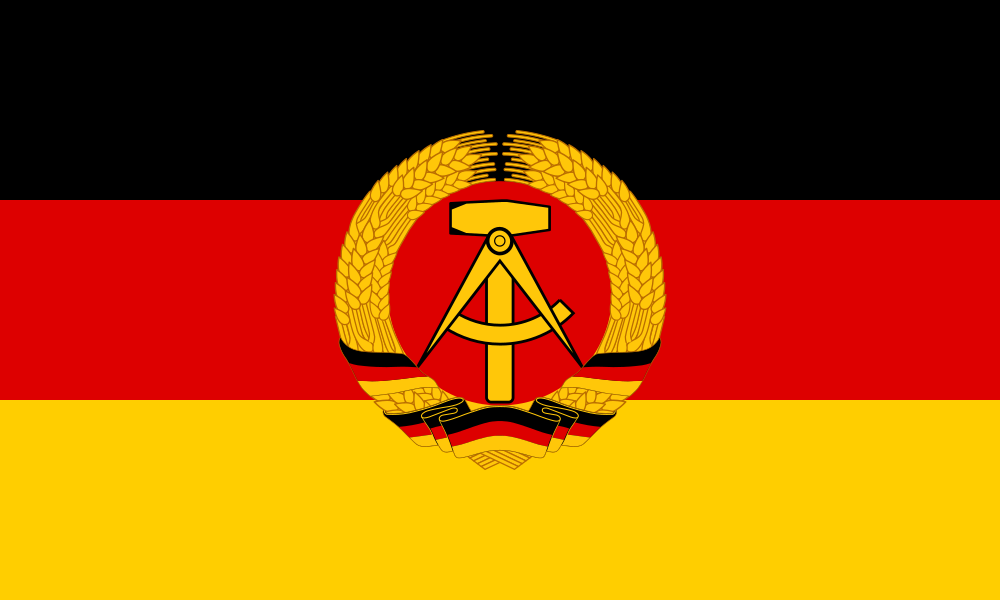
Again, the policies ofapartheid in southern Africa are under discussion in the plenary meetings of the United Nations General Assembly. Although it will probably not be the last discussion of the matter in this forum, there is no doubt that the sands of time for racist rule in southern Africa have run out. No one will be able to prevent its fmalliquidation.
16. In this final stage of the elimination of imperialist and colonialist strongholds in Africa, the national liberation movements in South Africa, Namibia and Zimbabwe have proved to be brave champions of the interetts of their peoples. They embody the strength and determination of those peoples to achieve their inalienable right to self-deter-
18. Thanks to the joint endeavours of all anti-colonialist and anti-racist forces, the United Nations has made a remarkable contribution to unmasking the character of the policy of apartheid. The ninth special session of the United Nations General Assembly, on the question of Namibia, and the World Conference to Combat Racism and Racial Discrimination4 have marked the road to freedom of the peoples in southern Africa.
19. Apartheid is the total negation of the rights and the dignity of man. It is also the crucial element in a power machinery that deprives more than 20 million people of their rights, thus reducing them to mere slave workers. Henchmen of the racist regime have imprisoned thousands of Africans and subjected them to cruel torture or murdered them.
20. The policy ofapartheid stands for violence, oppression and colonialism and constitutes a constant threat of aggression and war against sovereign Africllai States. While the massacre of Kassinga is still unpunished, the world is alarmed at new preparations for aggression. The facts stated ill the letter of the Permanent Representative of the People's Republic of Angola. to the United Nations, Mr. Figueiredo, dated 7 November 1978,5 call tor the determination of this Organization not to allow any new invasion of free Angola by the soldiery of the racist regime. We assure the people of Angola that they can always rely on the solidarity of the German Democratic Republic.
21. A clear understanding of the nature of apartheid will also lead to a logical answer concerning the means by which it is to be eradicated.
22. Certain Western quarters constantly talk of a peaceful settlement. They try to create the impression that the consistent champions of an anti-apartheid policy would seek a non-peaceful solution. The aim of this is to mislead world public opinion.
23. We have to proceed from the simple and bitter truth that a terrorist regime equipped with sophisticated weapons
V';.. ~es war against Africans, children and women, in the territory where it rules and in neighbouring countries. Hence a peaceful settlement can only begin with the disarming ofthat regime. Those that assist it in various ways obstruct a peaceful settlement. That js the compelling logic resulting from the real situation. What·is necessary is to
4 Held at Geneva from 14 to 25 August 1978. 5 See Officilzl Records of the Security Council, Thirty-third Year, Supplement for October, November and IRcember 1978, document 8/12917.
24. The Special Committee against Apartheid has sub- mitted its report [A/33/22 and Co".l]. The report not only reflects the broad activities of the Committee, it also answers the question how the United Nations should proceed in order to assist the national liberation movements in their hard struggle. Moral appeals will not suffice; they will be disregarded by the regime in the same way as the United Nations resolutions adopted so far.
29. Although this has been denied by certain quarters time and again, there can be no doubt that a close connexion exists between economic co-operation in various forms and the intensive military build-.up of the racist regime. It is necessary only to look at the wide range of products manufactured by subsidiary companies of transnational corporations in South Africa and at the interlocking with South African arms industries to see that connexion. These aspects should, in our view, receive greater attention when the activities of States and transnational corporations in South Africa are being investigated.
2S. The German Democratic Republic welcomes and supports the measures recommended in the report. It holds that these recommendations {ibid., chap.IIJ should be included in the relevant resolutions of the General Assembly at its thirty-third session and should serve as a basis for decisions on this question by the Security Council. It considers that the following demands should be met on a priority basis.
26. First, the Council must see to it that no arms a:: other equipment for military and police forces are supplied to the regime in South Africa, either directly or indirectly.'The arms embargo imposed by the Security Council in resolu- tion 418 (1977) came late. We know the reason. Now that it has been adopted, all necessary action must be taken to secure its strict observance. Therefore it is necessary that all indications of and information on continued supplies to the regime of arms and military equipment of any kind be carefully examined, and that such supplies be prevented. This, we believe, is a priority task both for the Committee set up under Council resolution 421 (1977)6 and for the Special Committee against Apartheid.
30. The argument that economic collaboration has a moderating effect on Pretoria merely serves 8S a protective cover for the efforts to ensure continued profits for corporations and essentially to maintain the system of Government as it exists today. Incidentally, that argument is refuted by everyday life. Relying on that collaboration, the regiQ1e disregar~s the resolutions of the United Nations and further expands the terrorist system for the continu- ance of the policy ofapartheid.
31. Another weighty reason for insisting on the strict enforcement of the arms embargo and on economic sanctions is the situation in Southern Rhodesia. In the recent past, the Smith regime has repeatedly attacked sovereign States with heavy and sophisticated weapons, killing many innocent people. The brands of those weapons are well known. The absence of ~ hoycott against South Africa and the fact that South Africa has received arms and licences for their production facilitate the gross breach of the embargo imposed on Southern Rhodesia. It is necessary to put an end to this.
27. Secondly, all nuclear collabor:--)jon with South Africa must be terminated at once. This applies to the supply of relevant material and equipment and to the exchange of scientific and technical data and personnel. Whatever may be the forms of that nuclear collaboration, there is always the possibility and danger that it could enable South Africa to manufacture nuclear weapons. There can be no justifi- cation for that collaboration. Some States which otherwise so vigorously support the justified demand to prevent the further spread of nuclear weapons forget these principles whenever South Mrica is concerned-and this despite the fact that the Pretoria regime is not a party to the TI'2aty on the Non-Proliferation of Nuclear Weapons {resolution 2373 (XXll), annexJ and shows no inclination whatsoever to accede thereto. So why is there such an attitude towards a regime that has been officially condemned by the Security Council as an aggressor? In its report the Special Committee against Apartheid suggests that the Security Council should deal with that question and should prohibit any nuclear collaboration with South Africa. This is fully in line with the position of the German Democratic Republic.
32. The United Nations has played an active part in the great endeavours aimed at eliminating South.Africa's illegal rule in Namibia. Certain circles make it their objective to create confusion. We therefore deem it necessary to declare our explicit agreement with the basic demands of the General Assembly, as laid down at its ninth special session, Dn the question of Namibia[see resolution 8-9/2J. The key need is to ensure without delay the complete and uncon- ditional withdrawal of the South African occupation troops. Only then can truly free elections be held under the ~ supervision and control of the United Nations.
33. The United Nations is being confronted with massive attempts to circumvent the implementation of these clear- cut demands and to install in Namibia a regime that would be ready to recognize South Africa's continued domination, to allow its Territory-that is, Namibia-to b~ used also in the future as a m~tshalling area against African States, and to leave the door WIde open for imperialism to exploit the people of Namibia and their natural resources by neo-colo- nialist methods. This purpose is to be served by the
28. Thirdly, what is necessary is economic sanctions against South Africa under Chapter VII of the United Nations Charter, in particular an oil embargo. This has been clearly reaffirmed in the report of the Special Committee
6 Security Council Committee established by resnlution 421 (1977) concerning the question of South Africa.
34. Such manoeuvres aggravate the situation and impede a solution of the problem. Allegedly, also some States members of the North Atlantic Treaty Organization and of the Security Council have aome misgivings regarding these elections. But why, then, did they abstain in the vote on Security Council resolution 439 (1978) on Namibia which was recently adopted? We call for the strict implemen- tation of the measures decided upon by the Security Council, if South Africa holds the so-called elections in Namibia.
35. At a time when determined and joint action by States is imperative, no back door must be opened to the regime. And even though high-ranking politicians from a number of States are visiting Pretoria, that does not alter the fact that the racist regime has no say in the matter. That regime's presence in Namibia is illegal; it must completely withdraw from the Territory, including Walvis Bay.
36. We consider it essential that the United Nations, in the interests of its authority, should remain faithful to its principles and not allow itself to be drawn into the neo-colonialist manoeuvies around Namibia, and that it should closely co-operate with the South West Africa People's Organization {SWAPO} as the legitimate represen- tative of the people of Namibia, recognized by the United Nations.
37. It is indeed gratifying to note that world public opinion, despite all the camouflage tactics of certain quarters, is condemning ever more strongly the policy of apartheid and emphatically demanding its elimination. Resolute measures by the United Nations for the inter- national isolation of the regime would certainly meet with approval throughout the world. The International Anti- Apartheid Year has been highly instrumental in conso- lidating this broad consensus and in intensifying the struggle for the right to self-determination and other fundamental rights of the people in South Africa.
38. The German Democratic Republic also is contributing to the Year with a wide range of measures. At its meeting on 13 November this year, the German Democratic Republic's Government Commission for the International Anti-Apartheid Year reviewed relevant activities. It under- lined the determination of the German Democratic Repub- lic consistently to pursue its anti-imperialist policy of support for the just struggle of the peoples of Namibia, South Africa and Zimbabwe in the future also. Alfred Neumann, First Deputy Chairman of the Council of Ministers, stressed in his statement:
"We demand strict observance by all States of the sanctions adopted by the United Nations Security Coun- cil. We call for a comprehensive international political and economic boycott against the racist regimes, which would place decisive restraints also on the profit-oriented prac- tices of transnational corporations."
40. We must not tire in our efforts to mobilize wodd public opinion. It is likely that certain circles will increas- ingly attempt to present a change of figures as the beginiling of a new policy by -the regime. Every measure passed off as a relaxation of the policy ofapartheid always proves to be another step towards the further perfecting of the system of oppression. It therefore remains a foremost task of the United Nations to disseminate the whole truth about the policy of apartheid and to state clearly time and again that the elimination of that policy cannot be achieved by joining the racist rulers of Pretoria but only by taking action against them.


In the history of the United Nations there have been few other problems on which so much has been said with so little practical effect as the perennial question of the policies of apartheid of the Government of South Africa. This very rostrum alone has served for hundreds, if not thousands" of speakers to condemn apartheid most resolutely and express wonder at why apartheid is still haunting mankind with the crimes of its perpetrators and the sufferings ofits victims.
42. Unfortunately this rostrum has also served-although on fewer occasions-for the raising ofsirens' voices counsel- ling inaction on all sorts of grounds, be it even implicitly, and defending practices which to a large extent account for the present state of affairs and the long-overdue oppressive reign of the policies of apartheid.
43. From the point of the mobilization of the inter- national community for the struggle against apartheid, this year's debate in the General Assembly is taking place in special circumstances. On the one hand, for the first time in history an International Anti-Apartheid Year has been launched by the United Natio,ns. On the other hand, however, the Pretoria regime, encouraged as it is by the failure of the United Nations to bring independence to Namibia and act more effectively towards the eradication ofapartheid, has shown new grave signs ofits open defiance of and challenge to this Organization. Regrettably, time has revealed that with every passing year the Pretoria regime not only gets more tyrannical towards the black
populatio~ of South Africa and Namibia, but also acts with ever greater impudence vis-i-vis the world community. More determined action by all, without exception, is therefore indispensable to make sure that the chances offered by the International Anti-Apartheid Year do not recede.
44. The political fabric of the tragedy of the people of South Africa, which is oppressed in one of the most vicious police States in the history of the world, is, naturally, a product of an ideology being imposed by a fanatical minority. Consequently, as you, Mr. President, yourself put
"Apartheid is an affront to the values that man throughout history has found to be marks of dignity and has expressed in his philosophies and religious beliefs. It is the negation of all the ethical victories that mankind has gained ...." [30th meeting, para. 4.J
45. Obnoxious racist laws; forced removals and eviction, like those entailed by the latest plans for the demolition of Crossroads near Cape Town: the establishment of ban- tustans; continuing killings of peaceful demonstrators; the torture and murder of patriots in detention; trials of freedom fighters-this is the sordid reality created by those who boast of being "part of the free world".
46. Soon after the death of Steven ,Biko, in September 1977, South Africa's Minister of Justice told a political meeting, "Biko's death leaves me cold". And he went on to talk about uthe democratic right to starve to death". In recent years the world has heard many other declarations of that kind made on different occasions by more or less prominent spokesmen of the Pretoria regime. But their infmite contempt for the Africans, inherent in the mass violation of human rights, has not prevented them from ,using the victims of their oppression to pursue ends the achievement of which has 'so far been reserved for the white masters of the colonial era. In illegally occupied Namibia, where the reign of apartheid is no less visible than in South Mrica, tribal armies are being created and trained as scouts to assist the South African army in tracking down SWAPO fighters. Indeed, is it not magnanimous of the South Mrican racists to let the oppressed share in the bloody rites of oppression?
47. In his statesmanlike, passionate and penetrating ad- dress before this Assembly on 11 October last, the Prime Minister of Jamaica, Mr. Manley, touched the very core of the problem. He said:
"The truth is ••• that these external symptoms, terri,ble as they are, are the superficial manifestations of a deeper process which is as old as the history of modem imperialism....
"0 .. it is impossible to understand apartheid and the entire structure of oppression in southern Africa without understanding the origins and continuing nature of imperialism." [Ibid., paras. 29-30./
48. The regime in Pretoria has made it abundantly clear, both in word and in deed, that it is not prepared to renounce its policies orapartheid. In the past several years it has replaced its verbal defiance of the concern of international public opinion by intensified reprisals at home, a growing military build-up, including advanced research on nuclear weapons, and acts of aggression against neighbouring independent African States, the most flagrant of which is the constant aggressive threat against the heroic People's Republic of Angola. All this is only too well known to this Assembly and, for that matter, to other organs of the United Nations, and first and foremost to the Security Council. South Africa's response to the legitimate demands of the world community turned long ago into an
49. We all know that the impediments to a just solution do not derive only from the very policies of the Pretoria regime. It is common knowledge that the world would be much closer to the total eradication of apartheid were it not for the disregard of United Nations resolutions and the assistance and support the South African regime is getting from outside. Is it not ironical that foreign investments in South Africa, instead of decreasing, have been steadily growing and have of late expanded competitively? While in 1974 the list of companies investing in South Africa amounted to 1,632, in 1978 the updated list shows 1,883 firms, and it is still not exhaustive.
SO. In the last three years alone the South African Government has received over $9 billion in loans from foreign banks. It has been provided with the advanced technology essential for its basic industries and for the implementation of its integrated regional development plans designed to enhance the so-called national self-suffi- ciency. The significance of these investments was under- scored when, following the adoption of Security Council resolution 418 (1977) imposing an arms embargo on South Africa, the Pretoria regime declared it would take over the facilities of any transnational firm which refused to produce strategic items requested. Precisely because of foreign activities in support of South Africa, it proved possible for its Government to finance not only the creation of a three-year store of oil and the continued import of essential parts and materials but also the acquisition of a huge stockpile of military hardware and weapons. No one can deny that foreign co-operation with and investment in South Africa have played a crucial role in building up and financing the military-industrial complex which has enabled South Africa's minority Government to perpetuate its oppressive rule over the African majority.
51. Seldom in the past have we seen more duplicity, political convenience and expediency than in the case of the decisive aspects of the international struggle against apartheid. In this International Anti-Apartheid Year it is time to realize that nothing will change the mind of the racist regime in Pretoria unless world pressure takes full and unselective account of United Nations resolutions concern- ing the policies of apartheid and of the sanctions provided for in the Charter of our Organization.
52. The Government and the people of Poland have always been and will continue to be on the side of the oppressed victims of apartheid. We are perfectly cognizant of the stuggle of the black majority in South Africa, to which we lend our full solidarity and which we unres- ervedly support. Faithful to its consistent position, Poland has always strictly observed United Nations resolutions concerning the policies ofapartheid. My country has had no relations whatsoever with the Pretoria regime, and it is our firm resolve to adhere to all the decisions in this regard until an end is put to the shameful policies of the racist minority. That is why at this thirty-third session of the General Assembly also we are ready and willing to support the political conclusions and recommendations of the
53. The history of the national liberation struggle of the last several decades shows in the clearest poss~bie terms that such a day will come sooner or later-sooner by far than the perpetrators ofapartheid could ever expect.


The question of apartheid in S(;lU~h Africa is a vital question of much concern to the African people and all the peoples of the world.
55. Following the vigorous development of the national liberation movement on the African continent, African countries, one after another, have won independence for themselves. The old colonial system has crumbled to pieces. But southern Africa remains the largest colonial region in the world today. The reactionary regimes of South Africa and Rhodesia, abetted and sustained by imperialism, continue to push forward frenziedly their colonial and racist policies. This situation cannot go on; a thorough change is imperative.
56. Racial discrimination and apartheid are the direct outcome of colonialist and racist policies. After their incursion into southern Africa early in the seventeenth century, the colonialists fabricated an extremely reaction- ary theory, advocating that "the white people are born noble" and the "coloured people are lowly by birth" in order savagely to plunder the rich resources of the indigenous people and ruthlessly exploit them. Basing themselves on this absurd so-called theory, the white racist regimes of South Africa and Southern Rhodesia have blatantly carried out their notorious racial discrimination and apartheid, so that the vast region of southern Africa has become a "paradise" for white racists while vast numbers of the people of Azania, Namibia and Zimbabwe are forced to live like slaves from year to year.
57. Of South Africa's total population of more than 26 million, 18.6 million are black-the oveiwheIming majority. Yet the whites, not quite one sixth of the population, hold over 80 per cent of the total acreage of rich arable land. They also hold under their control the cities, the industrial centres, rich mining regions and raw-materials bases, while the broad masses of black people are confmed to 10 so-called black "homelands" with poor land and hard conditions. There, the black people are crowded into dark, dilapidated lodgings and threatened constantly by diseases and death. The so-called "border industries" set up by the South African racists around the black "homelands" drove the black people into selling their labour cheap there. The South African racist regime also promulgated numerous racial discrimination bills forbidding the black residents to leave their "homelands" at will and having them arrested on the least pretext. The masses of the black people are not only persecuted politically and exploited economically, they are deprived even of their most fundamental rights and freedom. Every family has a history of blood and tears to tell.
58. What is even worse, the South AfricaIl authorities employ the most brutal means cruelly to suppress the
59. In October last year, the South African authorities outlawed 18 South African mganizations which stood against apartheid and arrested If.aders of the black people at various places. Brutal killings such as that of Steven Biko are definitely not isolated c~;ses. The shocking savagery and brutality of the reactionary South African racist regime is worse even than that of Hitler's brigands. . 60. Oppressed, exploited, bullied and downtrodden for some three centuries now, the people of Azania, Namibia and Zimbabwe are forced to rioo and launch an offensive against brutal colonialism and racism in order to survive and to liberate themsdves. Since the day the colonialists invaded their land, the Azanian people have never ~ased fighting. For long years now, they have fought fearlessly against tyranny and violence, rising and c:arrying on the struggle bravely in the place of martyrs who laid down their lives. In 1976, the heroic Azanian people launched a large-scale mass movement against tyranny, drawing into its ranks various sections, strata and tribes, amounting to a total of hundreds of thousands of people. In this struggle they issued a clarion call to wipe out apartheid a"'ld the system of exploitation.
61. The Azanian people's struggle against tyrariny joined the struggle'of the people of Namibia and Zimbabwe for national independence and liberation to form a mighty revolutionary torrent which is beating down with the force of an av~\lanche upon the reactionary rule.of the white racist regime in southern Africa.
62. Confronted with the ever-growing national liberation struggle, the South Mrican racists, with the support of imperialism, have, on the one hand, stepped up their internal military repression, and on the other, hypocritic- ally engaged in political tricks such as so-called "dialogue" and "improvement of racial relations", in an attempt to extinguish the roaring flames of the struggle of the Azaniaa'1 people. In .,Namibia, they obdurately persist in conducting sham elections, and setting up a puppet Government, to realize their criminal aim of occupying Namibia for a long time. Th.ey are also colluding closely and working hand in glove with the Smith racist regime in Rhodesia, perpetuat- ing a series of aggressions against independent neighbouring Mrican States. But these perverted acts have arou~d even stronger resistance from the peoples of southem Afric_~I..
63. The struggle of the people of Azania, Namibia and Zimbabwe is not an isolated struggle. It is an important integral part of the powerful current of the present-day struggle of the oppressed nations and peoples against imperialism, colonialism and hegemonism. It has won the broad sympathy and support of the peoples of Africa and of the whole world.
64. The positive results obtained at the World Conference for Action against Apartheid, held in Lagos last year, and the fifteenth ordinary session of the Assembly of Heads of State and Government of the Organization of African Unity


The Czechoslovak Socialist Republic attaches great importance to United Nations efforts in the struggle against remnants of the odious era of colonialism, against all forms of racism, racial discrimination and against the policy ofapartheid in South Africa, which is now the subject of our deliberations. We have always perceived the positive role which the United Nations can play in this process. The many years of United Nations activities in this field have helped to achieve a situation in which Member States, with some known exceptions, have united their positions and declared the policy of apartheid a crime against humanity. Racial discrimination has been outlawed by the international community. United Nations activities have significantly contributed to the mobilization of world public opinion, which now strives for the adoption of new, effective measures with a view to the speediest possible elimination of this evil, which not only is poisoning the international climate but also, in its possible consequences, poses a direct threat to peace and the security of the peoples of the world.
65. Just as hundreds of millions of African people are fighting in unity, thus launching a powerful offensive against colonialism and the racist regimes in southern Africa, the two super-Powers have also intensified their rivalry in this region. One super-Power, which maintains multifarious relations with the racist regime, is trying its utmost to preserve its vested interests, while the other super-Power, which brandishes the banner of "support for national liberation movements" and pay~ lip service to the "combat against racism", is even more active in leaving no stone unturned fu its inmtration and expansion in southern Africa. It assumes an offensive posture of forcing its way in, step by step, pressing ahead relentlessly to replace old-line imperialism, in an attempt to set up its own hegemony in the whole of southern Mrica. The frenzied rivalry between the two super-Powers in this region, which is of strategic importance and rich in resources, has greatly increased the difficulty and complexity of the liberation struggle of the people of southern Mrica.
70. It is, however, a sad fact that the results of that positive endeavour still do not meet the proclaimed objectives. Despite all its efforts and the adoption of a large number of resolutions, the United Nations has not achieved the main goal-the elimination of the policy ofapartheid in South Africa. Apartheid continues to be practised and South Africa is hardening its racist policies and expanding administrative as well as political measures based on the policy of apartheid. Racial discrimination has been devel- oped to the point of absurdity and embraces all areas of life. Moreover, South Africa has been applying this inhuman policy also in the Territory of Namibia, which it occupies unlawfully, obstinately refusing to grant it inde- pendence. South Africa continues to be a bulwark of racism and colonialism and a spring-board for neo-colonialism.
66. However, the great people of Africa, a people with a high degree of political consciousness, is an invincible people. Regardless of how the racists plot and conspire, or how they struggle on their deathbed, regardless of how the super-Powers act in a savage and cunning manner, or how they engage in intervention and sabotage, they cannot change the inevitable course of history in which the cause of national liberation of the peoples of southern Africa will win total victory. Southern Africa belongs to the peoples of southern Africa, and definitely not to the racists or to the super-Powers.
67. The Chinese Government and people have always supported the struggle of the Azanian, Namibian and Zimbabwean peoples for national independence and liber- ation. We resolutely support the just demand of the countries and peoples of Africa to impose comprehensive economic sanctions and a strict military embargo on South Africa. We stongly condemn the white racist regime for obdurately pursuing a policy ofapartheid and for its F&scist atrocities of frenzied suppression of the Azanian people. We also strongly condemn the shameless collusion between Israeli zionism and the South African racist regime.
71. Logically the question arises of how it is possible that South Africa has been able to continue for so long carrying out racial policies that are in contradiction with the pripciples of humanity and which represent a flagrant violation of all the principles of the United Nations Charter, to which ~l our Governments have solemnly affixed their signatures.
72. There is no doubt that the Government of South Africa could not have withstood for so long the pressure of the international public and ignored dozens of United Nations resolutions exposing and condemning the criminal nature of the policy of apartheid if it had not continually received direct or indirect political, economic, militaly and other assistance and support from certain Western States, particularly member States of the North Atlantic Treaty Organization, ~d their monopolies, which have their own interests and plans in that part of the world. That is attested to by data contained in the respective reports of the Special Committee against Apartheid and also in the final documents of the recent United Nations Wor!d Conference to Combat Racism and Racial Discrimination [A/33/262j, which was attended by representatives of
68. The peoples 9f Azania and southern Africa have a tradition of revolutionary struggle. We firmly believe that as long as they rely on their own strength, remove interven- tion by outside forces, strengthen their unity, persevere in launching struggles with a broad mass basis, particularly armed struggle, and continuously use revolutionary dual tactics against the counter-revolutionary dual tactics of the enemy, they will, with the solidarity and support of the peoples of Africa and the whole world, certainly be able to
7 Held at Khartoum from 18 to 22 July 1978. 8 Held at Belgrade from 25 to 30 July 1978.
73. Economic and other interests cast a number of Western countries in the role of trade partners and close collaborators of those who are making a daily practice of the racist doctrine ofapartheid. It is a well-known fact that foreign loans and investments play a central role in the development of the economy of South Africa and that the growth of South Africa's military potential, the creation of strategic reserves of oil and the development of the infrastructure are financed mostly from Western credits. More than 1,150 affuliates of Western companies invest a total of more than $7 billion in South Africa. They are attracted not only by South Africa's mineral wealth, with 49 per cent of world deposits of gold, 83 per cent of world deposits of platinum and chrome, and 64 per cent of the vanadium, but primarily by the prodigious percentage of profit. In the American periodical Foreign Affairs it was recently calculated that in the course of the last 2S years the annual returns of United States companies investing in South Africa represent~d approximately one fifth of the entire invested capital. The source of the fabulous profits by Western companies is the cheap labour of black workers.
74. It is apparent that States whose social system is based on profit will never voluntarily abandon co-operation with the apartheid regime, even if under the pressure of world public opinion they no longer associate themselves with it publicly. Any new African policy or initiative on the part of Western countries has therefore always been based on their economic and other interests. If the Western initiatives indeed pursued the objective of putting an end to the racist regime, whether in Pretoria or in Salisbury, it would suffice to put the necessary pressure on it and to agree to the adoption of effective sanctions by the Security Council.
75. However, last year the Western countries vetoed in the Security Council three draft resolutions calling for addition- al sanctions against South Africa and in particular for the discontinuance of oil deliveries to that country. Thus rhetoric is refuted by undeniable facts. In an effoit to justify the maintenance of economic contacts with racist regimes it is frequently argued that constitutional and legislative measures prevent those countries from stopping their companies operating in South Africa. But history offers plenty of examples of political and economic measures having been adopted by the Governments of those countries whenever the developments in this or that country were not to their liking from the point of view of the preservation of their interests.
77. Apartheid will not depart voluntarily from the poli- tical scene. Efforts to. retouch it will lead to no changes. Apartheid will remain apartheid. It must be opposed by all means. The current International Anti-Apartheid Year is a suitable opportunity for responsible consideration of the new steps that should be undertaken to give new impetus to and provide new instruments for the struggle. against apartheid, that source of armed confrontation in South Africa. In tms connexion, the Czechoslovak delegation supports the view of the Special Committee that the utmost priority must be accorded to international action to secure the fuii implementation of United Nations resolutions on the cessation of all military, nuclear, economic, political and other collaboration with South Africa.
78. The Czechoslovak Socialist Republic is prepared to give maximum support to any measures within the United Nations and elsewhere that would bring closer the day of the liquidation of colonialism, racism and apartheid in the African continent. We fully support the demands by African and other countries for the expansion of measures against the racist regime in Pretoria; especially with a view to halting capital investment in and loans and credits granted to South Africa, imposing an oil embargo and applying other effective measures in the economic, military and nuclear fields. The current situation in South Africa fully confirms the necessity of isolating the South African regime in accordance with Chapter VII of the United Nations Charter. --
79. The Czechoslovak Socialist Republic is taking an active part in the implementation of the Ptogrammp, for the Decade for Action to Combat Racism and Racial Discrimi- nation {resolution 3057 (XXVIII), annex}. Czechoslovakia is consistently implementing all United Nations resolutions calling for the boycotting of the racist regime, and already in 1963 it severed all contacts with South Africa On the basis of the relevant United Nations resolutions~ The Czechoslo- vak legislation contains effective guarantees against any
m~nifestationof racism, and, pursuant to the principles of Czechoslovak foreign policy, we consider the policy of apartheid a gross violation of basic human rights, a
80" The Czechoslovak people have consistently sided with, and will continue to side with, peoples struggling for their freedom and independence., They express full support for the respective national liberation movements waging an armed struggle against regimes that are guilty of crimes against humanity. In this forum also Czechoslovakia wishes to assure them of its continued political, material and moral support in their just struggle.
86. The fact that the white minority exploits the black majority and promulgates unfair laws aimed at ensuring the prosperity of the white minority and at the exploitation for its benefit of the natural resources and the human potential of the nationals and attributing iegitimacy to these prac- tices constitutes a flagrant violation of human values and principles.
81. In conclusion, I wish to express appreciation of the activities of the Special Committee against Apartheid in , constantly reviewing all aspects of the policies ofapartheid in South Africa and its international repercussions, and particularly in exploring ways and means of promoting concerted international action to secure the elimination of that evil. In the view of the Czechoslovak delegation the conclusions and recommendations of the Committee as set out in its report deserve serious consideration by the General Assembly.
87. The documents submitted by the Special Committee against Apartheid contain a clear condemnation of the policy of apartheid practised by the Pretoria regime and its allies, without whose aid that regime would not be able to continue to defy the will of the international community. As allies whose interests are intimately interrelated with the very existence of that regime, they provide it with all the military political and economic assistance it needs. Despite the efforts of the United.Nations to isolate and boycott this odious regime, statistics show that the volume of trade between Western States and the Pretoria regime has increased. Multinational corporations play a major role in strengthening the economy of South Africa and 'are consequently contributing to the exhaustion of the coun- try's natural resources.


The United Nations since its establishment
I has been considering the question of the evils of the policy of apartheid practised by the minority regime in South Africa. This question has been the subject of thorough discussions in many international conferences and seminars which have been held to discuss it. All those conferences and seminars have been unanimous in condemning the policy of apartheid.
83. The policy of apartheid is a tragedy of the twentieth century, a century which has witnessed the major achieve- ments of mankind, the miracles of material and technolo- gical progress producing prosperity for man. Despite this, the African people in southern Africa are deprived of their most basic human rights since inhuman and immoral practices inimical to human dignity and unprecedented in contemporary history are pursued there.
88. The United Nations has made a great contribution to the condemnation of this odious racist policy and to unmasking its methods. Th~ General Assembly debates on this agenda item took a positive turn, at the seventeenth Session, when the Special Committee against Apartheid was set 'up (resolutio.n 1761 (XVII)) and have enlightened world public opinion about the'shameful policy of apart- heid being practised in South Africa. They have also helped to make known to the world the just and heroic struggle of the African people and their rejection of the immoral practices which have victimized them. Many initiatives were taken to denounce that policy, in particular, the adoption of the International Convention on the Suppression and Punishment of the Crime of Apartheid Iresolutioi'Z 3068 (XXVIII), annex]. The General Assembly, at its twenty-ninth session, invited the South African national
84. The Pretoria regime has been set up on a racist basis and has adopted laws which allow for discrimination based on colour, origin and ethnic group. These laws enable the white minority to impose its domination over the African people who constitute the overwhelming majority of the population of south~rn Africa. To this day that regime has defied international public opinion and has trampled underfoot all human values in violation of the United Nations Charter, which expresses the aspirations and ambitions of mankind as a whole. .
liber~tion movements recognized by the OAU to take part as observers in the debates on apartheid of the Special Political Committee and at the same time it rejected the credentials of South Africa, an issue which has been debated in plenary meetings ever since the Assembly's thirty-first session. All this has unquestionably helped to support the struggle against apartheid.
85. The practices pursued in southern Africa violate the fundamental principles of human rights and, by denying the humanity of the Africans, are an affront to mankind. Today, when we are about to commemorate the thirtieth anniversary of the Universal Declaration of Human Rights, we see that human rights are being violated in southern Africa with utter unconcern. The African people there are victims of the most atrocious practices and suffer injustice, persecution and e~ploitation. The population in South Africa is 75 per cent black and lives in bantustans on territmy comprising not more than 13 per cent of the total
89. To meet the wishes of the international Organization the Security Council unanimously adopted resolution 418 (1977) imposing an arms embargo on South Africa. There can be no doubt that this decision will have a profound impact on the efforts made to isolate the racist
90. In addition to the stockpiling of weapons which it intends to use for the purpose of aggression against the people of South Africa and the neighbouring African States, the racist regime has expressed its intention of acquiring nuclear weapons, and this is a serious threat to the peace and security of southern Africa and the world. It therefore behoves all Western countries which supply aid and technical assistance to that regime to put an end to their co-operation with the racist regime. It also behoves the international community, and especially the Security Council, to think of adopting mandatory measures to halt nuclear collaboration with South Africa.
91. The oil embargo, moreover, is a step forward in terms of United Nations measures in the fight against racism, racm-discrimination andapartheid. The Special Committee's special report on oil sanctions against South Africa[A/33/ 22/Add.l] stresses that the situation in South Africa is becoming extremely tense and complex and that it can have extremely serious consequences for peace and security in the region and in the world.
92. In his report on the work of the Organization, the Secretary-General described the situation as follows:
"The situation in South Africa itself is a most serious cause for concern. There is little or no indication that its Government is moving away from its basic policy of
~stitutionalized racial discrimination. The repression of opponents of apartheid, the banning of African leaders and organizations and the continuation of the bantustan policy can only increase tension and lead to increasingly tragic results". [See A/33/1, sect. IlL]
93. All representatives present here are convinced that the minority regime enjoys the support of a great Power which has an interest in its survival. While that great Power boasts of belonging to the civilized world and the free world and clmms that its laws guarantee human rights and denounce Il[Jll1'theid, it continues to lend support to that regime in the United Nations and in other forums directly or indirectly through the intermediary of multinational monopolies. It behoves all countries, and the Wester.: countries in partic- ular, to adopt a clear policy, without manoeuvres or distortion, because that situation cannot continue. It behoves those countries to adopt a firm and c1eal position and to choose their side: either in favour of the African people or in favour of the racist regimes.
94. The situation which exists in South Africa is character- ized by the escalation of the struggle of the African people, who are scoring victories both internally and international- ly. It behoves the peace-lOVing countries and the intema-
95. The South African people, under the leadership of the liberation movements, are capable of continuing their fight notwithstanding the tragedy of mass killings, explusions, torture and all the other practices of the white minority regime. Today more than ever before the international community is called upon to stand in solidarity with the African people struggling for the restoration of their legitimate rights, of which they have been deprived in their own territory so that they.may recover their father- land and by all legitimate means accepted by the inter- national community, including armed struggle.
96. Today we are appealing to the international commu- nity to lend its material, political and moral support to the liberation movemen.ts recogilized by the United Nations, the OAU and the non-aligned movement. We also ask the international community to put an end to all co-operation with the racist regime either militarily, politically or economically. We must condemn the policy of bantustan- ization as being a practice aimed at strengtheni.'lg th~ apartheid regime and at the continuance of the white minority regime, which deprives the African people of their political rights and thus endangers peace and security in the region. It is our duty to declare our unflinching support for the political prisoners and detainees who are in gaol because of their anti-racial policies.
97. In this connexion I must mention certain international • conferences which have been held to express solidarity with the African people: the World Conference- for Action against Apartheid, held in Lagos in 1977; the International Seminar on the Eradication ofApartheid and in Support of the Struggle for Liberation in South Africa, held in Havana in 1976; the conference of governmental experts for the Preparation of a Draft Declaration on the eradication of racism and racial discrimination, held in April this year; and finally, the World Conference to Combat Racism and Racial Discrimination, held in Geneva in August 1978. Despite the withdrawal from this last Conference of some States at the last minute, ..which indicated their true position on racism and their close collaboration with the racist regimes, the unanimous adoption of a Declaration and Programme of Action IA/33/262, sect. Ill] confirmed the resolve of the international community to reject racism and the bargain- ing of capitalist Western countries which support the racist South African regime.
98. The entire world has condemned apartheid not only as a crime against mankind but as a threat to international peace and security, and it is on that basis that we must str€ngthen our effo.£s to eliminate that scourge.
99. While international public opinion has expressed itself unanimously in condemnation of collaboration with the racist regime in South Africa, ever closer co·operation has been seen in recent years between the racist regime in Pretoria and the racist Zionist entity in occupied Palestine. There are various anaiogies between thos:; two repimes. Both have expelled the indigenous populations from their territories and have enacted discriminatory laws against the
103. In conclusion, I should like to express on behalf of my delegation deep appreciation for the efforts made by the Special Committee against Apartheid, under the leader- ship of Mr. Hamman, our colleague the Permanent Repre- sentative of Nigeria to the United Nations. The report submitted this year by that Committee contains a vast amount of useful information and data on the Committee's activities. My delegation hopes that tha Committee's recommendations and conclusions will be implemented in order that an end may be put to the racist regime and its heinous policy of apartheid. We hope also that an inter- national convention against apartheid in sports, now being drafted, will soon be adopted.
100. I wish to quote the following text, which was published by the African National C-ongress in London, entitled South African and Israeli Racists Plot:
"News has come through of the visit of Mr. Rabin of Israel and Mr. Vorster of the South African racist regime. This visit is the highHght of a longstanding development of co-operation between these two of the most dangerous States threatening peace today: Israel in the Middle East and South Africa in Africa. This visit confirms the closest co-operation in economic, political and armaments fields. We have no doubt this will also include atomic co-oper- ation for the purpose of war against neighbouring States and confront('¥tion with the national liberation move- ments.


The world community has denounced apartheid as the most heinous system of racial discrimination and declared it a crime against humanity. The United Nations not only has condemned the institu- tionalized system of racial domination but has repeatedly warned South Africa to abolish apartheid and allow the majority of the people to enjoy its rights, freedom and equality. But the regime in Pretoria has been heedless of these warnings and is desperately attempting to pursue the despicable policy and maintain minority white supremacy at the expense of the majority indigenous population of the country.
"We call upon all democrats, anti-racists and all those who cherish peace in the world, to take heed of this latest • strategic co-operation and to take every possible step to expose it, challenge it wherever ·possible, and to render unworkable any form of assistance to the racists of both countries."9
101. On the other hand, the Foreign Secretary of the Libyan Arab Jamahiriya, as President of the OAU Co-ordin- ating Committee for the Liberation of Africa, in a telegram addressed to the Secretary-General of the United Nations, expressed the deep concern of the Committee at the fact that the Minister of Finance of the Zionist entity had gone to South Africa. This appears in the special report of the Special Committee(AI33122IAdd.2, chap.Il]•I also wish to quote from the Special Rapporteur's report to the Commis- sion on Human Rights concerning co-operation between the two regimes. After presenting information concerning co-operation between the Vorster regime and the Zionist regime, the Rapporteur says:
105. During the past year the situation LI1. South Africa has continued to be a matter of concern to the international community. The racist regime has< not changed its attitu.de towards the abolition of apartheid. On the contrary, it has increased its collaboration with some countries and rein- forced its repressive measures against the opponents of apartheid. Furthennore., the savage aggression against Angola and the massacre of innocent people have demons- trated the barbarous nature ofapartheid South Africa.
106. South Africa, by flouting the numerous l'elevant resolutions of the United Nations General AssembJ' . and the Security Council, has shown contempt for the world Organization. It is not difficult to perceive the strong backing of certain countries that has made the racist regime so arrogant as to refuse to comply with the decisions of this world body.
"Given the many links, repeatedly polmed out by United Nations organs and many world and regional conferences and meetings, between the two regimes, it is ciear that hard evidence that is not officially denied by one or both sides is difficult to come by. However, so many indices and incidents, like the ones cited above, point to the fact that trade and co-operation in the military field are well-established between the two regimes."1 0
107. There is no doubt that the economic and other interests of some Western and other countries are served by the maintenance of apartheid in South Africa. The racist regime, therefore, is continuously assisted and strengthened by those countries in order to preserve their interests of economic exploitation through a large number of trans- national corporations. The majority blacks, which are a
9 Quoted in English by the speaker. 10 See document E/CN.4/Sub.2/383/Rev.l, para. 40. Quoted in English by the speaker.
109. In the face of growing uprisings and increasing violence inside the country and mounting international pressures for the total eradication of apartheid, the regime iJl Pretoria is actively undertaking a massive military build-up. It has greatly increased its military budget, and collaboration with some countries in military fields has continued. South Africa's possession of a nuclear plant and its attempts to develop nuclear power with the co-operation of some countries constitute a grave threat to international security. The Security Council by its resolution 418 (1977) has imposed a mandatory arms embargo against the racist regime of South Africa. But reports indicate that this Security Council resolution has not been effectively implemented by all Member States. The racist regime in Pretoria has defied outright the decisions of the Security Council and stated that it will be able to sustain the pressures. Therefore, the Security Council Committee established under resolution 421 (1977) should properly study the violations of sanctions, and the Council should take effective measures against such violations.
114. Today the question of apartheid is not limited to South Africa alone. It has involved Namibia, Southern Rhodesia and the neighbouring countries of the region. The possibility of South Africa's becoming a nuclear Power and the dangerous consequences arising therefrom have made apartheid a problem of global concern. The civilized world cannot tolerate a system of racial ~egregation which totally disregards the principles of the United Nations Charter and the Universal Declaration of Human Rights. The oppressed people of South Africa and people within and outside the United Nations are fully determined to bring apartheid down once and for all. What is needed at this hour is the total isolation of the apartheid regime. As all other measures have·been ineffective in compelling South Africa to abolish apartheid, the international community should not hesitate to resort to mandatory sanctions against South Africa under Chapter VII of the United Nations Charter. 110. The commitment of the world community to elimi- nating apartheid is reflected in the adoption of various international an'ii-llpartheid instruments. My country, which is a State party to the International Convention on the Suppression and Punishment of the Crime of Apartheid, will not fail to fulfil its obligation and co-operate with the United Nations. My delegation commends the Ad Hoc Committee on the Drafting of an International Convention against Apartheid in Sports for the progress it has made and supports the recommendation contained in the report of the Ad Hoc Committee for renewal of its mandate to complete its work by next year {A/33/36, para. 9}.
Ill. The Special Committee against Apartheid, of which Nepal is honoured to be a founding member, has increased its activities during the past year and has successfully carried out its mandate. The report of the Special Commit-
112. Various activities launched during this year, which is being observed as International Anti-Apartheid Year, have fully demonstrated the determination of peoples through- out the world speedily and totally to eradicate apartheid. In this regard my delegation appreciates the significant efforts of the non-governmental and anti~partheid groups of various countries. We feel that both moral and material support should be extended to all such organizations for their contributions towards the increas~d and intensified international campaign against apartheid.
113. Nepal has always condemned apartheid and sup- ported United Nations measures aimed at the total eradi- cation of the anachronistic system of apartheid. We hold the view that the minority white regime should in no way oppress the majority blacks under its arbitrary and despi- cable policy of racial domination. My delegation suPpo.rts the struggling people of South Africa and all activities directed towards total elimination of racial domination in South Africa.
115. Ever since it was first seized of the question of apartheid the United Nations has displayed its indignation at the obnoxious system of apartheid and strongly denounced it in hundreds of resolutions. Resolutions of a similar nature will be adopted this year. We have always supported and will continue to support resolutions calling for the complete elimination of apartheid. However, we hold the view that the practice of singling out a particular country in a resolution md condemning it for its collabora- tion with South Africa is unfair and unjustified. In our considered judgement the time has come for this world body to move from the adoption of resolutions incorporat- ing verbal condemnations to the stage where it must ensure that its resolutions are effectively carried out so that mankind may see the scourge of apartheid wiped from the face of the earth for ever.
118. The United States Government has made our view clear to the Government of South Africa. We have stressed our commitment to human rights. We have called for the elimination of apartheid and for the full political participa- tion of all South Africans on an equal basis. We do not expect these changes to occur overnight, but we have stated that without evident progress in this direction our relations with South Africa will deteriorate. As President Carter said in his most recent State of the Union address:
"Unless [South Africa] ... begins a progressive trans- formation toward full political participation for all its people, our relations will suffer."
119. We hope that no further deterioration of our
I relations will be necessary. Our aim is not confrontation with South Africa but the achievement of progressive change in South Africa. As the Secretary of State Mr. Vance, stated earlier this year:
"Our policy towards South Afri:=a should not be misunderstood. We have no wish to see the whites driven from the home of their forebears. We suggest only that they seek a way to live in peace and justice with the majority of their fellow citizens. South Africans of all races, and not just its white citizens, should decide their country's future. We do not seek to impose either a timetable or a blueprint for this progress. But I hope, as do all who have sympathy for the problems any society encounters in facing fundamental change, that the begin- ning of basic progress will r.oon be seen."
120. We are looking anxiously for signs of that progress. The South African Government has a newly-elected Prime Minister, Mr. P. W. Botha~ who has a great opportunity to lead his nation in new directions; an opportunity to work constructively for peaceful change in his country and its region of the world; an opportunity to embrace peaceful solutions to problems which will otherwise surely result in increased violence and conflict.
122. And yet at present the oppression and the suffering in South Africa go on. The South African Government is planning for the destruction shortly of the Crossroads community outside Cape Town. The United States deplores this potential hun.'Ut tragedy and calls on South Africa to cancel such plans. Bannings and detentions without charge continue unabated. On 2S October we learned of the detention ~lf Sally Motlana, a prominent member of the Soweto community and a Vice-President of the South African Council of Churches. Detained without charge, Ms Motlana has had no access to counsel, or to family, or to other visitors. International concern for Ms Motlana's well- being is growing rapidly. It is unfortunate that international attention focuses on bannings and detentions in South Africa only when the prominent are involved, and yet it is, of course, fortunate that th~ detentions of the prominent draw attention to similar ,.lr worse treatment of the less known; draw attention to the unacceptable policy and laws under which these actions take place.
123. We are watching events in South Africa closely for signs of change. We are actively trying to influence "and persuade South Africa to change its policies. We look to South Africa for signs that it will cease bannings and detentions without charge; that it will abolish the pass laws and all other forms of discrimination; that it will give an equal opportunity to all for employment, job promotion and education; that it will provicie for the full political participation of all its citizens, regardless of race or colour.
124. As we have repeatedly said, we do not expect these changes to occur overnight, but we do expect signs of significant change soon. The present unswerving direction of the South African Government raises grave doubts about its future actions. Those doubts can only be reduced by evidence of a progressive change in South African policies. It is such evidence that is so immediately needed.
The meeting rose at 1.05 p.m.