A/33/PV.60 General Assembly
THIRTY-THIRD SESSION
Page
32. Policies of apartheid of the Government of South Africa : (il) Re~ort of the Special ComuJttee against Aportheid: (b) Report of the Ad Hoc Committee on the Drafting of an . Intel7'~ational Convention against Apartheid in Sports; (c) Report of the Secretary-General


If there is an item which has dominated the deliberations of this body for decades, it is that of the apartheid policies of South Africa. Ifthere is a State policy that has caused untold sufferL'lg to one part of humanity for co other reason than the colour of their skin and the desire economic~ly and mercilessly to exploit them, it is that ofapartheid, and there is no parallel to that abuse in recent history. If there is a policy that has evoked universal condemnation and yet has seen little concrete action on the part of the international community to eradicate it, it is certainly that ofapartheid
2. Despite the condemnations that the international com- munity has hea.ped upon the apartheid State, despite the numerous resolutions and decisions of tltis body, South Africa, in clear defiance of the overwhelming wish of humanity and of the United Nations, has proceeded further to entrench and extend apartheid in that unhappy country. This, in a nutshell, is the bleak situation we are faced with as we inch our way towards the last quarter of International Anti-Apartheid Year, which concludes on 20 march 1979.
3. We are therefore facing the unpleasant and real )rospect of having hardly anything to show as far as the eradication of apartheid is concerned, despite the very meritorious and indefatigable efforts of the Special Committee against Apartheid, for which Botswana has a very high regard.
4. The southern region of Africa, where we live, is a region of great potential, endowed as it is with· tremendous human and natural resources. It is a region that should provide bounteously for all its people regardless of race, origin or creed. And yet that region today is poised on the edge of a
NEW YORK
very dangerous precIpIce because of the inhumanity, oppressiveness and intransigence of the racist minority regime that hold our people in abject bondage. And the nerve-centre of that oppressive system is South Africa itself, which sustains the illegal regime in Southern Rhodesia and has extended its apartheid system to the international Territory of Namibia, which it occupies illegally in defiance of United Nations resolutions. Ultimately, only the eradi- cation ofapartheid can bring peace~ freedom and prosperity to our entire region.
5. As we debate this issue here, within South Africa itself ruthless oppression of the opponents ofapartheid continues unabated: arrests, banishment, detention and imprisonment without trial it" nany instances persist. So-called trials of those who are valiantly struggling against the evil apartheid system are multip;lying by the d~y. The exploitation of the non-whites at places of work continues. People continue to be forcibly removed from their places of birth, so-called squatter settlements, deprived of their South African citizenship and hti'ded into the bantustans. We learn that yet another bantustan-that of the Verrda-wiJJ soon join the Transkei and Bophuthatswana. As on previous occa- sions, the international community should not accord any recognition to that entity. These and many more are concrete forms of oppression which need no elaboration since they are all too familiar. 4
6. More recently, as representatives will have read in the press reports, South Africa has been said to be about to promulgate Draconian legislation relating to African educa- tion, which, if those reports are correct, is bound to evoke new protests and cause an exodus of refugees into the neighbouring countries. This is yet further evidence of the escalating oppression.
7. Faced with increasing determination on the part of the struggling people of South Africa and Namibia to free themselves, South Africa has sought scapegoats. The now well-known attacks on Angola and Zambia are cases in point. Sustained by South Africa militarily and econo- mically, the illegal regime in Rhodesia has attacked on several occasions Botswana, Mozambique and Zambia. Only recently some of the most dastardly attacks were perpe- trated against the Republic of Zambia. Let me declare Botswana's solidarity with the people of Zambia in their hour of greatest need. But, as I have stated already, all these situations stem from the fact that apartheid continues to exist, and it can only exist through naked oppression.
8. Despite the bleak situation I have outlined, southern Africa is in a state of great ferment. In Zimbabwe the valiant people, under the leadership of the Patriotic Front, are gradually liberating their country. The so-called internal
lOOS
A/33/PV.60
9. In South Africa, by unleasing violence against an innocent people, the apartheid State is courting counter- violence. There, too, the struggling people of South Africa are opposing the apartheid system. After Soweto-as indeed was the case after Sharpeville and, before that, after other equally heroic deeds-things can never be the same in South Africa. No amount of oppression or removal of leaders can kill a people's desire to be free. If that had been possible the resistance in South Africa would have collapsed long .ago; yet it has continued to grow from 'strength to strength.
15. Thus one can speak of the refugee problem as being a permanent one inasmuch as there will always be refugees as long as there is oppression. Consequently, permanent solutions to the problem are required. The real, enduring, permanent solution is not so much assistance to refugees or to countries which grant them asylum, very (;;ommendable though that is; rather it is the elimination of the conditions which create refugees-the eradication of apartheid. This calls for increased support to those who are struggling to liberate their people. This is the best tribute we can pay to the people of South Africa, those who fell in the pursuit of freedom and the living who are struggling on.
10. The lesson is clear here, and South Africa had better heed it and retreat from the brink of disaster for that lovely country: oppression can orily succeed in sharpenin~ the revolutionary ~eal of a people and tempering it=: 'oive with steel. ~n South Africa, if you will, we can now talk about permanent resistance, for, as leaders are removed and movements banned, others soon arise to take their place. So will it be until that country abandons apartheid. South African rulers would do well to recognize this glaring reality and work for the creation of a society of equals in South Africa.
16. In conclusion, I should like to pay a rJgh tribute to the Special Committee against Apartheid, which, under the able leadership of Ambassador Harriman of Nigeria, has done a marvellous job in articulating the true interests of the people of South Africa. Its meritorious efforts are clearly reflected in the Special Committee's report to the General AssembIY.lA/33/2'2 and Corr.J] and in its two special reports [A133/22/Add.l and 2J. I would ~so reaffirm once again our solidarity with the people of South Africa in their quest for freedom, justice and human dignity.
11. However, there is no point in entertaining false optimism. Some seem \to see what they consider positive change in the cosmetic changes with which South Africa from time to time hoodwinks the international community. But why entertain illusions when South Africa itself constantly reminds us that it has no intention of voluntarily abandoning apartheid? It has even threatened to stand aY-one in the world, if need be, to defend that iniquitous system.


The General Assembly is meeting again to consider South Africa's abhorrent practices of apartheid, which have justifi.ably been des- cribed as constituting an international crime of the greatest magnitude and an affront to our civilization.
12. What is needed now is for the international com- munity to stand solidly together in the effort to eradicate apartheid. Those who wield influence over South Africa should use the leverage at their disposal to get South Africa to abandon its mad course towards inevitable chaos "not only in South Africa but in our region as a whole. The allies of South Africa should not allow their short-term material gains to blind them to the fact that their real interests lie in a South Africa free of apartheid, a South Africa where aB the people of that beautiful country will collectively fun the affairs of their country and together enjoy its boun- teous wealth.
18. We have before us the annual report of the ~pecial Committee against Apartheid {A133122 and Co".ll, the special report of the Committee on oil sanctions against South Africa [AI33/22/Add.1J~ the report of the Ad Hoc Committee on the Drafting of an International Convention Against Apartheid in Sports {A/33/36J, and the report of the Secretary-General on the United Nations Trust Fund for South Africa [AI33/3l3J. We have given careful consideration to those reports, and I am pleased'to say that my Government concurs fully with the recommendations and suggestions of the Committees submitting them.
13. The oppression in South Africa has rendered homeless thousands upon thousands of South Africans of all ages. They are now languishing in exile. We in Botswana have first-hand experience of this terrible state of affairs, as our country and our African neighbours are countries of first entry for South African refugees and indeed for those from Namibia and Zimbabwe. It is our brotherly duty and commitment to give succour to our brothers and sisters. This we will continue to do to the best of our ability. All we ask is that the international community should come to our assistance so that we can cater fully for the needs of those oppressed people. None of our countries can cope unaided with this increasingly heavy burden.
19. I wish on this occasion to commend the Chairmen and the members of the Committees for their reports and contributions to the struggle for the elimination of apart- heid.
20. As stated on previous occasions, ~yprus has since its independence maintained no relations wh,atsoever with the racist Pretoria regime. Moreover, we have tried and we shall continue to try in the future-despite our present difficul- ties, as a result of the calamity that has befallen us through
21. The consistent policy of Cyprus, based on principles and ideals, has always been in favour of taking all measures prOVided for in· the Charter-in particular enforcement measures under Chapter VII-to bring about the speedy eradication of the evil of apartheid. Yet, after so many years, why is it that the racist Pretoria regime fmds it pC3sible to persist in and intensify such practices of racial discrimination, even extending its aggression against neigh- bouring African countries? I would respectfully submit that it is because of th'e lack of more determined action by the Security Council-through extension of the mandatory s8llctions against South Africa to make them comprehen- sive-that the Pretoria regime seems to have been embold- ened into continuing and escalating even further its sinister practices against the i"ldigenous majority African people of Azania, as well as against the peoples of the front-line States.
22. It is high time for the Security Council to face up fully to its primary responsibilities under the Charter, to acknow- ledge more clearly its special responsibility towards the oppressed people of South Africa, indeed towards !ill peoples of the world who are suffering oppression, racial 'discrimination, foreign occupation or alien domination. We the Cypriot peop~e, in the light of our bitter experience as a result of the- unhindered aggression and the continuing military occupation of 40 per cent of our national territory, are in a position to \1Inderst&nd fully what it means to be uprooted from your home and become a refugee in your own country; what it m\~ans to be d~scriminated against on the sole criterion ofyour ra'cSll or ~thnic origin.
230 We recognize the dangers emanating from the condem- nable policy of "bantustanizatilJn", as a devious pursuit for
d~viding the indigenous African people and perpetuating settler-colonialist domination. We have our own bitter experience of such a policy, as demonstrated by the purported setting up of a so-called separate State on the invaded territory of our country and the importation of tens of thousands of alien settlers to usurp the homes and land of the expelled indigenous people.
24. We understand. That is why we strongly believe that the Security Council should determinedly proceed without any further delay to impose-apart fr:>m the arms embar.. go-mandatory comprehensive sanctions, and in particular a full oil embargo as well as other economic sanctions, against the Pretoria regime. It is orJy through such comprehensive and effective action by the Security Council that our resolutions and decisions will be translated into reality and the struggle of the oppressed people ofAzania, the struggles of all oppressed peoples of the world, will at long last be vindicated.
25. After so many years of debate, there is indeed unanimity in this Assembly about the need for the immediate eradication of the evil of apartheid. Scores of resolutions have been adopted by the General Assembly and the Security Council on this or other situations


For nearly a century Japan has continuously advocated the principle of racial equality. Our own entry into the community of modern States about a century ago came at a time when all the ~oples of Asia and Africa were under the yoke of racial discrln1ination. Hundreds of thousands of Japanese who immigrated to other continents in the pre-war period received this inhuman treatment in the recipient countries, and fOf years we were virtually alone in the struggle to put an end to this abominable practice. As recently as 1919, when the First World War ended, Japan attempted, though unsuccessfully, to have a clause proclaiming racial equality included in ~he Covenant of the League of Nations. Thus, our opposition to racial discrimination is based not on some abstract intel- lectual understanding, but on the fact that our own bitter experience has made us profoundly sensitive to this problem. This experience, moreover, has led us to feel intense repulsion aud indignation against the pr~.ctice of apartheid in southr.;rn Africa. ,
27. It is for that reason that my Government has consistently adhered to a position of uncompromising opposition ~o all forms of racial discrimination, and has resolutely op~..>sed the apartheid policies of the South African Government. We are convinced that the policy of apartheid cannot possibly be tolerated, for it tramples upon one of the basic principles of the United Nations Charter; respect for human rightG and for fundamental freedoms of all, without f}lcial distinction. The continued policies of apartheid in South Africa must be vigorously condemned and the Government of South Africa must abolish such policies once and for all.
28. It is reported that the Government of South Africa has recently undertaken some "improvement" measures, often referred to as "petty apartheid". We do not believe that measures of this order can contribute to a fundamental solution of the problem of apartheid, for we are firmly convinced that the problem can be resolved only by recognizing the rights of equality and freedom to all races living in South Africa and by allowing all of them to participate in the political, social and economic life of their country on an equal footing.
29. My delegation is fully aware ofthe prevailing feeling that, inasmuch as the steady stream of.resolutions adopted by the Gener&! Assembly since 1952 has failed to produce any meaningful change in the South African policies, more drastic action to achieve the prompt abolition ofapartheid
30. To this end, my Government has undertaken its obligations as a member of the international community and has already taken measures of the following sort: we maintain no diplomatic relations with South Africa; we refuse to recognize the independence of the so-called Transkei and Bophuthatswana; we issue no visas to South Africans for the purpose of cultural.exchanges or sporting activities; and we do not permit direct investment in South Africa by Japanese nationals or bodies corporate. Further- more, I would point out that, during the thirty-second session of the General Assembly, my delegation expressed its full support for the Security Council decision taken in its resolution 418 (1977) imposing a mandatory ban on the provision of arms and related materials to South Africa) As far as Japan is concerned, this decision merely formal-
I ized a policy towards South Africa that my country had already been pursuing of its own volition.
31. The Japanese people have consistently supported movements in South Africa struggling for the abolition of apartheid. My Government has provided whatever humani- tarian assistance it could to the oppressed people of South Africa through annual contributions to the relevant fund of the United Nations. We will increase those contributions as much as we can. Japan is one of the sponsors of draft resolution A/33/L.I0, which the representative of Norway introduced in the plenary Assembly a few days ago {57th meeting}.
32. This universal Organization has endeavoured for many years to fmd ways and means of solving a chain of problems ID southern Africa that have been directly or indirectly affected by the attitude aild practices of the South African Government. In view of the fact that Japan is fmnly against the seemingly never-ending practice of racial discrimination and is particularly opposed to the institutionalized form of this practice current in South Africa, it is an obvious conclusion that, if the Government of South Africa continues to defy the relevant resolutions of the United Nations, particularly those of the Security Council that seek a peaceful settlement of the interrelated problems of southern. Africa, the Government of Japan will be forced to reconsider its policy towards the Government of South Africa in future.
33. Japan has been faithfully and determinedly fulfilling it,) obligations as a State Member of this Organization and has even voluntarily undertaken measures to keep our relations with the Government of South Africa as limited as possible. We shall continue to do so cntil such time as the


In his statement during the general debate {12th meeting}, L'J.e head of the Congolese delegation, Mr. Theophile Obenga, Minister for Foreign Affairs and Co-operation, laid stress on the right of every people of life, life which cannot, unfortunately, be guaranteed in a world where only a fictitious peace and freedom prevail in the Middle East, in Africa and elsewhere. The lives of millions of human beings are threatened by political systemtl dominate4 by selfish- ness, expansionism and oppression. The right of every people to live requires that the United Nations struggle resolutev against the vestiges of the odious era of colonial- ism and neo-colonialism in all its n.~ects or abandon the principles containea in our Charter.
35. Indeed, South Africa's policy of apartheid constitutes not only a threat to the peace and security of every country but also a crime against humanity. At a time when in Namibia and in Zimbabwe a series of developments are taking place that may have a lasting effect on the nature of international relations on the African continent and throughout the world, the strengthening of that regime and the aggressions perpetrated by it against independent African countries call for very special precautions.
36.. The South African regime and its policy of apartheid are an aberration which the United Nations has already qualified as a crime against humanity. This concept of crime, in the opinion of my delegttiun, summarizes all the conclusions that have been drawn at the end of a debate which has been going on here· for more than 30 years and which inspired my Minister for Foreign Affairs to use the expression "fossils" here to describe the kind of item included in our agenda that is debated endlessly.
37. The crime is being perpetuated nevertheless and the risk, if not of making it completely banal, at least of directing very badly advised international opinion to it appears to be as complete as the threat of apartheid itself. And yet, quite obviously, in spite of the conventions-on human rights, to start with those which denounce the system of slavery and go on to the ones which, more subtly today, are codifying labour law, the rights of women and the rights ~f the child, and on through the Universal Declaration of Human Rights-of which it will soon be the thirtieth anniversary-and the granting of independence of colonial countries and peoples, none of this, and Pretoria makes no secret of the fact, concerns the majority of the inhabitants of South Africa.
39. Indeed, apartheid is alive and well. Mr. Botha, who succeeded Mr. Vorster, has made it a point of honour to proclaim his determination to follow to its fmal conclusion the criminal policy of ms predecessor. The white minority regime persists in bringing into the world apologies for States, namely the bantustans, of which there are no examples anywhere else in the world. Men, women and children when they are granted the privilege of living together, are brutally uprooted at the whim of the white Jninority and herded like beasts where for a pittance they must carry out the superhuman work upon which the prosperity of the minority will rest.
40. In addition to this, the adherents of apartheid have been acting as apostles in presenting themselves as the greatest champions of Western Christian civilization and the
indom~table heroes' of the anti-Communist struggle. It is certafu iliat these outdated arguments, drawn from the purest imperialist tradition, find more than understanding in certain countries. How else is it possible to explain the incredible inertia in thi~ respect of the regimes allied to Pretoria?
41. This inertia, let there be no mistake, is drawing strength largely from the flood ofvery prosperous relations that traffickers in arms, diamond merchants and other modem gold prospectors maintain with South Africa. It is this economic dimension of apartheid that conceals the most decisive responsibilities.
42. The facts and figures showing the organic relationship among the companies and individuals coming largely from a handful of Western countries are known to all. Scarcely a year goes by without very serious organizations-like the United Nations itself-and even the press bringing all of this data within the scope of international opinion.
43. The Governments of the countries concerned in general do not challenge the validity of these facts: they acknowledge them only in order to draw the conclusion that their economic or trade relation~ with South Africa are at a lower level than those of some other partners of the apartheid regime. They may also develop the argument that the presence of European and American companies in South Africa has a softening influence on apartheid because of the liberality of their legislation with respect to black workers.
44. The question that arises is not one of establishing the variations in the degree of exploitation of the South Afric&Jl people; nor is it to determine whether apartheid can be divided into "petty apartheid" and ordinary apartheid for propaganda purposes. The evil is there; it subsists. The political fulfilment of apartheid is well and
45. Pretoria is very much aware of the credit it enjoys in certain countries, which are known. It can cultivate arrogance, therefore, as an essential feature of the character of its policy.
46. Proof of the pernicious arrogance of South Africa may be found in tha fact that even in thi~ year 1978, International Anti-Apartheid Year, Pretoria has shown unqualified contempt for the international community. Let us not forget, indeed, that the catalyst of all the tension prevailing in the southern part of Africa is Pretoria. The regimes of Rhodesia and South Africa differ from each other in a very few points only; not only is their conceptual and structural basis identical, but, worse, Salisbury receives all its support from or through Pretoria.
47. Similarly, the question of Namibia is today subject tD the caprices and whims of the apartheid regime, to such an extent that it extends to Namibia its own concept of the organization of the entire society: the black majority must necessarily be dominated by the white minority. Such a system, o1)viously, is not likely to produce peace. The movement against it which is developing in spite of torture and imprisonment constitutes a genuine groundswell which will necessarily triumph over the most brutal re~ction of the existing Fascist apparatus.
48. The year 1978, let us say quite clearly, has cast a glaring light on the diabolical designs of South Africa. While the ninth special session of the General Assembly, on Namibia, and the tenth special session, devoted to disarma- ment, were taking place, at the same time as Western initiatives directed at Pretoria, international opinion saw the unfolding of a policy of aggression which culminated in the attack on Kassinga in Angola.
49. That takes us closer than ever to the heart of the problem of the security of independent African States. That security, as will be observed, is not ensured, in spite of - the adoption last year by the Security Council of resolution 418 (1977) establishing a mandatory embargo on weapons destined for South Africa.
50. How often in the past as well as on the present occasion have we had to deplore the fact that the Powers most concerned by the oppression of the South African people have so frequently had to be directly provoked before showing the least goodwill in the struggle against South Africa. If they did so, it was first in order to side with Pretoria in denouncing alleged Cuban or other aggression, which in their unsubtle way they represent as a paramount danger. Their own presence, and the consoli- dation of South African power are never viewed as dangers.
51. In this instance, no one will challenge the fact that the famous arms embargo is only a smoke-screen wlL\ch very imperfectly hides the strengthening of the South African military capacity carried out under the aegis·of the strategists of the North Atlantic Treaty -Organization {NATO].
53. My country, the People's Republic of the Congo, might well count itself among the sworn enemies of Pretoria, because the policy of my Government will never cease to be that of supporting South African patriots whether they struggle within or outside the system.
54. Somewhat chastened by the results of its impulsive venture into Angola at the time of the second war of liberation of that country, South Africa has diversified its methods of action. In the last few years it has resorted in particular to appealing to white immigrants fleeing from Rhodesia. or the former Portuguese. colonies, and also has had recourse to mercenaries.
55. It is also to be deplored here that too many countries aJ:e showing an absolutely criminal sympathy with the apmtheid regime, which they are supporting, in fact, by showering jt with favours, economic, political and cultural.
56. AIlCi yet, as our Special Committee against Apartheid has been advocating, the sanctions against South Africa should be"extended to petroleum, because what good would be the so-called arms embargo if the arms Pretoria already has were being supplied with fuel and thus being kept constantly operational? It is as if this were a farce orchestrated by the moneyed Powers, which are always skilful in getting around mandatory sanctions and in toning down the resolutions, declarations and programmes of action adopted in these very precincts or at international conferences on South Africa such as those held at Maputo,2 Lagos3 and elsewhere, the results of which have always been ratified by this Assembly.
57. In short, we would strongly urge the United Nations to turn away from mechanical statements and to assume towards a people threatened in its daily existence the responsibilities which that people is entitled to expect it to assume; because, as the head of the Congolese delegation stated from this rostrum this last September:
"What is still lacking is additional effort.... But the precise moment of the denouement seems to recede indefinitely througl} a lack of temperate moral and political courage at the level of international organi- zations." [12th meeting, para. 16.}
58. If pressures of all kinds are' alone what regulates the lives of peoples and nations when we speak in impassioned terms of "human rigl}ts" in the name of what would we be speaking?
59. Those who will be writing the history of our period will have no difficulty in stigmatizing the hypocrisies
2 International Conference in Support of the Peoples of Zim- babwe and Namibia, held in Maputo from 16 to 21 May 1977. 3 World Conference for Action against Apartheid, held in Lagos from 22 to 26 August 1977.
60. I hope that the community of nations will be in a position, for its part, to devise the necessary machinery to thwart the regime of apartheid, that crime against human- ity, because, althougl} the perpetual presence of this item on our agenda is perhaps evidence of its importance, its routine reappearance is a flagrant example of the incredible cowardice of the States responsible for W\Jrld security and of the meagre attention devoted to anything relating to the soci,; conditions of individuals and, therefore, of nations.
61. The fate of a handful of people. even of a single individual, has frequently been the cause of interventionist action with humanitarian overtones, picked up by well- intentioned media; and we are well aware of this in Africa..~
62. Now, this is not a case of an individual but of a whole people, 18 million strong, caugl}t in an enormous trap: its freedom and the land of its ancestors have been confis- cated, and it lives in an unreal universe.
63. In this last part of the International Anti-Apartheid Year, it would be well for politics to be placed a little more at the service of man if there is to be any hope for positive change in the most reacHonary State in the world.


My delegation has listened with attention and interest to the statemen~s of the represen- tatives who have preceded me. Pakistan is at one with them in expressing indignation and abhorrence at the persistence of the inhuman policy of apartheid and racial discrimi- nation in South Africa.
65. My delegation also appreciates the efforts made by the Special Committee against Apartheid during the last year to create greater awareness of the apartheid policies of the Pretoria Government.
66. From its very inception, the United Nations hss been in the forefront of the movement to eradicate apartheid, and I am proud to say that my country, Pakistan, was among the first to bring the matter to the attention of this Organization. Since then, Pakistan has resolutely supported all efforts, within and outside the United Nations, to eradicate the abominable policies of South Africa. We have also contributed towards various United Nations pro- grammes for those unfortunate South Africans who have suffered as a result of racial discrimination and apartheid, and we shall continue to do so.
67. It is indeed regrettable that despite the unanimous condemnation of apartheid bi the entire world community anl1 in defiance of the resolutions of the General Assembly and Security Council, the racist regime has not only
68. My delegation has consistently maintained that apart- heid constitutes a gross violation of human rights and a continuing affront to human dignity. It has, besides, many other dimensions which run contrary to the ethical, political and humanitarian norms espoused by the inter- national community.
69. In South Africa, the practice of apartheid has takr.n the form of a social dogma and a political doctrine which are enshrined in its Constitution. Its nefarious influence is found in every law, regulation and act of Government of that country, distorting and destroying all the normal relationships between human beings in that society. Racism in South Africa is a doctrine which provides cover for an economic system designed to exploit the vast :-esources of that rich country for the benefit of the white minority: millions of the indigenous inhabitants live with- out any rights in their homeland, deprived of all its natural resources.
70. International peace and security is bound to be placed in grave jeopardy if the policy of apartheid is allowed to continue. It is, therefore, imperative that the international community reinforce its efforts to bring an early and speedyliquidation of this inhuman system ofapartheid.
71. The Pakistan delegation fully endorses the recom- mendations contained in the report of the Special Com- mittee [see A/33/22, chap. Ill. We share the concern expressed by the Committee, particularly regarding the evidence that the situation has worsened 3nd that the crimes a."ld massacres of tl)e racist regime continue. My delegation supports the recommendation, that during the current international Anti-Apartheid Year, efforts should be mobilized to rally public opinion in all countries in support of the anti-apartheid campaign and, in particular, to end all collaboration with racist regimes and to provide full support to the liberation 5truggle in South Africa.
72. There can be no denying the fact, as the Committee also observed, that the apartheid regime, confronted with. the advance of the liberation struggle and its own growing isolation, has resorted to brutal repression and indiscrim- inate killing and has also stepped up acts of aggression against independent African States. This situation demands that the international community put an end to all collaboration with the apartheid regime. Such collaboration constitutes a hostile act against the oppressed people of South Africa. It also constitutes the main obstacle to the liquidation of the racist regime. Pakistan, therefore, agrees with the recommendation that all States concerned should adopt effective measures to sever all links with the apartheid regime and that the sanctions imposed by the Security Council under resolution 418 (1977) must be scrupulously observed.
73. The intemational community must continue humani- tarian assistance to those who are persecuted under repressive and discriminatory legislation in South Africa, Namibia and Southern Rhodesia and should enhance its support and contribution to the United Nations Trust Fund
74. The contribution of the front-line States in the crusade against the evil system of apartheid and racial discrimination can be hardly over-emphasized. Those coun- tries have continued their SUppOi't for the liberation struggle in spite of very severe economic setbacks and the acts of aggression committed against them by South Africa. We admire their determination to uphold the cause of libera- tion. We must recognize the great c~>ntribution made by those States ~o the struggle of the oppressed people of southern Africa and provide them with all necessary assistance to preserve their independence and territorial integrity against the apartheid regime.
75. Pakistan fully shares the view that the dissemination of information on the inhumanity ofapartheid and on the valiant struggle of the oppressed people of South Africa is an essential &.I."d integral element in the Programme of Ac-Uon against ApartheidIresolution 31/6J, aimex].
76. Pakistan has given consistent and tangible support to the international endeavour to combat racism and apar- theid. My Government contributes regularly t.o the United Nations Trust Fund for South Africa and provides preferen~ tial and special treatment to students from the indigenous population of South. Africa in its edJ.1ca~ional and technical institutions.
77. In Pakistan we have obsen~d the Inte~ti,~nalPay for the Elimination of Racial Discrimination on 21 March every year for the last 12 years by holding' semmars, debates and so on at various educational insti:tutio&1 and national ceiltres and by extensive projection of the event by the mass media through articles, editorials and radio and television programmes. The President of Pakistan, General Zia ul-Haq, this year reaffmned Pakistan's totd com- mitment to and support of the just cause of the oppressed people of South Africa and said:
"... the belief in the equality of the man is the corner-stone of our faith. We consider it our sacred duty to provide concrete and tangible support to those who are engaged in the heroic battle against the forces of racial intolerance and exploitation. The courage and dedication with which the oppressed peoples of southern Africa are carrying on their struggle for liberation has earned them
world-wid~ respect and admiration. Despite penistent persecution, their spirit remains unbroken. We salute them and their indomitable will and reaffmn our total commitment and support to their just cause."

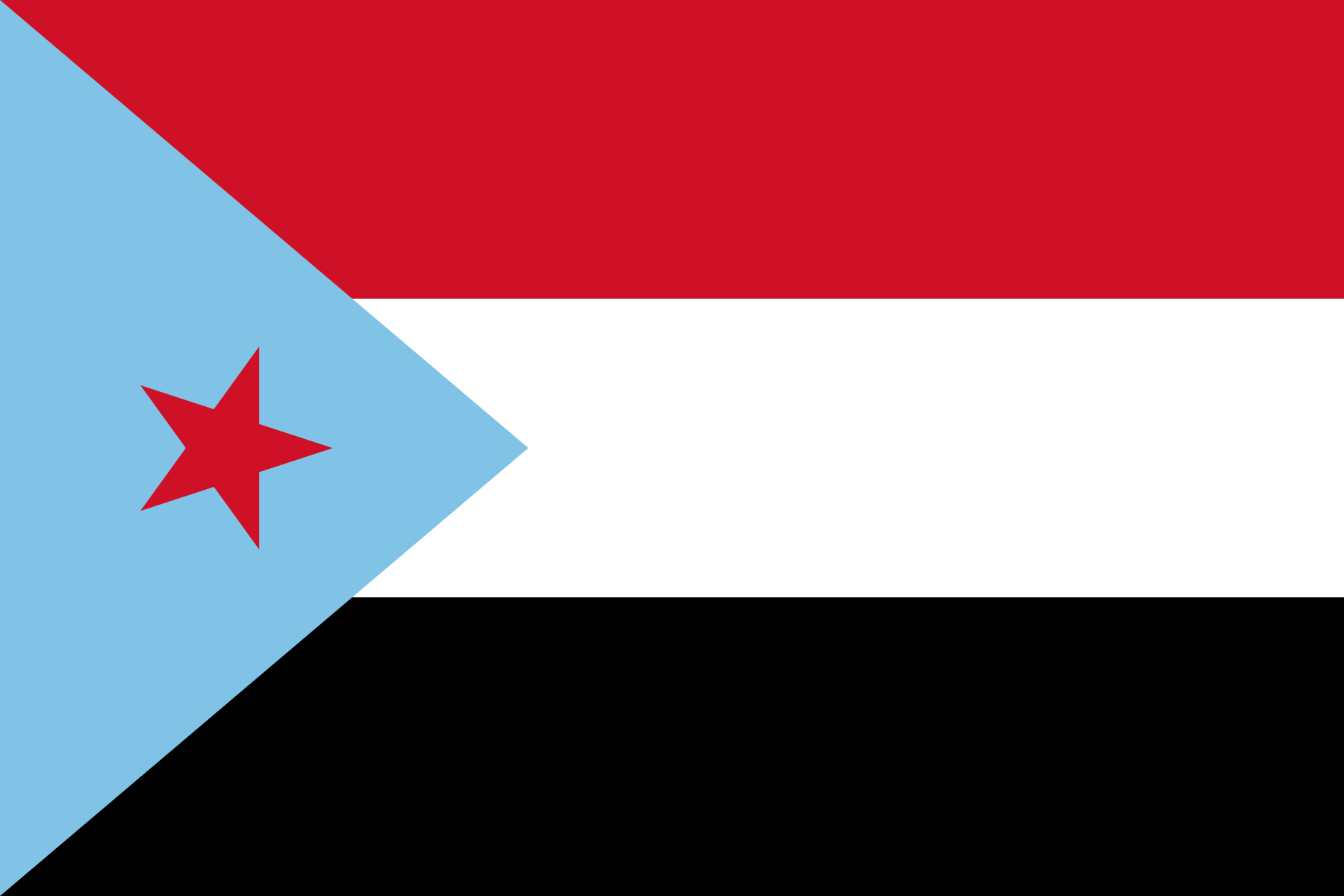
ftJlother year has elapsed since the General Assembly last debated the policies ofapartheid pursued by the racist South Mrican regime. Unfortunately, the inter- national community is powerless to put an end to the injustice inflicted on the people of southern Afri~ as a result of the discrimination and discriminatory policies practised by the illegal racist regimes in Pretoria and Southern Rhodesia. Our present debz.te is significet because it coincides with the International Anti-Apartheid
79. The discriminatory and illegal regime in Pretoria pursues heinous practices against the people of South Africa. Political detention, murder, refusal to recognize the fundamen'.:al rights and freedoms of human beings, torture of innocent people and other repressive measures intended to bolster the present regime are commonplace there today.
80. The peoples of South Africa, Namibia and Zimbabwe, like the Palestinian Arab people, are living in a situation where they are exploited by a small group of racists who have taken power arbitrarily and by means of oppression exploit the wealth and potential of those peoples and deprive them of their rights to self-determination, indepen- dence and sovereignty over their territory, as well as denying them the most fundamental rights enshrined in the Universal Declaration of Human Rights.
81. Despite General Assembly resolutions adupted at the thirty-second session concerning the multiple effects of the policy of apartheid {resolution 32/105 A-O], we note that the South African racist regime seeks to maintain its . strongholds by pursuing its imperialist colonialist policy and its illegal exploitation of the wealth and resources of those peoples. It has been clearly established that the racist regime in Pretoria is devoting millions of dollars to military operations and the recruitment of mercellaries. They are leeches sucking those peoples' blood and aiding in the oppression of the struggling peoples of Namibia, Zim- babwe and South Africa. Those regimes pursue a policy of aggression which constitutes a pennanent threat to p.::ace and security in the African continent. As I said, military aggression contl.lUeS against the independent neighbouring Mrican States: civilians are massacred a..'1d property in Angola, Botswana, Mozambique and Zambia is destroyed, all of which further confinns the aggressive nature of the racist Pretoria regime. . 82. General Assembly resolution 32/105 confinns that all co-operation with the racist regime of South Africa and other institutions practising apartheid constitutes an act of aggression in contravention of the principles and purposes of the United Nations Charter. However, we see among us countries which cynically pretend to be figh..£ag on the side of freedom in southern Mrica and which propose them- selves as mediators for a peaceful solution in South Africa, while their actions belie their true intentions. Those countries violate the resolutions and recommendations of the international community and encourage repression of the will of peoples struggling to recover their independence and freedom, because they are convinced that the con- tinued satisfaction of their interests can be safeguarded only by the oppression and exploitation of those peoples. The apartheid regime is in fact a secondary effect of imperialist colonialism intent on perpetuating its oppre8sive rule to the benefit of the white racist minority regime and international imperialism as a whole.
83. The racist regime in southern Africa could not have survived or continued to pursue their racist policies and
84. We need no further proof of imperialist collusion with the racist regimes than is given in the report submitted by the Special Committee against Apartheid {A/33/22 and CO".1], which is one of the documents that we are discussing het'e. We wish to express our appreciation to the Chairman and members of the Special Committee against Apartheid for the efforts they have made to obtain and compile information, and we wish to assert here that internationally known that the economic, military and nuclear support supplied by members of NATO and more particularly by the United States has enabled the racist rtSgime in Preturia to increase its aggressive military poten- tial, to intensify its repressive instruments and to launch projects for the manufacture of nuclear weapons.
85. Just as imperialism implanted Israel in the heart of the Arab homeland as a base for imperialist aggression, which is a threat to Arab nations and to international peace and security, simil~rly the presence of the racist regimes in southern Africa also pose a threat to the peace and security of the African peoples. Collusion between zionism, which is a form of discrimination and apartheid, and the racist regimes in southern Africa has served to confrrm the nature of the aggressive racist policies practised by those two regimes. Co-operation between those two entities in ~.u fields constitutes a threat to the independence and security of the African and Arab countries. In spite of many resolutions adopted by the Gr"1eral Assembly, the last of which was 32/105 D, which cc,ndemns continued relations between Israel and South Africa, the special report of the Special Committee against Apartheid {A/33/22/Add.2], informs us of developments in the relations between Israel and South Africa. That document confirms the attitude of Israel, which defies all the resolutions of the international community and which is stepping up its economic, trade and politicai relations with the racist Pretoria regime. Here I wish to refer to what is said in the report: "... Israel has been an important source of military supplies to South Africa" {ibid., para. ii]. Section III of that report refers to military and nuclear collaboration between Israel and South Africa.
86. The members of NATO are trying to create a buffer zone between the African continent and the racist regime in South Africa, which they consider to be an essential regional military and political Power indispensable in the vast geographical regions of Af:ica. The real aim of those countries is to free the racist regimes from all previous undertakings directed towards putting an end to the practices of apartheid and racial discrimination in South Mrica. The solutions adopted by NATO are intended to maintain the hold that those Powers have over the racists, through guararttees they give, in order to protect their interests and furtLer strengthen their authority and domi- nation in southern Africa. They are also directed towards the creation of conflicting alliances which might jeopardize the cause of the liberation movements in southern Africa.
88. As the Minister for Foreign Affairs of Democratic Yemen said in his statement before the General Assembly:
"The only way to liquidate the colonial racist regimes in Africa is through the acceleration of the armed struggle until the peoples attain their desired sovereignty and independence." {25th meeting, para. 68.]
89. This is a challenge. We must give material and moral support to the African peoples and, with this as our deep conviction, we wish to pay a tribute to the struggling patriots of South Africa, Zimbabwe and Namibia and to offer our full and unstinting support to the legitimate representatives of the people of Zimbabwe and Namibia: the Patriotic Front and the South West Africa People's Organization.
90. Democratic Yemen confirms Us principle of taking an unswerving stand alongside the national liberation move- ments in Asia, Africa and Latin America, struggling to achieve independence and establish peace, democracy and social development. Democratic Yemen strongly condemns the policies of apartheid and all methods involving aggres- sion and foreign interference in the internal affairs of other countries by imperialist Powers.
91. We also condemn the violation of the sanctions imposed on the illegal racist regimes of Pretoria and Southern Rhodesia, and we call upon all Western countries which breach those sanctions to honour their commitment under Article 25 of the United Nations Charter by respecting the mandatory arms embargo imposed on the racist r.egime in South Africa under Security Council resolution 418 (1977) and to implement the economic embargo imposed on the illegal racist Smith regime. We also call for an extension of the scope of all sanctions imposed on the racist regimes in South Africa so as to include all measures stipulated in Chapter VII of the Charter.
92. We subscribe to all the conclusions and recom- mendations of the Special Committee against Apartheid and in particular to the following:
"The situation [in South Africa] ... pose~ an urgent and inescapable challenge to the United Nations and the - international community. It requires decisive inter- national action to isolate the apartheid regime and support the righteous struggle of the oppressed people for freedom and human dignity, so as to bring about a speedy eradication ofapartheid. "fA/33/22, para. 231.}
In particular, we subscribe to all the Special Committee's conclusions and recommendations on recent developments in the relations between Israel and South Africa {A/33122/Add.2].


Many are the speakers who for a number of years have succeeded each other at this rostrum in order to censure and condemn the policy of apartheid of the Government of South Afri~l.
95. The United Nations has already adopted an impressive number of resolutions the application of which would contribute greatly to the elimination of this scourge of our time, namely, apartheid, which is a crime against humanity and a permanent danger to international peace and security.
96. On reading the declarations and statements of position of virtually all the Members of the United Nations, the question that arises in one's mind is how to understand the deep-rooted reasons for the persistf"nce in this last quarter of the twentieth century of a system of oppression and exploitation based on racism and colonialism, the only equal of which was the Nazi regime.
97. It is precisely this question to which my delegation would wish to give an answer in the interest of objectivity and with the sole purpose of inviting the Member States of our Organization and the international community to assume their full responsibility effectively to combat the odious system ofapartheid.
98. In spite of the sympathy and the complicity of certain Governmeilts and some of the international information media with the South African regime, the international community is sufficiently knowledgeable concerning the inhuman system of apartheid, which consists in racial, arbitrary and oppressive laws and regulations directed against the partisans of racial equality in South Africa and attacking pitilessly the black political movements that are fighting for freedom and justice.
99. Under those racial laws arrests and arbitrary detention, the murder of innocent persons, systematic torture and the assassination of political detainees have become common occurrences in that part of Africa.
100. That machinery of repression is also supported by law of the colonial type for the exploitation of the indigenous manpower, the plundering of the natural resources in South Africa and Namibia and bantustani- zation, aiming at the annihilation of the nation and the culture of the people of South Africa and the expropriation of the fertile lands of the coloured people in order to cast them into arid zones.
101. That regime of colonial exploitatkm has enacted laws on the repression of communism, terrorism, internal secur- ity and armed intervention by the South African regime in African States situated south of the equator. In the
102. In the view of the deleBation of Bunindi the true causes of the maintenance of apartheid in South Africa are essentially the follewing: first a belief in the theory of the superiority of certain races; secondly, the policy of coloni- zation; and thirdly, the safeguarding of strategic interests.
103. Without the survival of racial prejudices the South
~rican regim.e would never have succeeded in finding such
~por~t. allIes throughout the world today in perpetuat- mg a pohtlcal system based upon racial segregation.
104. In order to illustrate my thoughts, I should like to bring the following observations to the attention of the Assembly..
105. How can we avoid believing that racial prejudices underlie the political, military and economic collaboration which has b~en established and is being strengthened from day to day between South Africa ~md the States which have just lived through the long nightmare ofnazism and fascism, which were regimes similar to that of South Africa?
106. How can we close our eyes to the repression and enslavement of a whole people by a most barbarous police regime while officially proclamating a policy of respect for human rights and fundamental freedoms?
107. If we genuinely believe in equality, how can we accept that rescue operations are mounted for humanitarian reasons in certain cases and oppose the application of economic sanctions against a State which persistently violates the United Nations Charter and the Universal Declaration of Human Rights by its official policy of oppression and exploitation of a whole people?
108. In certain circumstances, where human rights are threatened, the Powers which block decisions in the Security Council that might put an end to that anachron- istic regime in South Africa, find that conditions for recourse to Chapter VII of the Charter immediately becume obvious, whereas the bloody repression in Sharpevil1a, Soweto and elsewhere and the acts of aggression by South Africa, on the one hand against the South African and Namibian refugees and on the other hand against the independent neighbouring States of Mozambique, Bot- swana, Angola and Zambia, do ,,\ot constitute the necessary and sufficient conditions for the application of the peaceful ·measures as provided in Chapter VII and in particular in Article 41.
109. We also note that it is the organizations on the extreme right, which have the reputation of being pro- foundly racist, that are responsible for the equipping of laercenaries sent to South Africa Namibia and Zimbabwe . ' , and to other countries still under colonial domination.
110. But a more revealing fact is the strengthening of the political, military and economic collaboration between South Africa and Israel.
111. According to the report presented by Mr. Ahmed Khalifa to the Sub-Commission on Prevention of Discrimi-
112. In political terms, the general tightening of political relations has taken the form of the establishment of diplomatic relations at the ambassador level.
113. In the military field, the Khalifa report gives us information on collaboration between South Africa and Israel in the manufacture by South Africa of the Uzi machine gun and the acquisition of the Mirage fighter. According to that report, South Africa would be prepared to finance the development of Ir,rael's capacity for pro- ducing weapons and eve~ to supply that country with uranium, provided that Israel in return would supply it with Kfrr jet fighters and other types of weapons.
114. That military co-operation has been strengthened since the visit of Mr. Vorster to Israel and is continued through the dispatch to Israel of South African naval officers and co-operation in the field of modem military techniques and methods of warfare.
115. According to the same report, Israel is apparently in the process of building several missile-launching vessels for the aparth~id regime and receiving in exchange steel and coal from South Africa.
116. Far be it from me to ~ry to provide detailed information on military collaboration between South Africa and Israel, for that would be far too ambitious on my part; but what fs certain is the strengthening. of political, military, economic and cultural relations between the regimes of Pretoria and Tel Aviv.
1-17. Thus we have to ask ourselves why these ties "of solidarity" are being developed every day between these two regimes. Some will say that South Africa needs skilled personnel and advanced Technology in order to achieve its goals of domination and that Israel wishes to secure strategic raw materials for the purpose of developing its war industries and its programme .for the procurement of nuclear weapons.
118. Israel's sympathizers have put forward the idea that
~ese rel~tions ~ave been motivated by the breaking off of diplomatic relations between the African States and Israel as a result of the Israeli aggression against the Arab countries and the Palestinian people. The proponents of this thesis deliberately ignore the fact that the decision of the African States was taken in order to protest against Israel's occupation by force of the territories of other sovereign States in spite of the provisions of the United Nations Charter and the principles contained in the Charter of the Organization of African Unity. The truth is that this alliance has been sealed as a result of the similarity between the regimes of Pretoria and Tel Aviv, because they are both profoundly racist and expansionist.
119. This strengthening of military, technical and econo- mic collaboration has no other purpose than to render inoperative Security Council resolution 418 (1977) and to
4 See document E/CN.4/Sub.2/383/Rev.1.
120. That is the reason why African countries and Arab countries must set everything in motion in order to fight against this alliance which is very dangerous to their security. It is necessary to decide on a strategy which could handle attacks on the part of these two regimes. In this context, we believe that the embargo on oil and oil products destined for South Africa is essential in our common struggle against apartheid and the aggression practised by the racist South African regime, which h,as been outlawed by mankind and condemned by the inteX'- national community.
121. We appeal to all those who have faith in the equality of the races and in the dignity of man to condf~mn apartheid, which is a political and philosophical system whose essence is similar to that of the Nazi regime, which l:aused the loss of so much human life and property and resulted in the persecution of so many innocent persons. We call on all Governments to turn away from their decision' to support the South African regime, which is engaging in an unprecedented policy of colonization and plunder in that part of Africa.
122. There can be no more doubt concerning the real intentions of South Africa as regards its policy of domi, nation. The policy practised by the South African regime against the people of South Africa and the people of Namibia is in no way different from that practised in the
count~· un(~er the colonial yoke. The savage l'epression of national liberation movements, the massacre of innocent persons at Sharpeville and Soweto and elsewhere, the policy of the destruction of national unity by bantustanization, the plundering of natural weaJh and the inhuman exploi- tation of African workers are very similar to the colonialist behaviour of the colonial Powers in Africa and elsewhere throughout the world.
123. In order to establish the link between apartheid and colonialism, it is sufficient to check the dates and the periods when the strengthening of military forces in South Mrica was decided upon. According to the report I have quoted, in 1960, at a time when several African countries were acceding to independence and at a time when the Sharpeville repression was shocking international opinion, the South Mrican regime decided to increase its military budget considerably. The second military strengthening was decided on in 1963-in other words, after the establishment of the Organization of African Unity at the Summit Conference of Independent African States, held at Addis Ababa that same year. The South African Government subsequently continued its policy of the enlargement and modernization of its military forces after the accession to independence of Mozambique and Angola. The policy of aggression and of colonial conquest pushed the South African regime to adopt in January 1976 the so-called Defence.~me~dment Act, by virtue of which South Africa
125. Since the facts speak for themselves, it is only those who are not aware of them that can be deluded. The life of the black worker becomes worse every day. Subjected to this regime of exploitation, the coloured man cannot enjoy the economic benefits that he has helped to produce in the most difficult and most degrading conditions. The invest- ments and banking transactions in that country take into account this shameful and inhuman exploitation in calcula- ting their profits.
126. Meanwhile, well-informed politicians have attempted to compare apartheid to violations of human rights throughout the world, but this parallel is inaccurate, because not only does apartheid ignore the polltical and civil rights of the people of South Africa but it goes so far as to deny all of the fundamental rights and freedoms inherent in the human person. The black man and the Coloured man is reduced to a state of slavery and permanent persecution. The black man or Coloured man is deprived of his right to a motherland in the land of his ancestors. Expelled from their homes and their fertile soil. in order to be herded into arid regions, those who are not of the white race are undergoing a systematic process of dehumanization which knows no precedent.
127. In order to fight apartheid effectively, we must first recognize what its true status is. As has been mentioned earlier, apartheid is nothing but racism impregnated with colonialism and imperialism. Apartheid is a crime against humanity. That means that the whole international com:_ munity and all States, whether or not Members of our Organization, have the sacred duty of prosecuting and condemning all those who have been guilty of this serious
outi'~6e against the multiracial society which we must all build. It also means that we must fight this scourge of our time and put an end to all political, cultural, economic and military co-operation with it.
128. The condemnation of the racist South African regime in international forums must be accompanied by specific actions which exclude any assistance to that system. It is disturbing to note today that certain countries are expand- ing their relations with the racist South African regime" in the economic~ military and even nuclear fields.
139. My delegation urges the Security Council to contem- plate the application of Chapter VII of the Charter, including the measures provided for in Article 41, against that State, whose policy is a negation of the purposes and principles of the United Nations Charter and a flagrant violation of the Universal Declaration of Human Rights.
140. The time has come to decree economic sanctions against this regime that engages in repression against the peoples of South Africa and Namibia. It is to be hoped that the Security Council will take a decision more quickly than it did in regard to military and nuclear co-operation with South Africa.
130. The racist South African Government draws financial and commercial profits from these large investments by Western countries. Thanks to this capital, the South African economy will be less vulnerable to the economic sanctions that sooner or later will be decreed by' the United Nations, which must face up to its responsibilities if it is to survive.
141. We have the firm hope that the Security Council will act in the same way as the General Assembly has done. Under its resolution 32/105 G the Assembly calls upon "all States to cease economic collaboration with South Africa and to take effective action to prevent such collaboration by corpor;lltions within their jurisdiction" and to "impose an embargo on the supply of petroleum and petroleum products to South Africa and on investment in the petroleum industry in South Africa".
131. The Western countries which fought against the Hitler regime cannot support the Vorster and Botha regime on the pretext that they claim that one of the pillars of the free world is in South Africa. -
132. Instead of advice to engage in non-violence, which in , these circumstances amounts to resignation, an end must be put to military, political, economic and cultural collabo- ration with the South African regime.
142. It is inadmissible for millions of innocent persons to be sacrificed for material or strategic interests which in any event have no future, because these peoples will triumph'in the end.
133. After the Sharpeville and Soweto massacres, the people of South Africa have the inalienable right to continue their struggle to take power by all the possible and appropriate means of their choice, including armed struggle. Faced with Hitler's dictatorship and repression, all the freedom-loving peoples took up arms to safeguard their dignity and their lives.

For almost 30 years now the international community, and particularly the United Nations, has been faced with a most heinous and condem- nable situation, a situation that has been denounced time and again and has become the shame of mankind in the twentieth century, in terms both of human dignity and of human rights, a situation that poses a serious threat to international peace and security. That situation is con- stituted by the apartheid policy of the Government of South Africa.
134. To repel aggression, the Western Governments appealed to their Communist comrades for solidarity. Why cannot the liberation movements in southern Africa act in the same way when they have knocked at other doors in vain or, more seriously still, when the peoples they represent are the victims of a criminal system supported by the free world, which is the supplier of deadly weapons, fighter aircraft and machinery for the torture of a peaceful people that is clamouring only for dignity and equality?
144. When, two years ago, it decided to consider this question in plenary meetings, our Assembly wished to demonstrate its very serious concern at the grave danger both to Mrica and to the international community posed by the policy of apartheid of the Government of South Africa, a policy universally condemned as a crime against humanity, and to define the ways and means capable of removing this scourge so that southern Africa might become a multiracial, democratic society providing equal opportunities for human progress to everyone.
135. Confronted by the intransigence of the South African racist regime, the international community must support the freedom-fighters and give the national libera- tion movements of South Africa material, moral, political and diplomatic assistance that could enable them to triumph over apartheid'and racism.
136. My delegation appeals to the trade unions to help thr non-white workers in South Africa to free themselves from this system of exploitation; we appeal to them to boycott the transnational corporations which are investing in South Africa.
145. Recent developments in the situation in that part of the world-and there are certain aspects, by no means the least important, which our Organization seems unable to control-hardly give any grounds for optimism.
137. We earnestly hope that the press and other infor- mation media will show the public the true face of apartheid. We appeal to all the international, governmental
146. Moreover, the fact that this year has been proclairried International Anti-Apartheid Year and will soon witness the
147. In that connexion we should like to congratulate the Special Committee against Apartheid on its very substantive report, which will serve as an inspiration to our Assembly in the drafting of a whole range of measures to be taken to isolate the South African regime and destroy apartheid.
I
148. The Universal Declaration of Human Rights, adopted 30 years ago, expressed and solemnly proclaimed the aspirations of mankind, which, after the scourge of war and the untold suffering that it had caused, was prepared. to imagine a better world for the future.
149. Twenty8eight of the 50 sentences of the Declaration ~ which the universally adopted human rights are listed begin with the words "Everyone has the right"or "Everyone is entjtled"; eight others beginning with the words ~'No one shall be" are designed to pro~ect us against all denials of fu.'1damental rights and freedoms.
150. All those arti91es have one aim: to guarantee to everyone the same rights "without distinction of any kind, such as ~ace, colour, sex, language, religion ...".
151. This Declaration, whose importance is now amply recognized, embodies a set of values to which States and the international community remain strongly attached. Witness to this is the extent and intensity of debates on this question, both in the General Assembly and in many other international conferences. The reference made to this Declaration in the Constitutions of most of our States is also proof of this.
152. What is the situation after the adoption of this Declaration?
153. Does the debate in which we are taking part today and which has, unfortlmately, become a ritual, allow us to see some ray of hope for the black peoples of southern Mrica, who are plunged in concentration8camp darkness? Almost 30 years ago, the word "apartheid". symbolic of a political doctrine based on contempt and on the subordina8 tion of the black man to the white man, was fIrst used in South Africa. To anyone who might doubt the essentially and fundamentally racist character of that policy, we could reply by quoting its apostle. I shall quote this despite the great revulsion I experience in reading it. He said:
"One of the most marked phenomena of the world in which we live is the diversity of human races. They were created separate. That separation should be maintained, even when economic and other circumstances create a situation in which the racial groups mix. To this end, we must maintain and develop in whites a feeling for their colour, so that the purity ofthe race may be maintained. The white race in South Africa, inheriting Western Christian civilization, has a double mission to fulfil: one, vis-a-vis the other members of the community of nations of Western Christian civilization; the other, vis8a8vis races of other colours, with whom events have brought them
154. Moreover, in article XII of the Statutes of the National Party of South Africa it is stated: "The Party considers itself to be the Christian mandatory of the European race .....It is absolutely opposed to all mixing between European and non8European races".
155. These extracts not only enlighten us as to the real dimensions of the South African'Government's racist policy but also explain the exis~ence of many powerful accom8 plices of this regime which proclaims itself to be the "Christian mandatory of the European race". These power8 ful accomplices have helped it to defy the international community and to pursue obstinately and with impunity its inhuman and barbarous policy. .
156. It would be of little use to evoke once more before this Assembly, since they are so well known, the crimes, atrocities and other acts of aggression of which the South Mrican regime has been and is guilty. We should, for our part, like to stress three aspects that we feel are most characteristic of it in its present state.
157. First of all, with its back to the wall, apartheid becomes more brutal and more oppressive, as we can see from the batch of abhorrent laws promulgated and applied by the South African regime in violation of the most fundamental human rights, and from the arrests and massive assassinations of old men, women and,children. Botha's uncontrolled apparatus of J;'epression has now at its disposal a tool which it uses as it wishes to maintain three fourths of the population in a state of submission. The latter find themselves more than ever reduced to the stl;te of submission and kept in a subhuman state. The latter fmd themselves more than ever reduced to the status of foreigners, of wandering herds hunted and harried in their own country, and this is further reinforced by the policy of bantustanization, which is a violation of the territorial integrity of South Africa and is practised in order to create cheap reserves bf labour at the disposal of the white lninority and the multinational corporations.
158. What is also important to stress is that southern Africa has, in our continent, become a turbulent and insecure region full of dangers that are ever increasing as a result of aggressions and process of terror for which the full.- responsibility must be borne by South Africa. The result is that general instability, dangerous tension and confusion develop in the area, thus threatening international peace and security there.
159. Finally, we should like to stress that all actions taken so far against apartheid have met with the arrogant resistance of the Government of Pretoria, thanks to the complicity of certain Western countries which are arming South Africa, providing it with the technology that it needs-even nuclear technology-and making a great num- ber of investments there, as well as in Namibia and Zimbabwe. Indeed, they are not the only partners, but the role they play, as I stressed here two years ago, strengthens
162. Cameroon for its part has taken an irrevocable stand alongside the peoples of southern Africa in their legitimate struggle for the creation in that region of a multiracial society based on freedom, equality and respect for the human person.
160. Some among them, in the course of the present session, have made statements suggesting that they will be alteiing their traditional policies vis-a-vis the racist regimes of southern Africa. Others have taken steps albeit hesitantly, towards a redefinition of their co-operation with Pretoria.
163. I would not wish to conclude without offering to this Assembly for reflection the following words of His Excel- lency Ahmadou Ahidjo, the President of our Republic:
161. We note with interest all these undertakings, but the situation being what it is, unless these declarations are translated into action, we will have to apply without restriction the relevant resolutions adopted by our Organi- zation in order to put an end to the reign of apartheid in South Africa. We are convinced that the time has come to implement all the measures provided for in the Charter if we want to put an end to this abhorrent regime, which tramples underfoot the most fundamental rights of human beings, sows terror in the region and threatens international peace and security. For, as the President of the United Republic of Cameroon, His Excellency Ahmadou Ahidjo, said:
"Human rights are indivisible and must be respected everywhere and by all peoples. It is an illusion to believe that we can defend them in one part of the world and allow them to be violated with impunity in another.
"To the determination and the arrogance of the apostles of racial domination, we must reply with equal determination and unfailing strength in the support that we provide for the struggles of the liberation movements for the dignity of the peoples of Zimbabwe, Namibia and Azania."
"It is increasingly evident to all that the policy of racial domination in South Africa, in Namibia and in Zimbabwe constitutes a grave threat to peace and that it is in the
The meeting rose at 5.55 p.m.