A/34/PV.56 General Assembly
THIRTY·FOURTH SESSION
Page
28. Policies of apartheid of the Government of South Africa : (a) Report of the Special Committee against Apart- heid; (b) Report of the A d Hoc Committee on the Drafting of an International Convention against Apartheid in Sports; (c) Report of the Secretary-General

Members will recall that the General Assembly, at its 4th plenary meeting, on 21 September 1979, decided that organizations having a special interest in the question now before us would be permitted to be heard by' the Special Political Commit- tee. In this connexion, I should like to announce that the following organications have asked to be heard on this item: the Afro-Asian Peoples' Solidarity Organization, the American Committee on Africa, the International Committee against Apartheid, Racial Discrimination and Colonialism in Southern Africa and the World Peace Council. Therefore I should like tosuggest that the General Assembly invite the Special Political Com- mittee to meet on Monday, 12 November, for the pur- pose of hearing those organizations. May I consider that the Assembly agrees to that suggestion? It was so decided.
I should like to remind delega- tions of the decision taken by the Assembly at its 54th plenary meeting, held yesterday, to close the list of speakers today at noon. I also request that represen- tatives who wish to submit draft resolutions do so as soon as possible.


Only those who have not personally suffered Irtrn any offence against human dignity can come to this rostrum and speak calmly and coolly about the Fascist regime of South Africa. Only Hitler's Germany has gone as far in ignominiousness, persecution and
NEW YORK
4. That is the South Africa of the Technicolor adver- tisements in the major North American journals, the fortress of fear of the troglodytic Boers, the South Africa to which one travels, if one can first establish oneself as an Aryan Fascist, in magnificent Boeing air- craft, racially restricted like the buses of Alabama. That is the paradise of multinational corporations and diamonds, the facets of which drip with the blood of the latest murdered black.
5. How can we repeat, year in and year out, the catalogue of crimes and not have indignation upset the digestion of those for whom the matter of apartheid is no more than an item that they are compelled to take up annually in the General Assembly and that they discuss with the same casualness with which they might taste Blue Point oysters or sip a glass of chilled Pouilly Fuisse? How many Sowetos are necessary for the periodic champions of human rights '.J raise an ad- monishing finger against their Pr-v o associates?
6. The permanent representatives ) have to live in this country, where the Establishme.it long ago rejected the principled temperance of Ralph Waldo Emerson and of Whitman of the flowing beard, not to mention the old-fashioned moralism of Thoreau, face daily con- tradictions, such as the murder of the four blacks in Carolina who were killed by hooded whites, and the pretended commotion over the fundamental rights of man.
7. Hypocrisy has no limits. This we have seen in the past few days, when the well known defoliators and killers of peaceful water-buffaloes and the colonizers of Indo-China have bemoaned the fate of those who had previously been their own victims. It is the very coun- tries which hand down vetoes in the Security Council that stubbornly prevent the international community from imposing well-deserved sanctions on the criminal clique in Pretoria and then proclaim to one and all that they are the defenders of the so-called free, Western and Christian world. It is impossible to say, like the man from Nazareth, "Forgive them, Lord ...", for they do know what they do.
8. Almost 25 years ago, the People's Congress of South Africa declared:
9. The peoples of South Africa, blacks and whites together as equals, fellow-countrymen and brothers, adopted their "Freedom Charter," vowing to struggle courageously and to spare no effort until the proclaimed democratic changes were achieved in their oppressed homeland.
10. Twenty-five years later, the implementation of the "Freedom Charter" continues to be the loftiest goal of the struggle of all South Africans at this critical and decisive juncture in their efforts to rid themselves of col- onialism, racism, racial discrimination and apartheid and win their inalienable right to self-determination and national independence.
11. At its Extraordinary Ministerial Meeting, held at Maputo from 26 January to 2 February 1979, the Co-or- dinating Bureau of the Non-aligned Countries declared that
"Southern Africa is the region where imperialism, using its last bastions - the colonial, racist and apart- heid regimes-subjects the peoples of Zimbabwe, Namibia and South Africa to the most vicious forms of aggression, oppression and exploitation in order to safeguard its various interests, including economic interests, in the region. They engage in military and other operations against neighbouring sovereign States, seriously threatening international peace and security. "For the survival and development of the big monopoly groups,"-the Ministers for Foreign Af- fairs of the countries members of the Bureau af- firmed-"imperialism continues to intensify its wan- ton exploitation of the peoples and wealth of southern Africa. As a result, the racist, illegal minority regimes of southern Africa guarantee the political, military and economic hegemony of im- perialism in the region, and are reinforced by certain Western and other countries, through financial, technological, material and political means, with a resultant increase in the aggressive capacity of those regimes." [A/34/126-S//3185, annex, paras. 19 and 20.J
12. The Maputo final communique is daily becoming more relevant. In the past few weeks, Zambia and Angola have been subjected to new acts of military ag- gression by the racist regimes of southern Africa. The support of well known Western Powers, who stubborn- ly refuse to cut their numerous ties with Pretoria, makes it possible for those regimes to sustain and develop their
13. The recent visit of the bandit Jonas Savimbi to the United States is additional proof of the commitment of North American imperialism to the racists of Pretoria and against the heroic people of Angola.
14. The recent report of a nuclear explosion by South Africa indicates a decisive step by the apartheid regime which threatens international peace and security and demands urgent concerted action by the United Nations. The gravity of this report is emphasized by the ex- pansionist and aggressive policy of South Africa against the front-line countries.
15. Once again, the responsibility for these serious events rests with those Western countries and Israel that are developing nuclear collaboration with South Africa. Their sole objective-as the African National Congress has declared-is to intimidate the oppressed people of South Africa and the international community and force them to capitulate in the interest of preserving the apartheid regime, thus guaranteeing the tremendous profits of the multinational corporations of those coun- tries.
16. The determined actions of the fighters of the African National Congress, especially its armed wing, the Umkhonto we Sizwe (the spearhead of the nation), show that they will not be intimidated by nuclear weapons or any racist threats. The extension of their operations has been recognized even by the censored press of Pretoria, and that Government has been forced to declare certain areas "war zones".
17. The heroic struggle of the people of South Africa and its vanguard, the African National Congress, is worthy of the full support of the international com- munity. It is necessary to increase material, financial, political and military assistance to those who are strug- gling for the freedom of South Africa, as called for by the non-aligned countries.
18. It is necessary to deal with the racists' most recent propaganda campaign on the changes which they have announced, but that are of a purely cosmetic nature. Their objective is to deceive world public opinion and legitimize the perpetuation of apartheid in a new guise, to create the false impression of a change in order to gain time and to minimize the revolutionary situation by maintaining the repressive status quo and increasing the acts of aggression against neighbouring countries.
19. The action of the Government of Sweden in deciding to put a stop to investment in South Africa is undeniably worthy of praise. If other Western Govern- ments were to follow that example, tne days of the racist regime would be numbered.
20. The policies of apartheid, especially the so-called bantustanization, the brutal repression of those who courageously oppose that regime and the constant acts of aggression against the Governments of independent neighbouring countries must all be condemned by the
21. The policy and the actions of the apartheid regime constitute a threat to international peace and security. Resolution 3411 C (XXX) of the General Assembly pro- claimed that the United Nations and the entire interna- tional community have a special responsibility towards the oppressed people of South Africa and their national liberation movements. Any collaboration with the racist regime of South Africa is a hostile act towards the South African people and an arrogant challenge to our Organization and. to the peoples of the world.
22. It is therefore inadmissable that the major coun- tries of the West, including the United States, France, the United Kingdom and the Federal Republic of Ger- many, should maintain close collaboration with the racist regime, a collaboration which is the fundamental obstacle to the liquidation of that regime and the elimination of the inhuman and criminal system of apartheid.
23. The noli-aligned countries have offered their full co-operation to the national liberation movement of South Africa, the sole authentic representative of the South African people in their just struggle for freedom, self-determination and independence. That struggle must receive the unconditional and unanimous support of those who claim to be supporters of the independence of the peoples of the world. For that reason, it is in- dispensable that we give all necessary assistance to the liberation movement in South Africa, that we reiterate the commitment of the United Nations to the fight for the eradication of apartheid and that we condemn any form of collaboration with the racist regime, which is the living antithesis of the purposes and principles of the Charter of our Organization.
24. Member States must cut -off diplomatic, military, nuclear, economic and other relations with the racist regime of South Africa; take action to prevent transna- tional corporations, banks and other institutions from collaborating with the apartheid regime; take the action necessary to end the granting of credits to the Govern- ment of South Africa by IMF; prevent the sale of krugerrands; deny all facilities to airlines and Shipping lines to or from South Africa; put an end to all trade relations with South Africa; and support all interna- tional sanctions against the racist regime of Vorster.
25. Words are not sufficient; we must proceed from words to deeds. Those who do not stand up today against the racists in South Africa will forever be brand- ed as enemies of mankind.

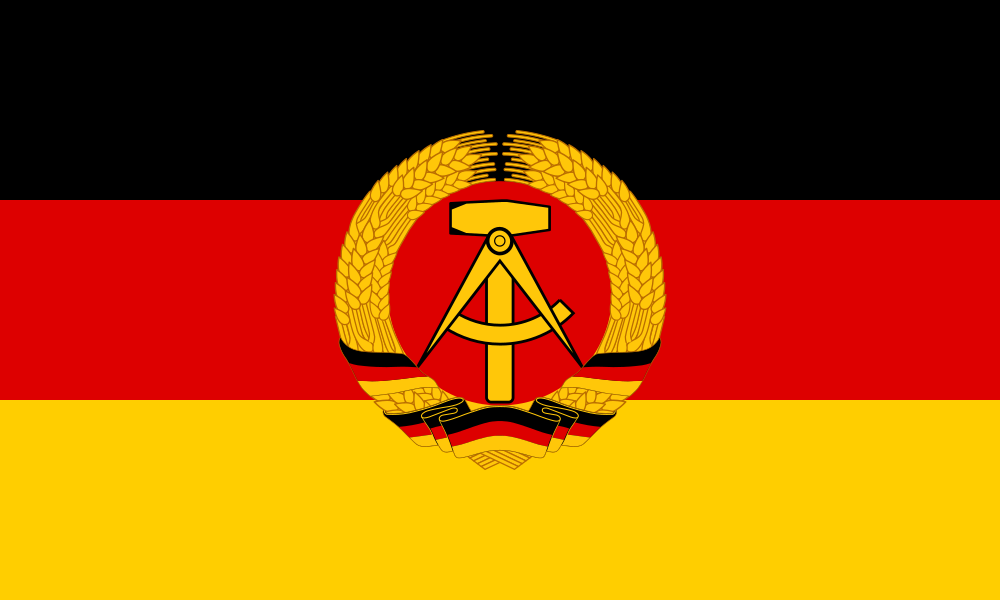
Permit me, at the outset, to convey through you our most cordial congratulations to the representatives of the Union of Soviet Socialist Republics on today's an- niversary of the Great October Socialist Revolution. That event, which is of historic significance for the en- tire world, ushered in a new era of the people's struggle for national and social liberation against colonialism, racism and apartheid. Persistently pursuing its policy of peace, the USSR has, for more than 60 years now, con-
28. The changes in the balance of forces in the world, and in particular in the south of the African continent, have created new and more favourable conditions for waging the liberation struggle. An important factor, in that context, is the solidarity and support offered by the front-line States, the Organization' of African Unity lOAU], the movement of non-aligned countries and practically all progressive forces to the peoples of southern Africa in their struggle. The International Anti-Apartheid Year and the international mobilization against apartheid prove that the- peoples fighting for freedom, independence and social progress can rely on many powerful friends in the world at large. Today, this solidarity has become manifest in a thousand ways. On all continents, we witness increasing abhorrence and hatred of apartheid and racism, which find their expres- sion in powerful actions. The struggle for national liberation in southern Africa has gained significant momentum. The fighters of the South West Africa Peo- ple's Organization lSWAPO], of the Patriotic Front and of the African National Congress are ever more closely encircling the anachronistic racist regimes. It is owing to the joint efforts undertaken by all progressive forces that today apartheid is condemned as a crime against humanity and denounced as a threat to peace and international security and that, more clearly than ever before, its roots are being revealed and its allies un- masked. Today, the social nature of the criminal policy of apartheid and its promotion and encouragement by the international capitalist monopolies, as well as the manoeuvres of reactionary forces aimed at perpetuating the system of oppression and exploitation of the peoples in southern Africa, have become more transparent than ever before.
29. But the results of the International Anti-Apartheid Year also include the awareness that the roots of racism and apartheid have not yet been torn up. The ruling circles in Pretoria are escalating their aggresive and ter- rorist policy. Backed by influential circles of the North Atlantic Treaty Organization [NATO] and international monopolies, they are trying to perpetuate their power at any cost.
30. By means of a system of discrimination against the black African majority, which has been developed and intensified over decades and which covers all social spheres, the racists have created particularly favourable conditions for preserving their power in South Africa. That, however, means enslaving economic exploitation as well as social and political oppression for more than 20 million Africans. The apartheid system denies to the African population the enjoyment of fundamental social, economic, political and cultural rights. Thus, the regime is securing for its own purposes an extremely high degree of exploitation and favourable conditions for profit-making by national and foreign monopolies.
31. The brutality of the racists does not even spare children. The International Seminar on Children under
33. The proclamation by the regime of a so-called in- dependence for Venda shows all too clearly how fitting this assessment is. This action was condemned by the United Nations Security Council.s The German Democratic Republic will strictly abide by the call to refuse any recognition whatsoever to that creation.
34. The intensification of the racist policy of apartheid in South Africa goes along with an escalation of Pretoria's aggressiveexternal policy.
35. Time and time again, the world public is alerted to new acts of aggression perpetrated by the apartheid regime. Angola and Zambia are permanently exposed to criminal attacks by the racist mercenaries. In 1976, 1,400 people became victims of Pretoria's slayings and terror in Angola alone. Only a few days ago, the Securi- ty Council, in resolution 454 (1979), once again con- demned South Africa's unscrupulous acts of aggression. The German Democratic Republic supports the demand for increasing assistance and support to the People's Republic of Angola and the other front-line States in order to strengthen the latter's defence potential. The South African war machinery is in full swing. The military budget of the apartheid State has risen to a sum of more than 2 billion rand.
36. The apartheid regime is the largest producer of weapons in the southern hemisphere and, despite a bind- ing arms embargo, continues to receive highly sophisti- cated military hardware of Western origin, as well as support in developing its own production of weapons. The objective and purpose of apartheid have been-and remain-to perpetuate and secure the political and economic power of the white minority, the systemof ex- ploitation and oppression in South Africa, as part of world imperialism and so as to have a bastion against the liberation of the African continent. It is the concern that those positions might possibly be lost, and not in any way a concern about human rights, that determines the policy of influential circles in States of NATO with regard to southern Africa.
37. The peoples of Namibia and Zimbabwe and their legitimate representatives, SWAPO and the Patriotic Front, are facing massive attempts to direct their development in a neo-colonialist manner. Negotiations drawn out over months and a permanent flow of so- called proposals were helpful only in giving the South African occupants enough time to enforce an internal
38. The United Nations bears a great responsibility for ensuring the independence and self-determination of the Namibian people. Decisions of the Security Council, particularly its resolution 385 (1976), and the relevant resolutions of the General Assembly outline the meas- ures required. South Africa must unconditionally end its illegal occupation, release Namibian political prisoners and respect the territorial integrity of Namibia. Namibian territory must no longer be misused as a deployment base for acts of aggression perpetrated by the racists against free African States. The United Nations has at its disposal the means to force South Africa to comply with these demands. Those means must be applied.
39. There is irrefutable proof of the complicity of cer- tain Western circles with the apartheid regime; they do, in fact, have common fundamental interests. The responsibility of those circlesfor the continued existence of apartheid cannot be denied. At the Sixth Conference of Heads of State or Government of Non-Aligned Countries, held at Havana from 3 to 9 September 1979, a very serious appeal was addressed to those States which have developed to the greatest extent their economic, military and nuclear collaboration with Pretoria. The Havana Political Declaration reads:
"It [the Conference] stressed that this co-operation had not only facilitated the establishment and con- solidation of the apartheid regime's repressive and oppressive apparatus but also increased Pretoria's war potential, including its plans for nuclear develop- ment, which constitute a threat to the South African people, independent neighbouring States and inter- national peace and security." [See A/34/542, annex, sect. I, para. 76.]
40. The recent debate in the Fourth Committee on agenda item 92, on the activities of foreign economic and other interests." made clear anew the dimensions of that collaboration. Backed by State guarantees, the foreign trade of imperialist Powers with South Africa is rapidly increasing. Capital exports to Pretoria are also constantly growing. Since 1970, foreign investments alone have expanded by 300 per cent. Since 1972, banks of the major imperialist Powers have made available to the apartheid regime$5.5 billion to pursue its opp ssive and aggressive policies.
41. In the military field, too, collaboration is being continued and even intensified. Documents of United Nations bodies indicate that imperialist States, as wellas transnational corporations such as Lockheed, Rolls- Royce, IBM, MBB and Siemens, actively contribute to developing South Africa's military machinery. A wide range of sophisticated weaponry and weapon systems are manufactured with the aid of Western capital or on the basis of Western licences. Particularly threatening is nuclear co-operation. Only recently the world heard the alarming news that a nuclear explosion had been
" . . . we emphasize ... that, in spite of "denials by South Africa and its Western accomplices in its diabolical strategy, a nuclear-weapon programme is possible for South Africa only because of the assist- ance and co-operation it has always received from some Western Powers and lately from Israel, which have consistently supplied it with technology, elec- tronic equipment and other materials. Because of this complicity and collusion, South Africa has not had any incentive to be a party to the Treaty on the Non- Proliferation of Nuclear Weapons or to disguise its evil intentions." [47th meeting, para. 13.]
42. More resolute action has to be taken by the Securi- ty Council. The threat to the African countries, and to peace and security throughout the world, must be firmly rejected. Pretoria must not be allowed to use the atomic weapon to exert pressure, or even plunge the world into a nuclear holocaust. The report of the United Nations Special Committee against Apartheid includes demands [see A/34/22, paras. 212-33/] which must be satisfied if the apartheid rule is to be overcome and the rights of the South African people secured. The German Democratic Republic supports these demands. My country wishes them to be embodied in resolutions of the thirty-fourth session and to form a basis for relevant decisions of the Security Council. It is most urgent that the following demands be fulfilled.
43. First, nuclear collaboration with South Africa must be halted immediately. Under Chapter VII of the Charter of the United Nations, the Security Council should adopt binding decisions committing States to forswear all supply of equipment and financing of ac- tivities for the carrying out of the South African nuclear programme.
44. Secondly, the arms embargo must be strictly ob- served and extended to all military spheres. The Com- mittee of the Security Council established by resolution 421 (1977), should consistently follow up any indication of the supply of weapons and military equipment to South Africa and disclose such supply. Military col- laboration with South Africa must be prevented by all States.
45. Thirdly, activities of imperialist corporations in support of the racist regime must be counteracted by comprehensive economic sanctions, in particular an oil embargo and the cessation of investments.
46. The struggle against racism and colonialism in southern Africa is a question of burning topicality. The need is now more pressing than ever before for pro- gressive mankind to support actively the just cause of
47. In this context, social organizations which are ac- tively engaged in the struggle against colonialism, racism and apartheid, and mobilization of the power of the mass media play an Important role. The delegation of the German Democratic Republic appreciates that in existing resolutions much attention is given to those aspects of the struggle against apartheid. Important im- pulses will result from the international conference against collaboration with the racist regime which it is proposed to hold next year. Thus, new forces will be stimulated to join the struggle of the oppressed peoples against the racist rulers and their backers.
48. Both within and outside the framework of the United Nations, the German Democratic Republic, as a member of the Special Committee against Apartheid will always support the just cause of the South Africa~ people. The Secretary-General of the Central Commit- tee of the Socialist Unity Party of Germany and Chair- man of the Council of State of the German Democratic Republic, Erich Honecker, reaffirmed this during his tour of African countries in February of this year as follows:
"In their arduous struggle, the peoples of Africa can firmly rely on the German Democratic Republic and the other States of the socialist community."


The adoption of the Universal Declaration of Human Rights, three decades ago, established common standards for the achievement by all peoples and nations of those rights, as provided for in the United Nations Charter. That Declaration dictated and underlined the in- violability of the dignity, equality and freedom of all human beings. The letter and spirit of the Declaration in effect represent the commonly accepted norms whereby the dignity, worth and humanity of beings are held sacrosanct. Those are values born of human beings.
50. Since the adoption of the Declination, our Organization, by the adoption of other declarations and resolutions, has painstakingly sought to attain that goal by the eradication of colonialism, injustice and inequali- ty. It is a fact that those ills are still rampant. But nowhere in the world is the mechanism to deny the rights enshrined in the Declaration as institutionalized as it is in racist apartheid South Africa. It is not without significance that this Organization records that the very foundation and existence of the Pretoria regime is geared to the promotion and practice of the denial of the humanity of the overwhelming majority of the peo- ple of South Africa. That is why this Organization, despite all efforts, continues to witness the unparalleled intransigence, arrogance and brutality demonstrated by that regime. The question is not why South Africa engages in such atrocities and demonstrates such stub- hornness, but why this defiance has been allowed to continue for so long,
51. In considering the policy of apartheid, therefore, it must be clearly pointed out that the persistence of that policy within South Africa has strong relevance to the
52. The massacre of innocent school children in Soweto and other townships, the murder of Steve Biko at the hands of the notorious racist "Gestapo", of Solomon Mahlangu and many other patriots, are among the most criminal and outrageous acts of the apartheid regime.
53. The systematic dismemberment of that country, the repression and terror, and the campaign of sustained distortions, treachery and lies, are characteristic of the mode of operation of that regime. In unleashing the decimation of the population of the country, the racist Pretoria regime has continued to mount a constant bar- rage of human indignities and systematic and ruthless repression, torture and imprisonment against the African people of South Africa. This gloomy picture of the range of physical, moral and legal monstrosities in South Africa not only goes beyond the violation of human rights but also constitutes an absolute and most elaborate negation of all the laws of humanity.
54. Also, in giving so-called independence to its sur- rogates in the so-called Bantu homelands of Bophuthat- swana and Venda, the regime is compartmentalizing apartheid for easier, more efficient stock-taking and management of the system. It is a design to create large concentration camps-the so-called independent States-which will enable South Africa to dismember the country and deprive the black people of South Africa of their citizenship.
55. The system of pass laws, expropriation of land, in- ferior or total denial of education, lack of health ser- vices and, above all, confinement in bantustans, and deprivation of political rights are among the monstrous atrocities committed by the racist regime against the black people of South Africa-simply because of their colour and their determination to live in freedom and dignity.
56. My delegation pays a tribute to the fallen heroes of the struggle and to those who still languish in banish- ment on the infamous Robben Island because of their opposition to apartheid.
57. Since African resistance is as old as racist oppres- sion in South Africa, the death and banishment of freedom fighters have been a stark feature of the strug- gle and a necessary sacrifice for the cause of justice, which is ultimately bound to triumph. This is a fact of history: where there is oppression, there will be resistance.
58. The systematic racial repression and acts of genocide practised by the South African regime are characteristic of the Nazi era, The world went to war and made immeasurable sacri fices in defence of humanity against the annihilation of a people. To most, the end of the Second World War meant the official demise of nazism, but to those who have continued to languish under the policy of apartheid and colonialism, nazism is still a contemporary feature. The institu- tionalization of the apartheid system of incarceration in South Africa and Namibia, the detentions, political assassinations, unfair and summary trials, and genocide
59. The continued affront to international opinion, and the flagrant flouting of resolutions of this Assembly and of the Security Council are largely made possible by the support extended by those Western countries and others, through clandestine operations, direct invest- ment and trade. The transfer of technology by some Western Powers to the South African regime has ena- bledthat regime to detonate a nuclear device.We strongly condemn that collaboration and reject the notion that collaboration with the regime through investment and transfer of technology supports the resolute determina- tion of the African people to resist apartheid and col- onialism. On the contrary, such collaboration,with the additional force derived from nuclear capability, only serves to strengthen the hand of the South African regime in resisting change. Such a situation serves to il- lustrate the evil dimensions of that partnership.
60. It subsidizes the South African programme of en- trenching its abominable policies in total violation of human rights and consolidating its military capability and racial instrument of oppression. This connivance has also enabled the South African regime, in refining its system of repression and genocide, to commit atrocities and launch repeated aggression against the sovereignty, territorial integrity and independence of the neighbouring African States of Angola, Botswana, Lesotho, Mozambique and Zambia, and to perpetuate its illegal occupation of Namibia with impunity.
61. This is a serious challenge to the entire interna- tional community, and particularly to those States that have willingly allowed themselves to be accomplices of this system which denies the people of southern Africa the enjoyment of fundamental human rights and the ex- ercise of their right to self-determination and in- dependence. The intransigence of that regime, and the intensification of its repressive and aggressive machinery, cannot be allowed to continue unchecked. It is this consideration which guides my Government in continuing to see no inconsistency between our defence and promotion of fundamental freedoms and human rights in the world, and our support for the armed strug- gle being waged by the patriots of southern Africa, through their liberation movements, in seeking to exer- cise their right to self-determination and independence. It is thus encouraging to note that the international community has not been found lacking in this endeav- our and has continued to respond positively in exten- ding moral, diplomatic and material support to those liberation movements, coupled with other measures to bring international pressures to bear upon that racist regime.
62. But the struggle against apartheid is a political issue, the social consequences of which stem from the core of the system itself. Therefore, in extending humanitarian support to the sufffering people, the in- ternational community must constantly guard against
63. Consideration of a negotiated political arrange- ment requires, among other ingredients, the recognition of the equality of peoples. It requires an atmosphere and system where relevant institutions are democratic enough to provide, as a minimum, freedom to exercise political rights.
64. However, those conditions are non-existent under the system of apartheid. Therefore, in such cir- cumstances where the pursuit of conditions necessary for negotiation is hampered, it is an untenable position to argue that patience would yield positive results. Since the racist and apartheid regime has refused to recognize the equality of peoples, continues to entrench the already institutionalized racial discrimination and to im- pose unilateral solutions to deprive the African people of their right to citizenship, it is an exercise in futility to expect good will from it. Consequently, increased inter- national pressure and an intensified armed struggle have become the only viable alternatives as prospects of negotiations have continued to dwindle.
65. It is a situation that requires concerted interna- tional action and co-operation, to eradicate this stand- ing scorn for civilization and menace to international peace and security. Its gravity is reflected in numerous General Assembly and Security Council resolutions. We demand that the Security Council promptly institute a mandatory arms embargo against South Africa under Chapter VII of the United Nations Charter.
66. In conclusion, my delegation salutes the valiant and relentless struggle for freedom, equality, justice and human dignity being waged by the people of South Africa, despite the immense brutality, banishment and death perpetrated by the Pretoria regime. This heroic struggle will continue to inspire the oppressed peoples in southern Africa and around the world, and keep up the tempo of the liberation process. Our commitment to stand in solidarity with the suffering masses of southern Africa should continue to find expression not only in our statements but also, and more important, in increas- ed and sustained material support to the liberation movements and peoples struggling in exercise of the right to self-determination and independence. We must continue to stand united and remain vigilant in fighting against the treacherous manoeuvres of the apartheid regime of South Africa.


It is with the deepest concern for the welfare of the South African people and its implications for the southern African region that we take up, once again, the question of the racial policies of the South African Government, policies for which for decades it has deservedly stood condemned.
68. It was during the very first session of the General Assembly that the Indian delegation first drew the atten- tion of this body to the discriminatory racial practices of
69. Apartheid, the system of institutionalized racial discrimination in South Africa, has been repeatedly condemned by the world community. Apartheiddistorts every aspect of South African society and brings misery and deprivation to the majority of its people. It is not possible here to detail all the facets of the system which demand condemnation, but I should like to refer to a few specific aspects.
70. Laws and regulations which dictate where people may and may not live disrupt and destroy family life. The way in which these laws and regulations are im- plemented through an iniquitous system of passes is humiliating and degrading. Nor should we forget the suffering inflicted on so many people by South Africa's laws against mixed racial marriages. Australia has noted the statements made by the Prime Minister of South Africa that he is ready to consider amendments to the Immorality Act and Mixed Marriages Act. We would hope that those statements indicate some readiness to begin to do away with the apartheid system.
71. My delegation has been disappointed that the South African Government is continuing to create fur- ther bantustans, selecting in an arbitrary fashion small and less favoured parts of South Africa to be the only official home for the majority of its people. We deplore the declaration by South Africa of a third bantustan, Venda, as an independent country on 13 September 1979. Australia will, of course, continue to refuse to recognize these attempts to perpetuate white political dominance. Such attempts amount to making the overwhelming ma- jority of South Africans foreigners in their own coun- try. Bantustans can only add to the resentment of black South Africans and to the prospects for further in- stability and violence.
72. The hypocrisy and injustice of apartheid are equal- ly apparent in the artificial barriers created to frustrate equitable employment. While statutory job reservation has been abolished, other legislative measures deprive South Africa of the potential skills of the majority by paying to black South Africans wages that are only a fraction of those paid to whites. These wages have risen somewhat in recent years, but the increases have done nothing to ameliorate the glaring inequalities that still exist.
73. For years we have pointed out that South Africa cannot avert the changes which must inevitably occur in its race relations. For years we have pointed out that urgent action must be taken if these changes are to be implemented peacefully. We have seen this judgement vindicated, as we have observed how the South African Government has resorted to taking increasingly repres- sive and brutal measures to maintain its control. The organized political life of the black population has been suppressed. The liberties of the remainder are under
4 See document A/149.
75. Australia's position on the question of apartheid is clearly and firmly on record. As my Prime Minister stated in last year's general debate, on 6 October 1978:
"We oppose and condemn a system which so grossly violates the basic rights of the black majority in South Africa. While some modifications have been introduced by the South African Government, it is quite clear that they do not represent a fundamental change of policy. Unless such a change occurs in- creasing violence appears inevitable. "The Government of South Africa must make fundamental changes. It must renounce the system of apartheid. It must cease to harass and humiliate the majority of its people.">
76. While there remains a prospect of averting a long and bloody struggle that could well engulf neighbouring States, we remain committed to pursuing every avenue for the peaceful elimination of the system of apartheid, just as we are committed to the pursuit of peaceful solu- tions to the other problems of southern Africa.
77. Australia has played its part in United Nations and Commonwealth bodies concerned with the problems of southern Africa, and it has participated actively in ef- forts to resolve the problems stemming from apartheid. We support funds for those suffering under apartheid, and we implement strictly the mandatory arms em- bargo. Indeed, we observed a voluntary arms embargo long before Security Council resolution 418 (1977) was adopted. Australia worked actively for the adoption at the Meeting of Heads of Government of Common- wealth Countries, held at Lusaka from I to 7 August 1979, of the Declaration of the Commonwealth on Racism and Racial Prejudice [see A/34/439-S//35/5, an- nex, para.5]. We see that Declaration as a world-wide standard for conduct by Governments and peoples alike, and we commend it to Members' attention.
78. My Government will continue to demonstrate in a concrete way its support for those suffering under the degrading system of apartheid.


The numerous facts brought before the General Assembly by representatives of many countries, and also those contained in relevant documents relating to this item, speak about the in- tolerable situation and grave conditions under which the peoples of Azania, Zimbabwe and Namibia continue t? live. They prove that the relevant resolutions and deci-
80. The racist regimes of Pretoria and Sali sbury con- tinue to commit crimes and to persist in the abhorrent apartheid policies at a time when the whole of pro- gressive world opinion is demanding that an end be put to those barbaric practices, which are inspired by a policy of oppression and exploitation, of racial repugnance and of the negation of the most elementary human rights.
81. The practices of apartheid and the manifestations of racial discrimination that are most typical in the region of southern Africa are clear evidence of the con- tinued existence of remnants of the colonial system and of the implementation by the super-Powers and other imperialist Powers of their expansionist and neo- colonialist policies in the African continent.
82. At a time when the peoples of Azania, Namibia and Zimbabwe are still under a real colonial yoke, the imperialist Powers -and, above a11~ the United States imperialists - which stand behind the racist regimes in southern Africa, are multnlying their statements and their pledges that an end \ 11 be put to that situation, that these peoples will be given the opportunity to decide their future for themselves, that it is only a ques- tion of time and that measures will be taken to boycott South Africa for its policy of apartheid, a policy that has already been condemned in a number of resolutions and decisions adopted by the General Assembly and its bodies.
83. The representatives of the super-Powers and other imperialist Powers declare that they do not maintain trade, military or other relations with the apartheid regime in South Africa. In fact, by utilizing various ways and means, they not only are continuing to main- tain omnilateral ties with that regime, including col- laboration in the field of nuclear armaments, but are doing their best, within the framework of their expan- sionist aims in Africa, to make use of the Pretoria and Salisbury regimes as their gendarmes against freedom- loving countries and against national liberation and revolutionary movements and forces in Africa. It is clear to everybody that, if those racist regimes are still in existence, it is because the imperialist Powers - and especially the United States imperialists-do not fail to give them backing and support of every kind.
84. The noise made by the imperialist Powers about the efforts they are allegedly making to exert pressure on the racist regimes of South Africa, or to bring about a solution to the problem of Rhodesia or Namibia, is but a political manoeuvre designed to deceive world public opinion and to calm the wave of protest by pro- gressive peoples and countries against the policy of apartheid being pursued by the reactionary regime of South Africa with the aid of its imperialist allies. By making use of such manoeuvres, the South African racists and their supporters seek to gain time so as to hinder and sabotage the armed struggle being waged by the peoples of Azania, Zimbabwe and Namibia for freedom and independence. To those peoples it is becoming increasingly evident that their struggle against such diabolical manoeuvres is part and parcel of the just
86. The peoples of Azania, Namibia and Zimbabwe have learned, from their own long experience of the struggle to liberate themselves from century-old ex- ploitation and oppression, not to believe in the pledges and noise of the imperialist Powers-led by the United States imperialists-who are purportedly concerned about the solution of the internal problems of those peoples. Nor do they believe in the friendship offered them by the Soviet social-imperialists, who spare no ef- fort to derive their own profit from the struggle being waged by the African peoples and to establish their con- trol over this important strategic area.
87. The road those peoples have embarked on in order to fulfil their national aspirations, by taking up arms in the struggle against their enemies and repudiating the tricks of the imperialist super-Powers, will certainly lead to the victory of their just cause.
88. The Albanian people, being a sincere friend of the African peoples that are struggling to win, preserve and strengthen their independence, will continue, as in the past, powerfully to support the just struggle of the peoples of Azania, Zimbabwe and Namibia, and ex- presses its conviction that the day of the fulfilment of their national aspirations is not far off.


I should like, first of all, to express the gratitude of the delegation of Ghana to the Chairman of the United Nations Special Committee against Apartheid and his colleagues for the report [A/34/22] that is before this Assembly. The various ac- tivities of the Special Committee outlined in the report, a,ll aimed at mobilizing international support for the vic- tims of apartheid, demonstrate the Committee's com- mitment to the fulfilment of the mandate entrusted to it by General Assembly resolution 1761 (XVII) of 6 November 1962 and resolution 2671 A (XXV) of 8 December 1970. In pursuance of its objectives, the Special Committee has received invaluable co-operation and assistance from a large number of non-govern- mental organizations. We appreciate the vital contribu- tion of these organizations to our common effort to find ways and means of promoting concerted international action to eliminate the criminal policies of apartheid.
91. The report of the Special Committee on the inter- nal situation in South Africa during the year under review makes depressing reading. A situation already bad enough has been further aggravated by the enact- ment of new discriminatory and repressive laws. Political trials under the so-called Terrorism Act have been intensified. Sinister new features in these trials in- clude the reintroduction of charges of high treason and what Mr. Shun Cherty, the attorney who represented Steve Bike's family at the martyr's inquest, aptly and correctly described when he said that the apartheid regime is entering the era of secret trials, as was clearly demonstrated in the Pietermaritzburg proceedings against the African National Congress. The regime ex- ecuted the young freedom fighter, Solomon Mahlangu, in total disregard of repeated appeals from the Security Council and the international community to the apart- heid regime to spare the life of that young patriot. In pursuit of its policy of Balkanization, the regime granted what it ludicrously terms independence to a piece of land in South Africa called Venda. As if these repressive measures were not enough, Botha's regime turned a deaf ear to the call for the cessation of its wanton aggression against neighbouring independent African States.
92. It is in this very disturbing context that the people of South Africa has risen to meet the challenge. The Soweto uprising in 1976 destroyed the myth, current par- ticularly amongst South Africa's trading partners, that South Africa was a. stable paradise. Thousands of peo- ple, we are informed, have joined the ranks of the liberation movement and are going out for military training. This points to preparations by the oppressed people for urban guerilla warfare. Indeed, according to some analyses, the extent and ferocity of the recent political trials suggest that a low-intensity civil war has already started. Increasing numbers of the youth who refuse service in South African armed forces provide another manifestation of opposition to the regime. In order to counter the increasing politicization resulting from the successes of the Black Consciousness Move- ment and to stem the tide, the racist regime has embark- ed on deceptive manoeuvres to maintain the status quo. These manoeuvres have recently been manifested in so- called reforms in labour legislation and in Botha's reported intention to review the infamous Immorality Act and Mixed Marriages Act. We have repeatedly warned in our statements that these so-called
93. One of Botha's grand designs is the concept of creating a constellation of friendly neighbours in an economic partnership, as a buffer against any external threat to this regime. This, together with Pretoria's plans to create a black middle class as a buffer against radicalism and subversion within South Africa, demon- strates how insecure the apartheid regime feels at the moment.
94. This sense of insecurity provides us with a unique opportunity to intensify international action aimed at eliminating, once and for all, the criminal policies of apartheid. In this regard, the Government of Ghana once again joins in the call to South Africa's trading partners to refrain from any form of traffic with the apartheid regime in accordance with decisions and resolutions of the General Assembly and Security Coun- cil. A similar appeal goes to all those States which con- tinue to collaborate with the apartheid regime in the political, economic and cultural fields to cease forthwith any such collaboration, since such co-operation gives that regime a feeling of respectability and strengthens its resolve to perpetuate its obnoxious policies. The Securi- ty Council, which has been entrusted by the Charter of the United Nations with the responsibility of determin- ing the existence of any threat to the peace, breach of the peace or act of aggression, should live up to its responsibilities by adopting immediate and effective measures, under Chapter VII of the Charter, against the further perpetration of the crime of apartheid. It is the viewof the Ghana Government that no situation threat- ens international peace and security more seriously than South Africa's apartheid policies, especially in the con- text of its nuclear ambitions and its continuing aggres- sion against neighbouring States. No time is more op- portune than the present for imposition against the racist regime of the whole range of mandatory measures prescribed under Chapter VB, for the simple and ob- vious reason that, with every mim.ue of delay, South Africa gains :,'.'ater strength and capacity for resistance from the a~:";;'lance and collaboration of its external friends.
95. One of the most significant activities of the United National Special Committee against Apartheid during the year was, in my view, the Seminar on Nuclear col- laboration with South Africa, held in London on 24 and 25 February 1979, in co-operation with the Non- Governmental Organizations' Sub-Committee on Decok, .ization, Racial Discrimination and Apartheid and the British Anti-Apartheid Movement. The report of the Seminar, which contained very important and far-reaching recommendations, was transmitted to this Assembly and to the Security Council. The Seminar recommended, among other things, that the Security Council should:
" ... adopt a mandatory decision, under Chapter VII of the Charter, to end all nuclear collaboration with South Africa. to require the dismantling of its nuclear plants and to warn the Pretoria regime that any efforts by it to continue its nuclear programme
"Urgent action must be taken by the United Na- tions and the international community to ensure that all nuclear contracts and agreements between South Africa and other countries, such as the United States of America, the United Kingdom, France, Federal Republic of Germany, Belgium and Israel, will be terminated and the supply to South Africa of nuclear equipment by these and other countries ended."?
96. Those are only some of the areas in which col- laboration should be discontinued. We have taken time to dwell on this matter because of the shocking an- nouncement that South Africa may have exploded an atomic bomb on 22 September. Had the Security Coun- cil acted on the recommendations of the Seminar transmitted to it by the Special Committee, the world would have been spared yet another production of a nuclear weapon, this time by a criminal regime capable of committing "omnicide".
97. The apartheid regime's nuclear development pro- gramme is in complete violation of the decisions regard- ing the denuclearization of Africa and of the Indian Ocean region. The possession by South Africa of nuclear weapons has such dreadful consequences not only for Africa and the Indian Ocean area, but also for the world at large, that there is an urgent need to ex- amine that question critically and in detail. To this end, myGovernment willgive consideration to the possibility of inscribing the question as a separate item on the agen- da of the thirty-fifth session of the General Assembly. In this way, the importance of the matter could be underlined in the debate and appropriate recommenda- tions made for implementation. It is my hope that we can count on the support of all delegations in this regard.
98. My delegation endorses the recommendations made by the Special Committee aimed at ending mil- itary and economic collaboration with South Africa and the cessation of investments in and loans to South Africa, including cessation of government promotion of trade and investment [see A/34/22, chap. Il, paras. 226-271]. We wholly agree that Security Council resolu- tion 418 (1977) needs to be urgently reinforced in order to close the loop-holes which have rendered it ineffective, and, as regards investment, the Government of Sweden has shown the way by enacting legislation debarring its nationals from investment in South Africa. In sad and striking contrast to this enlivhtened measure, we read that Sasol-the South African State corporation which aims at producing half of South Africa's oil needs from coal by 1984-has floated a public share issue which brought in $1.2 billion, an over-subscription by about thirty times, half of it from Western investors.
Q9. .ne Chairman of the Ghana delegation referred, III Uhf statement during the general debate earlier in this session? to certain additional mea.ores that could be
It is our view that, in the light of a sense of insecurity prevailing in South Africa, a faithful and strict im- plementation of the oil embargo, including such addi- tional measures, would create greater consternation in South Africa and contribute to the further undermining of the apartheid system.
100. Perhaps one of the most significant events en- visaged by tKe Special Committee for the coming year on its programme of activities is the proposal for the convening of an international conference for sanctions against South Africa [see A/34/22, paras. 277-280J. Having recognized the importance of :bis conference, OAU and the Sixth Conference of Heads of State or Government of Non-Aligned Countries have already en- dorsed the proposal. Ghana is anxiously looking for- ward to such a conference, which would map out an ef- fective strategy for total sanctions against South Africa. 101. While my delegation does not object to the recom- mendation of the Ad Hoc Committee on the Drafting of an International Convention against Apartheid in Sports, contained in document A/34/36, for the exten- sion of its mandate to enable it to continue its work, we would urge the Ad Hoc Committee to do everything possible to submit a draft convention to the General Assembly at the thirty-fifth session, for the adoption of such animportant convention as the one on apartheid in sports brooks no further delay. 102. The persistence of the policies of apartheid in South Africa does serious discredit to this Organiza- tion and the international community. We fail to understand the reasons for the continued existence of these obnoxious and untenable policies of racial superiority in the last quarter of the twentieth century. The blame for this must be placed at the feet of those powerful members of this Organization that have the resources and the appropriate influence to exert the necessary pressures on South Africa for the effective eradication of apartheid but have failed to do so for dubious economic and monetary gain. Yet, in spite of these failures, we remain c,~,'fident that the people of South Africa and their national liberation movement have the will and, indeed, the necessary determination to carryon the fight for freedom and dignity with all the means at their disposal? including armed struggle. In this just struggle for the freedom of the South African people for the restoration of their dignity and respect for their fundamental rights, the Government of Ghana
Mr. AI-Haddad (Yemen), Vice-President, took the Chair.


Examining the two reports submit- ted to the General Assembly [A/34/22 and Add. 1] on the policy of apartheid pursued by the racist Govern- ment of South Africa, the basic elements which have a direct impact on the persistence of that regime emerge clearly.
104. The reports also convey to the international com- munity a shameful picture of what is occurring in a country which is part of our modern world, a world of progress and development in the social, economic and scientific fields.
105. Our shame increases as we learn of the support given by some Western States to the racist regime of Pretoria, which enables It to continue to practise measures in violation of 'urman rights. Yet the col- onialist States pretend to protect those same rights, thus revealing the contradiction which exists between their declared policy and their practice.
106. The acts of violence committed by the racist regime of South Africa are many and various. In the first place, the racist regime oppresses the indigenous African population in South Africa by the application of racial discrimination in every sphere of daily life: preference is shown to the white man in housing, food and job opportunities and as regards the rights to mingle and move freely within the country and to own land. This policy is seen at its worst in the creation of so- called bantustans. The latest example of this was the sham declaration of the independent State of Venda on 13 September of this year.
107. Secondly, as a result of these violations, there is increased resistance of many kinds by the indigenous population. That has led the racist regime to further violations, to assassinations and the murder of students who were demonstrating peacefully and expressing their rejection of racist policies, whether within or outside the country. Among these acts may be mentioned the murder of Steve Biko and David Sibeko, among others.
108. Thirdly, the policy of apartheid represents a direct threat to international peace and security. The practice of that policy has gone beyond the international frontiers of South Africa and threatened the peace and security of those peoples and countries which oppose it. The repeated acts of military aggression against Angola, Mozambique and Botswana, all States Members of our Organization, are certainly proof of these violations.
109. The latest act of aggression was carried out by the racist forces of Pretoria against Angola only a few days age. Again, this is proof of the violation of the United Nations resolutions and of the principles of our Charter. The racist regime in South Africa continues these violations by interfering in the internal affairs of some of the independent African States through military support of the opponents of the legitimate Government of Angola which, consequently, leads to instability and insecurity in the region. This, too, can be considered a breach of the principles of our Charter.
111. Fourthly, the deliberate silence on the part of some Western colonialists, and their negative attitudes concerning the violations committed by the South African racist regimes, have allowed the latter to refuse to implement the General Assembly and Security Coun- cil resolutions concerning the restoration of Namibia to its people and the handing over of power to its represen- tative, SWAPO. Those countries have refused to com- ply with the resolutions of the United Nations, the most important of which are Security Council resolutions 418 (1977) and 421 (1977). The first calls for the cessation of military co-operation with the racist regime, but so far these States have not enacted any legislation to limit that co-operation or stop the export of sophisticated weapons to that regime. Nor have they co-operated with the Security Council Committee set up by the second resolution to consider what action to take in regard to the violations committed by the racist regime and how to limit them. On the contrary, military co-operation between these colonialist countries and the racist regime in South Africa has increased.
112. Fifthly, relations between the racist regime in South Africa and the zionist regime in occupied Palestine are being strengthened day by day. Both those regimes have thwarted the will of the indigenous people of South Africa and that of the Palestinian Arabs. To- day we have all heard of the nuclear explosion carried out by the racist regime in South Africa and of the technological and scientific support extended by Israel and some of the Western colonialist countries to that regime. This is indeed a confirmation of what the Arab c?legations - including my own country's - said a few years ago concerning the definite probability that Israel had the means and the capacity to acquire nuclear weapons. Chapters II and III of the special report [A/34/22/Add. I), and in particular paragraphs 11 to 22, confirm our expectations. This, again, is a violation of the United Nations resolutions on the establishment of nuclear-weapon-free zones in South Africa and the Middle East.
113. We condemn these violations which should be firmly checked, and we should ensure that there is no repetition. We should extend unbounded support to the African and Palestinian peoples in resisting these policies, securing their legitimate rights and establishing national power within their territories.
114. Sixthly, the huge economic interests of the transnational corporations from the Western imperialist countries, which rely on the illegitimate exploitation of the natural resources of the indigenous peoples of South Africa and Namibia, have exerted all possible pressure on their respective Governments to adopt policies which are contrary to those adopted by the United Nations and, indeed, constitute flagrant violations of the rights ofpeoples to exploit their own natural resources. These transnational corporations and the major capitalist in- terests continue to provide material assistance to the
115. We welcome the decision taken by Iran concern- ing the oil embargo against South Africa and we salute the Iranian people and its Government for having taken such a positive decision, which has indeed eliminated all the shameful measures undertaken by the regime of the former Shah.
116. We welcome also the action of the Swedish Government in enacting legislation forbidding Swedish companies to invest in South Africa and we hope that other Western States will follow its example.
117. The resolutions of the Sixth Conference of Heads of State or Government of Non-aligned Countries, held at Havana, reaffirmed the rights of peoples to carryon their just struggles, under the leadership of their na- tional liberation movements [see A/34/542, annex sect. VI A]. We appeal again for the implementation of those resolutions which do not conflict in any way with the United Nations resolutions.
118. We support the struggles of all peoples for the right to self-determination and call for further inten- sification of the support given to those peoples and to national liberation movements, including the African National Congress.
119. We should like to express our appreciation of and satisfaction at the positive role played by the Chairman and members of the Special Committee against Apart- heid in providing extensive information to peoples, countries and scientific institutions about the inhuman practices of the racist regime of South Africa and their negative impact on the realization of the aspirations of the peoples. We express also our satisfaction at the seriousness with which the Committee has enlightened us on the methods to be adopted in the struggle against the plague of apartheid.


The past year has witnessed a marked development in the national liberation movements in southern Africa both in depth and in scope. The great African people continue to wage resolute struggles against barbarous racism. The armed forces led by the Patriotic Front of Zimbabwe are growing in strength and maturity, deal- ing heavy blows at racism. Under the leadership of SWAPO, the people of Namibia have made gratifying progress in their struggle. The Azanian people have never ceased their resistance to criminal racial discrimination and apartheid; their mass resistance movement keeps pounding forcefully at the reactionary rule of the South African white racists. This great strug- gle of southern Africa is an important component part of the struggle of the oppressed nations and peoples against imperialism, colonialism and hegernonism.
121. The mounting struggle of the people in southern Africa against racism is an inevitable outcome of brutal racial oppression and colonialist rule perpetrated by the racist regimes over a long period of time. Racism and apartheid are the product of colonialism, as well as a manifestation of colonialism. To tighten their rule over the Azanian people, the South African white racists, relying on bayonets and prison, have concocted hun-
122. In Namibia too, which is under the illegal oc- cupation of South Africa, the black people live the life of slaves, treated no better than beasts of burden. The South African authorities not only occupy Namibia il- legally, but collaborate with the racists of Southern Rhodesia in suppressing the Zimbabwe people's na- tionalliberation movement and making ceaseless incur- sions against the neighbouring African States. In this regard, the Special Committee against Apartheid has made a detailed revelation in its report [A/34/22]. These Fascist atrocities of the South African racists have further roused the militant spirit of the people of Azania and southern Africa to fight against apartheid and for national liberation. They have put forward clear-cut militant slogans demanding the abolition of apartheid and the overthrow of the system of oppres- sion, the spearhead of their struggle being directed against the reactionary rule of the racist regime. The racists of southern Africa have landed themselves in great difficulties and unprecedented isolation.
123. However, in order to save themselves from their doom, a handful of racists, propped up by imperialism, are frenziedly resorting to counter-revolutionary dual tactics. On the one hand, they step up their savage sup- pression of the black people, -and on the other hand resort to political trickery to fool international opinion. They stage-managed the sham independence of the ban- tustans of Transkei and Bophuthatswana in 1976 and 1978 respectively, in a vain attempt to consolidate their criminal apartheid and perpetuate the dark rule of racism, thus depriving the people of southern Africa of their inalienable national rights. On 13 September this year, the South African authorities unilaterally declared Venda a so-called independent State. At its 2168th meeting on 21 September 1979, the Security Council promptly declared this bogus independence of Venda "totally invalid" and pointed out that "this action ... is designed to divide and dispossess the African people and establish client States under its domination in order to perpetuate apartheid." All this shows that the South African racist regime is still put- ting up a last-ditch struggle.
124. Through bitter struggles, the broad masses of the people of southern Africa have come to see more and more clearly that the only effective way to deal with the vile and treacherous racist regime is to see through all its conspiracies and persist in various forms of struggle so as to terminate its criminal rule. At its sixteenth or- dinary session, held at Monrovia from 17 to 20 July
125. The Chinese Government and people have always resolutely supported the peoples of Azania, Namibia and Zimbabwe in their just struggle against imperialism, colonialism, racism, hegemonism and for national liberation and independence, and we firmly support the front-line countries in their just struggles against the ag- gression carried on by South Africa. We strongly con- demn the South African racist regime for its sanguinary crimes: the adamant practice of apartheid and the fren- zied suppression of the Azanian people. We firmly sup- port the righteous demand of the African States and people for comprehensive economic sanctions against South Africa and a strict arms embargo against it. We hold that the various resolutions adopted by the United Nations against apartheid should be strictly im- plemented. The United Nations should also take effec- tive and practical measures to stop the South African authorities from developing nuclear weapons. We are convinced that, so long as the heroic people of Azania and scuthern Africa strengthen their unity, persist in struggle and guard against the meddling and sabotage of the super-Powers, they will definitely be able to over- come all difficulties and win brilliant victories in their struggle for national liberation.


I wish, first of all, to commend the Special Committee against Apartheid and in particular its Chairman, Ambassador Clark, for their continuing efforts and vigorous leadership in the strug- gle to eliminate apartheid. I wish also to pay a tribute to the former Chairman, Ambassador Harriman, for his outstanding contribution to the Committee's work dur- ing his term of office.
127. My delegation believes that the importance of the Special Committee's task cannot be over-estimated, since the institutionalized racism of apartheid strikes at fundamental objectives of our world Organization. Our long familiarity with this issue must not lead us to overlook this fact or to develop attitudes of complacen- cy or indifference. Apartheid has been rightly designated a crime against the conscience of mankind and, as long as it exists, it will be a symbol of oppression and inhumanity as well as a very real threat to regional and international peace and security. Until it is eliminated, it must continue to be one of the foremost challenges of our time.
128. The President of the Somali Democratic Republic, Major-General Mohamed Siad Barre, said the
129. Certainly, if we believe that peace and justice are indivisible, we cannot be content until apartheid's vicious assault on the human rights of the majority of the people of South Africa has been terminated. Neither can we slacken our efforts to bring about just solutions to the problems of Namibia and Zimbabwe-problems which are closely associated with the racist policies of the Pretoria regime. These provocative policies have brought steadily closer the possibility of racial confron- tation in southern Africa.
130. Of course this is not a new situation, and the United Nations over the years has answered this challenge with resolutions, declarations and action pro- grammes aimed at isolating South Africa's white minority regime until it ends its racist policies. The OAU and the non-aligned movement have provided the impetus for the adoption and strengthening of those measures.
131. Unfortunately, the collaboration of a number of States and of Israel with the racist regime-a collabora- tion that covers the financial, economic, military, technological and cultural fields-has not only under- mined the United Nations campaign against apartheid, but has also contributed to the strengthening and en- trenchment of that evil system,
132. My delegation particularly condemns South Africa's plan to develop a nuclear-weapon capability and thus threaten further the freedom struggle of the oppressed people of southern Africa and the in- dependence of neighbouring States. Recent reports of a nuclear explosion in the vicinity of South Africa serve only to emphasize what is already known-that the sup- ply of nuclear technology to South Africa over a long period of time has given it the ability to produce nuclear weapons.
133. The arming with nuclear and other sophisticated conventional weapons of a racist and aggressive regime bent on maintaining its oppressive control over southern Africa, either direct; ',' or indirectly, has been the most ir- responsible aspect of the collaboration between South Africa and its main trading partners. Also highly ir- responsible is the encouragement of South Africa in the establishment of a uranium-enrichment plant which could give the racist regime a dangerously commanding position, if it controls large supplies of enriched uranium.
134. Israel's steadily increasing collaboration with the
135. The racist policy of the South African oppressors is now leading to the dispossession and deportation of millions of Africans from their homes to the poverty and despair of overcrowded and unproductive ban- tustans. This same policy makes the majority of the peo- ple of South Africa aliens and migrant labourers in their own country. This same policy separates husbands and wives, parents and children, in hundreds of thousands of black families in South Africa, so that the conven- ience of the racist white minority can be served.
136. Like the Nazis, South Africa's whites claim, ironially, to be carrying out their barbaric policies on behalf of so-called white civilization. It should be clear, however, that all who collaborate in any way with the perpetrators of apartheid show themselves to be on the side of tyranny and injustice and bear a heavy respon- sibility for the human suffering engendered by this cruel system.
137. In recent times, the minority regime has tried to cover the ugly face of apartheid with some cosmetic changes. It is obviously alarmed at the intensification of the armed struggle in South Africa and aware of the growing determination of the world community to take national and international action against South Africa and its collaborators.
138. My delegation believes it is important at this decisive stage in the struggle against apartheid that Member States should not be deceived by the false im- age of liberality which the Botha regime has assumed. Many of the changes recently publicized are merely safety-valves introduced at pressure points of a society that is threatening to explode. These changes do nothing to remedy the fundamental injustices on which South Africa's society is based.
139. The international community must be aware of the efforts of the racist regime to undermine the solidarity of the anti-apartheid campaign. My delega- tion hopes that all States will recognize the legitimacy of the struggle of the oppressed people of South Africa against apartheid by all means necessary, including armed struggle, and will actively support their efforts to create a democratic State. A practical form of support is to contribute or increase contributions to the various United Nations funds which help the victims of apart- heid. There must be no letting-up of the struggle until there is fundamental change, capable of ensuring for all the people of South Africa their inalienable human rights, their just share in the resources of the country and their rightful place in its political and social struc- ture.
140. A realistic appraisal of the South African situa- tion shows that there has been no progress towards those goals, and that the plan for the separation of the races is being applied with increasing force and severity. If the South African authorities have changed in any
141. Externally as well as internally, South Africa con- tinues to defy the international community by its fre- quent acts of aggression against neighbouring African States, acts which usually involve the murder of women and children in refugee camps. These wanton and cruel attacks, these violations of the sovereignty and ter- ritorlal integrity of neighbouring States and this s~u~ born resistance to the march of the peoples of Namibia and Zimbabwe to independence, all constitute a grave threat to regional and international peace and security.
142. The fail~re of the Security Council to recognize the existence of this threat - and to take action commen- surate with the situation - is a major obstacle to the solu- tion of the interrelated problems of southern Africa.
143. My country, which is a founder-member of the Special Committee against Apartheid, ~ill give all .the support it can to the international mobilization against apartheid called for by ~he Gen~ral ~ssem~ly m Its resolution 33/183 B. We firmly beheve m the aim of the mobilization to marshal world public opinion in support of total sanctions against the apartheid regime. We have long been convinced that the international com- munity must deprive the illegitimate apartheid regime of all the benefits of international co-operation and isolate it totally. We believe that the international com- munity must take significant action against those Governments and multinational corporations that col- laborate with the racist regime. We strongly approve of the plans for a United Nations-OAU international con- ference in 1980 on sanctions against South Africa. We call on the Security Council to take immediate steps towards the goal of total sanctions by further strength- ening the mandatory embargo, which still has loop- holes, by imposing a mandatory <;>il embargo on So~th Africa and by taking steps to termmate all collaboration with the apartheid regime in the nuclear field.
144. Thirty-four years ago, this Organization was founded largely as a result of the determination to pre- vent a repetition of the tragedy of war and of the unspeakable horror of the Na~i ~olocaust. Tod.a¥ we are once again confronted by a regime whose pohc!es con- stitute a crime against humanity and threaten mter.na- tionaI peace and security. The failure of our Organiza- tion to take effective action against apartheid seems to show that we have learnt nothing from the past and so are doomed to repeat our mistakes. My delegation believes that the time for peaceful solutions IS runnmg out. We hope that there will be a new and determined effort to muster the necessary political will in support of the international mobilization against apartheid, so
146. Since its inception, the United Nations has ac- cepted as one of its goals the equality and freedom of all men, regardless of their origin, race! religion, belie~ or sex. It is possible that we have not paid enough attention to the fact that the United Nations has had the question of apartheid before it since 1946. In this hall there are statesmen who, at that time, were adolescents or less than 10 years old. Today, they can speak on behalf of their peoples and their countries.
147. The United Nations. was aware then that it had to correct an error of history by deciding to do everything possible to put an end to the exploitation and oppres- sion of the so-called Coloured people by the white minority in South Africa, so that the African people in South Africa could enjoy all the rights inherent in their status of human beings.
148. Thirty-four years will soon have passed since then, during which time, to its. credit, the Organization has adopted successively a senes of measures aimed at putting an end to the policy of apartheid. These measures range from appeals to South Africa to revise its policy, bearing in mind the principles of the Charter, to the categorical condemnation of apartheid as a crime against mankind-a succession of precise meas- ures of which the Assembly is well aware and which I do
1101 \\:1111 to recall at this late stage in our proceedings.
149. Those many noble resolutions have not produced the desired changes in the attitude of the racists in Pretoria. Apartheid as a State policy still exists in South Africa. The situation of the indigenous people is getting worse. They are dumped on arid and unproductive land that is not economically viable, where the social condi- tions are i,:lfinitely precarious, and their fate offends our conscience.
150. A minority of 3 million whites continues to e; ploit and subjugate a majority of 18 million Africans and so-called Coloureds. This minority of 3 million racist whites shares three quarters of the wealth produc- ed thanks to the productive force of the African ma- jo;ity, and 18 million inhabitants must be satisfied with a quarter of the income and resources produced annual- ly.
lSI. The Pretoria regime continues to attack indepen- dent African States, such as Botswana, Mozambique and recently, Angola and Zambia, in order to in- timidate them and prevent them from fulfilling their du- ty of acting in solidarity with the liberation movements of southern Africa.
154. Nor is it a question of condemning or not con- demning apartheid. We condemn the policy of apartheid and, for some, that has become more a habit or a routine than anything else, indeed a matter of not being the odd man out. But we do say that apartheid must be abolished. The real question is why, in spite of all that has been done already, the South African regime, so reviled and condemned, still remains in power, grows stronger and persists in its apartheid policy.
155. The question that arises is whether we are con- vinced that, on the one hand, we have taken all possible effective measures against the apartheid regime and, on the other hand, have respected the decisions adopted by the United Nations.
156. The answer to those two questions is fundamen- tal. As far as the second is concerned, it seems to us that, whenever the question of the use of the measures provided for in Chapter VII of the Charter and the im- plementation of effective global sanctions against South Africa arises, we face a stone wall. Why is this so?
157. The usual answer to the first question is that the Pretoria regime is getting stronger and persisting in its policy of apartheid because of the assistance so generously provided by its main economic, commercial and military partners in the West.
158. That reply is logical enough, to be sure. h is the truth, but it is not the whole truth. We believe that the reply is in any case a timid one, because it does not de- nounce the substance of the problem. It does not go so far as to put a finger on the basic ill, no doubt because ,of a certain shame, but also perhaps because of some embarrassment or complex. We think the forest cannot be seen for the trees.
159. Why are there countries that continue assisting a country which practises a policy that has been affirmed to be a crime against humanity? Is it solely for economic and commercial reasons? Is it because South Africa-in which there prevails an insecurity inherent in its political system-is a more interesting and important market than that constituted by the rest of the independent African States, which represent approximately 280 million persons and a whole range of resources and raw materials in demand throughout the world? Is it because protection and surveillance of the route to the Indies is of more concern than all the other interests of Europe in the rest of free Africa?
160. No. We have the impression that apartheid is a policy in the service of a policy whose name one does not wish to utter. Indeed, we have the impression that, between Pretoria and its principal partners in the West, there is an identity of views and a convergence of in- terests concerning the purpose sought, but a divergence
161. We have the impression that as long as the parties to this infamous design have not come to an agreement on an alternative global strategy intended to make it possible for them to retain their frequently unduly ac- quired privileges, given the horror and the almost universal revulsion brought about by apartheid, the condemnation of apartheid will continue to be verbal and timid in the case ofcertain States Members of our Organization and that it will therefore be increasingly difficult for us to obtain the latter's necessary endorse- ment of the application of effective measures against South Africa.
162. Therein resides the truth as we see it. That is the plot of the tragedy now being played out in South Africa. Millions of human lives, including the lives of women, children and the aged, all innocent, are thus sacrificed to the calculations of power and hegemony.
163. In his appeal to the people of Great Britain in 1963, Albert Luthuli said:
"To the nations and Governments of the world, I say: abandon your hypocrisy and your deceits. Do not think that we shall ever be deluded by your pious protestations as long as you are prepared to help and actively support the tyranny in our countries. The test is action against oppression."
And in his autobiography he said:
"WI.: an: not anti-South African. we are uuuinst white supremacy. We are not conspiring with foreign Powers. But we are particularly aware that the disavowal of the Pretoria regime and its isolation by other nations will, if properly practised, have the ef- fect of shortening the days of bloody violence and servitude there."
164. Many of our contemporaries are still possessed by the demon of the archetype and have not been exor- cized. They have difficulty in understanding that each people has had its answers to existential problems, has set up a specific system of representation or vision of the world, has its own culture and civilization and has created its own social values. They have difficulty in understanding that the African black has not escaped this movement of human history, that there exists no superior culture because there exists no superior people, and that peoples cannot be divided along hierarchic lines.
165. It is thus empty vanity to try to judge, and to con- tinue to judge, the values of other peoples and their cultures in exclusive reference to the criteria of a given civilization or a fundamentally relative culture. It is, in-
166. That is why in South Africa, Namibia and Zim- babwe the African populations are rising against the prejudices of superiority and domination. It is in the name of those prejudices and outdated ideas of supremacy and superiority that, in southern Africa, human beings who are "Coloured" are treated not like human beings, but like chattels. That is why apartheid is practised there, while the "civilized" world-whose constitutions are replete with formulas concerning freedom and equality of peoples, democracy and the right to self-determination and other inalienable and fundamental human rights-look on powerless, or rather silent, as if nothing particular, extraordinary or revolting was happening there. Nevertheless, they are ready to brandish the defence of human rights at the slightest peccadillo in order to castigate the barbarity and tyranny of our countries.
167. Who can remain insensitive to the horrors of Sharpeville and ..Soweto?
168. When our peoples arise against the will to supremacy, it is we who are accused of having com- plexes and frustrations, of hatred and revenge, and, in- deed, of reverse racism.
169. Responding one day to someone who had told him, "Your voice is red with hatred", Shaka, the Zulu, replied, "I have hated only oppression; to love one's people does not mean to hate." That was the beginning of the heroic resistance of the South African popula- tions.
170. The situation prevailing in South Africa may well seriously undermine the credit of the developed coun- tries of the West that honour us with their friendship and at the same time maintain economic, commercial, military, scientific, technical and nuclear relations with South Africa, and give the impression that they consider Pretoria to be the bastion of the struggle for the survival of their civilization and their culture.
171. We do not appreciate the problem of South Africa being represented as a struggle between the races or as a struggle against the white race. But if there exist in the world governing structures representing a race or a people which, in South Africa, identifies itself with the oppressors, it will be difficult for us not to align ourselves on the side of the oppressed, even if that should be interpreted as racism. For it is not we who have created and invented apartheid, and it is not we who are confronting the world with that alternative. And, i.i any event, no one can reproach us for taking the side of the oppressed.
172. Be that as it may, we assure our brothers and sisters in South Africa that, in the decisive struggle of the end of this century, the people of Zaire will be solid- lyon their side against the racist minorities of the op- pressors.
174. You will, I am sure, realize that our indignation in the face of this ignominy sometimes drives us to the very limit of our passions. The Republic of Zaire earnestly urges South Africa's partners to renounce all collaboration with the minority racist regime and to put an end to the aid they give it.
175. The Republic of Zaire considers that neither that aid nor the activities of multinational companies in southern Africa are contributing to the alleviation of the suffering of the African populations or to the improve- ment of their standard of living. We know that that is not the case, and national opinion in our countries will certainly not be misled on this score.
176. The Republic of Zaire firmly supports the im- position of effective over-all sanctions against South Africa, the application of the provisions of Chapter VII of the Charter and a complete embargo on oil products and weapons. We also support the provisions of the resolution adopted by the Council of Ministers of OA~, at its thirty-third ordinary session held at Monrovia, which
"Requests the Secretary-General of the OAU and the United Nations Special Committee against Apartheid to organize an international conference in 1980under the joint auspices of the UN and OAU to mobilize world public opinion in support of the ef- fective application of economic and other sanctions against South Africa". [See A/34/552, annex I, cu/s«. 734 (XXXIII).]
177. My country welcomed the fact that all the Heads or State or Government or Non-A ligned Countries. meeting at their Sixth Conference, held at Havana, Cuba, reiterated their support and reaffirmed their duty to stand in solidarity with the people of South Africa who are the victims of racial discrimination and apartheid.
178. The Republic of Zaire asks that world public opi- nion by mobilized and alerted to the fact that political, diplomatic, economic, commercial, military and nuclear collaboration between the Western Powers and South Africa is impeding the independence of the peoples of southern Africa, at the same time that it lends credence to the idea that the Pretoria regime and its Western part- ners are involved in an infamous political plot to realize white supremacy.
179. We ask the United Nations to launch, with the assistance of Member States and non-governmental organizations, a vast international campaign to de- nounce the fundamental and many-sided support being provided to the racist regime in southern Africa.
180. The States of the world that embrace justice and equality should elaborate short-term and long-term educational programmes designed to awaken the con- science of peoples and to make them aware of the pro- found causes for the existence of apartheid and racial discrimination as State policy in South Africa. Just as colonial settlement gave birth to the national liberation
181. Inspired by the courage. gallantry. heroism and self-denial of their ancestors and brothers in all parts of Africa. north and south. east and west. the population of South Africa. strong in the spirit of resistance of Albert Luthuli, Nelson Mandela, Hosea Kutako, Samuel Witbooi and others. willtriumph over the South African racists. for history teaches us that. although our lands have been conquered and our resources taken from us by force. violence. trickery and brutality. no one has been able to conquer our hearts and our spirits. or to imprison our pride and our human dignity-in short. to tame us.
183. I should be remiss. were I to conclude without paying tribute to the Secretary-General of our Organiza- tion and to the Special Committee against Apartheid for the excellence of the reports and suggestions they have presented to us. and for their untiring efforts in the ser- viceof peace. justice and equality throughout the world.
The meeting rose at 1.15 p.m.