A/35/PV.105 General Assembly
27. Question ~f Namibia : (a) Report of the Special Committee on the Situation with regard to the implementation of the Declara- tion on the Granting of Independence to Colonial Countries and Peoples; (b) Report of the United Nations Council for Namibia I. Mr. SASTROHANDOYO (Indonesia): As at the previous session, my delegation looks forward to your able guidance during this resumed session of the General Assembly dealing with the question of Namibia. My delegation would also like to take this opportunity to express its appreciation for the capable leadership of Mr. Paul Lusaka, President of the United Nations Council for Namibia, in conducting the activ- ities of the Council during the past year. Indonesia takes pride in the Council's continued strong efforts to carry out its mandate in support of the people of Namibia and their sole and authentic representative, the South West Africa People's Organization [SWAPOJ, in its struggle to achieve self-determina- tion, freedom and national independence in a united Namibia. 2. We postponed our discussion of the issue at hand during the regular session last year with the optimis- tic expectation that the then-scheduled Geneva pre- implementation meeting, undertaken at the initiative of the Secretary-General, would give rise to the inde- pendence for Namibia which we all seek. However, the expectations of the international community were not met by South Africa, nor was the willing- ness of SWAPO to sign a cease-fire agreement recip- rocated, thus resulting in the collapse of the meeting. It is obvious that South Africa undermined the talks with the aim of prolonging its control of the Territory of Namibia because South Africa's demand for so- called "impartiality" in prospective elections is absurd, considering the fact that it would be South NEW YORK African officials who would conduct the elections provided for by Security Council resolutions 385 (1976) and 435 (1978) under the observation of a United Nations Transition Assistance Group [UNTAG]. South Africa's unwillingness to reach a peaceful solution was further exposed when the South African Administrator-General of Namibia stated that it had been premature for South Africa to enter into the pre-implernentation plan. 3. It is very obvious that the international commu- nity and SWAPO have been most patient and rea- sonable in the search for a peaceful solution of the question of Namibia. However, we cannot afford to continue to tolerate South Africa's charade any longer, for the result of Pretoria's intransigence has not only led to a continuing stalemate in the search for a solu- tion of the question, but, more tragically, permits the Pretoria regime to continue to carry out its illegal occupation. 4. In addition to South Africa's continued colonial domination, the Pretoria regime also exploits the natural resources of Namibia without due consider- ation of environmental factors and in contravention of various United Nations resolutions as well as of Decree No. 1 for the Protection of the Natural Re- sources of Namibia [A/35/24, vol. I, annex /I], issued by the Council for Namibia in 1974 and approved by the General Assembly. The exploitation involves not only the mineral resources, but also the marine and fis'iing resources of Namibia, and this at a ti-ne when the 200-mile economic zone is finding acceptance in international law. This is not only a direct challenge to the international community, but is also deeply detrimental to the present and future economic well- being of the Namibian people. 5. If this exploitation is allowed to continue, Nami- bia' may well start its independence on a weakened economic footing. As a result, it is incumbent upon the international community to act immediately to terminate this illegal exploitation and to safeguard Namibia's economic legacy for its own people. This is particularly true regarding the uranium resources of Namibia since it i" not only an economic issue as concerns the naturai resources that can rightfully be exploited only by the Namibian people, but is also an issue of world peace and stability. 6. The Council has well documented the role of transnational corporations in assisting the Pretoria regime in its illegal exploitation of the resources of Namibia and in co-operating to strengthen the regime in the military and nuclear fields. In many cases these corporations initially gained expertise in nuclear technology as the result of research and development efforts that are often financed by their Governments. Having created the conditions which give these cor- porations the opportunity for profitable sales to South 7. My delegation is pleased that last year's hearings on Namibian uranium called attention to the eco- nomic exploitation and the military threat it raises to international peace. This threat is due to the dangers of nuclear proliferation resulting from South Africa's sale of Namibian uranium and the development by South Africa of a nuclear capability. This possibility already exists as a result of a reported nuclear explo- sion carried out by Pretoria. In view of this, my dele- gation supports the call contained in the report of the Panel for hearings on Namibian uranium [ibid., vol- ume Ill] for the Security Council to consider this par- ticular issue and take appropriate action. 8. An increasing military threat already exists, and I am referring (0 the stationing of some 75,000 to 100,000 troops by South Africa in Namibia. Those troops are not only used to subjugate the Namibian people, but they also make aggressive attacks on Namibia's neighbours, thereby worsening the already serious situation in the region. 9. To aid the Namibian struggle for independence it is important to promote greater awareness among the people of the world so as to create a strong and favourable world opinion. The United Nations Coun- cil for Namibia can assist in this effort by continuing to inform the world of the latest developments in Namibia and by keeping the issue before the public's attention. In this regard, the visits of the special mis- . sions of the Council to various States, along with international meetings, have played a role in sharp- enir g international focus on the Namibian question, as was the case of the International Conference in Solidarity with the Struggle of the People of Namibia, held in Paris from 11 to 13 September 1980. 10. But these activities alone are not sufficient. We must strive to carry out the findings and realize the goals of these missions and meetings; and, in this connexion, the Algiers Declaration and Programme of Action on Namibia (ibid., vol. I, para. 9/] is a useful plan for implementation, and we must all adhere to it. 11. Indonesia has a particular concern for the issue, as manifested by my country's commitment to and participation in various international activities spon- sored by the Council on behalf of Namibian indepen- dence. Along with the rest of the international com- munity, we have sought an expeditious and peaceful solution in line with Security Council resolution 435 (978), but, as we are all aware, these efforts have proved to be in vain. 12. In the light of the failure to arrive at a settlement at the recent Geneva pre-implementation meeting, it is imperative that a new avenue be pursued. My dele- gation looks forward to a new Security Council initia- tive, but the value of convening a special session of 15. When the Secretary-General made public his report of 24 November 1980,1 the delegation of Ghana and, I believe, several other delegations supported the initiative to have the General Assembly postpone the debate on Namibia because we felt that there were certain positive elements in the report which could be pursued at the proposed Geneva meeting with a view to securing self-determination for Namibia through fair and free elections under United Nations sponsorship. In short, the Ghana delegation felt that, on the basis of the conclusions of the Secretary- General's report, an opportunity had come to set in train a process that would lead to the signing of a cease-fire agreement and the commencement of UNTAG operations, in accordance with Security Council resolution 435 (1978). 16. Unfortunately, the expectanon of the interna- tional community was to be in vain. As it turned out in Geneva, Pretoria, true to its style, had been less than frank with the Secretary-General and had shown to the whole world that it was not interested in the proposed UNTAG operations. On the contrary, it had gone to Geneva to buy time. Indeed, behind the facade of a willingness to negotiate, the South African delegation used the occasion to make the most repre- hensible statements against practically all parties to the meeting. There was no doubt that its agreement to the holding of the Geneva meeting was just a ploy to perpetuate South Africa's illegal occupation of the Territory and frustrate the legitimate aspirations of the Namibian people. We have come to the painful conclusion that the failure of the Geneva meeting, as 2 Legal Consequences .f(JI' States of the Continued Presence of South Africa in Namibia (South West Africa) notwithstanding Security Council Resolution 276 (1970), Advisory Opinion, l.Ci}. Reports 1971, p. 16. 42. I should like to take this opportunity to express to SWAPO, the sole authentic representative of Na- mibia, the full and total support of my Government 49. In the declaration of the International Confer- ence in Solidarity with the Struggle of the People of Namibia, which has been published as an official doc- ument of the United Nations, it is stated: "The racist regime of South Africa has resorted to desperate acts and devious manoeuvres to con- tinue its illegal occupation of Namibia, consolidate its illegitimate rule over the great majority of the people of South Africa and to reverse the march of freedom in Africa." [See A/35/539-S/14220.] 50. The Pretoria regime has armed itself to the teeth and is trying to acquire a nuclear potential, in co- operation with or with the participation of major Western Powers and their transnational corpora- tions, in order to intimidate and blackmail the Gov- ernments and peoples of the whole region. 51. After the recent total failure of the Geneva talks, for which the South African racists are to blame and in which their Western protectors and patrons con- nived, the true purport of the political balancing act of the Pretoria regime has been even more convinc- ingly revealed, as has its final and high-handed refusal to comply with United Nations decisions on Namibia and to resolve the Namibian problem by means of negotiations. 52. All the political manceuvres and stratagems of the racist regime of South Africa have been repeatedly condemned by the United Nations, the Non-Aligned Movement, the Organization of African Unity [OA U] and all the progressive forces of the international community. The Conference of Ministers for Foreign Affairs of Non-Aligned Countries, which was held at New Delhi, categorically condemned the Pretoria regime for its constant refusal to leave the Territory of Namibia which it illegally occupies and for its de- liberate undermining of the Geneva talks. That Con- ference called upon the Security Council as a matter of urgency to apply against South Africa mandatory economic sanctions pursuant to Chapter VII of the Charter. The participants in the Conference also rec- ommended, in the event of the Security Council's being unable to apply sanctions against South Africa, that an emergency special session of the General Assembly be convened to consider the question of 54. Of course, the South African apartheid regime would be unable to pursue its policy of suppressing the indigenous African population, its illegal occupa- tion of Namibia and its aggression against sovereign African States were it not for the comprehensive assistance and support that the major Western Pow- ers and their transnational corporations afford to the South African racists. Indeed, foreign investment in South Africa by the end of 1978 amounted to $27 bil- lion; for the period from 1972 to 1978 alone, foreign banks granted loans to the Pretoria regime totalling $5.5 billion. As is pointed out in a United Nations document: "Total foreign exports to South Africa rose by 13 per cent in the first three quarters of 1979. The United States, South Africa's largest trading part- ner, accounts for 19 per cent of South Africa's total bilateral trade, followed by the United Kingdom and the Federal Republic of Germany." [A/35/22/ Add.l , para, 92.] In this connexion I should like also to refer to the Algiers Declaration of the United Nations Council for Namibia, which states, inter alia, "The Council also deplores in the strongest terms the fact that these States"--that is to say, the Western accomplices of South Africa-"have continued their collaboration with the racist re- gime, thus fortifying it in its defiance of the United Nations. This collaboration continues even in the face of South Africa's continued contempt for the settlement plan originally proposed by the Western Powers and accepted by the international commu- nity," [See A/35/24, \'01. I, para. 9/.] 55. As is well known, the basis for the co-operation between the imperialist Powers and the colonial racist regime of Pretoria lies in the cupidity of those coun- tries and their transnational corporations and in their predatory exploitation and plundering of the richest natural resources of Namibia, as well as in the fact that monopolistic super-profits are being derived through the most cruel, essentially colonial-type, exploitation of the indigenous Africans. It is the dia- monds, gold, ferrous alloys and especially uranium that attract imperialist monopolies to Namibia. South African, British and American transnational corpo- rations, as well as the monopolies of other Western countries, are all operating in that long-suffering country. South African and Western transnational corporations are dominant in the key industry of Namibia-the mining industry. Such capitalist octo- puses as Consolidated Diamond Mines of South West Africa, Ltd., which has an absolute monopoly over the mining of diamonds in Namibia; Tsumeb Corpo- ration, which accounts for 90 per cent of the produc- tion of base metals in the Territory; Rio Tinto Zinc Corporation, Ltd., which has a monopoly over the mining of Narnibian uranium and many other monop- olies are taking part in the imperialist plundering 57. In the light of South Africa's nuclear ambitions and its practically free access to Namibian uranium, this poses a genuine threat not only to the security of African States but to international peace and secu- rity as a whole. 58. In the past few years the importance of Nami- bian uranium in terms of meeting the interests of the West has grown appreciably. About 20 major West- ern transnational corporations are taking part in mining or prospecting for uranium in Namibia. That is done also in the light of the strategic interests of the NATO bloc. 59. The intensified activity of imperialist cricles of the major Western Powers in Namibia and their posi- tion on the question of Namibia in the United Na- tions are to be explained not in abstract terms but in terms of strictly concrete and material interests of profit-making, as well as military and strategic con- siderations. This position, which consists in blocking the adoption of effective measures against South Africa, is in fact-no matter what may be said here on the subject by representatives of those countries- aimed at supporting and entrenching the colonial racist regime of Pretoria. The continuing illegal occu- pation of Namibia by South Africa and the consolida- tion of its puppet neo-colonialist regime in Windhoek caters not only to the interests of the South African racists but also to the interests of imperialist circles of the major Western Powers. That is the nub of the problem in this extremely long-drawn-out question of a political settlement in Namibia. 60. The time for lengthy discussions and exhorta- tions addressed to the South African regime has passed. The United Nations must take urgent and effective measures to compel South Africa to leave Namibia unconditionally and without delay, to ensure the transfer of all power in the country to SWAPO, the sole lawful representative of the fighting people of Namibia-recognized by the United Nations and the DAU. 61. Attempts to infringe the territorial integrity of Namibia-including any attempts to annex Walvis Bay-must be vigorously halted. The efforts of the international community must be channelled towards providing comprehensive support for the struggle of the Namibian people, 'led by SWAPO, against the " ... Western Governments had always depended heavily on transnational corporations in their coun- tries to develop nuclear technology and raw mate- rials for nuclear development. Those Governments has created the conditions permitting private firms, which were eager to sell their output, to negotiate arrangements for profitable sales of nuclear tech- nology and materials to South Africa. They had done so within the framework of their government I should add that South Africa and its Western allies -particularly the NATO countries-need Namibia, rich in uranium and raw materials, and they are trying to find some way of maintaining their rule over the Territory. 77. The International Conference in Solidarity with the Struggle of the People of Namibia established that: ,,' 'The racist regime of South Africa has resorted to desperate acts and manoeuvres to continue its .illegal occupation of Namibia, consolidate its ille- gitimate rule over the great majority of the people of South Africa, and to reserve the march of free- dom in Africa. It has armed itself to the teeth and sought to acquire nuclear capability, with the col- laboration or complicity of powerful Government" [See A/35/539-S/14220.] 78. We are -experiencing the obvious manifestations of those manoeuvres day by day. In this regard I should just like to mention an article entitled ••South Africa Agrees to UN Plan" which appeared in The Christian Science Monitor on 31 October 1980, and which we can now compare with the facts: failure at Geneva and renewed armed aggression against Angola and Mozambique. I do not think that anyone need explain what is behind those facts and point out why we con- sider them as part of the above-mentioned maneeu- vres. I shall merely refer to the resolution of the Coun- cil of Ministers of the DAU at Freetown in June 1980, in which the Council stated that it had learnt ••with grave concern the decision by the illegal regime of South Africa to establish a puppet Council of Min- isters in Namibia, aimed at imposing an internal set- tlement upon the people of Namibia" [see A/35/463, annex I]. In Geneva, those puppets of Pretoria al- ready showed their true colours. 79. My Government and people keep rendering all possible support to SWAPO in its just struggle against neocolonialist aggression and imperialist exploita- tion. Our position on the question of Namibia is un- changed. We are strongly of the view that Namibia is the direct responsibility of the United Nations, and any settlement should be worked out within its frame- work; that SWAPO is the sole authentic representa- tive of the Namibian people, and the genuine inde- pendence of Namibia can be achieved only with the direct and full participation of SWAPO and only through the full implementation of existing United Nations and DAU resolutions on Namibia; that the territorial integrity of Namibia, including Walvis Bay and the offshore islands, should remain intact; that South Africa's illegal occupation of Namibia, its per- sistent defiance of United Nations decisions and its contempt thereof, the war of repression it is waging against Namibians, its repeated acts of aggression launched against independent African countries, its colonial expansion and its support of or collaboration with the Pretoria regime constitute a serious threat to peace and international security.


In the debate on the question of Namibia at the thirty-fourth session of the General Assembly, the international community expressed the hope that the year 1980 would be of decisive importance for the progress of the Namibian people to independence and self-determination, based on the United Nations transition plan. Once again, those hopes have not been fulfilled. 82. Austria has consistently associated itself with the United Nations plan for Namibia's peaceful and negotiated transition to independence. In the view of the Austrian Government, any political settlement which aims at stability and durability has to rest on the broadest possible basis, comprising all the parties engaged in the problem. The plan originally put for- ward by the five Western Powers and subsequently endorsed by the Security Council in resolution 435 (1978) meets those basic requirements, as it provides for true self-determination on the basis of democratic and internationally supervised elections. Austria continues to regard the United Nations transition plan as the most promising and probably the only way to discharge the United Nations' special respon- sibility for that Territory and to arrive at a genuine and peaceful transfer of power to the Namibian people. 83. We have on several occasions expressed our dismay and deep concern over the stalemate which the negotiations with the South African Government have reached. Our attention had therefore been fo- cused with renewed hope on the pre-implementation meeting at Geneva in January this year, which for the first time brought all the parties involved in the dis- pute to the negotiating table and which in our view should have resulted in a final breakthrough and the establishment of the dates for the cease-fire and the implementation of the United Nations plan. In spite of the spirit of compromise which was manifested in the negotiations by SWAPO and the front-line States, we have again been disappointed. The report that the Secretary-General submitted on 19 January to the Security Council clearly outlines the wide area of agreement on the transition plan itself and the estab- lishment of the demilitarized zone, an agreement which it has taken more than two years of intense and difficult negotiations to achieve. The international community cannot permit that those efforts should have been undertaken in vain and that the agreement on so many different issues should be of no avail. 84. Instead of appreciating fully the long-term advantages of a peaceful and internationally recog- nized transition of Namibia to independence, based on democratic principles, South Africa has continued its policy of obstructing the final implementatioi of
89, In our view, the present debate provides an excellent opportunity once again to impress force- fully upon South Africa that a solution to the Narni- bian question can be found only in an internationally recognized settlement based on the principles on which the world community has been united for a long time.


No one is entitled to challenge the fact that by now it is clear and obvious that South Africa does not intend to re- linquish its control over the Territory of Namibia. How could one be led to believe otherwise? Indeed, since the First World War during which South Africa conquered the then German colony, the policies it applied to the Territory have betrayed its actual designs of perpetual occupation and control. Al- though South Africa had agreed at the Paris Peace Conference of 1919 to place South West Africa under the Mandates System of the League of Nations, a quarter of a century later South Africa's plans for annexation were brought out into the open by its refusal to place the Territory under the International
100. It is paradoxical that the negotiations have failed, as a result of ever-increasing arrogant de- mands by a party that has no legal rights whatsoever over the Territory of Namibia and has long ago for- feited the respect and even the indulgence of the world community. Of South Africa, which was expected to have withdrawn from Namibia long ago, suffice it to say that at present it is continuing to sub- ject its people to the obnoxious policies of apartheid, The procrastination and devious tactics resorted to by the occupying Power bespeak its visceral con- tempt for the principles of the United Nations Charter and for established norms of international conduct. South Africa has not abated the place of the internal settlement it is imposing upon the Namibian people. The convening of the Turnhalle Constitutional Con- ference in September 1975 was followed by the for- mation of the Democratic Turnhalle Alliance, a col- lection of tribal groups that became the vehicle through which South Africa if attempting to "deco- Ionize" Namibia. A so-called National Assembly, which only pays lip-service to the notion of one man, one vote, was brought into being and granted some legislative powers. In June 1980 a Council of Min- isters was formed and a few administrative and exec- utive powers were bestowed upon it. But the main decisions on all important matters are left to the second-tier authorities-a system of government which, as already pointed out, is deeply rooted in the concept of ethnicity and reflects the philosophy of apartheid, which inspires all South African official policies. In the final analysis, it is nothing but a mani- festation of the old and well-known tactic of dividing in order to conquer. These internal and unilateral developments have been rejected by the international community as a whole. South Africa is fully aware of that. In pursuing the same course, it will not deceive anybody.
101. The commitment of Brazil to the independence of Namibia is a matter of record. We supported the United Nations settlement proposal as a means of making our aspirations come true. Now, as the Bra- zilian Minister for External Relations put it in his statement in the general debate at this session "The risk we have been running since resolution 435 (1978) was adopted two years ago is that of having placed
105. In the long history of United Nations efforts in the field of decolonization few examples could be given of so stubborn a resistance by the forces of colonialism to the legitimate aspirations of an op- pressed people as that facing us in the case of Nami- bia. However, never before has the responsibility of the United Nations towards a colonial people been so great as it is in this case.
106. Fourteen years have now elapsed since the General Assembly took the decision to terminate South Africa's Mandate over Namibia and to place the Territory under the direct responsibility of the United Nations until it achieved independence. Even after so many years our Organization is still con- fronted with the illegal occupation of the Territory of Namibia by South Africa.
107. Yet the general situation in the southern part of Africa has changed dramati, 'lv in the course of the last several years in favour of the forces of prog- ress and liberation. Not long ago we saw a number of colonial fortresses collapsing, one after another. The most recent example was the glorious victory of the people of Zimbabwe, won after a long and protracted struggle. That important victory has given a new impetus and encouragement to the liberation struggle of the Namibian people, waged under the leadership of SWAPO. The accession to independence of Zim- babwe has also underlined the anachronistic char- acter of the continued South African occupation of Namibia as an abominable remnant of the bygone era of rampant oppression and subjugation.
108. This debate is indeed taking place at a crucial stage of the situation prevailing in and around Nami- bia. Over the years of the liberation struggle SWAPO has both won important victories and made many sacrifices which have brought wide international recognition of it as the sole and authentic representa-
112. It is now clearer than ever before that the illegal occupation of Namibia by the South African regime, the war of repression it is waging there and its acts of aggression against independent African States repre- sent a serious and growing threat not only to peace and stability on the African continent but to interna- tional peace and security as well. This threat is even further aggravated by South African attempts to acquire nuclear-weapons capability.
113. The South African regime has been able to maintain its intrasigent position for so long and to persist in its refusal to meet the demands of the United Nations that it withdraw from Namibia be- cause of the deep involvement of a number of trans- national corporations from some Western countries in the exploitation of Namibian natural resources. The extent of that involvement was amply demon- strated recently during the hearings on the exploita- tion of Narni'iian uranium conducted by the Panel for hearings on Namibian uranium.
114. As we have already pointed out on many occa- sions a just solution of the Namibian problem lies in the speedy and unhesitant implementation of the relevant resolutions of the General Pt ssembly and of the Security Council.
115. My delegation is convinced that at this crucial moment of the tight for a free and independent Nami- bia decisive action should be taken by the interna- tional community. The p esent situation calls for urgent
116. In this regard my delegation considers espe- cially important and relevant the recommendation of the New Delhi Conference of Ministers for Foreign Affairs of non-aligned countries, endorsed recently at the thirty-sixth session of the Council of Ministers of the OAU, that mandatory sanctions against South Africa should be imposed by the Security Council, as provided for under Chapter VII of the United Nations Charter.
117. The United Nations must live up to its special responsibilities and assist the people of Namibia in its fight for self-determination and independence. In order to overcome and counteract the South African manoeuvres and delaying tactics the international community should intensify its support for the Nami- bian people and its sole and authentic representative, SWAPO.
118. On this occasion the Polish delegation wishes to reassure SWAPO and the African States of our firm and resolute support for their struggle for self-deter- mination and genuine independence for Namibia and the preservation of the unity and territorial integrity of Namibia. On the basis of its .consistent position of principle, Poland stands ready to make its contribu- tion to the cause of independent Namibia through its participation in the work of the United Nations Coun- cil for Namibia as well. We are sure that the long struggle of the Namibian people, supported by the United Nations, will be crowned with full success and that we shall finally be able to welcome among us a free and independent Namibia.

I call on the representative of the Netherlands who will address the Assembly on behalf of the 10 member States of the European Community.


I have the honour of making the following statement on behalf of the 10 member States of the European Community.
121. The United Nations has a particular responsi- bility for Namibia. The world community has repeat- edly indicated that the illegal occupation of Namibia by South Africa must be brought to an end in confor- mity with Security Council resolutions 385 (1976) and 435 (1978). The 10 member States of the European Community wish to reiterate their firm conviction that the people of Namibia must be enabled to exer- cise l without further delay, by means of free and fair elections its right to self-determination and indepen- dence. A solid foundation for this objective has been laid in resolution 435 (1978), which was accepted by both the Government of South Africa and by SWAPO. During past years strenuous efforts have been made by the Secretary-General and his Special Representa- tive, by the five Western States, the front-line States, Nigeria and the OAU to implement the settlement plan. The Community is deeply appreciative of their untiring efforts.
135. As a member of the Security Council in 1976, Romania took an active part in the preparation of resolution 385 (1976), which it introduced together with the non-aligned countries members of the Coun- cil. That resolution, which was adopted unanimous- ly, has served, as we know, as the basis for the efforts designed to achieve a political settlement of the problem of Namibia. Similarly, as a member of the United Nations Council for Namibia, whose report was introduced by its President, Mr. Lusaka [J03rd meeting], Romania has worked for the achievement of a negotiated solution of the question of Namibia and has in various ways supported the preparation of the United Nations plan for Namibia's accession to independence through free elections under the super- vision and control of the United Nations. It has ac- tively supported the efforts of the Secretary-General and of all the States that worked for the implementa- tion of this plan.
136. My country was in favour of the meetings of the representatives of the countries of the contact group with SWAPO and the front-line countries with a view to clarifying all the aspects of the implemen- tation of the United Nations plan for Namibia and welcomed the Secretary-General's initiative of con- vening the recent Geneva meeting.
137. Although we favour a political solution of the problem of Namibia, it has always been obvious to us that, in the face of the obstinate position and the illegal actions of South Africa, the oppressed Nami- bian people has every right, under the leadership of its legitimate and genuine representative, SWAPO, to resort to any means-political, diplomatic and other, including armed struggle-to achieve the erad-
138. We believe that there is broad agreement that a solution of the Namibian problem can no longer be postponed, which is the decisive stage in the exercise of the right of the Namibian people to decide its own future. . 139. At this time of difficult and protracted efforts to enable the Namibian people to accede to indepen- dence and put an end to one of the last vestiges of colonialism, it is, in our opinion, more necessary than ever for all Member States to intensify their actions of solidarity with the just cause of this martyred peo- ple and find the best possible means to enable the United Nations to discharge the historical responsi- bility it has solemnly assumed to bring about the independence of Namibia. In this context we attach special importance to the efforts of the non-aligned countries to strengthen the solidarity and co-opera- tion of all progressive, democratic, popular and anti- imperialist forces in the struggle for the triumph of the national cause of the Namibian people. The posi- tion stated in the Declaration of the recent New Delhi Conference of Ministers for Foreign Affairs of Non- Aligned Countries at which Romania was represented by an important delegation, undoubtedly constitutes a remarkable contribution to the efforts aimed at identifying new measures which should be taken at the international level in order to persuade South Africa to accept the effective implementation of the United Nations plan for Namibia. Indeed, as em- phasized in that declaration as well as in the final communique of the recent summit meeting of the front-line States and Nigeria, it is particularly impor- tant for the countries that maintain relations with South Africa, in particular the five Western countries of the contact group, to bring to bear upon the South African regime all necessary influence and economic and diplomatic pressure to compel this regime to enter into negotiations leading to a political settlement of the question of Namibia so that the Namibian peo- ple may obtain its independence without delay and in keeping with the United Nations plan. The United Nations and the international community as a whole are entitled to ask the countries of the contact group to make an effective contribution by means of firm action in the United Nations and through bilateral relations with South Africa to persuade the South
140. The present debate on the question of Namibia reflects the general concern of the countries of the world to find the most effective means to solve this problem and to eliminate a serious source of conflicts in southern Africa which threaten international peace and security.
141. More than ever before, the United Nations must meet these legitimate concerns by adopting de- cisions that will strengthen international action for the speedy attainment of Namibia's national inde- pendence.
142. We are convinced that the draft resolution on the situation resulting from South Africa's refusal to comply with United Nations resolutions on Namibia [A 1351L.59 and Add.I]-a draft resolution of which Romania is a sponsor-meets this requirement for inmediate and effective action by the General As- sembly and the Security Council, as well as all Mem- ber States.
143. As for the Security Council, it is called upon to act resolutely and to exercise fully its responsibility to adopt vigorous measures under the Charter, in- cluding measures under Chapter VII, to compel South Africa to comply with the resolutions and decisions of the Council and the General Assembly and to elimi- nate the opposition and obstacles created by the South African Government to the free exercise of the inalienable rights of the Namibian people.
144. It seems quite obvious to us that the General Assembly, in keeping with this role, must remain seized of this problem, whose special importance need no longer be emphasized and that, on the basis of future developments, it should meet to consider the measures required to speed up the process of accession to independence by the Namibian people.
145. In solidarity with the just cause of the people of Namibia, and aware of the direct responsibility of the United Nations towards Namibia, the Romanian delegation intends to continue to work together with other delegations for the adoption of vigorous mea- sures that the situation requires and that respond to the hopes of the Namibian people and its aspirations to freedom and independence. We are firmly con- vinced that solving the Namibian problem could have a positive influence on the international climate and encourage efforts towards the settlement, by political means and by means of negotiations, of other serious problems facing the United Nations and the interna- tional community as a whole at this time.


When it was agreed late last year to defer consideration of item 27 of the agenda, on the question of Namibia, my Gov- ernment welcomed that decision. We saw it as re- flecting the commitment of the international commu- nity to ensure that no possible pretext be given the parties attending the pre-implementation meeting which might delay agreement to put into effect in 1981 the procedures laid down in Security Council resolu- tion 435 (1978).
148. It is therefore all the more deplorable that the meeting broke down not over points of substance or even of detail but on a claim by members of the South African delegation that a definite date for implemen- tation would be acceptable only after the United Nations had demonstrated its impartiality to their satisfaction over an unspecified period. At a time when the technical issues had essentially been re- solved and when the other parties had gone out of their way to meet South African concerns, one can- not interpret the South African response as other than pure prevarication.
149. We agree with the Secretary-General when, in the report he submitted to the Security Council on 19 January, he states that the outcome of the meeting must give rise to "the most serious international con- cern" [ibid., para. 21], and that the South African refusal affects not only Namibia but "also the future of the entire region" [ibid., para. 9].
150. It is only a matter of time before Namibia will be independent. South Africa has the choice, even at this late stage, of co-operating in a prompt and peace- ful process with the support of the international com- munity or of persisting in its attempt to frustrate this process and facing mounting opposition, repression and violence from which none-least of nil South Africa and the internal parties-will benefit.
151. My delegation continues to believe that de- spite the latest disappointment in Geneva the pro- posals formulated in Security Council resolution 435 (1978) still provide the best means available for reaching a peaceful, just and lasting solution. We cannot accept the South African claim that at this late stage in the negotiating process it would be "prema- ture" to implement the proposals promptly. Further delay can only threaten the ccisensus already achieved and the commitments already made and add to the mounting mistrust of South Africa's commitment to a democratic and internationally acceptable solution.
152. In the course of this debate, speakers have referred to the role played by the Secretary-General and his senior staff and by the Western contact group. I should like to place on record my delegation's appre- ciation of the dedicated efforts of the Secretary- General, his Under-Secretary-General, his Special Representative and the Commander-Designate of UNTAG. We likewise commend the Western con- tact group for its persistence in keeping alive pros- pects for a peaceful settlement.
153. As the Secretary-General stated in his report, at Geneva all the parties, for the first time, sat around the same table and talked to each other. We hope that this contact will contribute to a sense of trust in the integrity of the United Nations. But it must not lead the internal parties to believe that with South African support they can hope to impose an "internal" solu- tion in defiance of the international community.

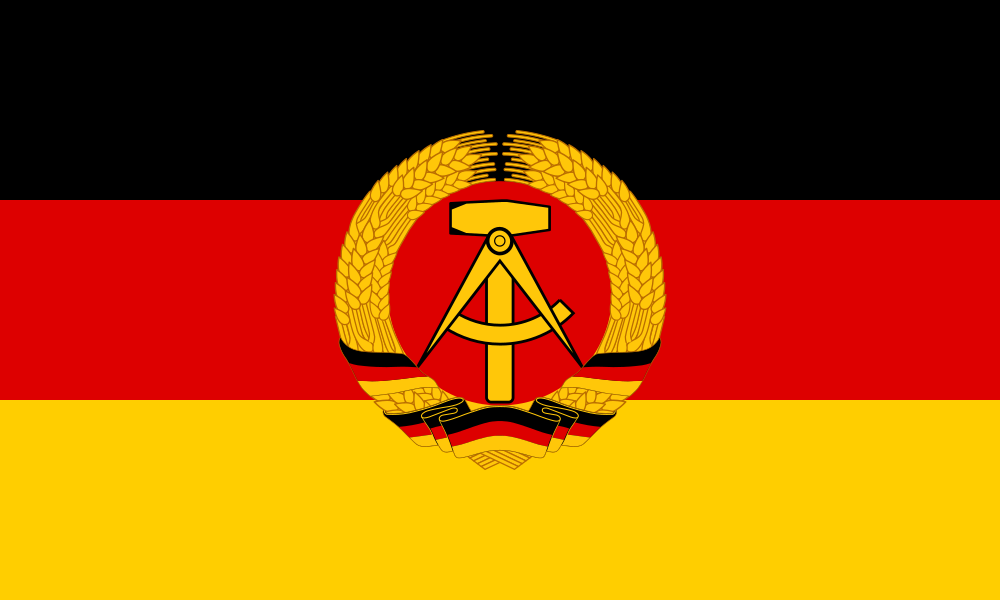
A few weeks ago, during the thirty-fifth session, the international com- munity marked the twentieth anniversary of the Decla- ration on the Granting of Independence to Colonial Countries and Peoples. Many representatives here today come from States that achieved their indepen- dence in that 20-year period. It is with profound con- cern, however, that we must note that the people of Namibia are still unable to exercise their right to self, determination and independence. The problem of Namibia, which is before the General Assembly this year too, is very familiar to everyone. A people has been denied its right to freedom, self-determination and national independence. There is constant dis- regard of decisions of the General Assembly and the Security Council, and there is defiance of the interna- tional community. 157. In itself, the racist Pretoria regime is an histor- ical anachronism For years and years it has been ille- gally occupying the Territory of Namibia, oppressing its population, plundering its natural resources and using it as a springboard for aggression against neigh- bouring African States.
158. The people and Government of the German Democratic Republic condemn with the utmost vigour the policy of aggression and occupation pursued by South Africa. General Assembly resolutions 2145 (XXI) and 3111 (XXVIII) and Security Council reso- lutions 385 (1976), 432 (1978) and 435 (1978) are clear and binding decisions of the United Nations on Na- mibia.
159. Now, what is the situation today with regard to compliance with those decisions? Everyone can see that since resolution 435 (1978) was adopted more than two years ago there has been no progress what- soever towards the Namibian people in exercise of its right to self-determination. The failure of the talks held at Geneva in January of this year strikingly con- firmed that. In spite of the constructive position of SWAPO, which in the interests of an early settlement of the Namibian problem agreed to considerable
160. The continuing destructive position of South Africa was reconfirmed in the letter sent by the South African Foreign Minister, Mr. Botha, to the Secretary- General on 28 January 1981.5 Pretoria has made no attempt to conceal the fact that the racist regime wanted to use the Geneva meeting simply to present to the international community the puppet politicians it maintains. Who are these representatives of the so-called internal parties? They are puppets selected by South Africa according to racial and tribal criteria who consistently and obediently represent the inter- ests of the racist regime. There are, in fact, quite a few among them who to this very day maintain their reverence for Hitlerite fascism and publicly declare themselves supporters of that criminal system. On 29 December 1980 The New York Times reported that Dirk Mudge, a representative of the so-called Demo- cratic Turnhalle Alliance and the so-called Council of Ministers in Windhoek, had only recently openly called for the direct incorporation of Namibia into South Africa., 161. At Geneva, indeed, the picture was practically symbolic. In the South African delegation, for dis- play purposes, the puppets were put in the front rows, while behind them sat their South African lords, the puppeteers, holding the strings. The parallel with Zimbabwe is only too clear. There, more than a year ago, Muzorewa, as the so-called Prime Minister of Zimbabwe, played the puppet. History has now dis- missed him, although there were powerful circles in imperialist States that flatteringly lauded him as the lawful, democratically elected head of the Zimbabwe Government and supported him. As for the South African puppets in Namibia, their places are ready for them in the scrap-heap of history.
162. With regard to the sham elections whereby South Africa attempted to lend a semblance of legiti- macy to their puppets in Namibia, in paragraph 3 of its resolution 439 (1978), the Security Council de- clares "those elections and their results null and void and states that no recognition will be accorded either by the United Nations or any Member States to any representatives or organ established by that process" 163. The Declaration by the Conference of Min- isters for Foreign Affairs of Non-Aligned Countries, held at New Delhi, contains the following passage: "The Ministers strongly condemned the South African racist regime for its persistent refusal to withdraw from Namibia, and in particular its delib- erate sabotage of the Geneva meeting convened to implement the United Nations plan for the inde- pendence of Namibia, and declared that this refusal constitutes a threat to peace."6 It is indeed high time to put an end to political con- cessions and appeasement of the racist aggressor. The experience of history-and the United Nations
5 Official Record» of till' Security Council, Thirtv-sixth Ye(//', Supptement for Januarv, February and March /981. document 5/14346.
164. The brutal attacks on Angola and Mozambi- que, the acts of subversion against Zambia and Zim- babwe over the last few months, should serve as a serious warning.
165. Once again, we must ask a question that we have asked in the past: how can such a Government as the apartheid regime in South Africa constantly flout the decisions of this world body, trample under- foot international law, terrorize with impunity the people of South Africa and the people of Namibia which they illegally occupy, as well as threaten neigh- bouring States and even attack them?
166. The answer is well known, and I should like to make it absolutely clear: co-operation with the apart- heid racist regime and political, economic and military support of that regime by the major Western States are all a major obstacle to the speedy and consistent solution to the problem of Namibia. Recent events have made it abundantly clear that the African racists as a result of that assistance feel confident in their policy of terror within the country and of aggression outside it. 167. In connexion with the failure of the recent talks at Geneva, the Co-ordination Committee for the Liberation of Africa, at its meeting in Arusha in Jan- uary 1981, noted in its resolution on Namibia.
"The initiative for a negotiated settlement of the Namibian situation has regrettably failed due to their vested interest in southern Africa, which clearly accounted for the apparent importance of the Western five in the Geneva pre-implementation meeting."6
168. Today, the United States and the Federal Republic of Germany, together with South Africa, are the three leading States in terms of the profit they have made from Namibia, which amounts to millions of dollars.
169. With regard to the interests of the Federal Republic of Germany, the Frankfurter Allgemeine Zeitung of 22 October 1980 reported:
"The interests of the Federal Republic in South Africa are multifaceted. First of all. there are the rights of almost 30,000 Germans living in Namibia. Then, there are the economic interests. Namibia is rich in uranium and diamonds. In addition, there are security interests."
170. With such interests at stake, we should not be surprised that the allies of South Africa in NATO have so far done nothing to exert pressure on the apartheid regime, pressure which is necessary to compel it to co-operate in bringing about a settlement of the Namibian problem and bringing the Territory to independence. Furthermore, imperialist circles of certain members of 'NATO are again obstructing decisive measures of the United Nations.
171. It is understandable why African States at the recent meeting of the Council of Ministers of the OAU at Addis Ababa in their final document noted "the half-hearted attitude of the Western contact group In
177. The regime has also intensified its military build-up in the Territory and escalated its wanton acts of aggression and interventions against neighbouring
180. Last June at Algiers the United Council for Namibia proposed that the Security Council should urgently impose comprehensive mandatory sanctions against South Africa under Chapter VII of the Char- ter. The same recommendation was made by the International Conference in Solidarity with the Strug- gle of the People of Namibia in Paris last September. In view of the obstructive and uncompromising atti- tude displayed by South Africa at the Geneva meeting such sanctions assume immediate relevance. When South Africa and SWAPO agreed to meet in a pre- implementation meeting, we hoped that a break- through would at least be achieved. However, after all the laborious efforts of the United Nations and other parties to make the meeting possible, South Africa, in a series of deceitful manoeuvres and de- laying tactics, declared that it was premature to im- plement the United Nations plan and that more time was needed to create a climate of confidence in the ability of the United Nations to oversee an election in Namibia impartially. We find the South African argu- ment unconvincing. It was obvious that the South African delegation had come to Geneva to win time rather than to arrive at an agreement. South Africa's deplorable action provides further proof of its delib- erate diversionary tactics and has serious security and political implications.
181. In regard to the Geneva talks, my delegation wishes to commend SWAPO for its display of cour- age, patience and a will to compromise and its con- structive attitude in the face of South Africa's pro- vocative and irresponsible actions. We should also like to extend our gratitude to the Secretary-General, to the OAU, to the front-line States and to the con- tact group for their untiring efforts in making the meeting possible.
182. Until and .unless the United Nations plan is successfully implemented, we will remain convinced that South Africa has no desire at all to see a free and independent Namibia. On the contrary, we are of the view that it is still intent on perpetuating its control over the Territory and on preserving the status quo.
186. The occupation of Namibia by South Africa is an illegal act, and an end should be put to it immedi- ately. Likewise, all the steps taken by South Africa unilaterally to impose an internal settlement on the people of Namibia should be regarded as a flagrant violation of all the resolutions of the General Assem- bly and Security Council and of the principles of international law. These actions should be held null and void. They further serve to strengthen tension and to threaten peace and security in South Africa and throughout the entire world.
187. The Security Council adopted a resolution by a large majority setting forth measures leading to genuine independence for Namibia. The five Western countries offered their good offices for the implemen- tation of that resolution, and SWAPO demonstrated flexibility when negotiating with those countries. That led to the creation of the United Nations plan for the independence of Namibia, which was adopted by the Security Council in its resolutions 435 (1978). 188. If we review what h~s been done to implement this settlement plan we see that one of the parties
195. That was demonstrated by the Secretary- General in his report of 19 January to the Security Council. It is clear now that, after the failure of the Geneva meeting, SWAPO has no alternative but to intensify its struggle to liberate Namibia. That is what the leaders of the front-line countries brought out at the meeting of 17 February last.
196. The situation in southern Africa is most critical: it threatens to lead to a bloody uprising which would threaten international peace and security. In the light of what I have just said, the Egyptian delegation deems it necessary, first, for the Security Council to meet immediately. In this connexion we appeal to the Western countries, permanent members of the Secu- rity Council, to shoulder their responsibilities and heed the will of the international community without creating obstacles to the imposition of mandatory sanctions against the racist South African regimevin accordance with Chapter VII of the Charter. If the Council fails to adopt a resolution on the imposition of such sanctions, the Egyptian delegation would favour the convening of an emergency session to reach a settlement of this issue. Secondly, the colo- nialist racist regime of South Africa must be con- demned. Thirdly, it is essential that Namibia swiftly gain independence and that its territorial and national integrity be respected. Fourthly, we must step up our support for SWAPO, the sole legitimate representa- tive of the Namibian people. Fifthly, we should con- tinue to co-operate with the front-line countries, which South Africa has forced to pay an enormous price, to bring about national independence in that region. Sixthly, we should reiterate the need for a commitment to respect Decree No. I for the Protec- tion of the Natural Resources of Namibia, enacted by the United Nations Council for Namibia in 1974, which affirms that the natural resources of Namibia are the national heritage of the Namibian people, and that its rights over these resources must not be vi- olated. All violations of that decree should be con- demned, including the illegal exploitation of Namibian resources and of the marine resources to be found in its territorial waters.
197. In this connexion the Egyptian delegation would like to refer to the results of the hearings of the Panel for hearings on Namibian uranium, which have uncovered serious violations of Namibia's wealth in uranium which the racist regime of South Africa, in collaboration with a number of transna- tional corporations and certain countries, has been trying to exploit for its own profit. These violations of the resources and national wealth of Namibia have reached dangerous proportions. On this question, my delegation would like to pay a tribute to Mr. Lusaka
205. Under the leadership of SWAPO the Namibian people has waged a difficult liberation struggle and has made great sacrifices for its freedom. In that struggle it has scored important victories and de- fended its cause. It has been able to foil its enemies. But the Namibian people are still faced with the aggressive acts of the South African Fascists, with the plots and intrigues hatched by the imperialist Powers to impede a just and final settlement of the Namibian question.
206. The most recent developments clearly demon- strate once again that the South African regime has never had and still has not the least intention of voluntarily renouncing its colonial domination of Namibia. At this moment it thinks only of stepping up its aggressive actions, terror and crimes so as to stifle the armed liberation struggle of the Namibian people. That regime continues not only to trample under foot the sovereign rights of the Namibian peo- ple but at the same time defies with heightened arro- gance all peoples and world public opinion, which continue to condemn it. The disdain of the racists for the United Nations decisions on Namibia has always been revolting. This was demonstrated again at the beginning of this debate when their representatives tried to occupy seats in this hall illegally.
207. There is no further need to show that the racist regime of South Africa would not dare to continue its colonial policy in Namibia if it could not rely on the strong and consistent political, economic mili- tary and diplomatic support of the imperialist Powers, and primarily of the American imperialists. Those are the Powers that have always done everything they could to help the racist regime in South Africa to maintain its colonial domination in Namibia and to protect, thereby, their neo-colonialist interests in that country and in southern Africa in general and to threaten the other countries in Africa. It is for rea- sons such as these that the imperialist Powers are seeking by every possible means to delay and sabo- tage the advent of freedom and national sovereignty for the Namibian people.
208. In the last few years, in order better to assist the racists of South Africa, American and other im- perialists have often pretended to work towards finding so-called political or negotiated solutions that would allegedly be to the advantage of and acceptable to everyone. A great deal of publicity has been given to the plan of the five Western countries, which has been held out as the best way to arrive at a solution of the problem of Namibia. All the manoeuvering of the imperialist Powers has been aimed at deceiving the Namibian people, the people of Africa and public opinion and at mitigating world reaction against the presence in Namibia of the racist regime of South Africa and imperialist interests. That rnanoeuvering has been aimed also at eroding the will to fight and breaking the national unity of the Namibian people, stifling its armed struggle for national liberation and