A/35/PV.82 General Assembly
Pape

I am deeply sorry to have to announce that our friend and colleague, Mr. Hamilton Shirley Amerasinghe, President of the Third United Nations Conference on the Law of the Sea and Presi- dent of the General Assembly in 1976, passed away peacefully this morning at 10.30. He fell gravely ill on 14 November and was immediately hospitalized, but all endeavours to save him were to no avail.
2. It is particularly sad to lose such an able and creative colleague, whose career spanned more than 45 years of selfless service to his country and to the international community. 3. He was born in Colombo, in what was then Ceylon, in 1913, and completed his university studies in his own country and in the United Kingdom in 1934. Having joined the Ceylon Civil Service soon after- wards, he served in the Ministry of Health, where he was actively and successfully involved in a malaria- eradication programme and later became the resident manager of a major statutory authority that admin- istered a multi-purpose river valley development project. 4. He first served overseas as Counsellor of Embassy in Washington, D.e., from 1953 to 1955. Upon his return home he occupied a succession of major posts in Treasury and Finance, which led to his becoming alternate Governor for Ceylon in the World Bank. 5. Thereafter, he was appointed High Commissioner of Ceylon to India, while serving concurrently as Ambassador to Nepal and Afghanistan, until 1967, when he joined the United Nations as the Permanent Representative of Sri Lanka. He had been the Presi- dent of the Third United Nations Conference on the
NEW YORK
Law of the Sea since 1973 and was elected President of the thirty-first session of the General Assembly in 1976. 6. It is, of course, his arduous work in bringing about the nearly complete compromise on the law ofthe sea for which he will be long remembered. 7. It saddens me that he will not be here with us fully to complete his historic work, but I am confident that his remarkable endeavours to ensure that that vast area of the globe becomes the common heritage of mankind will be crowned with success and be his lasting memorial. 8. Given the length of his tenure, his great expertise and the high esteem in which he 'was held by his colleagues, his passing represents a great loss to the United Nations. 9. May I now invite the General Assembly to stand and observe a minute of silent prayer or meditation in tribute to the memory of Hamilton Shirley Amerasinghe, The members of the General Assembly observed a minute of silence. 10. The PRESIDENT: I now call on the Secretary- General of the United Nations.

The death of Shirley Amerasinghe is a great loss for all of us who were his friends and also to the United Nations as an organization. Shirley Amerasinghe had served in the United Nations since 1957, when he represented his country on the Fifth Committee of the General Assem- bly. He became Permanent Representative in 1967 and in 1968 was elected Chairman of the Ad Hoc Committee on the Peaceful Uses of the Sea-Bed and the Ocean Floor beyond the Limits of National Juris- diction. From that time on he presided over the various United Nations bodies dealing with the subject and became, in 1973, the President of the Third United Nations Conference on the Law of the Sea. In 1976 he was elected President of the thirty-first session of the General Assembly. .
12. Recently most of us have associated Shirley Amerasinghe with his very effective work as the President of the Third United Nations Conference on the Law of the Sea. Here he made a major contribu- tion to one of the most important and successful enterprises of the United Nations. The successful conclusion of that work would certainly be an abiding monument to the friend we have lost.
13. Shirley Amerasinghe's record of service to the United Nations is a remarkable one, and he occupied an important place, both in the work of the Organiza- tion and in the hearts of his colleagues. His charming personality, humour and style were an encouraging and positive asset at all times. He was at the same time
I now call on the representa- tive of the Sudan, Chairman of the group of African States.


It is with a heavy heart and great sorrow that the delegation of the Sudan, on behalf of the African group in the United Nations, wishes to express its most profound condolences on the loss we have just sustained in the passing of Mr. Amerasinghe, Presi- dent of the Third United Nations Conference on the Law of the Sea.
17. We learn of this sad news at a time when the international community has the greatest need of his experience and his wisdom in the field of international diplomacy.
18. History will recognize with eternal gratitude the efforts made by Mr. Amerasinghe in the service of the international community and in the cause of world peace, as well as in connexion with the law of the sea, on which subject we are on the point of reaching agreement.
19. Mr. Amerasinghe was in the vanguard in bringing together and reconciling different points of view. It was our hope that he would be among us when the time came to sign the important international instru- ment with regard to the law of the sea. But it was the will ofGod that death should take Mr. Amerasinghe from us and we cannot but bow to the will of the Almighty.
20. The Sudan and Africa as a whole, as well as the international community, can only extend sincere condolences to the delegation of Sri Lanka, the Government and people of Sri Lanka and Mr. Amera- singhe's family. We ask the Almighty to give them and the international community consolation and the strength to bear this great loss. May the soul of the departed rest in peace.
I call now on the Chairman of the group of Western European and other States, the representative of Portugal. • 22. Mr. FUTSCHER PEREIRA (Portugal): The untimely passing of Mr. Shirley Amerasinghe has been a shock to us all. We were all familiar with the ebullient and warm personality of that great man and highly skilled diplomat, who was, during his long years in the United Nations, a dear friend and companion to us all.
23. His brilliant career as Permanent Representative of Sri Lanka and as President of the General Assembly, and especially the extraordinary job he did as Presi- dent of the Third United Nations Conference on the Law of the Sea, won him a well-deserved reputation for dedication and competence matched by few. It is sad to think that we shall not see him again in these corridors. It is a matter for regret that we shall no longer be able to benefit from his experience, his reason and his advice.
I now call on the representa- tive of Costa Rica, who will speak on behalf of the Latin American group of States.
35. Mrs. de BARISH (Costa Rica) (interpretation from Spanish): As Chairman of the Latin American group of States, the delegation of Costa Rica has the great honour and the sad duty of expressing, on behalf of the Latin American group, on its own behalf and on mine, the most heartfelt and sincere condo-
~ .iave the honour ofpresiding over this month.J should like to express our profound sorrow and our most heartfelt condolences at the passing of Mr. Shirley Amerasinghe- His death has robbed the international family of his experience, his wisdom and his ability to offer all that is good and useful in the interests of that family. He served the United Nations and its purposes and principles when he was the Ambassador of his country for 10 years. He served the Organization as President of the General Assembly-he was one of the best Presidents and often demonstrated his great capacities. He was also the President of the Third
United Nations Conference on the Law of the Sea. 39. Mr. Amerasinghe was one of my dearest friends. I went to see him just a few days ago; he was not conscious when I was there and I knew it would be our last meeting. Every day I waited for news. Then this morning I learned that he had passed away.
40. He lived for others, not for his own personal interests. He lived for the United Nations, for the principles of the Organization. He lived to serve those who suffered from injustice. The last time we were together he suddenly told me that he would have liked to have crowned his life by the signing of the convention on the law of the sea. He had intended thereafter to write a book on the law of the sea. He turned to me that day and said: "Abdalla, I do not fear death but I do fear suffering".
41. On behalf of the group of Arab States, I should like to convey my heartfelt condolences to the interna- tional community that he served. I should also like to convey those condolences to his country, to the delegation of Sri Lanka, to the group of Asian States ,- and to all his friends, who were so numerous.
42. In conclusion, I should like to say that the best thing we can do to pay a tribute to the memory of Mr. Amerasinghe would be to see to it that his efforts bear fruit, because we know that he devoted his life to the United Nations and to ensuring the triumph of justice. What he bequeathed to us is a precious heritage. Let us try to follow in his footsteps.
I now call on the representa- tive of Sri Lanka.
30. Question of equitable representation on and increase in the membership of the Security Council
I would remind representa- tives that the list of speakers in the debate was closed at 3 p.rn. today in accordance with the decision of the Assembly this morning. I should like to announce once again that the decision on draft resolution A/35/L.34/Rev.l will be taken at a later date. 48. Mr. KALINA (Czechoslovakia): We had the opportunity last year to explain the position of the Czechoslovak delegation concerning the question of equitable representation on and increase in the membership of the Security Council. t That position of principle remains unchanged. In our view, it is not merely the representation on or the membership of the Security Council that is questioned. First, and above all, it implies a revision of the Charter of the United Nations. The position of the Czechoslovak Socialist Republic, which is one of the founding Mem- 'iers of the United Nations, with regard to this question ic consistent. We consider the provisions of the Charter to be as fully adequate for the fulfilment of the principal task of the United Nations, which is the maintenance and strengthening of international peace and security, as they were 35 years ago when they were adopted. If anything should be revised or increased, it should be in the first place the political will of certain States to comply with those provisions. 49. Secondly, Czechoslovakia welcomes the growth of the membership of the United Nations, which ensures that the Organization will move closer and closer to universality. At the same time, we do not believe that this growth should find its mechanical reflection in an increase in the membership of the Security Council. This is quite apparent from Arti- cle 23 of the Charter, which clearly stipulates that non- permanent members of the Security Council should be elected, first of all, on the basis of their contribution to the maintenance of international peace and security. 50. In this connexion it is claimed that non-aligned and developing countries are not adequately repre-


My delegation listened with close attention to the eloquent statement in which the representative of India in- troduced draft resolution A/35/L.34/Rev.1 [8/st meeting]. We were, of course, aware that such a proposal was in the wind and we have been giving the question much thought ever since the idea of enlarging the Security Council was mooted at last year's session of the General Assembly. We have, in particular, asked ourselves what justification there might be for a proposal which, as I shall shortly indicate, we believe to threaten a further reduction in the effectiveness of the most important decision- making body in the Organization and even to threaten the very basis on which the United Nations exists. 55. In recent weeks our perplexity has increased as we have followed with growing bewilderment the arithmetical evolution of the proposal before us. Operative paragraph 3 (f) of the draft resolution now reads "One non-permanent seat shall alternate between Latin American States, on the one hand, and Western European and other States and Eastern European States, on the other, in the following se- quence: Latin American States, Western European and other States, Latin American States, Western
57. But my delegation would oppose even an increase of two. We would do so because we are, above all, concerned with the efficient operation of the Security Council. The United Kingdom did not welcome the increase from 11 to 15. We were concerned then about the effect that increase would have on the Council's ability to act quickly and effectively when quick and effective action was needed. My delegation does not accept that the Council has in recent years been as ineffective as some of its critics claim. But we believe that it is beyond doubt that a Council of 15 is less able than a Council of 11 to respond with alacrity and precision to crises of international peace and security. A Council of 21 would be even more handicapped.
58. There is another reason why my delegation is opposed to the change proposed by the representative of India and the other sponsors. The Security Council, as envisaged by the founders of the United Nations, was a carefully balanced instrument. This was, and remains, fitting for the most irr ~"rtant decision- making organ of the United Nations. With a required majority of seven votes, no political group was in those days able alone to command enough votes to impose its will against the wishes of all the other groups combined. The 1963 enlargement, although damaging to the Council's efficiency, nevertheless left that fundamental balance intact. But if the draft resolution before us were adopted, it would mean that for the first time in the history of the United Nations a single political group would by itself command the

The Soviet Union has consistently favoured the enhancement of the role and effectiveness of the United Nations as an important instrument for the strengthening of international peace and security, on the basis of strict observance of the Charter of the United Nations. It proceeds from a belief that, acting in accordance with the Charter, the Organization has made and continues to make useful-contributions to the strengthening of peace and the resolution of current international problems.
61. The event; of recent times have left no doubt that the central task of the United Nations, as laid down in the Charter, is the maintenance of interna- tional peace and security, and this remains as timely, relevant and urgent as ever.
62. Addressing the General Assembly at the current session, the head of the Soviet delegation, the Foreign Minister of the USSR, Andrei Grornyko, stressed that
.. In view of the specific character of the situation in the world arena today, it is essential for the work of the session to be conducted in a constructive atmosphere. Its participants will have to display to an even greater extent than before a sense. of realism, a considered approach to key international issues and a genuine interest in finding solutions to them". [6th meeting, para. 93.]
63. However, the consideration of the question of an increase in the membership of the Security Council is leading the Organization in the opposite direction. It is giving rise to unnecessary differences among States, it is creating additional complications in the work of the General Assembly and it is contrary to the spirit of co-operation required for the adoption of decisions on vital problems of the day, decisions that would be in keeping with the central task of the United Nations. In the final analysis, this pro- posal can only be detrimental to the effectiveness of the Organization, weakening and undermining its authority.
64. Claims that an increase in the membership of the Security Council is necessary to enhance the effectiveness of that body are, in our view, unfounded. Indeed, it is obvious that an increase in the member- ship of the Council would have an adverse effect on the efficient functioning of that important United Nations organ, which is required under the terms of
66. The Soviet Union is sympathetic to the legitimate desire of developing countries which arc States Mern- bers of the United Nations to play an active role in the work of the Organization, and the Charter provides the necessary opportunities for this. It is well known that every State Member of the United Nations can participate in the discussion of any item in the Security Council in all cases where the interests of such a State are particularly concerned. As has been shown in practice in the Council's work, the developing countries make wide use of this opportunity.
67. At the same time, it would be wrong to suppose that an increase in the membership of the Security Council would lead to a strengthening of its primary role in matters pertaining to the maintenance of international peace and security. The reasons why the Council has not always been in a position to take the necessary and effective decisions lie not in the pro- visions of the Charter which stipulate the composition of the Council, but in the specific policies of given
States and in the fact that certain Member States do not observe the provisions of the Charter and act contrary to the principles and purposes proclaimed in it.
68. In this regard, the task of strengthening the Charter t .comes particularly important, as does that of ensuring that it is fully and universally observed. However, the proposal for increasing the member- ship of the Council is aimed at a revision of the Charter and the revision of one of its most important provisions. Even now it is clear that the revision of one of the provisions of the Charter which has a direct bearing on the work of the Security Council could set off a chain reaction which would manifest itself in demands for the revision of other Charter provi- sions. As a result. the Charter, that is, the very basis
83. There is no question that the principal duty of the United Nations-if it is not indeed the very reason fo, the existence of the Organization-is to promote and maintain international peace and security. The Charter of the United Nations vests this vital responsi- bility above all in the Security Council.
84. The question of equitable representation on and increase in the membership of the Security Council is an item of great importance which is directly linked to the responsibiiity of the Organization for the main- tenance of international peace and security. All States have a stake in the questions of war and peace; indeed, all States, big or small, weak or strong, have a duty to participate in the search for world peace and security.
85. My Government is convinced that as presently constituted the Security Council lacks equity and balance. In our view, there is an urgent need for the Council to be made more representative, both numeri- cally and in terms of the political outlook States Members of the United Nations.
86. Originally, the United Nations had only 51 Mem- ber States. It has since grown by leaps and bounds to its present membership of 154 sovereign and inde- pendent States, thanks in particular to the decoloniza- tion process. Apart from the increase in the number of sovereign and independent States comprising the membership of the United Nations, we have also witnessed the birth and growth of the non-aligned
91. Those in favour of the status quo are in reality afraid of losing the power and prestige they enjoy in the Security Council. They do not want their privileges eroded and they construe the proposal to enlarge the Council as part of a campaign to undercut their much cherished position.
92. Matters of international peace and security are certainly more important than the status and privileged positions of individual States. What is needed on the part of all States is the necessary political will to subordinate parochial national interests to the more important and responsible objective of durable world peace and security envisaged in the Charter. We must have the magnanimity to accept the changed world order, to be willing to part with anachronistic situations
94. In the final analysis, as my delegation has re- peatedly stated, the unanimity rule will need to be dispensed with. More often than not, the veto has been used to frustrate the wishes and aspirations of the majority. It has been abused, to the detriment of endeavours to promote world peace and security. In any event, the unanimity rule is itself an affront to the principle of the sovereign equality of States.
95. Let me, in conclusion, express the hope that the General Assembly will adopt the draft resolution under this important item by an overwhelming majority.
96. It is also the hope of my delegation that, in accordance with the requirements of the Charter, the amendments proposed in the draft resolution will be urgently ratified, in any event by I September 1982, as proposed.
97. Mr. McHENRY (United States of America): The United States joins in expressing its sadness on the occasion of the death of Mr. Amerasinghe. We would only add that our tribute to the work of Mr. Amera- singhe could best be recorded by redoubling our devotion to the principles for which he worked and, in particular, to the successful conclusion of the law of the sea treaty.
98. The General Assembly is considering today a question of great, and perhaps cruci~1, impor.tance for the future effectiveness of the United Nations: the question of the size and make-up of another principal organ, the Security Council. This is a matter which
must be considered with the greatest of care and reflection, for the Council is endowed with a special responsibility, the responsibility for the maintenance of international peace and security. It is therefore essential that the Council be structured in such a way that it can carry out that responsibility efficiently and effectively.
99. It was for that reason that the Security Council was deliberately small at its inception. Article 23, paragraph I, of the Charter reads in its relevant part:
"The General Assembly shall elect ten other Mem- bers of the United Nations to be non-permanent members of the Security Council, due regard being specially paid, in the first instance to the contribu- tion of Members of the United Nations to the maintenance of international peace and security and
107. For all these reasons the United States cannot support the d"raft resolution before us.

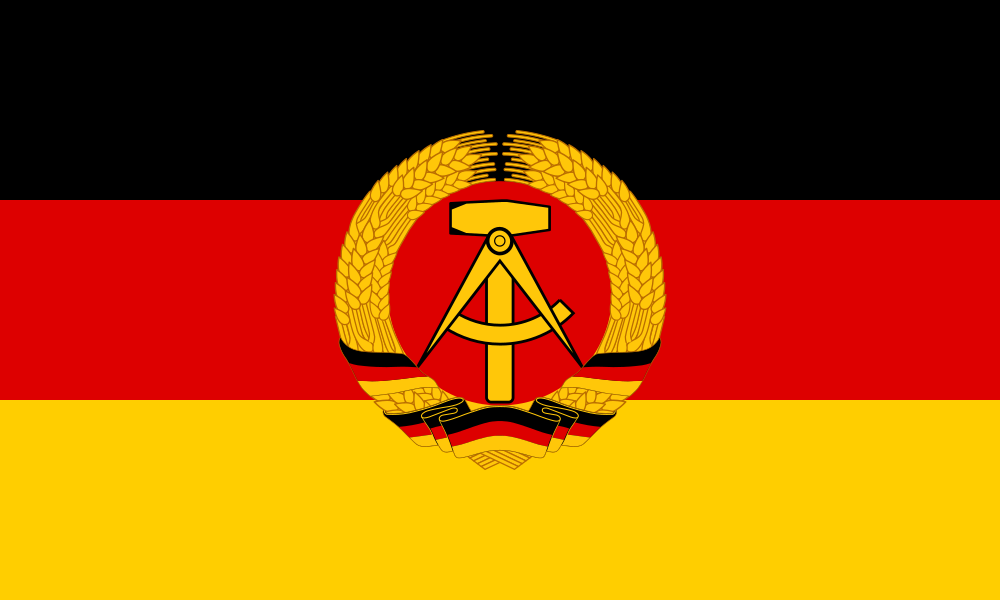
The question of an increase in the membership of the Security Council is directly linked with the revision of the Charter of the United Nations. The German Democratic Republic is against a revision of the Charter. The German Demo- cratic Republic shares the view of those States which proceed from the belief that the Charter is an unlimited legal basis for the work of the Organization; that it is, furthermore, the basis for contemporary international law; that it, has stood the test of time; and that. in changed international circumstances. it has preserved its significance as the fundamental law for the peaceful coexistence of States with different social systems.
109. As we have heard here today, there is an intent, having embarked upon a revision of the Charter with an expansion of the Security Council, to go further and to eliminate the so-called right of veto of perma- nent members of the Council. I must state here with the utmost seriousness that as a small socialist State the German Democratic Republic considers it fortunate that the Union of Soviet Socialist Republics has the ability to avert catastrophic decisions by the Council.
110. The composition of the Security Council is a question of decisive political significance and it requires an extremely careful and conscientious approach. To take a purely arithmetical approach would be an unwarranted simplication of the problem and would be tantamount to underestimating its vital political significance.
Ill. We have all seen, for example, the problems last year, and this year too, which have hampered the election of one of the non-permanent members of the Security Council, and those were situations in which the actual number of members of the Security Coun- cil played no part at all. No matter what our approach, we must take due account of the fact that the Security Council has been entrusted with far-reaching powers. and it would be too dangerous to run any risks. It should also be borne in mind that all social and
113. For these reasons, the delegation of the German Democratic Republic will vote against draft resolu- tion A/35/L.34/Rev.l, providing for an increase in the membership of the Security Council, if it is put to the vote. 114. In conclusion, I wish to make the point that fruitless discussions here in the plenary meeting of the General Assembly do not help us to solve the funda- mental problems of our day, which it is our responsi- bility to do.

It was with the most profound sadness that my delegation learnt the sorrow- ful news of the death of Hamilton Shirley Amerasinghe, a former President of the General Assembly, who also carried out other very important functions within the Organization. By his competence and devotion, as well as by his qualities as a man and a diplomat, Mr. Amerasinghe commanded the esteem, friendship and respect of all. I ask his family and his country to accept the heartfelt condolences of my delegation.
116. The United Republic of Cameroon is a sponsor of draft resolution A/35/L.34/Rev.1 on the question of equitable representation on and increase in the membership of the Security Council, which is now before the General Assembly. Cameroon is thus acting in accordance with its position on this issue as defined by its head of State, Mr. Ahmadou Ahidjo, before the Assembly on 17 October 1963/' and consistently reaffirmed since then.
117. This problem is not a new one, since it has already been considered at the thirty-fourth session of the Assembly and has always been a central preoccupation of a large number of Member States as the steady admission of new States has confirmed its universality.
118. When the United Nations was created imme- diately after the Second World War. the composition of its basic structures reflected the political panorama of the international community of the day. Hence the initial composition of the Security Council took full account both the special responsibilities of the allied Powers for the maintenance of international peace and security and the need to ensure the equitable geo- graphical representation of all the Member States of that period.
119. Thus it was that when the Organization com- prised 51 States Member, the Security Council. as the principal organ entrusted with the maintenance of international peace and security, was composed of 11 members, five of which were permanent members.
124. As a non-aligned country, Cameroon attaches great importance to the democratization of interna- tional relations and to the full and effective participa- tion of all States when decisions are taken likely to affect the destiny of mankind. In this connection, the essential issues of international peace and security, which cannot remain the exclusive prerogative of one State or a group of States, must be considered with the equitable participation of the different components of international society.
125. It would not be just to interpret this desire as evidence of some wish for confrontation with the great Powers. This is why we are appealing to them so to act that within the Organization a unanimous political will favouring the concerns of the third world can be given expression.
The meeting rose at 5./5 p.m.