A/53/PV.54 General Assembly
In the absence of the President, Mr. Mungra (Suriname), Vice-President, took the Chair.

This morning, before we take up the items on our agenda, it is my sad duty to pay tribute to the memory of the late head of State of the Islamic Federal Republic of the Comoros, His Excellency Mr. Mohamed Taki Abdoulkarim, who passed away on 5 November 1998.
On behalf of the General Assembly, I request the representative of the Comoros to convey our condolences to the Government and the people of the Comoros and to the bereaved family of Mr. Abdoulkarim.
I invite representatives to stand and observe a minute of silence in tribute to the memory of Mr. Abdoulkarim.
The members of the General Assembly observed a minute of silence.
I call on the representative of Sudan, who will speak on behalf of the Group of African States.


“Among the Believers are men Who have been true to Their covenant with Allah: Of them some have died And some (still) wait: But they have never changed (Their determination) in the least.” (The Holy Koran, XXXIII:23)
This is a sad time to address the General Assembly on behalf of the Group of African States Members of the United Nations. On behalf of the entire African continent and indeed the entire world, we express our sadness at the death of the late President of the fraternal Comoros, Mr. Mohamed Taki Abdoulkarim.
On behalf of the African Group, I convey our sincere condolences to the delegation of the Comoros and, through that delegation, to the Government and the people of that fraternal country and to the family of the late President, who was a major African figure. We ask God to take President Abdoulkarim to his bosom, and to inspire his family and people with fortitude and solace.
The deeds of President Abdoulkarim were many and valuable. He ranked among the best of statesmen; he was an outstanding leader of the Comoros. History will testify to his many achievements. Since he took power at a difficult time in the history of the Comoros, of which we are all aware, President Abdoulkarim saw his mission as
With the death of this wise leader, the fraternal Comoros has lost a great and wise man and a capable leader. This is a loss not solely for the Comoros, but for all of Africa, which aspires to having responsible leaders like Mr. Mohamed Taki Abdoulkarim. We ask God to take him and to forgive him, along with all martyrs.
I call next on the representative of Oman, who will speak on behalf of the Group of Asian States.
12. Report of the Economic and Social Council
Vote:
53/24
Consensus


On behalf of the Group of Asian States I have the distinct honour to join other members of the General Assembly in paying a special tribute to the memory of the late President of the Islamic Federal Republic of the Comoros, His Excellency Mr. Mohamed Taki Abdoulkarim. Mr. Abdoulkarim had a distinguished political career, having held important positions in successive Administrations since the Comoros achieved its independence in 1975. He played a prominent role in international affairs, with active participation, along with his fellow heads of State, in meetings of the Organization of African Unity, the Organization of the Islamic Conference and the League of Arab States. We recognize that the passing away of Mr. Abdoulkarim is an immeasurable loss to the Islamic Federal Republic of the Comoros and the cause of tremendous grief among its people.
On behalf of the Group of Asian States, I would like to request the Permanent Representative of the Comoros to convey the condolences of the Group to the Government and the people of the Comoros, and especially to the family of President Abdoulkarim. We pray that God will grant them the patience to bear this great loss. May the soul of President Abdoulkarim rest in eternal peace.
I call on the representative of Romania, who will speak on behalf of the Group of Eastern European States.
At this moment of deep sorrow, on behalf of the Group of Eastern European States, I wish to present to the President ad interim of the Comoros, to the Government and people of the Comoros and, foremost, to the bereaved family our heartfelt condolences. We are confident that this sad event will further mobilize the Comorian people in their efforts to achieve a peaceful settlement of the country’s political and economic problems.
I now give the floor to the representative of Ecuador, who will make a statement on behalf of the Group of Latin American and Caribbean States.


On behalf of the Group of Latin American and Caribbean States, the delegation of Ecuador wishes to express our most heartfelt condolences to the Government and people of the Islamic Federal Republic of the Comoros at the regrettable passing away on 5 November 1998 of their head of State, His Excellency Mr. Mohamed Taki Abdoulkarim. The Group of Latin American and Caribbean States would like to associate itself in solidarity with this special and heartfelt tribute to the memory of Mr. Abdoulkarim, who was a notable statesman and a political leader of great importance to his country and to the international community. His presence in the history of his country will always be remembered.
The delegation of Ecuador would be grateful to the delegation of Comoros if it would convey this message of friendship from the member countries of the Group of Latin American and Caribbean States to the family of the deceased, the authorities and the people of the Islamic Federal Republic of the Comoros.
I now give the floor to the representative of Australia, who will make a statement on behalf of the Group of Western European and other States.
It is my sad duty to extend sincere condolences on behalf of the Group to the people and Government of the Islamic Federal Republic of the Comoros on the untimely death of their head of State, His Excellency Mr. Mohamed Taki Abdoulkarim.
President Abdoulkarim was an important figure in the political life of Comoros for decades, with a career culminating in his election as President in March 1996. History will attest to his achievements as President and to the contribution he made to the advancement of his people.
Our thoughts are with the people and Government of Comoros at this difficult time.
I now give the floor to the representative of the Yemen, who will make a statement on behalf of the Group of Arab States.


On behalf of the Group of Arab States, I wish to express our most sincere condolences to the Government and people of the Comoros islands on the untimely death of His Excellency Mr. Mohamed Taki Abdoulkarim, who assumed the presidency of his country on 25 March 1996 after having played a great role in building the Comoros. This is a great loss for the people of the Comoros and for the entire continent of Africa.
We in the Group of Arab States would like to express our heartfelt condolences, and we pray to God that He will bring peace to the family of the deceased. We ask that the Permanent Representative of Comoros convey our condolences to the people of Comoros.
May God forgive him and give him peace.
I now give the floor to the representative of the United States of America, who will make a statement on behalf of the host country.


The Government of the United States would like to express its condolences to the family of President Abdoulkarim and to the people of the Islamic Federal Republic of the Comoros.
We recall that at a time of our own national grief — the tragic crash of a hijacked Ethiopian Airlines plane in the Indian Ocean — President Abdoulkarim and the people
At this critical juncture for the young democracy in the Comoros, we call on the Government and the people to pull together and work as one for the good of the nation. That is the best and most appropriate way to honour the memory of President Abdoulkarim — through the triumph of constitutional forces in the Comoros in ensuring the safe and legal succession of a new head of State.
I now give the floor to the representative of the Islamic Federal Republic of the Comoros, Mr. Mohamed Aboud Mahmoud.


It is with great emotion that the delegation of the Comoros has listened to the tributes you have just paid to our late President of the Republic, His Excellency Hajj Mohamed Taki Abdoulkarim. On behalf of my Government and the people of the Comoros, we would like to extend our most sincere thanks to all the Member States and to the Secretary-General of the United Nations, Mr. Kofi Annan, who has also paid a fervent tribute to our President.
I would first like to assure you that this interim period is proceeding calmly and peacefully. In accordance with article 10 of the Comorian Constitution, the High Council of the Republic, having been charged by the Government, took note of the passing away of the President of the Republic and conveyed interim power of the presidency to Mr. Tadjidine Ben Saïd Massonde, President of the High Council of the Republic, who also sits on the Constitutional Council.
I would like to recall some good memories of my President by describing some of his accomplishments. Born in M’Beni, Comoros, in 1936, Mr. Mohamed Taki Abdoulkarim was the fourth President of the Comoros, and it can be said that he was representative of the first Comorian political generation. He was distinguished by his dynamism and sense of responsibility and was elected a deputy of the Territorial Assembly of the Comoros in 1967 to represent his region.
He also held several ministerial portfolios before the Comoros attained independence. A tireless champion of
A man of dialogue, he appealed to all political groups to restore the archipelago’s legitimacy. In the framework of the Organization of African Unity, the French-speaking world and the Ad Hoc Committee on the Indian Ocean, President Taki was one step ahead of his counterparts in championing the idea of strengthened South-South cooperation. Within the framework of the French-speaking world, he recalled the archipelago’s profound dedication to the common cultural heritage shared by millions of men and women on various continents.
He supported the idea of the integration of a broad regional market among the countries of the Committee on the Indian Ocean. Likewise, in the framework of the League of Arab States and the Organization of the Islamic Conference, he recalled that the principle of solidarity must govern relations among its members. Finally, he endeavoured to strengthen bilateral relations through agreements that opened up the way for common development and educational support projects.
In keeping with the legitimate aspirations of President Taki, I should like from this rostrum solemnly to appeal to the international community to help my country find a solution to the separatist crisis plaguing it. The unity and territorial integrity of the Comoros are being threatened. The very foundation of our State is in jeopardy, as are peace and stability in Africa and the Indian Ocean. This sets a dangerous precedent for the rest of the world. Resolving the Anjouan crisis will require international solidarity and a commitment by the Arab and African countries. Now more than ever measures should be taken not only to resolve the current crisis but also to ensure peace and stability, which are a guarantee of lasting and harmonious economic and social development for the region and for the Comoros.
3. Credentials of representatives to the fifty-third session of the General Assembly (b) Report of the Credentials Committee (A/53/556)
The draft resolution recommended by the Credentials Committee in paragraph 11 of its report reads as follows:
“The General Assembly,
“Having considered the report of the Credentials Committee and the recommendation contained therein,
“Approves the report of the Credentials Committee.”


I only wish to make the following observation outside the framework of the procedures of the General Assembly on the report of the Credentials Committee.
It is well known to all members that the Twelfth Ministerial Conference of the Movement of Non-Aligned Countries recognized that the participation of Israel in the work of the General Assembly should be in accordance with international law. Consequently, the credentials of Israel should not cover the territories occupied since 1967, including Jerusalem/Al-Quds.
It is also well known that the Coordinating Bureau of the Non-Aligned Movement instructed the Chairman of that Bureau to send a letter to the Chairman of the Credentials Committee to let him and the Committee members know what the heads of State or Government of the Non-Aligned Movement had decided. We have been given to understand that this letter was conveyed to the Committee after it had convened its first meeting. Therefore, we hope that — regardless of the fact that the
We shall now proceed to consider the draft resolution recommended by the Credentials Committee in paragraph 11 of its report.
I shall now call on those representatives who wish to speak in explanation of vote before the voting.
May I remind delegations that explanations of vote are limited to 10 minutes and should be made by delegations from their seats.


I wish at the outset, on behalf of the delegation of Egypt, to thank the Chairman and the members of the Credentials Committee for the report contained in document A/53/556.
The delegation of Egypt recognizes that the draft resolution before us is always adopted by consensus. Egypt will join the consensus on the draft this year, and wishes to register that the credentials of the delegation of Israel apply only to Israel in its borders of 4 June 1967 and not to the territories occupied by Israel since 1967, including Al- Quds/Jerusalem. Our acceptance of the consensus adoption of the report does not constitute any recognition of Al- Quds/Jerusalem as the capital of Israel.
This is in keeping with the provisions of international law and international legitimacy. Our position was expressed at the Summit of the Non-Aligned Movement held in Durban last September, which underlined the following:
“The Israeli representation in the work of the United Nations General Assembly should be in consonance with international law. Consequently, we have to confirm that the Israeli credentials do not cover the territories occupied since 1967, including Al- Quds/Jerusalem.”
This position is also contained in a letter of 21 October addressed by the Permanent Representative of South Africa, as representing the head of the Movement, to the Chairman of the Credentials Committee. That letter was not mentioned in the report before the Assembly today.


I am taking the floor to express the reservation of my delegation regarding the part of the report of the Credentials
We have heard the last speaker in explanation of vote before the voting, and we shall now take a decision on the draft resolution recommended by the Credentials Committee in paragraph 11 of its report (A/53/556).
The Credentials Committee adopted the draft resolution without a vote. May I take it that the Assembly wishes to do the same?
The draft resolution was adopted (resolution 53/23).
We have thus concluded this stage of our consideration of sub-item (b) of agenda item 3.
I give the floor to the representative of Kyrgyzstan to introduce draft resolution A/53/L.24.


On behalf of 130 sponsors, I am very pleased to introduce draft resolution A/53/L.24, entitled “International Year of Mountains”.
The draft resolution proclaims the year 2002 as the International Year of Mountains. This date has been agreed upon by most delegations. Symbolically, the International Year of Mountains will coincide with Rio+10, the 10-year overall review and appraisal of the implementation of Agenda 21. It will also be preceded in the year 2000 by the eighth session of the Commission on Sustainable Development, which will focus on land resources, including mountain resources.
The draft resolution further invites the Food and Agriculture Organization of the United Nations, as task
It also encourages all Governments, the United Nations system and all other actors to take advantage of the International Year of Mountains to increase awareness of the importance of sustainable mountain development.
Mountains or highlands make up more than a quarter of the earth’s land surface and are home to approximately 10 per cent of the world’s population. More than half of the world’s population depends on mountain resources for water, biodiversity, recreation, agriculture, forestry and mining, among other things. Some of these resources are of more than national or regional importance; they have a truly global significance for the future of our planet.
Mountains are a great source of fresh water. All of the world’s largest rivers originate in the mountains. Because they store immense amounts of fresh water as ice and snow, and in lakes and reservoirs, mountains play a global role in supplying water for agriculture, industry and urban centres in adjacent lowlands. Since 35 per cent of the world’s population is likely to experience water scarcity by the year 2025, water management and economic cooperation between riparian States will become extremely important in the twenty-first century.
Mountains are core areas of global biodiversity. They are sanctuaries for a great wealth of endemic species, specialized ecosystems and remarkable landscapes. Tropical and subtropical mountains, in particular, include major centres of global biodiversity. Many mountain regions with the greatest biological and landscape diversity are protected areas. In fact, of the 785 million hectares of protected areas in the world, one third are in the mountains, in 65 different countries. Genetic material in plants, animals and micro- organisms holds potential for purposes of agriculture, the health and welfare of human beings and environmental protection. Thus, mountain areas play the most important role in the sustainable use and long-term preservation of biodiversity on our planet.
More than half of the world’s population lives in urban areas, and urbanization will continue in the next century. The rapid increase in global urbanization means greater demand for leisure and recreational areas. Mountains have the most attractive potential in this regard,
Sustainable mountain development and resource use is only possible by, and for, the mountain communities. Local knowledge and experience are necessary to sustain ecosystems, livelihoods and production. However, they must be integrated carefully with new techniques and research findings. Governments must be ready to make proportionately greater investments to train and educate people in mountain regions and to compensate the stewards of mountain resources. Governments have a great responsibility for these so-called peripheral regions and their vital resources. The decentralization of power from capital cities to mountain regions, towns and villages would be one of the best ways to empower mountain inhabitants, reduce costs, increase efficiency and create the necessary interest in sustainable development and management of mountain resources.
Mountains are dynamic landscapes which are changing on a global scale, probably much more rapidly than any other major environmental system. Enormous obstacles facing sustainable mountain development in the twenty-first century will not be overcome unless the problems are recognized and addressed by local communities, national policy makers and international organizations.
Chapter 13 of Agenda 21, adopted in Rio in 1992, recognized the vital and interrelated importance of this major ecosystem to the survival of the global ecosystem. It further emphasized the need to encourage the regional, national and international networking of people’s initiatives and the activities of international, regional and local non-governmental organizations working on mountain development. Such an initiative originated at an international conference held in Bishkek, Kyrgyzstan, in 1996 on “Mountain research: challenges and directions for the twenty-first century”. The participants in that conference adopted a resolution which called upon the international community to proclaim an international year of mountains with the idea of highlighting the importance and advancing the cause of sustainable mountain development. The proposal was strongly supported by the President of Kyrgyzstan, Mr. Askar Akayev, in his letter to the Secretary-General.
The report of the Secretary-General, prepared on the basis of the replies from Governments, non-governmental organizations, United Nations agencies and submitted at the substantive session of the Economic and Social Council last summer in New York, showed that although there is a greater recognition of the importance of mountains for the global economy, society and the environment, great efforts are still needed at all levels to protect, conserve and sustainably manage these resources.
At that session the Economic and Social Council session adopted a resolution recommending that the General Assembly proclaim an international year of mountains, as this would provide an impetus for achieving the objectives of Chapter 13 on sustainable mountain development. We very much hope that the General Assembly will follow this recommendation by the Economic and Social Council and adopt the draft resolution by consensus.


In line with Economic and Social Council resolution 1997/45 of 22 July 1997, entitled “Proclamation of an international year of mountains”, my delegation is pleased to express its full support both in terms of the desirability of this proclamation and, most importantly, in terms of taking appropriate action to ensure the sustainability of mountain countries.
As Nepal has the unique distinction of being home to most of the world’s tallest mountains, we believe that the proclamation of an International Year of Mountains not only recognizes the need for preserving the global life support system so indispensable to the survival of the global ecosystem, but also provides a sound basis for further substantive work on mountain development, thus having a truly global significance for the future of mankind.
It would be in order to mention that the Kathmandu- based International Centre for Integrated Mountain Development stands to contribute to attaining environmental sustainability and poverty eradication in the Himalaya- Hindu Kush region.
In the view of the Nepalese delegation, the proclamation of the International Year of Mountains is a modest first step towards environmental sustainability and poverty eradication, areas which need to be addressed more effectively throughout the world. It is also our view that such a solemn gesture would contribute to finding ways and means to ensure the sustainable development of mountain countries.
It is in this spirit that we emphasize the imperative need to use our resources and opportunities, combined with international collaborative efforts and an interdisciplinary scientific approach, to come up with an effective and viable plan aimed in this direction.


The proclamation of the Year 2002 as the International Year of Mountains is a very welcome initiative, for which I want to express warm thanks to Kyrgyzstan, which has enthusiastically and steadfastly inspired the draft resolution before us.
The draft resolution will enable us to strengthen international cooperation in the area of mountains, especially at the regional and subregional levels, to raise public awareness through a wide variety of activities and to intensify exchanges of information and of experiences in order, inter alia, to identify and disseminate information about good practice in this respect.
France is particularly sensitive to the need to preserve and develop mountain regions, but these efforts can be effective only if they take place within an international framework. Hence, my country, for example, concluded the International Convention for the Protection of the Alps (Alpine Convention) with its neighbours.
For all of these reasons, my country has decided, as it did at the last session of the Economic and Social Council, to co-sponsor this draft resolution, and we will strive to make the International Year of Mountains a memorable event.
May I take it that the Assembly decides to adopt the draft resolution?
Draft resolution A/53/L.24 was adopted (resolution 53/24).
We have thus concluded this stage of our consideration of agenda item 12.
31. Culture of peace Note by the Secretary-General, transmitting the report of the Director-General of the United Nations Educational, Scientific and Cultural Organization (A/53/370 and Add.1 and 2)
I should like to inform members that, in a letter dated 14 October 1998 addressed to the President of the General Assembly, the Permanent Representative of Andorra to the United Nations, in his capacity as Chairman of the Group of Western European and Other States for the month of October, requests that the General Assembly hear in plenary meeting a statement by the observer of the Holy See on agenda item 31, “Culture of peace”.
Taking into account the importance attached to the issue under discussion, it is proposed that the General Assembly take a decision on that request.
May I take it that there is no objection to the proposal to hear the observer of the Holy See on this agenda item?
It was so decided.
I now call on the representative of Bangladesh to introduce draft resolution A/53/L.25.


It is a particular pleasure for my delegation to initiate the discussion on agenda item 31, entitled “Culture of peace”. We have before us the Secretary-General’s report in document
Last year, Bangladesh was honoured to present to the General Assembly in plenary meeting, on behalf of 50 countries, the draft of resolution 52/13 on a culture of peace, which was adopted by consensus. The present consolidated report has been prepared in accordance with that resolution and contains recommendations which we believe are valuable and action-oriented and will contribute to the global spread of a culture of peace.
As the introduction of the report says, in a rapidly changing world characterized by the growing importance of ethical issues, a culture of peace provides future generations with values that can help them to shape their destiny and actively participate in constructing a more just, humane, free and prosperous society and a more peaceful world.
At this point of human history, why is it so important to have a culture of peace? The answer appears to be an obvious one if we look at the nature of the conflict and social strife that are experienced all across the world. We see that inter-State wars and occupation have been on the decline since the end of the cold war. This should have contributed to a lessening of violence, but the reverse appears to be the case. As we approach the next millennium, we are alarmed at the endemic violence that stems from intra-State conflicts, social strife, deprivation, the suppression of human rights, control over scarce resources, ethnicity, racism and xenophobia.
The defence against violence will have to be constructed not in the actions of States alone, but above all in the minds of women and men, children and adults alike. That defence will be the inculcation of the culture of peace and non-violence in every human being. The main elements of the culture of peace will include respect for life and all human rights; rejection of violence; inculcation of the principles of freedom, justice and democracy; tolerance and solidarity among individuals and peoples; addressing the root causes of conflicts; problem-solving through dialogue and negotiation; freedom of expression and opinion and the right to information; and full and effective participation in development processes.
When we consider these elements, we realize immediately that the culture of peace is no new invention. It is a set of values and principles that are respected and held in high esteem in all societies, cultures and religions.
The culture of peace aims at empowering people. It contributes to overcoming authoritarian structures and exploitation through democratic participation. It works against poverty and inequalities and promotes development. It celebrates diversity, advances understanding and tolerance, and reduces inequality between man and woman.
Indeed, the development of the concept of the culture of peace has both theoretical and practical values. It provides a conceptual framework that emphasizes the importance of addressing the deep cultural roots of war and violence and it constitutes the basis of a coherent strategy for the culture of peace and non-violence. Bangladesh believes that the draft declaration and programme of action on a culture of peace represent a significant step in the building of a global United Nations strategy of articulated, mutually reinforcing actions for the building of the culture of peace and for the prevention of violence. We welcome the texts and wholeheartedly support them.
The General Assembly, in proclaiming the millennium year 2000 the International Year for the Culture of Peace, has recognized the value of the culture of peace. The General Assembly will also be acting later today on the draft resolution contained in document A/53/L.25 on the International Decade for a Culture of Peace and Non- violence for the Children of the World (2001-2010). Bangladesh, along with a large number of co-sponsoring countries, had the honour of initiating the proposal for the Decade in the Economic and Social Council last July. We trust that the draft resolution will be adopted by wholehearted consensus by the world body, opening the vista for the culture of peace and non-violence for present and future generations.
Bangladesh is pleased to find in the consolidated report information on a wide range of activities relating to a culture of peace undertaken by the United Nations system, in particular by the United Nations Educational, Scientific and Cultural Organization (UNESCO), in various parts of the world. The involvement of civil society in these activities is very crucial. The challenge of promoting a culture of peace is so broad and far-reaching that it can be met only if it becomes a priority for the entire United Nations system. What better action can the United Nations take to realize the objectives of its Charter than the promotion of the culture of peace worldwide?
We would like to take this opportunity to welcome the resolution adopted at the meeting of the UNESCO Executive Board on Friday, 6 November 1998, at Tashkent on a culture of peace. The consolidated report has identified the varied nature of activities undertaken by countries, civil society and international and regional organizations to promote a culture of peace. A remarkable example of such activities is the memorial of the island of Gorée in Senegal, which is a manifestation of tolerance and non-violence for Africa and its diaspora. The peace prize named after President Félix Houphouët-Boigny is also a noteworthy way of honouring individuals dedicated to the culture of peace.
We believe that the draft declaration and programme of action are well drafted and contain the specific actions that will facilitate the promotion of a culture of peace. They provide a conceptual framework which can increase the effectiveness of the United Nations system in an integrated manner in its work for the promotion of a culture of peace and link these activities to other priority areas of the United Nations, including those pertaining to international peace and security, democracy, development and human rights. In this context, Bangladesh believes that a culture of peace can be chosen very appropriately as the overarching theme for the proposed Millennium Assembly in the year 2000.
We call for the adoption of the draft declaration and programme of action as soon as possible during this session of the General Assembly. Bangladesh will be greatly honoured to present an appropriate draft resolution for the consensus adoption of the texts. We will also be

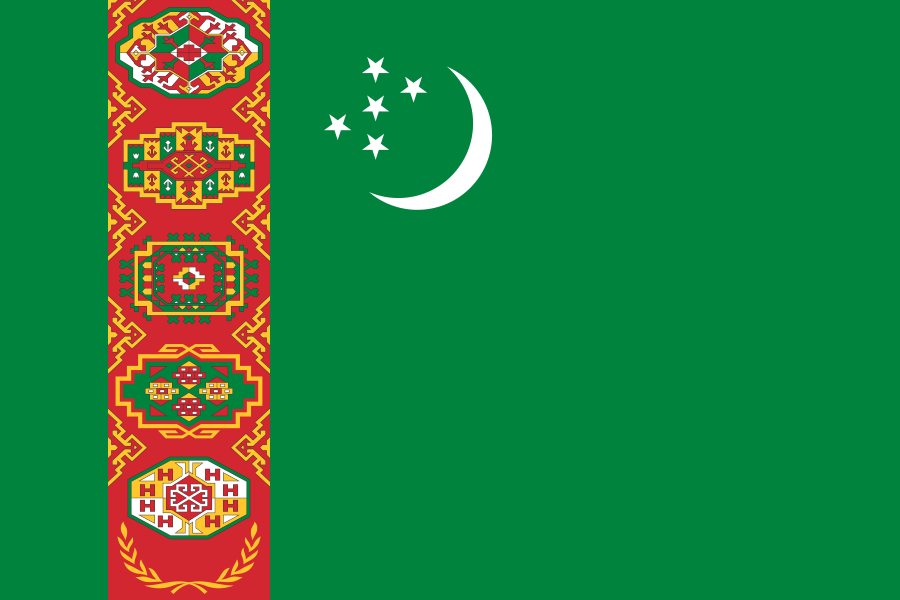
At the outset, allow me to express our gratitude to the Government of Bangladesh for bringing to this forum the issue that may define our future, that of a culture of peace.
Our delegation would like to commend the Secretary- General of the United Nations and the Director-General of the United Nations Educational, Scientific and Cultural Organization (UNESCO) for the comprehensive and substantive consolidated report containing a draft declaration and programme of action on a culture of peace. Turkmenistan fully supports the initiatives contained in the report calling upon all Member States to join in commemorating the year 2000, the birth of the new millennium, as the International Year for the Culture of Peace.
The Government of Turkmenistan is co-sponsoring the draft resolution on the culture of peace at this session, as it did last year. Last summer Turkmenistan co-sponsored the Economic and Social Council resolution on the International Decade for a Culture of Peace and Non-violence for the Children of the World (2001-2010). We hope that delegations will also support the adoption of the present draft resolution by consensus at the current session of the General Assembly.
A need for lasting peace prompted the creation of the United Nations more than 53 years ago. From the day of its founding until now peace has remained the first and most important commandment embodied in the Charter of the United Nations. A culture of peace is a comprehensive complex of values based on the right to peace, which is vital and inseparable from any other basic human rights, such as the rights to life, security, freedom and development, women’s rights and children’s rights. We believe that peace can be built only by sharing responsibility and engaging in dialogue in an effort to ban violence, hatred and the use of military power. Peace can be guaranteed if it is based on the values and principles of freedom, justice, democracy, respect for all human rights, tolerance and the recognition of diversity.
The notion of learning to live together is not a new one, and the threads and routes that linked cultures and civilizations can be found throughout human history. In our part of the world one of the longest bridges of multicultural communication was the Silk Road, which linked almost
We commend UNESCO’s work in providing assistance to several projects of the Integral Study of the Silk Road, in organizing international expeditions and colloquiums, launching international research programmes and institutes, in promoting cultural tourism and in producing studies, films, and publications, including a history book on the civilizations of Central Asia. Today, our countries are promoting the renaissance of those forgotten trails of the Silk Road by strengthening economic and cultural cooperation.
Turkmenistan believes that strong economic cooperation can help achieve a better peace. The only way to realize all the benefits of peace is by respecting international obligations and mutually agreed upon legal instruments and to recognize that the maintenance of peace is interdependent with other factors. In this regard, Turkmenistan has expressed the need to ensure the security and unimpeded transit of natural resources through pipelines. These pipelines, like another Silk Road, have become the main arteries of the region and are vital for its development.
Turkmenistan supports the revised UNESCO transdisciplinary project entitled “Towards a culture of peace”. A culture of peace will not become a reality unless it is supported by individuals, civil societies, Governments and, most importantly, the leadership of nations. Mr. Oscar Arias, a Nobel Peace laureate and former President of Costa Rica, said that
“our leaders must be willing to dedicate themselves to peace and education. Our creativity, our sense of justice and our humanity must be our weapons.”
Peace-building and peacemaking programmes should utilize all available resources of the United Nations, including human rights instruments, established mechanisms for conflict resolution, programmes and studies of UNESCO, the United Nations University and its International Leadership Academy and the good services of United Nations Volunteers and United Nations Goodwill Ambassadors.
In conclusion, I would like to quote the late United States Senator J. William Fulbright, who once said that
“our future is not in the stars but in our own minds and hearts. Creative leadership and liberal education, which in fact go together, are the first requirements for a hopeful future for humankind.”
Now is the moment for peace. At the close of the millennium, the entire world is clamouring for a lasting peace that leaves no room for war. In order to achieve this, we need to move towards a culture of peace, tolerance and solidarity based on the fundamental principles of human rights, democracy, freedom and social justice.
We must begin with an education based on ethical, pluralist, democratic, humanist and scientific principles, an education that promotes respect for human rights, develops critical thinking, provides the necessary skills for efficiency in work and production and encourages creativity and the full development of the personality and special skills of each individual. As a result, we will have human beings who are united, tolerant, peace-loving and prepared to resolve their conflicts by means other than the use of force and violence.
Three years ago, in this same Hall, in the framework of the celebration of the fiftieth anniversary of the United Nations, a group of Latin American countries, supported by a large number of delegations, took the fine initiative of welcoming resolution 5.3, adopted by the General Conference of the United Nations Educational, Scientific and Cultural Organization (UNESCO), and under which the Director-General of UNESCO was invited to direct the activities of the transdisciplinary project entitled “Towards a culture of peace”. They asked the Secretary- General to report on the educational activities conducted within the framework of that project. In 1996, after studying the report and taking into account the importance of all the activities thus far carried out for the culture of peace, they requested a report that would include elements of a provisional draft declaration and programme of action on a culture of peace.
A year ago, in the report of the Secretary-General contained in document A/52/292, we received the elements of that provisional draft declaration and programme of action. Today, the General Assembly has before it a concrete proposal, included in the report contained in document A/53/370 to which I have already referred. We therefore believe that the time has now come to turn concepts into proposals for action, to move from words to daily practice. Let us recall that together we decided to proclaim the year 2000 as the International Year for the Culture of Peace. What better time could there be to adopt a long-term programme of action that will contribute to the building of the world to which we aspire in the next millennium?
Ecuador wishes to take this opportunity to reiterate its commitment to work actively towards finding the mechanism that will make it possible for us to adopt a draft declaration and programme of action on a culture of peace. We believe that a declaration and programme of action of such importance needs the support of all, and
Lastly, I would like to recall that the Government of Ecuador co-sponsored the draft resolution entitled “International Decade for a Culture of Peace and Non- violence for the Children of the World (2001-2010)”, adopted at the substantive session of the Economic and Social Council, now contained in document A/53/L.25, which we recommend that the Assembly adopt today. It is in our hands to prepare the world of the future, the world of our children.


Since the end of the cold war, the General Assembly and the United Nations Educational, Scientific and Cultural Organization (UNESCO) have engaged in useful discussions on the relationship between peace and war and between peace and culture, and have advanced the important concept of a transition from a culture of war to a culture of peace, whose most important elements include, respect for human rights and fundamental freedoms, elimination of poverty, emphasis on education, the advancement of the status of women and the promotion of mutual understanding and tolerance among all peoples.
We are pleased to note that, in accordance with the General Assembly resolution adopted last December, the Secretary-General, in coordination with the Director- General of UNESCO, has submitted to the current session a consolidated report containing a draft declaration and programme of action on a culture of peace. This report is the result of the joint efforts of the world’s Governments and peoples. It reflects the ardent aspiration of the peoples of the world to maintain peace, end war, respect human rights and promote development. The Chinese Government expresses its appreciation for the submission of this report.
The Chinese are a peace-loving people. Over 2,000 years ago, the great thinkers of China expressed their
Peace and development are indivisible. Without peace and stability, economic and social development will have no basis on which to proceed; and without economic and social development, peace and stability will be difficult to consolidate and sustain. The Chinese Government has always believed that in order to realize the main objective of peace and development, the international community should make joint efforts to establish a just and reasonable new international political and economic order on the basis of the United Nations Charter and the five principles of peaceful coexistence. There should be no resort to the threat or use of force or to the indiscriminate use of sanctions to resolve differences and disputes among countries. Solutions should be sought by peaceful means, through dialogue instead of confrontation.
As pointed out in the draft declaration and programme of action, a culture of peace is a process of individual, collective and institutional transformation. It grows out of the beliefs and actions of the people themselves and develops and evolves in each country within its specific historical, sociocultural and economic context. Therefore, we believe that the culture of peace is not a rigid concept; it is a multifaceted concept rich in meaning. If it is to promote a culture of peace, the international community should pay full attention to the diversity of the world and respect the different approaches and means adopted by each country according to its national conditions. Only in that way will it be possible truly to realize the objectives and the essence of the culture of peace.


The creation of the United Nations was a conceptual watershed in the history of humankind. With that momentous step, we turned our back on the culture of war and violence. At the same
Having addressed the concept in the General Assembly at its last three sessions, we were able to adopt resolution 52/13 last year. Pursuant to that resolution, we now have before us the consolidated report containing a draft declaration and programme of action. In this regard, I wish to express to the Secretary-General and to the Director- General of UNESCO our thanks for the submission of the report contained in document A/53/370. As we are all aware, the draft declaration and programme of action submitted in the report are the end result of the efforts we have made over the years to lay the foundation for the establishment of a culture of peace. We are convinced that these two documents, based on the ideas accumulated in the process and strengthened by the proposals and suggestions submitted not only by various United Nations entities and other international organizations but by Member States as well, represent a solid basis for the achievement of our lofty aim. With the declaration and programme of action available to us now, we are hopeful that the intergovernmental process of examining them can be completed in time for the observance of the International Year for the Culture of Peace in the year 2000.
The establishment of a culture of peace is bound to be a long-term process of gradual transformation, addressing the roots of violence so firmly embedded and ossified in our minds. As history has clearly shown, transforming a culture of violence and war has proved to be difficult and sometimes even frustrating. The deaths of millions of people in wars and numerous other conflicts after the Second World War are eloquent testimony to that fact. If history and the current tragic developments unfolding in various parts of the world are any guide to us, we can easily foresee many obstacles in our future efforts for a culture of peace. We believe that it is with the conscious and active involvement of all concerned that we will be able to overcome future obstacles. We therefore consider it most appropriate that the declaration adopt a comprehensive approach involving all the main actors. We also believe that the primacy given to the role of a wide range of actors
Last year, my delegation stated from this rostrum that the firm establishment of a culture of peace at the national level would determine the success of our endeavours at the global level. In this respect, the declaration has rightly acknowledged the essential role of the State in establishing and consolidating the necessary conditions for the development of the concept. We are also pleased that the declaration recognizes the importance of the specific historical, sociocultural and economic context of a country in nurturing a culture of peace. Myanmar is fully aware of the powerful influence of the specific conditions of a country on the formation of a particular culture.
The importance of education in our undertaking cannot be overemphasized. There has been a consensus on the key role of education in the new directions that today’s world is taking. It has been generally accepted that investment in education amounts to investment in peace and progress. The task of constructing a culture of peace requires, first and foremost, disarming hatred and taming violence in their early stages. Education is the best tool in this regard, since it provides all the opportunities to do so. Education provides opportunities for much interaction and for engaging in a long learning process, which are the most propitious factors for strengthening the sense of belonging and togetherness. As a result, it instils tolerance in the mind and contributes to the rejection of violence in all its manifestations. If effectively implemented, a thoroughly formulated and carefully tailored education policy may instil in children, in their formative years, values, attitudes and behaviours which will promote a culture of peace. We believe that this will ensure a future free from all forms of violence. For these reasons, it is gratifying to note that the declaration urges us to mobilize every aspect of education towards the goal of building a culture of peace. In our delegation’s view, the draft declaration in its present form is correct in its thrust and approach.
I also wish to take this opportunity to make some comments on the draft programme of action. We need a programme of action with a sound basis to achieve the aims of a culture of peace. As it is presented in the report, the draft programme fulfils this need. Considering the importance of national efforts for the success of global endeavours, complementarity between national strategies for action and the overall strategy is vitally
Concerning the specific actions proposed in the draft programme, we believe that these will provide valuable guidance to Member States in working out appropriate national strategies. We feel sure that complementarity of the strategies at all levels will increase synergy in our activities and coherence in our approach. As suggested in the draft programme, it is crucially important to mobilize all available resources for the programme’s success. Although we believe that the comprehensive strategy yet to be formulated will include ways and means of finding resources for the programme, it is equally important to have the necessary fundamental resources available well before we fully embark on the programme. In this respect, solid and timely financial support for the programme is of vital importance for its implementation. We are convinced that the envisaged comprehensive strategy for the programme will ensure the adequacy and predictability of the funding. We feel certain that the monitoring system of the comprehensive strategy will also look after the funding aspect of the programme.
As a country where peace of mind is one of the most important aims in the life of almost every individual and where tolerance is one of the most important and most carefully nurtured and practised character traits of everyone, Myanmar was among the sponsors of General Assembly resolution 52/15, entitled “Proclamation of the year 2000 as the International Year for the Culture of Peace”. We therefore could not agree more with the objective of the draft programme to take advantage of the International Year for the Culture of Peace in the year 2000 as the appropriate occasion to launch the initiative it sets out. Nothing could be more auspicious than ushering in a new millennium with a peace programme.
Finally, the multifaceted task of constructing a culture of peace requires comprehensive action on all fronts, addressing all ages and all groups. It is incumbent on all of us to concert and coordinate all our efforts to accomplish this monumental undertaking. With the momentum we have gained thus far and with a road map for the future provided by the draft declaration and programme of action, we fervently hope that we will be successful.


It my honour to address the Assembly on behalf of Costa Rica, the Dominican Republic, El Salvador,
For many centuries people believed that war was inevitable, and that the settlement of conflicts and disputes among peoples could come only through violence or other equally destructive action linked to violence. This contributed to the forming and consolidation of a culture of war, which in the course of history led to innumerable acts of barbarism, destruction and death, and which found its ultimate expression in the Second World War and in the conflicts that arose under the bipolar system that followed that war.
With the creation of the United Nations in 1945, the international community embarked on an experiment that over time would radically change the idea that wars were inevitable: from the moment of its foundation, the new international Organization, based on universally shared values and purposes, defined its principal task as being “to preserve succeeding generations from the scourge of war”. The Organization itself was thus an act of a culture of peace.
As the Secretary-General says in the report on a culture of peace,
“The transition from the culture of war to a culture of peace, initially taken up as a priority by UNESCO, has now been taken up by the United Nations as well.” (A/53/370, annex, para. 3)
Recognition of this priority by the United Nations system opens the door on a new era for mankind in which we are confident that the conclusion will be drawn that violence, in any of its manifestations, can be avoided.
The Central American countries and the Dominican Republic share the view that the essence of a culture of peace approach is that rather than intervening in violent conflicts after they have erupted and then engaging in post-conflict peace-building, it is more humane and more efficient to prevent such violence in the first place by addressing its roots. Many of our peoples in the Central American region had to learn this approach in a painful
With the peace that arrived thanks to the spirit that gave rise to the Esquipulas, Chapultepec and Guatemala agreements, we in Central America aspire to a democratic and equitable region whose development is based on a process of progressive improvement in quality of life through economic growth with social equity, and the transformation of methods of production and patterns of consumption based on ecological balance as a vital support for the region. We hold that aspiration in spite of the obstacles and difficulties that have been magnified by the irreparable effects of hurricane Mitch in our region: property destroyed, thousands of lives loss and some 2 million people injured.
The vision of a region united in peace, freedom, democracy and development, a vision shared also by the Dominican Republic, is what makes it possible for our Governments to reiterate their resolute support for the draft declaration and programme of action on a culture of peace presented by the Secretary-General in coordination with the Director-General of UNESCO in the document before us, which we hope will be adopted by consensus at this session.
The considered aspects set out in the declaration on a culture of peace correspond to and complement the efforts of the international community to promote and universally apply all human rights — especially during this year when we are commemorating the fiftieth anniversary of the Universal Declaration of Human Rights and the fifth anniversary of the Vienna Declaration and Programme of Action — because, in our opinion, there is an undeniable and unequivocal link between peace and respect for all human rights.
We agree that a culture of peace is a process of individual, collective and institutional transformation which arises out of the beliefs and actions of individuals themselves and which evolves within each country in a given historical, socio-cultural and economic context. In this respect, the role played by the State to ensure respect for and promotion and protection of human rights and fundamental freedoms is essential and must take place in close collaboration and cooperation with all members of civil society in order to truly create the conditions that allow for the development of a culture of peace.
In connection with the programme of action, our Governments believe that there exist enough elements for broad-ranging and profound reflection in each of our countries that would allow us to prepare a national programme of action to promote the implementation of the proposals made by the Secretary-General in his report in accordance with our needs and economic and socio- cultural conditions.
Likewise, we believe that there is agreement between the objectives and strategies of the programme of action on a culture of peace and the concrete measures that can be adopted at the national, regional and international levels to promote the consolidation and integration of this effort with the gains and achievements made by the Member States of the United Nations in connection with the application of the results of global conferences, particularly those held since 1982. That agreement illustrates the importance that the United Nations system attaches to the mobilization of international public opinion for a culture of peace for the new millennium.
I would like to reiterate the commitment and political will of the Governments of the Central American countries and the Dominican Republic to disseminate and promote the values, attitudes and behaviours that are necessary to build a culture of peace that is strengthened by the successes and challenges confronting our peoples and Governments in the implementation of various programmes on a culture of peace that have been conducted in the region for some years now. We also want to reiterate our support for the draft declaration and programme of action on a culture of peace presented by the Secretary-General. We agree with him that the International Year for the Culture of Peace in the year 2000 can be an opportunity to put into practice the initiatives of the programme of action and to help motivate international public opinion in favour of a


My delegation associates itself with the important statement made in connection with agenda item 31, entitled “Culture of peace”, by the Permanent Representative of El Salvador, Ambassador Ricardo Cornejo, on behalf of Guatemala, Honduras, Nicaragua, Panama, the Dominican Republic and my country, Costa Rica.
The delegation of Costa Rica is convinced of the need for and the importance of promoting a culture of peace in order to achieve profound change — to replace the culture of war and violence with the culture of peace and non- violence. This will be the challenge of the new millennium. Our calling to peace has been demonstrated throughout the years through a number of proposals, such as the establishment of the University for Peace in 1980. The objectives and activities of the University have included and will continue to include cooperation with the United Nations Educational, Scientific and Cultural Organization (UNESCO) in an effort to establish a culture of peace in the world through the irreplaceable means of education and publicity.
Subsequently, my Government proposed the proclamation of 1986 as the International Year of Peace and, at the same time, the International Day of Peace to coincide annually with the opening day of the General Assembly session. Lastly, it called for the proclamation of the World Week of Peace during the celebration of the fiftieth anniversary of the United Nations, from 24 to 30 October 1995. In this connection, the representative of Turkmenistan referred just moments ago in her statement to the former President of Costa Rica, Mr. Oscar Arias, who was awarded the Nobel Peace Prize.
We thank Ambassador Anwarul Chowdhury of Bangladesh for introducing this important item so eloquently.
My delegation also appreciates the presentation by the Secretary-General of the United Nations and the Director- General of UNESCO of the excellent consolidated report contained in document A/53/370, which was submitted to us in accordance with resolution 52/13, adopted on 20 November 1997 with 71 co-sponsors, including my own delegation.
This report contains the draft declaration and programme of action on a culture of peace. We believe that
My delegation believes that this should be the theme of the millennium. With the end of the cold war, the United Nations now has the opportunity to fulfil one of its fundamental and primary objectives: that of abolishing war. This clearly requires a profound transformation of the cultural roots of war and violence in the transition to a culture of peace and non-violence.
As is described in the introduction — pages 4 and 5 — of the document we are considering, this objective is part of the very history of the United Nations and its partners and has been recognized by the General Assembly as a priority in its designation of the year 2000 as the International Year for the Culture of Peace. We recognize that the culture of peace is a necessary precondition for national and international peace and security. It complements preventive diplomacy, peacekeeping, disarmament and military conversion.
It is not enough to send peacekeeping forces to separate parties that are at war or to undertake post- conflict peace-building, nor does preventive diplomacy seem to suffice. We must also act at a deeper level. The development of a culture of peace can provide a secure basis for the achievement of disarmament and military conversion, and it can meet concerns for human security.
The transition to a culture of peace requires the participation of individuals, of communities and of institutions at all levels. It requires the development of a global movement so that the United Nations can provide inspiration and leadership. The International Year for the Culture of Peace, 2000, offers an opportunity for the mobilization of that global movement, which will include educators; journalists; parliamentarians; religious
It is important to emphasize the relationship between the culture of peace and the Universal Declaration of Human Rights. Respect for and defence of all human, political and civil, social, cultural and economic rights is essential for a culture of peace. In marking this year the fiftieth anniversary of the Declaration, it is necessary and important for the international community to reaffirm its full commitment to the establishment of all human rights.
There is nothing more destructive to human rights than the culture of war and violence. Therefore, the promotion of the culture of peace should be understood as one of the most significant milestones in the implementation of the Universal Declaration of Human Rights.
Finally, the Director-General of the United Nations Educational, Scientific and Cultural Organization, Federico Mayor, has stated that the right to peace is a human right.
My delegation hopes that the idea of a culture of peace will be the positive and basic vision with which we enter the new millennium. Costa Rica, as a sponsor of the draft resolution contained in document A/53/L.25, which was recommended by the Economic and Social Council at its recent meeting, would be very pleased indeed to see this draft resolution adopted by consensus in the Assembly.


The General Assembly is once again considering the item “Culture of peace”, thus providing all States with the opportunity to put forward their views and ideas on the meaning of a culture of peace.
Lebanon has always been the cradle of peace and disseminated its values and culture. Hence we would like to enrich the debates of the General Assembly with a contribution that may clarify certain dimensions of the issues that we think should be included in the documents to be issued on the culture of peace.
It expresses the desire for knowledge and the longing for a feeling of security. A civilization based on the culture of peace should oppose all aspects of ignorance, oppression and backwardness. It should not condone hunger, poverty, displacement or foreign occupation, for such scourges have grave implications for the international community and jeopardize international peace and security.
The culture of peace is a legitimate vision of the future and of the twenty-first century. If the essence of the culture of peace is intervention to prevent armed conflicts, then the international community, as represented in the United Nations, the forum for peace, is called upon to bring pressure to bear on the Israeli troops to observe the principles and the culture of peace. Israel must be compelled to desist from its aggressive policy against southern Lebanon and the western Bekaa Valley, occupied since 1978. Israel rejects the implementation of the provisions of Security Council resolution 425 (1978), which stipulate its immediate and unconditional withdrawal from southern Lebanon.
This policy, which arrogantly and intransigently refuses to implement the resolutions of the United Nations, is inimical to the culture of peace, which we all call for its dissemination among our people in order that they may live in peace. Is not the obsessive mentality of war prevailing in Israel reflected in the daily bombardment by weapons of all types of the civilian population in southern Lebanon? Is that not inimical to the culture of peace? The premeditated acts of aggression on the part of the Israeli occupation troops against the headquarters of the United Nations in Qana in southern Lebanon — the envoys of peace in the area — in April 1996 and the murder of 106 innocent women, children and elderly people, are these not acts that contravene the culture of peace?
Furthermore, what can we say when we see Israel, which claims to want to implement resolution 425 (1973) which stipulates Israel’s immediate and unconditional withdrawal from Lebanon, steal Lebanese soil and transfer it to Israel. Israel has admitted this. In this context, the Arabs, who have made peace an integral part of their civilization, legacy and daily conduct, as well as a deeply rooted element of their lives and customs, see the natural role of the United Nations and its various agencies as being to uphold and disseminate vigorously the values of peace. Hence, the Arabs have accepted the United Nations concept for achieving peace in the Middle East on the basis of land for peace, as well as Security
Here we are faced with two different cultures: humane, national culture — the culture of peace — versus the culture of domination and aggression as represented by the politics of the Israeli occupation forces. Our apprehension here is that culture itself would become an arena for sparking wars among peoples and states, instead of becoming the culture of peace that we all desire.
We regard the diversity of cultures in the world as a positive factor that enriches the culture of peace, which should be the sum total of all these cultures. In this respect there is no room for engaging in the whirlpool of imposing the cultures of certain countries and peoples at the expense of the cultures and customs of other peoples. Human rights are an expression of tolerance in all cultures. That is the foundation for peace and progress. Human rights — if understood properly, interpreted in a just manner, and implemented without double standards — are not alien to any culture, but part and parcel of the sum culture of all nations.
Nonetheless, the bitter reality confronting us in many parts of the world is that many attempts are being made to distort these facts by disregarding the massive violations of human rights as well as the values of the culture of peace. While there is disregard of the right to self-determination of the millions of Palestinians and of the hundreds of thousands of others that have been displaced by the Israeli occupying forces in southern Lebanon and the Syrian Golan, we discern no decisive and requisite movement on the part of some of those defenders of the culture of peace and human rights to compel the Israeli occupying forces to withdraw from the occupied Arab territories, to observe and implement the relevant United Nations resolutions with a view to giving a chance to a just peace and to its culture so that they may be deeply embedded in the conscience and in the daily life of all peoples.
Lebanon, the inheritor of 6,000 years of civilization, is looking forward today to a world free from occupation and hegemony, a world in which the principles of the United Nations prevail — the principles of justice, equality and peace.


The inclusion on the agenda of item 31, entitled “Culture of peace”, gives me once again the opportunity of taking
Following the example of other delegations, the delegation of Benin would like to commend and thank most warmly the Secretary-General and the Director- General of the United Nations Educational, Scientific and Cultural Organization (UNESCO), not only for the very useful documents made available to us, but also and above all for their tireless efforts to heighten the international community’s awareness of this universal value — peace — and to plant in minds the seeds of such a culture, which is so essential if we are to deal with the many challenges confronting humankind.
With the end of that long-dreaded phenomenon, the cold war, the international community heaved a sigh of relief because it felt that from then on it would be spared another world war as large as those that twice so terribly affected humankind. But we must now recognize that the coming of peace remains threatened by the persistence of underdevelopment and, above all, by the resurgence of the doctrines and ideologies of racism, xenophobia, ethnocentrism, intolerance and violence that, unfortunately, underlie the deadly and genocidal conflicts now taking place more or less throughout the world, and especially in Africa and in Europe.
Thus, in order to guarantee a lasting peace, we must simultaneously deal with these two categories of economic and social factors. Along with our efforts and actions in the area of development, we should work together to discourage forever the doctrines of violence and of intolerance and to promote — especially through education — a culture of peace in the mind of each and every human being, through respect for and protection and promotion of human rights.
In this regard, my delegation welcomes the effective actions undertaken by UNESCO in this area and would like to ensure that organization of Benin’s support and full cooperation.
The success of such a noble but difficult a task as the culture of peace should not be the prerogative of one individual, one State or one international organization. It demands the participation of the entire international community in the implementation, under the aegis of the
This is why my delegation welcomes the texts submitted to the Assembly: the draft declaration and programme of action contained in document A/53/370 and draft resolution A/53/L.25, entitled “International Decade for a Culture of Peace and Non-violence for the Children of the World (2001-2010)”. Above and beyond the outline of the concept of a culture of peace that they provide, these drafts contain proposals for strategies and concrete joint actions to be carried out to promote a genuine culture of peace and to forever ward off the spectre of war and conflict.
The establishment of a culture of peace would enable our Organization and the entire international community to devote their efforts and energies to the solution of many development problems, thanks to international security and the respect for and defence of human rights that it would inspire.
In proclaiming the year 2000 as the International Year for the Culture of Peace, the General Assembly did not wish simply to show its interest in peace; it wished, above all, to urge the international community to give priority to the promotion of a culture of peace in order to safeguard an international society free of violence for current and future generations.
Therefore, Benin supports the proposal that the principal theme for the fifty-fifth session of the General Assembly, to be held in the year 2000, be “A culture of peace”, so that the entire world might become aware of the need to safeguard this peace so as to ensure the well-being of the individual in the next millennium.
In view of the foregoing, it is up to each and every State to take here and now the steps required for the implementation of the programme of action to be adopted following our work. Provisions should be especially made to mark the year 2000, the International Year for the Culture of Peace, through the implementation of consciousness-raising programmes involving parliamentarians, political parties, teachers and journalists, in a word, all of civil society.
As far as Benin is concerned, it has already been working, through its democratization process begun in 1990, towards the establishment of a culture of human rights, a prerequisite for a culture of peace. Political and civil rights, the right to be different, and tolerance are all


Racial, ethnic or religious hatred, ignorance, cultural prejudice, xenophobia, abject poverty, the stifling of public liberties — these are all factors which harm peaceful coexistence among societies.
Peace is not only the absence of war. Racial discrimination, ethnic, religious or political intolerance, the failings of democracy and the absence of social dialogue can also be sources of tension which should be quelled.
My delegation believes that as this century fades into the dawn of the third millennium, with so many challenges giving rise to both hope and concern, humankind needs to take stock of its virtues and of its inexhaustible wealth — wealth represented by the dialogue among civilizations and cultures. We must implement a theory of convergence in order to ensure a transition from the reason of force to the force of reason, to borrow an eloquent expression from the Director- General of the United Nations Educational, Scientific and Cultural Organization (UNESCO), Mr. Federico Mayor. In the final analysis, the culture of peace implies the culture of non-violence, with priority being given to dialogue and negotiation. It also involves a strategy for conflict-prevention.
Today, all the regions of the world are subject to destructive conflicts which are swallowing up enormous human and financial resources which could have, or should have, been devoted to the peaceful development of nations. These continuing conflicts instil in people’s minds a dangerous culture of violence which no longer even spares children, women or the elderly. In addition, modern means of communication are, consciously or unconsciously, being used to spread the culture of violence, intolerance and xenophobia.
There is no need to recall that in this quest for the culture of peace the Félix Houphouët-Boigny Peace Prize was created by UNESCO in 1989. This prize has been awarded to outstanding personalities: in 1991 to Nelson Mandela, then Vice-President of the African National Congress, and to President Frederik De Klerk of South Africa. In 1993 it was awarded to Yitzhak Rabin, Shimon
The Government of Senegal, which has made dialogue one of the constant aspects of its foreign policy, remains dedicated to the promotion of a culture of peace. My Government, in cooperation with UNESCO, has taken the initiative of building a memorial not far from Gorée Island, facing the Americas, to remind the world what the slave trade was about, as well as to build a bridge designed to reconcile peoples who should henceforth cultivate forgiveness and tolerance.
This is why my country believes that it is of the utmost importance that we invest in education and the upbringing of the younger generations with a view to the universality of values and ideas, with a pan-humanist approach which would safeguard and perpetuate moderation, harmony and conciliation among peoples and nations.
For these reasons my country became a sponsor of the draft resolution submitted to the General Assembly proclaiming the decade 2001-2010 the International Decade for a Culture of Peace and Non-violence for the Children of the World — namely, a decade for the children who will be responsible for the fate of humankind.
Let us see to it together that we raise the defences of peace in the spirit of these young generations and that we ensure everywhere respect for and promotion of human rights — all human rights — be they civil, political, social, cultural or economic.
The fiftieth anniversary of the Universal Declaration of Human Rights gives us an exceptional opportunity to promote human rights education in our school systems, as well as the culture of tolerance and peace in relations among States and peoples. To that end, the role of the


For Uruguay, the culture of peace represents a vital commitment of the international community. We are by nature a peace-loving country. We understand no other form of behaviour and coexistence among nations. We cannot imagine a world in constant conflict. We do not want coexistence to be plagued by confrontation and are not pleased to see brothers from other cultures destroying societies that they could be building in peace. The time has come to settle quarrels begun generations ago. The time has come to end discord and to look with optimism to the future.
The culture of peace, as opposed to the culture of conflict, coincides with the end of the cold war. Nevertheless, and paradoxically, since 1989 over 4 million people have died as victims of armed conflict, most of the them civilians.
At its last session, the General Assembly, through resolution 52/15, declared the year 2000 as the International Year for the Culture of Peace and at this session will implement the programme of action prepared by the Secretary-General in cooperation with the United Nations Educational, Scientific and Cultural Organization (UNESCO). The United Nations is making progress in that direction by emphasizing the promotion of peace among its Member States. This is consistent with the founding idea of the Organization, which was based on avoiding war among nations.
Today, the nature of conflicts has changed. They have gone from being international to being mostly domestic conflicts that arise largely out of poverty, ignorance, environmental destruction and, inter alia, disregard for the basic rights required of a democratic order. The culture of peace entails a new mission for the coming century: to address the roots and causes of war and violence. This is an integral approach encompassing respect for human rights, democracy, tolerance, sustainable development, education for peace, the free flow of information and the wider participation of women.
I can assure the Assembly that, in Uruguay, educational programmes have already incorporated the concept of a culture of peace and it is our hope that future generations will fully embrace this view of the world. We are particularly pleased to know that, in our
The effectiveness of the culture of peace begins with the family, the primary and priority nucleus in which the child must receive its earliest instruction in that respect, then extends to the schools and communities. In this programme, another priority is the participation of the mass media: the oral, written and televised press, along with computers. Their duty and responsibility may not be emphasized as strongly in the draft programme of action as we believe they should have been. The international community, represented in this General Assembly, must appeal emphatically to the media to undertake the enormous task of inculcating a culture of peace, not a culture of violence. That global mobilization must start now.
Let us ensure that the year 2000 will mark the beginning of a century devoted to peace, in which nuclear weapons and all weapons of mass destruction are nothing but a nightmare of the past. Let us, with courage and determination, relegate to oblivion the culture of war that has dominated the century in which we still live.
My delegation is pleased with the report submitted by the Secretary-General and prepared in cooperation with the Director-General of UNESCO. We give our complete support to the draft declaration and programme of action contained therein, and we suggest that a culture of peace be considered a principal topic of the Millennium Assembly.


The Russian Federation consistently advocates the idea of a culture of peace, which includes values, approaches and universal norms of conduct based on respect for peace, tolerance, fundamental rights and human freedoms. The implementation of the concept of a culture of peace is a difficult and multifaceted task, the fulfilment of which, in practice, would entail the ultimate transition to a world without war and violence in which the rule of law and democracy would prevail.
Over the past year, this concept has been further developed, as reflected in the draft programme of action on a culture of peace contained in the consolidated report submitted by the Secretary-General in document A/53/370.
It is precisely in this area that a broad-based project has been launched in our country, in cooperation with the United Nations Educational, Scientific and Cultural Organization, called “Year 2000 — A Culture of Peace in Russia”. Its major objective is to focus and coordinate the holding of activities in Russia for the International Year for the Culture of Peace. In the long run, we aim at promoting the establishment in Russian society of a stable psychological trend towards non-violence and tolerance and the idea of peace as a positive process closely linked to the protection of human rights, democracy, mutual understanding and solidarity among all peoples and cultures.
In preparing the concept of the draft, account was taken of the recommendations of the United Nations Conference on Environment and Development, held in Rio de Janeiro in 1992; the World Summit for Social Development, held in Copenhagen in 1995; the Fourth World Conference on Women, held in Beijing in 1995; and the International Conference “From the stereotypes of war to the ideals of peace through culture and education”, held in Moscow in 1997.
The relevance and the special nature of the project as carried out in Russia are closely linked to the need for the formation of a civil society, the rule of law, the prevention of ethno-religious and social tensions and the performance of tasks for improving the cultural and living standards of our people. Furthermore, the culture of peace is a movement towards the reaffirmation of universal values and a search for answers to the challenges of so- called civilized crises in which we increasingly find serious phenomena such as alienation and marginalization of the individual, cultural cruelty and violence and the spread of various forms of extremism. The “Year 2000 — A Culture of Peace in Russia” project proceeds from the concept of a multifaceted idea of peace, non-violence and tolerance in the minds of people. A principal way to carry out this task is through education, including formal education in schools and informal education through public institutions and mass media.
The culture of peace is reaffirmed in the process of mobilizing civil society and enhancing the legal protection of the population. It will triumph when the importance of preventing conflicts and eliminating their causes, through dialogue and negotiation, begins to be understood not just
In supporting the adoption by the General Assembly of a programme of action on a culture of peace, the Russian delegation expresses the hope that the implementation of its provisions will promote the utilization of the basic purposes of the United Nations, first and foremost, to save succeeding generations from the scourge of war and to reaffirm faith in fundamental human rights and in the dignity and worth of the human person.


As we have been able to see, the question of promoting a culture of peace will be one of the priority objectives of the international community at the beginning of the next millennium.
If that is so, it is because, according to the report on this subject issued by the Secretary-General in coordination with the Director-General of the United Nations Educational, Scientific and Cultural Organization (UNESCO),
“In a rapidly and deeply changing world characterized by the growing importance of ethical issues, a culture of peace provides future generations with values that can help them to shape their destiny and actively participate in constructing a more just, humane, free and prosperous society and a more peaceful world.” (A/53/370, part I, para. 7)
On reflection, it seems clear that the process began with the very creation of the United Nations, founded on the values of peace and justice and designed to build a more just and peaceful world.
Before proceeding, on behalf of my delegation, I would like to congratulate the Secretary-General, and through him the Director-General of UNESCO, on their
Among the actions to be undertaken, I wish to refer briefly certain aspects that to my delegation seem essential. The building of a culture of peace, let us recall, is a task that requires wide-ranging educational, cultural, social and civic action. It is an endeavour that calls on every individual and presupposes a strategy of openness at the family, national, regional and global levels designed to ensure that a culture of peace is an inextricable part of culture itself and that it is deeply rooted in the hearts and minds of all men and women.
It will be up to young States, and those of Africa in particular, to work to strengthen the achievements of the nation State in artificially drawn geographic areas, a phenomenon that has already weakened the feeling of shared national community among populations living there. This phenomenon seems to have acquired a new dimension, since the process of democratization — seen as having to take into account the specificities of each people — has skidded out of control under the effect of pressures from outside the continent and little understood national realities. The inevitable consequence is that the sudden leap towards democratization in most of our States has been accompanied by socio-political troubles that have seriously frayed the social fabric and the efforts for national unity undertaken following independence.
In addition to consolidation of the nation State, the management of post-conflict periods on the African continent in particular, is, we believe, another essential aspect to be taken into account in promoting a culture of peace. Indeed, since violence always breeds violence, if concrete and appropriate actions are not taken in regions affected by conflict, we run the great risk of seeing those regions become constant settings for all types of confrontation. It is therefore important to develop and broaden the efforts made in this respect within the framework of the United Nations system. In this vein, we believe there is reason to hope that future peace agreements will be increasingly linked to the development of a culture of peace and that they will include national programmes on a culture of peace, calling upon parties to a conflict to work together in implementing development projects.
The vital need to promote a culture of peace also requires a revitalization of the three United Nations regional centres for peace and disarmament. In this connection, we are gratified at the renewed interest in these centres, which, we are convinced, can contribute to improving understanding and cooperation among States in each of the regions concerned in the fields of peace, disarmament and development.
The Government of Togo remains convinced that the United Nations Regional Centre for Peace and Disarmament in Africa — regarding which the First Committee, on 5 November last, unanimously adopted a resolution calling for its revitalization — can in the present context play a leading role by encouraging the adoption of confidence- building measures at the regional level and thus foster progress in the field of sustainable development. In so doing, the Regional Centre will support the efforts made in the framework of the mechanisms for prevention, management and resolution of conflicts on the African continent.
My country, where the Centre is headquartered, takes this opportunity to reiterate its heartfelt thanks to the
As the Declaration adopted at the end of the World Summit for Social Development proclaimed, social justice and the elimination of poverty are indispensable for the establishment and maintenance of peace and security both within nations and between them. Likewise, as the United Nations Development Programme so rightly affirms in its proposals, development that is focused on the human being is both a prerequisite for peace and the consequence of peace.
This demonstrates how important it is to ensure that the other dimension, the elimination of poverty, will be the object of particular attention in our campaign to promote a culture of peace. For if peace is to mean more than just the absence of war, it must obviously have a close relationship to economic development.
However, despite the many efforts made by the African States to reform their economies while broadening the scope of democracy, they still face economic and financial difficulties that do not allow them to meet the vital, minimum needs of their populations.
Hence, any effort to depart from the culture of violence would be inherently flawed if the populations concerned were to continue to live in a state of total deprivation, since situations of poverty are always conducive to the emergence of conflicts. Therefore, the interaction between the culture of peace and sustainable development is the cornerstone of the task the community of States faces at the threshold of the new millennium.
The report submitted to us in this connection describes the major aspects of the task to be accomplished and sets certain guidelines. It remains for States, intergovernmental and non-governmental organizations, specialized agencies and national civil societies equipped with the necessary political will to fulfil the profound and legitimate aspirations of the world’s peoples for a world of peace and justice, a world free of hardship and poverty.
The meeting rose at 12.55 p.m.