A/67/PV.67 General Assembly
The meeting was called to order at 4.15 p.m.
Tribute to the memory of His Excellency Mr. Hugo Rafael Chávez Frías, President of the Bolivarian Republic of Venezuela

Before we proceed to the item on our agenda, it is my sad duty to pay tribute to the memory of His Excellency Mr. Hugo Rafael Chávez Frías, President of the Bolivarian Republic of Venezuela, who passed away on 5 March 2013.
On behalf of the General Assembly, I request the representative of the Bolivarian Republic of Venezuela to convey our condolences to the Government and the people of Venezuela and to the bereaved family of President Chávez Frías.
I now invite representatives to stand and observe a minute of silence in tribute to the memory of His Excellency Mr. Hugo Rafael Chávez Frías.
The members of the General Assembly observed a minute of silence.
It was with great sadness that I learned of the passing of His Excellency Mr. Hugo Rafael Chávez Frías, President of the Bolivarian Republic of Venezuela. On behalf of the General Assembly, and in my own name, allow me to offer my deepest condolences to his bereaved family and friends, the Government and the people of Venezuela, as well as to his many admirers throughout Latin America, the Caribbean and the rest of the world. On this solemn occasion, it is my hope that we can put aside any personal or political differences and come together to pay our respects. History will no doubt remember President Chávez Frías, who was a charismatic leader whose progressive policies brought Venezuela’s poverty rate down from over 70 per cent at the close of the twentieth century to around 20 per cent today. Throughout his term in office, he remained committed to the cause of social justice, working hard to improve the lives of Venezuelans, especially the most underprivileged among them. Under his strong leadership, Venezuela made great strides towards fulfilling the Millennium Development Goals, to the lasting benefit of a great and proud nation. He was a man who came from humble beginnings, brought up in a mud-floor house on the cattle-ranching plains of Barinas state. That helped him better understand and feel the pain and privations of ordinary Venezuelans. While he was a great advocate of the sovereignty of his country, President Chávez Frías was also a strong proponent of the revitalization of the United Nations. Throughout his political career, he remained a vocal advocate of the global South and a firm believer in the potential of the Non-Aligned Movement and the Group of 77 in helping to uplift the developing world. He was also a driving force behind efforts to deepen Latin American and Caribbean integration. That led President Chávez Frías to be actively involved in establishing or strengthening organizations such as Petrosur, Petrocaribe, the Community of Latin American and Caribbean States, the Union of South American Nations and the Bolivarian Alliance for the Peoples of Our America. As President of the General Assembly, I remain steadfast in my commitment to deepening the relationship between Venezuela and this body, with the aim of strengthening the founding principles of the United Nations. May he rest in peace in the homeland of his hero, Simón Bolívar, from whom he drew inspiration time and again. I now give the floor to the Secretary-General, His Excellency Mr. Ban Ki-moon.
Offi cial Records

It is an honour to join with the Assembly in paying tribute to the work and memory of His Excellency President Hugo Chávez Frías. President Chávez was one of those leaders who made a difference in his country, the region and the world. His sense of solidarity with the most vulnerable and his commitment to improving the lives of the most underprivileged resulted in a fierce attachment to the Millennium Development Goals.
He also showed solidarity towards other nations in the hemisphere. Perhaps most notably, President Chávez ensured that Venezuela provided crucial assistance to Haiti following the devastating earthquake of 2010. He always reminded the region of the historic debt that it owed to Haiti, the first republic to gain independence in Latin America and the Caribbean.
I also want to recognize the contribution that President Chávez made to the peace talks in Colombia between the Government of President Juan Manuel Santos Calderón and the Revolutionary Armed Forces of Colombia. Basing himself on an eminently Latin American vision, President Chávez provided decisive impetus to new efforts towards regional integration. The United Nations has followed with interest and appreciation the advances in regional integration to which he gave momentum.
The progress in this area is clear, as illustrated by the Permanent Observer status before the General Assembly that the Union of South American Nations acquired in 2011. As the process of regional integration progresses, the key role that President Chávez played in promoting the unity of the peoples of Latin America and the Caribbean will be present in everyone’s minds. But perhaps President Chávez will be best remembered
for his ability to connect at a human level with the most vulnerable and give voice to their aspirations.
In memorializing President Chávez, I would like to recall his message when he first addressed the General Assembly in 1999. On that occasion, he stated his wish that one day in the near future it would be possible to proclaim that “peace, democracy and development have triumphed” (A/54/PV.7, p. 4). Let us honour the legacy of President Chávez by renewing our pledge to work toward these noble goals.
I thank the Secretary-General for his statement.
I now give the floor to the representative of Chad, who will speak on behalf of the Group of African States.


I have the great honour to speak on behalf of the Group of African States at this solemn gathering of the General Assembly to pay tribute to the memory of His Excellency President Hugo Chávez Frías, the late President of the Bolivarian Republic of Venezuela, who recently passed away. I would like first of all to bow to the memory of this great son of the Bolivarian Republic of Venezuela and to record that the announcement of his premature death at the age of only 59 years profoundly shocked and saddened millions of Africans.
Africa has lost a great friend. The passing of this great friend of Africa is undoubtedly an irreparable loss, but his leadership, especially in the conduct of international affairs in the interests of a fairer world, will not have been in vain. History will record his tireless fight for the weakest and most vulnerable, both in his country and around the world. In other words, President Chávez will live on in the hearts of millions of Africans.
(spoke in English)
On this solemn occasion, I also have the honour, on behalf of the African Group, to convey my deepest condolences to the family of the late President Hugo Chávez and to the Government and people of the Bolivarian Republic of Venezuela at this great loss. We remain prayerful that as they traverse this sad and painful period, his memory will remain forever etched in their hearts and minds.
For many of our countries in Africa, the commitment of the late President Hugo Chávez to the economic well-being of his people was greatly admired.
The bond between the late President Chávez and Africa was further cemented through his leadership role in the establishment of the Africa-South America Partnership. May his soul rest in peace and light perpetual shine upon him!
I now give the floor to the representative of Qatar, who will speak on behalf of the Group of Asia-Pacific States.
Sheikh Meshal Hamad M.J. Al-Thani (Qatar): On behalf of the Group of Asia-Pacific States, I would like to express my deepest condolences at the passing of the late President of the Bolivarian Republic of Venezuela, Mr. Hugo Chávez Frías. It is with grief and sorrow that the Asia-Pacific Group received the sad news of the death of the late President of the Bolivarian Republic of Venezuela, Mr. Hugo Chávez.
At the outset, let me refer to a statement issued by the World Bank regarding the education system in Venezuela, which notes that the number of children enrolled in secondary education rose during the 14 years of his presidency. The Centre for Economics and Policy Research has pointed out that poverty in Venezuela has fallen to its lowest level in a decade. The Asia-Pacific Group witnessed the efforts exerted by the deceased President to stand by his commitments to the poor and vulnerable in his country and beyond. He directed his country’s wealth to vast social programmes and provided his citizens with the vital services they most needed — health care and education. He also strove to improve the educational system of his country and provided its citizens with free education, as well as eradicating illiteracy.
At the international level, the late President spoke out in favour of oppressed people and was a vocal advocate of an international system based on justice and equality for all. The Asia-Pacific Group believes that President Chávez was a strong advocate of a strong United Nations and of strengthening South-South cooperation. The number of world dignitaries and Venezuelan people who attended his funeral on Friday stands as testimony to his status as a world figure who had a great impact on the lives of millions of people.
Based on President Chávez’s sympathy with the Asia-Pacific Group and the just causes of developing countries, he will be missed by his dearest friends and colleagues and will be remembered for his devotion to their causes. At this critical time, the Asia-Pacific Group hopes that the Government and the people of
Venezuela will overcome the hardship that they are going through, and wishes them success in their efforts to achieve the development to which they aspire and to build the prosperous future of which President Chávez Frías dreamed. May his soul rest in peace.
I now give the floor to the representative of the Republic of Moldova, who will speak on behalf of the Group of Eastern European States.

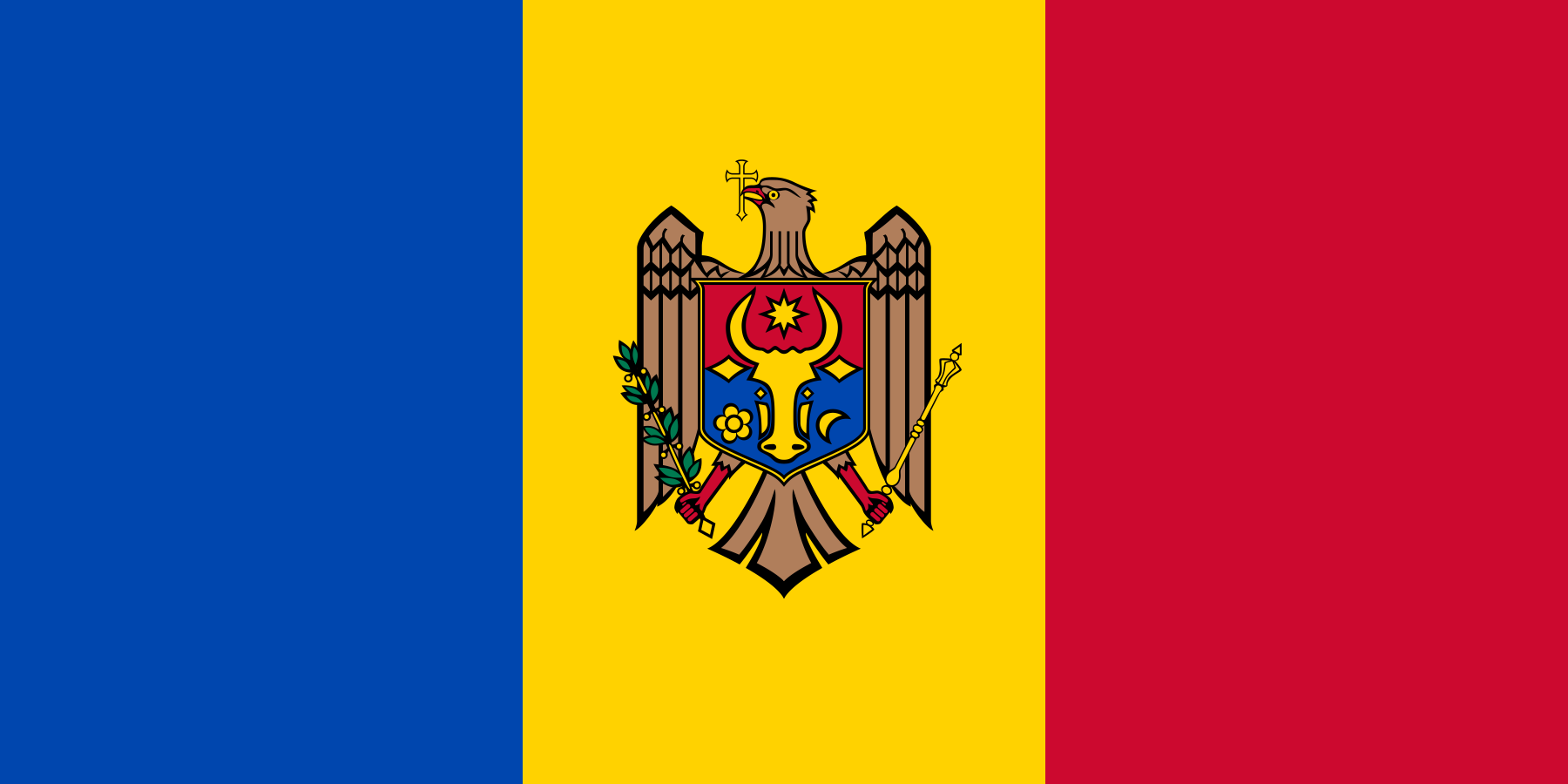
On behalf of the Group of Eastern Eastern European States, let me extend our condolences over the death of Hugo Rafael Chávez Frías, the late President of the Bolivarian Republic of Venezuela, as well as to convey our sympathies to his family and to the people and Government of Venezuela.
President Chávez Frías will be remembered as a prominent personality who was active in the international arena, standing for social justice and equality for the citizens of Venezuela. The States members of the Eastern European Group look forward to the durable development of Venezuela and to the strengthening and diversification of our bilateral relations for the benefit of our peoples.
I now give the floor to the representative of Saint Lucia, who will speak on behalf of the Group of Latin American and Caribbean States.


It is an honour to address the General Assembly on behalf of the Group of Latin American and Caribbean States. Today, we pay our deepest respects to the memory and contribution of the late President of the Bolivarian Republic of Venezuela, Hugo Rafael Chávez Frías. Our region and the entire world have lost a man of enormous character and great courage and vision. He was bold and fearless, never hesitant to express his deep convictions and not afraid to champion the cause of the weak and the dispossessed.
We honour President Chávez Frías as a brave and distinguished leader who was firmly committed to the cause of the integration of the Latin American and Caribbean region, which he regarded as the patria grande. He reinforced that commitment in words and fulfilled it in deeds. His cooperation initiatives, such as Petrosur, Petrocaribe and other bold and imaginative measures, remain instrumental tools in assisting many countries of our region in meeting the formidable challenges to development caused by high energy costs.
He often said that the resources with which his country was blessed were to be shared in order to promote the progressive and independent development of the entire Latin American and Caribbean region, whose collective growth would be further enhanced through such collaboration.
To that end, his dedication to Latin American and Caribbean integration was a hallmark of his tenure, during which there was strong support for mechanisms such as the Bolivarian Alliance for the Peoples of Our America, the Union of South American Nations and the Community of Latin American and Caribbean States. He was a strong advocate for South-South cooperation and the importance of reinforcing concepts, ideas and programmes to foster economic sovereignty among the countries of the South. He was a founding member of the Bank of the South, which was established in September 2009 as an alternative to the International Monetary Fund and the World Bank.
President Chávez Frías was a tireless champion of the poor, the dispossessed and the marginalized, in his beloved Venezuela and beyond. His efforts to address economic, social and political inequality are legendary. His initiatives resulted in reducing poverty by a half and extreme poverty by two thirds, with a significant reduction in income inequality, according to independent estimates. His efforts steadily increased the standard of living of the majority of his people. That remained his primary focus.
One major success of President Chávez Frías was the broadening of public participation in Venezuela’s political process. Such efforts in the socioeconomic and democratic spheres have created a new space for a broader dialogue on creative forms of development, all of which are people-centred.
President Chávez Frías was one of the most charismatic leaders. He emerged from relative poverty and identified with the ordinary man, the common person, who, in turn, identified with him. Perhaps his legacy is best illustrated by the thousands of people who came out into the streets of Caracas and other cities of the country to peacefully pay their respects to their beloved fallen leader. The many shouts of “I am Chávez” that filled the air were indeed an illustration of the love and dedication of the man and his ideal and of the commitment of the people to continue the struggle and to dare to win.
The States members of the Group of Latin American and Caribbean States grieve together with his family, the people of the Bolivarian Republic of Venezuela and those across the world who share the deep commitment of President Hugo Chávez Frías to working tirelessly for the betterment of the people around the world and for the self-determination of peoples.
(spoke in Spanish)
As the Group of Latin American and Caribbean States, we stand in solidarity with the people of Venezuela.
I now give the floor to the representative of Finland, who will speak on behalf of the Group of Western European and other States.


I have the honour to speak on behalf of the Group of Western European and other States to offer our condolences to the people and the Government of the Bolivarian Republic of Venezuela on the passing away of their President, His Excellency Mr. Hugo Rafael Chávez Frías. Our thoughts and sympathies are with the family of President Chávez Frías and with the people of Venezuela at this difficult time.
The countries of our Group stand ready to work with Venezuela through the United Nations and other platforms for prosperity, security and democracy. We wish the people of Venezuela well and offer our sympathies at this time of grief.
I now give the floor to the representative of Fiji, who will speak on behalf of the Group of 77 and China.


On behalf of the Group of 77 and China, I come before you, Mr. President, and the General Assembly to express profound condolences to the Government and people of the Bolivarian Republic of Venezuela at this time of mourning for the passing of President Hugo Rafael Chávez Frías. President Chávez Frías was the embodiment of the devoted leader who pursued a courageously principled path until the very end. He spoke for the multitudes of underprivileged people, both in Venezuela and around the world, who were most in need of the strong voice of a champion. His focus on providing basic services and maintaining policies that worked in favour of the poorest in society predated the world’s articulation of the need to eradicate poverty as the first of its Millennium Development Goals. Deeds followed words and, under
his leadership, Venezuela moved up seven points on the Human Development Index of the United Nations, while a report by UN-Habitat in 2012 highlighted that Venezuela had the lowest rate of income inequality in Latin America and the Caribbean.
Those are achievements of a leader who understood and acted upon the needs of his people. He was known as a leader who was not afraid to undertake the major changes needed to achieve his goals of greater inclusion of the marginalized through the use of national resources and the provision of education, housing and health care. President Chávez Frías translated those national priorities, which were shaped by his personal life experience of growing up in poverty, to the international arena. He challenged the laissez-faire attitudes of the international system and reminded us that real progress can be sustainable only if the benefits of development accrue equitably to all citizens, rather than just to elites.
President Chávez Frías stood fi rm in his commitment to the principles of respect for sovereignty and the equality of the rights of all States to make decisions in the best interests of their peoples. He believed that we must work together as equal States, and it was that cooperative spirit that underpinned many of his efforts to achieve regional cooperation and integration in the Latin American and Caribbean region.
The commitment of President Chávez Frías to the cause of the development of the South, his contribution to South-South solidarity and his legacy of struggle for equity in the world will serve as milestones to be long remembered. His moral values for social justice and his struggle for the cause of development for a better world will certainly serve as a source of inspiration for our Group. His legacy of providing effective leadership to the South during his chairmanship of the Group of 77 in 2002, his role in fostering solidarity among developing countries and his erstwhile promotion of South-South cooperation will be a source of enduring pride for our Group.
The world has indeed lost a visionary leader who challenged us all in our thinking and encouraged us to focus our work on the most pressing issues facing our generation. May the vision of President Chávez Frías continue to guide our work and spur us on as we continue to confront the many challenges before us. In sending our condolences to the Government and people of Venezuela and to the bereaved family of the
late President in these difficult times, we are assured they will take forward his legacy and rise to achieve the potential that President Chávez Frías saw for his people and for his great country. May his soul rest in eternal peace.
I now give the floor to the representative of the Islamic Republic of Iran, who will speak on behalf of the Non-Aligned Movement.


I address the General Assembly on behalf of the Non-Aligned Movement to express our deepest and most sincere condolences to the citizens and the Government of the Bolivarian Republic of Venezuela and to the brave family in the wake of the passing of President Hugo Rafael Chávez Frías. President Chávez Frías devoted the best part of his life to enhancing the welfare and happiness of his people. He will be remembered as one of the great leaders of the non-aligned countries for the relentless efforts he made throughout his life to strengthen the independence of his country and to put in place measures and policies designed to improve the lives of millions of his fellow countrymen.
The Bureau of the Non-Aligned Movement also recognizes the role President Hugo Chávez Frías played in the world. He believed in the need for the integration of Latin America and the Caribbean and promoted the processes aimed at helping to integrate that vast and important region. The commitment of President Chávez Frías to international peace and to the promotion of a world order based on respect for international law, sovereignty, political independence, the equality of the rights of States and the self-determination of peoples is also widely recognized.
The member countries of the Non-Aligned Movement recognize the dedication of President Hugo Chávez Frías to the interests of the people of the South. For that reason, they bestowed the chairmanship of the Movement upon his country, the Bolivarian Republic of Venezuela, for the period 2015 to 2018. May his soul rest in eternal peace.
I now give the floor to the representative of Cuba, who will speak on behalf of the Community of Latin American and Caribbean States.


I should like to begin my statement by reading out a message from the Community of Latin American and
Caribbean States (CELAC) on the death of Commander and President Hugo Rafael Chávez Frías.
“The members of the Community of Latin American and Caribbean States and the peoples of America learned, to their deep dismay and great sadness, of the passing away of the Commander and President of the Bolivarian Republic of Venezuela, Mr. Hugo Rafael Chávez Frías, on Tuesday, 5 March 2013. We extend our deepest condolences to the family of Commander President Chávez Frías, to the Government of the Bolivarian Republic of Venezuela and to all the people of Venezuela, to whom he dedicated his life.
“His unremitting dedication to the sovereignty and integration of our nations and to the development of solidarity among the peoples of the region; his commitment to eradicating poverty and inequality in Venezuela and in our region; his determination to work towards achieving a united, strong and secure Latin America and Caribbean are all values that have inspired the Community of Latin American and Caribbean States. For CELAC — of which he was one of the key founders and promoters — the example set by Commander President Chávez Frías inspires us to redouble our efforts to achieve unity, cooperation, solidarity and integration in Latin America and the Caribbean. That is the best tribute that the peoples of Latin America and the Caribbean can pay to Commander President Hugo Chávez Frías.”
As the Permanent Representative of Cuba, I would like to reiterate the deep pain that the people and revolutionary Government of Cuba feel over the death of President Hugo Rafael Chávez Frías, a hero of the Americas. The historic leader of the Cuban revolution, Commander-in-Chief Fidel Castro Ruz, described Chávez as the best friend that the people of Cuba had throughout its history, and he emphasized that he was honoured to have shared the Bolivarian leader’s ideals of social justice and support for the exploited.
President Chávez Frías led a tremendous battle throughout his short and fruitful life. We will always remember him as a patriotic soldier in the service of Venezuela and the great fatherland; as an honest, perceptive, bold and brave revolutionary fighter; as a supreme leader and commander who reincarnated Bolivar in order to carry out the work he could not finish.
All of Chávez’s work stands unassailable before us. The victories of a revolutionary people, who saved him from the coup of April 2002 and have followed him without hesitation, are now irreversible. As Cuban President Raul Castro Ruz said, Hugo Chávez died undefeated, invincible and victorious, and he carved out a distinguished place for himself in history.
Chávez shined in international battles in the face of imperialism. He always defended the poor, the workers, our peoples. He was passionate, persuasive, eloquent, ingenious and moving. He spoke to the hearts of people, sang our joys and recited our passionate verses with eternal optimism.
Cuba will remain eternally loyal to the memory and legacy of Commander President Chávez and will carry on his ideals for the unity of the revolutionary forces and for the integration and independence of our America. His example will lead us in our next battles. Forever onward to victory, Commander President Chávez!
I now give the floor to the representative of Peru, who will speak on behalf of the Union of South American Nations.


In conveying our deepest condolences on this occasion, on behalf of my country, Peru, as well as on my own behalf and on behalf of the Permanent Mission that I am honoured to represent, I ask the family, the Government and, above all, the people of Venezuela to accept our most heartfelt expression of Bolivarian, South American and Latin American solidarity. On this occasion, representing my country in its capacity as Chair of the Union of South American Nations, I have the honour of conveying the UNASUR statement on the occasion of the recent death of President Hugo Rafael Chávez Frías.
“The Union of South American Nations (UNASUR) expresses its deepest grief at the passing away of the President of the Bolivarian Republic of Venezuela, Commander Hugo Rafael Chávez Frías, a resolute champion of South American unity and integration. It was under the visionary impetus of President Hugo Chávez Frías that the decision was taken to establish UNASUR, in April 2007, at Isla Magarita, Venezuela. Since then, his tireless commitment to the South American cause has served to characterize our integration process with the inspired search for well-being and justice for the vast majority of our peoples.
“President Chávez Frías will live on in the collective memory of our peoples because of his role as a regional leader for integration and as a symbol of a generation of statespersons who cemented South American identity and unity, following the legacy bequeathed to us by the liberators. UNASUR shares in the pain and encourages the spiritual strength of the noble people and Government of the Bolivarian Republic of Venezuela, in particular the family of President Chávez Frías in their grief in such difficult circumstances.”
I now give the floor to the representative of Guyana, who will speak on behalf of the Caribbean Community.


On behalf of the member States of the Caribbean Community (CARICOM), I have the honour to pay tribute to the memory of Hugo Rafael Chávez Frías, late President of the Bolivarian Republic of Venezuela. His passing has touched our Community with sadness and a profound sense of loss. The overwhelming presence of CARICOM Heads of State in Caracas on 8 March gave eloquent testimony to the high esteem in which this remarkable leader was held by the Governments and peoples of our region.
In the words of the Chairman of the Conference of Heads of Government of the Caribbean Community, His Excellency Michel Martelly, President of the Republic of Haiti:
“President Chávez Frías opened a new chapter in relations between the countries of CARICOM and Venezuela with his generosity and deep interest in the welfare of the peoples of the Community. His outstretched hand to support our countries during times of great challenge will never be forgotten, in particular the generous assistance rendered by Venezuela to my country, Haiti, following the earthquake of 2010, as well as to other member States of the Community. His desire to improve the lives of the less fortunate in his country, the Caribbean and in Latin America was the hallmark of his political life and ensured that his name would be etched in the history of the region.”
Hugo Chávez Frías was a true friend to CARICOM. He demonstrated solidarity with the Governments and peoples of the region through tangible acts of cooperation, which redounded to the benefit of ordinary people. President Chávez’s vision for the unity of the people of Latin America and the Caribbean was driven
by his deep sense of concern for the well-being of the disadvantaged in society, not only in his country but in the wider region. In that respect, his tremendous advocacy for South-South cooperation and self- reliance was indeed a bold and determined appeal for the sustainable development and economic prosperity of developing countries — an appeal that challenged leaders to combat inequality and injustice at the individual, national, regional and international levels and to work for the common good. The Community of Latin American and Caribbean States, the Bolivarian Alliance for the Peoples of Our America — Peoples’ Trade Agreement, the Union of South American Nations, Petrocaribe, Petrosur and the Bank of the South, among others, all bear testimony to his outstanding work in concert with others.
President Chávez Frías has left an indelible imprint on Latin America and the Caribbean and, indeed, the world. Most importantly, he will be remembered for the love and high aspirations he held for Venezuela and his fellow compatriots.
I take this opportunity once again to extend CARICOM’s deepest sympathies to the Government and people of Venezuela and to the family of the late President. I am confident that the strength and spirit of the Venezuelan people, so strikingly exemplified by President Chávez Frías, will sustain that sister country in its time of grief and ensure its future in this season of change.
I now give the floor to the representative of Bolivia, who will speak on behalf of the Bolivarian Alliance for the Peoples of Our America.


I wish at the outset to convey revolutionary greetings to our colleague Mr. Elías Jaua Milano, Minister for Foreign Affairs of the Bolivarian Republic of Venezuela, who is with us on this occasion. At the same time, the Plurinational State of Bolivia, on behalf of the countries of the Bolivarian Alliance for the Peoples of Our America (ALBA) — Antigua and Barbuda, Bolivia, Cuba, Dominica, Ecuador, Nicaragua, Saint Vincent and the Grenadines and Venezuela — thanks you, Sir, for convening today’s meeting in tribute to our dear President Comandante Hugo Chávez Frías. ALBA endorses the statements made by the representatives of the Islamic Republic of Iran on behalf of the Non-Aligned Movement, of Fiji on behalf of the Group of 77 and China, of Cuba on behalf
of the Community of Latin American and Caribbean Nations (CELAC), and of Saint Lucia on behalf of the Group of Latin American and Caribbean States, We also welcome the statements made by the representatives of Peru on behalf of the Union of South American Nations (UNASUR) and of Guyana on behalf of the Caribbean Community, as well as others who have spoken before us.
We are here to honour the memory of an extraordinary man. He was extraordinary not because he was unable to hold his tongue, which is a great deal in a world of complacent people who are used to dissumulate their indignation and shame when they see misery and injustice. In addition to speaking out loud and clear, Hugo Chávez was a man who taught us to build and to put our bodies, minds, hearts and souls in the service of the greatest cause of all — that of the liberation of peoples and the revolution that transforms for the better the lives of each and every one of us. Hugo Rafael Chávez was a man and leader who, together with Fidel Castro, dared to interrupt the imperial monologue when no one else would, and to denounce crimes that take place every day. He was the man who spoke out in this very Hall to tell truths that everyone thought but no one dared to say. Chávez taught us in this very place to speak of writers such as Noam Chomsky and such books as The Open Veins of Latin America, of the future from the present perspective and of the present from the future perspective. That is why we believe that today it is also necessary to learn from the life of this great Latin American, this great revolutionary and this great man.
Why did he not hold his tongue? He did not because, as Fidel said in his message of farewell to this great man, he shared with so many other men and women the ideals of social justice and support for the exploited, because he knew that the poor are the same all over the world and that poverty is the first enemy to be defeated. He denounced that reality in order to transform it, starting long before he became the President of the Bolivarian Republic of Venezuela, since the time he was a young officer aware of the fact that he needed to change a world marked by injustice. But as we have already said, Hugo Chávez Frías was a man who did not content himself with words. On the contrary, he always knew how to put deeds ahead of speeches because he was a man who believed in just causes and because he was a revolutionary.
He was a leader who dreamed of giving the peoples of America sovereignty and independence, and of making the rights of Mother Earth a tangible reality. He succeeded in doing so. He was a leader who gave us an idea of a great homeland, as Simon Bolívar dreamed of it. He also dared to put into practice such great initiatives as ALBA, on behalf of whose members I speak today and which seeks nothing less than to spread literacy and to distribute medicine, doctors and nurses — that is, to share with others the gifts we have received by luck or by effort. Through such initiatives as the Bank of the South, which unlike capitalist financial institutions, acts for the sake of cooperation and solidarity to provide funds to developing countries while respecting their sovereignty and strengthening their national independence, and not to subordinate them in order to profit in exchange for impoverishing their people. They therefore reject the odious conditionalities imposed by the Bretton Woods institutions, which are a clear violation of the sovereignty of nations.
At a time when unilateralism was being imposed, President Chávez developed a geopolitical concept of liberation based on strengthening the powers of sovereign peoples and States predicated on multiple polarities and multicentrism. Out of that arose ALBA, UNASUR, the South America-Africa Cooperation Forum and CELAC, which is also a new name for the integration of peoples with dignity and sovereignty and which, unlike others, is governed not by the will of an empire, but rather by solidarity. Initiatives such as Petrocaribe are the proof that our natural resources can be shared for the good of all instead of being used as an instrument of domination and the enrichment of the very few to the detriment of the whole planet, and a way of doing things differently, realizing the dream of two other great Venezuelans — Bolívar and Miranda.
At a time when climate change, the loss of biological diversity and desertification processes are major threats to humankind, we need to remember Hugo Chávez. His strength and admirable vigour have also been acknowledged by the leaders of the Non-Aligned Movement, which have designated Venezuela as the host country for its next summit and future president of the Movement. President Chávez showed us that solidarity must defeat pillaging, and that complementarity is more powerful than competitiveness because without solidarity we fall apart. Hospitals, doctors, teachers and education are of course greater than bullets, cannons and invasions. In his way, he showed us that
the peoples of the South are no longer and never will be again — please hear me clearly — never will be again anybody’s backyard.
Today we mourn his passing, but we know that there are grounds for happiness. The world that Hugo Chávez left us is a better place. It is not yet the one he wished to see, but it is much better for all of us. For that reason also, anyone who was worried about the existence of Chávez should be even more worried now because, although he may have left us, the revolutionary force lives on. Our sorrow over his passing strengthens us in our courage to embrace and above all make a reality of the dreams of Bolívar, Manuela Sáenz, Antonio José de Sucre and José de San Martín. These were also the dreams of Túpac Katari, Bartolina Sisa, Túpac Amaru, Micaela Bastidas, José Martí, Francisco Morazán, Eloy Alfaro, Augusto Sandino, Che Guevara, Fidel and Raúl Castro and many others who never wavered in the fight for the freedom, dignity and joy of the great and noble peoples of Latin America and the Caribbean.
There are so many more. Today, at the head of this movement that will not be stopped or turned back, we have Baldwin Spencer of Antigua and Barbuda, President Evo Morales of Bolivia, Raúl Castro of Cuba, Roosevelt Skerrit of Dominica, Rafael Correa of Ecuador, Daniel Ortega of Nicaragua, Ralph Gonsalves of Saint Vincent and the Grenadines, and our comrade Nicolás Maduro, the man in whom Venezuela, Latin America and the world vest their hopes.
Lastly, we endorse the words that Fidel Castro uttered more than 54 years ago in Caracas and which remain valid and as powerful today. If we wish to save America; if we wish to save the freedom of each and every one of our societies, which are ultimately part and parcel of a great society of Latin America; and if we wish to save the revolution of Cuba, the revolution of Venezuela and the revolution of all the countries of our continent, then we have to close ranks and back each other up in solidarity; otherwise, alone and divided we will fail. As Permanent Representative of Bolivia, I reiterate the words of President Evo Morales Ayma, who said and says that Hugo Chávez Frías was the champion of the poor and that the fight against capitalism, imperialism and colonialism remains valid. Long live the memory of Hugo Chávez Frías! Our best tribute will be always to follow his example until victory. We will win!
Mr. Benmehidi (Algeria), Vice-President, took the Chair.

I now give the floor to the representative of Uruguay, who will speak on behalf of the Common Market of the South.


As Permanent Representative of Uruguay, allow me to start by reiterating the grief and solidarity of the people and Government of Uruguay with the family of President Hugo Chávez Frías and the people and Government of Venezuela. I have no words to add to those of President Mujica in Caracas, but may the people and Government of Venezuela know that Uruguay will always be where it should be, at their side.
Allow me now to read out the official statement of the Common Market of the South on the occasion of the death of Hugo Rafael Chávez Frías, President of the Bolivarian Republic of Venezuela, which has deeply touched our people’s hearts.
“President Chavez Frías was the founder of the modern and democratic State of Venezuela. Historic injustices have increasingly given way to a nation of equality and justice and the hope and trust that we will have a future that is free.
“President Chávez Frías was also one of the main architects of integration and sisterhood among our peoples. Initiatives such as the Bolivarian Alliance for the Peoples of Our America, the Community of Latin American and Caribbean States, the Union of South American Nations and the Bank of the South became a reality thanks to the unwavering dedication of President Chávez Frías to achieving the generous dream of the great fatherland of Simón Bolivar.
“President Chávez Frías is an irreplaceable figure of the twenty-first century with an outstanding presence in the eminent gallery of great names in the struggle for the liberation of peoples in world history. With a stature that matched that of his revolutionary forefathers, he rose to today’s complex challenges, in particular in building a fair, equitable and happy future for humankind. The ideals of freedom, democracy and equality that governed the revolutionary life of President Chávez Frías are at the heart of the integration of the South and Latin American peoples and the hope of building another world free of domination
and oppression. That is not only possible but also urgently needed. The history of humankind in the liberation of peoples found in Hugo Rafael Chávez Frías, President of the Bolivarian Republic of Venezuela, one of its most noble authors. In that regard, Chávez Frías was one of those vital human beings proclaimed by Bertolt Brecht.”


On behalf of the Government and people of Chile, I wish to convey our sincere condolences to the Government and people and the Permanent Mission of the Bolivarian Republic of Venezuela on the terrible loss of President Hugo Chávez Frías. We also express our solidarity with his family. After a long and hard fight for his life, President Chávez Frías now rests in peace.
We remember him as a charismatic man of tireless energy, dedicated to public service. Noted for his commitment to the integration of Latin America and the Caribbean, President Chávez Frías inspired various initiatives in our region. As host of the Caracas summit of December 2011, he was responsible for a historic landmark, namely, the establishment of the Community of Latin American and Caribbean States (CELAC). During Chile’s presidency of CELAC, together with the sisterly Republic of Cuba, we worked closely with President Chávez Frías as members of the troika of that body. That task was characterized by a shared dedication and fruitful efforts for integration under the principle of unity and diversity, which allowed us to move towards the development and well-being of our peoples.
In bidding farewell to President Hugo Chávez Frías, I wish to recall the words of the Heads of State of the Latin American and Caribbean States meeting at the first CELAC summit in Santiago last January: “Everything that we do for unity will not only be borne out by history but also become the brightest legacy that we could leave for future generations”.


We learned with great sadness and profound grief of the passing away of Mr. Hugo Chávez Frías, late President of the Bolivarian Republic of Venezuela. Mr. Chávez Frías served his country with passion, devotion and commitment.
As President of Venezuela for 14 years, Mr. Chávez Frías has left a lasting impression on his country and the world. He will be remembered for his bold assertion of autonomy and independence for the peoples of developing nations. His courage, formidable
communication skills and personal ability to connect with the people in his country and abroad will be missed. Egypt and the Arab world will never forget his principled position with regard to the question of Palestine and the occupied Arab territories.
We will always remember Mr. Hugo Chávez Frías as an exceptional leader and an international figure who advocated the principles of social equality, justice and independence. Egypt wishes to extend its sincere condolences and sympathy to the family of Mr. Chávez Frías and to the Government and the people of Venezuela on this great loss. The legacy of President Chávez Frías will endure. It will inspire the people of Venezuela and those of the global South in their ongoing quest for freedom, dignity and development. May God Almighty bless his soul and reward him for all that he has done for his people and this world.


On this sad occasion, I would like, on behalf of the Government and the people of Seychelles, to express our solidarity and support to the family of President Chávez and to the Government and the people of the Bolivarian Republic of Venezuela in their moment of great loss and bereavement. The loss of a leader like President Chávez is one not only for Venezuela, but for the whole of Latin America and beyond. President Chávez will be remembered for his utmost dedication to the concerns of his country and people, but he will be particularly remembered for being a real man of the people and a strong advocate of the less fortunate. His legacy will continue to guide and inspire present and future generations alike. My country, the Seychelles, will continue to deepen the relations of friendship and respect that our two peoples have always enjoyed. May his soul rest in peace.
(spoke in Spanish)
May the good fight continue in the Bolivarian Republic of Venezuela.


As a woman in politics, I have learned that we must not merely interpret leaders’ ideas. What we must do is freely choose to take them up as shining lights before us — lights in the darkness of mediocrity, indifference and forgetfulness. Out of respect and affection, and for the sake of consistency, I will not read out my own words to have them inscribed in the archives of history. What I want to do today is to share with the Assembly the words of a man who made history — words that he
spoke to his people and our peoples at various times throughout his life.
‘‘Weeping tears,” as José Martí said. That is what we all share today — tears for our great homeland and for humanity.
“Look to the streets. How can you remain indifferent before this great river of bones, this great river of dreams, this great river of blood, this great river?”
I have recalled again and again this week those beautiful words by the great Cuban poet and poet of the Americas, Nicolás Guillén. I have meditated again and again on the meaning and feeling expressed in every one of his words. This very river of bones, dreams and blood has shown its mighty grandeur in these difficult times of ours.
My President, Cristina Fernández de Kirchner, said, in her farewell to her friend, “Men like Chávez do not die; they are sown like seeds.” Men like Chávez are sown like seeds throughout Latin America and the Caribbean. Bolívar said that the great dream of South America has not yet arrived. Two centuries have passed since then, and our day has come. It has arrived, we have arrived, and we will be victorious. In a world marked by violence and war, both as threats and as realities, in South America we say no. In the Caribbean, we say no. In Latin America, we say no. We must strengthen our Latin American and Caribbean land to create a world of peace and show by example, in this world of war, misery, violence and invasions, how to build a world through democracy and the most eloquent words we can utter — words from our very souls and from the spirit of the warriors who we are.
We have embarked on a new path in our relations. We have been able to turn the page in a different way, recognizing and respecting our differences and opening up new horizons. We must take the utmost care of all that we have achieved. We cannot give a foothold to those who would have our differences divide us. The cornerstone of liberty in South America, as Bolívar said, has been laid. That is the key that allows us to understand the changing times, which started in South America and are being extended to all of America. United by the bonds forged in heaven, all of America is a nation.
Men like Chávez are sown like seeds throughout the world. I am convinced that a new day has dawned. The geopolitical map is radically different from that
of the late twentieth century or the early twenty-first. We are forging as one a new world, a multipolar world in which we each have our own national character, goals and geostrategic sphere; where we do not enclose ourselves within our borders but participate actively in building a new global system.
The unipolar world is no more. Our duty is to usher in the birth of a new, multipolar world that is balanced in the political, economic, social, cultural spheres. It demands a new world order in which the true interests of the people prevail and capital is not prioritized to the exclusion of everything else. It means radically changing the rules of the game. Now more than ever, we must redistribute humanity throughout the globe. To do so, a spirit of rebellion must live within all of us, so that we can continue to make progress and keep from getting bogged down, because our trials are not the result of nature playing a dirty trick on us. They are the direct result of the injustice that reigns in the world and that has had the greatest impact on the poor and on our peoples, who bear the least responsibility for the litany of disasters.
This is the dream of world peace, our dream of a world without the shame of hunger, sickness or illiteracy. Our extreme need requires us to grow not only roots, but also wings to fly. The challenge is great, as is our determination to not allow ourselves to be swallowed up by the dark forces that seek to concentrate wealth in the hands of the few at the expense of millions of human beings. We will rise above those gravediggers to strive for the dawn of a new history for this planet — a multipolar world, free and new, a world of peace.
Men like Chávez are scattered like seeds among the peoples of the world because there are times when the course of history is revealed and shows once again the path that people must take. There are times that reveal this and make it clear; that lead to commitment and reveal the destiny that we must live out in order to weigh the past and see with greater clarity the liberation that lies ahead.
“I am not much in the habit of weeping, but when I do, I weep with my whole being and my sorrow overflows into a confession — a confession that expresses the infinite pain in my heart when I received the terrible news of the physical departure of that great man Nestor Kirchner, my comrade, friend and brother.”
That is what President Chávez said on 27 November 2010 on the death of our President Nestor Kirchner. In that same spirit, the Government and people of Argentina are not saying farewell to this symbol of equality or to the dream of liberation. With profound emotion and commitment, the Government and people of Argentina say to him and the Venezuelan people: forever onward to victory, Comandante President; forever onward to victory, our friend and comrade Hugo Chávez Frías.


We are brought together today by a great individual who departed this world more than a week ago, but who has left us a precious legacy to cherish. Hugo Chávez Frías, President of the Bolivarian Republic of Venezuela, showed outstanding leadership and by all accounts will enter humankind’s history books. In this posthumous tribute, we join our voices with those of millions of human beings around the world in support of the brotherly Venezuelan people and their Government at this very difficult time. At the same time, we remind them that in the international concert of nations they enjoy the backing of those who represent it here.
As representative of El Salvador to the United Nations, I recall and appreciate Chávez’s devotion to his people and the commitment he always embraced to achieving the dream of Bolívar: unity, liberty and harmony among the peoples of the Americas. In that context, I would like to convey the respect in which the Salvadoran Government holds this event, which has moved us all. I recall the words of our President, Mauricio Funes Cartagena, who said that Venezuela is losing not only a President but a patriot, a man of transformative thoughts and deeds who governed for his people and changed the reality of inequality and exclusion that the Venezuelan people suffered under before he took office.
We are all aware of Venezuela’s progress in the social field, particularly for the more than 3 million Venezuelans who have emerged from extreme poverty and the 5 million who no longer live in conditions of poverty. Among his achievements, we should also emphasize the reduction in deaths from malnutrition and the access to food that the population now enjoys, all thanks to the programmes that President Chávez launched with so much dynamism and vision. Throughout his rule, we also all witnessed his great human sensitivity and solidarity with the neediest peoples and lands. In El Salvador, for example, we remember him for all the help he gave to the families
affected by the 2001 earthquakes, especially in the municipality of Comasagua La Libertad, where the town was rebuilt thanks to the friendly, supportive hand he extended.
Beyond that specific attention, our country has always viewed the Administration of Venezuela’s President as a Government on the side of the development, well-being and growth of Latin America. We have always succeeded in maintaining harmonious ties that have helped us realize numerous cooperative projects to benefit our peoples. Our Minister for Foreign Affairs, Hugo Martínez Bonilla, has also lamented his passing, saying that this was a sad day for Venezuela and for our continent, and that El Salvador expressed its solidarity in this time of mourning with the Venezuelan nation, with which we are united by historic ties of brotherhood. May those words stand as a tribute of gratitude for all the actions that will live forever for the Salvadoran people.
The tribute we pay to Hugo Chávez, who fought fiercely for his life, is given not in farewell but in recognition of his leadership, which will transcend the generations. We reiterate our most sincere condolences to our Venezuelan brothers and sisters, and wish them strength for the sad times they are enduring. At the same time, we thank them for having shared with all of the Americas this great patriot, who always preached justice and truth. May President Hugo Rafael Chávez Frías rest in peace. He will always live in our hearts.


On behalf of the delegation of the Republic of Belarus, I would like to express profound and heartfelt condolences to the people and Government of the Bolivarian Republic of Venezuela in connection with the passing away of President Hugo Chávez Frías. Our hearts are full of sadness and profound grief at the passing away of a friend and brother of Belarus.
The President of the Republic of Belarus attended the farewell ceremony for President Hugo Chávez Frías in Caracas. A three-day official state of mourning
was declared in Belarus. Today from the rostrum of the General Assembly, I am honoured to read out the address of the President of the Republic of Belarus, Mr. Alyaksandr Lukashenka:
“Belarus weeps and grieves with the Venezuelan people in mourning the untimely death of Hugo Chávez Frías, one of the greatest statesmen and public figures of the modern age, an unflinching hero, an ardent patriot and fighter for independence, an outstanding politician, thinker and orator, a brilliant and strong lover of life whose entire life was unreservedly and completely devoted to serving his fatherland. Under the leadership of Hugo Chávez Frías, the heir and successor of the sacred cause of Simon Bolívar, Venezuela cast off the odious yoke of backwardness and misery and freed itself from political and economic oppression by foreign Powers.
“President Chávez confidently led his fatherland towards freedom and happiness with a strong and firm hand. For millions of people he was, and I am sure will always remain, a true father of the Venezuelan nation, a champion of the poor, the underprivileged and the repressed, a beacon of hope and a bulwark of democracy on the South American continent. In the person of Hugo Chávez Frías, we have lost a close and good friend who loved Belarus and always extended us a helping hand in difficult times. Our joint work for the good of Belarus and Venezuela and the warm human relations that always united us throughout the years will remain some of my fondest memories throughout my life. The name of the President of Venezuela, Hugo Chávez Frías, will be written in gold in the annals of world history, and his personality and accomplishments now belong to eternity.
“Today, at this time of pain and grief, we convey our condolences to those closest to Hugo Chávez Frías and all the people of Venezuela, and swear by the memory of that great leader to implement our joint designs and plans, maintain the policy of friendship and mutual assistance, and do everything for the further strengthening of the voluntary cooperation for the good of both countries. Rest in peace our friend and brother, Hugo Chávez Frías; your deeds will live on forever.”


Brazil aligns itself with the statements made today, especially those of the representatives of the regional and subregional organizations of our corner of the world.
The Government of Brazil joins the people and Government of Venezuela and especially the family of President Hugo Chávez Frías in their mourning. President Chávez will live on in the memory of our peoples as the Venezuelan leader who developed the closest ties with Brazil, heading a process of rapprochement with our country that is unprecedented in history. Under his presidency, Venezuela has become a strategic partner of Brazil and a full member of the Southern Common Market. At the national level, President Chávez Frías undertook a process of economic, social and political advances which helped to significantly reduce social inequality among Venezuelans. At the regional level, the Venezuelan leader played an important role in integration efforts, in particular in creating the Union of South American Nations and the Community of Latin American and Caribbean States.
At this time of sadness and pain, the Government of Brazil wishes to express its full solidarity with the people and the Government of Venezuela, especially with the family of President Chávez Frías.


I speak on behalf of Interim President Nicolás Maduro Moros, the entire Bolivarian Government and the Venezuelan people, who today raise their voices in song, weeping and statements to honour the memory of President Commander Hugo Chávez Frías.
We thank those present and all the representatives of the countries of the world represented in the Assembly for their words of solidarity in the light of the physical disappearance of the supreme leader of the Bolivarian revolution. We deeply thank the Secretary-General, the President of the General Assembly and the Chairmen of the Groups of African, Latin American and Caribbean, Asian-Pacific, Eastern European and Western European and other States before the United Nations. Our deepest thanks also go to the representatives of the Non-Aligned Movement, the Group of 77 and China, the Community of Latin American and Caribbean States, the Bolivarian Alliance for the Peoples of Our America, the Union of South American Nations and the various organizations who have spoken, as well as all countries that have
taken the floor at this event in order to pay tribute to the memory of President Hugo Chávez Frías.
Today, we pay tribute to an important leader who understood the historic time in which we live. He dedicated his life to continuing the freedom movement of Simón Bolívar not only in our beloved native land by strengthening an unprecedented revolutionary process, whose social benefits are known throughout the world, but also beyond the borders of our fatherland, fostering the common unity and integrity of Latin America and the Caribbean, Africa and all peoples of the South. But, above all, may participants know that they are paying tribute to a good man, a true Christian and a humanist, President Hugo Chávez Frías.
For years, however, he was subjected to a systematic international demonizing campaign by world Powers. Hugo Chávez Frías entered political life on 4 February 1992, leading a people’s military rebellion brought about by the surrender of the fatherland to the poverty and exclusion that Venezuela experienced in the 1990s. We note in particular that the military rebellion was launched out of contempt for the political leadership of the time, which had ordered the military forces to mercilessly repress the first social rebellion against neoliberalism in the world, which took place in our country in February 1989. It claimed hundreds of victims, including children and the elderly, amounting to the greatest violation of human rights in our country.
Hugo Chávez Frías became President of Venezuela in 1999 by popular vote. He was re-elected three times. He defeated a referendum that sought to revoke his term in office. He defeated two attempted coups d’état by imperialists. He defied innumerable assassination attempts. He never gave in to pressures to renounce his popular mandate to transform Venezuela into a place of happiness for the great majority. President Hugo Chávez Frías survived the attacks of imperialism and the bourgeoisie. Commander Hugo Chávez Frías died victorious.
The Government of President Hugo Chávez Frías has been a landmark in Venezuela’s national and foreign policies. In the past, our country was embroiled in the interests of the North and turned into an oil plant. When he first came to power in 1999, Venezuela was moving towards the Free Trade Area of the Americas. The privatization of our oil industry was almost a reality. Our country blindly followed the positions
and the direction of the great Powers in international forums and negotiations.
Fourteen years later, everything has changed. Venezuelan foreign policy has become the independent, sovereign and loyal expression of the feeling of the Venezuelan people and the doctrine of Simón Bolivar, our liberating father. During the presidency of Commander Hugo Chávez Frías, Venezuela’s foreign policy essentially sought to promote the common integration of peoples and to establish ties so as to develop the nations of the South and to strengthen their political independence, sovereignty and inalienable right to self-determination.
A few months after being elected President of Venezuela, Hugo Chávez Frías said that his political programme was
“to put human beings first, as they should be. Venezuela thereby seeks to help not only itself but also, as Bolivar’s fatherland has always done, its brothers of Latin America, the Caribbean, Asia, Africa and everywhere, in particular the South and the third world, in pursuit of a much better path for our peoples. Our life follows that path and we must devote our life to that path, as so many have done.”
Commander Chávez Frías bequeathed us his creative effort for the union of the peoples of the world, built with other regional leaders and achieved in the Bolivarian Alliance for the Peoples of Our America, the Union of South American Nations and the Community of Latin American and Caribbean States. President Chávez Frías in particular worked to set up the Africa-South America Summit and the Summit of South American-Arab Countries and to strengthen the Organization of Petroleum Exporting Countries. He established Petrocaribe, recognized as an unprecedented energy cooperation instrument, and Venezuela’s membership of the Common Market of the South. He strengthened ties with emerging countries of the South.
In the context of the United Nations, Venezuela helped to strengthen the Group of 77 and China and the Non-Aligned Movement. The latter, in recognition of the leadership of President Hugo Chávez Frías, granted Venezuela the presidency of the Movement for the period 2015-2018. Rest assured that Venezuela will resolutely shoulder the responsibility that the 121 countries comprising the Movement have entrusted to
it. Now more than ever, that is a commitment to the memory of President Hugo Chávez Frías.
Today, we pay tribute to a great visionary who waged tireless battles in order to reset the foundations of our universal relationship, to put the human being above capital and to ensure truly sustainable development that does not threaten the future of humankind.
Among other elements, thanks to the brave thinking of Hugo Chávez Frías and his bold actions, we broke the Washington consensus and the thesis of the end of history and the triumph of capitalism. The peoples of the South once again hoisted anti-imperialist, anti-colonial and anti-neoliberal banners and the redeeming word of socialism began to resonate once more in world forums as the tangible hope for human emancipation. How can we forget the statement made from this rostrum that “it smells of sulphur here” as an ingenious way of denouncing belligerent imperialism or the memorable battle against the Free Trade Area of the Americas, truly crushing the neoliberal economic model, which sought to thwart the self-determination of peoples and to subject us to hunger and eternal poverty. How can one forget his successful effort to ensure that the revolutionary Cuba of Fidel and Martí, the Cuba of Latin American dignity, was freed from the disgraceful neocolonial sanctions imposed on that brotherly people by the Organization of American States.
In this tribute, as the children of Bolívar and Chávez Frías, we have come to endorse their crucial proposals for building another possible world. The time has come to unite efforts in order to revamp the United Nations. That is what President Hugo Chávez Frías proposed in his statements before this body in 2006 and 2009. That is an urgent necessity for the countries of the South.
We cannot remain insensitive to the deteriorating living conditions of the Palestinian people, in particular the women and children living in the occupied Palestinian territory. Strengthening the Palestinian State and its entry as a full Member of the United Nations is a historic debt of the Organization. The overwhelming will of the General Assembly has called for an end to the embargo on the heroic Cuban people for five decades. However, that will is still ignored.
The prevailing relationships today are based on global financial and economic power, through which a handful of countries maintain a monopoly on international credit. Those unjust institutions impair the sovereignty of the nations of the South and therefore
must be transformed. We face an emerging need for creating our own economic and financial institutions founded on the principles and values of solidarity and complementarity.
We cannot continue to allow environmental and climate deterioration; thousands of people to day every die from hunger, especially in our Mother Africa; or ethnic groups and ancestral cultures to disappear, thereby jeopardizing the diverse heritage of humankind. We are facing a crisis of an exploitative nature with three fundamental pivots: the exploitation of human beings, the exploitation of nature and the exploitation of us, the peoples of the South.
To fight against those oppressive realities, President Hugo Chávez Frías proposed the building of a United Nations that would represent the aspirations of all peoples and Governments of the world. Only in that way can we attain peace, justice, solidarity and the development of the peoples of the world. The United Nations must find effective and just means for addressing and resolving global conflicts. Foreign interventions only beget more violence and more instability. President Chávez Frías always underscored the fact that the peaceful means referred to in the Charter of the United Nations must prevail when the time comes to tackle the solution of conflicts.
In his statement at UNESCO in 1999, President Hugo Chávez Frías said:
“I am just a bearer of millions of voices and beating hearts that dare, in some small way, to search for the peace we all wish to see. But a true peace, not the peace of the graveyard, not the peace of a gag nor the peace of fettered slaves, nor the peace of the misérables of Victor Hugo — but true peace, life, education, culture and happiness for all”.
In 2006, here in this Hall, President Chávez stressed the need for making progress in enlarging the Security Council both in terms of both permanent and non-permanent seats, thereby creating opportunities for developing countries. He said that the Security Council should adequately represent all the regions of the world. He also called for the strengthening of the General Assembly, so that it would recover the place and importance that it had in the past. He stated that the voice of the countries of the South should be increasingly heard in this forum. President Chávez Frías referred to the need for continuing to bolster the Non-Aligned Movement and for promoting a sound and
united movement that would open up a new era for the United Nations, in which the countries of the South may genuinely have an impact on global affairs and make progress towards peace among peoples and nations.
Today we need to advance towards the construction of a new economy that will make it possible for each man, woman, boy and girl on the Earth to eat and be clothed and sheltered. To do that, there is a need to strengthen the common platform of the South for economic and social matters. Comandante Chávez Frías unstintingly worked for those objectives when he called for consolidating unity within the Group of 77 and China. President Chávez Frías gave his utmost to achieve a world in which peace, justice, solidarity and the well-being of the human being prevailed, which he felt was possible only through socialism.
Hugo Chávez Frías served the United Nations and complied with the Millennium Development Goals (MDGs) set forth by it. During his tenure, extreme poverty in Venezuela was reduced from 26 to 6 per cent, and he left us a mandate to eradicate it over the next six years. Hunger and illiteracy were eradicated. We made progress in the universalization of education, the active participation of women in all areas of national life, the protection of childhood and maternity, the environment and wholesale access to information and communication technologies. That is part and parcel of his legacy for the overall social happiness of our people and his commitment to the human cause.
Comandante Chávez Frías loved the Venezuelan people, just as he loved all the peoples of the world, especially the indigenous peoples and those of African descent. The legacy of President Chávez Frías is a benchmark for the oppressed peoples and nations of the world. Those of us who survive him in leading the political conduct of the Bolivarian revolution are committed to raising aloft with greater force than ever the banner of Bolivarian socialism in order to modestly contribute to a more humane humankind.
The leadership of the Bolivarian revolution headed by our comrade President-in-charge Nicolás Maduro Moros wishes to convey to the General Assembly our resolve to guarantee peace and the political, economic and social stability of Venezuela, as well as respect for all the international treaties and agreements, reaffirming the irrefutable principles of self-determination, sovereignty and the peaceful settlement of international conflicts. Nonetheless, we
wish to draw attention to the intentions of far-right groups, often fostered by imperialist forces, to disrupt the tranquillity of Venezuelan society. The Assembly should know that we have the democratic institutions and the political maturity to thwart those attempts. Only the Venezuelan people may decide in a sovereign manner at the elections to be convened on 14 April 2013 who will be the President and according to which social model we wish to live.
We are sure that the model of society set out in the Constitution of the Bolivarian Republic of Venezuela of 1999, as further developed by President Hugo Chávez Frías in the Plan for the Homeland submitted at the recent elections held on 7 October 2012, which was adopted by more than 56 per cent of the electorate, will be ratified. That model of society is underpinned by five great historic objectives written in his own hand by Comandante Chávez Frías in his Plan for the Homeland, which I will read out verbatim:
“First, to defend, expand and consolidate the most valuable achievement of the past 200 years, namely, our regained national independence;
“Secondly, to continue building Bolivarian socialism of the twenty-first century in Venezuela as an alternative to the savage model of capitalism, and thereby ensure the greatest possible happiness, the greatest possible security and the greatest possible political stability for our people;
“Thirdly, to turn Venezuela into a country that is a social, economic and political power among the nascent great Powers of Latin American and the Caribbean, guaranteeing the building of a zone of peace in our Americas;
“Fourthly, to contribute to the development of a new international geopolitics in which a multicentric and multipolar world would take shape, making it possible to strike a balance in the universe and to guarantee planet-wide peace.
“Fifthly, to contribute to preserving life on the planet and the salvation of the human race”.
That is the political will and testament of Comandante Hugo Chávez Frías.
To echo the slogan that our people are chanting today in the streets, factories, schools and universities, and fields, and to the four winds of the entire immensity
of Venezuela: “Chávez lives on! The struggle continues! Onward to victory!”
We have thus concluded the tribute to the memory of His Excellency Mr. Hugo Chávez Frías, late President of the Bolivarian Republic of Venezuela.
7. Organization of work, adoption of the agenda and allocation of items
I now draw the attention of the General Assembly to a note by the Secretary- General, contained in document A/67/784, circulated under sub-item (g) of agenda item 20, “Report of the Governing Council of the United Nations Environment Programme on its twelfth special session”.
Members will recall that the Assembly concluded the consideration of sub-item (g) of agenda item 20 at its 61st plenary meeting, on 21 December 2012. In order for the Assembly to take action on the document, it will be necessary to reopen consideration of sub-item (g) or agenda item 20. May I take it that it is the wish of the General Assembly to reopen sub-item (g) of agenda item 20?
It was so decided.
Members will further recall that, at its 2nd plenary meeting, on 21 September 2012, the General Assembly decided to allocate agenda item 20 and its sub-items (a) to (i) to the Second Committee.
In order to enable the General Assembly to take action expeditiously on the document, may I also take it that the Assembly wishes to consider sub-item (g) of agenda item 20 directly in plenary meeting and proceed immediately to its consideration?
It was so decided.
20. Sustainable development (g) Report of the Governing Council of the United Nations Environment Programme on its twelfth special session Note by the Secretary-General (A/67/784)
The Assembly will now take action on the draft resolution contained in the annex
to document A/67/784. The draft resolution is being presented as follow-up to paragraph 88 (a) of resolution 66/288, and more specifically to paragraph 4 (b) of resolution 67/213, through which the General Assembly mandated the Governing Council of the United Nations Environment Programme to make a recommendation on its designation to reflect its universal character.
Pursuant to that mandate, the first universal membership session of the United Nations Environment Programme Governing Council adopted decision 27/2, through which Member States decided on the recommended designation and the transmission of a draft resolution to be considered by the General Assembly. The text, adopted as an annex to decision 27/2, is before the General Assembly today.
I should like to clarify that the draft resolution recommended for adoption by the Governing Council is not presented in the context of the report of the Council. The Governing Council’s report will be transmitted to the Assembly at its sixty-eighth session through the Economic and Social Council, for consideration by the Second Committee in accordance with resolution 2997 (XXVII).
The Assembly will now take action on the draft resolution contained in the annex to document A/67/784, entitled “Change of the designation of the Governing Council of the United Nations Environment Programme”.
May I take it that the Assembly decides to adopt the draft resolution contained in the annex to document A/67/784?
The draft resolution was adopted (resolution 67/251).
Before giving the floor to speakers in explanation of position on the resolution just adopted, may I remind delegations that explanations of vote or position are limited to 10 minutes and should be made by delegations from their seats.
The United Nations Conference on Sustainable Development (Rio+20) was a milestone in moving sustainable development forward. The many processes launched by Rio+20 will ensure that we have both the substantive tools — the sustainable development goals (SDGs) — and the institutional framework — the high-level political forum and the strengthened United Nations Environment Programme
(UNEP) — to guide our enhanced efforts towards sustainable development.
Brazil is pleased to see the several Rio+20 processes moving forward, with the beginning of the open-ended working group on the SDGs, the ongoing consultations on the high-level political forum, and the establishment of the Expert Committee on a Sustainable Development Financing Strategy, the workshops on technology transfer and today, in particular, the implementation of paragraph 88 of the Rio+20 outcome document (resolution 66/288, annex) on the strengthening of UNEP.
For Brazil, strengthening UNEP was one of the main outcomes of the Rio+20 Conference. We recognize that we cannot achieve sustainable development without a strong environmental pillar. We commend in this regard the decision of the universal Governing Council of UNEP to implement the agreement reached by our heads of State and Government in Rio last year. We also welcome the recommendation made by the UNEP Governing Council to change its designation in order to reflect its universal character. We note, however, that the change of name is only part of the broader agreement reached in Nairobi last month. In that regard, we would like to offer the following comments on the direct submission of the draft decisions of the Governing Council to the plenary of the General Assembly for consideration.
We would like to recall that, in accordance with resolution 67/213, the report of the first universal session of the Governing Council was due for consideration by the General Assembly at its sixty- eighth session, in the fall. We would have preferred for normal practices to be respected, which would entail consideration of the report by the Economic and Social Council and subsequently by the Second Committee of the General Assembly. The recommendation on the change of designation would then be reflected in the draft resolution submitted annually by the Group of 77 and China on the report of UNEP at the sixty-eighth session of the General Assembly.
Bearing this in mind, we stress that the adoption today of the recommendation contained in the annex to the Secretary-General’s note (A/67/784) must not set a precedent, which would undermine the normal practice of consideration of the renamed Governing Council report from now on.


First of all, on behalf of the Government and the people of the Republic of Indonesia, I extend our deepest condolences to the Government and the people of the Bolivarian Republic of Venezuela on the passing of His Excellency Mr. Hugo Chávez Frías, President of the Bolivarian Republic of Venezuela.
On the consideration of the note by the Secretary- General (A/67/784) circulated under sub-item (g) of agenda item 20, we would like to raise our concerns as a matter of principle.
First, with regard to the procedural matter, we are convened in this plenary meeting under sub-item (g) of agenda item 20, entitled “Report of the Governing Council of the United Nations Environment Programme on its twelfth special session”, as a result of a decision taken by the Governing Council of the United Nations Environment Programme (UNEP) at its 2012 meeting. In this regard, I fail to see how the note that being considered today, the annex of which contains the decision of the Governing Council of UNEP taken just last month (resolution 67/251), could be procedurally relevant.
Secondly, with regard to the subject matter, the decision to change the designation of the Governing Council of UNEP and its relation to the follow-up of the outcome document (resolution 66/288, annex) of the United Nations Conference on Sustainable Development, which is stipulated in resolution 67/213, I would like to reiterate in its entirety the provision contained in paragraph 4 (b) of the resolution. This
means that it is not acceptable to pick and choose one element of the whole decision of the twenty- seventh Governing Council of UNEP for adoption. It is our preference that the entire decision to implement paragraph 66 of the Rio+20 outcome document be reflected.


I would like to take the floor to state that we are pleased to see the adoption of resolution 67/251, changing the designation of the Governing Council of the United Nations Environment Programme (UNEP) to the United Nations Environment Assembly of the United Nations Environment Programme.
Through our negotiation process at the United Nations Conference on Sustainable Development, Member States reached an agreement to strengthen the role and enhance the status of UNEP as the leading global environmental authority that sets the global environmental agenda. We see the resolution adopted today as an exercise of that commitment, with the confidence that the new designation of the United Nations Environment Assembly of UNEP will strengthen the governance of that body and enhance its responsiveness and accountability to Member States.
May I take it that the General Assembly wishes to conclude its consideration of sub-item (g) of agenda item 20?
It was so decided.
The meeting rose at 6.25 p.m.