A/68/PV.53 General Assembly
In the absence of the President, Mrs. Miculescu (Romania), Vice-President, took the Chair.
The meeting was called to order at 10 a.m.
114. Elections to fill vacancies in principal organs (b) Election of eighteen members of the Economic and Social Council

Members are reminded that the election of 18 members of the Economic and Social Council was held during the 40th plenary meeting, on 30 October, during which the following 18 States were elected members of the Economic and Social Council for a three-year term of office beginning on 1 January 2014: Antigua and Barbuda, Bangladesh, Botswana, China, the Congo, the Democratic Republic of the Congo, Denmark, Georgia, Guatemala, Kazakhstan, New Zealand, Panama, the Republic of Korea, the Russian Federation, Serbia, Sweden, Togo and the United Kingdom of Great Britain and Northern Ireland.
I would first like to draw the attention of members to a letter dated 12 November 2013 from the Permanent Representative of Luxembourg to the United Nations.
In her letter, the Permanent Representative of Luxembourg, in her capacity as Chair of the Group of Western European and other States, announces that Ireland will relinquish its seat on the Economic and Social Council at the end of 2013 for the remaining term, in favour of Germany; the Netherlands will relinquish
*1356715* 13-56715 (E)
its seat on the Council, also at the end of the year 2013 for the remaining term, in favour of Italy; Spain will relinquish its seat on the Council, also at the end of the year 2013 for the remaining term, in favour of Portugal; and Turkey will relinquish its seat on the Council, also at the end of the year 2013 for the remaining term, in favour of Greece.
As a result, four vacancies will occur and new members must therefore be elected to fill the unexpired terms of office of Ireland, the Netherlands, Spain and Turkey, commencing on 1 January 2014 and expiring on 31 December 2014, in the case of Ireland, Spain and Turkey, and on 31 December 2015, in the case of the Netherlands.
In accordance with paragraph 4 of resolution 2847 (XXVI), of 20 December 1971, and taking into account that the vacancies will occur from among the Group of Western European and other States, the new members should therefore be elected from that region.
I should like to inform the Assembly that the candidates that receive a two-thirds majority and the greatest number of votes by members present and voting will be declared elected. May I take it that the General Assembly agrees to that procedure?
It was so decided.
In accordance with rule 92 of the rules of procedure, the election shall be held by secret ballot, and there shall be no nominations. We shall now proceed accordingly.
I should like to inform members that, as of 1 January 2014, the following States from among the Group of Western European and other States will be represented on the Economic and Social Council: Austria, Canada, Denmark, France, New Zealand, San Marino, Sweden, the United Kingdom of Great Britain and Northern Ireland and the United States of America. The names of those nine States should therefore not appear on the ballot.
Before we begin the voting process, I should like to remind members that, pursuant to rule 88 of the rules of procedure of the General Assembly, no representative shall interrupt the voting except on a point of order on the actual conduct of the voting. In addition, ballot papers will be given only to the representative seated directly behind the country’s name plate.
We shall now begin the voting process. Members are requested to remain seated until all ballots have been collected.
I should like to remind members that, at this stage, they are voting in the by-election for four seats for the Western European and other States.
Ballot papers will now be distributed. I request representatives to use only those ballot papers and to write on them the names of the States for which they wish to vote. A ballot will be declared invalid if it contains more names of Member States from the relevant region than the number of seats assigned to it. A ballot will also be declared invalid if all the names of the Member States on that ballot do not belong to the relevant region.
At the invitation of the Acting President, Mr. Louis (Colombia), Ms. Del Águila Castillo (Guatemala), Ms. Jónsdóttir (Iceland), Mr. Ivezaj (Montenegro), Mr. Stefanik (Poland), Ms. Bartolini (San Marino), Ms. AlSweel (Saudi Arabia) and Mr. Madut (South Sudan) acted as tellers.
A vote was taken by secret ballot.
The meeting was suspended at 10.20 a.m. and resumed at 10.55 a.m.
The result of the voting is as follows:
Group B — Western European and Other States
(1 seat) Number of ballot papers: 187 Number of invalid ballots: 0
Number of valid ballots: 187 Abstentions: 1 Number of members voting: 186 Required two-thirds majority: 124 Number of votes obtained:
Italy 184 Greece 182 Germany 180 Portugal 179 Australia 1 The Netherlands 1
Having obtained the required two-thirds majority, Germany, Greece, Italy and Portugal were elected members of the Economic and Social Council. Germany, Greece and Portugal were elected for a term of office beginning on 1 January 2014 and ending on 31 December 2014. Italy was elected for a term of office beginning on 1 January 2014 and ending on 31 December 2015.
I congratulate Germany, Greece, Italy and Portugal on having been elected members of the Economic and Social Council.
The Assembly has thus concluded this stage of its consideration of sub-item (b) of agenda item 114.
129. International Tribunal for the Prosecution of Persons Responsible for Serious Violations of International Humanitarian Law Committed in the Territory of the Former Yugoslavia since 1991 Letter from the President of the Security Council (A/68/516) Memorandum by the Secretary-General (A/68/539, A/68/539/Add.1 and A/68/539/Add.2) Curricula vitae (A/68/540)
The General Assembly will proceed to the election of one permanent judge of the International Tribunal for the Prosecution of Persons Responsible for Serious Violations of International Humanitarian Law Committed in the Territory of the Former Yugoslavia since 1991 for a four-year term of office commencing on the date of election.
In connection with the election today of the one permanent judge, I should like to bring the following matters to the attention of the General Assembly.
First, according to article 13 bis, paragraph 1, of the statute of the International Tribunal as amended by Security Council resolutions 1166 (1998), of 13 May 1998, and 1329 (2000), of 30 November 2000, the one permanent judge of the International Tribunal shall be elected by the General Assembly from a list of candidates submitted by the Security Council.
In accordance with article 13 bis, sub-paragraph 1 (c), of the statute of the International Tribunal, a list of six candidates, taking due account of the adequate representation of the principal legal systems of the world, was formally conveyed to the President of the General Assembly by a letter dated 3 October 2013 from the President of the Security Council (A/68/516).
Secondly, in accordance with article 13 bis, sub-paragraph 1 (d), of the statute of the International Tribunal, the Holy See and the State of Palestine, non-member States maintaining permanent observer missions at United Nations Headquarters, shall participate in the election in the same manner as the States Members of the United Nations. On this occasion, I am happy to welcome here the observers of the Holy See and the State of Palestine.
Finally, I should like to draw the attention of the Assembly to the documents relating to the election. The memorandum by the Secretary-General concerning the election of judges of the International Tribunal is contained in documents A/68/539 and addenda 1 and 2. The list of candidates can be found in paragraph 8 of document A/68/539. As indicated in the addenda to that document, Austria, the Islamic Republic of Iran and Jordan have decided to withdraw their candidatures for judge of the International Tribunal. Therefore, there are only three candidates for this election.
The curricula vitae of the three candidates are contained in document A/68/540. In that connection, may I bring to the attention of the Assembly the provision of article 13 of the statute of the International Tribunal, which reads as follows:
“The permanent and ad litem judges shall be persons of high moral character, impartiality and integrity who possess the qualifications required in their respective countries for appointment to the highest judicial offices.
“In the overall composition of the Chambers and sections of the Trial Chambers, due account shall be taken of the experience of the judges in criminal law, international law, including
international humanitarian law and human rights law.”
As members are aware, the election of judges will take place in accordance with the relevant provisions of article 13 bis of the statute of the International Tribunal.
Also, given the similar nature of the election of judges of the International Court of Justice and the election of judges of the International Tribunal, it was decided at the time of the elections of judges in 1993 as well as in 1997, 1998, 2001 and 2005 to follow similar election procedures in the General Assembly.
In the light of the remarks just made, may I take it that the Assembly agrees with the suggestion to follow similar election procedures in the General Assembly election of judges of the International Court of Justice and the election of judges of the International Tribunal, in line with the procedures followed at the time of the elections of judges in 1993 as well as in 1997, 1998, 2001 and 2005?
It was so decided.
In accordance with article 13 bis, sub-paragraph 1 (d), of the statute of the International Tribunal, the candidate who receives an absolute majority of the votes of States Members of the United Nations and of the non-member States maintaining permanent observer missions at United Nations Headquarters shall be declared elected.
The consistent practice of the United Nations has been to interpret the words “absolute majority” as meaning a majority of all electors, whether or not they vote or are allowed to vote. The electors, for this purpose, are all the Member States, totalling 193, and two non-member States, namely, the Holy See and the State of Palestine. Accordingly, 98 votes constitute an absolute majority for the purpose of electing a permanent judge of the International Tribunal.
If, in the first ballot, none of the candidates obtains an absolute majority, a second ballot will be held and balloting will continue in the same meeting until a candidate has obtained an absolute majority.
Following the practice in the election of judges of the International Court of Justice, the Secretary- General suggests in his memorandum that any second and subsequent balloting shall be unrestricted.
It is further suggested that, following the practice in the election of the judges of the International Court of
Justice, if more than one candidate obtains an absolute majority of votes in the first ballot, a second ballot will be held on all candidates and balloting will continue at the same meeting until one candidate, and no more, has obtained an absolute majority.
May I take it that the Assembly agrees to the procedures I have just outlined?
It was so decided.
I now give the floor to the Observer of the Observer State of the Holy See.
Archbishop Chullikatt (Holy See): My delegation follows the work of the International Criminal Tribunal for the former Yugoslavia (ICTY) with great attention and welcomes efforts being undertaken to conclude the work of the ad hoc Tribunal.
While the Holy See is entitled to participate in the election of judges to the International Residual Mechanism for Criminal Tribunals, in accordance with its prior practice during the elections to the ICTY and in consideration of its specific nature and objectives, my delegation elects to abstain from casting its vote on individual candidates. In so doing, my delegation expresses its best wishes to the candidates and renews its vivid hope that the candidate who will be elected will serve justice and contribute to peace around the world.
Before we begin the voting process, I should like to remind members that, pursuant to rule 88 of the rules of procedure of the General Assembly, no representative shall interrupt the voting except on a point of order on the actual conduct of the voting. In addition, ballot papers will be given only to the representative seated directly behind the country’s name plate.
We shall now begin the voting process. Ballot papers will now be distributed. I request representatives to use only those ballot papers that have been distributed. Only those candidates whose names appear on the ballot papers are eligible for election. Representatives will indicate the one candidate for whom they wish to vote by placing a cross at the left of the name on the ballot papers. Ballot papers on which more than one name is marked will be considered invalid. Votes may be cast only for those whose names appear on the ballot papers.
At the invitation of the Acting President, Mr. Louis (Colombia), Ms. Del Águila Castillo (Guatemala), Ms. Jónsdóttir (Iceland), Mr. Ivezaj (Montenegro), Mr. Stefanik (Poland), Ms. Bartolini (San Marino), Ms. AlSweel (Saudi Arabia) and Mr. Madut (South Sudan) acted as tellers.
A vote was taken by secret ballot.
The meeting was suspended at 11.15 a.m. and resumed at 11.35 a.m.
The result of the voting is as follows:
Number of ballot papers: 193 Number of invalid ballots: 0 Number of valid ballots: 193 Abstentions: 4 Number of members voting: 189 Required absolute majority: 98 Number of votes obtained:
Mr. Koffi Afande (Togo) 94 Ms. Gabrielle McIntyre (Australia) 53 Mr. Pavel Gontšarov (Estonia) 42
Since no candidate has obtained an absolute majority of votes, the Assembly will have to proceed to a second unrestricted ballot to fill the remaining vacancy. In accordance with the decision taken earlier, that ballot shall be unrestricted.
I request representatives to use only those ballot papers that have been distributed. Only those candidates whose names appear on the ballot papers are eligible for election. Representatives will indicate the one candidate for whom they wish to vote by placing a cross at the left of the name on the ballot papers. Ballot papers on which more than one name is marked will be considered invalid. Votes may be cast only for those whose names appear on the ballot papers.
At the invitation of the Acting President, Mr. Louis (Colombia), Ms. Del Águila Castillo (Guatemala), Ms. Jónsdóttir (Iceland), Mr. Ivezaj (Montenegro), Mr. Stefanik (Poland), Ms. Bartolini (San Marino), Ms. AlSweel (Saudi Arabia) and Mr. Madut (South Sudan) acted as tellers.
A vote was taken by secret ballot.
The meeting was suspended at 11.55 a.m. and resumed at 12.15 p.m.
The result of the voting is as follows:
Number of ballot papers: 192 Number of invalid ballots: 0 Number of valid ballots: 192 Abstentions: 3 Number of members voting: 189 Required absolute majority: 98 Number of votes obtained:
Mr. Koffi Afande (Togo) 108 Ms. Gabrielle McIntyre (Australia) 56 Mr. Pavel Gontšarov (Estonia) 25
Having obtained an absolute majority, Mr. Koffi Afande (Togo) is elected a member of the International Tribunal for a four-year term beginning on 18 November 2013.
I take this opportunity to extend to the Judge the congratulations of the Assembly on his election and to thank the tellers for their assistance.
I now give the floor to the Observer of the Observer State of Palestine.

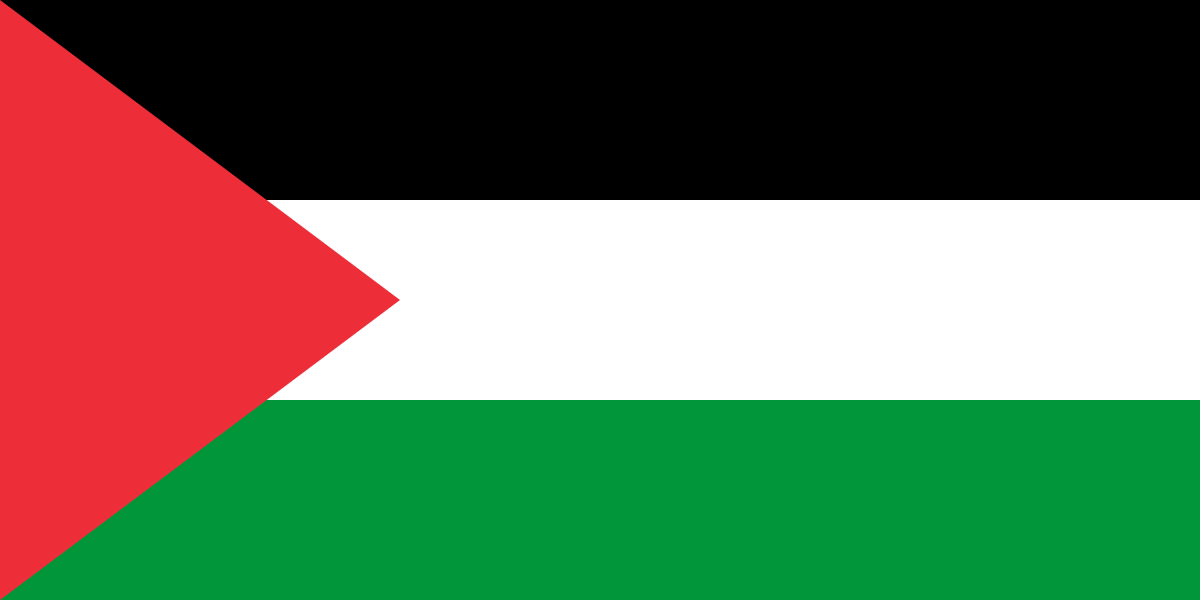
I take the floor to express, on behalf of the State of Palestine, the feeling of a proud people on this special occasion in our history at the General Assembly, in which the State of Palestine has participated for the first time in this election. It is an important step in our march for freedom and independence and for full membership at the United Nations. The reaction of almost all members of the General Assembly to our voting is a clear message that the Assembly is ready for our membership. We, along
with them, cannot wait for that moment, which we hope will occur very soon.
I now give the floor to the representative of Israel.


Israel congratulates Judge Afande and welcomes his election. I apologize for being forced to ruin what should have been a celebratory and professional vote. Unfortunately, that is not yet the case. Again, we see the representative of the Palestinian Authority trying to hijack precious time. I have no issue with the Palestinian Authority celebrating what it deems a historic vote. That should have been done outside the Hall. I regret that. What forces me to speak is the fact that Israel maintains its position that the Palestinian Authority is not a State and that it clearly fails to meet the criteria for statehood.
I wish to stress that the manner in which that delegation has participated in the proceedings today has no effect on its status and does not confer statehood. There is only one route to Palestinian statehood. That route does not run through the meeting rooms in New York, but through direct negotiations between Jerusalem and Ramallah, which, hopefully, we pray, will lead to a secure and lasting peace between Israelis and Palestinians.
May I take it that it is the wish of the General Assembly to conclude its consideration of agenda item 129?
It was so decided.
The meeting rose at 12.20 p.m.