A/72/PV.19 General Assembly
The meeting was called to order at 9 a.m.
Address by Mr. Joseph Kabila Kabange, President of the Democratic Republic of the Congo

The Assembly will now hear an address by the President of the Democratic Republic of the Congo.
Mr. Joseph Kabila Kabange, President of the Democratic Republic of the Congo, was escorted into the General Assembly Hall.
On behalf of the General Assembly, I have the honour to welcome to the United Nations His Excellency Mr. Joseph Kabila Kabange, President of the Democratic Republic of the Congo, and to invite him to address the Assembly.
President Kabila Kabange (spoke in French): I wish to express my very warm congratulations, Sir, on your election as President of the General Assembly at its seventy-second session, which is an acknowledgement of your distinguished career as a diplomat and a tribute to your country, Slovakia. I would also like to pay tribute to Secretary-General António Guterres for his leadership and efforts to strengthen the role of our Organization during this first year of his term of office.
The theme of this session — “Focusing on people: Striving for peace and a decent life for all on a sustainable planet” — responds to the concerns of the moment in most of the States Members of the Organization. I am pleased with it, as it is consistent with the logic of the Sustainable Development Goals
and because, for my country, peace, stability and the improvement of our people’s living conditions are the Government’s priorities.
Seventy-two years ago the Organization was born out of the ambition to reform relations among States on the basis of the principle of sovereign equality and the desire to guarantee peace and prosperity for all. That ambition remains relevant and is carried forward every day by the commitment of women and men who are determined to see it fulfilled, sometimes at the risk of their lives.
In the face of the rise of terrorism in various forms, it is indisputable that the world to which we aspire depends on how we address peace and security issues. For the past year, my country has been the victim of terrorist attacks, especially in the Kasai provinces and even in the capital, by certain armed groups whose objective is to destroy the peace so dearly acquired, so as to thwart the dynamics of consensus-based problem-solving at the national level and to undermine our development efforts. In the Kasai, a mystico-tribal militia is using the civilian population, including children, as human shields and is attacking people and public buildings that symbolize the authority of the State. It is thereby sowing terror — decapitating law-enforcement officers, agents of the Independent National Electoral Commission, and administrative and traditional authorities.
Those were the circumstances of deplorable barbarity in which the two United Nations experts lost their lives in March. We are determined to make sure that light is shed on the exact circumstances of
that crime so that that horrible act, as well as those to which our countrymen have been subjected, will not go unpunished. That is why public trials were begun several weeks ago, following the arrest of most of those presumed to be guilty. That was also the purpose of the recent conference on peace, reconciliation and development, which aimed to establish the truth of what really happened in those central provinces of the country, to promote reconciliation among the people of those provinces and to affirm our belief that all reconciliation necessarily involves justice and that there can be no real and lasting peace without justice.
My country remains open to all forms of collaboration on that subject. Thanks to that approach, which combines the restoration of State authority, dialogue and restorative justice, we have been able to reverse the dangerous trend in the security situation in the centre of the country, which has improved very significantly.
In the eastern part of the country, laudable efforts by the national defence and security forces have in turn allowed us to contain the terrorist attacks of the Allied Democratic Forces, which plagued our populations daily. We are convinced that the subregional cooperation initiative involving my country, South Sudan and the Central African Republic will also allow us to halt the terrorist threat posed by the Lord’s Resistance Army. Our participation in the process should be seen as evidence of our determination in the coalition’s fight against that threat.
With regard to combating sexual violence, I welcome the outstanding progress recorded by the courts, which have handed down hundreds of convictions for rape. No one has been spared from prosecution because of social position or military rank, which is proof that impunity in that area has ended.
Two years after the adoption of the 2030 Agenda for Sustainable Development, it is not too early to begin monitoring its implementation. In carrying out its commitments, my country has begun the process of prioritizing the environmental, social and economic dimensions of sustainable development in elaborating and implementing its national development plan. More specifically, in support of the Global Action Programme on Education for Sustainable Development, my country has been focusing on expanding access and equity, improving the quality of teaching and learning and improving governance in the educational sector.
We are are pleased with the increased access of girls to schools. Over 10 years, their enrolment rate has increased from 70 per cent to nearly 105 per cent. We are implementing plans to build thousands of schools, without neglecting in-depth reforms in that area.
Climate change is one of our greatest concerns, as it is a threat to humankind and our fundamental rights. Every State has the responsibility to contribute to limiting its impact. My country and the other countries in the Congo basin — home to the second-largest forest reserve in the world — are equipped, through the Central African Forest Commission, to help improve the quality of life on our planet. For its part, my country intends to uphold all of its commitments, beginning with the ratification of the Paris Agreement, which is now under way.
Like peace, political stability is for us a constant objective of our domestic policy. In that vein, for nearly a year we have been engaging in a dialogue that for us is a standing method of settling political disputes. In that connection, I would like to pay tribute to the African Union and other regional organizations. We are grateful for their support in that process. I also welcome the efforts of all the political forces in my country who, in the search for a comprehensive consensus on the electoral process, arrived at the agreement of 31 December 2016, the ultimate aim of which is the holding of elections.
At the request of all stakeholders for a new electoral register, voter registration has been under way for more than a year now. The last phase has just begun in the last two provinces in the centre of the country. We are pleased that more than 42 million voters of the projected 45 million have already been registered. In addition, a series of evaluations of the electoral process was started some 10 days ago by the National Monitoring Council, jointly with the Government and the Electoral Commission, which should allow for the publication of the electoral calendar by the Commission, which is the only competent institution in that regard.
Despite that progress, however, the challenges of organizing elections in my country remain enormous in terms of logistics, finances, security and legislation. We are confronting those obstacles with humility, but also with indisputable tenacity. Given the advances that have been made, I affirm that we are moving towards credible, transparent and peaceful elections and that our progress in that direction is irreversible, all
without external interference or any fiats. I ask the true friends of my country to sincerely support our ongoing electoral process.
The Charter of the United Nations imposes obligations on us, including striving to building a better world. For that reason, the Democratic Republic of the Congo maintains a strategic dialogue with the United Nations on the future of the United Nations Organization Stabilization Mission in the Democratic Republic of the Congo (MONUSCO), in accordance with the relevant Security Council resolution. That strategic review should determine the pace of the reduction of the MONUSCO force until its full withdrawal.
It is clear that, after almost 20 years of deployment, the United Nations force cannot expect to stay in my country indefinitely or to exercise its mandate in the same format and without drawing lessons from the weaknesses that have been identified. What is important to us, and what should be important to everybody, is the credibility of the Organization and the effectiveness of the contribution of United Nations troops on the ground. That is why, for several years now, we have been requesting the adjustment of the MONUSCO force to suit its dynamic missions, and the reorientation of resources thus freed up towards meeting our development needs. In that area, as in others, we do not intend to compromise on the respect due to the sovereignty of the Democratic Republic of the Congo, which is guaranteed by the Charter of the Organization.
I would like to believe that all who place their hopes in the United Nations — including my country — will fully commit to the implementation of the Sustainable Development Goals and to the long-awaited reform of the Organization. I wish the Assembly every success in its work.
On behalf of the General Assembly, I wish to thank the President of the Democratic Republic of the Congo for the statement he has just made.
Mr. Joseph Kabila Kabange, President of the Democratic Republic of the Congo, was escorted from the General Assembly Hall.
8. General debate Address by Mr. Taban Deng Gai, First Vice-President of the Republic of South Sudan
The Assembly will now hear an address by the First Vice-President of the Republic of South Sudan.
Mr. Taban Deng Gai, First Vice-President of the Republic of South Sudan, was escorted to the rostrum.
I have great pleasure in welcoming His Excellency Mr. Taban Deng Gai, First Vice-President of the Republic of South Sudan, and inviting him to address the Assembly.

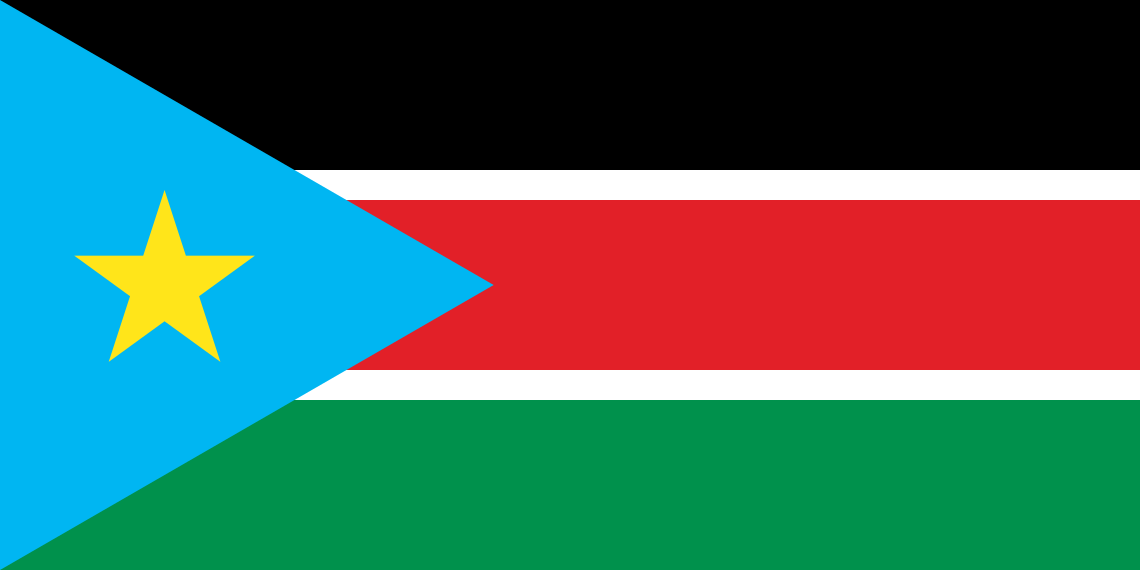
I am honoured to deliver this statement on behalf of His Excellency Mr. Salva Kiir Mayardit, President of the Republic of South Sudan, who unfortunately could not be present today owing to pressing domestic commitments back home.
I wish to congratulate you, Sir, on your election as President of the General Assembly at its seventy-second session. South Sudan affirms it commitment to playing its role in supporting you as you lead this historic session. I would also like to take this opportunity to congratulate His Excellency Mr. António Guterres and his Deputy, Her Excellency Amina Mohammed, for winning the confidence of this institution. South Sudan stands ready to cooperate and work closely with them.
The theme the President selected for this session, “Focusing on people: Striving for peace and a decent life for all on a sustainable planet”, resonates very well with the aspirations of our nation for peace, unity, development and prosperity. It is also in line with President Salva Kiir Mayardit’s declaration of 2017 as the Year of Peace and Prosperity. That solemn declaration is intended to cement our resolve that the aspirations of our people, for which they have fought long and hard, be realized.
However, the realization of peace is greatly impeded by a lack of resources. We commend the efforts of the Intergovernmental Authority on Development (IGAD), the African Union (AU) and international partners to shun and isolate political actors who seek power through violence. We urge all stakeholders to continue embracing that common position, and we renew our
commitment to further building on the progress we have made in order to ensure that our people inherit the future that we have always envisioned and aspired to.
Nonetheless, we do not wish to delude ourselves that peace, unity and development can be achieved overnight. On the contrary, they require relentless and concerted efforts, dedication and commitment by all partners, which we are willingly, consciously and vigorously pursuing.
We strongly believe that peace is not a one-day affair or event. For us and our friendly partners in peace, there is simply no other viable alternative to making peace. Nonetheless, bringing about peace takes time. Attaining peace in South Sudan is a process that will require our collective efforts. It is a consistent and persistent accumulation of positive steps towards achieving the world that we envision for the future generations in our country, in our continent and in our world at large.
It is therefore against that backdrop that the South Sudanese Transitional Government of National Unity has embraced the full implementation of the Agreement on the Resolution of the Conflict in the Republic of South Sudan as the only instrument pivotal to achieving that mission and vision. By way of updating the General Assembly, allow me to highlight some of the important steps that our Government has taken to further enhance the achievement of peace in our young country.
The Transitional Government of National Unity continues to stand by its commitment to implementing the unilateral ceasefire that was announced by President Salva Kiir Mayardit in May 2017, and continues to call to estranged opposition groups to reciprocate our gesture of extending an olive branch.
With support from friendly partners, the Government has embarked upon implementing key aspects of the transitional security arrangements, such as security-sector reform, the cantonment of forces and the training of the Joint Integrated Police (JIP) in an effort to demilitarize our communities. We hope that the recently graduated JIP for Juba will be an example that can be emulated in other security sector institutions, especially through the overhaul and restructuring of the Sudan People’s Liberation Army into a professional national army.
The Transitional Government of National Unity is spearheading grass-roots intercommunal
peace initiatives, as ongoing communal conflicts characterized by cattle-rustling, child abduction, high bride dowry and land disputes can be serious stumbling blocks to peace. It is essential to find ways to transform the way our communities interact with each other, and the international community should encourage and support Government efforts and invest in measures aimed at addressing those local conflicts so that success stories can be replicated all over South Sudan at different phases of our national dialogue.
It is in that area that I would like to highlight the role of young South Sudanese as either agents of, or detractors from, peace. One example of an intercommunal feud involving cattle-rustling and child abduction almost escalated into an uncontrolled conflict simply because the youth from the different communities were incited to violence. That makes us appreciate that our collective effort to ensure the situation in South Sudan can be salvaged only by embracing peace.
I also wish to highlight the important role that South Sudanese women continue to play as peacebuilders and custodians of intercommunal peace initiatives.
It is against that background that the Transitional Government of National Unity, with the support of religious leaders, the United Nations Mission in South Sudan, the United Nations Development Programme and other partners, is engaging in grass-roots, people-to-people peace by investing in improving economic activities among communities, such as building markets, rehabilitating schools, constructing fishing storage facilities and peacefully disarming armed communities. All of that has improved relations among warring communities, host communities and internally displaced persons.
We in South Sudan are currently optimistic about the return of peace. We have recently witnessed refugees and internally displaced persons gradually returning to their villages voluntarily, and several steps within communities indicate that the movement towards coexistence and living in harmony is a reality.
There will be challenges and reversals, but the direction of movement should be the big picture. We are very open to listening to counsel and to joint action, but we also expect our partners to acknowledge and reciprocate progress and to demonstrate some sense of respect and trust. An overtly confrontational approach risks creating a siege-and-bunker mentality. However,
we are confident that soon violence and wars will be stories of the past in the Republic of South Sudan.
The national dialogue initiative declared by President Salva Kiir Mayardit is making strong and steady progress with regard to the Government’s commitment to addressing a number of political and security issues, with a view to creating an enabling environment for dialogue. Some major steps taken include the release of prisoners, including journalists; the expansion of the Steering Committee to include all the relevant stakeholders in the country; an ongoing effort to reach out to opposition figures; and a declaration of unilateral cessation of hostilities. The primary objective of the national dialogue initiative is to promote reconciliation and enhance confidence in the peace process so as to make dialogue not just the only viable option for resolving conflict but also a foundation for the national constitutional review process.
At this juncture, I would like to note that the Steering Committee for the National Dialogue Initiative has embarked upon engagement with all shades of political opinion, in particular those living outside South Sudan, in order to ensure that the national dialogue is inclusive and that its outcomes reflect the views of all components of the South Sudanese community.
The Steering Committee is engaging teams of resource persons who will go to all the states, counties, payams and bomas to organize meetings with representatives of the relevant groups to seek their views on the grievances held by their people and to ensure that those grievances are effectively addressed and remedied. The results of those discussions in the states will be reported to the Steering Committee, which will in turn present them to the larger national dialogue conference. The process will end with recommendations and resolutions that will be presented to the national leadership under the presidency and to the national Parliament for final adoption and implementation.
Our Government is supportive of the efforts aimed at revitalizing the implementation of the peace agreement. We recently convened in our capital, Juba, a meeting of the IGAD Council of Ministers to deliberate on ways to further expedite the preparation for the establishment of a high-level revitalization forum, which is envisaged to focus on practical ways to expedite the implementation of the peace agreement.
Today South Sudan enjoys cordial relations with its neighbours. Those countries — Ethiopia, Kenya,
the Sudan and Uganda — are hosting South Sudanese refugees, providing corridors for humanitarian access and supporting development projects, all of which further enhance the efforts of the Transitional Government of National Unity to bring about peace. We are dependent upon those good relations in order to revive and increase oil production, construct and maintain important road infrastructure and provide electricity in the border towns — key ingredients for boosting the economy and work as incentives for peace.
Concerning Abyei, our Government reaffirms its willingness and readiness to implement the proposal of the African Union High-level Implementation Panel for the Sudan and South Sudan, of 21 September 2012, which, as presented by the Panel, was accepted by President Salva Kiir Mayardit. We are hopeful that the Republic of the Sudan and the Republic of South Sudan will soon resume cooperation in implementing that proposal.
I wish to report to the Assembly that our Government is cooperating with the United Nations Mission in South Sudan and is facilitating the deployment of the Regional Protection Force (RPF). In the past few months we have witnessed the arrival of members of the advance RPF, as agreed with the United Nations. The Government reaffirms its commitment to working closely with the United Nations, the AU and IGAD to oversee the smooth implementation and operationalization of the mandate of those troops in South Sudan.
The Transitional Government of National Unity continues to work towards ensuring that humanitarian access to those in need is unhindered. That has been done through continuous and open dialogue with aid agencies striving to have more humanitarian corridors opened up. I wish to commend the concerted efforts of the various humanitarian agencies that responded positively and worked to reverse the famine situation in parts of South Sudan. Despite some gains, I stress that continued support is necessary if we are to achieve a hunger-free South Sudan. I wish to take this opportunity to express our condolences and prayers to the families of those humanitarian aid workers who lost their lives in the line of duty in the Republic of South Sudan.
While we appreciate that saving lives is important, we also ought to save livelihoods. We cannot continue to mop the floor while the tap is open. The old “humanitarian intervention first and development later” paradigm is not a viable policy in the case of
South Sudan. It is important to incentivize peace and stability through a balanced approach to development and embracing a new way of working. Stabilization and recovery initiatives are essential, and emergency support needs to be effectively complemented with some level of economic dynamism that provides a new platform for social cohesion and resilience-building.
As partners, we all need to do business differently. As a Government, we will redouble our efforts to ensure access and improve the enabling environment for humanitarian intervention. It is our expectation that a smart combination and calibration of development and humanitarian support is needed to maintain positive momentum.
Our ultimate goal and responsibility is to provide an opportunity for peace to all South Sudanese people, one that will enable them to choose their own leaders through free, fair and credible elections. Our focus for the remaining months of the transitional period, therefore, is to ensure that adequate preparation and a environment conducive to those elections are our top priorities, and we will see to it that peace is realized and that sufficient resources are allocated to that task.
These efforts are core building blocks and prerequisites for boosting confidence among and within our communities, which will stimulate them to voluntarily and gradually return to their homes. I would like to reiterate our position that those efforts can be sustained if, and only if, all political actors continue to respect and reciprocate the unilateral ceasefire declared by President Salva Kiir Mayardit earlier this year.
The progress we speak of can come about only when we start to see progress in the reform of the Security Council. Reform of the Council is an urgent task, since its current composition and functioning do not reflect the realities of the international community in the twenty- first century. In order to achieve concrete progress on Council reform, it is imperative to launch text-based negotiations in the intergovernmental negotiations during the Assembly’s seventy-second session.
In that connection, South Sudan wishes to add its voice in expressing its concerns with regard to the increasing tensions on the Korean peninsula. South Sudan supports the call of the international community urging North Korea to fully comply with the relevant Security Council resolutions on nuclear tests and ballistic-missile launches. South Sudan urges North
Korea to show sincere will and concrete actions towards the denuclearization of the Korean peninsula.
With regard to climate change, although South Sudan’s greenhouse-gas emissions are negligible, it is one of the countries worst affected by climate change. The country is experiencing recurring droughts. According to the Intergovernmental Panel on Climate Change, it is the fastest-warming country in the region, with flooding and the loss of biodiversity and of livelihoods. I am glad to inform the Assembly that South Sudan has ratified the Paris Agreement on Climate Change and has prepared its national determined contributions and national adaptation programme of action to implement the projects embodied in both documents.
Allow me now to extend my appreciation to the countries members of IGAD, IGAD-Plus, the AU and the Troika, and China, Japan, Germany and the broader international community for their support for the peace process and development in my country. Although we appreciate that South Sudan as a nation cannot operate in isolation, the direction of the way forward must be South-Sudanese-led and its solutions must be home grown if we are genuinely striving to achieve sustainable results.
Long live South Sudan. Long live the United Nations.
On behalf of the General Assembly, I wish to thank the First Vice-President of the Republic of South Sudan for the statement he has just made.
Mr. Taban Deng Gai, First Vice-President of the Republic of South Sudan, was escorted from the rostrum.
Address by Mr. Yosiwo George, Vice-President of the Federated States of Micronesia
The Assembly will now hear an address by the Vice-President of the Federated States of Micronesia.
Mr. Yosiwo George, Vice-President of the Federated States of Micronesia, was escorted to the rostrum.
I have great pleasure in welcoming His Excellency Mr. Yosiwo George, Vice-President of the Federated States of Micronesia, and inviting him to address the Assembly


Let me at the outset congratulate you, Sir, on assuming your role as President of the General Assembly. I
also congratulate your predecessor, Ambassador Peter Thomson of Fiji, for a job well done over the past year. I must also mention the Secretary-General, Mr. António Guterres. Since assuming the leadership of the Organization a few months ago, he has already shown himself to be more than equal to the tremendous tasks associated with his high office.
As we gather here today in this great Hall, natural disasters and calamities are striking in many parts of our world. Hurricanes, typhoons and earthquakes have devastated communities and displaced thousands of people in just the past few days. To the victims and their families around the world, I offer our sympathies and condolences on behalf of the Government and the people of the Federated States of Micronesia.
We condemn terrorist attacks, which have taken innocent lives. Micronesia pledges its resolve to stand united against terrorism, in solidarity with affected nations. On behalf of the Micronesian Government and its people, I offer our deepest condolences to all those nations and families that have suffered losses at the hands of terrorists.
As we witness current record-breaking megastorms, we cannot ignore their connection to climate change, especially to ocean warming and sea-level rise. In the wake of those devastating events, we must not only stay committed to our collective fight against climate change, but we must also redouble our efforts.
Climate change is one of the most serious threats to global peace and security, endangering the very existence of our islands. It needs to be at the top of the agenda of the General Assembly. As the United Nations undertakes efforts to reorient its work around the priorities of peace and prevention, the United Nations system will have to adapt. We reiterate our call for the appointment of a special representative on climate change and security.
Climate change mitigation is also essential to achieving the Sustainable Development Goals (SDGs) and the targets of the 2030 Agenda for Sustainable Development, including the eradication of poverty, ending hunger, building resilient infrastructure and shared prosperity. Without progress in fighting climate change, our sustainable development efforts will be futile. That is particularly true for small island developing States.
The Paris Agreement on Climate Change has provided an avenue to enhance cooperation in our fight
against climate change, and the world must seize the moment. Micronesia expresses grave concern that some countries have chosen to break with the international community and neglect the Paris Agreement, against the best scientific advice. As a small island developing nation at the forefront of the battle, Micronesia calls on all States to fully engage in global efforts to implement the Paris Agreement, support the Green Climate Fund and access thereto, and contribute innovative climate solutions.
I would like to share with the Assembly a story of global cooperation at its finest. This is a story of a treaty that was designed to save the ozone layer and succeeded, but it has also made major contributions to climate-change mitigation. The Montreal Protocol on Substances that Deplete the Ozone Layer is considered the most successful multilateral environmental treaty of all time. That is why the 194 parties to the Protocol met last year in Kigali and agreed to amend the Protocol and expand its scope. Specifically, the Kigali Amendment allows the Protocol to regulate hydrofluorocarbons (HFCs), which are chemicals used in refrigeration and air conditioning that can contribute significantly to global warming. Phasing down the use of HFCs will help prevent 0.5°C of global temperature rise, and complementary energy-efficiency measures in the same sector could help avoid another 0.5°C of warming.
We thank the parties to the Montreal Protocol that have already ratified the Kigali Amendment, totalling eight out of the 20 needed for the Agreement to enter into force. We call on other parties to ratify the Agreement as soon as possible, ideally before the next Meeting of the Parties, in Canada in November.
Along with the Paris Agreement, the Kigali Amendment is a major step towards the survival of small island States. As the story of the Kigali Amendment demonstrates, with intelligence, perseverance and cooperation, we can achieve anything. That is the motivation that keeps us all working together for a better future.
In the islands we say the ocean is us, as we are the ocean. As an island nation, Micronesia fully supported and participated actively in the United Nations Ocean Conference in June. The Call for Action from the Conference, entitled “Our Ocean, Our Future,” highlights the actions required to achieve the targets of Sustainable Development Goal 14. Micronesia supports the intention to organize a second United
Nations Ocean Conference, in 2020, which will enable us to follow up on the commitments made at the first Conference and to assess our progress towards the full implementation of SDG 14 by 2030. We look forward to the work of the Special Envoy for the Ocean to maintain the momentum.
At the recent Pacific Islands Forum Leaders Meeting in Samoa, our leaders endorsed the Blue Pacific identity as the core driver of collective action in the Pacific region. That was a fitting progression from last year’s Pohnpei Oceans Statement, as elements of the Blue Pacific narrative reinforce the potential for shared stewardship of the Pacific Ocean.
We must now show ambition in tackling the mounting threats to the health of our ocean. The special case of small island developing States must be enshrined in the forthcoming implementing agreement under the United Nations Convention on the Law of the Sea on the conservation and sustainable use of marine biological diversity of areas beyond national jurisdiction. We welcome the successful conclusion of the meetings of the Preparatory Committee, and now we must urgently launch and conclude the intergovernmental conference to draft and adopt a new legally binding agreement.
For Pacific islands, fisheries are a mainstay of our economies, our most important renewable natural resource and an integral part of our sustainable development plans. Effective conservation and management of our tuna resource is important not only for us who depend on it for our livelihoods and sustainable development, but also for addressing global food-security concerns. We must remain steadfast in our efforts to combat illegal, unreported and unregulated fishing in all its forms.
I want to take this opportunity to express our concerns about the lack of recognition of, and respect for, the rights of coastal States such as Micronesia to manage fisheries in their own exclusive economic zones (EEZs). In the Western and Central Pacific, some developed-country fishing nations are advocating for flag-based rights in regional fisheries management organizations. Such measures would undermine existing zone-based management measures and erode the ability of small island developing States, as resource owners, to exercise their sovereign rights under international law. That would not be an acceptable outcome. Therefore, we call on those developed-country partners to withdraw all such proposals and to actively support the efforts of
small island developing States to increase benefits from the sustainable management of fisheries in their EEZs.
Allow me to briefly thank the Secretary-General for his proposals on the peace and security architecture, management reform and other reform processes for the Organization. We commend his proposals, which will result in a more transparent, efficient and effective regime that is able to respond to the challenges our world is facing today. The United Nations must be fit for purpose. While reforms are vital to any organization, they must not disadvantage small island developing States; they must leave no one behind.
For many years now, my country has also paid priority attention to the efforts by Member States to reform the Security Council, but those efforts have resulted in little progress. We need to break out of this cycle. It is high time to shift to real negotiations.
In the Western Pacific, and especially in our greater Micronesian region, the provocative and aggressive actions by the Democratic People’s Republic of Korea pose a threat to regional security and must be condemned in the strongest possible terms. Micronesia supports the actions taken by the Security Council. We call on the Council and on countries with the power and influence to help resolve the crisis to take action immediately to ensure that peace is achieved on the Korean peninsula.
We gather in this great Hall and debate among nations, but we are speaking for our peoples. We are trying to advance their interests. We are seeking to improve their lives. As history has taught us, we will fail our nations and our peoples unless we work together for the common good. The 2030 Agenda for Sustainable Development constitutes a people-centred approach. Consistent with that principle, the theme of this session of the General Assembly is “Focusing on people: Striving for peace and a decent life for all on a sustainable planet”. We must believe in such a future and move towards it together. Multilateralism and the United Nations are more important than ever. Only together can we restore and maintain peace and security. Only together can we overcome the threat of global climate change. Only together can we build a sustainable future for our planet and all of our peoples.
On behalf of the General Assembly, I wish to thank the Vice-President of the Federated States of Micronesia for the statement he has just made.
Mr. Yosiwo George, Vice-President of the Federated States of Micronesia, was escorted from the rostrum.
Address by Mr. Sher Bahadur Deuba, Prime Minister of the Federal Democratic Republic of Nepal
The Assembly will now hear an address by the Prime Minister of the Federal Democratic Republic of Nepal.
Mr. Sher Bahadur Deuba, Prime Minister of the Federal Democratic Republic of Nepal, was escorted to the rostrum.
I have great pleasure in welcoming His Excellency Mr. Sher Bahadur Deuba, Prime Minister of the Federal Democratic Republic of Nepal, and inviting him to address the Assembly.


I bring to the General Assembly warm greetings from the people and the Government of Nepal, the land of Lord Buddha and Mount Everest, as well as best wishes for the success of this session.
I congratulate you, Sir, on your election as President of the General Assembly at its seventy-second session. I pledge my full support to you as you discharge your important responsibilities. I also wish to put on record our appreciation for your predecessor, Ambassador Peter Thomson of Fiji, for his sterling leadership.
I wish to warmly congratulate His Excellency Mr. António Guterres on his appointment as the Secretary-General. We extend to him our best wishes and full support, including for his efforts aimed at reforming the Organization to make it fit for purpose. I also commend his predecessor, Mr. Ban Ki-moon, for his dynamic leadership of the Organization during his two terms of office.
It has been more than two decades since I first addressed the Assembly from this rostrum (see A/50/PV.37). In the decades that followed, the world witnessed a profound transformation. While there have been some notable achievements in poverty reduction, school enrolment, gender equality and in combating communicable diseases, those successes have not come without multiple and complex challenges. The world has become more interdependent and better connected, and growing interdependence and pluralism have unleashed both challenges and opportunities. A large geopolitical transformation is still in the making.
The rise of inward-looking tendencies in some nation States, marked by a tide of populism on both the left and the right, has created confusion in the course of world politics. The global community today is facing a more complex and polarized environment than before, with multiple transnational challenges ranging from terrorism, climate change and energy deficiency to food insecurity, mass migration and extremism. Ethnic tensions and intra-State conflicts have taken their toll on millions of innocent lives, while the suffering of people in Syria, Iraq, Libya and Yemen continues unabated. Unfortunately, our efforts to help have been too little and often too late. All of those challenges reinforce the role and responsibility of the United Nations.
As we embark upon the path of implementing the 2030 Agenda for Sustainable Development, those challenges are the litmus test for our leadership. The choice of the theme for our deliberations at this session of the General Assembly, “Focusing on people: Striving for peace and a decent life for all on a sustainable planet”, provides a clear direction to follow. However, the path to peace and a decent life for all will remain elusive without the resources and commitment needed to implement the Sustainable Development Goals. Delivering on commitments, making the process inclusive, coordinating efforts and shared responsibilities and backing up our efforts with adequate resources are all essential if we are to secure a sustainable future and ensure that no one is left behind.
The vicious race to acquire weapons of mass destruction continues to threaten the world. Nepal calls for time-bound general and complete disarmament. Nepal welcomes the confidence-building measures on conventional weapons that ended nearly two decades of stalemate in the United Nations Disarmament Commission. Nepal signed the Treaty on the Prohibition of Nuclear Weapons as a step towards nuclear disarmament.
Nepal deplores the Democratic People’s Republic of Korea’s continued defiance of the repeated calls made by the Security Council and the international community. We urge the Democratic People’s Republic of Korea to abide by all the relevant resolutions of the Security Council. We believe that this approach alone will safeguard peace and promote stability on the Korean peninsula. As host to the United Nations Regional Centre for Peace and Disarmament in Asia and the Pacific, Nepal emphasizes the need to
reactivate regional disarmament deliberations under the Kathmandu process.
Terrorism is a curse on humankind and today’s biggest threat to democracy and development. Nepal condemns terrorism in all its forms and manifestations everywhere in the world. The world must come together to address not just the symptoms of terrorism but also its root causes. An early conclusion of a global anti-terrorism convention is the call of our times.
Having contributed more than 130,000 peacekeepers to United Nations peacekeeping operations in some of the most challenging situations, we have shown a true commitment to the success of such operations. Nepal is prepared to continue to provide troops and civilian personnel for this noble cause. Nepal hosts a world- class peacekeeping training centre, the oldest in the region. The United Nations can make the best use of that facility by helping to develop it as a regional centre of excellence for peacekeeping training.
Nepal firmly believes that all troop- and police-contributing countries should be given a fair opportunity to serve in leadership positions, both in the field and at Headquarters, commensurate with their level and length of contribution.
The protection of civilians should be at the centre of peacekeeping operations. Nepal believes that protecting the safety and security of peacekeepers is key to enhancing their ability to deliver from the highest possible moral ground.
On sexual exploitation and abuse, we must move from zero tolerance to the zero-case scenario. It is in that spirit that Nepal endorsed the Kigali Principles on the Protection of Civilians in their entirety and signed the Secretary-General’s Voluntary Compact on Preventing and Addressing Sexual Exploitation and Abuse.
The Constitution of Nepal accommodates the aspirations of all of its citizens. It guarantees a comprehensive set of internationally recognized human rights and fundamental freedoms. We are fully committed to the promotion and protection of those rights and to their being fully enjoyed by our people. The Constitution establishes powerful commissions to promote and protect the specific rights and interests of women, Dalits, Muslims, Madhesis, indigenous people and other disadvantaged communities. The National Human Rights Commission, an independent constitutional body, is responsible for comprehensively
monitoring the human rights situation in the country and investigating violations.
Nepal views the right to life as the most important of all human rights. Nepal’s Constitution bans the death penalty in all circumstances. As a party to 24 international human rights instruments, including seven out of nine core instruments, Nepal has been fulfilling its international obligations with all sincerity and to the best of its ability.
Against that backdrop, Nepal has presented its candidature for membership in the Human Rights Council for the 2018-2020 term. Nepal’s first-ever election to the Human Rights Council would be an acknowledgement of our long-standing commitment to, and contributions in, the field of human rights. It would also encourage us to do more at the national and global levels. We seek the invaluable support of all Member States for Nepal’s candidature.
Nepal calls for concerted efforts at the national, regional and international levels to ensure that the migration process creates a fair, win-win situation for all. We call for the safety, security, dignity and well- being of all migrant workers. Although not a party to the Convention and Protocol Relating to the Status of Refugees, Nepal has earnestly upheld humanitarian principles by hosting thousands of refugees. Protecting minorities and their rights makes the world more humane and contributes to world peace and stability. The forced eviction of citizens is a grave crime against humanity. We call on the international community to respond responsibly and act decisively in all circumstances in support of the right of refugees to return safely to their homelands with dignity and with the hope of rapid reintegration. The cost in terms of human tragedy and devastation caused by natural disasters is increasing sharply. We call for greater global cooperation and coordination in prevention, mitigation and recovery. The trauma of the 2015 earthquake in Nepal has not yet subsided. Post- disaster reconstruction remains ongoing. We thank our neighbours, development partners, other friendly countries and the United Nations family for their generous support in our drive to rebuild. Poor and vulnerable countries suffer disproportionately from climate change despite their negligible greenhouse-gas emissions. The Paris Agreement on Climate Change should be implemented in coordination with the 2030 Agenda for Sustainable Development. The least developed countries represent the most vulnerable group of countries. They must not be perennially equated with dehumanizing conditions of poverty and underdevelopment. Rather, they must be empowered to smoothly and sustainably graduate to higher standards of living at an early date. As the cost of trade is higher for landlocked developing countries than for coastal countries, developing multimodal-transport infrastructure and providing unhindered transit rights to landlocked nations is critical to their sustainable development. We call for the full implementation of the Istanbul Programme of Action, the Vienna Programme of Action and the Addis Ababa Action Agenda in order to benefit from the potential synergies, in coordination with the 2030 Agenda. The essence of Nepal’s foreign policy is Panchsheel — the five principles of peaceful coexistence that are derived from the teachings of Lord Buddha, the enlightened son of Nepal. Those principles serve as the foundations for managing harmonious relations among nations at a time of increasing uncertainty and turmoil. We also believe in non-alignment. In exercising our independent foreign policy, we judge every issue on its merit without fear or favour. We consider regional cooperation to be an important means of building trust and confidence among nations and making the best use of complementarities for shared prosperity. Connectivity remains at the core of deeper integration and the creation of win-win situations. Nepal firmly believes in the indispensability of the United Nations in multilateral affairs and global governance. All countries, particularly the major Powers, are responsible for contributing to the global good by fulfilling their obligations and responsibilities. The reform of the Security Council is long overdue. The underrepresentation of developing countries in the Council must be addressed in recognition of their growing contributions to shaping the global agenda. Reform must be inclusive and representative in structure, transparent and efficient in procedure and accountable and effective in delivery. The Secretary- General’s reform proposals are a step in the right direction. We believe a clear statement of support from Member States, such as the political declaration for United Nations reform issued earlier this week, helps make the Organization more fit for purpose. Any repositioning of the United Nations development agenda should address gaps, build synergy and improve accountability, while steering clear of the politicization of development under any guise. Nepal supports the revitalization exercise in the General Assembly with a view, inter alia, to more streamlined functions and fairer gender and geographical representation in senior United Nations positions. Before concluding, I would like to share some insights into recent developments in Nepal. Our peaceful transition to democracy after a decade-long armed conflict demonstrates the power and promise of dialogue and negotiation as compared to the perils of violent methods for obtaining political control. The national peace process that began in 2006 concluded with the promulgation of a democratic and inclusive Constitution in 2015, through a popularly elected constituent Assembly. This unique peace process was home-grown and nationally driven. Its successful conclusion firmly established the culture of dialogue and accommodation in Nepal and could serve as a model for similar situations elsewhere. We appreciate the support and understanding that the international community provided. Proportional representation of all sectors of our society is at the core of Nepal’s inclusive democracy. Recent local elections firmly established the role of women in politics and development. The Constitution guarantees that 40 per cent of representation at the local level and one third of representatives in the federal and provincial parliaments are women. After the successful holding of local elections, dates have been announced for the first provincial and federal parliamentary elections in 20 years, in two months’ time. The ongoing transitional justice process combines the reality on the ground with our international commitment to delivering justice and sustaining peace. In conclusion, I would like to reiterate Nepal’s profound commitment to the purposes and principles of the United Nations. The Organization comprises large and small nations, and the vast majority of its membership comes from smaller countries, which confirms the universality and legitimacy of the world body. But a platform for a peaceful, stable, rules-based and just world order cannot be erected without addressing our genuine concerns for security, development and well-being. We believe that small nations have been sincere and serious in discharging their responsibilities as Members of the Organization. Even with their meagre economic and security resources, they have played a constructive role in it to promote peace, security and cooperation under very difficult circumstances in many parts of the world. I would like to recall the wise words of Bishweshwar Prasad Koirala, the first elected Prime Minister of Nepal, who, in addressing the fifteenth session of the General Assembly, in 1960, said, “Our physical strength may be negligible, but our moral strength, if we are true to ourselves and to the peoples for whom we speak, may be great” (A/PV.878, para. 228). That statement is as relevant today as it was then. Let us collectively display our wisdom, knowledge and capacity to address the pressing issues of peace, security, disarmament and sustainable development with due respect for the internationally accepted rules in order to ensure a safe and stable world order.
Mrs. Nusseibeh (United Arab Emirates), Vice-President, took the Chair.

On behalf of the General Assembly, I wish to thank the Prime Minister of the Federal Democratic Republic of Nepal for the statement he has just made.
Mr. Sher Bahadur Deuba, Prime Minister of the Federal Democratic Republic of Nepal, was escorted from the rostrum.
Address by Mr. Peter Paire O’Neill, Prime Minister and Minister for the Autonomous Region of Bougainville of the Independent State of Papua New Guinea
The Assembly will now hear an address by the Prime Minister and Minister for the Autonomous Region of Bougainville of the Independent State of Papua New Guinea.
Mr. Peter Paire O’Neill, Prime Minister and Minister for the Autonomous Region of Bougainville of the Independent State of Papua New Guinea, was escorted to the rostrum.
I have great pleasure in welcoming His Excellency Mr. Peter Paire O’Neill, Prime Minister and Minister for the Autonomous Region
of Bougainville of the Independent State of Papua New Guinea, and inviting him to address the Assembly.
On behalf of the General Assembly, I wish to thank the Prime Minister of the Independent State of Papua New Guinea for the statement he has just made.
Mr. Peter Paire O’Neill, Prime Minister of Papua New Guinea, was escorted from the rostrum.
I now call on His Excellency Mr. Walid Al-Moualem, Deputy Prime Minister and Minister for Foreign Affairs and Expatriates of the Syrian Arab Republic.


I would like to begin by congratulating Mr. Miroslav Lajčák on his election as President of the General Assembly at its seventy-second session and wish him every success. I would also like to thank his predecessor for the important role he played at the helm of the General Assembly during the seventy-first session. I congratulate Mr. António Guterres on his appointment as Secretary-General and wish him all the best in carrying out his responsibilities in service of the purposes and principles of the United Nations as set forth in the Charter.
As we meet again, our world is facing challenges and dangers that are mounting on a daily basis. There is a persistent stand-off between two sets of forces — one that strives to control and dominate nations and their riches by seeking to turn back the clock, re-establish a unipolar world order, fuel chaos and war and
violate international humanitarian law, and one that, in opposition, is working tirelessly to create a more balanced, secure and just world, respecting the sovereignty of States and the right of peoples to exercise self-determination and build their own future.
As we meet again, many people continue to pay dearly with their lives, losing the security, stability and livelihoods they once had, as a result of policies forced upon them by certain countries. These countries falsely believe that they can use terrorism as a tool to satisfy their greed and further ill-conceived agendas that do not serve the interests of any people, let alone their own.
No people have suffered as greatly at the hands of terrorism as the Syrian people, who, for six years now, have fought against terrorism pouring in from all over the world, with the support of parties from across the region and beyond. For more than six years, Syrians have endured the worst conditions and made the greatest sacrifices in order to defend their country in a terrorist war of unprecedented brutality that has spared nothing and no one. It has targeted innocent people, services, infrastructure and cultural heritage, and yet Syria is more determined than ever to eradicate terrorism from every part of the country without exception, relying on the selfless sacrifices of our army and the dedication of our people.
Since the beginning of the war, our State policy has followed two main tracks: combating terrorism and working towards a political solution that will end the bloodshed and restore stability. On the counter-terrorism front, the Syrian Arab Army, along with its supporting forces and allies, is making daily achievements in clearing out terrorist-occupied territories and removing the terrorists themselves. Nevertheless, the threat of this plague persists as terrorists claim the lives of Syrians on a daily basis and deplete the country’s resources.
We must all understand that terrorism and the underlying extremist takfiri ideology will continue to spread like a tumour throughout the world and haunt our peoples unless every one of us demonstrates a genuine will to cooperate and confront it together. Any such endeavour must respect the sovereignty of States and the interests of the people, and it must set aside the illusion that terrorism can be used as a tool for political gains and narrow interests.
On the political front, since the early months of the crisis the Syrian Government has spared no effort to stop the bloodshed. The success of reconciliation at
the local level would not have been possible without the leadership, political support and numerous amnesty decrees issued by President Bashar Al-Assad, which allowed everyone who had taken up arms to lay them down and resume their normal lives. These successful acts of reconciliation have allowed tens of thousands of internally displaced persons and refugees to return home and helped to improve the living conditions of a great number of Syrians who had fallen victim to terrorist crimes.
Syria is determined to scale up its reconciliation efforts wherever possible, as this is the best way to alleviate the suffering of Syrians and restore stability and normality. Since the very first day, the Syrian Government has considered all initiatives to put an end to the war with an open mind. However, all these initiatives eventually failed because States sponsoring terrorism persisted in their decision to pursue aggressive policies against Syria and its people.
With regard to the Astana and Geneva tracks, the Syrian Government has shown how serious and committed it is by doing its best to provide the conditions necessary for these efforts to succeed and for their goals to be achieved. We are encouraged by the Astana process and the resulting de-escalation zones, and we hope that it will help us to achieve an actual cessation of hostilities and separate terrorist groups such as the Islamic State in Iraq and the Levant (ISIL), Jabhat al-Nusrah and others from the groups that have agreed to join the process. This will be the real test of how committed and serious these groups and their Turkish sponsors are.
So far, under President Erdoğan, Turkey has continued to pursue its aggressive policies against the Syrian people and laboured under the illusion that terrorism will help serve its subversive agendas in Syria and other countries of the region. Turkey’s position stands in stark contrast to the positive and constructive role played by Russia and Iran. Notwithstanding its commitment to the memorandum on the creation of de-escalation areas in the Syrian Arab Republic, Syria reserves the right to respond to any violation by other parties. Syria also stresses that the de-escalation zones are a temporary arrangement that must not violate the territorial unity of Syria.
The Syrian Government reaffirms its commitment to the Geneva process and to making further progress on this track. In the absence of a genuine national
opposition that could be a partner in Syria’s future and as countries with influence over the other parties continue to block meaningful progress, this process has yet to bear fruit. It is truly unfortunate that among the countries blocking a solution in Syria are members of this international Organization and even permanent members of the Security Council.
The Syrian Government has always insisted that any solution in Syria must respect the country’s non-negotiable principles, its red line for all Syrians. These principles include the complete rejection of terrorism, the unity of the territory and the people of Syria, and the rejection of any outside interference in political decisions involving Syria’s future. Only Syrians have the right to make such decisions, whether now or in future. Absolutely no one can deprive the free Syrian people of their will to build the future of their country.
For decades, Israel has continued its unscrupulous, thuggish actions with full impunity. This usurper entity has occupied Arab territories in Palestine and the Golan for more than 70 years and has committed horrific crimes against innocent civilians. Israel has not stopped there; it has publicly interfered in the Syrian crisis since its earliest days, providing all forms of support, including funds, weapons, materiel and communications equipment, to the most visible terrorist gangs. Israel has also bombed Syrian army positions in service to terrorist agendas. Coordination between the Israel and the terrorists was at its highest point when terrorist groups decided to target Syrian air-defence assets that are used to defend Syria against Israeli aggression.
The unlimited Israeli support provided to terrorists in Syria does not come as a surprise. After all, they share the same interests and goals. Let me be clear, however: it is delusional to believe even for a moment that the crisis in Syria will make us forget our inalienable right to fully recover the occupied Syrian Golan to the lines of 4 June 1967.
For more than six years, the States and parties that were behind the war in Syria have continued to peddle lies and falsely accuse the Syrian Government of using chemical weapons despite the Organization for the Prohibition of Chemical Weapons confirmation that Syria has fully eliminated its chemical programme. This is proof enough of an ill-conceived intention to tarnish the true image of the Syrian Government in the
eyes of the international public and to come up with new excuses for continued aggression against Syria, which naturally favours the terrorists and their supporters. So it was when the United States blatantly attacked the Shayrat air base, claiming that it contained chemical weapons used in the alleged Khan Shaykhun attack. And, as we have done with regard to every accusation of this kind, we confirm our readiness to receive and cooperate with United Nations investigation teams.
Certain countries have boasted about fighting terrorism in Syria and having the interests of Syrians at heart. They have established coalitions and held dozens of conferences under deceptive titles, such as the Group of Friends of the Syrian People. It is quite ironic that these same countries are shedding the blood of thousands of Syrians through their support for terrorists, bombing innocent civilians and destroying their livelihoods. The so-called Global Coalition against Da’esh, created three years ago, allegedly to fight terrorist groups such as ISIL, and led by the United States, has killed many more innocent Syrians, mostly women and children, than terrorists, and has destroyed vital infrastructure that Syrians had worked for years to build. It has also flagrantly used phosphorus bombs and other internationally prohibited weapons for all the world to see.
We cannot understand the silence of the international community in the face of these crimes. The international community has not condemned or sought to stop these crimes even though the Syrian Government has repeatedly appealed to the Security Council to assume its main responsibility of maintaining international peace and security. The Syrian Government has urged the Council to implement its own resolutions on counter-terrorism, in particular resolution 2253 (2015), and prevent the Global Coalition from committing even more crimes against the citizens of my country.
While the Global Coalition has failed to make any meaningful progress against the terrorist group ISIL, the Syrian army, together with its allies and friends, has been able to secure real and significant gains and drive terrorists out of large parts of the Syrian desert. In what was considered a strategic achievement, the Army was recently able to break the siege inflicted by ISIL on the city of Deir ez-Zor and its people more than three years ago. This achievement will significantly improve the humanitarian situation in the city and contribute to the fight against terrorism in general.
We have declared more than once that it is impossible to fight terrorism without coordinating with the Syrian Government. It is the only way to make real gains in the war on terrorism. Any presence of foreign troops on Syrian territory without the consent of the Government is considered a form of occupation, wanton aggression and a flagrant violation of international law and the Charter of the United Nations.
The war that the most powerful countries and terrorist groups are waging against Syria is not just a military war. It has taken other forms, no less brutal or aggressive, in order to break the will of the Syrian people and punish them for their firm support of the Army as it strives to defend Syria’s political independence and territorial unity. That is why those countries have imposed a stifling economic blockade against Syria in blatant violation of international law, with a view to destroying the livelihoods of Syrians and increasing their suffering. These unilateral, coercive measures have been thrust upon vital sectors, most notably health-care services. Syria used to have an advanced health-care system. However, today, Syrians are denied access to many types of medicine, even those needed to treat life-threatening conditions, such as cancer. Sanctions such as these are a clear sign of certain countries’ hypocrisy as they shed tears over the suffering of Syrians while in fact practicing a more surreptitious form of terrorism.
The refugee problem is one of the consequences of terrorism. As Syria will need the efforts of every Syrian in the near future, the Syrian Government has made their return to their homes a top priority. To this end, the Syrian Government has embarked on a mission to liberate and secure areas occupied by terrorists and improve the basic living conditions of all Syrians.
Given that the United Nations has failed to uphold its own Charter and the principles of international law, all of us must consider reforming the Organization so that it can play its role effectively and defend legitimate rights from the law of the jungle that some are trying to impose. Our nations are yearning for a safer, more secure, stable and prosperous world. That world will remain a fantasy as long as certain countries maintain the belief that they can foment chaos and mayhem and force their will upon the world with full impunity.
With its resolute people, its courageous Army and the support of its loyal allies, my country is steadily marching towards the goal of rooting out terrorism. The
liberation of Aleppo and Palmyra, the lifting of the siege of Deir ez-Zor and the eradication of terrorism from many parts of Syria prove that victory is now within reach. I am confident that, when the unjust war on Syria is over, the Syrian Army will go down in history as the army that heroically defeated — with the help of supporting forces and allies — terrorists who came to Syria from many countries and received broad support in the form of weapons, funding, training, access and political cover from the most powerful countries in the world.
Those terrorists have tried and failed to impose their backward ideology on a peaceful nation that was once a cradle of civilization. For generations to come, history books will recount the achievements of the Syrian people and their dedication as they countered a barbaric terrorist campaign and fought unfair measures designed to compound their suffering and deprive them of their basic requirements. The Syrian people have stood their ground against all odds because they know that this war has been waged to eliminate their country and, with it, their very existence. Theirs is an example to follow for any people facing — today or in future — similar attempts to break their will and deny them their freedom and sovereignty.
Address by Mr. Roosevelt Skerrit, Prime Minister and Minister for Finance and Public Service of the Commonwealth of Dominica
The Assembly will now hear an address by the Prime Minister and Minister for Finance and Public Service of the Commonwealth of Dominica.
Mr. Roosevelt Skerrit, Prime Minister and Minister for Finance and Public Service of the Commonwealth of Dominica, was escorted to the rostrum
I have great pleasure in welcoming His Excellency Mr. Roosevelt Skerrit, Prime Minister and Minister for Finance and Public Service of the Commonwealth of Dominica, and inviting him to address the Assembly.


I come to the General Assembly straight from the front line of the war on climate change. With physical and emotional difficulty, I have left my bleeding nation to be in this Hall today because these are the moments for which the United
Nations exists. It is why we have always collectively respected and held dear the values of this Organization.
We congratulate the President on his election and wish him well in upholding the ideals of humankind’s greatest invention. In keeping with the Organization’s regard for fraternity, we take this opportunity to express our condolences to our brothers and sisters in Antigua and Barbuda, Anguilla, Cuba, Saint Martin, Saint Thomas, the British Virgin Islands, the Turks and Caicos Islands, Puerto Rico and the Dominican Republic, as well as to those who have suffered losses in the host country, the United States, in Texas and Florida. For our brothers and sisters in Mexico, we stand in prayerful solidarity following the catastrophic earthquake this past week.
Warmer air and sea temperatures have permanently altered the climate between the tropics of Cancer and Capricorn. Heat is the fuel that takes ordinary storms that we could normally master in our sleep and supercharges them into a devastating force. In the past, we would prepare for a single heavy storm per year. Now thousands of storms form on a breeze in the mid-Atlantic and line up to pound us with maximum force and fury.
Prior to this century, no other generation had seen more than one category 5 hurricane in its lifetime. This century, it has already happened twice and, notably, these two events occurred in the space of the last two weeks. I should add that we are only midway into this year’s hurricane season. In the case of Dominica, it had been only two years since we lost lives and endured substantial physical and infrastructural damage from the ravages of the floods and mudslides caused by Tropical Storm Erika.
To deny climate change is to procrastinate while the Earth founders. It is to deny a truth that we have just lived. It is to mock the thousands of my compatriots who in a few hours will watch the night descend upon Dominica without a roof over their heads, in fear of sudden mudslides or whatever else the next hurricane might bring. We as a country and a region did not start this war against nature. We did not provoke it. But the war has come to us.
There is no more time for conversation. There is little time left for action. While the big countries talk, the small island nations suffer. We need action and we need it now. We in the Caribbean do not produce greenhouse gases or sulphate aerosols. We do not pollute
or overfish our oceans. We have made no contribution to global warming that can move the needle, yet we are among the main victims on the front line.
We in the Commonwealth of Dominica have long pursued and respected an existence that preserves our little Eden. The Morne Trois Pitons has been a national park for 40 years and a UNESCO World Heritage Site for 20. Our livelihoods are part of our ecosystem. That is how my people and my country earn and survive. But what is our reality at this moment? It is pure devastation, as Dominicans bear the brunt of climate change. I repeat — we are shouldering the consequences of the actions of others, actions that endanger our very existence and all for the enrichment of a few elsewhere.
We dug graves today in Dominica. We buried loved ones yesterday, and I am sure that when I return home tomorrow, we will discover additional fatalities as a consequence of this encounter. Our homes are flattened, our buildings roofless, our water pipes smashed and our road infrastructure destroyed. Our hospital is without power and schools have disappeared beneath the rubble. Our crops are uprooted. Where there was green, there is now only dust and dirt. The desolation is beyond imagination. The stars have fallen. Eden is broken.
The nation of Dominica has come to the General Assembly to declare an international humanitarian emergency — one that is centred in Dominica but also encompasses many of our neighbours, including our sister isle, Antigua, which had to evacuate its citizens from Barbuda. Dominicans have been responsible members of the global community. We have joined all of the major international battles, from the abolition of forced labour to the protection of patents. Yet today 72,000 Dominicans stand on the front line in a war they did not choose, with extensive casualties from a war they did not start.
The time has come for the international community to take a stand and decide whether it will be shoulder to shoulder with those suffering the ravages of climate change worldwide, whether we can mitigate the consequences of unprecedented increases in sea temperatures and levels, whether it will help us rebuild sustainable livelihoods or whether it will merely show some pity right now and afterwards flee, relieved to know that this time it happened to someone else. Today, we, the small nations of the world, need to know who our real friends are, the people who have our backs.
Not all countries are sitting as inactive bystanders. Some of our traditional friends are playing their part. The United Arab Emirates, for example, has risen to the challenge. We commend Sheik Mohammed Al Maktoum, its Prime Minister, for his announcement, in this year of Zayed, that his country will boost the theme of giving by “delivering even more goodness to all parts of the world”. Today we invite nations of similar might to follow his lead.
The success of the twenty-first session of Conference of the Parties to the United Nations Framework Convention on Climate Change, held in Paris, was a demonstration of the collective political will of Member States in taking action to combat climate change. One year on, the call to action must be even more urgent if we are to curtail the impact of climate change on us and future generations. We need all humankind, all countries — big and small, developed and developing — to come together to save our planet. We must all live up to our obligations and commitments to do more. Inaction, and even inadequate action, destroys lives. The Green Climate Fund, which was created to help put mitigation measures in place and assist the victims of climate change, is commendable, but much more must be done to aid the countries that continue to bear the brunt of the impact of climate change.
The World Bank established the Caribbean Catastrophe Risk Insurance Facility to assist countries that have been affected by natural disasters. Though helpful, the amounts are usually grossly inadequate to rebuild infrastructure and maintain the gains and progress made in economic and social development in the wake of the likes of Hurricanes Maria and Irma, or even in the case of a tropical storm such as Erika, which occurred two years ago. Substantially more funds must therefore be made available to vulnerable countries for loss and damage so they can mitigate the risks associated with future incidents.
The World Bank Facility must be recapitalized for greater coverage by using already committed funds from the Green Climate Fund. That will enable our countries to focus on improving people’s lives and supporting the attainment of the Sustainable Development Goals. It will enable us to rebuild our nation — not as it was, but so that it is far more capable of meeting the realities of rising sea levels and warmer oceans. Not to do so would be to abandon those who have paid a steep price for what others elsewhere have created. It would be to
let 72,000 Dominicans shoulder the world’s conscience on climate change on their own.
Today, we ask members not to express their sympathies this week and then hope that our eyes do not meet next week. Let these extraordinary events elicit extraordinary efforts to rebuild nations sustainably. Let them unleash the innovation and creativity of global citizens to spark a new paradigm of green economic development that stabilizes and reverses the consequences of human-induced global warming. Let it spark a thousand points of light, not shame. Let us take serious action against the realities of climate change. I promise that we Dominicans and other Caribbean citizens will play our part.
We are in shock, but we are not bowed. We cry, but we do not despair. We will rise because Dominican people are strong, because Caribbean people are resilient. We will rebuild our Garden of Eden again for our children and for future generations.
As a result of Tropical Storm Erika in 2015, we committed to creating a national vulnerability risk and resilience fund to improve our Government’s ability to respond to the impact of natural disasters. It has not yet been capitalized. We intended to transfer funds to it from our own treasury on an annual basis, but our capacity to earn has now been significantly compromised even before we have gotten it off the ground.
Today we need all the things required after a natural disaster that has affected an entire nation. We need water, food and emergency shelter. We need roads, bridges and new infrastructure, but we also need delivery capabilities. I call on those with substantial military capacities to lend us the rescue and rebuilding equipment that may be standing idle, waiting for a war. Let Dominica today be that war, because our landscape currently resembles a war zone. The battle we are in has brought us to our knees. We need resources now so that we can move purposefully towards rebuilding our beautiful island home. We will need to rebuild homes and villages. We will need to rebuild communities, schools, roads and bridges. We will need to rebuild a country, and we cannot do it alone. Above all else, we need the international community. We need its humanity and we need it now to act truly as our United Nations.
On behalf of the General Assembly, I wish to thank the Prime Minister and Minister for Finance and Public Service of the
Commonwealth of Dominica for the statement he has just made.
Mr. Roosevelt Skerrit, Prime Minister and Minister for Finance and Public Service of the Commonwealth of Dominica, was escorted from the rostrum.
I now call on Her Excellency Ms. Sushma Swaraj, Minister for External Affairs of the Republic of India.


Let me begin by offering my heartiest congratulations to Foreign Minister Lajčák on assuming the presidency of the General Assembly at its seventy-second session. For those of us fortunate enough to represent our nations as Foreign Minister, it is a particularly happy event that one of us has this honour.
I addressed the Assembly last year as well (see A/71/PV.22). This year has seen much change both in the Assembly and the world it represents. We have a new Secretary-General at the United Nations who is determined to prepare and strengthen the United Nations to meet the challenges of the twenty-first century. We welcome his efforts and see in him a leader who can give practical shape to a vision.
Our world today is trapped in a deluge of troubles of which the most dangerous is surely the relentless rise of violence. The evil of terrorism and the ideas that provoke it are spreading like wildfire. Climate change stares us in the face, and its threat is growing. Maritime security is an increasing worry. For many compelling and terrible reasons, people are leaving the psychological, cultural and economic comfort of their homes to seek refuge on distant shores, giving rise to global anxiety. A large part of the world’s population still suffers from hunger and poverty. Young people are beginning to lose hope as they confront unemployment. Women, historically the victims of discrimination, are demanding what they should have — gender empowerment. The danger of nuclear proliferation is back in the headlines. Cybersecurity has become a source of deep insecurity.
In 2015, we set ourselves the target date of 2030 for finding solutions to many of the challenges on our agenda. Two of those years have already passed. Surely it is already time to ask how much has happened. If complacency ends up defining the next 13 years, we
will be in danger of losing control. We need a sense of urgency, as well as unshakable fortitude, if we are to take the decisions that can avert catastrophe. I am pleased that India has displayed the courage and leadership needed to take such tough decisions and launch its interlinked process of sustainable development.
My Government’s most important priority is the complete eradication of poverty, and there are two ways of addressing that curse. The traditional method is through incremental levels of aid and hand-holding, but our Prime Minister Narendra Modi has chosen the more radical route, through economic empowerment. The poor are not helpless; we have merely denied them opportunity. We are eliminating poverty by investing in the poor. We are turning them from job-seekers into job-providers. All of our economic programmes have one main purpose — empowering the poor. Jan Dhan, Mudra, Ujjwala, Skill India, Digital India, Clean India, Start-Up India, Stand-Up India — describing them all would take more time than I have at my disposal. I shall therefore dwell only on three core programmes.
The Jan Dhan plan must surely count as the world’s largest financial inclusion scheme. Those who had no money were able to open bank accounts with no balance. No other country in the world has enabled even those with no money to have a bank account and passbook. That impossibility has now become possible in India. At least 300 million Indians — almost the equivalent of the population of the United States — who had never crossed the threshold of a bank now have bank accounts. That was, understandably, not easy to complete in three years, but our banks have achieved that visionary goal set by our Prime Minister. While some have still to be included, the target has been set. Every Indian family will have a bank account.
Mudra Yojana has enabled the Government to fund the unfunded. Today, through Mudra, people who had never dreamt that bank credit could be an option for them are getting soft loans without collateral to begin micro-businesses. I am particularly pleased to be able to say that 70 per cent of those loans have gone to women. Unemployment spreads despair. Through Skill India, Start-Up India and Stand-Up India, poor and middle-class youth are being trained to match their talents with bank credit and become self-employed as small-scale entrepreneurs.
Ujjwala is one of the Government’s signature schemes. Poor women who had to work hard in the
kitchen were sometimes left blinded by the smoke from their stoves. The poor are being provided with free gas cylinders so that women do not have to suffer the dangerous consequences of wood-fired kitchens. Uniquely, gender emancipation is at the creative core of that programme.
Demonetization was a courageous decision to challenge the black money that disappeared from circulation and was one of the by-products of corruption. India has now also passed legislation for a goods and services tax under which there is one tax throughout the country, without the disorganized and punishing system of multiple taxes under different categories in different parts of the country. Our Save the Girl, Educate the Girl campaign is reducing gender inequality. Our Clean India programme is generating what can only be described as a revolutionary change in social attitudes and habits.
At this point, I would like to note that nations with rising capabilities can generate these kinds of change, but the developed world must become an active partner in helping vulnerable countries that are still mired in stagnant poverty to reach the Sustainable Development Goals (SDGs) horizon by 2030. That is why the principle of global partnership was included in the SDGs. I am happy to report that this year India has launched an India-United Nations Development Partnership Fund.
Regrettably, while we are fully engaged in fighting poverty, our neighbour Pakistan seems to be engaged only in fighting us. On Thursday, from this rostrum, Pakistan’s Prime Minister Shahid Khaqan Abbasi wasted rather too much of his speech (see A/72/PV.14) complaining about us, accusing India of State-sponsored terrorism and violations of human rights. Those listening had only one comment to make — “Look who is talking.” The country that has been the world’s greatest exporter of havoc, death and inhumanity has become a champion of hypocrisy by preaching about humanity and human rights from this rostrum.
Pakistan’s Prime Minister claimed that his nation’s founder, Muhammad Ali Jinnah, bequeathed a foreign policy based on peace and friendship. I would like to remind him that while it remains open to question whether Mr. Jinnah actually advocated such principles, what is beyond doubt is that from the moment India’s Prime Minister Modi took his oath of office, he has extended the hand of peace and friendship, and Pakistan’s Prime Minister must answer why his
nation has spurned that offer. Prime Minister Abbasi recalled old decisions that have long been overtaken by events, but his memory conveniently failed him where it matters. He has forgotten that under the Simla Agreement and the Lahore Declaration, India and Pakistan resolved to settle all outstanding disputes and issues bilaterally. The reality is that Pakistan’s politicians remember everything but conveniently manipulate those memories. They are masters at forgetting facts that undermine their version of events.
Pakistan’s Prime Minister spoke of a comprehensive dialogue between our two countries. I would like to remind him that on 9 December 2015, when I was in Islamabad for the Heart of Asia Ministerial Conference, a decision was made by his leader, Mian Nawaz Sharif, then still Prime Minister, to renew dialogue between us through what he called a comprehensive bilateral dialogue. The word “bilateral” was used consciously to remove any confusion or doubt about the fact that the proposed talks would be between our two nations and only our two nations, without any third party present. Mr. Abbasi must answer why that proposal withered, because Pakistan is responsible for aborting that peace process.
I would just like to ask Pakistan’s politicians why it is that although India and Pakistan became free within hours of each other, today India is recognized as an information-technology super-Power and Pakistan only as a pre-eminent exporter of terrorism? Have they ever thought about what the reason for that might be?
There is only one reason for it. India has risen despite being the principal destination for Pakistan’s nefarious export of terrorism. There have been many Governments under many parties during the 70 years of Indian freedom, because India has maintained its democracy. Every Government has done its bit for India’s development. We have marched ahead consistently, without pause, creating integrated management systems, education and technology services and AIMS foundations in education, health, space and the entire range of human welfare. We have established scientific and technical institutions that are the pride of the world.
But what has Pakistan offered the world or, indeed, its own people, apart from terrorism? We have produced scholars, doctors, engineers and scientists. It has produced terrorists and terrorist camps — Lashkar-e-Tayyiba, Jaish-e-Mohammed, Hizbul Mujahideen and the Haqqani Network. What has
Pakistan created? It has created terrorists and jihadists. Doctors save people from death; terrorists send them to their death. Pakistan’s terrorist organizations are not only attacking India, they are also affecting two of our neighbours, Afghanistan and Bangladesh.
In the history of the General Assembly, it may be a first that a country has asked for a right of reply in order to respond to the statements of three different countries. Does that simple fact not illustrate the reality of Pakistan’s actions? If Pakistan had spent on development what it has spent on developing terror, both it and the world would be safer and better off today.
Terrorism is at the very top of the list of problems to which the United Nations is searching for solutions. We are the oldest victim of this terrible, even traumatic terrorism. When we first began pointing to this menace, many of the world’s great Powers dismissed it as a law-and-order issue. Now they know better. The question is what we do about it. We must all look within ourselves and ask whether the action we are taking even approaches the level of our talk about it. In bilateral and multilateral discussions we all condemn this evil and piously declare our determination to fight it. The truth is that these statements have become rituals. The fact is that when we are required to fight and destroy this enemy, the self-interest of some makes them duplicitous. That has been going on for years.
Although India had proposed a comprehensive convention on international terrorism as early as 1996, two decades later the United Nations has not been able to agree on a definition of terrorism. If we cannot agree on a definition of our enemy, how can we fight together? If we continue to differentiate between good terrorists and bad, how can we fight together? If even the Security Council cannot agree on the listing of terrorists, how can we fight together?
In all sincerity, I would like to ask the Assembly, through you, Madam, to stop seeing this evil with self- defeating, indeed meaningless nuance. Evil is evil. Let us accept that terrorism is an existential danger to humankind. There is absolutely no justification for such barbaric violence. Let us display our new commitment by reaching an agreement on a comprehensive convention on international terrorism this year.
I have identified climate change as one of the significant dangers to our existence. India has already said that it is deeply committed to the Paris Climate Change Agreement. That is not because we are afraid
of any Power, influenced by friend or foe or tempted by some imagined greed. It is an outcome of a philosophy that is at least 5,000 years old. Our Prime Minister has, on his personal initiative, launched the International Solar Alliance as witness to our abiding commitment to this cause.
When we talk of world peace, we mean peace not only among human beings but also with nature. We understand that human nature is sometimes inimical to nature, but we would like to amend human nature when it tends in the wrong directions. When we inflict our greed on nature, nature sometimes explodes. We must learn to live with the imperatives, cycles and creative urges of nature. In that lies our own salvation.
We have just witnessed hurricanes and earthquakes, rains that inundate and storms that terrify. That is not mere coincidence. Through Hurricane Harvey, Nature sent its warning to the world even before the world’s leaders gathered at the United Nations in New York. After our gathering had already begun, an earthquake struck Mexico and a hurricane landed in Dominica. We must understand that this requires more serious action, not more talk. The countries of the developed world must listen more carefully than others, because they have more capacities than others. The developed world must help the less fortunate through technology transfer and Green Climate Fund financing. That is the only way to safeguard future generations.
We have been discussing turmoil and change around the world, but the one Organization created to address world affairs is beset by its own problems. It seems to believe that there is no need for it to make changes in the precepts and perceptions that brought about its birth. On 18 September, I participated in a meeting in New York on United Nations reform and witnessed a clear desire for change and action. But I should also remind the Assembly that at the 2005 World Summit there was a consensus that reforming the Security Council as soon as possible was an essential element of our overall effort to reform the United Nations. Efforts to conduct text-based negotiations on reforming and expanding the Security Council were initiated during last year’s session, and more than 160 nations expressed support for them. If we are serious, the least we can do is to produce one text that can be the basis for negotiation. I hope that under the enlightened leadership of the new President of the General Assembly this will become a priority. If it does, that will be a significant achievement.
We also have high expectations of the new Secretary- General. If he wants to reform the Organization’s peace and security architecture, he will also have to address the reforms related to United Nations peacekeeping that have long been demanded. Without such improvements, it will be impossible for him to achieve that goal.
There is no shortage of issues and problems that should be acknowledged from this rostrum. But time is not always on the side of those who would like to raise issues and problems in the interests of a better, more peaceful and progressive future. The issues that the President of the General Assembly has chosen are relevant to the Charter of the United Nations as well as to the ancient traditions of my land. My country’s culture and thought have been shaped by a history and philosophy that believes in peace as humankind’s only rational and practical objective. We truly believe that the world is one family, and we hope that every member of this family deserves that elixir of life that is happiness.
Let me end by reciting a verse that is a synthesis of our thought: “May all be happy; may all be healthy; may all see what is good; may all be free from suffering”.
I now call on His Excellency Mr. Mahmoud Ali Youssouf, Minister for Foreign Affairs and International Cooperation of the Republic of Djibouti.


At the outset, I would like to congratulate Mr. Miroslav Lajčák on his election as President of the General Assembly at its seventy-second session. I would like to take this opportunity to express the hope that under his leadership, the General Assembly will achieve its objectives and to assure him of my country’s full support for his efforts.
I would also like to pay tribute to Mr. Peter Thomson, who preceded Mr. Lajčák in his position, and to reiterate our warm congratulations to Secretary-General António Guterres on his well-deserved appointment. We wish him every success as he discharges the lofty mandate that has been entrusted to him.
Notwithstanding its major progress and new opportunities, the world continues to face many challenges. The economic and financial situation remains a source of concern, and the security front is equally worrying. New threats are emerging. The nature of conflict is changing. A number of crises
are worsening and growing ever more complex. Even if climate change sometimes gives rise to scientific controversy, today it is an undeniable reality that is producing one major catastrophe after another. I would like to take this opportunity to convey our sympathy and solidarity with the communities that have been recently affected in the United States, Mexico and the Caribbean.
All of these challenges underscore the crucial importance of sustained and resolute collective action to address them. We must mobilize once more to revitalize multilateralism and stress the central role to be played in it the United Nations. The task is enormous and the responsibility heavy. Such challenges require ambitious reforms and increased resources. The reform undertaken by the Secretary-General in three key areas — the repositioning of the United Nations development system in the implementation of the 2030 Agenda for Sustainable Development, management reform, and the reform of the peace and security architecture — is a timely response to the need to make the Organization a tool that can more effectively realize its full potential for serving the people it was created to serve.
The 2030 Agenda is an ambitious programme both for the eradication of poverty and the preservation of the planet. In addition, the Paris Agreement on Climate Change, the Sendai Declaration and the Addis Ababa Action Agenda represent an array of tools for strengthening the 2030 Agenda. It also calls on countries to adopt policy frameworks in order to change their modes of production and consumption, as well as strategies to address climate change and disaster risk. With regard to the full and effective implementation of the 2030 Agenda for Sustainable Development, Djibouti would like to make a few comments.
First, Africa and the least developed countries should be treated as a priority. As the United Nations Conference on Trade and Development has pointed out in its analyses,
(spoke in English)
“[Africa is] the battleground where [the Sustainable Development Goals] will be won or lost”.
(spoke in French)
We must also mobilize large amounts of financing if we are to match these ambitions. To do that, we must
adopt innovative financing mechanisms that not only guarantee increased foreign direct investment but also ensure that development aid commitments are kept. The necessity of that can be demonstrated by careful study of the pledges for financing the Millennium Development Goals, which were not fully honoured, and by the fact that the goal of 0.7 per cent as a portion of gross national income established for official development assistance has not been regularly paid. If it had, by now we would have mobilized $2.5 trillion. We should also emphasize the importance of an international trade system focused on the three Ps, that is,
(spoke in English)
poor-people-centred, productivity-enhancing and planet-friendly.
(spoke in French)
Lastly, we cannot stress strongly enough the importance of evaluation tools that make it possible to reliably measure progress. Through strong partnership and sustained effort, we can and must work to promote economic growth that is mindful of social justice and respects the environment.
The absence of peace is the major obstacle to economic development. The human cost of conflict is enormous and brings with it massive forced displacement, famine, the spread of communicable diseases, acute food insecurity and a rapid deterioration in respect for human rights. Now more than ever, our Organization has an increased role to play in conflict prevention and the peaceful settlement of disputes. In that regard, we welcome the Secretary-General’s emphasis on such prevention and the reforms under way to restructure the peace and security architecture.
The emergence of extremist terrorist groups perpetrating acts of unprecedented violence poses a new challenge. By disseminating an ideology of intolerance and hatred that calls explicitly for the annihilation of others, they undermine the cohesion of our societies and pose a threat to international peace and security that demands that we coordinate our efforts to combat terrorism.
Djibouti welcomed the recent establishment of the Office of Counter-Terrorism for coordinating United Nations action in the fight against terrorism and violent extremism. Djibouti also hosts the Centre of Excellence for Preventing and Countering Violent Extremism of the Intergovernmental Authority on Development
(IGAD), designed as a common platform for supporting the strengthening of national and regional coordination, producing analysis and ultimately formulating an action plan aimed at countering extremist rhetoric conveyed through social media.
I would now like to express our views on certain regional and international situations that are high on the agenda for States Members of the United Nations.
Regarding Somalia, Djibouti welcomes the recent political developments in the country and the momentum created by the election in February of President Mohamed Abdullahi Mohamed Farmajo and the formation of a new Government. We welcome the many encouraging steps taken to strengthen relations with Somalia’s federal member states and the strategy that has been implemented to promote tax and economic reforms aimed at mobilizing domestic resources. However, we stress the importance of increasing support to Somalia by mobilizing adequate funding in support of its development programme. We remain concerned about the proposed cuts in funding to the African Union Mission in Somalia (AMISOM), despite the consensus on that African peacekeeping operation’s success. Care must be taken to ensure that the improvements in the security situation are maintained. AMISOM has brought the Al-Shabaab terrorists to their knees in a bloody defeat.
With regard to South Sudan, we remain concerned by the slow implementation of the August 2015 Agreement on the Resolution of the Conflict in the Republic of South Sudan. The actors involved in that protracted crisis must acknowledge that there can be no military solution to the conflict. In that regard, we support the decision of the thirty-first Extraordinary Summit of IGAD Heads of State and Government on the situation in South Sudan, and reiterate the need for a genuine, transparent and credibly inclusive national dialogue to enable lasting peace to be restored. We also underline the important role played by the United Nations Mission in South Sudan in the quest for a solution to the crisis there and urge all stakeholders to continue their efforts to implement their mandates, while recognizing the importance of complementary and coordinated action.
Turning to Yemen, Djibouti continues to be extremely concerned by the triple tragedy the country is experiencing, as United Nations officials have emphasized in the Security Council — famine, an
unprecedented cholera epidemic and a serious political impasse hindering progress towards peace and security. We urge all parties to return to the negotiating table.
In Palestine, we all know that only a two-State solution can bring peace to the region. The suffering of the Palestinian people has lasted for too long and must end.
Djibouti is also troubled by the fate of the Muslim Rohingya minority in Rakhine state in Myanmar. We are gravely concerned about the military brutality targeting civilian populations and the atrocities that we have all seen in the press. Despite the Government’s assurances, the crimes against the Rohingya community have not abated. We support the conclusions of the final report of the Advisory Commission on Rakhine State, led by former Secretary-General Kofi Annan, and call on Myanmar to fully implement its recommendations without further delay.
Djibouti remains alarmed by North Korea’s belligerent and dangerously provocative attitude.
Its multiple ballistic-missile launch tests violate the provisions of the relevant Security Council resolutions. Member States should monitor the situation vigilantly. We call on North Korea to engage in a constructive and result-oriented dialogue to find a satisfactory solution to the crisis.
Djibouti is still awaiting the return of the 13 members of its military who have been detained by Eritrea, a neighbour of ours whose belligerent policies towards my country continue. We call on Eritrea to accept the mediation efforts of the African Union in order to demarcate its Ras Doumeira and Doumeira Island borders, begin to build trustworthy relationships with its neighbours and cease the hostile policies that are destabilizing the entire Horn of Africa.
I wish the General Assembly every success in its work.
The meeting rose at 11.55 a.m.