A/72/PV.70 General Assembly
The meeting was called to order at 10.10 a.m.
73. Strengthening of the coordination of humanitarian and disaster relief assistance of the United Nations, including special economic assistance Report of the Secretary-General (A/72/490) (a) Strengthening of the coordination of emergency humanitarian assistance of the United Nations Reports of the Secretary-General (A/72/76, A/72/348 and A/72/358) Draft resolutions (A/72/L.22, A/72/L.23 and A/72/L.24) (b) Assistance to the Palestinian people Report of the Secretary-General (A/72/87)

I now give the floor to the observer of the Observer State of Palestine.

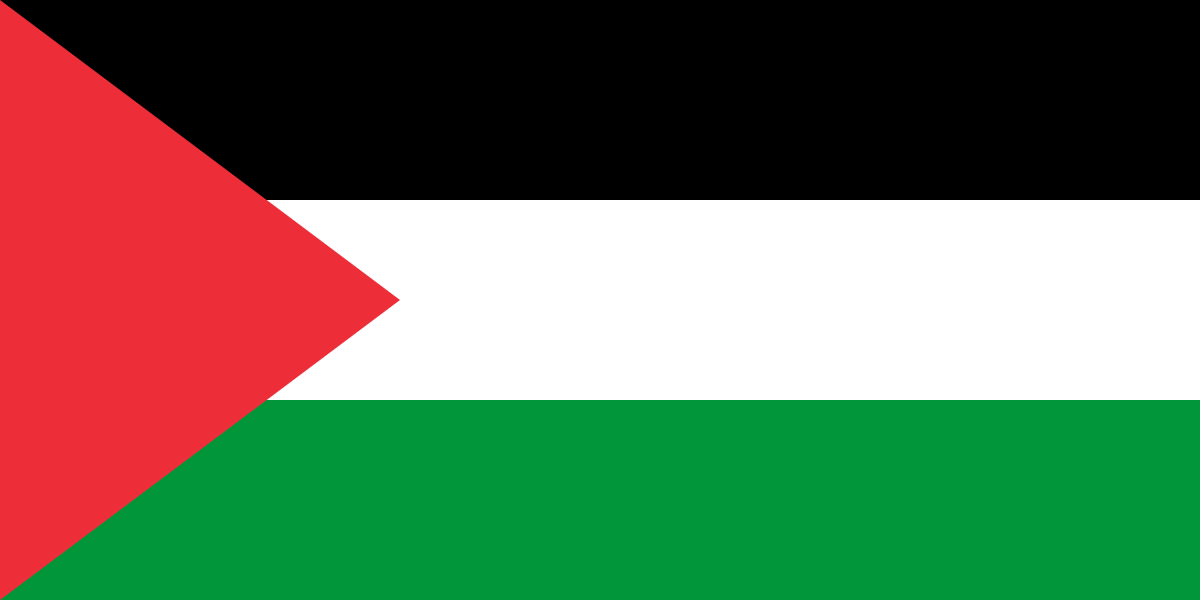
Having considered the report of the Secretary-General on assistance to the Palestinian people (A/72/87), covering the period from 28 July 2016 to 27 July 2017, I wish to thank the Secretary-General and his team for their efforts in preparing the report, which covers all aspects of the economic and social lives of the Palestinian
people. I should also like to thank all the United Nations agencies and programmes that continue to grant assistance to the Palestinian people. Furthermore, I should like to thank all donor countries individually and collectively for their efforts.
The 17 Sustainable Development Goals entered into force on 1 January 2016, which is why we now need to start practical work aligning our national plans with them and thereby doing our utmost to ensure that no one is left behind. The Palestinian Government, for its part, with the aim of implementing the Goals, has established a five-year national development plan for the period from 2017 to 2022, entitled “Citizens First”. It is a national action plan for humankind, freedom and prosperity, based on the three pillars of independence, governance reform and sustainable development. Many of its priorities are aligned with the 2030 Agenda for Sustainable Development. In formulating it, we conducted broad consultations with local and international partners, as well as those United Nations entities that are working in Palestine.
With the exception of some funding for education, all United Nations aid to the Palestinian people is allocated for relief, as it has been in the past and as the Secretary-General’s report (A/72/87) repeatedly confirms. It cannot be used for genuine development purposes that would improve the Palestinian people’s ability to remain on what is left of their land and establish sustainable peace in the future. There is no guarantee that the Palestinians will not be left behind as long as the Israeli occupation still exists in the West
Bank, including occupied East Jerusalem and the Gaza Strip.
Our development challenges are also global, inclusive and overlapping. Climate change, pollution, desertification, ocean acidification, water issues, transnational epidemics and others touch everybody. Their impact varies from one country to another and depends to a large extent on preparations for mitigating and adapting to these effects on a basis of three pillars — appropriate planning, the necessary capabilities and implementation and follow-up.
My country has a five-year plan in place focusing on adaptation to address inclusive development challenges. In addition, we are working on mobilizing local and international financing in order to implement it. As a result, the first two pillars — planning and mobilizing funds — have been successful, but the third — implementation and follow-up — is being seriously undermined by the Israeli occupation.
At the High-level Political Forum on Sustainable Development to be held in July, the State of Palestine will submit its voluntary national review related to the implementation of Sustainable Development Goals, despite our chronic challenges resulting from the Israeli occupation and its impact on us at every level. Palestine remains unshakeably determined, however, as shown in various reports of international institutions, especially the United Nations and World Bank. We will prove to everybody that we are capable of doing the impossible, overcoming all difficulties and prevailing in Palestine, where we will never tire of making sacrifices. As the great poet Mahmoud Darwish said, “We have on this Earth that which makes life worth living”.
I now call on the observer of the International Committee of the Red Cross.

This year, the new Secretary-General has begun sharing his vision for a renewed United Nations. He has made it clear that the United Nations is reforming to focus on three strategic priorities: prevention, development and peace. The simplicity of the new approach is refreshing and means that all United Nations agencies must pull together towards collective outcomes.
This year has also seen important diplomatic work get under way around the world on the global compacts for safe, orderly and regular migration and on refugees.
The International Committee of the Red Cross (ICRC) has been actively involved in both. We view the increasing needs and numbers of people forced to leave their homes and cross international borders as a global humanitarian crisis.
The year 2017 has also seen two important humanitarian milestones, the fortieth anniversary of the Additional Protocols to the Geneva Conventions and the twentieth anniversary of the United Nations Guiding Principles on Internal Displacement. Both continue to be essential instruments for protecting some of the world’s most vulnerable people during armed conflict. This year has also seen significant developments in the Organization’s approach to counter-terrorism, a global policy that will continue to intersect with armed conflict and humanitarian action in several ways.
We expect 2018 to see a consolidation of the Secretary-General’s reforms. We also anticipate that it will be another demanding year for humanitarian action, and so today the ICRC will focus on three key policy areas. First, we will comment on the Secretary-General’s vision of United Nations reform and what it means for humanitarian action. Secondly, we will remind States of the particular importance of the Additional Protocols in today’s armed conflicts. Thirdly, we will reiterate our position on counter- terrorism and humanitarian action.
First, I will address United Nations reform and the risk of a protection gap. The Secretary-General’s reform is based on a firm belief in the indivisibility of prevention, development and peace, embraced in several emerging United Nations policies. The ICRC understands the important connections between humanitarian action, development and peace, especially in protracted conflicts. Our humanitarian work shares many intermediate objectives of the Sustainable Development Goals (SDGs), such as reducing violence, malnutrition and disease and increasing people’s access to clean water, livelihoods and education. We work with those left furthest behind in armed conflict and urban violence. Our humanitarian efforts often act as development holds, maintaining people’s basic services and preventing further development reversals.
Humanitarian action complements broader efforts towards achieving the SDGs, which is why we are pleased to be working in partnership with the World Bank in Somalia. Development finance should lean into countries struggling with protracted conflict
and violence, where the SDGs are weakest. Our humanitarian dialogues with all parties sometimes serve as confidence-building measures between warring parties that are valuable to peace.
But the ICRC sees two worrying gaps in the indivisible policy of the United Nations on prevention, development and peace. The first is a protection gap. Current United Nations policy focuses too simply on development and peace, without recognizing that protection is essential to both. Protecting people’s is a precondition for development and peace. If people, including groups in need of special protection, such as women and children, are being attacked, forcibly displaced, looted, impoverished, besieged or unlawfully detained, or are too afraid to go to hospitals and schools, they cannot get close to development or peace.
Protection is also indivisible from development and peace. For example, many thousands of people are missing because of armed conflict; their families live in the agony of an ambiguous loss. The pain and anger around missing people represent a wound that threatens peace. Governments must work together to find answers about missing people and support their families. States must make the missing and their families a humanitarian priority. Inadequate detention policies also pose a risk to development and peace because inhumane detention practices may increase political grievances.
The second gap is in neutral, impartial and independent humanitarian action. Neutral action risks being lost from view in the new, integrated United Nations vision of prevention, development and peace. This essential humanitarian practice, rooted in the Geneva Conventions, must be respected and facilitated by States so that vulnerable people — whether under or beyond the control of the State — can be protected and assisted impartially on the basis of need.
It is essential to ensure that impartial humanitarian organizations such as the ICRC can work with all parties to conflict and reach all populations in need. Today, the ICRC calls on States to ensure that protection and impartial humanitarian action keep their rightful place in policymaking on armed conflict and violence, because if there is no protection, there is no health care, no food, no livelihood, no education, no home, no family, no development and no peace.
I would now like to speak briefly about the Additional Protocols. The fortieth anniversary of the Additional Protocols to the Geneva Conventions
coincided with a renewed interest on the part of States in the humanitarian issues at the heart of these two vital instruments of international humanitarian law — the distinction between military and civilian populations; conflict-related hunger and starvation; sexual violence; and attacks on the infrastructure and services that are essential to a civilian population’s survival, not the least of which are health care, water, electricity and education facilities.
Respecting international humanitarian law is the best way to ensure people’s protection in armed conflict. International humanitarian law sets clear standards for the protection of individuals and the natural resources, infrastructure and services indispensable to their survival.
I would like to say a final word on counter-terrorism and the criminalization of humanitarian action. The Additional Protocols also entail clear obligations for States and parties to conflict to facilitate the delivery of principled humanitarian assistance, even in areas where listed terrorist groups are active. The ICRC has repeatedly underscored the potential adverse effects on humanitarian action of counter-terrorism measures taken by States, both internationally and nationally.
Activities that are exclusively humanitarian and impartial should be excluded from the scope of application of criminal laws dealing with terrorism. Failure to do so implies a rejection of neutral, independent and impartial humanitarian action. This could jeopardize the mission of impartial humanitarian organizations to protect and assist people affected by armed conflict, particularly in areas controlled by non-State armed groups.
I now call on the observer of the International Federation of Red Cross and Red Crescent Societies.

On behalf of the International Federation of Red Cross and Red Crescent Societies, allow me to thank you, Mr. President, for the opportunity to address this important debate.
We live in a time of unprecedented humanitarian requirements in the face of conflicts, disasters and displacement. It seems that regardless of our best endeavours to do more and to work together to overcome humanitarian challenges, the needs go up, not down. Among the significant challenges we face is a changing
climate. More than 90 per cent of natural disasters are climate-related: famine, flood, fire and more. We have been dealing with the effects of the strongest Atlantic hurricanes in more than a decade and with the worst South Asian floods in a century, which have affected millions of people. In each of these events, and in disasters large and small globally, our Red Cross Red Crescent volunteers are there, delivering vital assistance and helping people recover and rebuild their lives.
We are conscious of what climate change means and how we have to respond to it, including by reducing risk and building resilience. That is why we welcome the increased attention that the Paris Agreement on Climate Change has brought to building resilience to climate extremes. A holistic effort to make progress under the Sendai Framework for Disaster Risk Reduction 2015-2030 is crucial, aligning disaster risk reduction, the Sustainable Development Goals and the Paris Agreement.
We know that the risks driven by climate change will be unevenly weighted against poorer people living in areas of low development, such as those crowded in urban slums without access to reliable water and electricity sources and displaced persons living in disaster-prone and climate-exposed areas. Addressing these risks will require increased investment in local action and strong efforts to ensure that we do not bypass the very people who will suffer the most.
Within the Red Cross Red Crescent, we have found that in order to see real progress, we must find ways to effectively link science to policy, decision-making and action on the ground — for instance, finding ways to address rising climate extremes through early warning systems that reach all the way to the most vulnerable communities and enable them to act. One way in which we have been working on this is by developing an innovative method of advance financing based on weather forecasts. We saw this method at work recently in Bangladesh as it braced itself for the impacts of Tropical Cyclone Mora. The day before the cyclone hit, the Bangladesh Red Crescent activated its forecast- based financing mechanism, under which nearly 2,300 households received grants to take their own actions to prepare.
The IFRC welcomes the recognition in several of the draft resolutions to be adopted today of the need to strengthen early warning and early action efforts, including through innovative financing mechanisms
such as forecast-based financing. We stand ready to support Member States in realizing these efforts. For our part, we have committed to ensuring predictable humanitarian financing for early action through the establishment of a new forecast-based financing window to our Disaster Relief Emergency Fund in 2018.
November marked the 10-year anniversary of the Guidelines for the Domestic Facilitation and Regulation of International Disaster Relief and Initial Recovery Assistance (IDRL). The IDRL Guidelines are a resource for Governments seeking to put in place dedicated rules and procedures for avoiding common regulatory problems in international disaster assistance, thereby eliminating delays, expenses and complexities in delivering aid while also improving oversight, regulation and coordination of international relief efforts. Since the IDRL Guidelines were adopted, national societies have provided advice to their Governments on how to plug these gaps in over 100 countries, and there are currently projects in over 50 countries. The IFRC will continue to support Governments, regional bodies and other stakeholders interested in strengthening legal preparedness for disasters.
Last month, the International Red Cross and Red Crescent Movement came together in its biannual statutory meeting. Among other things, we adopted a call for action on the humanitarian needs of vulnerable migrants, pointing out some basic issues that we fear are drifting away from the main debates about the global compact for safe, orderly and regular migration, including recognizing and directly addressing the extreme levels of vulnerability faced by irregular migrants. Moving forward from the recent preparatory meeting held in Puerto Vallarta, Mexico, we call on States to guarantee that all migrants have access to humanitarian assistance and protection, irrespective of legal status, and that their rights are respected.
Letting down the millions of people trapped in humanitarian crises, as well those vulnerable to tomorrow’s emergencies, is not an option. We need to be smarter and work harder as humanitarians and development actors, as Governments, as donors and as an international community.
We have heard the last speaker in the debate on agenda item 73 and its sub-items (a) to (c).
We shall now proceed to consider draft resolutions A/72/L.22, A/72/L.23, A/72/L.24 and A/72/L.25.
Before giving the floor to speakers in explanation of vote or position before the vote, I would like to remind delegations that explanations of vote are limited to 10 minutes and should be made by delegations from their seats.


I have the honour to speak on behalf of Australia, Iceland, Lichtenstein, New Zealand, Norway, Switzerland and my own country, Canada.
We take the floor today because we understand that a vote has been called for on two paragraphs of draft resolution A/72/L.22, specifically the twenty-eighth preambular paragraph and operative paragraph 7. We consider a call for a vote on these paragraphs to be most unfortunate, especially as it seeks to remove paragraphs that have been agreed language for years. The vote is even more troubling because we have been witnessing repeated violations of international humanitarian law in recent years, one of the most disturbing expressions of which is attacks on humanitarian and medical personnel in conflict situations. As such, the relevance of the agreed text is even higher than in past years.
The twenty-eighth preambular paragraph addresses attacks intentionally directed at personnel involved in a humanitarian assistance or peacekeeping mission in accordance with the Charter of the United Nations. It recalls that such attacks may, under certain circumstances, be considered a war crime under the Rome Statute of the International Criminal Court (ICC). This paragraph further underscores the role that the Court can play in bringing to justice those responsible for serious violations of international humanitarian law. It is a simple statement of fact.
Paragraph 7 calls on all States to consider becoming parties to the Rome Statute of the International Criminal Court. The ICC has a key role to play in ending impunity where national courts are unwilling or unable to exercise jurisdiction. The paragraphs do not seek to target any one country but rather recall one of the tools available to the international community in such circumstances, and encourage States simply to consider joining the Rome Statute. We therefore find it deeply disturbing that the paragraphs are now being attacked to the detriment of our common causes. We call on all delegations to vote in favour of retaining the paragraphs when they are put to the vote. We will do the same.


We too would like to explain our position with regard
to the two paragraphs of draft resolution A/72/L.22 that are to be put to a recorded vote.
We are voting on those paragraphs for the second year. It is also the second year that our delegation, like others, is calling on other delegations to review the agreed language because it can no longer be considered consensual. The Russian Federation has always urged that those guilty of the most severe war crimes be held accountable. We have always been in favour of the Tokyo Tribunal. We helped to draft the main documents on this issue.
Once the International Criminal Court was established, the international community had a strong expectation that we would address impunity, settle existing conflicts and ensure that new hotbeds of tension did not arise. Regrettably, although the Court has existed for many years now, we have simply been compelled to conclude that it has not fulfilled the hopes that were placed in it. It has not become an authoritative organ of international justice. On various platforms, including at the General Assembly and the Security Council, we have seen that the Court’s investigations have been ineffective and biased in terms of principle.
We stated our position clearly from the beginning of the talks on draft resolution A/72/L.22, on the safety and security of humanitarian personnel and protection of United Nations personnel. We, along with several other delegations, do not agree that the twenty-eighth preambular paragraph and operative paragraph 7 should be included in the text. We believe that the alternative wording that has been proposed should be endorsed because it takes into account issues that a number of delegations would like to see included in the paragraphs. At the same time, they resolve existing contradictions that do not allow the rest of the negotiating group to support the inclusion of those paragraphs. We believe that the amendments proposed should be supported because they would allow the draft resolution to be consensus-based, if adopted.


I have the honour to speak on behalf of the European Union (EU) and its member States.
We deeply regret that the Sudan has again called for the twenty-eighth preambular paragraph and operative paragraph 7 of draft resolution A/72/L.22, on the safety and security of humanitarian personnel and the protection of United Nations personnel, to be put to the vote. References to the International Criminal
Court (ICC) have existed in both the preambular and operative sections of the resolution since it was first adopted in 1999. The EU and its member States reiterate their unwavering support for the ICC as the world’s first permanent international criminal court and an important tool for the international community in the fight against impunity, as well as a contribution to peaceful societies.
The gross violations of international humanitarian law and human rights law that we have witnessed worldwide are a sharp reminder of the increasing relevance of the Court, whose role is to complement rather than replace existing national judicial systems. The primary responsibility to investigate and prosecute crimes remains with individual States. All perpetrators of such crimes must be held accountable for their actions. A key element of the Rome Statute is its equal application. In that regard, the creation of the ICC has given millions of victims of atrocity crimes new hope that justice will be done.
States from all over the world have begun to unite in that endeavour. The EU and its member States believe that the fight against impunity for the most serious crimes is critical to ensure a fair and just society by holding the perpetrators accountable and ensuring justice for victims. We also believe that peace and justice are complementary, not mutually exclusive. It is for those reasons that the 28 States members of the EU support the retention of the two paragraphs. We call on all other States to vote in favour of them.


At the outset, we would like to extend our heartfelt condolences to the peoples and Governments of the Democratic Republic of the Congo and Tanzania, following the deaths of peacekeepers from those and other sisterly countries.
We would like to welcome and commend those involved in the humanitarian efforts in the Sudan from the United Nations, individual countries and non-governmental organizations.
We have serious reservations about the inclusion of references to the jurisdiction of the International Criminal Court (ICC) in draft resolution A/72/L.22 and other resolutions as a means for exerting unacceptable pressure on the States Members of the United Nations to include such references and language. We refer the Assembly to the twenty-eighth preambular paragraph and operative paragraph 7 of draft resolution A/72/L.22, and we move that both paragraphs be put to the vote. We
reject the inclusion of the jurisdiction of the ICC in the draft resolution and others for the following reasons.
First, the Court is not an organ of the United Nations. In spite of the fervent attempts of some parties to paint it otherwise in meetings of the main committees of the General Assembly, we continue in that belief, which is supported by practice and law.
Secondly, the Rome Statute and other international treaties are somewhat incompatible and contain contradictions. Article 26 of the Vienna Convention on the Law of Treaties states that every treaty in force is binding only on the parties to it, based on the principle of free consent, which is observed and applied by the General Assembly.
Thirdly, according to the policy papers of the Office of the Prosecutor, the Court’s practice since 2002 has driven a wedge between the principle of justice and peace. Unfortunately, as far as the ICC is concerned, those principles are not connected. A wedge has been driven between the principle of justice and peace and one of the fundamental principles of international humanitarian law related to internal conflicts was suspended, namely, amnesty.
Fourthly, since 2003, the International Criminal Court has been only an impediment to peace in Darfur. The ICC is bound to create a serious conflict between peace and justice and, to the extent that the Darfur issue may result in arrest, it remains the main challenge facing the international community and the national Government of the Sudan in the area. It jeopardizes both peace and security. At best, the ICC is a threat to stability and peace in my country, in Africa and in so many parts of the world, not to mention the problems created by its disruptive history since its inception. The ICC has been fraught with one corruption scandal after the other.
Fifthly, the policy papers of the ICC Prosecutor clearly state that the Court exercises its jurisdiction by deciding on admissibility based on two criteria, possibility and feasibility. Selectivity in the practice of the Court is therefore not incidental; it is institutional and inevitable. That is why the authority and jurisdiction of the International Criminal Court are a menace to the tenets of peace and the sovereign equality of States, which includes pre-emptive norms of international law.
Sixthly, the ICC lacks independence, as half of its budget is drawn from voluntary contributions from
the States and non-governmental organizations that exercise control over it.
We tried our best to meet the interests of the proponents and sponsors of this draft resolution. With respect to the twenty-eighth preambular paragraph, we proposed the replacement of the phrase
“as a war crime in the Rome Statute of the International Criminal Court, and noting the role that the Court can play in appropriate cases in bringing to justice those responsible for serious violations of international humanitarian law”
with the following phrase: “as a war crime in relevant international criminal justice instruments”. That was not accepted.
In the same vein, in paragraph 7, we proposed replacing the phrase: “calls upon all States to consider becoming parties to the Rome Statute of the International Criminal Court”, with the following: “calls upon all States to consider becoming parties to relevant international criminal justice instruments”.
We have opposed the International Criminal Court since the beginning because of all these considerations. The means by which we express our opposition, of course, have changed according to circumstances and our decision as a sovereign State Member of this Organization.
Finally, we reiterate hereby our full subscription to the overall draft resolution. Humanitarian assistance is a vital and instrumental means to address humanitarian crises, whether man made or the result of natural causes. That is why the lofty goals of humanitarian assistance should not be disturbed and mixed with such politically driven language, which will lead only to discord and division. We call on Member States to vote against the inclusion of the twenty-eighth preambular paragraph and operative paragraph 7 as they stand in the draft resolution.
We have heard the last speaker in explanation of vote before the voting.
The meeting was suspended at 10.50 a.m. and resumed at 11 a.m.
The Assembly will now take decisions on draft resolutions A/72/L.22, A/72/L.23, A/72/L.24 and A/72/L.25.
We turn first to draft resolution A/72/L.22, entitled “Safety and security of humanitarian personnel and protection of United Nations personnel”. For the Assembly’s information, the draft resolution has closed for e-sponsorship.
I now give the floor to the representative of the Secretariat.

I should like to announce that, since the submission of the draft resolution, and in addition to those delegations listed in the document, the following countries have become sponsors of draft resolution A/72/L.22: Armenia, Bangladesh, Belize, Cabo Verde, Costa Rica, the Dominican Republic, Guatemala, Haiti, Honduras, Liberia, Malawi, Morocco, Nigeria, Peru, the Philippines, the Republic of Moldova, San Marino, the State of Palestine, Saudi Arabia, Senegal, Ukraine, Uruguay and Zambia.
A separate, recorded vote has been requested on the twenty-eighth preambular paragraph, together with operative paragraph 7.
A recorded vote was taken.
The twenty-eighth preambular paragraph and operative paragraph 7 were retained by 95 votes to 12, with 17 abstentions.
May I take it that it is the wish of the General Assembly to adopt draft resolution A/72/L.22 as a whole?
Draft resolution A/72/L.22, as a whole, was adopted (resolution 72/131).
I give the floor to the representative of Israel on a point of order.


Israel believes that resolution 72/131, on the safety and security of humanitarian personnel and protection of United Nations personnel, reaffirms the unique role played by the United Nations when providing humanitarian assistance.
Paragraph 5 of the annex to resolution 52/250, dated 13 July 1998, entitled “Participation of Palestine in the work of the United Nations”, determines “[t]he right to co-sponsor draft resolutions and decisions on Palestinian and Middle East issues”.
The subject matter of resolution 72/131, on the safety and security of humanitarian personnel and the protection of United Nations personnel, clearly does not fall within the parameters of the annex to resolution 52/250. I would like to stress the importance we attach to following the rules of procedure of the Organization. The rules of sponsorship have been clearly laid out in the rules and regulations governing this Organization. Any decision to disregard them acts in violation of the relevant United Nations resolutions and undermines the work of this institution.
We turn next to draft resolution A/72/L.23, entitled “International cooperation on humanitarian assistance in the field of natural disasters, from relief to development”.
I now give the floor to the representative of the Secretariat.
I should like to announce that, since the submission of the draft resolution, and in addition to those delegations listed in the document, the following countries have become sponsors of draft resolution A/72/L.23: Albania, Armenia, Australia, Austria, Belgium, Bulgaria, Cabo Verde, Canada, Croatia, Cyprus, the Czech Republic, Denmark, Estonia, Finland, France, Germany, Greece, Haiti, Hungary, Iceland, Ireland, Israel, Italy, Japan, Latvia, Lithuania, Luxembourg, the Maldives, Malta, Monaco, Montenegro, the Netherlands, New Zealand, Papua New Guinea, Poland, Portugal, Romania, the Russian Federation, Serbia, Slovakia, Slovenia, Spain, Sweden, Switzerland, Thailand, Turkey, Ukraine and the United Kingdom.
May I take it that it is the wish of the General Assembly to adopt draft resolution A/72/L.23?
Draft resolution A/72/L.23 was adopted (resolution 72/132).
Vote:
72/132
Consensus
The Assembly will now take a decision on draft resolution A/72/L.24, entitled “Strengthening of the coordination of emergency humanitarian assistance of the United Nations”.
I now give the floor to the representative of the Secretariat.
I should like to announce that, since the submission of the draft resolution, and in addition to those delegations listed in the document, the following countries have become sponsors of draft resolution A/72/L.24: Algeria, Cabo Verde, Chad, the Democratic Republic of the Congo, Ecuador, Haiti, Jamaica, Malawi, the State of Palestine, the Sudan, Togo and Zambia.
May I take it that it is the wish of the General Assembly to adopt draft resolution A/72/L.24 without a vote?
Draft resolution A/72/L.24 was adopted (resolution 72/133).
I give the floor to the representative of Israel on a point of order.
Vote:
72/133
Consensus
Once again, I will have to repeat what I have already said. Paragraph 5 of the annex to resolution 52/250, adopted on 13 July 1998, on the participation of Palestine in the work of the United Nations, determines that it has “[t]he right to co-sponsor draft resolutions and decisions on Palestinian and Middle East issues”. Again, clearly the subject matter of resolution 72/133 does not fall within the parameters of the annex to resolution 52/250, and we would again like to stress the importance that we attach to following the rules of the Organization. The rules of sponsorship have been clearly laid out in the rules and regulations that govern the Organization and any decision to disregard them, time and again, acts in violation of the United Nations resolutions and undermines the work of the institution.
The Assembly will now take a decision on draft resolution A/72/L.25, entitled “Assistance to the Palestinian people”.
I give the floor to the representative of the Secretariat.
I should like to announce that, since the submission of the draft resolution, and in addition to those delegations listed on the document, the following countries have become sponsors of draft resolution A/72/L.25: Albania, Andorra, Australia, Chad, the Gambia, Georgia, Haiti, Japan, Liechtenstein, Montenegro, New Zealand, the Niger, Norway, Pakistan, the Philippines, the Republic of Korea, San Marino, Senegal, Serbia, South Africa, the Sudan, Switzerland, Ukraine and Zimbabwe.
May I take it that it is the wish of the General Assembly to adopt draft resolution A/72/L.25 without a vote?
Draft resolution A/72/L.25 was adopted (resolution 72/134).
I now call on the observer of the Holy See.
Monsignor Grysa (Holy See): My delegation would like to thank the facilitator and the Office for the Coordination of Humanitarian Affairs for their commitment and hard work in achieving consensus during this year’s informal negotiations on resolution 72/133, “Strengthening of the coordination of emergency humanitarian assistance of the United Nations”. We commend the open and fruitful cooperation of many delegations, which made it possible to reach consensus and make progress, in particular with regard to migrants, refugees, internally displaced persons and the protection of women and children. However, the Holy See, in conformity with its nature and particular mission, would like to reiterate its reservations on the following concepts used therein.
First, the Holy See does not consider abortion, access to abortion or access to aborted patients as a dimension of the terms sexual and reproductive health and sexual and reproductive health care services. Secondly, with reference to gender, the Holy See understands the term to be grounded in biological sexual identity and difference, not in a psychological state, nor to be interpreted as a social construction.
The General Assembly has thus concluded this stage of its consideration of agenda item 73 and its sub-items (a) to (c).
Vote:
72/134
Consensus
The meeting rose at 11.15 a.m.