A/73/PV.75 General Assembly
The meeting was called to order at 11.35 a.m.
Reports of the Fifth Committee

The General Assembly will now consider the reports of the Fifth Committee on agenda items 142, 148, 136 and 135. I request the Rapporteur of the Fifth Committee, Mr. Hicham Oussihamou of Morocco, to introduce in one intervention the reports of the Fifth Committee before the Assembly today.
Mr. Oussihamou (Morocco), Rapporteur of the Fifth Committee: I have the honour to introduce to the General Assembly the reports of the Fifth Committee containing recommendations on issues considered during the first part of the resumed seventy-third session of the General Assembly. The Fifth Committee met from 11 March to 5 April and held six plenary meetings and numerous informal consultations.
Let me now present the reports of the Fifth Committee containing recommendations on issues that require action by the General Assembly.
Under agenda item 142, entitled “Joint Inspection Unit”, in paragraph 6 of its report contained in document A/73/826, the Committee recommends to the General Assembly the adoption of a draft resolution that was adopted by the Committee without a vote.
(spoke in French)
Under agenda item 148, entitled “Financing of the International Residual Mechanism for Criminal Tribunals”, in paragraph 6 of its report contained in
document A/73/670/Add.1, the Committee recommends to the General Assembly the adoption of a draft resolution that was adopted by the Committee without a vote.
Under agenda item 136, entitled“Programme budget for the biennium 2018-2019”, in paragraph 9 of its report contained in document A/73/686/Add.1, the Committee recommends to the General Assembly the adoption of a draft resolution on special subjects relating to the programme budget for the biennium 2018-2019, which was adopted by the Committee without a vote.
Finally, on agenda item 135, entitled “Review of the efficiency of the administrative and financial functioning of the United Nations”, in paragraph 8 of its report contained in document A/73/687/Add.1, the Committee recommends to the General Assembly the adoption of a draft resolution entitled “Progress towards an accountability system in the United Nations Secretariat”. In paragraph 9 of the same report, Committee recommends to the General Assembly the adoption of a draft decision entitled “Questions deferred for future consideration”, which was adopted by the Committee without a vote.
(spoke in Arabic)
I thank delegations for their cooperation during this session and for the spirit of compromise that enabled the Committee to finish its work on time. I would also like to thank the Chair of the Committee, Ambassador Gillian Bird, for her support, guidance and encouragement. I look forward to working with her and my colleagues in the Bureau to ensure the success
of the second part of the resumed session, which will take place in May, and whose agenda includes issues relating to the financing of peacekeeping operations.
I would like to express my thanks to the secretariat of the Fifth Committee and all the interpreters, translators and technicians who helped us throughout our work for their continuous support.
In conclusion, I would like to express my gratitude to my own family for understanding the nature of our work in the Fifth Committee, which requires us to work beyond normal hours, particularly on weekends. I also want to take this opportunity to reiterate my words of appreciation and respect to my Ambassador, His Excellency Mr. Omar Hilale, for his continuing support to me and the confidence he has had in me since I joined the Permanent Mission of the Kingdom of Morocco.
I thank the Rapporteur of the Fifth Committee and acknowledge the extraordinary efforts of the Chair and the Bureau of the Committee. I would also like to publicly recognize the generosity of their families, who miss out on time with their beloved fathers or mothers because of the weekends and long periods they spend outside normal working hours doing the work of the Fifth Committee. The results can be seen in the quality of the Committee’s work. I offer my gratitude to all of them.
The positions of delegations regarding the recommendations of the Fifth Committee have been made clear in the Committee and are reflected in the relevant official records.
If there is no proposal under rule 66 of the rules of procedure, I shall take it that the General Assembly decides not to discuss the reports of the Fifth Committee that are before the Assembly today.
25b. South-South cooperation for development
Vote:
73/291
Consensus
It was so decided.
Statements will therefore be limited to explanations of position. I would like to remind members that, under paragraph 7 of decision 34/401, the General Assembly agreed that:
“When the same draft resolution is considered in a Main Committee and in plenary meeting, a delegation should, as far as possible, explain its vote only once, i.e., either in the Committee or in plenary meeting, unless that delegation’s vote in plenary meeting is different from its vote in the Committee.”
It is good to keep that agreement in mind.
May I further remind delegations that, also in accordance with General Assembly decision 34/401, explanations of vote are limited to 10 minutes and should be made by delegations from their seats.
Before we begin to take action on the recommendations contained in the reports of the Fifth Committee, I would like to advise delegations that we are going to proceed to take decisions in the same manner as was done in the Committee, unless the Secretariat is notified to the contrary in advance. I therefore hope that we may proceed to adopt without a vote those recommendations that were adopted without a vote in the Fifth Committee.
142. Joint Inspection Unit Report of the Fifth Committee (A/73/826)
The Assembly has before it a draft resolution recommended by the Fifth Committee in paragraph 6 of its report.
We will now take a decision on the draft resolution, entitled “Joint Inspection Unit”. The Fifth Committee adopted it without a vote. May I take it that the Assembly wishes to do likewise?
The draft resolution was adopted (resolution 73/287).
The Assembly has thus concluded this stage of its consideration of agenda item 142.
148. Financing of the International Residual Mechanism for Criminal Tribunals Report of the Fifth Committee (A/73/670/Add.1)
The Assembly has before it a draft resolution recommended by the Fifth Committee in paragraph 6 of its report.
The Assembly will now take a decision on the draft resolution, entitled “Construction of a new facility for the International Residual Mechanism for Criminal Tribunals, Arusha branch”. The Fifth Committee adopted it without a vote. May I take it that the Assembly wishes to do likewise?
128. Cooperation between the United Nations and regional and other organizations (j) Cooperation between the United Nations and the International Organization of la Francophonie
Vote:
73/290
Consensus
The draft resolution was adopted (resolution 73/288).
The Assembly has thus concluded this stage of its consideration of agenda item 148.
136. Programme budget for the biennium 2018-2019 Report of the Fifth Committee (A/73/686/Add.1)
The Assembly has before it a draft resolution recommended by the Fifth Committee in paragraph 9 of its report.
We will now take a decision on the draft resolution, entitled “Special subjects relating to the programme budget for the biennium 2018-2019”. The Fifth Committee adopted it without a vote. May I take it that the Assembly wishes to do the same?
The draft resolution was adopted (resolution 73/279 B).
I now give the floor to the representative of Syrian Arab Republic.


The Government of the Syrian Arab Republic wishes to express reservations about the allocation of financial resources to the United Nations Monitoring Mechanism for the Syrian Arab Republic, as set forth in document A/73/686/Add.1, part V. My country’s position is based on the fact that the Mechanism flagrantly violates the Charter of the United Nations, in particular the principles of respect for national sovereignty and of non-interference in the internal affairs of Member States.
The Assembly has thus concluded this stage of its consideration of agenda item 136.
135. Review of the efficiency of the administrative and financial functioning of the United Nations Report of the Fifth Committee (A/73/687/Add.1)
The Assembly has before it a draft resolution recommended by the Fifth Committee in paragraph 8 of its report and a draft
decision recommended by the Committee in paragraph 9 of the same report.
We will now take a decision on the draft resolution and the draft decision, one by one.
The General Assembly will first turn to the draft resolution, entitled “Progress towards an accountability system in the United Nations Secretariat”. The Fifth Committee adopted it without a vote. May I take it that the Assembly wishes to do likewise?
The draft resolution was adopted (resolution 73/289).
The draft decision is entitled “Questions deferred for future consideration”. The Fifth Committee adopted it without a vote. May I take it that the Assembly wishes to do likewise?
The draft decision was adopted (decision 73/547 B).
The Assembly has thus concluded this stage of its consideration of agenda item 135.
The General Assembly has thus concluded its consideration of all the reports of the Fifth Committee before it for this meeting.
I now give the floor to the representative of Armenia to introduce draft resolution A/73/L.81.


As the representative of the Armenian presidency of the seventeenth Francophonie Summit and coordinator of the draft resolution entitled “Cooperation between the United Nations and the International Organization of la Francophonie”, I have the honour to introduce draft resolution A/73/L.81.
The Heads of State and Government of the countries sharing the French language met at the seventeenth Francophonie Summit from 11 to 12 October 2018 in
Armenia’s capital, Yerevan. For two days the Yerevan Summit debated the major global issues and the contribution made by La Francophonie in addressing them, particularly with regard to the question of living together. This theme, the common thread of the Summit, responds to the current contexts of the French-speaking and international spaces as a fact to be cultivated and preserved.
Living together is a fundamental value for the francophone family that the Summit expanded on. It brought together representatives of 88 States and Governments of La Francophonie to celebrate the common values of solidarity and cooperation in which diversity is a source of peace, democracy and human rights. The timing of this major gathering was truly symbolic, as it was held at a time when Armenia was inspired by the values of the civic and peaceful movement of its velvet revolution, led by the Armenian people in their desire to live together in a social environment that is free, fair and supportive.
In what the Secretary-General described as a fantastic example of the peaceful transfer of power, Armenia’s young people and women have been at the forefront of a non-violent democratic process in the full exercise of their human rights and fundamental freedoms. Our velvet revolution and the subsequent political changes in Armenia have demonstrated the Armenian people’s determined commitment to adopting policies of inclusion, equal rights and opportunities, development and peace at the national, regional and international levels. As our Prime Minister, Mr. Nikol Pashinyan, declared at the Francophonie Summit, the values of peace, solidarity and integral humanism that define the ideology of living together in the French- speaking world constitute a common good and wealth that we must preserve at all costs.
The Summit was also somewhat sadly symbolic value because it was held at a time when the French- speaking world — indeed, the whole world — was mourning the death of Charles Aznavour. A great man of culture and a legendary artist who transcended time, generations and borders, Charles Aznavour was a wonderful ambassador of La Francophonie and a truly extraordinary ambassador of Armenia. In paying tribute to him, the seventeenth Francophonie Summit reaffirmed its common commitment to the humanist values of art, culture and linguistic diversity.
Against the disturbing global backdrop of the sharp decline in the international commitment to multilateralism and respect for human rights, the message of living together, chosen as the main theme of the seventeenth Summit, is more significant than ever before, particularly at a time when we need greater international cooperation and strengthened capacities in that regard. The draft resolution submitted to the General Assembly for adoption today reflects the close links between the United Nations and the International Organization of la Francophonie and follows on from the previous resolution adopted two years ago in this Hall (resolution 71/289) and facilitated by the delegation of Madagascar.
The draft resolution presented today provides an overview of key commitments reaffirmed at the seventeenth Francophonie Summit, as set out in the Yerevan Declaration and other documents adopted at the Summit. The draft resolution notes the willingness of Member States to strengthen their cooperation in the promotion of peace and international security, the defence of human rights and gender equality, the fight against terrorism, the prevention of genocide and crimes against humanity, sustainable development, the promotion of education and training with a view to bridging the digital divide, as well as in other areas of cooperation. It welcomes the establishment of two new regional offices in Tunis and Beirut, pursuant to the relevant decisions adopted at the seventeenth Francophonie Summit.
I would like to conclude my statement by thanking all delegations for their constructive engagement in the consultation process on the draft resolution. We are very grateful for its substantial and consensus outcome.
Armenia welcomes the next summit of Heads of State and Government of La Francophonie, to be held in Tunis in 2020, which will mark the fiftieth anniversary of the International Organization of la Francophonie.
Before giving the floor to speakers in explanation of position before action is taken on the draft resolution, I would like to remind delegations that explanations are limited to 10 minutes and should be made by delegations from their seats.
I now give the floor to the representative of Azerbaijan.


We recognize that cooperation between the United Nations and regional organizations is essential to the promotion of the purposes and principles of the United Nations. As a strong advocate of enhancing dialogue between civilizations and cultures, Azerbaijan supports and shares the main objectives of the International Organization of la Francophonie, which has become an important multilateral cooperation framework.
It is notable that today, a day when the Assembly is adopting draft resolution A/73/L.81, on cooperation between the United Nations and the International Organization of la Francophonie, coincides with the end of the Francophonie weeks that have been taking place between 30 March and 15 April in Baku, the capital of Azerbaijan, to celebrate the cultural creativity and diversity of francophone countries. Among a series of events held within this framework, the French Embassy in Azerbaijan, in close cooperation with other diplomatic missions of member and observer States of the International Organization of la Francophonie, launched the second edition of the Salon Universitaire Francophone, bringing together participants from various countries and European universities.
The Governments of Azerbaijan and France have also been working together to further promote French language, education and culture in Azerbaijan. In 2011 President Ilham Heydar oglu Aliyev of Azerbaijan and the then-President of France, Nicolas Sarkozy, took part in the ceremony laying the foundation stone for the French Lycée in Baku. The Lycée opened in 2014, operating on the basis of the French national curriculum and with an enrolment of more than 400 students at the pre-, elementary- and middle-school levels. Another successful education project, initiated by the Presidents of Azerbaijan and France in 2014, is the French- Azerbaijani University, which is administrated by the Azerbaijan State Oil and Industry University and the University of Strasbourg.
The delegation of Azerbaijan participated actively in the negotiation process on this draft resolution, and we are pleased that some of the proposals we put forward during the informal consultations were accommodated in its final text. At the same time, we have reservations about the outcomes of the seventeenth Summit of la Francophonie, held in Yerevan on 11 and 12 October 2018, including the documents referred to in the ninth preambular paragraph and paragraph 45 of the draft
resolution. I want to make the following points in that regard.
In its resolution 73/129 of 12 December 2018, entitled “Promotion of interreligious and intercultural dialogue, understanding and cooperation”, the General Assembly noted but did not welcome the adoption of the Yerevan Declaration of the seventeenth Summit of la Francophonie. No compelling reasons have emerged since then to encourage the General Assembly to upgrade its assessment of the Declaration in the draft resolution before us. Moreover, the outcome documents of the Summit, first make ambiguous and out-of-context historical assertions. Secondly, they contain a one-sided approach to some commitments under international law, including international humanitarian law. Thirdly, they refer to some international instruments in an unbalanced manner. Fourthly, in the same way, they cite some criminal offences while remaining silent on others, and fifthly, they purport to create new duties deriving from political considerations rather than obligations and commitments set forth under international law.
During the informal consultations on the draft resolution, some provisions derived from the Yerevan Declaration were amended or reformulated. The very fact that those changes were made confirms the validity of the disagreements on the outcome document of the Summit, which precludes consensus on them in a wider context. In addition, the draft resolution’s welcoming of the adoption of the Yerevan Declaration is also an inconsistency, as not all General Assembly resolutions on cooperation between the United Nations and regional organizations contain that expression with regard to outcome documents adopted by other regional organizations, and we cannot accept such selectivity. Despite the fact that the delegation of Azerbaijan consistently expressed this position during the informal consultations, it has only partly been taken into account.
It is also highly regrettable that Armenia has attempted to abuse the privilege of hosting the seventeenth Summit of la Francophonie by misleading the organization’s member States about the causes and consequences of the war it has waged against Azerbaijan. The sole purpose of such futile attempts is to distort the factual situation, deny Armenia’s responsibility for aggression and atrocious crimes against Azerbaijan and its people, prolong the unlawful occupation of territories belonging to my country and prevent forcibly displaced Azerbaijanis from returning to their homes and properties in those areas. We should
note in particular that while the Summit was held under the theme “Living together through shared humanistic values”, the relevant United Nations bodies and other international organizations have repeatedly expressed their serious concern about the spirit of intolerance prevailing in Armenia and the discriminatory policies and practices that it pursues.
Indeed, as is well known, unlike other countries of the region and the States members of the International Organization of la Francophonie, Armenia is uniquely monoethnic, a shameful situation that it has achieved by expelling all non-Armenians, including Azerbaijanis. The process of expelling the 250,000 Azerbaijanis who remained there in the late 1980s was accompanied by the brutal killings of hundreds of innocent people. While Azerbaijani historical and cultural heritage has been consistently and purposefully eradicated in Armenia, no one in Armenia has been brought to justice for those acts.
Yerevan has applied the same policy and practices to creating ethnically homogeneous areas to the Nagorno Karabakh region and other occupied territories of Azerbaijan, where the most serious crimes of concern to the international community, such as war crimes, crimes against humanity, genocide and ethnic cleansing, have been committed by Armenian forces in the course of their aggression. Armenia’s denial of responsibility for its wrongdoing, including through apparent falsifications and distortions of the past and present and the glorification of war crimes and their perpetrators in defiance of human rights, is a direct obstacle to lasting peace and genuine reconciliation and a threat to regional security and stability.
Azerbaijan expects that the friendly member States of the International Organization of la Francophonie, guided by international law and the relevant resolutions of the Security Council and General Assembly, will prevent any future provocations and actions by Armenia within La Francophonie that are hostile to the sovereignty and territorial integrity of Azerbaijan.
For the reasons I have just outlined, Azerbaijan dissociates itself from the consensus on the ninth preambular paragraph and operative paragraph 45 of the draft resolution in relation to the Yerevan Declaration and the Yerevan Call for Living Together, adopted at the seventeenth Summit of la Francophonie.
We have heard the last speaker in explanation of position before the voting.
The Assembly will now take a decision on draft resolution A/73/L.81, entitled “Cooperation between the United Nations and the International Organization of la Francophonie”.
I give the floor to the representative of the Secretariat.

I should like to announce that since the submission of the draft resolution, and in addition to those delegations listed in document A/73/L.81, the following countries have also become sponsors of draft resolution A/73/L.81: Comoros, Croatia, Cyprus, Finland, Greece, Guinea, Latvia, Liechtenstein, Lithuania, Luxembourg, Madagascar, Malta, Mauritius, Morocco, Poland, Portugal, Samoa, Senegal, Serbia, Sweden, Thailand and Togo.
May I take it that the Assembly decides to adopt draft resolution A/73/L.81?
Draft resolution A/73/L.81 was adopted (resolution 73/290).
I now give the floor to the representative of the United States, who wishes to speak in explanation of position on the resolution just adopted. I would like to remind delegations that explanations are limited to 10 minutes and should be made by delegations from their seats.


Resolution 73/290 represents a notable example of ways in which the United Nations system works with other international and regional organizations to promote multilateral cooperation in areas of common interest. We thank Armenia for its leadership in bringing the text to fruition.
The United States welcomes the objectives of the International Organization of la Francophonie in support of dialogue between cultures and civilizations and the establishment of closer ties among peoples. For that reason, we are pleased at today’s adoption of the resolution on cooperation between the United Nations and the International Organization of la Francophonie. However, throughout the negotiations, we raised
concerns about the draft text with regard to three important issues, which, regrettably, the final draft did not address. I would like to take the opportunity to address them now.
The United States remains a leader in the fight to end impunity and continues to support justice and accountability for international crimes, including war crimes, crimes against humanity and genocide. We respect the decisions of the nations that have chosen to join the International Criminal Court (ICC) and, in turn, we expect that our decision not to join or place our citizens under ICC jurisdiction will also be respected. The United States therefore dissociates itself from paragraph 19 of this resolution, which includes a reference to the International Criminal Court that the United States cannot support, as such language does not distinguish sufficiently between parties and non-parties to the Rome Statute or is otherwise contrary to the United States position on the ICC. In particular, we reiterate our continuing and long- standing principled objection to any assertion of ICC jurisdiction over nationals of States that are not party to the Rome Statute, including the United States and Israel, in the absence of a Security Council referral or the consent of those States.
Turning to the references in paragraph 43 of the resolution to the Global Compact for Safe, Orderly and Regular Migration (resolution 73/195, annex) and the New York Declaration for Refugees and Migrants, both of those documents contain goals and objectives that are inconsistent and incompatible with United States law and policy and the interests of the American people. The United States maintains the sovereign right to facilitate or restrict access to its territory in accordance with its national laws and policies and subject to its existing international obligations. With regard to the New York Declaration, we reiterate the understandings expressed in our explanation of position, available as document number A/71/415. With regard to the Global Compact on Migration, we refer the Assembly to our national statement circulated to Member States’ missions on 7 December 2018.
Finally, with respect to the reference to the eleventh preambular paragraph and paragraphs 35, 37 and 42, on the 2030 Agenda for Sustainable Development, we refer the Assembly to our national statement delivered in the Second Committee on 8 November 2018, which addresses our concerns with respect to the 2030 Agenda for Sustainable Development, the Addis
Ababa Action Agenda, the Paris Agreement and the characterizations of trade, technology transfer and inclusive economic growth.
We have heard the only speaker in explanation of position. We will now hear statements following the adoption of the resolution.


My delegation welcomes the Assembly’s adoption today of the biennial resolution (resolution 73/290) on cooperation between the United Nations and the International Organization of la Francophonie (IOF).
France fully supports strengthened cooperation between those two organizations, which share the foundational values and principles of promoting peace, democracy, human rights, sustainable development, solidarity, tolerance, cultural and linguistic diversity, and living together. This last topic was a major theme at the most recent Summit of La Francophonie, held in Yerevan in October 2018, and represents an essential value for the broad francophone family, which grows with each Summit and now numbers 88 States or Governments as members or observers, reflecting the growing interest in uniting and taking action around these values.
The challenges that the United Nations faces in the areas of peacekeeping, development, human rights and in combating terrorism and climate change demand that we mobilize all relevant partners. The IOF has for many years been strongly committed to overcoming those challenges alongside the United Nations, and the cooperation between us is aimed at enabling us to tackle these issues together through a political and pragmatic approach and to strengthen our actions in order to respond effectively. In this way, the two organizations represent our demanding and effective multilateral system, which we actively promote. Resolution 73/290 therefore recognizes and welcomes the growing cooperation between the United Nations and the IOF and their joint action, especially in the areas of human rights, international criminal justice, peacekeeping and multilingualism, to mention just a few, while maintaining the individual prerogatives of both.
France would especially like to thank the Armenian delegation for facilitating the work on the draft resolution, and to commend its efforts and patience throughout a long process. The negotiations provided ample opportunity for dialogue and enabled all interested delegations to express their views and
see them reflected in the text. In that regard, I want to express the gratitude of France to all the delegations that participated actively in developing the draft resolution and whose spirit of solidarity and consensus enabled us to achieve this positive outcome. France sincerely hopes that such cooperation will continue to flourish in the future to the benefit of all.


For Canada, multilateralism represents the best way to build a more peaceful, prosperous and inclusive world. As an ardent defender of the rules-based world order, Canada strongly supports multilateral forums such as the United Nations and the International Organization of la Francophonie (IOF). We therefore welcome the adoption today of resolution 73/290, on cooperation between the two organizations, of which we were a sponsor. We welcome the closer relationship developed in the past few years between the United Nations and the IOF and the range of areas in which they cooperate. We hope that the Secretaries-General of both organizations can breathe new life into the relationship between them. The countries of La Francophonie are important partners for Canada, and we will continue to ensure that the needs and concerns of our partners are heard and to promote their know-how and capacities in both organizations.
I now give the floor to the observer of the International Organization of la Francophonie.

On behalf of the International Organization of la Francophonie (IOF), I would like to thank the members of the General Assembly for their adoption of resolution 73/290, on cooperation between the United Nations and the International Organization of la Francophonie. I am speaking on behalf of Ms. Louise Mushikiwabo, Secretary General of the International Organization of la Francophonie, and the entire organization, which consists of 88 member States and Governments from five continents, 80 of which are States Members of the United Nations.
We commend the especially productive cooperation between our two organizations and the joint activities that are implemented on a daily basis on the ground. The resolution just adopted reflects the values that we share, our shared understanding of the major challenges to be overcome, and the IOF’s unfailing willingness
to address all the major international issues. In the face of challenges and emergencies, La Francophonie aims to be a force for proposals and action. We make a significant contribution to the vitality of multilateral organizations and to multilingualism within them, as well as to sustainable development, international peace and security, gender equality and youth employment.
I would like to express our gratitude to you, Madam President, and to Secretary-General António Guterres, for the importance that you both attach to cooperation between our institutions. The resolution was facilitated by the persistent efforts of the Armenian delegation, which I would also like to thank. It welcomes the numerous recent positive developments in the cooperation between the United Nations and the IOF, as reflected at the most recent Summit of Heads of State and of Government, held on 11 and 12 October 2018 in Yerevan. Beyond the political action of La Francophonie, the Summit underscored the vitality of its cultural and economic diplomacy. I would also like to commend the dedication and solidarity of the group of francophone Ambassadors, who make an incredible contribution to promoting the values and ideals of La Francophonie within the United Nations, as well to achieving our common goals.
The resolution that the Assembly has just adopted reflects the efforts of the United Nations and the IOF to improve the coordination of their actions, which can provide increasingly concrete solutions and outcomes for the populations we all serve. I reaffirm the unwavering determination of the International Organization of la Francophonie to continue working to strengthen our cooperation as we prepare to celebrate its fiftieth anniversary in 2020.
I shall now call on those representatives who wish to speak in exercise of the right of reply. I would like to remind members that statements in exercise of the right of reply are limited to 10 minutes for the first statement and five minutes for the second, and should be made by delegations from their seats.

At the outset, I would like to take this opportunity once again to extend our deep appreciation and gratitude to all delegations that engaged constructively in the consultation process and offered their valuable input for this very important resolution (resolution 73/290) on cooperation between the United Nations and the International Organization
of la Francophonie (IOF). We also thank the sponsors of the draft resolution as well as the membership of the United Nations for their adoption of the resolution by consensus.
Throughout the two-month process of consultations on the resolution, the delegation of Armenia, in its capacity as Chair of the International Organization of la Francophonie, conducted more than a dozen rounds of informal consultations, with a view to arriving at a comprehensive text that would take stock of the main results of the seventeenth Summit of la Francophonie and reflect the close links between the United Nations and the IOF. We listened carefully to all the concerns voiced by interested parties during the consultations and took on board many constructive proposals. In that regard, the remarks we heard from the representative of Azerbaijan a few minutes ago are especially regrettable. With regard to her arguments about the outcome document of the seventeenth Summit of the Heads of State and of Government of the member States of the IOF, I want to emphasize that the concept of living together, chosen as the main theme of the seventeenth Summit, is based on the universal values of peace, democracy, respect for human rights and cultural diversity. It reflects the commitment of the 81 member States of the IOF to multilateralism and respect for human rights, which is a fundamental value of the francophone family.
We listened carefully to the representative of Azerbaijan’s far-fetched accusations, and we are sorry to see that the misuse of every agenda item, the dissemination of disinformation, distortions of the facts and efforts to simply spread lies about Armenia have become working habits of the Azerbaijani delegation and its representatives. Today Azerbaijan has once again repeatedly engaged in the art of fabricating facts.
I would like to emphasize that, unlike Azerbaijan, which has developed a tradition of abusing various international forums, especially those held in Azerbaijan, Armenia has never misused any event or manipulated any international gathering to turn it into an instrument of propaganda. Blaming its neighbour for its inability to deliver on its own commitments, both domestically and internationally, has become established practice for that oil-rich but inefficiently governed country. According to international human rights organizations, the repressive environment in Azerbaijan has reached unprecedented levels. Recent data from Reporters Without Borders indicates that
Azerbaijan has been waging a relentless war on freedom of speech since 2014. Independent journalists and bloggers are thrown into prison if they do not first yield to harassment, beatings, blackmail or bribes. Independent representatives of the media have been stifled economically or closed by force.
We would like to conclude by referring to the forthright verdict from Human Rights Watch that Azerbaijan’s Government has continued to conduct a vicious crackdown on critics and dissenting voices. The space for independent activism, critical journalism and opposition political activity has been virtually extinguished by the arrests and convictions of many activists, human rights defenders and journalists, as well as by laws and regulations restricting the activities of independent groups and their ability to secure funding. We urge the delegation of Azerbaijan to remain focused on the agenda of the Assembly and to refrain from further hijacking this meeting.
I apologize for being compelled to take the floor in reply to the statement just made by the representative of Armenia. Although it was not surprising, and we have already heard all its arguments before, we must still respond.
Our explanation of position with regard to resolution 73/290, which the Assembly has just adopted, contained concrete facts and arguments about acts that Armenia has committed against my Government, specifically with regard to occupation, the violation of our territorial integrity and the inviolability of our borders. Instead of responding to those concrete arguments and facts, which have been repeatedly recognized by the international community, including the Security Council and the General Assembly, the representative of Armenia decided to devalue them and engage in fabrications and accusations, practices that are routine for that delegation.
We would like once again to emphasize that while many of the delegations that spoke after the adoption discussed the importance of cooperation between the United Nations and the International Organization of la Francophonie and of shared values, Armenia is still incapable of implementing or living up to the values shared by the international community and the United Nations, including those related to the inviolability of borders and the non-use of force or threat of force against any country. We once again reiterate that fact and the importance of ensuring that Armenia replies
to the appeals and calls of the international community to respond to and comply with what has been set out in Security Council resolutions, withdraw its military forces from the occupied territories of the Republic of Azerbaijan and allow the Azerbaijani communities that have been expelled from those territories to return to their places of origin and to be able to exercise their rights to freedom of movement and to own property and live in their homeland.
In talking about human rights and dialogue among cultures, it is really very interesting to hear such words from the representative of Armenia, which is, I believe, the lone monoethnic country. The current conflict between Armenia and Azerbaijan is the only one where all Azerbaijanis living in the areas in question have been expelled. The occupying Power did not allow any Azerbaijani living in those territories to remain present there.
I therefore urge the representative of Armenia to comply with the international community’s calls and appeals and with its obligations under the Security Council resolutions before trying to accuse some neighbouring nations and other countries of not fulfilling their own obligations, because I believe that it should start with itself. Otherwise, it sounds ridiculous.
May I take it that it is the wish of the General Assembly to conclude its consideration of sub-item (j) of agenda item 128?
It was so decided.
The General Assembly has before it the outcome document of the second High-level United Nations Conference on South-South Cooperation, contained in document A/73/L.80, which was adopted at the second United Nations High-level Conference on South- South Cooperation (BAPA+40) in Buenos Aires, on 22 March. I reiterate my deep gratitude to the Republic of Argentina for the impeccable organization of the Conference. I also thank Member and observer States for their active participation and strong commitment to multilateralism, and all relevant stakeholders for their contributions to the process and to the Conference. The Conference highlighted the increasing role of South-
South cooperation and triangular cooperation. It also demonstrated the solidarity of the global South, while reflecting the fact that partnerships are key to achieving the eradication of poverty and the 2030 Agenda for Sustainable Development. I would like to make three brief points.
First, South-South cooperation and triangular cooperation are powerful tools. They are both processes and partnerships. They unite us in working together, in respect and in mutual learning.
Secondly, we all have a role to play in implementing the 2030 Agenda, for which the means take various forms. We must explore all possible options. South- South cooperation and triangular cooperation can clearly accelerate our implementation of the 2030 Agenda, and we must take advantage of that.
Thirdly, and lastly, BAPA+40 and its outcome document give us hope and optimism. The spirit of multilateralism continues and prevails. Consensus can be reached on issues of importance to everyone. The heart of multilateralism is clearly cooperation. The text of the Buenos Aires outcome document of the second High-level United Nations Conference on South-South Cooperation is the result of intense intergovernmental negotiations, which took place in New York as well as regional and international consultations and workshops held in various parts of the world, from Paris to Johannesburg, Brasilia, Beijing, Bangkok and Cairo.
I particularly want to thank Ambassadors Audra Plepytė and Adonia Ayebare, Permanent Representatives of Lithuania and Uganda, who led the negotiation process. In the outcome document we have a road map that will be a milestone in achieving sustainable development. It reflects current trends in South-South cooperation and triangular cooperation and brings together future-oriented elements that will be strengthened by South-South cooperation over the long term, including the mechanism of voluntary reporting, which will help to assess the impact of the South-South and triangular cooperation programmes, the increase in the number of relevant stakeholders, the fight against corruption and illicit financial flows, the role of the United Nations regional commissions and the strengthening of the United Nations development system in support of the promotion of South-South cooperation and triangular cooperation in implementing the 2030 Agenda.
It is clearly a strong document. Our efforts after its adoption should be aimed at implementing it in practice. I encourage Member States to continue strengthening multilateralism and ensuring that the United Nations is relevant to everyone.
The Assembly will now take action on draft resolution A/73/L.80, entitled “Buenos Aires outcome document of the second High-level United Nations Conference on South-South Cooperation”.
May I take it that the Assembly wishes to adopt draft resolution A/73/L.80?
Draft resolution A/73/L.80 was adopted (resolution 73/291).
Before giving the floor for explanations of position after adoption, I would like to remind delegations that explanations are limited to 10 minutes and should be made by delegations from their seats.


I would like to begin by expressing how honoured my country was to have hosted the second High-level Conference on South-South Cooperation, or BAPA+40, as it is known. It was a sign of the international community’s confidence in my country. After we held the eleventh Ministerial Conference of the World Trade Organization in 2017 and presided over the Group of 20 in 2018, the Conference was an affirmation of Argentina’s commitment to multilateralism as a means of promoting our interests and building consensus, while at the same time realizing its desire to strengthen the global governance of development.
The BAPA+40 conference represented a great opportunity to move forward in implementing the 2030 Agenda. With the adoption of the outcome document (resolution 73/291, annex), which is characterized by being action-oriented and having a clear vision for the future, progress has been made in identifying the tools that can enhance South-South and triangular cooperation among our countries. Argentina is a firm believer in the importance of that collaboration, and South-South and triangular cooperation are therefore an integral part of our foreign policy and one of our main ways of connecting to the larger world. On the basis of the outcome document that we have just adopted, Argentina would like to highlight certain points that could be addressed in the coming years within the High-level Committee on South-South Cooperation by
way of following up on and implementing the consensus reached in Buenos Aires.
First, it is important to enhance regional and interregional platforms as facilitators of cooperation partnerships, centres of expertise and as a means to identify inclusive development strategies. It would also be timely to consider the possibility of launching a process that is promoted by the countries of the South that respects the principles and characteristics of this type of cooperation, capable of bringing together major initiatives for collecting information and data on South-South cooperation and thereby jointly creating a common mechanism for dialogue whereby we can exchange and report on our experiences, projects, initiatives and lessons learned on South- South cooperation. Awareness of this activity would also help enhance triangular cooperation and other forms of association. For Argentina, the added value of triangular cooperation results from its ability to provide a stronger, more cross-cutting basis for development partnerships, guided by requests from partner countries and in line with national priorities.
Another point to emphasize is our desire for BAPA+40 to contribute to integrating South-South cooperation into the development policies of every country concerned, thereby creating and consolidating the capacities of the governmental institutions that manage South-South cooperation. It will also be important to step up the support provided by the United Nations development system to Member States, both in terms of strengthening institutions and facilitating partnerships that can lead to specific cooperation projects in areas that the countries identify as key to their development.
My delegation would like to especially thank you, Madam President, for your cooperation and commitment to the Conference from the beginning of your presidency, and even before your assumption of your post. In this regard, I would also like to congratulate the facilitators whom you appointed, Ms. Audra Plepytė and Mr. Adonia Ayebare, the Permanent Representatives of Lithuania and Uganda, whose excellent and tireless work has enabled us to adopt by consensus today resolution 73/291, on the outcome document of the Conference. I also want to thank the Group of 77 and China, represented throughout the process by its Chairs, Egypt and the State of Palestine, as well as the development partners, for their constructive involvement in the negotiations and their contributions
to a successful outcome in Buenos Aires. We believe that the BAPA+40 outcome document represents an optimistic outlook that considers the opportunities and challenges of South-South and triangular cooperation within the current global context. It is the product of the joint, dedicated and sincere work that our countries have carried out over the last two years, especially during the negotiating process.
I would also like to express my country’s gratitude to the Secretary-General and the entire Secretariat team, without whose support the success of the Conference would not have been possible. Special mention should also be made of the work of Ms. Catherine Pollard, Under-Secretary-General for General Assembly and Conference Management, who ensured that everything went according to the expected standards at all times.
Finally, I would like to acknowledge and thank the United Nations Development Programme in general and the United Nations Office for South-South Cooperation in particular. The Director of the Office, Mr. Jorge Chediek, and his team have been working side by side with my country since the end of 2016, when the General Assembly decided to convene the Conference. His work on substantive aspects of South- South cooperation, as well as on logistical issues, was invaluable to the success of the Conference.


Thank you, Madam President, for giving my delegation the floor to explain our position on the second High-level United Nations Conference on South-South Cooperation, held in Argentina from 20 to 22 March.
Egypt affirms its belief in the principles of South- South cooperation, based on respect for national sovereignty, national ownership, independence, equality, non-conditionality, non-interference in the internal affairs of States and the strengthening of mutual benefit. We would also like to stress that the South-South cooperation mechanism is designed to complement North-South cooperation, not supplant it. Consequently, Egypt supports the importance of the independent, flexible and unique nature of South- South cooperation mechanism, which takes various forms that cannot necessarily be measured through quantitative assessments, indicators, monitoring or evaluation. The independent nature of the South-South cooperation mechanism should not be subject to such rigid frameworks, which could affect its underlying principles and its ability to achieve the desired development and objectives, while preserving it as a
complementary framework to North-South cooperation and not an alternative to it.
In that regard, we want to emphasize that such quantitative measuring, indicators, monitoring and evaluation should be applied based on the national ownership of each State and on respect for the sovereignty of States, and should maintain the right of developing countries to share with the international community their voluntary activities within the South- South cooperation mechanism while preserving and respecting the principles on which the cooperation mechanism was founded, nearly four decades ago.
Finally, my delegation wants to stress the importance of promoting the role of all States in intergovernmental negotiations conducted at the United Nations, particularly on important issues, so as to facilitate all efforts needed to achieve consensus.
In conclusion, I would like to express my sincere gratitude to the Permanent Representatives of Uganda and Lithuania for facilitating the intergovernmental consultations that led to the outcome document of the Conference (resolution 73/291, annex). I also thank the Chair of the Group of 77 and China for his efforts in leading the Group and negotiating on its behalf, and the United Nations Office on South-South Cooperation for supporting our work, particularly in the phase leading to the conclusion of the intergovernmental negotiations. Lastly, I thank the people and the Government of Argentina for their outstanding organization of the Conference as well as their sincere hospitality.


My delegation welcomes the adoption of resolution 73/291, by which the General Assembly endorses the outcome document of the second High-level United Nations Conference on South- South Cooperation.
We express our sincere congratulations to the Republic of Argentina on its successful convening of the Conference and for hosting us in March in the beautiful city of Buenos Aires with the utmost professionalism and dedication. We thank you, Madam President, for your leadership, as well as the Permanent Representatives of Lithuania and Uganda, who co-facilitated the negotiations of the outcome document wisely, efficiently and transparently and with great dedication, enabling us to adopt by consensus today resolution 73/291, which not only reflects the commitment of the countries of the South to working together to promote sustainable development, but also
reinforces the commitment of all States Members of the United Nations to strengthening multilateralism, South-South and triangular cooperation, and joint efforts to move forward with greater impetus towards the implementation of the 2030 Agenda for Sustainable Development.
On behalf of the member countries of the Central American Integration System, which are Belize, Costa Rica, the Dominican Republic, El Salvador, Honduras, Nicaragua, Panama, and my own country, Guatemala, we reaffirm our common position, expressed during the Conference, recognizing the important contribution made by regional cooperation, South-South cooperation and triangular cooperation to fulfilling the 2030 Agenda for Sustainable Development. We therefore reiterate our call to the Member States and development partners present here to join us in promoting cooperation initiatives that foster deeper regional integration and development, establish new alliances and partnerships that help to eradicate poverty, reduce structural gaps and strengthen international cooperation for development, promote comprehensive criteria that go beyond per capita gross domestic product, and take into account the multidimensional nature of development and the necessary balance between the economic, social and environmental areas.
In conclusion, I would like to urge all of us to continue making progress together in implementing the agreements in the resolution adopted today, which will undoubtedly enable us to advance towards the sustainable development of our peoples.


First and foremost, I would like to thank you, Madam President, for presenting the outcome document of the recent High-level United Nations Conference on South-South Cooperation for adoption as resolution 73/291, and to join you in thanking the Argentine Republic for its holding of the Conference in Argentina.
We had hoped to take the floor before the adoption of the resolution to draw attention to a technical inaccuracy in the Russian version of the text of the Buenos Aires outcome document. Paragraph 6 of the agreed text of the document mentions that South-South cooperation and triangular cooperation help to implement the comprehensive vision of development contained in the 17 Sustainable Development Goals. However, there is a mistake in the Russian version of this paragraph because it refers to just one Sustainable Development
Goal, Goal 17. In that regard, I would like to ask for the Russian text to be corrected so that it accords with the text adopted at the Buenos Aires conference.
We will certainly review the translation into Russian of the outcome document, and I would ask the Secretary to make sure that is done.


Thank you, Madam President, for the trust you placed in us — in me and my colleague Ambassador Audra Plepytė, who is not here today — when you invited us to co-facilitate the negotiations process. I also want to thank Argentina for hosting the second High-level United Nations Conference on South-South Cooperation (BAPA+40), and for its hospitality and the facilities put at our disposal. And I would like to take this opportunity to thank the United Nations Office for South-South Cooperation for its support in acting as the secretariat for the process. I further thank all Member States for their cooperation during the two months of negotiations. Had it not been for their understanding and cooperation, we would not have obtained the outcome document adopted today (resolution 73/291, annex).
South-South and triangular cooperation are key tools in the implementation of the 2030 Agenda for Sustainable Development, and we kept that in mind as our guide during the negotiations. The outcome document is very substantive and covers many areas that will guide our work in South-South and triangular cooperation in the coming years. I want to touch on the principles of South-South cooperation that I emphasized in the outcome document and that, together with the future expansion of triangular cooperation, are important for developing countries. The implementation of the outcome document will be essential in the coming weeks, months and years. As President of the High-level Committee on South-South Cooperation, I will play a key role in the implementation of the outcome document, and I am counting on the support of all Member States and the United Nations system to that end. Uganda will host the third South-South Conference next year, building on the momentum of the BAPA+40 process to advance the South-South cooperation agenda.
As we implement the 2030 Agenda for Sustainable Development, we should make sure that the outcome document is mainstreamed into the work of the United Nations. In the outcome document Member States made it very clear that the United Nations should act
as one in its implementation, and clearly spelled out in various paragraphs how each United Nations agency and department will do that. In particular, the United Nations Development Programme will play a key role in hosting the Office for South-South Cooperation and assuming the leadership of the implementation process. The General Assembly will also have a role, as will the Secretary-General and the Secretariat generally, in implementing the document.
I thank the Permanent Representative of Uganda and the Permanent Representative of Lithuania for their outstanding work. It is thanks to them that we are here now.
I now give the floor to the observer of the Observer State of Palestine.

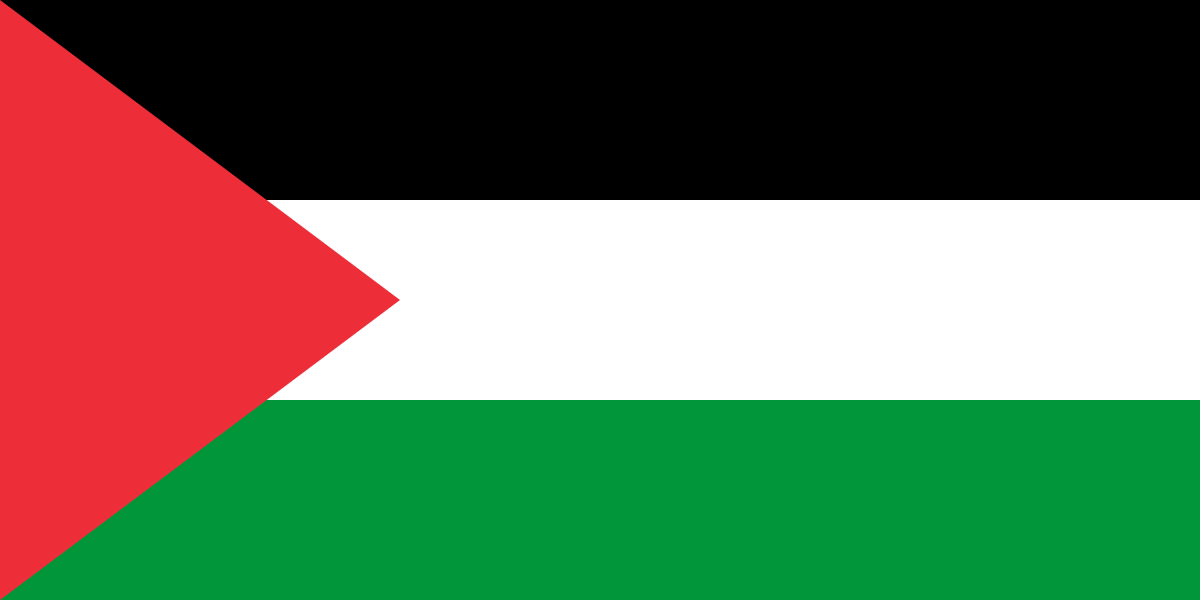
I have the honour to deliver this explanation of position on behalf of the Group of 77 and China.
At the outset, Madam President, the Group would like to express its appreciation for your continued support and commitment to the development agenda, particularly in the area of South-South cooperation, and to commend the continued commitment of the United Nations to strengthening that cooperation. Forty years ago, the United Nations convened the first United Nations Conference on Technical Cooperation among Developing Countries, which led to the adoption of the Buenos Aires Plan of Action for Promoting and Implementing Technical Cooperation among Developing Countries (BAPA), which in 2009 was followed by the first High-level United Nations Conference on South-South Cooperation, convened in Nairobi from 1 to 3 December of that year. Last month a second Conference was convened in Buenos Aires to mark BAPA’s fortieth anniversary with the adoption of the Buenos Aires outcome document of the second High-Level United Nations Conference on South-South Cooperation (BAPA+40), now endorsed by the General Assembly in resolution 73/291.
Our thanks also go to the two facilitators who coordinated this important undertaking on behalf of the President of the General Assembly. We are very grateful to the Government and the people of Argentina for hosting this important conference. We also acknowledge the important role of the United Nations development system, led by the Secretary-General, in further supporting and promoting South-South cooperation in line with its established principles. The Group believes that BAPA+40 gives us the opportunity to reaffirm our
strong support to the High-level Committee on South- South Cooperation and to the United Nations Office for South-South Cooperation, and we stress that the Office is the articulator of South-South cooperation in the United Nations system. The Group appreciates the efforts of the countries of the South that have stepped up their cooperation with the Office, which has also enhanced its role and impact by scaling up through increased financial, human and budgetary resources with a view to helping to achieve the 2030 Agenda for Sustainable Development.
The Group engaged constructively in good faith throughout the negotiation process on the outcome document with a view to reaching a balanced and substantive outcome document encompassing all the relevant issues of South-South cooperation. In that regard, the Group affirms that South-South cooperation is a manifestation of solidarity among the peoples and countries of the South and contributes to their national well-being, national and collective self-reliance, and attainment of the 2030 Agenda.
As laid out in the Nairobi outcome document (resolution 64/222, annex) and reaffirmed in the Buenos Aires outcome document, South-South cooperation and its agenda must be set by the countries of the South and must continue to be guided by the principles of respect for national sovereignty, national ownership and independence, equality, non-conditionality, non-interference in domestic affairs and mutual benefit. The Group emphasizes that South-South cooperation is a complement to and not a substitute for North-South cooperation, which remains the main channel for international development cooperation.
South-South cooperation has evolved significantly over the decades, and the South-South road map has never been as important as it is today. The international community is also well aware of the scale and impact of South-South cooperation, as the 2030 Agenda for Sustainable Development and the Addis Ababa Action Agenda both welcome the increased contribution of South-South cooperation to sustainable development and the eradication of poverty in all its forms and dimensions.
The Group would also like to emphasize the importance of triangular cooperation. In recent years, this component of cooperation has become more relevant in the current architecture of international cooperation, and it is called on to play an important role in the 2030 Agenda. However, we should stress that
triangular cooperation must be undertaken at the request of developing countries, in line with the principles of South-South cooperation and led by the countries of the South. We acknowledge the voluntary, participatory and demand-driven nature of South-South cooperation, born out of shared experiences and sympathies and based on common objectives and solidarity. We further recognize that South-South cooperation leads to more diverse opportunities for development and should not be equated with or measured or assessed as official development assistance. We also emphasize that the spread of South-South cooperation does not reduce the commitment of developed countries to allocating 0.7 per cent of their gross national income as their official development assistance to developing countries.
The Group understands that the 2030 Agenda represents a change in the development paradigm that prevailed in previous decades, since it recognizes that development is much more than economic growth. In that sense, we recognize the multidimensional nature of poverty, the social, economic and environmental dimensions of domestic output, and the structural gaps at all levels. We further recognize the importance of ensuring that international development cooperation includes a multidimensional perspective that transcends the use of per capita income as the sole indicator for measuring development, so that we can support all developing countries in achieving sustainable development while acknowledging both the serious ongoing challenges and the new and emerging ones that developing countries face.
The Group welcomes the Buenos Aires outcome document of the second High-Level Conference on South-South Cooperation as adopted in resolution 73/291, and looks forward to its effective implementation. However, we regret that to some extent the text fell below our expectations. Unfortunately, it singles out one Sustainable Development Goal (SDG) over the other 16, despite the fact that they are equally important. In that regard, we want to reiterate the importance of the full and comprehensive implementation of the 2030 Agenda and stress that this should not create a precedent for future intergovernmental negotiation processes. We also want to emphasize our regret about the inclusion of certain references, particularly to development effectiveness, which continues to be inapplicable to South-South cooperation and is more related to international development cooperation. While we agree that knowledge, experience and success stories should be shared among developing countries, we are concerned
about and strongly oppose attempts to measure, monitor or harmonize South-South cooperation with official development assistance frameworks, which, rather than creating more resources for development, will on the contrary jeopardize the existing diversity of flows. We stress that the South needs the international community to maintain and increase its contributions with a focus on achieving the 17 SDGs rather than demanding measurements, monitoring and reporting.
With respect to trade, the Group presented comprehensive and concrete proposals for strengthening the language during the informal consultations. Regrettably, they did not feature in the final version of the outcome document. In that regard, the Group recognizes the significant contribution of South-South cooperation in the area of trade and its ability to promote sustainable development among developing countries. Accordingly, the relevant United Nations entities, including the United Nations Conference on Trade and Development, must continue to support developing countries in deepening and enlarging South-South trade integration, regional, subregional and interregional economic integration and cooperation arrangements. The Group remains deeply concerned about the increase in unilateral and protectionist measures that will not only undermine the multilateral trading system but will also have a negative effect on the access of developing countries’ exports to the global market.
In conclusion, in line with our constructive approach and the need to ensure consensus in support of this important Conference, the Group of 77 and China agreed to the final version of the outcome document. We look forward to working with all partners in a spirit of mutual trust and good faith to implement the key deliverables of the outcome document, bolster support for the national and regional efforts being undertaken by developing countries in the implementation of the 2030 Agenda, and achieve the overarching goal of the eradication of poverty in all its forms and dimensions.
We have heard the last speaker in explanation of position on the resolution just adopted.
May I take it that it is the wish of the General Assembly to conclude its consideration of sub-item (b) of agenda item 25?
It was so decided.
The meeting rose at 1.10 p.m.