A/79/PV.25 General Assembly
In the absence of the President, Mr. Tōnē (Tonga), Vice-President, took the Chair.
The meeting was called to order at 3.05 p.m.
64. Zone of peace, trust and cooperation of Central Asia

I now give the floor to the representative of Turkmenistan to introduce draft resolution A/79/L.1.

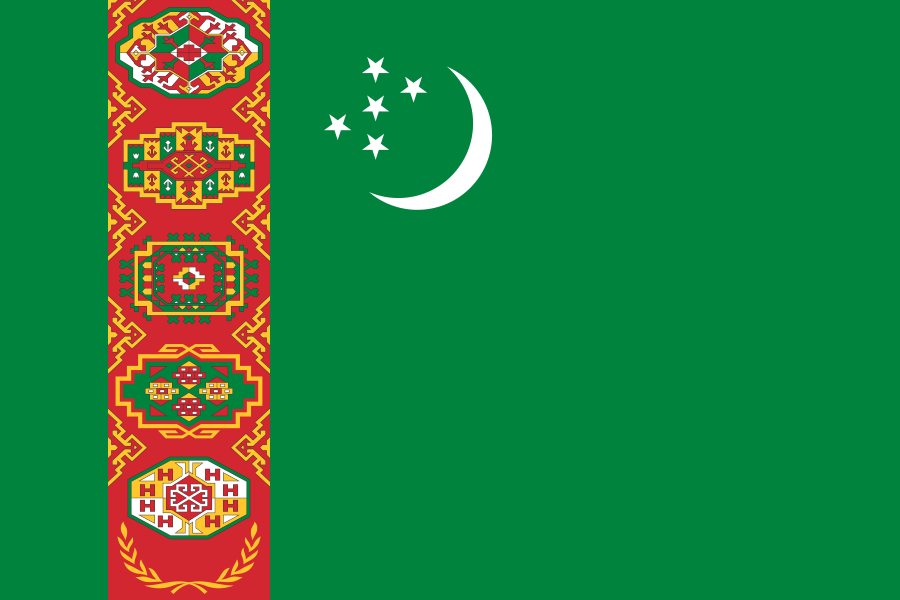
On behalf of the delegations of Turkmenistan, Kazakhstan, Kyrgyzstan, Tajikistan and Uzbekistan, it is my honour to present the draft resolution entitled “Zone of peace, trust and cooperation of Central Asia”, contained in document A/79/L.1. We extend our sincere gratitude to all delegations for their constructive and fruitful engagement during the negotiations, which resulted in a comprehensive and balanced text. I am pleased to note the broad interregional support for this peace-oriented draft resolution. Beyond the initial sponsors, more than 36 States joined the co-sponsorship, affirming their shared commitment to regional and global peace and security.
The Charter of the United Nations calls on all Member States to maintain international peace, promote friendly relations, foster cooperation and resolve disputes peacefully. The concept of regional zones of peace has long been recognized as an effective tool to enhance the security of States and contribute to stability globally. Various regions, including the Indian Ocean, the Mediterranean, South-East Asia, the South Atlantic, Latin America and the Caribbean, have established such zones with notable success. The General Assembly debate held on 16 May 2023 (see A/77/PV.70) clearly demonstrated that the time had come to establish clear principles and norms to define a common concept for the zones of peace.
The draft resolution before us today is the product of extensive consultations. It is built upon our shared aspirations and reflects the firm commitment of Central Asian
countries to lasting peace and mutual trust cultivated over the centuries. Central Asia stands at a unique crossroads, where regional cooperation and international partnership are essential to addressing complex global challenges. This draft resolution builds on the foundation laid by the General Assembly at its seventy-sixth session, when Central Asia was recognized as a zone of peace, trust and cooperation, underscoring respect for the national sovereignty, political independence and territorial integrity of each country in our region (see A/76/PV.97).
This document highlights Central Asia’s growing contribution to global disarmament and non-proliferation efforts, embodied in the Treaty on a Nuclear- Weapon-Free Zone in Central Asia. It is worth mentioning that in the coming days, a consensus draft resolution on the Treaty on a Nuclear-Weapon-Free Zone in Central Asia (A/C.1/79/L.5) is to be considered by the First Committee. I therefore call upon Member States to co-sponsor it. The importance of preventive diplomacy is also recognized in the text, underscoring the critical role of the United Nations Regional Centre for Preventive Diplomacy for Central Asia in Ashgabat.
The Central Asian peace zone is based on existing and strong political mechanisms, concentrated in the annual consultative meeting of the Heads of State of Central Asia. This draft resolution encourages the continued use of that platform to address common challenges and explore new opportunities for cooperation. We must recognize that cooperation in Central Asia extends far beyond economics and political relations. It is rooted in centuries-old trust and cultural diplomacy, as a vital bridge connecting East with West and North with South. As a testimony, the cultural summit in Ashgabat held just a few weeks ago brought together all Heads of Central Asian States to celebrate the 300th anniversary of the great Turkmen poet and prominent humanist Magtymguly Fragi, showcasing the unique ability of culture to overcome borders and foster mutual understanding and trust within our zone of peace.
We look forward to collaborating with the Department of Political and Peacebuilding Affairs to promote the existing regional zones of peace, encourage cooperation among them and, in that regard, organize a high-level meeting of the General Assembly, as highlighted in the draft resolution before us. We invite all nations that value peace, development and cooperation to lend their support and co- sponsor this draft resolution, reinforcing the Central Asian zone of stability at the heart of the Eurasian continent.
The Assembly will now take a decision on draft resolution A/79/L.1.
I now give the floor to the representative of the Secretariat.

I should like to announce that, since the submission of the draft resolution, and in addition to the delegations listed in the document, the following countries have also become sponsors of draft resolution A/79/L.1: Afghanistan, Algeria, Azerbaijan, Bahrain, Cabo Verde, Cambodia, China, Djibouti, Egypt, Equatorial Guinea, Fiji, Gabon, India, the Islamic Republic of Iran, Jordan, Malaysia, the Marshall Islands, Mauritania, Morocco, Nicaragua, the Philippines, Singapore, Sri Lanka, the Sudan, Timor-Leste, the United Arab Emirates, the Bolivarian Republic of Venezuela and Viet Nam.
The Assembly will now take a decision on draft resolution A/79/L.1, entitled “Zone of peace, trust and cooperation of Central Asia”.
May I take it that the General Assembly wishes to adopt draft resolution A/79/L.1?
Vote:
79/5
Consensus
Draft resolution A/79/L.1 was adopted (resolution 79/5).
Before giving the floor to speakers in explanation of position on the resolution just adopted, may I remind delegations that explanations are limited to 10 minutes and should be made by delegations from their seats.


The United States congratulates Kazakhstan, Kyrgyzstan, Tajikistan, Turkmenistan and Uzbekistan on resolution 79/5, reaffirming Central Asia as a zone of peace, trust and cooperation. The United States reaffirms its strong commitment to each Central Asia country’s independence, sovereignty and territorial integrity as well as to supporting a prosperous, secure and democratic region. We believe that the zone of peace helps to foster greater cooperation on sustainable development, peace and security, human rights and the rule of law. The continued commitment of the Central Asian countries helps to strengthen the security of the region and maintain international peace and security beyond it.
However, the United States underscores that the Declaration and Programme of Action on a Culture of Peace is a non-binding document that does not create rights, obligations or a universal mandate under international law. It states that international organizations, Governments and civil society may be guided in their activity by the Declaration, but it does not change the current state of conventional or customary international law. Nevertheless, we thank Turkmenistan for pursuing consensus among the members of this organ on the various elements of the text of the resolution and appreciate the extensive consultations with Member States on the text.
We have heard the only speaker in explanation of position after the adoption.
The General Assembly has thus concluded this stage of its consideration of agenda item 64.
73. Report of the International Court of Justice (A/79/4) Report of the Secretary-General (A/79/314)


My delegation would first like to thank the President of the International Court of Justice, His Excellency Judge Nawaf Salam, for his inspiring presentation (see A/79/PV.24) of the Court’s annual report (A/79/4). On behalf of the Kingdom of Belgium, I would also like to thank all the members of the Court and the Registrar for the work carried out over the past year.
Belgium aligns itself with the statement to be delivered on behalf of the European Union and would like to make several remarks in its national capacity.
The peaceful settlement of disputes, as enshrined in the Charter of the United Nations, is the corollary of the prohibition of the threat or use of force in international relations. In that context, my country has always attached the utmost importance to the International Court of Justice, which, as the principal judicial organ of the United Nations, plays a crucial and increasing role in the peaceful settlement of disputes and, as such, contributes to conflict prevention and the achievement of the purposes and principles of the United Nations. International law is the cornerstone of our multilateral system. It is an essential tool for preventing conflicts and thereby helping to maintain international peace and security. The Court is more essential than ever to ensure an international legal order based on the rule of law.
The figures given in the annual report speak for themselves: two judgments and one advisory opinion delivered during the past year; 27 orders, including eight on requests for the indication or modification of provisional measures; the holding of hearings in no fewer than 11 cases; four new cases and one new request for an
advisory opinion; 23 cases entered in the General List; 116 States and international organizations having presented written or oral statements as part of advisory proceedings; and 134 States having participated in contentious or advisory proceedings. The Court’s intense activity attests to the confidence that States place in it and to their interest in finding a legal and peaceful solution to their disputes. Moreover, the variety and importance of the areas in which the Court is called upon to rule, as well as the geographical diversity of the States concerned, also attest to its universal character and its central role in the application and interpretation of international law.
The representation of different legal systems, languages and cultures within the Court clearly contributes to the effectiveness and quality of its decisions. However, the Court’s contribution to conflict prevention can be effective only if its judgments and orders are respected and its opinions are implemented. We are extremely concerned by the fact that some States believe that they do not have to comply with its judgments. Every decision that is not respected and implemented is a direct attack on the system established by the United Nations Charter. We therefore call on the States concerned to implement the Court’s decisions, including orders indicating provisional measures.
In conclusion, Belgium would like to commend the work of the Court, which ensures that it addresses the cases brought before it as quickly as possible despite their increasing number and complexity in recent years. As the annual report shows, the Court faces an unprecedented workload. Consequently, Belgium fully endorses the ambitious budget proposed by the Court to enable it to fulfil the mandate entrusted to it under the Charter.


I would like to start my remarks by joining previous speakers in thanking the President of the International Court of Justice, Judge Nawaf Salam, and his fellow judges for the effective and professional work carried out again this year. Their personal and dedicated commitment is the first and most prominent condition to ensure that the Court performs its primary task to deliver justice at the international level. Indeed, the legal certainty of respective rights and duties is one of the main components of the peaceful settlement of disputes, contributing to the United Nations mission to maintain international peace and security. Italy also thanks the Registrar and all the staff at the International Court of Justice for their essential contribution in supporting the crucial task of the Court’s judges.
We also thank the Court for its new report (A/79/4), covering the period from August 2023 to July 2024, and the thorough survey of the activities carried out in the period considered. The Court has on its docket a record number of 23 cases, and we see a clear trend of growing participation in the proceedings before the Court. Over the past year, 134 States were involved, in different capacities, in cases covering a wide diversity of subject matters.
Beyond its contentious jurisdiction, the Court continues to play an important role in the determination of rules of international law as a result of legal questions posed by the political organs of the United Nations. The Court recently delivered an advisory opinion on the legality of Israel’s presence in the occupied Palestinian territories and is currently engaged in the ongoing advisory proceedings related to the legal implications of climate change and of the right to strike. In our view, first of all, that reflects the relevance and the vitality of the Court as the most prominent judicial body at the international level. More importantly, at a time of renewed tensions and in the face of ongoing conflicts affecting the entertaining of friendly relations among States, such a wide and diverse resort to international justice is a positive sign of the commitment of Member States to the rules-based international order, with the United Nations at its core.
Italy is an active player in that encouraging dynamic. We are currently party to a contentious case pending before the Court. In addition, Italy intervened under Article 63, paragraph 2, of the Statute of the International Court of Justice in the case instituted by Ukraine against the Russian Federation concerning Allegations of genocide under the Convention on the Prevention and Punishment of the Crime of Genocide (Ukraine v. Russian Federation). We submitted written and oral observations in the preliminary objections phase and, following the Court’s judgment of 2 February, we recently communicated to the Court our wish to maintain our original declaration of intervention also for the merits phase of the proceedings. Italy is intervening with a view to assisting the Court in the interpretation of the relevant provisions contained in the Genocide Convention, in pursuit of the common interest of each and all its parties. Still on the same case, Italy again wishes to recall that the Court’s orders on provisional measures are legally binding on the parties to a dispute. The order issued by the Court on 16 March 2022, which is still in force, is no exception.
In 2014, Italy accepted the compulsory jurisdiction of the International Court of Justice by means of a declaration under Article 36, paragraph 2, of the Court’s Statute. We encourage other States to consider doing the same as a means to reaffirm the crucial role of the Court in the international legal order.


Let me first thank His Excellency Judge Nawaf Salam, President of the International Court of Justice, for his presentation (see A/79/PV.24) of the Court’s report (A/79/4).
As the principal judicial organ of the United Nations, the Court’s work is essential to the maintenance of international peace and security. As the true world Court, the Court is increasingly engaged in ensuring respect for rules and norms that concern the collective interest of the international community as a whole. The Kingdom of the Netherlands remains, as ever, proud to be the host country to the Court.
My Government cherishes the continued performance of the Court in the peaceful settlement of disputes, especially considering the increase in caseload, the wide variety of the legal questions that the Court has to consider and the higher number of participating States in a single case. For the continued peaceful settlement of disputes by the Court, it is of pivotal importance that all States Members of the United Nations accept the compulsory jurisdiction of the Court. My Government regrets the fact that no additional State has deposited its declaration recognizing the compulsory jurisdiction of the Court since last year. In addition, several declarations deposited since 2019 have been accompanied by reservations, severely limiting the acceptance of the jurisdiction of the Court. That includes instances in which a State accepted the jurisdiction of the Court for only one single issue. My Government has eliminated limitations to the jurisdiction of the Court in contentious cases involving the Kingdom of the Netherlands as far as possible. It will accept all disputes arising out of situations or facts that took place no earlier than 100 years before the dispute is brought before the Court. The Kingdom of the Netherlands calls up States Members of the United Nations that have not yet done so to also accept the compulsory jurisdiction of the Court, in accordance with its Statute, and to do so with as few reservations as possible.
Of likewise importance is compliance with the decisions of the Court. The Kingdom of the Netherlands notes with some concern that that is not always the case. In addition, some States have taken to distorting the texts of the Court’s decisions to their advantage to a point at which a certain ruling is read into it or intentionally left out of it. For the effective functioning of the Court, my Government hereby calls on
the members of the United Nations to respect and comply with the decisions of the Court, which are binding upon them.
In times when more and more States find their way to the Court — a development that my Government embraces with open arms — the Court has a full docket. That is evidenced by the unprecedented numbers presented in the report for the period from 1 August 2023 to 31 July 2024. With two judgments and one advisory opinion handed down, 27 orders rendered and public hearings held in 11 cases, the Court has had a very active period. In addition, the Court was seized of four new cases and presented with one new request for an advisory opinion. My Government understands the financial implications that such an increased caseload has for the Court’s budget and considers necessary the increase in it, as proposed by the Court.
Let me conclude by expressing my Government’s gratitude to the Court for implementing changes to modernize its administrative practices. For example, while noting the necessity of filing a new case or intervention in person, the Kingdom of the Netherlands welcomes the opportunities provided by the Court to file some submissions and correspondence electronically and without bearing a wet signature. Those new opportunities reduce travel movements, which is especially valuable for States that do not have a representation in The Hague, reduce the use of paper and are more efficient and environmentally friendly. The Kingdom of the Netherlands is of the view that the modernization of certain practices is beneficial to the sound administration of justice and looks forward to the innovations that will be implemented in the upcoming period.


We welcome the President of the International Court of Justice to the General Assembly and express our gratitude for his comprehensive presentation of the Court’s report (A/79/4).
Ukraine, Europe and the world need a comprehensive, just and lasting peace. Ukraine wants to end the ongoing war more than any other country. It must be real peace, not an appeasement of the aggressor. The only matter-of-fact points to be fulfilled in order to establish comprehensive, just and lasting peace for Ukraine are included in President Volodymyr Zelenskyy’s peace formula, which fully respects the Charter of the United Nations and is aimed at restoring Ukraine’s territorial integrity within the internationally recognized borders.
What we all observe and what is confirmed by the report is the fact that more and more States are turning to the Court to seek the protection of their rights and the rights of their people. That confirms the demand of States to restore justice and trust in the power of the Court to administrate international justice.
The questions that are currently under consideration by the Court are of vital importance not only to the parties to the dispute, but also to the international community as a whole. They will affect the future application and interpretation of different instruments of international law and various bilateral and multilateral treaties.
We emphasize that every effort that Ukraine’s Government has made is directed at the people of Ukraine, whose rights and interests are being brutally violated. In February 2022, we turned to the International Court of Justice owing to the dire need for protection, and we still need that protection today. When Russia used its false allegations of genocide as a pretext for the full-scale military invasion of Ukraine, we had no choice but to come to the Court immediately. When the Convention on the Prevention and Punishment of the Crime of Genocide is so cynically abused and used for a war of conquest, Ukraine believes in the Court’s essential role in the implementation and correct application of that landmark human rights instrument.
Moreover, 33 States made declarations of intervention in the case Allegations of genocide under the Convention on the Prevention and Punishment of the Crime of Genocide (Ukraine v. Russian Federation) because they saw the extraordinary danger of a different application, interpretation and fulfilment of the Genocide Convention under which States may callously abuse their solemn obligation to prevent and punish genocide. The intervening States shared the view of their consideration in the highest purposes of the Convention and the preservation of its integrity and the integrity of the international legal order. We appreciate that, in our fight against tyranny, we are standing side by side with the democratic world and fighting for freedom in Ukraine.
We would also like to note the consistent practice of the International Court of Justice to emphasize, in its orders on provisional measures, reference to Article 41 of the Statute of the International Court of Justice. It reaffirms that its orders have a binding effect and create international legal obligations for parties to which the provisional measures are addressed.
On 2 February, the International Court of Justice delivered a judgment on jurisdiction and concluded, over Russia’s objection, that it had jurisdiction over the dispute that Ukraine had brought to the Court in the days after Russia launched its full-scale invasion, addressing the false allegations of genocide that were Russia’s express pretext for invading. Russia had to prove something that does not exist — an imaginary genocide. That decision has tremendous consequences for Russia, as the International Court of Justice will hear the merits of Ukraine’s Allegations of genocide case. The merits will afford Ukraine an opportunity to debunk the lie at the heart of Russia’s aggression.
Russia’s use of force remains very much a part of the case as it moves to the merits phase. The reason is the Court’s provisional measures order of 16 March 2022, which remains in force. The Court has jurisdiction to address violations of that order and to order relief for such violations. The order imposes clear obligations on Russia, which are binding under international law. The order of the International Court of Justice is legally binding and obliges Russia to cease hostilities. It is also clear that Russia has acted, and continues to act, in violation of the order on a daily basis for nearly three years.
I would like to recall that Russia’s contempt for international law did not start in 2022. Back in 2014, Russia occupied and illegally tried to annex the Autonomous Republic of Crimea and the city of Sevastopol and then imposed a constant policy of discrimination against the Crimean Tatar and Ukrainian ethnic population, with the aim of consolidating Russian dominance on the peninsula by destroying competing cultures. Back in 2014, Russia, its officials, military personnel, private organizations and individuals supplied weapons, provided financing, conducted training and supplied other forms of assistance to armed formations, including the so-called Donetsk and Luhansk People’s Republics and other related groups and individuals operating on the territory of Ukraine. In 2017, Ukraine brought claims under two treaties — the International Convention for the Suppression of the Financing of Terrorism and the International Convention on the Elimination of All Forms of Racial Discrimination, as we had a dire need of protection from the violence and terror that Russia has been perpetrating since the beginning of 2014.
In the judgment of 31 January, the International Court of Justice ruled that Russia had violated international law in three separate respects. Russia violated the International Convention for the Suppression of the Financing of Terrorism, the International Convention on the Elimination of All Forms of Racial Discrimination and its obligation under the binding provisional measures order dated 17 April 2017. It is the very first, but not the last, case since the International Court of Justice’s inception in 1945 that has found the Russian Federation in violation of international
law. The Court found Russia to be in violation of a specific provisional measure established in the International Court of Justice’s order that Russia had to suspend its ban on the Mejlis of the Crimean Tatar people. The Court found that the continuation of the ban on the activities of the Mejlis is a violation of international law, regardless of whether such a ban falls within the scope of the Convention. In addition, the Court ruled that a full-scale invasion, as well as the so-called recognition of certain organized anti-Government armed groups by Russia, is a violation of the Court’s order, and it is an aggravation of the dispute.
While Ukraine is facing the most brutal aggression on the largest scale since the violent times of the Second World War, we believe in the power of justice and accountability. As the whole world can see, Russia is not the only State that violates international law and threatens the integrity of the international legal system. I recall that, on 8 January 2020, the Islamic Republic of Iran committed a deliberate attack on the Ukrainian International Airlines civil Flight PS-752 in Tehran, effectively killing 176 innocent people on board, including 11 Ukrainians. In 2023, Canada, Ukraine, Sweden and the United Kingdom filed an application with the International Court of Justice against Iran under the Convention for the Suppression of Unlawful Acts against the Safety of Civil Aviation. Later, this month, the four States filed a memorial, in which we set forth undoubted facts and legal grounds for the Court to decide Iran’s violation of international law, as well as its disregard for the basic principles of the safety of civil aviation.
As jointly stated before, we have been reflecting our unwavering commitment to achieving transparency, justice and accountability for the families of the victims. We strongly believe in the Court’s impartiality and careful consideration in that and all other pending cases. Russia, Iran and other violators of international law must finally be held accountable. Justice for all victims of internationally wrongful acts must finally be restored.
Ukraine acknowledges the fundamental role of the International Court of Justice in the judicial settlement of disputes between States within the United Nations system. We reiterate our commitment to the peaceful settlement of disputes. We value the impartiality and expeditious manner of the Court’s activities. We recognize the crucial role of the International Court of Justice in maintaining and promoting the rule of law amid disputes that arise, including each and every situation of improper interpretation, application or fulfilment of an international instrument. We are confident that the International Court of Justice is an element of democracy and peace, in which its founders truly believed. Today it is in the Court’s hands to deliver historic decisions.


Brazil aligns itself with the statement to be delivered by the Permanent Representative of Cabo Verde on behalf of the Community of Portuguese-speaking Countries.
I thank the President of the International Court of Justice for his informative report (A/79/4) on the Court’s activities from August 2023 until July this year. I also commend its judges for the efforts that they devote to the advancement of peace and justice in international relations through their activities.
The annual debate on the report of the International Court of Justice report offers us an opportunity to assess its work as the judicial mainstay of the United Nations. It also helps us to better understand the pivotal role that international law plays in promoting friendly relations among Member States. By fostering dialogue, justice and the peaceful settlement of disputes through the common language of international law, the International Court of Justice contributes to a safer and more prosperous
world. It also serves as an effective channel for preventive diplomacy and cooperation.
Since its establishment, the world Court has been prolific in its contributions to the consolidation and clarification of international law in areas as diverse as the law of the sea, territorial and maritime delimitation, diplomatic law, human rights, the law of treaties, the use of force, reparation for internationally wrongful acts and environmental protection, to name just a few. Through its advisory opinions and judgments, including indications of provisional measures, the Court upholds the principles of the Charter of the United Nations and the rule of law in international affairs. The Court also provides fundamental guidance to all subjects of international law on the interpretation and application of international norms, including multilateral treaties.
In this year’s debate, we cannot fail to highlight the importance of the advisory jurisdiction of the International Court of Justice. Last July, the Court gave its landmark advisory opinion in respect of the Legal consequences arising from the policies and practices of Israel in the occupied Palestinian territory, including East Jerusalem, whose considerations are ever more important in the face of the devastating conflict in Gaza. The ongoing advisory proceedings on the Obligations of States in respect of climate change will provide much-needed enlightenment on a matter of vital relevance to the international community. The level of engagement in those advisory proceedings illustrates not only how important justice is for Member States, but also their firm belief in international law as a means to settle differences in a peaceful manner. Furthermore, let us not forget the advisory opinion on the separation of the Chagos archipelago from Mauritius. The agreement on the archipelago’s status and the acknowledgement by the United Kingdom and Mauritius of the need to address wrongs of the past and support the welfare of Chagossians in a joint statement on 3 October represent a watershed moment in the history of the fight against colonialism. Moreover, they are evidence of the power of the International Court of Justice to influence the behaviour of States through its advisory opinions.
The latest report testifies to the continued intense activity of the Court in its pursuit to ensure the rule of law in the international community. The Court rendered two judgments, one advisory opinion and 27 procedural orders. It held public hearings on 11 different cases, was seized of four new contentious cases and received one request for a new advisory opinion. The pending cases involve States from different regions of the world and address a great variety of international legal issues. That bears witness to the relevance of the Court in upholding international law and promoting the peaceful settlement of international disputes.
Outreach initiatives are necessary for a better understanding of the Court’s key importance in international justice. Such efforts also enable broader knowledge of international law. That is why Brazil welcomes briefings on the functioning, procedure and jurisprudence of the Court in The Hague and outside the Kingdom of the Netherlands, the wide availability of documents on its work on its website, the strengthening of its social media presence and the broadcasting of its public sittings.
Brazil also commends the International Court of Justice for promoting the geographic and linguistic diversity of legal practitioners taking part in its Judicial Fellowship Programme. The establishment in 2021 of a Trust Fund for the Programme was a crucial measure to ensure an increase in the number of young jurists from universities based in developing countries receiving professional training at the Court. In that vein, Brazil expresses its satisfaction with the news that, after the conclusion of the Programme by the first three fellows with sponsorship from the Trust Fund in mid-2023, three additional fellows followed it in 2023–2024, while 4
out of the 15 candidates for the period from 2024 to 2025 come from universities in the developing world and will be awarded scholarships.
We are aware that the International Court of Justice is devoid of the means to enforce its decisions and depends on the action of States to that end. In no way does that decrease the importance of the Court. On the contrary, that specific circumstance only heightens our responsibility as States to respect and implement the decisions of the International Court of Justice. Otherwise, we will undermine an institution that was created to protect us from arbitrariness and lawlessness at the international level.
As the main judicial organ of the United Nations and the only international court of a universal character with general jurisdiction, the International Court of Justice embodies the core values of the United Nations Charter. In times of polarization and disregard for international law, the international community must display an unrelenting commitment to upholding it and to supporting the institutions in charge of applying norms and principles that foster cooperation and peace.


We thank the President of the International Court of Justice, Judge Nawaf Salam, for presenting his comprehensive report (A/79/4) on the work of the Court.
The importance of the Court’s function in the peaceful settlement of international disputes for the maintenance of international peace and security cannot be overemphasized, particularly now in times of political and legal turbulence, when armed conflicts are increasingly being waged by hybrid methods or by proxy and the system of international law itself is facing unprecedented attempts to replace it with some kind of a rules-based world order.
The significant increase in the workload of the International Court of Justice shows the high level of trust that States place in it. The figures contained in the President’s report are striking. At the end of the reporting period, there were 23 cases on its docket, and 116 States and international organizations had submitted their written statements in three advisory proceedings. We commend the President and the judges for their efforts and measures to streamline internal processes so as to maintain the momentum and quality of the Court’s work.
We believe that it is important for the General Assembly to provide its full support to the Court. At present, its annual budget is grossly disproportionate to the increased workload. We are talking about $30 million. For example, that is half that of the International Residual Mechanism for Criminal Tribunals, which has completed all its proceedings and has only some residual functions. The expenses of the International Court of Justice are all the more negligible in comparison to the inflated budget of the so-called International Criminal Court. That useless pseudo-criminal and pseudo-international tribunal has a regular budget that is seven times greater — $200 million. We call on all Member States interested in upholding the rule of international law to redistribute financial resources towards the International Court of Justice — an organ that makes a genuine contribution to strengthening international law and works for the benefit of the international community.
By the way, another problem that the General Assembly should address is the closed circle of jurists representing the interests of States before the International Court of Justice. There is a veritable monopoly of Western nationals, enabling them to charge exorbitant fees that are unaffordable for developing States. Those experts also support unlawful unilateral coercive measures, which are a favourite tool of the collective West.
All that creates tangible obstacles to accessing the International Court of Justice and justice in general. In that regard, the General Assembly, together with the Court,
should consider practical capacity-building measures to increase the representation of all regions of the world and law schools among jurists providing such services. One option would be to call on all jurists who wish to represent the interests of States before the Court, including pro bono, to submit their names to the Registry. In addition, it would make sense for the General Assembly to modify the rules regarding the dedicated United Nations trust fund. Currently, in order to avail itself of such funds, a State must renounce in advance the possibility of raising objections to the jurisdiction of the International Court of Justice, that is, in effect, to voluntarily surrender part of its position in the dispute. We believe that such a situation is unfair and puts the recipient State at a deliberate disadvantage. Reviewing that provision would allow our country to consider making voluntary contributions to the fund. An interesting solution could also be the provision of such services pro bono, that is, scaling up the concept of legal clinics to an intergovernmental level.
The high authority of the International Court of Justice is based on its respect for the principle of the consent of a State to its jurisdiction and its strict adherence to its mandate and the Charter of the United Nations. That organ does not yield to pressure and does not allow itself to become a tool for settling political scores.
We strongly condemn attempts by some unscrupulous States to politicize the work of the Court and use references to it in their disinformation campaigns.
In that regard, we must mention Ukraine’s lawsuit against Russia under the International Convention on the Elimination of All Forms of Racial Discrimination and the International Convention for the Suppression of the Financing of Terrorism. As soon as it filed the case in 2017, Kyiv began trumpeting about the fact that our country’s violations of the provisions of those treaties had been established and allegedly proved at the International Court of Justice. How many times in this very Hall have we heard statements that the Court has already recognized, or is about to recognize, Ukraine’s claims.
And what is the outcome? Members will not hear from Ukraine or its sponsors that, during the reporting period, the Court delivered a judgment on those claims, which rejected the overwhelming majority of the allegations raised by Ukraine. The Court found only a few shortcomings. No compensation was awarded to Kyiv. Under the International Convention for the Suppression of the Financing of Terrorism, in particular, the Court did not uphold Kyiv’s demands to recognize Russia as a terrorist State or a sponsor of terrorism and to hold our country responsible for the tragedy of Flight MH-17. None of the other incidents cited in Ukraine’s case was recognized as an act of terrorism.
The Court also rejected Kyiv’s request to recognize the Donetsk and Luhansk People’s Republics as terrorist organizations. Consequently, the so-called counter- terrorism operation, launched by the nationalists who came to power as a result of the bloody Maidan coup in 2014, was a deception of the international community. The smokescreen of the counter-terrorism operation covered up eight years of systematic discrimination and extermination of the Russian and Russian-speaking population in the Donbas. Ukraine also failed to portray its war against the inhabitants of the Donbas as Russian aggression, just as it failed to achieve the reunification of Crimea with Russia being recognized as an annexation or occupation.
Similarly, under the International Convention on the Elimination of All Forms of Racial Discrimination, the Court refused to recognize Russia’s alleged policy of cultural cleansing against Ukrainians and Crimean Tatars. In all, it rejected more than 40 claims. Those included accusations of Russia’s allegedly systemic and State- sponsored policy of racial discrimination against Crimean Tatars and Ukrainians in Crimea. It was found that there was no evidence of systematic discrimination. On the
contrary, our country actively supports all ethnic groups in Crimea, increasing opportunities for education and cultural development in the Crimean Tatar and Ukrainian languages. All attempts to present that policy as erasing the ethnic identity were rejected by the Court as unfounded.
Ukraine’s attempt to use the Convention on the Prevention and Punishment of the Crime of Genocide to question the legality of the special military operation launched by Russia under Article 51 of the United Nations Charter also failed. The Court said that there was no jurisdiction over military operations. The only question that it is going to be considering in this case is whether or not Ukraine itself committed genocide in the Donbas. Thus Kyiv has put itself on the docket, and so have its backers. The meticulous and thoughtful work of the International Court of Justice has put everything in its place. It cast aside years of lies and false accusations of the Kyiv regime against us, and many of these fakes were reflected in politicized resolutions of the General Assembly, pushed through by Ukraine and its western group of backers. These documents have nothing to do with reality.
To sum up, the attempts of the Kyiv regime to use international justice for its political ends have failed. Actual justice brooks no politicization or manipulation. We can see this when we look at the nose-diving reputation of the International Criminal Court, on which great hopes were pinned. Amid the ongoing inaction by that pseudo- criminal tribunal on the situation in Gaza, we can see the decisive stance taken by the International Court of Justice. On 19 July 2024, it handed down an advisory opinion reaffirming the critical rights and obligations without which it is impossible to imagine the Palestinian people availing themselves of their legitimate right to self- determination.
The advisory opinion, which was not legally binding, nonetheless was an authoritative example of a guideline that can reaffirm and crystallize existing rules, obligations and laws that entail international legal responsibility. The General Assembly then passed resolution ES-10/24 further to that decision, which our country supported.
Finally, we must mention the decision of the Court to provide an advisory opinion on the obligations in the climate realm. The number of written comments submitted by States speaks for itself. That is unprecedented. Our country is also actively participating in these proceedings. We call upon the Court, when preparing the advisory opinion, to ground its analysis in the work of specialized intergovernmental forums, primarily the Conference of the Parties to the United Nations Framework Convention on Climate Change.
We are pleased that, in the boundless ocean of political instability and amid the chaos in many intergovernmental processes, the Court has remained an island of legal stability, ensuring the high quality of the decisions it hands down and the high quality of the legal and factual argumentation it uses to support those decisions. We are convinced that this is the very precise approach to the interpretation and application of international law that can serve as foundation for predictable and stable international relations.


I have the honour to speak on behalf of the Non-Aligned Movement (NAM) in the consideration of agenda item 73, entitled “Report of the International Court of Justice”, to which we attach great importance.
At the outset, I thank the President of the International Court of Justice for his presentation to the General Assembly of the report on activities of the International Court between 1 August 2023 and 31 July 2024, as requested by the Assembly last year and contained in document A/79/4, of which we have taken due note.
The Non-Aligned Movement reaffirms and underscores its principled position concerning the peaceful settlement of disputes and the non-use or threat of use of force. In this context, the International Court of Justice has a significant role in promoting and encouraging the settlement of international disputes by peaceful means, as reflected in the Charter of the United Nations and in such a manner that international peace and security, as well as justice, are not endangered.
At the 19th Summit Conference of Heads of State or Government of Non- Aligned Countries, held in January 2021 in Kampala, the Heads of State and Government of the Non-Aligned Movement agreed to endeavour to generate further progress to achieve full respect for international law and in this regard commend the role of the International Court of Justice in promoting the peaceful settlement of international disputes in accordance with the relevant provisions of the Charter of the United Nations and the Statute of the Court, in particular articles 33 and 94 of the Charter.
Noting the fact that the Security Council has not sought any advisory opinion from the International Court of Justice since 1970, the Non-Aligned Movement urges the Security Council to make greater use of the Court, the principal judicial organ of the United Nations, as a source of advisory opinions and interpretation of international law.
In this regard, the ministerial meeting of the Coordinating Bureau of the Non- Aligned Movement held in July 2019 in Caracas, the ministers of the Movement decided to encourage those in a position to do so to make greater use of the International Court of Justice and to consider conducting consultations among the States members of the Movement as and when appropriate, with a view to requesting advisory opinions of the Court, including in cases in which unilateral coercive measures that are not authorized by relevant organs of the United Nations and are inconsistent with the principles of international law or the Charter of the United Nations may undermine international peace and security.
Furthermore, the Non-Aligned Movement takes this opportunity to invite the General Assembly, other organs of the United Nations and specialized agencies that are duly authorized by the General Assembly to request advisory opinions of the International Court of Justice on legal questions arising within the scope of their activities.
Moreover, the States members of the Movement reaffirm the importance of the Court’s advisory opinion issued on 8 July 1996 on the legality of the threat or use of nuclear weapons, contained in the annex to document A/51/218. In this matter, the International Court of Justice concluded unanimously that there exists an obligation to pursue in good faith and conclude negotiations leading to nuclear disarmament in all aspects, under strict and effective international control.
NAM welcomes the 29 December 2023 application filed by a Member State of the Movement, South Africa, instituting proceedings against Israel before the International Court of Justice concerning alleged violations by Israel of its obligations under the Convention on the Prevention and Punishment of the Crime of Genocide in relation to Palestinians in the Gaza Strip and calls on Israel to implement the provisional measures ordered by the Court in this regard.
NAM welcomes the advisory opinion that was rendered by the International Court of Justice on 19 July 2024, pursuant to the request made by the General Assembly in its resolution 77/247 of 30 December 2022. The Court has clearly determined, inter alia, that Israel’s presence in the occupied Palestinian territory, including East Jerusalem, is unlawful and must be ended as rapidly as possible. It is now time to translate the Court’s authoritative determinations into action for
accountability towards ending this illegal occupation in all its manifestations and ensuring the realization of the inalienable rights of the Palestinian people, including self-determination and independence, and the realization of long-delayed justice. In this regard, the Movement welcomes General Assembly resolution ES-10/24, adopted on 18 September 2024 in follow-up to the advisory opinion of 19 July 2024, which called for an end to Israel’s illegal occupation within 12 months and for actionable measures to hold Israel accountable for its violations in the occupied Palestinian territory.
The Movement recalls the responsibilities of States not to support, facilitate or cooperate directly or indirectly with such unlawful policies or to undermine practical measures to bring them to a halt. We also urge the undertakings of serious efforts, collectively and individually, to ensure respect for the legal obligations defined in the advisory opinion of the International Court of Justice and affirmed in relation to United Nations resolutions, including enhanced efforts by the General Assembly and the high-contracting parties to the Fourth Geneva Convention.
In this regard, we continue to call on Israel, the occupying Power, to fully respect the 19 July 2004 advisory opinion of the International Court of Justice on the Legal Consequences of the Construction of a Wall in the Occupied Palestinian Territory, contained in document A/ES-10/273.
To conclude, we reiterate our call upon all States to respect and ensure respect for the Court’s authoritative determinations for the realization of the end of Israel’s occupation that began in 1967 and the independence of the state of Palestine with East Jerusalem as its capital and the achievement of a just, lasting and peaceful solution to the question of Palestine in order to bring an end to this historic injustice and prolonged conflict in all its aspects.
I now give the floor to the observer of the European Union.

I have the honour to speak on behalf of the European Union (EU) and its member States. The candidate countries Montenegro, Albania, Ukraine, the Republic of Moldova, Bosnia Herzegovina and Georgia, as well as Monaco and San Marino, align themselves with this statement.
Let me first thank President Salam for presenting to the General Assembly the report on the activities of the International Court of Justice between 1 August 2023 and 31 July 2024 (A/79/4). I wish to congratulate him on his election earlier this year, as well as Judge Sebutinde on her election as Vice-President. Equally, the same goes for Judge Charlesworth on her re-election as a member of the Court, as well as Judges Aurescu, Cleveland, Robledo Verduzco and Tladi on their appointments as new members of the Court. The EU and its member States would like to assure all members and staff at the Court of our deepest appreciation for their steadfast commitment to delivering justice and to express our unwavering support for their crucial work.
The report confirms once again the indispensable role that the Court plays in upholding the rule of law at the international level. Allow me to highlight a few remarkable findings.
States parties to pending contentious cases are spread across all continents. A total of 134 States are involved in different capacities in contentious and advisory proceedings, combined, before the Court. A total of 116 States and several international organizations are involved in advisory proceedings. With four new contentious cases and one request for an advisory opinion, the Court’s general list keeps increasing and has now reached 23 pending cases. These cases cover a broad range of fundamental issues of international law.
The increase in the Court’s caseload means that there are more and more disputes submitted to its jurisdiction, which proves the trust of States in the capacity of the Court to settle disputes that arise in today’s fragmented world. At the same time, it confirms the centrality of the Court in the peaceful settlement of these disputes at the international level. The level of participation, the geographical spread and the increasingly wide variety of the cases before the Court speak to the universal and general character of its jurisdiction. In the same vein, we note the call from the General Assembly to States that have not yet done so to consider accepting the jurisdiction of the International Court of Justice in accordance with its Statute.
The Court’s role in the maintenance or restoration of international peace and security through the peaceful settlement of disputes can be effective only if the parties to such disputes abide by the Court’s rulings. We thus reiterate our call to all States that submitted their disputes for international adjudication by the Court to comply with its judgments and orders.
In this respect, we continue to deplore that the binding orders on provisional measures issued recently by the Court remain unimplemented. The European Union and its member States take note of the Court’s judgment of 2 February 2024 on jurisdiction in the case between Ukraine and Russia concerning allegations of genocide under the Convention on the Prevention and Punishment of the Crime of Genocide. It allows the Court to look into the merits in this case, focusing on the false allegation of genocide levelled against Ukraine prior to Russia’s illegal fully-fledged invasion starting in February 2022.
As regards advisory proceedings, we took note of the advisory opinion of 19 July 2024 concerning Legal Consequences arising from the Policies and Practices of Israel in the Occupied Palestinian Territory, including East Jerusalem. We are currently assessing its implications for the European Union and its member States.
As regards Obligations of States in respect of Climate Change, the European Union was pleased to be able to submit written statements. We also intend to make oral statements at the hearings and look forward to the Court’s advisory opinion on this matter of utmost importance for the entire world and for present and future generations.
More generally, we would like to underline the importance and usefulness of engaging the Court through advisory proceedings. Despite their non-binding nature, advisory opinions contribute to the clarification and development of international law and thereby to the strengthening of peaceful relations between States.
Supporting the principles of international law and of the Charter of the United Nations is among the core objectives of the EU’s foreign policy. As a matter of long- standing practice, the Court of Justice of the European Union refers regularly to the jurisprudence of the International Court of Justice in order to interpret and apply international law within our very own Union legal order.
Let me conclude. Now more than ever, we need to stand by the rules of international law and prioritize the peaceful settlement of disputes and justice. As the principal judicial organ of the United Nations, the International Court of Justice has an increasingly important role to play through its authoritative decisions and advisory opinions for the promotion of international peace and justice globally. The European Union and its member States hereby reaffirm their unwavering support to the International Court of Justice and our commitment to actively contribute to its work.


The Group of Arab States underscores the important role of the International Court of Justice, which was established as the principal judicial organ of the United Nations to ensure the
protection and maintenance of peace. The Court has served as the guardian of international law for more than seven decades. It has a prominent role in peacefully resolving disputes between States and providing advisory opinions to United Nations bodies on issues related to international law. Consequently, the Arab Group wishes to stress that the Court’s work is today more important than ever, given the challenges that the international legal system is currently facing.
The Arab Group welcomes the content of the report of the International Court of Justice for 2023 to 2024 relating to the role of the Court in promoting the principle of the rule of law (A/79/4). It has a valuable role in improving young people’s understanding of international law and judicial proceedings and providing training programmes.
The Arab Group stresses the need for States to respect the decisions and opinions of the Court, given the competence, impartiality and integrity of its judges. In this regard, the Arab Group congratulates Judge Nawaf Salam on his election this year as President of the Court. We recognize his legal and diplomatic experience, which enriches the Court’s work.
The Arab Group notes the increased number of cases referred to the Court in recent times and the rise in the number of requests for advisory opinions submitted by United Nations bodies, which speaks to the confidence that the international community places in multilateral institutions. The court’s rulings and advisory opinions remain one of the most important sources for the development of rules and principles of international law and are an indispensable tool to strengthen the pillars of international peace and security and to uphold truth and justice in a world that is suffering from selectivity and double standards in the application of the law.
The Arab Group further welcomes the Court’s activities and its success in issuing numerous rulings and advisory opinions on a number of branches of international law, its principles and its founding rules. These rulings will have a tangible role and an effective impact that will enable the international community to resolve disputes through peaceful means and to strengthen the bonds of friendship and cooperation between States and peoples.
From this perspective, the Arab Group stresses the need to review the resources allocated to the Court and to increase them to ensure that the Court can meet its obligations effectively and efficiently. Indeed, the report for the period 2023 to 2024 indicates that the resources earmarked for the Court are insufficient to cover the significant increase in the number of cases referred to the Court, given their complexity and intricacy, as well as the workload related for the Court’s Registry.
The Arab Group welcomes the acceptance by the Court of jurisdiction to hear the case filed by the Republic of South Africa against Israel relating to Israel’s violations of its obligations under the Convention on the Prevention and Punishment of the Crime of Genocide of 1948. The Arab Group welcomes the conclusion reached by the Court — that is, that the Palestinian people are protected and have rights arising under the Convention on the Prevention and Punishment of the Crime of Genocide. Our Group welcomes the provisional measures ordered on 26 January 2024, 28 March 2024 and 24 May 2024, in line with which the Court ordered Israel to bring an end to the killing of Palestinians and to their physical and mental harm, to stop the hampering of the flow of relief and medical aid into the Gaza Strip and to ensure ongoing coordination with the United Nations Relief and Works Agency for Palestine Refugees in the Near East (UNRWA).
The Arab Group firmly condemns Israel’s refusal to comply with the provisional measures ordered by the Court, which are legally binding in nature, in line with Article 41 of the Statute of the Court. Our Group asks the Security Council to shoulder
its responsibilities pursuant to the Charter of the United Nations by adopting a resolution under Chapter VII of the Charter and Article 94 of the Charter to ensure that Israel, as the occupying Power, complies with an immediate ceasefire, brings a halt to its crime of genocide and aggression against the Palestinian people and their forced displacement, allows the entry of humanitarian aid, and ends its illegal siege and occupation, in accordance with the necessary mechanisms provided under Chapter VII of the Charter. We also invite the Council to ensure that Israel complies with the relevant Security Council resolutions and provisions of international law, international humanitarian law and the orders issued by the International Court of Justice.
The Arab Group welcomes the international and popular positions expressed in favour of the Palestinian cause and condemning the crime of genocide committed by Israel against the Palestinian people. We further welcome the diplomatic and legal efforts made by countries and human rights organizations before international and national justice mechanisms, including the claim brought before the Court by South Africa against Israel regarding violations of the Genocide Convention. We welcome the efforts of countries that have joined this case.
The Arab group welcomes the advisory opinion on the Legal Consequences arising from the Policies and Practices of Israel in the Occupied Palestinian Territory, including East Jerusalem, and from the illegality of Israel’s continued presence in the Occupied Palestinian Territory, and the fact that Israel is bound to bring an end to its occupation as soon as possible, to dismantle its settlements and to evacuate settlers from Palestinian territory. The advisory opinion also confirmed that Israel must pay compensation for the damage incurred by all persons concerned and that all States and international organizations are obliged not to recognize the situation arising from the continued and illegal Israeli occupation of the occupied Palestinian territory and not to provide any legitimacy to that, as well as to not provide aid or assistance to help to maintain this situation.
The Arab Group welcomes that Member States of the United Nations adopted, by more than a two-thirds majority, the resolution put forward by the State of Palestine to adopt the historic advisory opinion issued on 19 July 2024 by the Court (resolution ES-10/24) in order to bring an end to the illegal Israeli occupation within 12 months, including the immediate halt of the colonization and annexation activities, the dismantlement of existing settlements, the expulsion of settlers from Palestinian land, the restitution of the land and resources confiscated since 1967, reparations and compensation of the Palestinian people for the illegal policies and practices of the occupation, as well as a number of other issues submitted for advisory opinion. The Arab Group underscores the need to apply this decision.
The Arab Group wishes to recall what was stated in the advisory opinion of the Court in the 2004 case relating to the separation wall and the responsibility for Israel to respect the rules of international humanitarian law. Several Arab States, as well as the League of Arab States, have made written submissions to the Court with regard to the right of the Palestinian people to self-determination and the need for Israel to respect the legal and historic status of Jerusalem, to bring an end to the occupation and to proceed to dismantle the settlements in occupied Palestinian territories, including East Jerusalem, as well as the need for the international community to act to bring an end to the unilateral, illegitimate actions by Israel that undermine opportunities for peace.
In closing, the Arab Group wishes to reaffirm the active role of the Court in ensuring peace, security and stability around the world. Thanks to its essential role in settling disputes through legal means, we ask States to contribute to bolstering the
role of the Court, through the respect and implementation of its judgments and advisory opinions.


I am going to speak in Portuguese, but interpretation into all six official languages is available.
I have the honour to deliver this statement on behalf of the member States of the Community of Portuguese-Speaking Countries (CPLP): Angola, Brazil, Guinea- Bissau, Equatorial Guinea, Mozambique, Portugal, Sao Tome and Principe, Timor- Leste and my own country, Cabo Verde.
The area of the globe occupied by the nine member States of the CPLP is very vast. There are 10,742,000 square kilometres of land, 7.2 per cent of the planet’s land, translating it into a territory spreading across four continents — Europe, America, Africa and Asia. The CPLP was created as a forum for deepening cooperation and mutual friendship among countries sharing the Portuguese language. The cooperation of our Community with the United Nations began in 1996 and is periodically reviewed. The CPLP is governed, among others, by the principles that enshrine the primacy of peace, democracy, the rule of law, human rights and social justice. Indeed, the rule of law plays an important role in the constitution and progress of the CPLP, and the Community and its member States remain committed to the promotion and protection of those principles.
We are grateful to the honourable Judge Nawaf Salam, President of the International Court of Justice, for presenting the Court’s annual report (A/79/4) and for his insightful remarks.
The CPLP fully acknowledges the key role played by the Court, during the 78 years since its inaugural sitting, in ensuring the peaceful settlement of disputes and in clarifying the rules of international law on which its decisions are based with integrity, impartiality and independence, as well as its readiness to face challenges that may arise. We praise the ICJ’s work as the main judicial organ of the United Nations in adjudicating disputes among States and for maintaining and promoting the rule of law in the international system.
In the last two decades, the workload of the Court has grown considerably, both in the number of cases and in their factual and legal complexity. The flow of new and settled cases reflects the great vitality of the institution. The CPLP countries value the fact that the Court has to decide upon disputes voluntarily submitted by States under their sovereign rights. Therefore, from 1 August 2023 to 31 July 2024, the period under review, the Court experienced a high level of activity, being seized by a variety of issues related to territorial and maritime delimitation, diplomatic missions, human rights, reparation for internationally wrongful acts, interpretation and application of international treaties and conventions, and environmental protection, and by handing down judgments and holding public hearings.
Contentious cases involved States from all continents, while the variety of international issues submitted to the Court illustrates the universality of its nature and competencies. All United Nations Member States are parties to the Statute of the Court, and approximately 300 bilateral and multilateral treaties conferred jurisdiction to the Court over the settlement of disputes that may arise from their interpretation and application. Moreover, the existing dialogue between the General Assembly, the Security Council and the Court in the interpretation of the Charter of the United Nations is of the utmost importance. In this regard, the rulings and advisory opinions issued by the Court have been a meaningful contribution to strengthening and clarifying the rules of international law.
In this vein, the CPLP welcomes the Court’s advisory proceeding on the legal consequences arising from the policies and practices of Israel in the occupied Palestinian territory, including East Jerusalem, concluded in July, and the ongoing advisory proceeding on the obligation of States in respect of climate change. The high level of engagement of the international community in the proceedings is proof of the importance States attach to the International Court of Justice and international law in general as instruments to settle their differences in a peaceful and cooperative manner.
Likewise, we welcome the Court’s endeavours to ensure that its decisions are publicized as widely as possible through its publications, the development of multimedia platforms, the use of social media networks and its own Internet website, containing its entire jurisprudence, which contributes to better knowledge and to raising awareness concerning its activities. The high rate of compliance with the Court’s judgments throughout its history is very encouraging, as it demonstrates the respect and trust of States in the independence, credibility and impartiality of the world’s Court.
The CPLP member States welcome the widening of the scope of, and cooperation with, international law, as the Court’s judgments and advisory opinions have inspired other international decision-making bodies. It is also commendable that the Court is similarly paying due regard to the work of other international courts and tribunals.
We pledge our strong support to the Court in continuing to play a fundamental role in settling disputes between States, as well as in strengthening the international rule of law towards justice and peace, taking into consideration the situation of peoples and individuals. CPLP member States remain confident that the Court, as the principal judicial organ of the United Nations, will continue its fundamental work in accordance with stipulations of the Charter of the United Nations and the Court’s Statute, making a tangible contribution to the rule of law around the world.
Finally, I would like to convey, on behalf of the nine Member States of CPLP our sincere gratitude for the work of the International Court of Justice.


I have the honour to speak today on behalf of the three Baltic States — Estonia, Latvia and my own country, Lithuania.
The Baltic States align themselves with the statement made on behalf of the European Union and its member States.
Allow me to begin by thanking President Salam for presenting the report of the International Court of Justice covering the period from August 2023 to July 2024 (A/79/4).
The Baltic States welcome the report and commend the important work of the Court. The issues faced by the Court during the reporting period continue to address pivotal matters, such as the interpretation and application of treaties, human rights responsibilities, reparation for internationally wrongful acts, environmental protection, territorial and maritime disputes, and the jurisdictional immunity of States. Such a diverse range of cases submitted to the Court testifies to the universal character of the Court’s jurisdiction and its critical role in the prevention and peaceful settlement of disputes between States, as well as in the maintenance and promotion of the international order based on international law and the rule of law.
The report also highlights the importance of involving the Court through advisory proceedings. Although not legally binding, advisory opinions offer valuable insights into complex legal issues, contributing to the promotion of peaceful relations between nations.
The Baltic States would like to take this opportunity to reaffirm our strong support for the International Court of Justice as the principal judicial organ of the United Nations. We firmly believe that the principle of peaceful settlement of disputes and respect for international law should guide the action of all States, as outlined in the Charter of the United Nations. Therefore, we advocate for universal acceptance of the Court’s jurisdiction and urge all United Nations Member States that have not done so yet to accept the jurisdiction of the Court.
It is important to highlight that the establishment of the Court’s jurisdiction alone is not enough for effective judicial resolution of disputes. International justice can only thrive through the prompt and full implementation of the Court’s binding rulings and decisions, including orders on provisional measures. In this regard, we note that the Court’s binding order for provisional measures issued on 16 March 2022, which orders Russia to immediately cease its military actions that it commenced in February 2022 in the territory of Ukraine, remains in effect. Russia’s ongoing aggression violates this Court order and demonstrates a disrespect for international law, as well as the significant challenge posed by the lack of enforcement power behind the Court’s decision.
We take note of the Court judgment of 2 February 2024 on jurisdiction in the case of Allegations of Genocide under the Convention on the Prevention and Punishment of the Crime of Genocide (Ukraine v. Russian Federation). Ukraine’s pursuit of justice through legal means at the International Court of Justice has our full support. We now await the Court’s judgment on the merits in this case.
For my concluding remarks, I wish to emphasize the Court’s continued role as the international community of States’ forum of choice for the peaceful settlement of every kind of international dispute over which it has jurisdiction.


I have the honour to speak on behalf of the 14 member States of the Caribbean Community (CARICOM).
CARICOM thanks the President of the International Court of Justice, Judge Nawaf Salam, for his detailed presentation of the report on the activities of the Court (A/79/4).
As the principal judicial organ of the United Nations, the International Court of Justice contributes significantly to the peaceful resolution of disputes on international law. We note that, during the period under review, the Court had an increased caseload covering a wide range of issues. There were also requests by the General Assembly for advisory opinions on key legal questions. Given the devastating impacts of climate change in our region, CARICOM particularly looks forward to the advisory opinion of the Court on Obligations of States in respect of Climate Change.
The high number of States seeking resolution of their disputes via the Court is a positive signal at a time when respect for international law and international humanitarian law is under severe threat in our world. It is also indicative of the confidence that Member States have in the Court’s ability to resolve disputes impartially. It is encouraging that 116 States and several international organizations presented written or oral statements as part of the three sets of advisory proceedings before the Court during the period under review. We agree with the report’s assessment that the geographical spread of the cases brought before the Court and the diversity of their subject matter illustrate the universal and general character of the Court’s jurisdiction.
While noting that most States abide by decisions of the Court, CARICOM is concerned about the lack of compliance by some in contravention of the Charter of the United Nations. In this regard, we highlight Israel’s non-compliance with the
provisional measures of the Courts in the case filed by South Africa on Application of the Convention on the Prevention and Punishment of the Crime of Genocide in the Gaza Strip (South Africa v. Israel). We recall that, under Article 94 of the United Nations Charter, all Member States have an obligation to implement the legally binding decisions of the Court.
CARICOM underscores the need for cooperation between the Court and the Security Council within their respective mandates towards the achievement of sustainable peace and security. We urge the Council to make greater use of the tools provided to it in the United Nations Charter on seeking advisory opinions from the Court on legal questions, implementing Court decisions and considering referrals of legal disputes to the Court.
We commend the efforts of the Court to address all cases in a timely manner and note that on average the period between the conclusion of the oral proceedings and the delivery of a judgment on an advisory opinion by the Court did not exceed six months.
We also welcome the great interest shown in the annual Judicial Fellowship Programme and the impact the Trust Fund is having on enabling the participation of applicants from developing countries.
On the budgetary front, CARICOM acknowledges the Court’s indication that more work requires more resources. In this regard, we support the call for increased budgetary allocations, recognizing the Court’s crucial contribution to the rule of law, justice, peace and security. As stated by the late Reverend Dr. Martin Luther King Jr., there can be no justice without peace and no peace without justice.
As I close, I reaffirm CARICOM’s full support for the International Court of Justice, underscoring its crucial role in ensuring the implementation of international law and the peaceful resolution of all disputes.


I am honoured to deliver this statement on behalf of the member States of the Gulf Cooperation Council, namely the United Arab Emirates, the Kingdom of Bahrain, the Kingdom of Saudi Arabia, the Sultanate of Oman, the State of Kuwait and my country, the State of Qatar.
First, I would like to thank Ms. Joan Donoghue for her efforts during the previous period, in particular during her mandate as the President of the International Court of Justice. We welcome Judge Nawaf Salam, the President of the International Court of Justice, as well as all the judges newly elected this year. We thank the International Court of Justice for its report contained in document A/79/4, which covers the period from 1 August 2023 to 31 July 2024.
We believe in the International Court of Justice’s role in maintaining international peace and security, as the principal judicial organ of the United Nations, in accordance with Article 92 of the Charter of the United Nations. Concerning the advisory opinion issued by the Court and those mentioned in chapter V, section B, the majority of the States of the Gulf Cooperation Council have participated in the oral proceedings for the legal advisory opinion regarding Israel’s policies and practices in the Palestinian territories that have taken place in The Hague. In that context, the Gulf Group welcomes the advisory opinion issued by the International Court of Justice. We reaffirm the illegality of Israel’s presence in the occupied Palestinian territory for 57 years, and we call for efforts to reach a lasting and comprehensive settlement of the question of Palestine, in accordance the Arab Peace Initiative and the resolutions of international legitimacy, in a manner that guarantees the Palestinian people their inalienable rights to self-determination and to an independent State, within the pre-
1967 borders, with East Jerusalem as its capital. We also welcome resolution ES- 10/24, adopted at the emergency session, on the advisory opinion.
Pursuant to chapter V, section A, of the report, with regard to the case filed by South Africa, Application of the Convention on the Prevention and Punishment of the Crime of Genocide in the Gaza Strip (South Africa v. Israel), the Gulf Cooperation Council welcomes the provisional measures ordered by the Court on 26 January, which called for Israel to take measures to prevent genocide and to undertake immediate measures that enable the provision of necessary services and much-needed humanitarian assistance to address the harsh conditions the Palestinians are enduring in the Gaza Strip. We also reiterate that all necessary measures must be taken without delay and in full cooperation with the United Nations, in order to alleviate the suffering of the brotherly Palestinian people and to promote peace and security in the region. In this regard, we refer to Article 41 of the Statute of the Court, which stipulates that provisional measures establish legal commitments to preserve rights of the relevant parties. Accordingly, Israel is legally required to implement the provisional measures. We call for the continued application of agreed-upon international laws between all countries without any discrimination, selectivity or double standards.
We have recently seen an increase in the cases brought before the Court. In this regard, we applaud the International Court of Justice’s efforts, as the principal judicial organ of the United Nations, in resolving disputes. We emphasize the importance of what is included in Article 36 of the Statute of the Court with regard to its jurisdiction over Member States, as per the provisions of the Charter of the United Nations, especially as regards the sovereignty of States and non-interference in their internal affairs, and the peaceful settlement of disputes based on Article 33 of the Charter.
In reference to chapter I, section 4, of the report, related to the Judicial Fellowship Programme, which was established in 1999, it has witnessed the participation of more than 100 fellows and seeks to develop international competencies in the field of international law and improve participants’ understanding of public international law in practical application and the Court’s procedures through their involvement in the Court’s activities. In this regard, we encourage the Court to expand the programme to ensure broader participation from diverse geographical regions. We look forward in particular to seeing our countries participate in this programme, which would enhance cooperation between the Court and the Gulf Cooperation Council States.
In conclusion, we reaffirm the important role of the International Court of Justice in promoting the rule of international law and the peaceful settlement of disputes in order to achieve the purposes and principles of the United Nations.


I have the honour to deliver this joint statement on behalf of the group of States that includes Vanuatu, Viet Nam, Samoa, Colombia, Indonesia, Tuvalu, the State of Palestine, Costa Rica, the Philippines, Papua New Guinea and Jamaica.
First, we would like to express our sincere appreciation to His Excellency Judge Nawaf Salam, President of the International Court of Justice, and to commend the Court on its judicial output, which has grown in quantity and significance.
We have heard about and recognize the capacity constraints currently faced by the Court and support its proposals to increase budget support to the Court to address these challenges. We also appreciate the Court’s commitment to balance the equal interests of States participating in public hearings with these constraints and its efforts to carefully plan and manage the increasingly high levels of participation.
We are particularly grateful that the Court will be hearing the oral statements of United Nations Member States participating in the advisory proceedings on the Obligations of States in respect of Climate Change in December. For many of our States, this marks the first time we are engaging directly with the Court, which underscores the significance of these proceedings for us. We stress the critical importance of these proceedings for all Member States, the international community at large and humankind as a whole. The unprecedented number of States wishing to participate underscores the Court’s unique role, as the principal judicial organ of the United Nations, in ensuring that we all respond to global challenges in accordance with international law.
However, many States, in particular developing States, face capacity constraints and circumstances that may limit their ability to fully navigate the Court’s procedures and timelines, especially when the Court’s own practices are continuously evolving. We are concerned that certain States have been unable to participate in these proceedings owing to such difficulties, while exactly those States have significant interests in the proceedings. We respectfully urge the Court to exercise flexibility and consider accommodating all States wishing to contribute. While mindful of the Court’s prerogative to manage its calendar, especially its schedule of hearings, we wish to stress the importance of providing ample opportunity for all interested States to participate, both in the public hearings of the advisory proceedings on the Obligations of States in respect of Climate Change, and in any relevant future proceedings before the Court. Accordingly, we would welcome with great appreciation the Court’s continued support and accommodations for States with interest in ongoing proceedings to participate in its oral hearings.


Bolivia aligns itself with the statement delivered by Uganda on behalf of the countries of the Non-Aligned Movement, and we wish to express the following remarks in our national capacity.
I welcome the important presentation of the report covering 1 August 2023 to 31 July 2024 (A/79/4) by the President of the International Court of Justice, Judge Nawaf Salam.
Bolivia reaffirms its commitment to the principles of the rule of law and international law, recognizing the fundamental role of the International Court of Justice as the principal judicial organ of the United Nations. We commend those States that have had recourse to the Court to resolve their disputes, thereby reaffirming their commitment to the peaceful settlement of conflicts. Bolivia has accepted the Court’s jurisdiction and in past years has been a party to two contentious cases. Although the Court has issued its rulings, the definitive settlement of these matters continues to be pending.
Over the past years, we have seen a considerable increase in contentious cases and advisory cases brought before the Court. This is a trend that we applaud, because it demonstrates that as States, we are opting to resolve our disputes through peaceful proceedings. For this reason, we believe that it is essential to work towards the universalization of the Court’s jurisdiction. We therefore urge those States that have not yet recognized its jurisdiction to do so as soon as possible.
This year, the Court has highlighted its importance in maintaining international peace and security through its rulings and advisory opinions. In particular, in its advisory opinion on the occupied Palestinian territory, the Court reaffirmed its position of 2004 that Israel’s actions violate international law, underscoring the obligation for Israel to bring an end to its illegal occupation as soon as possible and to shoulder its responsibility for its unlawful acts. Bolivia participated in the oral and
written procedures for this case, reaffirming our unwavering support for the quest for justice for the Palestinian people.
In the period under review, the Court also managed two cases directly related to Palestine, issuing three provisional measures in the case of Application of the Convention on the Prevention and Punishment of the Crime of Genocide in the Gaza Strip (South Africa v. Israel). These include an order for Israel to cease its military operations in Gaza, in violation of the Convention on the Prevention and Punishment of the Crime of Genocide. We urge Israel to fully comply with these orders. With respect to the proceedings under the Genocide Convention, Bolivia, like many other States, was a third interested State. We submitted our written submissions, thus reaffirming our commitment to international law and the principles of justice.
Bolivia joins the voices of those delegations that have already underscored the importance of multilingualism. We believe that the international system and international justice systems, in particular the International Court of Justice, must incorporate this very important element. We believe that turning to a court but not being able to speak in our national language poses significant limitations on our ability to submit oral and written arguments. We therefore firmly advocate for the inclusion of Spanish as an official working language of the Court, bearing in mind that it is the fourth most widely spoken language in the world and one of the official languages of the United Nations. Moreover, we underscore that a significant proportion of the States that have recourse to the Court speak Spanish, which once again reinforces the need for this language’s inclusion.
To conclude, we reaffirm our firm commitment to supporting the role of the International Court of Justice in the peaceful resolution of disputes, in full compliance with the Charter of the United Nations and international law. We believe its role in maintaining international peace and security is crucial.


I would like to begin by extending my congratulations to His Excellency Judge Nawaf Salam on his election as the President of the International Court of Justice. Allow me to convey to President Salam my delegation’s best wishes for a successful and impactful term. My delegation also thanks President Salam for the comprehensive presentation of the report on the activities of the Court during the period under review (A/79/4).
Our world is indeed in turmoil, marked by an escalating climate-related crisis, rising geopolitical tensions and numerous conflicts. This underscores the critical need to uphold international law and the Charter of the United Nations. The growing challenges to international peace and security pose significant risks in both traditional and new domains, creating a perilous environment for small States such as Singapore. This is an existential issue, because respect for the principles of sovereignty, political independence and territorial integrity is fundamental to the survival of all States regardless of size, but especially for small States. In response to these seismic shifts in the global order, we firmly believe that we must act collectively to prevent the deepening crisis from becoming unsolvable. It is essential that we uphold the international rule of law and avoid a scenario where “might makes right”. As members of the international community, and especially taking into account the interests of small States, we must all send a signal that we are united in pursuing peace, upholding international law and safeguarding principles such as sovereign equality, territorial integrity and political independence. These principles are non-negotiable.
It is significant that our debate today takes place on United Nations Day. As reflected in its Charter, the United Nations was established to promote justice and respect for international law. The United Nations efforts in this regard over the last eight decades have built on the important work of the International Court of Justice.
The Court, which is the principal judicial organ of the United Nations, has been indispensable to the rule of law at the international level. Through its judgments and advisory opinions, all States, regardless of size, may be held accountable and have their rights and interests upheld, in accordance with international law. Its advisory jurisdiction contributes to the clarification and development of international law and thereby strengthens the international legal order.
The Pact for the Future (resolution 79/1), adopted by the General Assembly at the Summit of the Future last month, provides resounding reaffirmation of the role played by the Court in the maintenance of international peace and security. The Pact was a clarion call for the international community to keep up with the evolving challenges of protecting future generations from the scourge of war. In particular, my delegation wishes to highlight action 17 of the Pact, which was in fact proposed by Singapore with the objective of strengthening the international community’s commitment to and support for the work of the International Court of Justice. Action 17 reaffirms the obligation of all States to comply with the decisions of the Court in cases to which they are parties and records the decision of Member States to take appropriate steps to ensure that the Court can fully and effectively discharge its mandate and promote awareness of its role in the peaceful settlement of disputes, while respecting that parties to any dispute may also seek other peaceful means of their own choice.
Singapore will continue to be a staunch supporter of the Court, the work of which is essential to the maintenance of the international rule of law and the peaceful settlement of disputes. In line with Singapore’s long-standing commitment to international law and support for the International Court of Justice, the Singapore national group has announced its intention to nominate Ms. Rena Lee, Singapore’s Ambassador for International Law, for election as a judge of the Court for the term 2027–2036. Ambassador Rena Lee is a distinguished practitioner of international law, well-known to the international community. Member States would be familiar with her role and accomplishments as President of the Intergovernmental Conference on Marine Biodiversity of Areas Beyond National Jurisdiction, where her role and leadership of the negotiations led to the consensus adoption of the Agreement on Marine Biological Diversity of Areas beyond National Jurisdiction. Ambassador Rena Lee’s public international law practice also includes more than three decades of service as an international lawyer and diplomat. She has served in The Hague and as a legal adviser to and negotiator for the Singapore Government across the full spectrum of international law. The Singapore Government fully supports Ambassador Rena Lee’s candidature for judge of the International Court of Justice, and we look forward to receiving the support of all Member States.
In the light of what I have said as a backdrop, I would like to make three points.
First, Singapore commends the Court for its remarkable ability to manage its increased caseload, which demonstrates the Court’s resilience and adaptability in addressing complex legal and geopolitical issues, ensuring that all States, big or small, have a reliable and cost-effective legal avenue to resolve conflicts. As highlighted in the Court’s report, during the period under review, 134 States were involved in contentious or advisory proceedings before the Court, whether as parties or intervenors, which is a significant increase from the 85 States in the previous period. This underscores the growing importance and relevance of the Court in international conflict resolution. Singapore also appreciates the Registry’s efforts to streamline, optimize and modernize its working methods, which have been instrumental in enabling the Court to address the increased workload in 2023 within the resources approved for the year.
This leads to my second point, relating to the issue of funding for the Court. The Court is seeking an increase in its proposed budget for 2025 to strengthen the support provided by the Registry to the Court for its judicial functions. This is particularly critical in the light of the sustained increase in the Court’s workload and the need to modernize the Registry to enable it to face new challenges. The proposed budget for 2025 amounts to $33.7 million before re-costing, representing an overall increase of $1.1 million compared with the approved appropriations for 2024. In our view, the Court’s budget is a lean one, accounting for less than 1 per cent of the overall United Nations budget. The Court is also constrained in that it would not be able to accept voluntary contributions without compromising its integrity.
We believe the Court’s proposed budget for 2025 is reasonable and modest, considering the significant increase in workload and the mitigation measures taken by the Registry. It is essential that we support this budget to ensure that the Court can function effectively. Any shortfalls in the Court’s resourcing would hamper its ability to deliver on its mandates, which may have far-reaching consequences, beyond the impact on user States in the form of increased backlogs and delays in the processing of cases. We wish to highlight, in comparison, that the annual budget for United Nations peacekeeping operations amounts to about $6 billion and the International Criminal Court’s approved budget for 2024 was €183.5 million. Member States should therefore make the prudent investment in international justice through ensuring adequate resources for the International Court of Justice. We urge all Member States to support the Court’s proposed budget, which would allow it to continue discharging its vital role in an efficient and timely fashion.
Finally, as a member of the group of States that coordinated the General Assembly resolution (resolution 75/129) to establish the trust fund for the Judicial Fellowship Programme of the International Court of Justice, Singapore is pleased to see this programme growing from strength to strength. We welcome the continuing interest in the programme, as demonstrated in the high number and diversity of applicants to the programme, and the selection of four judicial fellows for the 2024– 2025 programme period, who are nationals of developing countries nominated by universities in developing countries. We are optimistic that the greater diversity in the selection of judicial fellows, which is being facilitated by the increased opportunities provided by the trust fund, will contribute to the development of a more inclusive international law community. That said, there remains a pressing need for more to be done to ensure that all States have equal access to the Court. Small States continue to face resource and capacity challenges, and my delegation stands ready to support new initiatives that have the objective of providing long-term solutions to such challenges.
In closing, we reiterate that a strong and effective multilateral rules-based international order is not merely a necessity but an existential issue, for all Member States and in particular for small States. The Court is a key pillar in upholding the international rule of law, and we call on members of the General Assembly and the United Nations to support the work of the Court at this critical time.


Allow me to begin my statement by expressing the Republic of Guatemala’s thanks for the work of the International Court of Justice. We would like to thank its President, Judge Nawaf Salam, for the presentation of the Court’s annual report A/79/4, which provides updates on the Court’s judicial activity, in particular its commitment to the peaceful settlement of disputes in line with the principles and purposes of the Charter of the United Nations and the Court’s own Statute.
Beyond our firm support for the Court, every year we see that the Court’s workload increases, which reflects the trust that we, as Member States, have in this international legal body to resolve settlements impartially and effectively, in
accordance with international law. We take note of the contentious cases addressed by the Court in the reporting period.
Guatemala appreciates the invaluable work carried out by the International Court of Justice for the peaceful settlement of disputes referred to it. The trust that Member States place in the Court in referring the disputes that have arisen between them to the Court shows its important role in the international order. It strengthens its universality and contributes to a rules-based order, in particular an international law- based order. We believe that its contribution is essential for peaceful coexistence and cooperation between States, as well as strengthening the rule of law at the international level. Similarly, we recognize that the International Court of Justice’s work, through its rulings, contributes to granting legal certainty and due compliance to the norms of international law, as well as accepted international practices.
History has documented the countless conflicts that have taken place over time and the different ways in which we have attempted to resolve them. Unfortunately, these disputes have on occasion been resolved by force, which has left a legacy of pain following the loss of countless human lives. In this context, we know that the Court’s work is the result of years of development in conflict resolution methods at the international level. The Court, established through the Charter of the United Nations, enjoys the trust of Member States to decide on contentious cases in a just and objective manner. The work of the 15 judges of the International Court of Justice is crucial. Its work should therefore be respected with full compliance with the commitments accepted by States that have voluntarily submitted to its jurisdiction.
As is well known by the Assembly, Guatemala and Belize have concluded the process to refer Guatemala’s territorial, insular and maritime claim to the International Court of Justice. This demonstrates Guatemala’s peaceful vocation at the international level, which is evident in the quest for a definitive settlement to this long-standing dispute. Guatemala, in April 2018, and Belize, in May 2019, conducted respective public consultations peacefully and with positive outcomes. The primary aim of these was to definitively resolve this dispute before the Court. On 12 June 2019, the International Court of Justice publicly announced that it would hear the territorial, insular and maritime claim of Guatemala, this in line with the commitments that both States made to agree through the special agreement between Guatemala and Belize.
Turning to the jurisdiction of this Court, Guatemala welcomes the fact that the International Court of Justice fixed 8 June 2020 and 8 June 2021 as the respective time limits for the filing of a memorial by Guatemala and a counter-memorial by Belize, which is reflected in the report that we are considering today. We hope to continue to strengthen relations between Guatemala and Belize, and we wish for this reason to express our deep gratitude to the group of friends of Guatemala and Belize that have supported us throughout this process. Likewise, as a country we have decided that the International Court of Justice will be the body to definitively resolve this issue, because we are sure that the resolution of this matter will bring economic, social and political benefits for both countries, as well as development for the inhabitants of the adjacent areas. This shows the world that we are responsible, peace- loving countries with a democratic vocation.
We are concerned that the International Court of Justice continues to face financial challenges owing to the liquidity problems that it has faced in 2023 and 2024. This report notes that this situation has caused great difficulties and could even hamper the implementation of the Court’s mandate in the current biennium. We welcome the fact that the Court has indeed taken cost-control measures. Nonetheless, we believe that it is the right time to urge Member States to discharge their financial obligations to guarantee that the Court can continue to fulfil its mandate.
In conclusion, allow me to reiterate once again our thanks and our support for the work of the International Court of Justice and its judges, as with their decisions they contribute to providing legal certainty to matters of particular sensitivity between States.


The Pakistan delegation aligns itself with the statement delivered by the representative of Uganda on behalf of the Movement of Non-Aligned Countries.
At the outset, I would like to extend my gratitude to the President of the International Court of Justice, Judge Nawaf Salam, for presenting the Court’s annual report, contained in document A/79/4. I also wish to thank him for his insightful briefing on the vital role and functioning of the Court.
The International Court of Justice is an integral part of the international architecture established under the Charter of the United Nations and one of the principal organs of the United Nations. Justice is a critical component for the preservation of world order. The Court is the guardian of the principles of the Charter of the United Nations and the corpus of the laws that have emerged under the Charter’s framework, treaties and conventions, the resolutions of the Security Council, and United Nations declarations, which have become common law, such as the Declaration on Friendly Relations and the Universal Declaration of Human Rights. The Court offers equal protection of these laws to all States and peoples, and especially for States and peoples who are unable to secure justice for themselves. The Court has the competence to secure the universal application of those laws and to issue orders, which are binding on Member States. The Court also has a critical role in the resolution of conflicts and disputes, in accordance with Article 36, paragraph 1, of the Charter. Further, through its advisory opinions, the Court plays a central role in the interpretation and elaboration of international law.
Seventy-five countries have accepted the compulsory jurisdiction of the Court under Article 36 of its Statute. This includes Pakistan. We greatly value the ability of the Court to resolve specific disputes and to be consulted by the General Assembly, the Security Council and other United Nations organs on any legal question.
The role of the International Court of Justice has become even more indispensable today. The threats to global peace and security and violations of the Charter of the United Nations and its principles, especially the use of unilateral force, have multiplied. Many peoples, particularly the people of Palestine and occupied Jammu and Kashmir, continue to be subjected to foreign and colonial occupation and denied their right to self-determination. Genocide, war crimes and crimes against humanity are being committed with impunity by some rogue States. In this context, and while the Security Council is virtually paralysed by the frequent use and threat of the veto power of some permanent members of the Security Council, the International Court of Justice has played a prominent role in upholding the principles of the Charter of the United Nations and international law. The International Court of Justice’s advisory opinion of 2004 on the Legal consequences of the construction of a wall in the occupied Palestinian territory (see A/ES-10/273) was an important precursor to its provisional measures in response to South Africa’s proceedings against Israel under the Genocide Convention and also to the advisory opinion on the Legal Consequences arising from the Policies and Practices of Israel in the Occupied Palestinian Territory, including East Jerusalem, issued on 19 July 2024, which was requested by the General Assembly in its resolution 77/247. Pakistan made a written submission to the Court on Palestine in July 2023, later shared a rejoinder with the Court and then participated in the Court’s oral public hearing in February 2024.
The Court’s advisory opinions and its provisional measures represent a significant contribution to unravelling the issues involved in the case of Palestine and in setting out the basis for the resolution of the conflict. The Court’s findings have established at least four core principles. First, the obligation of Israel, the occupying Power, to allow the exercise of the right to self-determination by the people of Palestine, both within and outside the occupied Palestinian territories. Secondly, the territory cannot be acquired by the use of force and military occupation. Thirdly, Israel must be held accountable and pay for the damages caused as a consequence of its illegal occupation of Palestinian territory. Fourthly, the obligation of all other States and of the United Nations to support the exercise of self-determination by the Palestinian people and to execute the findings of the Court.
These and other conclusions flowing from the Court’s findings have become legal precedents and have assumed the force of international law and norms, with universal application. Indeed, these are principles and norms that must be applied to all similar situations of foreign military occupation and the denial of the right to self- determination, such as the situation in occupied Jammu and Kashmir.
Given the proven capacity of the Court to play a meaningful role in the defence of international law and justice, it is essential to further strengthen the role of the Court in the preservation of world order. To that end, the delegation of Pakistan suggests consideration of the following measures by the General Assembly and the Security Council.
First, they must broaden the compulsory jurisdiction of the Court through the removal of reservations by Member States and through a binding decision by the Security Council to provide such mandatory jurisdiction to the Court for all items on the Security Council’s agenda, or at least those where the Charter’s principles and Security Council resolutions are being violated. Secondly, United Nations organs should have greater and more frequent recourse to the Court’s advisory opinions on specific disputes and on the fulfilment of the legal obligations of Member States and international organizations. Thirdly, the Court is also well-placed to play a larger role in ensuring the accountability of Member States for violations of international law, and in determining the damage and compensation due to aggrieved parties. Fourthly, the Court’s bench should be enlarged to enable it to cope with the larger caseload and provide it with adequate budgetary resources to the Court to undertake the heavier caseload. My delegation looks forward to further discussion in consideration of these suggestions with other Member States during the current session of the General Assembly.


The Republic of the Sudan has the honour to align itself with the statement delivered by the Republic of Uganda on behalf of the Movement of Non-Aligned Countries and Mauritania on behalf of the Arab Group.
We take note of the annual report of the International Court of Justice, contained in document A/79/4, and we express our deep appreciation to the honourable Judge Nawaf Salam, the President of the Court, for his comprehensive briefing on the report, which shed light on the activities undertaken by the Court in the past year. We take this opportunity to congratulate Judge Salam for his election as President of the Court, and we express our condolences with respect to the judges who have left us in the past year.
The International Court of Justice plays a pivotal role in promoting international peace and security, as the main judicial organ of the United Nations. The Court undertakes great responsibilities in this regard. Despite the fact that Court judgments are binding only on parties to the contentious proceedings, the impact of its advisory
opinions and judgments goes beyond legal boundaries, enriching international efforts aimed at achieving peace and stability. The Court, through its mandate to settle disputes peacefully, contributes to preventing conflicts among States. This in turn reinforces United Nations efforts aimed at promoting international peace and security. In addition, the Court plays an indispensable role in promoting the rule of law, both internationally and within the United Nations system.
Achieving the vision of the Charter of the United Nations, in the field of peace and security or in the field of sustainable development and human rights, hinges on strengthening and enshrining the rule of law. Based on this, the Court’s judgments and advisory opinions constitute essential instruments, enhancing the international commitment to comply with international law and to respect and affirm the foundations of the international order.
No doubt that the importance of the Court is greater today than ever before. The annual report reflects the extent of activities undertaken by the Court and its growing role in settling international disputes. We note that, during the period covered by the report, an increasing number of States around the world referred disputes to the Court. This reflects an increased trust in the Court’s ability to issue fair, just and independent judgments. It is encouraging to witness this ongoing positive trend towards a greater acceptance of the Court’s compulsory jurisdiction by Member States.
My delegation encourages the Court to continue to take necessary measures to improve its efficiency and capacity to face the rapid increase in the number of cases, and to settle these as quickly as possible in order to achieve justice within a reasonable time frame. The intense activity undertaken by the Court requires greater support by Member States. The Court requires political support, and Member States can provide the needed financial resources to allow the Court to undertake its duties properly.
In this regard, the annual report before us represents an important opportunity for the General Assembly to reiterate its full support for the work of the Court and to reinforce cooperation with the Court to enable it to undertake its vital role in safeguarding international peace and security and protecting international law.
My delegation calls on Member States who have not yet accepted the compulsory jurisdiction of the Court to re-evaluate their positions positively in order to promote the rule of law at the international level and enable the Court to fully fulfil its mandate, as stipulated in the Charter of the United Nations. The refusal of some States to accept the Court’s compulsory jurisdiction prolongs conflicts and hinders their peaceful settlement. This in turn leads to protracted international crises.
We also call upon the Security Council to seriously consider referring more issues to the Court for advisory opinions and interpretations of the principles of international law. Since 1970, the Security Council has not sought an advisory opinion from the Court. This is unjustifiable, as the Court could have played a pivotal role in guiding the Council’s resolutions based on the principles of international law. We further call upon the General Assembly and all other organs and specialized agencies to request advisory opinions when needed to interpret the principles of international law within the framework of their activities.
In conclusion, my delegation reiterates its deep appreciation for the role of the International Court of Justice in safeguarding international law. We reaffirm our full support to the Court and its vital role. We believe that the promotion of the authority of the Court, in this era characterized by international crises and instability and moving away from achieving international peace and security, is more important than ever before. In view of the spread of wars and conflicts, the Court remains the fortress safeguarding the principles of international law and promoting peace and stability in the international order.


I would like to express my gratitude to the President of the International Court of Justice, Judge Salam, for his leadership and the informative report on the Court’s activities (A/79/4). Japan commends the members of the Court and the Registry for their valuable contributions to the effective functioning of the Court.
The role of the Court in maintaining international peace and security has never been more critical. The increase in the volume of the Court’s caseload and the breadth of subject matter brought before the Court appear to demonstrate the confidence of States in the Court’s ability to resolve disputes. Unprecedented numbers of States have participated in the recent proceedings of the Court. Japan highly appreciates the Court’s efforts in seeking sound legal analysis and has full confidence in its work. Japan believes that the Court’s balanced approach in interpreting treaties and applying customary international law, based on solid evidence and authority, should continue to help the Court to maintain the trust of the international community.
Japan has been actively involved in promoting the rule of law on the international stage. Last year, as a member of the Security Council, Japan convened an open debate on the rule of law among nations (see S/PV.9241), calling for unity in upholding this principle. Japan’s highest political leadership has consistently supported the role of the Court and the promotion of the rule of law.
In February, Japan participated in the oral proceedings for the advisory opinion on Legal Consequences arising from the policies and practices of Israel in the Occupied Palestinian Territory, including East Jerusalem. Japan elaborated on the acquisition of territory by force, which we believe contributed to the deliberations of the Court to some extent. Japan will continue to make constructive contribution to the Court’s role in interpreting and applying the basic principles of the Charter of the United Nations, which are essential for the maintenance of international peace and security, including through active participation in the proceedings.
Japan welcomes the outcome of the Summit of the Future. In the Pact for the Future (resolution 79/1), the importance of the Declaration on Principles of International Law concerning Friendly Relations and Cooperation among States was recalled. The Declaration, adopted in 1970, said that the faithful observance of the principles of international law concerning friendly relations and cooperation among States and the fulfilment in good faith of the obligations assumed by States is of the greatest importance for the maintenance of international peace and security. Here, Japan places emphasis on the term “good faith”. If agreements are not observed in good faith, the rule of law would not exist, and rule by force would prevail. The decisions of international tribunals, including the Court, must be implemented in good faith.
Only 74 out of 193 United Nations Member States have accepted the compulsory jurisdiction of the International Court of Justice. Japan encourages more States to do so, as this would significantly strengthen the rule of law and contribute to the peaceful resolution of disputes.
The Pact for the Future also refers to Article 27 (3) of the Charter, which stipulates that a party to a dispute shall abstain from voting in Council votes regarding that dispute. We recognize that this provision has not been applied for a long time. However, we must observe all the provisions of the Charter, and we must explore all the possible options in order to avoid any military action and hostilities and settle conflicts and disputes exclusively by peaceful means.
In conclusion, I reiterate Japan’s steadfast support for the role of the Court in upholding the rule of law, as the principal judicial organ of the United Nations. Japan
remains committed to promoting the rule of law as a foundation of international peace and security.


I would like to join the previous speakers in thanking Judge Nawaf Salam, President of the International Court of Justice, for presenting a very comprehensive report on the judicial activities of the Court for the period from 1 August 2023 to July 2024 (A/79/4). We thank him and the Vice-President of the Court for guiding the work of the Court during this period.
As a country strongly committed to the rule of law, we reaffirm our commitment and support to the role of the Court as a principle judicial organ of the United Nations in settling disputes peacefully among Member States, in accordance with the principles and purposes of the Charter of the United Nations. We recognize that the Court enjoys Member States’ trust and confidence for its crucial role in the interpretation and clarification of the rules and the principles of international law, as well as in the progressive development and codification of international law. The Court has been entrusted with dual jurisdiction: the contentious jurisdiction that is adjudicating the legal disputes between States under its own Statute; and the advisory jurisdiction, namely rendering advisory opinions on legal questions presented to it at the request of organs of the United Nations or the specialized agencies authorized under the Charter of the United Nations.
We acknowledge that the Court has fulfilled its task admirably and has acquired a well-deserved reputation as an institution that maintains the highest legal standards in accordance with its mandate under the Charter of the United Nations and its own Statute, which is an integral part of the Charter.
The report of the Court reveals that, as at 31 July 2024, the Court had 31 contentious cases and two advisory proceedings pending on its docket. Moreover, 40 States had filed a request for permission to intervene or declarations of intention in contentious cases pending before the Court. The volume and the quality of work demonstrate that the Court has stood the test of fulfilling the task of settling disputes between States. It is beyond doubt that the Court has acquired a well-deserved reputation as an institution that maintains the highest legal standards in accordance with its mandate.
With respect to subject matter and issues, the cases before the Court involve complex factual and legal issues relating to a wide range of areas, including territorial and maritime delimitation; human rights; reparations for internationally wrongful acts; environmental protection; the jurisdictional immunity of States; and the interpretation and application of international treaties and conventions concerning, among others, diplomatic relations, the elimination of racial discrimination, the prevention of genocide, the suppression of the financing of terrorism, the prohibition of torture and other cruel, inhuman or degrading treatment or punishment, and the safety of civil aviation. This demonstrates the international community’s confidence in the Court’s adjudication and peaceful settlement of disputes.
The geographical spread of the cases brought before the Court and the diversity of their subject matters clearly illustrate the universal character of the Court’s jurisdiction and the importance of the Court’s role in upholding the rule of law. In the performance of its judicial functions, the Court has remained sensitive to the political realities and sentiments of States, while acting in accordance with the provisions of the Charter of the United Nations, its own Statute and other rules of international law. Significantly, the Court has not lost sight of the need to adapt its working methods, despite the persistent inflow of new cases and the significant number of judgments and orders it delivered.
We reiterate that the Trust Fund for the Judicial Fellowship Programme of the Court, established in 2021, following the adoption of a General Assembly resolution in 2020 (resolution 75/129), is a welcome initiative. We are pleased to note that the Trust Fund has had a promising start and the first three fellows selected for sponsorship by the Trust Fund have successfully completed the programme, and three further judicial fellows have been sponsored by the Trust Fund. The number and diversity of applications received by the Court, shown in the Court’s report, demonstrate continuing and growing interest in the Trust Fund sponsorship programme.
We appreciate the Court’s efforts towards ensuring the greatest possible global awareness of its decisions through its publications, multimedia offerings and website, which features the Court’s entire jurisprudence, as well as that of its predecessor, the Permanent Court of International Justice. These sources provide useful information for States wishing to invoke the jurisdiction of the Court.
To conclude, we wish to reaffirm our strong support for the Court and acknowledge the importance that the international community attaches to its work.


The International Court of Justice is the world’s court. We commend the Court’s pivotal role in advancing international law, promoting peace and strengthening the rule of law globally. Its relevance in peacefully resolving disputes was recently demonstrated by the United Kingdom’s decision to return the Chagos Archipelago to Mauritius after the Court’s corresponding advisory opinion.
In an overall climate of attempts to undermine international law, the increased impact and relevance of the Court is an important signal of the commitment of small States in particular to the rule of law. Indeed, the Court’s advisory role is instrumental in providing clarity on complex international legal issues, thereby promoting peace. Advisory opinions help to resolve long-standing disputes peacefully and guide States towards legal compliance. We are encouraged by the increasing trend of States seeking advisory opinions from the Court, and we believe this strengthens the role of the General Assembly as a leader in preventing conflicts and resolving legal uncertainties.
In this regard, we believe that the advisory opinion on Legal Consequences arising from the policies and practices of Israel in the Occupied Palestinian Territory brought much-needed clarity to the legal questions that are fundamental to the two- State solution that this Organization has tried to achieve for long decades. Liechtenstein remains convinced of our collective responsibility to make the two- State solution a reality. A full understanding of the legal dimensions is indispensable to this effect, and we welcome the advisory opinion issued by the Court.
Very much in the same vein, Liechtenstein was proud to support Vanuatu’s efforts in requesting an advisory opinion on climate change as a member of its core group. Climate change’s far-reaching impacts demand clear legal guidance, particularly at the intersection of human rights and environmental law. We trust that the Court’s opinion will provide the clarity needed to navigate this critical existential issue. We also look forward to participating in the oral proceedings at the Court in early December.
For the Court to fully achieve its mandate of peaceful dispute resolution, Member States must accept its compulsory jurisdiction. Unfortunately, only 74 Member States have done so, leaving nearly two thirds of the United Nations membership outside its full reach. We therefore renew our call for all States to make declarations under Article 36 of the Statute of the Court, broadening the Court’s reach and influence, as advocated in Romania’s declaration promoting the Court’s jurisdiction. Moreover, all States aspiring to serve on the Security Council, as well as
permanent members, should set a positive example by accepting the Court’s compulsory jurisdiction.
Lastly, the Court faces an increasing demand for its services, whether in contentious cases or advisory opinions. To ensure it can continue to fulfil its role effectively, it is essential that the Court receive the necessary resources to manage its rising caseload. A well-resourced Court is better equipped to issue timely, thorough and fair judgments, which ultimately contribute to global peace and stability. By supporting the Court and its work, also financially, we promote a fairer, more peaceful international system built on the rule of law that benefits us all.
We have heard the last speaker in the debate on this item. We shall hear the remaining speakers on Tuesday, 29 October at 3 p.m. here in the Hall.
The exercise of the right of reply has been requested. May I remind members that statements in the exercise of the right of reply are limited to 10 minutes for the first intervention and to five minutes for the second intervention and should be made by delegations from their seats.
I now give the floor to the representative of Israel.


Israel does not usually participate or speak in international forums during the Jewish high holidays. However, owing to the extreme circumstances this year, we felt compelled to appear here today, and we will exercise our right of reply to set the record straight. According to the Jewish lunar calendar, followed in Israel, today we celebrate the festival of Simchat Torah, which can be translated from Hebrew as “joy in the reading of the Torah”, the Jewish Bible.
Exactly one year ago today, during a holiday of celebration and joy, Israel suffered the worst terror attack in its history. While firing rockets throughout Israel’s territory, thousands of Hamas terrorists from the Gaza Strip invaded Israel and murdered, burned alive, butchered, mutilated, raped, tortured and desecrated the bodies of 1,200 people — children, women and men, Israeli and foreign citizens — and took over 250 hostages. Israel was forced to enter into a war it did not want and did not start, and we are still engaged in this war and still awaiting the return of more than 100 hostages, held in subhuman conditions in Gaza.
Since the horrific events one year ago, Israel has been forced to engage in a war on no less than seven fronts, battling to protect itself and its citizens from those who seek its annihilation. Our war is with Hamas, Hizbullah and other terrorist groups, which indiscriminately target Israeli civilians. Our war is not with the civilian populations in which these terrorists intentionally embed themselves, proudly declaring their willingness to sacrifice innocents in order to pursue their violent and extremist agendas. However, while this battle continues, the State of Israel is also facing a vicious attack in the political and legal arena.
Today, we have seen another example of the unfortunate trend of increasing attempts to exploit the Court’s procedures to advance aims that are far removed from the foundation upon which the Court was established. In this regard, distorting ongoing cases before the Court in this forum is yet another example of the cynical political exploitation of international legal mechanisms. However, since the subject has already been raised today in this forum, I reiterate: there is no genocide in Gaza.
Moreover, the Court has not yet begun to examine the merits of this outrageous claim. The trend of abusing the Court’s mechanisms, clearly exemplified in this case, is not only harmful to the States unjustly impugned, but aso affects the entire international community negatively, because it ultimately cheapens and even strips
fundamental principles and terms of international law of their intended meaning and moral force, with untold damage to the international legal order.
There is no law without facts, and the facts are very clear. Do not lend hands to unjust political manipulations. Do not help to spread misinformation. Support those who battle terrorism in order to protect the international community.
The Assembly has concluded this stage of its consideration of agenda item 73.
The meeting rose at 6 p.m.