S/PV.6628 Security Council
Provisional

I wish to thank you, Madam President, for your kind words addressed to me. I am pleased to be here today for this first Security Council briefing in my capacity as Under- Secretary-General for Peacekeeping Operations.
This briefing will focus on the situation in the Abyei Area. The Council has before it the report of the Secretary-General (S/2011/603), which provides an exhaustive overview of the situation there in the past two months. I plan to brief the Council on the most recent developments relating to the security situation on the ground as well as on the status of the deployment of United Nations Interim Security Force for Abyei (UNISFA) and of political negotiations. I will also present the recommendations of the Secretary-General calling for a modification of the UNISFA mandate aimed at incorporating the border- monitoring mechanism established by the Sudan and South Sudan. I will then respond to questions, should there be any.
The security and humanitarian situation in the region has remained unchanged since June 2011. The humanitarian community continues to assist about 110,000 displaced persons in Agok and in Warrap State, in South Sudan. Unfortunately, the delivery of humanitarian aid remains hampered by flooding and by restrictions on flight authorizations and security clearances. The Sudanese Armed Forces (SAF) and the Sudan People’s Liberation Movement are present in the north and the south, respectively, of the Kiir/Bahr el-Arab river. Although UNISFA has not observed any significant movements across the river or skirmishes between the two forces, tensions remain high.
Mines also remain a cause for concern, as was made clear by the tragic deaths of four Ethiopian soldiers on 2 August following a landmine explosion. With respect to the human rights situation, as has been reported earlier, the Office of the United Nations High Commissioner for Human Rights deployed an evaluation mission to Abyei to investigate allegations of human rights abuses following the May hostilities. However, the mission did not receive authorization to go to Abyei.
A total of 1,780 UNISFA troops are currently deployed on the ground, including a small contingent in Kadugli, where, on 2 October, UNISFA took over the logistics base that had been used by the United Nations Mission in the Sudan. Military observers have taken up positions in Abyei, Agok and Diffra. Liaison officers have been designated for deployment to Khartoum and Juba, and a small team is in place to facilitate the mission’s deployment. Since 23 August, UNISFA has been patrolling the city of Abyei and Agok, Diffra, Banton and Noon, as well as the main roads. The mission has also undertaken patrols and air reconnaissance operations. It has also undertaken demining operations, pending the deployment of the United Nations Mine Action Service. Preparations have been made to repair the Banton bridge when weather and road conditions improve. As Council members know, the Banton bridge is a strategic point linking the south and the north parts of the Abyei Area. It is therefore essential for the return of displaced persons and also for the delivery of supplies to UNISFA as well as its operations.
We could say that the deployment of UNISFA is an important success story given the many obstacles the mission has faced: delays in the issuance of flight authorizations and road access clearances, which have
led to a shortage of fuel and rations, as well as delays in the issuance of visas and residence permits; and, of course, heavy rains.
We continue to address these problems so as to deploy 900 additional troops by the end of October to strengthen the mission before the migration of Misseriya nomads. In order to enhance our cooperation with the Governments of the Sudan and South Sudan, and in an attempt to resolve operational problems related to the deployment of UNISFA, a consultative mechanism has been established between the United Nations and the Governments of Ethiopia, the Sudan and South Sudan. This quadripartite consultative mechanism held its first meeting on 26 September in New York and was able to make progress in several areas, including land allocation for deployment follow- up, the opening of supply routes and demining. In addition, I spoke with the State Minister of the Sudan and received guarantees as concerns the issuance of visas.
(spoke in English)
Council members will recall that, under the terms of the 20 June Agreement on temporary arrangements for the administration and security of the Abyei Area, all armed forces are to withdraw from the area, and UNISFA is to provide the sole military presence in Abyei. The withdrawal is essential to facilitate the return of displaced persons, create conditions for a peaceful Misseriya migration and build confidence among the parties.
Following a lack of progress on the withdrawal of armed forces in July and August, we were encouraged when on 8 September the Abyei Joint Oversight Committee agreed on a timeline for the redeployment of Sudan People’s Liberation Army and SAF forces, at a meeting facilitated by the African Union High-Level Implementation Panel, in Addis Ababa. The parties agreed that the withdrawal would begin on 11 September and conclude by 30 September. In recent weeks, the UNISFA Head of Mission, Lieutenant- General Tesfay, has continued to engage the parties on actions required to effect the spirit of the agreement.
Unfortunately, as of today UNISFA has not observed significant progress on the withdrawal of armed forces from the Abyei Area. A second meeting of the Abyei Joint Oversight Committee, scheduled for 15 and then 30 September, has been further postponed. On 30 September, according to media reports, a
Sudanese Armed Forces spokesperson stated that Sudanese troops will remain in Abyei until UNISFA is fully deployed. The Government of South Sudan accused the Sudan of retaining its troops in order to prevent the return of the displaced. The two parties have yet to make further progress on the formation of the Abyei Area administration, which has been stalled by a disagreement on the chairmanship since early July. In the context of UNISFA’s role, a functioning Abyei Area administration is also essential to the establishment of the Abyei police service, which UNISFA is mandated to support.
The lack of progress towards implementation of the 20 June Agreement is of particular concern as we approach the upcoming seasonal migration of the Misseriya. Council members will recall that, due to a number of political and security issues, last year’s migration through the Abyei corridor was blocked. In this context, and given the violence of May this year and the fact that the Misseriya will be traversing an international border, we are concerned that this year’s migration will be more sensitive and a test of the relationship between the two countries. It could become a potential source of serious tensions in the Abyei Area if armed forces remain in place and the Ngok Dinka internally displaced persons are unable to return before the end of the planting season, which has already begun.
UNISFA is already being configured to provide support, within its capacities, for a peaceful migration and the protection of civilians, but the mission’s best efforts cannot compensate for the progress urgently needed on the political track. The parties must therefore redouble their commitments to withdrawing their armed forces, establishing the joint administration and allowing recovery and reconciliation efforts in Abyei to begin.
Council members will recall that on 30 July, the Sudan and South Sudan signed the latest in a series of agreements on the border, recommitting themselves to the establishment of a border monitoring mechanism and envisaging a key supporting role for UNISFA. In line with this Agreement, Lieutenant General Tesfay conducted a reconnaissance mission with both parties in early August, to define the possible structure and modalities of a border monitoring support mission. The results were discussed during a meeting of the Joint Political and Security Mechanism on 18 September, under the chairmanship of President Thabo Mbeki.
While that meeting did not deliver a formal agreement on all the technical details, it was held in a constructive atmosphere, and we hope that the locations of the team sites and mission headquarters will be formalized at the next meeting, which will take place in Juba on 18 October.
On the basis of these positive developments, the Secretary-General has proposed an amendment of UNISFA’s mandate to incorporate support for the border monitoring mechanism and implementation of the parties’ security commitments along the border, under a Chapter VI mandate. As laid out in detail in the report, UNISFA’s new tasks would include support for the operational activities of the parties along the safe demilitarized border zone, such as verification, investigations, monitoring, arbitration, coordination, information exchange and patrols, as well as the maintenance of charts and maps, liaison between the parties and support for capacity-building for effective bilateral management mechanisms along the border. We propose that this be achieved within the existing troop strength of 4,200 military personnel.
Our proposal envisages the reconfiguration of UNISFA into two pillars with separate and distinct sets of tasks, albeit of course under a common leadership and management structure. The new pillar would comprise a dedicated capacity of 297 force protection, 90 military observers — subject to a final agreement between the parties on the number of team sites — and 146 enabling elements for support to the border mechanism. These elements would be deployed into four joint border verification and monitoring sectors, each comprising a sector headquarters and up to 10 permanent joint border verification monitoring teams composed of personnel from the Sudan, South Sudan and UNISFA, under a UNISFA lead. The mission would avail of existing operating bases, assets, infrastructure and supply routes established by the United Nations Mission in the Republic of South Sudan and UNISFA.
In order for UNISFA to deliver this support to the border mechanism, a number of conditions must be in place. First, it is critical that the parties continue to move forward to formalize the technical arrangements of the border mechanism, including the locations of the team sites and headquarters. Secondly, UNISFA must have the full support of the Governments of the Sudan and South Sudan, including unrestricted freedom of movement by air and land and full cooperation for the
deployment of the mission’s remaining troops. Thirdly, given the fact that the border is 2,100 kilometres long, and due to limited road infrastructure, UNISFA will also require additional air assets, including four utility helicopters and two specialized reconnaissance fixed- wing aircraft. I urge the Council to work with the parties to ensure that the conditions for successful implementation of the mandate are in place.
The two Governments have shown that they can come together to make progress, most recently in relation to the border. International engagement towards the implementation of existing commitments is therefore essential to building trust and fostering an environment conducive to the negotiation on the final status of Abyei. It is in this spirit that I would encourage the Council first, to authorize UNISFA support for the establishment of the border monitoring mechanism, and secondly, to engage the parties on the withdrawal of their forces from Abyei so as to enable internally displaced persons to return and ensure a peaceful migration in order to prevent a serious deterioration of the situation in the coming months.
(spoke in French)
In closing, I would like to thank the Government of Ethiopia for its commitment to UNISFA and to its troops for their proactive efforts to deploy and to start implementing the mandate in very challenging circumstances.

I thank Mr. Ladsous for his briefing.
I now give the floor to the representative of the Sudan.


At the outset, I should like once again to congratulate you, Madame, on your accession to the presidency of the Security Council for this month. Your country is an African friend of the Sudan and has contributed significantly to the maintenance of international and regional peace and security, particularly on our mother continent, Africa, and in my country, the Sudan. The Darfur peace negotiations were launched in Abuja, the capital of your country.
Through you, I should like once again to extend our sincere condolences to the Government and people of Ethiopia for the death of four Ethiopian soldiers in a landmine explosion on 2 August in the Mabok region, east of Abyei.
I also reiterate my congratulations to Mr. Hervé Ladsous, Under-Secretary-General for Peacekeeping Operations, on his well-deserved appointment. I wish him every success in his new endeavours and stress our commitment to cooperating with him in that regard, just as we enjoyed close cooperation with his predecessor, Mr. Le Roy.
The report of the Secretary-General on the situation in Abyei (S/2011/603) states, in paragraph 2, that the security situation in the Abyei region remained calm during the reporting period. In paragraph 6, the report also mentions that progress has been made towards implementing the 20 June Agreement between the Government of the Sudan and the Sudan People’s Liberation Movement, which, inter alia, provided for the important need to negotiate so as to achieve a political settlement on the implementation of the outstanding elements of the Comprehensive Peace Agreement. All of these are indicators of our Government’s resolve to settle all pending matters through political dialogue.
With regard to the deployment of the United Nations Interim Security Force for Abyei (UNISFA), I would like to assure the Council that the Government of the Sudan is keen to expedite the deployment and facilitation of the work of the Force. A case in point is that the first phase of deployment was completed in September. A total of 1,798 personnel of the mandated troop strength of 4,200 were deployed. The Government of the Sudan has stated its commitment to facilitate the second phase of deployment through its participation in a meeting of the mission’s quadripartite consultative mechanism, held in New York on 26 September. All aspects related to the deployment of the Force were discussed, including special measures to secure land for the construction of its premises, as well as supply lines, necessary logistics and the civilian support component of the Force. These details indicate that the two parties are firmly resolved to press ahead with the completion of the deployment of the Force.
The recommendation to amend the mandate of UNIFSA to provide force protection for the border monitoring mechanism is in itself a positive development. It shows the Council that the Governments of the Sudan and South Sudan are indeed cooperating, having agreed to establish a border monitoring mechanism to ensure that their accessible borders allow for the movement of citizens and trade
between the two brotherly countries. Again, this is a positive development that demonstrates the constructive steps taken by both parties to contain outstanding issues and to push ahead with efforts to substantially increase cooperation.
Therefore, as Council members discuss the expansion of the mission’s mandate, we trust that it will take decisions in accordance with the recommendations contained in the Secretary-General’s report. I would like to recall here the recommendation that border monitoring personnel consist of some 300 personnel, within the mission’s current authorized troop strength of 4,200, in compliance with Security Council resolution 1990 (2011).
The report before the Council recommends, in paragraph 25, that UNIFSA be reconfigured in order to establish a dedicated capacity for the border mechanism, including 297 force protection personnel, 90 military observers and 146 enabling elements. We trust that the Council will adhere to the recommendations contained in paragraph 24 of the report, which establishes that the troops are mandated under Chapter VI of the United Nations Charter, and which indicates, as I mentioned, that the purpose is to make the borders accessible and facilitate the movement of citizens and trade between the two countries.
Concerning the withdrawal of the forces of the two parties to outside the Abyei Area, in my previous statements to the Council I indicated that the Sudanese Armed Forces did not enter Abyei so as to remain there. Today I reiterate that they will not stay in Abyei ad infinitum; they will be pulled out. However, the withdrawal that we meant should be organized in concurrence with the completion of the deployment of the Ethiopian forces, so as to avoid a security vacuum. This is a genuine concern of the Council. In that connection, I would like to share with the Council that, owing to the heavy rainfall typical of the fall season in the region and the lack of paved roads, as Mr. Ladsous said moments ago, this may be an obstacle to the movement of vehicles and cars transporting UNIFSA personnel. We hope that this will be taken into account when the Council discusses the withdrawal of forces. These are obstacles beyond our control that are imposed by weather conditions in the Area. They are ad hoc conditions.
In conclusion, we wish to reiterate our gratitude to the sisterly State of Ethiopia, as well as to Mr. Thabo Mbeki, head of the African Union High-level Implementation Panel, and Mr. Haile Menkerios, the Special Envoy of the Secretary-General. Once again, we would like to reiterate our commitment to facilitate the deployment of these forces and to extend the necessary support to them.
Finally, I have three brief observations. First, with regard to visas, I wish to say to the Council that a commitment has been made to grant visas to all UNISFA personnel. To date, we at our Mission have issued visas to all who have requested them, including a number of diplomatic missions concerned with the deployment of UNISFA.
My second point has to do with the visit to Khartoum this Saturday by President Salva Kiir of South Sudan to meet with President Omer Hassan Al-Bashir. We look forward to that meeting and hope that it will take place in an atmosphere of good faith to contain and resolve all remaining problems. I hope that such an environment is taken into consideration as we discuss here all the matters pending before us.
Lastly, with regard to internally displaced persons, it is our hope that, given that a force of more than 1,700 has now been deployed, those people will begin to return to their areas. That would send a positive message with regard to the success of the mission.
I now give the floor to the representative of South Sudan.

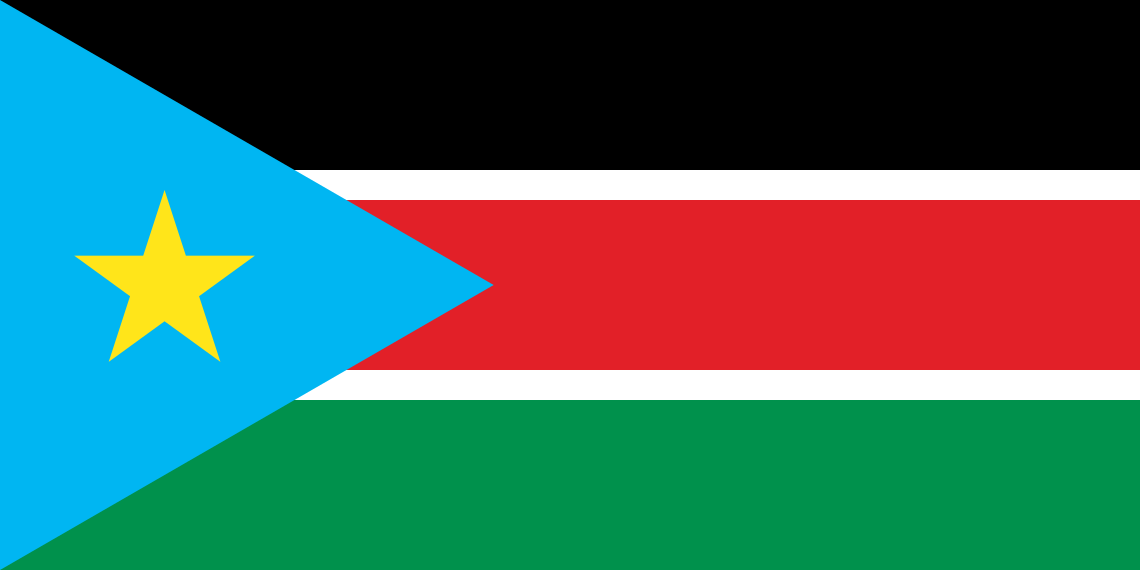
The Republic of South Sudan welcomes the report (S/2011/603) of the Secretary-General on the situation in Abyei. We also express our thanks to the Government of the Federal Republic of Ethiopia for providing troops to the United Nations Interim Security Force for Abyei, as well as for its continuous efforts in support of peace and stability in the region.
As the Secretary-General notes in his report, the Abyei Joint Oversight Committee, comprised of senior representatives from the Republic of the Sudan and the Republic of South Sudan, met for the first time on 7 and 8 September in Addis Ababa, in the presence of the
African Union High-level Implementation Panel and the United Nations. At that meeting, the members of the Committee agreed and signed a detailed timetable for the withdrawal of all troops from the Abyei Area.
In compliance with the provisions of the Addis Ababa agreement, Sudan People’s Liberation Army forces withdrew from the Abyei Area and redeployed to Warrap State. Subsequent to the issuance of the Secretary-General’s report, the Force Commander confirmed that SPLA forces had complied with the agreed withdrawal plan. As of today, Sudanese Armed Forces (SAF) troops have not withdrawn from the Abyei Area, despite the clear timeline agreed at the meeting of the Abyei Joint Oversight Committee, which was signed by senior representatives of the Government of the Republic of the Sudan.
The SAF must now withdraw immediately and unconditionally from the Abyei Area. We respectfully request the Council to set a deadline for that withdrawal, and to hold whoever violates it accountable. In that regard, we are also concerned that the Republic of the Sudan has stated that the SAF cannot withdraw from Abyei unless the Area institutions are established. While establishing those institutions is necessary, in no agreement between the parties is the withdrawal of troops conditional upon their establishment.
The Republic of South Sudan underlines that it is ready to continue serious negotiations with the Republic of the Sudan on all outstanding issues. My Government seeks lasting peace in Abyei. We wish to see the security situation on the ground stabilized in order to enable the peaceful return of civilians.
We thank the Council for its continued support for peace and stability in the region. We stand ready to continue cooperation with the Council, the United Nations peacekeeping missions, the African Union, regional partners and the international community in support of that purpose.
I now invite Council members to informal consultations to continue our discussion of the subject.
The meeting rose at 10.45 a.m.