S/PV.6660 Security Council
Provisional

I thank Ms. Johnson for her briefing.
I now call on Mr. Ladsous.
Mr. Ladsous: I thank you, Sir, for this opportunity to further brief the Security Council on recent tensions on the border between the Sudan and South Sudan, and recent reports of bombings in the border areas. I will also say a few words on the report of the creation of a new military coalition between the Sudan People’s Liberation Movement-North and Darfur rebel groups.
UNMISS dispatched a verification mission to Yida, Unity state, on Sunday, 13 November. A joint team of civilian and military personnel, including mine-action staff, confirmed that four bombs had been dropped on 10 November. Three of these bombs exploded and one did not. The fourth bomb landed on a schoolyard but, fortunately, did not explode. According to different eyewitness accounts of the incident, the
bombs were dropped by a white Antonov aircraft coming from the Sudan.
The Government of the Sudan has denied that these bombings took place on South Sudanese territory. Luckily, no casualties or injuries were suffered during this incident. The Nuba populations that had fled the Yida refugee camp following the bombing are now slowly returning. I am also in a position to confirm that bombing took place in Guffa, in Maban county, Upper Nile state, on 8 November. At least four bombs were dropped.
Regarding reports of fighting in Kwek, in Manyo county, Upper Nile state, on 11 November, UNMISS could not verify the allegations of cross-border incursions. It confirmed that fighting took place in the northern part of Manyo county, however, and supported the medical evacuation of nine seriously injured Sudan People’s Liberation Army soldiers from Renk to Juba.
(spoke in French)
As stated by the Secretary-General yesterday, the escalation of rhetoric between the Government of the Sudan and the Government of South Sudan, particularly in regard to cross-border support to their respective rebel groups and incursions into one another’s territory, is extremely worrying. The African Union High-Level Implementation Panel chaired by President Mbeki has called for a meeting of the Joint Political and Security Mechanism between the Government of Sudan and the Government of South Sudan on 18 November. As the Council is probably aware, the Joint Political and Security Mechanism is a Cabinet-level bilateral body agreed upon by the two Heads of States to resolve disputes and to support the consolidation of peaceful relations between the two countries.
I would like to urge both Governments to seize this opportunity to de-escalate the current situation and move swiftly towards the establishment of the joint border monitoring mechanism they agreed upon on 30 July. Only the two parties, working together, can efficiently and effectively manage security at their common border. As stated by the Secretary-General his September report (S/2011/603) on Abyei, the United Nations stands ready to support them in that respect.
The Panel will also resume post-Comprehensive Peace Agreement negotiations at the end of the week in Addis Ababa. In that connection as well, I would like
to urge both Governments to demonstrate the necessary flexibility and commitment and to agree swiftly on a package of measures to resolve remaining differences on financial transitional arrangements, Abyei and border demarcation. Both meetings are critical to reduce tensions, but the parties will also need to make sure that any efforts aimed at providing support to rebel groups one another’s territory seizes immediately.
We also received reports this weekend of the establishment of a new military alliance of Darfur rebel movements and the Sudan People’s Liberation Movement-North, which is calling for the forceful removal from power of the Government of the Sudan. That represents a stage in a pattern of escalation that is counter-productive. The United Nations continues to stress that all parties to the different conflicts between the Government of the Sudan and its peripheries need to return to the negotiating table and resolve their differences through political dialogue. There is no military solution to the Sudan conflicts and all military actions only endanger the lives of innocent civilians, who deserve a return to peace and stability after so many years of fighting.
I thank Mr. Ladsous for his briefing.
(spoke in English)
I now give the floor to the representative of South Sudan.

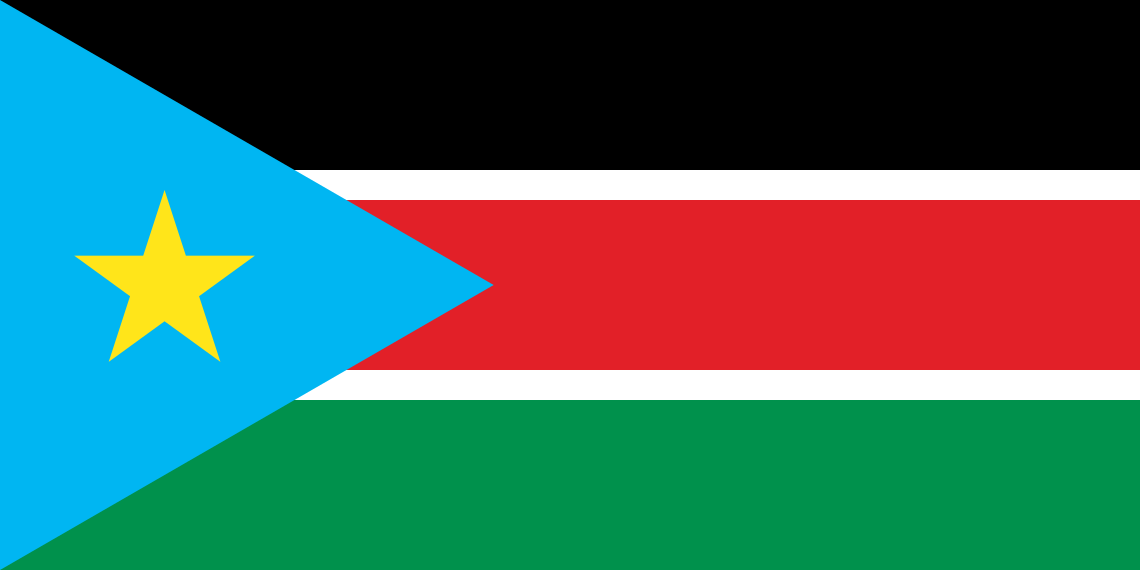
On behalf of the Government of the Republic of South Sudan, I wish to thank the Secretary-General for his comprehensive report (S/2011/678). I would also like to take this opportunity to thank Mr. Ladsous, Under-Secretary- General for Peacekeeping Operations, as well as Ms. Hilde Johnson, Special Representative of the Secretary-General, for her role on the ground in the successful establishment of the United Nations Mission in the Republic of South Sudan (UNMISS). Lastly, I wish to thank all members that have contributed military and police personnel to the United Nations Mission in South Sudan. We are grateful for their support of the Mission.
As noted by the Secretary-General in his report, the Government of the Republic of South Sudan has made progress on the 100-day programme established by President Kiir following the appointment of his Cabinet in early September. In particular, President
Kiir has committed to enacting legislation on transparency and accountability. The Government is also forging ahead with its plan to establish the national constitutional review commission in early 2012. Those actions will contribute to the establishment of a fully functioning democracy, in which the Government is accountable to the people and acts in the people’s interests.
The security situation in Jonglei and Upper Nile states is of course a concern to my Government. We underline that, on 9 July, President Kiir once again extended an amnesty to all militia groups. Since then, my Government has worked successfully to reach agreements with several groups, resulting in their integration into the South Sudan armed forces. Certain groups have, however, chosen not to accept the amnesty offer or to negotiate the terms of their integration into the South Sudan armed forces. We will redouble our efforts in that regard. In the meantime, the Government takes very seriously its primary responsibility for the protection of civilians and, as noted by the Secretary-General, has mobilized additional troops to the areas of greatest concern.
Recently, the Republic of the Sudan accused the Republic of South Sudan of facilitating and hosting two meetings, in Juba and Yei, for the purpose of uniting rebel factions to overthrow the Government in Khartoum. That allegation is baseless. We stress categorically that there is no element of truth to the claims of accusations brought forth by Khartoum, nor any sponsorship by the Government of the Republic of South Sudan for any hostile activities to topple the Government in Khartoum, militarily or otherwise. Moreover, as a matter of policy, we are not providing military assistance to the opposition forces operating in the Sudan.
The Republic of South Sudan encourages both the Government of the Republic of the Sudan and the opposition forces to engage in mutually beneficial discussions that will enable a peaceful resolution of hostilities and improve the current humanitarian crisis in Southern Kordofan and Blue Nile states.
In conclusion, the Republic of South Sudan will continue to enhance its security and the delivery of services to its citizens. We welcome the support of the international community and that of United Nations agencies.
I now give the floor to the representative of the Sudan.


Allow me, first, to thank you, Mr. President, for giving us this opportunity to participate in this meeting to enable the Council to acquaint itself with the truth, in order that it can adopt positive and objective resolutions. I should like to make five points during my intervention.
My first point is that we are committed to the peace process and negotiations to achieve a peaceful solution to outstanding issues between us and our brothers in South Sudan. Any allegations that the Government in the north is seeking to carry out military action against the south in order to occupy it are unacceptable. We are the ones who granted the south a peaceful transition towards independence, a choice they exercised in complete freedom and in a smoothly organized way.
The second point that I would like to emphasize to the Council is that, regrettably, the Government of South Sudan is continuing to support rebel movements. It supervised two meetings, at Yei and Juba, which resulted in the establishment of the Sudanese Revolutionary Front, whose declared objective is to topple the Government in the north through military action. That is further confirmed by information I have just received, to which I hope the members of the Council will be patient enough to listen. The source is Captain Hafez Hamza Abkar, who defected from the Sudan People’s Liberation Army (SPLA). He has affirmed that General James Oshun and Major Mattur supervised the transport of military equipment from Serjas by plane to the Jamjam area in Southern Kordofan. Those are confessions that we can provide to the Council on video, with sound, from an officer of the Sudan People’s Liberation Movement.
The third point I want to share with the Council concerns the Yida camp. For the benefit of everyone, the camp is on a lake called Lake Abyad. Part of the lake is in the southern part of the Sudan and the other part is in South Sudan. The camp is in the Sudan, in Southern Kordofan. It is not a refugee camp at all. We should be more precise and specific, Mr. Ladsous, when we use terms. It is not a refugee camp; it is a
camp of the Ninth Brigade of the SPLA. I am not used to telling lies. I am speaking concrete facts. I am —
(spoke in English)
— dealing with the Council in all civility, according to the dictates of diplomacy. Even if I have to differ with anybody, I would start by saying, “I beg to differ”. I never lie. I do not lie.
(spoke in Arabic)
It is my hope that this information can help the Council to verify the facts and not rush to accuse and condemn the Government of the Sudan of undertaking military activities or aerial bombardment of civilians. As I have said, we reserve our right to self-defence and to carry out any military actions within our national territory. I wish to assure the Council that we never will carry out any military actions inside the territory of the Government of South Sudan.
To show our good will, even though many defend false and baseless accusations about us, the same day that we were wrongly accused of bombing territories of the Government of South Sudan, there were more than 30 trucks carrying goods, including food, on their way from the north to the south at the Joda crossing. That can easily be verified. It is part of the commercial activities that we consider a humanitarian obligation, because of the need of our brothers in South Sudan for those supplies. Thirty trucks have crossed the border through the Joda crossing point into South Sudan.
I hope the Council will take into consideration what I have said and will link it to what is mentioned in paragraph 10 of the Secretary-General’s report (S/2011/678) about shortages of basic commodities and inflation reaching 61.5 per cent in South Sudan. That is the spirit in which we confront those who defend untrue accusations; they will only expose themselves in the final analysis, however loud their voices may be.
There are no more names inscribed on the list of speakers. I now invite Council members to informal consultations to continue our discussion on the subject.
The meeting rose at 4.05 p.m.