S/PV.6730 Security Council
Provisional


At the outset, I should like to thank you, Sir, for giving us the opportunity to participate in this important meeting.
I believe that the presidential statement that has just been adopted is balanced. I should like, however, to clarify a few truths that may have been omitted. I do so not to attack or to go on the offensive, but simply to clarify certain facts.
I affirm that we fully intend to resolve all pending questions between us and the sisterly State of South Sudan through negotiations. We have not started a war, but were forced into one despite hating the idea of entering into hostilities with the sisterly State of South Sudan. That is the first truth.
The second truth is that we have cooperated with the Security Council and the African Union High-Level Implementation Panel (AUHIP) in order find lasting solutions to this issue. I affirm our good intentions and wish to clarify the following points.
As I informed you yesterday, Sir, we have some 12,000 brotherly students from South Sudan in our educational institutions. They are treated with great dignity, and we shall continue to treat them thus in our educational system. Moreover, Council members may not be aware that Southerners have not been expelled from the military schools and institutions that train our military officers and many of our brothers from the South. They have never been subjected to ill-treatment; on the contrary, they have been treated with great dignity. I reiterate that we shall extend our assistance to their attendance at these military institutions until they have fully completed their studies and received their diplomas. They will then be transferred to South Sudan in the most dignified manner.
The Sudan has always accepted and will continue to accept all mediation proposals put forward by AUHIP. As Mr. Thabo Mbeki has said, we have rejected no proposal and have cooperated extensively.
Another point I wish to raise is that some three weeks ago we welcomed to Khartoum our brother the Minister for Humanitarian Affairs of the brotherly State of South Sudan. We signed an agreement with him concerning the citizens of South Sudan who are to return there, stipulating the need for flexibility with regard to the 8 April deadline. As I said, all these facts
may be unknown to the members of the Council. I feel that Council members should be aware of certain facts concerning the other side. Again, I wish not to go on the attack, but simply to describe genuine realities.
In conducting operations to assist citizens returning to South Sudan, we have done so in three ways. With the cooperation of the International Organization for Migration, they have been transported by rail, river and air. We dispatched five boats laden with returnees to South Sudan. River transport is the best means of conveying passengers and freight alike. In providing the five boats to transport returnees to the South, we agreed to allow South Sudan to transfer through the Sudan and on its rivers all equipment belonging to the United Nations Mission in the Sudan (UNMIS).
Does all this not sufficiently demonstrate our good intentions? And yet, some 12 Sudanese vessels were confiscated by South Sudan and not returned; indeed, they have been used for military purposes. The Council should be aware of these facts. What does all this mean? Clearly, it will delay the return of Southern citizens who remain in the North. In the light of the confiscation of our vessels, I will leave it to the Council to determine what it must do to help us return the citizens of the South to their country.
With regard to cooperation with the peacekeeping Mission, I should like to emphasize that, as it has in the past, the Government of the Sudan will continue to cooperate with missions deployed on Sudanese territory with the consent of its Government. With regard to other missions deployed on the territory of other countries with their consent, they are of no concern to us whatsoever — although, as I have indicated, we did provide assistance in transporting equipment for the United Nations Mission in the Republic of South Sudan.
The last point that I would like to mention pertains to the humanitarian situation in Southern Kordofan and Blue Nile states. The Sudan would like to underscore its cooperation with the United Nations. Speaking here two days ago, the Sudan’s Minister for Social Affairs, who is responsible for humanitarian issues, told Ms. Valerie Amos that our country would consider the tripartite initiative, which we accepted in principle. We will continue to review the proposals over the next few days, so as to reach a definite solution to this matter.
In accordance with the latest information we have available on the humanitarian situation, the situation in Southern Kordofan is far from reaching the crisis stage. A recent development relating to cooperation with United Nations agencies involved in humanitarian affairs — the Food and Agriculture Organization, UNICEF, the World Health Organization and the International Organization for Migration, among others — has resulted in an improvement in that regard. Lastly, we have no doubt that the situation will continue move in a positive direction in the course of the coming days.

I now give the floor to the representative of South Sudan.

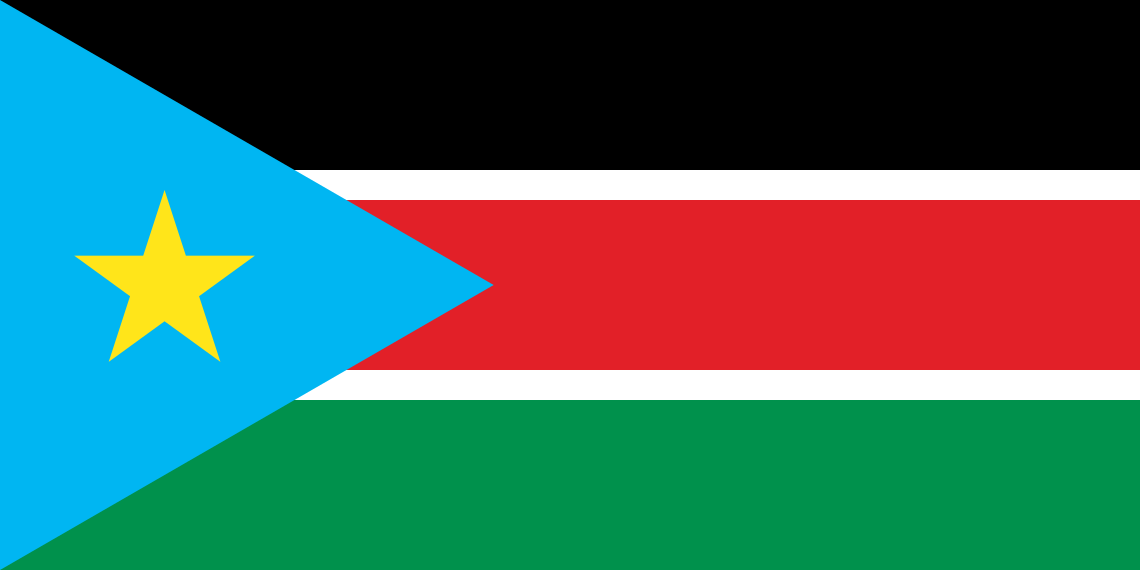
I would very much like to thank the members of the Security Council for the important presidential statement adopted today (S/PRST/2012/5). Having read the statement, I should like to make a few points.
First, I would like to reiterate the policy of the Republic of South Sudan: we are committed to two viable States living side by side in peace. We also have a policy of non-interference in the affairs of other sovereign States. I would like to point out that we have been unfairly accused several times of supporting the opposition groups fighting the Government of the Sudan. I again reiterate that we have not supported any opposition groups fighting the Government of the Sudan. It is not our policy to support opposition against other States.
Secondly, I would also like to bring to the Council’s attention the fact that the Republic of South Sudan welcomed the non-aggression pact signed in Addis Ababa on 10 February. However, we also want the Council to know that three days after the signing of the pact, the Government of the Sudan violated the agreement by bombing areas in Western Bahr Al-Ghazal and Unity states on 13 February, and areas in Upper Nile state a few days later. We condemned those acts of aggression, which are in violation of the agreement we signed with the Republic of the Sudan.
I would also like to inform members of the Council that our team is now in Addis Ababa for the resumption of the negotiations. We have negotiated in good faith and given some proposals to the African Union that are in line with international standards with regard to oil transit fees. We are committed to the negotiations and we are fully supporting the African Union High-level Implementation Panel as a forum in which all outstanding issues can be resolved.
I also want to point out that we believe in a comprehensive resolution of all outstanding issues, because they are all connected. When a border is not clearly defined, that is a recipe for conflict. In that regard, we have called upon the Republic of the Sudan to demarcate the border. There has not been political will to demarcate the border. It is therefore very important that the Council call for the border to be demarcated.
The last point I want to emphasize has to do with the issue of citizenship. It has been our position since the beginning of the negotiations that both the citizens of the Republic of the Sudan and South Sudan could chose where they want to live. That is the proposal we made, but the Republic of the Sudan did not agree to it. Based of what I have heard from the representative of the Sudan, I hope that there will be a change in the position they have taken.
In addition, there is a bad humanitarian situation in the two areas involved. We are concerned because the refugees fleeing Southern Kordofan and Blue Nile states in the Sudan are coming to areas in our country. In line with our commitment to the Charter of the United Nations, we have extended assistance to refugees who have crossed our border, who are frequently targeted on our territory, in violation of international law.
Finally, I would like to thank you, Mr. President, for giving my this opportunity to participate.
The Security Council has thus concluded the present stage of its consideration of the item on its agenda.
The meeting rose at 10.40 a.m.