S/PV.7141 Security Council
Provisional
The meeting was called to order at 3.05 p.m.
Adoption of the agenda
The agenda was adopted.
Reports of the Secretary-General on the Sudan and South Sudan Report of the Secretary-General on South Sudan (S/2014/158)

In accordance with rule 37 of the Council’s provisional rules of procedure, I invite the representative of South Sudan to participate in this meeting.
In accordance with rule 39 of the Council’s provisional rules of procedure, I invite Mr. Hervé Ladsous, Under-Secretary-General for Peacekeeping Operations, to participate in this meeting.
In accordance with rule 39 of the Council’s provisional rules of procedure, I invite Ms. Phumzile Mlambo-Ngcuka, Executive Director of the United Nations Entity for Gender Equality and the Empowerment of Women to participate in this meeting.
The Security Council will now begin its consideration of the item on its agenda.
I wish to draw the attention of Council members to document S/2014/158, which contains the report of the Secretary-General on South Sudan.
I now give the floor to Mr. Ladsous.

I thank you, Madam President, for this opportunity to brief the Security Council once again on the situation in South Sudan and to present the most recent report of the Secretary-General (S/2014/158).
Little more than three years since the holding of the referendum that led to the independence of South Sudan, the country, it must be said, is in a tragic situation marked by extreme violence. The number of civilians who have been brutally killed or mistreated is in the thousands, with at least 800,000 refugees and displaced persons, 75,000 of whom are in camps of the United Nations Mission in South Sudan (UNMISS). Despite the signing of a ceasefire agreement, it must be reported that both parties continue to fight against one another, in violation of that agreement. With the arrival of the rainy season, we fear that the humanitarian
situation, which is already extremely difficult, will further deteriorate. Moreover, the initial investigatory findings suggest that atrocities and grave violations of human rights have been committed by both parties in the course of the fighting. In that regard, I would like to welcome the news of the establishment of a commission of inquiry by the African Union.
This crisis is fundamentally a national political crisis. The conflict has spread to the whole country. No region has been spared. It is true that the violence has mainly taken place in the states of Jonglei, Upper Nile, Unity and Central Equatoria, but the political polarization caused by the conflict now affects the lives of all South Sudanese and the functioning of Government throughout the country.
That is why the mediation process, led by the Intergovernmental Authority on Development (IGAD), has focused on three priorities, namely, the cessation of hostilities, the crisis in the Sudan People’s Liberation Movement (SPLM) and the national political dialogue. As the Council knows and as I stated, the mediation process conducted by the Intergovernmental Authority on Development led to the signing, on 23 January, of agreements between the Government of South Sudan and the Sudan People’s Liberation Movement/Army (SPLM/A) in Opposition on the cessation of hostilities and on the status of detainees. Mediation under the auspices of IGAD has also led to the release of 7 political leaders of the SPLM, among the 11 who were arrested, as members may recall, at the beginning of the political crisis in December 2013.
During the second round of negotiations, the parties agreed to resolve the political conflict at the root of the internal dynamics of the SPLM. It is expected that a meeting will be held between the eight members of the SPLM party leadership — four allies of the Party Chairman, President Salva Kiir, and four of his opponents — to find a solution to the party’s internal crisis. Those negotiations are to be conducted jointly under the aegis of officials from the Ethiopian People’s Revolutionary Democratic Front and the African National Congress.
With a view to ensuring that that exercise in national reconciliation includes all segments of society, this week the mediation is convening a civil society forum where the views of civil society can be considered in determining the modalities that will allow the country to move forward.
(spoke in English)
A key demand of the opposition is the release of all 11 political detainees. Seven of them were indeed released on 29 January, but the remaining four remain in detention, and trial proceedings against them commenced on 11 March. The resolution of that issue will be necessary to make meaningful progress in the talks.
Furthermore, the gap between the parties on the content, objective and sequencing of the broad-based dialogue, as envisaged by IGAD, remains wide. While agreeing to the conduct of a national conference, the Government continues to insist that it be held within the country, once a ceasefire has been agreed upon and is effectively implemented. The forces opposing the Government, both the SPLM/A in Opposition and the released political leaders, on the other hand, demand the immediate start of a broad-based dialogue, in addition to the formation of an interim Government ahead of the elections.
The security and humanitarian situation in South Sudan will continue to deteriorate until the parties engage fully in the political talks, until they respect the cessation of hostilities and allow freedom of movement for the United Nations and its partners. Both parties continue to prioritize the pursuit of military gains over talks towards a comprehensive political settlement. The crisis has already affected the security of the region. The longer it goes on, the more the chances for further regional intervention will grow.
In that regard, the immediate establishment of the monitoring and verification mechanism is essential. A joint technical committee has been established, with a functioning headquarters in Juba, and monitoring and verification teams are being trained for deployment to six sites in conflict areas. With a view to ensuring effective and robust monitoring and verification, the IGAD Heads of State decided on 13 March to deploy by mid-April a robust protection and deterrent force to provide security for the monitors. This week, the Department of Peacekeeping Operations and UNMISS are sending planners to Addis Ababa to work with IGAD and other partners in developing the concept of operations of the force and the modalities of its cooperation with UNMISS. IGAD has indicated that it will require the financial support of Member States to deploy and sustain the force. We shall keep the Council informed closely of further developments in that regard.
UNMISS was deployed to help South Sudan transform into a democratic State and to assist its leadership in delivering long-awaited dividends of peace and independence to its citizens. Today, the leadership stands divided, its security institutions are fragmented and the society is victimized by communal tensions. Under those conditions, and as discussed with the Council, the initial raison d’être of UNMISS no longer applies.
It is for that reason that the Secretary-General’s report on South Sudan before the Council highlights the need for a strategic shift in the posture of UNMISS. Accordingly, we will temporarily put on hold activities aimed at the extension of the authority of the State and focus on five main priorities, all within a posture of impartiality. They are the protection of civilians, the facilitation of humanitarian assistance, human rights monitoring and reporting, the prevention of further intercommunal violence and support to the IGAD process, as and when requested and within capabilities.
The troops of UNMISS are operating under a Chapter VII mandate, which allows the use of force to protect civilians and ensure the safety and security of United Nations personnel and assets. The protection priority will be for those sheltering at United Nations compounds and other locations where they have sought sanctuary, which the Mission will try to support by facilitating humanitarian access. Subsequently, as additional troops arrive and conditions are created for the safe, voluntary return of the internally displaced persons, upon a request from humanitarian partners, the protection operation would spread further so as to contribute to creating the conditions for safe and voluntary returns. To implement that protection mandate, UNMISS will, let me say again, uphold strict impartiality, interacting with both sides as necessary, to reach out and facilitate access to civilians at risk.
As far as other activities of UNMISS are concerned, they will be guided by two cardinal principles. First, UNMISS will not undertake any activity that could enhance the capacity of either side to engage in military or hostile operations, and, secondly, the Mission will not participate in any activity with the parties that could jeopardize the mediation process led by IGAD.
That new posture of the Mission will remain in place until the parties finalize a comprehensive political agreement. At that time, we shall conduct a more comprehensive integrated review of the mandate,
posture and capabilities of UNMISS and provide further recommendations to the Security Council.
At this point, I need to raise a very serious question. There has been a negative campaign against UNMISS and its leadership in South Sudan, which seems systematic and organized. There has been an unacceptable vilification of the United Nations by some local and national officials, with public demonstrations, media articles and harassment of United Nations personnel, including to the point of putting their lives in danger. Under those conditions we will need to consider further drawing down our staff and limiting our activities to the absolute minimum related to protection, human rights monitoring and support to humanitarian assistance.
The incident of 7 March in Rumbek, during which national authorities seized the weapons and ammunitions of a United Nations contingent, has been used to excite the negative climate regarding UNMISS. I dispatched a high-level team last Wednesday to investigate where mistakes were made in the shipping of that equipment. We offered to the Government to conduct a joint investigation, simply to prove our good faith and provide full transparency. Unfortunately, that offer was declined.
The situation is grave. World Food Programme operations have been brought almost to a standstill, despite the dire need for humanitarian assistance. Cross- border movements of humanitarian supplies — for instance, food and seeds to plant the next crop — which urgently need to be prepositioned before the rainy season sets in, are being delayed. United Nations flights are being searched, convoys stopped and personnel harassed by South Sudan security across the country. Organized demonstrations against the Mission have increasingly begun to adopt a very aggressive tone. The Mission’s freedom of movement has been severely restricted, despite repeated démarches, including from the Secretary-General to President Kiir.
We very much hope that the situation changes soon, as its continuation is not sustainable, nor indeed is it acceptable. I would urge the Security Council and its members to intervene on behalf of UNMISS, condemn the campaign and request President Kiir to condemn it himself immediately and issue instructions to national and local authorities and SPLM cadres to stop it.
(spoke in French)
Last December’s decision by the Security Council to authorize the deployment of additional troops and
police units to UNMISS was certainly timely and greatly contributed to saving human lives on the ground. In the light of the obstructions to a political resolution of the crisis, the Secretary-General is asking the Security Council to raise the ceiling for UNMISS military and police personnel for one year, outside the inter-mission cooperation framework. The ceiling would therefore increase from 7,000 to 12,500 soldiers and four mobile police units.
The deployment of additional military personnel would take place in three phases. The second phase will be completed between now and the end of June, with 2,800 soldiers deployed and three mobile police units on the ground. The third phase provides for the deployment of the two remaining infantry battalions and will be realized once the Mission has re-evaluated the situation and its own absorption capacity.
In conclusion, I would like to reiterate that the people of South Sudan have suffered too much and for far too long. Its sole wish is that the crisis end as quickly as possible. It is now the duty of the political authorities to stop the violence, and to do so immediately. They must give orders to their respective forces to cease military operations without delay, participate in a significant and constructive manner in the talks that are taking place in Addis Ababa and work towards building a State that exercises its functions through democratic institutions and transparent processes, accountable for their acts before the representatives elected by the people. The international community was a guarantor of the Comprehensive Peace Agreement that allowed South Sudan to gain its independence. Now more than ever, it is our duty to remind the South Sudanese parties of the commitments they undertook therein.
I thank Mr. Ladsous for his briefing.
I now give the floor to Ms. Mlambo-Ngcuka.
Ms. Mlambo-Ngcuka: Two years ago, the international community celebrated with the people of South Sudan their independence, new Statehood and entry into the United Nations. Today, South Sudan has lost its peace, and the international community is called upon to help the people of South Sudan restore their hard-won peace, as violence by conflicting parties is continuing. The situation has caused a serious humanitarian crisis that has had a disproportionate impact on women and girls.
Since the current conflict began, in December, I have met with women from civil society and
representatives from South Sudan inside the country, in Addis Ababa during the African Union Summit and in New York this week in the course of the ongoing session of the Commission on the Status of Women.
One month ago, I had an opportunity to visit Juba. On my arrival, I was greeted by nearly 100 women bearing the slogan “South Sudan Women for Peace” and calling for peace and the support of UN-Women and the United Nations. Those women came from all parts of the country and from all sides of the conflict. They are partners of UN-Women, as well as the Security Council’s partners for peace and security in South Sudan.
During my trip, I met with President Salva Kiir, key Cabinet Ministers, including the Ministers for Cabinet Affairs, Justice, Education and Finance. I also met with donors, representatives of United Nations agencies, the Speaker of Parliament, members of the National Legislative Assembly, women leaders and displaced women living in the United Nations Mission in the Republic of South Sudan (UNMISS) civilian protection sites.
I was appalled at the conditions of those living in the protection sites. The onset of the rainy season has worsened an already critical situation. The density of people in living spaces was 13 times the recommended humanitarian minimum. Such conditions pose significant health, protection and security risks to girls and women. In those sites, there is only one latrine for more than 200 people, and open sewers run through the camp itself.
Women and girls have been exposed to heightened levels of violence and crime, including sexual and gender-based violence. Attacks are occurring both inside the camp and outside the camp. When women leave the camps to search for food for their families, they are also exposed to violence. The population in the camps I saw were overwhelmingly women and children. The women I spoke with were often distressed and traumatized.
Data from one of the sites indicates that 58 per cent of households are headed by women, and 34 per cent of households are missing one or more family members. Some women did not know where their children were; some had husbands who were missing or who had been killed. Many had experienced violence themselves. All expressed a feeling of not knowing their own or their family’s future and were struggling to survive.
The current conflict has exacerbated the already dire conditions of poverty and violence. In addition, South Sudanese women experience the highest levels of maternal mortality in the world. More than 8 in 10 women are illiterate. A recent United Nations study found that as many as 40 per cent have been affected by physical or sexual violence. What they are facing is a matter of extreme urgency — of life and death.
The response from the international community has been vastly insufficient thus far, with only 24 per cent of the appeal funded. Our colleagues from the United Nations and other humanitarian organizations have worked extremely hard, with very limited resources.
I urge the Council to use its voice to ensure a more immediate and decisive response in support of the people of South Sudan and the agencies that are bringing relief to the country. For our part, together with our partners, such as UNMISS, we are doing our best to make sure that the humanitarian response fully takes into account the special needs of women and girls and facilitates their full participation.
During my visit, I made a commitment to initiate UN-Women’s humanitarian efforts in the Juba-based UNMISS civilian protection sites, which support the commendable efforts of our sister agencies. Our focus is on providing safe spaces and psychosocial support, as well as income generation and skills training. We are also engaging in start-up literacy courses for adults and exploring ways to support education so that children and youth who are trapped in a camp do not miss out on their education during the current crisis.
The women I met in the protection sites shared the impact of the current humanitarian crisis, their concerns for the future and their demands for inclusion in the peace negotiations. Their resilience is striking, and so is their overwhelming desire for peace. They have mobilized across divisions and built inclusive coalitions. They are demanding a voice in the decisions being made to resolve the crisis and rebuild their country.
I also engaged with the Intergovernmental Authority on Development (IGAD) on the representation of women in the peace talks. Today I commend Ambassador Mesfin, the chief mediator for the IGAD peace talks, for his efforts to encourage the inclusion of women. I applaud the efforts of both sides to ensure women’s participation. Each has had three women mediators.
President Kiir has also expressed his commitment and has asked UN-Women to support women’s representation in Addis Ababa, in addition to women who are in the delegations. However, much more remains to be done. To be sustainable, negotiations must reach beyond the confines of the two parties to the conflict. The equal representation of women at the talks, a robust role for civil society and gender expertise and analysis are needed. UN-Women has offered a senior gender adviser to the IGAD mediation team and looks forward to supporting its efforts through that and other means of support.
I also welcome the signing of the cessation of hostilities agreement and its inclusion of rape as a recognized violation. The commitments on paper will of course need to be translated into action. The monitoring and verification mechanism must be established and deployed to enforce the ceasefire.
UN-Women is ready to offer any support necessary to the IGAD efforts to increase the numbers of women in monitoring and verification efforts, to link to civil society efforts and to provide dedicated expertise on the monitoring of sexual violence. I echo the voices of women in South Sudan that urge both sides to return to the peace table as a matter of urgency, to renew their commitment to a ceasefire and to find a political solution that allows the displaced to return home and for South Sudanese to continue to build their new country. Women told me of their desire to go back to their homes and communities.
While negotiations are needed to resolve the immediate political crisis, accountability and reconciliation are equally needed to ensure that we build a foundation for sustainable peace. I welcome the efforts of the African Union in establishing a commission of inquiry to investigate conflict-related human rights violations in South Sudan and to make recommendations on accountability and reconciliation. I was particularly pleased by the announcement, last week, of the appointment of five commissioners to head that body, in particular the appointment of two women commissioners, one of whom is the African Union’s own Special Envoy for Women, Peace and Security, Ms. Bineta Diop. That enables greater efforts to be focused on ending impunity. UN-Women stands ready to offer the support of a dedicated sexual and gender crimes investigative expert to form part of the Commission’s team. That is in line with the support we
have provided to all United Nations commissions of inquiry since 2009, largely with good impact.
The last time I addressed the Council was last October (see S/PV.7044), during the Council’s adoption of resolution 2122 (2013). In that and previous resolutions, the Council made very significant promises to women to address their needs and to deliver on the commitment to women’s participation. Those commitments are being tested now in places such as the Central African Republic, Syria and South Sudan.
UN-Women benefits from the attention and support that the Security Council provides as we take those resolutions to the people who need them the most. That includes briefings such as this one today and briefings that the Council receives from envoys.
Together we can demonstrate to the women of South Sudan, who continue on in the most desperate of situations, that their courage and determination can be matched by our own commitment to their cause, through stronger support for the implementation of all Security Council resolutions dedicated to women, peace and security.
Once more, Madam President, I thank you for this opportunity and I look forward to our discussion.
I thank Ms. Mlambo-Ngcuka for her briefing.
I now give the floor to the representative of South Sudan.

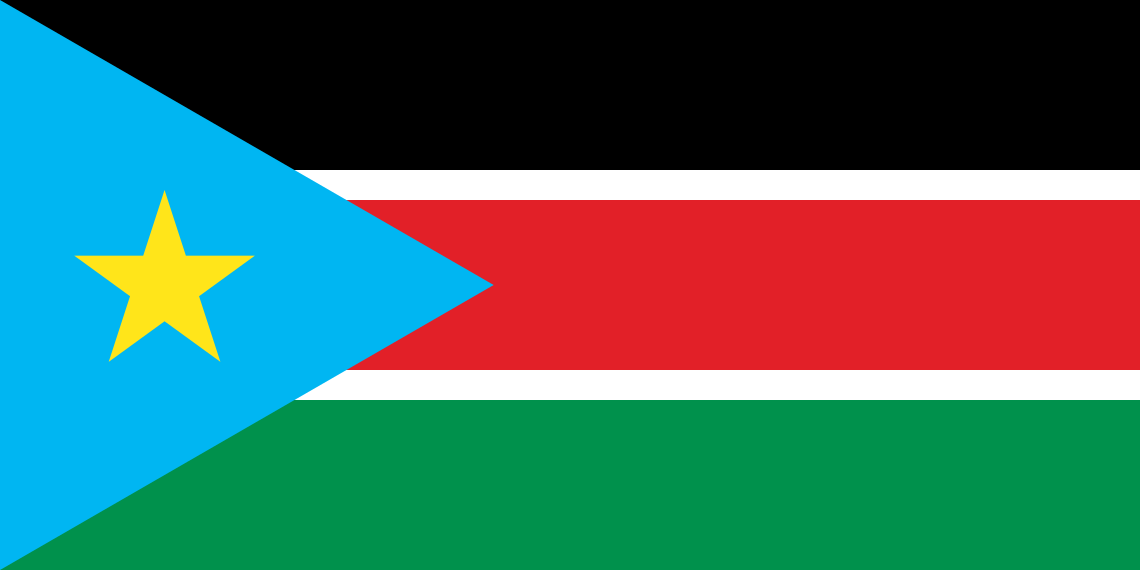
As this is the first time that my delegation addresses the Security Council during your presidency, Madam President, permit me to begin by congratulating you and your delegation on assuming that responsibility for the month of March 2014 and by wishing you every success in your leadership. I would like to assure you of the full support and cooperation of my delegation. I would also like to commend your predecessor for her leadership of the Council for the month of February, when I had the honour to exchange views with her on the crisis situation in our country. I want to assure her and the Council that the concerns the Council asked her to share with me have been duly conveyed to the authorities at home, and I have been assured that they are being given serious consideration.
Permit me also to take this opportunity to thank Mr. Hervé Ladsous, Under-Secretary-General for Peacekeeping Operations, and take note of his
statement on the operational challenges facing the United Nations Mission in South Sudan (UNMISS). I also thank the Executive Director of UN-Women for her reflections on her visit to South Sudan and on the current humanitarian situation. I would like to assure them both that the Government of South Sudan will give their observations due consideration and attention, with a view to improving cooperation as we jointly engage in expediting recovery for the people of South Sudan. My gratitude is also due to Ms. Hilde Johnson, who has borne the brunt of the burdens of the UNMISS responsibilities during these very trying times.
It is of course very painful to listen to the details of the situation as just presented. We realize that all of it is strongly motivated by the desire on the part of our colleagues in the Secretariat and the Council to help the people and the Government of South Sudan. As the representative of South Sudan, my reaction cannot be one of defensiveness, denial or discomfort in hearing what has been said. All I would say, however, is that, realizing that we have a mutual interest in addressing the crisis and restoring peace, security and stability for our people, we need to see the situation, when possible, from both perspectives. It is in that light that my statement will reflect my desire — our desire — to bridge the differences and to try to work together in addressing the crisis.
Despite the difficulty our relations have been confronted with during the current crisis, the Government of South Sudan continues to sincerely appreciate and support the work that the Security Council, the Secretary-General and other bodies within the United Nations system continue to carry out in South Sudan under extremely challenging circumstances.
It is to the trauma, fustrations, pain and anger caused by the devastating violence that broke out on 15 December 2013 that much of the negative public outcry against UNMISS should be attributed. It is undeniable that, had UNMISS not opened its camps to fleeing internally displaced persons, thousands more would have lost their lives. It is also obvious that the country has nothing to gain, and much to lose, in alienating the United Nations and the international community at large. I know personally that the leadership of South Sudan, in particular President Salva Kiir himself, remains deeply appreciative of the role the United Nations is playing in the country and is unwaveringly committed to continued cooperation with the Organization.
Much appreciated also is the role played by the community of international non-governmental organizations in working with UNMISS to save lives. We appreciate the development of the crisis-response plan for South Sudan, which aims at continuing to save lives and helping the people of South Sudan begin the process of restoring peace and normalizing the situation in the country. As a Government, it is indeed our responsibility to do our utmost to cooperate closely with those who are trying to help us alleviate the suffering of our people.
The Government of South Sudan is doing its best, under very difficult circumstances, to prove to its people, and indeed to the international community, that it wishes to see a speedy end to the current conflict that is devastating our country. It is well known that President Salva Kiir is strongly committed to peace, unity and national reconciliation. The Government remains committed to the talks of the Intergovernmental Authority on Development (IGAD) with the Sudan People’s Liberation Movement/Army (SPLM/A) in Opposition and has agreed to the deployment of the IGAD regional force and the monitoring verification mechanism to the affected areas. The SPLM/A in Opposition, which currently controls Nassir, Malakal and Akobo, has, regrettably, not accepted the regional force or the monitoring verification mechanism.
In crisis there are also opportunities. Since the process of negotiations takes time, South Sudan will probably adopt a two-phased approach. The first phase is to end the violence as soon as possible, along with, of course, providing much needed humanitarian assistance. The second phase will be a more in-depth discussion of what went wrong and how the mistakes of the past can be corrected so as to put the nation back on the path of sustainable peace, development and prosperity, which the people of South Sudan so badly need and deserve. We are deeply grateful to regional leaders and international partners that have assisted South Sudan in having an opportunity to discuss differences and to strategize on the way out of the crisis.
We cannot, of course, take lightly the anti-UNMISS sentiment that is reflected in the demonstrations across South Sudan and may indirectly have led to some infractions of the status-of-forces agreement. I would like to assure the Security Council that that is not the policy of the Government of South Sudan. The Cabinet discussions and decisions reflect the notion that the United Nations is indeed a principal partner of South
Sudan and represents the goodwill of the international community towards our country. Again, I speak not only for the Government but also for the President personally in saying that the Government intends to exert all efforts to calm the situation and to contain the hostile statements and demonstrations. Indeed, the Government of South Sudan deeply regrets the loss of life among humanitarian personnel as a direct result of the heightened tension in the conflict.
As I have said, I make these remarks not only as a representative of the Government but also as someone who has engaged with the authorities on all such issues. I note and should say that, during my visit to Juba for a conference of ambassadors, I requested and was granted permission by the President to visit the detainees, both the four still in Juba and the seven in Nairobi. I gained an insight of the extent to which, despite all the sharp differences, there was a profound desire on all sides, at least among the detainees to whom I talked, to end the hostilites as rapidly as possible so as to restore peace, unity and reconciliation.
Despite my appreciation for all that is said by the United Nations about the situation in our country, we appeal to the international community to appreciate not only the democratic freedom of peaceful demonstrations but also the frustration and anger inciting the people, especially when certain actions take place that give them the impression, however mistaken, that those representing the United Nations may be sympathetic to, and supportive of, the other side in the conflict. In saying that, let me emphasize that the United Nations cannot of course take sides. However, misunderstandings in a crisis situation can generate hostile reactions. As I have
said before, continuous engagement and constructive dialogue are the way to correct such misunderstandings.
Much of my statement is the result of my engaging with the authorities, be it with the leadership, the President, the Vice-President or the relevant ministers. In fact, earlier today, I spoke with both the President and the Vice-President. My remarks are exactly those that they asked me to convey to the Council.
As reflected in the Secretary-General’s report (S/2014/158), the Government of the Republic of South Sudan is aware that the Security Council is considering changes to the UNMISS mandate. Given the reality of the conflict in South Sudan, it is of course understandable that the Security Council will revise its priorities and look into focusing the UNMISS mandate on the protection of civilians, human rights and security sector reform. We would, however, urge the Council to continue with some of the other crucial elements aimed at stabilizing the country, as originally envisaged. As I have often said, South Sudan was rendered vulnerable by a war that raged for half a century, and ironically has now become even more vulnerable owing to the current crisis. The country is more in need of international support than ever before.
Finally, let me conclude by reiterating our appreciation and support for the work of UNMISS, and the United Nations in general, despite concerns on both sides, which, I believe, can be addressed and resolved through constructive dialogue.
There are no more names inscribed on the list of speakers. I now invite Council members to informal consultations to continue our discussion on the subject.
The meeting rose at 3.50 p.m.