S/PV.7235 Security Council
Provisional
The meeting was called to order at 10.05 a.m.
Adoption of the agenda
The agenda was adopted.
Reports of the Secretary-General on the Sudan and South Sudan Report of the Secretary-General on South Sudan (S/2014/537)

In accordance with rule 37 of the Council’s provisional rules of procedure, I invite the representative of South Sudan to participate in this meeting.
In accordance with rule 39 of the Council’s provisional rules of procedure, I invite Mr. Edmond Mulet, Assistant Secretary-General for Peacekeeping Operations, to participate in this meeting.
The Security Council will now begin its consideration of the item on its agenda.
I wish to draw the attention of Council members to document S/2014/537, which contains the report of the Secretary-General on South Sudan.
I now give the floor to Mr. Mulet.
Mr. Mulet: I thank you, Sir, for this opportunity to present the report of the Secretary-General (S/2014/537). I will provide a brief update on the latest developments since the publication of the report on 25 July. In conjunction with that, an update on violations of the status-of-forces agreement for the month of June was circulated on 1 August.
The first major incident since the 9 May and 10 June meetings of President Kiir and Mr. Riek Machar took place in Nassir, Upper Nile state. On 20 July, forces affiliated with the Sudan People’s Liberation Movement in Opposition launched an attack on Nassir. Fighting continued until 24 July, when the Sudan People’s Liberation Army (SPLA) repelled the opposition forces. The two sides clashed again on 26 July. Currently, the SPLA remains in control of Nassir and is firing artillery and other weapons towards the surrounding areas, primarily to deter opposition forces from regrouping and launching a counter-attack.
Furthermore, skirmishes between the SPLA and opposition elements have also been taking place in Renk, also in Upper Nile state, and in Ayod, Jonglei
state. On 16 July in Aweil, Northern Bahr El Ghazal state, the United Nations Mission in the Republic of South Sudan (UNMISS) received reports of clashes between Government security forces and approximately 200 SPLA deserters who had abandoned their posts due to the lack of payment of salaries. On 2 August, in Bunj, Maban county in Upper Nile state, clashes erupted between a local militia that calls itself the Maban Defence Force and approximately 20 SPLA soldiers of Nuer ethnicity who had deserted the SPLA.
The militia suffered heavy casualties during the fight. In reaction to the clash, the militia began pursuing Nuers in Bunj and surrounding areas including, regrettably, those working for United Nations agencies and international non-governmental organizations. Since the fighting started, United Nations personnel and aid workers have moved to the compounds of United Nations agencies and international non-governmental organizations for protection from the militia, while thousands of displaced civilians have sought refuge in a refugee camp near the airstrip. Sadly, initial reports indicate that five humanitarian workers of Nuer ethnicity have so far been killed by the militia, and one is missing.
A quick-reaction force with four armoured personnel carriers is about to reach the area, and another platoon-size force is being deployed by air. The extraction of non-essential United Nations and humanitarian personnel via airlift has begun. Non-governmental organization employees of Nuer ethnicity remain inside some of the compounds and will be escorted to the airstrip as soon as force protection arrives in Bunj. That incident also demonstrates the fragile environment in which violence can quickly engulf communities not originally involved in the conflict.
The situation on the ground therefore remains precarious, with a risk of further polarization and the conflict spreading to other parts of the country. In the current environment of insecurity, UNMISS also continues to encounter movement restrictions, especially in high-risk areas.
In Bentiu, Unity state, local SPLA troops have repeatedly obstructed movements of United Nations personnel and internally displaced persons (IDPs) around the UNMISS protection site. UNMISS flights out of Bentiu have also been cancelled several times due to the denial of flight safety assurances.
UNMISS is today hosting more than 95,000 IDPs at its sites, comprising 40,000 in Bentiu, 31,000 in Juba and 17,000 in Malakal. With the prolonged presence of that considerable number of people at facilities that were not built for such a purpose, conditions have become extremely challenging. Heavy rains have severely flooded large areas in the Bentiu and Malakal protection of civilian sites, exacerbating the health and sanitation situation. There have been a number of incidents including serious crimes as well as incidents compromising the safety of United Nations personnel. A significant number of resources, both military and material, are being expended to manage the sites. In addition, the Mission continues to incur financial expenses not budgeted as part of its mandate. While a voluntary and dignified return of IDPs to their homes in safety remains the ultimate objective, the situation on the ground and the pace of the peace process indicate that the displacement is likely to continue for a relatively prolonged period. The status quo is therefore not sustainable, and alternative options must be explored.
We have commenced discussions with United Nations agencies and humanitarian partners to better delineate roles and responsibilities in an effort to enable the Mission to focus on its core mandate as prescribed in resolution 2155 (2014). In the meantime, the Mission continues to encourage IDPs to relocate to newly constructed sites in order to decongest the existing ones.
The deployment of additional troops authorized under resolution 2155 (2014) is well under way. As of 4 August, a total of 3,525 out of the 5,500 surge troops had been deployed. The remaining contingents, including an infantry battalion, three military utility helicopters, three additional aircraft and a tactical helicopter unit are expected to deploy by October.
We have also identified police-contributing countries for the deployment of four formed police units (FPUs), comprising a total of 660 personnel. The generation of the fresh FPUs is expected to take approximately six months. Until then, the three FPUs currently on the ground will remain, together with individual police officers, and assist with the maintenance of public safety and security within the UNMISS protection of civilian sites.
UNMISS continues to provide logistical support to the Intergovernmental Authority on Development (IGAD) monitoring and verification teams now
deployed in Bor in Jonglei state; Bentiu and Pariang in Unity state; and Malakal, Nasser and Melut in Upper Nile state. Those monitors have been conducting patrols, with the support of UNMISS, while the regional troops, with an additional responsibility to provide protection for the monitors, have begun to arrive.
The scale of the humanitarian operation in South Sudan has reached the point in which it now constitutes the biggest aid operation inside any single country. However, the capacity and funding of the humanitarian operation falls far short in the face of the overwhelming needs. Almost 4 million people are facing alarming levels of food insecurity, amidst growing concerns of a famine. There are 1.1 million people who have been internally displaced by violence and fear, and 434,000 have fled across borders. Up to 50,000 children are at risk of dying as a consequence of acute malnutrition this year alone. The cholera epidemic continues to grow, with more than 5,300 cases, including 115 deaths. While humanitarian assistance has been able to reach some 2.4 million people, aid efforts have been hampered by insecurity, obstructed access, insufficient and delayed funding and delayed logistical, human resource and political constraints. The deteriorating humanitarian situation also carries with it security implications, as communities begin to compete for diminishing resources.
The IGAD-led talks between the Government and the Sudan People’s Liberation Movement/Army in Opposition resumed on 4 August. The objective is to engage in all-inclusive negotiations on issues of security and humanitarian access; political transition and the establishment of a Government of national unity; justice, reconciliation and healing; and the parameters of a new constitution for the country. Right now — today — the parties are engaged in security talks focused on the implementation of the cessation of hostilities agreement.
The IGAD mediation will have to tackle several challenges, including the need to align the positions of all IGAD member States on the application of sanctions against those who continue to undermine the peace process, should the need arise. In the face of the unfolding humanitarian crisis in South Sudan, it will be important to make good on previous statements and hold the parties to account for any further delays in the peace process.
After three years of independence, South Sudan is on the brink of a humanitarian catastrophe and a
protracted internal conflict. This is a man-made crisis, and those responsible for it have been slow in resolving it. Both sides continue to believe that they can achieve more through the pursuit of a military option. There is an urgent need for the international community to speak with one voice to incentivize the parties to participate meaningfully in the peace talks, but, more important, to caution them with one voice on the consequences of impeding the peace process, as well as on the futility of pursuing the military option.
The visit of the Security Council to South Sudan next week is particularly timely in that regard. The parties must reach an agreement, without further delay, on how to end the conflict and embark on the path of reconciliation. Those responsible for committing serious human rights violations must be held accountable. Both sides must also ensure unhindered and safe access by road, air and river for United Nations and humanitarian personnel.
While UNMISS continues to carry out its mandate, the four objectives identified in resolution 2155 (2014) — the protection of civilians, the promotion of human rights and accountability, the facilitation of humanitarian assistance and support for the cessation of hostilities — should be a collective responsibility of the United Nations and its partners, Member States and, most importantly, the South Sudanese leaders.
I thank Mr. Mulet for his briefing.
I now give the floor to the representative of South Sudan.

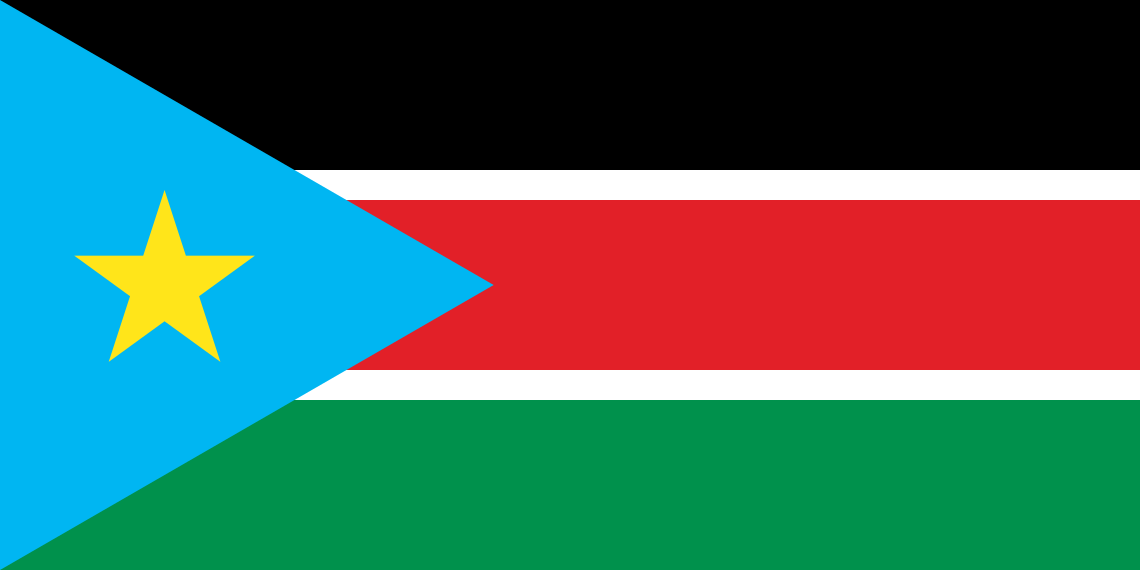
As this is the first time that my delegation addresses the Security Council during your presidency, Sir, permit me to begin by congratulating you, Mr. President, and your delegation on assuming responsibility for the month of August 2014. I wish you, Sir, every success in your leadership. I would like to assure you of the full support and cooperation of my delegation, particularly as the Security Council plans to travel to Juba in the coming days. I would also like to use this opportunity to thank Mr. Edmond Mulet, Assistant Secretary- General for Peacekeeping Operations, for his briefing, which provided more depth to the issues raised in the Secretary-General’s report (S/2014/537).
At this juncture, allow me, once again, to reiterate our commitment and faithfulness to the peace process, and to assure the Council that we are indeed determined to reach a final settlement of the conflict
through negotiation. The people of South Sudan have already experienced a lot of wars and suffering from conflicts. We cannot afford to prolong the current situation. Therefore, we are expecting the rebels to show seriousness and faithfulness in the negotiations.
As highlighted in the Secretary-General’s report, the situation in South Sudan is both difficult and dire. It is not something the Government of South Sudan wants. As documented in the report, His Excellency President Salva Kiir Mayardit, the elected Head of State, has expressed his willingness to form an interim/transitional Government in order to promote constitutional reform, national peace and reconciliation, as well as accountability mechanisms. He remains steadfast in the realization of those objectives.
It is in the best interests of the Government of South Sudan that, with the new round of discussions in Addis Ababa, the parties find renewed vigour in truly moving towards peace and alleviating the suffering of our people. We call on the Council and the international community to remind the rebels of the importance of adhering to the cessation of hostilities agreement signed on 23 January, the agreement signed on 9 May and the recommitment agreement, signed on the 10 June, which they have violated many times — thereby forcing the Government to react in self-defence to protect its citizens and the territorial integrity of the country.
We must also continue to thank the IGAD countries and partners for continuing to walk this path with us.
The Secretary-General’s report highlights, among many important elements, the challenges the Government of South Sudan has faced in undertaking various investigations and bringing them to a logical conclusion, where justice and accountability are the pillars and the goal. It is important for the international community to note that there may be, in fact, technical capacities missing in order to swiftly undertake forensic and legal proceedings. The Government of South Sudan has expressed its regret with regard to the frozen capacity-building efforts of the United Nations Mission in South Sudan (UNMISS) with regard to the organized forces and other rule of law institutions, which would be the pillars in driving this process.
While the Government is trying to do its best to contain the very difficult reality, it also needs help to achieve that. As a Government, we also continue to collaborate with the African Union Commission of Inquiry for South Sudan as a key element of
confidence-building, not only with the continent and the world but our own people as well.
I know that in the past there have been a lot of mistakes and misunderstanding between UNMISS and South Sudan, but the Government is willing to work with UNMISS and the United Nations as a whole.
I would like to conclude by saying that many of the elements set out in the Secretary-General’s report and the briefing provided to us by Mr. Mulet will be
discussed with the members of the Security Council. The Government of South Sudan commits itself to a frank conversation in order to jointly find mechanisms to help the people of South Sudan.
There are no more names inscribed on the list of speakers. I now invite Council members to informal consultations to continue our discussion on the subject.
The meeting rose at 10.20 a.m.