S/PV.7276 Security Council
Provisional
The meeting was called to order at 10.05 a.m.
Adoption of the agenda
The agenda was adopted.
Reports of the Secretary-General on the Sudan and South Sudan Report of the Secretary-General on the situation in Abyei (S/2014/709)

In accordance with rule 37 of the Council’s provisional rules of procedure, I invite the representatives of the Sudan and South Sudan to participate in this meeting.
The Security Council will now begin its consideration of the item on its agenda.
Members of the Council have before them document S/2014/728, which contains the text of a draft resolution submitted by France, the United Kingdom of Great Britain and Northern Ireland and the United States of America.
I wish to draw the attention of Council members to document S/2014/709, which contains the report of the Secretary-General on the situation in Abyei.
It is my understanding that the Council is ready to proceed to the vote on the draft resolution before it. I shall put the draft resolution to the vote now.
Vote:
S/RES/2179(2014)
Recorded Vote
✓ 15
✗ 0
0 abs.















A vote was taken by show of hands.
There were 15 votes in favour. The draft resolution has been adopted unanimously as resolution 2179 (2014).
I now give the floor to the representative of South Sudan.

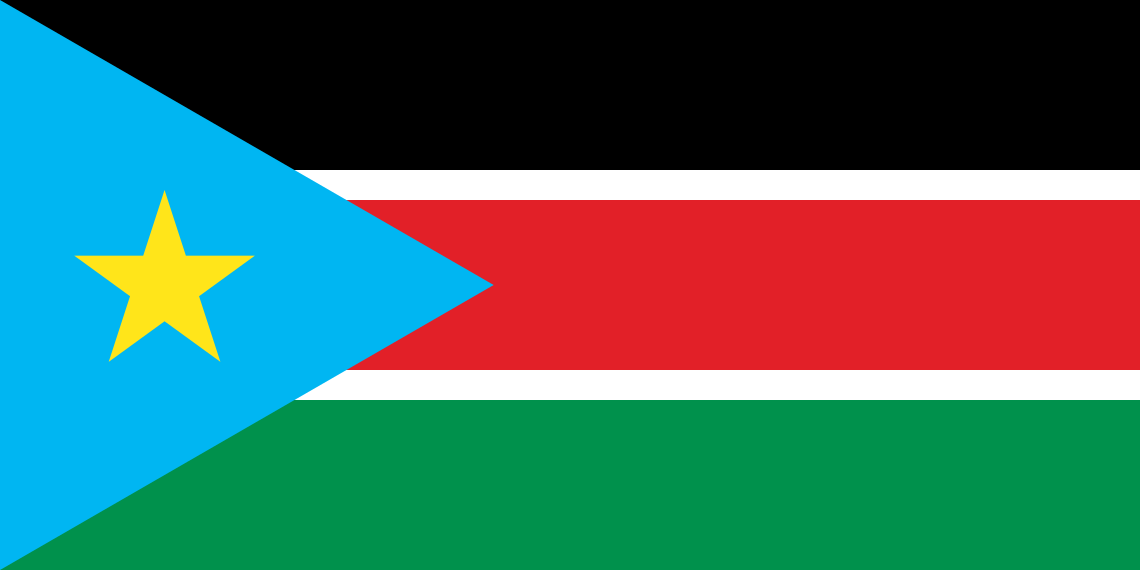
As this is the first time that I am addressing the Security Council during your presidency, Madam, allow me to express my congratulations to you and your delegation. I assure you of my delegation’s full support as you carry this important mantle. I also take this opportunity to
acknowledge your predecessor’s successful discharge of her leadership.
The Government of South Sudan welcomes the renewal of the mandate of the United Nations Interim Security Force for Abyei (UNISFA) that has just been adopted. I would like to take this opportunity to reiterate to the Security Council the appreciation of the people of Abyei and the Government of South Sudan for the continued support of the United Nations and the wider international community to both the Sudan and South Sudan in resolving their differences on the final status of Abyei through peaceful means. It is, however, evident, as reflected in the Secretary-General’s report (S/2014/709), that there is, regrettably, a prolonged impasse and that new and creative ideas must be sought in order to generate the required outcome.
The Abyei Protocol of the Comprehensive Peace Agreement refers to Abyei as the area where the nine Ngok Dinka chiefdoms settled prior to the 1905 annexation of the Area by northern Sudan. The Permanent Court of Arbitration, with the acceptance of both the Sudan and South Sudan, defined the Area, now commonly referred to as “the box”. The only thing that remains to be settled is the self-determination of the Ngok Dinka, on which the people expressed themselves unequivocally in October 2013, in their community referendum.
Although the Abyei community referendum was well organized and efficiently and transparently conducted, and resulted in a 99.8 per cent vote in favour of joining South Sudan, that vote has unfortunately not been recognized by the two Governments or the international community. As you know, Madam, a high- level team from Juba, comprised of the Chairman of the Abyei Referendum High Committee and two senior ambassadors, is now in New York — and, I believe, sitting just behind me — to advocate for the recognition of the results of the Abyei community referendum. While we hope that their efforts will bear fruits, we realize that such recognition will not be forthcoming.
It should, however, be recalled that the African Union (AU) Peace and Security Council, at its 405th meeting on 16 November 2013, reaffirmed its communiqué of 26 October 2013, which, among other things, reiterated its full acceptance of the proposal of the African Union High-Level Implementation Panel on Abyei and renewed its appeal to the United Nations Security Council to urgently support the proposal as the best way forward for the solution of Abyei. If the
results of the Abyei community referendum are not recognized, at least the proposals of the Panel should be pursued and implemented towards an internationally conducted and recognized referendum. Failure to act on these two grounds would create a tragic situation for the people of Abyei.
We are most appreciative of the Secretary-General’s observation that
“the people of the Abyei communities remain bereft of basic social services and vulnerable to ethnic violence. The status quo cannot continue” (S/2014/709, para. 31).
Along those lines, we strongly support the results of the recently conducted strategic review of UNISFA, aimed at developing “proposals for operational support ... in particular as they pertain to the stabilization of Abyei” (ibid., para. 28).
An important factor in the stabilization process is intercommunal dialogue, which, as the Secretary- General’s report notes, hinges on a number of issues. Foremost among those issues is the urgent need for the two communities to “find closure to the issue of the assassination of the Ngok Dinka Paramount Chief” (ibid., para. 34). A step in that direction should be the release of the report of the AU Investigation Committee into the assassination of the Chief, and holding accountable those who are found to be responsible. There is also need to address the dispute arising from cattle-rustling. We acknowledhe the Secretary-General’s “appeal to the leaders of both countries to ensure that a formal intercommunal conference begins as soon as possible” (ibid.), provided that a conducive climate is created.
In that context, it must be noted that, in addition to closure on the assassination of the Paramount Chief, the issue of armed Sudan oil police in Diffra, which is in violation of the 20 June 2011 Agreement and the relevant United Nations resolutions, must be resolved. The report of the Secretary-General states that UNISFA also observed the presence of small numbers of Sudan People’s Liberation Army personnel in southern Abyei, in contravention of the Agreement and Security Council resolutions. One way of addressing this tendency towards moral equivalency would be to send an investigation committee to verify the facts on the ground.
The Government of South Sudan welcomes the decision of the Secretary-General to appoint a civilian Head of Mission to aid in the pursuance of targeted
and effective humanitarian intervention to address the dire needs of the Ngok Dinka and to facilitate their recovery and cooperation with the Misseriya nomads. Such peaceful interaction and cooperation between the two communities would encourage Sudanese and South Sudanese to find acceptable and creative solutions on the resolution of the final status of Abyei. In this connection, both countries will need the support of the AU and the United Nations in addressing the security, political, humanitarian and development challenges in Abyei and for both the Ngok Dinka and the Misseriya nomads.
Finally, I would like to reiterate my Government’s profound appreciation for the support already being provided by the international community, particularly the Government of Ethiopia through its invaluable contributions to UNISFA, a crucial force for the security of the Ngok Dinka and other communities that come to the area seasonally.
I now give the floor to the representative of the Sudan.


I should like at the outset to thank and congratulate you, Madam, on your country’s accession to the presidency of the Security Council for this month. I also thank the Council members that worked so hard in the consultations on resolution 2179 (2014), which was adopted earlier, in order to reach a balanced, positive text that will promote the efforts being made to accelerate a political settlement of the final status of Abyei in accordance with the Protocol of the Comprehensive Peace Agreement and subsequent agreements signed by the parties, including the Agreement of 20 June 2011 and the African Union road map that was endorsed by the Security Council in resolution 2046 (2012).
We commend the provisions of resolution 2179 (2014) aimed at ensuring the timely settlement of pending issues and the final status of Abyei through negotiations that will obviate all unilateral actions. We also commend the provisions concerning the importance of conducting an intercommunal dialogue in order to preserve the historic coexistence of the communities of the Area. In that respect, we stress once again the commitment of the Government of the Sudan to the provisions of the 20 June 2011 Agreement and resolution 2046 (2012) concerning the importance of establishing administrative and security bodies, including a legislative council and a police force, as such mechanisms would pave the way for a political
settlement. In that respect, no attempt to circumvent these steps or to promote other possible solutions would achieve the desired political settlement, security or stability.
We commend the efforts being made by Ethiopia to establish security and stability in Abyei through its contribution to the work of the United Nations Interim Security Force for Abyei. We will spare no effort to help Ethiopia to implement its mandate.
Regarding the statements contained in the report of the Secretary-General before us (S/2014/709) about the decision concerning the forthcoming elections in the Sudan, we stress that as of now and until a final settlement is achieved, Abyei is an integral part of the Sudan. In that respect, it remains officially a district to be discussed in the negotiations. No entity claiming to represent Abyei unilaterally can help to promote the intercommunal dialogue being called for by the Council or to achieve a political settlement. As to the
force that is safeguarding the oil facilities in the region, the substantial presence of some 1,000 armed elements from the State of South Sudan in southern Abyei, as mentioned by my brother the representative of the Government of South Sudan, is a threat to stability in the region.
In conclusion, I reaffirm the readiness of the Government of the Sudan to pursue the negotiations. We hope that the visit of President Salva Kiir to the Sudan on Thursday will lead to measures that will help resolve the issue. We stress once again that dialogue and a political settlement are optimal solutions, and that no other option can achieve stability in the region.
There are no more names inscribed on the list of speakers. The Security Council has thus concluded the present stage of its consideration of the item on its agenda.
The meeting rose at 10.25 a.m.