S/PV.7282 Security Council
Provisional
The meeting was called to order at 10.05 a.m.
Adoption of the agenda
The agenda was adopted.
Reports of the Secretary-General on the Sudan and South Sudan Report of the Secretary-General on South Sudan (S/2014/708)

In accordance with rule 37 of the Council’s provisional rules of procedure, I invite the representative of South Sudan to participate in this meeting.
In accordance with rule 39 of the Council’s provisional rules of procedure, I invite the following briefers to participate in this meeting: Ms. Ellen Margrethe Løj, Special Representative of the Secretary- General and Head of the United Nations Mission in the Republic of South Sudan, and Ms. Zainab Hawa Bangura, Special Representative of the Secretary- General on Sexual Violence in Conflict.
On behalf of the Council, I welcome Ms. Bangura, who is joining today’s meeting via video-teleconference from Geneva.
The Security Council will now begin its consideration of the item on its agenda.
I wish to draw the attention of Council members to document S/2014/708, which contains the report of the Secretary-General on South Sudan.
I now give the floor to Ms. Løj.
Ms. Løj: I wish to thank you, Madam President, for the opportunity to present the latest report of the Secretary-General on the situation in South Sudan (S/2014/708). I will provide a brief update on the most recent developments since the report’s publication, on 30 September, and highlight some of the major challenges facing the United Nations Mission in South Sudan (UNMISS) at this time.
On the security front, small-scale skirmishes have continued between the two parties to the conflict. Two weeks ago, the opposition forces mobilized from the Canal area of northern Jonglei state and attacked and captured Doleib Hill, to the south of Malakal, in Upper Nile State. The Sudan People’s Liberation Army (SPLA) subsequently recaptured Dolieb Hill and pushed the opposition forces back into Northern Jonglei. In
Unity state, tensions remain high, particularly around the UNMISS protection site in Bentiu, with the SPLA continuing to allege that the UNMISS protection site is an opposition stronghold.
Outside of the traditional conflict zone, we are paying close attention to Lakes state, as intercommunal violence continues, which, in the most recent spate, left 30 dead in Rumbek Centre in early October. The Government is deploying additional security forces to Rumbek in an attempt to bring the security situation under control, and UNMISS is looking into ways to support the efforts of national authorities to end the violence and foster intercommunal reconciliation.
There was an outbreak of violence in Chukudum, Eastern Equatoria, this month between the SPLA and the local community, following the killing of an SPLA soldier by an unidentified attacker. Tensions are also continuing in Western Equatoria as a result of the influx of pastoralists from Jonglei and Lakes states, whose cattle are destroying the crops of the mainly farming communities in the Mundri area. On a more positive note, however, the Greater Pibor Administrative Area in Jonglei state remains calm and UNMISS and the United Nations country team are looking into ways to contribute to the consolidation of peace in the Area.
The humanitarian situation across the country remains dire. Over 1.8 million people have been displaced — 1.35 million internally and another 453,000 to neighbouring countries. Around 4 million people, close to a third of the population, are facing serious food insecurity. Aid agencies are working hard to support those in need, with over 3.2 million people having been reached with some form of humanitarian assistance over the course of the year. UNMISS will continue to support the humanitarian community to ensure the key needs of the people of South Sudan are met. During the dry season, requests are likely to increase for UNMISS to provide force protection to relief convoys and sites where relief is prepositioned and stored. The arrival of the remainder of the authorized surge capacity, including the proposed riverine capacity, will be key to respond to those needs. However, no amount of aid can solve the crisis or convince people to return home. Only peace and reconciliation can and, sadly, in the absence of both, the aid operation will have to be sustained if we are to continue to prevent the humanitarian situation from further deteriorating.
UNMISS continues to provide protection to about 100,000 internally displaced persons (IDPs) in nine of
its protection-of-civilian sites, including about 49,000 in Bentiu, 28,000 in Juba and over 18,000 in Malakal. To improve living conditions in UNMISS protection sites, UNMISS and humanitarian partners have invested substantial resources on existing site enhancements and the construction of new sites. In Juba, two thirds of the internally displaced persons — that is, over 10,000 — have been moved from the UNMISS base in Tomping to the new site in United Nations House. Within the Malakal site, almost 14,000 persons have been relocated to areas with improved living conditions, while construction work continues to accommodate the remaining 5,000 persons. In Bor, the relocation to the new site started on 9 October, with approximately 1,200 persons, about 40 per cent, relocated thus far. In Bentiu, prevailing physical conditions and the lack of financial and engineering resources have limited options for the reconstruction of a new site, but planning for necessary drainage and other works to be carried out during the dry season is ongoing.
The approaching dry season offers an opportunity to pursue sustainable solutions for the plight of the IDPs in our camps. The United Nations family in South Sudan is working on a comprehensive strategy for such sustainable solutions. In that regard, discussions are under way between UNMISS, United Nations agencies, the Government and all the relevant partners to commence the process of facilitating voluntary returns where security conditions allow. I would like to underline that any return will be voluntary and based on humanitarian principles.
With regard to the human rights situation, UNMISS continues to receive reports of gross violations of human rights, indicating that conditions remain unsafe for civilians in many parts of the country. In the Greater Upper Nile area, UNMISS investigated allegations of civilians killed in the context of hostilities in Renk during the latter half of September. Likewise, the Mission is monitoring closely the aggressive posture of the SPLA towards internally displaced persons sheltering in the UNMISS protection site in Bentiu. The recently adopted national security bill, if enacted into law, could also potentially further undermine fundamental rights and freedoms and narrow the political space in the country.
I must say that since I have been on ground, I have been shocked by the complete disregard for human life. Those responsible for committing atrocities and human rights violations must be held to account and
face justice. In that connection, I look forward to the findings of the African Union Commission of Inquiry on South Sudan.
As of 21 October, the UNMISS troop strength stood at 10,488 military personnel, and its police strength at 890 police officers, including 363 formed police unit personnel. With the arrival of additional troops, UNMISS has been exerting all efforts to expand its reach, including through the establishment of forward bases, proactive patrolling, both military and integrated, and, where possible, on foot, in order to provide protection to vulnerable civilians beyond the UNMISS premises.
The deployment of the remaining authorized personnel, as well as equipment, therefore remains vital for the Mission to more effectively deter violence against civilians. We therefore continue to work with our Department of Peacekeeping Operations colleagues and troop- and police-contributing countries to accelerate the process. I wish to thank all the troop- and police-contributing countries for their continued support to UNMISS and I urge them, as well as other Member States with the means, to help equip and accelerate the deployment of UNMISS personnel and resources.
The Mission continues its strong advocacy with all the relevant authorities to ensure unfettered freedom of movement and access for UNMISS peacekeepers and other personnel, particularly in areas at high-risk of conflict and with large displaced populations. Although the relations between the Mission and the national authorities have improved at the political level and the number of violations of the status-of-forces agreement has decreased over the past couple of months, violations continue.
In that respect, I am seriously concerned by the recent spate of unlawful arrests and detentions and abductions targeting United Nations and humanitarian personnel. Two of our national staff have remained in detention since August. On 10 October, three UNMISS individual contractors were abducted at Malakal Airport, two of whom have since been released, but the third person is yet to be found. On 16 October, a United Nations agency national staff member was abducted at Malakal Airport by unknown persons. I urge Government authorities to do everything within their power to see that the captured UNMISS individual contractor and the United Nations agency staff member are freed quickly and unharmed.
The monitoring and verification teams of the Intergovernmental Authority on Development (IGAD) continued to focus on monitoring and reporting on the cessation of hostilities violations. Eight IGAD monitoring and verification teams are now deployed, with one mobile team based in Juba and the Akobo team operating from Bor. UNMISS is providing the necessary support, including logistical and force protection, to facilitate the work of the monitoring and verification teams, which are vital for the monitoring of the cessation of hostilities agreement. It is important to encourage IGAD to continuously take stock of the operations of its monitoring and verification mechanism, especially the monitoring and verification teams, with a view to enhancing their effectiveness so that their presence can help reduce conflict on the ground.
There is no alternative to silencing the guns and concluding, without further delay, a comprehensive peace agreement in order to return the country to the path of peace and stability. This is the message I have consistently conveyed to all my South Sudan interlocutors, including President Kiir and opposition leader Riek Machar. I have told them that the guns must be silenced; peace cannot be delayed even for one more day. The untold suffering of the people of South Sudan must stop. After only six weeks in South Sudan, I am convinced that every day without a political agreement contributes to a further deterioration of the situation on the ground. This complicates the work of the Mission and risks negatively impacting the region. I therefore call on the Council, regional leaders and all friends of this young nation to remain fully engaged with the warring parties so that they make the necessary compromises required to translate their public statements of commitment to peace into actions on the ground. The people of South Sudan deserve no less.
I thank Ms. Løj for her briefing.
I now give the floor to Ms. Bangura.
Ms. Bangura: From 5 to 11 October, I conducted my first visit to the Republic of South Sudan. The circumstances that I witnessed, in particular in the fiercely contested town of Bentiu in Unity state, are among the worst I have ever experienced. The internally displaced persons (IDPs) seeking refuge there face a devastating combination of chronic insecurity, unimaginable living conditions, acute day-to-day protection concerns and rampant sexual violence. The
character of sexual violent crimes shocked me to my core, captured in the words of one survivor who told me, “It is not just about rape. It is to break your dignity; it is done to cause unimaginable suffering and destruction”.
My visit bears out reports that sexual violence in South Sudan is widespread, including acts of rape, gang rape, abductions, forced marriage and sexual slavery, and mutilation of sexual organs. These violations are being perpetrated by all sides in the conflict. Sexual violence predates the December 2013 crisis. However since the crisis, sexual violence attacks have reached an alarming level, expressed in a vicious cycle of retribution and revenge. I am gravely concerned about the ethnic dimensions, manifest particularly in targeting and reprisals between Dinka and Nuer communities.
Across the country, women live in appalling conditions. They have little or no access to medical services let alone access to justice. They have few opportunities to secure a livelihood for themselves and their families. Their views are not represented in Government or other crucial decision-making processes. One woman activist told me: “We are living under the rule of men, not under the rule of law”. When I visited the Juba Teaching Hospital, I was told that 75 per cent of survivors of sexual violence are girls under the age of 18. Their youngest victim is 2 years old, a girl completely destroyed by the rape she suffered. Civil society groups made me aware also of the acute vulnerability to sexual violence faced by women with disabilities.
The challenge of addressing sexual violence is complicated by a prevailing culture of silence and blame-game. This exacerbates other critical challenges such as acute lack of medical, psychosocial and legal services for survivors, lack of capacity of the police and the military to investigate sexual violence allegations, and a lack of capacity of the judiciary to prosecute perpetrators. At the legislative level, it is essential to harmonize customary and statutory law. As it stands, most sexual violence offences are decided under customary law systems, most often to the detriment of the survivors.
I believe that national Governments hold the primary legal and moral responsibility to protect their citizens from sexual violence and other grave violations. I am pleased therefore to announce that at the end of my visit President Salva Kiir and I signed a joint communiqué on addressing conflict-related sexual violence, in line with resolution 2106 (2013). I
am encouraged by this expression of political will at the highest level, and pledge the support of my Office and the United Nations System to the Government of South Sudan to implement the commitments outlined in that agreement. That includes the issuance and enforcement of clear orders through the military and police chains of command prohibiting sexual violence; developing concrete action plans specific to the Sudan People’s Liberation Army and the South Sudan National Police Service; fighting the impunity of perpetrators and ensuring survivors’ access to justice through reform and capacity-building in the justice sector; and ensuring the provision of appropriate services for survivors of sexual violence.
I urge the opposition to show a similar commitment and remind Mr. Riek Machar, leader of the Sudan People’s Liberation Movement in opposition, of the command responsibility he bears to prevent sexual violence being committed by the forces under his command. I urge Mr. Machar to issue without delay a communiqué that clearly outlines the prevention measures that they will put in place. In the name of the women and children that I met during my visit, I say this to the leaders of South Sudan: You cannot wage war against your own people. You cannot wage war on the bodies of the women and children of South Sudan. You must put people, not politics, at the centre of your relationships.
Although the international community can accompany the peace process, ultimately only the leadership of South Sudan can make peace. I implore them to stand in solidarity with the women and children of South Sudan, whose lives are being devastated every moment that they fail to reach a resolution to this crisis. I implore them to stand on the right side of history, and surely the international community will continue to stand with them.
I thank Ms. Bangura for her briefing.
I now give the floor to the representative of South Sudan.

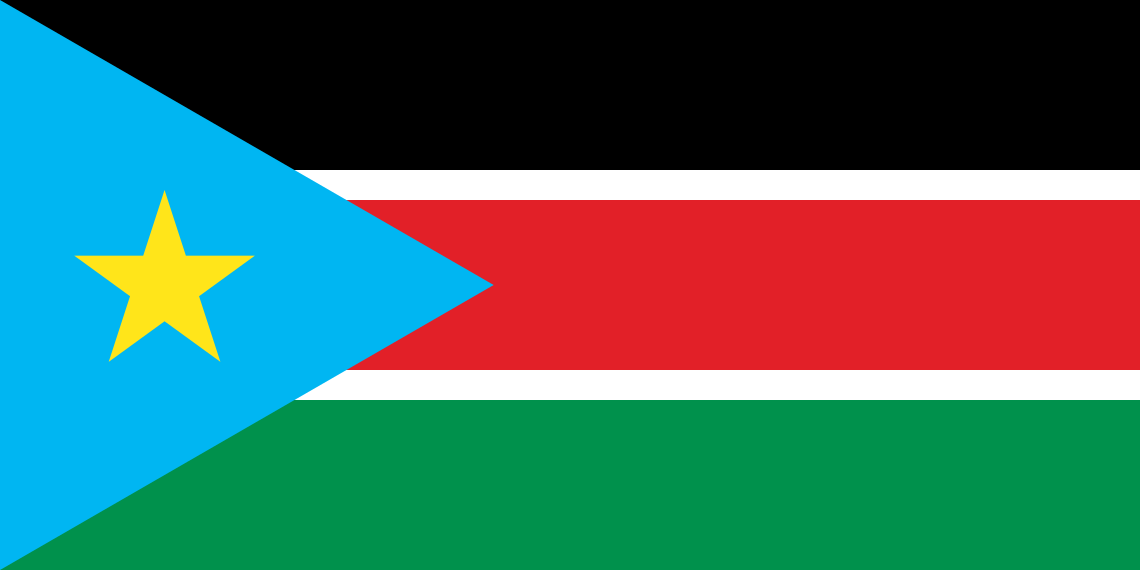
I express my appreciation to you, Madam President, for this opportunity to address the Security Council once again. It was only about one week ago that I addressed the Council on Abyei (see S/PV.7276). I realize that the frequency with which I am honoured to address the Council is a manifestation of the compelling crises in our country.
As I have repeatedly said, while it is painful to listen to accounts of what is going on in our country, I see no value in being defensive or in denial.
My remarks today will be very brief and will focus on a few salient points. I would first like to express appreciation for the Secretary-General’s report (S/2014/708), which, though it paints a very disturbing picture of the situation in our country, demonstrates his characteristic compassion for our people’s plight and his determination to mobilize international support for us.
I would also like to express our deep appreciation for the work of the two ladies we have just heard, Ms. Zainab Bangura, the Special Representative of the Secretary-General on Sexual Violence in Conflict, and Ms. Ellen Margrethe Løj, the new Special Representative of the Secretary-General for South Sudan. I have had the pleasure of interacting with both and have been impressed by the way they balance credibility and compassion in their accounts and assessment of the situation with sensitivity to the perspective of the national leadership. I would like to congratulate Ms. Bangura on her successful visit to South Sudan and on signing with President Salva Kiir a communiqué expressing the Government’s commitment to her mandate’s objectives. And although Ellen Løj modestly emphasizes how brief her time in the country has been, she has already made a positive impression on her interlocutors, especially in the way she balances sensitivity and diplomacy with candour in addressing the difficult issues. I believe that both have adopted an approach that constructively engages the authorities in a way that fosters productive cooperation. It is my strong belief that candour in dialogue need not conflict with a cooperative relationship.
Despite the devastation the conflict has wrought in our country, the prompt and supportive response of our subregional and regional organizations, and of the United Nations and the international community at large, is a commendable demonstration of shared responsibility for peacemaking and the protection of civilians from physical threats and humanitarian needs. I had the honour of accompanying members of the Security Council on their field visit to Malakal, where we saw internally displaced persons (IDPs) in a dire situation, living in wetlands and without sanitation. Members of the Council were deeply and visibly moved both by the conditions they saw and what the IDPs had to say. The challenges are formidable for South Sudan,
a country that had already been devastated by war for half a century before the latest outbreak of violence. South Sudanese society has not only been shattered, it has been heavily militarized by small but deadly arms that have been spreading for decades. That cancer must be urgently addressed.
It has been correctly noted that the current conflict is primarily a political rather than an ethnic one between Dinka and Nuer. However, its ethnic character has increased, both in perception and where there have been targeted killings, which have created deep cleavages between groups that otherwise have a great deal in common. Nevertheless, there are Dinkas and Nuers living peacefully side by side, and there are members of all groups in the national Government, as there are also ethnic representatives on both sides of the conflict.
In this conflict, leadership is of course critical to restoring peace, unity and reconciliation, but a great deal more must be done to sensitize the population to the challenge and promote a broad-based healing process leading to sustainable peace and national reconciliation. The recent intra-party talks in Arusha facilitated by President Jakaya Kikwete of the United Republic of Tanzania are an encouraging step towards putting South Sudan on the path to national healing, justice and accountability. It is also a significant complement to the peace process facilitated by the Intergovernmental Authority on Development.
As I have had occasion to listen to both Ms. Bangura and Ms. Løj, I have said that sexual violence and military exploitation of children are antithetical to our cultural values. In the traditional society in which I grew up and that I studied in depth, if a man committed any form of rape, he would have been so ostracized that he would have been forced to leave the community and migrate to an area where his background was unknown. In battles, women and children could not be harmed. Far from it — if a woman protected a wounded warrior, that man could no longer be targeted. What we are
witnessing now is a breakdown of the traditional social order and related cultural values. It is my opinion that we must reorient our people so that they can appreciate that current behaviour patterns in our country violate not only international norms but their own cultural values as well.
For historical reasons whose roots continue to feed into their current internal and cross-border conflicts, the Sudan and South Sudan are paradoxically bound together by conflict. We call on the international community to support the improving relations between the two countries and help them resolve their internal conflicts, since that is the only way their bilateral relations can be substantially grounded on a sound and constructive foundation.
On a different but related issue, while we appreciate the reasons for reconsidering the priorities of the United Nations Mission in South Sudan, we believe that capacity-building remains critical to assisting the country to live up to standards of good governance, respect for human rights and civilian protection. In particular, building the capacity of the police and associated security elements is vital if we are to achieve the objectives we would all like to see pursued.
Finally, while we recognize that there are many challenging issues to be resolved in our relationship with the United Nations and the international community, we remain deeply appreciative of our joint cooperation and would like to assure the Council of our willingness to continue to improve it.
Once again, I would like to thank you, Madam President, for giving me the opportunity to address the Council on this issue of vital importance to my country.
There are no more names inscribed on the list of speakers. I now invite Council members to informal consultations to continue our discussion on the subject.
The meeting rose at 10.40 a.m.