S/PV.7393 Security Council
Provisional
The meeting was called to order at 3.05 p.m.
Adoption of the agenda
The agenda was adopted.
Reports of the Secretary-General on the Sudan and South Sudan Report of the Secretary-General on the situation in Abyei (S/2015/77)

In accordance with rule 37 of the Council’s provisional rules of procedure, I invite the representatives of South Sudan and the Sudan to participate in this meeting.
The Security Council will now begin its consideration of the item on its agenda.
Members of the Council have before them document S/2015/134, which contains the text of a draft resolution submitted by the United States of America.
I wish to draw the attention of Council members to document S/2015/77, which contains the report of the Secretary-General on the situation in Abyei.
It is my understanding that the Council is ready to proceed to the vote on the draft resolution before it. I shall put the draft resolution to the vote now.
Vote:
S/RES/2205(2015)
Recorded Vote
✓ 15
✗ 0
0 abs.















A vote was taken by show of hands.
There were 15 votes in favour. The draft resolution has been adopted unanimously as resolution 2205 (2015).
I now give the floor to the representative of the Sudan.


At the outset, I should like to congratulate China on its accession to the presidency of the Security Council for this month.
This month has witnessed the review of the Security Council report on the situation in Abyei following the strategic review of the previous mandate of the United Nations Interim Security Force for Abyei (UNISFA), as well as debates over the renewal of the current mandate,
as adopted today in resolution 2205 (2015). I should like to convey my thanks and appreciation to our neighbour Ethiopia for its efforts to establish peace and security through UNISFA.
The resolution adopted today stresses in many of its provisions the importance of implementing the Agreement between the Government of the Sudan and the Sudan People’s Liberation Movement on temporary arrangements for the administration and security of the Abyei Area. It also stresses that the situation can be resolved only through dialogue between the two parties. We therefore express our gratitude for the adoption of the resolution. The 20 June 2011 Agreement, the 29 June 2011 Agreement between the Government of the Sudan and the Government of South Sudan on Border Security and the Joint Political and Security Mechanism, and the 30 July 2011 Agreement on the Border Monitoring Support Mission between the Government of Sudan and the Government of South Sudan, as well as the 27 September 2012 Agreements on Cooperation and Security Arrangements should all be implemented and respected. All of these agreements are a single package that should be applied without selectivity.
As Council members know, the Implementation Matrix for the agreements signed between the two parties has been referred to the Security Council and issued as an official Council document. We reiterate our commitment to implementing the agreements and we believe that the best way to resolve the situation in Abyei should begin with the Joint Political and Security Mechanism, as applied through the administration of the Abyei Police Service. Such a mechanism could fill any gap in the security and administrative level and settle the situation once and for all in order to achieve peaceful coexistance between the Misseriya and Ngok Dinka communities. There is no alternative to dialogue to resolve the situation in Abyei. We stress that the resolution adopted today warns against any unilateral measures to that end.
With regard to the provisions of the resolution regarding the preparations of the Government of the Sudan for the elections in Abyei, I stress that the situation is normal and should not be a source of concern. The Abyei Protocol and related agreements are very clear in that respect. Until the situation is resolved definitively, Abyei is part of the territory of the Sudan. All other constituencies in the Sudan are under similar arrangements, which fall within the purview of our sovereignty and do not conflict with our
commitment to settling the Abyei situation pursuant to the aforementioned agreements.
The resolution again stresses concern regarding the situation of Abyei. The draft paragraph relating to the referendum held by the Ngok Dinka community was originally much longer, but we believe that it is better as it is. However, we appreciate the fact that the Council has rejected all unilateral arrangements. We recall that when the Sudanese army withdrew from Abyei, it did so in accordance with our commitment to the agreements, the road map adopted by the African Union and Security Council resolution 2046 (2012), in which the African Union plan was adopted. At that time, we reaffirmed our commitment to implementing the agreements concerning Abyei and the border security arrangements, including the establishment of a demilitarized border zone, and to activating the Joint Border Verification and Monitoring Mechanism.
The Security Council understands that any attempt to impose unilateral and hasty procedures in Abyei or to manipulate the situation would be disastrous for Abyei and only further complicate the situation. We therefore hope that our brothers in South Sudan will address the situation and contribute to ending the paralysis, as we are committed to doing as we seek to establish cooperation and peaceful coexistence in order to help the two parties resolve the situation in a sustainable and peaceful way.
In that regard, we recall that the Sudan and President Omer Hassan Al-Bashir have sought to address the strife in South Sudan in a way that would help to restore stability and security there. Indeed, we are directly affected by the situation in South Sudan and are therefore eager to achieve stability there. Before the referendum was held on South Sudan’s self-determination, we understood that if that country were separated from us it would never move to another continent but would be our southern neighbour and connected to us forever and that we would therefore have to develop cooperative relations between the two countries and peoples.
During the course of the new UNISFA mandate adopted today, we are determined to achieve progress towards establishing security and administrative mechanisms in Abyei. We hope that a final settlement will be achieved there so as to restore peace and security.
I give the floor to the representative of South Sudan.

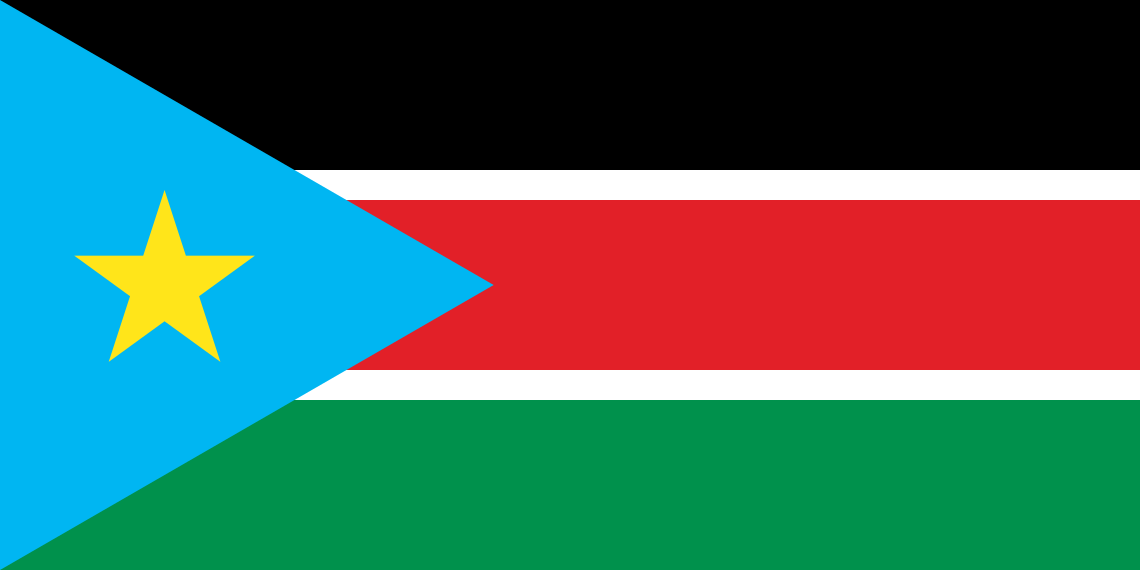
I am very pleased and honoured to address the Security Council again under your leadership, Sir, on an issue of great interest and concern to us as a country, and to me personally — that is, the crisis situation in Abyei. As I have spoken on numerous occasions on the situation in Abyei and the role of the United Nations Interim Security Force for Abyei (UNISFA), I will try to be brief in my statement.
We sincerely welcome the report of the Secretary- General (S/2015/77) and the renewal of UNISFA’s mandate by the adoption earlier of resolution 2205 (2015). Both the report of the Secretary-General and the resolution address issues that are critical to the security and the general welfare of the people of Abyei.
As I have repeatedly said, the deployment of UNISFA is perhaps the most significant positive development for the people of the area in decades. Abyei used to be exposed to unhindered attacks from the North that had led to the virtual depopulation of the area as people fled to the North and the South for safety. We are very grateful to the United Nations and the Federal Democratic Republic of Ethiopia for this major historical reversal of the situation. We also appreciate the role played by successive Force Commanders of UNISFA and their brave men and women in service. We take this opportunity to welcome the appointment of the civilian Head of Mission of UNISFA, whom we expect to work in close partnership with the Force Commander and other stakeholders in the Abyei situation.
While we acknowledge with great appreciation the positive role being played by UNISFA and the sustained commitment of the Security Council, the Secretary- General and the Secretariat to enhance the protection and welfare of the people of the area, I would like to take this opportunity to underscore a number of issues.
First, it cannot be overstated that although the Government of South Sudan and a number of international actors are doing what they can to provide assistance to the area, the people of Abyei are suffering from a vacuum of State responsibility for their protection and service delivery. Secondly, despite the heroic efforts of UNISFA, as the Secretary-General’s reports so credibly reflect, they continue to experience high levels of insecurity, with frequent killings, cattle looting and overall physical harassment. Thirdly, all this is done with absolute impunity. With all the murders
that have been committed in the area over decades, not a single culprit has been arrested, tried and punished. This has naturally deterred the displaced Ngok Dinka from returning to the area, despite repeated calls for them to do so. The international community is called upon to redouble its efforts to more effectively fill this protection and assistance vacuum.
A positive step in that direction must be identifying the sources of insecurity and threats to lives without ambiguity or moral equivalence. Although the last report of the Secretary-General has clearly and unequivocally exposed the attacks on the Ngok Dinka, the resolution unfortunately falls back on the old practice of evenhandedness that clouds the facts and the correlative responsibility. For instance, the language,
“strongly condemning the attacks on United Nations personnel, calling for investigations of these attacks in a swift and thorough manner and to hold those responsible to account” (resolution 2205 (2015), fourteenth preambular paragraph)
makes it sound as though these attacks are from both communities, which is not the case. Likewise,
“expressing its determination to prevent the recurrence of violence against or displacements of civilians and to avert intercommunal conflicts” (ibid., fifteenth preambular paragraph)
gives the impression that both communities are responsible, when it is well documented that the attacks in the area are one-sided. Again, “expressing concern over ... ‘the decision of the Ngok Dinka to conduct a unilateral referendum’”, while only “taking note that ... the Government of the Sudan is proceeding with the preparations for the organization of its national elections in Abyei” (ibid., eighteenth preambular paragraph) can hardly be called evenhandedness. Finally, “the denial of security clearances, and the tense security situation in the vicinity of Kadugli” (ibid., ninth preambular paragraph) is presented as a shared responsibility, when it is occurring within the Sudan. It is only by credibly identifying the source of problems that appropriate remedies can be found. We hope that future draft resolutions will take these concerns into consideration.
Although good will implementation of all agreements between the Sudan and South Sudan for resolving the Abyei situation is pivotal, the security of the area will ultimately rest on restoring the peaceful
and cooperative relations that used to exist between the Ngok Dinka and the Misseriya. While that state of affairs has been severely damaged by armed conflicts, compounded by the linkage of the two communities to Khartoum and Juba, with good will from the key stakeholders, the situation can be much improved and eventually normalized in the interest of all concerned. Steps need to be taken urgently to facilitate dialogue, reconciliation and cooperative coexistence between the Ngok Dinka and the Misseriya. In this connection, we welcome the call for measures aimed at bringing closure to the assassination of the Ngok Dinka Paramount Chief, including by releasing the report of the African Union investigation committee into the assassination, and facilitating traditional methods for resolving such conflicts.
While the traditional rights of seasonal access to water and grazing for the Misseriya must be reaffirmed and guaranteed, the reported plans and actions of the Government of the Sudan to resettle the Misseriya nomads in the Ngok Dinka territory, as defined by the Permanent Court of Arbitration in July 2009, must be stopped, as they only fuel tensions between the two communities. In the interim, until the current tensions ease, UNISFA should be commended for the measures it has taken to improve the security situation by establishing a disengagement line between the Ngok Dinka and the Misseriya during the dry season and determining safe routes for Misseriya’s passage to water and grazing.
A conspicuous source of insecurity in Abyei is the presence of the oil police in Diffra, whose Dinka name is Ker. Indeed, one of the incongruities in the area is the tendency to call many Ngok Dinka areas by the names given to them by the Misseriya nomads instead of their original Dinka names. Efforts have been made to correct this tendency without much success.
On the oil police specifically, we welcome the Security Council’s reiteration of
“its demands that immediately and without preconditions the Government of the Sudan redeploy the oil police in Diffra from the Abyei Area” (ibid., paragraph 10).
Instead, UNISFA should be mandated to control and protect the wells and the installations in the Area.
There is an urgent need to enhance the security of the area north of Abyei town, encourage the displaced
inhabitants to return to their original home areas, provide them with essential services and stabilize the situation, pending the resolution of the final status of Abyei. In this connection, we welcome with much appreciation the statement that the Council
“recognizes that absence of the development projects and the inability to deliver basic government services has had an adverse effect on Abyei populations and calls upon ... donors to support reconstruction and capacity-building” (ibid., paragraph 20).
Towards that objective, the Government of the Sudan should be urged to make available to the area the agreed percentage of the revenues from the oil produced in the Abyei Area and to agree on a mechanism for their control and disbursement.
The issue of the administrative vacuum in Abyei also needs to be urgently addressed. Abyei needs and deserves arrangements that will ensure autonomous self-administration for the Ngok Dinka, in much the same way the Misseriya administer themselves in their own area. This can then be complemented by special arrangements for addressing issues of mutual concern, such as is now the case with the Abyei Joint Oversight Committee.
To conclude, allow me to restate a point that I introduced earlier. Given the obvious lack of State protection and assistance for the Ngok Dinka of Abyei, the international community is urgently called upon to step in and fill the vacuum. Much has already been done and is being done, especially through UNISFA,
but a great deal more needs to be done. Abandoning the area can no longer be an option.
I give the floor to the representative of the Sudan to make a further statement.
I asked for the floor once again just to give some clarifications regarding the oil police around the Diffra oil complex. I would like to reaffirm, as we have already stated, that the oil police currently in Abyei is present pending the establishment of a joint patrol police. Once the Abyei Police Service has been established, we will withdraw the police that are currently there. These forces are stationed only around the oil complex.
With respect to the insecurity in Abyei, this is a cause for concern to us too, as Ambassador Deng has pointed out. We are working to create the necessary mechanisms because security is a problem for the other parties and for us alike. The Diffra oil complex has suffered three sabotage attempts in recent months. We have therefore had to maintain this unarmed police force there so as to provide symbolic protection for the oil complex. As soon as a police force to protect the oil complex has been put in place, we will withdraw the forces presently stationed in Abyei.
There are no further names inscribed on the list of speakers.
The Security Council has thus concluded the present stage of its consideration of the item on its agenda.
The meeting rose at 3.35 p.m.