S/PV.7444 Security Council
Provisional
The meeting was called to order at 3.05 p.m.
Adoption of the agenda
The agenda was adopted.
Reports of the Secretary-General on the Sudan and South Sudan Report of the Secretary-General on South Sudan (S/2015/296)

In accordance with rule 37 of the Council’s provisional rules of procedure, I invite the representative of South Sudan to participate in this meeting.
In accordance with rule 39 of the Council’s provisional rules of procedure, I invite Ms. Ellen Margrethe Løj, Special Representative of the Secretary- General and Head of the United Nations Mission in South Sudan, to participate in this meeting.
The Security Council will now begin its consideration of the item on its agenda.
I wish to draw the attention of Council members to document S/2015/296, which contains the report of the Secretary-General on South Sudan.
At this meeting, the Security Council will hear briefings by Ms. Margrethe Løj and His Excellency Mr. Carlos Olguín Cigarroa, Deputy Permanent Representative of Chile, in his capacity as representative of the Chair of the Security Council Committee established pursuant to resolution 2206 (2015), concerning South Sudan.
I now give the floor to Ms. Løj.
Ms. Løj: I thank you, Madam President, for this opportunity to present the latest report of the Secretary- General on South Sudan (S/2015/296), published on 29 April. I will focus my briefing on developments since then and on some of the major challenges facing the United Nations Mission in South Sudan (UNMISS) at this time.
The security situation further deteriorated during late April and May, with significant military action in Unity, Jonglei and Upper Nile states, in complete disregard of the cessation of hostilities agreement. That is very worrying, as it has had a devastating effect on the civilian population in those areas. Furthermore, an increasing number of reports indicate widespread human rights abuses, including murder, rape and the
harassment of civilians, including women, children and the elderly, as well as the destruction of civilian property and livelihoods.
Unity state currently constitutes the most serious situation, where we have reports of Sudan People’s Liberation Army (SPLA) advances and fighting as they push into southern Unity state towards Koch, Leer and Adok. That has necessitated that most humanitarian agencies and non-governmental organizations evacuate their staff, further aggravating the suffering of a large number of civilians. The flow of internally displaced persons (IDP) into the UNMISS camp in Bentiu — some 2,400 so far in May — and the general displacement of innocent civilians has continued.
I have issued a statement expressing concerns about the reports of serious human rights violations and reminding the parties of their obligations to abide by international human rights and humanitarian law, and to take all measures to ensure the safety of civilians and guarantee the safety of international aid organizations, United Nations personnel and assets.
In addition to the continuing clashes between Government and Opposition forces, fighting between Dinka and Shilluk militias, both affiliated with the SPLA, occurred in Malakal, Fashoda and Akoka, in Upper Nile state. The origins of the tension lie in a historic land dispute, but this has developed into a situation that has gotten out of hand. That has also led to the reversal of the trend in Malakal, which until recently saw the return of people to the town and the re-opening of local markets. UNMISS assisted the Government in sending a senior delegation led by the Shilluk King from Juba to Malakal to mediate and contain the conflict. Consultations between the two parties are still ongoing, but the situation remains tense, with potential for further clashes.
The fighting and tribal tensions in Upper Nile, Unity and Jonglei states are being felt inside the civilian sites protected by UNMISS. Not only are more IDPs arriving, but incidents of ethnic, political and tribal clashes have grown during the past two months. The most recent incident occurred in Juba from 10 to 12 May, when widespread fighting between Nuer Mayom and Nuer Mayendit IDPs led to two deaths and over 60 people injured. The UNMISS force and formed police units were able to restore order; however, tensions continue to grow. Although many of the Mayom IDPs left the camp, citing their inability to live with the rest of the IDP, UNMISS has since been able to promote
reconciliation, which has led to the return of some of the IDPs.
Outside of the traditional conflict zone of the greater Upper Nile region, UNMISS is also paying close attention to repeated occurrences of intercommunal violence in other states involving cattle-raiding incidents and revenge attacks in which women and children are often targeted. Lakes state in particular needs our attention, as the level of violence and casualties in the first three months of this year surpassed that associated with the fighting between the SPLA and the Opposition. UNMISS continues to explore ways to support efforts to end the violence and foster intercommunal reconciliation.
Against the backdrop of the prevailing insecurity and the significant increase in violence, the humanitarian situation is one of deepest concern. Over 2 million people remain displaced, with over 1.5 million internally in South Sudan and over 500,000 in neighbouring countries. Over 2.5 million people face severe food insecurity, especially in the greater Upper Nile region, and this figure will most likely increase significantly. UNMISS continues to provide support to humanitarian agencies to enable them to meet the primary needs of those at risk. UNMISS has provided force protection to relief convoys being used to preposition humanitarian and relief supplies ahead of the onset of the rainy season.
As of 6 May, UNMISS had provided protection to nearly 120,000 displaced persons in seven sites, including about 53,000 in Bentiu and 34,000 in Juba, and now nearly 29,000 in Malakal following the latest fighting in the area. UNMISS and humanitarian partners have invested substantial resources to improve living conditions in Bentiu and Malakal ahead of the rainy season. In Bentiu, despite severe physical constraints and limited financial and engineering resources, UNMISS and the International Organization for Migration have almost completed the construction of a new site with the necessary drainage to prevent flooding.
However, I should also highlight the unsustainability of those protection sites in the longer term. As recent events in Juba have shown, the longer the camps exist in their current form, tensions within the camps will increase. We are therefore experiencing a multitude of challenges at the sites, including crime, gang- related violence and disturbances based on ethnicity. Furthermore, it is critical that all humanitarian actors
do their utmost to provide services to people in need all over the country, and not only in the UNMISS protection-of-civilian sites. Attention must also be given to ensuring that those sites do not become magnets that attract people looking to avail themselves of the services available in the camps, rather than those needing physical protection.
The arrival of additional troops has permitted UNMISS to expand its reach, including through the establishment of forward operating bases, proactive patrolling and providing protection and reassurance to vulnerable civilians beyond UNMISS premises. Capacity and resource constraints, as well as deliberate obstruction by the parties, however, limit protection activities by UNMISS military personnel, in particular in hard-to-reach areas.
With regard to human rights, I continue to be shocked by the low level of respect for human life in South Sudan. UNMISS continues to receive reports of gross violations of human rights, indicating the unsafe conditions faced by civilians in many parts of the country. In the greater Upper Nile area, UNMISS investigated allegations of civilians killed in hostilities in Malakal, Akoka and Fashoda during April. We are also closely monitoring the aggressive posture of the SPLA towards internally displaced persons sheltering in the UNMISS protection site in Bentiu, where several people have been killed or injured. We will of course also do our utmost to investigate what has been happening in Unity state during the recent fighting.
On a more positive note, to date 1,757 children linked to the Cobra Faction have been demobilized. During my meeting with him on 28 April, the Chief Administrator and former Commander of the South Sudan Democratic Movement/Army Cobra Faction, David Yau Yau, assured me of his continued support to secure the release of the remaining child soldiers in his area. But as important as the release of child soldiers is, it is equally important to support vocational training and livelihood-related efforts to ensure that they do not relapse into joining another armed group. That effort will need donor support.
Despite assurances of cooperation and support at higher levels, we continue to experience restrictions and obstruction on the ground. I therefore urge the Government and the Opposition to renew their commitment to facilitate the work of the United Nations in South Sudan. In that respect, I am seriously concerned by the continued incidence of unlawful arrests,
detentions and abductions, including the targeting of United Nations and humanitarian personnel. As stated in the Secretary-General’s report, three World Food Programme national staff went missing on 1 April in Upper Nile state and have still not been found. The situation of the five United Nations staff I referred to in my statement in October (see S/PV.7282), including two missing persons and three in detention, remains unchanged.
UNMISS continues to provide support and assistance to the Intergovernmental Authority on Development (IGAD) Monitoring and Verification Mechanism through the Joint Technical Committee, both in Juba and in the field locations. Five IGAD teams have deployed to the states, and UNMISS is providing logistical and force protection support to facilitate their work. On 7 May, UNMISS uniformed strength stood at 11,302 military personnel, 1,103 police officers, including 492 formed police unit personnel. I wish to thank the troop- and police-contributing countries for their continued support. I urge them and other Member States to help equip and accelerate the deployment of UNMISS personnel and resources.
While the Mission has no mandate to facilitate the peace process, we are directly affected by the lack of progress in reaching a peace agreement. We had high hopes for a breakthrough earlier this year, and we are extremely disappointed by the parties’ inability to reach a compromise. There is no alternative to silencing the guns and concluding a comprehensive peace agreement in order to turn South Sudan towards the path of peace and stability. I have consistently conveyed that message to all interlocutors in South Sudan, including President Kiir and Opposition leader Mr. Riek Machar. The untold suffering of the people of South Sudan must stop. Every day without a political agreement contributes to further deterioration of the situation on the ground, leading to greater displacement and human misery and risking regional peace and security.
The economic situation in South Sudan is deteriorating, particularly in view of the decrease in oil revenues, heavy expenditure on defence and the inability of the Government to secure external financial support. The gap between the official and unofficial exchange rates of the United States dollar to the South Sudanese pound has widened and inflation is rising.
The situation will continue to worsen if conflict continues and external assistance is not forthcoming. The international community must find ways to support
the South Sudanese people to create an environment that eliminates the drivers of conflict and permits development. Enhanced support in critical areas such as health, education and food production will be essential to curtail the worsening economic situation in South Sudan — not only to prevent the collapse of the country’s social fabric but also to prevent insecurity from spreading to areas not directly affected by the overall conflict. We cannot wait for a comprehensive agreement before focusing on those long-term development imperatives.
In my recent meeting with the Women’s parliamentary caucus, I was greatly encouraged by the women’s yearning for peace and by their demand for South Sudanese leaders to rise above personal political ambition for the sake of future generations and to create a more cohesive nation. As they said, “Please help us dry the tears of the women of South Sudan.” I therefore call on the Council, regional leaders and all friends of this young nation to remain fully engaged to encourage the necessary compromise that will turn public statements of commitment to peace into action on the ground. UNMISS, together with its partners, remains committed to facilitating peace and security, delivering humanitarian assistance and laying the foundations for long-term development. The girls and boys and the women and men of South Sudan deserve no less.
I thank Ms. Løj for her briefing.
I now give the floor to Mr. Olguín Cigarroa.

It is an honour for me to address the members of the Security Council on behalf of the Chair of the Security Council Committee established pursuant to resolution 2206 (2015), concerning South Sudan. In accordance with sub-paragraph 16 (f) of that resolution, and based on the Council’s decision that the Committee should report on its work within a period of 60 days and whenever subsequently necessary in the view of the Committee, I would like to give a brief overview of the work that has been undertaken since the resolution was adopted, on 3 March.
On 20 March, one day after the President of the Security Council issued a note announcing the election of the Chair of the 2206 Committee and the election of the representatives of Malaysia and New Zealand as Vice-Chairs, the presidency distributed a copy of draft guidelines, a draft note verbale and a draft press release for feedback from delegations in accordance with
sub-paragraph 16 (e) and paragraph 17 of resolution 2206 (2015).
In those paragraphs, respectively, the Council decided that the Committee would establish the necessary guidelines to facilitate the application of the measures imposed and called on all Member States to inform the Committee within 90 days following the adoption of the resolution with respect to the measures they had implemented in compliance with the provisions of paragraphs 9 and 12 of the resolution, namely, the travel ban and the freeze on assets.
The draft guidelines, the draft note verbale and the draft press release were considered in an informal meeting held at the Permanent Mission of Chile on 24 March. The draft note verbale and the draft press release were officially approved at the first official meeting, held on 1 April. The Committee guidelines were approved on 20 April following a no-objection procedure.
With regard to the appointment of the Group of Experts, I wish to report that,, on 15 April the Committee distributed a letter from the Under-Secretary- General for Political Affairs that contained a list of five candidates, including experts on humanitarian affairs, finance and human resources, weapons, armed groups and regional affairs. On 22 April, a letter was sent to the Assistant Secretary-General indicating that the Committee had no objection to the proposed candidates. The appointment letter from the Secretary- General was published on 27 April as a document of the Security Council (S/2015/287). It is expected that the Group will be in New York between 18 and 22 May to conduct consultations and to meet with the Committee on 22 May, before travelling to the region to begin gathering, considering and analysing information in accordance with its mandate.
With respect to other meetings, on 28 April the Committee attended an information session held by the International Criminal Police Organization (INTERPOL) and the United Nations Mine Action Service (UNMAS), after which it issued a press statement. On 8 May, the Committee was briefed by Ms. Leila Zerrougui, Special Representative of the Secretary-General for Children and Armed Conflict, and Mrs. Zainab Hawa Bangura, Special Representative of the Secretary-General on Sexual Violence in Conflict. Following that meeting, a press statement was issued in which the members of the Committee acknowledged that, in accordance with the provisions
of sub-paragraphs 7 (d) and 7 (e) of resolution 2206 (2015), persons and entities could be subject to possible economic sanctions and travel prohibitions for actions such as attacks on civilians, including women and children; acts of violence, including assassination, rape or other forms of sexual violence; and the use or recruitment of children by armed groups or armed forces. The Committee looks forward to ongoing cooperation with INTERPOL, UNMAS and both Special Representatives as it carries out its tasks.
At the right time, the Committee also intends to meet with the representatives of South Sudan and other States in the region in order to exchange views on the sanctions that might be imposed in compliance with sub-paragraph 16 (g) of resolution 2206 (2015).
I also wish to take this opportunity to remind Member States that, in compliance with paragraph 17 of resolution 2206 (2015), the Committee looks forward to receiving, within the 90-day limit and no later than 3 June, reports regarding the travel ban and asset freeze. In that regard, I ask the members of the Council to practice what they preach.
Before concluding, I wish to indicate that although in recent weeks significant progress has been made regarding the establishment of the Committee and the Panel of Experts, the Committee is fully aware of the grave humanitarian and security situation in South Sudan. I note that in resolution 2206 (2015) the Security Council reiterates its intention to impose the appropriate sanctions to respond to this situation, which may include an arms embargo and the listing of senior officials responsible for acts or policies that threaten the peace, security or stability of South Sudan. This, in order to encourage the Government of South Sudan and Opposition forces to form a transitional Government of national unity, take effective and comprehensive measures to compel the forces under their control, directly or indirectly, to put an end to military operations, acts of violence and violations of human rights and to allow full access to humanitarian assistance.
The Chair recalls that, on 24 March, the Peace and Security Council of the African Union noted the adoption of resolution 2206 (2015). At the same time, it recalled its earlier pronouncements on the issue of sanctions against those undermining the quest for peace, violating international humanitarian law and obstructing the efforts of the United Nations Mission in South Sudan. The Chair also notes the statement of
the Chairperson of the African Union of 12 May, which highlights the importance of the
“effective implementation of sanctions against all those undermining the quest for peace, violating international humanitarian law and obstructing the efforts of peacekeepers on the ground, in line with the United Nations Security Council resolution of 3 March 2015.”
In that regard, paragraph 5 of resolution 2206 (2015) emphasizes the willingness of the Council to impose targeted sanctions in order to contribute to achieving an inclusive and sustainable peace in South Sudan. The Council entrusted to the Committee the task of gathering and reviewing information on persons and entities who may be responsible for, or complicit in, or who may have participated, either directly or indirectly, in acts or policies that threaten the peace, security or stability of South Sudan, in accordance with the provisions of paragraph 7 of resolution 2206 (2015).
In that regard, I wish to echo the call the Council makes in paragraph 19 of the same resolution, which urges all parties and all Member States, as well as international, regional and subregional organizations, to cooperate with the Panel of Experts. It also urges all Member States to guarantee the security of the members of Panel of Experts and their unhindered access, in particular to persons, documents and sites, so that the Panel of Experts can properly perform its mandate.
I thank Mr. Olguín Cigarroa for his briefing.
I now give the floor to the representative of South Sudan.

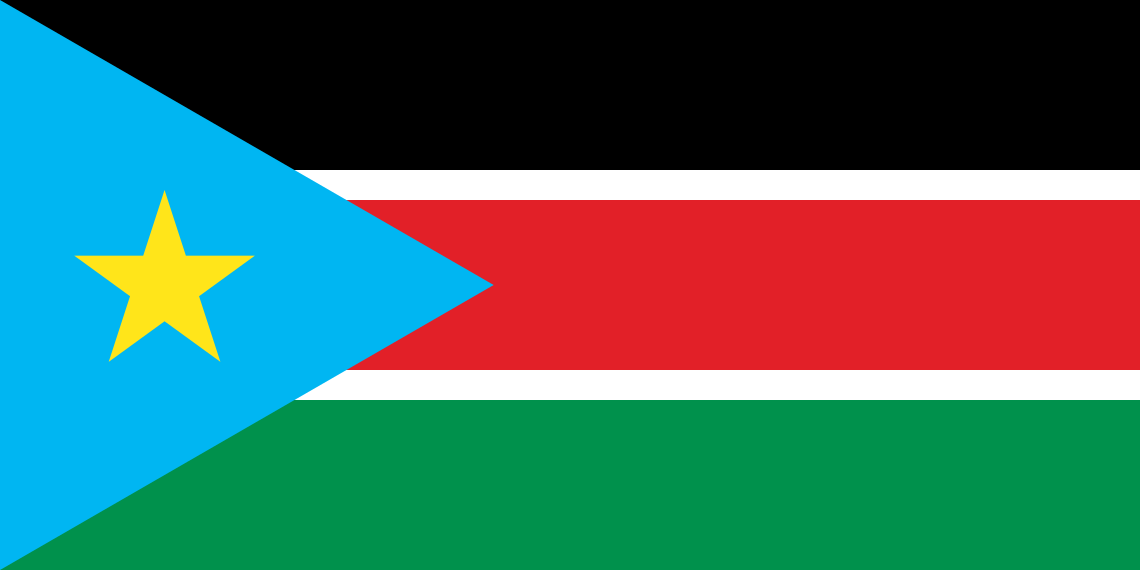
I thank you, Madam President, for giving me an opportunity to once again address the Security Council on an issue of great significance to my country. This being my first time to address the Council under your presidency, allow me to congratulate you, Madam, on your assumption of the leadership of the Council for the month of May, and to pledge our support and cooperation with you and your team. I would also like to commend your predecessor for successfully leading the Council during the month of April. I also want to express our appreciation for the work of the Special Representative of the Secretary- General in South Sudan, whose commitment, dedication and cooperative approach have gained her wide admiration in the country and internationally.
We have listened with obvious interest to the statement of the Chair of the Security Council Committee established pursuant to resolution 2206 (2015) on the progress of their work. We pledge our cooperation with the Chairman, his Committee and the Panel of Experts.
The frequency with which I address the Council is, needless to say, due to the grave crisis situation in my country. It is an honour I wish I did not need. This is a situation that confronts us with a dilemma. On the one hand, as I have often said, although we do not always agree, we realize that the Council’s sustained preoccupation with our country’s situation emanates from the concern of the international community about the tragic conflict in the country and its dire humanitarian consequences. We are sincerely grateful for that concern. On the other hand, however, it raises many issues on which we have genuine differences of opinion.
There can be no doubt about our common interest in restoring peace, security and stability in our country. We are all aggrieved by the death and suffering of our innocent people. Our differences therefore do not lie in the overriding goal of peace and the need to protect civilians, but in the methods of achieving them. For instance, the many allegations of gross violations of human rights and humanitarian law can be debated. In any situation where such allegations are made there are different perspectives, and therefore controversies. Moreover, it has been our principle not to be in denial nor to be defensive about allegations of human rights violations. As people who believe in the ideals of human rights, we have a common interest in fighting violations of human rights, while at the same time the details can create different perspectives on what actually happens on the ground.
On the other issue — namely, on sanctions and other punitive measures — if they were certain to facilitate and accelerate the achievement of peace, there would be no controversy over them. Our position has been that, rather than promote peace, they are likely to harden positions and generate confrontation. That would undermine the necessary cooperation on the peace process. We believe that the international community, both as a whole and as concerned individual members, has the moral authority and the leverage to exert pressure by engaging the parties constructively, rather than by antagonizing them through threats of punitive actions.
We also believe that the efforts of the Government, in particular President Salva Kiir, for the cause of peace are not being adequately recognized and rewarded. For a democratically elected leader confronted with a rebellion aimed at overthrowing him to have moved so fast from the outbreak of the rebellion to engage his adversaries in a dialogue for peace and to make the major compromises President Kiir has made is remarkable. Granting amnesty to those waging war against the State, inviting them to return and join the political process, even restoring them to their former positions in the leadership, not to mention agreeing to form a transitional Government of national unity and to share power with them, might strike some people as encouraging impunity, but they indicate a serious commitment to the quest for peace.
We acknowledge that pursuing peace requires engaging the warring parties with a degree of objectivity, impartiality and parity. But rights and wrongs, although never one-sided, are also never equal. The risk with moral equivalency is that the wrongdoer is equated with the wronged, and that cannot be a basis for finding a truly just solution.
We remain deeply appreciative of the Intergovernmental Authority on Development (IGAD) mediation efforts. Indeed, the speed with which those efforts were undertaken soon after the outbreak of hostilities in December 2013 was quite impressive. Since then, IGAD’s efforts have received sustained support from the African Union, the United Nations — in particular the United Nations Mission in South Sudan (UNMISS) — and a wide array of other international partners. However, the reports of the Secretary- General, his Special Representative and other United Nations bodies indicate that the challenge is formidable and calls for a redoubling of efforts. It is very painful to read the details of pervasive violence in the country, especially in the three most affected states. While some may see the glass as half-empty and others as half-full, restoring peace must be a top priority for the parties and international partners.
As I see it, history is about to repeat itself. The IGAD initiative in the early 1990s that eventually culminated in the 2005 Comprehensive Peace Agreement began with a very promising declaration of drinciples. With time, the process began to stall as regional partners began to differ among themselves. The process was then reinforced and reinvigorated by the friends of IGAD, who evolved into an IGAD partners forum, with the
troika of Norway, the United Kingdom and the United States playing a leading, and ultimately successful, role. It is now widely acknowledged that the IGAD mediation process is being severely challenged and is showing signs of exhaustion. It needs to be reinforced and reinvigorated. The fact that the principle of IGAD + 5 is being seriously considered is an encouraging sign, but it needs to be acted upon and even more needs to be done, and urgently.
We are also encouraged by what appears to be an increasing willingness to offer more capacity-building support in some critical areas in the new order of priorities for UNMISS, especially in the security sector. We have always said that, while it is understandable that the United Nations needed to reorder its priorities in the light of the current situation of conflict, capacity- building need not be viewed as a means of empowering the Government to be repressive or oppressive, but should be seen as a way of developing more responsible and responsive institutions of good governance that are capable of protecting the civilian population and ensuring their general welfare. We have been receiving very positive reports about the cooperation of the leadership of the police force with UNMISS. We welcome the prospects for increased collaboration to enhance the protection role of the security forces, particularly the police. Related to police services is the prison system, which desperately needs reform. Equally important is the judicial system and the qualification of the judges, especially in the light of the call for accountability. Those are some of the priority areas that call for capacity-building and support from the United Nations.
Finally, while the sanctions regime now appears to be in place and about to be operationalized, we still strongly advocate constructive engagement between the international community and the parties, in particular the Government. A great deal can be done through positive collaboration, while confrontation carries risks that can be counter-productive. Although war cannot be ended overnight by the actions of one side, I trust that an agreement on specific actions that the Government could take, with clear benchmarks, could encourage cooperation with the international community. A great deal of international goodwill has already been invested in South Sudan. It would be tragic if that were to dissipate, thus denying the people of South Sudan, who have already suffered from decades of devastation, the protection, assistance and development support they so desperately need.
There are no more names inscribed on the list of speakers.
I now invite Council Members to informal consultations to continue our discussion on the subject.
The meeting rose at 3.45 p.m.