S/PV.7532 Security Council
Provisional
The meeting was called to order at 11.20 a.m.
Adoption of the agenda
The agenda was adopted.

In accordance with rule 37 of the Council’s provisional rules of procedure, I invite the representative of South Sudan to participate in this meeting.
The Security Council will now begin its consideration of the item on its agenda.
Members of the Council have before them document S/2015/770, which contains the text of a draft resolution submitted by the United States of America.
I wish to draw the attention of Council members to document S/2015/654, which contains a letter dated 19 August 2015 from the Chargé d’affaires a.i. of the United States Mission to the United Nations addressed to the President of the Security Council, and document S/2015/655, which contains the report of the Secretary- General on South Sudan.
The Council is ready to proceed to the vote on the draft resolution before it. I shall put the draft resolution to the vote now.
A vote was taken by show of hands.















The draft resolution received 13 votes in favour, none against and two abstentions. The draft resolution has been adopted as resolution 2241 (2015).
I will now give the floor to those members of the Council who wish to make statements after the vote.

Given the need to pursue active international efforts towards a peaceful settlement to the armed conflict in South Sudan and the important role in that process being played by the United Nations Mission in South Sudan, Russia decided today not to stand in the way of the Security Council’s adoption of the resolution on the subject.
Nevertheless, we were unable to vote in favour of resolution 2241 (2015), since it fails to take into account certain serious concerns of the Russian Federation and other members of the Security Council. Inter alia, we cannot agree with the wording in the form of an ultimatum regarding sanctions against South Sudan. The use of such language in the resolution is inappropriate, as the resolution’s main purpose is to supplement the mandate of the peacekeeping mission with tasks aimed at facilitating the peace process, rather than to frighten the parties with the “club” of sanctions.
In principle, it is unacceptable when, instead of serious political and diplomatic work, certain colleagues prefer to arbitrarily make use of Security Council sanctions. A political settlement will not be helped by that. The South Sudanese parties need support and encouragement to implement the agreement and to settle the conflict in South Sudan, whereas the threat and use of sanctions will only harden their positions. We are also unable to agree with the wording regarding the Council’s intention to formulate any kind of assessment of the hybrid court in South Sudan, since, under the peace Agreement and the decisions of the African Union, the establishment and activities of that judicial body are the exclusive prerogative of the African Commission.
We are also against attempts to force South Sudan to accept the use by the Mission of unmanned aerial vehicles (UAVs), despite the repeated energetic objections by the Government of that country. The absence of Juba’s consent could result in problems if UAVs are deployed and operated. The wording in that regard effectively undermines the State sovereignty of South Sudan and is therefore unacceptable to a number of Security Council delegations. Also inappropriate are calls on the part of the sponsors of the resolution for the Council to agree to those intrusive provisions just because the Secretariat requests them. We do not think that the recommendations of United Nations officials
represent an obligatory action manual for Member States or the Security Council.
Finally, we have long had serious concerns about the working methods of certain colleagues in the Security Council who, in the furtherance of their national interests, try to push through resolutions that ignore the legitimate concerns and redlines of other delegations. Such practice is at odds with the calls of those colleagues for more democratization and greater openness in the Council’s work.

China voted in favour of newly adopted resolution 2241 (2015) on adjusting the mandate of the United Nations Mission in South Sudan (UNMISS). Under the active facilitation efforts on the part of the Intergovernmental Authority on Development (IGAD) and other international partners, parties to the conflict in South Sudan formally signed the agreement on resolving the conflict in South Sudan. The peace process in South Sudan has therefore entered a new stage. China welcomes that development. We appreciate the tremendous efforts undertaken by the African Union (AU) and IGAD in that regard.
It is China’s hope that resolution 2241 (2015) will play a vigorous and constructive role in moving South Sudan towards the early achievement of peace and stability. The current imperative is to support the efforts of the AU and IGAD, urge all South Sudanese parties to honour their ceasefire commitments in an effective manner and comprehensively implement the provisions of the agreement on schedule, firmly support the role of IGAD as the main conduit of good offices and actively provide assistance to IGAD in monitoring the implementation of the agreement.
On the question of sanctions, China has always maintained that the Security Council should exercise caution. The Council’s actions on South Sudan should consider the broader picture of the peace process in South Sudan and facilitate the implementation of the Agreement by all parties and the prevention of confrontation and conflict. China notes that the concerns of certain members of the Council with regard to the draft resolution have not been completely met. We believe that the Security Council should have spent more time on broad consultations so as to maximize efforts to seek a consensus, maintain the unity of the Council and ensure the successful implementation of the resolution.

Nigeria voted in favour of resolution 2241 (2015), renewing the mandate of the United Nations Mission in South Sudan (UNMISS), because we acknowledge the role of the Mission as vital to stabilizing South Sudan. The tasks of the Mission are clear: to protect civilians, to monitor and investigate human rights, to facilitate the delivery of humanitarian aid and to support the implementation of the ceasefire and the Agreement on the Resolution of the Conflict in the Republic of South Sudan. Those are without a doubt essential tasks that, in the current circumstances, only UNMISS can perform. We welcome the adoption of the resolution, which sends a message of support to the brave men and women of UNMISS working in very challenging circumstances to save lives and contribute to the peace process in South Sudan.

The Bolivarian Republic of Venezuela has supported and will continue to support the efforts of the parties to the conflict in the Republic of South Sudan to end the fratricidal war that has led to the suffering in the youngest nation in the world. We also reiterate our support for the work done by the regional authorities, such as the Intergovernmental Authority on Development (IGAD) and the African Union, as well as the brotherly countries of the continent seeking African solutions to African problems. It was thanks to this desire for peace that the Agreement on the Resolution of the Conflict in the Republic of South Sudan was signed in August, and which our country welcomed with hope. Everyone in this Council should support the Agreement.
Furthermore, we wish to express our gratitude and ongoing support for the work being done by UNMISS, whose personnel have delivered a valuable service in protecting civilians, particularly the most vulnerable, such as women and children, and in providing humanitarian assistance.
Nonetheless, our country decided to abstain in the voting on resolution 2241 (2015) because we believe that it contains elements that unnecessarily divert the focus of attention from its main objective, which is to adapt the work of UNMISS to the terms established in the Agreement and to contribute through the Mission to creating conditions that will allow the Government and the South Sudanese opposition to take part in the process of negotiations.
In the case of South Sudan, a resolution that will help make UNMISS an instrument to promote the implementation of the Agreement should not include provisions that could be counterproductive to achieving peace. That is why we abstained. Other reasons are the references to targeted sanctions and a definition of the protection of civilians that is not generally found in contemporary peacekeeping mandates. The inclusion of equipment, such as unmanned aerial vehicles, has generated opposition within the South Sudanese State with respect to safeguarding its sovereignty. The mention of the hybrid court for South Sudan could create confusion over the provisions of the Agreement promoted by IGAD and the African Union. We believe that no peacekeeping operation should act without the consent of the host Government to all aspects of its action, in this case of the Government of South Sudan.
We regret the fact that the spirit and unity that should characterize the work of the Security Council was not achieved in this case, and that many of the observations and comments that were made in the discussion of the resolution did not receive proper attention. The sponsors instead preferred a controversial text.

Earlier this week, the outgoing head of the delegation of the International Committee of the Red Cross in South Sudan described the horrific attacks — including rape, abduction and murder — that his teams have observed in that country. Let me read some of what he told a reporter:
“Civilians have been directly targeted, houses are burned, properties destroyed and the people are literally running for their lives.”
“We went to one village to distribute aid and our teams were told they had been attacked some days earlier, and 90 women had been abducted. After several days, only about 60 of them came back.”
“Women have been attacked while they have been seeking refuge. Those who are abducted may be forcefully married, enslaved or killed.”
Again, that is the account of the outgoing head of the delegation of the International Committee of the Red Cross, an institution that is known for its neutrality. It aligns with similar reports from multiple sources — journalists, human rights groups, humanitarian workers, United Nations staff and others — of widespread atrocities against civilians, and in particular against women and girls.
We are here today to support the hard-earned Agreement on the Resolution of the Conflict in the Republic of South Sudan, and to respond to the fighting that persists in spite of repeated pledges by both sides to commit to peace. Resolution 2241 (2015) is the beginning of a process to ensure that the United Nations Mission in South Sudan (UNMISS) has the tools it needs to support the implementation of the peace Agreement, which is essential to ending the cycle of violence in South Sudan.
Let me briefly highlight what thie resolution does. The resolution amends the UNMISS mandate to undertake a series of immediate steps to support the peace Agreement. No changes have been made to the Mission’s core tasks of protecting civilians, monitoring and investigating human rights abuses and violations, and creating conditions in which humanitarian assistance can reach people in need. The resolution asks the United Nations to provide, within 45 days, an assessment and recommendations to improve UNMISS civilian and force-structure capabilities so that the Mission can help implement the peace Agreement and the core tasks of its mandate. That review is essential for the Mission to better address the growing numbers of people in protection-of-civilian camps, the hundreds of thousands of South Sudanese in need of assistance, and the ongoing violations of human rights and international humanitarian law, which must be rigorously documented and whose perpetrators must be held accountable.
This resolution reflects the consensus we witnessed on 29 September at the high-level meeting on South Sudan, convened during the General Assembly’s high- level week, when the international community spoke in a single voice about the critical importance of the signatories and other stakeholders fully supporting the implementation of the peace Agreement. However, while the resolution reflects that consensus and is focused on ensuring that UNMISS can fulfil its role in supporting the peace Agreement, some have attempted to distract from its aims. Therefore let me briefly respond to some of those criticisms.
The resolution expresses our continued commitment to maintain pressure on both sides, neither of which has fully complied with its ceasefire obligations. That is fully consistent with the strong warning issued by the Peace and Security Council of the African Union in its communiqué of 26 September
“that it will not tolerate any further violations and, in line with its previous pronouncements, expresses its determination to impose measures against all those who would impede the implementation of this Agreement”.
The resolution makes clear our shared responsibility to ensure that the United Nations Mission in South Sudan is adequately equipped to fulfil its mandate in support of the peace Agreement.
Eight of the 15 countries represented on the Council, including the United States, have troops or police serving in UNMISS. If we are going to ask peacekeepers to risk their lives to protect civilians, monitor ceasefires and fulfil other duties under a mandate the Council has adopted, then surely it is our collective duty to ensure that they have the tools and technological capabilities needed to fulfil their mission and do so safely. The Department of Peacekeeping Operations has told the Security Council precisely what it needs in order to keep troop and police contributors safe and empower them to do their job. It is incumbent upon the Council to deliver, as we have. History has repeatedly demonstrated how dangerous it is to deploy peacekeepers who are not adequately equipped to do what is asked of them.
Finally, the resolution affirms the Council’s unwavering commitment to advancing accountability for the crimes that have been perpetrated against the people of South Sudan, including by providing support to the accountability mechanisms outlined in the peace Agreement. In this respect, the resolution responds directly to the 26 September request of the Peace and Security Council of the African Union, which asked the United Nations Security Council to support and assist its efforts to promote justice.
In the context of this horrific conflict, justice is not a choice — it is a necessity. Ensuring that perpetrators are punished for their abuses and that victims have access to justice is an essential part of building a lasting peace, not an obstacle to it. The hybrid court proposed by the Agreement could play an important role in that effort, and the resolution reaffirms the Security Council’s commitment to staying involved in the development of that institution.
In conclusion, we know the profound stakes of securing peace in South Sudan. We have witnessed the devastating consequences of the violence — in the words of that Red Cross officer, of women and girls
being abducted and raped and of people “literally running for their lives”. It is the welfare of the South Sudanese people — a people who have already endured so much — that drove our collective efforts to support a peace Agreement, to press the warring parties to abide by their commitments, and to see that United Nations peacekeepers are equipped to do their part in its implementation. This resolution continues that important effort.

Today we have adopted resolution 2241 (2015) to reconfigure the mandate of the United Nations Mission in South Sudan (UNMISS), taking into account the signing of the Agreement on the Resolution of the Conflict in the Republic of South Sudan by the South Sudanese parties and the international stakeholders, in particular the Intergovernmental Authority on Development. This was possible thanks only to the cooperation of all the members of the Council.
We voted in favour of the resolution despite the fact that, as we have said, the fragile Agreement just signed is aimed at ensuring a ceasefire and the end of violence in South Sudan. It is not a perfect document, but it is the basis for the current discussions between the parties. The Council needs to continue to keep a very close watch on the parties and listen to their concerns and reservations if it is to be of assistance instead of creating new problems that could create a situation that we would have to address when it comes to the implementation of the Agreement.
Our vote today expresses our support for the mission of UNMISS and the troops, despite the differences of views among the members of the Security Council on a number of issues, including the use of unmanned aerial vehicles, the balance between accountability and reconciliation, the role of the United Nations in the establishment of the hybrid court and the adoption of the new configuration. The question of sanctions remains very sensitive, and I think that the Council will have to address it with extreme care in order to avoid creating problems rather than resolving them.
We believe that the actions of the Council should be in support of the discussions of the African Union Peace and Security Council, which is the main partner of the Security Council in matters related to international peace and security and stability in the African continent.
I give the floor to the representative of South Sudan.

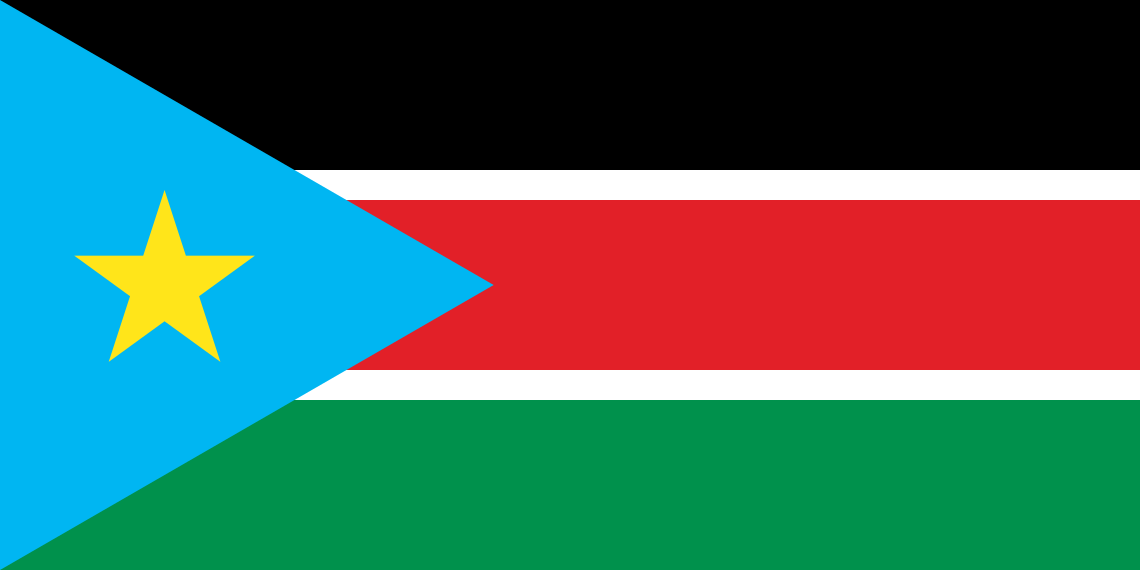
Since this is the first time that I am speaking to the Council under your presidency, Sir, I would like to congratulate you on your leadership of the Council this month and pledge our full cooperation. I would also like to acknowledge the role of your predecessor in leading the Council last month.
It has been a while since I addressed the Security Council on the tragic situation afflicting my country. I take this to be a good sign of improvement of our situation and our relations with the United Nations and the Security Council following the conclusion of the Agreement on the Resolution of the Conflict in the Republic of South Sudan, brokered by the Intergovernmental Authority on Development (IGAD). We welcome today’s renewal and extension of the mandate of the United Nations Mission in South Sudan (UNMISS ) for 90 days, during which the Mission is called upon to conduct an evaluation of how best to improve the mandate in light of the recently signed peace Agreement. This is a welcome move.
Our consistent support for the extension of the UNMISS mandate is an indication of our appreciation of the contribution the Mission is making in our country. Despite differences on some issues and the manner of implementation of the mandate, we have always recognized that we share the same objective of consolidating peace, security and stability in our country as prerequisites to the reconstruction, rehabilitation and socioeconomic development of a country that has been devastated for far too long by chronic wars.
It was our hope that at this critical juncture, when the peace Agreement is bringing the warring parties together and gaining the support of the international community, the Security Council and the international community will engage the Government of South Sudan constructively on all matters related to peace, security, the protection of populations, human rights and humanitarian issues, and promote close cooperation with the peacekeepers. In this connection, we recall resolution 2086 (2013), which reaffirms the basic principles of peacekeeping that require impartiality and the consent of the parties. It is in this light that we hope that the Council will seek the consent of the Government of South Sudan during the implementation of some of the provisions of the mandate adopted today.
These issues naturally call for close consultation between the United Nations and the Government, and that is precisely what the Government requested of the United Nations. It is therefore unfortunate that the resolution has been adopted without consultation with the Government. It is particularly regrettable that issues on which the South Sudan Government had made its position clear have been adopted without regard to the Government’s point of view. I refer specifically to operative paragraph 10, which
“Requests the Secretary-General to prioritize the complete deployment of UNMISS personnel to the authorized military and police strength, including tactical military helicopters and unarmed unmanned aerial vehicles”.
It is well known that the Government considers these to be contested issues, and to include them without consultation with the Government is to invite controversy and potential disagreement and hostility, when harmony and cooperation are what the situation calls for. Furthermore, they undermine the lofty principles expressed in the second preambular paragraph, which states that the Security Council is
“Reaffirming its strong commitment to the sovereignty, independence, territorial integrity and national unity of the Republic of South Sudan, and recalling the importance of the principles of non-interference, good-neighbourliness and regional cooperation”.
The Government of South Sudan reaffirms its commitment to working with UNMISS and the international community at large. We would like to thank the troop-contributing countries and all the men and women of the civilian, military and police components of UNMISS for their tireless and courageous efforts to execute their mandate even under difficult circumstances. South Sudan also deeply appreciates the support that the international community rendered in its liberation struggle, which culminated in independence, and the goodwill demonstrated by the United Nations and many nations that resulted in the creation of UNMISS.
The Government of South Sudan is most grateful for the efforts of the “IGAD-Plus” initiative, which has resulted in the signing of an agreement, as well as for the role that the Chama Cha Mapinduzi, the African National Congress party and other friends of South Sudan have played in reunifying the Sudanese
People’s Liberation Movement. We call on the Council, the international community and all friends of South Sudan to support the parties rather than making threats and proposing punitive measures, which, as we have repeatedly stated, only aggravate the situation and may tend to harden positions in the direction of confrontation rather than cooperation.
South Sudan now desperately needs the support of the United Nations and the international community if it is to achieve credible implementation of the peace Agreement. It is also time for them to focus once again on the initial objective of providing South Sudan with a comprehensive programme of assistance in a variety of areas related to peacebuilding, including ensuring security, building governance capacity, delivering essential services and generating socioeconomic development. That was indeed the message of the high-level side event organized by the Secretariat on 29 September 29 and chaired by the Secretary-
General and Deputy Secretary-General. It is time for the United Nations and the international community to engage with the Government of South Sudan on that positive, constructive agenda, instead of making negative threats of sanctions and punishment, which can only undermine cooperation and the possibility of our country’s optimistic march towards peace and reconciliation.
I am a strong believer in cooperation rather than confrontation. I also believe in the power of optimism rather than pessimism. We hope and trust that there will be much improvement in the efforts to achieve a more effective, constructive dialogue with UNMISS and the Security Council in the implementation of the Mission’s vitally important mandate.
There are no more names inscribed on the list of speakers.
The meeting rose at 11.55 a.m.