S/PV.7840 Security Council
Provisional
The meeting was called to order at 4.05 p.m.
Adoption of the agenda
The agenda was adopted.
Reports of the Secretary-General on the Sudan and South Sudan

In accordance with rule 37 of the Council’s provisional rules of procedure, I invite the representative of the South Sudan to participate in this meeting.
The Security Council will now begin its consideration of the item on its agenda.
Members of the Council have before them document S/2016/1066, which contains the text of a draft resolution submitted by the United States of America.
The Council is ready to proceed to the vote on the draft resolution before it. I shall put the draft resolution to the vote now.
Vote:
S/RES/2327(2016)
Recorded Vote
✓ 15
✗ 0
0 abs.















A vote was taken by show of hands.
The draft resolution received 15 votes in favour. The draft resolution has been adopted unanimously as resolution 2327 (2016).
I shall now give the floor to those members of the Council who wish to make statements following the voting.

Last month, the Special Adviser on the Prevention of Genocide, Mr. Adama Dieng, warned the Security Council that there was a strong risk of violence escalating along ethnic lines, with a potential to spiral into genocide. Just this week, the head of a team of United Nations human rights investigators in South Sudan echoed Dieng’s message, saying that South Sudan is on the brink of an all-out civil war, which could destabilize the entire region.
The horrors facing the South Sudanese people are extraordinary. We know that 7.5 million people — 75 per cent of the population — are in desperate need of humanitarian assistance. That is not the only appalling condition in South Sudan. Rape has also been an element of an apparently intentional strategy for terrorizing and punishing the population. What all that tells us is that the status quo in South Sudan is unbearable and cannot persist.
Today, the Security Council has taken a necessary and important step in helping address that bleak situation. Today’s resolution 2327 (2016), unanimously adopted, urges parties to return to the peace process as the primary means of ending the conflict. The resolution also ensures, in the face of the heightened tensions I have described, that the United Nations Mission in South Sudan (UNMISS) has the necessary tools to carry out its core mandate — the protection of civilians.
The resolution decides to continue the deployment and full operationalization of the 4,000-strong Regional Protection Force, which we first mandated four months ago, and it responds to the Secretary-General’s request to increase the number of police assigned to UNMISS. Both of those steps are intended to strengthen the Mission’s ability to protect civilians. The resolution also retains the other key responsibilities of UNMISS, including the monitoring and investigating of human rights abuses and violations and creating the security conditions for humanitarian assistance to reach all those who need it.
Furthermore, the resolution calls on peacekeepers to do more to prevent and respond to sexual violence and urges the United Nations to incorporate lessons learned from the attacks on the protection of civilians sites in Malakal and Juba. In that regard, we note our expectation that the United Nations will implement reforms to better enable the Mission to protect civilians and will report to the Council on its progress.
The resolution is a reflection of the briefings we have heard over the past few months from high-level United Nations officials on the deteriorating situation in South Sudan and is focused on ensuring that UNMISS has the right mandate and has the tools it needs to implement it. The resolution expresses our continued commitment to considering the use of sanctions and an arms embargo as tools to reduce the ability and incentives of those who attack civilians and derail the peace process.
While some have argued that those measures would be counterproductive or irrelevant, we cannot think of a more appropriate measure than an arms embargo that would impede the flow of arms, particularly heavy weapons, to a Government intent on pursuing violence at the expense of its people and to rebel factions that aim to disrupt the peace agreement.
Similarly, we believe that targeted sanctions can be an effective tool in sending a message from the Council about our disapproval of leaders, on both sides, who are responsible for inciting violence in South Sudan. We are prepared to support imposing such measures in response to the worsening violence that includes Government offences, the Government’s ongoing obstruction of UNMISS and the regional protection force — despite pledges to the contrary — and the role played by individual actors in perpetuating the cycle of violence in South Sudan.
South Sudan is on a precipice. The country can return to the peace process towards greater stability or allow further violence to devolve into outright ethnic war. We have already seen a glimpse of what the high cost of the latter would be, with reports of thousands of women and girls having been raped and gang-raped, people fleeing their homes en masse and the spectre of widespread hunger following a disruption of normal agricultural production due to continued conflict.
With resolution 2327 (2016), the Council recognizes those high stakes and commits to trying to return the country to peace and stability.

The Russian delegation supported resolution 2327 (2016), based on the need to pursue active international efforts for a peace settlement of the armed conflict in South Sudan, and the important role played in that process by the United Nations Mission in that country. However, we are compelled to note that the sponsors, as they have done with certain other Council resolutions on South Sudan, again failed to take on board a whole string of serious concerns of the Russian delegation and several others. In the text of resolutions they pushed through their own national priorities, neglecting the red lines of other delegations.
That even further undermines the unity and effectiveness of the Council’s work, including on the subject of South Sudan. In particular, the pen-holders rejected the proposal to modify the Mission’s mandate, singling out as a priority the task of supporting the
peace process. They also refused to give Blue Helmets powers to provide assistance to the South Sudanese police. That is precisely what the Secretary-General recommended pursuant to the autumn review of the activities of the United Nations Mission in the Republic of South Sudan. Juba, too, has long been asking for this. It turns out that for South Sudan, some of our colleagues only seek to wish to use the stick, including new sanctions; there is never any talk of carrots.
As before, we think that inappropriate to include Security Council sanctions against South Sudan in the resolution, the main intention of which seems to be to extend the mandate of the peacekeeping mission. Such ultimatums and wording look all the stranger given the progress in implementing the 2015 Agreement on the Resolution of the Conflict in the Republic of South Sudan. For example, we have a successfully working Transitional Government of National Unity and Parliament, with the participation of representatives of the armed opposition. President Salva Kiir has initiated a nation-wide dialogue and an amnesty for supporters of Riek Machar. Juba has stated its categorical consent for the deployment of the Regional Protection Force.
Despite all that positive momentum, the sponsors of the draft resolution sought at any cost to push through wording on sanctions. The delegation of the United States of America does not seem bothered that its draft resolution submitted in November on expanding the Security Council sanctions regime against South Sudan was supported by fewer than half of Council members. The sponsors also ignored the latest Intergovernmental Authority on Development summit decision that new sanctions were counterproductive to the settlement process. Our colleagues directly stated that they were only interested in those African documents that were consistent with their own interests and approaches.
As before, we cannot agree to wording on the future hybrid court in South Sudan. It runs counter to the provisions of the 2015 Peace Agreement, according to which the institution and activities of that judicial body are the exclusive prerogative of the African Union Commission. We have warned many times of how unacceptable it is to attempt to deploy unmanned aerial vehicles against the will of the Government of South Sudan. The wording in favour of their use by the United Nations Mission effectively flouts the State sovereignty of that country.

China has very closely followed the situation in South Sudan. President Salva Kiir of South Sudan announced the initiation of the nation-wide dialogue. The South Sudanese Transitional Government of National Unity has unconditionally accepted the deployment of the Regional Protection Force. It also announced concrete measures in support of the United Nations Mission in the Republic of South Sudan (UNMISS) and of the humanitarian workers in fulfilling their mandates. China welcomes those recent developments.
The international community should take this opportunity to call on all parties in South Sudan to implement the Agreement on the Resolution of the Conflict in the Republic of South Sudan and return to the search for a political solution in order to attain peace, stability and development as soon as possible. China welcomes the Intergovernmental Authority on Development’s (IGAD) recent convening of a summit and the issuance of a communiqué on South Sudan, and China supports IGAD’s continued leading role in mediating that matter.
The South Sudan Transitional Government has taken an important step in implementing resolution 2304 (2014) and the Joint Communiqué. The Council, in turn, should send out more positive messages and signals in order to encourage the parties in South Sudan to meet each other half way and jointly commit to national peace, stability and sustainable development. With respect to to sanctions, the Security Council should act prudently in order to avoid reversing the current positive momentum.
China supports the renewal of the UNMISS mandate. China appreciates the Mission’s role in implementing the Peace Agreement, protecting the civilian population and delivering humanitarian assistance. We hope that the Secretariat can comprehensively review the new and emerging challenges faced by United Nations peacekeeping operations and systematically improve its peacekeeping work in order to enhance the efficiency and effectiveness of peacekeeping operations and ensure the enhanced protection and safety of peacekeepers by giving them a better capacity to deal with complex situations and fulfil their mandates.
The Chinese Government is consistent in its support of the peace process in South Sudan and has provided assistance to South Sudan’s State-building efforts, within its capabilities. China has dispatched more than
1,000 peacekeepers to UNMISS. China stands ready to maintain, alongside the international community, its constructive role in assisting South Sudan to achieve lasting peace and stability.

My delegation voted in favour of resolution 2327 (2016), extending the mandate of the United Nations Mission in the Republic of South Sudan (UNMISS). Despite the impediments we faced during the negotiating process, the limited time the pen-holders made available for a serious, substantive negotiation on the draft resolution and our concerns over some of the resolution’s provisions, Egypt perceives that the real political benefit achieved today was the Council’s success in reaching a minimum level of consensus on the contents of today’s resolution, after heeding the views and concerns of the three African States that played the most important role in reaching that consensus.
We were and remain firm believers in the vital significance of a united political message from the Council to the warring parties in South Sudan. Such a united message would give momentum towards a comprehensive peaceful settlement to the crisis on the basis of the Agreement on the Resolution of the Conflict in the Republic of South Sudan.
Egypt would like to underscore that the policy of adopting punitive and menacing approaches has proved its ineffectiveness and failed to end the conflict in South Sudan. We therefore believe in the need to focus the efforts of the Council on reaching a political breakthrough, promoting dialogue among the parties to the conflict to address the root causes of the crisis, ending the tensions and achieving comprehensive reconciliation to support the creation of a strong national identity for all South Sudanese. That would be the sole and optimal way to protect civilians, put an end to the violations of human rights and stop the human suffering faced by the South Sudanese since 2013.
In parallel to the message addressed to the international community and the Security Council, we have a message of even greater importance to convey to all of the parties in South Sudan. They all bear the responsibility for alleviating the suffering of their people and meet the aspirations that were raised by the secession and formation of their young State. Furthermore I reaffirm that the patience and understanding of the international community concerning the specific nature of the situation in the
South Sudan and the challenges it is facing must not be interpreted as acceptance of the continued killing of innocents and violations against civilians.
We wish to reaffirm once again our full support for the work of UNMISS and our appreciationg for its coordinated efforts to protect civilians and alleviate their suffering. We do not accept any challenge or impediment to the work or mandate of the Mission. Egypt is ready to work as a mediator among the various viewpoints inside the Council and to provide any assistance necessary to South Sudan in overcoming its current crisis.

The Bolivarian Republic of Venezuela voted in favour of resolution 2327 (2016), convinced of the need to conserve the unity of the Security Council with respect to the situation in South Sudan and given the important role of the United Nations Mission in South Sudan (UNMISS) on the ground, in particular its mandate to protect civilians and the support it can provide towards the implementation of the peace agreement.
Although my country decided to support the resolution just adopted, we wish to stress the fact that the negotiating process did not address certain special interest concerns expressed by Venezuela. Among the issues that were not addressed, we wish to highlight the language of today’s resolution referring to sanctions, and reiterate our emphatic condemnation of the attacks on the Mission, its personnel and facilities, which must be respected in accordance with international law. We believe it unnecessary to include threats of a potential imposition of additional measures against South Sudan when those measures are not directly related to a text that is intended to renew the mandate of the Mission — all the more so when the resolution sets out the expansion of the sanctions regime imposed on that country. In our opinion, this would be the appropriate context for addressing the sanctions.
However, in that regard we note the position of the region, which only 10 days ago stressed that an
“an arms embargo or sanctions on South Sudan will not provide the solution being sought for permanent peace and stability in the country and stresses that what is required is dialogue, reconciliation and commitment by all South Sudanese parties to faithfully implement the Agreement on the Resolution of the Conflict in South Sudan and
for the region and the international community to support them”.
We therefore reiterate once again our position on the necessity of applying African solutions to African problems. We believe that in order to maintain consistency in the supremacy of the political process, the Security Council should join efforts in revitalizing the political process in South Sudan and progress in drawing up a clear political strategy to comprehensively deal with the conflict in South Sudan in strict coordination with countries and organizations of the region.
That is why we not only note, but also welcome the recent announcement by President Salva Kiir of his decision to convene an inclusive national dialogue and the decision of the Transitional Government of National Unity to authorize the unconditional deployment of the Regional Protection Force. Furthermore, once again the concerns expressed by several countries, including Venezuela, about references to unmanned aerial vehicles or unmanned, unarmed aircraft systems were ignored. These systems have frequently met with the opposition of the State of South Sudan because of their implications for the safeguarding of its sovereignty.
The same thing happened when we indicated concerns about any interference by the Council in the affairs of the African Union, when the intention was expressed to assess the work of that regional organization in the establishment of the hybrid court for South Sudan, in accordance with international standards that are not clearly defined. As in the past, we participated actively in the discussion and negotiation of the draft resolution, in a consistently constructive spirit in search of consensus. However, the penholder’s negativity and inflexibility in accepting questions of principle, such as that I have just raised, with a view to adopting a text that might generate dissension, has required us to speak out.
In conclusion, we trust that future concerns will take these concerns into account so that we may achieve a balanced text for an appropriate instrument to support the work of UNMISS.

Malaysia welcomes the adoption of resolution 2327 (2016) today. We thank the United States for its efforts and Council members for their constructive engagement, which have contributed to bridging the gaps and achieving a more agreeable resolution. Malaysia supports resolution 2327 (2016) as
the United Nations Mission in South Sudan (UNMISS) maintains a critical role and functions in assisting and supporting the Transitional Government of National Unity of South Sudan in implementing the Agreement on the Resolution of the Conflict in the Republic of South Sudan, as reflected in the special report of the Secretary-General on the review of the mandate of the United Nations Mission in South Sudan. UNMISS, in cooperation and coordination with the Transitional Government of National Unity of South Sudan will be better equipped to continue playing a pivotal and effective role in ensuring the safety and security of the people of South Sudan.
Malaysia therefore welcomes the decision of the Transitional Government of National Unity of South Sudan to fully and unconditionally implement resolution 2304 (2016) and the Joint Communiqué with the Council. We appreciate the ongoing efforts of the Transitional Government of South Sudan and further encourage the Government, UNMISS and the United Nations to enhance their engagement and partnership. We also commend the leadership role and solidarity shown by the regional partners — namely, the African Union and the Intergovernmental Authority on Development — in mediating the dialogue to restore peace and stability in South Sudan.
Finally, we wish to reiterate that Malaysia supports the aim of resolution 2327 (2016) to provide the opportunity and retain the platform for the Transitional Government of National Unity and UNMISS to continue their cooperation and partnership for the well-being of South Sudan and its people.

New Zealand strongly supports the work of the United Nations Mission in South Sudan (UNMISS) and we are pleased that the Council was able to reach consensus on the Mission’s new mandate. That said, we would have preferred a fuller discussion in order to work through the contentious issues, and we hope that sufficient time will be provided for such a discussion at the next renewal.
The Council should continue to closely monitor the suitability of the UNMISS mandate in the light of developing circumstances on the ground. It will be important for the incoming Special Representative of the Secretary-General to make his own assessment of the needs of the Mission with fresh eyes and to bring that assessment to the Council early next year. It will also be important for the work of the task force
headed by Assistant Secretary-General Wane on the independent special investigation to be mainstreamed into the future mandate. In the meantime, we support the Secretary-General’s message from his strategic assessment of UNMISS that the Mission needs to focus on its most pressing tasks, particularly the protection of civilians and support to the political process.
As a final point and as this may be our last public statement on a peacekeeping mission before our term ends, I wish to briefly note New Zealand’s efforts to provide new, more meaningful Security Council engagement with troop-contributing countries (TCCs) and other key stakeholders through informal triangular consultations. We encourage Council members to continue those efforts to engage TCCs more productively. We also owe it to our peacekeepers and the people they are mandated to protect to ensure that they are more consistently provided with clear and realistic mandates, as well as the resources, equipment and support to carry them out.

My delegation voted in favour of resolution 2327 (2016), working in close cooperation with the delegations of the African member States, as we are convinced of the need for the Security Council to be united in addressing the serious crisis in the Republic of South Sudan. That approach is supported by our determination to accompany South Sudan in its quest for stability and lasting peace, while supporting the United Nations Mission in South Sudan and troop-contributing countries, to which we again pay special tribute for their efforts and great sacrifices in a very difficult environment.
The scope of challenges requires not only the Security Council’s ongoing investment, as reflected by its many decisions in the past year, not to the ongoing work of the Committee established pursuant to resolution 2206 (2015), for South Sudan and the other countries of the region, but also its united approach, in full coordination with the organizations and countries of the subregion, which have an important role to play.
Given the humanitarian emergency and the imperative to protect civilians, we must provide the Mission with the means for effective response. We believe that if it is to succeed, the Security Council needs to engage in dynamic and constructive dialogue both with the Transitional Government of National Unity and with the subregional and regional organizations, such as the Intergovernmental Authority on Development
and African Union. Such exchanges and cooperation, which we will need to further bolster, must address the main elements involved in stabilizing South Sudan, including the implementation of the Agreement on the Resolution of the Conflict in the Republic of South Sudan, the protection of civilians, upholding human rights and providing humanitarian assistance.
In conclusion, my delegation takes due note of the decision of the South Sudanese Government to authorize the deployment of the Regional Protection Force and to organize a national inclusive dialogue. We encourage the Government to continue along the path of national reconciliation.

The United Kingdom welcomes the adoption of resolution 2327 (2016) today, renewing the mandate of the United Nations Mission in South Sudan (UNMISS). It is a vital Mission, carrying out perhaps our most important role — protecting civilians when they need it most. I want to pay tribute to the brave men and women that make up the peacekeeping force as they undertake their duty in one of the world’s most dangerous environments. In many ways, they are charged with, let us be frank, an impossible task — peacekeeping where there is no peace to keep. Some point to progress on the ground; that is not what I see.
Last month, we heard from Adama Dieng that violence is ongoing and at risk of dangerously escalating along ethnic lines. Despite statements from the Government, the people of South Sudan continue to risk their lives to flee the violence in their country, with over 7,000 refugees arriving in Uganda alone in the second week of December. So the work of UNMISS matters, and it is painfully clear that it has much, much more to do.
The United Kingdom calls on all South Sudanese leaders to end the violence. All parties must genuinely engage in an inclusive political solution. We have been waiting far too long to see meaningful action from leaders in Juba. We have heard the Government’s statements. It says it is pursuing peace. It says it is agreeing to the deployment of the Regional Protection Force, and it claims that it will allow UNMISS to fulfil its mandates. We must now see that in its actions and not just in its words. We call on our partners in the region to support the United Nations efforts in South Sudan. The conflict does not stop at its borders; in fact, South Sudan’s neighbours are the ones that know it the
best of all. They are now playing host to over a million refugees. For peace to take root, we need to ensure that the United Nations is acting in cooperation with the African Union and the Intergovernmental Authority on Development, all pressing for the same ultimate end.
The people of South Sudan can no longer afford empty promises. They are the ones who are paying the highest price for this war, and they are paying for it with their lives and livelihoods. If the Government continues its track record of failing to deliver peace, we can and must act. Everyone around the table knows that we do have tools. Those include sanctions and an arms embargo. The United Kingdom believes that those are tools that should be used to save lives. We believe that it is critical that this be linked to actions that undermine the ceasefire and result in widespread violence. The Government must not impede the Regional Protection Force, but it must also understand that continued disregard for its citizens will not be tolerated by the Council. We wanted that to be explicit in the text, so I am being very explicit now.

Angola voted in favour of resolution 2327 (2016), renewing the mandate of the United Nations Mission in South Sudan (UNMISS), keeping the Security Council’s commitment to the country and its people. In fact, the situation in South Sudan has been, over the years, a matter of great concern for the Security Council, which authorized the deployment of a peacekeeping mission, operating in a very difficult and challenging environment. We welcome the commitment of the Mission staff and pay tribute to those who have paid the ultimate sacrifice in trying to bring peace and stability to South Sudan. Angola reiterates its full support for the Mission, its leadership and staff.
Angola supported the resolution, although we would like to raise a number of concerns. The main purpose was to renew the mandate of the peacekeeping mission for another 12 months, incorporating the Regional Protection Force. The inclusion of provisions pertaining to sanctions regimes and the management of the hybrid court to be established by the African Union, among other issues, remain an issue of contention among Council members.
The Intergovernmental Authority on Development met recently at the level of Heads of State and Government and underscored that
“[an] arms embargo or sanctions on South Sudan will not provide the solution being sought for permanent peace and stability in the country, stressing that what is required is dialogue, reconciliation, and commitment by all South Sudanese parties to fully implement the peace agreement”.
Angola believes that the current situation in South Sudan must be addressed through a meaningful political dialogue, leading to the implementation of the Agreement on the Resolution of the Conflict in the Republic of South Sudan as the primary focus of the Mission’s mandate, including a permanent ceasefire and provisions to address accountability and the root causes of the conflict, leading to sustainable peace in South Sudan.
Lastly, we call on all South Sudanese parties to cease hostilities, take the necessary actions to protect the civilian population and engage in good faith in political negotiations to address their disputes. That is the only path to fulfil the aspirations of the people of South Sudan for peace and development.

Uruguay has just voted in favour of resolution 2327 (2016) on the mandate of the United Nations Mission in Republic of South Sudan, as we believe it urgent to continue renewing the commitment of the Security Council to peace, security and stability in South Sudan, given the delicate situation it is facing.
Although the delegation of Uruguay had no major objection to the proposed text, we appreciate that the views expressed by different members could have been taken further into account during the negotiation process. Looking to the future, and in order to avoid last-minute emergencies and tensions, Uruguay believes that members of the Council need to have a frank and friendly talk leading to an improvement in negotiation proceedings and in the quality of the product — in other words, the resolutions that we adopt.
Furthermore, resolution 2327 (2016), through detailed preambular paragraphs, makes a correct diagnosis of the situation in South Sudan, which is also in line with the findings of the Security Council mission in September, when we had the opportunity to make contact with the authorities and representatives of civil society from South Sudan. The Security Council has devoted a lot of time this year to considering the situation in the country and is ready to carry on doing so, but the most important thing was to provide
a mandate that ensures continuity and contributes to some of the salient needs for the political development of South Sudan, including the peace process, respect for the human rights of the citizens of South Sudan, providing the country with stability and cooperating with the authorities in promoting the governability of South Sudan.
I shall now make a statement in my capacity as the representative of Spain.
Spain welcomes the unanimous adoption of resolution 2327 (2016), renewing the mandate of one of the most important peacekeeping missions. The situation in South Sudan continues to be of great concern. The country is mired in a severe political, economic, humanitarian and security crisis. As if that were not enough, there are indications that the conflict may well become an ethnic war. Everybody here, and especially the authorities of South Sudan themselves, must do their utmost in order to reverse the situation.
We take due note of the commitment made by the Transitional Government of National Unity to the swift deployment and full operationaliztion of the Regional Protection Force. We hope that that will now move from words into deeds, and that the contingent will be able to fulfil its mandate as quickly as possible. It is essential that UNMISS be able to operate without restrictions in order to comply with its mandate, especially with regard to the protection of civilians and the safe, unrestricted delivery of humanitarian assistance.
I now resume my functions as President of the Council.
I give the floor to the representative of South Sudan.

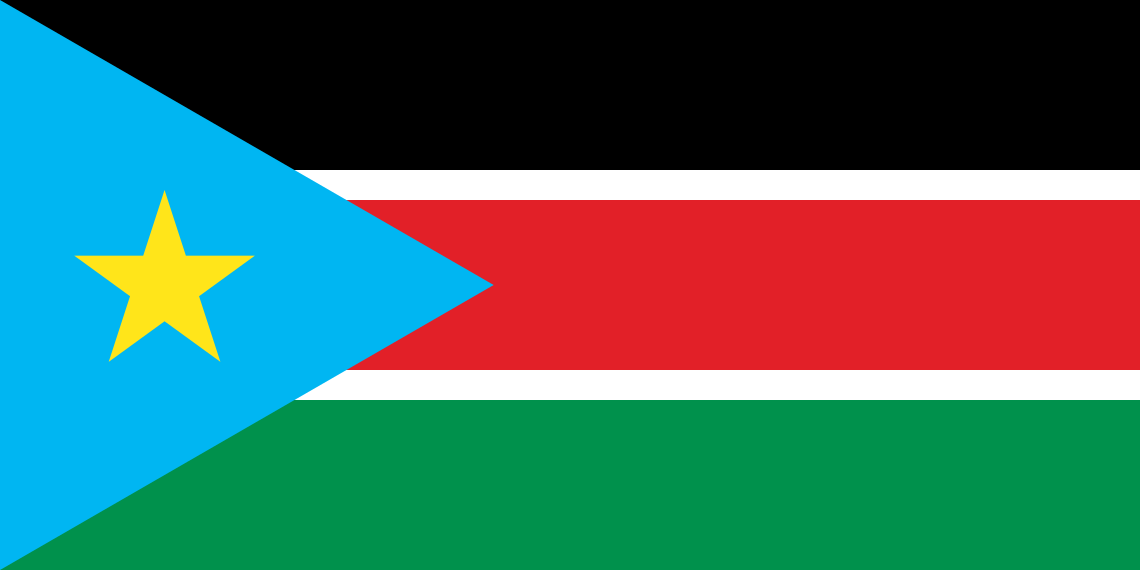
Mr. President, since this is the first time my delegation has taken the floor to address the Council under your presidency, I would like to congratulate you on your leadership of the Council this month and to pledge our full cooperation. I would also like to acknowledge the role of your predecessor in leading the Council last month. I would be remiss if I did not thank you and the members of the Council for giving me the opportunity to address the Council on this issue of vital importance to my country.
First and foremost, I would also like to take this opportunity, on behalf of my Government, to welcome the appointment of Mr. David Shearer by Secretary-General Ban Ki-moon as his next Special
Representative for South Sudan and Head of the United Nations Mission in South Sudan (UNMISS). I would like to assure him of the full cooperation of my Government in his endeavours for the entire time that he will be leading UNMISS in South Sudan. In addition, we highly appreciate the positive role played by the former Special Representative for South Sudan and Head of UNMISS, Ms. Ellen Margrethe Løj, and we want to tell her that she ran a good race during her tenure with UNMISS in South Sudan. We wish her all the best in her future endeavours.
We welcome today’s renewal and extension of the mandate of UNMISS for 12 months, during which the Mission will be called upon to undertake the core functions of protecting civilians, monitoring and investigating human rights, creating the conditions conducive to the delivery of humanitarian assistance, and lastly, supporting the implementation of the Agreement on the Resolution of the Conflict in the Republic of South Sudan, signed on 26 August 2015. That is a good approach.
Our consistent support for the extension of the UNMISS mandate is an indication of our appreciation for the contribution the Mission is making in our country. We consider that to be a good symbol of improvement of our situation and our relations with the United Nations and the Security Council, following the recent agreement of the Republic of South Sudan to implement the Joint Communiqué signed by the Transitional Government of National Unity and the Security Council on 4 September, concerning the deployment of the Regional Protection Force without conditions.
However, I must express my delegation’s disappointment that our concerns and those of some members of the Security Council were not taken into consideration, which goes against the spirit of cooperation. The Council continues to deliberate on the important issues of peace and security in South Sudan without adequate consultation with the African region. Recently, the Intergovernmental Authority on Development Assembly of Heads of State and Government held its twenty-ninth Extraordinary Summit on 9 December in Addis Ababa, at which it underscored in its communiqué that:
“an arms embargo or sanctions on South Sudan will not provide the solution being sought for permanent peace and stability in the country and stresses that what is required is dialogue, reconciliation
and commitment by all South Sudanese parties to faithfully implement the Agreement on the Resolution of the Conflict in South Sudan and for the region and the international community to support them”.
The Government of South Sudan continues to oppose the negative threats of sanctions and punishment, which can only undermine cooperation. The call for the imposition of an arms embargo and targeted sanctions on senior Government officials in South Sudan will only weaken the Government’s ability to execute its constitutional mandate and give the upper hand to armed groups, given the long history of war in the country, which left small arms and light weapons in the hands of civilians.
Despite the international community’s skepticism about the will of South Sudanese leaders to bring an end to the conflict that is devastating their country and inflicting death and suffering on their people, we have always recognized that we share the same objective of consolidating peace, security and stability in our country. These elements are fundamental for the reconstruction, rehabilitation and socioeconomic development of a country that has been at war for far too long. President Salva Kiir Mayardit, in his statement on 14 December to the National Legislative Assembly, reiterated his commitment to implementing the Peace Agreement in letter and spirit. He announced intentions to launch a national dialogue that will include all stakeholders in the country. This dialogue will be led by eminent statesmen who are trusted, genuine and credible.
As the President, it is understandable that much of the responsibility for the state of affairs in the country would fall on Salva Kiir Mayardit, but it is obvious that he has been very accommodating and compromising. This has not been adequately acknowledged, let alone appreciated. Contrary to what most presidents would do, President Salva Kiir has demonstrated leadership and conceded a great deal for the cause of peace.
Republican orders issued by President Salva Kiir Mayardit should leave no doubt about his determination to do all he can to end this senseless tragedy for his country. He has recently declared a unilateral ceasefire, with instructions to the National Army to fight only in self-defence. He has granted amnesty to those who have taken up arms against the State. He has created a ministerial committee of the Transitional Government
of National Unity charged with implementing the Joint Communiqué and resolution 2304 (2016), and established a national planning committee and a humanitarian high-level committee.
All these steps are intended to address the relevant aspects of the crises faced by the country. Their active coordinating role should be recognized and respected by our international partners to ensure more effective partnership in providing assistance to the country. Close cooperation and partnership between the international community and South Sudan are essential, not only in addressing the many problems faced by the country and achieving positive results but also in enhancing the capacity of the Government to be more effective in the delivery of essential services to the people of South Sudan.
To conclude, the Government of the Republic of South Sudan reaffirms its commitment to working with UNMISS and the international community at large. What the Republic of South Sudan needs is a positive and constructive agenda that includes restoring complete security and stability; nationwide peace and reconciliation efforts; the strengthening of the security and judicial sectors; and support for disarmament, demobilization and reintegration efforts to help clear guns from the hands of civilians and bring the perpetrators of crimes to justice.
What we do not need is the negative threat of sanctions and punishment, which can only undermine the spirit of cooperation.
The meeting rose at 4.55pm.