S/PV.7846 Security Council
Provisional
The meeting was called to order at 4.10 p.m.
Adoption of the agenda
The agenda was adopted.
Reports of the Secretary-General on the Sudan and South Sudan

In accordance with rule 37 of the Council’s provisional rules of procedure, I invite the representative of South Sudan to participate in this meeting.
In accordance with rule 39 of the Council’s provisional rules of procedure, I invite Mr. Stephen O’Brien, Under-Secretary-General for Humanitarian Affairs and Emergency Relief Coordinator, to participate in this meeting.
The Security Council will now begin its consideration of the item on its agenda.
I wish to warmly welcome the Secretary-General, His Excellency Mr. Ban Ki-moon, and give him the floor.

Before proceeding, I would like to offer my deepest condolences to the Russian delegation following the assassination of their colleague, Ambassador Andrey Karlov in Ankara, earlier today. I condemn that senseless act of terror, for which there can be no justification.
We are here to address one of the world’s most urgent crises — the deteriorating situation South Sudan. Not long ago, the people of South Sudan were riding a wave of optimism. Africa’s longest civil war had ended. The world’s youngest nation was born. Yet today, all of that hope and promise has disappeared. South Sudan is engulfed in yet another civil war. Tens of thousands of civilians have been killed. The country’s economy is in ruins. The social fabric is in tatters. Millions of people are homeless and displaced. Hunger and poverty have only deepened.
The responsibility for that tragic state of affairs lies squarely on the shoulders of South Sudan’s leaders. They have betrayed the public trust and continue to show a perverse sense of entitlement, seeking to retain power and wealth at all costs. Reports suggest that President Salva Kiir and his loyalists are contemplating a new military offensive in the coming days against the Sudan People’s Liberation Movement/Army in
Opposition. Moreover, there are clear indications that Riek Machar and other opposition groups are pursuing a military escalation.
It is time to put the people of South Sudan, and not its leaders, at the forefront of any strategy. The international community must come together to provide the necessary help and incentives. At the same time, we should be united and determined in following through with severe consequences for those who impede the path to peace and stability.
In that spirit, I reiterate my call for an arms embargo on South Sudan. Such an embargo would diminish the capacity of all sides to wage war. South Sudan faces no external threat. More weapons will only pose a greater threat to its own people. We have repeatedly seen the deliberate targeting of civilian communities perceived to support an opposing side. As efforts to revive the political process continue, the least we can do is to stop the flow of more weapons, which pose a direct threat to the safety and security of civilians and humanitarian workers. Instability in South Sudan is also a threat to the region. I call on all the neighbouring countries to support and cooperate on an arms embargo.
The most urgent need is to prevent the parties from launching any military operation at the beginning of the dry season. I urge the Security Council, regional leaders and the international community to make it clear to President Kiir and Riek Machar that the initiation of a military offensive will carry serious consequences.
The parties must reinvigorate an inclusive political process that is deemed credible by the people of South Sudan and the international community. Any attempt to rubber-stamp the legitimacy of those in power will not bring peace or stability. An inclusive and credible process requires all parties to the conflict to have a seat at the negotiating table with the ability to share and exercise power without fear of reprisals. A national dialogue could be a positive step if all stakeholders are able to participate in freedom and safety. Unfortunately, that environment does not currently exist in South Sudan.
I call on regional leaders to invest all possible efforts into resuscitating the political process in South Sudan. I commend the work of the Intergovernmental Authority on Development and the African Union, and call upon the Security Council to complement those efforts. I strongly believe that an arms embargo is the most appropriate way to do so. Such a step, I should
emphasize, would strengthen and not undermine the political process.
The conflict in South Sudan has already assumed an ethnic dimension. We have witnessed hate speech from many internationaln leadership positions. As my Special Adviser for the Prevention of Genocide, Mr. Adama Dieng, said to the Council after his recent visit to South Sudan (see S/PV.7814), genocide is not one event; it is a process. I am afraid that process is about to begin unless immediate action is taken. The Security Council must take steps to stem the flow of arms to South Sudan, as well as to send a clear warning that hate speech, incitement and violence must end and that there will be accountability for mass atrocities and other crimes.
As the Council is aware, after two independent investigations, I have had to take some difficult decisions regarding the performance of our troops in the United Nations Mission in South Sudan (UNMISS). Moreover, UNMISS continues to face serious restrictions on its freedom of movement throughout the country, in clear violation of the status-of-forces agreement. The Secretariat has been providing the Security Council with a list of those violations on a monthly basis. Unfortunately, those reports have not resulted in any action on the part of the Council to restore the freedom of movement without which the Mission will be unable to fully implement its mandate.
But an improvement of the Mission’s performance is only one part of the picture. The Government of South Sudan should also fulfil its pledges of unconditional acceptance of the deployment of the Regional Protection Force. Words alone are insufficient. They must be matched by practical actions that demonstrate a strategic shift to full cooperation with the United Nations and all partners for peace.
I spoke with President Kenyatta of Kenya on Saturday to exchange views on the South Sudan peace process. I emphasized that the Regional Protection Force represented the collective commitment of the region to peace, security and stability. I would like to commend Kenya for its unwavering commitment to peace in South Sudan and for working closely with the United Nations to meet that goal.
The people of South Sudan have suffered for far too long and far too much. We must put all pressure on leaders who think or act otherwise. If we fail to act, South Sudan will be on a trajectory towards mass atrocities.
Its people will be the targets of those atrocities while they pin their hopes on the international community in general and the Security Council. I appeal to the Security Council to act now in fulfilment of its responsibility and in support of ongoing regional efforts.
I thank the Secretary-General for his briefing.
I now give the floor to Mr. O’Brien.
Mr. O’Brien: I wish to add my condolences for the tragic loss of Ambassador Andrey Karlov today.
I fully align with the Secretary-General’s request of the Council and of the Government of South Sudan.
I thank you, Mr. President, for this timely opportunity to brief the Security Council on the humanitarian situation in South Sudan. In my briefing to the Council on 22 June, and in the written submission issued jointly with the Office of the High Commissioner for Human Rights in August, I highlighted the spread of violence to new areas and its humanitarian consequences. Six months later, the humanitarian situation has deteriorated dramatically. This will not come as any surprise to anyone in the Council, since they have heard and have been following the reports, as I have, month upon deteriorating month. Violence and attacks against civilians have continued. Hundreds of thousands of people have been driven from their homes and hunger has deepened. There are numerous accounts of horrific gender-based and sexual violence, with most perpetrators walking free.
Last week, the conflict in South Sudan entered its fourth year. Since December 2013, civilians have borne the brunt and faced increasingly appalling humanitarian conditions. We are now witnessing a scale of need for assistance and protection that demands our urgent, relentless attention and action. This year, some 6.1 million people — half the population of that young nation — required humanitarian assistance. The humanitarian community expects that number to rise by a staggering further 20 to 30 per cent in 2017, due to the destructive violence on the ground and forced displacement compounded by food insecurity, economic decline, destitution and a breakdown of basic services.
Approximately 3.1 million South Sudanese have been forced to flee their homes — 1.3 million of them across borders as refugees and more than 1.8 million internally. Many South Sudanese have been displaced multiple times, failing to find the safety and security
they so desperately need. Since July alone, more than 383,000 people have gone to Uganda while the others have moved to Ethiopia, the Sudan, the Central African Republic and the Democratic Republic of the Congo. People flee with almost nothing — just the clothes on their backs and whatever few belongings they are able to carry. Their journeys are mostly perilous, due to insecurity, leg-sapping marshland to slog slowly through, or desiccated, inescapable heat, and always with a lack of food, water and shelter. I have received more and more harrowing reports of families being separated with little to no provisions. The sick, disabled and elderly are simply, terrifyingly, being left behind to an inhumane and unknown or sadly at times a too well- known fate and of attacks, including killing, rape and the abduction of young men.
For children, as ever the future of that young country, the cost of protracted conflict continues to be particularly brutal. Children make up around half of all those who are displaced, and more than 9,000 children are registered as being unaccompanied, separated or missing. More than 17,000 children are believed to have been recruited by armed actors since the conflict began. Fewer than half of primary school-aged children are currently enrolled in schools. One in four schools is closed, primarily due to insecurity, and learning in general has been disrupted by the displacement of teachers and schoolchildren alike. There has been one lost generation and now another, and much capacity to rebuild South Sudan one day, somewhere ahead, has also been lost.
Hunger and malnutrition levels are disconcertingly high and encompass communities in places that were considered to be relatively food secure less than a year ago. More than 1 million children under the age of five are now estimated to be acutely malnourished. Recent screenings in Torit, Lafon and Ikotos in Eastern Equatoria have found proxy global acute malnutrition rates above the emergency threshold. At the height of the lean season in 2016, approximately 4.8 million people — more than one in every three people in South Sudan — were estimated to be severely food insecure. That number will increase in 2017 because of the ongoing conflict, economic decline and poor agricultural yields.
Basic services are severely stretched and in many areas only partially functioning, if at all. Fewer than half of the country’s medical facilities are operational, and even when operational they have the capacity to
provide only minimal services, given chronic lack of essential medicines. Since December 2013, 106 health facilities have closed, while at least 29 have been looted or destroyed. As a result, the sick or wounded, including survivors of rape, often have nowhere to go to get treatment.
Women and girls continue to face heightened risks of sexual violence, particularly by armed actors, with rape used as a weapon of war. In Wau in February and June, and in Juba in July, hundreds of women reported rapes and gang rapes. Other reports have come in from Bentiu, Leer, Malakal, Yambio and other locations across the Equatorias, including of abductions and rapes. Those reported attacks often occur at armed checkpoints. There have also been multiple reports of sexual violence perpetrated against women and girls who leave protection-of-civilians sites to gather firewood and food. With reference to the prevalence of gang rape, the Commission on Human Rights in South Sudan said last week that it is “running out of words to describe the horror”.
At the very moment when needs are growing and deepening, the ability of humanitarian partners to provide life-saving assistance timely and effectively is diminishing at an alarming pace. National and international organizations continue to work tirelessly to provide assistance in one of the most dangerous and challenging operating environments in the world today. I want to express my deep respect and admiration for their commitment and courage. But everyone needs to know that it comes at a high cost. So far, at least 67 humanitarian workers have paid with their lives — 12 of them since July. The humanitarian community is also being targeted in other ways. During the horrific attack on the Terrain Hotel in July, humanitarian workers were sexually assaulted, raped and murdered. Over the past months, reports of harassment have become numerous and routine.
Beyond the ongoing insecurity, aid organizations are now facing increasing levels of bureaucratic obstruction and intimidation, mainly by the Government of South Sudan, but also by parts of the Sudan People’s Liberation Movement/Army in Opposition. In the past four weeks alone, there have been four serious incidents in which South Sudanese authorities have arrested, detained or deported senior staff of non-governmental organizations (NGOs). No formal charges have been presented in any of those cases. In another case, one of the largest South Sudanese NGOs had their office
in Juba shut down by authorities, again without documented cause. Despite démarches from the United Nations, there have been no explanations.
That is simply unacceptable, and those incidents must stop. To be clear — our NGO partners deliver around 70 per cent of all humanitarian assistance in South Sudan. Their presence and programming are fundamental to the continued life-saving response. Without national and international NGOs on the ground, food cannot be delivered to scale; emergency medical relief cannot be provided to all those who require it; malnutrition cannot be adequately treated; and life-saving access to clean water to prevent the spread of diseases such as cholera will be hampered.
Despite those immense challenges, humanitarians have delivered life-saving aid to approximately 4.7 million people this year, including nearly 3.6 million, who were reached with food assistance or emergency livelihoods support; more than 195,000 severely malnourished children, who were admitted for treatment; more than 2 million who were provided access to clean water; more than 1 million, who were reached with emergency shelter and vital non-food items; and nearly 200,000 children, who were administered with the pentavalent vaccine against five major diseases. More than 18,000 survival kits — an inter-agency lightweight package of supplies designed to be easily carried by people on the run — have been dispatched to some of the most remote locations. That assistance has been delivered based on assessed needs, targeting people in the most severe need in all areas of the country.
Against the backdrop of a humanitarian situation that is a relentless descent into this catastrophic abyss of hopelessness, fear, intimidation, irreversible damage, destruction, stunting and death, an increasing number of South Sudanese are looking to humanitarian actors for assistance. Yet access to those most in need continues to be restricted in some areas of the country. Last month, 100 reports of humanitarian access incidents were documented — the highest number in any month since June 2015. I am appalled to highlight that approximately 67 per cent of those incidents involved violence against humanitarian workers or assets.
Where towns are controlled by one party to the conflict and surrounded by another, we continue to face major challenges to reaching people in need owing to the active conflict and access denials, particularly
in Yei, Central Equatoria, in which we estimate that tens of thousands of people who have been unable to make the long and costly journey to Uganda remain displaced in areas surrounding the town and unable to access assistance and in Wau, Western Bahr el Ghazal, in which tens of thousands of people outside the town have been largely cut off from aid for months. The recent proliferation of armed actors has increased the complexity of access negotiations and heightened risks to aid workers.
As I have stated before, including in Juba, Wau and Aweil, during my visit in August, steps and action must be taken once and for all to remove those obstacles, which are unacceptable and run contrary to the parties’ obligations under international humanitarian law. It is critical that all humanitarian organizations are granted free, safe and unhindered access to all people in need wherever they are. While we welcome steps taken by the Government to address some of those challenges, including the establishment of the Humanitarian High Level Oversight Committee, it is vital that commitments be translated immediately into concrete and effective action.
South Sudan is on the brink. Decisive action to end the violence is needed, and it is incumbent upon the Council to make sure that the necessary action is taken. My message today is therefore three-fold.
First, if a political solution is not urgently found to stop the violence, the humanitarian crisis in South Sudan will not only grow but will cascade way beyond anyone’s control, not least, that of the Council. There must be a cessation of violence. There is no alternative.
Secondly, collective leverage must be exerted to ensure the facilitation of unhindered access to all those who require assistance in all areas of the country. As part and parcel of that, there must be real commitment to protect humanitarian workers. Meanwhile, those who killed, attacked and raped humanitarian workers must be prosecuted and held to account just as the impunity of those who attack civilians must come to an end.
Finally, I draw the Council’s attention, as did the Secretary-General just a moment ago so powerfully, to the recent call made by his Special Adviser on the Prevention of Genocide on the imminent risk of violence escalating along ethnic lines with the clear potential for genocide. There is no greater urgency than to prevent that from happening. Millions of women, men, girls and boys are already suffering. It is imperative that all do
what is in their power to stop the current trajectory and collectively help South Sudan and, above all, the South Sudanese people avert a cataclysmic infernal event and find a path to get back on a track to peace and security for all its citizens.
I was going to stop there, but allow me as the Council’s humanitarian adviser to add one more point. I say this with the representative of South Sudan present here today. The international community and the Council itself have repeatedly said, “Never again” —after Srebrenica and Rwanda. Given the clear facts and evidence in South Sudan presented this evening, how many more clues do we all need to move from our anxious words to real, preventative action? How many lives, women, men and children can we all save if we and those with influence over the parties act decisively today?
I thank Mr. O’Brien for his briefing.
I shall now give the floor to the members of the Security Council who wish to make statements.


I thank Secretary-General Ban Ki-moon for showing his deep dedication to the people of South Sudan by being here today and injecting his passion and compassion for the people of a country that he has visited many times.
I want to begin my remarks by apologizing to the Secretary-General, because I do not know how long he has been asking for an arms embargo and targeted sanctions. It is not every day that he comes to the Security Council and is very specific about his prescriptions. Yet, in the case of South Sudan, he has asked, and we have not delivered. I think that is something upon which we need to reflect in light of the graphic nature of the briefings that we have heard and the first-hand eyewitness testimonies that we have read, by which we have been horrified. South Sudan used to be an issue on which the Council was pretty unified. We should try to retrieve that unity in light of the Secretary-General’s warning, which will go down as one of his last warnings to this Council. If we fail to act, South Sudan will be on a trajectory towards mass atrocities. The Secretary-General has said it. We have to admit that, as a Security Council — each and every one of us.
I would just add an account of one family that has been affected by the conflict, the matriarch of which
is 28 year-old, Irene, a mother from Yei River state. She and her children barely escaped death on two occasions. The first time, she was reportedly at home when armed men came to her door and called out her husband’s name. Irene’s husband had just managed to push her and the kids under their bed before the soldiers kicked down the door and shot him in the head. Irene fled for the Ugandan border but ran into another group of armed men. As she relayed to a journalist, two women were trapped and raped by the men. The men took two infants and used them as if they were sticks to beat the women. The children survived but they were damaged inside.
That account is so graphic and so terrible and yet, the number of accounts from the region that have that kind of gory, savage detail is too large to count. Babies used as clubs to beat their own mothers, rape, the execution of a woman’s husband — that is what Irene witnessed before getting to Uganda and the relative safety of a refugee camp. That is just one story over the past week — just this week. For Council members who were saying that things are getting better, they should know that an average of 5,189 refugees like Irene stream into Uganda every day. That is this week. That is not back in July or back when the conflict started in 2013. The situation is not getting better, but worse.
Meanwhile, we are sitting on our hands as a Council. We have to try to stop atrocities in South Sudan, and the question is not whether we should do that, but rather how quickly we can do that. We have to adopt an arms embargo, targeted sanctions — the tools in the toolbox that we have. If people have better ideas, then we are open to better ideas, but more of the same is not working. Violence is tearing South Sudan apart, and the Government undermines virtually all international efforts to help. I say that much more in sorrow than in anger, given how closely the United States has worked with that Government and how closely the United States has wanted to work with that Government, even throughout this crisis.
Three million people have been displaced inside and outside South Sudan and more than half of the country faces food insecurity. The United Nations High Commissioner for Human Rights, Mr. Zeid Ra’ad Al Hussein, has reported that violations of human rights are so widespread that they have become almost commonplace. As we have heard from all the visitors who go to various parts of South Sudan, violations includes the systematic use of sexual violence as a
weapon of war. What does that actually mean to the people in the country? In the town of Yei, blockaded civilians cannot venture out of the city into their fields, so the crops that would feed them rot away. That is what is happening right now. In the Equatorias, which in one stage of the conflict had not seen violence, the threat of violence is now so extreme that the only way to flee the city is by crawling through the bush, because soldiers and armed groups who rape and murder control the roads. In Unity state, one rape victim told the Commission on human rights in South Sudan, “there is no stigma around rape because for us it is normal. It is happening every day to us.”
Those Council members who were on the trip to South Sudan heard those testimonies at first hand. That should not surprise us. Consider the Government’s unfortunate response: continued obstruction of assistance and defiance of the demands of the Council. As we have heard, in recent weeks, the Government deported four highly experienced aid workers with no apparent justification, including the country directors for two very large non-governmental organizations.
We also have to talk about the opposition. The Sudan People’s Liberation Army in Opposition (SPLA-IO) is making it even harder for humanitarian agencies to operate in the areas that they control. Non-governmental organizations now need to petition the SPLA-IO for accreditation, which requires a fee. Then they have to give at least 48 hours notice of any humanitarian flight before arrival. That is now common practice across the country. It makes it impossible to deliver food to people who need it. Again, for those who think that the situation is getting better or is static, I have bad news. The United Nations recorded more obstructions to humanitarian assistance last month than during any other month since June 2015. We see more obstructions to humanitarian assistance and yet, we sit here doing more of the same and expect a different result, which is the definition of insanity.
South Sudan is making it harder for people to get aid, even as the Council has done the right thing in demanding unfettered access. The Government is obstructing and defying. In August, we tried to mitigate the violence by authorizing the United Nations Mission in South Sudan (UNMISS) Regional Protection Force (RPF). I express thanks to all Council members who supported the Force. Since then, the Government has talked a lot about allowing the RPF to deploy, and they have expressed some type of consent to the RPF in
statements and letters at least six times — we only know about six times. How often have they consented? They consented on 4 September, 20 September, 15 October, 16 October, 16 November and 30 November. However, none of those letters of consent or words of consent has translated into consent on the ground and deployment, which is the measure of whether our will as a Council is being respected. Again, we are witnessing obstruction and defiance.
The South Sudan Government has also offered assurance that UNMISS can patrol without interference. That is part of what the Council has rightly asked for. However, in reality, we know that is not happening. In recent weeks, South Sudan’s authorities have again imposed restrictions on UNMISS patrols around the Equatorias, as well as in areas outside Wau and in the region of Bahr el Ghazal — two places where we know that people are in need of protection. Yet, we see more obstruction and more defiance of the Council’s resolutions.
The problem right now for us in taking this wait- and-see posture is that South Sudan, as the Secretary- General put it in his extraordinary briefing, may be running out of time. Even if we could deploy the entire RPF tomorrow and even if UNMISS faced no obstruction of any kind, those peacekeepers would face immense challenges in stopping the escalating, ethnically based violence that we are witnessing on the ground. The Council needs to do much more to respond to the growing risk of mass atrocities. The warnings are everywhere. We have all heard them. The Commission on human rights in South Sudan has said that South Sudan is on the brink of an all-out ethnic civil war. The Special Adviser of the Secretary-General for the Prevention of Genocide, Ms. Adama Dieng, who is sitting right here with the rest of us, has warned of a “strong risk of violence escalating along ethnic lines with the potential for genocide”.
Nobody here can say that things have gotten better since Adama Dieng briefed us. We have just heard from the Secretary-General and Mr. Stephen O’Brien that things have gotten worse. The people within the United Nations system whose job it is to sound the alarm have sounded it. History is going to show what each of us did and where each of us stood when the sirens were blaring and when the red lights were flashing in South Sudan. Now is when each of us has to be counted. Where were we when the lights flashed red for the people of South Sudan?
In some parts of South Sudan, ethnic killings are already underway. Every day, we hear vows to take revenge on the airwaves, as the number of killings increases and as the cycle of violence escalates. In Central Equatoria, at least 1,900 structures — houses, businesses, schools — have been destroyed since the fighting began two months ago. The Government has mobilized at least 4,000 militia from other areas and staged them in Equatoria. We know that large-scale attacks could start at any moment.
Let me wrap up with a closing argument on this incredibly important issue. Some on this Council argue that it is not the right time to impose an arms embargo and targeted sanctions. Some point to the public statements and nice words from Government officials that say that we need to give the Government yet another chance. Another chance? We have seen citizens in South Sudan go hungry as money gets invested in large weapons systems. We have seen the deployment of peacekeepers stalled. It is late December. We were there in early September. Not one soldier of the RPF has been deployed — not one soldier.
Of course, we join others in hoping that our dear friends in South Sudan, with whom we have worked so closely and for whom we worked to secure their independence, will follow through on their recent promises, just as we had hoped that they would follow through on previous promises. However, to use those promises as an excuse to delay action, when we hear from the Secretary-General so powerfully about what is happening on the ground, when he has been banging his head against this table for so long, for more than a year, asking for such measures to try to mitigate the violence, we have no more alibis.
Some Council members have been pretty direct about expressing concerns about the risks that imposing those measures would pose to their peacekeepers or to their workers who are on the ground in South Sudan. Every Government has a responsibility to look out for their citizens, and I very much appreciate that concern, as we also, of course, have many aid workers and embassy personnel who are there in South Sudan.
But can we really believe — those of us who care about our people — can we really believe that more arms coming into the country is the way to look out for their safety? Can we really believe that allowing the Government of South Sudan to continue to invest its money in such weapons systems, instead of in the food
that people need to eat, is the best way to look out for our people? The people that we are hoping to designate are people whose public statements no one disputes — they are on the record, advertising their statements aimed at ethnicizing the conflict and spoiling whatever hope there is to get back to a peace agreement. Those individuals feel a sense of impunity. If the Council is unprepared to act on such designations, can that sense of impunity be good for our people on the ground, our workers, our peacekeepers and our aid workers? It can not be. How is impunity good? How are more arms good for the safety of our people?
However, well beyond that, what about the South Sudanese people? Do they get a vote? How would they vote on such measures? We heard them when we met with a wide range of civil society and other actors. We know how they would vote, and we need to keep their votes in mind. We need to bring this draft resolution at last to a vote, which we will do by the end of this year. Members of the Council will need to raise their hands and make a decision on where they stand on the issues of life and death that have been raised by the Secretary- General and by everyone who goes to South Sudan and comes back. Above all, the people of South Sudan have a stake in our action. Council members — each of us — will need to own our decisions, so the United States urges members to prepare to vote your conscience and to vote to stand with the people of South Sudan.


At the outset, allow me to thank Secretary-General Mr. Ban Ki-moon, and the Under-Secretary-General for Humanitarian Affairs, Mr. Stephen O’Brien, for their briefings.
Uruguay expresses its deep concern about the current situation affecting South Sudan. The worsening violence, in particular since July, has had devastating consequences for civilians. There have been widespread violations of human rights law and humanitarian law, including extrajudicial killings, forced disappearances, rapes and other acts of sexual violence, arbitrary arrests and imprisonment, attacks against civilians and attacks against medical facilities, humanitarian assistance workers, medical personnel and media workers. Some human rights violations are increasingly taking on an ethnic nature, and hate speech is increasing throughout the whole country, which is extremely alarming, given the fact that it could lead to large-scale atrocities. Furthermore, the humanitarian crisis in the country is increasing in scope and intensity as a result of the armed
conflict in several parts of the country, the exacerbation of the food-security situation and the worsening of the economic situation.
The United Nations figures are disturbing: more than 1 million refugees, more than 1.6 million internally displaced persons and almost 5 million people who are in a state of acute food insecurity. After the Security Council mission to the country last September, we returned very aware of what has happened there. Uruguay calls upon all the parties involved in the conflict and on the entire international community to bring an end to the suffering of civilians in South Sudan. The situation is unsustainable.
In that connection, we must continuously remind the Government that its main responsibility is that of protecting its own citizens and that it should provide that protection regardless of their ethnic origin or political affiliation. Also, the political leaders of South Sudan must behave responsibly and reject any incitement to violence, while opting for the path of dialogue. In the final analysis, they must honour their leadership.
On this point, we take note of the statement delivered by the President of South Sudan, Mr. Salva Kiir, on 14 December, when he announced the beginning of a national dialogue process. We hope that that process will truly be inclusive in nature. We urge all the parties to join in a dialogue process, with a view to achieving reconciliation and peace in the country, just as happened five years ago, when South Sudan became an independent country. Today we must seek unity and pluralism, which is the only way to put the country on the path towards stability and development.
Lastly, I would like to mention the work of the United Nations Mission in South Sudan (UNMISS), whose mandate was renewed unanimously a few days ago by the Council. It is crucial for UNMISS to be able to fulfil its mandate fully. We therefore urge the Government of South Sudan to fully cooperate with the implementation of resolution 2327 (2016), including the deployment of the Regional Protection Force, as well as lifting any restriction on the Mission. Neither UNMISS nor the Regional Protection Force are against the Sudan. To the contrary, they are for South Sudan.
In conclusion, I would like to wish every success to the new Special Representative of the Secretary- General and Head of UNMISS, Mr. David Shearer, and assure him of my delegation’s support and cooperation.


We would like to start by conveying our gratitude to the Secretary-General and Mr. Stephen O’Brien, as well as to all our colleagues, who during the previous meeting took the floor and extended kind words of condolence to us following the killing of Ambassador Karlov in Ankara. Their words of condolence and support are extremely important for us.
I now to turn to South Sudan. We note the progress in implementing the South Sudanese peace agreement of last year. The Transitional Government of National Unity and the Parliament are working effectively with representatives of the armed opposition. Practical steps are being taken to strengthen mechanisms aimed at providing security and to draft a new constitution. President Salva Kiir launched an inclusive national dialogue. Amnesty has been declared for the partisans of Riek Machar who participated in the July events in Juba.
We are concerned by reports of armed clashes in various parts of the country. However, one has to understand clearly what their exact nature is. We share the view of the United Nations and the Intergovernmental Authority on Development (IGAD) that, to a large extent, those incidents have been the result of problems in the command structures and a lack of discipline in units of the Government’s armed forces and those of the opposition. Another factor is the split in the opposition forces of the partisans of Taban Deng Gai and Riek Machar. There are also groups that are under no one’s control. On top of all that there have been spontaneous clashes that are the result of interethnic tensions or even simply criminal actions.
Against that backdrop, we have doubts with regard to the widely circulating rumours that the Government is amassing its forces and mobilizing local armed elements in the Equatoria region for a large-scale offensive that is about to start after the end of the rainy season.
I would like to take the opportunity of the presence of representatives of the Secretariat to ask whether they can comment on the fact that the Juba Government has said that what is involved are normal rotations of the armed forces? We would also call upon our colleagues from the Council and the Secretariat to refrain from speculation about the threat of genocide in South Sudan. Naturally, we are concerned by the proliferation of venomous rhetoric in South Sudan, as well as actions
against various ethnic groups; however, those actions are not targeted against any particular community, rather there has been an increase in ethnic tensions in general.
We also note that those manifestations and actions have emanated, as a rule, from various types of armed and criminal groups and undisciplined elements of the security apparatus. This is why we would refrain from concluding that there is any form of targeted or systemic policy.
Among the positive events of late, we have Juba’s unconditional agreement to and acceptance of the Regional Protection Force. That step was welcomed by the Secretary-General, as well as by the IGAD summit in Addis Ababa. Practical issues regarding the deployment of the Force are being discussed by representatives of the Government and the United Nations in a constructive manner, which was demonstrated, inter alia, by Juba’s consent to the request of the United Nations for the provision of plots of land for the use of the Force.
However, even the deployment of a full- fledged 4,000-strong Regional Force is unlikely to significantly improve the difficult political, military and humanitarian situation in the country. We agree with the view of the Secretary-General and IGAD that that would require the full implementation of the peace agreement by the parties, with international partners’ support.
Our position regarding new sanctions against South Sudan is well known and is shared by many members of the Council. In the IGAD summit communiqué dated 9 December it was clearly stated that new targeted sanctions or an arms embargo would not serve to establish lasting peace and stability in South Sudan. Furthermore, the African Union’s Peace and Security Council’s summit communiqué dated 19 September includes no calls for new sanctions.
Put succinctly, the sponsors of the draft resolution on sanctions are essentially ignoring Africa’s position regarding the counterproductive nature of new restrictions on the process aimed at trying to reach a settlement. Those colleagues are clearly demonstrating in their statements that they only accept those African documents that are in line with their interests and approaches.
The sponsors of the draft resolution on sanctions are ignoring the fact that differences among African States will probably undermine the effectiveness of
any such restrictions. We see that in the example of a number of African States, including the Central African Republic, where targeted sanctions and the arms embargo are simply not working. South Sudan is awash with arms. That is evident from the fact that the group of a few hundred supporters of Riek Machar who fled to the Democratic Republic of the Congo had very few weapons with them, so quite obviously they dumped or hid them somewhere in South Sudanese territory.
The former Special Representative of the Secretary- General, Ellen Løj, also confirmed the presence of weapons in camps for the protection of civilians as well as in arms caches in the immediate vicinity. That, by the way, might have been what motivated the decision by the authorities to shut down the displaced-persons camp in Juba.
Generally speaking, in order to establish lasting peace in South Sudan, we do not need a Security Council arms embargo but rather targeted measures aimed at disarming the population as well as at demobilizing and reintegrating combatants. Targeted sanctions against the Minister of Information and the Chief of General Staff of the Government Army may have unpredictable consequences. We suspect that someone really wants to get rid of President Salva Kiir by ensuring that he gets into a fight with various influential figures in his immediate surroundings.
Instead of helping to resolve the conflict, a number of Security Council members are attempting to increase pressure on Juba, including through targeted sanctions and the hybrid court. Such short-sighted tactics will not help the situation.


I would like to start by saying that France also aligns itself with the words of condolence conveyed to the Russian Federation in the light of the criminal attack that struck its Ambassador in Turkey.
I had not intended to take the floor here today in the Chamber, as I really only wanted to speak in the consultations, but it is not every day that the Secretary- General sends us such a powerful public message. The Secretary-General, as well as, of course, the Under- Secretary-General, delivered strong messages warning us that we have to assume our collective responsibility. It is a call for action.
For us, the serious nature of the situation in South Sudan requires collective mobilization not only by the Security Council but also by the whole of the United
Nations system and by the region itself, starting with the Intergovernmental Authority on Development (IGAD) along with the African Union. First and foremost, however, resolute action by the Government of South Sudan is essential. For us, collectively speaking, there are five or six axes on which we need to act rapidly.
The first — stated quite clearly by the Secretary- General — is the arms embargo. We regret the fact that for almost a year we have been discussing the embargo; the Secretary-General has advocated for it, and we have called for it. We regret that the arms embargo has not yet been imposed. Let me make it clear that for us the arms embargo is not a punitive measure or a lever to obtain some sort of political advantage. It is a measure of common sense that is intended to help a country ravaged by war and awash in weapons. The flow of weapons needs to be halted, and an end needs to be put to the arms trade circulating in that war-torn country. It is necessary, therefore, that the arms embargo be put in place as soon as possible.
The second element is a political process. We know, of course, the roles that the region, the subregion, IGAD and the African Union have played in undertaking rather encouraging developments in terms of national dialogue. What we would like to see are those encouraging developments actually being converted into actions. What is certain in any case is that, in the face of the obstacles created by some parties and the hate speech, which might hinder or undermine the peace process, the Security Council will have a role to play. We do have an instrument — targeted sanctions — that will enable us to intervene in support of a peace process, which we all desire.
The third element is the central question of the protection of civilians. That is, after all, at the very heart of the mandate of the United Nations Mission in South Sudan (UNMISS). We decided last August to deploy the Regional Protection Force to bolster UNMISS capabilities. Since then, the Transitional Government of South Sudan has given its formal consent to that deployment, but unfortunately things have not moved forward, and now it is high time for plots of land to be provided so that we are able to deploy the Force. That is, of course, a test of the good faith and will of South Sudan, namely, to enable the deployment of the Force, and it is very important that Juba demonstrate that.
The fourth element is linked to my previous point. The implementation of the UNMISS mandate will require the unfettered ability to move and act. All
obstacles that might hinder the deployment of the Force must be lifted. That is a core element of the message sent by Security Council members during their visit to South Sudan in September. Obstacles to the status of forces agreement must be lifted, and targeted sanctions by the Security Council will ensure that that takes place. In the case of confirmed obstacles, we could use sanctions to ensure that the peacekeeping operation that we have deployed is able to operate fully.
The fifth point I wanted to make is related to humanitarian issues. After I heard the point made by the Under-Secretary-General regarding the difficulties and obstacles that we face and the unacceptable price being paid by humanitarian workers, it is quite clear that it is absolutely essential to ensure that full access and cooperation be granted to the whole of the humanitarian community, at a time when the situation is quite disastrous.
My last point concerns the question of accountability and impunity. The transitional agreement adopted earlier this year provided for a hybrid court, the establishment of which is absolutely essential. South Sudan requires a judicial mechanism commensurate with the grave crimes being committed. The African Union will have an important role to play. It will enjoy the support of the Security Council in that regard, but there must be progress towards the establishment of the hybrid court.
All of these messages are contained in resolution 2327 (2016), adopted a few days ago, but the Security Council will have to make them more concrete and operational, first by voting in favour of the draft resolution on an arms embargo, and secondly by remaining mobilized and prepared to use leverage, starting with targeted sanctions, to curb a spiral of violence that could well lead to the disastrous situation described by Mr. Adama Dieng a few days ago.
I now give the floor to the representative of South Sudan.

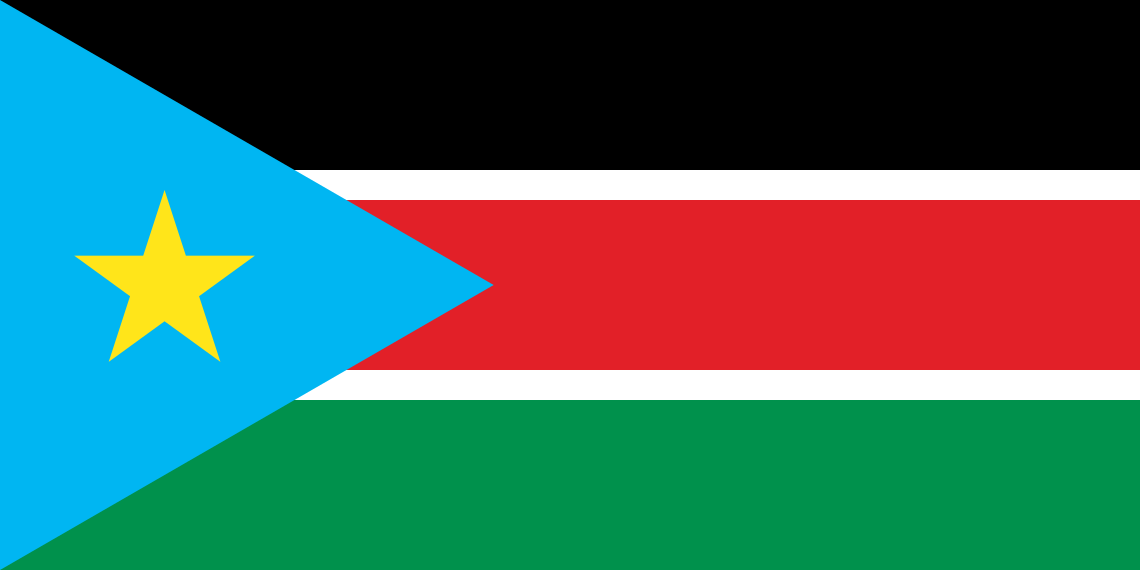
First, let me express my deepest condolences to the delegation of the Russian Federation for its loss.
I congratulate you, Sir, on your assumption of the presidency for this month. I would also like to acknowledge the successful tenure of your predecessor and the positive role he played in leading the Council last month.
Let me also thank the Secretary-General and Mr. Stephen O’Brien, Under-Secretary-General for Humanitarian Affairs and Emergency Relief Coordinator, for their kind briefings.
The Government of South Sudan has demonstrated political will by expressing its commitment to fully implementing the Agreement on the Resolution of the Conflict in the Republic of South Sudan. There is not much more to be said other than to reiterate some important points.
Recently the Government of South Sudan agreed and accepted the deployment of Regional Protection Force (RPF) without conditions. If there is any failure or delay in the deployment of the Regional Protection Force, it is not on the part of South Sudan. The Department of Peacekeeping Operations has not informed us of any failure on the part of the Government of South Sudan. We have allocated land for the RPF, concerning which we have communited officially to the Security Council through the monthly presidency.
The Government has also formed a committee that will look into the obstruction and the complaints lodged by the United Nations Mission in South Sudan (UNMISS) about any possible roadblock. From the time the committee was established, there has been no further report presented for us to look into.
Recently, the President of South Sudan, His Excellency Mr. Salva Kiir Mayardit, announced a national dialogue that will include all the stakeholders in the country. The dialogue is the only viable means of solving the political and socioeconomic problems in South Sudan. Unfortunately, it was rejected by Riek Machar.
We disagree with the characterization by Mr. Adama Dieng, the Special Adviser of the Secretary-General for the Prevention of Genocide, of the ongoing conflict in South Sudan, which according to him could become an outright ethnic war, perhaps verging on genocide. Such description is a bit exaggerated and does not reflect the reality on the ground. There have been no attempts that we are aware of on the part of the South Sudanese masses to turn against each other. Recently, the rebels have resorted to killing innocent civilians because of their ethnic background, but the Government has not planned or launched a campaign to target specific ethnicities or communities and has no intention whatsoever to engage in anything of that nature.
We recognize the importance accorded to the protection of civilians and the safeguarding of the delivery of humanitarian assistance, but it is our sincere hope that UNMISS will also pay due attention to capacity-building of Government institutions, which have crucial roles to play during the transitional period. It should assist the activities of the South Sudan Disarmament, Demobilization and Reintegration Commission, the National Constitutional Amendment Committee and the National Elections Commission, and provide technical expertise on security sector reform. In other words, UNMISS should attach importance to supporting the implementation of the agreement.
Some members have spoken of a lack of progress, but I can report that there has been tremendous progress made in the implementation of the peace process in South Sudan. Council members did not mention that people have been voluntarily leaving the protection of civilians camps for their respective home regions. Over the past two days, over 2,000 citizens have left the protection of civilians camp in Juba to return to Unity state, and the Government is assisting them by providing transportation. If there had been progress, they would not have risked their lives to go back to their homes.
The proposed arms embargo and threats of sanctions on all the parties engaged in the conflict in South Sudan are unfortunately another indication of a moral equivalency that does not distinguish between a legitimately elected Government and an armed rebellion intent on overthrowing the Government. To deny the Government the necessary means to discharge its responsibility is to fundamentally undermine its sovereignty, which is totally unacceptable. The imposition of sanctions would be counter-productive.
To conclude, I would like to reiterate my Government’s commitment to implementing the agreement in letter and spirit, and emphasize the need to encourage and support political dialogue and the efforts of the Government of National Unity to fully implement the peace agreement. The road to final peace may be long and difficult, but with the support of our partners we are optimistic that we will shall see the light at the end of the tunnel.
I now invite Council members to informal consultations to continue our discussion on the subject.
The meeting rose at 5.15 p.m.