S/PV.8100 Security Council
Provisional
The meeting was called to order at 11.15 a.m.
Adoption of the agenda
The agenda was adopted.
Security Council resolutions 1160 (1998), 1199 (1998), 1203 (1998), 1239 (1999) and 1244 (1999) Report of the Secretary-General on the United Nations Interim Administration Mission in Kosovo (S/2017/911)

In accordance with rule 37 of the Council’s provisional rules of procedure, I invite the representative of Serbia to participate in this meeting.
On behalf of the Council, I welcome His Excellency Mr. Ivica Dačić, First Deputy Prime Minister and Minister for Foreign Affairs of the Republic of Serbia.
In accordance with rule 39 of the Council’s provisional rules of procedure, I invite Mr. Zahir Tanin, Special Representative of the Secretary-General and Head of the United Nations Interim Administration Mission in Kosovo, to participate in this meeting.
In accordance with rule 39 of the Council’s provisional rules of procedure, I also invite Ms. Vlora Çitaku to participate in this meeting.
The Security Council will now begin its consideration of the item on its agenda.
I wish to draw the attention of Council members to document S/2017/911, the report of the Secretary- General on the United Nations Interim Administration Mission in Kosovo.
I now give the floor to Mr. Tanin.
Mr. Tanin: At the outset, I would like to congratulate you, Mr. President, and Italy on your assumption of the presidency of the Council for this month. I am happy to join this meeting today.
The most recent reporting period is well covered in the Secretary-General’s report (S/2017/911) that we are reviewing today. In addition, I will brief the Council on recent significant developments that have taken place since the end of the reporting period.
On 19 October, municipal elections were conducted throughout Kosovo — the second Kosovo-wide local elections since the agreement of 19 April 2013 on the principles of the normalization of relations between
Belgrade and Pristina. It was therefore the second time that the four Kosovo Serb-majority municipalities in northern Kosovo had participated in such elections. Those elections saw a strong turnout, particularly in the Serb-majority areas throughout Kosovo. They provided the population of Kosovo the opportunity to select their most immediate leaders and thus to express their views on their political priorities, as well as the performance and the delivery of the major competing parties. More than 7,000 candidates competed across Kosovo.
A significant increase in Serb participation occurred in the Serb-majority municipalities. The average turnout in those municipalities was 43.4 per cent, which can be compared with around 38 per cent in 2013. In the four northern municipalities, the difference was even more pronounced: a turnout of 44 per cent compared with 24 per cent turnout in 2013. The European Union (EU) deployed some 100 observers across Kosovo on election day while the Organization for Security and Co-operation in Europe facilitated the voting in the northern municipalities. Both organizations praised the generally peaceful and orderly conduct of the elections. However, the EU observers also stressed that, in the Kosovo Serb-majority municipalities, the campaign was affected by restricted competition and intimidation.
As I reported in August (see S/PV.8025), the multiple election processes this year in Kosovo produced a period in which few decisions could be undertaken with the necessary authority in Pristina. With the runoffs for mayoral elections scheduled for 19 November and the electoral process now nearing completion, I am hopeful that this will soon change. Some signs warrant cautious optimism. On 31 October, the new Assembly of Kosovo, passed a second reading of the Kosovo budget, despite the narrow majority held by the Government. The Serb caucus and the cabinet of the Prime Minister collaborated to achieve that result. Meanwhile, we see signs of movement on other particularly important social and economic issues that have repeatedly been delayed during the lengthy elections period.
This leaves the question of what lies ahead. During the past three months, I have had the opportunity to share views on the situation with a variety of interlocutors, in Pristina, in Belgrade and more widely. I would like to underline the fact that all sides generally share the view that the state of affairs between Belgrade and Pristina has the potential to evolve beyond the unfortunate long- standing impasse.
On 24 October, 40 new judges and 13 new State prosecutors from the Serb community were sworn into office in Kosovo — a significant step in the implementation of the first EU-facilitated agreement. These judicial officials will work as part of a unitary Kosovo justice system, and staffing and logistical arrangements are also under way, with support from all the international presences in Kosovo, including from the United Nations Interim Administration Mission in Kosovo (UNMIK). The parties are to be commended for moving this forward. The judicial area had lagged notably behind other implementation achievements, such as police integration and implementation of technical steps in the telecommunications and utilities spheres.
However, it is equally important to note that overall, the implementation of agreements achieved in 2013, and even earlier, continue, at best, to be sporadic and variable. Within the framework of the EU-facilitated dialogue, technical implementation needs more meaningful commitment from both sides. The most obvious gap continues to be the lack of progress towards the implementation of the agreed association/ community of Serb-majority municipalities.
Considerable headway has already been made, and the EU-facilitated dialogue in Brussels remains crucial as a core element in a wider process. Alongside that endeavour, the European Union’s Berlin process, addressing the future enlargement potential of the European Union, has also progressed. Having begun at a 2014 Western Balkans summit, it has been followed by meetings in 2015 in Vienna, 2016 in Paris and 2017 in Trieste. Its strength lies in the inevitable conclusion that economic growth, peace and prosperity depend on the quality of relations among neighbours, the creation of a beneficial space of connectivity and the prospects for multifaceted interaction. My own discussions with leaders in Belgrade, Pristina and Tirana have convinced me that each of these important centres shares the same understanding of that principle.
In relation to the Belgrade-Pristina political dialogue, which has suffered from a long hiatus, what I can say today is that both sides are well aware of its importance and its potential during the coming year. To that effect, informal consultations with European Union facilitators have taken place over several months, most importantly with the EU High Representative for Foreign Affairs and Security Policy, Ms. Federica Mogherini.
Signs of political will and commitment to move forward seem increasingly evident. Populations are understandably frustrated by the lack of opportunities brought on by unresolved political mistrust and tensions. With the end of the election cycle, the time for action now moves ahead of the time for excuses. In many practical areas, political bickering and the failure to fully implement technical agreements place unacceptable burdens on the population. As one example, excessive administrative obstacles continue to discourage travel and commerce, despite agreements which purported to alleviate such impediments.
Allow me to offer another example, which has arisen during the past few days. In accordance with its mandate, UNMIK has continued to do everything within its authorized powers to support the implementation of the Central European Free Trade Agreement (CEFTA), which UNMIK signed on behalf of Kosovo in 2006. In practice, Pristina representatives working on CEFTA issues attend all CEFTA meetings. UNMIK’s basic participation has always been in accordance with legal statutes. Despite these facts, some actors have recently sought to repoliticize, through public rhetoric, those otherwise highly practical, functional and beneficial arrangements. Permit me, in this forum, to be very clear. UNMIK participation continues strictly to the extent required by CEFTA members to ensure its functionality, which in turn supports economic opportunity throughout the region. UNMIK will equally support any agreement reached by CEFTA Members which would allow them to work effectively together. In our view such arrangements are best achieved through discussions among those concerned, not through the media.
I have previously taken note here and commended President Vučić’s initiative for internal dialogue on Serbia’s stance towards the Kosovo issue. I have also taken note that Prime Minister Edi Rama in Tirana has stated that such internal examinations will not be lost in Tirana or Pristina either. These forward-looking positions do a real service to the people, as they seek to address the facts head on. Despite the many looming global challenges, leaders in the European Union have also made focused engagement in the region a priority. All parties now need to play their part as well. That is the thesis upon which the Belgrade-Pristina dialogue rests. It is important that the potential for embarking on a sustainable peace process not be hindered by inflexibility or simple inaction.
While dialogue and other diplomatic initiatives can provide a new basis for peacebuilding, serious work to address pressing and immediate issues also needs urgent attention in Pristina. The much-needed provision of economic and employment opportunities, the need to counter public corruption and ensure public accountability at all levels and, perhaps above all, fighting organized criminality are crucial objectives.
Our mission in Kosovo is to work primarily at the grass-roots level to support the impulse of people to pursue the benefits of cooperation and reconciliation. We apply the funds available to us to support ground- level initiatives that shape the future and perspective of the post-conflict generation in Kosovo. Talent knows no boundaries of gender, ethnicity or political affiliation.
We find energy within this new Government, which is already taking new steps to work in a multi-ethnic partnership. We find it in region-wide initiatives to remove the scourge of political interference in the delivery of justice and the rule of law. We find it in the bold initiatives being undertaken by all to fundamentally examine the issues that will allow the Western Balkans to continue to advance their European aspirations.
Our attention has also been focused on issues that require more emphasis and are essential for reconciliation and the rebuilding of trust. Those include initiatives to engage women in the political process, help bring attention to the untold stories of those targeted during the time of conflict, promote the role of youth in peace and security, and do more to resolve the cases of many persons who are still missing from the war. We stand in open partnership with all Governments to address those issues. Likewise, we recognize the immense challenges of ensuring the freedom of cultural and religious identity in the fight against extreme and close-minded views, which are a threat and plague not only in our area, but throughout the world at present.
UNMIK continues to play its role in working towards a closer partnership with all international presences on the ground and with all actors engaged, particularly at a time when we are witnessing new dynamics emerging in the region. The final objective of the Mission remains clear. With the Council’s support, we will achieve sustained peace and the opportunities it provides to individuals to fulfil their aspirations and their potential.
I thank Mr. Tanin for his briefing.
I now give the floor to Mr. Dačić.

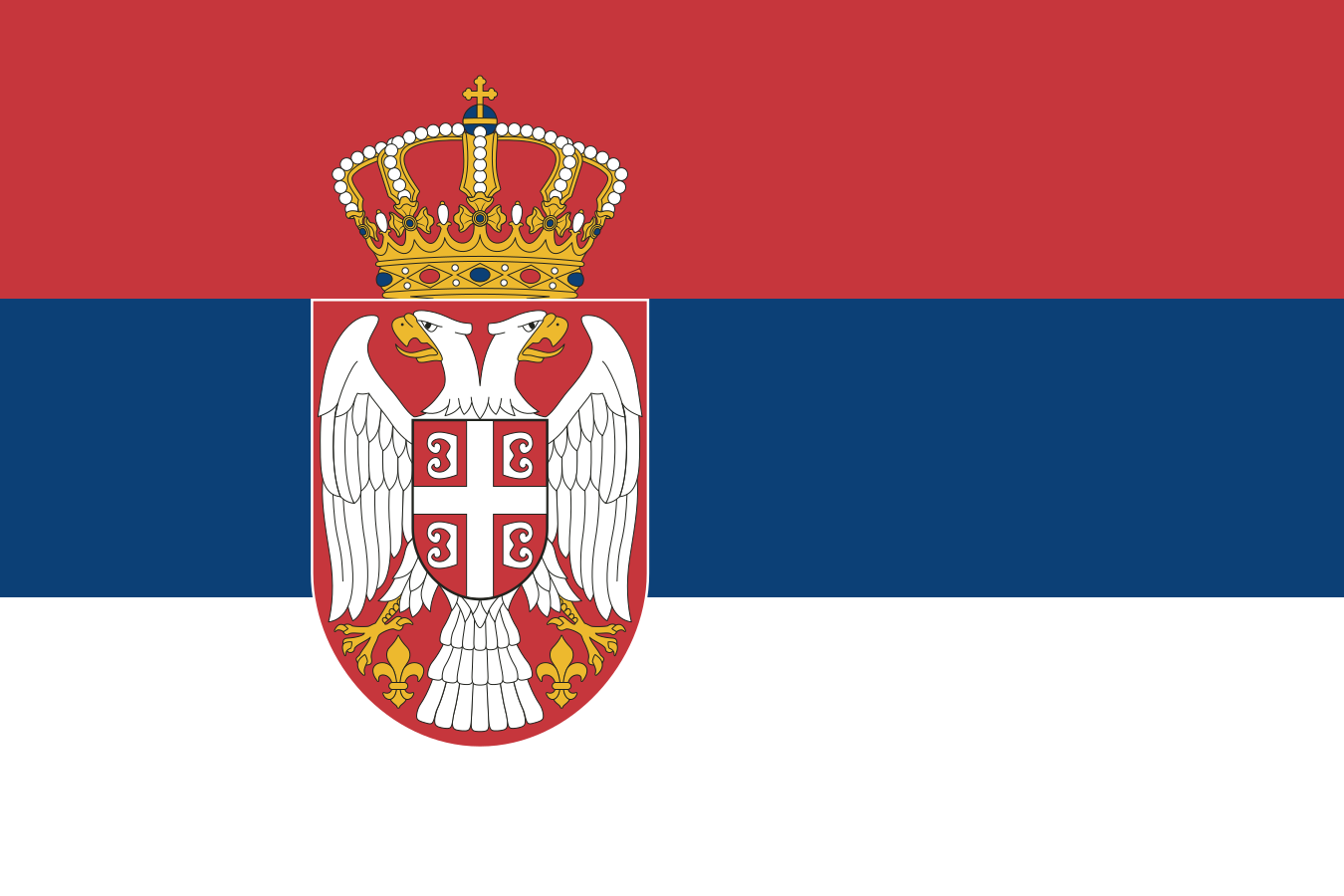
I would like to thank Secretary- General Guterres and his Special Representative, Mr. Zahir Tanin, for their submission of the report before us (S/2017/911) and their overall engagement in the realization of the mandate of the United Nations Interim Administration Mission in Kosovo (UNMIK) under resolution 1244 (1999). I also thank the President and members of the Security Council for recognizing the importance of the continued review and consideration of the issue.
UNMIK’s presence in Kosovo and Metohija in an undiminished scope and under an unchanged mandate as a guarantor of the status neutrality of the international presence is of paramount importance to promoting security and stability and to building trust between the communities of Kosovo and Metohija. Strengthening its financial and human resources will enable the international community to comprehensively and sustainably assess and address the problems and challenges facing the Serbian and non-Albanian populations every day.
The political situation, given its sensitivity in Kosovo and Metohija, has a major impact on building trust and confidence among its communities. Therefore, UNMIK’s undiminished presence ensures the necessary security and provides guarantees and impetus to Serbs and non-Albanians to involve themselevs in the processes initiated by the Brussels Agreement, without fear for their future or the future of their families.
The fact that 18 years after the arrival of the international presence in the province, some 200,000 internally displaced persons (IDPs) who were forced to flee Kosovo and Metohija continue to live in Serbia, outside the province, is a powerful argument that UNMIK’s scope should not be changed. Sustainable return has been achieved by only 1.9 per cent of IDPs, and I am sure that the Secretary-General will agree that that is one of the key questions that UNMIK should accentuate in the future. I would also point out, however, that the number of IDPs in Kosovo and Metohija cited in the report does not adequately reflect the magnitude of the problem and does not call for the commensurate attention of the Mission.
A number of structural shortcomings in the institutional and judiciary systems of Kosovo and Metohija are noted in the report. Those shortcomings
have negative consequences for vulnerable communities, primarily regarding the protection of the rights of the Serbs and other non-Albanians in the south of the province and the rights of returnees, as well as the process of reconciliation among communities. The negligible number of returnees is due to the failure to bring to justice offenders who have incited racial, ethnic and religious hatred and intolerance, ongoing institutional discrimination against Serbs, and ethnically motivated restriction measures, including arbitrary arrests. In particular, instances of arrests executed on the basis of trumped-up charges in the south of the province testify to the general physical and legal insecurity. Such measures seek to enable usurpers to take possession of property by illegal means.
The report of the Secretary-General should therefore accord attention in a separate section to the violation of human rights and freedoms of the returnees to southern Kosovo and Metohija. UNMIK must invest additional efforts in strengthening all its capacities in order to ensure the necessary level of protection of the human rights and freedoms of internally displaced persons, and to create optimum conditions for sustainable returns, including through the restitution of property or, put simply, the guarantee of property rights.
The report notes that no progress has been made with regard to the implementation of the ruling of the Kosovo Constitutional Court, confirming the ownership by the Visoki Dečani monastery of the surrounding land. The monastery, which features on the UNESCO World Heritage List, was founded in the first half of the fourteenth century by the Serbian King Stefan Dečanski. It has been vandalized many times in the past, including by adherents of the Islamic State in Iraq and the Levant. The report also draws attention to other disputes related to the property of the Serbian Orthodox Church. Those issues provide ample evidence of the importance of the protection of Serbian historical, cultural and religious heritage that is part of the invaluable heritage of Europe and the world.
The international community should also make additional efforts to establish a society in Kosovo and Metohija in which the rule of law is respected, in which conditions are created for effective, impartial and credible trials of war criminals, and in which the fate of missing persons is clarified, thereby contributing to the process of reconciliation among communities. As the legal framework for prosecuting perpetrators of war crimes in the Specialist Chambers has now been fully
put in place, we expect that those suspected of carrying out crimes against Serbs and other non-Albanians in Kosovo and Metohija will be indicted and tried.
Serbia continues to be firmly committed to dialogue between Belgrade and Pristina, facilitated by the European Union. Despite the many doubts, second- guessing and challenges encountered on the way, Serbia has demonstrated great resolve to find compromise solutions, which are not always simple or easy to come by. That constructive approach is evinced by the implementation by our side of a number of obligations assumed in the dialogue, including the recent integration of judges and prosecutors into the judicial framework of the province. Serbia’s commitment to resolving all outstanding issues peacefully and through dialogue is motivated first and foremost by its strong conviction that there is no alternative to such an approach and that only within a status-neutral framework is it possible to contribute to regional peace, security and stability, as well as to the region’s progress towards integration into the European family of nations.
Our responsible approach has also been reaffirmed by the bold political decision of the representatives of the Serbian list to enter Ramush Haradinaj’s Government after the parliamentary elections. The decision once again confirmed the political unity of the Serbs of Kosovo and Metohija and the perpetuation of the constructive policy of protecting their status and interests. Explaining their decision, the representatives stated that the conditions in which they decided to participate in the Government of Kosovo were very clear. They pointed to the need to protect the interests of Serbs and their central demands for the establishment of the association/community of Serb- majority municipalities, the protection of property and the guaranteed return of IDPs.
Regrettably, the efforts made by Serbia to find realistic, status-neutral and mutually acceptable solutions through compromise have not been reciprocated by the other side, particularly with respect to implementing the agreements that have been reached thus far. Let me point out in that connection that, even four and a half years after the obligation to establish the community of Serbian municipalities was assumed as the key part of the first agreement of principles governing the normalization of relations, no progress has been registered in its implementation. Surprisingly, no mention is made of that fact in the report. For us, the establishment of the association/community of Serb-
majority municipalities is the most important question and a cornerstone of the protection of the interests of the Serbs in Kosovo and Metohija.
I take this opportunity to call on the representatives of the Provisional Institutions of Self-Government in Pristina to demonstrate goodwill and commitment to dialogue and to proceed to establish the association/ community of Serb-majority municipalities without delay — in other words, to implement the obligations they have assumed and carry out the most important element of the Brussels agreements of 2013, which was signed by me in my capacity as Prime Minister of Serbia, by Catherine Ashton on behalf of the European Union, and by former Prime Minister Hashim Thaçi. This confirms the credibility of the statement made by Ramush Haradinaj, to the effect that there is no alternative to dialogue and that direct talks must occur between peoples and not the political elites.
The stalemate in the dialogue accounted for the emergence of a whole range of problems in the implementation of the agreements. Pristina continues to violate the provisions of the agreement on official visits and without a valid reason banned entry into Kosovo and Metohija to Serbia’s Minister of Education, Science and Technological Development, Mr. Mladen Šarčević, and the Director of the Office for Kosovo and Metohija Marko Ðjurić. In addition, the problems in the sphere of freedom of movement and integrated border management continue. Internally displaced persons are treated inadequately by being requested to provide additional personal data, while their passports, issued by the Coordination Directorate of the Ministry of the Interior of the Republic of Serbia, are not recognized when they attempt to enter the province.
Motivated by a desire to find a lasting solution to the question of Kosovo and Metohija, the President of Serbia Aleksandar Vučić has called on the citizens of Serbia to embark on an internal dialogue, which was institutionalized by the establishment of a working group. A long-term solution is a precondition of Serbia’s progress and that of the entire region. We need a serious, responsible and forward-looking approach in our relations with Pristina, and we are ready to offer a soluton that would contribute to regional stability, political cooperation and economic prosperity. Rather than be a cause of new divisions, misunderstanding and conflicts, it will provide an opportunity for a historic agreement with the Albanian community of Kosovo and Metohija.
I therefore take this opportunity to call on Security Council members and Pristina’s representatives to make a joint effort to focus on substantive issues and on the quest for a lasting and sustainable solution for Kosovo and Metohija rather than on technical aspects, such as the dynamic and format of Security Council meetings. Calls to change the long-standing modality of informing the Security Council and States Members of the United Nations about this important issue, at a time when we are trying to find a lasting solution for this problem, can only create new divisions within the Council and deepen the differences between Belgrade and Pristina. They counterintuitive and not conducive to the creation of a constructive atmosphere for the continuation of dialogue.
Serbia’s efforts are aimed at protecting, in a legitimate way, its national and State interests and at asserting the authority of international law, the Charter of the United Nations and resolution 1244 (1999), which guarantee Serbia’s sovereignty and territorial integrity. Any attempt to resolve any issue in Belgrade-Pristina relations unilaterally is unacceptable and may negatively affect the implementation of obligations assumed in the dialogue. In that context, I stress the disapproval of my country and of the international community of efforts to establish a Kosovo armed force. Such unilateral acts by Pristina are fraught with the potential to destabilize the security situation in the region and threaten the process of normalizing relations between Belgrade and Pristina.
At the same time, Pristina’s efforts to promote its unilateral declaration of independence by applying for membership in international organizations and, by the same token, of politicizing their work have been denounced by many countries, including some that have recognized the unilateral declaration of independence. I take this opportunity to thank them for standing firm in the defence of international law in order to emphasize that the only right thing to do in this international context is to discourage Pristina from seeking admission to international organizations and to focus on a good-faith dialogue as the only way to resolve all issues. It is also worth mentioning in that connection that recent events have shown that States can and do backtrack and renounce their recognition of Kosovo’s unilateral declaration of independence. Sao Tome and Principe and Suriname have proved that it is possible.
Before I conclude, let me take this opportunity to recall that Serbia has warned for the past 10 years of the danger of unilateral acts and drawn attention to the fact that recognition of Kosovo’s unilateral declaration of independence may open a Pandora’s box of many other separatist and secessionist movements around the world. Regrettably, we have seen this happen of late. Serbia condemns each and every attempt to declare independence unilaterally in the strongest terms and unequivocally supports the principle of the territorial integrity and sovereignty of all States.
In conclusion, I express special thanks to States that have not recognized the unilateral declaration of independence of Kosovo for their principled position and their respect for resolution 1244 (1999) and the Charter of the United Nations.
I now give the floor to Ms. Çitaku.
Ms. Çitaku: As always, I am honoured to be here in the Council on behalf of the Republic of Kosovo, although, I must admit, I fear we are not showing the Chamber the respect it deserves when we come here every three months, taking members’ valuable time, to stage a theatre for purely domestic consumption. The intention is to somehow artificially instil the idea that the status of Kosovo is not resolved, and that Kosovo is akin to a war zone where minorities are expelled and persecuted.
That is simply not true. Furthermore, that is offensive not only to us Kosovars but, frankly speaking, to the United Nations and its agencies, which have put so much effort into reviving Kosovo in the immediate aftermath of the terrible war of 1999. Hundreds of thousands of refugees and hundreds of thousands of internally displaced persons returned to their homes to find everything in ashes. But we had much more than only hope and determination; we had the help of the United Nations, and for that we will be forever grateful. Therefore, for us, this Chamber is too important and too valuable to see it being misused in a projection of images that do not match reality. Our northern neighbour insists on projecting an alternative universe where time has not moved a second since the 1990s.
Kosovo is free and independent, and that will never change. A steep price was paid for it. On that cold day in February 2008, we knew that our struggles would continue and that there would be twists and turns. But the clock of history is not going backwards. Regardless of the difficulties, we will never give up our aspiration to
make Kosovo an equal member of the family of the free nations of the world. We are not asking for shortcuts; we are just asking for fair treatment. We believe that it is fair to ask for the mandate of the United Nations Interim Administration Mission in Kosovo (UNMIK) to be redefined to match the reality on the ground.
UNMIK is not a peacekeeping mission, Kosovo is at peace and there is no conflict to be contained or civilians to be protected. UNMIK is not an administrative mission; Kosovo has its institutions. Did its mandate not expire more than a decade ago? Although the main purpose of the Council has been to maintain stability in Kosovo, the Council has not pronounced itself since 2008, when we gained our independence. Instead, it prefers to continue with routine reporting and keeps a Mission that reinvents its mandate without any real need, when we should be talking about downsizing and withdrawing the United Nations Mission in Kosovo in the light of the situation on the ground.
In less than six months, Kosovo organized both national and local elections. The turnout was especially high in the Serb-majority areas. The new Government, with Mr. Ramush Haradinaj as Prime Minister, was voted in on 9 September. It is important to note that according to international observers, both electoral processes met the highest international standards, with the exception of few Serb-majority areas where the local population was subjected to different kinds of pressure and intimidation to vote in a certain way. Often, Belgrade officials were responsible for such intimidations. In fact, I can say that the only Government that exercises pressure on the local Serbs is the one that sits in Belgrade.
Yes, there is discrimination against minorities in Kosovo, but it is of a positive nature. Kosovo institutions have gone to great lengths to accommodate the rights of non-majority communities. In today’s Government, the Serbian community is represented by one Deputy Prime Minister, three Ministers and six Deputy Ministers. As the saying goes, we have put our money where our mouth is. Between 2008 and 2017 alone, the Kosovo Government has spent over €51 million for the repatriation and reintegration of minority communities in Kosovo; that is a public record.
However, I must reiterate that the claim that 200,000 Serbs were displaced from Kosovo after the war is factually incorrect. If that had been the case, there would be no single Serb living in Kosovo today.
According to the census organized in 1991 by the then- Yugoslav authorities, the number of Serbs living in Kosovo was 194,000. Unfortunately, to date we still do not know the accurate number of the Serbs living in Kosovo. That is because when the Kosovo institutions organized a census in 2011, the Government of Serbia unleashed a very aggressive campaign to discourage the participation of the Serb community. The smear campaign went so far as to label registration for the census as an act of betrayal. For us, it is not about numbers. Even if just one Kosovo Serb cannot return, that is one too many for us.
At the same time, we must also remember that not all Serbs that fled Kosovo after the war were actually citizens of Kosovo. When the war erupted in Croatia and Bosnia and Herzegovina, entire neighbourhoods were built in several locations in Kosovo to accommodate Serbs who used to live in those parts of the former Yugoslavia. Some decided to stay in Kosovo, as was the case of the Marević family, which came to Kosovo in July 1995. One member of that family was a minister of the local Government in the previous Government of the Republic of Kosovo.
In addition, in line with our Constitution, dual citizenship is allowed. Kosovo Serbs who are also citizens of Serbia have a constitutional right to vote in the Serbian parliamentary and presidential elections. In the absence of a Serbian embassy in Kosovo, the Organization for Security and Cooperation in Europe mission administers the process. According to data from the last two rounds of elections, 106,094 voters in Kosovo were eligible to vote. Obviously, the numbers do not match up. Either the Serbian Election Commission inflated the number of Serbian voters in Kosovo or the number of Serbian displaced persons is inflated. We will get the full picture only when we organize the next census, and we will spare no effort to create better living conditions for all Serbs who decide to return.
It is regrettable that at a time when we should be concluding the dialogue with Serbia, its political representatives persist with their hatred and unacceptable declarations, followed by all sorts of attempts to rewrite history, including by choosing war criminals, such as General Ljubiša Diković, who committed war crimes in Kosovo, to teach cadets at the military academy. What is a man who is responsible and convicted for the death of thousands, including children, the rape of thousands of women and the deportation of hundreds of thousands
going to teach young Serbians today? In the words of the Human Rights Watch official Fred Abrahams,
“this is a dangerous refusal of the truth about the war. It is the same as if we were to appoint a thief to protect our banks”.
Again, I do not mention this because I want to talk about the past; I am raising this point because I simply see no way to build peace and reconciliation if we deny the truth or bury it. Furthermore, if our neighbour declares victory because we are not able to join INTERPOL this year, it is not only wrong, but also irresponsible. We all know that the challenges we and the rest of the world face are borderless, and that they can be won only if we share information and work together. From terrorism to cyberthreats, we cannot win by excluding Kosovo and declaring that a victory. Quite the opposite is true.
Again, we are not giving up. I believe that Kosovo will soon secure its place within all the relevant international bodies, in coordination with our partners. That would not be a victory of Kosovo over Serbia; it would only be a just victory over the unjust, and the right and smart thing for the international community’s investments for peace and stability in the region. The host country of this year’s meeting of the INTERPOL General Assembly did not allow members of the Kosovo delegation to obtain visas, which was another unnecessary obstacle that our shaped final decision to withdraw our application this year.
Meanwhile, in Kosovo just yesterday, five members of the non-majority communities — Serbs — were promoted to higher officer ranks in the Kosovo security forces. As President Thaçi stated during the promotion ceremony, “once again the Kosovo security forces show that it is a force in the service of all citizens of Kosovo and in every corner of Kosovo”. Kosovo’s army will be exactly the same — a modern, defensive army that will reflect Kosovo’s desire to join the Euro-Atlantic family. We will do our utmost to make that process as inclusive and consensual as possible, but no one will have veto power over it.
Furthermore, after many years of unnecessary delays, we can now say that Kosovo’s Constitution and Kosovo’s laws can now be applied throughout Kosovo’s territory, since 40 new judges and 13 new prosecutors from northern Kosovo took an oath of office on 24 October. That is important not only in constitutional terms but because, after many years of being denied
justice, Serbs living in northern Kosovo will finally start receiving the services that they deserve from their own State.
I want to assure everyone here that Kosovo remains strongly committed to dialogue with Serbia, and I reaffirm that we will implement all the agreements reached in Brussels, in line with our Constitution. It is true that our electoral processes have caused us some delays, but our commitment remains. We know better than anyone what happens when we stop talking to each other, even if we disagree. However, we do not want a farce, or a process conducted merely for the sake of obtaining compliments or favours for anyone. We want a genuine process that will lead to the full normalization of relations between the two States.
I would like to add that Kosovo’s independence is not a product of a secessionist movement but of the dissolution by consensus of the former Yugoslavia. We had borders long before we had statehood. Besides that, there was international intervention in Kosovo to stop ethnic cleansing. The United Nations Interim Administration Mission was deployed in Kosovo, and President Martti Ahtisaari was appointed by the Secretary-General to head a United Nations-led process, proposing an initially supervised independence for Kosovo. The International Court of Justice then issued a ruling clearly stating that Kosovo had not broken or violated any international law, and that its case was sui generis. Any attempt to draw a parallel between Kosovo and other situations around the globe will fail.
As we approach the tenth anniversary of our independence, we have a lot to be proud of. Just last week, for example, the World Bank announced that Kosovo is among the top 10 global economies displaying the most notable improvement in carrying out business reforms. Nonetheless, we are fully aware that we have much more to do in order to meet the rightful expectations of all people in Kosovo. They deserve better education, better health care and more opportunities to prosper. Our young people deserve that as they make us increasingly proud every day with their selfless dedication and accomplishments. With little or no institutional support, our young women and men are becoming shining examples and inspirations. They have taken Kosovo to the Olympics, bringing home gold medals from competitions ranging from mathematics to judo and raising our flag in places where politics still cannot land. We owe it to them and to future generations to leave behind a Kosovo that is
not only at peace with itself but also prosperous and at peace with its neighbours. That is a dream worth fighting for.
I now give the floor to the members of the Security Council.


I would like to thank Mr. Tanin, the Special Representative of the Secretary- General, for his informative briefing and continued service. I also appreciate the statements made by First Deputy Prime Minister Dačić and Ambassador Çitaku.
As an Ambassador to the United Nations residing in New York, I have one important lesson in mind when attending any Security Council meeting, which is that we should conduct discussions based on the realities on the ground and, when appropriate, call for measures to be taken. The Council should always pay attention to developments on the ground. One such is that the local elections held throughout Kosovo were conducted in a fairly peaceful manner, including in areas with Serb majorities, despite some challenges, and that the new Government of Kosovo, formed in September, is embarking on a smooth political administration transition. Another is that Kosovo has long faced a number of challenges, including the need to create jobs, expand foreign direct investment, normalize relations with Serbia and demarcate its border with Montenegro. The Government therefore has no time to waste in squarely facing those challenges.
Another important reality is that the risk of violence in Kosovo is far lower than in other regions on our agenda, such as the Middle East and Africa. Since its establishment in 1999, the United Nations Interim Administration Mission in Kosovo (UNMIK) has greatly contributed to the development of self-governing democratic institutions and ensuring the conditions for peaceful and normal lives for the citizens of Kosovo. Today Kosovo has its own Constitution, democratic Government and parliament. UNMIK is undeniably a success story for the Security Council.
At the same time, the Council has the responsibility for determining UNMIK’s future. The Mission must be reviewed so that we can assess which functions and mandates it alone can provide. We must address UNMIK’s possible duplication of the rule-of-law activities of the European Union (EU) and the Organization for Security and Cooperation in Europe, and consider a physical reduction of UNMIK personnel. In addition, an adjustment to the briefing cycle is long
overdue. A half-year cycle or longer is more than sufficient. Japan very much hopes that the Council will discuss UNMIK’s future functions and make the necessary decisions calmly.
Of course, while almost 10 years have passed since Kosovo gained its independence, the realities in Kosovo are far from rosy. The crucial issues include reconciliation between Kosovo’s Albanian and Serb communities, which is far from complete, and the normalization of relations between Kosovo and Serbia. In that connection, Japan welcomes the oath taken by Serb judges and prosecutors and their integration into Kosovo’s justice system last month, in accordance with the agreement between the two leaders in the EU-facilitated dialogue in August. The Government of Kosovo must now accelerate the establishment of the long-awaited association/community of Serb-majority municipalities in order to honour the 2013 agreement on the subject with Serbia.
Regarding the relations between the two sides, Japan appreciates President Vučić’s recent remarks on his commitment to a final resolution of the conflict, and we have taken note of the commencement last month of an internal dialogue. The environment for dialogue between the two sides on their status has been gradually improving, thanks in part to the call by President Thaçi of Kosovo for an internal dialogue as well. Japan hopes very much that with the assistance of the EU, the two sides will succeed in normalizing their relations in the near future through high-level, serious dialogue, while promoting tolerance and refraining from provocative ethnic rhetoric.
In conclusion, Japan is confident that Kosovo will achieve reconciliation among its ethnic groups under democratic governance, and sustained economic growth by exploiting its abundant natural resources and facilitating a predictable business environment. Japan fully supports Kosovo’s efforts to that end, as well as its aspirations for European integration.


I would like to thank the Special Representative of the Secretary-General, the First Deputy Prime Minister and Minister for Foreign Affairs of Serbia and the Ambassador of Kosovo for their briefings.
France welcomed Kosovo’s formation of a new Government on 9 September in the wake of the legislative elections, which were held on 11 June and monitored by a large number of international observers.
The establishment of new institutions is an essential step in enabling Kosovo — which France fully supports in both its national capacity and as a member of the European Union (EU) — to meet its challenges and the needs of the Kosovan people. The municipal elections are now taking place, and the first round, held on 22 October, was an overall success. We hope that the second round will also go well, free from attempts at intimidation, particularly in the Serbian municipalities, as the European Union Election Observation Mission has highlighted.
France supports the new Prime Minister’s desire for reform, particularly in the area of economic development and its corollary of job creation, as well as improving health care and the education system. We also welcome the unanimous ratification on 4 October of the agreement between Kosovo and the European Union on the disbursement of financial assistance from the EU. Kosovo’s political and economic institutions have been consolidated in recent years, and that significant progress, particularly on the security and economy fronts, is reason to continue adjusting the work of the United Nations Interim Administration Mission in Kosovo and coordinating it with the other international stakeholders in Kosovo. Changing nothing is not acceptable, considering that it is our responsibility, as members of the Security Council, to ensure that United Nations resources are fully adapted to the situation on the ground. Kosovo no longer needs peacekeeping efforts per se, so we should therefore review how we are spending those resources.
France firmly believes that the future of Kosovo will be shaped by the political dialogue between Belgrade and Pristina conducted under the auspices of the European Union, which has been very clear about this. For both Serbia and Kosovo, rapprochement with Europe is conditional on normalizing relations between the two countries. In that respect, it is important that the parties show good faith and a willingness to engage with each other at the highest level. The recent meetings of the Presidents of both countries convened by Ms. Mogherini, the High Representative of the European Union, at which both sides emphasized their willingness to resume the dialogue between Pristina and Belgrade, are positive signs in that regard. We have also noted with interest the initiative of President Vučić to launch an internal dialogue on Kosovo in Serbia.
Beyond the declarations of intent, from now on we expect that all the agreements reached in 2013
and 2015 will be effectively implemented as soon as possible, so that meaningful progress can be made in fully normalizing relations between the two parties. In that regard, we welcome the integration of Serbian staff into Kosovo’s judicial system that took place on 24 October. France fully supports the mediation efforts led by the European Union and its High Representative, Ms. Mogherini. We urge the Kosovo and Serbian authorities to step up their efforts to produce concrete results in that regard. Each side must do its part by adopting a constructive attitude and refraining from any provocations that could jeopardize the stability of the region. We also stress the importance of efforts to promote reconciliation and closer ties within and between communities.
In conclusion, further efforts to consolidate the rule of law in Kosovo must remain a priority. That is a particularly firm European demand and one that we support. Whether this issue is one of administrative capacity-building, justice or of combating corruption and organized crime, much remains to be done. Fighting radicalization in all its forms must also continue to be a priority. We therefore commend Kosovo’s unconditional commitment to this issue, both at the local level and in the international coalition against Da’esh.


We welcome the participation in today’s meeting of Mr. Ivica Dačić, First Deputy Prime Minister and Minister for Foreign Affairs of Serbia, and we share his serious concerns about the status quo in Kosovo. We thank Special Representative Tanin and his team for their efforts and objective briefing on the activities of the United Nations Interim Administration Mission in Kosovo (UNMIK), which make it clear that there are persistent, deep-rooted problems in the province that require urgent resolution as well as monitoring by the international community.
We do not share Ms. Çitaku’s optimistic, rosy assessments. Incidentally, I would like to let her know that while it is kind and even touching to hear her concerns about the time at our disposal, she need not worry about that. I would like to say to her that she does not need to worry about our time — the time of the Security Council — as we indeed do have much to say about what is going on in the province. Unfortunately, we have been compelled to conclude that the process of settling the situation in Kosovo has utterly stagnated. The dialogue between Belgrade and Kosovo under European Union (EU) auspices has essentially ceased to
function. Despite the periodic meetings held in Brussels by the EU in which senior officials from both sides take part and which are intended to show that the format is still strong, no work is being done on substantive issues and there are no prospects of reviving the dialogue. It is telling that the executive structures in Pristina that previously provided technical support for the talks have been dismantled. We took note of the idea expressed by President Vučić of Serbia at the trilateral meeting in Brussels on 31 August with regard to launching a discussion of the long-term prospects for relations between Serbs and Albanians and ways to resolve them on a sustainable basis. We have heard no response to that initiative from either the Kosovo-Albanian side or the EU mediators.
We believe that the formation of a so-called Government in Kosovo in September is a clear illustration of the degree to which the situation has deteriorated and the extent of the radicalization in the province. The choice for the majority was between Ramush Haradinaj, who has been implicated in war crimes, and the ultranationalist Albin Kurti, who advocates the establishment of a greater Albania. That only emphasizes the fact that Kosovo is not only not a fully fledged State but that it is a source of instability with the potential to lead to a relapse into ethno-religious conflict in the Balkans and the collapse of the entire regional security system.
We are compelled to note the lack of progress in the relations between Belgrade and Pristina. The EU- led dialogue has for many months been at a conceptual dead end. Clearly, the parties view its essence and its ultimate aims in different ways. That is first of all the result of the biased mediation of Brussels, encouraging the Kosovo Albanian leadership to take hostile steps that are poisoning the atmosphere of the dialogue and undermining mutual trust. The European partners are playing into the hands of the Kosovo Albanians by attempting to shift the blame onto the Kosovo Serbs for the slow pace of implementation of the agreements that have been reached. However, a key item in those agreements is the one on establishing an association/ community of Serb-majority municipalities, which Pristina has been cynically sabotaging since April 2013.
We trust that following the conclusion of the second round of municipal elections, scheduled for 19 November, the Kosovo Albanian authorities will no longer have any pretext for dragging their feet in dealing with these protracted issues. The pace of
the process of the return of refugees and internally displaced persons to the province is as slow as ever, as is the work of clarifying the fate of missing persons. It is clear that individuals of non-Albanian ethnicity fear for their safety and see no possibility of resolving their property-related issues.
The oppression of the Serbian Orthodox Church persists. Despite the decisions of every Kosovo authority, including judicial ones, affirming the property rights of Visoki Dečani with respect to its adjacent land — which, I would like to recall here, is a UNESCO World Heritage site that is listed as threatened — the leadership of the municipality has not complied with them. What kind of trust can there be in Kosovan justice after that, especially given the backlog of court cases — approximately 350,000 — mentioned in the report of the Secretary-General (S/2017/911)? The fact is that the project known as the Republic of Kosovo is clearly not working.
Another area where no progress has been made is the investigation into the war crimes committed by the Kosovo Liberation Army. It remains unclear when the Specialist Chambers in The Hague will begin to function. Nor should we forget that the basis for the establishing that court was the report of the Special Rapporteur of the Commission on Human Rights of the Parliamentary Assembly of the Council of Europe, Mr. Dick Marty, which accused certain present-day Kosovo Albanian politicians of involvement in the illegal trafficking of human organs and other extremely grave crimes. This is a very serious issue that a lot of people do not want to remember. All legal obstacles to the commencement of the court’s work have been overcome, and we trust that initial charges will be brought shortly.
Another difficult topic concerns forcing the issue of the transformation of the Kosovo security forces into a full-fledged armed force, in spite of the positions of both Belgrade and the Kosovo Serbs, an idea that the authorities in Pristina have cherished for a number of years, with attempts being made to give it a pseudo- legal basis. In our view, the real issue is completely different. It is crucial to understand that in and of itself, this undertaking represents a breach of international law, since it runs counter to resolution 1244 (1999), which provided for the presence of a force in the province exclusively on the basis of a Council mandate, specifically the Kosovo Force, which is currently largely composed of NATO member State contingents.
Moreover, such a step would be extremely reckless in terms of security both in the region and in Europe as a whole.
The presence in the Balkans of a new force component in the form of the so-called Kosovo armed forces would fly in the face of the Florence agreement, annexed to the Dayton agreement, designed to support regional stability with support from the Organization for Security and Cooperation in Europe. It would seem that a military body not under the control of the country’s authorities has appeared on the territory of one of the signatories to the Florence agreement, Serbia.
The importance of countering the proliferation of Islamic radicalism and terrorism in Kosovo is still extremely urgent. We are troubled by the fact that the province is being used for the recruitment of fighters involved in hostilities in the Middle East on the side of the extremists and for staging terrorist attacks in other countries. With respect to the rule of law and safety and security in Kosovo, we would draw the Council’s attention to the guilty verdict recently handed down by a court in Skopje against a large group of Kosovars who participated in a terrorist raid in Kumanovo on 9 and 10 May 2015. We would note that questions about who in Kosovo was behind the attack and why the international presence was unable to prevent it, not to mention that questions about eliminating such hotbeds of tension remain unresolved.
We were dismayed by the claims from Pristina relating to the allegedly politicized verdict of the Macedonian court and assertions about monetary assistance to the families of the condemned. Given the upcoming rout of the Islamic State and the predicted return to the Balkans of a number of a foreign terrorist fighters to the region, including Kosovars, such an approach to counter-terrorism issues is, at the very least, ambiguous.
Despite the multitude of domestic issues it faces, Kosovo portrays itself as an active player on the national stage and is striving to join the greatest possible number of multilateral structures. We continue to consider that illegitimate, since from an international legal standpoint the province’s representation at that level is through UNMIK. Moreover, the modalities for Kosovo’s participation in regional bodies, through the so-called Kosovo asterisk formula, based on a footnote, have been established within the framework of the Belgrade-Pristina dialogue. The European
Union, as a conscientious mediator, must ensure compliance with these resolutions in negotiations held pursuant to General Assembly resolution 64/298, of September 2010.
The artificial nature of Kosovan statehood is reflected in the Republika Srpska’s recent reference to the sovereignty of the Republic of Kosovo. This attests to a gradual acknowledgement of the damaging nature of decisions, often taken under external pressure, on the acknowledgement of the independence of territorial bodies that unilaterally secede in breach of international law. Under these conditions, we deem untimely and counterproductive talks about a reduction of staffing and budgetary parameters of UNMIK. The situation in the province is such that no decision of this sort can be taken, and, incidentally, it must be acknowledged that in essence the dialogue between Belgrade and Pristina has been virtually non-existent.
For this reason, we must reject requirements to draw down or close the Mission. Instead we must commence constructive work in cooperation with this important United Nations operation. Let us recall that the Mission has been working with minimal resources. However, it plays a key role in Kosovo affairs and remains a critical tool for international oversight. It deals with issues relating to the normalization of the situation, in line with resolution 1244 (1999), which remains fully in force.
In the light of the aforementioned, we see no justification for any revision of the practice of quarterly reports to the Security Council about the situation in Kosovo. As has been reflected in today’s discussion, this issue continues to require close international oversight and attention.


I want to start by thanking the Special Representative of the Secretary-General, Mr. Tanin, for his briefing and also express appreciation for the interventions this morning by First Deputy Prime Minister and Foreign Minister Dačić, as well as by Ambassador Çitaku.
We welcome the formation, since the Council last considered this agenda item, of a new government in Kosovo. We now encourage all political actors, both inside and outside of the government, to engage in constructive dialogue and to continue implementation of the reforms necessary to strengthen the rule of law and the fight against corruption and to stimulate
Kosovo’s economic development and create employment opportunities.
We deem positive the fact that the first round of the municipal and mayoral elections in October was genuinely competitive and peaceful in most parts of Kosovo. However, we regret that there were cases of threatening behaviour and intimidation in certain Serb- majority municipalities in the run-up to the elections.
The future of both Serbia and Kosovo lies within the European Union (EU). In order to achieve their European perspective, the normalization of relations between the two countries is essential. Regional cooperation and good neighbourly relations are pivotal for a stable, peaceful and prosperous Western Balkans. In that regard, it is crucial that all political leaders in the region refrain from provocative actions and statements. It is essential that the status issue does not hamper Kosovo’s European perspective or prevent its membership in international organizations. We welcome the resumption of the EU-facilitated dialogue, which provides an important contribution to the normalization of relations between Kosovo and Serbia. Pristina and Belgrade must now intensify efforts to implement their respective parts of the agreements reached. In that regard, we welcome the recent integration of Serb judges into the Kosovo justice system as a most positive development. It is critical that parallel structures in Serb-majority areas be dismantled, and that the association/community of Serb-majority municipalities be established in a way that strengthens links between Kosovo-Serb citizens and the Pristina Government, and increases public trust in dialogue.
The United Nations and the United Nations Interim Administration Mission in Kosovo have made an invaluable contribution to the progress made in Kosovo since the end of the conflict. Building on that progress to establish a truly peaceful and prosperous Kosovo, including by engaging women and youth, will require the constant vigilance and unwavering commitment by all political leaders. The EU integration process, including through the support of European Union Rule of Law Mission in Kosovo, provides the framework to deal with remaining challenges. By continuing to work towards Kosovo’s European perspective, Kosovo’s leaders can deliver on the expectations of their people for a better future.
In that light, we remain interested in receiving Special Representative Tanin’s views on possible
prospects of further downsizing the Mission’s structure, size and tasks, as well as the possibility of adjusting the reporting and briefing period from three to six months, which is something we would support.


I thank the Special Representative of the Secretary- General and Head of the United Nations Interim Administration Mission in Kosovo (UNMIK), Mr. Zahir Tanin, for his briefing and his presentation of the report of the Secretary-General (S/2017/911).
I also thank First Deputy Prime Minister and Minister for Foreign Affairs of Serbia, Mr. Ivica Dačić, and Ms. Vlora Çitaku for their statements, and the Italian presidency for convening this open meeting.
Uruguay advocates for the respect of the principle of sovereignty and territorial integrity of Serbia, as well as for compliance with resolution 1244 (1999). In the same vein, it advocates for political dialogue and constructive approaches that can lead to solutions that promote progress and stability in the region. As my delegation has indicated on previous occasions, I would like to point out that, as a country that has traditionally championed diplomacy and the peaceful resolution of disputes, Uruguay considers the European Union (EU)- facilitated dialogue between Pristina and Belgrade essential. In that regard, we express our full support for that process.
With regard to the events of the past several months, we urge the political leaders to promptly resume the Belgrade-Pristina political dialogue and compliance with the agreements already reached. The dialogue’s hiatus and delays in implementing international agreements are a source of tensions and distrust between the neighbouring countries. Moving forward the commitments already made will contribute to achieving stability at the international and national levels, and improving the living conditions and development of individuals so that they can reach their full potential. We firmly believe in the path that leads to reconciliation, and we way we must continue working in that direction. The renewal of the dialogue would be laudable.
I would like to dwell on several aspects related to human rights that we believe are essential to achieving reconciliation among the various communities living in Kosovar territory, namely, the protection of cultural property, mutual respect for the communities’
differences and setting up conditions that will allow for the return of internally displaced persons.
Respect for the culture and religious beliefs of each community, as well as policies aimed at protecting minorities, are fundamental for achieving reconciliation and peaceful coexistence, and will contribute to the return of internally displaced persons who, according to the Office of the United Nations High Commissioner for Refugees, numbered 16,418 as of September. Addressing the issue of internally displaced persons will be necessary so as to achieve post-conflict reconciliation. We appreciate the round table held in Geneva in August as a follow-up to the issue of missing persons. Progress must be made in that area as time and the age of those involved are working against achieving an outcome. The families of missing persons have the right to the truth and justice. It is an urgent and basic matter of humanitarian law.
Respect for each community, its culture and religious beliefs, as well as policies aimed at protecting minorities, are essential to consolidating peace. Truth, justice, reconciliation, security, equal rights, guarantees and inclusive processes constitute the foundation for sustainable peace. We appreciate the work that UNMIK is carrying out on the ground, the European Union as a facilitator of the dialogue, and the Organization for Security and Cooperation in Europe as a cooperating partner, and acknowledge the work of all the relevant United Nations agencies, funds and programmes.


First of all, allow me thank Ambassador Zahir Tanin, Special Representative of the Secretary-General and Head of United Nations Interim Administration Mission in Kosovo (UNMIK) for the clarity of his presentation of the report of the Secretary-General (S/2017/911). I would also like to welcome the presence of First Deputy Prime Minister and Minister for Foreign Affairs of the Republic of Serbia, Mr. Ivica Dačić, and Ambassador Çitaku, to whose statements we have listened attentively.
My delegation welcomes the coordinated efforts of the various political parties which, with the support of the Kosovo Serb bloc in the Assembly, resulted in the election of an Assembly bureau and the establishment of a New Government, thereby ending the months- long political stalemate. Those developments, as well as the holding of free and transparent municipal elections with the wide participation of the Serbian municipalities in the north, represent, in our view,
significant and praiseworthy progress. We therefore encourage Kosovo’s political stakeholders, on the one hand, to continue their work in maintaining a peaceful political climate, on which the effectiveness of the Belgrade-Pristina political dialogue largely depends, and, on the other hand, Serbian authorities to strengthen their commitment within a constructive and calm dialogue with Pristina.
Moreover, my delegation takes this opportunity to welcome the progress made thus far by the two parties in the framework of that dialogue under the auspices of the European Union (EU) to which they must fully commit in a constructive spirit, with the knowledge that it remains the only viable way to normalize relations.
In the judicial area, the integration and swearing-in of 40 judges and 13 Serbian prosecutors from northern Kosovo before President Thaçi, is contributing to bringing communities together and promoting peace. Equally encouraging was the high-level meeting organized by Ms. Federica Mogherini, High Representative of the European Union for Foreign Affairs and Security Policy, held in Brussels on 31 August, at which the Presidents of Serbia and Kosovo participated and committed to resuming the dialogue at the highest level under the auspices of the EU, while focusing on the implementation of agreements already concluded within that framework.
The issue of missing persons must remain a priority. It requires that the leaders of both parties show robust political will to provide families that have been waiting for a long time with answers.
I welcome the ongoing efforts of the security forces aimed at countering violent extremism in Kosovo as well as the constructive avities carried out within the framework of the European Union Rule of Law Mission in Kosovo (EULEX), which contribute to strengthening the achievements made in the fields of defence, the rule of law, human rights, and the fight against terrorism and organized crime. Likewise, we welcome UNMIK’s activities in promoting reconciliation, transitional justice, human rights and support for the process of normalizating relations between Belgrade and Pristina.
Senegal would like to reiterate its unreserved support for the joint United Nations-European Union programme to strengthen inter-community trust through the protection of cultural heritage. In that regard, we advocate for greater cooperation in terms of information exchange.
In conclusion, my delegation would like once again to pay merited tribute to the Special Representative of Secretary-General for his wise stewardship of UNMIK, while also expressing appreciation to the International Security Force in Kosovo, EULEX, the European Union itself, and the Organization for Security and Cooperation in Europe for their valuable contributions to building a peaceful and prosperous society in Kosovo.


I thank Special Representative of the Secretary-General Tanin for his briefing. I also wabt to thank Ambassador Çitaku and Minister Dačić for their participation.
We congratulate Kosovo on formulating a new Government following free, fair and peaceful democratic elections in June, which clearly demonstrates Kosovo’s democratic maturity. We also welcome the successful local elections that Kosovo held on 22 October, which is further evidence of Kosovo’s continuing progress. We urge Kosovo’s newly elected leaders to use their mandates wisely to advance the welfare of all of Kosovo’s communities and to maintain progress towards Euro-Atlantic integration. We also welcome recent advancements in the Kosovo-Serbia dialogue with a successful integration of Kosovo Serb judges, prosecutors and administrative staff into the Kosovo judiciary.
We greatly appreciate the European Union’s contributions as facilitator of the Brussels dialogue. We reiterate our support for the dialogue and encourage leaders in both Belgrade and Pristina to continue efforts to reach agreement on normalization.
As we have repeatedly said in this Chamber, the United Nations Interim Administration Mission in Kosovo (UNMIK) has long ago fulfilled its mandate in Kosovo. There is no doubt that over the years the Mission has successfully helped Kosovo build multi-ethnic democratic institutions that uphold the rule of law and respect human rights. The United Nations should be proud of these accomplishments and this success story.
But it is now time for the Mission to make a transition. United Nations resources must be directed towards more critical issues. In that regard, we firmly believe that the Security Council should consider UNMIK in a format that will allow us to discuss in detail proposals to improve the Mission and to bring its resources in line with any needs on the ground. The current format has not allowed us as a Council to seriously evaluate and assess the Mission and its future.
We also reiterate our call on the Council to adjust the reporting and briefing period for UNMIK. The Mission’s reporting and briefing period should change from three months to six months or even longer.
During the last briefing, in August (see S/PV.8025), we recommended that, in his next report, the Secretary- General provide an assessment of possible budget and staff reductions with a focus on reducing redundancy (see S/PV.8025). We reiterate our recommendation for such a report.
Finally, we continue to strongly support full international recognition of Kosovo and Kosovo’s membership in all relevant international organizations, including the United Nations and INTERPOL. We encourage States Members of the United Nations that have not yet done so to join the more than 110 United Nations Members that have already recognized Kosovo as an independent State.


I thank Special Representative of the Secretary-General Tanin for his briefing. I would also like to welcome Deputy Prime Minister Dačić and Ambassador Çitaku to the Security Council and thank both of them for their constructive statements this morning.
It has been three months since the Council last met to discuss the situation in Kosovo. As the report of the Secretary-General (S/2017/911) makes clear, it is been a comparatively quiet period, one that does not warrant the Council’s attention so soon after our last meeting on the subject (see S/PV.8025).
Since we last met, we have seen the welcome formation of a new Government and a National Assembly. As the United Kingdom’s Minister of State for Europe, Sir Alan Duncan, made clear on his visit to Pristina the last week, the United Kingdom remains fully committed to working with Kosovo on a broad range of issues, including strengthening the rule of law, addressing weaknesses in the justice system and fighting organized crime. We also welcome the Government’s commitments to addressing profoundly complicated legacy issues, including missing persons and sexual violence. Kosovo will have the United Kingdom’s support in these efforts. We recognize that for Kosovo to look to the future, it must first come to terms with the past.
Over the past quarter, we have also seen broadly free and fair municipal elections across the vast
majority of Kosovo, which is a welcome step following the free and fair elections in June. We were, however, concerned that the coordinated passive intimidation within Kosovo Serb majority areas directed against candidates competing against the Srpska list. This behaviour has no place in Kosovo or indeed any other country striving to join the European Union (EU).
This goal of membership in the EU is shared by both Serbia and Kosovo, and I would like to emphasize the need for normalization of relations between these two countries to help reach this goal. The EU- sponsored dialogue is an essential part of these efforts. Both parties have an equally important role to play in making the dialogue work, and I urge both parties in the Chamber today to redouble our efforts to implement dialogue agreements so as to reach their shared goal. Because it is Brussels and not the Security Council that is the forum of the future for Kosovo and Serbia, constructive exchanges in Brussels, such as those between Presidents Vučić and Thaçi, should echo louder than exchanges in this Chamber.
We of course welcome the years of service that the United Nations Interim Administration Mission in Kosovo (UNMIK) has provided in Kosovo, and we are grateful to the Special Representative of the Secretary- General for all of his efforts. But just as Kosovo must come to terms with the past, so must UNMIK. The United Nations needs to recognize that Kosovo today is not the same country as it was when UNMIK first arrived. Put simply, UNMIK’s operating environment has changed and on current trend, will continue to keep changing for the better. We therefore need to see a full and effective transition from UNMIK to Kosovar institutions or other international organizations that have taken over historical UNMIK roles, including on missing persons. This is a time for UNMIK to be doing less, not more.
To aid this effort, we want to see a leaner, more efficient UNMIK, one with a stronger focus on established and agreed priorities. This is a call we have made numerous times alongside others in this Chamber, and we are disappointed not to see options for reconfiguring UNMIK presented in the latest report of the Secretary General.
I would like to close by reiterating the United Kingdom’s long-standing position that is past time for the Security Council to meet less frequently on this issue. The number of issues on our agenda only
continues to grow. We must focus our time and attention on genuine threats to international peace and security. All of us in this Chamber should be thankful that the situation in Kosovo no longer falls into this category.


I would like to thank the Special Representative of the Secretary-General and Head of the United Nations Interim Administration Mission in Kosovo (UNMIK), Ambassador Tanin, for his comprehensive briefing on the latest developments in Kosovo. We also welcome the presence of the Serbian First Deputy Prime Minister and Minister for Foreign Affairs, His Excellency Mr. Dačić, and thank him for his statement. We also thank Ambassador Çitaku for her statement.
Our position on the issue at the hand has always been anchored in our commitment to contributing to peace between the parties. We reaffirm our support for the peaceful and amicable resolution of all outstanding issues between Belgrade and Pristina, in accordance with the Brussels Agreement.
We also welcome the ongoing efforts of the European Union in facilitating the dialogue between Serbia and Kosovo. We have been encouraged by the renewed commitment of the leaders of both sides in the reporting period to undertake a new phase of dialogue to normalize their relations. In that regard, we take note of the resumption of the European Union-facilitated dialogue between Belgrade and Pristina at the presidential level in Brussels and in New York. We also welcome the agreement they reached on the final steps for the full implementation of the agreement on the judiciary.
Nonetheless, we understand from the report of the Secretary-General (S/2017/911) that, despite progress in implementing the judiciary agreement, important gaps remain, and it is our hope that they will be filled soon — particularly the lack of progress on some of the key provisions of the EU-facilitated agreement, including, inter alia, on the establishment of the association/community of Serb-majority municipalities in Kosovo, which continues to be a social concern.
It is our hope that the new leadership in both Belgrade and Pristina will continue to engage in dialogue and maintain the momentum in a positive and constructive spirit with a view to addressing outstanding issues and disagreements through peaceful means. That demands that both sides refrain from actions and statements that could cause ethnic discord and that they exert in-State
efforts to create an atmosphere of trust and confidence conducive to dialogue.
Ethiopia fully supports the work that the United Nations Interim Administration Mission in Kosovo (UNMIK) has been undertaking to discharge its mandates in line with resolution 1244 (1999). Its engagement with municipal authorities and community representatives in support of the efforts to protect the rights of communities and to promote inter-community reconciliation and trust-building is commendable, as are the efforts by Kosovo authorities to implement measures aimed at preventing violent extremism and radicalization by constructively engaging youth and women.
It is our hope that UNMIK will continue to promote political dialogue, strengthen community reconciliation and ensure security and stability in Kosovo and in the region. We also recognize the significant role of the European Union on matters concerning Kosovo, and we commend the European Union Rule of Law Mission in Kosovo and the Kosovo Force for their valuable contributions in the areas of rule of law and security.
In conclusion, I wish to state that security and stability in Kosovo and the region will ultimately be ensured when there is political will and resolve from both parties. We once again encourage both to remain committed to dialogue and negotiation with a view to finding a mutually acceptable solution.


China thanks Mr. Tanin, Special Representative of the Secretary-General for Kosovo, for his briefing. China welcomes Mr. Dačić, First Deputy Prime Minister and Minister for Foreign Affairs of Serbia, to the Chamber to addresses the Council. I also listened very carefully by the statement made by Ms. Çitaku.
Currently, the security situation in the Kosovo region is relatively stable, although complex factors remain. China welcomes the resumption of high-level dialogue between Belgrade and Pristina since August. We hope that the two sides will remain committed to the general direction of a political settlement, continue to implement existing agreements and gradually increase mutual trust so as to create favourable conditions for the final peaceful settlement of differences.
For ethnic communities in Kosovo, reconciliation and peaceful coexistence serve the fundamental interest of all and meet the need of Kosovo and countries in
the region to develop and prosper. China hopes that the relevant parties will always put the well-being of their people first, effectively protect the legitimate rights and interests of all communities in Kosovo, refrain from actions and rhetoric that might escalate the situation and safeguard the peace, development and stability of the Balkans.
Resolution 1244 (1999) provides an important legal foundation for resolving the question of Kosovo. All parties should observe the purposes and principles of the Charter of the United Nations and seek, through dialogue and negotiations, a solution that is acceptable to all parties within the framework of relevant Security Council resolutions. China respects the sovereignty and territorial integrity of Serbia. We understand the country’s legitimate concern on the question of Kosovo and commend its efforts to strive for a political settlement. The Security Council should maintain its attention on the question of Kosovo and remain committed to promoting its proper settlement.
China supports the United Nations Interim Administration Mission in Kosovo (UNMIK), under the leadership of Special Representative Tanin, in discharging its duties in accordance with its mandates and working together with all parties constructively. We hope that UNMIK, the European Union Rule of Law Mission in Kosovo and the Kosovo Force will work together in close collaboration to play a constructive and positive role in helping to gradually improve the situation on the ground and achieve early settlement of the Kosovo issue.


Bolivia thanks the Special Representative of the Secretary-General and Head of the United Nations Interim Administration Mission in Kosovo (UNMIK), Mr. Zahir Tanin, for his informative briefing. We also thank the First Deputy Prime Minister and Minister for Foreign Affairs of Serbia, Ambassador Ivica Dačić, and Ms. Vlora Çitaku for their statements.
Bolivia reiterates its call for compliance with resolution 1244 (1999), including full respect for the territorial integrity, sovereignty and independence of the Republic of Serbia. In that understanding, and in accordance with that resolution, Bolivia believes it important that the parties abide by the commitments entered into during the negotiations held under the auspices of the European Union. We urge them to work within that framework towards a peaceful
solution through dialogue and in compliance with the obligation to negotiate, in line with the provisions of international law.
In that connection, Bolivia encourages the parties to comply with the provisions set out over four years ago in the Brussels Agreement on the establishment of the association/community of Serb-majority municipalities in order to ensure that the security and human rights of the Serbs in Kosovo and Metohija are upheld. We ask the Special Representative to report on the progress of that agreement, which we consider essential to achieve a peaceful long-term settlement.
Bolivia appreciates the efforts made by the European Union and commends the mediation efforts of the High Representative of the European Union for Foreign Affairs and Security Policy to get the the parties to agree on the final steps for the full implementation of the judicial agreement, which demonstrates willingness to move forward in the implementation of existing agreements. In that way, the dialogue facilitated by the European Union is conducive to fostering mutual trust between the parties.
We also commend the initiative of President Vučić of Serbia to launch an internal dialogue on the question of Kosovo. Likewise, we commend and recognize his efforts to coordinate the institutionalization of the dialogue process and to form a working group comprising members of the Government, the opposition, civil society and religious institutions.
Bolivia appreciates the work carried out by UNMIK, in line with its mandate in the framework of resolution 1244 (1999). We encourage them to continue working to build trust between the parties, make use of their good offices to mitigate tensions, use peaceful means to seek mutually acceptable solutions and promote political dialogue and respect for human rights in safeguarding peace, in line with the Charter of the United Nations.
Bolivia praises the work of UNMIK, which it continues through collaboration with the municipal authorities and the representatives of the community of Kosovo to protect the rights of communities, promote intercommunity reconciliation, create confidence-building measures and facilitate the return of internally displaced persons. We also hail their efforts to encourage the adoption of normative regulations for the establishment of the Truth and Reconciliation Commission. In that connection, Bolivia welcomes the
convening of the conference financed by UNMIK on the difficulties of identifying human remains, as well as the production of the documentary Something Still Missing to commemorate the International Day of the Victims of Enforced Disappearances.
We praise the Secretary-General’s establishment of a trust fund to carry out community assistance projects to benefit the minority communities of Roma, Ashkali and Egyptian peoples who were victims of lead poisoning as a result of their transfer to camps for internally displaced persons in northern Kosovo. We encourage Member States to contribute to that fund.
Finally, we urge political leaders to exercise prudence in their public statements regarding the special court for Kosovo — the Kosovo Specialist Chambers — and to refrain from making statements that contain bellicose or inflammatory rhetoric. Bolivia considers the rule of law and its impartial application essential to combat impunity. Those responsible for committing war crimes must take responsibility for their actions, regardless of their condition. The victims deserve justice.


I thank the Special Representative of the Secretary-General for Kosovo, Mr. Zahir Tanin, for his briefing. I am also grateful to His Excellency Mr. Ivica Dačić, First Deputy Prime Minister and Minister for Foreign Affairs of the Republic of Serbia, and Ms. Vlora Çitaku for their briefings.
I am pleased to underline that the overall security situation in Kosovo during the reporting period remained stable and that Kosovo’s institutions managed to maintain a peaceful environment in a complex political landscape. We also witnessed some progress in the normalization of the relations between Belgrade and Pristina, due to the continuous efforts of the European Union (EU) to intensify the political dialogue between the parties. That means that despite a number of existing challenges, Belgrade and Pristina are moving in the right direction and taking important steps to strengthen peace and stability in the region.
It also proves that we need to resume discussions on the role of the United Nations Interim Administration Mission in Kosovo (UNMIK) in the current circumstances and on actions by the Security Council that are needed to advance political dialogue, achieve long-due reconciliation and rebuild trust between communities. In the light of the general trend at
present, Ukraine supports the idea of extending the reporting period to six months or even longer, as well as considering potential options for downsizing the structure, size and tasks of UNMIK. We are sure that United Nations resources thus freed up could be put to better use elsewhere.
We are confident that present challenges could be successfully met within the EU integration process through the active involvement of the European Union Rule of Law Mission in Kosovo, the International Security Force in Kosovo and the Organization for Security and Cooperation in Europe. With that in mind, we think it is the right time to conduct a review of UNMIK in order to provide the Council with options on how to improve the Mission’s efficiency.
We welcome the latest statements by President Vučić on beginning a new phase of internal dialogue, the outcome of which would define the relations between Serbia and Kosovo. We hope that that step will be translated into actions, leading to the complete normalization of relations. Ukraine commends the readiness of the sides to intensify efforts to implement existing agreements.
In our view, fulfilment of the agreement on the establishment of the Association of Serb-majority municipalities, the agreement on the freedom of movement across Mitrovica and the agreement on energy should be among the top priorities. We highly value the role of the EU in the process of normalizing relations and its assistance in implementing the European reform agenda. Despite some problems in the latter area during the reporting period, we welcome the informal consultations at the highest level conducted here in New York and in Brussels. Continued efforts in the direction of full implementation of the judiciary agreement also deserve our attention.
Next month, Ukraine finishes its term as an elected member of the Council, and this is likely to be our final statement on this issue. I would like to take this opportunity to once again underline that Ukraine remains fully committed to the normalization of relations between Belgrade and Pristina and the intensification of cooperation between them on the path towards European integration, which is the real key to their long-term stability.


I would like to thank Mr. Zahir Tanin for his update on recent developments. We also thank First Deputy Prime Minister and
Minister for Foreign Affairs of Serbia, Mr. Ivica Dačić, and Ms. Çitaku for their informative briefings.
We fully support the efforts of the United Nations Interim Administration Mission in Kosovo (UNMIK) in achieving peace and stability in Kosovo. We welcome UNMIK’s facilitating role in promoting dialogue between the parties. My delegation also commends the European Union (EU) leadership for successfully hosting a high-level meeting between the two parties in Brussels on 31 August, as well as on the margins of the General Assembly in New York in September. It was very promising that both sides agreed to conclude steps to implement the judiciary agreement, aiming to integrate judges and prosecutors from the Serb- dominated north into the Kosovo judiciary. We also see constructive measures taken to implement other existing agreements between Belgrade and Pristina. It is good news that on 21 October, 40 judges and 13 prosecutors from the Serb-dominated north were integrated into the judicial system in Kosovo.
Kazakhstan welcomes the recent decision by Belgrade and Pristina to institutionalize their dialogue process with the engagement of representatives of the Government, opposition, civil society, the media and religious organizations. For that to succeed, all interested parties must boost and encourage steps that promote the deliberations of the peoples of Serbia and Kosovo and convince the local population in Kosovo to accept their outcomes.
It is crucial to communicate with the parties and communities, accurately and in detail, the types of economic benefits gained by the local population in Kosovo. Residents need to know that dialogue is the only way to bring about good governance, the rule of law and human rights, as well as to solve the problems of unemployment, corruption, organized crime, education and health care, among others. All such outreach activities will assist in gaining much-needed support.
It is very important that any discussions that follow on the agreement on the establishment of the Association/ Community of Serb-majority municipalities should be inclusive, with the close and active involvement of all relevant stakeholders, first of all the EU and the United Nations. The situation in Kosovo requires the continued attention of the Security Council. There are still a number of complex and sensitive issues, such as a lack of intercommunity trust, a large number of
missing persons and implementation of a law on the use of languages.
Equally and crucially important is the protection of vulnerable groups and the cultural heritage in Kosovo. Fully implementing the languages laws to protect the non-majority communities is crucial to ensure equal rights and preserve the cultural diversity and heritage of both Kosovo and Serbia. Special attention must be paid to implementation of resolution 1325 (2000), on women and peace and security, by addressing the issue of conflict-related sexual violence. In that regard, we call on the authorities of Kosovo to withdraw their decision to shorten the deadline for the verification of survivors of conflict-related sexual violence, and we ask that victims be economically reintegrated, socially empowered and psychologically supported.
The issue of returning refugees and displaced persons, as well as their resettlement, will also have to be addressed. With such a rapidly growing young population in Kosovo, there is also a need to implement resolution 2250 (2015), on youth and peace and security, and to provide full support for the laudable engagement of young people of all ethnicities in order to promote reconciliation. Therefore, progress in the normalization of relations between Serbia and Kosovo remains crucially important to both sides, as well as to the European Union and the Western Balkans as a whole.
Finally, stability will be achieved only if the parties follow agreements that avoid nationalist and provocative rhetoric and focus on promoting intercommunity reconciliation and mediation, as well as following the path of trust, confidence-building measures, peacebuilding and conflict-prevention in Kosovo.


At the outset, I would like to express my gratitude to the Special Representative of the Secretary-General for Kosovo, Mr. Zahir Tanin, for his comprehensive briefing on the work of the United Nations Interim Administration Mission in Kosovo (UNMIK). We wish him every success. We also thank Mr. Ivica Dačić, First Deputy Prime Minister and Minister for Foreign Affairs of Serbia, and Ms. Vlora Çitaku for their statements.
Egypt welcomes the significant political developments in Kosovo, including the election of the Speaker of Parliament and the establishment of a new Government, which has ended the impasse in the country since the legislative elections in June. Egypt calls on the new
Government to continue to build on the reform efforts and the progress achieved in many areas, among them the rule of law and economic development, by adopting policies that will generate employment and improve the investment climate in the country.
Egypt hopes that the Government will begin to consider a number of urgent issues, including border demarcation with Montenegro, the normalization of relations between Belgrade and Pristina and matters related to strengthening integration into European institutions, all of which will have a positive impact on peace and security not only in Kosovo but in the entire Western Balkans region.
We welcome the continuing dialogue between Belgrade and Pristina at the presidential level in Brussels and on the margins of the high-level general debate of the General Assembly. Egypt reaffirms the fact that high- level and European Union-facilitated talks between the two parties remain the most appropriate way to resolve all pending issues peacefully. In that regard, we commend the mention in the report (S/2017/911) of the two principal parties’ increasing acknowledgement of the importance of strengthening dialogue. We welcome the agreement resulting from the consultations in Brussels on 31 August on the most recent measures for implementing the justice agreement. We call for the full and immediate implementation of that agreement and all previous agreements reached between 2013 and 2015 without delay.
Egypt has consistently called for abstention from inflammatory rhetoric and hate speech, which further fuels internal strife. We have therefore urged both parties to show the utmost restraint and avoid any unilateral initiatives that may heighten tension. The broad participation of Kosovo Serbs in the recent elections therefore gives us grounds for optimism and increases the possibility of their involvement in the political processes.
In conclusion, we are convinced of the need for Belgrade and Pristina to build on their joint initiatives in order to overcome their differences and agree on consensus-based, fair and lasting solutions for peace and stability in the region and the peaceful coexistence of all parts of society. We also believe that regional integration into European institutions should be expedited in order to ensure its positive impact on the stability of Kosovo and the region.
I shall now make a statement in my capacity as the representative of Italy.
I would first of all like to thank Special Representative of the Secretary-General Zahir Tanin for his briefing and Minister Dačić and Ambassador Çitaku for their constructive statements.
Italy is bound by long-standing ties of friendship with Kosovo and Serbia and is also a long-standing supporter of the path that the Western Balkan countries have chosen towards the European Union. European integration is the key to the long-lasting peace and development of the entire region. Italy will continue to promote regional integration, building on the outcomes of the Western Balkans Summit held in Trieste in July under our presidency of the Berlin process.
The normalization of relations between Belgrade and Pristina remains crucial. We commend Belgrade and Pristina for resuming the dialogue facilitated by the European Union at the presidential level and welcome their resolve to open a new phase of that dialogue. We call on both parties to take advantage of that window of opportunity to move steadily towards normalizing their relations. We also welcome the decision of the President of Serbia to open an internal dialogue with the aim of defining an overall, comprehensive and widely shared policy on Kosovo by involving all potential stakeholders. We welcome the formation of a new Government in Pristina and look forward to the free and fair conduct of the run-off municipal elections on 19 November.
We call on the new Government to intensify its efforts to move forward with the reforms that the country so greatly needs. The most urgent measures to be taken include the ratification of the agreement on border demarcation with Montenegro and the implementation of the association/community of Serb- majority municipalities. The rule of law, justice and the fight against corruption should also remain high on the Government’s agenda. We also underscore the importance for all parties to ensure full cooperation with the Specialist Chambers. We commend and support the work of the United Nations Interim Administration Mission in Kosovo and of the European Union Rule of Law Mission in Kosovo and we affirm our contribution to the Kosovo Force.
Being aware of the many challenges that are still to be tackled, while taking into account the progress made in recent years, Italy will continue to assist Kosovo. In
that perspective, we stand ready to discuss a way forward for the United Nations presence in the country, which should be adjusted to the current needs in coordination with the other international actors involved and in line with the wider review of peacekeeping operations. We therefore look forward to the Secretary-General’s recommendations in that regard. We are also open to extending this reporting period in line with the evolution of the situation on the ground.
In conclusion, I call on both parties to refrain from rhetoric rooted in the past and to focus their energy and
attention on the future of the relationship. Both at the international and bilateral levels and as a member of the European Union, Italy will continue to do its part to facilitate dialogue and to build mutual trust.
I now resume my functions as President of the Council.
There are no more names inscribed on the list of speakers.
The meeting rose at 1.20 p.m.