S/PV.8101 Security Council
Provisional
The meeting was called to order at 10.05 a.m.
Adoption of the agenda
The agenda was adopted.
Reports of the Secretary-General on the Sudan and South Sudan

In accordance with rule 37 of the Council’s provisional rules of procedure, I invite the representatives of South Sudan and the Sudan to participate in this meeting.
The Security Council will now begin its consideration of the item on its agenda.
Members of the Council have before them document S/2017/951, which contains the text of a draft resolution submitted by the United States of America.
The Council is ready to proceed to the vote on the draft resolution before it. I shall put the draft resolution to the vote now.
Vote:
S/RES/2386(2017)
Recorded Vote
✓ 15
✗ 0
0 abs.















A vote was taken by show of hands.
The draft resolution received 15 votes in favour. The draft resolution has been adopted unanimously as resolution 2386 (2017).
I now give the floor to those membes of the Council who wish to make statements after the voting.

We appreciate the successful work of the United Nations Interim Security Force for Abyei (UNISFA) in stabilizing Abyei. The mission’s efforts in working with local communities to strengthen ties, resolve disputes and increase stability have greatly contributed to the general calm in that contested area between the Sudan and South Sudan. We commend Ethiopia for its contributions to UNISFA and for successfully achieving the mission’s core mandate — the stabilization of the Abyei Area.
Since 2011, however, the Sudan and South Sudan have made little concrete progress on implementing their agreements related to Abyei and the border. As
a result, UNISFA has been regularly prevented from fully implementing its mandate, particularly with respect to supporting the Joint Border Verification and Monitoring Mechanism (JBVMM), which has not functioned as intended for almost six years.
When the Security Council unanimously renewed the UNISFA mandate in May 2017 under resolution 2352 (2017), the Council gave the parties a final six months to show their commitment to fully operationalizing the Border Monitoring Mechanism. While we continue to support the JBVMM concept, the Security Council cannot continue to support and resource a mechanism that the parties themselves do not expeditiously take tangible steps to implement.
The parties agreed to take several important steps in that regard at the extraordinary session of the Joint Political and Security Mechanism, held on 14 and 15 May. We acknowledge that there has been limited progress in completing those steps, such as by authorizing UNISFA to use the helipad at Gok Machar and conducting aerial reconnaissance patrols to establish JBVMM team sites. We note that a meeting of the Joint Political and Security Mechanism was held on 31 October, at which it reaffirmed the parties’ commitments. It is unfortunate, however, that it took more than five months for that meeting to take place, especially considering the deadline the Council had given.
In addition, we remain seriously concerned about reports that armed forces continue to occupy areas within the agreed Safe Demilitarized Border Zone and that Sudanese armed police still surround the Diffra oil complex. These actions are inconsistent with the Agreement between the Government of the Republic of the Sudan and the Sudan People’s Liberation Movement on temporary arrangements for the administration and security of the Abyei Area, of 20 June 2011, as well as with several Security Council resolutions.
In consulation with regional and international partners, and in view of the mixed results since the Council last renewed UNISFA, we support resolution 2386 (2017), renewing the overall mission mandate for another six months, while giving the parties a final four months to complete the steps to which they have previously agreed with respect to fully implementing the JBVMM.

We welcome the unanimous adoption of resolution 2386 (2017), extending the
mandate of the United Nations Interim Security Force for Abyei (UNISFA) for another six months. We thank the United States, as the penholder, for faciliating the negotiations on the resolution, as well as for the flexibility shown in order to achieve the necessary consensus.We also thank all members of the Security Council for their support.
No doubt, we would have liked to see the UNISFA mandate renewed as a whole, maintaining the integrity of the mission, especially given the fact that the Joint Border Verification and Monitoring Mechanism (JBVMM) and UNISFA are mutually reinforcing and that the former is in fact an integral part of UNISFA. What UNISFA has been able to achieve in maintaining peace and stability in the Abyei Area and in preventing confrontations along the border between the Sudan and South Sudan has much to do with the JBVMM. Of course, we understand that the Council resolved last time that the support UNISFA provides to the JBVMM would be withdrawn unless the parties took concrete steps to achieve the full operational capability of the Mechanism.
Over the past six months, we have witnessed some encouraging progress with regard to the JBVMM, but we also recognize that what has been done falls far short of what the parties have agreed to carry out in the benchmarks they have set for themselves. We expect the parties to build on the positive momentum gained by the meeting of the two Presidents in late October in Khartoum. The continued support of UNISFA to the JBVMM directly depends on the achievement of the benchmarks set forth in the resolution the Council has just adopted. The parties certainly bear the primary responsibility in that regard, and we are hopeful that they will live up to their commitments.
Finally, it is absolutely critical that the two parties take advantage of what UNISFA has been able to accomplish in the maintenance of peace and stability in the Abyei Area and beyond to address some of the most important outstanding issues. We call on both parties to engage continuously and constructively in swiftly implementing the various agreements they have concluded, including the formation of the joint interim institutions that were supposed to be put in place pending the final resolution of the Abyei issue.
I now give the floor to the representative of the Sudan.


I take this opportunity to congratulate you, Sir, on your assumption of the presidency of the Council for this month. I also thank your predecessor, the Permanent Representative of France, for his able leadership of the Council’s work last month.
I further thank the Security Council for the spirit of cooperation and consensus that allowed it to adopt resolution 2386 (2017), extending the mandate of the United Nations Interim Security Force for Abyei (UNISFA) for six months. We also thank the delegation of the United States of America for its efforts in drafting resolution 2386 (2017), and I reiterate my country’s commitment to cooperating with UNISFA in the implementation of its mandate under resolution 1990 (2011).
We confirm that security and stability in Abyei today and the remarkable progress that has been made towards establishing peaceful coexistence between the Misseriya and Ngok Dinka there, as confirmed by the reports submitted to the Security Council recently, are the direct result of the joint efforts of the Government and the community, together with the positive role played by UNISFA since its establishment.
My delegation affirms that the Sudan was never behind the suspension of the work of the Joint Border Verification and Monitoring Mechanism (JBVMM), the obstruction of its movements, or the difficulties encountered in the implementation of the September 2012 Cooperation Agreement between the Sudan and South Sudan. We believe that the Mechanism is necessary to sustaining peace along the border between the two countries and the full normalization of relations between them. That opinion is shared by many regional and international partners, foremost amongst whom is Mr. Moussa Faki Mahamat, Chairperson of the African Union Commission, as indicated in his letter to the Secretary-General of 23 October 2017. It is therefore difficult to find any justification for ending support for its operations.
We also reiterate the commitment of the Government of the Sudan to the implementation of the decisions of the Joint Political and Security Mechanism, as confirmed at the 31 October meeting in Khartoum, particularly with respect to the operationalization of the JBVMM, the establishment of the Safe Demilitarized Border Zone, and the implementation of the first phase of the border-crossing initiative and the implementation of
the decisions of previous meetings of that mechanism. We hope that the decisions arising from the visit of President Salva Kiir to Khartoum on 1 and 2 November will mark the beginning of the full normalization of relations between the two countries and of addressing all concerns, in particular those related to security.
We affirm our complete commitment to all agreements signed with the Republic of South Sudan, starting with the 2004 Abyei Protocol; the Agreement between the Government of the Republic of the Sudan and the Sudan People’s Liberation Movement on temporary arrangements for the administration and security of the Abyei Area, of 20 June 2011; and the Cooperation Agreement of 27 September 2012. We call on our brothers and sisters in the Government of South Sudan to engage positively and seriously with the Government of the Sudan and the African Union in accelerating the establishment of the Abyei institutions foreseen in the June 2011 Agreement, including the Abyei Area Administration, the Abyei Area Council and the Abyei Police Service.
Council members will no doubt agree that those institutions are critical to adminstering the Area, providing the necessary services to its inhabitants, promoting peaceful coexistence among its various societal components, and allowing for a final settlement of the status of Abyei in a manner that is acceptable to all and meets the expectations of all stakeholders. Needless to say, the adoption of resolution 2386 (2017) today clearly demonstrates that developments and events have not superseded the Cooperation Agreement on security arrangements or its provisions concerning the Abyei Area Administration, the Abyei Area Council and the Abyei Police Service, as claimed by my brother, the representative of South Sudan, at the latest meeting, held on 26 October.
With respect to the deployment of a police unit to secure the Diffra oil facilities, as mentioned by the representative of the United States, my delegation confirms that its presence is necessitated by the fact that the Abyei Police Service has yet to be established and by the existence of rebel movements in South Sudan that may target those vital installations, as they did in 2012 during the occupation and sabotage of the Heglig oil field, near Abyei. My delegation is of the view that we must address the matter by finalizing the establishment of the police force, which is a pillar of the June 2011 agreement. Once we do, there will there
be no justification for the deployment of the Diffra police unit.
I should like to reiterate our gratitude and thanks to all our partners whose efforts have facilitated UNISFA’s work, in particular the Government of Ethiopia, the African Union (AU) Peace and Security Council, the AU High-Level Implementation Panel, the Special Envoy of the Secretary-General for the Sudan and South Sudan, and all personnel affiliated with UNISFA. We also reiterate the Sudan’s commitment to cooperating with UNISFA in fulfilling all its mandated tasks smoothly under resolution 1990 (2011) and subsequent resolutions.
In conclusion, Council members may rest assured that since last May only one goal has spurred us to make every effort to retain UNISFA and its subsidiary mechanisms, including the JBVMM, in Abyei. That goal is to maintain the current peace until we arrive at a final settlement on the status of the Sudanese region of Abyei. Our tireless efforts to end all manifestations of conflict south and west of our territory arise from our desire to eliminate all forms of friction, confrontation and violence. That is our only motive for coordination with South Sudan regarding Abyei, as evinced by the joint letter sent by our respective Foreign Ministers to the Council and the Secretary-General, andthe subsequent steps taken, including the recent meeting of Joint Political Committee in Khartoum, as well as the operationalization of the various related mechanisms, alongside the several communications with all members of the Council, without exception.
We call on the Security Council today to support us in maintaining that momentum. Blessed are those who pave the way to peace and support it.
I now give the floor to the representative of South Sudan.

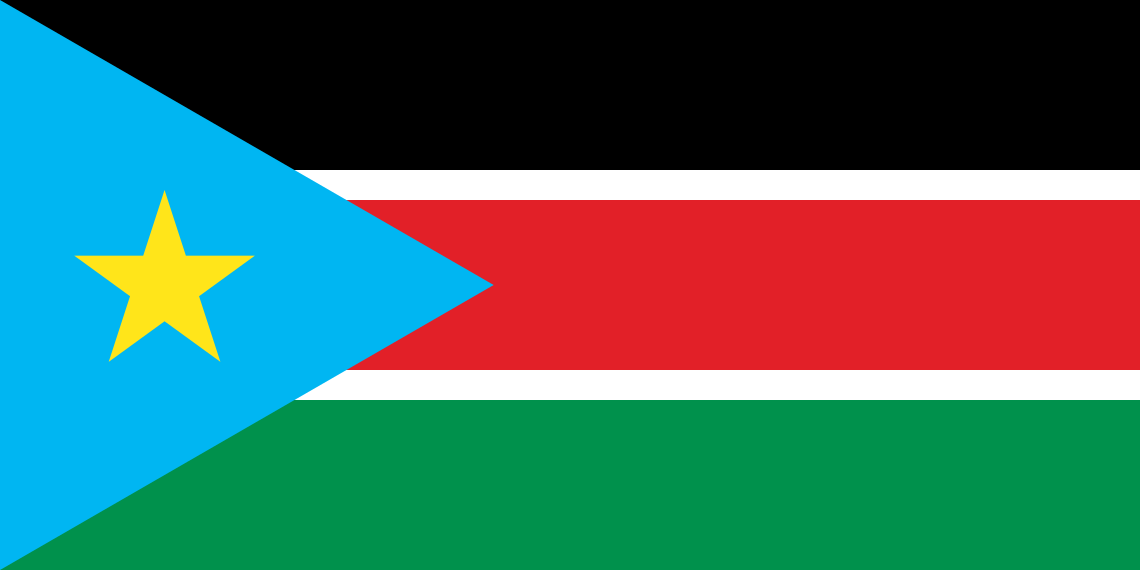
Allow me at the onset to congratulate you, Sir, upon your assumption of your duties as President of the Security Council for the month of November. I assure you of our delegation’s support and cooperation.
I would also like to extend the appreciation of our delegation to the members of the Security Council for the effort and time they put into negotiating the text of resolution 2386 (2017), adopted today, and welcome the extension of the mandate of the United Nations Interim Security Force for Abyei (UNISFA). Our appreciation
also goes to the Department of Peacekeeping Operations for its tireless assistance to UNISFA in the fulfilment of its mandate.
Lastly, I would like to pay tribute to the men and women of the Ethiopian armed forces, who have demonstrated their dedication to the people of Abyei despite the challenges they are facing.
This extension comes at the time when the Republic of South Sudan and the Republic of the Sudan, through their leaderships, have renewed their resolve to
solve any outstanding differences within the agreed
established channeled.
In conclusion, it is our hope that through the
extension of this mandate, the people of Abyei will enjoy
greater peace and security as a permanent settlement is
sought under the auspices of the African Union High-
Level Implementation Panel.
The meeting rose at 10.25 a.m.