S/PV.8124 Security Council
Provisional
The meeting was called to order at 10.05 a.m.
Adoption of the agenda
The agenda was adopted.
Reports of the Secretary-General on the Sudan and South Sudan Report of the Secretary-General on South Sudan (covering the period from 2 September to 14 November 2017) (S/2017/1011)

In accordance with rule 37 of the Council’s provisional rules of procedure, I invite the representative of the Sudan to participate in this meeting.
In accordance with rule 39 of the Council’s provisional rules of procedure, I invite the following briefers to participate in this meeting: Mr. Jean-Pierre Lacroix, Under-Secretary-General for Peacekeeping Operations; Mr. Mark Lowcock, Under-Secretary- General for Humanitarian Affairs and Emergency Relief Coordinator; and Mr. Ismail Wais, Intergovernmental Authority on Development Special Envoy for South Sudan, who is joining today’s meeting via video teleconference from Addis Ababa.
The Security Council will now begin its consideration the item on its agenda.
I wish to draw the attention of Council members to document S/2017/1011, which contains the report of the Secretary-General on South Sudan covering the period from 2 September to 14 November 2017.
I now give the floor to Mr. Lacroix.
Mr. Lacroix: I thank you, Mr. President, for this opportunity to brief the Security Council on South Sudan in advance of the renewal of the mandate of the United Nations Mission in South Sudan (UNMISS).
Further to the Secretary-General’s report (S/2017/1011) on South Sudan published on 1 December and Assistant Secretary-General Keita’s briefing to the Council last week (see S/PV.8115), I will focus my remarks on some key developments and challenges over the past year, including with respect to the security situation in the country, the peace process and the efforts of UNMISS to protect civilians and build durable peace. The Under-Secretary-General for Humanitarian Affairs, my friend and colleague Mark Lowcock, will follow me and cover the humanitarian situation.
At the outset, let me repeat that we remain gravely concerned about the precarious security situation prevailing in South Sudan. As the dry season sets in, we face the possibility that the military conflict will escalate, as well as intercommunal fighting. The economic crisis also continues to have serious repercussions for the security environment. Civilians will suffer the consequences of any escalation of violence. We cannot continue to stand by and watch. Now more than ever, I urge the Council to remain vigilant and exert more effort to condemn and stop the violence, protect civilians and urgently facilitate a political settlement to the conflict.
Further to the 90-day report before the Council, I would like to reflect more generally on the situation in the country and the United Nations sustained efforts to effect change on the ground, which will require the continued support of the Council. In that challenging environment, UNMISS has endeavoured to be more robust, nimble and proactive in its approach to mandate delivery. UNMISS peacekeepers have helped protect humanitarian facilities, facilitated aid delivery in areas plagued by insecurity and, on many occasions, contributed to the evacuation of humanitarian personnel caught up in active hostilities. To further deter violence and human rights abuses, they have intervened to protect civilians from abduction, recruitment, sexual violence and harassment.
The efforts of UNMISS to assert its freedom of movement have also resulted in the Mission’s patrols reaching areas to which it had long been denied access, including areas south-west of Wau and in Equatorian villages outside of Yei. Shortly, UNMISS will establish a permanent presence in Yei, and has already reinforced its presence in Yambio and Torit. The Mission is also working with partners to halt the increasing number of local-level conflicts through reconciliation and peaceful coexistence activities. Meanwhile, the brave efforts of humanitarian partners have resulted in 5 million vulnerable people being reached with life-saving assistance.
Those efforts have come about as conflict has spread across the country and as the young nation struggles to define a path towards inclusive governance. Since the setback to the peace process in July 2016, we have seen a new wave of armed conflict and insecurity spread into the Equatorias. Those military offensives forced tens of thousands of civilians to flee their homes. At
the height of hostilities, more than 2,000 civilians were crossing into Uganda daily.
In 2017, major clashes between the Sudan People’s Liberation Army (SPLA) and the Opposition shifted towards Greater Upper Nile state as the Government continued efforts to exert military dominance and take opposition strongholds in the area. At the same time, clashes continued in the Equatorias and Western Bahr el-Ghazal. Civilians were displaced in droves, including 25,000 from the West Bank of the Nile, 100,000 from parts of Jonglei and 22,000 from Western Bahr el- Ghazal.
While members of the Council will hear more from Mr. Lowcock in a few minutes on the impact of the conflict on the humanitarian situation, let me just underscore that the human cost is catastrophic. In total, we are looking at approximately 4 million people displaced since the conflict began in 2013. Moreover, conflict-related human rights violations and abuses, including looting and burning of houses, killings of civilians, arbitrary arrests and detentions and sexual violence, accompanied those hostilities, with organized forces being implicated as perpetrators in most instances.
Our fears of a further escalation of hostilities during the dry season are not unwarranted. In the past two weeks, we have seen a resurgence of fighting in southern Unity state between opposition forces allied to Riek Machar and those affiliated with First Vice-President Taban Deng and allied to the SPLA. On 20 November, intense clashes between the two forces took place 10 kilometres north of our temporary operating base in Leer. Thereafter, reports of an imminent attack on Leer town prompted local authorities to urge civilians to move towards our base. On 26 November, approximately 350 displaced civilians rushed into the UNMISS base for temporary protection in response to conflict. Further hostilities in Leer town broke out on 30 November.
In addition to protecting civilians near its base and supporting the relocation of aid workers to safety, UNMISS peacekeepers have continued their patrolling in Leer in an effort to show the United Nations presence. Meanwhile, the continued fragmentation of the opposition — particularly in the Equatorias — remains a source of instability. A case in point is Kajo-keji, where SPLA in Opposition forces have clashed with other opposition groups. Armed groups appear to
be ramping up hostilities in an effort to demonstrate relevance as players in the ongoing political processes.
Further impacting the security situation is intercommunal fighting. The most significant recent example took place on 28 November, when around 45 people were killed, 19 others injured and hundreds of huts and houses burned when members of the Murle ethnic group attacked a Dinka village in Jonglei. The attack came exactly six months after the signing of a cessation of hostilities agreement between the Dinka, Bor and Murle communities, intended to launch a comprehensive dialogue process. This is a stark example of the continued intercommunal tensions and proliferation of arms at the local level, and highlights the need for sustained engagement in intercommunal dialogue and reconciliation efforts.
Prompted by the rapidly deteriorating situation in the country, regional partners have stepped up their efforts to revitalize the peace process. In particular, we welcome and fully support the Intergovernmental Authority on Development (IGAD)-led high-level revitalization forum, which aims to secure a cessation of hostilities, implementation of the 2015 peace agreement, and the development of a revised and realistic timeline for its implementation. I welcome the efforts of the African Union (AU), including through its High Representative, former President Konaré, to urge the region to speak with one voice. I also welcome its Peace and Security Council’s expression of intent to consider punitive measures against those who aim to spoil the peace process. We hope that the high-level revitalization forum will not be a one-off, time-limited event, but rather that it will unfold as a sustained process to hold all parties accountable in order to maintain a cessation of hostilities and engage in the inclusive implementation of the peace agreement to ensure a successful transition. Tough issues will need to be tackled during these discussions, however, including on governance and security arrangements if the Forum is to succeed, as I am sure Ambassador Wais will tell us.
Meanwhile, at the local level, the national dialogue is progressing, with subnational consultations conducted on the root causes of the conflict. By most accounts, the consultations have been frank and have raised legitimate public grievances related to governance, corruption and the rule of law. Concerns remain, however, as to how the outcomes of these consultations will be used. The United Nations continues to reiterate the importance
of complementarity between the national dialogue and the implementation of the peace agreement, and of their being transparent and genuinely inclusive of all political viewpoints, including those of key political actors and parties to the conflict.
The conflict in South Sudan is now entering its fifth year. We believe that both the high-level revitalization forum and the national dialogue can address the spiralling crisis, if well coordinated. But fighting cannot continue in tandem with efforts to craft a durable peace. The two are simply incompatible. We must not allow tactics we have seen before to frustrate a change in course. The people of South Sudan have simply suffered too much for far too long, and we must not take their resilience against incredible odds for granted. In that regard, I urge the Council to redouble its efforts in support of the region and the ongoing political process.
In March, recognizing the failure of the parties to the conflict to meet their commitments to implement the peace agreement, the Council laid out five benchmarks to be met immediately. The first was immediate adherence to the permanent ceasefire by all forces of the parties to the conflict and all other armed groups. The second was the urgent tackling of challenges faced by humanitarian personnel in the delivery of humanitarian assistance throughout South Sudan and specifically to famine-affected areas, including through meetings of the Humanitarian High-Level Oversight Committee and the urgent implementation of its decisions. The third was unconditional support of all parties for the endeavours of the United Nations, the AU and IGAD towards ensuring the implementation of the agreement and the inclusivity of the national dialogue as outlined in their 29 January statement. The fourth was the immediate removal of obstacles to UNMISS and the Ceasefire and Transitional Security Arrangements Monitoring Mechanism operations, including obstacles to the deployment of the regional protection force and attacks on UNMISS and Monitoring Mechanism personnel. The fifth was the immediate cessation of obstructions to and attacks on all national and international humanitarian personnel and facilities endeavouring to provide life-saving assistance throughout South Sudan.
Those benchmarks are even more relevant today as we head into the dry season and look towards the convening of the high-level revitalization forum. I thus urge the Council to speak with a united voice, once again, and to use all means necessary to demand a
change of course from South Sudan’s leaders and all parties to the conflict. For our part, the United Nations will continue to engage the parties and support the region and the international community in order to facilitate a political solution of the crisis.
I thank Mr. Lacroix for his briefing.
I now give the floor to Mr. Lowcock.
Mr. Lowcock: This is my first briefing to the Security Council on South Sudan, and I would like to focus on four issues. The first is the humanitarian outlook for the coming months. The second is humanitarian access constraints. The third is current aid delivery, and the fourth is the help we seek from the Council to guarantee free and consistent access to all those who need humanitarian assistance and protection. I agree with and will try not to repeat everything that Mr. Lacroix has said.
On Tuesday, we released the 2018 South Sudan Humanitarian Needs Overview. The conclusions of this comprehensive assessment are bleak. Even though more than 2 million people have fled South Sudan as refugees over the past four years of conflict, 7 million people inside the country — almost two-thirds of the remaining population — still need humanitarian assistance. About 1.9 million people are internally displaced, of whom some 210,000 seek safety in the protection of civilians sites located on United Nations Mission in South Sudan (UNMISS) bases.
According to the latest integrated food security phase classification released by the Government of South Sudan and food security partners a month ago, the number of severely food insecure people has steadily increased with each successive year of the conflict. As we approach the end of 2017, 1.25 million people are in the emergency phase of food insecurity; that is almost twice as many people one step away from famine as was the case at the same time last year. In early 2018, half of the population remaining in South Sudan will be reliant on emergency food aid. The next lean season, beginning in March, is likely again to see famine conditions in several locations across the country.
The massive and debilitating needs do not stop with hunger. Only one in 10 people currently has access to basic sanitation, which helps prevent deadly diseases. Only half of the country’s schools are functioning, and 2 million children are currently out of school. In one of every two households, a woman or girl experienced
gender-based violence in the past year, according to the International Organization for Migration. A study just released by the International Rescue Committee underscored the high levels of violence, with many incidents directly related to a raid, displacement or abduction. Reported rates of violence against women and girls in South Sudan are among the highest in the world.
On access, the suffering faced by civilians in South Sudan is primarily the result of actions by the parties in their conduct of the conflict. The alarming level of food insecurity, for example, is directly linked to restrictions on people’s freedom of movement, their access to humanitarian assistance and their ability to plant or to harvest. The impact of conflict on agricultural production is particularly severe in the greater Equatorias, which was typically a surplus food-producing area before the conflict, but is now seeing production deficits owing to insecurity and related access challenges. Most farmers from the most productive area along the border with Uganda are now in refugee camps inside Uganda.
The recent rainy season did not see the usual lull in fighting, nor a respite in humanitarian need. Now, with the beginning of the dry season and ahead of the anticipated peace talks between parties this month, military offences have further intensified in recent days, especially in Jonglei’s Ayod county, Unity’s Leer and Mayendit counties, and Western Equatoria’s Greater Mundri, all forcing more civilians to flee these areas in search of safety and the essentials to survive.
The protection of civilians remains a key concern. The violations of international humanitarian law and human rights violations and abuses continue to be perpetrated by both the Sudan People’s Liberation Army (SPLA) and the Sudan People’s Liberation Movement/Army in Opposition. I remind all parties that they must take constant care to spare civilians and the infrastructure civilians rely on.
The suffering is also both a cause and a consequence of the economic situation, which continues to deteriorate, as Mr. Jean-Pierre Lacroix has said. Many Government workers have not been paid in months. The brutal reality of the economic situation puts food out of reach for many people; it reduces the provision of even the most basic services, such as health and education; and it increases criminality, especially in urban areas. Civilians’ safety is at risk and
humanitarian organizations face an increasing number of armed robberies and looting of convoys. Just last week in Jonglei, around 2.3 metric tons of food were looted from a humanitarian warehouse. Such actions are perpetrated both by parties to the conflict and by criminal groups for economic benefit.
Aid workers are paying with their lives to deliver assistance. At least 95 humanitarian workers have been killed in the line of duty since the start of the conflict, and at least 28 of them have been killed this year alone. More than 90 per cent of those people are national staff, who form the backbone of the humanitarian response. Mr. Lacroix mentioned the recent horrific attack in Jonglei. That is just one example of the violence aid workers face and five aid workers were killed in that attack.
Allowing and facilitating rapid and unimpeded humanitarian access for civilians in need is an obligation for all parties and essential for humanitarian relief organizations to effectively save lives. The parties regularly and flagrantly ignore these obligations. There are areas of the country where humanitarians have been unable to deliver assistance and programmes for extended periods. That compounds the already dire food security and nutrition situations. One example is the opposition-held territory of Greater Baggari, near Wau, which is classified in the emergency phase of food insecurity — so it is just a step away from famine — and where agencies have been able to deliver aid only sporadically owing to access denials and SPLA roadblocks. The situation will get even worse without an improvement in access.
In recent weeks, the Government, as well as opposition forces and non-State armed actors, have continued to interfere with the delivery of humanitarian assistance to people in need. Government security forces have denied humanitarian access in Liwolo in Kajo-keji county, non-State armed actors continue to deny access in areas outside Yei and Mundri towns, and opposition forces have denied access in Torit county’s Gunyoro town. Access blockage to a waste disposal site in Bentiu also continues, despite assurances from the Governor that humanitarian agencies would be provided unhindered access to the site.
Ongoing fighting also prevents us from delivering aid, including clashes between SPLA and SPLA in Opposition in Yei and surrounding counties. In 2017, more than 500 humanitarian workers across the country
have been relocated for extended periods of time owing to conflict and insecurity. Humanitarian organizations do not relocate staff lightly — the objective is always to stay and deliver — so when we do have to relocate, the situation must be very extreme.
In early November, President Kiir released a Republican order for the free, unimpeded and unhindered movement of humanitarian assistance convoys. I take note of this order, which enshrines existing international obligations. I urge for it to be translated into concrete actions and instructions at all levels to remove roadblocks and bureaucratic and other types of impediments and for it to be realized in practice on the ground, because, as I have said, that is not happening now.
Thirdly, despite these challenges and as Mr. Lacroix has said, the United Nations and its humanitarian partners have reached 5 million people with essential assistance this year and the aim for next year is to reach more. About 4 million people have received food assistance and emergency livelihood support this year; nearly 730,000 children and pregnant and breastfeeding women have benefited from emergency nutritional assistance; more than 2.1 million have gained access to clean water; nearly 780,000 people have been assisted with vital non-food items, including blankets and mosquito nets; more than 350,000 children have a chance to go to school; and nearly 400,000 people have received gender-based violence services. To ease aid delivery, an additional humanitarian corridor was opened from the Sudan last month.
The fact remains that until international humanitarian law is complied with, until the fighting ends and until basic services are established, the humanitarian situation will remain dire. This year, the United Nations and its humanitarian partners have halted famine, but that has taken enormous resources and involved substantial risk to staff, some of whom, as I have said, have lost their lives in the endeavour. We must avoid a recurrence of famine next year. UNMISS has played and will continue to play an important role in protecting civilians and creating the conditions conducive to the delivery of humanitarian assistance, but its efforts cannot replace or in any way substitute the responsibilities of the host Government.
Fourthly and in conclusion, I call upon Council members, first, to use their influence to ensure that the parties comply with their obligations under
international humanitarian law to respect and protect civilians, including humanitarian workers; and, secondly, to ensure that the parties allow and facilitate humanitarian relief operations and people’s access to assistance and protection.
I thank Mr. Lowcock for his briefing.
I now give the floor to Mr. Wais.
Mr. Wais: First of all, I congratulate you, Mr. President, on your leadership of the Security Council for the current month. I wish you, Sir, success in your presidency.
I thank the Council for this opportunity to brief it on the progress made in preparation towards the convening of the high-level revitalization forum of the parties to the peace process, including estranged groups, to restore the permanent ceasefire, full implementation of the peace agreement and establish realistic timelines for democratic elections at the end of the transition period. Since this is my first time briefing the Security Council, I will just concentrate on what we have done so far.
For six months, we have been doing everything possible to revitalize the peace process in South Sudan. The first action we undertook was to assist the stakeholders of the conflicting parties in South Sudan. After concluding the mapping exercise of the key stakeholders, we planned a pre-forum consultations schedule, which was also approved by the Council of Ministers. In September and October, we conducted pre-forum consultations and presented our findings to the Council of Ministers in the first week of November. We held the consultations in various locations within and outside the region, such as Ethiopia, South Africa, the Sudan and Juba. The Council of Ministers of the Intergovernmental Authority on Development (IGAD) took an active part in the discussions in the course of those consultations. It is worth mentioning, for example, that all of the members of the Council of Ministers were present in South Sudan’s capital, Juba, where they led the consultations. After the conclusion of the pre-forum consultations, we sat down again to draft a report on those consultations, which we concluded in November and presented to the Council of Ministers.
For the Security Council’s information, I would now like to provide a brief summary of the contents of the pre-forum consultations. In total, more than 48 different stakeholders made submissions, either
directly or indirectly, through consultations or in position papers. All submissions were analysed, and I would now like to highlight some of the key findings.
Stakeholders made proposals for a new transitional Government, which included the following five options: maintaining the status quo; returning to the status quo ante of 8 July 2016; reconstituting the Agreement on the Resolution of the Conflict in the Republic of South Sudan to include new parties; establishing a new transitional Government of national unity composed of technocrats; and establishing a hybrid transitional Government of national unity made up of technocrats and politicians.
In addition, three key proposals were advanced for the restructuring of the states, namely, first, revoking the current number of states and reverting to 10 states; secondly, maintaining the 32 states and renegotiating new power-sharing arrangements based on that number; and, thirdly, reverting to the three regions of Bahr el- Ghazal, Equatoria and Upper Nile.
Some stakeholders demanded that the status quo of the Transitional Government of National Unity be maintained until the end of the current transitional period. Alternative proposals were made for the current governance system to be restructured into a federal or a confederal system of governance. Under a restructured governance system, two options were proposed for the presidency in the interim period, namely, a rotational presidency or a ceremonial President with an executive Prime Minister.
Three main proposals for constituting the Council of Ministers were also put forward: first, maintaining the 30 ministries and establishing a deputy ministry for each; secondly, reducing the numbers of ministerial positions to 18 so that the Cabinet is lean; and, thirdly, restructuring the Council of Ministers based on the three regions, with each of one holding 10 portfolios and 10 deputy portfolios.
The report made it very clear that all stakeholders demanded a total cessation of hostilities before the convening of the IGAD-led high-level revitalization forum. The report also proposed that all parties and estranged groups must sign a political charter that committed all parties to non-violence before the the holding of the forum. It was furthermore proposed that an inclusive permanent ceasefire and transitional security arrangements be negotiated at the forum, with the regional protection force at the centre. There was also
a call for an effective ceasefire monitoring, verification and enforcement mechanism, including measures to guarantee the freedom of movement of citizens through the provision of enablers and multipliers. Stakeholders also recommended that the citizens’ mandate be reviewed to make it robust and effective. A national ceasefire commission was proposed to oversee the implementation of the Ceasefire and Transitional Security Arrangements Monitoring Mechanism.
The report also mentioned several critical issues. The success of the IGAD-led high-level revitalization forum was deemed to be dependent upon the following factors: inclusivity; the cessation of hostilities and the establishment of a permanent ceasefire; political will; a unified position on the part of the opposition; IGAD’s leadership and credibility as an impartial arbiter; a robust enforcement mechanism agreed by IGAD, the African Union and Security Council prior to the holding of the revitalization forum; the structure of the forum; gender parity and women `s participation; the participation of Riek Machar; coordination of concurrent political initiatives, such as the national dialogue, the Sudan People’s Liberation Movement re-unification process and revitalization, and wider consultations and transparency.
Suggestions on the timeline were also put forward. On average, the stakeholders suggested that a new transitional period would require four years to deliver an effective transition that would culminate in democratic elections. The majority proposed a two to three year period, while others suggested four to five, and others five to 10 years. In addition, the majority thought that a three to six month pre-transitional period would be required.
The report was subsequently presented to the Council of Ministers, which endorsed it. I am very glad to mention that, last week, at the African Union-European Union Summit held in Abidjan, the IGAD Council of Ministers held an informal meeting at which they endorsed the pre-forum consultations report. They also agreed to hold a Council of Ministers meeting on 15 and 16 December. Immediately after the Council’s meeting, they also agreed that the high- level revitalization forum should take place between 17 and 28 December. Both the Council of Ministers and the forum should take place in the African Union Multi-Purpose Hall.
I am very pleased to say that we are now at the threshold of commencing the IGAD-led high-level revitalization forum, according to the decisions of the IGAD Council of Ministers and the Summit.
I thank Mr. Wais for his briefing.
I shall now give the floor to those members of the Council who wish to make statements.


At the outset, I would like to thank the Under-Secretary-General of Peacekeeping Operations, Mr. Jean-Pierre Lacroix, the Assistant Secretary- General for Humanitarian Affairs and Emergency Relief Coordinator, Mr. Mark Lowcock, and the Intergovernmental Authority on Development (IGAD) Special Envoy for South Sudan, Mr. Ismail Wais, for their briefings. Those briefings have given us a comprehensive overview of the latest events in South Sudan.
Given that the Security Council dealt with this issue just last week (see S/PV.8115), and without wishing to repeat ideas, I shall focus my statement on the most recent events in South Sudan, many of which the briefers referred to quite clearly. However, before doing that, I would like once again to express Uruguay’s deep concern at this protracted crisis.
Just a few weeks from the end of this year — the fifth year since the conflict broke out — the future of South Sudan is at a critical juncture. All of the promises and announcements of commitments have already been made by all the parties to the conflict. All that has not been lacking. What there has been a dearth of, and what the country and its population urgently need, are concrete actions and tangible results that lead to a resolution of the crisis. In that regard, the parties will soon have a unique opportunity, perhaps a last chance, to demonstrate to their people their commitment to a peaceful solution to the crisis. We have great expectations for the convening of the high- level revitalization forum on the 2015 Agreement on the Resolution of the Conflict in the Republic of South Sudan, to be led by the Intergovernmental Authority on Development. We reiterate that, for that initiative to be conducted normally and successfully, it is essential that the parties involved once and for all comply with their commitments to immediately put an end to the hostilities across the entire country. It should be clear that the persistence of any armed confrontation is
incompatible with the establishment and conduct of a genuine dialogue.
With regard to the United Nations Mission in South Sudan (UNMISS), we regret to note that it continues to face all kinds of restrictions imposed by the Government, at the same time that the regional protection force approved by the Security Council over a year ago is still far from being 100 per cent operative. In that regard, we once again urge the Government of South Sudan to lift restrictions imposed on the Mission and all humanitarian workers, as well as to fully cooperate with the United Nations. We have heard numerous promises on that topic, but it is now time for those to translate into concrete action. On the other hand, we note the progress that is under way on the Secretariat’s strategic review of the UNMISS mandate. We are fully confident that its conclusions will enable the Security Council to take a responsible decision on the future of the Mission, which plays a crucial role in protecting civilians.
In conclusion, by way of summary, given that our participation in the Security Council is coming to an end, I must highlight our disappointment about the situation of South Sudanese civilians. We had hoped for more diligent action on the part of the Government in Juba. We all know what goes on and how people live in the so-called civilian protection sites. Many of us here in the Council saw it barely over a year ago when, in September 2016, we visited civilian protection sites in Juba and Wau — places close to, or under the protection of, UNMISS, or the Catholic Church in the case of Wau.
Unfortunately, the displaced people living there are facing the terrible dilemma of remaining cooped up without being able to work, with little or no prospects for their future, or of leaving those centres to return to their homes at the high risk of being robbed, sexually attacked or killed. This week, the Minister for Humanitarian Affairs and Disaster Management, Mr. Hussein Mar Nyuot, presented a so-called resettlement package that encouraged civilians to leave protection sites to return to their homes. No one in their right mind would want to return to their homes, or what is left of them, when they pose so much danger. We have to set our priorities: there must first be an immediate cessation of hostilities and, thereafter, security guarantees have to be provided for the entire civilian population.
As this is our last statement on South Sudan at the Security Council, we pay tribute to all South Sudanese civilians.


We thank the Japanese presidency of the Security Council for convening this meeting, and Under-Secretary-General Jean-Pierre Lacroix and Under-Secretary-General Mark Lowcock for presenting the quarterly report of the Secretary- General on the situation in South Sudan (S/2017/1011). We also welcome and thank the Special Envoy of the Intergovernmental Authority for Development (IGAD) for South Sudan, His Excellency Mr. Ismail Wais, for briefing us in detail about the progress in the preparations for the holding of the high-level revitalization forum.
I shall briefly touch upon three points at today’s: the political process, access to humanitarian aid, and the renewal of the mandate of the United Nations Mission in South Sudan (UNMISS).
First, my delegation expresses the support of the Government of Bolivia for IGAD’s initiative and the work carried out by Mr. Wais. We reiterate that a sustainable solution to the conflict in South Sudan must take place through a free and sincere political process and through an inclusive dialogue that consolidates the fulfilment of the 2015 Agreement on the Resolution of the Conflict in the Republic of South Sudan. The efforts being made by regional organizations are crucial and need the support of the international community; however, above all, real commitment by the Government and the opposition groups in South Sudan is what is required.
In that connection, we believe that the inclusiveness being demonstrated when it comes to the high-level revitalization forum is very encouraging. We know that there is still a lot of work is to do, but the fact that direct interaction with all the parties has been initiated and that those parties show interest in the forum is something that we should underscore and continue to foster. We encourage the parties to continue actively taking part in the revitalization forum and to take advantage of that opportunity so that the South Sudanese people can establish a dialogue that allows for, first, a restoration of a permanent ceasefire; secondly, the development of a realistic time-frame for the holding of democratic elections at the end of the transition period; and, thirdly, the full implementation of the peace agreement.
With regard to access to humanitarian aid, we regret the current situation and we are concerned about the alarming statistics concerning displaced persons who constantly face food insecurity. We hope that we will not face a famine situation, and therefore believe that priority should be given to guaranteeing a propitious operational environment for humanitarian workers and for UNMISS. That cannot simply be just a call in a statement — it is crucial that Government and opposition forces comply with the order issued by the President Salva Kiir on 9 November, in order to guarantee the security of humanitarian workers and their free movement throughout the territory, as well as enabling people who are urgently in need to be able to access humanitarian aid. Along those lines, we commend the work of the United Nations Mine Action Service, which, during the reporting period under consideration deployed dozens of mine-clearance teams to determine and demine highways and landing strips with the aim of providing security and humanitarian access.
As to my third point — with regard to the renewal of the UNMISS mandate — my delegation supports the recommendation of the Secretary-General for a two- month extension while the strategic review is concluded. We hope that, with the progress in the deployment of the regional protection force, it will be possible to extend and guarantee a more robust presence for UNMISS patrols in areas of major conflict, such as the Equatorias, the Bahr el-Ghazal region and the Upper Nile. We also hope that such an extension will provide for greater flexibility of movement for UNMISS so as to prevent clashes between the parties and to be able to act in a timely manner in order to reduce tensions between communities. We believe that the strengthening of the three-level strategy for the protection of civilians is also a very important point to take into account.
In conclusion, we would like to express our appreciation to the United Nations team and to UNMISS for the important work they do in South Sudan in fulfilling the noble task of saving lives and looking after the welfare of millions of South Sudanese people, who have already suffered almost five years of conflict in their country. That is why we urge all the parties involved and the international community to support this commendable work as well as the high- level revitalization forum, so as to prevent the civilian population from continuing to bear the consequences of the conflict.
I now give the floor to the representative of South Sudan.

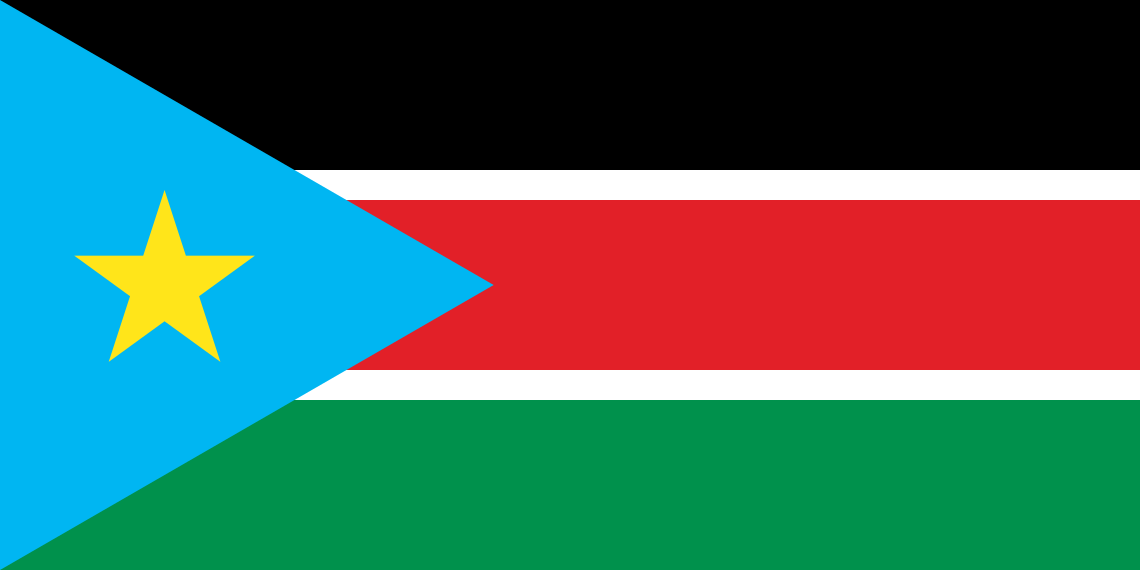
Allow me, first of all, to congratulate you, Mr. President, on your assumption of the duties of the presidency of the Security Council for this month. I assure you of my delegation’s support and cooperation.
I would also like to welcome and acknowledge the two Under-Secretaries-General for their briefings and their work on South Sudan. Likewise, I would like to welcome and thank the Special Envoy for South Sudan of the Intergovernmental Authority on Development (IGAD), His Excellency Mr. Ismail Wais, for his briefing regarding the IGAD pre-high-level revitalization consultations that took place in October.
We are happy to reiterate the commitment of the Transitional Government of National Unity to the high-level revitalization forum. As reported, key consultations have been held with the presidency and members of the Council of Ministers of the Transitional Government of National Unity. We look forward to the upcoming meetings of the IGAD Council of Ministers and the summit that will be convened in December. I would like to assure the Council that the Government will attend the summit with an open mind in the hope that all parties will recommit themselves to fully implementing the Agreement on the Resolution of the Conflict in the Republic of South Sudan.
I would also like to inform you, Mr. President, and the Council of the Government’s recent meeting in Juba with the review team of the United Nations Mission in South Sudan (UNMISS). That was the first time that the Government of South Sudan was included and consulted in the review of the mandate of UNMISS. It was a welcome change.
On 4 December, the Transitional Government of National Unity met with the UNMISS review team to discuss and conduct a comprehensive review of the engagement of UNMISS in South Sudan. We are reliably informed that the meeting was frank and open, and that the Government put forth a number of proposals regarding the future mandate of UNMISS. Among those proposals was the Government’s wish to see UNMISS engage in the capacity-building of human resources and institutions, and to commission some much-needed development projects. We therefore look forward to the final report and its recommendations, which we hope will reflect some of the Government’s points of view.
There are no more names inscribed on the list of speakers. I now invite Council members to informal consultations to continue our discussion on the subject.
The meeting rose at 10.55 a.m.