S/PV.8128 Security Council
Provisional
The meeting was called to order at 11.10 a.m.
Adoption of the agenda
The agenda was adopted.
The situation in the Middle East, including the Palestinian question

In accordance with rule 37 of the Council’s provisional rules of procedure, I invite the representatives of Israel and Jordan to participate in this meeting.
I propose that the Council invite the Permanent Observer of the Observer State of Palestine to the United Nations to participate in the meeting, in accordance with the provisional rules of procedure and the previous practice in this regard.
There being no objection, it is so decided.
In accordance with rule 39 of the Council’s provisional rules of procedure, I invite Mr. Nickolay Mladenov, Special Coordinator for the Middle East Peace Process and Personal Representative of the Secretary-General, to participate in this meeting.
Mr. Mladenov is joining today’s meeting via video- teleconference from Jerusalem.
The Security Council will now begin its consideration of the item on its agenda.
I now give the floor to Mr. Mladenov.
Mr. Mladenov: Jerusalem is one of the most complex, and perhaps captivating, cities in the world. Of all the final-status issues in the Israeli-Palestinian conflict as identified in the Oslo Accords — refugees, settlements, security arrangements, borders, relations and cooperation with other neighbours and other issues of common interest — Jerusalem is the most emotionally charged and difficult subject.
For the Jewish people, it is, and will always be, the centre of their faith and life. For centuries, they have looked to it as a symbol of hope for the future. It is also the centre of life for Palestinians and, since the occupation of East Jerusalem in 1967, many have lived in fear of losing their livelihoods and their connection to the city. For both Israelis and Palestinians, Jerusalem is, and will always remain, an integral part of their national identity. For billions of people around the world, it also serves as a symbol and a cornerstone of
their Christian, Jewish or Muslim faiths. That is why it remains one of the most sensitive places in the world.
For decades, there has been broad agreement among Member States about the particular status of Jerusalem, including through resolutions 252 (1968), 476 (1980) and 478 (1980), as well as General Assembly resolution 181 (II). The United Nations has repeatedly declared that any unilateral decision that seeks to alter the character and status of Jerusalem could seriously undermine the current peace efforts and may have repercussions across the region. As stated by the Secretary-General, the United Nations position is clear: Jerusalem is a final-status issue, for which a comprehensive, just and lasting solution must be achieved through negotiations between the parties and on the basis of the relevant United Nations resolutions and mutual agreements.
On 6 December, United States President Donald Trump announced that the United States recognized Jerusalem as the capital of the State of Israel. In that recognition, he said that final-status issues, including the boundaries of Israeli sovereignty, remained for the parties to determine. He made clear his commitment to advancing peace between Israelis and Palestinians and called for the status quo at the holy places to be respected. The announcement also signalled the start of preparations to move the United States Embassy from Tel Aviv to Jerusalem, while renewing the six-month waiver by which the Embassy remains in Tel Aviv.
Without doubt, that decision has been widely welcomed in Israel. It has also caused much anger among Palestinians and anxiety across the Middle East and beyond. Palestinian President Abbas condemned the move and stressed that the United States had withdrawn from its role as a mediator in the peace process. He warned of the potential consequences for security and stability in the region and underlined the need to immediately work towards national reconciliation. Hamas described the proclamation as an attack against the Palestinian people and called on the Palestine Liberation Organization to withdraw its recognition of Israel. In Israel, Prime Minister Netanyahu thanked President Trump for the decision. He reaffirmed his commitment to maintaining the status quo at the holy sites, while President Rivlin said that Jerusalem was not an obstacle to peace.
I am particularly concerned about the potential risk of a violent escalation. In anticipation of the United States decision, Palestinian factions called for three
days of rage to take place from 6 to 8 December. Some called for 8 December to be the start of a new uprising, or intifada.
Since the decision, we have seen widespread demonstrations and violent clashes between Palestinian protesters and Israeli security forces throughout the occupied West Bank, including East Jerusalem, and Gaza. According to the Office for the Coordination of Humanitarian Affairs, at least one Palestinian was killed and more that 140 have been injured. There have also been protests in Arab cities and villages within Israel, as well in cities around the region and beyond, from Lebanon and Jordan to Malaysia and Bangladesh.
On 7 December, six rockets were reportedly fired from Gaza towards Israel. All but one landed short of Israel, without causing damage or injury. The Israel Defense Forces responded by shelling a Hamas military installation in the Gaza Strip and by bombing another from the air, causing damage but no injuries. We continue to follow developments on the ground very closely.
We all understand and respect the symbolic, religious and emotional charge that Jerusalem holds for people across the region and beyond. Nevertheless, I urge all political, religious and community leaders to refrain from provocative action and rhetoric that could lead to escalation. I call on all of them to exercise restraint and to engage in dialogue.
It is now more important than ever that we preserve the prospects for peace. It will be ordinary Israelis and Palestinians — their families and their children — who will ultimately have to live with the human costs and the suffering caused by further violence. They will look to their leaders to find the strength and the will to achieve a just and comprehensive peace that addresses all final-status issues, that ends the occupation of Palestinian territory that started in 1967 and that brings security and stability to both Israelis and Palestinians.
The United Nations remains strongly committed to supporting all efforts to achieve a negotiated two-State solution. That is the only way to achieve the legitimate national aspirations of both Israelis and Palestinians. That point has been clearly reaffirmed by Secretary- General Guterres. I again stress his view that there is no plan B for the two-State solution. Palestinian and Israeli leaders, as well as the international community, have an important responsibility to advance peace efforts to that end. Only through constructive dialogue
can we hope to achieve peace. I call on all parties to remain engaged.
Today we stand at another critical moment in the long-running history of the conflict. We are yet to see if the prospects for peace can be preserved and advanced. It is up to us all in the international community, as much as it is up to Israeli and Palestinian leaders, to urgently advance a just and lasting resolution of the conflict. The Secretary-General clearly stated that realizing a two- State solution with Jerusalem as the capital of Israel and Palestine is the only way that such a vision can be achieved. I have warned many times in the past — and I will do so again today — that if the Israeli-Palestinian conflict is not resolved in line with relevant United Nations resolutions and in a manner that meets the legitimate national aspirations of both peoples, it risks being engulfed into the vortex of religious radicalism that has taken over the Middle East. There is a serious risk today that we may see a chain of unilateral actions that can only push us further away from achieving a shared goal of peace. In the coming days, it will be critical that leaders demonstrate their wisdom and make every effort to reduce the rhetoric, prevent incitement and rein in radical elements.
In its 2016 report (S/2016/595, annex) the Middle East Quartet called for steps to reverse negative trends that undermine the two-State solution, so as to build the conditions necessary for successful final-status negotiations. Today that call remains as valid as ever. I urge the international community to fulfil its historic responsibility to support the parties in achieving peace and a comprehensive agreement. The Secretary- General and the United Nations are committed to supporting Palestinian and Israeli leaders in returning to meaningful negotiations in order to achieve a lasting and just peace for both peoples. We remain deeply committed to working with the parties and with our international and regional partners to realize that objective.
I thank Mr. Mladenov for his briefing.
I shall now give the floor those members of the Council who wish to make statements.


I thank you, Mr. President, for organizing today’s emergency meeting. I also thank Special Coordinator Nickolay Mladenov for his very clear briefing.
We requested today’s meeting, together with seven other members of the Security Council — Bolivia, Egypt, France, Italy, Senegal, the United Kingdom and Uruguay. Sweden took that step in anticipation of the repercussions that the statement made by United States President Donald Trump with regard to Jerusalem on 6 December would have. We clearly disagree with the recognition of Jerusalem as the capital of Israel and with the plan for a move of the United States Embassy to Jerusalem for number of reasons, which I will now outline.
First, it contradicts international law and Security Council resolutions. Jerusalem is a final-status issue, and can therefore be resolved only through negotiations agreed upon between the parties. In 1947, the United Nations attributed to Jerusalem a special legal and political status as corpus separatum. In 1980, when Israel attempted to declare Jerusalem its capital, the Council stated, in resolution 478 (1980), that it was a violation of international law. Furthermore, the Council declared that attempts to change the character and status of Jerusalem were null and void, and called upon all States to accept that decision, as well as to withdraw their missions from Jerusalem. Until now, all States have abided by the Council’s call. It was only one year ago that the Council again stated that
“it will not recognize any changes to the 4 June 1967 lines, including with regard to Jerusalem, other than those agreed by the parties through negotiations” (resolution 2334 (2016), para. 2).
The European Union (EU) has a clear position on Jerusalem, which explains why all EU member States on the Council were united in requesting today’s meeting. We consider Jerusalem to be the future capital of two States. We have never recognized Israel’s annexation of East Jerusalem, and we therefore consider it to be part of occupied territory. As I stated, we believe that the future status of Jerusalem can be resolved only through negotiations. The statement made by the President of the United States is at variance with the plea of many friends of the United States and Israel. However, it does not affect the position of Sweden, the European Union or the wider international community, which, up to now, has been in line with international consensus on the status of Jerusalem.
Secondly, it is fuelling tensions and increasing instability in an already volatile and turbulent region. The question of Jerusalem has an impact far beyond
the region — and there are already strong reactions to that decision around the globe. Clashes yesterday and today have already resulted in more than 100 people injured. We call on all parties to maintain calm, show restraint and refrain from violence. The conflict must not be turned into a religious one. Jerusalem is a holy city for the three Abrahamic religions. Now more than ever, we need respect, tolerance and dialogue to prevail over division and antagonism. We should not forget the strong ties to Jerusalem of both Israelis and Palestinians, and that approximately 40 per cent of the inhabitants of Jerusalem are Palestinians.
Thirdly, despite its stated intention to the contrary, it risks prejudging the outcome of negotiations on final-status issues, such as Jerusalem, and therefore threatens prospects for peace itself. As the Secretary- General has stated repeatedly, there is no alternative to the two-State solution and no plan B. Yet that vision is threatened now more than ever before. Sweden has a long-standing and firm commitment to the two-State solution. Seventy years ago, Sweden was one of 33 States Members of the United Nations that voted in favour of General Assembly resolution 181 (II), which paved the way for the establishment of the State of Israel. In 2014 Sweden decided to recognize the State of Palestine as a logical consequence of our support for the two-State solution.
For decades, the United States has played a key role in the quest for peace in the Middle East. We note the stated intention of the United States Administration to bring an end to the Israeli-Palestinian conflict and to facilitate a peace agreement between Israelis and Palestinians. Words must now be followed by deeds and ideas by proposals. We encourage the United States to follow up its statement with action towards the two- State solution. Now is the time to move forward with a detailed peace plan that enables the State of Israel and the State of Palestine to live side by side in peace and security, with Jerusalem as the future capital of both States. The Council also has a responsibility. and all stakeholders must engage more than ever on the path to peace in the Middle East.


The Security Council is meeting today in an emergency meeting at the request of the majority of its members, which, along with a large number of countries and people around the world, are gravely concerned about an international peace and security-related issue. This
is about a dangerous precedent, and one that requires our consideration.
Over the past few days, fear has emerged in the international community with regard to one of the issues that has been on the Security Council’s agenda since its establishment — the question of Palestine. Such fear also emanates from the repercussions and impact of unilateral decisions that are at odds with international law and threaten the system of international political relations. That system was founded based on the Charter of the United Nations over 70 years ago to prevent the repetition of the scourges of war and to regulate relations among peoples in an era that supposedly takes into account the fundamental rights of peoples on an equal basis. We are confronted with a test of that system, a test of the rule of law. Our efforts will not be successful unless we work together in the framework of international legitimacy. If we surrender and fail, the repercussions will be grave — whether on this question or other international issues — for years to come.
The issue of Al-Quds Al-Sharif is rooted in history. Generations of followers of the three Abrahamic religions have been closely linked to that city for hundreds of years. In modern times and under the umbrella of the United Nations, the international community succeeded in setting legal parameters to address this issue when the Organization decided to establish two States on the Palestinian territories — pursuant to resolution 181 (II). Therefore, the sole rationale and only solid basis for addressing the question of Al-Quds Al-Sharif in the context of the Palestinian question is to follow that reality — pursuant to international law, as established through United Nations and Security Council resolutions. All such resolutions have unequivocally rejected the occupation of Jerusalem that started in 1967.
Since we are meeting today to shed light on the danger of infringing upon the legal parameters that were reached over dozens of years, it might be appropriate to recall the most important binding Council resolutions on Jerusalem, longstanding and more contemporary ones alike. Resolution 242 (1967) provided for the withdrawal of Israel from the territories occupied in 1967, including Jerusalem. Resolution 478 (1980) rejected the occupation of the city by force and considered Israel’s imposition of the so-called basic law to be a violation of international law and asserted that the basic law did not alter the legal status of the city.
It also maintained that the basic law had no impact on the applicability in Al-Quds Al-Sharif of the Fourth Geneva Convention relative to the Protection of Civilian Persons in Time of War.
It is also of vital importance to recall the latest Council resolutions on the matter. Some of them are only one year old. We are referring to resolution 2334 (2016), which reaffirmed that the Security Council does not recognize any alteration of the 4 June 1967 lines, including with regard to Al-Quds Al-Sharif, unless it is a result of negotiations between the two parties. Moreover, resolution 478 (1980) called for the withdrawal of all diplomatic missions from Jerusalem, since the international community does not recognize it as the capital of Israel. Resolution 2334 (2016) clearly requested that all countries differentiate between Israeli territories and those occupied in 1967, including Jerusalem.
Those are all resolutions of the Security Council elaborated over decades and up until this very day. Taken as a whole, they constitute the corpus of law governing the status of Jerusalem. They are the binding Security Council resolutions that all countries have pledged, pursuant to the Charter of the United Nations, to implement and abide by in order to maintain international peace and security. They are the Council resolutions that represent the only reality and logic with regard to Al-Quds Al-Sharif.
Based on what I have just referred to, the Arab Republic of Egypt denounces the United States decision to recognize Jerusalem as the capital of the State of Israel and to move its Embassy to Jerusalem. We also reject any implications of that decision. We would also like to stress that such unilateral decisions violate international legitimacy, and therefore have no impact on the legal status of the city of Jerusalem, as it is a city under occupation. It is not legally permissible to take any action that would alter the status quo of the city.
As I have explained, and as is well-known to everyone, given the highly sensitive nature of the question of Jerusalem, we would like to express our serious concern about the potential repercussions of such a decision on the stability of the region — since it will arouse sentiments among Muslim and Arab peoples given the great spiritual, cultural and historical status of the city of Jerusalem in Arab and Muslim hearts. Such a decision will also have a grave negative impact on the peace process between the Palestinian
and Israelis. That process was founded on major terms of reference, including providing that the question of the city of Jerusalem was to be a final-status issue to be settled through negotiations between the two parties.
The call to safeguard the international legal terms of reference and international law is not a luxury, especially in a region that is beset by conflict and a world subjected to huge challenges. We have no need for further unjustified chaos. This is a call that takes into account what is before our very eyes — the huge danger posed by the deterioration of the international legal system. Therefore, we once again reaffirm that the status of Jerusalem as a city under occupation, pursuant to Council resolutions, has not changed and will not change unless the parties agree to that issue through negotiations. We call upon United Nations agencies to face the emerging challenges on the Palestinian question in a way that maintains the inalienable rights of the Palestinian people, including the right to establish an independent State along the 4 June 1967 lines, with east Jerusalem as its capital.
Egypt will always uphold its pledge to reach fair, just and durable peace in the region, based on the parameters of international legitimacy.


I thank you, Mr. President, for scheduling this important meeting. I also thank Mr. Mladenov for his briefing, in particular for his unequivocal support for the two-State solution and for his warnings against unilateral measures that jeopardize the prospects of sustainable peace for Israelis and Palestinians.
At the outset, I would like to note that the United Kingdom’s position on the status of Jerusalem is clear and long-standing: it should be determined through a negotiated settlement between the Israelis and the Palestinians, and Jerusalem should ultimately be the shared capital of the Israeli and Palestinian States. In line with relevant Security Council resolutions — including resolutions 242 (1967), 478 (1980) and 2334 (2016) — we regard East Jerusalem as part of the occupied Palestinian territories. We therefore disagree with the United States decision to move its Embassy to Jerusalem and to unilaterally recognize Jerusalem as the capital of Israel before a final status agreement. Those decisions are unhelpful to the prospects of peace in the region — an aim that I know all of us in the Security Council remain committed to. The British Embassy to Israel is based in Tel Aviv, and we have no plans to move it.
We share President Trump’s desire to bring an end to this conflict. We welcome his commitment to a two-State solution negotiated between the parties. We note his clear acknowledgement of the importance of the final status of Jerusalem, including the sovereign boundaries within the city, which must be subject to negotiations between the parties.
We remain committed to an Israeli-Palestinian peace agreement that is based on 1967 borders with agreed and equal land swaps, reflecting both parties’ national and religious interests, and with Jerusalem as the shared capital of an Israeli and Palestinian State. This outcome must be determined through a final status agreement and a just, fair, agreed and realistic settlement for refugees that is demographically compatible with the principle of two States for two peoples.
We recognize that Jerusalem holds huge significance and holiness for Jews, Muslims and Christians. We reiterate the fundamental necessity of maintaining the status quo at the holy sites, in particular the Temple Mount/Haram al-Sharif, and we welcome President Trump’s call on the parties to maintain that status quo. The access and religious rights of both peoples must be respected. We value Jordan’s important role as custodian of the holy sites, and remain fully supportive of their efforts to maintain calm.
We are deeply concerned by continued developments on the ground that undermine the prospects for a two-State solution. As the Quartet has made clear, settlement construction and expansion, particularly in East Jerusalem, are a significant barrier to achieving that solution. Terrorism and incitement to violence constitute another crucial barrier. We will continue to press the parties to refrain from actions that make a viable peace more difficult to achieve. A just and lasting resolution to end the occupation and deliver peace for Israelis and Palestinians alike is long overdue. Recent developments demonstrate the urgent need for progress towards peace.
Today, I reaffirm our strong support for renewed peace negotiations between the Israelis and Palestinians as soon as possible. These should be supported by the international community and should result in a safe and secure Israel living alongside a viable and sovereign Palestinian State. We welcome the Secretary-General’s intent to do everything in his power to support the Israeli and Palestinian leaders in returning to meaningful negotiations and in realizing this vision of
a lasting peace for both peoples. We strongly encourage the United States Administration to bring forward detailed proposals for an Israeli-Palestinian settlement. The United Kingdom will also do everything we can to support progress and achieve the vision of a lasting peace.
To have the best chances of success, the peace process must be conducted in an atmosphere free from violence. We call on all parties to maintain calm and work together in a spirit of commitment to that common enterprise. On Jerusalem specifically, peace efforts need to take account of the people, not just the land and the holy sites. There are more than 320,000 Palestinians in East Jerusalem. The vast majority are permanent residents whose permits can be revoked at any point. If they move away from the city, Israel often does not allow them back. If they marry, they face obstacle in bringing their spouses. If they apply for Israeli citizenship, and most do not, a high proportion of applications are rejected. Their status must not be forgotten in any peace effort.
If all parties can truly take bold steps in the spirit of compromise, I have no doubt that an agreement can finally be reached. That is the only way to ensure the long-term security that Israelis deserve, and the statehood and end to the occupation that Palestinians are calling out for. This is what both peoples ought to have. It has been denied to them for too long.


I thank the Special Coordinator for his briefing.
The status of Jerusalem has been the subject of specific Security Council resolutions and in that regard concerns the entire international community, as the President of the French Republic, Mr. Emmanuel Macron, reminded us yesterday. That is why, with several of its partners, France took the initiative to request this meeting of the Security Council.
As President Macron noted, we regret the decisions announced by the President of the United States on Wednesday, unilaterally recognizing Jerusalem as the capital of Israel and preparing for the transfer of the American Embassy from Tel Aviv to Jerusalem. I wish to stress three elements guiding France’s position, concerning the law, the two-State solution and the risk of escalation, respectively.
First, as to the law, the decisions to which I have just referred do not alter the parametres of the
settlement of the Israeli-Palestinian conflict, as set out by international law. The status of Jerusalem will have to be determined by the parties in the framework of a peace agreement. In the absence of agreement, and in accordance with the consensus that has prevailed for 70 years within the international community, France does not recognize any sovereignty over Jerusalem. Thus, following the June 1967 conflict, we did not recognize the annexation of East Jerusalem, which is, under international law, part of the occupied territories; nor in 1980 did we recognize the unilateral acts taken by Israel concerning Jerusalem.
The Council adopted resolutions 476 (1980) and 478 (1980), before and after the enactment of the Israeli Basic Law: Jerusalem, Capital of Israel. These resolutions include two principles. First, any measure aimed at altering the status of Jerusalem, as well as the geographical, demographic and historical characteristics of the city, is considered null and void and must be abandoned. Secondly, all United Nations Member States that have established diplomatic missions in Jerusalem must remove them from the city. This is what happened as a result of resolution 478 (1980), without exception. Finally, barely a year ago, the adoption by the Council of resolution 2334 (2016) recalled that no modification of the 1967 borders other than those agreed by the parties would be recognized by the international community, including in Jerusalem.
It is now up to the United States to clarify the compatibility of President Trump’s announcement on 6 December with this common legal base on which all peace efforts are built. And it is more than ever up to us to reaffirm our collective commitment to international law, including the resolutions of the Council, on the essential question of the status of Jerusalem, which is decisive for any prospect of peace. For without agreement on Jerusalem, there will be no peace agreement.
That is the second element guiding our action. The historical and religious significance of Jerusalem in the eyes of all parties makes it one of the keys to resolving not only the Israeli-Palestinian conflict, but also to regional and international stability. Given its gravity, its centrality in the Middle East, its symbolic dimensions and its place in the collective imagination, the Israeli-Palestinian conflict — and at its core the unique question of Jerusalem — is a deeply mobilizing issue, the scope of which extends far beyond the borders of Israel and the Palestinian territories. That is why it is
essential to take great care to provide no pretexts to the radical movements in the region and, on the contrary, to encourage all peacemakers.
In that spirit, and because it is steeped in spiritual and symbolic significance, if we are not careful the question of Jerusalem could transform from a political conflict, which by its nature is susceptible to compromise, into a religious conflict that would be intrinsically impossible to resolve. In that context, France and its European Union partners believe that Jerusalem is destined to become the capital of two States, Israel and Palestine, pursuant to parameters that must be defined by Palestinians and Israelis through negotiations, together with Jordan, given its special role in that regard. Let us be clear: there is no alternative to the two-State solution, and there will be no two-State solution without an agreement between the parties on Jerusalem. In that regard, we noted the willingness displayed by the President of the United States to support the two-State solution. We hold out the hope that it will pave the way for the United States to return to the fold of international consensus.
Thirdly, in the immediate term we are of course very concerned about the risk of escalation on the ground following three days of clashes, particularly in Gaza and parts of East Jerusalem. We call on everyone to exercise restraint and make every effort to restore calm. Beyond that, negative repercussions throughout the region must be avoided. We therefore call upon all regional stakeholders to avoid fuelling tension and contribute to restoring calm.
France is both a friend to the Palestinians and the Israelis, which is why we are seeking an honest approach to the situation by calling upon those parties to simply return to the negotiating table. Indeed, there is no shortcut in the difficult path towards peace — that path is one of negotiation and respect for the other. As the issue of Jerusalem is one of the keys to peace in the Middle East, it is more important than ever to recall our collective commitment to safeguarding international consensus on the specific status of the city. The following things are at stake: respect for international law and the legitimate rights of each of the parties, the legitimacy of the Security Council and preserving the two-State solution. In all of those endeavours, members of the Council can count on the continuous and resolute commitment of France.


In view of the announcements made by the President of the United States concerning his unilateral recognition of Jerusalem as the capital of Israel and his decision to start taking steps to move the United States Embassy to that city, eight Security Council delegations requested the Council’s presidency to convene this emergency meeting. The Movement of Non-Aligned Countries has taken the same stance in that regard, as have the African Union and the League of Arab States. A series of statements by several Member States also attest to the importance of the issue that we are addressing today.
Bolivia wishes to clearly and unequivocally state that it opposes that unilateral decision, as it is not only contrary to international law, but it is also harmful and undermines the possibility of achieving a just and lasting peace between Israel and Palestine. The decision is extremely damaging and irresponsible, because it further exacerbates the already unstable situation in the Middle East, in addition to being in contravention of the Charter of the United Nations and Security Council and General Assembly resolutions. That decision will affect not only Palestinians and Israelis, but the entire region. It will be exploited by extremists and fule violence by radicals.
Likewise, that unilateral decision affects the multicultural and multi-religious identity of Jerusalem, which Pope Francis put in the following words:
“I cannot silence my deep concern for the situation that has been created in recent days. At the same time, I urgently call on all parties to strive to respect the status quo, in accordance with the relevant United Nations resolutions. Jerusalem is a unique city; it is sacred to Jews, Christians and Muslims, who therein venerate the holy places of their respective religions. It has a special vocation for peace.”
We express our resolute commitment to all international efforts that lead to a peaceful solution to the Israeli-Palestinian conflict. In that regard, we of course support initiatives such as the Quartet road map, the Madrid principles, the Arab Peace Initiative and others that constitute guarantees for a just and lasting peace, so that both peoples can live within recognized and secure borders. Bolivia is convinced that the only alternative to resolving this conflict is the two-State solution — a free, sovereign and independent Palestinian State within
the pre-1967 international borders, with East Jerusalem as its capital, in accordance with the relevant Security Council and General Assembly resolutions.
It is necessary to remember that, while there are two parties to this conflict, they are not on an equal footing. One of the parties, Israel, is the occupying Power; the other, Palestine, is an occupied people. There is historic and undeniable inequality between them. One of the parties has used, and uses, force to occupy the territory of the other. One of the parties has built a wall that, according to an advisory opinion of the International Court of Justice, constitutes a violation of international law. One of the parties builds illegal settlements in the territory of the other. One of the parties forcibly displaces civilians, confiscates land, demolishes homes and transfers settlers to illegally built settlements. One of the parties imposes a blockade on Gaza, with terrible humanitarian consequences, restricting access to basic services. One of the parties has caused 5 million Palestinians to become refugees. One of the parties appropriates the water resources and agricultural lands of the other. One of the parties has unleashed a brutal military campaign against the Palestinian people. One of the parties commits serious human rights violations and has allegedly committed war crimes. One of the parties is responsible for the forced displacement of Palestinian civilians. One of the parties violates its international obligations and systematically violates General Assembly and Security Council resolutions.
That is the result of the longest military occupation in the modern world. In recent years and months, settlements have increased exponentially, and a discriminatory economic, political, juridical and social system has been emplaced. This situation removes us further from the two-State solution.
We must ask ourselves — how is such a situation occurring in the twenty-first century? How is it admissible that the series of resolutions of the Council are not being implemented, not just with regard to Jerusalem but concerning the conflict in general? We must recognize that calls for dialogue and negotiations are insufficient. The Security Council bears a responsibility to take action and decisions; otherwise, the Security Council will also become an occupied territory, and this Chamber will have to join the long list of settlements of the occupying Power. We will have demonstrated our irrelevance in this matter. Bolivia demands the end of the occupation, the end of its
policies that violate international law and its colonizing practices in Jerusalem and all Palestinian territory.


I thank the Special Coordinator for the Middle East Peace Process, Mr. Nickolay Mladenov, for his very accurate briefing.
The political, historical and religious relevance of Jerusalem for Israel and Palestine, as well as Christian, Jewish and Muslim believers all over the world, is the reason that it has been given a special status. My Government issued a statement yesterday, which I am now going to read out:
“The Government of Uruguay reaffirms its support for General Assembly resolution 181 (1947), which provided for the creation of a Jewish State and an Arab State in the Palestinian territory, with Jerusalem as corpus separatum subjected to a special international regime, while at the same time as expressing its commitment to Security Council resolution 478 (1980). In that connection, the Government of Uruguay expresses its concern and objection with the decision of the Government of the United States, which does contribute to the essential climate of peace and mutual respect needed to reach a fair, complete and lasting solution in Middle East.”
Uruguay voted in favour of General Assembly resolution 181 (1947), and reaffirms once more the special status of the city of Jerusalem according to all of the relevant resolutions of the General Assembly and of the Security Council.
As stated yesterday by Secretary-General António Guterres, the final status of Jerusalem is an issue that is yet to be resolved. Therefore, the sovereignty and the boundaries of Jerusalem must be agreed by Israel and Palestine in bilateral negotiations. As we have done since 1947, Uruguay underscores the right of Israel and Palestine to live in peace, within secure and internationally recognized borders, in an atmosphere of renewed cooperation and free of any threat or act that endangers peace.
The two-State solution continues to be the only viable option to end the conflict. To that end, it will be necessary to resume direct, bilateral negotiations at the earliest opportunity so that all pending issues can be clarified in order to reach a peaceful, fair and lasting solution to this long-standing conflict.
Exactly 37 years ago today, in this very city and not very far from here, John Lennon was murdered. In one of its most famous songs, Lennon, a self-declared pacifist, imagined a world in which humankind could live in peace, sharing the whole planet, without reasons for killing or dying. Lennon was a dreamer, but he was not the only one. I hope that, one day, his dream will become a reality.


First of all, I would like to thank Mr. Mladenov for his briefing. I also welcome the continued personal engagement of the Secretary- General on this issue.
Following the recent declaration on Jerusalem by the President of the United States, Italy joined seven other members of the Security Council in requesting this meeting. Italy’s position on Jerusalem remains unchanged. It continues to be consistent with that expressed by the European Union and with international consensus based on the relevant United Nations resolutions.
We believe that the status of Jerusalem as the future capital of two States needs to be negotiated between Israel and Palestine, within the framework of a peace process that will eventually lead to the establishment of two States, living side by side in peace and security, taking into account the legitimate concerns and aspirations of both parties. Until that moment, Italy will continue to abide by the relevant United Nations resolutions and will maintain its Embassy to Israel in Tel Aviv.
We are, of course, very concerned by the risk of unrest and tensions in the region. We call on all actors in Palestine and the Middle East to show responsibility, exercise restraint and refrain from any form of violence or incitement. As the Secretary-General affirmed in his statement on Wednesday, there is no alternative to the two-State solution. Therefore, Italy reiterates its commitment to working towards that aim together with the members of the European Union and other regional and international partners, and to contributing to the resumption of a meaningful peace process.


I would like to thank you, Mr. President, for having agreed to the request of eight members of the Security Council, including Senegal, to allow this organ, charged by the Charter of the United Nations to maintain international peace and security, to be able to discuss in an open meeting today the situation generated by the decision
taken by the United States announced on 6 December. I also thank the Special Coordinator for the Middle East Peace Process and Personal Representative of the Secretary-General, Mr. Nickolay Mladenov, for his briefing today.
Our meeting today is all the more important given that it makes it possible for us to reiterate the international consensus on the status of Jerusalem, which the Israeli and Palestinian parties, supported by the United Nations and, in particular, by the Security Council, have reserved for final-status negotiations.
There is no need to dwell on the particular importance of the city of Jerusalem for the Israeli and Palestinian parties, nor on the symbolism that this holy city represents for the three monotheistic Abrahamic religions, and therefore for the entire world. Therefore, Senegal, in its capacity as Chair of Committee on the Exercise of Inalienable Rights of the Palestinian People, calls for strict respect for the status quo concerning Jerusalem, in line with the international parameters established by General Assembly resolution 181 (II) as well as Security Council resolutions 476 (1980), 478 (1980) and 2334 (2016). The question of Jerusalem lies in a final status.
All of us should work towards a climate of peace and bear in mind the violence of recent days, which has unfortunately claimed Palestinian and Israeli victims. My delegation reiterates its condemnation and rejection of violence, extremism and terrorism, whomever the perpetrators and whatever the justificaitons. The violence brings to mind the extreme volatility of the security situation in Jerusalem, and should therefore prompt all stakeholders to act with restraint and, above all, to safeguard the current status of the city pending the outcome of negotiations, which all of us fervently hope for.
Senegal once again reiterates its thanks to Jordan for its ongoing important role as custodian of Christian and Islamic holy sites, including Al-Haram Al-Sharif.
Lastly, my delegation calls for a return to the spirit of sharing that prevailed 70 years ago at the establishment of two States, Israel and Palestine, both of which have a right to Jerusalem as their capital.


The Jewish people are a patient people. Throughout 3,000 years of civilization, foreign conquest, exile and return, Jerusalem has remained their spiritual home. For nearly
70 years, the city of Jerusalem has been the capital of the State of Israel, despite many attempts by others to deny that reality. The American people are less patient. In 1948, the United States was the first nation to recognize the independent State of Israel. In 1995, the United States Congress declared that Jerusalem should be recognized as the capital of Israel and that the United States Embassy should be located there.
Former United States Presidents Clinton, Bush and Obama all agreed with that position, but they did not act. They delayed, in the hope that a peace process would produce results, but those results were never attained. For 22 years, the American people have overwhelmingly supported that position, and they have waited — and waited. This week, President Trump finally made the decision to no longer deny the will of the American people. It is important to be clear about what the President’s decision specifically means.
The President has announced that the United States recognizes the obvious; that Jerusalem is the capital of Israel. He has also instructed the State Department to begin the process of relocating the United States Embassy from Tel Aviv to Jerusalem. That is what the President has done; and the following is what he has not done. The United States has not taken a position on boundaries or borders. The specific dimensions of sovereignty over Jerusalem are still to be decided by the Israelis and the Palestinians through negotiations. The United States has not advocated changing any of the arrangements at the Temple Mount/Al-Haram Al-Sharif. The President specifically called for maintaining the status quo at the holy sites. Finally, and critically, the United States is not pre-determining final-status issues. We remain committed to achieving a lasting peace agreement. We support a two-State solution, if agreed by the parties. Those are the facts of what has been said and done this week. There are a few more points that are central to the discussion of this issue.
Israel, like all nations, has the right to determine its capital city. Jerusalem is the home of Israel’s Parliament, its President, its Prime Minister, its Supreme Court and many of its ministries. It is basic common sense that foreign embassies be located there. In almost every country in the world, the United States Embassy is located in the host country’s capital city. Israel should be no different. The United States took that step in the full knowledge that it would raise questions and concerns. Our actions are intended to help advance the cause for
peace. We must recognize that peace is advanced — not set back — when all parties are honest with each other. Our actions reflected an honest assessment of reality.
I understand the concerns that Security Council members have in calling this meeting. Change is hard, but we should never doubt what the truth can do. We should never doubt that peace can happen when we face the truth, believe in the human spirit and encourage each other. To those who have good-faith concerns about the future of peace between the Israelis and the Palestinians, let me again assure them that the President and the current Administration of the United States remain committed to the peace process. To those who do not act in good faith, including any person, leader, country or terrorist group that uses this week’s decision as a pretext for violence: they are only showing themselves to be unfit partners of peace.
Finally, I will not let this moment pass without a comment about the United Nations itself. For many years, the United Nations has outrageously been of the world’s foremost centres of hostility towards Israel. The United Nations has done much more damage to the prospects for peace in the Middle East than it has advanced those prospects. We will not be a party to that. The United States no longer stands by when Israel is unfairly attacked in the United Nations, and the United States will not be lectured by countries that lack any credibility when it comes to treating both Israelis and Palestinians fairly. It is no coincidence that the historic peace agreements between Egypt and Israel and between Jordan and Israel were both signed on the White House lawn. If and when there is a historic peace agreement between Israelis and Palestinians, it is likely that that will also be signed on the White House lawn. Why is that? It is because the United States has credibility with both sides. Israel will never be, and should never be, bullied into an agreement by the United Nations, or any collection of countries that have proven their disregard for Israel’s security.
To my Palestinian brothers and sisters, I can tell them with complete confidence that the United States is deeply committed to achieving a peace agreement between the Israelis and the Palestinians. We have demonstrated that commitment over many years and with the investment of large quantities of financial resources and diplomatic energy. Sadly, peace between the two sides has not been achieved, but we will not give up. Our hand remains extended to them. We are more committed today to Israeli-Palestinian peace than
we have ever been, and we believe that we might be closer to that goal than ever before.
Both Israelis and Palestinians have very real stories to tell; painful stories of challenges, distrust and destruction. But this conflict is not just about the past. It must not be about all of those painful stories. It must be about future generations. Palestinian and Israeli children both deserve a future of peace; neither one deserves it more or less than the other. When those children have grown up, they should be able to look back to this time as one when the parties genuinely negotiated for their sake. Those Palestinian and Israeli children deserve to have hope for a brighter and more peaceful future.
Our wish and prayer is that this is the time when both sides stop thinking about their present needs and start thinking about future generations. I urge all countries in the Security Council and in the Middle East to temper their statements and actions in the days ahead. Peace remains achievable. We must all do our parts to achieve it.


I would like to thank you, Mr. President, for convening this emergency public meeting. I also thank Mr. Mladenov, Special Coordinator for the Middle East Peace Process, for his briefing.
The question of Palestine is at the heart of the issue in the Middle East and is fundamental to achieving peace in the region. China is paying close attention to the recent developments regarding the status of Jerusalem. A series of Security Council resolutions, including resolution 2334 (2016), include provisions regarding the status of Jerusalem. Any unilateral action that changes the current status of Jerusalem will alter the long-standing foundation for the settlement of the question of Palestine. It would trigger new conflicts and confrontations in the region.
We urge the parties concerned to bear in mind the overall interest of peace and tranquility, as well as the peace process in the Middle East, while avoiding any action that might exacerbate tensions or complicate the situation. China has always firmly supported and promoted the peace process in the Middle East. We support the just cause of the Palestinian people for restoring their legitimate national rights. We support the establishment of a fully sovereign and independent State of Palestine, based on its 1967 borders and with
East Jerusalem as its capital. That is the position of China, and it will not change.
The two-State solution is the right choice for the political settlement of the question of Palestine. As a permanent member of the Security Council and a responsible State, China will continue to play a constructive role with respect to the political settlement of the question of Palestine.
Chinese President Xi Jinping has put four proposals for the promotion of the settlement of the question of Palestine, namely, advancing the process of political settlement based on the two-State solution, adhering to the concept of common, integrated, cooperative and sustainable security, further coordinating the efforts of the international community, increasing synergies for peace and taking integrated measures to promote peace through development.
This year China received visits by the President of Palestine, Mr. Abbas, and the Prime Minister of Israel, Mr. Netanyahu, and has engaged with both sides. Recently President Xi Jinping sent a congratulatory message to the meeting in commemoration of the International Day of Solidarity with the Palestinian People in which he said that China firmly supports peace between Palestine and Israel (see A/AC.183/PV.386).
China will remain true to its commitment and continue to work towards the settlement of question of Palestine and the promotion of the peace, stability and development of the Middle East.


I want to thank you, Mr. President, for having organized this very important and urgent meeting and to express appreciation to those Council members who took the initiative for the meeting. We thank Special Coordinator Mladenov for his briefing.
We appreciate the statement that the Secretary- General issued two days ago, which we believe was timely and most appropriate and reaffirmed the long- standing position of the United Nations regarding the approach and the principles on the basis of which peace, security and justice could be sought by the Israeli and the Palestinian sides.
The Chairperson of the African Union Commission has also spoken on our behalf when he reiterated the African Union position and called for renewed efforts to find a just and lasting solution to the Israeli-Palestinian conflict, stressing the solidarity of the African Union
with the Palestinian people and its support for their legitimate quest for an independent and sovereign State, with East Jerusalem as its capital.
We are indeed very concerned by this latest development surrounding Jerusalem, because unilateral measures concerning a place with so much historical, religious and therefore emotional significance is bound to cause incalculable damage and undermine hopes for peace.
Jerusalem, as the Secretary-General said, is a final-status issue that must be resolved through direct negotiations between the two parties on the basis of the relevant Security Council and General Assembly resolutions, taking into account the legitimate concerns of both the Palestinian and Israeli sides.
It seems to us that there is only one viable, realistic, fair and sustainable option for resolving the Israeli-Palestinian conflict: the two-State formula, which entails two States living side by side in peace and security.
We are not aware of any other viable option that would accommodate the interests of both parties and also accord with the interests of the region for durable peace and security while being consistent with the aspiration that people have for justice and fair play.
We are not convinced that this latest development, which, not surprisingly, has begun to roil the Middle East, will advance the cause of peace and lay the foundation for peace, security and the two-State solution, with all its implications. Obviously, the Middle East does not need all this, for it already has its fair share of insecurity and very complex challenges that could affect not only the security of the region but also that of the entire globe.
That is why this latest development is so worrisome and why it is so critical that ways and means be found to limit the damage that might be caused and to try, no matter how difficult it might be, to save the two-State formula in a credible manner and in a way that goes beyond paying lip service.
Many who still had some hope despite the many hurdles have already begun to show signs of despair and hopelessness. We all know, and life experience has shown so many times, that when those who seek moderate solutions are deprived of space and their credibility is destroyed, the results are never salutary. That is one way of inadvertently opening
the floodgates for extremism and terrorism. That is to say, the implications of this latest development are so huge that it warrants serious handling and readiness to look into what the Security Council can do to avert what otherwise could be the further destabilization of a region that is already facing major challenges.


I would like to thank Special Coordinator Nickolay Mladenov for his statement.
Ukraine is convinced that the issue of Jerusalem is a final-status issue that needs to be resolved through negotiations only and in strict compliance with the relevant Security Council resolutions. We believe that the United Nations, through the Office of Special Coordinator Mladenov, as well as the Quartet, must redouble their efforts to resume the negotiations and to achieve progress in the Middle East peace process.


We express our appreciation to Nickolay Mladenov for his briefing and to the delegations of Bolivia, Egypt, Italy, Senegal, Sweden, the United Kingdom and Uruguay for requesting this meeting on the status of Jerusalem.
This meeting is important as it demonstrates once again that there is unity among the States members of the Security Council that peace in the Middle East is important, and it is a warning that any unilateral action to change the status or even a declaration about it will cause great concern.
Kazakhstan’s position on the Middle East peace process remains unchanged: maintain the historical status quo in accordance with the previously reached international agreements. We firmly support the two- State solution and stand for an early resumption of dialogue, especially in the bilateral format and without preconditions. The ultimate goal should be the restoration and promotion of the peace process in accordance with the relevant Security Council resolutions, the Madrid principles, the land-for-peace formula, the road map for peace and the Arab peace initiative.
We stress once again that there is no alternative to the two-State solution. We call on both sides to refrain from provocative actions and rhetoric, to take appropriate steps to resume direct negotiations as soon as possible, and to comply with their obligations in the spirit of mutual respect and understanding, and calm and compromise, in accordance with the previous Security Council resolutions.
Peace should be based on the inalienable right of the Palestinians to statehood and the right of Israel to its own durable long-term security. It is necessary to begin negotiations on each existing problem with a view to reaching agreement on pending issues and arriving at a so-called final status. Only such an approach can lead to the adoption of a basic treaty.
Kazakhstan is strongly against any modification of the existing status quo concerning the future of Jerusalem, as it could aggravate an already difficult situation and threatens to result in serious consequences for the entire region and the world.


We have listened attentively to the assessment of Mr. Nickolay Mladenov, Special Coordinator for the Middle East Peace Process and Personal Representative of the Secretary-General, of the announcement made in Washington, D.C., recognizing Jerusalem as the capital of Israel.
Washington’s decision on Jerusalem was received with criticism by the Palestinian side and the Arab- Muslim world. President Abbas of Palestine emphasized that the move undoes all the international community’s efforts to resolve the Middle East issue. At the same time, Palestinian factions, including the Palestinian Liberation Organization and Hamas, have called for strikes and protest marches in the Palestinian territories of the West Bank and the Gaza Strip.
In Moscow, the decisions announced in Washington, D.C. were received with grave concern. We believe that a fair and sustainable settlement of the long-standing Palestinian-Israeli conflict must be achieved on a basis of commonly accepted international law, including the relevant Security Council and General Assembly resolutions, which provides for the settlement of all aspects of the final status of the Palestinian territories, including an issue as sensitive as that of Jerusalem, through direct Palestinian-Israeli negotiations. It is an alarming fact that the newly declared position of the United States on Jerusalem risks further complicating the situation in Palestinian-Israeli relations and in the region as a whole. We therefore call on all the parties involved to exercise restraint and refrain from actions that could have dangerous and uncontrollable consequences. Particular attention should be paid to ensuring that all worshippers have freedom of access to Jerusalem’s holy sites.
Russia’s principled position on this issue is unchanged. It calls for facilitating a lasting Palestinian- Israeli settlement that ensures Israel’s peaceful and secure existence within internationally recognized borders and fulfils the Palestinian people’s aspirations to establish their own independent State, in which East Jerusalem becomes the future capital of Palestine and West Jerusalem, the capital of the State of Israel. As a permanent member of the Security Council and an active participant and mediator in the Middle East Quartet, Russia will continue to actively assist the Palestinians and Israelis in achieving the relevant agreements. We reiterate our firm position that there can be no alternative to a two-State solution. Everyone should have an interest in resolving the Palestinian- Israeli and Arab-Israeli conflicts, and all efforts to achieve that goal deserve support. However, a decision that fails to consider the interests of all of the parties in the Middle East peace process cannot succeed.
We welcome the steps that have been taken to solidify the unity of the Palestinian people with the help of Egypt. We support regional stakeholders’ active involvement in the Middle East peace process, especially that of Cairo and Amman. Russia’s proposal for convening a summit in Russia for the leaders of Palestine and Israel is still on the table. We await the long-promised United States proposals to the international community for settling the Palestinian- Israeli conflict.
We have already asked the United States to explain the rationale for its decision to eventually transfer the United States Embassy in Israel from Tel Aviv to Jerusalem and what effect it imagines that it will have on the international mediation efforts of the Quartet being conducted under the auspices of the United Nations. We have pointed to the apprehensions voiced by Arab and Muslim countries in general, as well as the League of Arab States and the Organization of the Islamic Conference, about how it could undermine or even put a stake through the heart of the negotiations for a two-State solution, in which the States of Israel and Palestine can live fully, side by side and in security, in accordance with the relevant General Assembly and Security Council decisions.
Given the present circumstances, it is more important than ever to relaunch a sensible political process aimed at achieving a lasting and sustainable Palestinian-Israeli settlement based on a two-State
solution. In that regard, the Quartet remains a unique international mediation mechanism.
I shall now make a statement in my capacity as the representative of Japan.
The Security Council has closely followed the Palestinian issue in its monthly meetings. I thank Mr. Mladenov for his update, and Japan shares his assessment of the alarming situation surrounding the peace process.
Japan’s position remains unchanged. Japan supports a two-State solution, based on the relevant Security Council resolutions, the Madrid principles, the Quartet road map, the agreements previously reached by the parties and the Arab Peace Initiative. The final status of Jerusalem is part of a range of issues that should be resolved through negotiations based on those parameters.
President Trump reaffirmed his strong commitment to facilitating a lasting peace agreement and his support for a two-State solution in his announcement two days ago. Japan appreciates that strong commitment and support. Japan also notes the importance of the President’s clear acknowledgement that the final status of Jerusalem, including the sovereign boundaries within the city, must be subject to negotiation between the parties. The United States should continue to play an important role in advancing peace. However, Japan is concerned about the fact that the United States’ announcement could worsen the environment surrounding the Middle East peace process or lead to a deterioration of the situation in the Middle East more generally. Japan took note of the Secretary-General’s statement two days ago about the Middle East peace process and of Mr. Mladenov’s briefing today, which calls for avoiding any unilateral measures that might jeopardize the prospect of peace. Japan has consistently reiterated its support for that position in the context of the issue of settlements and violence. We are deeply concerned about the increasing tension on the ground. Cases of violence at such times can easily snowball into larger crises. Japan has consistently stated that violence will not bring peace any closer. We call on the parties to maintain calm and act in the interests of peace rather than violence.
Against that backdrop, efforts to create an environment conducive to peace are all the more important. We have seen various parties put forward initiatives and proposals for bringing both sides closer
to meaningful negotiations. Their implementation is key, and Japan calls on both Israelis and Palestinians to sincerely engage in those initiatives and take advantage of opportunities leading to peace. For its part, Japan will support efforts to bring peace in the Middle East by facilitating confidence-building and the economic development of Palestine. We are committed to working with our partners in the international community to uphold a two-State solution whereby Israel and a future independent Palestinian State can live side by side in peace, prosperity and security.
I now resume my functions as President of the Council.
I now give the floor to the Permanent Observer of the Observer State of Palestine.

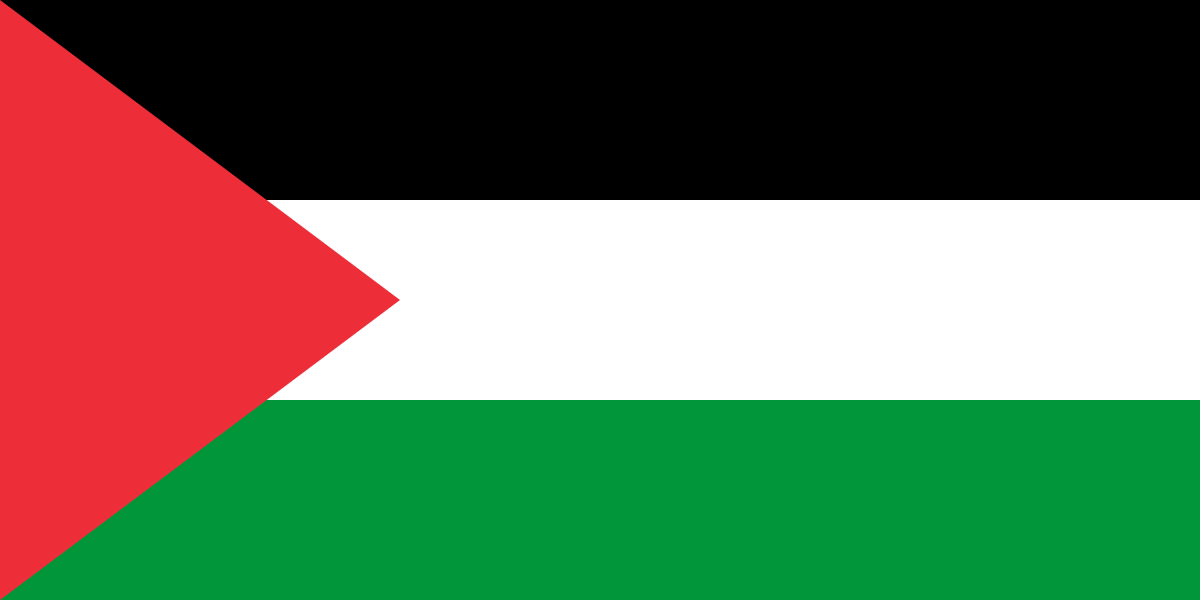
I would like to thank Japan in its capacity as President of the Security Council for the leadership it has shown in convening this emergency meeting. I also express our gratitude to the eight members of the Council — Egypt, Bolivia, France, Italy, Senegal, Sweden, the United Kingdom and Uruguay — who requested this meeting as a matter of urgency following the recent alarming developments regarding Jerusalem. We also thank Mr. Nickolay Mladenov, Special Coordinator for the Middle East Peace Process and Personal Representative of the Secretary-General, for his briefing to the Council, and the Secretary-General for his statement in this regard. Before I deliver the rest of my statement in English, I would like to say something in Arabic.
(spoke in Arabic)
From this Chamber, I would like to commend our great Palestinian people who are defending Jerusalem today in its neighbourhoods, streets and places of worship. I would like to commend those at the Gate of Amud, in all the villages and Palestinian camps and all over the world. I would like to commend the honourable people who support and defend international law, our rights and the resolutions of the Security Council, and those — whom we support — who are urging the United States Administration to withdraw its illegal, irresponsible and provocative decision, which has no meaning other than that of pleasing Israel, the occupying Power, as it continues its arrogant and unjust defiance of international law. I would like to thank the 14 members of the Security Council who expressed their principled legal positions with respect to Jerusalem.
(spoke in English)
We come before the Security Council today with a sense of urgency. We urge the Council to act swiftly to uphold its duties under the Charter of the United Nations and the integrity and authority of its resolutions in the light of the violations and provocations against Jerusalem’s legal, political and historical status, and the Palestinian people’s rights and legitimate national aspirations. The extremely regrettable announcement by President Donald Trump on 6 December declaring that the United States recognized Jerusalem as the capital of Israel, and his decision to move its Embassy to that city, in direct contravention of Security Council resolutions and the long-standing international consensus on Jerusalem, has heightened tensions and risks the complete destabilization of this volatile situation, with far-reaching consequences.
The Israeli Government’s glee at this decision underscores the fact that the situation we face today has been blatantly instigated by the occupying Power. Rather than complying with the Council’s repeated demands to cease its violations in the occupied Palestinian territory, the Israeli Prime Minister and his Government have persisted with their crimes and with their incessant bullying of world leaders into endorsing Israel’s illegal policies and practices in the city and even joining it in its attempts to destroy the possibility of a two-State solution based on the pre- 1967 lines, including by altering and undermining Jerusalem’s legal status, character and demography, along with that of the rest of the occupied territory, in grave breach of international law and the relevant United Nations resolutions.
We have often lamented this impunity, but we have not addressed often enough the actions enabling the crimes that have led to the grave reality we now face. The complicity must be recognized. The decision by the United States to reward the Israelis’ impunity undermines and essentially disqualifies its leadership role in the quest for peace in the region. Indeed, world leaders’ resounding rejection of this provocative decision is indicative of the general rejection of all such illegal policies and measures and of the immense concerns about the dangerous implications of this decision, including the prospects for peace and security in the region and beyond. We are grateful for the strong, principled positions that have been expressed by States and organizations worldwide. The global consensus in this regard is clear. International law and the relevant
Security Council resolutions, including resolutions 478 (1980) and 2334 (2016), must be upheld and respected; the status of Jerusalem cannot be unilaterally altered or determined by any State; and this decision by the United States should be reconsidered and rescinded.
That the Israeli-Palestinian conflict continues to pose a threat to international peace and security is beyond question. That has been confirmed by the national, political and religious sensitivities and emotions stirred by these developments. Jerusalem’s significance to the Palestinian people, both Muslims and Christians, cannot be underestimated. President Abbas, in his statement of 6 December, clearly reaffirmed our historical, national and religious attachment to the Holy City. His declaration, along with those of Palestinian officials and millions of Palestinian citizens, should leave no question that Jerusalem is a matter of priority and a redline for Palestinians. There can be no just and lasting solution to the question of Palestine without a just solution to the question of Jerusalem. Jerusalem has long been the heart of Palestine and always will be.
Nor can Jerusalem’s significance to all Arabs and Muslims worldwide be underestimated. It is the first qibla, and Al-Haram Al-Sharif is the third holiest sanctuary in Islam. The historic status quo at Al-Haram Al-Sharif must be fully respected and preserved, as repeatedly called for by Arab and Muslim nations and by the international community as a whole, and as reflected in the resolutions of the Security Council and the General Assembly. We recognize the Hashemite Kingdom of Jordan and its special role and efforts in that regard as custodian of the holy sites in Jerusalem. And the clarity and strength of statements made in recent days — a profound backlash against this irresponsible unilateral decision — reaffirm the legitimate concerns and interest of the international community regarding the question of Jerusalem.
Jerusalem has long been accorded a special political and legal status, beginning with General Assembly resolution 181 (II) of 1947, in which the city was designated a corpus separatum, and the many resolutions thereafter that called for protection of the city’s unique spiritual, religious and cultural dimensions and heritage, and for access to its holy sites by people of all religions and nationalities, with due regard for the fact that Jerusalem is sacred to the followers of the three monotheistic religions, Islam, Christianity and Judaism. The Assembly has just reaffirmed those principles by a vast majority in its resolution 72/15 on
Jerusalem, contrary to the false Israeli narrative and rhetoric in that regard.
Israel has never been recognized by any country as sovereign over Jerusalem. Its status remains unresolved, as affirmed in Security Council and General Assembly resolutions and by its designation for decades as a final-status issue in the Middle East peace process. Moreover, East Jerusalem has continued to be occupied territory since 1967 and an integral part of the rest of the occupied Palestinian territory, to which international law, including the Fourth Geneva Convention, applies, as reaffirmed by the Council, most recently in resolution 2334 (2016), the General Assembly and the International Court of Justice.
We recall the Council’s resolutions on Jerusalem, including resolution 476 (1980) and resolution 478 (1980), which lays out the clear determination that
“all legislative and administrative measures and actions taken by Israel, the occupying Power, which have altered or purport to alter the character and status of the Holy City of Jerusalem”
have no legal validity and constitute a flagrant violation of the Fourth Geneva Convention and “are null and void and must be rescinded forthwith”. Resolution 478 (1980) rejected Israel’s attempts to forcibly annex East Jerusalem, deeming the occupying Power’s enactment of its basic law a violation of international law and demanding that it be rescinded. The Council further specifically called on all Member States to accept its decision not to recognize the basic law or any other such actions seeking to alter the character and status of Jerusalem, and directly called on “those States that have established diplomatic missions at Jerusalem to withdraw such missions from the Holy City”. In resolution 2334 (2016), the Council unequivocally affirmed that
“it will not recognize any changes to the 4 June 1967 lines, including with regard to Jerusalem, other than those agreed by the parties through negotiations”.
The decision of the United States cannot change those facts. I repeat, the decision of the United States cannot change those facts. Actions taken contrary to Security Council resolutions have no legal effect and cannot change the applicability of international law to the situation, including the prohibition of the acquisition of territory by force. The occupied territory of the State of Palestine, which encompasses the West
Bank, including East Jerusalem and the Gaza Strip, is an established legal and political fact. No policy announcement can change that reality, nor can it negate the rights of the Palestinian people, as per international law and the relevant United Nations resolutions.
The Security Council must reaffirm its clear position on the status of Jerusalem and its rejection of all violations of that status regardless of when they are committed or who commits them. The Security Council’s resolutions remain fully valid and must be implemented. They are the key to peace. The extremely negative messages that such reckless action sends to our people are clear. They say that our belief in international law and the international system, our patience and perseverance, our unending pursuit of peace and cooperation in good faith with all peace initiatives, not to mention our historically painful compromise for peace, based on a two-State solution, have all been to no avail. They say that those who play by the rules will lose and those who trample on the law will win. That must be redressed. The Council must act to restore the Palestinian people’s belief in international law as the most viable path to the realization of our rights and freedom. The Council must restore our belief that peace is possible and ensure that no more generations will suffer this grave injustice.
As President Abbas has repeatedly cautioned, the Council must also act in order to avert the risks of further exacerbating religious sensitivities, which threaten to transform a solvable political-territorial conflict into a never-ending religious war that will only be exploited by extremists, thereby fueling more radicalism, violence, terrorism and strife in the region and elsewhere. We call on the Council to denounce the recent decision about Jerusalem, act responsibly and assert its authority in the efforts to resolve the Israeli-Palestinian conflict. We will work with all of our partners to adopt a Security Council resolution. We believe that paragraph 3 of Article 27 of the Charter of the United Nations should be invoked and that it is applicable in this regard.
We once again urge the United States to rescind its decision and rectify this serious matter, in conformity with the relevant resolutions and in a manner that can salvage the prospects for a peaceful solution and ensure a future of peace, security, prosperity and dignity for both the Palestinian and Israeli peoples sooner rather than later. In line with the relevant resolutions, we urge States not to recognize such unilateral decisions and the
unlawful situation that has resulted from Israel’s illegal measures, and to ensure that all of their respective policies and actions, including vis-à-vis Israel’s illegal settlement and colonization of our land, conform to that.
We also call on States that have not recognized the State of Palestine, with East Jerusalem as its capital, on the basis of the pre-1967 borders, to do so as a matter of urgency and an investment in peace. That practical step would accord with the long- standing international consensus and the international community’s declared commitment regarding a two- State solution. Considering recent developments, it would also represent an important contribution to salvaging the prospects for peace and pushing back against actions that undermine efforts to achieve a just and lasting solution that is based on the relevant United Nations resolutions, the Madrid principles, including the principle of land for peace, and the 2002 Arab Peace Initiative.
We call yet again for collective peace efforts. In resolution 2334 (2016), the Council advocated intensifying and accelerating international and regional diplomatic efforts aimed at achieving a comprehensive, just and lasting peace in the Middle East without delay. It is high time for all the parties concerned to mobilize such efforts. From now on, it must be a collective process undertaken by the Security Council and the Quartet-plus-plus-plus. It must be collective, because when one party dominated the process, that did not lead to success. It led to what we saw two days ago.
We cannot continue repeating the same failed formula and mistakes of the peace process of decades past. It is clear that only a collective effort can resolve the prolonged conflict. The recognition that all must do their part and that a multilateral approach is the more effective path has been central to the Arab Peace Initiative and the French initiative, as well as to the efforts of the Russian Federation, China, Egypt and the Quartet. It is urgent that we expand on and accelerate those efforts. One party cannot continue to monopolize the peace process, and especially not one that acts with a bias in favour of the occupying Power at the expense of the law and rights of the occupied people.
For their part, in the days ahead, President Abbas and the Palestinian leadership will continue their consultations at all levels to address the critical situation and determine the most appropriate path forward. That will include emergency meetings of the Palestinian
Liberation Organization’s Central Council to affirm a unified Palestinian national position, as well as the upcoming Arab Ministerial Meeting in Jordan and the Organization of Islamic Cooperation’s Islamic Summit in Turkey on Wednesday. Our overarching priorities will remain central to all of those efforts — the protection of our steadfast people, our land, including Jerusalem, and our holy sites. That will be true as long as Israel’s belligerent foreign occupation persists. We will make every effort to bring an end to that occupation and to achieve a just and lasting peace that upholds the rights of the Palestinian people, ensures a just solution to the plight of the Palestinian refugees, in accordance with resolution 194 (II) and the Arab Peace Initiative, and achieves the independence of the State of Palestine, with East Jerusalem as its capital, where our people can finally live in freedom, dignity, peace and security side by side with Israel and all our other neighbours in a new Middle East.
I now give the floor to the representative of Israel.


Wednesday’s declaration marks a milestone for Israel, for peace and for the world. The United States had the courage and true understanding of justice to officially state what has always been known — that Jerusalem has always been and always will be the capital of Israel, and that the Embassy of the United States belongs in Israel’s capital. For that, I thank President Trump, Vice President Pence, Ambassador Haley and the American people.
The Jewish people are an ancient nation. Three thousand years ago, King David declared the city of Jerusalem the capital of the Jewish people. Jerusalem appears in the Bible 660 times. It is the centrepiece of our vibrant Jewish history. Three times a day, Jews turn towards Jerusalem to pray. At every birth and every wedding, we remember Jerusalem. I have here a replica of an ancient coin, found on the Temple Mount in Jerusalem. It dates from the year 67 A.D., during the time of the second Jewish Temple. The words “Jerusalem the Holy” are inscribed on it. Only three years later, in the year 70 A.D., our holy temple was destroyed and the Jewish people were sent into exile for 2,000 years.
Nearly 70 years ago this week, shortly after Israel declared independence, Prime Minister David Ben- Gurion made a timeless affirmation. He said: “Jerusalem is an inseparable part of Israel and her eternal capital.
No United Nations vote can alter that historic fact.” It was an important message, one that the world too often seems to forget.
Last year, in this same Chamber, almost all of us were here when the Security Council adopted its shameful resolution 2334 (2016). The Council had the audacity and the chutzpah to say that Israel’s presence at the Western Wall in Jerusalem has, and I quote, “no legal validity and constitutes a flagrant violation under international law”. Then, in May, UNESCO, the organization responsible for preserving cultural heritage, adopted a resolution declaring that Israel has no legal or historical rights anywhere in Jerusalem. It was one historic wrong after another. That is why President Trump’s decision was so important. The United States had the courage and sound moral judgment to right those historic wrongs in recognizing Jerusalem as the capital of the State of Israel.
Middle Eastern capitals are not known for tolerance or freedom of religion. But not in Israel. Jerusalem, under a sovereign Israel, is freer and more open to people of all religions than at any time in history. In Jerusalem, all people practice their religions freely. These values are enshrined in our Declaration of Independence, the founding document of our State. In it, we pledged to “safeguard the holy places of all religions”. We have always known that Jerusalem is holy for others, too. From the moment of our founding, we vowed to create a State that would honour that holiness; a democracy that would respect and value the traditions of all people. That has never changed, nor will it ever change — not this past week, not tomorrow, not ever.
The announcement on Wednesday revealed a sad truth about some people around the world, the people who threaten to ignite a wave of violence against Israel and Jews everywhere and who may claim they want peace but whose actions speak louder than their words. That is why every member of the Security Council must send a clear message today that there is never any excuse for violence. Violence must never be used as a threat. We have heard such threats before. In 1948, when the State of Israel was established, President Harry Truman of the United States was warned not to recognize us. People said that such recognition would spark terrible violence, but President Truman stood strong, just as President Trump did this week. They made the right decision.
The Palestinians now have a decision to make. They can choose violence, as they have always done. As we speak, we are seeing reports of rockets flying from Gaza into Israel. Or they can choose to join us at the negotiating table. They can meet us to talk — in Ramallah, Jerusalem or anywhere around the world. I sincerely hope they make the right decision. The United States announcement should serve as a reality check for the Palestinians and for the nations of the world. They can see this moment for what it is, an opportunity to initiate hope. They can realize what has always been true — that recognizing Jerusalem as Israel’s capital is a critical and necessary step for peace. They can learn that there will never be peace without Jerusalem as the capital of the State of Israel. That is why today I call on all countries, all peace-seeking nations of the world, to join our American friends, recognize Jerusalem’s connection to Israel and move their embassies to our capital. I urge them to understand that this declaration is a positive step and to see in it the potential that it can bring to our region.
Twice a year, Jews all over the world conclude two of our major holidays, Yom Kippur and Passover, with a prayer. That prayer calls for “next year in Jerusalem”. Seventy years ago, the Jewish people came home to Jerusalem. We are grateful to the United States for its courageous decision and we call on all the nations of the world to join us this year in Jerusalem, the capital of the State of Israel.
I now give the floor to the representative of Jordan.


Allow me to begin by thanking you, Mr. President, for having convened this emergency meeting in the delicate circumstances our region is experiencing and which pose a threat to international peace and security. I would also like to thank Mr. Nickolay Mladenov, Special Coordinator for the Middle East Peace Process, for his briefing ,and I thank the members of the Security Council that called for this very important meeting to be convened.
The Government of the Hashemite Kingdom of Jordan underscores that the decision taken by the United States Administration on 6 December to recognize Jerusalem as the capital of Israel and transfer the Embassy of the United States there constitutes a violation of internationally legitimate resolutions and a transgression of the Charter of the United Nations,
which confirms that the status of Jerusalem can be decided only through final-status negotiations between the parties involved. The Hashemite Kingdom believes that any unilateral measure aiming to impose a new situation on the ground is null and void. That is why Jordan rejects this decision, which risks exacerbating tensions, consolidating the Israeli occupation on Palestinian land and even prejudge the outcome of negotiations on the final status, as well as inciting anger and provoke anti-Muslim and anti-Christian sentiment throughout the Arab world.
We believe that the occupation is the principal cause of tension in the region and that there will be no security or stability without a settlement to bring justice to the Palestinian people and satisfy their legitimate rights to freedom and the creation of an independent Palestinian State with East Jerusalem as its capital. Jordan also highlights the importance and the need to intensify consultations to find a political horizon that will prevent despair and aggression from taking root in the region and its surroundings.
The issue of Jerusalem must be addressed from the perspective of all three religions. We once again underscore that the question of Jerusalem is a final-status issue that must be resolved through a comprehensive settlement of the Palestinian-Israeli conflict, while guaranteeing the existence of an independent Palestinian State along the borders of 4 June 1967 and with Jerusalem as its capital. That is the only way of achieving security, stability and peace in accordance with internationally legitimate resolutions and the Arab Peace Initiative.
The United States recognition of Jerusalem as the capital of Israel has no validity under law as it only perpetuates the Israeli occupation of the eastern part of the city occupied by Israel in June 1967. Resolution 478 (1980) stipulates the non-recognition of Israel’s basic law on Jerusalem and calls on the Member States with embassies in Jerusalem to close them. Any proceedings or measures taken by Israel on Jerusalem that aims to alter its legal nature and status, including declaration of it as capital, are null and void as confirmed by various relevant Security Council resolutions, particularly resolutions 465 (1980), 476 (1980) and 478 (1980).
We must emphasize that recognition of any status of Jerusalem as the capital of Israel can have no legal effect
in changing the status of Jerusalem from occupied land, as determined by the General Assembly, the Security Council and the advisory opinion of the International Court of Justice on the Legal consequences of the construction of a wall in the occupied Palestinian territory (see A/ES-10/273). Jordan also condemns the expansion of settlements and asserts their illegality. We highlight the need to halt all unilateral Israeli measures that may impose a new reality on the ground. We must also emphasize the need for the United States to play its central role as a neutral mediator to settle this conflict and achieve peace on the basis of the two-State solution, agreed upon by the entire world as the only way of settling this conflict and achieving lasting peace.
I wish to emphasize that the Hashemite Kingdom of Jordan will spare no effort and take all possible measures, together with the international community, to help successfully reach a settlement and realize the legitimate rights of our brotherly Palestinian people. I would also like to inform the Council that the Hashemite Kingdom, together with our brothers in the Palestinian National Authority, has called for an emergency meeting of the Council of the League of Arab States at the ministerial level in Cairo tomorrow to coordinate our position regarding the United States decision and agree on a collective action mechanism to lessen its negative effects and contain the potential consequences.
Jordan has also called on Istanbul to hold a meeting of the Foreign Ministers of the Organization of Islamic Cooperation to unify efforts. That meeting will precede the summit convened by Turkey, which will be held next Wednesday in Istanbul rather than on Sunday in Amman.
In conclusion, under the leadership of His Majesty King Abdullah II bin Al-Hussein, as Custodian of the Islamic and Christian holy sites in Jerusalem, the Hashemite Kingdom of Jordan will continue its intensive diplomatic efforts at the regional and international levels. In close coordination with our brothers in the Palestinian Authority, we will endeavour to put an end to the occupation and strive for the creation of an independent Palestinian State, the protection of Jerusalem and its Islamic and Christian holy sites and the preservation of its legal and historic status — a top priority for Jordan.
The meeting rose at 1.15 p.m.