S/PV.9170 Security Council
Provisional
The meeting was called to order at 10.45 a.m.
Adoption of the agenda
The agenda was adopted.
Reports of the Secretary-General on the Sudan and South Sudan Report of the Secretary-General on the situation in Abyei (S/2022/760)

In accordance with rule 37 of the Council’s provisional rules of procedure, I invite the representatives of the Sudan and South Sudan to participate in this meeting.
In accordance with rule 39 of the Council’s provisional rules of procedure, I invite the following briefers to participate in this meeting: Ms. Martha Ama Akyaa Pobee, Assistant Secretary-General for Africa in the Departments of Political and Peacebuilding Affairs and Peace Operations; and Ms. Hanna Serwaa Tetteh, Special Envoy of the Secretary-General for the Horn of Africa.
The Security Council will now begin its consideration of the item on its agenda.
I wish to draw the attention of Council members to document S/2022/760, which contains the report of the Secretary-General on the situation in Abyei.
I now give the floor to Ms. Pobee.
Ms. Pobee: I thank everyone for this opportunity to brief the Security Council on the United Nations Interim Security Force for Abyei (UNISFA), including the mission’s support for the Joint Border Verification and Monitoring Mechanism. I will also update Council members on the latest developments since the publication of the report of the Secretary-General (S/2022/760).
Today’s Security Council meeting comes at a time of renewed engagement in the political process to address the final status of Abyei and Sudan-South Sudan border issues. While progress has yet to materialize in the form of improvements in the lives and rights of the people of Abyei, there have been significant steps towards dialogue in the context of continued improvement in the relationship between the Sudan and South Sudan.
We are also encouraged by the agreement earlier this week between Sudanese and South Sudanese
officials to enhance their joint cooperation on issues related to Abyei and its final status, as well as the willingness indicated to resume the meetings of the Abyei Joint Oversight Committee (AJOC), which has not met since 2017.
The African Union Peace and Security Council is seized of the Abyei issue, having recently requested the African Union Commission to nominate a facilitator for the AJOC. We welcome the renewed efforts of the African Union High-Level Implementation Panel, chaired by former President Thabo Mbeki, to engage the local communities, as well as the sustained engagement by the Special Envoy of the Secretary-General for the Horn of Africa, Hanna Tetteh.
It is a welcome sign that the parties and regional actors are now giving greater diplomatic attention to the issue. I encourage all stakeholders, including the international community, to sustain their support for the ongoing efforts. UNISFA stands ready to play its role in support of our shared objectives for Abyei.
While the security situation in the Abyei Administrative Area has remained mostly calm, there has been some shift in the conflict dynamics seen in previous years. Despite the continued trust deficit between the Misseriya and Ngok Dinka communities, intercommunal violence between them declined somewhat in 2022. UNISFA has worked continuously to promote intercommunal dialogue. After a failed attempt earlier this year, the mission was successful in facilitating the convening of a joint traditional leaders peace conference in Entebbe in May, which brought together the leaders of both communities and led to a joint communiqué, in which they recommitted to peace while also noting their remaining points of disagreement.
The mission continues to engage both communities, as well as leaders in Khartoum and Juba, with the aim of holding seasonal peace conferences to discuss modalities during the transhumance season. Critical to the success of such dialogues, as well as grass- roots conflict-resolution mechanisms, will be the full, equal and meaningful participation of women, which has been lacking to date. UNISFA will work with both communities to ensure the integration of the women and peace and security agenda into the substantive results of conferences and other engagements, as a vital tool for advancing peace.
The year 2022 has seen a new conflict emerging between the Ngok Dinka and Twic Dinka communities in southern Abyei. Since the outbreak of clashes in February, much of the intercommunal violence witnessed in Abyei has been related to that conflict, with the loss of lives on both sides and the displacement of thousands of civilians, including many who sought sanctuary next to UNISFA bases. Despite the mobility challenges due to flooding during the rainy season, UNISFA responded to the clashes by intensifying patrols to deter further violence, offering protection to the displaced and providing medical services to the wounded. The mission continues to engage with local authorities and community leaders to restore calm and provide a secure environment for displaced families to return home.
After a lull in the violence during the rainy season, clashes resumed in late September and October. That worrying development potentially foreshadows further violence during the upcoming dry season, as conditions for mobility improve. In that regard, UNISFA, in coordination with the United Nations Mission in South Sudan, has maintained close contact with the Government of South Sudan to support mediation efforts and, in particular, plans for a Government- facilitated peace conference to be held in South Sudan.
We are particularly concerned that, amid the tensions between the Ngok Dinka and Twic Dinka communities, there were attacks and threats against UNISFA peacekeepers, staff and contractors. A total of seven attacks on peacekeepers were recorded during the reporting period, including against patrols responding to intercommunal violence at Amiet market, Athony and Malual Aleu, the targeting of UNISFA observation posts and attacks on UNISFA bases at Athony, Tajalei and Marial Achak. The use of high-calibre weapons, such as rocket-propelled grenades, against UNISFA troops in those attacks was of concern to the mission. While those incidents did not result in serious injuries to peacekeepers, we condemn the attacks in the strongest terms and remind all parties that such violence may constitute crimes under international law.
Most recently, starting on 16 October, the safety and security of UNISFA personnel once again came under threat during protests by local community members demanding the removal of Twic Dinka employees and some international staff members from the UNISFA headquarters camp in Abyei. The mission’s prompt engagement with local community leaders to seek
a peaceful solution and their support in that regard helped to calm the situation. We would like to reiterate that the safety and security of our peacekeepers, staff and contractors remain a top priority, and we urge the Government of South Sudan to continue its engagement with the local community to ensure that such threats do not reoccur.
The humanitarian community continued to assist 250,000 vulnerable people in central and southern Abyei, including people displaced by intercommunal clashes. In late August, there was significant flooding in a large part of the Abyei Area, affecting some 91,000 people. UNISFA supported the Office for the Coordination of Humanitarian Affairs and other partners in delivering humanitarian assistance by air to some of those who remained cut off by road.
I am pleased to report that the reconfiguration of the mission into a multinational peacekeeping force continued during the reporting period, and it is near completion, with 2,567 military personnel out of the authorized 3,250 personnel in place. The reconfiguration process is expected to be finalized in the coming months with the arrival of the remaining troops and equipment during the upcoming dry season. As the new force establishes itself on the ground, the mission is collaborating with United Nations Headquarters to develop a new mission concept, the mission plan and the military and police concept of operations to direct the strategy of UNISFA in implementing its mandate. The new force is also carrying out civilian and military coordination activities to help to meet some of the basic needs of the local population and build support for the UNISFA mandate. A remaining challenge for the mission is the relatively low number of women among military personnel, at only 7 per cent, and I urge all stakeholders to work with UNISFA to prioritize the deployment of women troops.
With the Ngok-Twic conflict creating new protection needs in the south, the new force must be better equipped to cover a wider area. Force mobility in the context of the reduced helicopter capacity and the terrain being flooded for half of the year is a further challenge. At the same time, the mission continues to face other capacity challenges with regard to its support to the Joint Border Verification and Monitoring Mechanism, where no progress has been made on reoperationalization in Sector 1, including the Sector headquarters in Gok Machar, South Sudan, and its team sites 11 and 12 after its forced withdrawal in 2021. It is
critical that the Government of South Sudan continue its efforts to enable the re-establishment of those locations as soon as possible, as underscored by the Security Council in its press statement of 15 October 2021 (SC/14666).
During the reporting period, there was also no progress on the deployment of the three formed police units and individual police officers, as mandated by the Security Council, owing to the continued non-issuance of visas. I appeal to the members of the Security Council for their support in facilitating the deployment of those valuable assets. In the meantime, United Nations police continue to mentor and monitor the community protection committees and the joint protection committee in the absence of the Abyei Police Service.
Two encouraging developments took place in June, when UNISFA inaugurated the first-ever gender desk to report cases of gender-based violence 24/7 and when community protection committees were established in some areas in northern Abyei for the first time since 2015.
The Security Council has clearly indicated that our efforts must focus on improving the rights and livelihoods of people in Abyei. To that end, the mission continues to work closely with the United Nations country teams in the Sudan and South Sudan on the Abyei joint programme. Following a productive visit by the resident and humanitarian coordinators of the Sudan and South Sudan, the programme document has nearly been completed, and implementation of the activities planned is expected to commence during the next reporting period. The joint programme will help to create an enabling environment for peace by focusing on services in the areas of water management, health, livelihoods and conflict resolution skills. It also focuses on creating opportunities for young people and women as central actors in peacebuilding. I am grateful for the Council’s continued political support for that important initiative.
The visit to Abyei by Under-Secretary-General Lacroix, accompanied by Special Envoy Tetteh, will provide an opportunity to address some of the political and logistical challenges that I mentioned today.
I would like to end my remarks by thanking Major General Benjamin Sawyerr and the women and men of UNISFA for their tireless work in the service of peace in Abyei. I would also like to thank the Security Council
members for their continued support to UNISFA, and I seek the Council’s support for the Secretary-General’s recommendation to extend the mandate of UNISFA for a period of one year.
I thank Ms. Pobee for her briefing.
I now give the floor to Ms. Tetteh.
Ms. Tetteh: I am grateful for the opportunity to brief the Security Council on the progress in implementing resolution 2046 (2012), which relates to outstanding bilateral issues between the Sudan and South Sudan. I do not want to repeat the points that my colleague Assistant Secretary-General Pobee has already made, and I will therefore be brief.
The Sudan and South Sudan continue to enjoy improved relations and have made some headway through regular bilateral meetings. They also held a Joint Political and Security Mechanism meeting in Khartoum in May this year. However, even as they continue exchanging high-level visits, each country’s priority seems to be its domestic challenges. In the Sudan, the parties have yet to agree on the way forward to restore a democratic transition after the coup d’état of 25 October 2021. In South Kordofan and Blue Nile states, the stalemate in talks between the Government of the Sudan and the Sudan People’s Liberation Movement-North, led by Abdelaziz Al-Hilu, has persisted. In South Sudan, some progress has been registered in the peace process, that is, in the implementation of the Revitalized Agreement on the Resolution of the Conflict in the Republic of South Sudan, as the graduation of forces finally took place on 30 August, nearly three years after they completed their training.
High-level engagements between the Sudan and South Sudan are a regular feature of their bilateral relations. The South Sudan national unified force’s graduation on 30 August allowed President Salva Kiir Mayardit to meet and discuss bilateral issues with General Abdel Fattah Al-Burhan, Chairperson of the Sudan’s Sovereign Council and current Chairperson of the Intergovernmental Authority on Development (IGAD). Earlier in the process, General Al-Burhan was instrumental in unblocking the stalemate over the command structure of the unified army by presenting a proposal acceptable to the parties, thereby paving the way for the graduation of forces. The Sudan has expressed interest in training South Sudanese forces on
security and defence, the rule of law and maintaining order. In early August, the Deputy Chairperson of the Sovereign Council, Lieutenant General Mohamed Hamdan Dagalo, also known as Hemedti, travelled to Juba, where he expressed that wish and IGAD’s support for the decision by the South Sudanese parties to the Revitalized Agreement on the Resolution of the Conflict in South Sudan to extend the transition period to 2025. He urged the parties to maximize the extension by implementing all outstanding tasks.
The two countries also meet periodically to address outstanding issues. On 24 May, the Sudan’s Minister of Defence, Lieutenant General Yassin Ibrahim Yassin, and his South Sudan counterpart, Angelina Teny, chaired a meeting of the Joint Political and Security Mechanism in Khartoum, at which they agreed to re-establish the Abyei Joint Oversight Committee, activate river transport and immediately open border crossings, while controlling and monitoring the movements of citizens at the borders. They also recommitted to withdrawing their forces from the safe demilitarized border zone, as agreed at previous Joint Political and Security Mechanism meetings. On 28 May, Tut Gatluak, South Sudan’s Presidential Adviser on Security Affairs, and Omar Al-Khalifa Abdullah, Governor of the Sudan’s White Nile state, launched the reopening of the river transport route in Kosti, 11 years after it was closed. However, the four border-crossing points of Jebelain-Renk, Meiram, Buram-Timsah and Kharsana-Panakuac have not yet been opened, due to disputes over land attributed to the local communities.
Building on the agreement reached in March between President Kiir and General Al-Burhan to resolve their outstanding issues through economic and political cooperation, the two countries have been meeting regularly, including at the technical level. On 12 May, a South Sudanese delegation, led by Mr. Gatluak and accompanied by the Minister of Finance, met with the leadership of the Sovereign Council in Khartoum. They reviewed progress on the implementation of the peace agreements in both countries and the enhancement of economic cooperation, especially in the oil sector and trade, including the border opening to ease trade flow. The discussions also focused on technical and financial arrangements, increased oil production and a review of the challenges faced in implementing previous agreements. On 22 May, at a technical meeting in Khartoum between the Sudanese Minister of Energy and Petroleum, Muhammad Abdullah, and South Sudan’s
Undersecretary at the Ministry of Petroleum, Awow Daniel Chuang, the two countries agreed to develop a cooperation framework in the field of petroleum for their mutual benefit. On 27 September, President Kiir reiterated the decision of both countries to use the cooperation framework to resolve bilateral disputes, including over Abyei, and suggested that all questions relevant to Abyei be addressed to the Committee on Abyei that he established in May 2021.
Following the African Union Peace and Security Council meeting held on 29 September on the political and security situation in Abyei, President Kiir reconstituted the Committee on 4 October by creating a subcommittee on development and natural resources. Among other things, the subcommittee is mandated to create a cooperation framework for the development of oil and other natural resources in the Abyei Area and to report to the Abyei Committee responsible for pursuing negotiations on the final status of the Abyei Area, through engagement with the Government of the Sudan.
In the meantime, since May, working with the Chairperson of the African Union High-Level Implementation Panel, I have been holding separate consultations with the Ngok Dinka and Misseriya communities to find a way out of the stalemate in the settlement of the final status. In addition to the communities, our consultations involved Mr. Deng Alor, Minister of East African Community Affairs of South Sudan and head of the Ngok Dinka delegation, Mr. Francis Deng, former South Sudan Permanent Representative to the United Nations, and Mr. Luka Biong, an eminent Abyei academic and the United Nations Interim Security Force for Abyei. We are currently working to achieve a face-to-face engagement between the two communities at the request of one of them, and both Governments have been informed accordingly by the High-Level Implementation Panel.
As previously stated, when the African Union Peace and Security Council met on 29 September to consider the political and security situation in the Abyei region, it appointed a facilitator for the Abyei Joint Oversight Committee. We hope that all of those collective efforts will help the parties to re-engage proactively to address existing challenges within the region, but also to find a solution to the status of Abyei. Ahead of that meeting, I visited Juba on 19 and 20 October and had a meeting with President Kiir, who confirmed to me his determination to work cooperatively with the Sudan
to expeditiously resolve the issue of the final status of Abyei. He also stressed that conflicts are better settled through peaceful means to enable communities and their respective countries to enjoy healthier relations.
On 24 October, a delegation led by Mr. Gatluak, in his role as Chairman of South Sudan’s Abyei Committee, met with General Dagalo and members of the Sudan Abyei Committee in Khartoum. Both countries agreed to jointly expedite the provision of services to the citizens of Abyei and activate joint mechanisms to provide the necessary humanitarian services by creating an appropriate environment for the communities in the Area. They also agreed to encourage social peace and community dialogue among communities in Abyei as a gesture of trust- building. Earlier today, I met with senior officials of the Ministry of Foreign Affairs of the Sudan, the Minister of Defence and General Dagalo, who all confirmed to me their commitment to working closely with their South Sudanese counterparts on the final resolution of the status of Abyei. They referenced the meeting held on 24 October and noted their commitment to using this opportunity for re-engagement to meet regularly on issues relating to Abyei on a quarterly basis.
In conclusion, progress in improving bilateral relations between the Sudan and South Sudan has been positive, and we believe that it will have a stabilizing effect on the dispute between the two countries. Nevertheless, a renewed commitment regarding the implementation of transitional arrangements, as well as the dispute resolution over Abyei’s final status, cannot be set apart from the fragile internal situations in both countries. My office will continue to engage with the Governments of the Sudan and South Sudan, as well as the African Union and IGAD, to maintain the international community’s support for fully normalizing the relationship between the two countries. We will also continue to offer assistance to the parties as they take these encouraging steps to find ways of working towards a definitive resolution of Abyei’s status.
I thank Ms. Tetteh for her briefing.
I shall now give the floor to those members of the Council who wish to make statements.


I would like to thank Assistant Secretary-General Pobee and Special Envoy Tetteh for sharing the progress of the United Nations Interim Security Force for Abyei
(UNISFA) on mandate implementation, and for their updates on Abyei.
The United States deeply appreciates UNISFA’s tireless efforts to implement its mandated tasks to protect civilians and facilitate the delivery of humanitarian aid throughout its troop reconfiguration and in the face of unprecedented challenges. In line with the Secretary-General’s recommendation in his 13 October report (S/2022/760), we support a one-year extension of UNISFA’s mandate. We hope the Secretary-General’s recommendation will have the Council’s support as well. A one-year mandate would allow UNISFA to complete its troop reconfiguration and give the mission adequate time to receive visas, identify key stakeholders and develop the essential relationships that it needs to implement its mandate. We also continue to urge the Sudan and South Sudan to facilitate the smooth functioning of all UNISFA bases and Joint Border Verification and Monitoring Mechanism team sites and provide full support for UNISFA in the implementation of its mandate.
The United States is gravely concerned about the re-emergence of deadly violence between Dinka communities. More than 20 civilians have been killed and thousands remain forcibly displaced following the destruction of their property and homes. We condemn those acts of violence and urgently call on the two Governments to intensify their efforts to end those violent clashes. Similarly, we call on both Governments to do their utmost to prevent seasonal clashes among local communities. Given that Abyei continues to lack United Nations police and a joint police service, it will likely continue to experience violent clashes and criminality. The formation of joint security and administration institutions, the issuance of visas for United Nations police and the deployment of a civilian deputy would allow for more non-military approaches to mitigating conflict and building peace among communities. We again strongly urge the Sudan to issue visas for United Nations police in a timely manner, allow for the appointment of a civilian Deputy Head of UNISFA and allow UNISFA the use of the Athony airfield. Finally, we ask both the Sudan and South Sudan to make progress towards the establishment of Abyei’s joint police service, which will be a critical tool for quelling violence in Abyei.
Those political impasses, which have continued for the past 11 years, remain a great disappointment because the people of Abyei continue to suffer from
violence, mass displacement and a lack of basic needs and humanitarian aid. We reiterate our call to the parties to renew their diplomatic engagement in order to achieve a peaceful and mutually acceptable resolution of Abyei’s final status and to participate in the Joint Political and Security Mechanism and the Abyei Joint Oversight Committee meetings. We welcomed the announcement of an agreement on 24 October and note that the implementation of its commitments could be essential in bringing peace and security to the people of Abyei. We look forward to more information on their specific plans and details on which institutions and mechanisms will be activated, as well as plans for discussions on a final status. We commend and support the African Union Peace and Security Council’s 29 September communiqué, which appealed to the Sudan and South Sudan to hasten their efforts to establish joint institutions, and we strongly encourage the African Union to intensify those engagements in order to make progress towards a solution in Abyei.
Lastly, we continue to encourage UNISFA initiatives to support community dialogue aimed at strengthening intercommunal relationships that promote and facilitate stability in the Abyei Area and stress the importance of women’s full, equal and meaningful participation in those processes. We encourage UNISFA to continue its efforts to protect women and children from violence, particularly sexual and gender-based violence. The United States also calls on UNISFA to provide more extensive mission activity reporting focused on UNISFA’s effectiveness, and more qualitative measures in implementing its mandate.
We reiterate our commitment to working with the Governments of the Sudan and South Sudan and the people in the region, our fellow Council members, the African Union, and other international and regional partners with the goal of achieving peace, security, and the prosperity of the region.


I have the honour to deliver this statement on behalf of the three African members of the Security Council (A3), Gabon, Kenya and Ghana.
At the outset, we would like to thank the Secretary- General for his report (S/2022/760), as well as Assistant Secretary-General Martha Pobee and Special Envoy Hanna Serwaa Tetteh for their insightful briefings on the situation in Abyei and the activities of the United Nations Interim Security Force for Abyei (UNIFSA).
Our statement will focus on the political, security and humanitarian situations.
On the political front, the A3 welcomes the growing positive relations between the Sudan and South Sudan and their commitment to good-neighbourliness, as demonstrated by their continued mutual support for resolving their respective internal political and security challenges. We urge the two countries to use that new positive momentum to seek a peaceful settlement on the final status of Abyei, as provided for in the 2005 Comprehensive Peace Agreement. The A3 discourages any unilateral action by either of the parties and urges them to seek mutual agreement on the Abyei referendum as part of the overall objective of the stabilization process.
While the A3 welcomes the two countries’ efforts to re-establish discussions on Abyei, it is regrettable that during the reporting period there was no progress on the implementation of the 2011 agreement on temporary arrangements for the administration and security of the Abyei Area. There was also no progress in facilitating the long-standing requests of UNISFA that affect the mission’s performance, including for the use of the Athony airstrip, the issuance of visas for formed police units, the appointment of a UNISFA civilian Deputy Head of Mission and the redeployment of Sector 1 of the Joint Border Verification and Monitoring Mechanism. Regrettably, the people who continue to be negatively affected by the stand-off are the desperate civilians in Abyei, who are still not being provided with any reliable basic essential services.
The A3 takes note of the convening in May of a meeting of the Joint Political and Security Mechanism and the recommitment to past agreements, including the reopening of the border crossings. Indeed, the realization of soft borders should remain a strategic objective between the two countries owing to their strong mutual interdependence. We therefore urge them to expedite the implementation of all the previous recommendations and conclusions of the meetings of the Joint Political and Security Mechanism and the Abyei Joint Oversight Committee. Moreover, the two parties should jointly and in a coordinated manner implement all the protocols of the September 2012 cooperation agreements, especially the demarcation of the safe demilitarized border zone, in order to enable the Joint Border Verification and Monitoring Mechanism to discharge its mandate effectively.
The A3 welcomes the communiqué issued at the 1108th meeting of the African Union Peace and Security Council held on 29 September, on Abyei, and reiterates its full support to the work of the African Union High-Level Implementation Panel. We reiterate our call to all international partners to remain engaged diplomatically and politically in support of the dialogue efforts between the two countries and to offer any required technical support in the implementation of the existing framework agreement.
With regard to the security situation in Abyei, the A3 is deeply concerned about the resurgence of armed violence and intercommunal attacks in Abyei. We strongly condemn the reported violent confrontations, destruction of property and loss of life. We urge the parties to the conflict to cease hostilities, exercise restraint and pursue dialogue to address their grievances. The A3 welcomes the establishment of the community protection committees and the convening of the Abyei Joint Traditional Leaders’ Peace Conference, held in Kampala in May. It is our belief that frequent and broad-based intercommunal dialogues can go a long way to addressing the existing grievances and tensions among the communities.
On the humanitarian situation, the A3 is deeply concerned by the worsening humanitarian situation evidenced by the displacement of the population and the lack of access to essential social services, which has added to the hardship in the Abyei Administrative Area. We are also concerned by the devastating impacts of climate change, which have caused floods, diminished livelihoods and increased the competition for scarce resources, thereby further driving conflicts and insecurity in Abyei.
The A3 therefore welcomes the completion of the document on the Abyei joint programme of the United Nations country teams of the Sudan and South Sudan, and it looks forward to the expeditious implementation of the identified quick-impact projects. We further call on Member States and humanitarian agencies to continue to provide the necessary support for the people of Abyei to accord them dignity and alleviate their suffering. As the dry season approaches, we urge UNISFA to implement early interventions, including facilitating intercommunal dialogues on transhumance.
Finally, the A3 commends UNISFA and the troop- contributing countries for their continued commitment to execute the mandate of the mission despite the
existing challenges. We condemn the reported attacks directed against UNISFA personnel and facilities.
As noted in our statement of 21 April to the Council (see S/PV.9020), we remain convinced that the realization of the final status of Abyei is the key to any future decision on the withdrawal of UNISFA, taking into account the safety and security of Abyei residents.
The A3 therefore reiterates the need to maintain the presence of UNISFA and welcomes the Secretary- General’s proposal for a 12-month mandate cycle for UNISFA in lieu of the current six months, which we believe would greatly help for planning and operational purposes. We also urge the Sudan and South Sudan to fully cooperate with UNISFA, including through ensuring full respect of the status-of-forces agreement in order to enable implementation of the mission’s mandate.
In conclusion, the A3 wishes to recognize with gratitude the sustained efforts over the years by the African Union High-Level Implementation Panel, chaired by former President Thabo Mbeki; the role of the Special Envoy of the Secretary-General for the Horn of Africa; the Intergovernmental Authority on Development; and the regional leaders who have contributed to the stabilization of the Abyei Administrative Area. We encourage the African Union to sustain its efforts to ensure the success of that undertaking, aimed at finding peaceful solutions to the challenges in Abyei.


I thank Assistant Secretary-General Pobee and Special Envoy Tetteh for their briefings, and I welcome the participation of the representatives of the Sudan and South Sudan in this meeting.
Albania strongly supports the efforts of the United Nations Interim Security Force for Abyei (UNISFA) personnel operating in the Abyei Administrative Area to ensure the protection of civilians and promote dialogue between the two Governments and the implementation of their mandates.
In that regard, attacks against UNISFA personnel and restrictions of movement against the mission are unacceptable. We strongly condemn the violence against peacekeepers and call on all stakeholders to enable the mission’s freedom of movement. We also call on the Sudan to facilitate the issuance of the necessary visas for UNSIFA to complete its troop reconfiguration.
We are concerned about the humanitarian crisis, the security and socioeconomic situation, as well as the absence of a functional justice system. Regarding the recent local community tensions and the political situation in Khartoum, we urge the parties to cease hostilities and address the root causes in order to achieve sustainable peace.
Also, the situation has been worsened by the recent flooding in South Sudan, which affected the Abyei Administrative Area.
We welcome the agreement by both Governments to strengthen cooperation on Abyei. The holding of the Joint Political and Security Mechanism meeting in May was a positive step, but all parties must further participate and hold Abyei Joint Oversight Committee meetings. Those talks remain crucial for resolving the border-crossing corridors, restoring the operation of the Athony airstrip and establishing the joint border verification and monitoring mechanism.
In that regard, Albania calls on the Sudan and South Sudan to take concrete action to strengthen their engagement to enhance dialogue among all stakeholders. We must see serious commitment and political will to implement the Revitalized Agreement on the Resolution of the Conflict in South Sudan and to build joint structures.
Furthermore, we welcome the recent communiqué adopted by the Peace and Security Council of the African Union. We commend its efforts and call for further mediation engagement to find a way forward on the political stalemate.
In conclusion, it is clear that the final status of Abyei is dependent upon the Sudan and South Sudan. Therefore, we urge that concrete and constructive action be taken to resolve the final status and bring peace and stability to Abyei.


I thank Assistant Secretary-General Pobee and Special Envoy Tetteh for their briefings. I also welcome the Permanent Representatives of the Sudan and South Sudan to the meeting today.
In recent years, the bilateral relations between the Sudan and South Sudan have been improving. That is conducive to stability in the region and settling the question of Abyei question.
China welcomes the Joint Political and Security Mechanism meeting between the Sudan and South Sudan held last May. Among other things, it resulted in progress in opening transit corridors. We are also pleased with the interaction between the two parties in preparation for the upcoming Abyei Joint Oversight Committee meeting. We hope that they will continue to increase their political input on the Abyei question, maintain their dialogue and consultation and, with the support of the African Union and the Intergovernmental Authority on Development, speed up the implementation of the agreement on temporary arrangements for the administration and security of the Abyei Administrative Area in order to continue to move towards the settlement of the Abyei question.
The sporadic outbreaks of intercommunal clashes and security incidents in Abyei are disconcerting. However, it is reassuring that thanks to the joint response of the United Nations Interim Security Force for Abyei (UNISFA), the Abyei administration and the Sudan and South Sudan, the security situation in Abyei has remained generally stable and under control.
China welcomes the seasonal peace conference and the resumption of consultations between the Misseriya and Ngok Dinka communities. We encourage all tribes in Abyei to actively participate in the seasonal peace conferences convened by UNISFA and the International Organization for Migration, in order to reach consensus on arrangements for transhumance during the next grazing period, and to work together to reduce tension and achieve harmonious coexistence.
The people of Abyei are experiencing multiple challenges, such as violent crime, flooding and difficulty in terms of livelihoods. They lack basic public services, including water, public health, education, assistance in agriculture and animal husbandry, and are in dire need of targeted relief from the international community.
China supports the United Nations in carrying out peacebuilding projects in Abyei, helping to improve the situation of the people there, properly handling the violent clashes triggered by the competition for resources and building a solid foundation for lasting peace through sustainable development.
UNISFA is an important force for maintaining peace and stability in Abyei, and it plays an indispensable role in the political settlement of the Abyei question. China supports UNISFA in continuing to perform its duties
and encourages both parties to continue to cooperate with UNISFA.
In that regard, we welcome the near completion of the reconfiguration of UNISFA and thank the Ethiopian peacekeepers for their efforts over the years to promote Abyei’s stability.
As one of the troop-contributing countries of UNISFA, China dispatched a peacekeeping helicopter contingent to Abyei, which has since its deployment actively met the needs of the peacekeeping mandate and spared no efforts to complete a range of flights and ground-support tasks. The Chinese peacekeepers will continue to support the work of UNISFA with practical action and will resolutely fulfil their peace mission.


I thank the Assistant Secretary-General and the Special Envoy for their very helpful briefings. I would also like to welcome the representatives of the Sudan and South Sudan to this meeting.
We would like to make three brief points today.
First, the United Kingdom commends the tireless efforts of the United Nations Interim Security Force for Abyei (UNISFA) to deliver its mandate under such challenging circumstances, and we also thank the troop-contributing countries. We fully support the extension of the mission’s mandate for 12 months. We fully support the extension of the mission’s mandate for 12 months, and we join our fellow Council members in reiterating the call on the Governments of the Sudan and South Sudan to remove the long-standing obstacles that limit the full implementation of UNISFA’s mandate. In particular, we are concerned about the restrictions on the mission’s freedom of movement and the attacks on UNISFA personnel. We urge the Government of South Sudan to ensure the re-operationalization of the Joint Border Verification and Monitoring Mechanism headquarters in Gok Machar.
Secondly, we must continue to watch the situation on the ground in Abyei carefully. Civilians continue to suffer due to the absence of basic services and the limited rule of law. We are concerned about the ongoing intercommunal violence across Abyei, including the worrying increase in tensions between the Dinka communities. Recent flooding has also compounded the worsening humanitarian situation. In addition to insecurity and a lack of infrastructure, it is putting huge pressure on the humanitarian response. Given
those circumstances, ensuring unrestricted access is vital. The United Kingdom urges all parties to fully respect international humanitarian law and to protect and enable humanitarian staff, assets and operations in order to deliver aid to those in need in all parts of Abyei without hindrance.
Thirdly, we remain concerned about the lack of progress on a political solution for Abyei. We therefore welcome the increased focus on the issue from the Sudan and South Sudan. We call on both Governments to seize that momentum and deliver measurable positive change for the people of Abyei. As a next step, we urge both countries to organize a further meeting of the Abyei Joint Oversight Committee as a sign of their recommitment to reaching an agreement.
Lastly, we welcome the recent communiqué of the African Union (AU) regarding Abyei, and encourage the AU to intensify its mediation efforts to help reach an agreement on its final status.


I thank Ms. Martha Pobee and Ms. Hanna Tetteh for their briefings. I also welcome the participation of the Sudan and South Sudan in this meeting. I would like to highlight three points.
We are concerned about the changing nature of intercommunal violence, with clashes between the Ngok Dinka and Twic Dinka communities. That violence is going hand in hand with an upsurge in attacks on Blue Helmets that is also unacceptable. We call on the Sudan and South Sudan to reduce those tensions. The two countries are bound by the status-of-forces agreement. They must allow the United Nations Interim Security Force for Abyei (UNISFA) to carry out its mandate safely in all of its areas of deployment. I refer here in particular to support for the Joint Border Verification and Monitoring Mechanism, as well as the use of the Athony airstrip. Those difficulties show that the status quo in Abyei is at a tipping point. The accumulated tensions and fragility of institutions could lead to an escalation at any time. We call on Khartoum and Juba to take advantage of their warming relations to reach a final-status settlement for Abyei. At a minimum, it must be possible to meet the basic needs of populations and reduce intercommunal tensions. We therefore welcome the agreement signed on 24 October in Khartoum and call for its implementation.
UNISFA can support a positive dynamic through its peacebuilding activities and its support for community
protection committees. If that approach is to be scaled up it requires that progress be made with regard to the appointment of a civilian Deputy Head of UNISFA and the deployment of United Nations Police units.
The stalemate of the situation in Abyei reflects the fragility of a region where crises are multiplying and protracted. A year has passed since the 25 October 2021 coup in the Sudan. That political crisis continues to hamper the peace process in Darfur, as well as the settlement of the status of Abyei. It also hinders the response to intercommunal violence, which has recently re-emerged in West Kordofan and Blue Nile, worryingly. France reiterates its call on all the parties to identify a way out of the political crisis and make progress on the formation of a credible civilian Government. In South Sudan, closing the gaps in the implementation of the 2018 Revitalized Agreement on the Resolution of the Conflict in the Republic of South Sudan must remain a priority. We encourage the authorities to show unity and accelerate the implementation of security arrangements in accordance with the road map adopted in August.
Finally, we encourage the States of the region to resolve their differences through dialogue, whether in relation to Abyei, the Al-Fashaga triangle, the Grand Ethiopian Renaissance Dam or the conflict in Tigray. In that context, we reiterate our support for Special Envoy Tetteh and are in favour of bolstering her team’s resources.


We thank Assistant Secretary-General Pobee and Special Envoy Tetteh for the valuable information they have provided, and welcome the delegations of the Sudan and South Sudan to this meeting.
Brazil remains concerned about the situation on the ground, which has been marked by recurring waves of violence in Abyei. We are apprehensive about the persistently tense relations among the local communities. The ongoing hostilities make humanitarian assistance in remote areas even more dangerous. The persistence of armed conflict also threatens the livelihoods of civilians, who already face substantial socioeconomic challenges, and we echo the Secretary-General’s worries about the enduring hardships that the people of Abyei face.
The precarious situation on the ground makes the work of the United Nations Interim Security Force for Abyei (UNISFA) even more critical. We deplore the attacks on peacekeepers and the restrictions on the
mission’s freedom of movement. We thank UNISFA’s leadership and personnel for the substantial endeavours they have made so far and continue to accomplish every day. In particular, we thank Special Envoy Tetteh and Major General Sawyerr for their critical efforts. As the time to renew UNISFA’s mandate approaches, we should ensure that the mission has the means to perform its crucial functions, including with regard to the protection of civilians and peacekeepers. In that connection, Brazil highlights the importance of strategic communications to support the mission’s activities, counter misinformation, garner trust among the relevant stakeholders and safeguard the protection of Blue Helmets. That is especially relevant in light of recent attacks on United Nations personnel.
Regarding the status of the Abyei Area, we reiterate that common ground between the Sudan and South Sudan will only emerge through fair, credible negotiations. We support additional dialogue between the Sudan and South Sudan and further contact between the two parties at various levels. We also welcome the friendlier relations between the two Governments in recent years. The domestic challenges in the Sudan and South Sudan should not derail bilateral dynamics. Those positive bilateral developments are why we call on the leaders of both countries to seize the opportunity to progress towards a long-term political settlement of the Abyei Area’s status. We underline the African Union’s legitimacy in intensifying its mediation efforts between the Sudan and South Sudan and highlight the critical support provided by the African Union High-Level Implementation Panel. In his latest report (S/2022/760), the Secretary-General supports a more significant role for the African Union on the issue. As we advance towards a settlement of the Abyei situation, we reiterate that positive synergy among the United Nations, the African Union, the Sudan and South Sudan is a critical factor.
We welcome the agreement between the Sudanese and South Sudanese authorities announced earlier this week in Khartoum. We call on the Sudan and South Sudan to seize this window of opportunity.


I thank the briefers for their insights. I particularly commend Special Envoy Hanna Tetteh for her efforts to revitalize the political process. We also want to commend her collaboration with the African Union (AU) Peace and Security Council and the AU High-Level Implementation Panel for the Sudan and South Sudan.
Norway remains deeply concerned about the high level of tensions in and around Abyei. We note with particular concern the report’s reference to
“coordinated attacks on Ngok Dinka communities by Twic Dinka and Misseriya” (S/2022/760, para. 10).
The repeated cycles of violence between communities make development impossible and have a devastating effect on civilians, including children. We call on the Misseriya, the Ngok Dinka and all neighbouring groups to show restraint and engage in efforts to decrease tensions ahead of the next dry season.
We are also concerned about the continued attacks on the peacekeepers of the United Nations Interim Security Force for Abyei (UNISFA). UNISFA must remain operational, willing and ready to implement its full Chapter VII mandate to protect civilians under threat of physical violence.
Let me add three points to today’s discussion on UNISFA and the situation in Abyei.
First, we need to see progress on the most contested issue — will Abyei belong to the Sudan or South Sudan? While that remains unresolved, the implementation of the joint mechanisms, as stipulated in the June 2011 agreement, is essential for ensuring stability and providing services for the people. That will strengthen cooperation and build trust between the communities on the ground. We welcome the high-level meeting held between the Sudan and South Sudan earlier this week and urge the parties to commit to regular meetings within the Abyei Joint Oversight Committee. It is also critical that efficient visa procedures be applied to ensure the timely recruitment and replacement of police and military personnel, as well as human rights experts and other civilian personnel, for UNISFA. In addition, the Athony airstrip should be accessible.
Secondly, we commend UNISFA’s efforts to build peace and support reconciliation among the communities in Abyei, including through the Abyei joint programme. Women’s voices are important. Enhancing their participation in those processes must remain a top priority. We also commend the efforts of UNISFA to promote human rights and the rule of law. The pilot referral pathway for survivors of sexual and gender-based violence is a great example. However, more could and would be achieved if the authorized
number of police personnel and the appropriate human rights capacity were in place.
Thirdly, it is important to recognize that the current impasse on the final status of Abyei reflects the severe democratic challenges that mark the transitions in both the Sudan and South Sudan. We encourage the Governments of both countries to promote inclusive political processes that consider the views of the local populations and ensure the protection of civilians, including children. Cross-border cooperation is, and will continue to be, key for a future in which people enjoy security and development. Practical confidence-building measures create a conducive environment. Neither side should see the final solution as a zero-sum game.
In conclusion, Norway strongly supports the renewal of UNISFA’s mandate. We urge the parties to implement the joint mechanisms. We call on the leaders of the Sudan and South Sudan to redouble their efforts to reach an agreement on the final status of Abyei.


At the outset, let me thank Assistant Secretary-General Martha Pobee and the Special Envoy of the Secretary-General for the Horn of Africa, Ms. Hanna Tetteh, for their respective briefings on the developments concerning the United Nations Interim Security Force for Abyei (UNISFA), its support for the Joint Border Verification Monitoring Mechanism and progress in the implementation of resolution 2609 (2021).
I also welcome the presence of the Permanent Representatives of the Sudan and South Sudan at today’s meeting.
The peaceful resolution of the final status of Abyei, in conformity with the Comprehensive Peace Agreement, remains fundamental for achieving durable peace, stability and development in the region. We believe that developments during the reporting period provide hope for both the Sudan and South Sudan in moving forward on the political settlement. We also welcome the role of the African Union in that regard.
The convening of the meeting of the Joint Political and Security Mechanism, which was long overdue, and the opening of border-crossing corridors are noteworthy developments. We believe that regular meetings of the Abyei Joint Oversight Committee are important for effective administration and addressing the security challenges in Abyei. The Joint Traditional
Leaders’ Peace Conference held in Entebbe also brought together the Ngok Dinka and Misseriya communities, which provided a list of pending matters that could be considered by the Joint Political and Security Mechanism at its future meetings. There is also a positive indication for the convening of meetings of the Abyei Joint Oversight Committee in the coming months.
The security situation has largely remained calm, although violent incidents have continued. We note with concern the armed attacks and freedom-of-movement violations against UNISFA troops. It is important that those issues, including the operationalization of the Athony airstrip and visas for formed police units, be earnestly addressed by South Sudan and the Sudan. We also call for the establishment of an Abyei police service.
Despite those operational challenges, UNISFA has continued to support and enhance the rule of law in the Abyei Administrative Area, through the involvement of community protection committees and the joint protection committee. UNISFA has also supported the communities through quick-impact projects. The situation in the Joint Border Verification Monitoring Mechanism area has remained calm. We hope that it will be reoperationalized in Sector 1 in the coming days. We believe that raising awareness among the local population will play an important role in the reactivation of the Joint Border Verification and Monitoring Mechanism.
We also welcome the progress made in the ongoing process of UNISFA reconfiguration. The deployment of an Indian contingent of 570 peacekeepers is currently under way, which reflects India’s commitment to the peace, stability and development of Abyei.
In conclusion, let me highlight that India has long- standing and friendly relations with both the Sudan and South Sudan. We are confident that both countries will successfully resolve all outstanding issues and continue to emerge stronger. For our part, we will continue to support Juba and Khartoum in the peaceful resolution of the status of Abyei.


First of all, we would like to thank Assistant Secretary-General Pobee and Special Envoy Tetteh for their briefings.
We also welcome the presence of the representatives of the Sudan and South Sudan at today’s meeting.
Mexico believes that the improved relations between the Sudan and South Sudan and the relative stability of the security situation provide an opportunity that the parties should seize to reach a settlement on the final status of Abyei. In that regard, a meeting of the Abyei Joint Oversight Committee must be held to enable the parties to agree on a process and timetable for reaching a political agreement to resolve the issue of the final status of Abyei.
We closely monitor the work of the United Nations Interim Security Force for Abyei, the International Organization for Migration and the African Union, including the High-Level Implementation Panel on the Sudan and South Sudan, to facilitate dialogue between communities. We acknowledge in particular the exchange in Entebbe in May, which was mentioned earlier.
Dialogue is essential for preventing intercommunal clashes that lead to mass population displacement and numerous consequences for the security and humanitarian situation. For example, they increase the risk of sexual and gender-based violence and impede humanitarian assistance.
It is also critical that the Sudan and South Sudan move forward in establishing rule-of-law and accountability institutions and providing basic services in Abyei. We acknowledge the efforts of the United Nations to implement the Abyei joint programme, which will provide the population with support for the management of water and health resources.
With regard to the climate situation, floods have had a negative impact on food security, in addition to hampering humanitarian aid. In that regard, we also regret that the provision of humanitarian assistance has been affected in some areas by the presence of armed groups.
Concerning the security situation, we regret that the issuance of visas for the Abyei police service by the Sudan remains pending and that the road map for the establishment of the Abyei police service has yet to be agreed. Initiatives such as the community protection committees, in which women are widely involved, are welcome. However, they are not a substitute for the role of the Abyei police service.
We acknowledge the significant work that has gone into the reconfiguration of the Force. We must ensure its freedom of movement, as well as counter
misinformation and negative perceptions about its role through quick-impact projects that address the needs of more-disadvantaged communities. We note the establishment of processes to support victims of sexual and gender-based violence in Abyei and reiterate the importance of human rights expertise within the Force so that it can document violations and abuses.
In conclusion, we condemn the attacks against UNISFA personnel, and we reiterate our full support for the Force and the Joint Border Verification and Monitoring Mechanism in fulfilling their respective mandates, which are vital to stabilizing the situation in Abyei.


At the outset, I would like to thank Assistant-Secretary-General Martha Pobee and Special Envoy Hanna Tetteh for their thorough briefings and tireless efforts in the Abyei Area. I also welcome the representatives of the Sudan and South Sudan at this meeting.
Promoting dialogue and peaceful coexistence are key pillars to building peaceful and prosperous societies. The United Arab Emirates therefore continues to urge the United Nations Interim Security Force for Abyei (UNISFA) to engage with local communities in the Abyei Area to reduce current tensions. In that regard, we are encouraged by the recent initiatives and developments in the region, most notably the conference held under the theme “Peace for dialogue”, which took place in May and brought together tribal leaders and women and youth representatives.
We believe that such inclusive exchanges must continue regularly to take stock of the progress made on the implementation of the principles agreed upon at the conference. We also commend the leadership of UNISFA in delivering quick-impact projects and working jointly with United Nations police to refer survivors of sexual and gender-based violence in Abyei to the Experimental Gender Bureau, which works 24/7.
We commend the efforts made by the community protection committees and joint protection committees for supporting UNISFA to respond to incidents in a timely manner, including armed attacks and intercommunal violence.
Despite those positive developments, the United Arab Emirates remains concerned about the continued intercommunal clashes and violence, including
incidents that have hampered UNISFA’s operations and targeted its forces. That further complicates the dire humanitarian situation in the Abyei Area, especially in the light of the floods that have caused recent displacements and washed away farmlands, exacerbating food insecurity. That highlights once more the extremely important role played by UNISFA in facilitating the delivery of humanitarian assistance to those in need and affected, including through the Abyei joint programme supervised by the United Nations Resident Coordinators for the Sudan and South Sudan, which is pivotal to supporting people’s livelihoods in the region. As the seasonal migration period approaches, intercommunal tensions may increase. We believe that addressing those challenges requires communicating with all relevant stakeholders. Therefore, convening a seasonal peace conference is an important step in that regard.
Concerning the Sudan and South Sudan, we note that their relations have continued to improve, including through the Joint Peace and Security Mechanism meeting held in Khartoum in May, which led to achieving progress on the opening of border-crossing corridors in addition to urging the parties to resume regular meetings of the Abyei Joint Oversight Committee.
In that regard, an agreement on the final status of Abyei can only be reached through dialogue. We also encourage the continuation of diplomatic efforts to accelerate the implementation of the arrangements for the administration and security of the Abyei Area, as well as redoubling efforts to achieve a peaceful and mutually acceptable settlement by the parties involving Abyei’s final status.
In conclusion, as we prepare to consider UNISFA’s mandate in the upcoming period, we look forward to holding constructive discussions. We take this opportunity to thank UNISFA, the troop-contributing countries and the African Union for their tireless efforts to maintain peace and security in the Abyei Area.
Ms. Evstigneeva (Russian Federation) (spoke in Russian) We are grateful to Assistant Secretary-General Martha Pobee and Special Envoy of the Secretary- General for the Horn of Africa Hanna Tetteh for their informative briefings. We welcome the Permanent Representatives of South Sudan and the Sudan at this meeting.
We are pleased to note that, according to the latest report of the Secretary-General (S/2022/760), the
situation in Abyei has remained generally stable in recent months and that relations between the Sudan and South Sudan have continued to improve. We welcomed the meeting of the Joint Political and Security Mechanism in May, which confirmed agreement between Khartoum and Juba on a number of issues, including resolving the issue of border crossings. We also welcome the declared readiness of the two States to resume the work of the Abyei Joint Oversight Committee, which has not met since 2017. We also note the meeting that took place in Khartoum at the beginning of this week. We hope that the dialogue will facilitate agreement on determining the final status of Abyei.
At the same time, we are concerned about the status of intercommunal dialogue. New outbreaks of violence between the Twic Dinka and Ngok Dinka, in violation of the cessation of hostilities agreement signed between the communities in April, cannot but cause concern. We continue to believe that joint efforts by the parties are critical to successfully making progress towards an inter-Sudanese settlement that would result in the determination of Abyei’s final status. In our view, it is imperative that the status of the disputed Area be resolved based on international law and agreements between the two States.
We consider the United Nations Interim Security Force for Abyei (UNISFA) as an important factor in ensuring stability in the region. The main goal of the United Nations presence in the Area is to help the Sudan and South Sudan in their efforts to find a mutually acceptable solution to the Abyei and border issues. We are also convinced of the need for strict compliance with the UNISFA mandate. We support the extension of the Force’s mandate. We welcomed the mission’s facilitation of the joint traditional leaders’ peace conference, which brought together traditional Ngok Dinka and Misseriya leaders in Entebbe. We look forward to continuing efforts to strengthen relations among local communities, including through the planned next regional conference on transhumance.
We note that the reconfiguration of UNISFA into a multinational mission is in its final stages. We call on the leadership of the peacekeeping mission to continue to work with Khartoum and Juba to resolve ongoing issues pertaining to the work of the Blue Helmets, as well as to implement the benchmarks in the work of the Joint Border Verification and Monitoring Mechanism. The positions of the Sudan and South Sudan, as well as their concerns, must be duly taken into account.


I thank Assistant Secretary-General Pobee and Special Envoy Tetteh for their briefings today. I also welcome the representatives of South Sudan and the Sudan to the Chamber.
The humanitarian situation in Abyei is exacerbated by frequent outbreaks of violence and insecurity and the ongoing challenge of sexual and gender-based violence. Conditions are further worsened by the impacts of flooding, other climate-related issues and the global food crisis. Those circumstances make it all the more urgent that the Sudan and South Sudan redouble their efforts to find a mutually agreed solution for Abyei.
We cannot let it become a forgotten crisis. The people of Abyei need access to State services. They deserve justice, security and the opportunity for economic development. It is beyond time for the Governments of the Sudan and South Sudan to live up to their responsibilities. We are encouraged by the indications from the co-Chairs of the Abyei Joint Oversight Committee that they are ready to meet.
There are no short cuts to lasting peace. Nevertheless, we are encouraged by the leadership of the African Union (AU) and its commitment to supporting the parties and communities on the ground in finding a lasting solution. In particular, we are impressed by the AU plans to actively engage with local communities to help tackle the root causes of the conflict and to appoint a facilitator for the Abyei Joint Oversight Committee.
Ireland welcomes the traditional leaders’ dialogue that took place earlier this year, supported by the United Nations Interim Security Force for Abyei (UNISFA). That can be a platform to be built on, and it should be accompanied by a commitment to refraining from violence, including during the upcoming dry season.
We also welcome the efforts of the mission and the South Sudanese authorities to forge peace between the Ngok Dinka and the Twic Dinka. It is critically important that all dialogue efforts benefit from the full and unhindered participation of women and the inclusion of young people, both of which are key to inclusive and sustainable peace. We also welcome the inaugural opening of a pilot gender desk referral pathway for survivors of sexual and gender-based violence in Abyei in June.
Ireland welcomes the progress made in the reconfiguration of UNISFA to a multinational force and the mission’s increased engagement with communities.
While some operational issues must still be resolved, the rapid progress on reconfiguration is laudable.
Ireland once again calls on both the Sudan and South Sudan to address outstanding operational issues, such as the issuance of visas and access to Athony airstrip. The Sudan, for example, has been unable to facilitate the deployment of critical mission personnel. That leaves the mission with only 50 police personnel — a fraction of the 640 police officers authorized by the Security Council.
The progress achieved on the reconfiguration took place despite the continued attacks on peacekeepers. We were very disturbed by Assistant Secretary-General Pobee speaking earlier of rockets and grenades being used against United Nations peacekeepers. Ireland condemns all such attacks. We commend the bravery and sacrifices of the UNISFA troops, and we call for them to be protected. We appreciate the efforts of the mission to continue to foster positive relations with local communities and address their concerns.
Ireland remains concerned that the Joint Border Verification and Monitoring Mechanism does not have access to all areas under its mandate. While there have been some welcome positive signals, we call on South Sudan to help to deliver concrete progress on the ground.
Ireland looks forward to engaging in the upcoming mandate renewal. The renewal should support the recent mission configuration and allow adequate time to consolidate the progress already made.
This is the last scheduled meeting in relation to UNISFA during Ireland’s current term on the Security Council. It is disappointing that we have seen only marginal progress towards a comprehensive political agreement on the final status of Abyei. I again call for all parties to find a peaceful and lasting solution to the final status of Abyei and the demarcation of the border. The people of Abyei deserve no less.
I now give the floor to the representative of South Sudan.

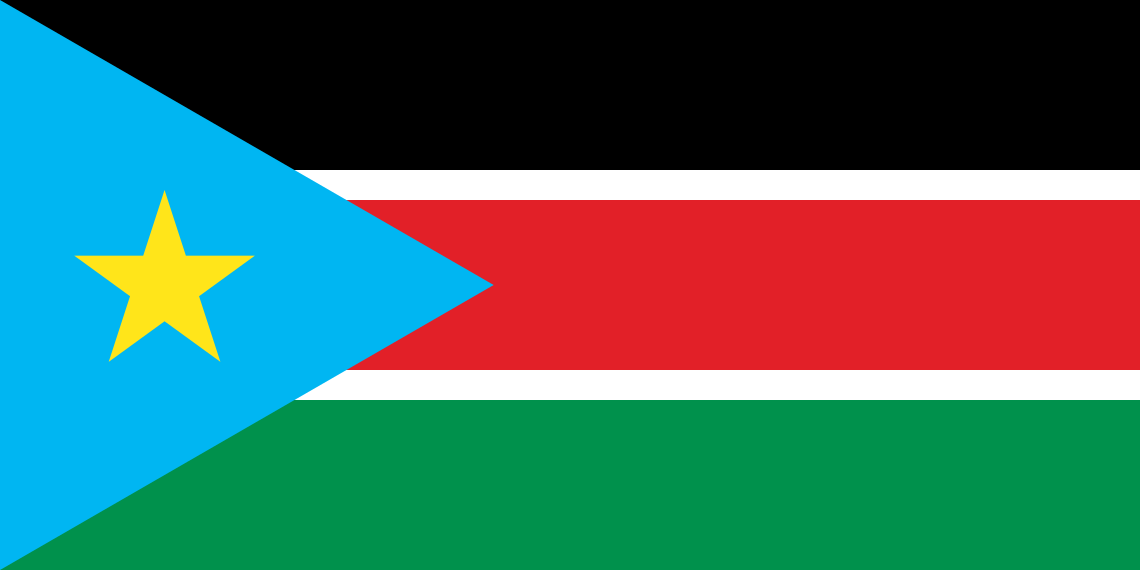
Allow me to congratulate you, Mr. President, on your assumption of the presidency of the Security Council for this month. At the same time, I would like to welcome today’s briefers, Ms. Martha Ama Akyaa Pobee. Assistant Secretary-General for Africa, and Ms. Hanna Serwaa Tetteh, Special Envoy of the Secretary-General for the
Horn of Africa. Their work is integral to the success of the mission and the maintenance of stability in South Sudan.
Today’s briefing comes at a time when the region is facing challenging security dynamics, particularly since the multinational force is not fully deployed and retreated to the areas where the Ethiopian forces were previously deployed north and south of Diffra. In our view, that has created more insecurity for the Ngok Dinka, as they are left exposed to random attacks from the Misseriya nomads in the Area.
Furthermore, the regrettable intercommunal clashes between the Twic Dinka and the Ngok Dinka has created a more challenging environment in which the United Nations Interim Security Force for Abyei must carry out its mandate, especially with regard to keeping the box a weapon-free zone. Nevertheless, through its investigating committee, under the leadership of His Excellency Vice-President Hussein Abdelbagi Akol Agany, my Government is working around the clock to address the root causes of the conflict in order to restore and foster intercommunal harmony between the two communities.
Despite the incomplete deployment of the multinational force, we call for the reconfiguration to allow for a rapid response to any security situation that may arise, taking into account the changing terrain dictated by the rainy season, in which some roads are completely cut off by either floods or mud, which renders the mobility of vehicles impossible. There is also the need for an early warning system to be put in place to complement the proposed rapid response, so as to defuse tensions and prevent clashes before they happen.
The question of development remains more crucial in the box, and the Security Council has adopted resolutions that call on the United Nations country teams in both South Sudan and the Sudan to join hands and effect some changes. We applaud them for their efforts. We are aware of both the arbitration in The Hague and its resolution, which calls for the Misseriya to be consulted in Muglad. Any development must therefore be carried out in the respective territories of the two countries.
Allow me to conclude by highlighting the renewed spirit of cooperation and engagement between the leadership of our two countries on the issue of the final status of Abyei. As all Council members may be
aware, the high-level delegation from South Sudan has been in Khartoum for the past few days with the sole mission of initiating discussions towards an agreed resolution of the status of Abyei. Encouraged by that new atmosphere of positive engagement between the two sisterly countries, my delegation would like to take this opportunity to call on the Security Council, the African Union and the wider international community to play their fundamental role in giving support and encouragement to the leadership of the two countries in order to maintain that spirit of engagement until they reach a mutually acceptable agreement on the final status of Abyei.
I now give the floor to the representative of the Sudan.


At the outset, I would like to congratulate you, Mr. President, and your friendly country on assuming the presidency of the Security Council for October. We pay tribute to your leadership and conduct of the work of the Council in a month when its agenda has been full of important items.
I thank Assistant Secretary-General Martha Ama Akyaa Pobee for her briefing on the implementation of the mandate of the United Nations Interim Security Force for Abyei (UNISFA), as well as the Special Envoy of the Secretary-General for the Horn of Africa, Ms. Hanna Serwaa Tetteh. We also take note of the report of the Secretary-General (S/2022/760).
As is well known, there are political and legal terms of reference that govern the current situation in Abyei, including the presence of UNISFA and, most important of all, the Agreement on Temporary Arrangements for the Administration and Security of the Abyei Area, of June 2011, and the cooperation agreements between the Sudan and South Sudan.
All those terms of reference require the implementation of many political, security and administrative arrangements and measures, including the formation of a joint administration, a joint legislative council and a joint police force for Abyei until the Sudan and South Sudan can reach an agreement on the final status of Abyei in a realistic and mutually acceptable way to address the situation there that is accepted and trusted by all social segments of the region in order to ensure a sustainable peace and social harmony. The Sudan has currently no other alternative but to commit to upholding those terms of reference by implementing
their provisions in letter and spirit, as they are supported by international legitimacy.
The Sudan has repeatedly declared that it is committed to establishing temporary administrative measures, including a police force and a legislative council. I would therefore like to emphasize the following three points.
First, the Government of the Sudan reaffirms once more its commitment and willingness to implement temporary administrative and security mechanisms, pursuant to the agreement signed by the two parties on 20 June 2011, and its commitment to the delineation of borders within the region without encroaching on other territories or undermining the current demographic nature of the region. The Sudan welcomes the sincere efforts of all actors, in particular of the African Union and others. However, we stress that a settlement on the issue of Abyei cannot be reached without an agreement between the two States that would be acceptable to the stakeholders and social constituencies.
Secondly, while the Sudan is committed to maintaining security and stability in Abyei, we are concerned about some incidents that have occurred in the region, such as those that led to the withdrawal and closure of a number positions pertaining to the Joint Border Verification and Monitoring Mechanism, in addition to tribal clashes and tensions between the Ngok and Twic communities. The Sudan calls for de-escalation and the reduction of tensions in the region by refraining from any act that could threaten stability and affect the work of the mission. We stress that Abyei must be free of any armed presence in the buffer zone north and south of the zero line, according to the agreements signed by the two countries.
Thirdly, UNISFA continues to play an important role in maintaining security and stability in Abyei until there is consensus on a final resolution of the outstanding issues. The Sudan will spare no effort to enable the mission to play its role pursuant to relevant Security Council resolutions. We welcome the Secretary-General’s recommendation to renew the mission’s mandate for one year until 15 November 2023.
In response to a number of queries raised in the Council, the Sudan wishes to note that it is committed to the following legal terms of reference on the current status of Abyei: the Abyei protocol annexed to the 2005 Comprehensive Peace Agreement; the Agreement on Temporary Arrangements for the Administrative and
Security Measures of the Abyei Area, which was signed by the Sudan and South Sudan on 20 June 2011; the bilateral dimension of resolving the problem peacefully pursuant to the agreement supported by resolution 1990 (2011) — therefore, to shift the resolution of the problem from that bilateral framework to a multilateral framework without the consent of the two sides would be unacceptable and would constitute a clear violation of the commitments and resolution 1990 (2011); and the fact that the nature of the United Nations mission in Abyei is temporary to allow it to carry out specific security tasks in accordance with paragraph 29 of the bilateral agreement of 20 June 2011, which cannot be amended without the consent of the relevant parties.
The Sudan calls for efforts to be focused on supporting and strengthening the joint mechanisms, including the Legislative Council, the current Joint Administration of Abyei and the police, while consolidating the communal administrations until the final status is peacefully established by the two countries.
The peaceful coexistence of the communities of the region must be consolidated, while addressing the humanitarian situation, providing services and implementing quick-impact projects.
The Sudan does not recognize the outcome of the unilateral referendum conducted in 2013 by certain elements to annex Abyei to South Sudan.
The communities of the region must be granted safety pursuant to paragraph 39 of Abyei Protocol of 2005. The determination of the final status will be based on a bilateral sovereign decision and until then the Abyei Area remains purely Sudanese, pursuant to the decision of the Permanent Court of Arbitration at The Hague, the Abyei Protocol of 2005 and the Comprehensive Peace Agreement. I hope that answers the question of the representative of Norway.
The following are my comments on the report of the Secretary-General.
The additional United Nations police units at a strength of 590 personnel, which increases the police force to 640 personnel, is considered an amendment to the mission’s mandate. Before the entry of those police units, the joint police force must first be formed. Although there are advantages, including the implementation of the Security Council mandate and a demonstration of good faith by the Sudan in cooperating
with the United Nations and helping the United Nations police units in peacekeeping operations and the protection of civilians within Abyei Area, as well as providing technical and logistical support to the joint police force upon its formation, there are obvious flaws in allowing the other party to evade the implementation of the agreement of 20 June 2011.
The presence of United Nations police units and a community police force belonging to South Sudan, without the presence of a Sudanese police force, is not an exemplary situation, because it will be difficult for the United Nations police force to work in the absence of one party and of executive and legislative governance institutions.
The formation of a joint police force will enable the Sudanese parties to enter the central and southern sectors of Abyei. If the entry of some United Nations police personnel is approved, the formation of local community police will be conducted under the supervision of the Ministry of the Interior. Therefore, we are of the view that the formation of the joint police force should precede the arrival of the United Nations police force due to the need for provision of technical and logistical support.
With regard to the question of the delayed appointment of a civilian Deputy Head of UNIFSA, as noted in paragraph 5 of the report of the Secretary- General, we believe that such an appointment would constitute a change in the mission. The Sudan is of the view that there is a need to maintain the status quo.
With regard to the question of operationalizing the Athony airstrip, as noted in paragraph 3 of the report of the Secretary-General, that was raised at the tripartite meeting of the Joint Political and Security Mechanism held in Khartoum in May and was referred for discussion by the presidential summit of both countries so that a presidential decision may be taken on the matter. We stress the continued willingness of the Sudanese side to attend joint meetings on Abyei, which demonstrates the commitment of the Sudan to the agreements concluded.
With regard to the activity of the Joint Border Verification and Monitoring Mechanism in Sector 1 in Gok Machar, as noted in paragraph 4 of his report, the Secretary-General calls on South Sudan to raise awareness among local authorities and reopen the monitoring sector. That issue requires exerting more pressure on the State of South Sudan to respond, because it is hindering the activities of the Joint Border
Verification and Monitoring Mechanism. Any delay in the establishment and formation of Abyei’s joint police service and rule-of-law institutions within the Abyei Area is always attributed to the Government of South Sudan. For its part, the Sudan is fully prepared to establish such a police service in Abyei.
Paragraph 7 of the Secretary-General’s report mentions the presence of Sudanese armed forces personnel inside the Abyei Area. We would like to stress that that is not true, and that Sudan’s armed forces have not been present in that location since their withdrawal in 2012.
Paragraph 17 of the report of the Secretary-General notes freedom of movement violations against UNISFA and mentions that the Sudanese armed forces denied access to a water point to a UNISFA water truck in Tishwin. However, it is well-known that the Sudanese authorities grant that service free of charge in support of UNISFA. We provide the mission with two water trucks per week, upon request.
Finally, in the meeting between the two parties on 24 October, namely, Lieutenant General Mohamed Hamdan Dagalo, Deputy Chair of the Sovereign Council, and Mr. Tut Gatluak, Adviser to the President of South Sudan, both sides agreed to hold joint cooperation mechanisms on Abyei on a quarterly basis, or whenever is necessary, to present proposals to the leadership of both countries in order to reach a solution on Abyei’s final status.
The two parties also agreed on mutual cooperation in order to create a healthy and appropriate environment
for the communities in both the Sudan and South Sudan, with the aim of activating the bilateral cooperation mechanisms between the two States and supporting security, development and stability in the Abyei region, for the benefit of the local communities and the two countries. They also stressed the importance of committing to a peaceful, negotiated and mutually agreed solution on Abyei’s final status.
I reiterate the Government of the Sudan’s commitment to strengthening cooperation with the Government of brotherly South Sudan, with a view to enhancing the work of the Joint Political and Security Mechanism and the Abyei Joint Oversight Committee. We are eager to establish joint mechanisms between the two countries, based on the terms of the agreements signed between both sides, in order to achieve a solution on Abyei’s final status in accordance with the agreed terms of reference. From this United Nations organ, we call on the regional and international communities to support the two parties in their efforts to achieve security, stability and development, as well as to reach an agreed solution on Abyei’s final status. I also thank the United States for providing financial support to both parties to improve conditions for local communities in Abyei.
There are no more names inscribed on the list of speakers.
I now invite the Council members to informal consultations to continue our discussion on the subject.
The meeting rose at 12.25 p.m.