S/PV.9467 Security Council
Provisional
The meeting was called to order at 10.05 a.m.
Adoption of the agenda
The agenda was adopted.
Reports of the Secretary-General on the Sudan and South Sudan Report of the Secretary-General on the situation in Abyei (S/2023/777)

In accordance with rule 37 of the Council’s provisional rules of procedure, I invite the representatives of the Sudan and South Sudan to participate in this meeting.
In accordance with rule 39 of the Council’s provisional rules of procedure, I invite the following briefers to participate in this meeting: Mr. Jean-Pierre Lacroix, Under-Secretary-General for Peace Operations; and Ms. Hanna Serwaa Tetteh, Special Envoy of the Secretary-General for the Horn of Africa.
The Security Council will now begin its consideration of the item on its agenda.
I wish to draw the attention of Council members to document S/2023/777, which contains the report of the Secretary-General on the situation in Abyei.
I now give the floor to Mr. Lacroix
Mr. Lacroix: I thank you, Mr. President, for this opportunity to brief the Security Council on the United Nations Interim Security Force for Abyei (UNISFA), including the mission’s support to the Joint Border Verification and Monitoring Mechanism (JBVMM). I will take the opportunity to update members on the latest political, security and humanitarian developments, including the impact of the ongoing fighting in the Sudan.
The outbreak of armed conflict in the Sudan in April interrupted the encouraging signs of dialogue between the Sudan and South Sudan witnessed earlier in 2023. It effectively put on hold the political process with regard to the final status of Abyei and border issues. The United Nations, in close coordination with the African Union, remains ready to support a resumption of dialogue and is monitoring the situation for the conditions that might allow for that. Special Envoy Hanna Tetteh will provide the Council with a further update on developments related to the political process with regard to the Sudan and South Sudan and other regional issues.
In Abyei, the Sudan crisis has resulted in an influx of displaced people. At the Amiet market, our humanitarian partners have recorded over 9,000 people who have sought refuge from the fighting. The mission has already seen increased weapons circulation in Abyei, a situation that may have been exacerbated by the situation in the Sudan. The conflict has also created economic hardship for the population of Abyei as the flow of basic goods and commodities, many of which came from the north, has been disrupted. UNISFA, too, has had to adjust its deployment routes and supply arrangements in line with the new reality.
Fighting in South Kordofan and the area of operations of the Joint Border Verification and Monitoring Mechanism has created challenges for UNISFA, including restrictions on air movements that have hampered efforts to ensure safe resupply and the continued implementation of the Mechanism’s mandate. We are deeply grateful for the commitment of the troop-contributing countries that make the JBVMM’s continued presence possible under difficult circumstances. The JBVMM has faced serious challenges in Kadugli, the Sudan, due to the ongoing crisis and continues to lack a presence in its Sector 1 headquarters in Gok Machar, South Sudan, and associated areas after its forced withdrawal in 2021. We remain in contact with the Government of South Sudan on that issue and have called for its cooperation to re-establish the JBVMM’s presence there.
While aerial patrolling has been halted due to airspace restrictions, JBVMM personnel remain in place and ground monitoring in the border area continues. Amidst the regional insecurity, supporting constructive relations between the two countries with regard to their shared border remains an important priority for UNISFA.
The targeting of UNISFA personnel remains of great concern. Over the past six months, there were three occasions where peacekeepers were attacked and injured. Thankfully, those colleagues are now in stable condition. I extend my gratitude and support to them and to their families and respective Governments. The safety of our peacekeepers is a top priority, and investigations into the attacks are ongoing.
The mission has worked to facilitate humanitarian assistance to an estimated 220,000 vulnerable people in the central and southern parts of Abyei, including those displaced in intercommunal clashes and those fleeing
the fighting in the Sudan. While humanitarian partners work to provide support to those in need, efforts are also being made to increase the humanitarian presence in northern Abyei, where the Sudan crisis has created significant challenges for the deployment of staff and supplies.
During the reporting period, intercommunal relations in Abyei remained tense. While violence between the Ngok Dinka and Misseriya communities was somewhat reduced, with UNISFA’s mediation support through specific initiatives such as the transhumance corridors conference held in Noong in central Abyei in June, continued efforts are required to address ongoing tensions and promote reconciliation, At the same time, the dispute over land in the southern part of Abyei that flared into violence between the Ngok Dinka and Twic Dinka in February 2022 remains a serious concern. While there was a welcome lull during the first part of the reporting period, new clashes have been reported on both sides of Abyei’s southern boundary as the rainy season has receded. UNISFA remains alert, responding to early warning provided by the community and working in close coordination with the United Nations Mission in South Sudan (UNMISS) to protect civilians. UNISFA and UNMISS have jointly also provided support to reconciliation talks between the Ngok Dinka and Twic Dinka communities, such as those held in Wau, South Sudan, in August, and we welcome the mediation efforts of the Government of South Sudan.
The mission is working to promote the rule of law in Abyei, including through United Nations police (UNPOL) support to the community protection committees and the joint protection committees, in the absence of the Abyei police service, as foreseen in the 2011 agreement. The mission continues to face challenges in that regard, including the non-deployment of additional individual police officers and three formed police units mandated by the Security Council. Those assets would be very valuable to strengthening the rule of law in Abyei, particularly amid the influx of people displaced by the crisis in the Sudan. UNISFA continues to engage the relevant authorities in that regard.
UNISFA continues to prioritize gender in its work, including by increasing the recruitment and retention of female staff and promoting the participation of women in local conflict-management structures. In June, the mission launched the UNPOL Women Network as a forum to share experiences, raise awareness about
gender mainstreaming in peace operations and promote the implementation of the women and peace and security mandate. However, the number of women in troop contingents remains low, at only 7 per cent, and we call for the support of the troop- and police-contributing countries in working with UNISFA to prioritize the deployment of women.
The crisis in the Sudan has delayed the completion of UNISFA’s reconfiguration from a single troop- contributing country mission to a United Nations multinational peacekeeping force, as the deployment of personnel and equipment was disrupted and shifted to the longer southern route. However, we expect the remainder of troops and contingent-owned equipment to have arrived and the mission to have reached its full operational capacity by the first quarter of 2024. In the meantime, peacekeepers in UNISFA, with equipment supplemented where necessary by United Nations- owned equipment, have been capably implementing the mission’s mandate.
A continuing challenge for the mission is the presence in southern Abyei of approximately 200 South Sudan People’s Defence Forces and South Sudan National Police Service personnel, and an estimated 60 Sudanese oil police in northern Abyei. Those presences, which are in contradiction to the mission’s mandate and Abyei’s demilitarized and weapon-free status, have also resulted in restrictions on UNISFA’s freedom of movement. We continue to call on the relevant authorities for their withdrawal.
Finally, during the reporting period, the United Nations country teams in the Sudan and South Sudan, with UNISFA, continued the implementation of the Abyei-United Nations joint programme, aimed at creating an environment conducive to peaceful coexistence. The Sudan crisis has created delays in joint programme implementation, particularly with respect to the deployment of staff and supplies. Despite that, UNISFA and the two country teams have been able to provide services to the population where possible and will continue, as the joint programme remains important in helping to create the conditions necessary for peace in Abyei.
In conclusion, I want to thank the Acting Head of Mission and Force Commander Major General Benjamin Olufemi Sawyerr and all the personnel of UNISFA and the two country teams for their tireless efforts in support of peace and security in Abyei,
particularly in these challenging times. I am grateful to the troop- and police-contributing countries for their continuing close collaboration on the force’s reconfiguration and in support of UNISFA’s mandate, despite the challenging environment. I also want to thank the members of the Security Council for their continued support to UNISFA.
I thank Mr. Lacroix for his briefing.
I now give the floor to Ms. Tetteh.
Ms. Tetteh: I thank members for the opportunity to brief the Security Council on the progress in implementing resolution 2046 (2012), which relates to the outstanding bilateral issues between the Sudan and South Sudan and the situation in the South Kordofan and Blue Nile states. I am also very grateful to my colleague Under-Secretary-General Lacroix for the critical issues highlighted in his briefing.
The unprecedented conflict that erupted in the Sudan on 15 April between the Sudanese Armed Forces and the Rapid Support Forces (RSF) is now entering its seventh month, with significant humanitarian, security, economic and political consequences that are a matter of deep concern for the South Sudanese political leadership. Indeed, in addition to the thousands of Sudanese fleeing the conflict, more than 353,000 registered returnees and refugees from the Sudan have crossed into South Sudan, in a country where two thirds of the population is already in need of humanitarian assistance. With the military developments in the Sudan, and most recently the RSF seizure of the Belila airport and Belila’s oilfield, the military confrontation between the Sudanese Armed Forces and the RSF is getting closer to the boundary with Abyei and the border with South Sudan. Given the proximity of a number of Misseriya groups to the RSF and the recruitment campaigns by warring parties, those military developments could have adverse consequences for Abyei’s social fabric and the already fragile coexistence between the Misseriya and Ngok Dinka.
On the political front, given the risks posed by the Sudanese conflict for South Sudan, the Government of South Sudan continues to engage with regional leaders and the warring parties to support efforts to de-escalate the conflict, secure a ceasefire and promote dialogue. On 4 September, General Abdel Fattah Al-Burhan, the Chairperson of the Sudan’s Transitional Sovereign Council, visited Juba and discussed efforts to resolve
the conflict. Other Sudanese stakeholders, notably Malik Agar, the Deputy Chairperson of the Transitional Sovereign Council, and RSF leaders, have also met with the South Sudanese leadership in Juba as part of the South Sudanese mediation efforts. President Salva Kiir Mayardit, who has also been actively engaging with the Egyptian authorities on a political solution to the Sudanese conflict, offered to mediate between the RSF and the Sudanese Armed Forces and proposed face-to-face talks in Juba, but that did not materialize. Meanwhile, South Sudan continues to publicly exercise neutrality amid concerns over the security of the oil installations and pipeline used to export South Sudanese oil through Port Sudan.
As a guarantor of the Juba Peace Agreement, South Sudan also remains concerned about the agreement’s relevance. In that regard, the Government of South Sudan held a consultative meeting with the parties to the Peace Agreement on 24 and 25 October to evaluate its implementation and consult with the parties on peace negotiations between the RSF and the Sudanese Armed Forces. The RSF was invited but did not participate in the consultations. The participants called for an immediate cessation of hostilities in the Sudan and urged the warring parties to resolve the crisis peacefully. On 29 October, a group of signatories to the Juba Peace Agreement issued a follow-up statement, condemning RSF abuses and underscoring the Sudanese Armed Forces’ legitimate defence of the country. However, the Justice and Equality Movement and the Sudan Liberation Army Faction subsequently distanced themselves from that statement. The Presidential Adviser on Security Affairs, Tut Gatluak, stated that President Kiir had directed all relevant institutions to prepare the ground for possible peace talks between the RSF and the Sudanese Armed Forces.
With the conflict in the Sudan, the conditions are not conducive to talks on the final status of Abyei. And indeed, as Under-Secretary-General Lacroix mentioned, the progress that had been made was unfortunately not something that we could build on. Key Sudanese and South Sudanese leaders have not expressed a desire to engage on these topics. And with its military offensive in West Kordofan, the RSF is getting closer to Abyei and controlling parts of the border with South Sudan. Previously, General Hemedti was indeed the head of the Sudan’s Abyei Committee and was engaging with the United Nations and his South Sudanese counterparts on the status of Abyei. Nevertheless, representatives of the
Abyei communities, very much aware of the adverse consequences of the Sudanese conflict for the prospects for resuming talks on Abyei, expressed the importance of maintaining the Abyei issue on the agendas of the United Nations and the African Union (AU), and specifically their respective Security Councils.
The South Sudanese Abyei High-Level Committee, led by Minister Deng Alor Kuol, met with me in Addis Ababa on 4 October, together with members of the South Sudan Abyei committee, and proposed that Abyei’s final status could be part of a broader framework of political negotiations addressing the Sudanese conflict. The Committee also reiterated its commitment to implementing the African Union High-level Implementation Panel’s proposal on the final status of Abyei. However, as the AU High-Level Implementation Panel’s proposal has not been accepted by the Sudanese authorities or endorsed by the AU Peace and Security Council, any progress on the final status of Abyei would require, as I impressed on the Committee’s members, a decision of the AU Peace and Security Council that would provide clarity as to whether the AU High-Level Implementation Panel’s recommendations have indeed been adopted by the African Union.
In addition to the uncertainties of Abyei’s final status, the people of Abyei are concerned about the deteriorating security situation following the continued violence and the cycle of retaliatory attacks between the Twic Dinka and the Ngok Dinka over land ownership and income-generating hubs in Anet, Agok and Athony. The violence displaced some members of the Ngok population from their villages located along the boundary with Warrap and has led to the destruction of property and livelihoods and losses of life on both sides. There are indications that the tensions may persist, as grievances of both communities over those areas remain unresolved. Meanwhile, the South Sudanese co-Chair of the Abyei Joint Oversight Committee has expressed disappointment that the resolutions reached by President Kiir during his visit to Warrap in March this year were not adhered to by the communities. In that regard, I will continue my engagement with representatives from Abyei and the Government of South Sudan to advocate against violence and hate speech, while encouraging community-based reconciliation.
On the humanitarian front, the Sudanese conflict, coupled with intercommunal violence between the Ngok and the Twic, has already compounded Abyei’s difficult humanitarian situation. The influx of displaced
persons, who continue to arrive daily, has overwhelmed host communities, stretching already limited food supplies and hiking market prices in Abyei. Clashes between the Twic and Ngok have hampered farming activities in southern Abyei, which will have further implications for the humanitarian situation.
If I may now turn to the two areas of South Kordofan and Blue Nile, the conflict between the Sudanese Armed Forces and the RSF has aggravated an already tense security situation and dire humanitarian conditions in those two territories. It has also reignited a conflict between the Sudanese Armed Forces and the Sudan People’s Liberation Movement (SPLM)-North, led by Abdelaziz Al-Hilu, which had been frozen for the past few years. In addition, South Kordofan and Blue Nile have also been a theatre for clashes between the SPLM-North and the RSF. The SPLM-North took over several Sudanese Armed Forces bases in South Kordofan, notably in the area south-east of Kadugli, in June and July, while in Blue Nile it took control of several villages in the Al-Kurmuk locality. The Sudanese Armed Forces reacted to the SPLM-North’s military offensive with air strikes on its positions in the Dilling and Kadugli localities. The armed movement claimed that those military operations were necessary to protect the civilian population from the insecurity caused by the conflict between the Sudanese Armed Forces and the RSF.
In an attempt to close the opening of a second front in addition to the conflict with the RSF, General Al-Burhan has sought President Kiir’s mediation to stop the fighting. To the best of our knowledge that has not yet produced a favourable outcome. In the meantime, the security situation in South Kordofan and Blue Nile continues to deteriorate because of the clashes between the Sudanese Armed Forces and the RSF in those two territories. The conflict in those two areas cannot be addressed without negotiations on their final status. That requires a permanent ceasefire and a political process to end the conflict between the Sudanese Armed Forces and the RSF. Yet given the multiplicity of conflicts in the Sudan, we believe that the international community should pursue a comprehensive political strategy dealing simultaneously with the conflict in the Sudan, South Kordofan and Blue Nile, and paving the way for talks on Abyei’s final status.
My Office will continue to engage with the authorities of both countries and the relevant Sudanese and South Sudanese stakeholders, in addition to the
African Union and the Intergovernmental Authority on Development, to advocate for a comprehensive process that leaves no conflict unaddressed and is in line with resolution 2046 (2012), giving due attention to Abyei, South Kordofan and Blue Nile.
I thank Ms. Tetteh for her briefing.
I shall now give the floor to those members of the Council who wish to make statements.


I thank Under-Secretary-General Lacroix and Special Envoy Tetteh for sharing the progress of the United Nations Interim Security Force for Abyei (UNISFA) on its mandate implementation and their updates on Abyei. The United States deeply appreciates UNISFA’s tireless efforts to implement its mandated tasks to protect civilians and facilitate the delivery of humanitarian aid throughout its troop reconfiguration and in the face of unprecedented challenges.
I would like to start by emphasizing the United States’ concern about the continued presence of South Sudanese and Sudanese armed groups in Abyei. Those forces represent a destabilizing factor for civilians in Abyei and threaten Abyei’s demilitarized status. UNISFA peacekeepers are the only force that should operate in Abyei. We call on all armed groups to depart the region, and we urge the Governments of the Sudan and South Sudan to instruct their forces to evacuate Abyei.
Peacekeepers’ safety and security is of the utmost importance. We are concerned about the fact that UNISFA peacekeepers were attacked in two separate incidents in August. On 10 August, a UNISFA helicopter carrying troops was fired on by elements suspected of belonging to the Sudan People’s Liberation Movement- North faction led by Abdelaziz Al-Hilu. On 28 August, three peacekeepers returning from a patrol were injured in an attack by armed Twic Dinka. We condemn those attacks and call for the appropriate authorities to investigate them and hold the perpetrators accountable.
In addition to attacks on peacekeepers, UNISFA and the Joint Border Verification and Monitoring Mechanism (JBVMM) continue to be the subject of misinformation campaigns. For the past two years the re-establishment of the JBVMM in Gok Machar has yet to come to fruition due to false reports that the JBVMM will declare the final border status. UNISFA
is mandated to support the JBVMM, and the Security Council has repeatedly urged the Governments of the Sudan and South Sudan to support UNISFA, including by facilitating the smooth operation of all JBVMM team sites. We strongly encourage the Government of South Sudan to engage the local community and provide it with accurate information on the JBVMM’s agreed role, enabling it to re-establish its headquarters and team sites. Similarly, we urge the parties to the conflict in the Sudan to ensure a safe environment for all JBVMM and UNISFA personnel by providing safe passage to UNISFA and the JBVMM, facilitating full and safe resupply and ensuring freedom of movement for the JBVMM in Kadugli and the two team sites.
On a positive note, we were pleased to learn that the violence between the Ngok Dinka and the Twic Dinka has declined over the reporting period. Efforts to foster peace should continue. We strongly urge the Government of South Sudan, with support from UNSIFA, to promote improved relations between the two communities and foster a cohesive environment in which the people of Abyei can live in peace and security.
Lastly, if the Sudan and South Sudan wish to see true stability and peace within the disputed border area, they need to act with resolve to grant access to the Athony airfield, establish the Abyei police service and facilitate the deployment of three formed police units.
We reiterate our commitment to working with the Governments of the Sudan and South Sudan and the peoples of the region, our fellow Council members, the African Union and other international and regional partners to promote peace, security and prosperity in the region.


I thank Mr. Lacroix and Ms. Tetteh for their briefings and welcome the presence of the representatives of the Sudan and South Sudan at this morning’s meeting. For my part, I will emphasize four points.
First of all, the action of the United Nations Interim Security Force for Abyei (UNISFA) is essential to protecting civilians and preserving the conditions for a settlement of the conflict. We welcome all efforts to ease tensions between local communities, including those facilitated by South Sudan. We call on the Sudan and South Sudan to respect the demilitarization of Abyei.
Secondly, the protracted conflict in the Sudan is having an increasing impact on Abyei and UNISFA. As has been pointed out, the conflict has now frozen the political dialogue between the two countries that had been resumed. It has led to an influx of refugees. It has complicated the rotation of peacekeeping personnel and equipment and is hindering support for the Joint Border Verification and Monitoring Mechanism. In that context, there is an urgent need to put an end to the fighting and deliver humanitarian aid to the Sudan. We condemn large-scale acts of violence against civilians, including those committed in Darfur on a basis of ethnicity. We call for an end to the ongoing escalation in Al-Fashir and North Darfur. Humanitarian access must be guaranteed.
To overcome the deadlock, all parties must seize the opportunity presented by the resumption of the Jeddah talks, which now involve the Intergovernmental Authority on Development and the African Union in the efforts undertaken by Saudi Arabia and the United States. Following that, the time will come for political negotiations to resolve the crisis. We will follow the situation closely to ensure that the Sudanese people and their democratic aspirations are not left behind.
Finally, we reiterate our support to Special Envoy Hanna Tetteh. The United Nations has a major role to play in supporting peace efforts in the Horn of Africa. We encourage States in the region to maintain their neutrality with regard to the conflict in the Sudan, which is essential, in order to promote a political resolution of the conflict and prevent it from spreading into the region.
One year after the conclusion of the Pretoria agreement, we call on the countries in the region to resolve their differences through dialogue and to respect the principle of territorial integrity, so that their populations can benefit from the dividends of peace. We also welcome the resumption of the dialogue on the Grand Ethiopian Renaissance Dam.


I thank Under-Secretary- General Lacroix and Special Envoy Tetteh for their informative briefings. I welcome the presence of the representatives of the Sudan and South Sudan at this meeting.
We appreciate the near completion of the reconfiguration of the United Nations Interim Security Force for Abyei (UNISFA) to a multinational United
Nations force. Its work is essential in promoting security and the protection of civilians in the Abyei Area.
Allow me to focus on three key concerns.
First, as highlighted in the Secretary-General’s report (S/2023/777), the conflict in the Sudan has impeded any political progress in resolving the final status of Abyei. That is regrettable since the Sudan and South Sudan had achieved momentum, and dialogue was on the right path. UNISFA has made significant gains in promoting the rule of law in the absence of the Abyei police service, however, the ultimate responsibility lies with the Sudan and South Sudan. The African Union, the Intergovernmental Authority on Development and the United Nations should continue engagement and monitoring efforts with the aim of resuming political talks.
We commend UNISFA for enhancing its early warning systems to bolster responses. It is imperative that all social cohesion and peacebuilding efforts ensure the full, equal and meaningful involvement of women, youth and civil society.
Secondly, the fragile security situation is concerning, with intercommunal violence persisting and leading to attacks against United Nations personnel. We strongly condemn the attacks and call for full investigations. The presence of UNISFA in Abyei plays an important role in preventing further escalations of violence. However, the fighting in South Kordofan has created restrictions for the Joint Border Verification and Monitoring Mechanism and hampered UNISFA’s freedom of movement. We urge all parties to respect the status-of-forces agreement and allow the mission to safely execute its mandate. The Sudan and South Sudan should also respect the 2011 agreement and withdraw their military and police troops from the demilitarized zone.
The engagement demonstrated at the transhumance corridors conference is positive and efforts to strengthen peaceful coexistence between communities should continue.
Thirdly, the protection of civilians must remain a priority. UNISFA has facilitated critical humanitarian assistance to almost a quarter million vulnerable and displaced individuals. The conflict in the Sudan has placed further strains on the humanitarian situation with over 9,000 refugees. We stress the necessity of continued humanitarian assistance for those in need.
As this meeting marks Albania’s last address on the issue of Abyei in the Security Council, we seize the moment to express regret for the stalled progress in advancing the political process and achieving a mutually acceptable permanent solution for the Abyei Area. While the conflict in the Sudan has complicated matters and impeded progress, that should not hinder the aspirations of the Abyei people for a peaceful settlement.
We look forward to engaging with the Council to renew the mandate of UNISFA for one year.


I would like to join my colleagues in thanking Under- Secretary-General Lacroix and Special Envoy Tetteh for their briefings. I also welcome the presence of the representatives of the Sudan and South Sudan at this meeting.
As the Secretary-General points out in his report (S/2023/777), and as we have just heard today, the conflict in the Sudan is having a worrisome impact on the situation in Abyei. It has put an end to the constructive momentum towards a resolution of the disputes related to the region that prevailed at the beginning of the year and is worsening an already critical humanitarian and security situation. Added to that are the clashes between the Twic Dinka and Ngok Dinka on both sides of the southern border, which have escalated again in recent weeks. All that is affecting the implementation of the mandate of the United Nations Interim Security Force for Abyei (UNISFA).
Given the risk of increased instability, I would like to emphasize three points.
First, more needs to be done to protect the population from armed incidents and to mitigate the impact of the arrival of those fleeing the conflict in the Sudan and displacement resulting from intercommunal tensions. In that respect, we congratulate the Misseriya and Ngok Dinka on the transhumance corridor conference in Noong and encourage them to continue that positive momentum. In the absence of the Abyei police service, the community protection committees and the joint protection committees are essential for the promotion of the rule of law and maintaining an early warning system. We welcome the support provided by UNISFA in that regard and reiterate our call to the Sudanese authorities to facilitate the full deployment of the mandated police capacity. Moreover, the presence of security forces from both countries and the proliferation of weapons continue to worry us. Abyei must remain a demilitarized zone, as requested by the Council.
Secondly, promoting an inclusive peace is fundamental in the current circumstances. It is therefore important to continue to invest in a climate of trust and to strengthen an inclusive community commitment. We welcome the active role played by women, whether through consultative forums, joint peace committees in the Amiet region or as human rights defenders. Similarly, the increased involvement of youth networks in the dissemination of early warnings demonstrates their key potential as agents of peace.
We fully support the efforts of the United Nations country teams in the Sudan and South Sudan to operationalize the joint Abyei programme, despite the difficulties encountered, in particular in northern Abyei. That is all the more important as economic activities and the supply of goods from the north are disrupted. In addition, we call on all parties to respect their obligations under international humanitarian law, including allowing and facilitating the rapid and unhindered passage of humanitarian relief supplies.
Thirdly, UNISFA plays an essential role for peace and security in Abyei. We welcome its key commitment to the protection of civilians and the operational flexibility it demonstrates in response to changing circumstances on the ground. We look forward to greater acceptance of the force thanks to the multinational contingent. Owing to the conflict, its reconfiguration has been delayed. Only with full operational capability would UNISFA be sufficiently mobile, agile and responsive in this difficult context. In that respect, we call on the Sudan and South Sudan to continue to respect the status-of-forces agreement. That includes ensuring that UNISFA and the Joint Border Verification and Monitoring Mechanism can continue to move freely and operate in safe and secure conditions.
In view of the increasingly difficult conditions, we reiterate our full support for the work of UNISFA, the Special Envoy, the African Union and the Intergovernmental Authority on Development. Switzerland remains committed to working with all stakeholders to achieve peace and prosperity in Abyei.


I thank Under- Secretary-General Lacroix and Special Envoy Tetteh for their briefings. I welcome the participation of the representatives of the Sudan and South Sudan in our meeting today.
Let me start by commending the newly reconfigured multinational force of the United Nations Interim
Security Force for Abyei (UNISFA) for its substantial contribution to maintaining peace and security in Abyei.
The United Kingdom welcomes the mediation efforts of the Government of South Sudan to address tensions between the Ngok Dinka and Twic Dinka, while noting that the security situation in Abyei remains tense. Violent intercommunal clashes continue to threaten the lives and safety of civilians and peacekeepers.
We are concerned about the continued positioning of the South Sudanese People’s Defence Forces in southern Abyei. We call upon the Government of South Sudan to immediately withdraw its troops, in line with its commitments under the 2011 status-of- forces agreement.
As we have heard, the fragile security situation in Abyei is further threatened by the wholly unjustified and brutal conflict being waged by the Sudanese Armed Forces and the Rapid Support Forces in the Sudan. More than 9,000 displaced civilians have entered Abyei since hostilities began, posing further challenges to the already dire humanitarian situation and complex communal tensions.
The effective closure of Sudanese airspace has made aerial patrolling impossible. It is crucial that the Joint Border Verification and Monitoring Mechanism (JBVMM) is able to maintain a range of operations in order to deliver on its mandate in full.
We call on the warring parties and armed groups in the Sudan to urgently facilitate safe supply routes for the JBVMM headquarters and ensure the safe passage and freedom of movement for all United Nations staff.
Progress towards ending the political gridlock on the future status of Abyei can be made only if all sides in the Sudan cease hostilities and return to the negotiating table in good faith. In the meantime, we urge both the Government of South Sudan and the Sudanese authorities to ensure that UNISFA can implement its mandate, in line with their primary responsibility as host States and the status-of-forces agreements.


I have the honour to deliver this statement on behalf of the three African members of the Security Council (A3).
We thank Under-Secretary-General Jean-Pierre Lacroix and Special Envoy Hanna Tetteh for their important and insightful updates on the situation in Abyei and the activities of the United Nations Interim
Security Force for Abyei (UNISFA) and the Joint Border Verification and Monitoring Mechanism. We welcome the participation of the representatives of the sisterly countries of the Sudan and South Sudan in this meeting.
The unresolved status of the region of Abyei continues to be a matter of great concern to the A3. As long as the status quo remains, the people of Abyei are unlikely to receive the level of assistance they need to thrive and prosper, as any other people in the world.
We regret the fact that no progress was made in the Abyei political process, mainly due to the conflict in the Sudan. Mindful of that, we reiterate our call on the warring parties in the Sudan to cease hostilities and embrace dialogue and diplomacy so as to allow for peacebuilding and reconciliation in the country. Resuming dialogue in the Sudan is a sure path for the resumption of the political process in Abyei and, thus, a facilitator for the stabilization of the region.
The A3 emphasizes the central role of the African Union and the Intergovernmental Authority on Development in supporting both countries towards a comprehensive agreement on the final status of Abyei. It is our view that the leadership of the region is crucial for a sustainable solution to the situation in Abyei, taking into account the history, culture and shared values of the inhabitants of Abyei and its surrounding areas.
Intercommunal clashes continue to be a significant source of insecurity in Abyei. While welcoming the reduction in intercommunal violence during the reporting period, we note that clashes between communities have continued to occur, despite all the efforts on the ground. The proliferation of weapons, particularly at the community level, seems to be increasing the rate of fatalities from such clashes.
The A3 regrets the loss of lives as a result of these conflicts and underlines the importance of the implementation of a comprehensive arms control programme that can help combat the illicit flow of weapons and prevent them from falling into civilian hands. In implementing these programmes, we urge a holistic approach in order to address the root causes of the proliferation of weapons in the region.
We are also concerned about the continued attacks on civilians and UNISFA peacekeepers. The A3 firmly condemns those attacks and echoes the call of the Secretary-General, to the relevant authorities, to promptly investigate those attacks and
hold those responsible to account. Attacks on civilians are unacceptable and constitute a gross violation of international humanitarian law and international human rights.
The A3 also wishes to express concern about the presence of some forces in the areas of operation of UNISFA. We are concerned about that development in view of the fact that their presence limits the freedom of movement of UNISFA to discharge its mandate. In that connection, we call on the concerned parties to withdraw their forces in order to maintain the demilitarized and weapons-free status of Abyei, in line with the 2011 agreement on temporary arrangements for the administration and security of the Abyei Area.
On a positive note, we welcome the continued efforts of the Government of South Sudan to halt violence in Abyei and Warrap state by promoting the implementation of the agreement of the Wau conference.
We also welcome the progress in strengthening the early-warning system for conflict prevention at the local level. The operationalization of that mechanism is a step forward in improving UNISFA’s conflict prevention and preparedness capacity, which can contribute to reducing fatalities. In that endeavour, we encourage UNISFA to continue its approach of inclusivity and strengthen its engagement with community protection committees, youth and women, among other groups, to enhance information gathering and early response.
In the spirit of African solidarity and as a great gesture of humanity, South Sudan has unconditionally opened its borders to allow the inflow of South Sudanese returnees and refugees from the Sudan, but that also has consequences for the humanitarian situation in Abyei, among other regions.
Against that backdrop, we remain concerned about the systematic decrease in financing humanitarian assistance, especially prospects of resource mobilization for humanitarian assistance in 2023 and 2024. Regrettably, the financing challenges are occurring while the drivers of vulnerability are multiplying, placing the most vulnerable people in an unbearable condition.
In that regard, we reiterate our call on the donor community to step up its financial support for humanitarian assistance in Abyei, mindful of the nexus between humanitarian assistance, development and peace. It is important that we redouble our efforts to alleviate the suffering of people who have already endured multiple and successive crises over the years.
In conclusion, the A3 wishes to reiterate its unwavering support for the political process in Abyei, with a view to the definition of the final status of the region.


I thank Under-Secretary- General Lacroix and Special Envoy Tetteh for their insightful briefings. Japan appreciates the recent Secretary-General report (S/2023/777) on the United Nations Interim Security Force for Abyei (UNISFA), which elaborates both progress and challenges in Abyei and highlights the continued relevance of the mission’s mandate.
Mindful of the observations made in the Secretary- General’s report and by both briefers, I would like to make the following three points related to UNISFA’s mandate.
First, Japan reiterates its strong concern about the many negative impacts of the ongoing fighting in the Sudan on the situation in Abyei. Political progress towards a resolution of the final status of Abyei and border issues is blocked. The difficulties on the implementation of UNISFA’s mandate are compounded by the influx of returnees and refugees to Abyei, hindering the rotation of the peacekeepers and complicating logistics. In the light of this, we continue to closely follow the situation in the Sudan, and we once again call upon the parties to enact an immediate and permanent ceasefire and pursue a peaceful political process.
Secondly, we are pleased to see a reduction in violence during the reporting period as a result of the continued efforts of the Government of South Sudan to address the conflict between the Ngok Dinka and Twic Dinka communities in southern Abyei and Warrap state, South Sudan. We re-emphasize that such efforts are needed to break the cycle of violence and build lasting peace and security. We also call upon the Misseriya and Ngok Dinka communities to build upon that positive engagement and work towards peaceful cohabitation.
Thirdly, we are concerned about the continued presence of South Sudanese and Sudanese security forces in Abyei, which constitutes a violation of the Area’s demilitarized status. We call upon the authorities of both the Sudan and South Sudan to address that issue without delay. In addition, we call on both Governments to attend to UNISFA’s outstanding operational issues, such as the freedom of movement of all Joint Border Verification and Monitoring Mechanism and UNISFA
personnel, as well as all United Nations national staff. The deployment of the three formed police units and individual police officers is also important.
To conclude, Japan would like to thank all UNISFA personnel for their service in protecting civilians and mitigating violence in a challenging environment, and we reiterate our full support for United Nations efforts in the region. We express our readiness to work constructively towards the renewal of the mandate.


I thank Under-Secretary-General Lacroix and Special Envoy of the Secretary-General for the Horn of Africa Tetteh for their informative briefings. I also acknowledge the presence of the representatives of the Sudan and South Sudan.
Ecuador highlights the efforts of the United Nations Interim Security Force for Abyei (UNISFA) to fulfil its mandate in complex circumstances, and urges the Governments of the Sudan and South Sudan to provide vital support for the mission to carry out its work. In that regard, we are concerned about the continued presence of Sudanese and South Sudanese security forces in Abyei, which violates the Area’s demilitarized status. The 2011 agreements must be fully respected. We call for civilian infrastructure to be respected — failure to do so has a negative impact on communities and the work of the mission.
The conflict in the Sudan, which began in March, continues to have negative effects on its civilian popula tion, one of which is the displacement of thousands of people affected by the violence. Thus far, the conflict has increased the number of people in need of assistance to 25 million, including 14 million children. The United Na tions human rights reports detailing the enslavement of women and girls, who are abducted and held in inhuman and degrading conditions, are alarming, and we con demn such acts. We call for their immediate release, and we demand that their perpetrators be brought to justice.
Food insecurity, which affects 31 per cent of the population, is exacerbating the situation in the Area. We wish to recall the obligations established by international law, human rights and international humanitarian law. Today more than ever, humanitarian assistance and the protection of those who deliver it are indispensable. In that regard, we appreciate the efforts of the World Food Programme and the International Organization for Migration in assisting the displaced and of the international agencies that provide aid in those conditions.
As noted by the Secretary-General in his report (S/2023/777), the effects of the conflict, including the potential increase in intercommunal tensions, are blocking political progress towards a peaceful resolution of the final status of Abyei and the border issues. We support the role of the African Union and the Intergovernmental Authority on Development in addressing the crisis, and we hope that there will be a path towards dialogue with United Nations support. We encourage the expansion of women’s full, equal and meaningful inclusion and participation in all social spheres as an essential step towards achieving sustainable peace and comprehensive development. We are concerned about attacks directed at civilians and UNISFA peacekeepers. Their safety is paramount, and Ecuador supports their role in efforts towards dialogue and their function in the management of humanitarian assistance.
Since 2005, a total of 151 Ecuadorians have served as military observers and staff members of the missions in Abyei, the Sudan and South Sudan, and we hope to continue to strengthen that presence in the Area. We reiterate today more than ever the need to silence the weapons and move towards a definitive solution.


I would like at the outset to thank Under- Secretary-General Lacroix and Special Envoy Tetteh for their comprehensive briefings. I also welcome the representatives of the Sudan and South Sudan to this meeting.
The region is witnessing an escalation that threatens to complicate the efforts toward achieving tangible progress for the settlement of the final status of the Abyei Area and the border issues. In that context, I would like to focus on three main points.
First, with the outbreak of violence in the Sudan and the continued security and political tensions in South Sudan, we believe that enabling the Joint Border Verification and Monitoring Mechanism (JBVMM) to accomplish its work is an absolute necessity. That requires the protection of its staff to continue their important tasks, especially in the light of the security gaps along the border area, as reported by the Secretary-General, which is not in line with the Agreement of 20 June 2011 on maintaining the demilitarized status of the Abyei Area. We also believe that it is important to continue the coordination of work and information-sharing between the United Nations
Interim Security Force for Abyei (UNISFA), the United Nations Integrated Transition Assistance Mission in the Sudan and the United Nations Mission in South Sudan to enhance efforts to address issues of common concern, including border security and transhumance. We further recall the need to focus on safeguarding the progress that was already made on Abyei and work towards the resumption of dialogue once conditions are in place, which also requires close cooperation between the United Nations and regional organizations such as the African Union and the Intergovernmental Authority on Development.
Secondly, efforts to reduce tensions among communities must be coupled with efforts to improve livelihoods for the long-term security and stability of Abyei. Recent efforts have resulted in reduced levels of violence and clashes among communities, but we note that the cycle of violence and clashes among communities continues. In that context, my country condemns the killings of civilians and sexual and gender-based violence. Those challenges require continued efforts to strengthen the capacity of community protection committees and joint protection committees to identify early warning signs, which is critical to strengthening the rule of law in Abyei. The concerns of survivors of sexual and gender- based violence must also be addressed through UNISFA’s gender desk. Furthermore, in line with resolution 2686 (2023), we encourage the mission to continue to promote dialogue and peaceful coexistence among communities by engaging with traditional leaders, local authorities, youth and women to defuse tensions, address intolerance and mobilize support for peace.
Thirdly, it is important that the United Nations system continue to play its vital role in coordinating peace efforts and humanitarian activities in the Abyei Area. We believe that the efforts of the troop- contributing countries are particularly commendable in terms of facilitating humanitarian aid, and in that context, the United Arab Emirates condemns all attacks targeting peacekeepers and preventing humanitarian aid from reaching those most in need. We also encourage UNISFA to continue to implement quick-impact projects to support communities throughout the Area.
In conclusion, in the context of the upcoming negotiations on the UNISFA mandate, we look forward to constructive discussions with the other members of the Council. The United Arab Emirates remains committed to supporting all peace and stability efforts in Abyei.


I thank Under- Secretary-General Lacroix and Special Envoy Tetteh for their comprehensive briefings. I also welcome the representatives of the Sudan and South Sudan to this meeting.
The fighting in the Sudan continues to affect the lives of Abyei’s population. The pressing security concerns created by almost six months of armed conflict have pushed aside interactions that could help both parties find common ground on border issues. The lack of tangible bilateral developments since April has interrupted the positive momentum built in prior years and dashed the hopes for a solution for Abyei’s final status in the short term. Another effect of the prolonged conflict in the Sudan is the danger of increasing intercommunal tensions in Abyei. We welcome the endeavours of the United Nations Interim Security Force for Abyei (UNISFA) to strengthen the mission-wide early-warning system and commend the mission’s effective integration of inputs from the community protection committees.
Brazil fully supports UNISFA’s efforts to promote peace initiatives such as the process between the Ngok Dinka and Twic Dinka. We commend the contribution of South Sudan to addressing the conflict between the two communities and hope that it leads to a further reduction in violence. We acknowledge that the transhumance corridors conference held in June provided essential lessons for peaceful cohabitation. Leaders from the Misseriya and Ngok Dinka communities have demonstrated encouraging signs of constructive dialogue. We echo the Secretary-General’s appeal for ensuring the meaningful participation of women in such peace efforts.
The complete demilitarization of Abyei has yet to be achieved. Security forces from both countries remain mobilized in the Area, violating the 2011 agreement on temporary arrangements and endangering the peaceful cohabitation of local communities. We call on the Sudan and South Sudan to make progress on demilitarizing Abyei. That will entail improving the trust between the two Governments and enabling safe movement for the personnel of both the Joint Border Verification and Monitoring Mechanism and UNISFA who are working in Abyei and the surrounding areas. We also encourage the Sudan and South Sudan to prioritize the establishment of the Abyei police service. We call on both Governments to take advantage of the support that the African Union and the Intergovernmental Authority
on Development can provide on that front. While the United Nations police have provided essential services to local communities, an Abyei police service and local police personnel would be better equipped to address a number of issues with a higher degree of local ownership and legitimacy. Making progress towards establishing the Abyei police service would enable UNISFA to focus on the valuable capacity-building initiatives that the Abyei population needs most.
The security context in Abyei has remained unstable despite reductions in intercommunal fighting. UNISFA therefore needs all our support to implement a mandate that remains essential for the people of Abyei.


We thank Under-Secretary-General Lacroix and Ms. Tetteh, Special Envoy of the Secretary-General for the Horn of Africa, for their informative briefings. We welcome the participation of the representatives of the Sudan and South Sudan in this meeting.
As the report of the Secretary-General (S/2023/777) notes, there has been no political progress in the Abyei peace process in the past few months. However, in the current circumstances, there are empirical reasons that should not lead us to expect more. The Sudan is in the middle of an intense armed conflict that has engulfed the capital region and parts of Darfur, with severe humanitarian consequences for the entire region. South Sudan is facing serious challenges in terms of fulfilling its commitments under the Revitalized Agreement on the Resolution of the Conflict in South Sudan, completing the transition period and holding its first- ever general elections, scheduled for December 2024. Both countries are facing acute shortfalls in terms of financial resources as well as dealing with political blackmail and external interference, including through the imposition of illegitimate unilateral measures.
At the same time, there have been no major negative developments in the situation in Abyei in recent months. Despite occasional incidents of intercommunal violence, the situation in the Area has generally remained stable. We welcome the responsible approach that both States have taken with regard to Abyei. We commend the steps taken by South Sudan to welcome Sudanese refugees and South Sudanese returnees. We also acknowledge Juba’s efforts to promote intercommunal reconciliation in Abyei and the significant reduction in recent months in the number of clashes between the Misseriya and Ngok Dinka and the Ngok Dinka and Twic Dinka
communities. However, we are concerned about the outbreaks of violence among the Nuer community. We continue to believe in the need for the parties to work together in matters concerning Abyei. Any unilateral attempts to change the status of the disputed Area in violation of the existing international legal framework and the agreements between the two States are unacceptable. In that regard, we attach importance to both countries’ fulfilment of their obligation to maintain Abyei’s demilitarized status.
Against that background, the United Nations Interim Security Force for Abyei (UNISFA) remains the most important factor in ensuring stability. We welcome the role played by the Blue Helmets in resolving ongoing security problems, maintaining law and order and strengthening relations between local communities. We are concerned about issues involving the work of the Joint Border Verification and Monitoring Mechanism (JBVMM), in particular its headquarters in Kadugli, the operability of supply routes and the rotation of UNISFA personnel. We call on the UNISFA leadership to work more closely with the authorities of both States to resolve the situation. We believe that the continued presence of the Blue Helmets in the Area remains very important. In that connection, we support the proposal for a technical extension of the peacekeeping mandate, including support for the JBVMM, for another year.


I thank Under-Secretary-General Lacroix and Special Envoy Tetteh for their briefings. We also welcome the representatives of the Sudan and South Sudan to this meeting.
The situation in the Abyei region warrants our continued attention. We are concerned about the current paralysis over arriving at a permanent settlement for Abyei, and the ongoing hostilities in the Sudan are also impacting those efforts. We strongly encourage the Sudan and South Sudan to build on previous exchanges held in Khartoum and Juba and revive further discussions on the final status of Abyei as soon as the time is right. Malta remains steadfast in its support for a mutually acceptable permanent solution and calls on both sides to withdraw their security forces. The continued military occupation of schools and community centres is a threat to children’s education and hinders the work of the United Nations Interim Security Force for Abyei (UNISFA). We also reiterate the need to establish the Abyei police service until the parties agree on Abyei’s final status. Malta supports all endeavours that seek to end the violence in the Abyei region, particularly those at the grass-roots
level, and welcomes the recent intercommunal talks. We commend the participation of women in early-warning and conflict-management structures, as well as in local administration, including the appointment of two women to ministerial positions. We support UNISFA for its intercommunal engagement, and welcome programmes designed to combat disenfranchisement, the involvement of young people in conflict and their recruitment by armed groups.
The region is seeing increasing humanitarian needs for 220,000 people, 8,000 of whom are refugees from the violence in the Sudan. Access to basic services, such as water, sanitation, education and primary health care, is dire. The increases in the numbers of malnourished children and in cases of malaria and measles among the displaced serve only to further highlight the severity of the situation. We are also increasingly concerned about the heightened risk of recruitment or use of children in armed conflict. We continue to support UNISFA in sensitizing interlocutors on those and other related violations. As the proliferation of small arms and light weapons is exacerbating instances of armed violence and insecurity, we commend the work of the United Nations Mine Action Service in destroying confiscated weapons and ammunition, as well as delivering education on the risks of explosive ordnance.
Malta deplores sexual and gender-based violence against women, as well as child marriage. The protection of women and girls must continue to be given priority. The recent establishment of an internal gender focal point system within UNISFA, accompanied by the launch of the UNISFA United Nations Police Women Network, is key to ensuring a coordinated and integrated response to the protection needs of women in the Abyei Area.
The freedom of movement of UNISFA personnel must be respected at all times. As we reiterate our support to UNISFA’s ongoing reconfiguration into a multinational force, we look forward to seeing its mandate renewed next week.
In conclusion, ensuring a peaceful Abyei that can bring prosperity and stability to its population should be at the heart of our efforts. Malta continues to stand with the people of Abyei and calls for reinvigorated will to instil a lasting and meaningful peace.
I shall now make a statement in my capacity as the representative of China.
I thank Under-Secretary-General Lacroix and Special Envoy Tetteh for their comprehensive briefings,
and I welcome the representatives of the Sudan and South Sudan to today’s meeting.
It is the consensus of the international community that a political settlement must be found for the Abyei issue. It requires joint efforts by the Sudan and South Sudan, with the attention and support of the Security Council. At present, the political process in Abyei is facing many difficulties and challenges. In that regard, we must increase our efforts in three areas.
First, maintaining peace and stability in Abyei is a top priority. The situation in the Sudan has been volatile for some time now, and that has had an impact on the political process in the region. We hope that the Sudan will institute a ceasefire as soon as possible with the aim of resuming dialogue with South Sudan and relaunching the political process in the Abyei region. We appreciate and support the efforts in that Area by the United Nations, the African Union and the Intergovernmental Authority on Development and call on the parties concerned to provide security guarantees for the Joint Border Verification and Monitoring Mechanism. The recent increase in the number of returnees and displaced persons in Abyei has exacerbated the humanitarian crisis in the Area. China appreciates the humanitarian action on the ground by the United Nations country team and calls on the international community, especially traditional donors, to continue to provide assistance in order to prevent an even greater humanitarian crisis.
Secondly, intercommunal relations are the key to long-term peace and stability in Abyei. China notes the decrease in violent conflicts during the reporting period, and we welcome the efforts of the Government of South Sudan to alleviate intercommunal conflicts. At the same time, the lack of development resources in Abyei remains one of the root causes of violent conflict there, with sporadic outbreaks of communal violence triggered by competition for means of production and daily necessities. China hopes that the United Nations will step up its peacebuilding efforts in the region and help the people of Abyei improve their situation. We encourage the tribes in the region to implement the consensus reached at the transhumance period conference in order to ease tensions and achieve a harmonious coexistence.
Thirdly, this month the Council will consider the renewal of the mandate of the United Nations Interim Security Force for Abyei (UNISFA). China appreciates the important role played by UNISFA in maintaining stability in Abyei, promoting the political process and resolving communal conflicts. UNISFA has been facing
considerable difficulties in terms of logistics support for some time. China calls on the Secretariat to strengthen cooperation with the countries of the region to restore the regular provision of logistics supplies as soon as possible. We call on the Governments of the Sudan and South Sudan to facilitate the implementation of UNISFA’s mandate. The recent attacks on UNISFA helicopter and patrol units while in the line of duty are alarming. UNISFA must make every effort to minimize safety risks to peacekeepers. As a country contributing troops to UNISFA, China will continue to work for peace and security in the Abyei region.
I now resume my functions as President of the Council.
I give the floor to the representative of the Sudan.


At the outset, Mr. President, I would like to congratulate you and your friendly country on your assumption of the presidency of the Security Council for the month of November. I thank Mr. Jean-Pierre Lacroix, Under- Secretary-General for Peace Operations, for his briefing on the extension of the mandate of the United Nations Interim Security Force for Abyei (UNISFA). I also thank Ms. Hanna Serwaa Tetteh, Special Envoy of the Secretary-General for the Horn of Africa. We have taken note of the report of the Secretary-General (S/2023/777) on the issue under consideration.
To begin with, I would like to respond to some re marks made by certain delegations. Between 20 and 23 March, a seasonal peace conference was held in To dach between the Misseriya and the Ngok Dinka com munities with the aim of preventing clashes during the seasonal transhumance period. The agreement con cluded at the conference has remained in effect, with the exception of attacks by individuals from the Nuer tribe targeting the Misseriya in the Luki region. The conflict between the Twic Dinka and the Ngok Dinka is also a source of concern inside and outside the region.
While it is true that the crisis that broke out in the Sudan in April has led to people’s displacement towards the Abyei Area, the Sudanese authorities are not hindering the humanitarian agencies there. Nor have there been any more Sudanese security forces in the Agok area after they were deployed to prevent further attacks resulting from the dispute between the Ngok Dinka and Twic Dinka. Those present there are 60 police officers in the Diffra region, as UNISFA is aware, and they are unarmed. The use of the Kadugli airport is being prioritized to enable the mission to deliver its
forces with aid, and the Government of the Sudan has granted permission to the head national controller to approve the mission’s flights.
Besides that, with regard to grass-roots peace efforts, a peace- and confidence-building conference was held from 8 to 10 October in the town of Tonj to promote peaceful coexistence in the central and eastern areas, in which representatives of the Misseriya and Ngok Dinka tribes participated. Peaceful coexistence and grazing were agreed on with the aim of improving local communities’ economic welfare and strengthening relations among them. The role played by the UNISFA office for the coordination of civil affairs, the Food and Agriculture Organization of the United Nations and the British organization Concordis International in furthering agreement on a grass-roots peacebuilding process between the Misseriya and Ngok Dinka tribes was commended. At that conference, decisions were adopted that were not mentioned in the report. By way of example, I would like to cite the cessation of criminal acts between the two parties; a commitment to implementing the agreements concluded; the need to arrest the criminals and bring them to justice; the relocation of the detention centre and the community prison from the Amiet market to a site inside UNISFA camps in order to prevent the criminals from fleeing; and the lifting of the charges imposed on persons from both parties who are travelling within the Area. Moreover, UNISFA forces were requested to provide better comprehensive security and to put an end to attacks on villages and the kidnapping of women and children perpetrated by criminal gangs, as well as to stop attacks on cow herders in the areas surrounding the road linking Amiet, Goli and Abyei. It was also decided to lift the arbitrary fuel surcharge at the Amiet market and to hold annual conferences on transhumance in November, ahead of the migration of livestock, which begins in January, with post-migration conferences being held in May, taking into account climate conditions.
It was also recommended that constant communi cation be maintained between civilian communities and their members, with a view to exchanging information between the parties, and that the frequency of escort se curity be increased to three times per day, from and to the Amiet market. The need to pay blood money and rep arations for the theft and plunder of property by criminal gangs was stressed. Moreover, a recommendation called upon herders to cooperate with, and show respect for, the people and farmers in villages, in order to ensure peace and stability among herders.
Recommendations adopted at the conferences also called for the division of the central route into two parts in order to facilitate the administration thereof, in order for UNISFA to patrol roads within the Abyei box, in the Abyei, Agok, Abyei Ding, Aweil and Abyei- Amiet-Goli areas. Capacity-building and awareness- raising workshops for the committees are to be held, and conferences will be convened for Misseriya and Ngok Dinka youth males and females, with UNISFA to open buffer lines in the region. In addition, humanitarian relief aid will be distributed along the western route.
Some delegations raised the possibility that the situation in Abyei might be a reflection of the ongoing armed conflict caused by the Rapid Support Forces, which continue to openly receive specific armed support from countries in the region, particularly their attacks last week in the Belila and Nyala regions. Those attacks targeted armed forces barracks and were supported by mercenaries. Fifteen nationals of neighbouring countries fighting alongside the Rapid Support Forces were arrested. In addition, fighters from other countries were identified, killed in combat or arrested. In particular, the United Nations Integrated Transition Assistance Mission in Sudan (UNITAMS) expressed its concern about the Rapid Support Forces’s kidnapping of women and girls and their detention in conditions that were tantamount to enslavement. No violations by the armed forces were reported.
The Sudan has not hindered relief efforts, as attested to by Mr. Griffiths in his tweets last week and by the conference to revitalize efforts to fulfil the pledges made, which was held in Geneva on 15 May. The conference was held during the proceedings of the General Assembly at its seventy-eighth session. The Sudan did not hinder peace efforts, as attested by its participation in negotiations in Jeddah. Instead of characterizing the current conflict in the Sudan as imperilling the Abyei Area, regional organizations should communicate with the countries in the region that are fuelling the conflict by funding the war effort of the Rapid Support Forces, in whose ranks many nationals of those countries have been captured during combat. For its part, the Sudan is fully prepared to provide evidence about that.
With regard to the legal establishment, the Sudan reaffirms its commitment to the political and legal terms of reference governing the current situation in Abyei and considers the presence of UNISFA itself to be one of the manifestations and results of those references. The most important of those references is the June 2011 agreement on temporary arrangements
for the administration and security of the Abyei Area and the cooperation agreements between the Sudan and South Sudan. Those terms of reference require several agreements to be implemented, along with political, security and administrative measures, including the composition of the joint administration, the joint legislative council and the Abyei joint police, pending agreement between the Sudan and South Sudan on the final-status issues in Abyei in a consensual, realistic and reasonable manner in addressing the situation there in a way that is trusted and acceptable to the social groups in the region and that ensures sustainable peace and social harmony. At present, the Sudan sees no alternative to abiding by, and adhering to, those terms of reference and to implementing their provisions in letter and in spirit.
The Sudan has repeatedly declared its desire, ability and commitment to establish those temporary arrangements, including administrative, police and legislative, and we expect our brothers in South Sudan to implement what they pledged in the 2011 agreement. We all hope that that will be the case.
I would like to emphasize the following three points.
While the Sudan affirms its keenness to maintain peace, stability and security in Abyei, we stress that unilateral measures should not be taken that may threaten the stability within the purview of UNISFA’s work, and we also stress the need for Abyei to be a demilitarized area in the buffer zone north and south of the zero line, in accordance with the agreements signed between the two countries.
The Government of Sudan reaffirms its commitment and readiness to establish the temporary administrative and security mechanisms stipulated in the agreement of 20 June 2011 signed between the two parties. It also remains committed to the demarcation of borders in the region and to refraining from encroaching on the territories or undermining the demographic reality that currently exists in the region. Moreover, we affirm that there is no way to resolve the issue of Abyei apart from an agreement between the two States that enjoys the acceptance of societal groups and stakeholders.
We call on the UNISFA mission to implement quick-impact projects and expand the establishment and implementation of more such projects that will positively affect the lives of the people there, especially in the fields of education, health, drinking water and maintaining security and order. As many people have returned to the Abyei Area following security developments in some cities in the Sudan, we call on UNISFA, in
collaboration with the country team and specialized agencies, to provide them with assistance and meet their humanitarian needs.
The United Nations Interim Security Force for Abyei continues to play an important role in maintaining security and stability in the region until consensus is reached on final-status issues. The Sudan will spare no effort in enabling the mission to fulfil its role, as stipulated in the relevant Security Council resolutions. We therefore welcome the Secretary-General’s recommendation to renew the mission’s mandate and for the mission to provide support for the Joint Border Verification and Monitoring Mechanism.
In conclusion, I reiterate the commitment of the Government of the Sudan to strengthen cooperation with the Government of South Sudan with a view to promoting the work of the Joint Political and Security Mechanism and the Abyei Joint Oversight Committee, as well as to ensure the establishment of joint mechanisms between the two countries, based on the terms of the agreements signed between the two sides, leading to a solution to the final-status issues in Abyei, in accordance with the agreed terms of reference.
I now give the floor to the representative of South Sudan.

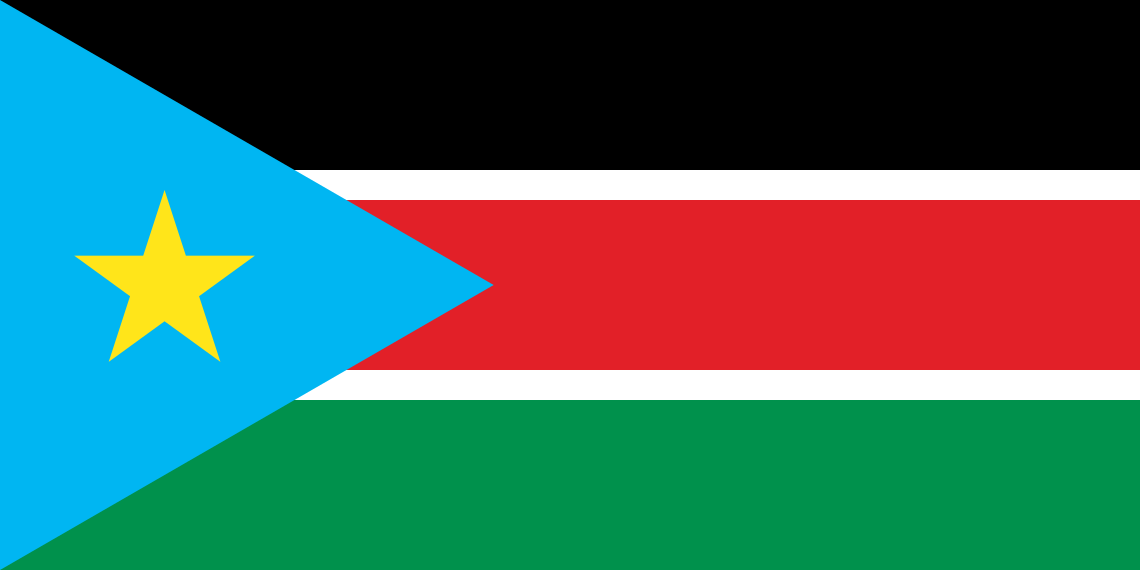
The South Sudan delegation takes this opportunity to congratulate you, Mr. President, on your presidency for the month of November, and we assure you of our full cooperation. We also thank you for convening this meeting and welcome the adoption next week of the draft resolution to extend the mandate of the United Nations Interim Security Force for Abyei (UNISFA) for another 12 months. We would also like to thank the Secretary-General, as well as the Special Envoy for the Horn of Africa for her briefing. We thank both for their efforts to support peace and stability in Abyei and the region.
We commend the valuable role of UNISFA in maintaining security and facilitating humanitarian assistance in the Abyei Area, as well as in supporting the Joint Border Verification and Monitoring Mechanism along the border of South Sudan and the Sudan. We appreciate the contribution and the sacrifices of the Ethiopian troops, who have been the sole contributing country to UNISFA since its inception in 2011. We also welcome the reconfiguration of UNISFA into a multinational peacekeeping force, and we express our gratitude to the new troop-contributing countries for
their commitment and readiness to join UNISFA. We reiterate our full support and cooperation to UNISFA and its leadership, and we assure the Council of our respect for the status-of-forces agreement and the freedom of movement and access of UNISFA personnel and assets. We condemn any acts of violence or harassment against UNISFA peacekeepers, and we call for accountability and justice for the perpetrators.
We reaffirm our commitment to the peaceful resolution of the Abyei dispute, and we restate our acceptance of the proposal of the African Union High- level Implementation Panel, which provides for a referendum to determine the final status of the Abyei Area. We call on the Government of the Sudan to demonstrate the same political will and to engage constructively in dialogue and negotiations with us, under the auspices of the African Union and the United Nations, to reach an agreement on this matter as soon as possible. We also reaffirm our commitment to the implementation of the other outstanding issues between the two countries, such as the demarcation of the border and the promotion of local peace and reconciliation between the Ngok Dinka and Misseriya communities. We appreciate the support of UNISFA and the international community in facilitating and monitoring those processes, and we urge the parties to honour their obligations and to build trust and confidence.
We believe that the Abyei Area can be a bridge of peace and cooperation between South Sudan and the Sudan, rather than a source of conflict and tension. We appeal to the Security Council and the international community to continue supporting our efforts to achieve that vision, and to ensure that UNISFA has the necessary resources and capabilities to fulfil its mandate effectively and efficiently. We also hope that the current situation in the Sudan will not affect the progress and stability in the Abyei Area and the region, and we reiterate our solidarity with the people of the Sudan and their aspirations for democracy and development. President Mayardit has stood — and still stands — ready to continue facilitating any peace efforts, if called upon.
We welcome the report of the Secretary-General on UNISFA (S/2023/777), which provides an update on the situation in Abyei and the progress towards the transition of UNISFA into a United Nations multinational peacekeeping force. We appreciate the efforts of the Secretary-General and his Special Envoy in supporting peace and stability in Abyei and the region.
The meeting rose at 11.35 a.m.