A/32/PV.46 General Assembly
Ol/icial Records
91. Question of Namibia : (a) Report of the Special Committee on the Situation with regard to the Implementation of the Declaration on the Granting of Independence to Colouial Countries and Peoples; (6) Report of the United Nations Council for Namibia; (c) Report of the Secretary-General


We were very distressed to learn of the assassination of the Minister of State for Foreign Affairs of the United Arab Emirates. We would request our colleague Mr. All Hu- maidan to accept the heartfelt condolences of my dele- gatiOil and to be kind enough to transmit this message to the Government of the United Arab Emirates as well as to the family of the deceased.
2. It is regrettable in this day and age to see that the major problems before the United Nations are very slow of solution. Also, old crises are breaking out again, and a number of hotbeds oftension are appearing in various parts of the world. This situation jeopardizes the positive results our Organization has attained and undoubtedly constitutes a threat to international peace and security. We are entitled to wonder why we fmd ourselves in this position.
3. During his statement at the opening of the present session [1st meeting), the President said that the goal of bringing about the necessary changes it"l international relations is encountering various forms of resistance and pressure from various Member States which wish to preserve the privileges and positions they have already acquired. My delegation can only whole-heartedly concur with that thought.
4. This Assembly has heard the Minister for ForeIgn Affairs and Co-operation of Chad state in the general debate [25th meeting) that respect for and observance of the universal principles enunciated in the Charter and reiterated in the various resolutions and decisions adopted
NEW YOlK
by the United Nations system made it possible to ensure international peace and security. But these principles have too often been trampled underfoot, something which is unlikely to strengthen ~ace throughout the world or make it possible to eliminate the mmger of a generalized world conflagration. .
5. Now, at the end of the twentieth century a situation which is unthinkable and anachronistic for the over- whelming majority of the peoplef-. in the modem world appears to be quite normal in certain parts of the world. I refer to the very serious situation which prevails in Namibia. To better grasp the situation, it is essential to go into the background ofthis matter.
6. Just after the First World War South Africa was entrusted with a Mandate over South West Africa. That Territory was administered in a way which ran counter to the spirit of the Mandate granted by the League of Nations.
7. Then, the Charter ofthe United Nations was adopted in 1945 and Chapters XII and XIII of that instrument provided for the establishment of an International Trustee- ship System whose fundam~ntal goals were to promote the . political, economic and social advancement of the in- habitants of the Trust Territories and their progressive development towards independence.
8. After the creation of the United Nations, the General Assembly frequently had occasion to request South Africa . to place South West Africa under the International Trustee- ship System, in accordance with the relevant provisions of the Charter.
9. Then the General Assembly requested an advisory opinion of the International Court ofJustice as to what was the international status of South West Africa and what were South Africa's obligations in the Territory. In the opinion of the Court,! the Territory should have been placed under the International Trusteeship System.
. 10. Subsequently, the General Assembly invited the Government of South Africa to take all the steps ~ecessary to give effect to the advisory opinion of the Court.
11. In 1962 the Chairman and Vice-Chairman of the Special Committee for South West Africa, created by the General Assembly to take over supervisory and control functions, visited the Territory and pointed out that apartheid was spreading throughollt the South African administration of the Mandated Territory; they therefore
1International status of South West Africa, Advisory Opinion: I.CJ. Reports 1950, p. 128.
13. Since the birth of the United Nations the problem of South West Africa, which in 1968 became Namibia in accordance with the wishes expressed by the people ofthat Territory, has been appearing on the agenda ofeach session of the United Nations General Assembly. Numerous resolutions adopted with a view to compelling South Africa to withdraw from Namibia hav.~ elicited no response from the racist Vorster regime. The Government of Pretoria, in defiance of all decisions adopted by the United Nations, is intensifying its policy of apartheid and is perpetuating its illegal control over that country.
14. Thirty-one years is more than time enough for anYOlie still to expect some change in the behaviour of South Africa.
15. Dispossessed as they are of their inalienable rights, the heroic Namibian people, under the leadership of their only authentic representative, the South West Africa People's Organization {SWAPO), have constantly resisted the colo- nial oppression practised by the racist regime in South Africa in order to recover all their rights to freedom and national independence.
16. In the face of dds struggle, South Africa has simply gone on adopting even more drastic measures by stepping up its military potential in Namib~a, by practising bantu- stanisation and by cynically embarking on the policy of annexing the Walvis Bay enclave.
17. Vorster, whose overwhelming ambition is to go on developing his weapons, is using the Kalahari Desert to carry out nuclear tests and to launch attacks against neighbouring countries. What is more, he has set up a vast emergency programme for the training of tribal armies. There is no doubt that this behaviour is aimed at complicating any efforts to imd a solution to the Namibian problem.
18. Faithful to the policy of apartheid, which he does not appear to wish to deviate from, he organized a so-called referendum for the benefit of the white population, the undeniable purpose of which was to make it possible for the whites in Namibia to endorse the tribal constitution of Tumhalle, which would assure that the settlers would enjoy
political-econom~ domination of Namibia in perpetuity.
19. Chad, which has had its own experience in this respect, can but strongly denounce any expansionist poli- cies wherever they come from. The annexation of Walvis Bay last August reflects the lack of sincerity and the bad faith of the racist regime of Pretoria. Walvis Bay is an integral part of Namibia and, as-Mr. Nujoma of SWAPO said {35th meeting] quite properly, such claims are based on outdated, arbitrary, illogical and unjust agreements. As we see it, this is a case ofaggression and any country that loves peace and justice should denounce this reactionary attitude on the part of South Africa.
20. For many years now SWAPO has been struggling for the liberation of Namibia. We support its actions, which have involved mobilizing political and diplomatic factors as well as the intensification of the armed struggle which they are waging against the South African occupation forces. We should like to pay a particular tribute to the freedom fighters who have fallen on the field of battle, and the valiant sons of Namibia such 'is Filemon Nangolo, who have been assassinated in South African gaols.
21. It is indeed regrettable that the pressures which have been exerted by our Organization on the Pretoria regime have not achieved their purpose. If the efforts initiated by the United Nations have remained fruitless, it is because of ihe complicity of the great Powers, which, in order to protect their own selfish interests, spurn all decisions taken by this international institution. Their behaviour. makes them natural allies of the minority racist regime in South Africa.
22. Confident of his strength, Vorster is persisting in his arrogance towards the international community. It is high time that enforcement measures be taken to induce the apartheid Republic of South Africa to abide by the decisions of the United Nations, particularly those which have requested it to withdraw its administration from Namibia immediately and to put an end to the illegal occupation of that Territory and its arbitrary legislative measures and out-and-out violations ofhuman righ~s.
23. The United Nations should shoulder its responsibilities towards the Namibian people. We should like to commend the constructive efforts which may be made by Members of this body, either individually or collectively, for an ac- ceptable solution to be found to this problem on the basis ofGeneral Assembly resolutions and the pertinent decisions of the Security Council.
24. What are the main facts emerging from the question of Namibia, which now appears as a matter of priority on the agenda ofthis present session of the General Assembly?
25. My country has certain legitimate anxieties about the future of Namibia. Until the United Nations exercises its full power as an independent organ, South Mrica will not give up its selfish greed for domination and its mania for the unconscionable exploitation of the defencele~ Nami- bian people. The question ofNaJI'Jbia has to be resolved on
26. As we see it, the racist Vorster must he induced to immediately liberate the Namibian patriots who are being detained in South Africa, to withdraw his armed occupying forces and to respect the territorial integrity of Namibia.
27. In conclusion, I should like to join with previous speakers and to congratulate the members of the Special Committee on the Situation with regard to the Implemen- tation of the Declaration on the Granting of Independence to Colonial Countries and Peoples, as well as the members of the United Nations Council for Namibia, for their extremely edifying reports which the Assembly now has before it [A/32/23/Rev.l, chap. VIII and A/32/24]. These reports have indeed made it easier to understand the problem of Namibia, which is so important a problem.


The questions of colonialism .md aptUtheid have rarely been discussed so thoroughly and so often by the United Nations system as during the current year. Two world conferences, the International Conference in Support of the Peoples of Zimbabwe and Namibia, held in Maputo in May, and the World Conference for Action against Apartheid, held in Lagos in August, were major steps to mobilize world public opinion against the per- sistent attitude of South Africa in its illegal occupation of Namibia and its policy ofapartheid.
29. However, and unfortunately, we still have to bear with a totally unjustifiable situation of occupation of Namibia by South Africa, in open defiance of Security Council and General Assemlby resolutions and of the advisory opinion of the International Court of Justice. This situation is further aggravated by the fact that parallel to the illegal occupation there is the imposition of racial discrimination and segregation on the Namibian people.
30. Once more we reaffirm the position of Brazil, which is that of refusal to recognize any form of South African authority over the Territory as a whole or over any part of it. We fully recognize the legitimacy ofthe authority of the United Nations Council for Namibia over the Territory until the Namibians themselves are able to express their right to self-determination and reach independence. The report of the UniteG Nations Council for Namibia [A/32/24] cannot but lead us to praise and admire the manner in which it is fulfIlling its mandate under the firm and able leadership of Ambassador Gwendoline Konie. However, its comprehensive information brings to light the fact that despite all the efforts of this Organization the situation in Namibia has not ceased to deteriorate.
31. This means that we must provide greater support for the Council. Brazil has always co-operated in its work. We have made contributions to the Institute for Namibia. We have invited the Council to send a visiting mission to Brazil and have been honoured by the acceptance of this invitation and by the visit itself. The Brazilian Government has offered scholarships for Namibians and fully recognizes the trave.l documents issue€" to Namibians by the Council. I
33. Brazil has invariably favoured negotiation as a means of solving international disputes. However, it stands to reason that negotiations can be fruitful only if presided over with frankness and good faith on the part of all the parties concerned. The failure of any interested side to comply with these basic principles while in search of an acceptable level of understanding risks the total disruption of the structure of a peaceful negotiation. The full and unqualified recognition of the right of Namibia to terri- torial integrity, self-determination and independence is the very foundation of any dialogue which is likely te be fruitful.
34-. Mrs. DE ADENAUER (Honduras) (interprett':ionfrom Spanish): This is an excellent opportunity, Mr. President,
for hIe to convey my warmest congratulations to you and to the other officers of the General Assembly on your well-deserved ele1:tion.
35. The fact that the question of Namibia is being discussed directly in the plenary meetings of the General Assembly reflects once more the importance of an issue that is so important to the independence and self- determination of the peoples.
36. My delegation wishes at this time to reiterate the determined and sincere support of the people and Govern- ment of Honduras for the just and patriotic cause defenJed by the noble and valiant people of Namibia. This support does not stem from any political, economic or other type . of interest but rather from our conviction that the peoples of the world must be free and masters of their own destiny.
37. Eleven years have already elapsed since 27 October 1966, when the General Assembly adopted resolution 2145 (XXI), by which it put an end to Sou'rh Africa's Mandate to administer Namibia. The Assembly thus as- sumed responsibility to guide the people and Territory in question towards self-govemmerlt.
38. None the less, South Africa still unrelentingly deprives the people of Namibia of the exercise of its basic human rights. It occupies the Territory illegally in violation of its obligations under the Charter, to which it is a signatory, thus disregarding the advisory opinion of the International Court of Justice and, worse still~ :t continues to enforce apartheid. the most unjust of socia structures.
39. The mpport given by five Western members of the Security Council in order to achieve a prompt and peaceful transition merits the most sincere congratulations of my Government.
40. My delegation is equally pleased to congratulate the Special Committee on the Situation with regard to the Implementation of the Declaration on the Granting of
41. The peaceful decolonizatioT.l of Namibia, achieved with the unanimous suppc1rt of the international com- munity, is the most noble and sincere aspiration of the people and the Government ofHonduras.


First of all I should like -on behalf of the delegation of Cape Verde to express my 5incere con- dolences to my friend and colleague, Mr. Ali Humaidan, the Ambassador of the United Arab Emirates t,"or the brutal and shocking death of Mr. Saifbin Ghobash, the Minb.iter of State for Foreign Affairs of that fraternal country and I hope that these condolences will be transmitted to his Government.
43. We are ~~~'>aldng today in order to fulfIl a duty of militant solidaIity with the people of Namibia and with its vanguard organization, SWAPO, and with the emerging independent and sovereign State which will in the future take the p1.ace reserved for it among us.
44. We are nearing the conclusion of this debate on Namibia, during which almost all the Members of our" Organization will have spoken at this thirty-second session of the General Assembly. This is a significant fact which attests not only to the particular interest of the inter- national community in this question but also to the acuteness and the urgency of the problems it poses.
45. In requesting that this issue !.le given priority con- sideration in the General Assembly, the African group was aware that this was a matter of the rir,ht to life ofan entire people and of the dignity and honour of an entire continent. Indeed, as a considerable number of"those who spoke before me at this rostrum have said, this question has been on the agenda of the Assembly for a long time-too long--innumerable resolutions and decisions have been adopted withr,ut any tangible, substantive results, and no effective measures have been taken towards attaining the objectives ofthe international community.
46. Among the most signific2Ilt decisions and resolutions adopted by the United Nations on the item under con- sideration, resolution 2145 (XXI) of 27 October 1966, through which the General Assembly put an end to the MaMlate of South Africa over the Tetritory of Namibia, and resolution 2248 (S-V) of 19 May 1967, which created t.lte United Nations Council for Namibia have been men- tioned frequently here, as well as Security Council reso- lution 27{/ (1970) and the advisory opinion of the Inter- nationa: CDUrt of Justice of 21 June 1971 which declares the iUegality ofSouth Africa's presence in Namibia.3
47. Likewise, the reference to Securij}' Council resolution 385 (1976) of 30 January 1976 me ie it possible for us to
3 LegrJ O.:mseauences for· States of the Continued Presence of Sout!f Afnca tii Namibia (South West Africa) notwithstanding Security Council Resolution 276 (1970), Advisory Opinion, LeJ. Reports i 971. p. 11;.
48. Foreign activities and interests are still continuing in the Territory and are even developing dangerously despite international disapproval and in complete defiance of the sacred right of the Namibian people to its national resources.
49. fhe clear role played by certain Western countries in the worsening of the situation in the Territory has been repeatedly condemned here, cmd we hope that effective action .lean be taken to dissuade these countries from continuing to strengthen and uphold the South African regime, and to correct a situation which has lasted for too :ung. This situation has shockingly distorted the sacred objectives of our Organization and outrages the universai conscience more-with every passing day.
50. In Africa during recent years there has been a series of events which, because of the radical changes brought about, and the irreversible nature of the struggles waged, are of great importance for the entire region and should be emphasized. The long, resolute anned struggle for the poIiticalliberation of the former Portuguese colonies p'ut an end to Portuguese colonialism, particularly in Africa, stripped the racist regime of a certain source ofshelter and dismantled the security belt provided by the dominated Territory, making it possible for the borders of freedom today to extend beyond the curtain of blood and iron, behind which those regimes condemned by history have entrenched themselves.
51. The progressive organization and the strengthenil1g of the independent States of the region in a cohesive front line determined to overcome the expansionist and aggressive designs of the racist regimes is another factor characterizing the evolution of the situation in that part of the African continent. It is important to 3tress once more the growing awareness of the international community of the threats posed by the racist apartheid regimes to international peace and security, as demonstrated by the appreciable results of the International Conference in Support of the Peoples of Zimbabwe and Namibia, held in Maputo in May, and the World Conference for Action against Apartheid, held in Lagos in August, as well as by the just position taken by a growing number of Member States on this question.
52. But the most decisive factor remains the struggle of the peoples under racist domination themselves the new dynamism of that struggle today and, as far as Namibia is concernf"d, the rapid development of the fighting forces of SWAPO~ Despite the fierce and constant blind repression they suffe.r, these forces have dealt severe and repeated blows to the occupation troops, and have given a new course to events in the Territory.
54. Ever since our own recent nationalliber;riion struggle, our party, the PAIGC,4 has had relations of militant, fraternal solidarity with SWAPO and we have always defended the correct position taken by that movement.
55. Moreover, not too long ago we ourselves were facing a painful but glorious situation of armed political struggle against colonial forces of occupation. We are therefore deeply aware of the various types of difficulties and obstacles faced by our brothers in SWAPO. However, we learned through our own experience that a determined and organized people will sooner or later always achieve its lofty objectives. We have confidence in the ability of a movement like SWAPO, tempered by long years of hardship and resistance and determined to continue its struggl-; until all the reasons for that struggle are eliminated.
56. It has been stressed here many times that South Africa, which is illegally occupying the Territory of Namibia, far from meeting Lite demands ofthe international community and implementing the decisions of the United Nations, is feverishly attempting to maintain its hold over the Namibian people and to strengthen its control and domination of the Territory. While stating that it is prepared to accept the independence of Namibia in December 1978, the South African regime is increasing itR sordid threats, strengthening its armed forces in the Territory, promoting several constitutional conferences based on unacceptable tribal considerations, and main,: taining laws enshrining bantustanization, .division and ex- ploitation. In fact, while pursuing a scorched-earth policy in Namibia, South Africa is transforming the Territory into an immense concentration camp, where the people ofNamibia are managing to survive, penned in, divided and plundered.
57. At the same time the regime is strengthening its military bases for the purpose of aggression against the freedom flghters and the neighbouring independent terri- tories. The racist military forces stationed along the southern border of the People's Republic of Angola are a constant threat to, as well as a factor of insecurity for, the ptiople ofAngola.
58. Moreover, as the President of SWAPO, Sam Nujoma, stated, that aggressive regime maintains puppet armies within the Territory in order to perpetuate its irresponsible policy which runs counter to the course ofhistory.
59. The Pretoria Government thus endeavours to protect its rear by the prior sabotage of the future independent State of Namibia. The claims it makes to the port ofWalvis Bay are a clear manifestation of that strategy, which cannot
60. It goes without saying that Cape Verde unreservedly supports SWAPO's endeavours for a just and lasting solution of the situation prevailing in Namibia,particularly with respect to the withdrawal by South Africa of its administration and all its military forces, which constitute tools of legalized terrorism imposed by Pretoria on the people of Namibia, the release and return of all detainees and political prisoners, as well as the preservation of the territorial integrity and unity ofNamibia.
61. Truly free elections should be held und",. the auspices of the United Nations, whose Council for Namibia remains the legal authority over the Territory until it accedes to sovereignty.
62. The United Nations and the international community should do everything in their power so that Security Council resolution 385 (1976) as well as all the other relevant resolutions of the United Nations concerning Namibia can be fully implemented. Toward this end there must be a genuine and sincere political will on the part of all the States Members ofour Organization which'have been entrusted with the difficult and noble res-:t10nsibility of guaranteeing the support and protection the Namibian people need for the achievement of their sacred objectives.
63. Cape Verde wishes to state once more that it gives full and unconditional support to the legitimate struggle of the Namibian people under the guidance of SWAPO for a life of peace, justice and progress. •
64. We would like to conclude our statement by quoting one of the Namibian leaders who was tried and convicted during the "terrorist" trials in 1968, and who stated the following to his judges:
"I am a loyal Namibian and I ~ould 110t turn my people over to its enemies. I admit that I decided to help those who had taken up arms. I know that the struggle will be a long and difficult one. I also know that my people will wage this struggle regardless of the cost. It is only when we have our independence that the struggle will come to an end. It will only be when we regain our human dignity on an equal footing with whites that we will be at peace with them."

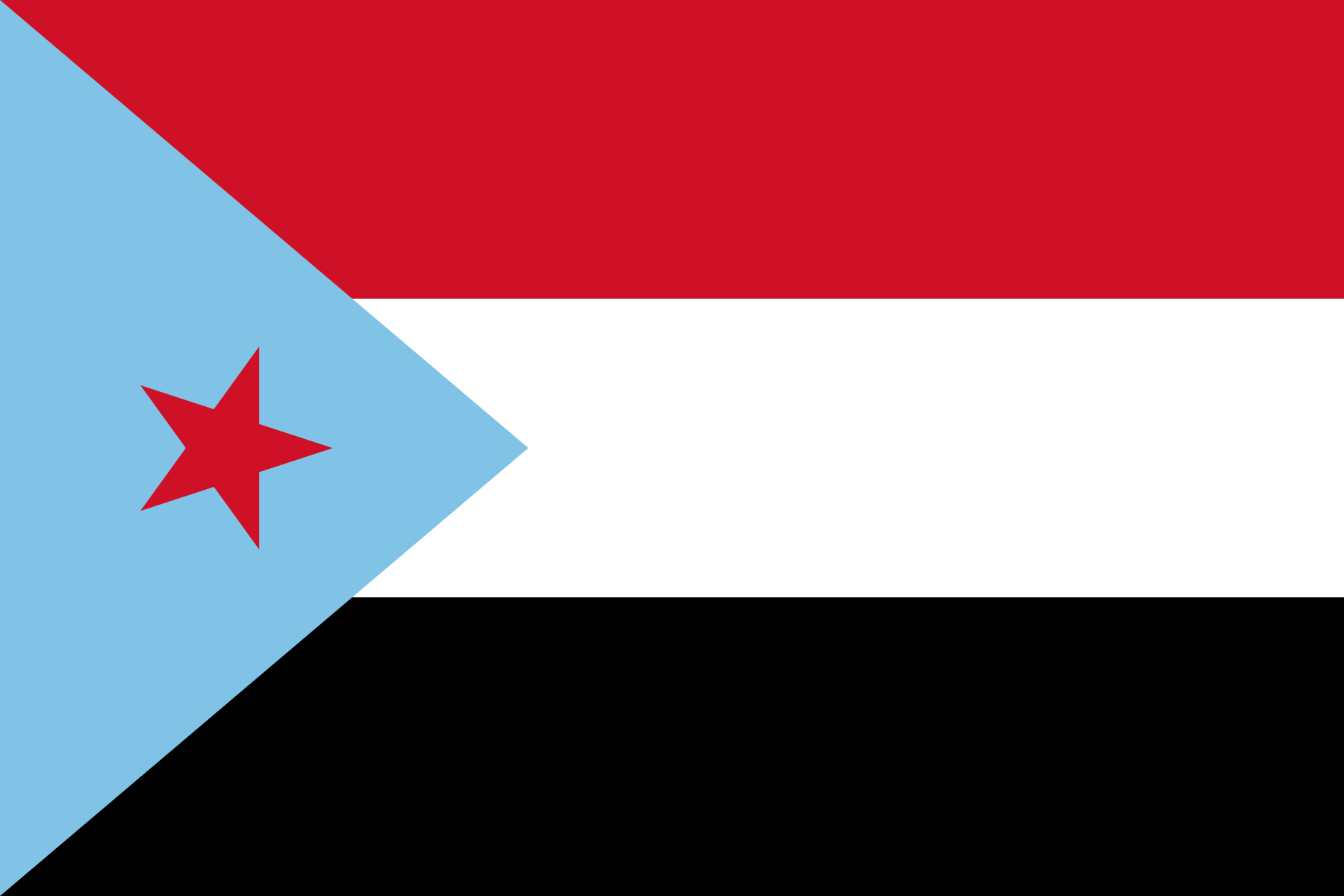
Mr. President, allow me fIfSt of all to express to the delegation of the United Arab Emirates, on behalf of the Arab delegations, our deeply felt condolences on the regrettable incident which took place yesterday and which caused the death of Saif bin Ghobash, Minister of State for Foreign Affairs of the United Arab Emirates. My dele- gation, while sharing the feelings expressed by the dele- gations here, notably the Arab ones, would like to stress the part played by the late Minister of State for Foreign Affairs for the revival of his country and the realization of Arab aspirations. We are sure that the people ofthe United Arab
66. Eleven years have elapsed since the General Assembly, in resolution 2145 (XXI), terminated the Mandate of South Africa over Namibia, and in that same resolution entrusted the administration of the Territory to the United Nations to ensure the implementation ofresolution 1514 (XV).
67. During the years which have intervened, a number of resolutions have been adopted by the General Assembly and by the Security Council, and advisory opinions have been issued by the International Court of Justice, re- questing the racist, colonialist and apartheid regime in Pretoria to put an end to its illegal presence in Namibia and to grant the people the right to self-determination and independence in the context of a unified Namibia. How- ever, the racist regime of the white minority in Pretoria economic support given South Mrica by certain Western countries and particularly the members of the North Atlantic Treaty Organization.
75... Tile Special Committee on the Situation with regard to the Implementation of the Declaration on the Granting of Independence to Colonial Countries and Peoples has _ condemned the activities of transnational and multinational corporations which are acting in that part of the world under the illegal administration of South Africa. They exploit the material and human resources of the Territory. The Special Committee on decolonization requested that this exploitation be stopped and stated that the activities of 69. Because of tIle military and economic support given to these corporations were considered illegal. The colonialist South Africa by th~ Western countries, South Africa has depreda~ion of ~he natural. resources o~ the Namibian managed to acqu:re military forces which make it possible' people .IS still g~mg on d~splte t?~ resolutI?ns adopte~ by to defy with impunity all decisions taken by this Organi- . the Umted Nations and Its subSidiary bodIes. The Umted zation. Nations Council for Namibia has enacted a Decree for the Protection of the Natural Resources of Namibias to prevent their further exploitation by transnational corporations and the South African authorities. Foreign ftnus control most of the economic activities in Namibia. Transnational corpo- rations of the major Western countries collect approxi- mately three-fifths of all income taxes in Namibia. Those sums go directly to South Africa.
68. In fact, this flagrant deftance of international political opinion could not have continued without the military and economic support given South Afiica by certain Western countries and particularly the members of the North Atlantic Treaty Organization. ~
70. As long as the Western countries continue 1:0 engage in economic and miiitary co-operation with the white mi- nority regime in Pretoria and' as long as foreign capital continues to flow into that country, it will be impossible for the United Nations to convince Vorster's regime to change its racist policy towards the people of Namibia.
71. Since 1967 the heroic people of Namibi~t faced with the barbaric attitude of the racists and colonialists of Pretoria, had to resort to armed struggle in order to defend their right to self-determination and to national inde- pendence under the guidance of SWAPO_ The intensi- fication of the armed struggle md the long list of those heroes and mm-tyrs who fell on the battlefield a~: a reflection of the hopes and bravery of the Namibian people and their determination to struggle against an inhuman enemy. The racists in Pretoria have been obliged to step up theif military strength in Namibia to 50,000 men. This is a sign of the succe~'s ofthe struggle which is being waged.
72. The Special Committee on decolonization has con- demned the extensive use of military forces by the racist regime of Pretoria in NM1ibia, the reign of terror and violence which has been imposed OIi that Territory, and the detention of freedom fighters by South Africa in an attempt to stifle the struggle of the Namibian people for freedom and independence.
73. My COMity strongly condemns the apartheid regime and the numerous violaUons ofhuman rights and individual
74. Democratic Yemen firmly condemns the policy of bantustanization, which endangers the territorial integrity of Namibia and which is designed to weaken that Territory and its people. That is why we consider that the annexation by South Africa of Walvis Bay can only be regarded as an act of territorial expansion contrary to the Charter of the United Nations and running counter to all the relevant decisions adopted by the United Nations. As we see it-and this view is shared by previous speaker:;-we consider Walvis Bay to be an integral part of Namibia, and therefore its annexation by South Africa endangers the territorial integrity and unity of Namibia.
76. SWAPO is the authentic representative of the ~;ami bian people. It has laid down six pre-conditions, which deserve the support of the State.. Members of the Organi- zation. They are that South Africa must recognize the right of the Namibian people to independence and national sovereignty, that it must also recognize that Namibia's territorial integrity is indivisible lL.'1d non-negotiable, that South Africa must free all the political prisoners and allow the return of exiles while guaranteeing their future free- dom, that South Africa must withdraw its troops from Namibia and must not use Namibia as a base frgm which to launch acts of ag~ession against neighbour1ng rode- pendent countries anti that all constitutional negoi~ations
concerning Namibia must be held under the auspices ofthe United Nations and must be aimed at holding free elections under the control and ~11pervisionof the United Nations.
77. The Namibian people, under the leadership of SWAPO, have enjoyed and continues to enjoy the support of the majority of the States Members of the United
5 See O/flcwl Records of the General Assembly, n.,enty-nf.....h Sessio.l, Supplement No. 24A. para. 84.


The importance of the problems under consideration was stressed by the Secre- tary-General, Mr. Kurt Waldheim, some time ago when he declared:
"The persistance and repercussions of these problems in Africa and in a wider sphere create a serious potential threat to international peace and security. It is impossible to over-emphasize the nee,; for urgent progress in this region of the world. Even now it may be very late for peaceful solutions. With every month that p~sses the likelihood of inter-racial violence on a large scale ~comes greater....
"There can be no peace in southern Africa until the necessary changes, so long called for by the United Nations, come about. We can no longer afford delay, as the potential for major disaster becomes more real every day."6
80. In view of this situation, the delegation of the Kingdom of Bhutan is happy to find this year the question of Namibill\ receiving full consideration in the plenary meetings ofthe General Assembly. Illdeed, we should assess in depth the present situation regarding the struggle in-
Na~l1ibia and make recommendatio!l5 to engble the people of Namibia speedily to attain its long-denied freedom and independence.
81. Tne question ofNamibia-then South West Africa-has been on the agenda of the United Natio_'1s since 1946. The white minc-}ty regime in South Africa continues to ~ubject the peor " cf Namibia to oppressive treatment, challenging all civifu..:J norms. Elevtn years ago the Genera! Assembly in its momentous resolution 2145 (XXI) of 1966 declared that South Africa had failed to fulfil its responsibility to promote the m~terial, moral and social obligations of the people in that Territory. Th~ decision terminated South Africa's Mandate over Namibia. The Assembly has ever since assumed direct responsibility for the Territory and has afanned that Namibia had an international status which should be maintained until its independence. But up to this date the Pretoria regime 60ntinues to occupy Namibia illegally. The Council for Namibia has been unable to visit the Territory to fulfIl the mandate given it in General Assembly resolution 2248 (S-V). The white minority regime in Pretoria is still pursuing its internationally condemned policy of apartheid, its domination over the
6 Ibid., Thirty-first Session, Supplement No. lA, sect. In.
"... the Security Council nhall meet immediately to decide upon effective step~ or measures, in accordance with the relevant Chapters of tIt,~ Charter, tc secure the full and speedy implementation of ~'I.e pn:sent reso- lution".
In addition, the Council unanimously adopted resolution 366 (1974) and 38$ (1976).
83. The legime in South Africa flr)uted those resolutions and it is continuing to defy the VIlli of the international community, yet no helpfcl steps or measures have been taken. Such a deplorable r\~sponse from the Vorster regime has indicated that South Africa desires to ma!Iltam its record of defiance and cont...mpt of this Organization and its decisions. In the ,...,.:antime the situation ht'2S been deteri".>rating with every passing day. Indeed, beginning
yester~ay, the &curity Council is once again. considering the gra',re situation in southern Africa. In our opinion, in order ft.' make thE resolutions and the will of the international community respected, the moment is perhaps opportune to take decisive action in accordance with the relevant provisions of the Charter of the United Nations. The Secretary-General has in his report on the work of the Orga.Lization pointed out that:
''The Council is, or was intended to be, the keystone of the st~uctUl'e of international order prescribed in the Charter. The way in which the Council is used, or not used, ilud the respect, or lack of it, for its decisions is therefme a matter of the highest importance for the effectiveness.and credibility of the United NaLions as an essential instrument of peace." [See A/32/1, sect. ILl
84. Earlier in the debate many representatives have more eloquently drawn our attention to the serious concern of this Organization regarding the grave situation in Namibia. I cannot hope to express the plight of the black Mricans and Namibians with the same incision, eloquence and personal involvement as was described in particular by the repre- sentative of SWAPO, who addressed the Assembly last week [35th meeting]. All I can hope to do is to remind this body of the urgency of correcting a situation in which millions of our fellow men are livmg in misery and humiliation. As South African men and women of feeling and reason see their future being determined by the demolition crew, the security police and bantustanization, they respond with
85. Last week Mr. Nujoma pointed out the futility of
expe~ting any true reflection of the majority will in an election held under the terror of the South Afric;m army. According to him, and we agree, the only way for the people Qf NamibZa to exercise mea right without fear of IeDP..s;aJ!. and to vote honestly would be if the South African 'anny were withdrawn from the area and elections
were condtlcted under the auspices of the United Nations. In Namibia, peopk are reduced to the status ofnon-citizens in the so-cal1ed homeland. We in Bhut~n conderr.n this bantustanizatic!\ ~heme. Thetefore, l~! year my dele- ptlon was a $pOD:5 nf the draft resokution C)fi the so-called. independent Tran; i.7
86. The Kingdom of Bhutan i~ ~ peace-loving t:ountry and we w~lcome all peaceful moves and methods. hldeed, every effort hts to be made to restore fundament&! human rights and to bring about a peaceful solution in Namibia. In this
respect, my delcsati(h~ has foUowed with interest the initiative taken b" Canada, France, the Federal Republic of
~imii.~Y, the Uilited Kingdom and the United States: We hope that their initiatiV1: will I;~ad to a peaceful solution of the problems which tould be acceptable to un the parties concerned and, Clbo'le ~ll)c to the people of Namibia and its leade!S. We view their effort~\;'ith interest because oftheir ability in ~·~ir present special positivn to influence tile regime in South Africa and pe.rsuade it to heed the call of the international community.
87. Many speakers before me have referred to the military and nuclear danger now emerging in South Africa. We cknounce this potential dangert which could be a threat to international peace and security)c apart from affecting the well-being of the people of Namibia and southern Africa. Indeed. a massive strengthening of the South African armed. forces and increasing repression t intimidation and coercion against neighbouring African States pose a threat to world peace and security. At this point. it is important to refer.to the ~pecial Committee's call to all States to stop supplymg arms to South Africa. It is of the greatest importance that States should renounce all forms of military collaboration, direct or indirectt with the apartheid regime.
88. In view of all this, my delegation welcomed the Maputo Declaration in Support ofthe PeoplesofZimbabwe and Namibia and the Programme of Action fOl the Liberation of Zimbabwe and Namibia.1S: Suggestions were made for action to be taken in various fields by States Members of the United N~tions system and other inter- governmental and ncn-governmental organiza!i0ns. in sup- port of the liberation struggle. Such action mcludes boycotting trade and other relations with South Africa,
7 Ibid., Thirty-first Session. Annexes. agenda item 52.. document A/31/LS.
8 See Offlci41 Records of the sewrity Council, Thirty-:.econd Yf1QT. Supplement [or July, Augustand September 1977. document S/12344/Rcv.l, annex. V.
90. In conclusion, I should like to reaffirm the statement
mad(~ by my Foreign Minister recently in the General Assembly {25th meeting}.' Mr. Tsering expressed .rrt.y Government's conviction that the people of NamibIa cannot continue to be denied their ~egitimate rights to self-determination and independence and that there should be joint action to implement the relevant resoll~tions and decisions of the Security Council, the General AS3embly and theOAU.
91. I also Wish to take this opportunity to convey the sincere condolences of my delegation to the delegation of the United Arab Emirates, a f~lIow member of the Asian group of States, and to the members of the bereaved family, on the tragic death of the Minister of State for Foreign Affairs of the United Arab Emirates.


First, I should like to convey the condolences of the Sparush delegation to the representatives of the United Arab Emirates on the very tragic death of the Minister of State for Foreign Affairs ofthat country.
93. Tne fact that we are considering the question of Namibia in plenary meetings and the great number of speakers in this debate bear witness to the growing conce.rn of the international community about a constantly deteno- rating situation, the continuation ofwhich is becoming ever more intolerable.
94. Spain shares that co~cern, as ~as indica~ed by.the Minister for Foreign Aff3h"'S of Spam, Mr.Ore.Ja Aguirre,
from this very rostrum on 26 September. He said:
"The situation in southern Africa also seriously en- dangers peace and security and constitutes ~ open defiance of the entire international commumty. The apartheid system, the persistence of the illegal minority
regime in Southern Rhodesia and the illegal occupation of Namibia by South Africa are three aspects of the same reality of oppression and injustice which has prevailed for such a long time in that part ofthe world, and where the situation is progressively deteriorating." {6th meeting, para. 161.}
95. Our concern and our hope that a solution will be found to the problem of Namibia have been reflected in successive statements m~de by the Spanish delegation in this General Assembly and in the Security Council during the two years when we were members of the Council, and during Spain's participation in the International C~n~e~nce ill Support of the Peoples of Zimbabwe and NamIbIa, held in Maputo in May 1977.
96. At this. time we have no wish to delve into the background of the lengthy consideration of the question of Namibia in the United Nations. We all know the body of
97. My delegation believes that this debate at least serves to highlight once again the fact that there is a consensus on a series of basic aspects of this question: frrst, that the presence of South Africa in the Territory constitutes illegal cccI'Jpation; secontiry,that· South Africa must therefore withdraw from Namibia; thirdly, that the United Nations has direct responsibility for the Territory during its transition to independence; fourthly, that the people of Namibia must be allowed to exercise their right to self·detennination and independence, while preserving Namibia's national unity and territorial integrity, through free elections under the control and supervision of the United Nations, in keeping with resolution 385 (1976) of the Security Council; and fJfthly, that, in this process, the participation of SWAPO is essential, since SWAPO is recognized by the United Nations and by the OAU to be the authentic representative of the people ofNamibia and enjoys observer status in this Assembly which has been conferrred on it by General Assembly resolution 31/152, which received the. affirmative vote of the Spanish dele- gation. Any negotiating process attempting to exclude SWAPO or any programme for the solution of the problem which does not receive its approval will be doomed to failure.
98. There is certainly consensus as to what the objective of United Nations action on this question should be: the prompt establishment in Namibia of majority government, although there may be differences as to the way of approaching the problem or as to procedures to be followed in order to obtain that objective.
99. My delegation feels that the search by all means possible to fmd a peaceful solution to the problem must be continued, for the peaceful solution of international prob- lems is the mission of the United Nations..
100. None the less it is a fact, and we understand tlm, that the people of Namibia, or at least a substantial part of it, has been struggling in different ways to obtain freedom and independence, and that its patience, just like that of the international community, has its limits.
101. Within these parameters, my delegation supports all efforts, including those of the five Western members of the Security Council and the so-called "front-line" countries, aimed at achieving a rapid and peaceful solution to the problem. These efforts have at least managed to destroy the so-called Tumhalle plan, which would have involved pseudo-independence and the bantustanization of Namibia. But there are still many obstacles to be overcome. First and foremost among these must be the establishment of an atmosphere conducive to the full application of Security Council resolution :'J5 (1976), which would require the immediate adoption of a series of measures such as the end ofrepression, the release ofpolitical prisoners, the return of exiles and an end to those arrangements of a military nature which to a great extent explain the expressions of scep- ticism we have heard throughout this debate.


We were overwhelmed to learn of the attack against the Minister of State for Foreign Affairs of the United Arab Emirates: We now know that the Minister was killed and .my delegation expresses its sincere condolences to the delegation of the United Arab Emirates.
104. To turn now to the topic under discussion, last July, when he received our brother Sam Nujoma in Ubreville, the Niger Head of State assured him·of the active solidarity of the people and Government of the Niger with the Namibian freedom fighters. It is in the context of that unfailing support that this statement is being made.
105. The question of Namibia is undoubtedly the baro- meter of the effectiveness of this Organization, the way in which its decisions are being implemented and the sincerity of its Members. After all, this item has been on our agenda for 32 years now, without the stretch of·African son previously called South West Africa having recovered its independence or having regained its sovereignty, which was usurped by sui generis colonialism which apparently could only be the brainchild of the seemingly exceptional minds ofthe individuals irstalled in Pretoria.
106. Nevertheless attempts and initiatives have never been lacking in the lengthy history of this former German colony. Since the revocation in 1966 ofthe Mandate of the Republic of South Africa over the Territory right up until the Conference of Maputo, a great deal ofground has been covered. The creation of the United Nations Council for Namibia, the advisory opinion of the international Court of Justice of 1971, the creation of the United Nations Institute for Namibia at Lusaka, the Dakar International Conference on Namibia and Human Rights, held in January 1976, Security Council resolution 385 (1976)-all these will undoubtedly be events Namibian children will learn ofwith emotion when they study the history of their country's struggle for independence.
107. But if Africa has requested that this subject, which is of concern to us, be discussed in the plenary meetings of the Assembly as a matter of priority, it is because the problem remains as it was. In other words, the situation in Namibia has made no tangible progress since the thirty-first session. In this connexion, the report ofthe United Nations Council for Namibia and the statement of the President of SWAPO have been extremely revealing.
108. The Republic of South Africa, the most unworthy member of the international community, continues to betray the confidence placed in it at the time ofthe League of Nations. Furthermore, it constantly indulges in delaying tactics and criminal stratagems. It throws down the gauntlet, and even makes threats. But things are even more serious. By their avowed intention to annex Namibia, their brazen exploitation and daily plunder of Namibia's wealth, the growing militarization of the Territory and the barbaric oppression of its people, the racists in Pretoria pose a serious threat to international peace and security. This is so
109. But the South African racists who illegally administer the Torritory and have been doing so since 1966 are hatching the devilish plot of taking it over or at least of splitting it up into entities such as those which are elements of their Vile system.
110. Naturally, the United Nations has every respon- sibility to thwart this sinister plan by all means in its power. In fact, our Organization has since 1946 spared no effort to re--establish the law in former South West Afrtca, but it has always encountered the obstinate refusal of one of its
M~mbers to comply with all its decisions, the most recent of which, namely ~curity Coup-cU resolutiorl 385 (1976), neverthelesn constitutes the best possible basis for the solution of aproblem which hasbecome most grievous and disquietingin all respects,
I bring about a negotiated settlement of this matter. My country has, nothing against this.. Quite the contrary; since in Niger ~ l().v~ both peace andjustice, we cannot but encourage all
111. Some: initiatives have been taken in order tO
thosch n:ear and far~ who can make Vorster's clique listen to the voi~ of reason., Neverthele~ we do doubt the sincerity of W.&clique which iscomposed ofdied-in-the-wool racists. That is why last June in LibreviUe we associated ourselves
with· all cur African brothers to reaffirm" in resolution CM/RIiS..SSl (XXIX,) [see A.f32/310. annex 1J, our support fQC SWAPO- and to pledge to increase our imancial, military and dip!olllatic ass{stam.'e to the Natnibian people.
112.. At this moment when the thirty«cond session of the Goneral Assembly of OUt Organization is meeting, the situation in Namibia hardly gives us any ground for optitnWU.. T~ white minorit.y regime has just annexed the PQrt of Walvi~ Bay to the South African Cape h'ovi.m.'e'.
FUdhetmore~ through self-styled constitution~ \,'Omerences and by using trait.ors. and stateless- people in theit PQCket,. thtl)' ate pursuing their evil dttsigns to creabt in Namibia 11 oontustans ill which. the Na.mibi:m ~~ will be divided up into ))amnr~ OvambQ.s,.Hemrosand SQ un.
113~ I should like h~te to repc~.t in very solemn terms the adherel1@: of my country to the termsQfGeneral Assembly resolution 3i1146 enti~ "Situation in'Nlmitml resulting l«un the iUtg41 o~u~tiOtt of the TerritQ~' b,' South
Attict·~. ~bia must ca~"\tdt to in~~nden\'''e \\ith a
utUfl~d peopla and with its Territory intt~t.. The~ are
prin~ipl~s- on wt,\iclt we Afri~ans, ~\ never Qlnlpromise:..
t 14.. 'The~t\)N~ we exhurt tbe :allieS Qf Pretoria t\) put ~ eud tu their dupli\':ity and to refrain tMll itnpedin& the impbunenbltiQtl ut' the peftiu~nt pN\lisiQ,t\$ ~f ~ ('hatter
S(,) th:ltt tlndlyt the N~lubmn poople ~~\ cxc~i~ their inlllieulbht tisht IQ ~elf..utt~rlUjnati~n in. the \,-unditiQl\$ bid uQWU. b)t SWAN ~md reaffttmed b~ the ASStmbl) \)f Ht~s ur Stal\l and Govenummt \It' tht OAU at it$. t\.\Utt~nth
115. Unl~ss these pre-conditions are met, those who hav~ armed Pretoria, and helped its economy and maintained its
~ower may run the risk of a breach of the peace, the consequences of which would be incalculable.


Before 1 say anything elSiC, please allow me to convey the heartfelt condolences ofthe people and Government of Lesotho to the United Arab Emirates delegation on the sad, tragic and untimely death of their distinguished Minister of State for Foreign Affairs, a person who was responsible for the very cordial and healthy relations that exist between th'" United Arab Emiratesand the Kingdom of Lesotho.
117. My delegation is speaking for the second time in this Assembly mainly to restate its position on the Namibian question.. The issue. before this Assembly is that of the illegal' occupation of the Territory of Namibia by the aparthejd regime ofSouth Africain flagrant defiance of the
resolutions and decisions of the United Nations and the OAU on the Narnibian issue.
118" This sessiQn should do more than reiterate its position with regard to the numerous resolutions it has passed since 1966 by taking decisions which entail a programme of action aimed at implementing the decisions previously taken.
119. The question of Namibia h~ more than any other issue in our time, brought into question, even into doubty
the efficiency of our Organization. The reasons why South Aeria has been able to withstand an kinds of pres~reand to defy the United Nations for 10 years are wen known to all of us. By General Assembly resolution 2248 (S-V) of 19 May 1967,- the United Nations Council for Namibia was established 3$ the sole legal Administering Authority for Namibia,. but to date this Authority is still not only challenged but successfully resisted by the illegal occu- pation forces ofSouth Africa.
120. The implementation of the decision of this Orgam.. zaOOn contained in General Assembly resolution Z14S (XXI) of 1966y by whiclt South Africa"s Mandate over the Nmtibian Territory W3S terminated. is long overdue~ It must Qe regretted that~ in pursuit of sectional interests of multinational corporations\' the lives and the rights of the N3mibian people have been ~d and international 3Ction on their plight stalled. My delegation takes this opPQrtUnity~ once3pin"to reiterate its plea that those who brlve the power and influence should use the privilege of their position to press for South AfrlQ"s complete com- plilnce with the decisionsofthe Unibtd Nations.
t21.. My CQWlUy fully supports SWAPO ~ the only lepl and tt\lthen.~ repre&lQtatlve of the people ofNamib~ and we M.~ a!w'Ys unNSe~d1y ~dtmned my actions by South Africa t\> ~"Wnwntthe resolutions of the United
~tNns ~ 'OftM OAU by iBtg1l m~vres sudl as the T~ ~stitutional:cin.'US..
l~'::.. lndtN~ ~ ~'le ooted with ~preQltiunthe initia-
123. However, there is still time for this Organization to spell out the limits of the authonty of the Administrator- General appointed by South Africa in such a way that the authority of the representative of the United Nations Secretary-General shall not be compromised. South Africa's military presence 1n Namibia must be terminated, as indeed it poses the most serious threat to any peaceful solution to the Namibian problem. It is these racist forces which have repeatedly and illegally used the Territory of Namibia to launch indiscriminate and ruthless acts of aggression and provocation against the sovereignty and the territorial integrity of the People's Republic of Angola. It is these
forces which murder, rape find multilate the heroic: and freedom-loving people of Namibia. Indeed, it is impossible under these circumstances for SWAPO to participate freely and securely in any electoral process.
124. I wish also to reiterate my delegation's view with regard to South Africa's intention to dismember Walvis Bay from Namibia. My Government will not accept any partial solution of the problem. a solution which will circumvent the independence and the territorial integrity of Namibia.
125. I wish, in conclusion, to call upon those countries whose companies continue to exploit the people aqd resources of Namibia to use all legitimate means at their disposal to discourage and end sUl:h actions which stand in the way of freedom and justice for the Namibian people. One would hope that the signs are clear enough to encourage a revision of positions. In our view it is advisable for the multinational corporations to start now to invest in the lasting goodwill of the Namibian people rather than in their temporary exploitation and oppression for the sake of easy profits.


Thirty-one years after the question of Namibia was first included in the agenda of the General Assembly and more than 10 years after South
Mrica~s Mandate was terminated and the United Nations assumed direct responsibility for the Territory, the question of Namibia continues to remain unsolvedt with its dimen- sions constantly increasing at a disquieting and dangerous rate. Numerous resolutions adopted by the General As- sembly and the Security Council during the passage of a long time reiterate in various ways the strong di~pproval by the international community of the illegal occupation of Namibia and the anachronistic policy ofapartheid followed by the South Africa regime. The violation of basic freedoms and fundamental human rights by this illegal regime constitutes the original cause for the prolonged tragedy of
128. Since the establishment of the United Nations, no other international problem has given rise to so many resolutions as the question of Namibia. YetI what is the result/? The absence of any positive outcome in this regard caUs in question the practical usefulness. of the practice of
the mere adoption of resolutions. If resolutions are adopted without any possibility of being implemented, if the adoption of resolutions simply expresses wishes and views in a theoretical manner but without a determination to translatc the words into deeds, then the solution to the various international problems should be soug!lt outside the resolutions and far away from the world Organization. In this context. the struggle ofSWAPO, the sole and authentic representative of the people of Namibia, inevitably consti- tutes an cffort to implement in a practical way t.l-te wishes and recommendations of the United Nations regarding the Territory. The road leading to freedom can be opened cither by peaceful means or by armed struggle. When the
peaceful means arc exhausted· or reduced to a waste of time, what then remains is to seek freedom and justice by other means and through other ways. The way of armed struggle is now followed by SWAPO. which, however, does not refuse a genuine and constructive use of the peaceful means. Nobody has the right to question the rights of SWAPO, and especially not this Organization. which, for many and well-known reasons, has failed to fulfil eiTee- tively its responsibilities and obligations towards Namibia. Faced with an abhorrent system that denies the most elementary human rights, and confronted with South Africa·s persistent refusal to withdraw from Namibia in accordance with the relevant United Nations resolutions and the advisory opinion of the International Court of Justice, it has become increasingly apparent to Namibians
that the only remaining road to fre~dom lies in the intensification of their liberation struggle_
129. For many years now, the illegal Pretoria regime has applied in a systematic way to Namibia all the o~tr3geous and inhuman methods and elements composing its abhor- rent policy. In violation of all General Assembly and Security Council resolutions and with contemptuous dis- regard of every nono of international law, the South African regime continues to occupy Namibia and use all means and methods in order to consolidate its: position in
the occupied Territory. It deprives the Namibian people of the most elementary human rights and continu:illy escalates against them its reign of terror by mass a:rrests~ mtimi~
130. Realizing the absence of any genuine threats against its policy and convinced that the fate ofthe United Nations resolutions against it is to remain empty words on a piece of paper, the Pretoria regime is encouraged to continue its illegal practices against the people of Namibia. Its general attitude and approach are determined by the lack of any effective action against its policy. It turns a dea~ear to the resolutions of the United Nations, violates the fundamental principles of the Charter, ignores the inalienable rights of the Namibian people, bypasses and undermines any peace- ful procedure and undisturbedly proceeds with the imposi- tion ofits arbitrariness and illegal policy.
131. The United Nations has a grave responsibility to- wards Namibia and its people. The United Nations Council for Namibia, with its commendable task and valuable contribution, fulfIls only a part of the responsibility placed upon the world Organization. After the adoption of so many ineffective resolutions, the mere adoption of yet another one does not shorten the road towards the fmal solution of the Namibian question.
132. What is urgent today is the taking of measures fOf the effective implementation of the relevant resolutions, the complete withdrawal of South African troops from the Territory and the recognition of the right of the Namibian people to decide their destiny and the future of their country. Any support, direct or indirect, for the South African regime is tantamount to the toleration of injustice and the violation of the basic principles of the Charter.
133. The position of Cyprus on the question of Namibia has always been clear and fmn. We strongly condemn the anachronistic policy followed by the illegal regime of South Africa in all its forms and expressions and we fully support the struggle of the Namibian people for freedom and independence. We regard SWAPO a~ the only and authentic representative of those people and we believe that no just and lasting solution to the problem of Namibia can be achieved in the absence of SWAPO. Before the com- mencement of the electoral process there should be complete and unconditional withdrawal of all South
134. Cyprus, having had bitter experience of methods similar to those employed by the Pretoria regime, having been subjected to acts of aggression by a foreign country which has occupied a large part of its territory, and being itself a victim of the same expansionist and inhuman policy as that of South Africa, fully understands the tragedy of the Namibian people and stands with them for reasons both of principle and 9fsubstance. The struggle of the peoples of Namibia and Cyprus is a struggle for the same principles and against the same kind of policy, regardless of the distan..ee separating the two countries and irrespective of the different names of the aggressors against them.


I should like first of all to express our sincere condolences to the delegation of the United Arab Emirates on the occasion of the tragic death of the Minister of State for Foreign Affairs of that friendly country.
136. It is indeed unfortunate that at this very moment of our gathering here a Jrersistent hum:;l..D tragedy, a canse- .quence of colonial greed, is currently in progress in Namibia. While the basic ingredients of such human values as freedom, justice and equality, as well as human life and dignity, have been continuously ignored, in contempt of the morally-oriented conscience of an mankind, even the independent countries in the vicinity of South Africa have not been immune from acts of repression, invasion and destruction by the Government of South Africa.
137. The illegal action of South Africa in depriving the indigenous population of Namibia ofits basic human rights and its burning lust for war and aggression are dangerous manifestations of behaviour barbarous in approach and destructive in result. The continuance of this situation constitutes not only an obvious threat to the peace, security and progress of the region and indeed of the world in general but also a moral and cultural stigma which it is very painful for our generation to bear.
138. The racist Government of South Africa, in spite of General Assembly resolution 2145 (XXI), which terminated its Mandate in South West Africa, has continued its illegal occupation of the Territory and has totally denied the inalienable rights of the people of Namibia. South Africa's Government has spared no effort to violate the United Nations Charter through its decision to create bantustans for the purpose of Balkanizing the Territory and isolating the liberation movement. It has taken all possible measures to perpetuate its occupation of the international Territory by convening the so-called Windhoek constitutional talks and the so-called Turnhalle tribal talks, imposing martial law and. enacting the so-called Internal Security Amend- ment Act, all of which measures have been rejecte.d by the United Nations. It has also exploited and is continuing to
140. This open defiance of the principles of the United Nations Charter is not the only issue at stake here; what makes this tragedy even more unbearable is the ruthless of violation of hwmm rights in Namibia. The people of Namibia have been exposed to deprivation and torture by the Government ofSouth Africa. Even more painful is their waiting and suffering. Although what has been so far only verbal strategy may still persist, an exaggerated emphasis on such strategy could expose U3 to the danger of acquiring the habit of rhetorical eloquence and practical inactivity. Now is the time for Dction. The dignity, if not the existence, of all the principles which were so scrupulously and labor- iously embodied in the United Nations Charter, the Universal Declaration of Human Rights and various interna- tional conventions is at stake.
141. Clearly, the United Nations, through the Security Council and the General Assembly and its various bodies, has endeavoured to bring about a peaceful solution. But those efforts have been frustrated by the nihilistic attitude of the illegal regime of South Africa.
142. The International Conference in Support of the Peoples of Zimbabwe and Namibia, held in Maputo in May of this year, was another occasion on which the world community solemnly proclaimed and reiterated its full support for the struggle of the Namibian people to achieve the right to self-detennination, freedom and independence in a united Namibia under the leadership ofSWAPO. It was a landmark in the history of the liberation struggle in southern Africa. The Programme of Action adopted by th~ Maputo Conference calls, as far as Namipia is concerned, for, among other measures, a mandatory arms embargo agamst South Africa and aid to the liberation movement and the front-line African States. In our view, the imple- mentation of that Programme of Action could ensure the attainment by the Namibian people of their inalienable rights.
143. In line with the basic policy adopted by my Government, we should like in this Assembly to extend our full support to the Declaration and Programme of Action of the Maputo Conference. For our part, we will continue to respect our commitment to the implementation of the Programme of Action for the Liberation of Zimbabwe and Namibia_
144. The main principles of the policy of my Government with regard to seeking a solution to the present situation in Namibia are well known. It is our frrm conviction that the basis of any consideration of the question of Namibia must be the resolution adopted by the General Assembly on 27 October 1966 ending South Africa's right to rule Namibia, reaffirmed by the Security Council in its resolution 269 (1969) of 12 August 1969 and confirmed by the advisory opinion of the International Court of Justice in
146. My Government strongly condemns South Africa for its policy ofllpartheid. This policy has a corrosive influence on relations between the peoples ofSouth Africa, as well as on the prospects for peace in th~ African continent. This increasingly explosive situation, especially the miIitariza- tion of the Territory and its use as a base for armed attacks on the African front-line States, constitutes a threat to international peace and security.
147. The United Nations, by assuming direct respon- sibility for Namibia in accordance with resolution 2145 (XXI) incurred a sole.mn obligation to assist the people of the Territory morally and materially. While we extend our full support to the programmes and activities of the United Nations Council for Namibia, we believe that the functions of that Council have to be further supported by voluntary contributions from Member States. In this connexion I am happy to announce that the Government of the Republic of Afghanistan has decided to contribute a token amount to the United Nations Fund for Namibia. That contribution is no more than a manifestation of our solidarity with the oppressed people of Narilibia.
148. In conclusion, I should like to state that my delegation, in view of the continued defiance by the South African Government of the decisions ofthe United Nations, will extend its support to any decision which would ensure taking appropriate action under Chapter VII of the Charter ofthe United Nations.


I would begin by expressing on behalf of my delegation our profound regret at the death of the Minister of State for Foreign Affairs of the United Arab Emirates.
150. Once again the Assembly rmds itself debating the question of Namibia, a question which has-been before it since 1946. Eleven years ago, in October 1966 the twenty-illSt session of ·thiK. Asseinbly took a historic decision jn that it te~minatedthe Mandate of South Africa over Namibia and declared that henceforth .South West Africa, as Namibia was then known, was to be under the direct responsibility of the United Nations. It followed this up at its fifth special session held in 1967 by establishing the Council for Namibia and entrusting to that body responsibility for administering the Territory until inde- pendence.
151. What has taken place since then is nothing less than-a shameless defiance of the authority of the United Nations. The facts and fIgures are too well known to bear repeating before this body. Suffice it to say, South Africa has continued to maintain its hold on the Territory by repressive police measures and by its attempts at the Balkanizatioll of the Territory by creating bantustans. It
• 152. In the face of all this the designated arm of this Organization has not proved equal to its task. Resolution after resolution adopted by the Security Council has raised the hopes of peoples all over the world that at last positive action would be taken.
153. Resolution 385 (1976) of 30 January 1976 adopted unanimously by the Security Council was a most positive step in that it condemned the illegal and arbitrary applica- tion of racially discriminatory laws and practices in Namibia, condemned South Africa for its failure to comply with Security Council resolution 366 (1974) and con- demned attempts calculated to evade the demand of",the United Nations for the holding offree elections in Namibia under Unite~ Nations supervision and controL It set a deadline by which South Africa should comply with the terms of the resolution. In the event of non-compliance the . Council agreed to consider appropriate measures to be taken under the Charter.
154. This body is well aware of what took place when the Council met in October 1976 and the fate which befell the draft resolution under which- certain sanctions would have been imposed on South Africa under the terms ofChapter VII -of the Charter in the light of its non-compliance with Security Council resolution 385 (1976).
155. Despite this, however, my delegation continues to be
heart~rled by a number of developments. First, there is the work being done by the United Nations Council for Namibia, and here my delegation wishes to pay a tribute to Ambassador Konie~ the President of the United Nations Council for Namibia, for her introductory remarks in presenting the report of the Council for the period 21 October 1976 to 5 October 1977 [35th meetingj. Despite the fact that the Council has, through no fault of its own, been unable to carry out the mandate entrusted to it under the resolution adopted at the fIfth special session it has intensified its efforts in support of self-determination, freedom and national independence for the people of Namibia. The collaboration by the Council with the Special Committee ih the holding in Maputo of the International Conference in Support of the Peoples of Zimbabwe and Namibia further contributed to that end.
156. In this connexion, my delegation also wishes to pay a tribute to the efforts of the Special Committee, presided over by Ambassadcf Salim. The role of SWAPO, the authentic representative of the people of Namibia, serves as a constant reminder of the courage, heroism ~d reS01!rCe-
157. My delegation is indeed grateful to the President of SWAPO, Mr. Sam Nujoma, for his statement at the opening of this debate and the very clear and forthright manner in which he sought to place events now taking place in Namibia in their true perspective.
158. Finally, we come to the initiative taken by Canada, France, the Federal Republic of Germany, the United Kingdom and the United States in an attempt to bring about the end of South Africa's illegal occupation of the Territory. My delegation is pleased to learn from the statement delivered in this debate by Ambassador Barton of C:mada on behalf of the five Governments [38th meetingj that Security Council resolution 385 (1976) continues to
hav~ the full support ofthose Governments and constitutes the basis for their joint efforts.
159. We are also pleased to note the statement by the representative of Belgium on behalf of the nine member States of the European Community with regard to the importance .of the implementation of Security Council resolution 385 (1976) [40th meetingj. We note the una- nimity which exists among the European States regarding that resolution, for we believe that, as South Africa's major trading··partners and the shield behind which it has been able to hide due to the casting of the veto by some of the permanent members of the Security Council, those States have the capability and the necessary influence- with the South African Government to assist in bringi.,g about peaceful change in the Territory and full independence.
160. It is not possible to comment defmitively on the results of the initiatives being undertaken by the Western Powers with the Pretoria Government, nor would we wish to do that at this time. We would, however, wish to emphasize, as others before us have done from this rostrum in this debate, the roles to be played by the various organs of the United Nations in the resolution of this matter by the Security Council, with its primary responsibility for the maintenance of international peace and security, by the United Nations Council for Namibia, with its responsibility for administering the Territory until independence, by the Special Committee and by the General Assembly itself.
161. My delegation fully expects that any proposals resulting from the initiatives will be in conformity with resolution 385 (1976). My delegation stands finnly behind that resolution and behind that section of the Maputo Declaration relating to Namibia. We fmnly believe that it is up to the people ofNamibia to determine their own future, that free elections must be held in the country under the supervision and control of the United Nations, and that prior to such elections conditions for a negotiated settle- ment must be created in accordance with the relevant decisions and resolutions of the United Nations, par- ticularly as they relate to the removal of South Africa's military presence from the Territory. We believe that the participation of SWAPO in the elections is essential and that Namibia must proceed to indepenJence as one political
163. The PREJIDENT: We have heard the last speaker in the debate on agenda item 91.
164. The representative of Mauritius wishes to speaR in exercise ofthe right of reply, and I now call on him.


The Assembly will recall that on the morning of 19 October I made a statement on item 91, that is, the question of Namibia [37th meeting]. On the same afternoon at a time when I was occupied elsewhere my colleague and friend, Ambassador Barton of Canada, referred to my statement and made: some remarks thereon [38th meeting].
166. Soon after I had an opportunity of consulting with Ambassador Barton, who, if I understood him well, was under the impression that the language that I had used could be interpreted as a reflection on the sincerity of the fIVe Western Powers of the Security Council, which, on an independent initiative, are involved in certain negutiations concerning the independence of Namibia.
167. I wish to assure Ambassador Barton and his Western . colleagues that such was not my intention and that, indeed, my delegation fully supports their initiatives for a peaceful . settlement, even if in the procl;'~Sthey are trying te protect their own economic interests, ;',mvided'they ar~ also generally working towards the ind.;pendence of Namih1;~.
168. Nevertheless, it is to be recognized that the five Western Powers are negotiating with a very intransigent racist regime in Pretoria. After six months of such negotiations. I see no change in the situation. Indeed, it has become worse, as we all know only too well. Of course, those negotiations have been conducted in some secrecy, but that does not necessarily mean that African members of the Security Council like myself are totally in the ddI'k.
169. I made my comments on the situation as it then was, a situation well-known generally in this building. I regret that Ambassador Barton found my remarks "unhelpful", and it is, of course, open for any member to reject the remarks of .my other member.

There are no further speakers on agenda item 91, the question of Namibia. The voting on the various draft resolutions before us YIill take place after the Advisory Committee on Administrative and Budgetary Questions and the Fifth Committee have had an oppor- tunity to consider and report on the fmancial implications of those draft resolutions. The date of the voting will be announced later to the Assembly.
172. During the two plenary meetings held today a number of delegations have expressed sympathy in con- nexion with the untimely death of Mr. Saif Bin Ghobash, the Minister ofState for Foreign Affairs ofthe United Arab Emirates and the former Chairman of the delega~ionof the United Arab Emirates to the Gem~ral Assembly. To those statements I wish.to add my own sincere condolences. On behalf of the General Assembly, I ask the representative of the United Arab E:nirates to extend to the Government and the people of the United Arab Emirates our deep sympathy in their tragic loss.
173. I now call on the representative of the United Arab Emirates.


Mr. President, fust, I should like to convey to you my thanks for having voiced your con- dolences on the passing of our beloved Minister, Mr. Saif bin Ghobash. I should also like to thank sincerely all my colleagues who did likewise, in view of this major loss which has been suffered by the United Arab Emirates. Minister Saif bin Ghobash was assassinated at the Abu Dhabi airport while he was seeing off the Minister for Foreign Affairs ofSyria, who was leaving Abu Dhabi.
175. The death of Saif bin Ghobash is not only a loss for the United Arab Emirates, the countries of the Gulf and the entire Arab nation; it is a loss for mankind as a whole. Because the e'S-perience acquired by the late Minister in Europe when he was absent from his country while it was under foreign domination enriched his cultural background, he was the best defender of the cause of the coUntries of the third world, and in particular in the struggle against colonialism, racism, and the violation ofhuman rights. May he be blessed by the Almighty.
The meetingrose at 6 p.m.