A/32/PV.68 General Assembly
THIRTY-SECOND SBSSION

Before calling on th~ fmt speaker for this afternoon, I should like to propose, if there is no objection, that the list of speakers in the debate on this item be closed tomorrow, Tuesday, 15 November, at 6 p.m.
It was so decided.
I now invite the Rapporteur of the Ad Hoc Committee on the Drafting of an International Convention against Apartheid in Sports, Mrs. Lucille Mair of Jamaica, to present the report of the AdHoc Committee contained in document A/32/36.
3. Mrs. MAIR (Jamaica), Rapporteur of the Ad Hoc Committee on the Drafting of an International Convention against Apartheid in Sports: It is an honour for me to submit to the General Assembly the report of the Ad Hoc Committee recommending an International Declaration against Apartheid in Sports. Members will recall t~at in resolution 31/6 F of9 November 1976, the General Assem- bly recognized the importance in the international cam- paign against apartheid of the boycott of South African sports teams selected on the basis ofapartheid. It welcomed the proposal for an international convention against apart- heid in sports to promote adherence to the Olympic principle of non-discrimination and to discourage and deny support to sporting events organized in violation of that principle.,
NEW YORK
4. The Gene.ral Assembly established the Ad Hoc Com- mittee to prepare a draft declaration on apartheid in sports as an interim measure and to submit it to the General Assembly at its thirty-second session. It further requested the Ad Hoc Committee to undertake preparatory steps for the drafting of an international convention against apart- heid in sports.
5. The Ad Hoc Committee, after extensive consultations, has prepared and submLted to this Session of the General Assembly a draft International Declaration Against Apart- heid in Sports [A/32/36, .annex},and I hope that that
Declaration will be adopted unanimously.
6. In the preparation of the draft Declaration, the AdHoc Coinmittee has taken into account all the resolutions adopted by the General Assembly on apartheid in sports and also the resolutions adopted by the Assemblies of Heads of State or Government of Non-Aligned Countries and the Organization of Mrican Unity [OAU}. It has also taken into account the Programme of Action adopted by the International Seminar on the Eradication of Apartheid and in Support of the Struggle for Liberation in South Mrica, held at Havana, Cuba, in May 1976, and the decisions taken by the World Conference for Action against Apartheid, held in Lagos, Nigeria, from 22 to 26 August 1977.
7. The Ad Hoc Committee considers that the provisions in the Declaration would contribute sIgnificantly as an interim measure towards the total boycott of racially selected South African teams. However, it wished to emphasize the need for the adoption of an internAtional convention on apartheid in sports which would include the principles contained in the declaration.
8. The Ad Hoc Committee also recommended that its mandate be extended so that it could undertake the drafting of an international convention and report to the Assembly at its thirty-third session next year.
. 9. The Ad Hoc Committee is convinced that the adoption of the proposed International Declaration and the prepara- tion and enforcement ofan international convention would be an important contribution to the elimination of apart- heid in sports and, indeed, to international efforts for abolishing apartheid in all fields.
10. I have the honour, on behalf of the Ad Hoc Committee, to commend its report to the General Assem- bly.


The question of apartheid has for many years been of special concern to the international
12. My Government has repeatedly denounced that policy. and whenever we have participated in conferences on this matter we have declared our full support for the heroic struggle waged by the people of South Africa to recover their right to self-detennination, to govern the country themselves and to put an end to the heinous crime practised by the white minority against the black majority in South Africa.
13. We are fully aware of the danger that the white minority regime constitutes for peace and security not only in Africa but also throughout the world. We condemn apartheid. which constitutes defiance of the simplest humanitarian principles.
14_ That is why my country, on 20 June 1974, acceded to the International Convention on the Suppression and Punishment of the Crime of Apartheid [resolution 3068 (XXVlll)j and the International Convention on the Elimination of All Forms of Racial Discrimination [resolu tion 2106 A (XX)]. My country has implemented all the relevant resolutions adopted by the General Assembly and other United Nations bodies designed to boycott South Africa. We have in fact imposed an embargo on the supply of oil destined for that country and we entertain no trade or economic relations with the Pretoria Government.
15. Moreover, my country has provided moral and material assistance to African liberation movements which are struggling heroically to recover their dignity.
16. That has been positively and effectively reflected on several occasions, including the Lagos Conference and the Arab summit conferences.
17. My country is pleased to note that South Africa lives in the greatest isolation. None the less, we believe that new practical and effective measures should be adopted by the great Powers to put pressure on South Africa and to lead the Pretoria Government to recognize the sovereignty of the African people.
18. The struggle of the South African people to recover their rights is identical to that of the Palestinian Arab people against Israel to recover their legitimate rights in their homeland. The unholy alUance between Israel and South Africa is based on the similarity of-regirnes; in fact, it . is a racism which draws a distinction between men and denies the indigenous population its rights.
19. We are pleased to see that the Security Council on 4 November 1977 adopted resolution 418 (1977), which imposes a mandatory embargo on the supply of arms to South Africa. We would have wished the resolution to have been issued a long time ago, for it reflects the position of the world towards the heinous crime of apartheid. We hope that this resolution will mark the beginning of a series of measures which will enable the African people to recover all their rights, and we agree with the report of the Special

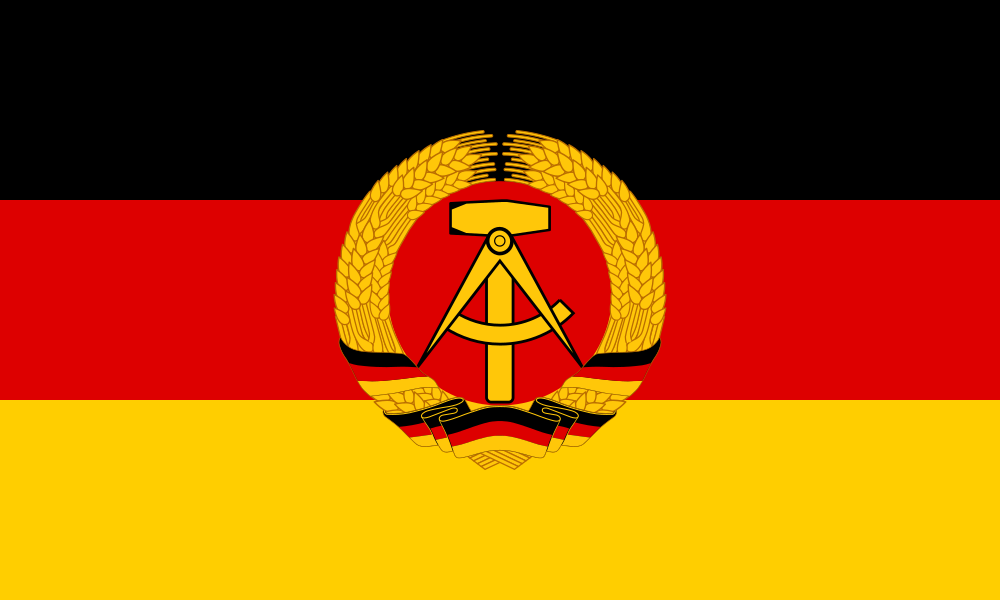
We are all witnesses to the changes in the international relationship of forces throughout the world that favour the struggle of peoples for peace, self-determination and independence, and for liberation from exploitation and oppression. The point of departure for those changes was the Great October Socialist Revolu tion which took place 60 years ago. Also, the peoples in the south of Africa have entered a new stage in their struggle for liberation from colonialism, racism and apartheid. The national liberation movements and the legitimate represen tatives of their peoples are making themselves heard Loud and clear in the United Nations in their demands for effective measures to ensure the immediate elimination of the rule of colonial and racist regimes, and they are meeting with ever wider support.
21. At a time when nations are calling ever more strongly for an end to the arms race, the cessation of the development of m;w types of weapons of mass destruction, such as the neutron bomb, and are clamouring with increased insistence for the strengthening of peace and international security, and yearn for the establishment of new and equitable economic relations so that they may devote their whole energy to peaceful ends, the illegal apartheid regime in Pretoria is not only an historical anachronism but also a serious obstacle to the achievement of a peaceful African continent. The apartheid regime in South Africa is the fundamental bastion of racism and colonialism in the south of Africa, and a serious threat to international peace and security. That is indicated by its anns build-up. and in particular, its attempt to obtain nuclear weapons, by its repeated acts of aggression against independent African States, by its continuing unlawful occupation of Namibia, and by the wide support it gives to the illegal Smith regime in Southern Rhodesia.
22. As once again we discuss the Pretoria regime here, a regime which is acting in criminal violation of the letter and spirit of the United Nations Charter, and as we demand the adoption. of effective measures to eliminate it, we cannot filii to note that this hotbed of danger would long since have been removed if all States Members of the United Nations had acted in compliance with the decisions of the General Assembly and had cut off all forms of assistance and support for the Pretoria regime. A few days ago in the Security Council, the right of veto was once again abused, as it has been repeatedly, for the purpose of preventing the adoption of effective sanctiol1s against the apartheid regime. Once again, the imperialist States set themselves against the group of African States and their just demands, based on decisions by the OAU and supported by the sOcialist and non-aligned States. That veto reflected an attempt on the part of the ruling circles of those States to obstruct radical change in South Africa. What is needed, of course, is not cosmetic changes, but a transformation which would deliver people from colonialism and ensure their equal rights. It is essential for that purpose to step up pressure on those still ruling in Pretoria and to give wide support to the efforts made by the oppressed and exploited people of South Africa to gain their freedom.
24. At a pienary meeting of the General Assembly the other day, Wc were again told that we must not set ourselves against Vorster, bel;ause allegedly it is n;ce~5.ary to show our bust and co-operation with him in the .'nterests of a so-called peaceful settlement. By way of ilbstratiorl! the question of Namibia was mentioned. However, to adopt that argument would be tantamount to putt~g the cart before tne horse, VI letting the goat loc ~~ in the kitchen garden. So far ~r· Namibia is concerned, w~ know that the UpJted Na!io:l~, in the General Assembly, in the Security Council. and, it the United Nations Council for Namibia, have adopted l uambiguous decisions which ouglri: to be
~piemented, so that the people of Namibia may exercise their sovereign right to self-rletermination and indepen- dence. The United Nations has reaffinned that the South West Afi'ica People's Organization [SWAPO] is the sole lawful representative of that courageous people. Therefore, the world Organization, which has assumed direct responsi-
~ility for Namibia, is in duty bound to ensure the transfer of political power into the hands of SWAPO. Attempts· to evade that commitment are merely an attempt to circum- vent the decisions taken by the United Nations. We stand fIrmly on the side of SWAPO in its struggle to counter plans that would lead to the achievement of neo-colonialist interests in Namibia.
25. Incidentally, I should like to note that trust in the racist regime of South Africa has never been justified; nor have the expectations that it would participate in good faith in resolving the existing political problems. Tins is shown by the pertinent documents of the U~ted Nations.
26. At this thirty-second session of the General Assembly con;;iderable attention has been given to the threat arising from the proliferation of nuclear weapons. We therefore fmd strange a recent statement published in The New York Times arguing in favour of continuing co-operation in the nuclear sphere with South Africa. There is strange logic in the assertion that co-operation with South Africa in that sphere would be a more effective means of preventing the acquisition of nuclear arms by the apartheid regime than cutting off co-operation, the more so as it is only the assistance and support of the Western Powers that have enabled the apartheid regime to i~ake so bold as to si!ek to acquire nuclear weapons. In my delegation's view, any State genuinely fIghting against the danger of nuclear weapons
27. The delegation of the Gennan Democratic Republic is frrmly convinced of the need to deepen the isolation of the apartheid regime in the interests of altering the ,situation now F,revailing there, which is a threat to peace. The Special COIIUr'oittee against Apa'theid, of which the German Demo- cratic Republic is a member, has rep\)atedly drawn atten- tioa to the dangerous protectioner that regime which takes the fonn of wide economic co-operation with SGuth Africa.
28. According to the documents of the Special Committee against Apartheid, many States members of the North Atbmtic Treaty Organization, in concluding long-tenn licensing contracts, in investing large amounts of capital and in exti~ndingcredit and facilities, a!'e decisively contributing to the strengthening of, among ot:her things, the military- industrial complex in South A:nca, and are making it
possibl~ for Vorster to continue his aggressive foreign policy as well as his policy of domestic repression. Here I should like also to refer to {!le document concerning co-operation between South A~ri(;a and Israel [A/32/22/ Add.3].
29. The peoples of the world are more and more vigor- ously demanding that all Governments take active steps to curb the designs of the ruling circles of South Africa, which are contrary to international law. At the Assembly of Heads of State and Government of the OAU, held in Libreville in July, it was noted that its ~olicy, which is dangerous to peace, and the character of the acts of the apartheid regime are making South Africa's complete isolation essential. The World Conference for Action against Apartheid, which met in Lagos with the participation of 112 States, the liberation movements and numerous governmental and non-govern- mantal organizations, also took a position of principle on the situation in South Africa and indicated what must be done to support the liberation struggle of the peoples of South Africa.
;;.-" ..' 30. Paragraph 6 of the Declaration adopted in Lagos states:
"The apart.heid regime in South Africa is ... one of the main opponents of th~ efforts of the United Nations and the international community to promote self-detenni- nation and independence in me ·lI'ea."l
The Lagos decisions call for an end to any military and nuclear co-operation with the racist regime, the cessation of economic suppert for that regime and effective control over strict compliance with the pertinent sanctions.
31. In the view of the delegation of the Gennan Demo- cratic Republic, the Lagos Declaration represents a pro- gramme the full implementation of which would serve the
1 See Report of the World. Conference for Action against Apartheid (United Nations publication, Sales No. E.77.XN.2), chap. X.
33. My delegation shares the view of the overwhelming majority of the membership of the United Nations that, as regards the regime in South Africa, which has long behaved disrespectfully to the United Nations, there can be no question of symbolic warnings that do no real damage to that regime. We are firmly convinced that the point is not merely to increase the rights of the oppressed people of South Africa but to attain equal rights for all. We do not share the view that all that is needed is merely some limitation of apartheid We are in favour of the extirpation of racial discrimination and for the exercise of the inalienable rights of the oppressed people in South Africa. Our position is in accordac~e with the Charter of the United Nations.
34. In order to biing about the defmitive elimination of the vestiges of colonialism, racism and apartheid the further mobilization 'Jf world opinion is going to be necessary, as well as the adoption of effective decisions to bring about the complete isolation ofthe apartheid regime.
35. The German Democratic Republic stands frrmIy in solidarity on the side of the oppressed peoples in southern Africa and supports them in their arduous and many-sided struggle.
36. We are convinced that the national liberation move- ment of South Africa, which has produced so many brilliant leaders, such as Nelson Mandela, in alliance with the other progressive forces of the world, and in particular the socialist States, will win the day over the forces of colonialism and raClSffi and their patrons. The German Democratic Republic wllI be all the more glad to contribute to this in 1978, the International AniJ-Apartheid Year.


The agenda item now before us is of the greatest international importance. We are dealing with the issue of apartheid caused by the policy of racial discrimination and oppression practised by the southern African racist regimes against the peoples of the region. This problem has taken on such scope that the security of the region has seriously deteriorated and international peace and security are directly affected.
39. The report of the Special Committee against Apart- heic! fA/32/22j and the Secretary-General's report /A/32/302j describe the seriousness of the situation in the region as well as the flagrant injustice inflicted upon the peoples of South Africa and the escalation of operations perpetrated by the racist regime in a manner which violates the most fundamental human rights.
40. In this connexion, I should like to pay a tribute to the Special Committee against Apartheid. which has spared no effort to unmask the policy of the racist regime and to mobilize world public opinion against that regime.
41: Since the birth of the United Nations and the adoption of principles concerning human rights, the Pre- toria Government has disregarded all those principles and United Nations decisions and has not respected them because Pretoria thought that time was on its side and that only force could provide a sound basis for that racist regime. That regime has led certain countries to believe that it is· alone capable of protecting their interests and of safeguarding one of the last bastions ofWestern civilization in the region.
42. Egypt was one of the first States which from this rostrum and _in other bodies drew attention to the seriousness of the oppressive situation in South Africa and to the danger stemming from the indulgence shown by the international community to this regime, and we have given our support to liberation movements because we believe that the struggle of those movements is alone capable of speedily ensuring majority rule and the security of the region.
43. Some countries felt that the required changes could be effected by entering into direct contact with the racist regime and that, through peaceful negotiations, there could be a peaceful settler.tent of the problem. This is reflected in the votes on draft resolutions submitted to the Security Council and the General Assembly. This difference of views has in turn led to division in our international community and has been a reason for friction between various groups.
44. Reality has proved the soundness of our premise that this regime is not flexible enough,ID allow us to solve the problem peacefully by means of progressive change. This is something that we ascertained at the Conferences in Maputo and in Lagos because there we were witness to the greatest and most widespread struggle of the peoples against the racist regimes of southern Africa. Thanks to those two Conferences world public opinion was mobilized to put an end to the racist policy of Vorster.
46. The Security Council decision, together with the growing awareness among the world's public of the trials and tribulations of the Mrican people, which has been dispersed, whose blood has been shed, whose homeland has been tom apart, and whose desire, like that of other peoples, is to achieve independence, leads us all to assume responsibility in a common struggle to eradicate the racist regime and to enable those whose prerogative it is to exercise their rights to do so.
47. In our view, Vorster has turned his country into an arsenal of ultramodern weapons; he has the means to produce nuclear weapons. Consequently, unless a fmn position is adopted towards him, he will shamelessly pursue his aggressive policy and try to stifle the heroic struggle of the African people. Proof of this is to be found in the comment by the Prime Minister of the Pretoria Government on the last Security Council decision, which was published in the 8 November issue of The New York TImes:
"The Prime Minister ... said that his Government had anticipated the move by making South Africa self- sufficient. He was alluding to the stockpiling of foreign anns supplies and the build-up of the country's military industry, which manufactures almost all the material needed for internal security."2
That statement does not worry us in the least, as long as we are all determined to put an end to that regime. It has not caught us unawares; indeed the Mrican continent is fully aware of Vorster's measures to confront the situation by manufacturing anns and trying to produce nuclear
weap~ns. What is important is the regime's shamelessly declared overt intention to pursue its policy. That is why it is proper for us to assess that regime as we are doing, and that is also why the international community has to unite its efforts to confront that regime. Moreover, the Charter, notably in Chapter VII, has provided us with numerous means by which to fight that regime.
48. In our view, VOiSter will forge closer links with those of his allies that do not implement the Security Council 53. Egypt, faithful to its policy and to its obligations decision-Israel in particular, whose co-operation with towards the people of South Mrica, and faithful to the Pretoria is not merely a strategic factor but an integral part moral, political and material support it accords to the of both countries' national security. I shall not go into liberation movements to aid in the attainment of their detaB here on the undeclared alliance between Israel and goals, will continue to co-operate with the African National South Africa. Need we recall that Israel is providing Congress of South Africa JJld the Pan Africanist Congress Pretoria with specialists in tl}.e struggle against liberation of Azania.
49. In this connexion, Reuters, on 6 November, wrote as follows:
"Israel has growing commercial trade ties with South Africa, and according to foreign press reports-denied by Pretoria-has agreed to supply South Africa with up to 24 Kfll' jet fJghter planes and six long-range gunboats with missiles."3
50. True, on the following day, Israel attempted to reduce the scope of that statement in order not to exacerbate further international public opinion. However, we would draw the attention of members to the fact that thp, nature of those two regimes and the similarity of their policies are such that it would be difficult to believe that Israel would implement United Nations resolutions as do other countries ofthe international community.
51. As part of the African continent, Egypt considers it its duty to its African brothers to draw attention to the danger threatening our continent-the danger po~d by Israel and by all those who co-operate with Pretoria. We have already denounced that unholy alliance betwten those regimes and the South African racist regime. The time has come to prove the soundness of our thesfs by recalling the reaction of Israel and Pretoria to the Security Council decision. Their position can well be described as one of arrogant, stubborn disregard for unanimous international opinion.
52. Pretoria's cOllilict with the heroic freedom fighters, and that regime's efforts to destroy the unity of the South African people through the policy of bantustanization; South Mrica's military arsenal; its alliance with other racist regimes-none of that will be able to stem the tide of history or the natural trend towards majority rule, because oppression and injustice engender only bitterness and the determination tp recover rights of which one has been deprived. Our contemporary history provides an example of one of the greatest revolutions of all time which succeeded· in changing, political, social and economic situations based on the subjection of peoples to injustice. Those feelings of bitterness and frustration were the creative force behind the success of such revolutions.


Last August the World Conferent;e for Action against Apartheid was held in Lagos with the participation of representatives from more than 100 Governments and organizations. The Secretary-General of the United Nations himself attended the Conference, as did three·Heads of State and 40 ministers of cabinet rank. It was indeed an epochal event and it was all the more impressive because of the fact that a conference of that magnitude was able to adopt by consensus a Declaration on this complex issue ofapartheid
56. The success of the Lagos Conference cannot but remind us of Japan's single-handed struggle for racial equality more than half a century ago, in fact in the days of the League of Nations. At the turn of the century, when Japan entered the modem society of nations, the concept of racial inequality towered so high that it seems to us a forbidding wall which defied any challenge. Japan was alone at that time in crying out to the world for racial equality. Now we fmd ourselves in a completely different world. Global decolonization has been almost completed. The principle ofthe equality ofthe races is accepted almost the world over. Although there are still some areas in which racial discrimination is imposed, it is almost a certainty that majority rule will be implemented in Rhodesia and Namibia in the near future, in one way or another. And now we have the world consensus against apartheid, as stated explicitly in the Lagos Declaration.
57. The position of the Japanese Government on the question of apartheid has been made clear on very many occasions in the past. We have always believed that the apartheid policies of South Africa are a violation ef racial equality and respect for fundamental freedoms, which are among the basic purpcses of the United Nations. As for a method of dealing with this problem, we have always maintained that it is essential to seek a peaceful solution of the problem through talks among all racial groups in South Africa and, in order to induce changes within the South African society, to apply to South Africa as much international pressure ~ possible and practical.
58. In this context, it is indeed deplorable that the South Mrican Government recently resorted to harsh measures against citizen organizations and newspapers. Those measures have dealt serious blows to those who have consistently maintained that the problem of apartheid should be soh'ed through practical dialogues between the different races in South Mrica.
59. Also, the Japanese Government feels obliged to express its deep concern over the possibility that nuclear weapons are being developed by the South African Govern- ment. If is incumbent upon Japan to express this concern. As the only nation which has experienced the horrors of
61. Today the Japanese Government renews it appeal to South Africa to face up to the prevailing reality of international solidarity and seek as soon as possible a solution to the problem~based on the racial equality and fundamental human rights proclaimed in the Charter. The situation is moving fast, perhaps faster than at any time in the past half century, since Japan first raised the question of racial inequality.
62. In connexion with the United Nations endeavours to exert pressure on South Africa, I wish to explain briefly the actions that Japan has taken in addition to the arms embargo and the prohibition of nuclear co-operation which I have mentioned.
63. Japan -has no diplomatic representation in South Africa but only maintains the consular relations which are necessary for all practical purposes. In the economic field, it is Japan's basic policy to confme its economic relations with South Africa within the framework of normal trade. The Japanese Government :has refrained from extending any economic co-operation to Squth Africa. Japan has prohibited direct investment in South Africa by Japanese nationals or bodies corporate under its jurisdiction. In other fields, the Japanese Government has adopted the policy of discouraging exchanges with South Africa by Japanese nationals in the fields of sport, culture and education. Furthermore, in view of the relevant United Nations resolutions, the Japanese Government has adopted the policy of refusing, in principle, the issue of any entry visas to South African nationals for the purpose of exchanges in sport, whether amateur or professional, or in cultural and educational fields.
I 64. Japan has provided assistance to the oppressed people of South Africa and their liberation movements in the fonn of annual contributions to the United Nations Educational and Training Programme for South Africa, the United Nations Trust Fund for South Africa and the Trust Fund for Publicity against Apartheid.
65. I wish to conclude my remarks by commenting on the particular significance ofthe strict ban on direct investment in South Africa which Japan has voluntarily imposed on itself. For a country such as Japan, with its vast population and scanty natural resources, trade is a matter of survival. Of special importance to Japan is trade that is supported
66. It is not that we are complaining. The Japanese delegation simply wishes the representatives here to know that Japan is making a sacrifice of significant importance in the common cause of mankind. The Japanese people, whose Government was the first to speak out for racial equality in international society, has proudly accepted this sacrifice. It is the sincere hope of the Government of Japan that this sacrifice by the Japanese people, together with the sacrifices offered by other nations, will r'lt have been in vain, and in the end will have contributed to progress toward a society in South Africa blessed with human dignity and political equality.


More than three decades have passed since the General Assembly of the United Nations first took up the question of the racist policy of apartheid pursued by the South African regime. If we were to see only the phenomena and do no more than gloss over them, it would appear strange that, while our Organization has resolved several questions of historic significance during the past 30 years, it has produced no spectacular progress in this regard. We who participate in this debate are never- theless aware that what is involved here is not simply the fact that 18 million Africans are oppressed and exploited by 4 million whites, who also keep Namibia under occu- pation; there is a fundamental social contradiction lying hidden behind this matter on an international scale. As a fortress of imperialism's colonial system now going down the drain, the apartheid regime is trying to conserve an outmoded and outlived systerri of society that stands up against the advance of mankind and against universal social progress.
,58. The truth of this statement is borne out by m3J"ly years of experience in the struggle against apartheid. The growing unity and the increasing joint efforts of the world's progressive forces on behalf of the oppressed people of South Mrica are meeting with ever stronger resistance from the Fascist regime and with desperate manoeuvring by the extremist circles of imperialism. Such imperialist support has led to a reign of terror in that region which reminds us of the darkest days ofNazi fascism.
69. Since June of last year the ill-famed security policy of the apartheid regime has admittedly murdered over 400 African patriots and has wounded hundreds and imprisoned thousands .of people in its hunt after the activists and
f!ght(~rs of the progressive and liberation movements. In the overwhelming majority of· cases, the imprisonments and internments are not subject to court judgement, while even
71. Applying the principle of 4ivide and rule, divide et impera, which is a well-known tool in the colonizers' arsenal and is now embodied in the establishment of the so-called bantustan administration, the apartheid regime is going out of its way to prevent the people of that territory from ever exercising its sovereignty and achieving the integrity of its ancient land. The internal terror is coupled with immense aggressiveness, constituting a permanent threat to the neighbouring countries of Africa and to international peace.
72. We are all aware that the apartheid regime is no longer able to maintain its rule except by resorting to brute force. Spending astronomical amounts on military purposes, it has built up a military potential that, with the added factor of the regime lack of restraint, has come to raise dangers for the peace and security not only of the region but also of the world at large. It was only with support from the extremist circles of imperialism that the South African regime was able to build an enormous arsenal of arms and to develop a capability for the production of even the most modern weapons. Despite successive resolutions of the United Nations, that support has not diminished but rather has increased through loans, fmancial transactions and foreign investments. The total value of foreign-owned working capital in South Africa is impossible to estimate. The subsidiaries there of the large multinational corpora- tions constitute the strongest basis of and guarantee for th~ racist regime, a guarantee to the effect that, despite all their fine-sounding political statements and window-dressing actions, the imperialist countries concerned will continue to support the apQltheid regime. Once again such an attitude . was revealed recently by the Western members of the Security Council when they vetoed the draft resolution of Mrican countries4 which provided for appropriate sanc- tions against the South African regime.
73. The fact that those Member States did not agree to sever fmancial and economic relations and even to suspend nuclear co-operation, thus openly throwing offtheir masks as spearheads· of social progress, shows that the racist regime in South Arnca and the imperialist Powers stem from one and the same root. Their ties are much too deep-rooted to permit them to stand ready to break such ties in the interests of about a score of millions of blacks, let alone that black continent as a whole.
74. In view of these facts it is only natural that the progressive forces of the world should unite their efforts in taking ever more vigorous action with each passing year. It was du.e to such concerted action that the question before us was, for the fIrst time, considered directly in plenary meetings, with last year's session of the General Assembly
75. After the conclusion of the thirty-frrst session of the General-Assembly, the international struggle against apart- heid continued with new important landmarks, like the meetings at Maputo and Lisbon or the Lagos Conference, which was attended by delegations from 114 Governments, the OAU, liberation organizations and international demo- cratic movements, as well as by outstanding fighters for peace.
76. Also worth mentioning are the consultative missions sent by the Special Committee against Apartheid to various Mrican and European countries, including the Soviet Union, for the purpose of advancing the international struggle against apartheid and co-ordinating it at a higher level. These missions resulted in an understanding on the strengthening of future co-operation in this field.
77. Added encouragement would be provided by the series of events proposed for the year against apartheid and the racist regime in a recommendation made by the Economic and Social Council in its resolution 2082 (LXII) and reaffrrrned in decisions of the OAU and of the Lagos Conference.
78. The aforementioned international events and the fmal documents of the Conferences and the Lagos Declaration clearly show to the General Assembly at its current session the way towards an actual solution. The strengthening of the role of the United Nations is demonstrated by a significant step that we have indeed taken on this road, namely, that after a lapse of 30 years the Security Council, responding to a proposal in paragraph 26 of the Lagos Declaration, has adopted the frrst resolution imposing a mandatory embargo on arms to the racist regime in South Mrica by invoking Chapter VII of the Charter of the United Nations. It should be noted, however, that the significance of that step lies today more in the affinnation of a principle than in any practical value given the economic potential that that regime has come to possess in the meantime.
79. The Hungarian People's Republic, as a founding member of the Special Committee against Apartheid, has from the outset consistently taken an active part in the struggle against apartheid. Our delegations participate and assist in international arrangements and jot'! in the prepara- tion of relevant resolutions. As the President of the Presidential Council of my country stated in his message to the Lagos Conference:
, "In keeping with its position of principle, the Govern- ment of the Hungarian People's Republic has undertaken to play an active role in helping the growth of the anti-apartheid movement and, by making use of every possible means, has consistently supported and will continue to support the struggle of oppressed peoples seeking to put a fmal end to racial discrimination and apartheid within the framework of their fight for the achievement and exercise of the right to self-determi- nation u •


The agenda item now under discussion in our Assembly is one of those which are as old as the United Nations itself.
82. We may remind ourselves that thi: racial policy of
S(j~th Africa was one of the first questions to which the United Nations addressed itsalf at the opening session of the General Assembly in 1946. In 1952, this question was raised as a \Yhole for the fust time before the General Assembly and became the sUdject of frequent debate in subsequent years.
83: Nevertheless, it was with the Sharpeville massacre in 1960 that the world was brutally awakened to the inhumanity of the system and to the dangers it represents.
84. Since its creation in 1963, the OAU has been firmly conunitted under its Charter to the struggle against apart- .heid.
85. But what is this word that has been so sadly added to ourvocabulary?
86. Apartheid is a more sophisticated fonn of racism. The word "racism'~ has at its root the word "race", and racism is a distinction or a discrimination among human beings based on their belonging to a particular race. This distinc- tion is itself based on a value judgement that draws up a certain hierarchy among races. Thus, there are sa:.d to be superior races and inferior races. The criteria employed for establishing this hierarchy are determined by those who thought up the theory.
87. In various periods of history there have always been madmen or fanatics who invented racist theories, but this is the first time that any theory has been politically institu- tionalized, as it has been in the Republic of South Africa. This particular system, which has been dubbed with the notorious name of "apartheid", is a pure and simple negation of the value of man. Apartheid, as a policy institutionalizing racist domination and exploitation im- posed by a minority regime in South Africa, constitutes a flagrant violation of tlt.e United Nations Charter and the Universal Declaration of Human Rights. T~1is policy rests on discrimination, dispossession, plunder, exploitation and social oppression of the indigenous population by white settlers from the second half of the seventeenth century down to our own day. It is a crL.-ne against the conscience and dignity ofmankind.
88. Apartheid has brought tremendous suffering to the blacks through laws that have been especially enacted for them to restrict their freedom ofmovement. That inhuman policy is implemented by mercilessly repressive measures. It creates tensions and conflicts that are likely to endanger .world peace. In violation of elementary human rights it reduces men to the status of objects, forbidding them every act except that oflabour which is rewarded with a pittance.
90. Apartheid is truly hateful because it is a system that has one sole aim, the domination of the black man by the white man. This domination is extended also to the moral and religious areas. Apartheid thus runs counter to the principles of Western civilization, which is ostensibly based on Christianity.
91. But the fundamental message of Christianity has to do with equality and the liberation of men. We can thus deny that the South African whites are Christians at all, just as we can deny that anyone can be a Christian who supports them-unless Christianity is a bad joke.
92. If, then, the blacks of South Africa are regarded as being subhuman, we may also conclude that this is because of racist theories which flourished in the time ofGobineau and all his disciples, including Nietzsche, to reach their apotheosis under Hitler. According to Hitler, the finest type of man is strictly the Aryan type. By that token, we can once again note that the Boers of South Africa, according to that theory, must be regarded as sub-men. But those sub-men, according to the Hitler theory, have found their own sub-men, regarded as such because they are blacks. That is indeed an aberration.
93. Free and independent Africa is amazed to eee that those who claim to represent Christian civilization, those who cringed from the ideas of Gobineau as practised by Hitler are those who today are the supporters of the South African regime-oris it that they'accept the theory of black sub-humans proclaimed by their white South African brothers?
94. The regim6 established in South Africa is one based on fear-fear that a liberalization of the regime will lead to a loss of the tyrranical predominance of the present minority; fear that that minority will lose all present privileges that have been accumulated at the expense of the blacks; fear, lastly, of democracy, since it would give the country to the black majority if agreement is reached on the principle of "one man, one vote".
95. The system of apartheid is inadmissible because itis a system which isolates. It isolates both those who must suffer it and those who practise it. It isolates those who are its victims in a world which humiliates them and deprives them of the most elementary freedoms and guarantees. It also confines the partisar..s of that policy within an absurd all-or-nothing adventurism which today is leading them into the worst type of excesses and may well plunge the country into catastrophe. In their struggle to survive, the South African whites resort to the most inhuman means of defence, both internally and externally; it is a reign of terror. They cannot triumph because they are in a perpetual state of fear, convinced that .the South African blacks are the authentic African, if not the only South African, having no other possible origin.
97. The role of the international community is to call upon South Africa to abandon its rar-ist policy and restore to the blacks their dignity by allowmg them to live as free men, side by side with other human beings, black, yellow or white. This is the only way they can become the brothers and friends of the whites ofSouth Africa.
98. But that peaceful and friendly solution has been awaited all too long.
99. Among the various measures taken by the United Nations on the matter, we may mention, among others, the proclamation contained in resolution 3411 C (XXX) of 28 November 1975, that:
"... the United Nations and the international com- munity have a special responsibility towards the oppressed people of South Africa and their liberation movements, and towards those imprisoned, restricted or exiled for their struggle against apartheid"•
Another recommendation is that the General Assembly adopt, inter alia, a global action programme aimed at the complete isolation of the racist regime of South Africa and effective support for the South African lineration move- ments.
100. For its part, the Security Council has adopted a number of resolutions on the question, particularly resolu- tion 392 (1976) of 19 June 1976, which declares that the policy of apartheid seriously disturbs international peace and security. .
101. In its resolution 417 (1977) of 31 October last, the Security Council strongly condemned the South African racist regime for its resort to massive violence and repres- sion ..t~ainst the black people. It demanded that the racist regime of South Africa abolish the policy of apartheid by desisting from violence, by releasing all political prisoners, by abolishing the policy of bantustanization and ensuring majority rule based onjustice and equality.
102. Finally, on 4 November 1977, in its resolution 418 (1977), the Security Council, for the first time in the history ofour Organization, unanimously adopted a manda- tory emh~go on arms shipments to South Africa. That was a historic event, for action under Chapter VII of the Charter has now been taken against a Member State. My delegation is happy to extend its congratulations to the members of the Security Council for ushering in a new phase, which is the culmination of the very prolonged efforts ofthe international community to put an end to the tragic situation v.:hich obtains in South Africa. We cannot, of course, harbour too many illusions about that first step, frrst because no measure, whatever it may be, will have its full effect unless Member States are fmnly convinced of the danger to international peace and security represented by the apartheid regime. Next, we hope that the embargo will be honestly and scrupulously applied by all Member States, above all by those States that are the major arms merchants.
would oblige the rest of the continent to equip itself with similar weapons, by hook or by crook, and at any cost.
104. Thus far the racist South African regime has flouted the international community by rejecting all the decisions of our Organization. Thus my delegation was not surprised to note, in the letter of 4 November 1977 addressed to the Secretary-General by the charge d'Affaires of the Perma- nent Mission of South Africa to t..11e United N2tioIis,5 the
blind arrogance of the Pretoria leaders andche defiant challenge hurled at our Organization and the whole world by the racist SouthAfrican regime.
105. The international community cannot remain indif- ferent to that explosive situation, particularly since that community includes, among others1 black African States in which there are good relations between black and white populations following a common destiny.
106. That is why it would be too much to expect the international community to wait indefinitely for political changes in South Africa.
107. In its struggle against apartheid. the United Nations must seek out the most effective ways and means of
ac~elerating the process of liberalization of the South Mrican regime.
S Ibid.• iocument 8/12439:
109. To be effective those extreme measures would have to be applied without exceptions. J'he dignity and freedom of South African blacks are more important than any material advantages that may be derived from that country.
110. It is by the adoption and stringent application ofthe measures I have just listed that African public opinion will be convinced that the international community really wants to see an end to the racist South African regime; otherwise the frne speeches larded with good intentions that are delivered in this hall will merely be an attempt to pull the wool over people's eyes.
~ 111. In that case, there would be only the one alternative left: violence, which becomes legitimate when all attempts at a peaceful solution have failed. But we have not yet reached that point.
112. We still hope that the United Nations, which bears the heavy burden of safeguarding the freedom and dignity of every man, whoever he may be, will be able to frnd a just and equitable solution to this painful problem, which is paralysing tile normal life of a whole region of the African continent.
The meetingrose at 5.15 p.m.