A/60/PV.91 General Assembly

I now call on the representative of South Africa, speaking on behalf of the Group of 77 and China.


On behalf of the Group of 77 and China, we would like to concur with the Secretary-General’s decision to nominate Anna Kajumulo Tibaijuka as Executive Director of the United Nations Human Settlements Programme (UN- Habitat) for another term of four years.
Since her appointment as Executive Director of UN-Habitat, she has proven herself worthy of leading that important Programme by working hard to analyse the issues and challenges to sustainable urbanization — an issue that is of great relevance to the developing world. Her leadership qualities, which have guided issues of sustainable urbanization, prompted the General Assembly to upgrade the old United Nations Centre for Human Settlements into a full-fledged programme of the United Nations. The Group of 77
and China hold that decision dear, as it was sponsored by the Group.
The Group of 77 and China commend the progress made in the first four years of UN-Habitat in its new capacity as a Programme. Ms. Tibaijuka has untiringly raised the visibility of the issues and the Programme. In particular, we have noted with satisfaction the active role being played by UN-Habitat in assisting Member States to achieve the Millennium Development Goals, especially target 10 on water and sanitation and target 11 on slum upgrading. In that regard, we urge our development partners to give the Executive Director of UN-Habitat the financial support required.
The youngest programme in the United Nations system plays an important role towards achieving sustainable development. Unfortunately, the resources dispensed to the Programme are disproportionate to its task.
We are all acutely aware of the problems facing the world. Recently, at the third session of the World Urban Forum in Vancouver, Canada, we were once again alerted to the fact that one of the most pressing issues we face today is rapid urbanization in a world where half of humanity lives in cities and where, in the next 50 years, that proportion is expected to reach two thirds of the global population. Most of that urban growth is taking place in developing countries, where the major challenge is to combat poverty and provide better access to basic shelter and services, such as clean water and sanitation.
The Group of 77 and China would like to emphasize that, during the ongoing reform process within the United Nations, such programmes as UN- Habitat, which have a clear and unique mandate, should not be sacrificed or diluted by that exercise. Instead, such programmes, which are so intricately linked to sustainable development in a rapidly globalizing world, should be bolstered and strengthened.
Once again, we wish to renew our confidence in the leadership of Ms. Anna Kajumulo Tibaijuka, as she has proven herself in her last term to be a champion of the cause of sustainable urbanization. We particularly commend her participation in the follow-up to the work of the Commission for Africa on urbanization in Africa. Her humanity and humility were so aptly expressed at the third session of the World Urban
Forum, where she introduced to the gathering her student and her old teacher, to whom she attributed her professional success, as it was due to that person’s encouragement that Ms. Tibaijuka excelled in her debating team and so developed the requisite skills for promoting and creatively leading such a programme.
We look forward to the next four years of her visionary approach around issues of sustainable urbanization, as well as to finding the balance between urban-rural linkages, so touchingly depicted by the little Kenyan Moipei sisters singing at the third session of the World Urban Forum.
The Group of 77 and China wish Ms. Tibaijuka every success in her new term, and we look forward to working with her once again.


My delegation associates itself with the statement just delivered by the representative of South Africa on behalf of the Group of 77 and China.
I take this opportunity to welcome and congratulate Ms. Anna Tibaijuka following her reappointment to the post of Executive Director of the United Nations Human Settlements Programme (UN- Habitat) at this morning’s 91st meeting of the General Assembly.
The appointment of Ms. Tibaijuka is a true indication of the trust and confidence we, the States Members of the United Nations, have in her abilities. Of course, she has eloquently justified that trust and confidence through her diligent, dedicated and unwavering engagement at the helm of the United Nations Human Settlements Programme since her first appointment in 2001.
The importance of the United Nations Human Settlements Programme cannot be overemphasized, given the issues that it is handling. Issues of human settlements are at the core of sustainable development, as they are closely linked to shelter, which, in its true sense, is indeed a basic need.
We well know that millions of people in the world today either have no shelter at all or live in substandard and inhuman conditions. Equally important are the very worrying rate of urbanization and the associated threatening rate of slum development. It is estimated that, today, over 1 billion people live in slums, and that number is likely to double in about 10 years unless urgent measures are
taken. We know well that those are issues on which UN-HABITAT has developed immense competence, especially during the tenure of Ms. Anna Tibaijuka. It is important therefore that the UN-HABITAT programme be adequately supported, both technically and financially, to enable it to face the challenges before the world in the areas of human settlements, slum prevention and slum upgrading.
Closely linked to the work of UN-HABITAT are the health and environmental aspects — water and sanitation and environmental management and sustainability — of the housing and human settlements area. It is, however, important to note that, by working closely with other United Nations agencies and programmes, UN-HABITAT has been able to integrate those important aspects into its work. That is commendable, as it has greatly contributed to the improvement of human livelihoods through an integrated approach to human settlements and related environmental aspects.
I wish to applaud the Executive Director for her great work in those areas, including in particular her efforts in implementing the Habitat Agenda and the related Millennium Development Goal programmes and projects in Kenya. She has been instrumental in supporting my Government in slum-upgrading programmes. More striking is the fact that she is the first UN-HABITAT Executive Director to have established an office in one of the largest slums in the world, the slum of Kibera in Kenya. I believe, Mr. President, that you yourself visited the Kibera slums during your recent visit to Nairobi and saw the challenges, as well as the efforts that are being made jointly by the Government, UN-HABITAT and other development partners in partnership with grass-roots organizations and non-governmental organizations.
Hence, I call upon Member States to reaffirm their support for the Executive Director in her endeavours to implement the Habitat Agenda and the related Millennium Development Goals in all our countries, especially in the developing world.
My delegation, I personally and Kenya, which is host to UN-HABITAT, reaffirm our support and will facilitate the work of UN-HABITAT and of the United Nations Office at Nairobi to the fullest extent possible.
Let me end by noting the excellent work done by the Executive Director in spearheading very important initiatives, which include organizing the second session
of the World Urban Forum, held in 2004 in Barcelona, Spain, and the Forum’s third session, which concluded just last week in Vancouver, Canada.
I wish the Executive Director well; we shall give her the fullest support.


The delegation of the United Republic of Tanzania wishes to join the first two speakers in extending our warmest congratulations to Ms. Anna Tibaijuka on her re- election as Executive Director of the United Nations Human Settlements Programme (UN-HABITAT). Ms. Tibaijuka has done a commendable job in raising the profile of urbanization challenges in all parts of the world.
My delegation wishes specifically to emphasize the importance of capitalizing the United Nations Habitat and Human Settlements Foundation and its Slum Upgrading Facility. That call was made in paragraph 56 (m) of the 2005 World Summit Outcome (resolution 60/1). Our Vice-President, His Excellency Mr. Ali Mohammed Shein, who delivered a keynote address at the third session of the World Urban Forum, which just ended in Vancouver, has correctly observed that, unless good urban policies are followed by commensurate investment resources at the local level, it will be very difficult to translate ideas into action. We urge Ms. Tibaijuka to enhance her efforts in the challenging task of capitalizing the Habitat and Human Settlements Foundation. We appeal to donor countries to continue their efforts to assist the Executive Director in that task by providing sufficient and predictable resources in a timely manner, in order to enable her to fulfil her obligations as mandated by Member States.
Tanzania will do all that is within its power to assist the Executive Director to discharge her responsibilities successfully.
114. Admission of new Members to the United Nations The President: I should like to invite the General Assembly to consider the positive recommendation by the Security Council on the application for admission to membership in the United Nations of the Republic of Montenegro. The Security Council has recommended the admission of the Republic of Montenegro to membership in the United Nations, as stated in document A/60/902. In this connection, a draft resolution has been issued as document A/60/L.58. I give the floor, first, to the representative of Austria, to introduce draft resolution A/60/L.58.
Vote:
60/264
Consensus


Let me begin by associating Nigeria with the statement made by the representative of South Africa on behalf of the Group of 77 and China, and in particular by congratulating Ms. Anna Tibaijuka on her good work and her strong leadership of the United Nations Human Settlements Programme (UN-HABITAT), in recognition of which the Secretary-General recommended her re-election, which the General Assembly has just endorsed. That is a reflection of our collective faith in Ms. Tibaijuka and our satisfaction with her excellent work. Since her assumption of office, Ms. Tibaijuka has worked
tirelessly to place the critical issues of shelter and urban environmental sustainability on the front burner of the global agenda, particularly in Africa, where the challenge of rapid urbanization is most acute.
Nigeria is very pleased at the support that UN-HABITAT has given to the African Union, and more especially the establishment of the African Ministerial Conference on Housing and Urban Development as the vehicle to facilitate the implementation of the Habitat Agenda and the relevant Millennium Development Goals. UN-HABITAT has also been instrumental in launching the Cities Programme of the New Partnership for Africa’s Development and is working with the African Development Bank to ensure the realization of sustainable shelter objectives in Africa. Indeed, Nigeria has been working very closely with UN-HABITAT on the sustainable cities initiative and sustainable urban governance, and it is very happy to house the UN- HABITAT support office in Abuja to further those goals. We look forward to expanding our cooperation and would like to emphasize the need for adequate funding of the core budget of UN-HABITAT to enable the Programme to fulfil its mandate.
I think I can safely say that we in the United Nations can congratulate ourselves on the re-election of Executive Director Anna Tibaijuka. During my visit to Nairobi in April, I saw for myself the impact of her leadership on the United Nations Human Settlements Programme and on the important issues of human settlements, urbanization and development.
The General Assembly has thus concluded its consideration of sub-item (d) of agenda item 112.
161. Extension of the term of the permanent judges of the International Criminal Tribunal for the Prosecution of Persons Responsible for Genocide and Other Serious Violations of International Humanitarian Law Committed in the Territory of Rwanda and Rwandan Citizens Responsible for Genocide and Other Such Violations Committed in the Territory of Neighbouring States between 1 January and 31 December 1994 Letter dated 3 May 2006 from the Secretary- General addressed to the President of the General Assembly (A/60/878) Letter dated 13 June 2006 from the President of the Security Council addressed to the President of the General Assembly (A/60/906) The President: In document A/60/878, the Secretary-General transmitted a letter dated 21 March 2006 from Judge Erik Møse, President of the International Criminal Tribunal for Rwanda. In his letter, the President of the Tribunal recalls that the term of office of the permanent judges of the Tribunal will come to an end on 24 May 2007 and that there are a number of multi-accused trials that are currently under way before the Tribunal that are likely to continue beyond that date. All single-accused trials currently in progress are due to be completed between May 2006 and May 2007. The President of the Tribunal is of the view that it would not be a viable option to delay the commencement of new trials until after the newly elected judges assume their duties on 25 May 2007. This means that most if not all of the permanent judges will be engaged in trials when their four-year term expires on 24 May 2007. Should certain judges not be re-elected, particular cases might have to resume de novo with new judges. Consequently, in order to ensure continuity and the ability of the Tribunal to implement its completion strategy, as set out in Security Council resolution 1503 (2003) of 28 August 2003, and complete all trials by 2008, the President of the Tribunal requested that the current term of office of the permanent judges of the Tribunal be extended until 31 December 2008. As the statute of the Tribunal does not provide for extending the term of office of the permanent judges, approval of the Security Council, as the parent organ of the Tribunal, and of the General Assembly, as the organ that elects its judges, would be needed in order to extend the term of office of the permanent judges until 31 December 2008. The Secretary-General therefore requests that the General Assembly and the Security Council grant such approval. In document A/60/906, the President of the Security Council transmits to the President of the General Assembly the text of Security Council resolution 1684 (2006) of 13 June 2006, whereby the Council, inter alia, “Decides in response to the request by the Secretary-General and notwithstanding the provisions of Article 12 (bis), of the Statute of the International Tribunal for Rwanda, to extend the term of office of the following permanent judges of the International Tribunal at the Tribunal until 31 December 2008: – Mr. Charles Michael Dennis Byron (Saint Kitts and Nevis) – Mr. Asoka de Silva (Sri Lanka) – Mr. Sergei Aleckseievich Egorov (Russian Federation) – Mr. Mehmet Güney (Turkey) – Ms. Khalida Rachid Khan (Pakistan) – Mr. Erik Møse (Norway) – Ms. Arlete Ramaroson (Madagascar) – Mr. Jai Ram Reddy (Fiji) – Mr. William Hussein Sekule (United Republic of Tanzania) – Ms. Andrésa Vaz (Senegal) – Ms. Inés Mónica Weinberg de Roca (Argentina) “Requests States to continue to make every effort to ensure that their nationals who serve as permanent judges of the International Tribunal for Rwanda remain available to serve in their positions until 31 December 2008.” If there is no objection, I propose that the Assembly decide to endorse this recommendation of the Secretary-General, which was endorsed by the Security Council in its resolution 1684 (2006) of 13 June 2006.
It was so decided.
May I take it that it is the wish of the General Assembly to conclude its consideration of agenda item 161?
It was so decided.


On behalf of the European Union, the countries aligning themselves with this statement and an impressive number of other sponsors, it is a great honour and privilege to recommend to the Assembly the adoption of the draft resolution before it to admit the Republic of Montenegro to membership in the United Nations. That is in accordance with Article 4 of the Charter, and it follows the adoption of Security Council resolution 1691 (2006) of 22 June 2006, which recommends to the General Assembly that the Republic of Montenegro be admitted to membership in the United Nations.
In his letter of 5 June (A/60/890, annex), President Vujanović has requested the admission of the Republic of Montenegro to membership in the United Nations and has confirmed his country’s complete adherence to the Charter of the United Nations. We warmly welcome the presence of the President of the Republic of Montenegro, His Excellency Mr. Filip Vujanović, here with us today.
The Declaration on the Independence of the Republic of Montenegro was passed on 3 June 2006 by the parliament of Montenegro after the national referendum on 21 May based on the Constitutional Charter of the State Union of Serbia and Montenegro. It envisages Montenegro as a multi-ethnic, multicultural and multireligious society in an independent State with full legal personality under international law. In that Declaration, Montenegro had already signalled its intention to become an active member of the international community and to join the United Nations.
We commend the peaceful and democratic way in which Montenegro gained its independence. We see this as a sign of the political maturity of all actors. The European Union has been a steadfast partner of the people of the Western Balkans in the past years. It fully respects the decision of the people of Montenegro. On 12 June, the foreign ministers of the European Union decided to further develop their relations with the Republic of Montenegro as a sovereign, independent State. On 16 June, our heads of State or Government once again reconfirmed the European perspective of the Western Balkans on the basis of the Stabilization and Association Process.
The European Union is therefore very pleased to present this draft resolution to the Assembly. To our new Member, the 192nd, the Republic of Montenegro, we say welcome to the United Nations.
Since the draft resolution was submitted, we have received the names of a large number of additional sponsors, which I will now read out to the Assembly. The additional sponsors are: Andorra, Argentina, Armenia, Australia, Belarus, Belize, Brazil, Brunei Darussalam, Cameroon, Costa Rica, Cuba, El Salvador, Guatemala, Iceland, Indonesia, Israel, Kyrgyzstan, Malaysia, Maldives, Mexico, Monaco, Morocco, Nepal, Nigeria, Norway, Peru, Qatar, the Russian Federation, Saint Vincent and the Grenadines, San Marino, Singapore, Switzerland, Timor-Leste, the United States of America, the Bolivarian Republic of Venezuela and Viet Nam.
May I take it that the General Assembly accepts the recommendation of the Security Council and adopts draft resolution A/60/L.58 by acclamation?
Draft resolution A/60/L.58 was adopted (resolution 60/264).
I therefore declare the Republic of Montenegro admitted to membership in the United Nations.
I request the Chief of Protocol to escort the delegation of the Republic of Montenegro to its place in the General Assembly Hall.
The delegation of the Republic of Montenegro was escorted to its place in the General Assembly Hall.
It is a great honour and pleasure for me on this historic occasion to welcome, on behalf
of the General Assembly, the Republic of Montenegro as a new Member of the United Nations. I congratulate the people and the Government of the Republic of Montenegro, and I congratulate the United Nations on the admission of its 192nd Member State.
Less than six weeks ago, the people of Montenegro held a referendum with a very high voter turnout, where a majority of the voters chose independence. Two weeks later, on 3 June, the parliament of Montenegro passed a declaration on the independence of the Republic of Montenegro. In an open, democratic and peaceful manner, Montenegro has secured a smooth transition to the status of an independent and sovereign State. In demonstrating its adherence to democratic values and principles and the rule of law, Montenegro has set an important example. I am confident that Montenegro will strive for good- neighbourly relations and strong regional cooperation in the Western Balkans, thus promoting stability in an area struck by conflict in the recent past.
I believe that Montenegro will also actively contribute to the multilateral efforts of the General Assembly and the United Nations in addressing the multitude of global challenges that lie ahead and that we all face together. I wish the Republic of Montenegro and its people peace, prosperity and every success in the future, and again wish them a warm welcome to the United Nations.
I now give the floor to the representative of Zimbabwe, who will speak on behalf of the Group of African States.


Allow me, on behalf of the Africa Group, to welcome the new State of the Republic of Montenegro to this family of nations. We sincerely congratulate the Republic of Montenegro on becoming the 192nd Member of the United Nations and wish President Vujanović and the people of Montenegro well as the country joins us in the collective endeavour to address the many and complex issues before the United Nations.
The 21 May 2006 referendum that saw the birth of the new and independent State of Montenegro was an exercise of the right to self-determination. That is a principle that we in Africa have always respected and will continue to cherish. Being the newest member of the family is an experience that most of us in the African Group can relate to. It has its challenges as well as its excitement. With respect to the challenges,
the Group of African States will be ready to extend its cooperation to the fullest extent possible to the new Member, the State of the Republic of Montenegro. We look forward to working together with the country’s representatives.
The Republic of Montenegro joins the United Nations at a crucial moment, when the Organization is seeking to renew itself and to make itself more efficient and more responsive to the needs of its Members and their citizens, particularly those in the developing world. It is our hope and expectation that the increase in the membership of the United Nations will translate into a groundswell of voices and opinions that will help us realize the many goals and targets that we have set for ourselves.
I now give the floor to the representative of Turkey, who will speak on behalf of the Group of Asian States.


Today we have gathered in the General Assembly Hall to salute the admission of the Republic of Montenegro as the newest Member of the United Nations. On this happy occasion, as Chair of the Asian Group, I have the honour to extend our warmest congratulations to the Republic of Montenegro on joining the United Nations family as its 192nd Member.
We note with great satisfaction the solemn commitment of the Republic of Montenegro to abide by and fulfil the obligations contained in the Charter of the United Nations. We would like to commend both the Republic of Serbia and the Republic of Montenegro for the peaceful manner in which they concluded the dissolution of Serbia and Montenegro, in line with the results of the referendum held in the Republic of Montenegro on 21 May 2006, organized in accordance with the constitutional charter of the State Union of Serbia and Montenegro. The two brotherly nations have now decided to live in separate homes. We wish both countries continued progress and prosperity.
The Asian Group looks forward to working closely with the representatives of the Republic of Montenegro in promoting peace, stability and welfare in the Balkans, as well as in the international sphere.
I now give the floor to the representative of Albania, who will speak on behalf of the Group of Eastern European States.


It is my honour to speak on behalf of the States members of the Eastern European Group on the adoption of draft resolution A/60/L.58 and to congratulate the Republic of Montenegro on its admission today to membership of the United Nations. On this occasion, let me warmly welcome His Excellency Mr. Filip Vujanović, President of the Republic of Montenegro, on this historic day for his people and for his country. We rejoice with them and share the sense of joy and fulfilment which presides on this historic day.
As the newest State admitted to this indispensable institution, the Republic of Montenegro will add its voice to the voices of other members of this body to further harmonize our actions towards our common ends and to further strengthen the universality of the United Nations, as well as its legitimacy and effectiveness.
With the admission of this new peace-loving State, willing and able to carry out its obligations under the United Nations Charter, the goal of universality moves closer to its ultimate attainment. We praise the acceptance of Montenegro as a new Member of the United Nations and are reassured in our belief in the family of cooperation and partnership among our countries as we work towards fulfilling our obligations as States Members of the Organization.
I now give the floor to the representative of Cuba, who will speak on behalf of the Latin American and Caribbean States.


I have the honour to speak on behalf of the Group of Latin American and Caribbean States to welcome the admission of the Republic of Montenegro as the 192nd State Member of the United Nations. We welcome the presence at this very special meeting of the delegation of the Republic of Montenegro, headed by the President, His Excellency Mr. Filip Vujanović.
On this historic occasion, when we are welcoming a new Member among us, it is appropriate that we reaffirm our firm commitment to the common values uniting us at the United Nations and to reiterate that we will continue to work tirelessly to realize the hopes placed in the Organization. Much remains for us to do to achieve the noble purposes and goals of the United Nations. We are certain that, through its efforts, the Republic of Montenegro will contribute to progress in that endeavour.
The members of the Group of Latin American and Caribbean States are prepared to work in close cooperation with the Republic of Montenegro in all areas of United Nations activity. The Republic of Montenegro will always be able to count on our goodwill, support and cooperation. On behalf of all the members of the Group of Latin American and Caribbean States, I wish to reiterate our warm welcome to the Republic of Montenegro and to congratulate the people and the Government of that country on this special occasion, wishing them much success, peace and prosperity.
I now call on the representative of Ireland, who will speak on behalf of the Group of Western European and other States.


It is my particular honour, on behalf of the Group of Western European and other States, to welcome the Republic of Montenegro as the 192nd Member of the United Nations. The Republic of Montenegro arrives among us as a newly independent State, but we acknowledge its long national history, reflected in its name, which reaches back through the centuries.
The people of the Black Mountain, Crna Gora, Montenegro, have taken the democratic decision to assume their independence and to take their place in the family of sovereign nations. They have done so according to procedures agreed with the Republic of Serbia. We salute the Governments and the peoples of both Montenegro and Serbia for the dignified and peaceful manner in which they managed the delicate process of separation in full conformity with the United Nations Charter.
We welcome the Republic of Montenegro as a State committed to the maintenance of a multi-ethnic, multicultural and multireligious society. We look forward to the Republic of Montenegro playing an active and constructive role in the work of the United Nations.
We, for our part, pledge ourselves to work with the Republic of Montenegro to fulfil the purposes and promote the principles of the United Nations Charter in the interests of the people of Montenegro and of all mankind.
I now give the floor to the representative of the United States of America, the host country.


On 12 June 2006, the United States formally recognized the Republic of Montenegro as a sovereign and independent State, consistent with the request of its Government and the will of the people of Montenegro. The United States now welcomes Montenegro’s admission as a Member of the United Nations and takes note of its commitment to fulfil its international obligations.
We join our colleagues in extending our congratulations to the Republic of Montenegro on this momentous occasion in its history.
I now call on the representative of Serbia.

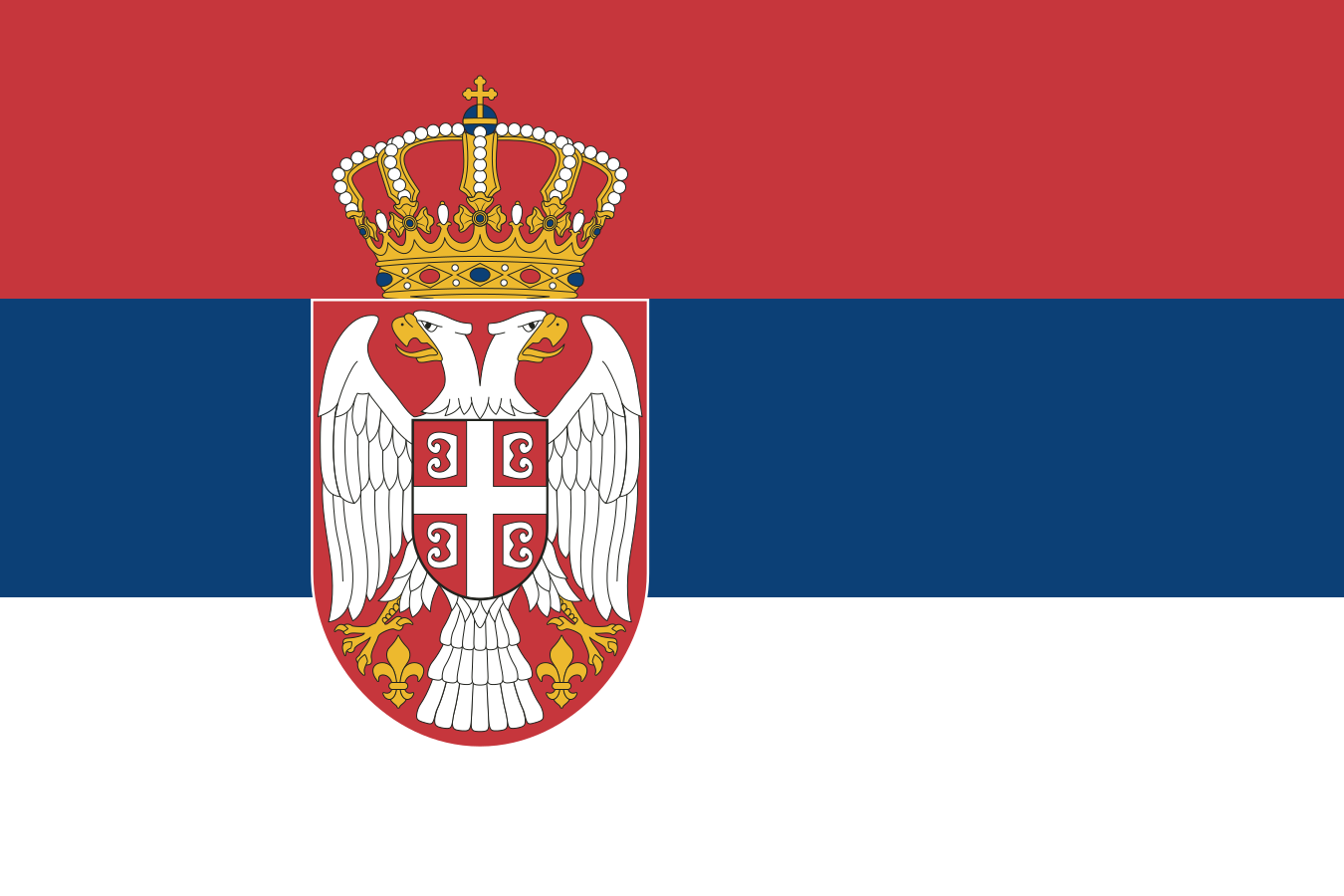
Allow me at the outset to welcome in our midst His Excellency Mr. Filip Vujanović, President of the Republic of Montenegro. We are gratified at his presence in the General Assembly Hall today.
The Republic of Serbia, continuing the international personality of the State Union of Serbia and Montenegro, is pleased to see the Republic of Montenegro — now a neighbouring and friendly country with which it has maintained close ties — become the 192nd Member State of the United Nations. We are convinced that the Republic of Montenegro will contribute fully to the respect for and pursuit of the principles and purposes of the world Organization.
I would like to emphasize that the Republic of Serbia, having spent nearly a century in a common State with the Republic of Montenegro, will seek to develop the closest and most friendly bilateral relations with that country. Good-neighbourliness and regional cooperation constitute the cornerstone of my country’s foreign policy in its commitment to the lasting stabilization of the region of South-East Europe. We are convinced that that concept is also truly contributing to the fulfilment of the principles of the Charter of the United Nations. It is our firm belief that, through bilateral and regional cooperation and Euro- Atlantic integration processes, to which both the Republic of Serbia and the Republic of Montenegro aspire, that common goal can be achieved most efficiently.
The Republic of Serbia stands ready to extend its full support to the Republic of Montenegro within the
United Nations and to closely cooperate and coordinate its activities with that country. We believe that in doing so, both countries will contribute to the strengthening of the role of the world Organization and its capacity to respond to the numerous challenges of the present-day world.
Address by Mr. Filip Vujanović, President of the Republic of Montenegro The President: The Assembly will now hear an address by His Excellency Mr. Filip Vujanović, President of the Republic of Montenegro.
Mr. Filip Vujanović, President of the Republic of Montenegro, was escorted into the General Assembly Hall.
On behalf of the General Assembly, I have the great pleasure to welcome to the United Nations His Excellency Mr. Filip Vujanović, President of the Republic of Montenegro, and to invite him to address the General Assembly.
President Vujanović: It gives me particular pleasure and honour to convey the gratitude of the Republic of Montenegro to the States members of the General Assembly, which voted in favour of Montenegro’s accession to membership of the United Nations only five weeks after the decision of Montenegrin citizens to restore independence.
(spoke in Montenegrin; English text provided by the delegation)
I would also like to thank Mr. Per Stig Moeller, Minister for Foreign Affairs of Denmark, and the Security Council for its recommendation that Montenegro become a State Member of the world Organization. Of course, our special appreciation also goes to the Secretary-General, Mr. Kofi Annan, for his significant contribution to our swift accession to United Nations membership.
After 88 years, Montenegro regained its independence on 21 May, thus becoming the youngest country in the world. It regained the independence it had gained at the Berlin Congress in 1878. This time, it was done without a peace conference, in a democratic referendum. The referendum process was organized in compliance with democratic best practices and international standards, as generally recognized by all international and local observers. As a result, given its
genuine commitment to democracy, Montenegro immediately received international recognition.
The referendum was held in close cooperation with the European Union and represented another significant step towards our strategic priority related to European and Euro-Atlantic integration, demonstrating that we have the democratic capacity required for further progress. Our membership in the United Nations represents a step forward in the overall development of Montenegro and additional proof that we are on the right track. We are aware of the many challenges that lie ahead, but, after a long period of time, we will now be responsible for our own destiny, in line with the development capacities of our State.
For all of us in Montenegro, the United Nations has always provided an irreplaceable means of connection among various States, peoples and cultures, particularly during the times of crisis that the Balkans experienced in connection with the recent tragedies and conflicts of war. Throughout that period, the role of the United Nations was of paramount importance in encouraging dialogue and compromise. Although Montenegro was not directly engulfed by the war, it was not spared its consequences. Therefore, the role of the United Nations during that period was valued and respected to an even greater degree. For that reason, as a new State Member of the United Nations, Montenegro is ready actively to support the Organization’s efforts aimed at the peaceful resolution of conflicts and to make its contribution to the humanitarian efforts of the United Nations as well as to its peacebuilding and peacekeeping missions.
I would like to recall a significant, but perhaps insufficiently known, detail from our Montenegrin past which serves as testimony to Montenegro’s devotion, throughout its history, to this lofty goal. In January 1897, the Prince of Montenegro, Nikola Petrović Njegoš — later King Nikola I Petrović Njegoš — when sending Montenegrin soldiers to the island of Crete to join a peacekeeping mission of the then Great Powers to help resolve the ongoing conflict, proudly said:
“The Great European Powers paid me a great honour by inviting me to send troops composed of my Montenegrins to Crete to join the international army, because they believed that Montenegrins would discharge their duty as befitting them — honestly and heroically.”
I am sure that this principle, which is still valid, as well as the commitment of Montenegro — despite its size — to contribute to peace will also be reaffirmed in the future engagement of our country within the United Nations.
On the basis of its previous experience, Montenegro is deeply aware of the importance of establishing relations with other countries based on friendship and partnership, respecting their sovereignty and territorial integrity. In that regard, we attach special importance to good-neighbourly relations and regional cooperation, with the goal of ensuring economic and overall prosperity and stability.
We would like in particular further to develop close cooperation with the Republic of Serbia, not only in the context of good-neighbourly cooperation and a commitment to European integration, but in all spheres of common interest, reflecting our social and historic ties. As a new State Member of the United Nations, Montenegro undertakes to respect all obligations under the Charter of the United Nations, including all United Nations documents signed and acceded to by the State union of Serbia and Montenegro. Montenegro hereby reaffirms its dedication to observing the principles of international law, as well as to respecting the International Court of Justice, which safeguards those principles.
In the present context of challenges to global security, Montenegro wishes fully to contribute to the fight against terrorism, organized crime and the proliferation of weapons of mass destruction. To that end, Montenegro will in particular respect all United Nations conventions defining measures to efficiently deal with those challenges.
As an ecologically oriented State, Montenegro has a special obligation to respect United Nations efforts aimed at promoting sustainable development at the global level, and it will actively continue to develop as a State that enables its citizens to enjoy overall progress on the basis of sustainability. In that respect, we find it particularly important that the first United Nations EcoBuilding in our region, which will be used by various specialized United Nations agencies, is to be built in Montenegro in cooperation with the United Nations.
Taking into account the efforts made by the United Nations aimed at reducing the existing gap between the rich and the poor, the developed and the
underdeveloped, the small and the large, Montenegro will further dedicate itself to the full implementation of the Millennium Development Goals, thus contributing to better living standards for its citizens and to stability in general.
Montenegro will continue to develop and shape its policy in line with the principles enshrined in the Charter of the United Nations and the Universal Declaration of Human Rights, which serve as the basis for modern democracies. Furthermore, it will continue to implement and promote a policy that fully respects the human rights and fundamental freedoms of all citizens regardless of their personal or other differences.
Montenegro is very proud of its multi-ethnic and multireligious harmony. This is one of the fundamental values that distinguish it in both the regional and the broader international context.
Montenegro is aware of the opportunities offered by the United Nations to small countries, which are given a chance to preserve and protect their interests on an equal footing with other States and are able to promote their identity and specific characteristics through membership in the United Nations. In that respect, I am sure that even small countries, as has been proved in the past, can contribute to the goals for which the United Nations stands.
From the very beginning, the United Nations has initiated positive changes and played an irreplaceable role on the international scene. Respect for, and the promotion of, its achievements and principles have been embraced by all modern and democratic States, including Montenegro. I am confident that, despite the fact that the United Nations has always faced — and will continue to face — challenges, the Organization has bright prospects and a bright future. United by the common goals and lofty values to which all of us are committed, we can be sure of long-term stability, security and overall prosperity.
I am positive that Montenegro can make its contribution to that noble goal. Today, by becoming the one hundred ninety-second State Member of the United Nations, Montenegro has assumed, with honour and dignity, that challenge and responsibility, confident that it will meet the attendant expectations and obligations with equal success.
On behalf of the General Assembly, I wish to thank the President of Montenegro for his important statement.
Mr. Filip Vujanović, President of the Republic of Montenegro, was escorted from the General Assembly Hall.
I should like to inform Member States that the flag of the Republic of Montenegro will be raised at a ceremony that will take place in front of the delegates’ entrance immediately following the adjournment of this meeting.
The meeting rose at 11.40 a.m.