A/69/PV.36 General Assembly
In the absence of the President, Mrs. Baaro (Kiribati), Vice-President, took the Chair.
The meeting was called to order at 3 p.m.
73. Report of the International Criminal Court Note by the Secretary-General (А/69/321) Reports of the Secretary-General (А/69/324 and A/69/372)


As a responsible member of the international community, Georgia is a firm supporter of the view that there cannot be long-lasting peace without justice. The International Criminal Court (ICC) is one of the principal international organs tasked with helping States ensure a durable peace that should be built on justice.
In that respect, I must say that it is still sometimes misperceived when a primarily international prosecutorial body chooses to prosecute some crimes on its own and leaves appeals to prosecute some others unanswered. It is therefore essential to emphasize that the very idea of the ICC is, above all, one of prevention and should be put into effect by assisting national capacities in the handling of situations that potentially fall within the ICC’s jurisdiction.
The concept of positive complementarity is the best reflection of this idea, and we believe that in addition to supporting the Court in its immediate judicial activities,
*1459895* 14-59895 (E)
all States should redouble their efforts to ensure the better dissemination of this concept.
In that connection, we also must acknowledge that in the case of some Member States, a partially unsatisfactory situation still prevails in terms of the national legislation implementing the Rome Statute. We invite all the parties concerned to deal with this situation for their own benefit.
It is positive complementarity that safeguards countries from the need for the Court to interfere, preserves the resources of the Court and obviates the need for additional allocations from national budgets — a win-win situation for all. We therefore invite our colleagues to direct more of their efforts towards promoting the concept of positive complementarity and are ready to participate in such efforts.
As one of the countries under preliminary examination by the ICC as a consequence of a foreign military aggression, Georgia remains fully committed to continuing effective cooperation with the Court and dealing with our respective tasks domestically, to the extent that the situation, involving an ongoing foreign military occupation of the main areas affected by the conflict, allows us to do so.
Georgia is among those countries that have already ratified the Kampala amendment on the crime of aggression and we would like to take this opportunity to call on all those parties that have not done so to step up the process.
After years of operation, even a building designed by brilliant architects often needs refurbishment, and so does the ICC. After more than a decade since its inception, today it needs to be rejuvenated so as to adequately respond to the challenges of today and of tomorrow.
Justice should not only be just but also be perceived as such. Georgia stands committed to making this change happen. Therefore, Georgia decided to nominate a candidate, Judge Mindia Ugrekhelidze, for a judicial vacancy at the Court to be filled during the election of judges in December. His track record of judicial experience in criminal law and human rights at both the national and international levels is proven, as shown by his service as Chief Justice and President of the Supreme Court of Georgia, and Judge at the European Court of Human Rights in Strasbourg. His tenure at each Court lasted for about a decade. We believe that thanks to his experience and competencies, the Georgian candidate would represent an extraordinary addition to the ICC’s judicial bench. If he is elected, it would be a first for Georgia, a small developing State with a proven track record of reforms and of overcoming the obstacles that countries in many regions and on various continents face today.
Let me also take this opportunity to also express our support to Senegal in connection with the next presidency of the Assembly of States Parties and assure it of our cooperation.
Let me end by reiterating what I said at the outset, but expressed through the words of Martin Luther King, spoken in a somewhat different context but equally relevant to what we are discussing today: “True peace is not merely the absence of tension; it is the presence of justice”.
We commend the International Criminal Court for advocating this timeless idea and stand firm in support of it.


I wish to begin by acknowledging the very positive work done by Judge Song as President of the International Criminal Court (ICC) at a very complex juncture. His contribution has been decisive in consolidating the role of the Court in fighting impunity for the most serious international crimes. We also thank him for his presentation of the tenth annual report of the Court to the United Nations (see A/69/321) (see A/69/PV.34).
On 25 September, Spain deposited its instrument of ratification of the Kampala amendments with the United Nations Secretariat. This demonstrates my country’s strong commitment to the work carried out by the ICC since its inception, as an institution that embodies the paradigm of universal criminal justice and that is at the forefront of the fight against impunity for the most serious crimes against humanity.
I should like in particular to make special mention of the victims, as Spain believes that special attention should be paid to them. That is why, among other actions, my country has been contributing to the Trust Fund for Victims.
There is no doubt that ICC is an independent judicial institution. However, it is also quite clear that it has a natural and very close relationship with the United Nations. That is why it is crucial for the cooperation mechanisms between the two bodies to be strengthened, for example through cooperation between the Court and peacekeeping operations and through interaction between commissions of inquiry and the Office of the Prosecutor, or by creating greater synergy between the Security Council and the Court.
I would now like to comment on some issues set out in the report of the Court 2013/2014, which was presented yesterday by President Song. The report underscores the importance of complementarity as a basic instrument for achieving the goals of the Rome Statute. Since it is States that bear the primary responsibility for ensuring accountability for crimes admissible before the Court, it is imperative that the United Nations, its Member States and other international and regional organizations assist States to strengthen their capacities so as to be able to comply with the objectives at the domestic level.
In recent years, the United Nations has given ever greater importance to strengthening national capacities to prosecute the crimes covered by the Rome Statute. This is reflected in the 2013/2014 report, which details the various technical assistance activities that have been organized in the framework of the United Nations. The report also notes the growth in recent months of the Court’s cooperation with the countries of Latin America ‑ organizing numerous seminars and meetings of experts ‑ and with the European Union. It is important to maintain that effort in the future.
Likewise, considering that the Office of Legal Affairs is the focal point that assures cooperation
between the United Nations system and the Court, it is important that all stakeholders in the Organization systematize their cooperation with the Office. It is essential that the Legal Counsel continue the practice of informing, in advance, the ICC Prosecutor and the President of the Assembly of States Parties of any meeting with persons who may be under an arrest warrant of the Court, pursuant to the United Nations guidelines on non-essential contacts. Finally, the report highlights the sharp increase in the Court’s activities over recent months. Bearing in mind that its resources are limited and that it is necessary to maintain strict control on spending, cooperation with Member States and with the United Nations in pursuit of the Court’s objectives is crucial if we aspire to the ideals of peace and justice enshrined in both the Rome Statute and the Charter of the United Nations. Spain promotes the universality and integrity of the Rome Statute in its bilateral relations, in accordance with the common position of the European Union. Moreover, we included the commitment to support the work of the International Criminal Court in Spain’s priorities for the sixty-ninth session of the General Assembly and in the document “Transparency and Accountability”, part of our efforts seeking a non-permanent seat on the Security Council. I can assure the Assembly that, during our upcoming two-year term as a non-permanent member of the Council, Spain will support the work of the International Criminal Court, as we always have done, with responsibility and sensitivity.
Mr. Imnadze (Georgia), Vice-President, took the Chair.


Estonia aligns itself with the statement delivered yesterday on behalf of the European Union (see A/69/PV.34).
I thank President Song for his presentation yesterday of the Court’s report (see A/69/321), which illustrates the ever-increasing caseload of the Court, which in turn reflects the demands for justice worldwide. There are now nine active situations under the Court’s consideration, of which a considerable number were referred to the Court by States themselves. In addition, the Prosecutor is seized with numerous communications and preliminary analyses from all over the world. My delegation hopes that States parties will keep the growing workload of the Court in mind when negotiating the Court’s budget at the upcoming
session of the Assembly of States Parties and will provide the Court with the necessary resources to fulfil its mandate.
President Song has made a compelling call for the universal ratification of the Rome Statute. Although no further States have ratified the Rome Statute in the past year, Ukraine has accepted the Court’s jurisdiction, under article 12 of the Rome Statute, over alleged crimes committed on its territory from 21 November 2013 to 22 February 2014, and the Office of the Prosecutor has opened a preliminary examination into the situation. Estonia hopes that Ukraine will also promptly ratify the Rome Statute so as to enjoy the full protection of the Rome Statute system. We also call on all United Nations Members that have not yet done so to ratify the Rome Statute.
While the ICC is an independent judicial institution, it is connected to the United Nations through its genesis and shared values. This natural relationship was institutionalized 10 years ago, in 2004, through an agreement negotiated between the General Assembly and the Court. The Relationship Agreement between the United Nations and the International Criminal Court provides a general framework for cooperation between these two institutions. The continued cooperation and crucial assistance the Court receives from the United Nations, as evidenced in the report, are much appreciated. However, I feel that it is time for a new phase in the relationship, one in which the cooperation and assistance are not provided solely on a reimbursable basis.
Considering that the Office of Legal Affairs is the focal point for ensuring cooperation within the entire United Nations system on all aspects of the relationship with the Court, Estonia encourages all United Nations actors to systematize their cooperation with the Office of Legal Affairs. It is also the Legal Counsel who implements the practice of informing the Prosecutor and the President of the Assembly of States Parties, beforehand, of any meetings with persons who are the subject of ICC arrest warrants that are considered necessary for the performance of United Nations- mandated tasks, on the basis of the United Nations guidelines on non-essential contacts with persons subject to an ICC arrest warrant. Estonia welcomes the guidelines and calls for the continuation of this practice.
The relationship between the Court and the Security Council should also be strengthened — a position many
Member States share, as evidenced during last week’s Security Council open debate on working methods (see S/PV.7285). Ideas on practical steps on how to create greater synergies between the Council and the Court can also be found in the Court’s report to the Assembly of States Parties on the status of ongoing cooperation between the ICC and the United Nations (ICC-ASP/12/42).
The Security Council has authorized the missions in the Democratic Republic of the Congo and Mali to cooperate with and support the Court. Considering the 13 warrants of arrest issued by the Court that remain outstanding and the common goal of the Council and the Court — to prevent mass atrocities that constitute a threat to international peace and security — we encourage the Security Council to mandate peacekeeping missions throughout to arrest ICC fugitives and to equip them in such a manner that the missions are able to fulfil their mandate. Estonia also calls on all Member States to contribute to ending impunity by working together to execute the pending arrest warrants.
To fail to bring to justice individuals responsible for the most serious crimes under international law is to fail the victims of those crimes. The victims are the raison d’être of the Rome Statute system. The Court has given hope to the victims of atrocity crimes, and more than 200,000 victims have already benefitted directly or indirectly from the concrete assistance programmes of the ICC Trust Fund for Victims. Estonia also contributed to the Trust Fund this year, and we call upon others to do the same.
As the report highlights, the Court was never intended to replace national courts, nor could it ever do so. Given that States have the primary responsibility to ensure accountability, it is of utmost importance that States, the United Nations and other international, regional and non-governmental organizations assist States in building a national capacity to investigate and prosecute Rome Statute crimes domestically. The increasing attention that the United Nations has recently given to strengthening domestic capacity to address Rome Statute crimes is most welcome, and I hope those efforts will continue. Estonia has allocated development cooperation resources to promoting the strengthening of national judicial capacity in that regard, working closely with civil society organizations, which play a crucial role in assisting States in incorporating the Rome Statute into their domestic legislation, and we
call upon all Member States in a position to do so to do the same.
There are States parties to the ICC across all regions of the world, and all States parties share ownership of the Statute. The work of the Assembly of States Parties conducted intersessionally is open to all parties. It is indeed expected that all States parties will engage actively in its work and its working groups at all diplomatic levels.
As the mandates of the current President of the Court and the President of the Assembly of States Parties will come to an end soon, I would like to take this opportunity to thank Judge Song and Ambassador Intelmann — one of our own — for their tireless efforts in enhancing States’ support for the Court and cooperation between the Court and the United Nations.
Estonia will continue to be committed to the ICC. We pledge to defend the independent mandate of the Court and the election of the most qualified judges. I will also extend the same level of support to the candidate for the post of President of the Assembly, His Excellency Mr. Sidiki Kaba, Minister of Justice of Senegal.


Thank you, Mr. President, for this opportunity to address the General Assembly on the work of the International Criminal Court (ICC). I wish to start by thanking Judge Song, the President of the International Criminal Court, for the report of the Court (see A/69/321), as well as for his presentation (see A/69/PV.34). This being his last such address to the General Assembly in his capacity of President of ICC, we congratulate him for his service and wish him the very best in his future endeavours.
Uganda fully identifies with the concerns raised by the African Union’s extraordinary summit that was held specifically to discuss the politicization and selectivity of the ICC, on 12 October 2013 in Addis Ababa. Uganda further identifies with the well-articulated statements made to the General Assembly by the representatives of different African Member States on the issue of the politicization and selectivity of the ICC’s methods. Indeed, my Head of State, while marking our much- cherished 52 years of independence earlier this month, focused on the issue of the ICC’s undermining the African Union by summoning a sitting African Head of State to The Hague earlier in October 2014. He said
“My view is that at the next African Union summit, African countries should review their membership to the ICC treaty. The ICC is turning out not to be value addition product that we had expected it to be. It is instead a biased instrument of post-colonial hegemony.”
Africa’s legitimate concerns have to be genuinely addressed if the ICC is to retain its relevance in Africa.
That said, I would like to reiterate Uganda’s commitment to the fight against impunity for the perpetrators of the most heinous crimes of concern to the international community. Uganda has incorporated the Rome Statute into our domestic law, followed by the establishment of the War Crimes Division of its High Court. The Division is seized with cases that would otherwise be handled by the ICC. We commend the Court for the assistance it has rendered by training the judges and prosecutors of the International Crimes Division. At the moment, the Division is seized with the case Uganda v. Thomas Kwoyelo, a senior Lord’s Resistance Army commander accused of Rome Statute crimes.
Uganda was the first to make a State referral to the ICC, which led to the indictment of Mr. Joseph Kony and others from the Lord’s Resistance Army, who are beyond our national jurisdiction. Unfortunately, not only are the indictees at large, but they continue to cause untold suffering wherever they operate. Under the auspices of the African Union Regional Task Force, the Uganda People’s Defence Forces are currently pursuing Mr. Joseph Kony and his Lord’s Resistance Army in the Central African Republic. Due to the asymmetrical tactics and the nature of the terrain in which the Lord’s Resistance Army operates, the maintenance and sustainability of the African Union Regional Task Force is very costly to individual troop-contributing countries, and we would encourage further support for it.
That notwithstanding, the Uganda People’s Defence Forces observe high standards of discipline as outlined in its operational code of conduct. It has a field court martial that deals with cases of errant soldiers as soon as they are detected. All reports indicate the least incidence of crime in the eastern areas of the Central African Republic where the Uganda People’s Defence Forces are operating.
In paragraph 33 of the Court’s report, in which the situation in Uganda is discussed, it is stated that
the Office of the Prosecutor continued to gather and analyse information related to alleged crimes committed by the Uganda People’s Defence Forces and continues to encourage national proceedings in relation to both parties to the conflict. That should not create the impression that the Government is soft on Uganda People’s Defence Forces members who are alleged to have committed crimes in the course of pursuing the Lord’s Resistance Army; far from it. The Ugandan Government routinely investigates and conducts public trials in a general court martial of any errant soldiers. We would therefore welcome any further information available to the Prosecutor of the ICC so as to assist our national investigations and prosecutions. That kind of collaboration would go a long way in enhancing our common efforts in the fight against impunity.
Finally, I would like to end by addressing the issue of unfunded mandates. I am talking about the referrals by the Security Council, which are not funded from the budget of the United Nations. By their nature, Security Council referrals involve the most difficult cases. If the referrals continue to be unfunded, the resources of the International Criminal Court will be depleted with nothing much to show for it in the end.
11. Sport for development and peace
Vote:
69/6
Consensus

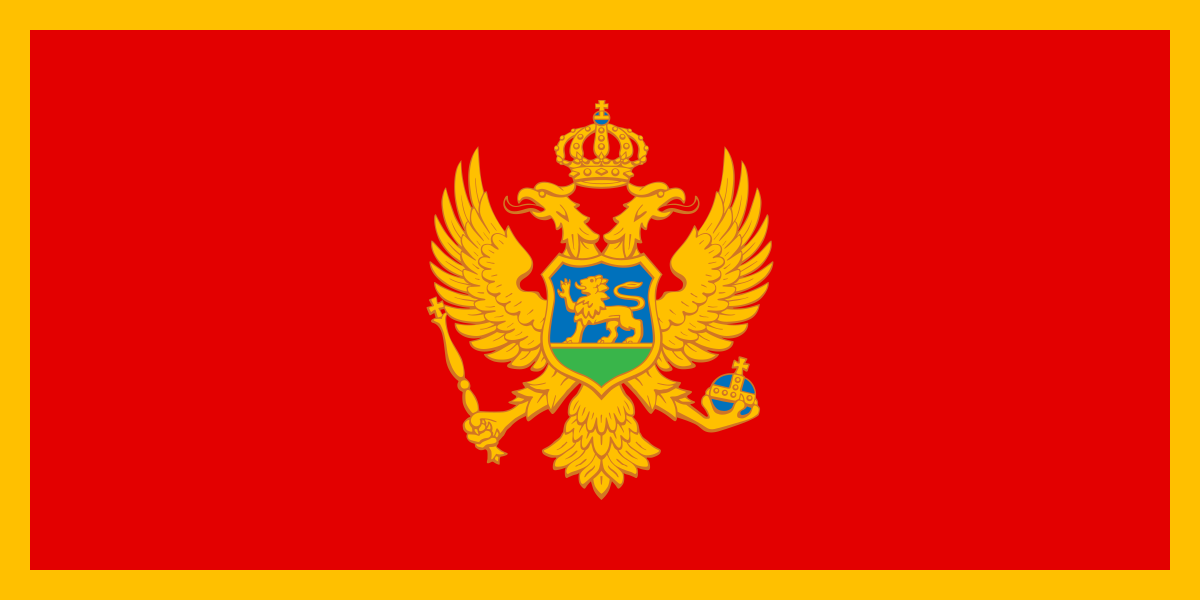
Since this is the first time I take the floor in the sixty-ninth session of the General Assembly, I would like to offer my congratulations to President Sam Kutesa on his election to lead the General Assembly at this session. I assure him and the Bureau of our strong support and full cooperation.
Montenegro fully aligns itself with the statement delivered yesterday by the observer of the European Union (see A/69/PV.34). However, I would also like to make a statement in my national capacity.
In contrast to previous human rights treaties, which required only self-reporting, a State’s commitment to the International Criminal Court (ICC) requires it to cede to an independent prosecutor the power to investigate and prosecute that State’s own nationals for mass atrocities when the prosecutor determines that the State is unwilling or unable to carry out such an investigation domestically. The fact that almost two thirds of United Nations Member States have embraced the jurisdiction of an independent international institution on their own territory is a remarkable development. Indeed, a decision by national leaders to become party to the Statute of the Court would appear to run against to their self-interest, since it is widely assumed that the ICC will focus on
prosecuting high-level figures in countries where mass atrocities have occurred. Certainly there is no other area of international law where we have delegated so much unconditional authority to an international institution over which national leaders have so little control. All of that is proof of our commitment to improving international law and independent judicial mechanisms.
The international community should leave no space for political calculation when it comes to ratifying the Rome Statute of the ICC, since such practices could result in serious harm to the lives and fundamental human rights of civilian populations. We are aware that the root causes of the problems facing international criminal law lie mainly in political instability, or sometimes in the poor education or economic conditions that give rise to conflict. Such failures, however, cannot serve as an excuse for violations of international criminal law, particularly the Rome Statute.
The twentieth century witnessed a number of cases of genocide, and we must do our best to prevent history from repeating itself. However, the growing number of conflicts and crises we are seeing today — some of which, in the words of the Secretary-General, have become among the greatest since the Second World War — reminds us that we must pay great attention to further improving international mechanisms to fight impunity. While we should continue to strengthen the International Criminal Court as the most important of such mechanisms, we must also deliver tools for prevention through concepts such as the responsibility to protect and offices such as that of the Special Adviser to the Secretary-General on the Prevention of Genocide.
I take this opportunity to reaffirm once again our strong commitment to the principles of the Rome Statute and the work of the International Criminal Court, as well as to supporting all efforts aimed at achieving universal jurisdiction for the Court. I would therefore like to recall that over the past decade Montenegro has actively cooperated with all international judicial institutions, especially the International Criminal Tribunal for the Former Yugoslavia. We strongly support the rule of law at the international level and its implementation through the mechanisms established through the United Nations. In that regard, we encourage all United Nations actors to systematize their cooperation with the Office of Legal Affairs, and we stress the importance of the efforts the United Nations has made in that field.
Without strong rule of law at the national level, attempts to strengthen it at the international level are significantly hampered. Montenegro is therefore continuing to reform its criminal court procedures by incorporating the principal international crimes described in articles 6, 7 and 8 of the Rome Statute, thereby aligning its domestic criminal code with the Statute. We have also enacted a law on cooperation with the International Criminal Court, proving once again our full commitment to the further development of international judicial mechanisms.
Through our activities in the Human Rights Council we continue to stress the importance of ratifying the Rome Statute, and we invite those States that have not yet ratified it to do so. As a party to the Statute, we once again express our strong political will and determination to carry out further procedures in the process of ratifying the Kampala amendments by the end of 2016. In that regard, we have already made adjustments amending our criminal code by stipulating the crime of aggression.
I would like to conclude by saying that Montenegro welcomes the General Assembly’s annual consideration of the report of the ICC. We commend the role of its outgoing President of the Assembly of States Parties. At the same time, we stress the importance of the complementarity of the ICC as a crucial tool to achieve the common goals of peace and security.


The Republic of Cyprus is pleased to participate in today’s consideration of the annual report of the International Criminal Court (ICC) (see A/69/321) and would like to thank the President of the Court, Judge Song, for his comprehensive presentation of the report to the General Assembly yesterday (see A/69/PV.34).
The Republic of Cyprus aligns itself the the statement delivered yesterday by the observer of the European Union (see A/69/PV.34).
Cyprus would like to take this opportunity to reiterate the commitment and support that it has always given to the Court since its inception, for the following reasons. First, we consider it a moral obligation to promote accountability for atrocities, regardless of where they are committed. Secondly, we steadfastly support strengthening international law as a means to a more just and peaceful international order. Thirdly, the fact that our country continues to experience the effects of injustices committed over 40 years of aggression
and foreign occupation renders the Court’s mission even more salient to us. Considering those reasons, it is no coincidence that Cyprus has been a party to the ICC since 2002 and was one of the first countries to ratify the amendments to the Rome Statute adopted in Kampala in 2010, including the amendment concerning the crime of aggression.
My country is proud to be actively engaged in, among other things, promoting the universality and full implementation of the Rome Statute. Those issues have been persistent challenges for the Court, and overcoming them is vital for achievement of its mission. In that regard, my country is honooured to be currently serving as a focal point in the Assembly of States Parties for promoting its plan of action for the universality and full implementation of the Rome Statute.
My delegation believes that cooperation among all stakeholders is key to overcoming current and future challenges. In particular, States parties should continue to promote the Court’s independence, credibility and efficiency.
The Republic of Cyprus would like to reiterate its conviction that the Court significantly contributes to the overall goal of the United Nations in working to consolidate peace and security. In that regard, the relationship between the United Nations and the Court, as formalized in their 2004 Relationship Agreement, is significant, and we support further strengthening the relationship through practical steps such as those outlined in the report of the Court to the Assembly of States Parties on the status of the ongoing cooperation between the ICC and the United Nations, which is contained in document ICC-ASP/12/42. As we emphasize the importance of the relationship’s complementarity, we also take this opportunity to highlight the importance of efforts on the part of the United Nations to strengthen the capacity of its membership to address Rome Statute crimes.
Many thought the creation of the ICC was a mission impossible. Yet for the last 12 years it has tangibly contributed to advancing international justice. For that reason, the Republic of Cyprus, in welcoming the progress the ICC has made this year, would like to reiterate its unwavering support for the Court.

We have heard the last speaker in the debate on this item.
Several representatives have asked to speak in exercise of the right of reply. May I remind members
that the statements in the exercise of the right of reply are limited to ten minutes for the first intervention and to five minutes for the second intervention. Statements should be delivered by delegations from their seats.


My delegation would like to exercise the right to reply to certain statements that have been made concerning the situation in the Syrian Arab Republic. In that connection, my delegation would like to emphasize the following points.
First, the major responsibility for accountability and the administration of justice falls upon the shoulders of the concerned countries themselves.
Secondly, the mandate of the International Criminal Court is complementary to the various national jurisdictions, and it cannot replace national justice. It can be resorted to only in the framework of certain specific conditions, which are not fulfilled in the Syrian case.
Thirdly, the Syrian people are the main sovereign decision-maker and the only entity capable of choosing the justice system that it deems appropriate in order to bring the perpetrators of crimes to account. No country and no other party has the right to try to usurp the rights of the Syrian people or their national decisions. No party and no State has the right to speak on behalf of the Syrian people.
Fourthly, justice is indivisible. It has to be comprehensive. Justice has to be far removed from politicization, selectivity and double standards. The noble concept of justice should not be abused, nor should it be used according to the various whims and interests of certain influential parties and their allies.
One of the permanent members of the Security Council has talked about the so-called harsh reality. Unfortunately, that harsh reality is obviously before us. It manifests itself when some countries behave in a way that does not serve justice at all but rather undermines its credibility. Such behaviour is used in order to adopt an obviously arbitrary and politicized policy whereby those countries insist on talking about the situation in some countries while turning a blind eye to a lot of blatant crimes and documented atrocities perpetrated by other countries. We have listened to a number of presentations and statements by those countries in which no mention was made of the crimes committed by the Israeli occupation against the people in the Arab occupied territories, and that has been going on for
many decades. The latest such crimes were the heinous atrocities perpetrated by the occupation authorities against the inhabitants of Gaza.
The delegations of those same countries have also ignored the fact that some permanent members of the Security Council have provided immunity and impunity to the leaders of the Israeli occupation forces. They have done so by using their right of veto dozens of times in order to prevent the Security Council from adopting resolutions that would condemn Israel and make its Government accountable for war crimes and crimes against humanity committed against the countries in the region and the Arab inhabitants living under occupation. Those countries are the ones that have raised the slogan of international justice but ignore what their allies are doing, which includes exacerbating certain conflicts in various countries at the expense of the people of those countries.
Who will talk about holding the Western former colonial Powers accountable for inciting conflicts in Africa? Have those countries forgotten the painful events that occurred in Rwanda? Have they forgotten what the commander of the United Nations peacekeeping forces said at that time, namely, that a certain Western country with a permanent seat on the Security Council had itself supported the perpetrators of genocide? Where do we stand today on the question of making accountable all those who have committed war crimes and major blatant violations of human rights against the Iraqi people in Abu Ghraib or elsewhere?
Even if some have forgotten those events, the people of the region will not forget the lies and fabrications against Iraq and Libya. The photos of the abused and raped in Abu Ghraib prison will forever be imprinted in our memories, especially for proponents of human rights and true international justice. Acts of rape, beheading, terrorism, sexual abuse, torture and other atrocious practices must be completely rejected, whether they are acts practiced on the ground or in mobile secret prisons.
My delegation reiterates its call for holding the officials of Governments that support terrorism responsible for the terrorist acts that the Syrian people and others in the region and the world are experiencing today. Behind the terrorist who is leading Daesh ‑ the self-proclaimed Khalifa al-Baghdadi ‑ there are people in the Governments of neighbouring countries who are able on a daily basis to create hundreds of terrorists like him. There is also the would-be sultanate-illusion
pursuer who is seeking to make himself a new sultan at the expense of many Arab countries and the blood of their people. Another governor is financing terrorism and investing in it in the same way that he would buy a hotel in Paris, a store in London, or the right to host the FIFA World Cup. And there are others like him in other countries. Pure justice would require that we prosecute those officials and make them accountable for crimes committed against Syria, the Syrian people and peoples of the world who are suffering from terrorism.
In conclusion, my delegation would like once again to remind countries that allegedly care for Syria and the Syrian people that the only way to help Syria is clear and well known. The only way to help Syria is to exert sincere efforts to combat terrorism, to support a genuine political and peaceful solution based on a national and comprehensive dialogue between and among Syrians and under Syrian leadership, as well as to support the efforts of the United Nations Special Envoy, Mr. De Mistura, in that respect.


With regard to the baseless allegations just made by the representative of one delegation, I would like to stress that they will be duly responded to by their counterpart, the Turkish Cypriots, whose voice unfortunately cannot be heard in the Hall.
May I take it that it is the wish of the General Assembly to conclude its consideration of agenda item 73?
It was so decided.
Members will recall that the General Assembly previously considered agenda item 11 at its 28th plenary meeting, on 20 October.
I now give the floor to the representative of Tunisia to introduce draft resolution A/69/L.5.


At the outset, allow me to commend the role played by the United Nations and its specialized agencies and programmes in the support of sport, especially the activities conducted by the United Nations Office on Sport for Development and Peace. I would like to reiterate our appreciation of the great and sustained efforts deployed by the Special Adviser to the Secretary-General on
Sport for Development and Peace, Mr. Wilfried Lemke, promoting the affinities relating sport to development and peace.
Sport plays a major role, especially in developing a relationship of cooperation among countries, nations and individuals far from their geographic, social, racial and cultural environment. That is what we clearly see in the various sporting events and forums at the local and international levels, where athletes quickly become ambassadors of their countries, defending the values of peace, friendship and just competition, which are the principles enshrined in the international Olympic Movement. Sport is also a means to support social integration and human development, especially when it develops awareness, confidence and the spirit of leadership among groups and societies, which brings with it a number of environmental, development, economic, social and political benefits. In the light of the important instrumental role played by sport at many levels, sport has been included in the development process as a major means for ensuring peace and security.
Sport is also important for human fitness. That is why we have seen a close link between sport on the one hand and human rights and development on the other. Allow me, Sir, to refer to the General Assembly’s debate last week (see A/69/PV.28). That debate revealed a major consensus on the importance of sport as a means to promote human development.
Within that context and in order to use sport as an engine for sustainable peace and development, I would like to present today to the sixty-ninth session of the General Assembly the draft resolution entitled “Sport as a means to promote education, health, development and peace” (A/69/L.5), on behalf of Tunisia and Monaco and all the other countries sponsoring the draft resolution. The draft resolution reiterates the commitment of the international community to using sport as a tool for conciliation and good cooperation among countries without discrimination or exclusivity at the regional, national and international levels, thereby further promoting understanding, cultural diversity and human rights.
The draft resolution calls upon Member States to give priority to sport in national policies and to focus on the international character of that activity as a tool to promote peace, health, education and development. The draft resolution welcomes the Olympic Games that are scheduled to be held in Rio de Janeiro in 2016; in
Pyeongchang, Republic of Korea, in 2018; and in Tokyo in 2020, as those occasions can be considered to be a means to consecrate the culture of peace and amity and unify all the various athletes and parties wherever they come from and whatever their faiths or ethnicities.
Finally, allow me to extend my thanks to all Member States for the laudable efforts they have exerted in support of the draft resolution. I would now like to call upon other Member States to support the draft resolution in the General Assembly, as it will be a significant message to all stakeholders that they should promote and advance sports activities in a way that will serve the cause of development and peace in the world.
The General Assembly will now take a decision on draft resolution A/69/L.5, entitled “Sport as a means to promote education, health, development and peace”.
I give the floor to the representative of the Secretariat.

I should like to announce that, since the submission of draft resolution A/69/L.5, the following countries, in addition to those delegations listed on the document, have become sponsors: Andorra, the Bahamas, Belgium, Bulgaria, Cameroon, China, the Congo, Croatia, Cyprus, Denmark, Estonia, Finland, France, Greece, Iceland, Iraq, Ireland, Israel, Italy, Jordan, Kyrgyzstan, Lebanon, Lithuania, Luxembourg, Mongolia, the Netherlands, Nicaragua, Poland, Romania, the Russian Federation, San Marino, Serbia, Slovakia, Slovenia, Sweden, the United Kingdom of Great Britain and Northern Ireland, Uruguay and Viet Nam.
May I take it that the Assembly decides to adopt draft resolution A/69/L.5?
Draft resolution A/69/L.5 was adopted (resolution 69/6).
Before giving the floor to the speakers in explanations of vote, I would like to remind delegations that explanations of vote are limited to 10 minutes and should be made by the delegations from their seats.


We would like to explain our position on the adoption of resolution 69/6.
On behalf of my delegation, I would like to commend the President’s leadership and professionalism in
guiding the work of the General Assembly and to thank him for providing us the opportunity to share our views on the subject. Armenia understands the importance of resolution 69/6, “Sport as a means to promote education, health, development and peace”, and commends the efforts of its main sponsors, Monaco and Tunisia, as we share in the strong belief that sport promotes mutual understanding and coexistence, peace and development throughout the world. We are of the view that sport should be kept out of politics, and we strongly condemn xenophobia, racism and discrimination in sport in all its forms and manifestations.
Having said that and in reference to the recognition of the importance of international sporting events as indicated in resolution 69/6, we would like to express
our concern with regard to a certain sporting event to be held next year. Considering the ongoing hatred against Armenians and the Government-sponsored Armenophobia in the host country of the inaugural 2015 European Games, we have well-grounded and serious doubts about the ability of the latter to ensure the safety and security of all athletes, provide fair and equal conditions for participants and guarantee the integrity of that international sporting competition.
May I take it that it is the wish of the General Assembly to conclude its consideration of agenda item 11?
It was so decided.
The meeting rose at 4 p.m.