A/76/PV.19 General Assembly
The meeting was called to order at 10.05 a.m.
116. Elections to fill vacancies in subsidiary organs and other elections (d) Election of members of the Human Rights Council

The General Assembly will now proceed with the election of 18 members of the Human Rights Council to replace those members whose term of office expires on 31 December 2021.
The 18 outgoing members are the following: Argentina, Austria, Bahamas, Bahrain, Bangladesh, Bulgaria, Burkina Faso, Cameroon, the Czech Republic, Denmark, Eritrea, Fiji, India, Italy, the Philippines, Somalia, Togo and Uruguay. In accordance with paragraph 7 of resolution 60/251, of 15 March 2006, those Member States are eligible for immediate re-election, except those that have served two consecutive terms, namely, the Philippines and Togo.
The 18 vacant seats should be distributed among the regional groups as follows: five seats for the African States; five seats for the Asia-Pacific States; two seats for the Eastern European States; three seats for the Latin American and Caribbean States; and three seats for the Western European and other States.
In accordance with resolution 60/251, membership in the Council shall be open to all States Members of the United Nations, and the members of the Council shall serve for a period of three years. The members of
the Council shall be elected directly and individually, by secret ballot, by the majority of the members of the General Assembly. Accordingly, 97 votes constitute a majority in the General Assembly, which has a membership of 193 States.
I would like to inform members that the following States will continue to be members of the Human Rights Council: Armenia, the Plurinational State of Bolivia, Brazil, China, Côte d’Ivoire, Cuba, France, Gabon, Germany, Indonesia, Japan, Libya, Malawi, the Marshall Islands, Mauritania, Mexico, Namibia, Nepal, the Netherlands, Pakistan, Poland, the Republic of Korea, the Russian Federation, Senegal, the Sudan, Ukraine, the United Kingdom of Great Britain and Northern Ireland, Uzbekistan and the Bolivarian Republic of Venezuela. The names of these States therefore should not appear on the ballot papers. I also remind delegations that the names of the following Member States should also not appear on the ballot papers, as they have served two consecutive terms and are therefore not eligible for this election: the Philippines and Togo.
This election will be held in accordance with the relevant rules of procedure on elections. In that regard, rule 94 shall be applied.
Consistent with the practice of the General Assembly, if more than the required number of Member States have obtained the votes of the majority of the members of the Assembly on the same ballot, those Member States that have obtained the largest number of votes above the required majority will be considered as elected, up to the number of seats to be filled. Also
consistent with past practice, if, due to a tied vote, it becomes necessary to determine a candidate or candidates to be elected or to proceed to the next round of restricted balloting, there will be a special restricted ballot limited to those candidates that have obtained an equal number of votes.
May I take it that the General Assembly agrees to these procedures?
It was so decided.
Regarding the candidatures of the respective regional groups, the Secretariat has been informed that for the five vacant seats for African States, the Group has endorsed five candidates: Benin, Cameroon, Eritrea, the Gambia and Somalia.
For the five vacant seats for Asia-Pacific States, the Group has endorsed five candidates: India, Kazakhstan, Malaysia, Qatar and the United Arab Emirates.
For the two vacant seats for Eastern European States, the Secretariat has received communications from two candidates: Lithuania and Montenegro.
For the three vacant seats for Latin American and Caribbean States, the Secretariat has received communications from three candidates: Argentina, Honduras and Paraguay.
For the three vacant seats for Western European and other States, the Secretariat has received communications from three candidates: Finland, Luxembourg and the United States of America.
I have also been informed by the Secretariat that voluntary pledges and commitments made by Member States in accordance with paragraph 8 of resolution 60/251 have accordingly been issued as official documents of the seventy-sixth session.
Before we begin the voting process, I would like to remind members that, pursuant to rule 88 of the rules of procedure of the General Assembly, no representative shall interrupt the voting except on a point of order on the actual conduct of the voting.
As indicated in my letter dated 8 October 2021, all representatives were requested to proceed to pick up their ballot papers from the East Documents Counter, located towards the back of the General Assembly Hall, before being seated. The ballot papers are marked “A”, “B”, “C”, “D” and “E”. Each ballot paper is assigned to
one of the five regional groups. I request representatives to use only these ballot papers.
In accordance with resolution 71/323, of 8 September 2017, the names of the States that have been communicated to the Secretariat at least 48 hours prior to the election today have been printed on the ballot papers for each of the regional groups. Also, additional blank lines corresponding to the number of vacant seats to be filled for each of the regional groups have been provided on the ballot papers for inscribing other names as necessary.
Representatives are requested to use only the ballot papers that have been provided at the Documents Counter, to put an “X” in the boxes next to the names of the States that they wish to vote for and to write other eligible names on the blank lines. If the box next to the name of a candidate is checked, the name of that candidate does not have to be repeated on the blank line. The total number of checked boxes and handwritten names should not exceed the number of vacant seats to be filled, as indicated on the ballot paper.
Accordingly, for the ballot papers marked “A” for African States, the total number of checked boxes and/ or handwritten names should not exceed five; for the ballot papers marked “B” for Asia-Pacific States, the total number of checked boxes and/or handwritten names should not exceed five; for the ballot papers marked “C” for Eastern European States, the total number of checked boxes and/or handwritten names should not exceed two; for the ballot papers marked “D” for Latin American and Caribbean States, the total number of checked boxes and/or handwritten names should not exceed three; and for the ballot papers marked “E” for Western European and other States, the total number of checked boxes and/or handwritten names should not exceed three.
The ballot paper will be declared invalid in the following instances: if the number of votes for eligible Member States on the ballot paper exceeds the number of vacant seats indicated on the ballot paper; if all the votes on the ballot paper are for Member States that do not belong to the relevant regional group; or if all the votes on the ballot are for Member States that are not eligible for election. In that regard, I recall that the following Member States are not eligible for election: those that will continue to be members of the Council next year and those that are currently serving their second consecutive term in the Council.
If a ballot paper contains the name of any of the following types of Member States, the ballot remains valid but the vote for that Member State will not be counted. Those are: Member States that do not belong to the region concerned; Member States that will remain members of the Council next year; and Member States that are currently serving their second consecutive term on the Council.
Finally, if a ballot paper contains any notation other than votes in favour of specific candidates, those notations will be disregarded. If a mistake is made in filling out the ballot paper, delegations should request a new ballot paper from the Secretariat at the East Documents Counter.
We shall now begin the voting process.
At the invitation of the President, Ms. Khachidze (Georgia), Mr. Kuymizakis (Malta), Mr. Henry (Saint Lucia), Ms. Morel (Seychelles), Ms. Senesi (Sierra Leone) and Mr. Suwannikkha (Thailand) acted as tellers.
A vote was taken by secret ballot.
As announced in The Journal of the United Nations, at 10.45 a.m., in the interest of time while the ballots are being counted, the General Assembly will proceed to pay tribute to the memory of His Excellency Mr. Abdelaziz Bouteflika, President of the General Assembly twenty-ninth session.
The General Assembly has thus concluded this stage of its consideration of sub-item (d) of agenda item 116.
The meeting was suspended at 10.25 a.m. and resumed at 10.50 a.m.
Tribute to the memory of Mr. Abdelaziz Bouteflika, President of the General Assembly at its twenty- ninth session
It is my sad duty to pay tribute to the memory of His Excellency Mr. Abdelaziz Bouteflika, President of the General Assembly at its twenty-ninth session, who passed away on 17 September 2021. On behalf of the General Assembly, I should like to convey our deepest condolences to the Government and the people of Algeria and to the bereaved family of Mr. Bouteflika.
We have all assembled here today to pay our respects to the late Mr. Abdelaziz Bouteflika, former President of Algeria, who was also the President of the General Assembly at its twenty-ninth session. I wish to convey our deepest condolences to the Government and the people of Algeria, as well as to the family of the departed leader.
Mr. Bouteflika was a seasoned diplomat and a skilled behind-the-scenes negotiator. As one of the youngest persons ever elected President of the General Assembly, in 1974, he was committed to upholding the values of multilateralism and the principles of the Charter of the United Nations.
As a conflict mediator, he played a leadership role in the region, especially in Africa, contributing to Algeria’s conclusion of several peace agreements. He participated at an early age in the struggle against colonialism and advocated for liberation movements around the world. Under his presidency during the twenty-ninth session, the General Assembly adopted resolution 3236 (XXIX), thereby including the question of Palestine in the provisional agenda of the General Assembly.
Mr. Bouteflika played a very important role in the consolidation of the organizations of the developing world, particularly the Movement of Non-Aligned Countries and the Group of 77, and in the strengthening of their unity of action. He believed in the importance of international cooperation and solidarity among countries to achieve our aspirations — from a new international economic order and South-South cooperation to peace in the Middle East.
He always defended decolonization processes in the world. He believed in the value of human rights and the necessity of mobilizing the international community in the fight against racism and racial discrimination. He believed in empowering women through increased participation in decision-making and advocated for the advancement of women’s rights in his own country.
Mr. Bouteflika’s successes are mirrored by his presidency of the twenty-ninth session. He showed us that, yes, it is possible for the United Nations to be a community of nations united. His contributions are now part of the annals of diplomatic history.
(spoke in Arabic)
May he rest in peace.
(spoke in English)
I now ask representatives to stand and observe a minute of silence in tribute to the memory of His Excellency Mr. Abdelaziz Bouteflika, former President of the General Assembly.
The members of the General Assembly observed a minute of silence.
I now give the floor to Secretary- General António Guterres.

I wish to start by reiterating my sincere condolences to the Government of Algeria on the passing away of His Excellency Mr. Abdelaziz Bouteflika.
Mr. Bouteflika, former President of Algeria, presided over the General Assembly at its twenty-ninth session from 1974 to 1975 while serving as Foreign Minister. As President of the General Assembly, he promoted the principles of justice, freedom and peace as priorities for the United Nations and played an active role in those areas during his presidency. He was particularly active in the area of decolonization and is remembered for giving a voice to the liberation movements in Africa, Asia and South America.
President Bouteflika also strongly advocated for a more inclusive United Nations in the post-Second World War era. He oversaw the admission of Bangladesh, Grenada and Guinea-Bissau as new Members of the United Nations. Many will remember that, in 1974, he extended an invitation to former Palestinian leader Yasser Arafat to address the General Assembly. He also played a central role in the Movement of Non-Aligned Countries and will be remembered for taking a firm stand against apartheid in South Africa, whose membership was suspended under his presidency.
I also remember his support for the democratic opposition in Portugal and for the liberation movements of former Portuguese colonies during the Salazar dictatorship. It is with emotion that I remember listening as a boy to the only radio station that was linked to the Portuguese democratic opposition. It was called “Radio Free Portugal” and broadcast from Algiers, thanks to the support of the Algerian Government, in particular of Minister Bouteflika.
(spoke in French)
During his presidency of the General Assembly, President Bouteflika facilitated the adoption of many
resolutions, including on the definition of aggression, the preparations for the World Disarmament Conference and the establishment of the International Civil Service Commission. He also chaired five plenary meetings on the question of Cyprus, leading to resolution 3212 (XXIX), which was endorsed by the Security Council.
Throughout his mandate at the head of the General Assembly, President Bouteflika fostered dialogue and demonstrated leadership and strong engagement in favour of the principles of the Charter of the United Nations.
For all those reasons, we pay tribute today in the General Assembly to President Bouteflika. May he rest in peace.
I now give the floor to the representative of Ghana, who will speak on behalf of the Group of African States.


It is with profound sadness that, on behalf of the Group of African States, I read out this tribute to the memory of His Excellency Mr. Abdelaziz Bouteflika, President of the General Assembly at its twenty-ninth session and former President of Algeria.
The passing away of this great pan-Africanist, on 17 September 2021, marked the closing of a remarkable chapter in Africa’s history. A fierce fighter for the rights of others, President Bouteflika was visible in his opposition to the obnoxious apartheid regime, especially in 1974, when he served as Minister for Foreign Affairs under President Ahmed Ben Bella and was also elected as President of the General Assembly at its twenty- ninth session, the fourth African to assume the role, after Liberia’s Angie E. Brooks, who incidentally was also the first female President of the General Assembly.
Like many of his generation, President Bouteflika saw the effort to liberate Africa not as end in and of itself but as the necessary struggle required to place Africa on an independent and sustainable path towards economic development, self-sufficiency, prosperity, peace and stability for the benefit of the peoples of Africa.
Together with President Thabo Mbeki of South Africa and President Olusegun Obasanjo of Nigeria, President Bouteflika was instrumental in the establishment of the New Partnership for Africa’s Development (NEPAD). The co-initiators of NEPAD were subsequently joined by President Hosni Mubarak
of Egypt and Abdoulaye Wade of Senegal in pushing further the NEPAD initiative. Later to be joined by President Amadou Toumani Touré of Mali and Prime Minister Meles Zenawi of Ethiopia, the NEPAD model became a globally accepted framework for partnership in Africa’s development.
President Abdelaziz Bouteflika’s commitment to international peace and security was also well known and, as mentioned by both the President of the General Assembly and Secretary-General this morning, it included his contributions to the fight against terrorism and his active participation in the Trans-Sahel Counter- Terrorism Initiative.
While he was known to be a fighter for freedom, justice and fairness, President Bouteflika was also a man who embraced peace. He helped to bring peace to several parts of our region. He will forever be fondly remembered for his immeasurable contribution to a just and fair international order and for his commitment to the cause of multilateralism and Africa. His life and legacy continue to serve as an inspiration to many on our continent and across the world.
On behalf of the African Group, I would like to extend our sincerest condolences to the family of the late President and to the Government and the people of Algeria. May his soul rest in perfect peace.
I now give the floor to the representative of Malaysia, who will speak on behalf of the Group of Asia-Pacific States.


We are here today to pay tribute to the life and leadership of His Excellency the late Abdelaziz Bouteflika. On behalf of the Group of Asia-Pacific States, I extend our heartfelt sympathies and deepest condolences to his family and to the Government and the people of the Democratic Republic of Algeria.
His Excellency the late Abdelaziz Bouteflika will be remembered for his consequential role in fighting for Algeria’s independence and his notable leadership in his home country, the Arab world and Africa. His advocacy and role in fostering peace and security at the regional and international levels were appreciated by many of us. His passion for championing the cause of post-colonial States and the developing world were among his many accomplishments during his lifetime.
We also remember him for his demonstration of courage and statesmanship throughout his interaction
globally. He challenged the hegemony of the world and brought Algeria to prominence as a leader of the Movement of Non-Aligned Countries and a founding member of the African Union. He will also be remembered for championing multilateralism, particularly in leading the General Assembly as President at its twenty-ninth session.
Under his leadership, the General Assembly adopted the Declaration and Programme of Action on the Establishment of a New International Economic Order at its sixth special session; accorded special treatment to the late Chairman of the Palestine Liberation Organization (PLO), Yasser Arafat, at the general debate on the question of Palestine; and adopted the resolution on the right of peoples to self- determination and the resolution giving observer status to the PLO.
The suspension of apartheid South Africa’s participation in the General Assembly and the adoption of the Charter of Economic Rights and Duties of States also took place under his presidency. He was also instrumental and played a key role in enriching the dialogue among civilizations from an early stage. In his own words, “a dialogue among civilizations can be seen as a dialogue between the individual and the universal”.
Let us celebrate his memory and legacy by committing ourselves to the founding ideals of this Organization and further strengthening multilateralism in the name of humankind. May President Bouteflika rest in peace, and God bless his soul.
I now give the floor to the representative of Bulgaria, who will speak on behalf of the Group of Eastern European States.


I take the floor on behalf of the Group of Eastern European States to pay tribute to the memory of his Excellency Mr. Abdelaziz Bouteflika, President of Algeria and President of the General Assembly at its twenty-ninth session. On behalf of the members of the Group of Eastern European States, I would like to express our deepest condolences to the family of Mr. Bouteflika, as well as to the Government and the people of Algeria.
President Bouteflika dedicated his whole life to serving his country, Algeria, and its people. He was a visionary African statesman and a prominent figure in the Movement of Non-Aligned Countries who, through his work, gave voice to the countries of Africa, Asia
and Latin America. When elected President of the General Assembly at its twenty-ninth session in 1974, at 37 years old, he was the youngest person to preside over this organ. And yet, when he assumed the post, he had already served as Minister for Foreign Affairs of Algeria for 11 years and was not new to the United Nations.
Internationally, Mr. Bouteflika will be remembered as a strong advocate for developing countries. Our thoughts and sympathy are with the family of President Bouteflika.
I now give the floor to the representative of El Salvador, who will speak on behalf of the Group of Latin American and Caribbean States.


I have the honour to deliver this statement on behalf of the Group of Latin American and Caribbean States on this solemn occasion to acknowledge the loss of His Excellency Mr. Abdelaziz Bouteflika, President of the General Assembly at its twenty-ninth session. We extend our profound condolences to the family of His Excellency Mr. Abdelaziz Bouteflika and to the Government and the people of Algeria.
President Bouteflika was a distinguished statesman who played a consequential role in Algeria’s history, serving in the National Liberation Army, fighting for Algeria’s independence and serving as Foreign Minister. President Bouteflika will undoubtedly be remembered as one of the outstanding leaders of this Organization. We mourn his loss together with Algeria.
In 1963, Mr. Bouteflika became the world’s youngest Minister for Foreign Affairs, a record that still stands. He was only 25 years old. With foresight, political wisdom and persistence, he shaped Algeria’s diplomatic engagement in the region and internationally.
(spoke in English)
In the United Nations, Mr.Bouteflika headed the Algerian delegation to the regular and special sessions of the General Assembly. He also headed his country’s delegation to the fifty-fifth session of the Economic and Social Council and the second and third sessions of the United Nations Conference on Trade and Development held in New Delhi and Santiago. All around the world, especially in the most fragile contexts, the blue flag of the United Nations symbolizes hope. That hope is part of the legacy that we mourn today. Let us honour the memory of President Bouteflika by recommitting
ourselves to the noble cause of promoting peace, prosperity and opportunity for everyone, everywhere, for all generations to come.
Mr. Bouteflika’s initiative and leadership during his presidency of the General Assembly were decisive in some of the most important multilateral efforts around the globe. The lives of millions of people in need were improved because of his compassion and commitment. Throughout his presidency, he earned recognition and respect from near and far for his outstanding leadership and commitment to the principles of the Charter of the United Nations. He always stood ready to bridge faiths, cultures and countries in the neighbourhood and beyond.
As a close friend of the United Nations, President Bouteflika was also reliably on the front lines of mobilizing the international community in acts of solidarity. The Group of Latin American and Caribbean States looks forward to continuing our strong partnership and friendship with Algeria, building on the legacy of President Bouteflika. The world has lost a global leader.
(spoke in French)
We will keep supporting Algeria’s mediation efforts and its role in promoting peace and stability through the United Nations. We trust that President Bouteflika’s tireless efforts in regional and international diplomacy to ensure stability will remain a priority for the People’s Democratic Republic of Algeria.
In this difficult time, we once again offer our deepest condolences to the people of Algeria on their tremendous loss.
I now give the floor to the representative of Turkey, who will speak on behalf of the Group of Western European and other States.


I have the honour to deliver this statement on behalf of the Group of Western European and other States.
It is with great sadness that we received the news of the passing away of former President of the People’s Democratic Republic of Algeria, His Excellency Mr. Abdelaziz Bouteflika. On behalf of the Group of Western European and other States, I would like to extend our sincere condolences and profound sympathies to the people and the Government of Algeria, as well as to the deceased’s family and loved ones.
Today we pay tribute to a leader who was a veteran of Algeria’s struggle for independence and a staunch advocate for worldwide decolonization. As the world’s youngest Minister for Foreign Affairs and an accomplished diplomat, he played a consequential role in world affairs and championed the cause of post-colonial States and the developing world. As one of the co-authors of the New Africa Initiative, which later transformed into the New Partnership for Africa’s Development, his contributions and commitment to the security, stability and development of the African continent will be remembered fondly by the international community.
As the President of the General Assembly at its twenty-ninth session, he did not hesitate to take action in pursuit of the promotion of the common values of humankind. His legacy as the President of the General Assembly includes the suspension of apartheid South Africa’s participation at the General Assembly and the adoption of the Charter of Economic Rights and Duties of States. Those achievements continue to echo here at the United Nations as we reaffirm our commitment to the founding ideals of the Charter of the United Nations and multilateralism.
Allow me to extend once again, on behalf of the Western European and Other States Group, our heartfelt condolences to the bereaved family, the Government and the people of the People’s Democratic Republic of Algeria.
I now give the floor to the representative of the United States of America, who will speak on behalf of the host country.


Especially as the former American ambassador to Algeria, many years ago, and someone who work closely with President Bouteflika on a number of important issues, I particularly appreciate this opportunity to join with so many others today in paying tribute to former Algerian President Abdelaziz Bouteflika.
His political career spanned a remarkable transition in Algeria. After fighting for Algeria’s independence in the National Liberation Army, as President of Algeria, he helped bring an end to a brutal, decade-long civil war. He led Algeria out of that dark decade and provided a measure of compensation for many who suffered during the war.
Algeria, an early proponent of coordinated international efforts against terrorism, was among the first States to condemn the 2001 terrorist attacks against the United States. We have not forgotten that. Guided by Mr. Bouteflika, Algeria became a leader in confronting transnational terrorism in the region and beyond. He made important contributions through Algeria’s participation in the Mediterranean Dialogue of the North Atlantic Treaty Organization.
Throughout his time as President, Mr. Bouteflika was a champion for Africa, throwing support behind regional organizations, most notably the African Union, and encouraging and facilitating mediation and dialogue to help stabilize conflicts in neighbouring States.
And so today, the United States recognizes Abdelaziz Bouteflika’s long career as an influential figure in international politics. We extend our condolences and welcome the continued growth of the relationship between the United States and Algeria.
I now give the floor to the observer of the Observer State of Palestine, who will speak on behalf of the Group of Arab States.

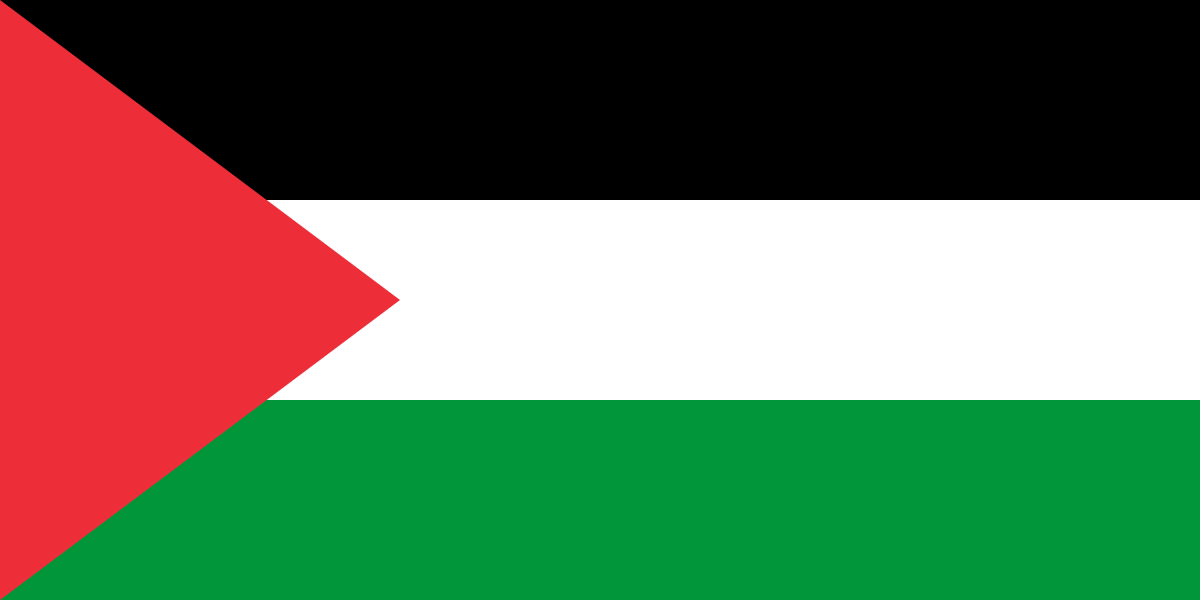
It is a pleasure for me to deliver this statement on behalf of the Group of Arab States in New York.
We are gathered here today to pay tribute to the memory of the late Algerian President, Mr. Abdelaziz Bouteflika, and to remember together a man who spent his life serving his country and defending all noble causes throughout the world. History continues to remember the sterling qualities of this fighter and his contributions during the Algerian revolution and afterwards, particularly during his 15-year tenure as Minister for Foreign Affairs. During that period, Algerian diplomacy had a prominent place that made it the official spokesperson for developing countries and it became the supporter of oppressed peoples in various international forums.
That was busy period for Mr. Bouteflika, during which he staunchly defended the need to reconsider the global economic order to make it more equitable and better tailored to countries’ needs, particularly the least developed countries. He also worked to strengthen the sovereignty of peoples over their natural resources in all international resolutions to ensure that it would become a tangible reality for them all. He worked to
ensure political and economic independence in order to realize the completion of national sovereignty.
Mr. Bouteflika also presided over the General Assembly at its twenty-ninth session, which was truly a milestone in the history of the United Nations, during which President Yasser Arafat was called to take the floor from this podium for the first time as the legitimate representative of the Palestinian people, with the aim of defending his oppressed people and their inalienable right to establish an independent State with East Jerusalem as its capital, pursuant to international law.
The Secretary-General mentioned earlier how he listened to the news of liberation movements broadcast by Radio Algérie. At that time, I was a young university student and participated in demonstrations along with 10,000 people outside the United Nations building to welcome Yasser Arafat and his historic speech. At that time, the representative of the apartheid regime of South Africa was expelled from the Organization, marking an international boycott of that regime.
We recall once again the major accomplishments of Algerian diplomacy under Mr. Bouteflika as Minister or President of the Republic, as well as the important role of Algeria in strengthening the values of peace and co-existence. Algeria’s mediation brought an end to the war between Iran and Iraq in 1975 and to the war between Eritrea and Ethiopia in 2000, not to mention the 2015 Agreement on Peace and Reconciliation in Mali emanating from the Algiers process, which brought an end to the conflict in Mali. Those achievements reflect the wisdom of Mr. Bouteflika and his ability to negotiate solutions among warring parties.
In that regard, we must commend the national reconciliation policy established by President Bouteflika after he assumed the Presidency of sisterly Algeria in 1999, which became an example for many States to follow and a road map for emerging from internal crises with peaceful solutions that guarantee the continuity and stability of States.
May Allah rest President Bouteflika in peace and make his abode in paradise for all the services he rendered to his people, his nation and humankind as a whole.
I now give the floor to the representative of Algeria.


At the outset, I would like to express my sincere thanks and gratitude to you, Mr. President, for your heartfelt words and for convening this meeting of the General Assembly to pay tribute to the memory of the His Excellency President Abdelaziz Bouteflika, former President of the People’s Democratic Republic of Algeria and President of the General Assembly at its twenty-ninth session. I also thank the Secretary-General for his condolences and kind words about Mr. Bouteflika his rich life story. May Allah rest him in peace and make his abode in paradise.
I would also like to seize this opportunity to thank the heads of the regional groups for their condolences and their statements on behalf of Member States, as well as the representative of the host country for his valuable statement.
We meet today to remember the life and career of a man of exceptional diplomatic and political skill who played a leading role and made every effort to promote the values of the United Nations and defend the cause of justice around the world, given his belief in the importance of building a multilateral system that would do justice to developing countries, countries recently liberated from colonization and all oppressed nations worldwide during a critical period of the history of humanity.
President Bouteflika was one of the most eminent leaders who called for justice and international legitimacy, in line with the Charter of the United Nations and Algeria’s honourable principled positions. He strongly called for reconsidering the international economic order to make it more just and equitable. He worked tirelessly to unify the positions of developing countries through the Charter of Algiers, which continues to be considered a reference document for the Group of 77 and China. His aim was to ensure the development of the African continent in all fields.
President Bouteflika, with his counterparts from Egypt, Nigeria, South Africa and Senegal, worked to establish the New Partnership for Africa’s Development, which enshrines the African Union’s vision for the economic and social development of the African continent. It became the continent’s road map and reference point for negotiating with other countries and groups of States.
He also defended the sovereignty of peoples and their natural resources, making it a tangible reality,
especially within the Organization of the Petroleum Exporting Countries, as one of the conditions for achieving development. President Bouteflika made significant contributions, working tirelessly to establish the values of cooperation and solidarity among nations for the sake of just causes, leaving an indelible mark for which the international community will remember him always.
In his attempt to translate those values into action, President Bouteflika continuously called for dialogue and the peaceful settlement of disputes. Thanks to him, Algeria played the role of a successful mediator in many intractable crises, including the war between Iran and Iraq in 1975 and the war between Eritrea and Ethiopia in 2000, as well as in the conclusion of the Agreement on Peace and Reconciliation in Mali, which emanated from the Algiers process and ended the conflict in Mali in 2015. He devoted his life to achieving coexistence among nations on the basis of mutual respect, which prompted him to call for the proclamation of the International Day of Living Together in Peace, adopted by the General Assembly in 2017 (resolution 72/130).
President Bouteflika believed in the importance of the United Nations and its role in maintaining a global balance of power. He sought to make the Organization a true advocate of the international community, while realizing many achievements which reflected on the Organization and its work. I would like here to commend his pivotal role in ensuring that the People’s Republic of China regained its permanent seat on the Security Council.
He presided over the General Assembly at its twenty-ninth session of at the age of only 37. During his presidency, the United Nations witnessed a landmark event in its history, when Mr. Bouteflika invited Yasser Arafat, leader of the Palestine Liberation Organization, to address the General Assembly as representative of the Palestinian people to shed light on the suffering of Palestinians and to defend their inalienable right to establish their own State. That historic event earned him international recognition.
As President of the General Assembly, Mr. Bouteflika managed to oust the representative of the South African apartheid regime because of its policy of racial discrimination at the time. His action was in defiance of a number of countries that supported apartheid, but it represented valuable support for the
people of South Africa and other peoples of the region in their struggle to end the apartheid regime.
President Bouteflika defended multilateral action and international cooperation in the face of many global challenges as the best means of ensuring our collective security and comprehensive development. He called for a reform of the United Nations to enable it to achieve the goals set out by its founding fathers. He took noble positions and made outstanding contributions to upholding the ideals and objectives of the United Nations Charter. History will definitely remember him for his dedication and achievements at the helm of the General Assembly and his commitment to global causes in order to establish a more just, fair and safe world. That is the noble goal to which we all aspire.
We have heard the last speaker for the tribute.
7. Organization of work, adoption of the agenda and allocation of items: reports of the General Committee Letters from the Chair of the Committee on Conferences (A/76/316/Add.1 and A/76/316/ Add.2)
Members are aware that, pursuant to section 1, paragraph 7, of resolution 40/243, no subsidiary organ of the General Assembly should be permitted to meet at United Nations Headquarters during the main part of a regular session of the Assembly, unless explicitly authorized by the Assembly. Accordingly, authorization is sought for the Conference on the Establishment of a Middle East Zone Free of Nuclear Weapons and Other Weapons of Mass Destruction to convene its second session from 29 November to 3 December 2021 and for the Executive Board of the United Nations Development Programme, the United Nations Population Fund and the United Nations Office for Project Services to hold elections for Bureau members for 2022 on 6 December 2021, on the strict understanding that all meetings will be allocated conference services on an “if available” basis, from within existing resources, and in such a way as to ensure that the work of the General Assembly and its Main Committees is not impeded.
May I take it that it is the wish of the General Assembly to authorize the Conference on the
Establishment of a Middle East Zone Free of Nuclear Weapons and Other Weapons of Mass Destruction and the Executive Board of the United Nations Development Programme, the United Nations Population Fund and the United Nations Office for Project Services to meet during the main part of the seventy-sixth session of the General Assembly, on the strict understanding that all meetings will be allocated conference services on an “if available” basis, from within existing resources, and in such a way as to ensure that the work of the General Assembly and its Main Committees is not impeded?
It was so decided.
116. Elections to fill vacancies in subsidiary organs and other elections (d) Election of members of the Human Rights Council
The result of the voting in the election of members to the Human Rights Council is as follows:
Group A — African States (5 seats) Number of ballot papers: 193 Number of invalid ballots: 0 Number of valid ballots: 193 Abstentions: 1 Number of members present and voting: 192 Required absolute majority: 97 Number of votes obtained:
Benin: 189 Gambia: 186 Cameroon: 179 Somalia: 171 Eritrea: 144
Group B — Asia-Pacific States (5 seats) Number of ballot papers: 193 Number of invalid ballots: 0 Number of valid ballots: 193 Abstentions: 0 Number of members present and voting: 193 Required absolute majority: 97 Number of votes obtained:
India: 184 Kazakhstan: 184 Malaysia: 183 Qatar: 182 United Arab Emirates: 180
Fiji: 1 Maldives: 1
Group C — Eastern European States (2 seats) Number of ballot papers: 193 Number of invalid ballots: 0 Number of valid ballots: 193 Abstentions: 9 Number of members present and voting: 184 Required absolute majority: 97 Number of votes obtained:
Lithuania: 178 Montenegro: 178 Estonia: 1 Slovakia: 1
Group D — Latin American and Caribbean States (3 seats) Number of ballot papers: 193 Number of invalid ballots: 0 Number of valid ballots: 193 Abstentions: 5 Number of members present and voting: 188 Required absolute majority: 97 Number of votes obtained:
Paraguay: 185 Argentina: 175 Honduras: 172 Chile: 1 Costa Rica: 1 Dominica: 1 Ecuador: 1
Group E — Western European and other States (3 seats) Number of ballot papers: 193 Number of invalid ballots: 0 Number of valid ballots: 193 Abstentions: 6 Number of members present and voting: 187 Required absolute majority: 97 Number of votes obtained:
Finland: 180 Luxembourg: 180 United States of America: 168 Canada: 1 Israel: 1 Italy: 1
Having obtained the required majority and the largest number of votes of the members of the General Assembly, the following 18 States were
elected members of the Human Rights Council for a three-year term of office beginning on 1 January 2022: Argentina, Benin, Cameroon, Eritrea, Finland, the Gambia, Honduras, India, Kazakhstan, Lithuania, Luxembourg, Malaysia, Montenegro, Paraguay, Qatar, Somalia, the United Arab Emirates and the United States of America.
I congratulate those States that have been elected members of the Human Rights Council, and I thank the tellers for their assistance in this election.
The General Assembly has thus concluded its consideration of sub-item (d) of agenda item 116.
The meeting rose at 11.45 a.m.