A/77/PV.9 General Assembly
In the absence of the President, Mrs. Narváez Ojeda (Chile), Vice-President, took the Chair.
The meeting was called to order at 3.05 p.m.
Address by Mr. Lazarus McCarthy Chakwera, President of the Republic of Malawi and Minister for Defence

The Assembly will now hear an address by the President of the Republic of Malawi and Minister for Defence.
Mr. Lazarus McCarthy Chakwera, President of the Republic of Malawi and Minister for Defence, was escorted into the General Assembly Hall.
On behalf of the General Assembly, I have the honour to welcome to the United Nations His Excellency Mr. Lazarus McCarthy Chakwera, President of the Republic of Malawi and Minister for Defence, and to invite him to address the Assembly.
President Chakwera: Leave no one behind — those four words are the promise at the heart of the 2030 Agenda for Sustainable Development. That is the principle to which this United Nations body is committed. But today, more than three and a half years after that commitment was made, smaller nations and younger democracies around the world already feel that was an empty promise. Today not only do smaller nations and younger democracies, such as Malawi, still feel that they have been left behind, but they feel much farther behind than they were before.
For instance, we all know that climate change is a global problem that will never be solved unless all nations solve it together. Yet, months after Malawi and its Sustainable Development Goal gains were set backwards by two tropical storms in quick succession, we have been left behind. We all know that pandemics are a global problem that will never be solved unless all nations solve it together. Yet, in the roll-out of vaccines and the application of travel restrictions, we have been left behind.
We all know that regional insecurity is a global problem that will never be solved unless all nations solve it together. Yet, in terms of participation in Security Council decisions that affect us, we have been left behind. We all know that food shortage is a global problem that will never be solved until all nations solve it together. Yet, in the allocation of international facilities for agro-based and debt-distressed economies, we have been left behind.
As a result of our collective negligence, the global economy is now a house on fire. Yet we continue to use evacuation methods that rush some nations out to safety while leaving the rest of us behind to fend for ourselves in the burning building. However, if we are truly one United Nations family, then leaving no one behind must be practised, not just preached. If we are truly one United Nations family, we must reject any attempts to politicize human suffering by lobbying us to refuse the help of those some find politically offensive.
If we are truly one United Nations family, we must abandon political posturing and welcome more helping hands in resolving the problems that the permanent
members of the Security Council have sometimes created and failed to solve alone, namely, the failure to stop environmental degradation, prevent unjust wars, lift unsustainable debt burdens, prevent food insecurity and contain pandemics.
How do we get back on track? As I see it, with so many left behind, the only thing to do is to concentrate United Nations support on the most vulnerable who are lagging behind so that they can catch up. Malawi stands ready to do its part in using any new support it receives to make up for lost ground and catch up.
On addressing the current global food crisis, Malawi is ready to catch up, having just joined the Feed the Future initiative, which will give us access to new financing in the next few years to use Malawi’s vast arable land and large volumes of fresh water to develop mega farms that will feed the world and lift millions of our farmers out of subsistence living. We are delighted that many private sector investors are flocking to us to join the agricultural revolution that is coming to Malawi, as well as investors in mining, who know that the recent discovery in Malawi of the largest deposit of rutile in the world means that Malawi’s economic rise is imminent.
On climate change mitigation and adaptation, Malawi is ready to catch up. With the twenty-seventh session of the Conference of the Parties to the United Nations Framework Convention on Climate Change to be held imminently in Sharm-El-Sheikh, we call for action on the pledges that have already been made so that Malawi and other least developed countries (LDCs) can build resilience to climate-change induced events, such as floods, droughts, pests and cyclones — all projected to become more frequent and more severe.
Those disasters reverse years of developmental gains. Cyclones Ana and Gombe alone destroyed strategic infrastructure and community assets and displaced thousands of households. One fifth of our people are currently at risk of acute food shortage — 3.6 million Malawians face hunger from next month until March. As we prepare to deploy food assistance from our strategic reserves, we welcome members’ support through early-warning systems for generating and managing climate data to reduce the impact of disasters, as well as technical and financial capacity-building on weather data analysis, modelling and forecasting to address the barriers faced by farmers in accessing useful information.
Our ongoing institutionalization of our national climate change fund should help in that regard, as will other measures for making climate financing predictable. Although Malawi and other least developed countries contribute the least to climate change, we are committed to the global climate agenda. Malawi’s own ambition is to cut carbon emissions by half before the year 2040, and we therefore call for support for our efforts to transition to clean and green energy.
On dealing with the evolving challenge of the coronavirus disease, Malawi is again ready to catch up. Crucial to that effort is obtaining access to vaccines, and members’ support to our efforts to catch up in that area will strengthen our vaccine-delivery systems in general.
However, the critical need for us is to strengthen health systems more broadly in order to build resilience against future pandemics, which calls for investment in health infrastructure and research. In that context, the news that six African States have been chosen to produce messenger RNA vaccines in Africa is music to my ears. I am proud of Malawi’s advocacy of that approach, as well as Malawi’s role as a co-pioneer of An Accord for a Healthier World, which was announced by Pfizer in Davos four months ago and aims to bring quality medicines to 1.2 billion people in low- income countries.
Those action-oriented partnerships are examples of the importance of Sustainable Development Goal 17 in the advancement of all other Sustainable Development Goals (SDGs). We own the SDGs fully, and Malawi has so far undertaken two voluntary national reviews since 2020 in order to strengthen its national ownership of the SDGs. However, we see global private-public partnerships as essential to reclaiming the gains we have lost towards achieving the SDGs in the recent months of global crises.
It is because of our collaborative approach that we are on track to implement 60 per cent of the Goals. We are now in the process of reviewing the United Nations Sustainable Development Cooperation Framework for the period 2024 to 2028 so that it is responsive to national development plans, linked to the delivery of the SDGs. In that spirit of partnership, we also plan to make full use of the Doha Programme of Action for the Least Developed Countries for the Decade 2022-2031 in order to catch up even more on achieving the SDGs.
Speaking of LDCs, it is my pleasure as Chair to invite members to the fifth United Nations Conference
on Least Developed Countries, to be held in Doha in March 2023, where even more partnerships will be forged around creating solutions for vulnerable countries.
One problem in desperate need of a solution for the most vulnerable LDCs is the unsustainable debt levels and distress they bear. It is not for nothing that the scriptures, which are regarded as sacred in more than half the world, describe unsustainable debt as a form of slavery. As leaders of generations past worked together to end old forms of slavery, we must also work together to end this new form.
Recently, the Managing Director of the International Monetary Fund called on the world’s major lenders to show leadership by relieving vulnerable countries of the debts that shackle them, because even loans that were given and received in good faith have become unsustainable in the recent and current climate of relentless and unforeseen external shocks.
I therefore join her in reiterating that call and commend the People’s Republic of China for leading by example by fulfilling the pledge it made at last year’s Forum on China-Africa Cooperation to forgive interest- free loans owed by 17 African countries. Let that be the beginning of breaking the chains holding vulnerable countries back, not the end, because when we say that we are leaving no one behind, that is one way to put our money where our mouth is.
Let me hasten to add that, as President of a country that stands to benefit from debt-relief measures, I do not regard my country as entitled to such. In fact, I am fully committed to being held accountable for the responsible use of those life jackets. I recognize that we must also prove ourselves worthy of such assistance by using it to cushion our citizens against the worsening financial volatility, trade cost and human suffering that debt and other external factors cause.
Indeed, there must be no Member State in our midst that is beyond scrutiny or exempt from accountability. For that to become a reality, United States President Biden’s recent call for the United Nations family to defend the rights of smaller nations as equals of larger ones must not only be applauded, but it must be uploaded.
As African Member States, we do not wish to gather here next year with no progress made on the African Union’s Ezulwini Consensus, which demands two permanent seats with veto power and five non-permanent seats for Africa. Following the strong
signal of support from the Government of the United States, we expect to see that matter on its way to the Security Council to be proposed, discussed and decided.
That is the United Nations we want. That is the United Nations the world needs — a reformed United Nations that practises the equality and democracy it preaches; a reformed United Nations that is not constantly polarized by nuclear Powers, stuck in Cold War mindsets; a reformed United Nations that uses its multilateral muscle to give equal attention to the interlocking issues of public health, food insecurity, climate change and conflict, regardless of where they emerge or whom they affect; a reformed United Nations that gives equal weight to all States Members that give it meaning, not just those that give it money. That is because we are one humankind, facing the same storm in the same boat.
In that spirit of one humankind, let me conclude by expressing my country’s deepest condolences to the British royal family and to the people and the Government of the United Kingdom and the Commonwealth on the passing of Queen Elizabeth II, who was laid to rest on the eve of the Assembly’s high- level debate week.
I thank Mr. Csaba Kőrösi, President of the General Assembly at its seventy-seventh session, for this opportunity, and I congratulate him on his election, as I wish outgoing President Abdulla Shahid the very best in his continued service to humankind and the cause of leaving no one behind.
On behalf of the General Assembly, I wish to thank the President of the Republic of Malawi and Minister for Defence for the statement he has just made.
Mr. Lazarus McCarthy Chakwera, President of the Republic of Malawi and Minister for Defence, was escorted from the General Assembly Hall.
Address by His Excellency Mr. David Panuelo, President and Head of Government of the Federated States of Micronesia
The Assembly will now hear an address by the President and Head of Government of the Federated States of Micronesia.
Mr. David Panuelo, President and Head of Government of the Federated States of Micronesia, was escorted into the General Assembly Hall.
On behalf of the General Assembly, I have the honour to welcome to the United Nations His Excellency Mr. David Panuelo, President and Head of Government of the Federated States of Micronesia, and to invite him to address the Assembly.
President Panuelo: I bring the General Assembly warm greetings from the paradise in our backyards, the Federated States of Micronesia.
It is my honour to address the General Assembly, and in doing so I bring a warm kaselehlie on behalf of my delegation and the leadership and the people of the Federated States of Micronesia to all Member States in attendance today and those joining us virtually from across the globe.
I express my country’s gratitude as we join other members of the Assembly in extending our heartiest congratulations to the President on his election.
We also wish to thank his predecessor, His Excellency Mr. Abdulla Shahid, for his excellent leadership.
I would also like to pay our respects to Secretary- General António Guterres, who continues to demonstrate dedication and integrity in his role as Secretary-General of this — our — United Nations.
I will begin by reiterating that the Federated States of Micronesia’s foreign policy is to be a friend to all and an enemy to none; that we extend to all peoples and nations that which we seek: peace, friendship, cooperation and love in our common humanity.
As leaders of the world, it is our duty and obligation to take bold decisions and actions that serve our citizens and reflect our values. Every person in this Hall and beyond is impacted, in some form or another, by the brutal and unjustified invasion of Ukraine. The unprovoked attack against the people of Ukraine by another Member of the United Nations is illegal, blatantly disregards international laws and norms and undermines the Charter of the United Nations, whose purposes and principles are to maintain international peace and security.
I join Secretary of State Blinken of the United States and the members of the Security Council in imploring Russia at their recent meeting to stop the threat of nuclear war.
The people and the Government of Micronesia support the people and the Government of Ukraine in their quest to defend their families and their homes.
Micronesia strongly encourages all other peoples and Governments, most particularly those with greater influence and means, to firmly stand with the people and the Government of Ukraine and show that the people of the twenty-first century cannot and will not tolerate aggressive and violent behaviour. An infringement on the rights of one is an infringement on the rights of us all, and we do well to stand with our neighbours — lest we one day find ourselves standing alone.
While traditional security concerns have taken much of our world’s attention in recent memory, for Micronesia, as a Pacific island country, it must continue to be emphasized that the most enduring security threat to the Pacific and the world is in the form of anthropogenic climate change.
The Federated States of Micronesia makes its most urgent appeal to the global community, especially the developed countries, to commit to the intent of the Paris Agreement on Climate Change by providing adequate, accessible and concessional financing for climate mitigation and adaptation, as well as for loss and damage.
On loss and damage specifically, Micronesia calls for the adoption of an agenda item at the twenty- seventh session of the Conference of the Parties to the United Nations Framework Convention on Climate Change (COP 27) on a loss and damage response fund, the establishment of that fund at COP 27 and the full operationalization of the fund to be completed at COP 28.
The Federated States of Micronesia cannot overemphasize the extreme urgency of limiting global warming to 1.5°C through rapid, deep and sustained reductions in greenhouse-gas emissions. However, to the extent that mitigation, as well as adaptation, are not sufficient to avert or minimize loss and damage, financing must be provided with all due haste to help vulnerable communities, like those of my country, to recover from climate change-related loss and damage.
Current efforts to reduce greenhouse-gas emissions remain wholly inadequate. The world is moving past 1.5°C of warming and is rapidly speeding towards and will soon exceed 1.5°C. Despite warnings of dangerous feedback and tipping points, many actors still continue to engage in the worst carbon-emitting activities. They ignore the solutions that could address climate while supporting development goals in favour of business as usual.
Fortunately, the tide is changing on CO2 emissions, but still too slowly. Moreover, research shows that efforts to reduce CO2 alone will not cool the planet in the short term. Only the mitigation of methane, which is a super pollutant and the second-most potent greenhouse gas, and of the other short-lived climate pollutants can prevent the world from exceeding the 2.0°C upper limit over the next two decades.
We need a new and robust methane agreement, which is currently not addressed sufficiently in the existing legal framework. Doing so is key to ensuring that countries can put their adaptation plans in place while additional CO2 mitigation gets under way. Micronesia urges all countries to commit to the Kigali Amendment and the Global Methane Pledge to see a 30 per cent reduction of methane emissions from 2020 levels by 2030.
In that connection, I congratulate the United States on the ratification of the Kigali Amendment by the United States Senate yesterday. That is indeed a monumental step towards curbing climate super pollutants. I urge other countries to take that important step forward to collectively secure a liveable planet for all of us and for future generations. I look forward to working closely with the United States and others in fully implementing the amendment.
This is my fourth address to the Assembly. In my previous three addresses, I urged the United States of America and the People’s Republic of China to consider climate change a non-political and non-competitive issue for cooperation, because solving the climate change crisis ultimately requires both of those super- Powers to work together.
For the briefest period of time, it seemed as if the Americans, with whom Micronesia shares an enduring partnership, and the Chinese, with whom Micronesia shares a great friendship, were starting to work together on that issue despite increases in tension in other areas. Now they are no longer speaking to each other on that important issue.
Micronesia cannot understand why our partners and friends cannot get along on an issue of total international importance, but one way to get attention and action is to explicitly call out your closest friends and allies by name instead of talking around the substance. Indeed, President Xi and President Biden are both friends of Micronesia. I respect both of them and their peoples and their countries. As the two super-Powers in this world, they both set the tone and cadence of global
conversations. It is my wish that they can respect each other so that they can see with their eyes wide open that it is Micronesia’s strongest desire and the desire of the rest of the Pacific island countries that they resume cooperation on tackling climate change.
Micronesia says that to each of them bilaterally and at the General Assembly multilaterally, in the quietest conversations in the President’s Office and in the loudest conversations streamed across the world, because it is our most important issue. Their capacity to cooperate on climate change is necessary to ensure that our world is habitable for future generations and does not suffer from civilizational collapse.
Ours is undoubtedly an interdependent world, in which we share common goals for sustainability. I am of the view that, through cooperation, we have a better chance of building healthy societies that we can proudly pass on to our children and a world that values the rights of every individual and every society.
I want to personally thank the leadership of this Organization and its Members for the support extended to my country in establishing the Multi-Country Office for the North Pacific. I am proud to announce that the establishment of the Multi-Country Office has added value to our response to the coronavirus disease and accessing available funding sources and technical support through the United Nations system. Small island developing States (SIDS) such as Micronesia are in dire need of support from our partners to support our country-driven development strategy.
Distance continues to be a challenge in providing service delivery. In view of the efforts provided by the Multi-Country Office, I wish to acknowledge and commend the United Nations agencies for their diligent work in making sure that they reach every island in my country and in the Micronesia subregion, including the vulnerable outlying islands.
While acknowledging our interest in strengthening our tourism sector and developing value-added agricultural products, investment in the blue economy is our main aim. To that end, our Government works closely with the private sector for the benefit of all. Sustainable fisheries management and the protection of the environment are therefore essential in our endeavour to sustain marine life for our future generations.
In 2022, we have focused a substantial amount of work on oceans, with mixed results. While the Our Ocean Conference, held in Palau, and the Ocean
Conference, held in Lisbon, both concluded with successful outcomes, critical work remains to be done to fully protect the ocean resources considered a common heritage of humankind.
In March, as the international community, we were unable to finalize an international legally binding instrument to conserve and sustainably use the marine biological diversity of areas beyond national jurisdiction. Just last month, we had to pause the fifth session of the Intergovernmental Conference on Marine Biodiversity of Areas Beyond National Jurisdiction (BBNJ) because we ran out of allotted time. It is imperative that we finalize that work as soon as possible so that we can protect ocean resources effectively. Micronesia looks forward to the resumption and conclusion of the BBNJ negotiations very soon.
This past summer, Micronesia announced that we were joining the Alliance of Countries for a Deep- Sea Mining Moratorium, alongside a number of fellow Pacific SIDS. It is the view of Micronesia that deep seabed mining in the international seabed area should not occur until the precautionary principle, the ecosystem approach and the polluter-pays principle have been implemented. In the area of the international seabed, no such implementation can take place in the absence of the finalization of a robust, responsible and comprehensive set of exploitation regulations by the International Seabed Authority. To do otherwise would be a dereliction of our duty to protect and preserve the marine environment and respect the common heritage of humankind.
Turning to the maritime areas within our national jurisdiction, the vast expanse of Micronesia’s maritime zones represents both an opportunity and at the same time an enormous challenge. We have some of the largest fishing grounds in the Pacific, covering an area of 1.1 million square miles, and one of the most productive tuna fisheries in the Western and Central Pacific.
Our maritime zones are exposed to threats of transnational crime, illegal activities and illegal, unreported and unregulated fishing. We need our partners to support us in capacity-building efforts for strengthened law enforcement in the areas of maritime surveillance, money-laundering and terrorist financing, drug trafficking and other transnational crimes.
We are thankful to Australia for donating two Guardian-Class patrol boats, as well as to Japan for complementing those assets with four smaller patrol boats for nearby coastal waters. We recognize the
United States Coast Guard as an enduring partner in protecting our expansive ocean territory.
But given our vast exclusive economic zone and extended continental shelves, which reach beyond 200 nautical miles, we invite additional countries to assist us in acquiring more assets with much more advanced maritime surveillance capabilities, such as drones and submersibles. Our law enforcement, border management and maritime surveillance teams would benefit from more partnership in capacity-building and support for continually enhancing their law enforcement skills.
Speaking further of the common heritage of humankind, Micronesia wishes to express its gravest concern about Japan’s decision to discharge, as of next year, nuclear-contaminated water, otherwise known as advanced liquid processing system water, into the Pacific Ocean. We cannot close our eyes to the unimaginable threats of nuclear contamination, marine pollution and the eventual destruction of the Blue Pacific continent. The impacts of that decision are both transboundary and intergenerational in nature. As Micronesia’s Head of State, I cannot allow the destruction of our ocean resources that support the livelihood of our people.
The leaders of the Pacific Islands Forum face the future with a lot of optimism. As leaders, through the Suva Agreement, we adopted key structural reforms for the Forum that strengthen our region, including reforms on the selection and subregional rotation of the Secretary General position, the hosting of a subregional office of the Forum in Micronesia, the hosting of the Office of the Pacific Ocean Commissioner in Micronesia and the filling of the head of that office in Micronesia. We are implementing those reforms in good faith to strengthen unity among the Pacific nations as one family.
We also adopted the 2050 Strategy for the Blue Pacific Continent, which we just launched this afternoon in New York. It represents an important bridge into the future — a unique opportunity for our region to develop long-term approaches to address our common challenges. The solidarity of our region will strengthen our collective sense of Pacific regionalism and the security of the Blue Pacific continent, and we therefore ask our partners to assist us — and not to divide us in any way.
The key message for the United Nations and all countries in the world that engage with the Pacific is that Micronesia and the rest of the Pacific Islands Forum solicit all countries that engage with the Pacific to support and respect the 2050 Strategy for the Blue
Pacific Continent. It is the Pacific region’s road map for sustainable development and growth and the security of current and future generations. We can succeed in implementing it only if we work together with the support of our international partners.
I wish to conclude by explicitly calling on all peoples and nations who hear me today to know that the people and the Government of the Federated States of Micronesia extend to them peace, friendship, cooperation and love in our common humanity. We need Member States — all of them — to stand with us as nations united. To my fellow world leaders: we must take action and make bold decisions today. Our actions today will be our global prosperity tomorrow.
On behalf of the General Assembly, I wish to thank the President and Head of Government of the Federated States of Micronesia for the statement he has just made.
Mr. David Panuelo, President and Head of Government of the Federated States of Micronesia, was escorted from the General Assembly Hall.
8. General debate Address by His Excellency Mr. Hussein Abdelbagi Akol Agany, Vice-President of the Republic of South Sudan
The Assembly will now hear an address by the Vice-President of the Republic of South Sudan.
Mr. Hussein Abdelbagi Akol Agany, Vice-President of the Republic of South Sudan, was escorted into the General Assembly Hall.
On behalf of the General Assembly, I have the honour to welcome to the United Nations His Excellency Mr. Hussein Abdelbagi Akol Agany, Vice-President of the Republic of South Sudan, and to invite him to address the Assembly.

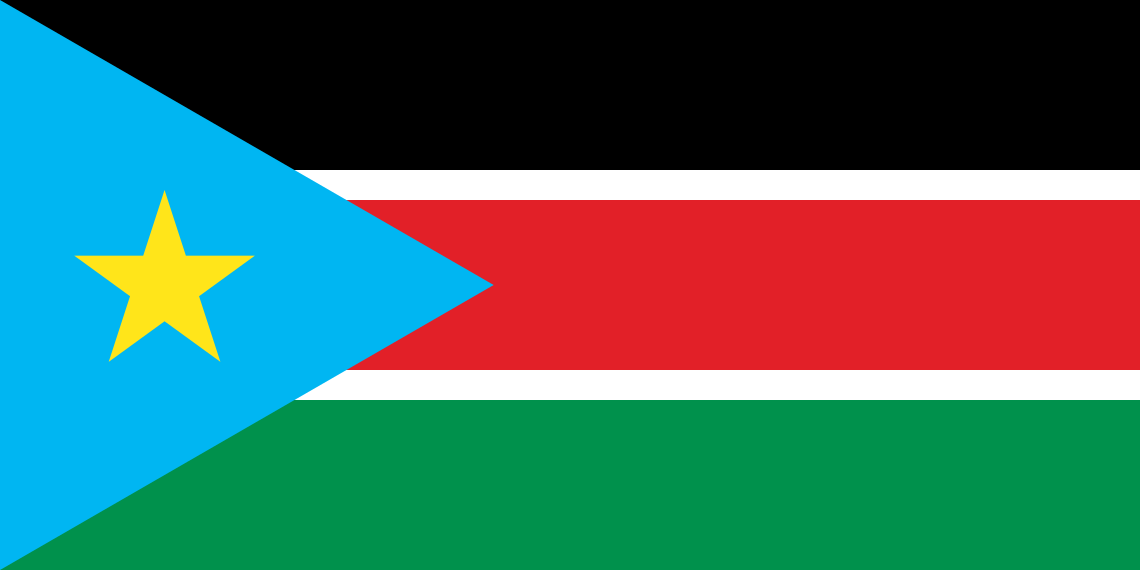
It is my distinct honour to address the General Assembly at its seventy-seventh session today on behalf of His Excellency Mr. Salva Kiir Mayardit, President of the Republic of South Sudan. I wish to congratulate the President, His Excellency Mr. Csaba Kőrösi of Hungary, on being chosen to lead the seventy-seventh session of the General Assembly. The Government of South Sudan welcomes his motto,
“Solutions through solidarity, sustainability and science”. We stand in support of sustainable policies and positive social transformations.
We commend the Secretary-General for convening the Transforming Education Summit, which successfully concluded this week. I am pleased to report that South Sudan is committed to transforming its education system by increasing its budgetary allocation for education to 17.5 per cent of the national budget. This investment in education will enable us to build more schools and improve teachers’ pay and thereby put the country on track to achieving Sustainable Development Goal 4 by 2030.
The Revitalized Peace Agreement on the Resolution of the Conflict in the Republic of South Sudan, signed on 12 September 2018 between the Government and opposition groups, ended the internal conflict in South Sudan. The parties are committed to the implementation of the Peace Agreement, which has improved security in the country. Thanks to the relative peace, internally displaced persons and refugees have been voluntarily returning home, although more formal reintegration remains a challenge, owing to limited resources. Nevertheless, the Government is doing whatever it can to resettle the internally displaced and refugees.
On the same note, I am pleased to inform the General Assembly that the command structure of the national unified forces has been established. This is a major leap towards transformation and regularization of the forces. Since the unification of the command structure in April 2022, there has been a de-escalation in clashes between the South Sudan Peoples’ Defence Forces and the Sudan People’s Liberation Army in Opposition. In addition, the first batch of 53,000 national unified force personnel successfully graduated on 30 August 2022. I am equally pleased to inform the Assembly that the parties to the Peace Agreement have agreed on a road map to complete the remaining tasks in the Agreement, which will pave the way for peaceful, fair and credible elections at the end of the transitional period in 2025.
Through thoughtful and targeted actions, South Sudan has been able to contain the spread of the coronavirus disease (COVID-19). The health effects of the pandemic in South Sudan have been surprisingly less pronounced than expected, marked by very low morbidity and fatality rates. As of 9 May 2022, only 17,513 confirmed COVID-19 cases, which includes 138 deaths, were reported since the start of the pandemic. The current vaccination campaign continues to be
effective, with the coverage of 45 per cent of the entire population over the age of 18.
Despite this positive health news, the pandemic has had negative effects on the economy, starting with dramatic declines in domestic production and revenue collection, followed by a rising cost of living. These economic consequences are far-reaching, severely weakening, for example, human-capital formation, especially in education, as the lockdown deprived school-age children of learning opportunities.
In April 2016, South Sudan ratified the Paris Climate Agreement, which seeks to solidify a global response to the threat of climate change by keeping global warming to well below 2°C. South Sudan has strategized to build on nature-based solutions and green infrastructure and to foster socioeconomic recovery pathways centred on climate change and natural disasters. It recently became evident to us that climate change is real, with the impacts of climate change and global warming now manifesting in various part of South Sudan. For example, 70 to 80 per cent of South Sudan has been affected by floods for the last three years in a row.
In its analysis of food insecurity between the periods of February to March 2022, the Government of South Sudan estimated that 6.83 million people — 55.3 per cent of the population — are facing acute food insecurity. Some 2.37 million people are in a state of emergency. The severe food insecurity is worsened by the combination of added shocks, including flooding, prolonged drought, physical insecurity and the effects of COVID-19.
South Sudan is surrounded by countries afflicted by conflict. As part of its obligation to promote peace and stability in the region and beyond, South Sudan successfully played a mediating role in the armed conflict in the Sudan, which resulted into the signing of Juba Peace Agreement in 2020. South Sudan stands ready to mediate in the current conflict between the Sudanese Army and the Forces of Freedom and Change in the Sudan so that the country can finally enjoy lasting peace. Recently, South Sudan also offered to mediate to resolve the tensions between Egypt and Ethiopia over their disagreement on the construction of the Grand Ethiopian Renaissance Dam. We further demonstrated willingness to mediate in the internal conflict in Ethiopia between the Ethiopian Government and the Tigrayan People’s Liberation Front. Furthermore, the Republic of South Sudan made itself available to play a mediating role on the border issue between the
Republic of the Sudan and the Federal Democratic Republic of Ethiopia.
By participating in efforts to bring about regional peace and stability, South Sudan has demonstrated its reliability as a partner in the quest for regional and international peace and security. Furthermore, the Republic of South Sudan is contributing a battalion of peacekeeping forces to the Eastern Africa Standby Force seeking to bring peace to the eastern part of the Democratic Republic of the Congo.
The current war between Russia and Ukraine is very unfortunate and devastating to the lives and livelihood of the citizens of both countries and beyond. The war has led to a severe humanitarian crisis where millions are in dire need. This war has not only affected the two warring parties, but it has had far-reaching effects on the global economy. From the moral point of view, the Government of South Sudan calls on Russia and Ukraine to cease all forms of hostilities and resolve the dispute through diplomatic and constructive dialogue so as to avert further consequences.
The Government of South Sudan appreciates the critical humanitarian and technical support made by States Members of the United Nations, and it looks forward to that support continuing. To mitigate the effects of flooding on the population and their livelihoods, South Sudan is donating $10 million to the World Food Programme to alleviate the suffering of the affected displaced communities. However, we need the support of the international community to reach all the flood- and drought-affected areas and communities. The President of the Republic of South Sudan will convene a conference of all the humanitarian organizations in South Sudan to coordinate humanitarian activities. The Government of South Sudan is committed to providing security and protection to relief workers. Together, we can save our planet by playing our roles and by supporting each other to mitigate the effects of climate change and come up with alternative methods and solutions based on available protocols.
Finally, the implementation process of the Revitalized Peace Agreement is facing numerous challenges, and sanctions imposed by international partners on individuals and entities are a disservice to the process. As we make progress in the implementation of the Revitalized Peace Agreement on the Resolution of the Conflict in the Republic of South Sudan, we call upon the international community — and the United Nations in particular — to revise the individual and
targeted sanctions and the arms embargo imposed on my country, in order to enable the successful completion of the remaining provisions of the Peace Agreement outlined in the new road map.
On behalf of the General Assembly, I wish to thank the Vice-President of the Republic of South Sudan for the statement he has just made.
Mr. Hussein Abdelbagi Akol Agany, Vice-President of the Republic of South Sudan, was escorted from the rostrum.
Address by Mr. Philip Isdor Mpango, Vice-President of the United Republic of Tanzania
The Assembly will now hear an address by the Vice-President of the United Republic of Tanzania.
Mr. Philip Isdor Mpango, Vice-President of the United Republic of Tanzania, was escorted to the rostrum.
I have great pleasure in welcoming His Excellency Mr. Philip Isdor Mpango, Vice-President of the United Republic of Tanzania, and inviting him to address the Assembly.


I wish to begin by conveying to this august body fraternal greetings from Her Excellency Ms. Samia Suluhu Hassan, President of the United Republic of Tanzania, who could not attend this year’s session owing to pressing national commitments. It is therefore my distinct honour and privilege to address the United Nations General Assembly at its seventy-seventh session on behalf of the Government and the people of the United Republic of Tanzania.
Let me join those who have spoken before me in congratulating the President of the Assembly on his election to preside over the General Assembly at its seventy-seventh session. I assure him of Tanzania’s support and cooperation as he discharges his responsibilities.
Let me also extend our appreciation to the Secretary- General, His Excellency Mr. António Guterres and the entire United Nations Secretariat for their dedicated service as guardians of the common interest of all peoples and all States, particularly during this time of unprecedented global challenges.
This Assembly is convening at a critical point, when the world is engulfed in dangerous flames ranging from conflicts and mounting geopolitical tensions, devastating effects of the coronavirus disease (COVID-19) pandemic, food and energy insecurity, environmental carnage and extreme climate-change-related events, to barriers to education, technology and opportunity for shared prosperity. These challenges are in turn inextricably linked with and propelling stubborn global poverty. Furthermore, with only eight years remaining before 2030, the world is still way off the mark in meeting many of the targets that we set in 2015.
The root cause of all these challenges is human greed, selfish desire and unilateralism. Yet we know for sure that unilateralism, driven by greed, is leading us, rich and poor, strong and weak, to a catastrophe. For it is now evident that these challenges have inflicted and continue to inflict enormous disruptive impacts on economies, ecosystems and social lives worldwide, with sub-Saharan African countries and other developing countries being hit disproportionately.
We have a famous proverb in Kiswahili that says, “Where there are problems, ingenuity increases.” In the spirit of this, we in Tanzania are convinced that transformative solutions to the global challenges we face are already at our disposal but subject to two conditions being met: first, there must be a passionate belief in the need to bring a caring spirit to considering the needs and happiness of other peoples and nations; and, secondly, there must be solemn adherence to the credo of multilateralism and collaborative efforts. Fortunately, both conditions are a restatement of the ideals, values and principles of the United Nations Charter.
Specifically, on the COVID-19 pandemic, the pandemic had devastating effects on Tanzania’s socioeconomic systems and performance. As it did for most other developing countries, the pandemic robbed us of precious lives, over-stretched health infrastructure and health-care workers to the limit and led to severe budget constraints and economic deceleration. Real gross domestic product growth declined from 6.7 per cent decadal growth attained in the pre-pandemic period to 4.8 per cent in 2020.
The key lesson we have learned from the COVID-19 pandemic is that the world needs to be better prepared in terms of national and global health systems in order to be able to handle future pandemics. This entails investing more in building health infrastructure and
beefing up the health workforce, as well as enhancing national and regional capacity to manufacture drugs, supplies, vaccines and medical equipment.
In addition, Africa’s marginalization in the provision of vaccines underscored the need for African countries to work together in the development and nurturing of indigenous solutions through joint medical and scientific research. The pandemic also brought to the fore the need to invest more in public health education, especially preventive medicine to build individual resilience, including body fitness and healthy diet and habits.
However, I wish to acknowledge that although international support in taming the spread of the global pandemic, through provision of diagnostic equipment, medicines, vaccine support programmes and financing came late to Africa, it was critical in winning the war against the pandemic. Tanzania would therefore like to thank all our development partners that have been working with us to deal with the pandemic and put the country on a bright post- COVID-19 recovery path. Currently, the Government continues with its vaccination campaign whereby, as of 11 September, we already vaccinated 60.56 per cent of the targeted population.
With respect to climate change, we are indeed at a tipping point. The United Republic of Tanzania appreciates all individual efforts and other collective measures taken thus far to implement interventions geared at upscaling mitigation and adaptation as stipulated in the Kyoto Protocol of 1997 and the Paris Agreement of 2015. However, despite the efforts, we are observing unprecedented changes across the whole climate system in every region.
The fact remains that the most vulnerable countries, including Tanzania, have been disproportionately affected and that we do not possess the capacity to effectively respond. Tanzania has put forward ambitious targets on both adaptation and mitigation through nationally determined contributions (NDCs). The Government spends an average of $500 million per annum on adaptation measures and up to 3 per cent of its gross domestic product on mitigation and building community resilience. With the help of the international community, we are committed to continually updating our NDCs and making important progress to tackle climate change.
Yet, unless there are immediate, rapid and large-scale reductions in greenhouse-gas emissions,
limiting warming to at least 2°C will be elusive. As much as we remain committed, most developing countries have insufficient fiscal space and weak debt- sustainability status to address increasing demand for climate-resilience interventions. Addressing the climate crisis therefore requires reliable access to climate finance. It is on this note, that Tanzania calls on the international community to live up to its commitments made under the Paris Agreement. Enhanced capacity- building, technology transfer and support for adaptation and mitigation measures, as well as the creation of an independent loss-and-damage financial facility must be implemented in order to scale up the fight against climate change. We need, as a matter of urgency, to take action and walk the talk.
At this point, I must emphasize that Tanzania and the rest of Africa need a just transition from fossil fuels to renewable energy. Africa must be given time to adjust since the majority of Africans have no access to energy. The well-established principle of common but differentiated responsibilities and respective capabilities must be observed. In this regard, we call upon the lifting of opposition to global financing and implementation of the transformative projects in our countries that aim to harness our hydrocarbon deposits for energy and other equally important uses to address our critical developmental needs. As long as robust environmental and social impact assessments have been done and concrete measures taken to effectively address the environmental and democratic governance concerns of our citizens, our sovereign rights to pursue transformative projects should be respected.
We also call upon transparency in the conduct of carbon-credit markets so that Africa benefits fairly from our earnest effort to take care of the carbon sinks that we are holding for the world. For example, Tanzania has preserved over 30 per cent of our total land area — a land mass almost equivalent to the size of Germany — which includes forests and wildlife parks.
In the maintenance of peace and security, Tanzania has always believed that diplomacy is the best instrument for resolving conflicts. Experience has taught us that, in war, everyone loses, including the non-warring parties. It is therefore our plea that, in the wake of global conflicts, our focus should remain to be on safeguarding human lives, especially children and women, and the well-being of people. Moreover, just recently, we have witnessed disruptive effects on global supply chains, dramatic increases in food and fuel prices as well as food shortages and declines in
agricultural and industrial production around the world — all the more reasons to state that we all have a stake in pursuing the peaceful resolution of conflicts. As we do so, we must also leverage our abundant resources and human capabilities to address some of the impacts.
In the same spirit, peacekeeping operations remain one of the most dependable instruments for promoting world peace and security. Tanzania is proud to have contributed men and women in 5 of the existing 16 peacekeeping missions across the world. Despite this state of affairs, Tanzania stands ready to contribute more, if requested to do so. We also continue to actively participate in regional peace initiatives — and more so now in our capacity as a member of the African Union Peace and Security Council as well as the East African Community and Southern African Development Community. We therefore call upon the United Nations to enhance its support to regional efforts in peacebuilding and peacekeeping.
The credibility of the United Nations rests on a well-represented and responsive Security Council. We therefore wish to reiterate the common African position, as elaborated in the Ezulwini Consensus and the Sirte Declaration, with respect to the long-awaited reforms of the Security Council. It is well past time the Security Council reflected the present-day realities of the United Nations membership and not that of the 1940s.
I would be remiss if I did not end my statement without acknowledging that, the world celebrated the Kiswahili Language for the first time this year on 7 July, following the historic UNESCO declaration designating that date as World Kiswahili Language Day. As the birthplace of the Kiswahili language, Tanzania commends the efforts of the United Nations in promoting multilingualism as a core value, which is essential to achieving both the 2030 Agenda for Sustainable Development and the African Union Agenda 2063.
To conclude, let me once again reaffirm the resolve of the United Republic of Tanzania to uphold the three pillars of the United Nations, namely, peace and security, development and human rights. I also call upon all of us to renew our commitment and prioritization of actions especially on those Sustainable Development Goals where we lag behind. We remain committed to working closely with the United Nations and its Member States in the spirit of multilateralism and global solidarity towards a sustainable future.
On behalf of the General Assembly, I wish to thank the Vice-President of the United Republic of Tanzania for the statement he has just made.
Mr. Philip Isdor Mpango, Vice-President of the United Republic of Tanzania, was escorted from the rostrum.
Address by Ms. Jessica Alupo, Vice-President of the Republic of Uganda
The Assembly will now hear an address by the Vice-President of the Republic of Uganda.
Ms. Jessica Alupo, Vice-President of the Republic of Uganda, was escorted to the rostrum.
I have great pleasure in welcoming Her Excellency Ms. Jessica Alupo, Vice-President of the Republic of Uganda, and inviting her to address the Assembly.


I congratulate the President of the General Assembly on his election to preside over the Assembly at its seventy-seventh session and assure him of Uganda’s full support. I would like to thank His Excellency Mr. Abdulla Shahid for his stewardship of the General Assembly at its seventy-sixth session. I pay tribute to the Secretary-General, His Excellency Mr. António Guterres, for his commitment to the work of the United Nations.
The seventy-seventh session of the General Assembly is being held in person for the first time since 2020, when the coronavirus disease (COVID-19) pandemic made it impossible to do so. It is a timely reminder of the urgent need to strengthen international cooperation, collaboration and solidarity so that the world may take transformative actions to address the common challenges that include, inter alia, poverty, health, pandemics, climate change, food insecurity and biodiversity loss.
As we celebrate 77 years of the United Nations, we need a revitalized Organization that is fit for purpose. We need our Organization to be stronger than ever before. We believe that multilateralism is fundamental and crucial in addressing our common challenges. We believe that, by acting together in solidarity as nations, the world can effectively address the current and emerging challenges. Responding to COVID-19 has taught us a lot. We should scale up cooperation in vaccine production capacity and resource mobilization
in order to support efforts to mitigate the impact of the COVID-19 pandemic. We are thankful to our bilateral and multilateral partners that supported our response to the COVID-19 challenge.
The Government of Uganda attaches importance to the 2030 Agenda for Sustainable Development and continues to register progress in its implementation. It has continued to strengthen its institutional coordination to achieve the 17 Sustainable Development Goals (SDGs), and its national SDG secretariat has been strengthened to support the coordination architecture in order to ensure that the country stays on track in implementing the SDGs. The Government of Uganda has fully mainstreamed the SDGs in its national development plan and is working together with the United Nations family and other stakeholders. That will sustain and strengthen collaboration with all actors. However, the effective implementation of the 2030 Agenda will require support in areas such as transfer of technology, capacity-building and financing.
Climate change remains one of the greatest challenges of our time. Our collective effort to fight climate change is an irreversible process that must continue. However, we must note that, despite contributing an insignificant amount of global greenhouse-gas emissions, the African continent, like many developing regions of the world, suffers the effects of climate change to a disproportionate degree. Uganda, for instance, continues to experience prolonged droughts and the melting of ice caps on its highest mountain, Mount Rwenzori, as well as floods, erratic rainfall patterns and landslides.
Moreover, as His Excellency President Yoweri Kaguta Museveni has said before, the climate change problem is also the result of irresponsible and sometimes greedy human actions. Similarly, if underdevelopment persists, we can forget about conserving the environment. It is regrettable and hypocritical that some of the regions and nations that mismanaged the environment and are disproportionately responsible for global warming have embarked on a rigorous campaign to thwart the efforts of other countries to responsibly and sustainably develop their oil and gas sectors. Our view is that development should be environmentally friendly, inclusive and provide benefits for all — it should leave no one behind.
Uganda has continued to scale up investments in climate adaptation and mitigation measures, specifically with regard to increasing access to clean energy in
order to enhance production, as well as increasing forest and wetland cover, among other interventions. Climate change action must uphold the principles of equity and common but differentiated responsibilities and be consistent with a country’s national context. We therefore urge developed countries to fully deliver, in line with the Paris Agreement on Climate Change, on the commitments to the goal of providing $100 billion per year to assist developing countries in the climate change actions they take to mitigate the adverse effects of climate change.
South-South cooperation, a framework of international cooperation within the global South, continues to play a vital role in supporting developing countries in their efforts to address interlocking challenges. We applaud the countries of the global South for their solidarity in responding to global challenges. Uganda will continue to work towards and support the strengthening of North-South, South-South and triangular cooperation at the United Nations. As host country of the third South Summit, to be held in Kampala from 10 to 12 December 2023, we look forward to welcoming the leaders of the Group of 77 and China.
The world currently faces many challenges that undermine international peace and security. The Russia-Ukraine military conflict continues to cause more suffering, destruction and displacement of the civilian population, mostly women and children. The longer it persists, the more suffering, destruction and displacement we will witness. We are deeply concerned about the loss of life and the serious humanitarian situation. Uganda supports dialogue with a view to reaching a peaceful resolution to the crisis. My President has said many times that,
“We think the best way is to negotiate. Everybody who wants peace in the world should support negotiations in order to get a balanced peace that ensures safety for all.”
Terrorism is currently one of the major global threats to peace, security, stability and social and economic development. No region of the world has been safe from the scourge of terrorism. Terrorism and violent extremism continue to bring death and suffering to innocent people. Terrorist groups such as Al-Shabaab and the Allied Democratic Forces continue to commit terrorist acts in our region. As a community of nations, we must be unwavering in our resolve to prevent and combat terrorism in all its forms and manifestations.
We should act in a coordinated manner at the national, regional and global levels to counter that threat. Uganda will continue to support and actively participate in global and regional counterterrorism efforts.
Peace, security and development are inextricably linked and should be pursued simultaneously. Recently, we have seen some progress in our quest for peace and security in our region. Uganda, working with partners in the region and beyond, continues to support and advance peace and security efforts in the region. We remain actively involved in regional initiatives, such as those of the African Union, the Intergovernmental Authority on Development, the East African Community and the International Conference on the Great Lakes Region, and we are encouraged by the progress that we have made and continue to make. We believe that long-term and sustainable solutions lie in those collaborative processes. The international community, in particular the United Nations, should therefore continue to support conflict-prevention initiatives undertaken by those regional and subregional organizations. Experience has shown that, when and where that has happened, the chances of success have been high.
The conflicts in our region and beyond have led to an inevitable refugee influx into Uganda. Currently, we have more than 1.5 million refugees in the country — the largest refugee population on the continent of Africa and the third-largest in the world. We are committed to working with refugee-sending countries and regional and international partners to address the causes of the refugee crisis. We urge the international community to continue supporting our efforts in the region in that direction.
The need to reform the Security Council is now more urgent and imperative than ever before. The current geopolitical realities make an increasingly compelling case for a comprehensive reform of the Council to make way for equitable representation. Africa, which has more than 1 billion citizens and accounts for more than 70 per cent of the issues on the agenda of the Council, continues to suffer the historical injustice of having no representation in the permanent category of Security Council membership — and is also underrepresented in the non-permanent category. It is time for the long-standing injustice and imbalance perpetuated in the current configuration of the Security Council to be addressed. Uganda supports the comprehensive reform of the Council and urges Member States to continue working towards achieving progress in the
intergovernmental negotiations so that Africa can assume its rightful place in the Security Council.
The Movement of Non-Aligned Countries (NAM) remains a strong pillar in addressing global challenges within the United Nations. We remain actively involved in NAM, in line with its purposes and principles. In that regard, Uganda will continue to collectively work with other NAM countries to further strengthen the critical role of the Movement at the United Nations. As host of the nineteenth NAM Summit, to be held in Kampala from 5 to 9 December 2023, we look forward to welcoming the leaders of the Non-Aligned Movement.
On behalf of the General Assembly, I wish to thank the Vice-President of the Republic of Uganda for the statement she has just made.
Ms. Jessica Alupo, Vice-President of the Republic of Uganda, was escorted from the rostrum.
Address by Mr. José Gabriel Carrizo, Vice-President of the Republic of Panama
The Assembly will now hear an address by the Vice-President of the Republic of Panama.
Mr. José Gabriel Carrizo, Vice-President of the Republic of Panama, was escorted to the rostrum.
I have great pleasure in welcoming His Excellency Mr. José Gabriel Carrizo, Vice-President of the Republic of Panama, and inviting him to address the Assembly.


First of all, I thank God and the Virgin Mary for making it possible for us to gather here, and I ask them to enlighten the work of this session.
I would like to convey to the General Assembly the greetings of His Excellency Mr. Laurentino Cortizo Cohen, President of the Republic of Panama, who has delegated me to represent our country here today.
Our country firmly supports the important themes proposed for consideration at this session of the General Assembly. We share the view that, in order to overcome the global health crisis and move forward in the transition to a post-pandemic world, we must promote creative solutions and share a greater degree of solidarity and support, using science as a fundamental ally to confront the challenges facing humankind. Knowledge, research and education are the tools
required to ensure that transition, especially in nations with high levels of poverty, where millions continue to be deprived of the opportunity to live a dignified life. Too many people continue to starve; meanwhile, others suffer from indigestion. Withholding knowledge instead of sharing it is a selfish act.
The current Government of the Republic of Panama has been at the helm of the country for 38 months, 30 of them during the pandemic. No other Administration in the history of Panama has been confronted with such complex challenges. In that regard, we concentrated our efforts on saving lives, preventing the collapse of the health system and maintaining social peace. Two and a half years later, we are on the threshold of recovering from the damage caused by the global health crisis, and we continue to make progress. We are capable of achieving exceptional outcomes that we can share with the world.
Our national strategic plan was conceived with a particular objective in mind: fighting the causes of poverty and inequality. Our Government’s leadership rests on our commitment to laying the foundations for profound transformations. While our country is indeed experiencing robust growth, it also faces unacceptable inequality, and we are working tenaciously and tirelessly to combat that reality. Our Administration seeks to lay the foundations for a fairer country, consolidate democracy and strengthen the independence of the judiciary. For the first time in the history of our country, as Head of the Government, the President waived his prerogative to unilaterally appoint the judges of the Supreme Court of Justice and established a system of independent evaluation based on professional merit. Also for the first time in the history of our country, the majority of the judges on the Supreme Court of Justice are women, and none of them has any relationship, link or subordination to the President of the Republic.
In Panama as in the rest of the world, we had to face the pandemic. Protecting human lives, especially those of the most vulnerable, was our primary mission. We deployed creativity and innovation to develop technological instruments that enabled us to serve our population directly, openly and equitably. We transformed Panama’s national identity card into an instrument for transferring resources — a free debit card, in fact.
We were the first country on the continent to implement a centralized tracing and monitoring system for communicable diseases, which registers every case
of infection in real time in our national epidemiological surveillance system.
We stopped students’ learning processes from being disrupted during the lockdown period by using the strategy for resilient educational transformation computer platform, known as ESTER. We guarantee free internet access to the vast majority of students, including those in remote communities.
We are currently overseeing the development of the MedicApp platform, an innovative digital database that keeps citizens informed in real time about the availability of medicines, as well as points of sale and comparative prices. We are willing to share those experiences and achievements — which have been recognized by international organizations, including the United Nations — with the international community.
I fully share with our President Cortizo the belief that dialogue, participation and consensus build social peace. To cite a concrete example, at the height of the pandemic, we promoted a bicentennial pact initiative on the theme of closing gaps, designed as a point of contact for Panamanian society, as a way to develop a framework for how it sees itself in the future — and we see a country with a common good for all that is prosperous, safe and lives in peace. A total of 186,182 proposals were freely presented as possible solutions to problems encountered in the population. From that broad consultation, there have emerged national agreements that respond to the real concerns of the Panamanian people and transcend governmental term periods.
The destabilization of fuel prices also led to demonstrations and protests in Panama, primarily owing to the increase in the costs of food, medicine and gasoline. Instead of confrontation, President Cortizo opted for dialogue. Nobody in our country lost their life during those protests. Our governing style has enabled agreement and consensus where the deepest needs of the population are concerned. Our national Government has articulated concrete provisions and measures. And it is very important to point out that we have been able to ensure social peace. In the global context, dialogue is the only way to reduce the space for extremism.
Accessible medicine is the difference between life and death. President Cortizo has decided to confront that issue with courage and political will. To that end, he instructed me to establish and organize our country’s national Commission of Medicines with a view to securing a supply of medicines for our population, with prices much lower than the current ones. The
pharmaceutical industry, including the production, supply and distribution of medicines in the world, is supposed to contribute to people’s health; however, we note with concern that millions of people cannot access medicines. That access has become a cold, business- like exchange. The oligopolies earn disproportionately high profits from the medicines they distribute and sell to both Governments and private individuals. Such a system, which is shameful for humankind, cannot continue.
It is everyone’s responsibility — and we must examine and address the global implications — to ensure that access to medicines is valued as a human right and not as an expensive luxury commodity. Panama calls on the General Assembly to adopt a global initiative to solve the issue of the excessively high prices of medicines and their inaccessibility to the people of the world.
Panama is in fact a transit country for irregular migration. Thousands of people transit through the Darien Gap jungle crossing on the border with Colombia. It is a dangerous and treacherous crossing, where people risk their lives, get sick and die. We are not just a transit country for migration. Also included in that context are criminal organizations engaged in the nefarious business of human trafficking. Our Government has adopted a State policy for addressing and providing assistance to migrants, with a particular emphasis on humanity and solidarity. We emphasize that the possible solutions to this painful and regrettable situation can be provided by the origin countries, whose poverty and social marginalization determine irregular migration, as well as those of us are affected by the transits, especially the countries of destination.
Our Government believes that the current development model must be transformed to take into account the value of biodiversity and to promote healthy and sustainable ecosystems. Panama is one of the three carbon-negative countries in the world. Some 35 per cent of our national territory and 30.5 per cent of our seas have been declared as natural protected areas. More than 80 per cent of our electricity generation comes from renewable sources. In July of this year alone, we achieved a new historic record: 95 per cent of the energy generated to supply our national matrix was clean energy. Our country ranks eighth in the world for clean-energy generation.
President Cortizo’s energy transition agenda has strengthened Panama’s global leadership in combating
climate change. Panamanians have a historical awareness of the value of our geographic position because of the presence of the Panama Canal and the role it plays in the world economy. We are a country with a mission to protect its natural resources.
Young people are harshly critical of the many forums, summits and declarations on climate change and the preservation of the environment and natural resources that continue to be held while emissions and deforestation increase without restraint, along with the contamination of water, aquifers, rivers and oceans. How can we win the trust of new generations while the planet where we live, and our descendants will have to live, is being destroyed before their eyes? How many more lives must be lost? How many more natural disasters must take place? I wonder: when are they going to stop the ecocide? From this rostrum, we remind the big emitters of gases, those that encourage deforestation and those that dump chemicals that pollute and kill, that it is matter of the survival of the Earth and the species that inhabit it. Today, before this gathering of nations, Panama proposes that the time has come for the world to have an international body to hold all those that inflict damage on the planet accountable.
The future depends on every decision that we take now. It is no longer viable to take the wrong direction and then try to correct it. The path of conflict and war leads to more calamities and disasters. It is the wrong path.
Because of its geography and ethnic and cultural diversity, Panama is a country of openness and common ground. Situated at one of the main maritime corridors in the world, at the centre of the American continent, we Panamanians are always ready to serve humankind, as we have done for centuries.
Today, before the General Assembly, we want to resolutely say to the world that it depends, and will always depend, on Panama. The times we live in have changed. The world that was is no more. Ahead of us, we have the challenge of building another world — a better world, with answers to ensure human health and life on this planet, which is our home, a world with greater solidarity and peace. We must succeed. United, we will always be much stronger.
On behalf of the General Assembly, I wish to thank the Vice-President of the Republic of Panama for the statement he has just made.
Mr. José Gabriel Carrizo, Vice-President of the Republic of Panama, was escorted from the rostrum.
Address by Mr. António Costa, Prime Minister of the Portuguese Republic
The Assembly will now hear an address by the Prime Minister of the Portuguese Republic.
Mr. António Costa, Prime Minister of the Portuguese Republic, was escorted to the rostrum.
I have great pleasure in welcoming His Excellency Mr. António Costa, Prime Minister of the Portuguese Republic, and inviting him to address the General Assembly.


In 1945, representatives from 51 countries met in San Francisco to found the United Nations. They made a commitment to maintain international peace and security, develop friendly relations among nations and “save succeeding generations the scourge of war”. Seventy-seven years later, we have still not achieved those goals. Around the world, many children, and even many adults, have never known peace.
In Europe today we are confronted with the unjustified and unprovoked invasion of Ukraine in flagrant violation of international law, in particular the Charter of the United Nations. It is a war with devastating effects for the Ukrainian people, brutally affecting the civilian population. The gravity of the acts committed makes an independent, impartial and transparent investigation imperative so that the crimes committed do not go unpunished.
Therefore, we cannot fail to once again condemn the Russian aggression and emphasize Portugal’s support for the sovereignty, independence and territorial integrity of Ukraine. Russia must cease hostilities and allow for a serious and sustained dialogue towards a ceasefire and peace. This is not the time for Russia to escalate the conflict or to make irresponsible threats to resort to nuclear weapons.
We welcome the efforts of the entire United Nations system, in particular its Secretary-General, Mr. António Guterres, to resolve the conflict and to mitigate its damaging effects, such as the food crisis. It has once again been the most vulnerable who have felt the impact of the energy and food crisis the most, after being buffeted by almost three years of the pandemic.
That is why we reiterate our solidarity with all those around the world, particularly in Africa, who are suffering from the impact of Russia’s invasion of Ukraine. That is also why it is important to make it clear and unequivocal that the necessary sanctions applied to Russia cannot affect, directly or indirectly, the production, transportation and payment of cereals and fertilizers.
Peace was not definitively won in 1945, but the world has changed radically since then. We need a representative, agile and functioning Security Council that is able to respond to the challenges of the twenty-first century without becoming paralysed, and whose actions are scrutinized by the other Members of the United Nations. We need a Security Council that incorporates a comprehensive view of security, recognizing, inter alia, the role of climate change as an accelerator of conflict — a Security Council where the African continent, and at least Brazil and India, have seats and where small countries are more fairly represented.
A global vision of security is essential, based on the New Agenda for Peace advocated by Secretary-General Guterres — an agenda focused on conflict prevention and capable of ensuring adequate, predictable and sustainable funding for peacebuilding.
As the international community, it is our duty to support the efforts of African nations for the stability of their continent, seeking African solutions to African problems. The worsening security and humanitarian context in the Sahel also requires a concerted and multidimensional effort, ensuring humanitarian assistance to populations affected by the multiple crises that plague the region.
The evolving terrorist threat around the world, particularly in Mozambique, the Sahel and the Gulf of Guinea, requires a targeted and effective response from the international community.
Over the past decades, my country has established itself as a reliable partner for global peace and stability. At the service of the United Nations, we are currently present in four theatres of peacekeeping operations, including in the United Nations Multidimensional Integrated Stabilization Mission in the Central African Republic. I am very proud of the recognition that our military and security forces have received for their contribution to crisis and conflict management on all continents under the aegis of the United Nations, NATO or the European Union.
It is undeniable that there is a link between climate and security. Today more than ever, we are feeling the effects of climate change — heat waves or intense cold, droughts, fires, floods and storms. Countries, such as Portugal, that suffer from coastal erosion, increased droughts and the tragedy of forest fires clearly understand the urgency of climate action. Neither is it necessary to explain it to countries like Pakistan, which today is suffering the truly devastating consequences of the rest of the world’s climate inaction, or to coastal countries, particularly small island nations, which see their livelihoods threatened year after year by rising sea waters.
We hope that the twenty-seventh Conference of the States Parties to the United Nations Framework Convention on Climate Change (UNFCCC), to be held in Sharm El-Sheikh, Egypt, can be a time that leads to an inclusive transition, ensuring a more balanced allocation of climate financing between mitigation and adaptation.
Portugal has been at the forefront of the decarbonization process, having been the first to commit to achieving carbon neutrality by 2050 as early as the twenty-second Conference of the States Parties to the UNFCCC, held in Marrakesh. We believe that that goal is feasible from an economic and technological point of view and will promote employment and generate social justice.
We will seek to accelerate those commitments, as we already did with our goal of ending electricity production from coal, which we achieved last year. By 2026, we want to increase the percentage of renewables in the electricity consumed in Portugal from 60 per cent to 80 per cent. To that end, we will continue our strong investment in solar, wind and ocean energies, and we will invest in the use of renewable gases, such as green hydrogen. The sea is one of the platforms where climate is projected. We welcome the active participation of all States in the second Ocean Conference, which we had the honour of co-organizing with Kenya. The Lisbon Declaration represents a genuine action plan for achieving Sustainable Development Goal 14, on the conservation and sustainable use of ocean resources. As part of the commitments made by the various countries and entities present, Portugal also reiterated its commitment to protecting at least 30 per cent of marine areas by 2030. We went further; by the end of the decade, we want 100 per cent of the maritime space under Portuguese sovereignty or jurisdiction to be assessed as being in a good environmental status. After Lisbon, there remains much work to be done on the ocean agenda. I am sure that France and Costa Rica will continue the work undertaken by Portugal and Kenya in recent years with redoubled energy. We therefore call for the conclusion of negotiations on a post-2020 global biodiversity framework that enshrines the 30-by-30 target. We also support progress in the negotiations of the treaty on marine biodiversity in areas beyond national jurisdictions by the end of this year. The transition to a prosperous future — a green and digital future — can leave no one behind. Social policies must be at the heart of our action, the development of our economies and the fight against climate change. We therefore support the preparatory process for the Social Summit, proposed by the Secretary-General. We must also continue to work to ensure effective and equitable immunization worldwide, improve the global health architecture and find ways to respond more quickly, in a coordinated and decisive manner, to future crises by adopting a genuine pandemic treaty. The successful implementation of the 2030 Agenda for Sustainable Development plays mainly on the most vulnerable countries and populations. All those challenges further highlight the universal, indivisible and independent nature of all human rights, whose respect, protection and promotion are a top priority of Portugal’s external and internal action. Imbued with the humanist spirit that our historical responsibility as forerunners of the abolition of the death penalty instils in us, we will continue to fight for its universal abolition. No future will be truly transformative without pluralist, inclusive societies that promote gender equality and combat racial discrimination, racism, xenophobia and all forms of intolerance. In that regard, the fight for gender equality and women’s empowerment is absolutely crucial. If we do not achieve that, it will not be possible to meet our human rights obligations or the successful implementation of the 2030 Agenda for Sustainable Development. It is also crucial that we pay particular attention to the impact of conflict situations on the rights of women and girls and the fundamental role that they can play in processes to build and consolidate peace. I therefore want to reiterate Portugal’s support for the United Nations women and peace and security agenda. As a country of emigration and immigration, we will continue to participate constructively in discussions on the global governance of migration. We will continue the good path that we have been following in our national territory, from the integration of migrants to the promotion of regular pathways for labour mobility. We have played an active role in welcoming migrants and refugees in a clear expression of solidarity, having welcomed refugees from Ukraine and Afghanistan, among other places. The transformative potential of the United Nations is immense, but it must be given the tools to realize the high expectations placed on it by people around the world, particularly young people. One third of the world’s population is under 20 years old. It is therefore essential to ensure that young people participate in decision-making processes and that their voices be effectively heard. We will therefore continue to take a leading role in the youth agenda and support the work of the United Nations Youth Office. The United Nations is the global forum for consultation among peoples. The challenges that we face today require that we continue to adapt our common home, making it more efficient, fairer and more representative. Portugal is ready to make its contribution. We are therefore candidates to the Security Council for the two-year term from 2027 to 2028. We once again hope to merit the trust of Member States, because only together can we build a more peaceful, more sustainable, more inclusive and more prosperous future. The strengthening of multilateralism is not an option. It is an absolute necessity in order to deal with global challenges. Today it is time to move from words to action, with more cooperation, more solidarity and more multilateralism. Portugal, as always, will not miss that call.
The President took the Chair.

On behalf of the General Assembly, I wish to thank the Prime Minister of the Portuguese Republic for the statement he has just made.
Mr. António Costa, Prime Minister of the Portuguese Republic, was escorted from the rostrum.
Address by Mr. Nikol Pashinyan, Prime Minister of the Republic of Armenia
The Assembly will now hear an address by the Prime Minister of the Republic of Armenia.
Mr. Nikol Pashinyan, Prime Minister of the Republic of Armenia, was escorted to the rostrum.
I have great pleasure in welcoming His Excellency Mr. Nikol Pashinyan, Prime Minister of the Republic of Armenia, and inviting him to address the Assembly.


It is an honour to return to the General Assembly, although I wish I were here with a more positive message given all the challenges and tribulations that the world has been through in the past few years. However, my statement will focus on the latest Azerbaijani unprovoked aggression against the sovereign territory of the Republic of Armenia and its overall impact on stability in the South Caucasus.
On 13 September, Azerbaijan launched an unprovoked and unjustified military aggression against Armenia. Using heavy artillery, multiple-launch rocket systems and combat unmanned aerial vehicles, the Azerbaijani armed forces shelled 36 residential areas and communities, including the towns of Goris, Jermuk, Vardenis, Kapan and Geghamasar, deep within the sovereign territory of Armenia. That was not a border clash. It was a direct, undeniable attack against the sovereignty and territorial integrity of Armenia, which was condemned and addressed during the most recent Security Council meeting (see S/PV.9132) and beyond.
The Azerbaijani attack deliberately targeted the civilian population and vital civilian infrastructure. Jermuk is one of the main health tourism and resort sites of Armenia. As a result of the Azerbaijani aggression, all the hotels, resort facilities and health centres of Jermuk are now closed. All the residents of that town are displaced. Overall, the number of those temporarily displaced from the Gegharkunik, Vayots Dzor and Syunik regions of Armenia is more than 7,600 persons, mostly women and elderly people, among them 1,437 children and 99 persons with disabilities.
Around 192 houses, three hotels, two schools and one medical facility were partially or completely destroyed. Seven electrical infrastructures, five water infrastructures, three gas pipelines and one bridge were damaged. Two ambulances and four private cars were shelled. The Kechut water reservoir was targeted and
shelled. Journalists and ambulance vehicles were also targeted and shelled.
As a result of the aggression, at the moment the number of victims and missing persons exceeds 207, among whom three civilians were killed and two civilians are missing. A total of 293 servicemen and eight civilians were wounded; at least 20 servicemen were captured. There is evidence of cases of torture, the mutilation of captured or already dead servicemen and numerous instances of extrajudicial killings and ill-treatment of Armenian prisoners of war, as well as the humiliating treatment of their bodies. The dead bodies of Armenian female military personnel were mutilated and then proudly video-taped by Azerbaijani servicemen with particular cruelty. The videotapes, featuring such gruesome war crimes and crimes against humanity, are being shared and praised on Azerbaijani social media by individual users.
No doubt, committing such unspeakable atrocities is a direct result of a decades-long policy of implanting anti-Armenian hatred and animosity in Azerbaijani society by the political leadership.
In the wake of that offensive, the official narrative and other sources of information suggest that Azerbaijan intends to occupy more territories of Armenia, which needs to be prevented. I want to stress that the risk of a new aggression by Azerbaijan remains very high, especially taking into account the fact that every day Azerbaijan violates the ceasefire, and the number of causalities and those injured could change at any moment. Another factor for further escalation may be the inappropriate reaction to this situation by the regional security organizations, which raised very difficult questions among Armenian society.
Despite the facts I just mentioned, Azerbaijan is trying to present itself as a country seeking peace in our region and peace with Armenia. Hearing from aside what Azerbaijan is saying, one can even be impressed by its devotion to peace efforts. To stage that impression, Azerbaijan is using the subjects of a peace treaty with Armenia, border delimitation and a regional communication opening agenda.
Why have we not made any tangible progress in those directions? The reason is very simple. Azerbaijan is using all those topics for territorial claims against Armenia. For example, one of the most important subjects of a peace treaty is the bilateral recognition of territorial integrity between Armenia and Azerbaijan. We already declared that we were ready to do that, but
so far Azerbaijan has not done so. On the contrary, Azerbaijan has been publicly voicing that the entire south and east of Armenia, and even the capital city of Yerevan, is Azerbaijani land. On the other hand, Azerbaijan is keeping physical territories of Armenia under occupation, and, as I said, the risk of a new aggression by Azerbaijan remains very high.
In that regard, I pose an official and public question to the Azerbaijani President. Could he show the map of Armenia that he recognizes, or is ready to recognize, as the Republic of Armenia? Why I am asking that is because it can come out that, from the point of view of official Azerbaijan, only half of Armenia, or even less, is the Republic of Armenia. If Azerbaijan would recognize the territorial integrity of Armenia, not theoretically, but concretely — I mean the integrity of our internationally recognized territory of 29,800 square kilometres — it would mean that we could sign a peace treaty by mutually recognizing each other’s territorial integrity. Otherwise, we will have a phantom peace treaty, and, after that, Azerbaijan will use the border delimitation process for new territorial claims and occupation.
As Member States may know, the bilateral commission for border delimitation and border security was formed in May, and two meetings of the commission took place. Before the formation of the commission, last year Azerbaijan occupied more than 40 square kilometres of territory of Armenia. One of Azerbaijan’s excuses for the reasons that it did that was that, according to it, Armenia refuses to form a border delimitation commission. Of course, we did not refuse to do that but insisted only that a border-security mechanism should be simultaneously established. In the end, according to a request by our international partners, who argued that the Border Commission’s work itself would be a reliable factor for border security, we agreed to start the work. But now that the Commission for Border Delimitation and Security has been established and is operational, Azerbaijan has initiated a new phase of aggression, while some of those international partners have been silent. So what is the explanation for Azerbaijan’s aggression now? As everyone knows, if someone is excessively aggressive, there is always a reason. As has been said in a movie, it is always possible to find a reason. Why was Prince Hamlet killed? Who killed him, how, when and why? The reason does not matter. The reality is that Azerbaijan is trying to use the delimitation process for
territorial claims against Armenia and will continue to do so.
Another related topic is the opening of regional transport communication links. Azerbaijan is trying to portray Armenia as the destructive side in that discussion. The reality is that Armenia is ready to open its roads to Azerbaijan within the framework of our national legislation. The Government also recently published a draft decision proposing to open three checkpoints on the border with Azerbaijan in order to implement article 9 of the trilateral statement of 9 November 2020. According to the draft decision, citizens and goods coming from Azerbaijan would be eligible to use Armenia’s existing roads to commute from Azerbaijan proper to the Nakhchivan Autonomous Republic. The Armenian Government, in a demonstration of political will, was willing to adopt the draft decision unilaterally. But Azerbaijani officials have told us that they do not want those routes. What do they want? They want a new road to be built, which is also acceptable to Armenia. But according to article 9 of the trilateral statement, a new road can be built only with the consent of both sides. Armenia is ready to build that road if its operation is regulated under the legislation and sovereign control of the Republic of Armenia.
What therefore is the point of Azerbaijan’s claims? It is hinting that Armenia must provide an extraterritorial corridor, and, according to Azerbaijan, article 9 of the trilateral statement of 9 November 2020 is supposed to support that claim. The statement is a public document, and in article 9 there is no mention of a corridor, extraterritoriality or any related matters. So what is Azerbaijan’s purpose in this? It is to create a new crisis to provide a pretext for a new aggression against Armenia and a new territorial claim. We have shared packages of proposals with Azerbaijan on the topic of opening communications, and if Azerbaijan accepts the fact that those roads must operate in accordance with national legislation, we can decide that very quickly. By the way, the trilateral statements of 9 November 2020 and 11 January 2021 imply not only that Armenia should provide roads to Azerbaijan, but that Azerbaijan should provide roads to Armenia too. And we have received nothing so far. As for the wording about corridors, it is very important to note that in the trilateral statement of 9 November 2020 only one corridor is mentioned, the Lachin corridor for Nagorno Karabakh.
One of the crucial factors in the stability of our region is a comprehensive settlement of the conflict in Nagorno Karabakh whereby the rights and security of the Armenians living there must be addressed and guaranteed. However, the latest aggression is happening while the humanitarian consequences of the 2020 war in Nagorno Karabakh have yet to be addressed. The post-war rehabilitation of Nagorno Karabakh, the psychosocial issues of the displaced population, the repatriation of Armenian prisoners of war and the preservation of cultural and religious heritage remain on our Government’s agenda. Nevertheless, the Armenians in Nagorno Karabakh are in need of the international community’s support. We call for support for ensuring that United Nations humanitarian agencies have secure and unhindered access to Nagorno Karabakh in order to assess the humanitarian and human rights situation and ensure the protection of cultural heritage on the ground. We believe that the Office of the United Nations High Commissioner for Refugees and an independent fact- finding mission under the auspices of UNESCO should be granted access to the Nagorno Karabakh conflict zone. Unfortunately, Azerbaijan has been blocking the possibility of a visit by either body by setting artificial, political preconditions, essentially blocking access for an independent fact-finding mission in Nagorno Karabakh. It is also reprehensible that Azerbaijan is stalling the repatriation of Armenian prisoners of war, among other things subjecting them to staged trials in gross violation of international humanitarian law, its own commitments and in contravention of the calls of the international community.
Sustainable regional peace and stability are our objective. Last year, through snap democratic elections, our people strongly supported the Government’s peace agenda and reaffirmed Armenia’s commitment to pursuing its democratic path. It is very important to emphasize that Azerbaijan’s attacks target not only Armenia’s independence, sovereignty and territorial integrity but its democracy as well. Despite the expectations of certain forces, in the wake of the devastating war of 2020 Armenia has remained democratic, using free, fair and democratic elections as a way to avoid an internal political crisis, a fact that the international community has unanimously recognized and praised. Armenia’s democracy is struggling in an atmosphere in which Azerbaijan is using force every day to unilaterally impose its plans to put an end to our statehood, independence and democracy. But I am here to announce that we are determined to defend our democracy, independence, sovereignty and territorial
integrity by every possible means. I want to underscore that diplomatic solutions are an absolute priority for us and that the international community’s full engagement and support are crucial. In that regard, I would like to mention that an international observation mission to the Armenia-Azerbaijan border areas would be an important factor in achieving regional stability. There can be no question that in the interests of regional stability and in accordance with the norms and principles of international law, Azerbaijan’s military forces must be withdrawn from the sovereign territory of the Republic of Armenia.
I want to stress once again that we are determined to build peace in our region, but we need the full support of the international community in standing by our sovereign and democratic country and people, who have been subjected to aggression that goes against the norms and principles of international law. I believe in the possibility that we can establish long-term stability, security and peace, and Armenia is committed to continuing diplomatic efforts to that end.
On behalf of the General Assembly, I wish to thank the Prime Minister of the Republic of Armenia for the statement he has just made.
Mr. Nikol Pashinyan, Prime Minister of the Republic of Armenia, was escorted from the rostrum.
Address by Mr. Micheál Martin, Taoiseach of Ireland
The Assembly will now hear an address by the Taoiseach of Ireland.
Mr. Micheál Martin, Taoiseach of Ireland, was escorted to the rostrum.
I have great pleasure in welcoming His Excellency Mr. Micheál Martin, Taoiseach of Ireland, and inviting him to address the Assembly.


This year Ireland marks the centenary of its independence. The Irish Free State was established on 6 December 1922, when we began our journey as an independent sovereign nation. From the start of that journey, we were a nation that looked outwards. One of our first acts was to apply to join the League of Nations. The following year, in his first address to the Assembly of the League of Nations, the then President of the Irish Government’s Executive Council, W. T. Cosgrave, spoke of Ireland’s desire to
“avert the ancient evils of warfare and oppression; to encourage wholesome, and to discourage
unwholesome relations between nation and nation; to enable even the weakest of nations to live their own lives and make their own proper contribution to the good of all, free even from the shadow and the fear of external violence, vicious penetration or injurious pressure of any kind”.
Those are the ideals that guide Ireland’s foreign policy. Those same principles, articulated 100 years ago by the League’s newest member, continue to inform our actions today — the belief that all countries have an equal right to live in peace; that all countries, no matter how small, have a contribution to make to international peace and security and to economic and social development; and that all people have the right to live in dignity and to have their human rights and fundamental freedoms respected.
One hundred years later, we as a global community are very far from living up to those principles. We are convening here at a time of crisis, when we are yet again facing the threat of widespread global hunger and food insecurity; when we see daily the devastating impacts of climate change, with those who bear no responsibility for its causes being most affected; when we have witnessed the most blatant disregard for international law and for the Charter of the United Nations on my own home continent of Europe; and when much of the progress that we were making towards achieving the Sustainable Development Goals has stalled or gone into reverse as we grapple with the continuing effects of the coronavirus disease pandemic.
It does not have to be this way. We have the tools and the systems to address those issues. In the General Assembly and the other organs, institutions and agencies that make up the United Nations, we have the spaces to discuss, negotiate, share experiences and craft solutions. We have an interlocking web of charters, treaties, norms, resolutions, international jurisprudence, political declarations and agreed conclusions. Our global structures are not perfect. We know that. No structures ever are. There is much that needs reform. But it is not our systems or our structures, our treaties or charters, that are fundamentally failing us. It is the lack of political will to implement and uphold them.
I began my statement by quoting a former Irish Leader speaking to the League of Nations Assembly, almost 100 years ago. Let me quote another Irish leader and former President of Ireland, Éamon de Valera, also speaking to the League of Nations, exactly 90 years ago
today. De Valera believed in the League’s potential to protect small nations through collective security. But he recognized that in order to be effective, the League’s Covenant had to be enforced and Member States had to fulfil their obligations. In his speech in September 1932, he warned that world opinion was losing faith in the League’s capacity to protect peace and stability. He said,
“People are complaining that the League is devoting its activity to matters of secondary or very minor importance, while the vital international problems of the day … are being shelved or postponed or ignored”.
Ninety years on, we cannot continue to shelve, postpone or ignore our existential global challenges.
As an elected member of the Security Council, Ireland has seen first-hand that political will and a commitment to the principles of the Charter can deliver results. On Syria, Ireland has worked in partnership with Norway, and with all Council members, to ensure that humanitarian aid can continue to reach the millions who need it. During our 18 months on the Council, we have twice renewed the United Nations cross-border operations, which provide crucial aid to 4 million people in the north-west of the country. Ireland will continue to work to keep that critical lifeline open. We urge other members of the Council to support their further renewal. To do otherwise would have devastating consequences for the people of Syria.
We have worked with our partners on the Council to extend and renew the mandates of the 14 United Nations peacekeeping operations and the many United Nations special political missions that require the Council’s approval. Day after day, across the globe, the military and civilian personnel in those missions protect civilians, monitor ceasefires, support peacebuilding, facilitate negotiations and verify the implementation of peace agreements. Among them are hundreds of Irish men and women, who carry on our proud tradition of peacekeeping and crisis management. We are deeply proud of their service. In an echo of that tradition last year, Ireland led work on Security Council resolution 2594 (2021), the Council’s first-ever resolution on peacekeeping transitions. Adopted with the support of all Council members, it will help to ensure that the hard- won gains of peace are maintained when a peacekeeping mission ends. It puts the protection of civilians at the centre of United Nations planning for transitioning
from military peacekeeping operations into civilian-led political missions in countries emerging from conflict.
We have also seen progress on the women and peace and security agenda. As co-Chair, together with Mexico, of the Informal Expert Group on Women and Peace and Security, Ireland has ensured that the role of women as peacebuilders and agents of change is at the heart of United Nations peacekeeping and political missions across the globe. We have brought the voices of grass-roots women peacebuilders to the Council table, with a record 16 women civil-society briefers during our presidency of the Council in September. Our commitment to the protection of civilians has also informed our work in leading negotiations earlier this year to agree on a political declaration on the use of explosive weapons in populated areas. The declaration is a significant milestone that recognizes the humanitarian consequences of the use of explosive weapons in populated areas and includes a number of ambitious actions to address them. I look forward to its formal adoption at a high-level international conference in Dublin on 18 November.
We have been encouraged by those successes, incremental though some of them are. But at times we have also been deeply frustrated by the Security Council’s failure to act. A year ago I stood before the Assembly (see A/76/PV.13) and spoke of our ambition for the Council to adopt a resolution on climate and security. Together with the Niger, we worked tirelessly to craft a draft resolution in the Council that reflected the reality that climate change is increasingly driving insecurity and acting as a threat multiplier. We challenged the Council to take on its responsibility to address the impact of climate change on international peace and security, and 113 countries — 113 members of the Assembly — supported us in our efforts. One country — Russia — vetoed those efforts.
It frankly beggars belief that in 2022, the United Nations organ charged with the maintenance of peace and security has still not accepted its responsibilities in this area. It is a singular failure of political will and political responsibility. A year ago, I also spoke to the Assembly about Ireland’s deep concern about the situation in Tigray, in northern Ethiopia, the looming humanitarian catastrophe there and the violations of human rights and international humanitarian law. I spoke of the vital need for a negotiated ceasefire, unfettered humanitarian access, the restoration of basic services and a political solution to the crisis. Yet a year later, we continue to raise the alarm. We continue to
urge the Council to act decisively. We continue with our determination to support a political solution and seek accountability for gross human rights abuses.
Every month, the Security Council meets to discuss the situation in Palestine. Every month, Ireland, together with many of our fellow members of the Council, has reiterated its firm commitment to a two-State solution, with a viable Palestinian State based on the 1967 borders, living in peace and security alongside the State of Israel, with Jerusalem as the capital of both States. But we are no nearer today to that aim than we were when we joined the Council 18 months ago — and, truth be told, long before that. Israel’s settlement building continues — knowingly and deliberately, it would seem — to undermine the viability and territorial contiguity of a future Palestinian State and to jeopardize the possibility of a two-State solution. Settlements are a clear violation of international law and today stand in the way of a just, lasting and comprehensive peace. We should be clear that the situation in the occupied Palestinian territory is untenable. We cannot and must not become inured to it. We cannot tolerate a situation where young Palestinian people have no confidence in political progress and no hope for the future. The very real risk is that the space for the political middle ground is being squeezed out, further lessening the prospects of a just and lasting solution. The international community must renew its efforts. Progress will not be possible without addressing the root causes of the conflict. The Security Council must fulfil its responsibilities. Crucially, it must work for compliance with its own resolutions.
With regard to Afghanistan, since the Taliban takeover of Kabul Ireland has resolutely defended the human rights of the Afghan people, particularly women and girls, and we have increased our humanitarian aid. We helped to ensure that the mandate for the United Nations Assistance Mission in Afghanistan, adopted in March through Security Council resolution 2626 (2022), was directly informed by the courageous activism of Afghan women. And we have pushed for accountability for the Taliban’s actions. But we continue to witness the ongoing erosion of the rights of Afghan citizens, particularly women and girls, as well as those of ethnic and religious minorities and the LGBTQI+ community. September is a month when many students around the world return to school. For girls in Afghanistan, there is no return. They have now been out of school for more than a year. That is a clear violation of their fundamental rights and freedoms. Their potential
will not be fulfilled and that of Afghanistan will be weakened if the situation continues to prevail.
At this time of heightened nuclear threat, it is deeply regrettable that one country alone — Russia — prevented an agreement from being reached at the tenth Review Conference of the Parties to the Treaty on the Non-Proliferation of Nuclear Weapons last month. The heightened nuclear risks arising from Russia’s aggression against Ukraine and the threats to nuclear safety and security resulting from military activity in and near civilian nuclear facilities in Ukraine are unprecedented. The Treaty on the Non-Proliferation of Nuclear Weapons must remain an essential element of international peace and security. The urgency of its full implementation cannot be overstated.
In the past few days, many of my colleagues in this Hall have spoken of Russia’s illegal and immoral invasion of Ukraine. For European Member States in particular it carries dark echoes of our continent’s past. We face an expansionist Power brutally invading and occupying a peaceful neighbour. While we in Europe faced that many times in the twentieth century, we did not think we would face it again in the twenty-first. But this is not just a European issue or a concern for the West. All States, and particularly small countries such as my own, should fear a world where might equals right, where the strong can bully the weak, where sovereignty and territorial integrity can be blatantly violated and where the Charter that all of us in the Assembly have faithfully put our trust in can be flouted with impunity.
In Ukraine in July, I heard first-hand accounts from civilians of the brutality and violence visited on men, women and children by the occupying Russian forces. Where Russia’s forces have been pushed back, we have seen the wanton destruction and the uncovering of mass civilian graves such as in Bucha and, more recently, Izyum. We have seen the targeting of nuclear facilities and of civilian infrastructure. And now we see President Putin’s planned sham referendums in eastern Ukraine, aimed at forcibly changing its borders, in clear violation of the Charter. We have to name what we are seeing. Those actions, taken collectively, show Russia behaving like a rogue State.
We are also seeing how the impact of Russia’s aggression reaches far beyond Ukrainian or European shores and borders. From the Horn of Africa to the Sahel and beyond, food insecurity has reached a critical tipping point. Some of the countries that have been the worst affected by the current food-insecurity crisis are
those most reliant on imports of wheat from Russia and Ukraine. Combined with the impact of climate change, conflict, severe drought and other extreme weather events, we are facing a crisis that requires urgent action. Like many others represented in this Hall, Ireland has responded by increasing its humanitarian aid. That has included direct humanitarian support of €78 million for the Horn of Africa and sustained and early funding to other severely affected countries and regions, including Yemen, Afghanistan and the Sahel.
Yesterday, together with the United States, UNICEF and others, Ireland led a pledging event at which we committed an additional €50 million over three years specifically to tackle acute child malnutrition. We have also increased our core funding to the Central Emergency Response Fund in recognition of the critical importance of enabling United Nations agencies to respond rapidly as crises unfold. We have prioritized gender responsiveness in our humanitarian work, addressing the particular vulnerabilities faced by women, girls and boys in emergency settings. And we have adapted our funding and our programming so that we respond to humanitarian emergencies in a way that underpins our climate, development and peacebuilding interventions and builds the resilience of individuals, families and communities.
The link between conflict and food insecurity is irrefutable. That is why we focused on hunger and conflict as a priority for our term on the Security Council. Conflict is now the main driver of hunger, reversing some of the gains made during recent decades. We are failing in the challenge to reach zero hunger. Ireland’s long-standing commitment to food security will guide our international cooperation for many years to come. Ending world hunger and ensuring the right to food must be placed firmly at the top of the political agenda. At major summits over the past 12 months on food systems and nutrition for growth and at the European Union-African Union Summit, Ireland has committed to helping partner countries on their journey towards sustainable, resilient and nutritious food systems. That transformation is more urgent now than ever.
At the twenty-seventh Conference of the Parties to the United Nations Framework Convention on Climate Change later this year, we will be at the forefront of efforts to combat the existential threat of climate change. Adaptation to climate change and its effects will remain a key focus of our international engagement and support. We must make progress on averting,
minimizing and addressing losses and damages that are a direct result of our changing climate.
On global health, Ireland has strongly supported the work of the Global Fund to Fight AIDS, Tuberculosis and Malaria since its inception 20 years ago. This week we announced a significant new contribution of €65 million over three years — a 30 per cent increase over our previous such contribution — to support their important work against those diseases, as well as the related strengthening of health systems.
The United Nations and the rules-based international order are central to who we are as a nation. But multilateralism can succeed only if it is effective, and it can be effective only if we, the Member States, allow it to be so. That takes courage, political will and commitment to collective solutions to global challenges. It takes a readiness to compromise, and it takes a genuine belief in the principles of the Charter. When, in 100 years’ time, a future Irish leader marks the bicentenary of Ireland’s independence and returns to this Hall, I hope that he or she will be making a very different speech — one that celebrates substantive, sustained progress in ending conflict and tackling global inequality, poverty and hunger; one that will not cite frustrations over the use of the veto in the Security Council to thwart the will of a majority of Member States, because the veto will be an anachronism that has long ceased to exist; one that refers to a strengthened and reformed United Nations system, structured and equipped to tackle the challenges of its day; one that remarks on the common will to uphold the principles of the Charter of the United Nations and that looks back with relief at the collective action that brought this planet back from the brink of catastrophic collapse.
On behalf of the General Assembly, I wish to thank the Taoiseach of Ireland for the statement he has just made.
Mr. Micheál Martin, Taoiseach of Ireland, was escorted from the rostrum.
Address by Mr. Robert Abela, Prime Minister of the Republic of Malta
The Assembly will now hear an address by the Prime Minister of the Republic of Malta.
Mr. Robert Abela, Prime Minister of the Republic of Malta, was escorted to the rostrum.
I have great pleasure in welcoming His Excellency Mr. Robert Abela, Prime Minister of
the Republic of Malta, and inviting him to address the Assembly.


The theme for this General Assembly is indeed an appropriate one, for this truly is a watershed moment. As I was preparing for my address today, I thought to myself, “What is it that the people we represent want most? What do they expect of their leaders?” The answer is peace, equality and prosperity. Every person wants to live in peace, to be free and equal, and to have a decent quality of life. Those are the three themes that I would like to focus on today. All three are equally important, interlinked and go hand in hand. This institution should be focusing on delivering on them through concrete actions rather than words. For far too long, I would say, world leaders have allowed disparities to grow in this world, whether between the rich and the poor; between those who have access to fundamental rights and needs such as health care, water, food, and technology and those who are deprived of even the most basic needs; and between those with different sexual orientations. Peace, equality and prosperity are what we as world leaders should aspire to deliver to our people, to the world and to future generations — that is, if we truly want to make a positive difference in their lives.
I want to start by discussing peace. Peace builds, restores and strengthens. Without peace, security and stability, we will never be able to focus on the more important challenge we face, which is bringing about growth, equality and prosperity. That is what Malta and its people stand for. It is what our predecessors had in mind when they enshrined in our Constitution the words “Malta is a neutral State actively pursuing peace, security and social progress among all nations”. That declaration of principles is also echoed in the core values and principles of the Charter of the United Nations, which we should all be committed to upholding. Today, peace is threatened by what Secretary-General Guterres rightly referred to as the cauldron of crises in which we find ourselves. And if we do not come together to work for a global order and world peace, we do not stand a chance, for no single State can do it alone.
In 1989, Malta played an important role in bringing an end to the Cold War by hosting the Bush-Gorbachev summit. Today we remain more committed than ever to contributing to the re-establishment and maintenance of world peace, order and security. As an island State in the Mediterranean, we have seen first-hand the effects of conflicts in our southern area. For more than a decade, those conflicts have led to instability,
with wars and violence causing irreparable harm in Libya, Syria and Yemen, which in turn also led to mass migration. Equally tenuous are the situations in the Sahel, Afghanistan and the Middle East. Naturally, at this moment in time, the most prominent is the war in Ukraine. Following decades of peace in mainland Europe, it is a stark reminder that peace can never be taken for granted.
Thousands of civilians have been killed and millions are suffering devastating losses. Close to 12.8 million people are estimated to have been displaced in Ukraine, which is a third of its population and constitutes the largest human displacement crisis in the world today. The international community cannot afford to lose sight of any of these situations. Our sustained support is urgently required to address the humanitarian needs they create and put an end to the devastation in order to end the suffering of innocent civilians.
Let us not underestimate the effects of the war. A failure to act will also cause instability to spill over into neighbouring regions with all of its negative consequences, including mass migration, human trafficking and terrorism. Yet as the war rages on in Ukraine, we must not forget the other issues that require our attention and action. I would like to speak briefly about our brothers and sisters in Northern Africa, particularly in Libya — a country that is a neighbour to Malta. Under the auspices of the United Nations and without interference from foreign actors, I believe that Libya and its people can transition to more peaceful, secure, stable and prosperous times. For that to happen, however, decisions must be taken to immediately put aside vested interests in Libya once and for all. That is what the Libyan people deserve and what is best not just for their region but for the Mediterranean area and the African continent in general.
We are indeed living in trying times as a result of these wars. Despite our efforts, equality remains a remote concept. Today’s global food supplies and energy markets have been shaken as never before, mostly because of the war in Ukraine. The knock-on effects will be felt by our peoples in different ways. Right now, they are taking the shape of constraints in the purchase of grains, fertilizers, agricultural equipment and livestock feed, shortages of which have inflated the prices of key basic imports. That in turn has negatively affected the purchasing power of consumers around the world. That continuing rise in the rate of inflation on food products, as well as in food scarcity and insecurity, is a major cause for concern and should
be at the top of our agenda. Those pressures have an even more intense effect on small islands such as my country, owing to their insularity and other specificities. In Malta’s case, we took a calculated strategic decision to support and stand behind our people all the way to the best of our ability. If we do not support our people until the situation improves, we will have failed them. We cannot leave them to carry the burdens alone.
At the same time, we must bear in mind that if the situation is prolonged, it will lead to increased pressures on economic, social and environmental sustainability for us all. It is our duty, as citizens of a global, interconnected world, to work for more sustainable food systems, fulfilling our commitment to achieving zero hunger. But in order to end hunger, we must also end conflict and war. The right to food is a recognized basic human right. The consequences of not acting to safeguard it, compounded with the devastation caused by climate change, will be severe and could lead to famine and the further displacement of peoples. The number of people globally living in poverty is estimated to have risen by more than 70 million so far. With the probability of further marked increases in the coming months, that is something we cannot afford.
We appeal for the United Nations to address the global needs for resilience, as a counterpart and counterbalance to the dynamics of globalization and as a matter of urgent priority. In that regard, my country is a firm believer in international fair trade as a key element in the development of nations and something that is particularly important for smaller economies, which are largely dependent on external supply and demand for economic growth and increased social well-being. The pandemic has severely slowed the historical decline in the poverty rate. Food insecurity and price hikes will exacerbate the plight of millions around the world, as the effects of the war in Ukraine could continue to push the number of people at risk of falling below the poverty line even higher.
In the twenty-first century we will not find solutions through the use of force or weapons. We can prevent a further deterioration of the situation only if we manage to resolve war through dialogue and meaningful negotiation efforts. The twenty-first century should not be an era of war. The quest for peace requires that all who are parties to conflict put the best interests and priorities of the people first. We all know what the best interests of our peoples are. Our absolute priority should be to re-establish peace and order and to end war. That is what our people are telling us they
want, and it is what they deserve, so that is what we must deliver to them, without any further delay. We have all experienced almost three years of continued crisis, including a pandemic. The most vulnerable in our societies are the ones who have been the hardest hit. Social unrest will increase if our peoples’ quality of life deteriorates. That is why we must intensify our pursuit for peace, equality and justice for all. Malta will continue to stand with the people of Ukraine as they continue to face an unprovoked aggression. We will continue to provide humanitarian assistance to innocent civilians and condemn all tactics and recent statements that do not bode well and will most probably mean a further deterioration of the situation.
The third theme I want to delve into is prosperity. Economic resilience is now more important than ever. Only through economic ties and interdependence and the freedom of movement of people and capital across countries can we hope for long-lasting world peace. For decades, globalization has been hailed as the next frontier of economic growth, by enabling human, financial and capital resources to be deployed as effectively as possible; by fostering jobs — or rather, careers — through international trade; by creating wealth through technological advances and their dissemination; and by allowing for better diversification against risk through the creation of multiple investment opportunities. Our time is now, and if not now, when? Let us turn the challenges we face into opportunities to transform our economies and make them future-ready, and to focus on our green objectives. It is imperative that during these trying times we avoid any temptation to put the climate on the back-burner. We should make no mistake — the future is green, and it is digital.
I will focus on the latter first. The digital arena is one that Malta has recognized and embraced. We have invested heavily in our digital economy, both in terms of public administration and on the business and social fronts. Today we rank first in the European Union (EU) in terms of e-Government and fifth on the EU Digital Economy and Society Index. That is no coincidence. It is the result of our strategic vision on digitalization. Our priority is always to keep our citizens at the heart of our policies and to strive to improve their quality of life, on multiple levels, by providing excellent, quality services, increasing the number of high-quality jobs, and reducing the digital divide to avoid leaving anyone behind where the use of technology is concerned. Digital is the future, and we are committed to it.
In parallel with the digital transition, we have to work on the green one. In both areas, we must continue emphasizing the importance of closing the digital gap across all nations in order to ensure a level playing field. The displacement of peoples due to climate change, particularly as a result of droughts and sea-level rise leading to loss of territory, is unfortunately taking place on our watch. Though no one is safe from climate change, it is those who are most vulnerable who are the worst affected. In Pakistan floods have already claimed thousands of lives. And what about the heatwaves and droughts in China, California, the Middle East, Africa and Asia? What about the cyclones and typhoons in Japan? All of those are climate disasters that happened in 2022 but may become the order of the day if we do not intensify our efforts. There is no quick fix — far from it. Here I must reiterate that global challenges require global solutions. Together, we must keep the 1.5°C target alive, ensure that no one is left behind, and continue working to build decarbonized nations and societies.
As my country is about to proudly embark on a two-year term on the Security Council, we intend to do our utmost to keep climate change on the international peace and security agenda. Climate change poses a serious threat to us all, but particularly to small island developing States and many coastal communities. It threatens State sovereignty, leads to loss of territory and damages States’ infrastructure, as well as jeopardizing their existing rights under maritime zone boundaries. As Prime Minister of Malta, I am fully aware of the threat that climate change poses to small island States all over the world. No matter how near to or far we are from one another, we truly share similar climate challenges. Malta was one of the founding members of the Alliance of Small Island States and aims to become a leader in small island State governance. A lot has already been done in recent years. Malta has been channelling overseas development aid for decades now and we are committed to continuing to offer support through scholarships and dedicated learning and training programmes in various areas. One such area is water management. Water scarcity is becoming one of the most serious effects of climate change. Our water-management practices, particularly sourcing water through desalination and wastewater recycling, can serve as a model for addressing our world’s future needs, especially in view of the increasing recurrence of droughts brought about by climate change.
Moreover, small States may serve as platforms where innovative ideas and technologies can be tested and eventually identified as international best practices and adopted on a wider scale. Malta launched an initiative for islands at the twenty-sixth Conference of the Parties to the United Nations Convention on Climate Change in Glasgow last year, and we intend to continue to build on it further. Our aim is to bring to the fore the realities of small island economies as we strive to decarbonize, digitalize and fulfil the Sustainable Development Goals. Safeguarding our oceans therefore remains one of our key priorities. The interplay between climate change and the health of our ocean is important for Malta as we draw on our maritime legacy and our historical contribution at the United Nations. The ocean plays a pivotal role in combating climate change but is itself also vulnerable to the effects of climate change, such as rising sea levels and changes in sea temperature and currents. That is why as a member of the Security Council we will place particular emphasis on bridging the gap between science, policy and law-making in order to address global security concerns, especially with regard the ocean, as the single largest habitat on our planet.
I would like to take this opportunity to thank members for placing their trust and confidence in my country to serve on the Security Council for a two- year term starting in January 2023. As a proud State member of the European Union, located between two continents, we are committed to promoting dialogue and understanding with a view to strengthening cooperation and social progress. While the challenges we face are many, if we work together and concentrate our efforts I am sure that there are no obstacles we cannot overcome. Through cooperation and exchange, we will be able to see our societies grow and thrive. Now is the time for nations to reach out, deepen ties with existing partners and develop new relationships with others. As a State Member of the United Nations and a member of the Security Council starting next year, Malta stands ready to work with other Member States to maintain and encourage international peace and dialogue and to find transformative solutions to today’s challenges by fostering peace, strengthening equality and delivering prosperity, keeping security, sustainability and social justice at the heart of our efforts and priorities.
I would like to conclude by conveying a message that my 10-year-old daughter, Giorgia Mae, who is here with us in the audience, asked me to pass on when I explained to her that I would be addressing this meeting
of world leaders. She said, “Papa, I would like the world leaders to be an example to us children and leave behind a beautiful Earth”. May that simple yet poignant message enable us to deliver what is expected of us.
On behalf of the General Assembly, I wish to thank the Prime Minister of the Republic of Malta for the statement he has just made.
Mr. Robert Abela, Prime Minister of the Republic of Malta, was escorted from the rostrum.
Address by His Highness Sheikh Ahmad Nawaf Al-Ahmad Al-Sabah, Prime Minister of the State of Kuwait
The Assembly will now hear an address by the Prime Minister of the State of Kuwait.
His Highness Sheikh Ahmad Nawaf Al-Ahmad Al-Sabah, Prime Minister of the State of Kuwait, was escorted to the rostrum.
I have great pleasure in welcoming His Highness Sheikh Ahmad Nawaf Al-Ahmad Al-Sabah, Prime Minister of the State of Kuwait, and inviting him to address the Assembly.
Sheikh Al-Sabah (Kuwait) (spoke in Arabic): At the outset, it is my great pleasure to congratulate you personally, Sir, and the friendly country of Hungary, on your election as President of the General Assembly at its seventy-seventh session. We assure you of our total support in everything that would facilitate the discharge of your tasks. On this occasion, I would also like to express our sincerest gratitude for the efforts of your predecessor, His Excellency Mr. Abdulla Shahid, who assumed the tasks of the presidency during the seventy-sixth session.
I am also pleased to pay tribute to the great and appreciated efforts exerted by the Secretary-General, His Excellency Mr. António Guterres, in leading the Organization under the sensitive and delicate circumstances of our world. He has worked to fulfil the lofty vision of the United Nations based on the provisions of its Charter underpinning the maintenance of international peace and security.
The historic path of the United Nations over the course of almost eight decades has led us to key facts, namely, that the Organization has addressed changing events, massive challenges and chronic crises in the world. The multiplicity and diversity of the challenges and dangers facing humankind include the spread of deadly diseases, the proliferation of weapons of mass
destruction, the growing phenomenon of terrorism, in addition to threats related to natural disasters, climate change, poverty and the increase in food insecurity.
All those challenges and dangers require international cooperation that would avoid unilateral solutions. In that context, the Organization has played a most prominent role in addressing all emergency and chronic risks that the Secretary-General covered in his report entitled Our Common Agenda (A/75/982). The aim is to achieve the Sustainable Development Goals based on more comprehensive foundations, while taking into account the need to address a set of obstacles and to develop innovative scalable solutions and chart a clearer future. In that regard, we reiterate the State of Kuwait’s adherence to the international multilateral system and the purposes and principles of the Charter of the United Nations in order to realize the lofty vision of the Organization in serving the whole of humankind, as well as fostering mediation and preventive diplomacy to saving succeeding generations from the scourge of war and conflicts.
The world is following with great interest the developments in the situation in Ukraine and its accelerated complexities, whose effects and repercussions on security and stability have become tangible. In that regard, we affirm our principled and firm position in support of the principles of international law and the United Nations Charter, which reject the use of force, or the threat of the use of force, or even hinting at using it in resolving conflicts among countries.
We emphasize the importance of adhering to the principles enshrined in the Charter. In that regard, the State of Kuwait supports all United Nations endeavours and all other international efforts to de-escalate and reach a ceasefire in Ukraine, in order to find a peaceful solution to the crisis. Our experience from contemporary history shows that peace, and its related mechanisms of mediation and dialogue, have always been and will continue to be the optimal choice for resolving conflicts, no matter how long they last.
The Palestinian question holds a central and pivotal place in our Arab and Muslim worlds. Tensions and instability will remain prevalent in our region until the proud Palestinian people obtain all their legitimate rights, and until Israel, the occupying Power, ceases its continuous violations of international humanitarian law. We stress the need to undertake efforts to relaunch negotiations within a fixed time frame, in order to achieve a just and comprehensive peace, in accordance with the
terms of reference of the peace process, resolutions of international legitimacy and the Arab Peace Initiative, which would end the Israeli occupation and lead to the establishment of an independent Palestinian State, with East Jerusalem as its capital, within the borders that existed prior to 4 June 1967.
The absence of international consensus, on the one hand, and the increase of external interventions, on the other, have been a major reason for the prolongation of the Syrian crisis, which has entered its twelfth year, reflecting one of the ugliest scenes of human suffering ever. In that regard, we reiterate our firm position that there is no military solution to that crisis. We stress the need to work towards a political settlement, in accordance with relevant Security Council resolutions, particularly resolution 2254 (2015), and towards realizing the hopes and aspirations of the brotherly Syrian people.
In the context of the crisis in the brotherly Yemen, we once again welcome once the truce agreement between the Yemeni parties and stress the need to implement all of its provisions. We also commend the efforts of the Special Envoy of the Secretary-General for Yemen as he works to strengthen compliance with the truce, which was brokered under the auspices of the United Nations and within the context of the peace initiative announced by the sisterly Kingdom of Saudi Arabia in March 2021. Those efforts were undertaken to end the crisis and reach a comprehensive political solution based on the three agreed terms of reference, namely, the Gulf Cooperation Council Initiative and its Implementation Mechanism, the outcomes of the National Dialogue Conference and the resolutions of the Security Council, particularly resolution 2216 (2015).
At the regional level, and proceeding from basic premises related to the rules of good-neighbourliness contained in the Charter of the United Nations, we reiterate our call to the Islamic Republic of Iran to take serious confidence-building measures so as to start a dialogue based on respect for the sovereignty of States and non-interference in their internal affairs, as well to reduce tensions in the Gulf region and preserve the safety, security and freedom of maritime navigation, free from any threats.
The State of Kuwait is about to celebrate the sixtieth anniversary of joining the United Nations, through which we have had many experiences and witnessed global events, most notably the invasion and liberation of my country. It was a success story
for the Organization in its strict implementation of the resolutions of international legitimacy, at the forefront of which were the relevant outputs of the Security Council and the General Assembly. That has increased our belief in multilateral international action and its importance in achieving the ambitions and aspirations of a world where security, stability and prosperity prevail and where the voice of the people is the main compass for action.
The State of Kuwait is celebrating democracy, represented by holding parliamentary elections for the National Assembly. Based on clear and lofty guidance from the political leadership, the Government has secured all the means and capabilities and provided all officials with guidance to meet the needs of the citizens and endeavour to resolve obstacles within the framework of the law. That approach emanates from our belief that any effort towards achieving development will not pay off or have the expected results in the absence of the involvement of citizens or listening to their voices. That is in line with our multilateral vision for development to create a new Kuwait by 2035.
In November, our Arab region will witness a prominent world sporting event presented by the Fédération Internationale de Football Association World Cup and organized by the sisterly State of Qatar, which reflects its economic and cultural renaissance and confirms its ability to host such major sporting events. We wish the State of Qatar exceptional success as the first Arab and Muslim country to host that international championship.
On behalf of the General Assembly, I wish to thank the Prime Minister of the State of Kuwait for the statement he has just made.
Sheikh Ahmad Nawaf Al-Ahmad Al-Sabah, Prime Minister of the State of Kuwait, was escorted from the rostrum.
Address by Mr. Pedro Sánchez Pérez-Castejón, President of the Government of Spain
The Assembly will now hear an address by the President of the Government of Spain.
Mr. Pedro Sánchez Pérez-Castejón, President of the Government of Spain, was escorted into the General Assembly Hall.
On behalf of the General Assembly, I have the honour to welcome to the United Nations His Excellency Mr. Pedro Sánchez Pérez-Castejón,
President of the Government of Spain, and to invite him to address the Assembly.


Rarely have the foundations of this institution been shaken as strongly as in the early hours of 24 February, when various cities throughout Ukraine felt the terror of Russian bombardments. More than six months later, we still witness the horror of an invasion that evokes times we believed we had left behind in Europe. Yesterday Putin continued his headlong rush with totally unacceptable statements.
From this rostrum and what it represents, I want to condemn in the strongest terms the announcement of the annexation referendums in the occupied territories of Donetsk, Luhansk and Kherson. Those false referendums constitute a further violation of international law by Vladimir Putin. Let me be clear: the results will never be recognized. We will continue to support what we have supported since the beginning of this dispute — the freedom, sovereignty and territorial integrity of Ukraine. It is precisely now when we must act united in defence of the principles enshrined in the Charter of the United Nations and in support of an attacked country, Ukraine.
This war seeks to rob the sovereign people of Ukraine of their legitimate right to exist in peace and freedom, and it has condemned the entire world — because it is a global crisis — to an era of uncertainty. And it has done so at the very moment when we were on the cusp of a well-deserved era of optimism, just after humankind had successfully set in motion the greatest large-scale scientific and humanitarian cooperation effort in its history in order to combat the coronavirus disease (COVID-19). In these uncertain times, the economic and social consequences of the war are a threat to global prosperity, especially for the most vulnerable countries. The food crisis, which has been central to the debate of the General Assembly, is being compounded by an energy crisis provoked by an autocrat who will stop at nothing and utilize any and every instrument as a weapon of war in order to stay in power. The impact on prices, already rising due to the supply chain crisis last year, threatens to leave the world’s poorest even poorer.
It is not hard to understand why many people feel that they have had enough. Young people, born at the start of this new millennium, in particular represent a generation that, in addition to confronting this new crisis in their lives, is living under the very real threat
of the climate emergency and its consequences for the world they will inherit.
Despite everything, however, I am certain that precisely where the danger lies, there too lies our salvation. That is why today I want to extend an unequivocal message of hope and confidence — hope in the capacity of the international community to overcome any adversity, and confidence in the strength of an institution such as the United Nations to rise up against challenges that know no borders.
Allow me to focus this reflection on five major challenges: the commitment to global health, the food crisis, the environmental transition, the digital transition and true and effective gender equality.
In matters of global health, it is essential that we learn from the lessons of our fight against the COVID-19 pandemic. On 9 November 2020, the whole world celebrated the news that the first vaccine against the virus was proving successful. Barely six weeks later, the first doses began to be administered. With those vaccines, not only did we begin to invert the trend of the pandemic, but we also reversed the pessimism of a world that had come to doubt whether things would ever return to normal.
The vaccine represents many things, but above all — in my view — it represents the triumph of the human spirit over adversity. I say that because, in just two years, the world has managed to develop not one or two, but 40 vaccines against COVID-19. Through the COVID-19 Vaccine Global Access Facility, more than 2 billion doses have been allocated for developing countries. Massive vaccination campaigns have enabled us to control the spread of the virus and return to normality in many countries. However, it is clear that much remains to be done and that many lessons must be drawn from the handling of the pandemic. The degree of inequality between countries with regard to access to the vaccine is, quite simply, insulting. That inequality, moreover, is to the detriment of humankind as a whole because a virus cannot be eradicated if its spread is not halted in each and every country around the globe.
Spain, which was very affected at the beginning of the pandemic due to our strong tourism sector, seeks to be part of the global solution to the enormous challenge that this pandemic and future pandemics represent. We will contribute €15 million to the Financial Intermediary Fund for Pandemic Prevention, Preparedness and Response, and we support the adoption of a legally binding international instrument to that end by the
World Health Organization. In that way, we will strengthen a key organization in the global response to the COVID-19 pandemic. Our debt to science also demands that we take action in areas neglected during our race against the virus. We must step up efforts and promote scientific research in order to guarantee universal access to medical care and treatment. Over the next three years, Spain intends to allocate more than €237 million of its official development assistance funds to health-related issues, including €130 million for the Global Fund to Fight Aids, Tuberculosis and Malaria.
The second major challenge I wish to share is the food crisis currently threatening millions of human beings. It is a complex problem that has the potential to deteriorate in 2023 if we do not act. The crisis has been exacerbated both by Russia’s blockade of grain exports from Ukraine and by selfish decisions to erect barriers to trade in agricultural products and fertilizers.
Two days ago, as co-sponsor of the Leaders Network Reinforcing Multilateralism Together, I co-chaired — together with the President of Senegal and Chairperson of the African Union, the President of the European Council and the United States Secretary of State — the Global Food Security Summit, on the current food crisis affecting the entire planet. It brought numerous world leaders from all regions, especially those most affected by this crisis, and we adopted a joint declaration renewing our commitment to deal with the crisis.
The meeting had a very clear purpose — to address this challenge and to seek solutions as a matter of urgency. At the meeting, I announced that Spain would lead by example by mobilizing €151 million in donations, and a further €85 million in loans over the next three years. That step is consistent with my country’s commitment to combating inequality and poverty the world over. That commitment has been made visible through our new law on cooperation, which anchors our promise to allocate 0.7 per cent of our gross national income to official development assistance by 2030.
The third major challenge I wish to discuss is related to the climate emergency and the need to advance the ecological transition with urgency and determination. It is clear that the current energy crisis is pushing us towards making a decisive commitment to far more sustainable energy models, reducing our dependencies and becoming more resilient. Diversifying, electrifying and decarbonizing our energy mix will be essential for
two reasons. First, we must prevent certain countries from using their resources as a weapon of war, as Putin’s regime is doing. Russia believes it has the right to blackmail the entire planet, helping to increase inflation and jeopardize the crucial recovery of the many economies that have suffered greatly due to the pandemic. Secondly, it is necessary because if we are to respond to climate change, which is the fundamental and increasingly obvious challenge facing our and future generations, we need to redouble our commitment to the transition to renewable energy.
I believe that the current situation is pushing us to even greater determination to deliver on our societies’ commitment to decarbonizing our economies. It is not a question of whether or not to do so but to do it fairly and at the speed demanded by the scientific certainty that time is running out. In that regard, Spain also wants to contribute to concrete solutions within the framework of the United Nations. Together with Senegal, we will support the creation of an international alliance for drought resilience to promote innovation, technology transfer and the mobilization of resources for countries exposed to this threat, which includes Spain. We will present that initiative in Egypt in November during the twenty-seventh Conference of the Parties to the United Nations Framework Convention on Climate Change, together with the secretariat of the United Nations Convention to Combat Desertification and other interested countries.
I believe that the energy crisis is severely testing all European societies, including mine, essentially because of the harshness with which it is attacking the social majority of our societies, the middle and working classes. Every measure taken to reduce its impact should be based on the principle that this time the burdens and sacrifices should not fall on the shoulders of the great majority who were mistreated in previous crises, in particular the financial crisis. In that context, Spain has pushed for far-reaching regulatory reforms to reduce the impact of gas prices. But we are also aware, as the Secretary-General has said, that we must continue working — as we have been doing so for more than a year now — on vitally urgent reform of the electricity sector throughout the European Union. It is time to move forward by adjusting the sector to the current reality and distributing and limiting the costs and benefits of price increases in a fairer way. That is a commitment that my country will adhere to and uphold.
The fourth major challenge I want to mention relates to the digital transition and its impact on education and
labour rights, now and in the future. On Monday, Spain participated in a session of the Transforming Education Summit dedicated to the digital transformation. We once again evoked the lessons learned during the pandemic and how technological solutions made it possible for the benefit of our children to bridge the gap of the in-person presence that was impossible at the time. Spain wants to play a leading role in that regard. We will be hosting the Giga Technology Centre, a United Nations programme for the digitalization of education to be established in the beautiful city of Barcelona, thanks to Spain’s collaboration with UNICEF and the International Telecommunication Union. Education is the path to a more educated, better informed, freer, more inclusive and more egalitarian society. If we want to continue advancing our human rights agenda, it is essential that we continue to support the right to education for all, but especially for girls. For it is at school where the agenda for gender equality and the empowerment of women — half of the world’s population — begins.
In that connection, my fifth and final point concerns the feminist agenda and real and effective equality between men and women. We live in times when stating the obvious sounds revolutionary. The global threats to women’s sexual and reproductive freedom are yet another example of the exasperatingly slow progress the world is making in ensuring full equality between men and women. Worse still, we are seeing that previous achievements are fragile, with women falling victim to an inexplicable regression in some advanced democracies in the twenty-first century. Spain will continue to be at the forefront on the matter, with the adoption of a new law guaranteeing sexual freedom and a future law on sexual and reproductive health to ensure public health care for women and all their needs across the entire country. In that area, I would also like to announce that Spain will lead by example and contribute €100 million over the next three years to organizations working for gender equality and with a focus on reproductive and sexual rights, including UN- Women. I believe it essential that we listen to women’s voices and remove every obstacle in their path so that they can occupy their rightful spaces in business, Government and peacebuilding.
I invite members to participate in a simple exercise and contrast pictures from 20, 30 or 40 years ago. Compare family photographs at home with the images that appeared then in the national media. For example, in my country, Spain, it is surprising and indeed amusing to see how our fashion, appearances and habits
have changed — including smoking indoors. All of that has changed. However, when we compare those images, we see one particularly intolerable difference, which is the presence of women in family photographs and their absence in public images reflecting the political or economic news of the day. We have come a long way towards achieving equality between women and men, but there is still a long way to go. Besides, not everything can be guaranteed, as we saw a few months ago in Afghanistan with the Taliban’s rise to power.
Last month, I had the privilege of visiting the Memory, Peace and Reconciliation Center in the Colombian capital of Bogotá. I was able to observe first-hand the efforts of an entire people, and especially its women, to move forward by providing reparations to victims and building a society free of violence. Colombia is entering a new stage of hope in its efforts to continue building peace, and Spain will stand by its side, ready to support it. The countries of Latin America and the Caribbean have a fundamental role to play in the world and in the multilateral order, starting with the defence of democracy. However, we must be aware that the region also needs international support, including in the fight against drug trafficking. Spain is committed to supporting Latin America and the Caribbean and we will work to achieve greater rapprochement between the region and the European Union under our presidency of the Council of the European Union in the second half of next year. We want Europe to reaffirm its broad and strategic outlook towards Latin America and the Caribbean, aimed at achieving very simple objectives that make sense, such as revitalizing a fundamental alliance between the two regions. We must also pay greater attention to our own southern neighbourhood.
We are ready to take up the baton at a key moment for Europe. We seize it with enthusiasm and hope, aware of the challenges ahead and the responsibility it represents. We want the priorities I have just outlined to permeate and direct our action in the second half of 2023. The green transition and digitalization, as well as the social transition, will resolutely guide the path we wish to follow during our presidency of the Council of the European Union.
Europe is a project for stability, peace, freedom, democracy and harmony. It is a project for peace that we want to see projected into other parts of the world, starting with Ukraine. It is clear that we must continue to work to ensure that other areas, in addition to Ukraine, also regain stability. We are making progress in negotiations to reach a nuclear deal in Iran, in
which I believe the European Union is playing a key role. However, we have recently seen how tensions in the East China Sea are threatening the status quo in a region that is key to humankind’s present and future. The importance of Asia in the field of global security was underlined at the NATO Summit in Madrid in June, which brought NATO’s Pacific partners together at the top level for the first time and endorsed a new strategic concept for the organization for the next 10 years. In Madrid, we welcomed two new full and democratic members, Sweden and Finland, and approved a new strategic concept for NATO that will guide the future of the alliance for the next few years. The concept makes a fine-tuned diagnosis of an increasingly complex strategic environment. It gives significant attention to the South and the Sahel in particular, a region affected by growing instability and increasing terrorism. We must focus on the serious risks in the area such as irregular migration flows and the threat of terrorism, which could be exacerbated by the conjunction of the food and energy crisis, the climate emergency and demographic trends.
We cannot carry over conflicts from the past century. For that reason, with regard to Western Sahara, an area of great importance to Spain, we support a mutually acceptable political solution within the framework of the Charter of the United Nations and in line with the relevant Security Council resolutions. In that regard, we consider the work of the Personal Envoy of the Secretary-General for Western Sahara to be fundamental, and I want to assure him of the Spanish Government’s full support. My country will continue to support the Sahrawi population in refugee camps, as it has always done, in its capacity as the main international donor of humanitarian aid to those camps.
On the other hand, as I reported during last year’s general debate (see A/76/PV.9), on 31 December 2020, Spain and the United Kingdom reached a bilateral understanding on Gibraltar in the context of the United Kingdom’s exit from the European Union. We have been working very hard since then to ensure that this understanding serves to lay the foundations for the territory’s future relationship with the European Union, trusting that an agreement will be reached between the European Union and the United Kingdom in relation to Gibraltar as soon as possible. The agreement should fully respect United Nations doctrine on the territory, with which Spain is wholly aligned, as well as for my country’s legal position with regard to its sovereignty and jurisdiction. In any case, we hope to work for the
development of a prosperous social and economic area that encompasses the whole of Gibraltar and the Campo de Gibraltar as well.
In conclusion, I appealed at the beginning of my address to two sentiments — hope for the future and confidence in the multilateral order represented by the United Nations system. Two years ago, we feared we would never again see a world in which people could shake hands or hug or kiss one another. We came to believe that such acts of affection and courtesy would also fall victim to the pandemic. Today the world that seemed unattainable has been restored. It is a logic often repeated in history when societies arrive at a great crossroads. Yet hope always finds a way. Sometimes with a push from science and knowledge, as in this case, and sometimes from a desire not to repeat the fatal mistakes of the past. I believe that humankind will always find a way to overcome the blows of fate and move forward. What makes the difference is how we deal with these crises and how we heal the wounds suffered along the way, while at the same time protecting those who are most vulnerable and most exposed.
We must be guided by the values and principles to which we all adhere as Member States of this noble and important Organization, in which Spain reaffirms its full confidence. We must persevere in our efforts to build a freer, more prosperous, fair, diverse and democratic world. In order to do so, it is essential to strengthen rules-based multilateralism and ultimately to guarantee peace — the most valuable asset we have.
On behalf of the General Assembly, I wish to thank the President of the Government of the Kingdom of Spain for the statement he has just made.
Mr. Pedro Sánchez Pérez-Castejón, President of the Government of the Kingdom of Spain, was escorted from the rostrum.
Address by Mr. Andrew Holness, Prime Minister and Minister of Defence, Economic Growth and Job Creation of Jamaica
The Assembly will now hear an address by the Prime Minister and Minister of Defence, Economic Growth and Job Creation of Jamaica.
Mr. Andrew Holness, Prime Minister and Minister of Defence, Economic Growth and Job Creation of Jamaica, was escorted to the rostrum.
I have great pleasure in welcoming His Excellency Mr. Andrew Holness, Prime Minister
and Minister of Defence, Economic Growth and Job Creation of Jamaica, and inviting him to address the Assembly.


I congratulate you, Sir, on your election to lead the General Assembly. You can be assured of our full commitment to the successful execution of your mandate, including from our position as a Vice-President this session. I also acknowledge your predecessor for his sterling stewardship of the Assembly during his presidency of hope.
This year, Jamaica celebrates 60 years of independence and membership in the United Nations. We reflect with pride on the significant contributions that Jamaica, a small island developing State, has made to global efforts for peace, development and human rights, as well as in the fields of music, culture and sports. At home, our diamond jubilee of independence has provided the impetus for us to reignite our nation for greatness. It is our intention to bring that same energy to the work of the seventy-seventh session.
We gather as the world faces unprecedented overlapping crises: the ongoing impact of the coronavirus disease pandemic; the war in Ukraine; inflation; debt; energy and food insecurity; and natural disasters fuelled by climate change. We do not all have the same capacity to withstand and recover from such shocks. Indeed, recovery has been uneven, and there has been a further widening of pre-existing development inequalities. As we search for solutions, let us acknowledge the differentiated needs and vulnerability of all members of our global family. Small island developing States and some middle-income countries are particularly vulnerable to climate and external economic shocks, which have an oversized impact relative to their national budgets and an often-crippling impact on their infrastructure. In order for small island developing States to survive economic shocks and recover lost and damaged infrastructure, they are forced to borrow, only to be confronted again in a few years with another round of natural disasters that could wipe out significant infrastructure and force us to add to our already high debt. As I speak, I am monitoring a tropical system that is threatening the Caribbean.
Jamaica believes that a comprehensive and targeted approach to accessing development finance is needed. We fully support the work of the high-level panel developing a multidimensional vulnerability index. We eagerly anticipate an era of truly equitable access to concessional financing and other funding support
that will enable us to invest in resilient infrastructure and create fiscal buffers so that we can withstand and recover quickly from the next economic, health or climate shock with little borrowing.
Without the acknowledgment of vulnerability as a basis for access to finance, small island developing States will continue to struggle and will be unable to achieve the Sustainable Development Goals. Even as we call for reforms of the global financial architecture to account for vulnerability, Jamaica is exercising great fiscal discipline. It has been a long and hard struggle, but we have lowered our ratio of debt to gross domestic product from stratospheric levels a decade ago, and we continue to pursue policies to ensure that we can drive down our debt. We are building fiscal buffers to help us respond quickly to shocks. We are working with our development partners using innovative financing tools, such as floating a catastrophe bond to insure us against climate disasters. Most important, we are mainstreaming climate resilience in all our infrastructure investments.
Small island developing States such as Jamaica are always mindful that despite their best efforts to improve fiscal management and debt sustainability, a single climate event could wipe out 100 per cent of a country’s economy in a few hours. Climate change is an immediate existential threat for small island developing States such as Jamaica. Concerted action to slow down and halt global temperature rise is literally a question of our survival. While we continue to develop our own resilience and play our part in mitigating climate change, we cannot change the trajectory by our actions alone. Jamaica looks forward to the convening of the twenty- seventh session of the Conference of the Parties to the United Nations Framework Convention on Climate Change in Egypt later this year. We call on all countries to meet their commitments and contributions to climate targets. We also call on the countries of the developed world to increase their commitments and ambitions in climate financing, especially for adaptation and loss and damage.
As an island, Jamaica is keenly attuned to the importance of protecting and sustainably using its ocean and marine resources. We recognize that urgent action is needed to address the health and sustainability of the oceans. Jamaica joins the global community in celebrating the fortieth anniversary of the United Nations Convention on the Law of the Sea, which opened for adoption in Montego Bay, Jamaica, on 10 December 1982. The Convention is a testament to the power of multilateralism. As the constitution for the ocean,
the Convention has yielded immense benefit since its entry into force. Since 1994, Jamaica has welcomed representatives to the International Seabed Authority who have brought to life its important deliberations on the preservation and exploitation of the resources of the international seabed, which forms part of the common heritage of humankind.
The pandemic has made it clear that for developing countries, major and inclusive transformations are required in the areas of technology and innovation. While all countries suffered during the pandemic, they did not all suffer equally. A country’s economic resilience was often a reflection of how digitally advanced it was. Many countries lag far behind in digital access, penetration and capability. We must prioritize bridging the digital divide both within and between countries, to create a level playing field and spur a transformation of critical sectors of the economy and the society. As the world prepares for an even more digitally engaged future, we must take effective steps to protect cyberspace and its physical infrastructure to ensure that it is safely and securely available to all users across the world. Cybercrime is an increasing threat and international cooperation is required to deal with it in a comprehensive manner. Jamaica fully supports the work under way in the United Nations to formulate a cybercrime treaty and come up with guidelines and a framework for cybersecurity.
A number of countries in Latin America and the Caribbean are facing an epidemic of crime and violence. Since the pandemic and the disruption in education, mental-health challenges are increasingly being expressed in violent ways. A propensity to try to resolve conflict or cope with social and mental stresses through violence requires a public health response, and Jamaica has not only engaged in global initiatives such as the Global Partnership to End Violence Against Children, but it has also recently empanelled a National Commission on Violence Prevention to advise the Government on building an articulated public health and social services response. However, the situation is exponentially complicated and exacerbated by the influx of illegal and unregistered small arms into our country.
Whether among organized transnational criminal enterprises, street-level gangs or misguided young people in inner cities, the availability of guns is driving an ever-increasing homicide rate. In the same way that a war on drugs is being prosecuted in which we have been faithful partners in policing what comes through
our waters or leaves our shores, there must now be a war on guns. Jamaica does not manufacture guns, but its population suffers from the effects of their wide availability. The countries that manufacture weapons that are available to the public must implement stronger measures to ensure that those weapons do not end up on the streets and in the hands of people for whom they were not intended. In the same way that there is concern about illegal drugs on the streets of rich countries, there must be concern about guns on the streets of developing countries such as Jamaica.
The situation in our sister Caribbean Community (CARICOM) country of Haiti is one of deep concern for Jamaica and the region. The challenges there — political, economic, environmental and social — are long- standing and present serious obstacles to the peace and dignity of the Haitian people. Indeed, they present challenges for the region, particularly where crime and other security issues are concerned. We support a Haitian-led process to arrive at sustainable solutions to those challenges, and together with CARICOM and the international community, we are committed to moving beyond just standing with Haiti to working more closely with Haiti to provide consistent and meaningful support. Jamaica also once again joins the calls for discontinuing the economic, commercial and financial embargo on our closest Caribbean neighbour, Cuba.
We cannot properly make use of this watershed moment to benefit the future without adequately addressing the past. Jamaica reaffirms its determination to further the call for the international recognition of reparative justice as a necessary path to healing, the restoration of dignity and progress for people of African descent. The world cannot turn a blind eye to the systemic imbalances that persist after centuries of exploitation. If the moral standard today by which we claim a higher civilization acknowledges that actions in the past that generated wealth for some by depriving others of their freedom were wrong, then that same moral standard must lead those who benefited from the wrongs of the past and claim a higher civilization today to repair that which their morality now acknowledges to be an injustice. There is an inescapable duty to make economic redress for historical injustices and recognize the dignity of the States and peoples affected. The arc of international morality will not complete its bend for the peoples of the African diaspora without open and inclusive exchanges on the dispensation of reparative justice. We recognize the complexities associated with that sensitive issue. Yet as with all complex global
challenges, we must summon the determination to take bold and creative steps to meet the moment.
Since Jamaica attained independence 60 years ago, multilateralism has been a core principle of its foreign policy. It continues to underpin our cooperation with Member States and other stakeholders within the United Nations system. Transformative global solutions can thrive only within a robust multilateral framework. The current global political and security environment is cause for great alarm. We have witnessed a nuclear armed super-Power, a permanent member of the Security Council, acting with impunity to launch a military offensive against its neighbour. Russia’s military incursion into Ukraine can only be condemned as a flagrant violation of the Charter of the United Nations. We must never return to the days when military might is considered right. Jamaica strongly cautions against actions that could signal the demise of a peaceful multilateral order.
I commend the Secretary-General and his team for the initiatives undertaken within his purview to fulfil relevant mandates. For their part, Member States must also address long-standing issues of reform and restructuring, including with regard to the Security Council. That critical organ must work more transparently and responsively. It must be more representative of the world of today and more prepared for the world of tomorrow. A rotating seat for small island developing States would ensure that their unique perspectives, challenges and contributions are permanently available to the Council, thereby improving the quality of its service and work for our people.
As a highly tourism-dependent country in the most tourism-dependent region of the world, Jamaica has invested heavily in building resilience in the tourism sector. During the pandemic we pioneered the introduction of resilient corridors on the island, which served as a focused, protocol-based and data-driven blueprint for safely reopening tourism and assisted greatly in fast-tracking our tourism sector’s recovery. We have been engaging countries across the world in our efforts to bolster resilience in global tourism, and Jamaica is proposing officially designating 17 February as Global Tourism Resilience Day every year. That annual commemoration would serve to encourage a consistent examination of resilience-building in the tourism sector, in the face of persistent global disruptions to sustainable tourism and development. We encourage the global community to work with us to
commemorate the first Global Tourism Resilience Day in 2023.
In conclusion, while our current reality presents complex challenges, I believe that the capacity and capabilities exist within in this body to overcome those challenges. The gap between the challenges we face and the solutions that exist or have yet to be created is the human will. The General Assembly is about developing the common global political will to see this time as a watershed moment to deploy and accelerate transformative solutions to the interlocking challenges we face. The people of the world are counting on us to lead and work together as one humankind — one love. Jamaica is committed to doing its part, in this its sixtieth year of membership and in the years ahead.
On behalf of the General Assembly, I wish to thank the Prime Minister, Minister of Defence, Economic Growth and Job Creation of Jamaica for the statement he has just made.
Mr. Andrew Holness, Prime Minister, Minister of Defence, Economic Growth and Job Creation of Jamaica, was escorted from the rostrum.
I now call on His Excellency Mr. Alexander Schallenberg, Federal Minister for European and International Affairs of the Republic of Austria.


When we met in this Hall last year, I was cautiously optimistic that the world would slowly but surely find its footing after the coronavirus disease (COVID-19) pandemic. My call then was to look forward and focus on strengthening our resilience and preserving our hard-earned development goals (see A/76/PV.11). Little did we know then that only one year later we would find ourselves in a very different world, facing another crisis with tremendous global consequences that reach beyond the pandemic.
On 24 February, war returned to Europe when Russia brutally attacked Ukraine, an independent and sovereign country. Russia is trying to redraw borders using tanks and rockets — something that the world has not seen since Saddam Hussein’s invasion of Kuwait. It is using explicit nuclear blackmail and fake referendums in clear violation of international law. Its war of aggression against Ukraine has destroyed many illusions — the illusion that the security architecture that we created after the fall of the Iron Curtain would continue to pay a peace dividend, guaranteeing stability and security; that the European peace project
would prevent war on our continent; and that crises and tensions can and would ultimately be solved by peaceful means, through dialogue and diplomacy.
Russia’s attack was like a geopolitical ice bucket thrown at our face, brutally tearing us from our daydreams of a post-historical and post-national Europe. Deep within us, we clung to the belief that Francis Fukuyama might still be right with his The End of History, at least as far as Europe was concerned. And we trusted that we had learned our lessons after the two horrific World Wars, half a century of the Cold War and the Iron Curtain dividing our continent. Looking back, we have to admit that we were perhaps delusional, naive and, yes, maybe even foolish. Indeed, our holiday from history is over.
Many in this Hall might now think: Why do Europeans make such noise and a fuss over it? They might point to the fact that war and military conflict are an everyday reality in many parts of the planet. They might even accuse us of applying double standards and contend that we only react so strongly to Russia’s invasion because of geographic and cultural proximity, or because the Ukrainians look like us. I firmly reject such a narrative. Let me be very clear: this is a war in Europe, but it is not a European war. In fact, it is an assault against the rules-based international order, which we all established together over the past decades. It is a flagrant and deliberate breach of the founding Charter of this very Organization — our United Nations.
In the Charter, every single State in this Hall has committed to settle international disputes by peaceful means and to refrain from the threat of use of force against the territorial integrity or political independence of any State. What is worse is that this breach has been committed not by any State, but by a permanent member of the Security Council — the very organ responsible for upholding the Charter and ensuring international peace and security. That puts into question the very foundations of our security and stability.
All of a sudden, we find ourselves in a world in which the rule of law risks being replaced by the law of the jungle. Honestly, such a world poses a fundamental threat to us all, especially to smaller countries, such as Austria — countries that rely on international law as their shield and their protective cloak against unilateralism and the use of force. I firmly believe that the ideas and principles laid down in the Charter are as valid today as they were 77 years ago, when, in 1945,
in his address to the San Francisco Conference, former United States President Harry Truman said,
“We can no longer permit any nation, or group of nations, to attempt to settle their arguments with bombs and bayonets. If we continue to abide by such decisions, we will be forced to accept the fundamental concept of our enemies, namely, that, ‘Might makes right’”.
Those words have not lost their truth or validity. Are we really incapable of learning from history? We are once again facing a country that is attempting to settle its neo-imperialistic score by using bombs and bayonets, targeting civilians and committing atrocities that may amount to war crimes under international humanitarian law. And those bombs and bayonets are not only targeting Ukrainians. They are also targeting the world’s most vulnerable countries, pushing them into a triple crisis of food, energy and financing shortages.
Let me be very clear here: We should not confuse cause and effect. We have to place responsibility firmly where it belongs. Some try to spread the narrative that the triple crisis of food, energy and financing is somehow connected to the sanctions imposed by the European Union on the Russian Federation. That is simply wrong. To put it very clearly, there are no sanctions whatsoever on the exports of grain, oilseeds, other foodstuffs, fertilizers or gas to third countries. Instead, it is actually the Russian Federation that is cynically using food and energy as a weapon, pushing millions of vulnerable people around the world into poverty, hunger and debt. According to the Global Crisis Response Group on Food, Energy and Finance, the triple crisis involving the latter is now affecting 1.7 billion people around the planet. Not even the Soviet Union went that far.
We are living in an era of transformation, with the COVID-19 pandemic, global food and energy shortages, the soaring rise in the cost of living, rapid technological change, climate change and the prospect of a very bumpy road ahead of us as far as the world economy is concerned. Those are indeed scary perspectives. It is no wonder that our citizens feel anxious and insecure. A storm is brewing that will seriously affect millions of people, especially the most vulnerable. That is a recipe for disaster, potentially leading to mass migration and social and political tensions.
We rapidly have to take countermeasures, not only nationally but in global solidarity. This year, Austria is spending more on development assistance
and humanitarian aid than ever before, and next year we will increase our respective budgets even more. But we all know in this Hall that no Government alone can shoulder those challenges. We desperately need a functioning multilateral system. We need a rules- based international order with the United Nations at its core. Our security depends on States respecting one another’s sovereignty and territorial integrity. Our political stability rests on the principle of pacta sunt servanda. And our economic prosperity requires functioning export markets and secure supply lines.
The war in Ukraine is not a conflict of East versus West or North versus South. The dividing line runs clearly between the rule of law and the law of the jungle. International law is valid for everyone, no matter the geographical, religious or ethnic context. There is no such thing as first-class or second-class international law. Civilians need to be protected, whether in Mariupol or in the villages of Yemen. Fundamental freedoms and human rights, especially the rights of women and girls, must be respected, whether in Crimea or in Kabul.
Using hunger as a weapon is simply unacceptable, whether by blocking shipments out of Odesa or by preventing humanitarian aid from reaching the province of Tigray. There needs to be accountability for war crimes, whether they happen in Bucha or Aleppo. I am proud that Vienna is host to the Independent International Commission of Inquiry on Ukraine. We, the Austrians, will continue to actively support the efforts by the International Criminal Court to shed light on the savage acts committed in Ukraine.
Effective multilateralism and respect for the rule of law have been at the core of Austria’s foreign policy for decades, as symbolized by the United Nations Headquarters in Vienna and our willingness to take on even more responsibility as a candidate in the 2026 elections for a non-permanent member seat on the Security Council. We count on State Members’ support. Constructive dialogue and pragmatic diplomacy will continue to be our guide. It is what Austria as an open and democratic society simply stands for.
I truly believe that we are facing the most challenging time of our political generation. Our actions today will shape the future of our international system, which rose out of the ashes of the two horrible World Wars and the end of the Cold War. I am not saying that the system is perfect — far from it — but at least it is a system in which we are striving to create a world where the rights of all people and the sovereignty of every nation are
respected and peace, sustainability and social justice are possible.
Obviously, these times are heydays for doomsayers. Yet I remain confident that we can and will prevail. Why, one might ask? It is because I deeply believe that our societies based on freedom, pluralism and individual rights are remarkably resilient and have proven so during the pandemic — not despite, but because of our vibrant political debates, opposing opinions, critical media and civil society. They are the key reasons and ingredients that we continue to innovate, adapt and learn from our mistakes to rise in the face of adversity.
I want my children and grandchildren to be able to grow up in a world where rules are applied and respected; where they can live their lives in freedom and without fear; and where might does not make right. Yesterday’s speech by President Vladimir Putin of Russia made it obvious that this conflict will not be over very soon. But let us not give in to fear, self-doubt or defeatism. Let us be steadfast. Let us stand ready to defend our values — the values of the United Nations.
I now call on His Excellency Mr. Marcelo Ebrard Casaubón, Minister for Foreign Affairs of the United Mexican States.


I share the warm greetings of President Andrés Manuel López Obrador and the entire population of Mexico.
In 2022, we are facing one of the most serious crises in recent times, which has had an impact on the global order, international peace and security, the economy, the supply of basic commodities and essential services. Humanitarian assistance needs have multiplied, inequality has unfortunately grown, and the negative effects of climate change have also increased. In addition to health security, which has been weakened by the pandemic, there is a serious threat posed to food security for large segments of the populations in the poorest and most marginalized countries. Furthermore, the current situation is marked by an increase in geopolitical tensions among the major Powers.
Just as it seemed that we were recovering from the grave effects of the coronavirus disease (COVID-19) pandemic, the war in Ukraine erupted, bringing with it the risk of a nuclear accident and its potentially catastrophic consequences. In addition to its high cost in terms of human lives and impact on millions of internally displaced persons and refugees in
third countries, the war in Ukraine has affected the availability of food and fuel throughout the world.
Together with other unresolved armed conflicts, the war in Ukraine is seriously undermining cooperation and the global order based on international law. As a responsible State committed to the promotion of the peaceful settlement of disputes, Mexico would like to make the following proposal before the General Assembly to foster dialogue and peace in Ukraine.
The Security Council — it must be said — has been unable to fulfil the mandate conferred upon it by the Charter of the United Nations by having failed to prevent the war, take the measures needed to end the armed aggression and, to a greater degree, initiate any diplomatic process to seek a solution through dialogue and negotiations. It has also been unable to ensure the delivery of the all the humanitarian assistance required and, unfortunately, to openly support the work of the Secretary-General and other actors in managing access to the markets for Russian- and Ukrainian-produced grain and fertilizer.
Confronted by that paralysis, we had to resort to the General Assembly and convene its eleventh special emergency session, in which Mexico, together with France, proposed the appropriate framework for channelling humanitarian aid in the adoption of resolution ES-11/2, which has undoubtedly been useful but is clearly inadequate in the wake of the destruction and suffering that the war has left behind. For those reasons, as he is aware of our individual and collective responsibility, His Excellency President López Obrador of Mexico proposes that a delegation or caucus of Heads of State and Government encourage and support the Secretary-General’s efforts to promote measures to build trust, which has been lost, between the Russian Federation and Ukraine so as to establish, as soon as possible, the conditions necessary for the parties to avail themselves of the mechanisms designed for the peaceful settlement of disputes, as set forth in the Charter. In other words, before the paralysis of the Security Council, we must provide, inter alia, a diplomatic channel to complement those already in place to communicate with the parties to the conflict, with a view to reducing tensions and harnessing crucial mediation.
This proposal has been shared in recent days with the Secretary-General, the parties concerned and the delegations of India and the Holy See, since President López Obrador believes that His Excellency
Narendra Modi and His Holiness Pope Francis, among others, should participate, together with the Secretary- General, in any such delegation. We will continue with the necessary consultations, with the sole purpose of being able to contribute, as an impartial actor and in good faith, to generate the broadest possible support for the efforts and good offices of the Secretary-General and the caucus, whose formation we hope will proceed, with the support of United Nations Member States.
For nearly two years, as an elected member of the Security Council, Mexico has sought to address the structural causes of conflicts and promote preventive diplomacy as a central element in the maintenance of international peace and security. We have brought to the Council’s attention issues that had been neglected, such as poverty, corruption and inequality, as underlying factors of conflict, the goal of ensuring mental health as an integral part of humanitarian aid, concepts of masculinity to prevent radicalization and terrorism, the importance of respecting the collective security system established under the Charter and the need for coordination and cooperation in achieving peace among the principal organs of the United Nations.
The illicit flow of small arms and light weapons, as a result of their widespread availability, undermines regional and international security. That is why Mexico has urged for the need to take measures to stop their flow. That was also demonstrated by the adoption of Security Council resolution 2616 (2021), on respecting arms embargoes and ensuring that peace operations contribute to strengthening the capacities of national authorities to combat illicit arms trafficking and diversion. We have also advocated for transparency, efficiency, accountability and equitable participation in the Council’s work. In that regard, Mexico will continue to advocate a comprehensive reform of the Security Council, including more seats and with longer terms of office in the elected-member category, to make it more representative, transparent and efficient.
The paralysis of the Security Council is the result of the abuse of the poorly named “right of veto” by some of its permanent members. During this plenary meeting, two of them have even explicitly referred to the need to restrict its use to truly exceptional situations. In that regard, Mexico and France have continued to advocate that the permanent members refrain from resorting to the veto in situations of mass atrocities. We invite those States that have not yet done so to join that initiative, which is already supported by 106 States.
In the meantime, Mexico and 83 other States have promoted an accountability mechanism whereby, each time a veto is recorded in the Security Council, the General Assembly would meet without delay to discuss the issue and invite the author or authors of the veto to explain their position or positions. That proposal, which was adopted unanimously by resolution 76/262 and has already been used twice, points in the right direction. It is now up to us to decide whether we want to take the subsequent steps to prevent the system from continuing to be paralysed in the face of massive human suffering.
Nuclear weapons continue to represent the worst threat to the very survival of humankind. Mexico regrets the lack of political will, particularly on the part of the nuclear-weapon States, to reach agreements to achieve that goal, something that was confirmed at the recent Review Conference of the Parties to the Treaty on the Non-Proliferation of Nuclear Weapons, which did not achieve any results, even though the risks of nuclear proliferation are becoming more real and obvious every day. My country agrees with the Secretary-General’s vision that a safer and more peaceful world must be based on international law, cooperation and solidarity — and not on the incessant accumulation and modernization of nuclear and conventional arsenals. It was precisely that vision that led the countries of Latin America and the Caribbean to establish the first nuclear-weapon-free zone in a densely populated area through the Treaty of Tlatelolco, which led to the conclusion and entry into force, in recent years, of the Treaty on the Prohibition of Nuclear Weapons.
Mexico reaffirms that the United Nations continues to be a unique tool of the international community for the peaceful resolution of disputes and the achievement of the objectives of the 2030 Agenda for Sustainable Development. Our country will continue to promote multilateralism, international solidarity and cooperation as the best way to face global challenges.
We cannot close the door to political dialogue and diplomatic negotiation. Current international tensions will not be resolved by force. We must secure political understandings and confidence-building mechanisms. Indeed, restoring trust is one of our greatest challenges. Mexico calls on all Member States to work together to achieve the peace we all yearn for, to work as one in post-pandemic recovery with a sustainable and resilient approach that fully considers the needs and priorities of all countries and which puts people at the centre of our actions.
I now call on Mr. Abdullatif bin Rashid Alzayani, Minister for Foreign Affairs of the Kingdom of Bahrain.


It is with pleasure that I congratulate you, Mr. President, and your friendly country on your election as the President of the General Assembly at its current session. I wish you success in managing the work of the Assembly. I would also like to express thanks and appreciation to the former President of the General Assembly, His Excellency Mr. Abdulla Shahid, for his efforts in leading the previous session competently and professionally.
Let me also express the Kingdom of Bahrain’s appreciation and support for His Excellency Mr. António Guterres, the Secretary-General of the United Nations, for his outstanding efforts aimed at reinforcing the role of the international Organization, contributing to the maintenance of international peace and security, protecting human rights, coordinating humanitarian relief operations and supporting the Sustainable Development Goals, climate action and environmental protection.
The general debate of the current session is taking place amid armed conflicts in most parts of the world and shared economic challenges of extreme importance and danger, which, if left unresolved, together with the increased menace posed by terrorist organizations in various parts of the world — a challenge that has not been comprehensively addressed — would lead to wider conflict and greater destruction, killing, misery, human deprivation and displacement of innocents, thereby threatening the lives of those living in peace, especially women and children, and preventing individuals and societies from enjoying their most basic rights to a dignified and stable life. Those threats impose the necessity of international partnership and joint coordination at bilateral and multilateral levels to end wars and conflicts and resolve them through dialogue and peaceful means, encourage constructive cooperation among great Powers to achieve international peace and security, combat extremism and terrorism by eradicating their financial, organizational and ideological foundations, and addressing any political, economic or social problems that may fuel conflicts, disputes or hatred.
My country believes that the only way to resolve existing regional and international crises is through adherence to the principles of the United Nations, most
important, respecting sovereignty and international law, not interfering in the internal affairs of countries, achieving consensus on more effective mechanisms to avoid future conflicts, resolving conflicts or disputes before they break out, ending the heavy loss of life and property and channelling financial resources to lift millions of people out of hunger, poverty and illness, instead of wasting wealth on igniting hostility and hatred.
In order to avoid or prevent future conflicts, we must do everything in our power to resolve conflicts or disputes before they turn violent. To do that, we must believe in the essential role of promoting the values of tolerance, coexistence, mutual respect and dialogue in trying to prevent the outbreak of conflicts and preserving security and building cooperation and confidence among countries.
The United Nations remains a crucial element in supporting dialogue and peaceful coexistence among cultures and civilizations, reinforcing human solidarity in addressing the problems of poverty and hunger, allocating greater resources to assist the least developed countries and the most disadvantaged groups and encouraging scientific research and exchanging experiences in preserving the environment and treating diseases and pandemics.
The security and stability of the Middle East region is a fundamental pillar of international peace and security, with this vital and strategic region facing wars and crises that have caused enormous human and economic losses, displaced millions, threatened navigation, trade, energy, water and food security and deprived millions of the young people of the region of hope and optimism for a better and more prosperous future.
Under the leadership of His Majesty King Hamad bin Isa Al Khalifa, the Kingdom of Bahrain has always stressed, in all its diplomatic stances and effective international responses, the need for international cooperation and partnership on the basis of brotherly relations, understanding and the principles of good- neighbourliness and respect for the sovereignty of countries and non-interference in their internal affairs. We also have always stressed priority for dialogue and diplomatic solutions in settling regional and international conflicts and tensions, and consolidating peaceful coexistence among all religions, civilizations and cultures, based on the Charter of the United Nations and the principles of international law.
The Kingdom of Bahrain has prioritized strengthening integration and interdependence among the countries of the Cooperation Council for the Arab States of the Gulf (GCC) and their sisterly peoples and building on the achievements made in following up on the outcomes of the Al Ula summit of the GCC. We have been working to fulfil the requirements for achieving economic unity and establishing joint development programmes, as well as the defence and security systems, so as to enhance the security, stability and unity of the GCC countries and their effective role at the regional and international levels. The Kingdom of Bahrain is also eager to preserve the security, stability, unity and territorial integrity of Arab countries as integral to its national security. We have confidence in the ability of our sisterly countries to resolve their crises and overcome any differences through political dialogue.
The Kingdom of Bahrain believes that achieving a just and comprehensive peace in the Middle East region depends primarily on settling the Palestinian- Israeli conflict in accordance with the two-State solution, resolutions of international legitimacy and the Arab Peace Initiative. Based on those established principles and values, the Kingdom of Bahrain has undertaken important initiatives such as hosting the Peace to Prosperity workshop and signing the Abraham Accords: Declaration of Peace, Cooperation and Constructive Diplomatic and Friendly Relations, which has entered its third year, embodying the importance of cooperation instead of confrontation and conflict, and working to build trust and partnerships in order to meet the aspirations of peoples for security, peaceful coexistence, prosperity and sustainable development.
In that context, the Kingdom of Bahrain welcomes the existing truce in Yemen, with the support and sponsorship of the United Nations, in line with the initiative of the Kingdom of Saudi Arabia and its efforts to reach a comprehensive and sustainable political solution to the Yemeni crisis, in accordance with the GCC Initiative and its Implementation Mechanism, the outcomes of the Comprehensive National Dialogue Conference and resolution 2216 (2015), which emphasize the importance of opening all humanitarian corridors and enhancing economic and development support for the Yemeni people.
We also stress our support for the legitimate historical rights of the Arab Republic of Egypt and the Republic of the Sudan to the waters of the Nile River and for the protection of their water security. We
support those countries’ efforts to reach a binding legal agreement on filling and operating the Grand Ethiopian Renaissance Dam in a way that benefits all parties, in accordance with the rules of international law.
We reiterate our firm stance and solidarity with the sisterly Kingdom of Morocco in preserving its security and territorial integrity, and we value resolution 2602 (2021) on Moroccan Sahara.
The Kingdom of Bahrain affirms its interest in establishing friendly and balanced relations with all countries in the Middle East region, including the Islamic Republic of Iran, in compliance with the United Nations Charter, international law, the principles of good-neighbourliness and non-interference in the affairs of other countries, while respecting international law and the sovereignty of States and their religious and cultural values and refraining from the use or threat of use of force. We call upon Iran to fully cooperate with the International Atomic Energy Agency and work to make the Middle East region, including the Arabian Gulf, a zone free of weapons of mass destruction.
Under the wise leadership of His Majesty King Hamad bin Isa Al Khalifa and the direction of the Government led by His Royal Highness Prince Salman bin Hamad Al Khalifa, the Crown Prince and Prime Minister, the Kingdom of Bahrain has been able to turn challenges into opportunities and success stories, thanks to the team work characterized by responsibility and a united spirit, placing at the forefront of its priorities respect for human rights, human dignity, freedoms, welfare and security, as human beings are the real wealth of the country and the focus and purpose of the comprehensive development process.
Team Bahrain represents a pioneering and civilized model in overcoming the repercussions of the coronavirus disease pandemic, as the Kingdom provided free health services and examinations for all citizens and residents without discrimination. We administered nearly 3.5 million doses of vaccines, which is more than 230 per cent of the total population, 67 per cent of whom have also received a booster dose. That is in addition to launching, in March 2020, a financial and economic package worth $12 billion, equivalent to a third of gross domestic product, to support the most affected individuals and sectors and reduce the economic and social repercussions, leading to the Kingdom of Bahrain deservedly being placed first in the world, according to international indicators, in recovery rate, with Manama becoming the first
Healthy City in the Middle East region, pursuant to the World Health Organization.
In order to further enhance its development process, the Kingdom of Bahrain has continued to implement an integrated plan for economic recovery that includes the completion of an advanced national programme for employment and training of citizens, updating legislation and commercial procedures to attract foreign direct investment, launching major strategic development projects, modernizing infrastructure, establishing new investment and industrial zones and developing the oil and non-oil economic sectors, along with the shift to the fourth industrial revolution, with support for the digital economy and artificial-intelligence technologies, tourism, logistics and financial sectors, and promoting programmes for financial sustainability, economic stability and fiscal balance.
The Kingdom of Bahrain is also eager to follow up on its commitments to achieving the Sustainable Development Goals (SDGs) and looks forward to presenting its second voluntary report on the implementation of the SDGs next year.
Out of its awareness of the interdependence among the environment, natural resources and human, food and water security, the Kingdom of Bahrain has stressed its support for the four major international initiatives in the field of climate change and its commitment to achieving net-zero by 2060, reducing emissions by 30 per cent by 2035, doubling green spaces and enhancing the effective use of energy and renewable energy sources. My country stresses the importance of strengthening international cooperation in protecting the environment and addressing climate change in a sustainable and equitable manner, while ensuring energy security. We express our support for the Saudi Green and Middle East Green initiatives and wish the sisterly Arab Republic of Egypt success in hosting and presiding over the twenty-seventh session of the Conference of the Parties to the United Nations Framework Convention on Climate Change, to be held in November in Sharm El-Sheikh.
My country will soon witness a new blossoming chapter on its democratic path, with the holding of its sixth round of parliamentary and municipal elections in November, so that the Parliament continues to exercise its legislative and oversight powers as an expression of the true will of the electorate within the framework of the coordination between the Shura Council and the Council of Representatives, where the fully elected
Council of Representatives provides all Bahrainis with the opportunity to participate and the Shura Council ensures the inclusion of different groups, including minorities, from all walks of life.
The Kingdom of Bahrain is proud to have in place modern legislation compatible with its accession to seven of the nine major human rights instruments, thereby attaining the highest international human rights standards. The most prominent of our laws recently is the Alternative Sanctions and Measures Law, which has benefited more than 4,200 convicts since its implementation in May 2018, whose approach towards creating open prisons is in line with modern criminal justice systems; the law on restorative justice for children and the protection of children from ill treatment; and other legislation that supports human rights in a society based on freedom, equality, justice, security, tranquillity and social solidarity.
In order to enhance its human rights and development gains, my country’s Government has this year approved the national human rights plan for the period 2022 to 2026, which includes 102 projects prepared in cooperation with the Office of the United Nations Resident Coordinator and in consultation with representatives of the legislative, executive and judicial authorities, national human rights institutions and United Nations entities. The plan is currently being implemented through dialogue, interaction, transparency and community partnership as firm principles, in line with His Majesty the King’s reform approach and the Economic Vision 2030 and its principles based on sustainability, fairness and competitiveness.
Under the leadership of His Majesty the King, and with the support of His Royal Highness the Crown Prince and Prime Minister, the Kingdom of Bahrain is continuing its reform and diplomatic approach that supports international partnership to consolidate the values of peace, tolerance and peaceful coexistence, while rejecting extremism, hatred and terrorism, promoting and protecting human rights and supporting sustainable development and service to humankind. We call on the permanent members of the Security Council to de-escalate tensions and work on resolving disputes through dialogue and diplomatic means. We also call on all countries to reaffirm their commitment to the values of tolerance, coexistence, mutual respect and dialogue and to intensify their work together to confront and overcome all challenges for the good and happiness of
all humankind and for peoples’ right to build a better future in which safety, peace and tranquillity prevail.
I wish you, Mr. President, success in your presidency of the General Assembly at its current session and in strengthening constructive cooperation among Member States in partnership with the United Nations and its main organs and agencies, in order to confront the ongoing challenges and take joint action for the sake of a world that enjoys security and peace and embodies growth and prosperity.
I now call on Mr. Jeppe Kofod, Minister for Foreign Affairs of Denmark.


As we gather for the seventy-seventh opening of the General Assembly, the unique and indispensable convening power of the United Nations is evident for all of us to see. Having listened to addresses and statements from leaders from around the world, it is equally clear that the Charter of the United Nations continues to inspire and fill us with hope for a better world.
And, still, our world is in crisis. We are, in the words of the Secretary-General, “gridlocked in colossal global dysfunction” (A/77/PV.4, p. 2). Six months ago, war erupted again in Europe. Unprovoked, Russia attacked Ukraine, a neighbour shared by Russia and Europe. The military aggression is a vicious onslaught on the people of Ukraine. Their resilience and bravery in the face of brutality is awe-inspiring.
Throughout the week, we have heard many perspectives on the Russian aggression. We have heard the concerns of fellow Member States geographically remote from the war, worried about being caught in the middle of a new Cold War. And we have heard the despair over the consequences on food supplies and energy prices worldwide. We acknowledge those concerns, but we also feel the need to stress that they are caused by the Russian aggression, not by international sanctions.
Importantly, we have heard no one — apart from a few self-interested voices — denying the obvious: that Russia’s aggression against Ukraine is a direct violation of the United Nations Charter. Let me therefore be clear: Russia’s invasion of a neighbouring State, President Putin’s blatant imperial ambitions and his horrifying allusions to using nuclear weapons are unprecedented threats against not only Europe, but international peace and security. We are extremely concerned.
So, yes, we rally fellow States Members of the United Nations to take a stand for the territorial
integrity of Ukraine, just as Denmark has stood up in support of the independence and sovereignty of other nations throughout the history of the United Nations, against apartheid and for decolonization. This is an appeal to all Member States to stand firmly on the side of the United Nations Charter, to fight back against an international disorder where might makes right.
We appeal to the rest of the world to see Russia’s aggression for what it is: an attempt to expand its own territory by force, which is completely unacceptable, not just to European neighbours, who rightly worry that we could be next in line if Putin has his way in Ukraine, but also for all who believe in the sanctity of the Charter and the principles of territorial integrity and the political independence of sovereign States. We appeal for the understanding of the General Assembly as a whole: that a war in our backyard, initiated by a permanent member of the Security Council and a nuclear Power, and the resulting influx of millions of Ukrainian refugees to Europe, will obviously exhaust a great deal of our resources and political focus. That will inevitably be the case until the territorial integrity of Ukraine is restored and respected.
Nonetheless, we do not neglect other crises and global challenges. We know that our other joint challenges remain and have in many cases been aggravated by Russian acts of aggression. The most pressing crises of our time are all truly global. Climate, pandemic, violent conflict, instability, forced displacement, food insecurity — we feel them everywhere, regardless of where we live, in our everyday lives, as the price of food and energy rises, inequality increases and extreme weather and climate-induced disasters hit.
Yet, even as those events affect us all, there is no doubt that they are felt most strongly by the most vulnerable, the most fragile and the poorest among us. Developing countries are — unfairly and unjustly — hit the hardest by the global crises of our time. That was and is clearly the case with the coronavirus disease. The lingering repercussions of the pandemic continue to inflict human and economic wounds on societies in the global South.
Collectively, we must do more to address both the problems at hand and the fundamental imbalances of the world we share. And we must do it now, for the sake of both current and future generations. None of us can steer through pandemics or counter the climate crisis alone, and neither should we.
In the twenty-first century, it is — or rather, it should be — clear to us all that the future we share depends on solidarity and on our ability to address and overcome the fault lines and divisions that increasingly drive us apart. Solidarity is an investment in prosperity, in security, in peace. Denmark is one of very few countries that lives up to the United Nations official development assistance target of 0.7 per cent, and we have done so for more than 40 years.
More than anything, today we need climate solidarity. The industrialized world must acknowledge its responsibility to deliver on the climate crisis. Climate solidarity means climate financing. As Denmark strives to reduce its own footprint, we have made major global commitments on climate adaptation and climate financing. We have massively scaled up Danish grant-based climate financing to at least $500 million a year by 2023. We are dedicating 60 per cent to adaptation in poor and vulnerable countries. And we are strengthening our efforts to mobilize public and private financing from other sources. In total, Denmark aims to contribute at least 1 per cent of the collective target of $100 billion dollars — way above our relative share — and we call on others to follow and to do so urgently. If a small country like Denmark can, the Group of 20 also can.
We also need to step up and listen to those affected the most by climate-induced damages. We were proud to be the first contributor to the Santiago Network for Averting, Minimizing and Addressing Loss and Damage at the twenty-sixth Conference of the Parties to the United Nations Framework Convention on Climate Change (COP 26), and this week we have followed up with several new initiatives for those hardest hit and the world’s poorest. As we look towards COP 27, Denmark will also be among the founding members of the Systems Observations Financing Facility — an initiative taken by Secretary-General Guterres to ensure that early- warning services reach everyone in the next five years. It is a small step, but it is important, because it will make a difference in the lives of people and societies living on the brink.
The United Nations most essential task is to save the world from the scourge of war. That might sound like a lofty ideal, but in essence it is about providing space for difficult conversations, restoring trust and finding spaces for common ground on those issues where we stand far apart. The United Nations needs to deliver on that, but the United Nations is all of us, and the United Nations is only as good as what we as
Member States put into it. We all need to put in the work and take responsibility to ensure that the trenches between us do not grow deeper. There is no free ride on multilateralism. We must not neglect to maintain and protect the global common that the United Nations is. Denmark is ready to do its part.
Just a few hours ago, Denmark announced that it is running for a seat on the Security Council for the period of 2025 to 2026. If elected to the Security Council, Denmark will do all it can to help ensure that the Council fulfils its vital mandate of maintaining international peace and security. As a small country with a long history of global engagement and international solidarity, Denmark takes pride in being a bridge builder. We know — simply by virtue of our smallness — that if we want to achieve anything, we must work with others. And we must do so on the basis of partnership and dialogue. We pursue cooperation where all voices are heard. We seek honest conversations with partners about the challenges we face. And we work to find ways of confronting them together. That is the spirit of cooperation, and we hope to bring that spirit also to the Security Council.
Our candidature is a natural extension of our long-standing and unwavering commitment to multilateralism in general and to the United Nations in particular. We all need a United Nations-system that is fit for the future and able to deliver effectively for today. Denmark is a long-time advocate for United Nations reforms — both at the highest level and in everyday workings of the Organization. We championed the reform of the United Nations development system. We continue to support the implementation of the reforms, both financially and politically.
Earlier this week, we launched the Pledge to Predictable Payments initiative. It is a small, yet pragmatic step, paving the way for a United Nations that is better able to act. We urge all delegations to help the United Nations help us all, by recommitting to the goal of making our payment patterns predictable and transparent. Giving the United Nations that predictable and transparent ability is a small act with no cost to us as individual Member States, but it is of significant value to the United Nations ability to serve us.
The United Nations, however, also needs more fundamental reform. In particular, it needs a Security Council that better reflects the world of today. During the seventy-sixth session of the General Assembly, Denmark co-facilitated the intergovernmental negotiations on
Security Council reform. We will continue to advocate for reform towards a more accountable, representative, transparent and effective Council.
That also means that, even as we call on fellow Member States to stand up for the Charter of the United Nations and its universal principles and aspirations, we must not settle for simply defending the status quo. We need to do more. We need to do better. And we need to do it together.
The good news is that we know what needs to be done. The Secretary-General has presented us with a sobering analysis of the state of the world in Our Common Agenda (A/75/982) and presented a clear path forward. Denmark fully supports the Secretary- General’s vision and remains unwavering in its commitment to a revitalized multilateralism with the United Nations at its centre. We look forward to working with fellow Member States in translating that vision into reality. And we will do our part to ensure that we — as a collective — make the most of the upcoming sister summits: the Sustainable Development Goal summit in September 2023 and the Summit of the Future in 2024, because those two agendas — the 2030 Agenda and Our Common Agenda — are mutually reinforcing.
The twin agendas and the sister summits provide us not only with a sense of direction, but also with the tools to get there if we work together. Moving forward together on the twin agendas of those summits provides a way out of the current gridlock of global dysfunction, a way for us to live up to the expectations of future generations.
And let us not forget that this remains the decade of action, so let us act.
We have heard the last speaker in the general debate for this meeting. We will continue the general debate tomorrow at 9 a.m. in this Hall.
The exercise of right of reply has been requested. May I remind members that statements in exercise of the right of reply are limited to 10 minutes for the first intervention and five minutes for the second intervention and should be made by the delegations from their seats.


I take the floor to respond to the unfounded accusation made against my country earlier this afternoon (see A/77/PV.8) by the representative of the Israeli regime, who, in a customary and yet another desperate attempt, misused this United Nations platform to make false
claims against others. The Islamic Republic of Iran categorically rejects all allegations and baseless accusation levelled against it, which are entirely based on the false-flags and fictitious assumptions designed to conceal the Israeli regime’s destabilizing, outrageous and malicious policies, as well as terrorist activities, in the region under the guise of Iranophobia.
Paradoxically, the Israeli regime has falsely accused Iran of being a source of regional insecurity and a threat to the region, while that regime, as a primary source of insecurity in the region, continues its malign and destabilizing activities by flagrantly and systematically violating international law and the Charter of the United Nations.
The Israeli regime is notorious for its atrocities and apartheid policies against the people of Palestine. By targeting and killing of innocent people, including women and children in occupied Palestine, the Israeli regime continues to commit flagrant and systematic violations of human rights and international humanitarian law, especially the core crimes of genocide, crimes against humanity, war crimes and crimes of aggression.
The Israeli regime also openly supports terrorists in the region and beyond, as stated in the letter dated 7 September 2022 from the Permanent Representative of the Islamic Republic of Iran to the United Nations addressed to the President of the Security Council (S/2022/679). Israeli authorities have unequivocally acknowledged the regime’s involvement in the criminal terrorist acts against Iranian officials, scientists and civilians, as well as sabotage operations against Iran’s peaceful nuclear infrastructure inside Iranian territory. That regime also continues to work closely with the terrorist groups designated by Security Council resolutions to further its sinister and political agenda in the region and will go to any lengths to prevent terrorist groups from being defeated.
And yet, to cover up its illegitimate and illegal actions and distract the international community’s attention, as a long-lasting pattern of its ill-intended policy, the Israeli regime blames the Islamic Republic of Iran. That regime itself utilized weapons of mass deception. However, that is not the end of the story. The representative of the Israeli regime has claimed that Iran’s peaceful nuclear programme, which has been under the comprehensive safeguards of the International Atomic Energy Agency (IAEA), poses a threat to regional and international security, whereas the true
threat to international peace and security is the Israeli regime’s development, production and stockpiling of various types of weapons of mass destruction and its actual threat to use them against countries of the region. That regime is the only one in the Middle East that has not acceded to the Treaty on the Non-Proliferation of Nuclear Weapons and has refused to subject its nuclear facilities to the comprehensive safeguards regime of the IAEA.
Furthermore, the Israeli regime refuses all international efforts to rid the Middle East of nuclear weapons and other weapons of mass destruction. The Israeli regime has taken advantage of every opportunity to threaten the use of force against other Members of the United Nations. And now the representative of that regime abused this high-level meeting, in flagrant violation of Article 2 of the Charter of the United Nations, by threatening to use force against my country with its military capabilities, which include its nuclear weapons.
Given the long and dark story of the crimes and malicious activities in the region, the weapons of mass destruction held by that criminal regime, which has no qualms about publicly forbidding other United Nations Members from using force, are the true source of the terror and insecurity in region and endanger international peace and security.
Therefore, the international community must strongly condemn the belligerent and threatening statements of the Israeli regime’s representative and compel that regime to abide by the rules, eliminate all its weapons of mass destruction arsenals under transparent, verifiable and irreversible verification regimes and stop its persistent threats, along with its disruptive and malign activities in the region. It is a well- known fact that peace and security in the Middle East will not be achieved until the international community and the United Nations fulfil their responsibility to combat and to put an end to the persistent threat posed by that dangerous regime against international peace and security.
Last but not least, the Islamic Republic of Iran reserves its inherent right to self-defence under international law and the Charter of the United Nations to decisively respond to any threats or wrongful acts perpetrated by the Israeli regime. As a responsible Member of the United Nations, the Islamic Republic of Iran is committed, consistent with its right and obligation under international law, to actively assist
nations and Governments of the region in their efforts to combat foreign-backed terrorist groups in the region until they have been fully eradicated.
As I have the floor, I would like to refer to the statement just made by the Minister for Foreign Affairs of the Kingdom of Bahrain and remind his delegation that the term “Persian Gulf” has been the correct appellation for the body of water situated between Arabian peninsula and the Iranian plateau since 500 B.C. and will remain so forever.


The Algerian delegation saw fit to respond (see A/77/PV.7) to the statement of the Kingdom of Morocco at the general debate (see A/77/PV.5) to reiterate its fallacious words on the question of Moroccan Sahara to try to shirk its historic, legal and political responsibility in that regional dispute. In doing so, the Algerian delegation is trying in vain to mislead the international community.
My delegation has referred only to United Nations decisions and established facts. We will see this evening — by way of historic, legal and political decisions, United Nations decisions and Algeria’s own actions — that the latter is the main party to the regional dispute on Moroccan Sahara and that the dispute is a question of the territorial integrity of the Kingdom of Morocco.
First, with regard to Algeria’s role, Algeria was mentioned five times in the most recent Security Council resolutions on the subject, including resolution 2602 (2021), from October 2021. It is mentioned the same number of times as Morocco, and the Security Council makes it a main party to the dispute.
Secondly, Algeria itself says that it is a main party to that regional dispute. In its letter to the Security Council of November 1975, the former Permanent Representative of Algeria to the United Nations said that the parties concerned and interested in the matter of Western Sahara were Algeria, Morocco and Mauritania. That is in the annex of Security Council document S/11880, in case anyone would like to consult it.
Thirdly, Algeria has officially responded to all the proposals made by both the Secretary-General and his personal envoys and by Morocco. Algeria did not officially refuse the framework agreement proposed by former Special Envoy James Baker. Its letter to the Secretary-General on that topic is contained in the report of the Secretary-General to the Security Council (S/2001/613, annex II).
Fourthly, Algeria is almost breaking its diplomatic relations and taking retaliatory economic measures against countries supporting the Moroccan initiative for autonomy.
Fifthly, on 2 November in Houston, United States of America, Algeria submitted to then Special Envoy Baker a proposal for the partition of the territory of Moroccan Sahara and its people, which is something that Morocco categorically rejected.
Sixthly, Algeria created the POLISARIO Front, a separatist armed group, and hosted it on its territory, generously financing it and providing it with weapons and political diplomatic support, as well as all the resources necessary within its diplomatic apparatus.
Unlike the erroneous assertions of Algeria, the issue of Moroccan Sahara is an issue of the territorial integrity and national unity of the Kingdom of Morocco and is not an issue of decolonization.
I would like to remind the Algerian delegation that it was Morocco that, in 1963, put the issue of Moroccan Sahara on the United Nations agenda to definitively regain its southern provinces. At that time, the separatist armed group POLISARIO Front, which is linked to terrorism in the Sahel, did not exist. It was created more than 10 years later by Algeria to try to counter the territorial integrity of the Kingdom of Morocco.
Furthermore, Morocco definitively and irreversibly recuperated its Sahara through the signing of the Madrid Accord, which was deposited with the Secretary-General on 18 November 1975 and adopted by the General Assembly in resolution 3458 (XXX) B, of December 1975.
Finally, the question of Moroccan Sahara is on the agenda of the Security Council under Chapter VI of the Charter of the United Nations, on the peaceful resolution of disputes, as a regional dispute.
The delegation of Algeria continues to refer to an alleged referendum. We must remind the Algerian delegation that the Secretary-General, after many years of fruitless discussions, concluded that the referendum plan solution was not applicable, namely, in paragraph 32 his report contained in document S/2000/131, of 17 February 2000.
The Security Council no longer refers to the settlement plan or the referendum, which has not appeared in any of its resolutions adopted since 2001. The claimed referendum is dead and buried, and despite
Algeria’s initiatives in vain, it will never be able to resuscitate it, because we cannot bring the dead back to life. The only solution that the Security Council has called for is a realistic, practicable, enduring and mutually acceptable political solution to this regional dispute, in line with paragraph 2 of resolution 2602 (2021), as reflected by the Moroccan autonomy initiative.
With regard to the process for round tables, once again, and unlike Algeria, Morocco is fully in line with international law. Indeed, the round table process has been enacted, established and enshrined by the Security Council in all of its resolutions since 2018, including resolution 2602 (2021). The Security Council has also established the format and the participants, which are Morocco, Algeria, Mauritania and the POLISARIO Front. In attacking the round table process, Algeria is attacking international law, as enshrined by Security Council resolutions, which is the only authority responsible for addressing the issue of Moroccan Sahara. Algeria seems to have forgotten that its country participated in two round tables with two Ministers for Foreign Affairs. Algeria should therefore actively participate in good faith in the round tables, as the Security Council has requested and as it has done twice before.
With regard to the biased references made by the Algerian delegation to the Moroccan initiative for negotiating autonomy, I would like to recall before the General Assembly that the pre-eminence of that initiative has been enshrined in all Security Council resolutions since it was submitted in 2007. The same resolutions welcomed the serious and credible Moroccan autonomy initiative. That initiative, in the context of the sovereignty and territorial integrity of the Kingdom of Morocco, is the only solution to the regional dispute, supported by more than 90 State Members of the United Nations, and is in line with international law and United Nations resolutions.
I would like to recall that the population of Moroccan Sahara enjoy all civil, political, social, economic and cultural rights, and have democratically elected their representatives in regional and national bodies of the Kingdom of Morocco. Their legitimate representatives are working every day to manage the affairs of the two regions of the south of the Kingdom
of Morocco. Moreover, Morocco’s southern provinces enjoy the highest levels of development in the whole North African region.
Finally, 27 countries and regional organizations have opened Consulates General in Laayoune and Dakhla in Morocco, demonstrating that the Sahara is Moroccan.
With regard to the registration and the census of the people held captive in Tindouf camps, Algeria is once again in an awkward position with regard to the legal nature of international treaties, because since 2011 all Security Council resolutions have called on Algeria to allow the Office of the United Nations High Commissioner for Refugees (UNHCR) to carry out a census of those populations. The 1951 Convention relating to the Status of Refugees requires Algeria, a State party, to allow a census to be conducted of the people held in the camps and allow them to benefit from three sustainable solutions. UNHCR has a mandate to conduct a census of all people in the camps, which is allowed around the world, except in Algeria. The absence of a census enables the misappropriation of humanitarian aid in the Tindouf camps. The delegation of Algeria is contradicting itself by saying that the census is a technical issue, while conditioning it on a political settlement.
In terms of the proven links between the POLISARIO Front and terrorist groups in the Sahel, I would like to remind the Algerian delegation of the case of the terrorist named Adnan Abu Walid Al-Sahraoui, who was a member of the POLISARIO Front, lived in the Tindouf camps for a long time, was head of the terrorist group Islamic State in the Greater Sahara and was killed last year. That is just one case. Owing to time constraints, I will not cite all the cases of the proven links between the POLISARIO Front and terrorism in the Sahel.
Finally, I would like to call on the Algerian delegation to prioritize good sense and to engage in the round-table process in a serious manner, as called upon by resolution 2602 (2021), to find a definitive solution to this regional dispute on the basis of the Moroccan autonomy initiative.
The meeting rose at 8.35 p.m.