A/78/PV.39 General Assembly
The meeting was called to order at 10.10 a.m.
Tribute to the memory of His Excellency Mr. Samuel Rudolph Insanally, President of the General Assembly at its forty-eighth

It is my sad duty to pay tribute to the memory of His Excellency Mr. Samuel Rudolph Insanally, President of the General Assembly at its forty- eighth session, who passed away on 26 November. On behalf of the General Assembly, I should like to convey our deepest condolences to the Government and people of Guyana and to the bereaved family of Mr. Insanally.
I now invite representatives to stand and observe a minute of silence in tribute to the memory of Mr. Samuel Rudolph Insanally, former President of the General Assembly.
The members of the General Assembly observed a minute of silence.
35. Question of Palestine Report of the Committee on the Exercise of the Inalienable Rights of the Palestinian People (А/78/35) Note by the Secretary-General (А/78/303)
The question of Palestine has lingered on the General Assembly’s agenda for 76 years. Over the decades, numerous resolutions have been adopted, instruments have been established and international law has been invoked to end the vicious
cycle of violence in the Middle East. Nevertheless, politics have again grown fraught and the loss of civilian life agonizingly rife as, unfortunately, we have all been witnessing in recent weeks.
The horrifyingly lethal attacks by Hamas on 7 October have deepened the divisions, while Israel’s response in placing Gaza under siege has only increased the urgency of achieving a peaceful and just solution to the situation in the region, for a secure and better future for the peoples of the region, in which Israelis and Palestinians live side by side in peace and security, within internationally agreed borders. The longer the fear, distrust, appetite for revenge, hatred and anxiety fester and the more they deepen, the more lethal the psychological chasm will grow and the darker the shadow it will cast over generations to come. One could be forgiven for asking: where does this end?
It is time to acknowledge that the divisions that we perpetuate in this Hall are deeply connected to the hopelessness that millions will inevitably feel outside these walls, should we continue to fail in finding common ground, to engage with each other respectfully and in good faith and to gain traction towards better outcomes. Sustained security and stability in the Middle East cannot and will not be achieved without a just, lasting and comprehensive peace. The only viable way to break the endless cycle of conflict, violence and mutual pain and suffering is through a two-State solution, in line with the relevant General Assembly resolutions.
Just as the Assembly agreed in 1947 to collectively address this issue, it must now take seriously and uphold its responsibility to support the two sides in
peacefully resolving this conflict. That means working much harder to build the consensus needed for peace. It means forging new avenues for direct dialogue between the parties, fostering respect for General Assembly resolutions and supporting all efforts that build on previous agreements. We must therefore do our utmost to seek all viable outcomes, for the sake of the many innocent civilians who have paid and currently are paying the ultimate price of our continued failure to unify. At all costs, we must do our part to avert any regional conflagration.
In that context, I welcome the opportunity created by the temporary ceasefire, which allowed for the release of hostages over the weekend and access to much-needed humanitarian aid for the people of Gaza and all affected areas. I share the deep relief that that development must bring to the affected and their families. That agreement offered a breakthrough for hope, but it is not nearly enough. I strongly call, yet again, for the humane treatment and immediate, unconditional release of all hostages. I reiterate my call for a longer-term humanitarian ceasefire so that food, water and desperately needed medical aid can reach all those in need in the Gaza Strip and all affected areas. Humanitarian aid corridors must remain open and secure, and more assistance simply must be allowed to enter Gaza and all affected areas.
I strongly condemn the indiscriminate damage caused to United Nations Relief and Works Agency for Palestine Refugees in the Near East (UNRWA) schools, which are now housing more than 1 million internally displaced persons. It is unthinkable that, in the prosecution of this war, and contrary to the rules of war, schools are no longer inviolable or used exclusively for their intended purpose — that is, education. Under international law, the protection of civilians is and must remain paramount. I therefore urge Member States to provide sustainable and predictable support to UNRWA as it works to rebuild and valiantly address the biggest humanitarian crisis since its establishment. And I reiterate my solemn tribute to all the brave UNRWA staff and other humanitarian workers who gave their lives trying to attenuate massive human suffering in the search for lasting peace.
Amid this carnage and extraordinary loss and sacrifice, we must find our way back to rebuild trust: trust that the words of the Universal Declaration of Human Rights, that all human beings are born free and equal, that all deserve a life free from fear and want, were not written in vain; trust that the United
Nations Charter and international law, the pillars of our multilateral system and foundation for our efforts to chart a more peaceful tomorrow, remain intact; and trust that parents and relatives on both sides of this conflict and throughout the Middle East will be able to put their children to bed each night in safety.
Ralph Bunche, who received the Nobel Peace Prize in 1950 for his work as a United Nations mediator, had similar aspirations when he expressed his hope for morality in the relations among nations. I reiterate, in his words, the desire that “there be, in our time, at long last, a world at peace in which we, the people, may for once begin to make full use of the great good that is in us”. As President of the General Assembly, I remain at the service of members should any nation or leader desire my assistance in facilitating dialogue towards that end.
I now give the floor to His Excellency Mr. Ahmad Faisal Muhamad of Malaysia, in his capacity as Vice-Chair of the Committee on the Exercise of the Inalienable Rights of the Palestinian People, to introduce the Committee’s report (А/78/35).


Allow me first to thank esteemed delegations for their dedication to the question of Palestine and for their support in the 27 October General Assembly vote on humanitarian assistance to Gaza (see A/ES-10/PV.41), and the resounding General Assembly vote on resolutions concerning the United Nations Relief and Works Agency for Palestine Refugees in the Near East (UNRWA). The Committee also welcomes the adoption of Security Council resolution 2712 (2023) concerning the Gaza Strip and demands that all parties comply with its implementation and their obligations under international law, including international humanitarian law, most notably with regard to the protection of civilians.
It is an honour, in my capacity as Rapporteur of the Committee on the Exercise of the Inalienable Rights of the Palestinian People, to present the annual report of the Committee, contained in document A/78/35. The report covers developments relating to the question of Palestine and the work of the Committee between 2 September 2022 to 31 August 2023. The report is organized in seven chapters.
Chapters I and II contain the introduction to the report and a brief overview of the major political developments during the reporting period. The referenced developments served as the context for the Committee’s evolving programme of work and activities
during the reporting period. Chapters III and IV outline the mandate entrusted to the Committee by the General Assembly and contain information on the organization of the Committee’s work during the year. Chapter V features the work of the Committee and the activities carried out on its behalf by the Division for Palestinian Rights around four major aspects of its mandate: first, mobilization of the diplomatic community; secondly, raising awareness on the question of Palestine; thirdly, cooperation with intergovernmental organizations, non-governmental organizations and United Nations entities; and fourthly, capacity-building. Chapter VI reports on the activities of the special information programme of the Department of Global Communications on the question of Palestine.
The final chapter, Chapter VII, of the report contains recommendations of the Committee to the Assembly and other relevant actors, which are based on international consensus and the Secretary-General’s known position on the question of Palestine. Specifically, the Committee calls on Israel to halt and reverse its ongoing annexation, home demolitions, settlement expansions and forced displacement of Palestinians, including women and children. The Committee urges Israel to reverse punitive measures against the Palestinian Authority, cease the disproportionate use of lethal force and protect Palestinian civilians, including from Israeli settlers, in line with its obligations under relevant United Nations resolutions and international humanitarian law. The Committee calls on Israel to respect the status quo at the holy sites in Jerusalem, ensure peaceful religious practices and lift the ongoing land, air and sea blockade of Gaza. The Committee deems unilateral decisions taken by Member States to recognize Jerusalem as the capital of Israel as null and void and urges Member States to officially recognize the State of Palestine in order to promote the two-State solution.
The Committee will continue to encourage all supporters of the two-State solution to assist with the resumption of meaningful multilateral negotiations towards the achievement of a peaceful settlement on the basis of the long-standing international parameters for a just solution. The Committee urges the General Assembly and the Security Council to ensure the implementation of the long-standing parameters for peace in accordance with relevant United Nations resolutions and calls on the Secretary-General to continue to leverage his good offices in support of a political horizon and a two-State solution. The Committee urges regional organizations to take a politically active role
to put an end to the Israeli occupation and to achieve a just and lasting resolution to the question of Palestine, such as the one offered by the Arab Peace Initiative. In a similar vein, the Committee urges Member States to review anti-terror legislation affecting Palestinian civil society organizations. The Committee urges Member States to support UNRWA with sustainable funding and calls on them to carefully review Israel’s use of anti-terror legislation against Palestinian civil society organizations aimed at delegitimizing and undermining their activities.
The Committee conveys its gratitude to the Division for Palestinian Rights of the Department of Political and Peacebuilding Affairs for its support of the Committee’s work. It requests the Division to continue to provide substantive and secretariat support for all aspects of its mandate. The Committee requests the continuation of the special information programme on the question of Palestine of the Department of Global Communications, which has made an important contribution to informing the media and the public.
Tomorrow we will observe the International Day of Solidarity with the Palestinian People in the Economic and Social Council Chamber from 9 a.m. to 12 p.m. At 1 p.m., the Committee will inaugurate the exhibition entitled “Palestine: A Land with a People” in the visitors’ lobby. We invite all Member States to attend tomorrow’s events and to submit messages of solidarity from their respective Heads of State and Government. This year in particular, the observance of this Day of Solidarity, mandated by the Assembly, and in such tragic times when humanity is tested, presents an opportunity to renew our commitment to protect the inalienable rights of the Palestinian people and salvage the two-State solution.
I now give the floor to the Permanent Observer of the Observer State of Palestine.

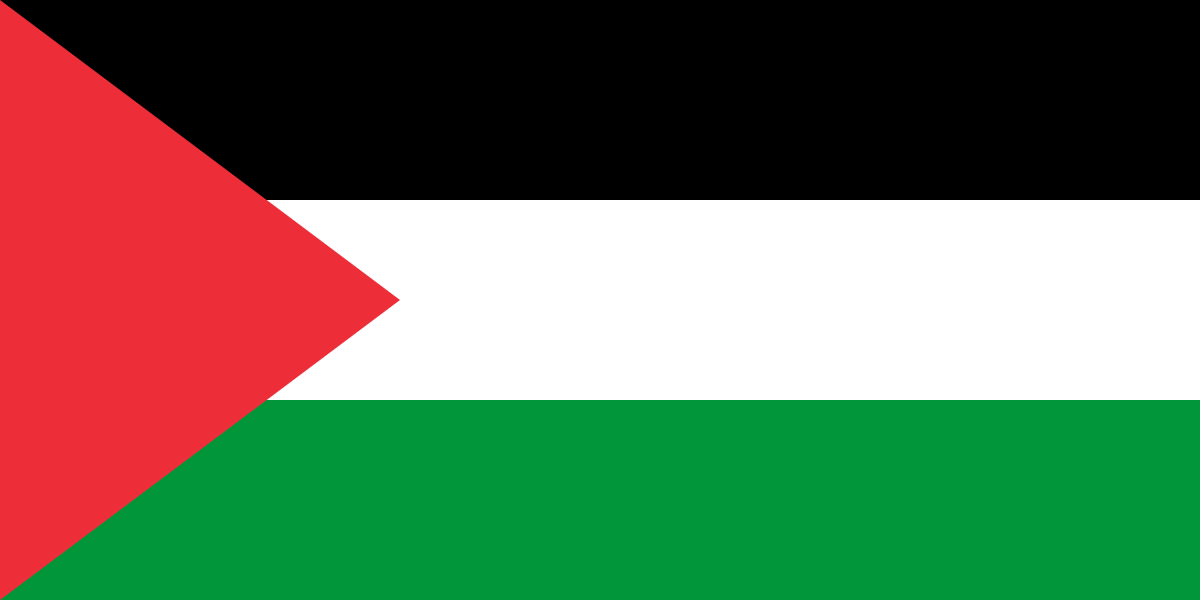
At the outset, I would like to renew our gratitude to the Committee on the Exercise of the Inalienable Rights of the Palestinian People, under the leadership of Senegal and Ambassador Cheikh Niang, and its Bureau members, Cuba, Indonesia, Malaysia, Nicaragua and Namibia, for remaining at the forefront of the international community’s efforts to address the plight of the Palestinian people, enable the realization of their inalienable rights, including to self- determination and freedom, and bring an end to the grave and historic injustice that they have borne for more than 75 years since the start of the Nakba — an ongoing
and searing Nakba that we have painfully witnessed in the dark days of these past weeks and throughout the decades.
We are grateful to Ambassador Ahmad Faisal Muhamad, Vice-Chair, for presenting the Committee’s annual report (A/78/35) to the General Assembly, reflecting on the Committee’s many efforts over the past year and its appeals to the international community, as we gather once again in the Assembly to address the question of Palestine and take stock of where we are today and where we are going, as the United Nations carries forth its permanent responsibility towards the question of Palestine until it is justly resolved in all its aspects, in accordance with international law and the relevant United Nations resolutions.
The Charter of the United Nations begins with the following phrase: “We the peoples of the United Nations determined to save succeeding generations from the scourge of war”. I often repeat this phrase in many of my statements. Not a single Palestinian generation has been saved from the scourge of war. Every single one has witnessed and endured horrors in its flesh. An entire nation, over decades, has faced dispossession, displacement, denial of rights, destruction and death. But, maybe since the 1948 generation, this generation is the one that has suffered most painfully and traumatically. This is the deadliest period ever endured by Palestinians in the Gaza Strip, and they have witnessed many previous assaults. This is the largest forced displacement of Palestinians since the Nakba. This destruction is apocalyptic, and the humanitarian crisis catastrophic. There are no laws, morals or principles in the world that can justify this abhorrent, inhumane reality. It is one that shakes the human conscience and demands global action for justice.
The massacres against our people in Gaza have mobilized peoples and nations around the world, speaking out against injustice and calling for justice, calling for a ceasefire now in Gaza — I repeat, calling for a ceasefire now in Gaza — calling for an end to the Israeli occupation and oppression of the Palestinian people, and calling for a free Palestine. The General Assembly was the first United Nations body to reflect this global outrage and take a clear and unequivocal stand calling for an immediate, durable and sustained humanitarian truce leading to a cessation of hostilities. I must add that the Secretary-General called for an immediate humanitarian ceasefire, and the President of the General Assembly repeated the same idea a few minutes ago in his statement. The Assembly reconvened
the tenth emergency special session and took that courageous step more than a month ago. Two thirds of the United Nations membership voted in favour of that resolution (resolution ES-10/21). Had it been implemented then, thousands of Palestinian lives would have been spared, and families would not have endured such agony and anguish. In adopting the resolution, the General Assembly was guided by the imperatives of legality, morality and humanity, and it proved also to be correct politically.
It took the Security Council several more deadly and devastating weeks to finally adopt a less ambitious resolution (Security Council resolution 2712 (2023)), but driven by several of the same humanitarian considerations addressed by the General Assembly. As the Assembly’s resolution had foreseen, only a truce could allow for sincere efforts to begin to address the humanitarian catastrophe being inflicted by Israel, the occupying Power in Gaza, and only a truce could lead to the release of people held in captivity and avoid further regional escalation. The truce must turn into a permanent ceasefire. The massacres of Palestinian children, women and men cannot and should not resume. It should not be allowed to resume. The human conscience cannot bear it. International law, including humanitarian law and human rights law, prohibits it. International law, as well as the norms of humanity, demand that we act to stop this war against innocent civilians and save human lives, that we act for humanitarian aid and access throughout the Gaza Strip, the return of those displaced without delay and the end of the siege and blockade, and that we act for accountability. Nothing can ever justify war crimes, crimes against humanity and genocide.
As more and more images of the devastation in Gaza reach the world, each one of us has a choice to make: either for the protection of civilians or their slaughter; either for the rule of international law or indiscriminate vengeance; and either for the prospect of peace or perpetual conflict. Virtually every nation represented here has decided — some sooner than later — to join the right side of history. Now we need to stand united in putting an end to this madness and charting a way forward for a more just, peaceful and stable future.
There have been 15,000 Palestinians killed in Gaza, including more than 6,000 children and 4,000 women. More than 30,000 people have been wounded, with many suffering amputations and burns, enduring their injuries and pain without medical care and with no safe place to heal and recover. Over 1.8 million civilians in
Gaza — or nearly 80 per cent of the population — are estimated to be internally displaced, the majority of them refugees displaced for the second, third or fourth time in their lives. Of them, nearly 1.1 million are sheltering in 156 United Nations Relief and Works Agency for Palestine Refugees in the Near East facilities across Gaza, bearing indignities that no human should be forced to bear. They are still not protected, not even under the United Nations flag — not even that is respected by the occupying Power as it deliberately strikes homes, schools, hospitals and United Nations shelters with barbaric and punitive violence, intent on destroying the basis of human life in Gaza and on terrorizing and traumatizing everyone.
The sheer magnitude of the killing and maiming, the destruction and forced displacement is testimony to how indiscriminate the war is. It goes to show that its primary targets and victims are actually the civilian population in the Gaza Strip.
No conflict in recent memory has seen so many children, civilians, journalists, United Nations staff and humanitarian and medical personnel killed at this pace. This is a full-fledged war against Palestine and its people. That is reconfirmed by what we are witnessing in the West Bank, with over 230 Palestinians killed and thousands more injured in the span of seven weeks at the hands of Israeli occupation forces and settlers. That is in addition to the more than 180 Palestinians killed prior to October, among them 107 children. It is the deadliest period virtually ever witnessed in the West Bank.
More than 1,200 Palestinians have been displaced over the same seven-week period, in addition to the more than 1,000 people forcibly displaced earlier this year as Israel carries on non-stop with its illegal settlement, colonization and annexation of our land.
More than 3,000 Palestinian civilians, including children, have been arrested and detained in incessant military raids by the Israeli occupying forces across the West Bank, including East Jerusalem, in that same seven-week period. That has now brought the number of Palestinian prisoners held captive in Israeli jails, enduring inhumane conditions, to over 10,000. The oppression, persecution, abuse and discrimination against our people continues unabated under the illegal Israeli colonial occupation and apartheid regime.
It is the same logic at play everywhere. For the Israeli Government, the priority is not security — it is the destruction of the Palestinian nation, of the very
presence and existence of the Palestinian people on their land, and of Palestinian statehood, even at the expense of security, through dispossession, displacement and the denial of rights and, in case all of that were not enough, then through death. Even their right to life is denied.
How do we know all of this? Because Israeli leaders are not even bothering to hide it anymore. They are telling the world this every day, in every statement they make. In the words of one of them — a minister sitting in Prime Minister Netanyahu’s cabinet — Palestinians have three choices: surrender and subjugation; exodus; or death. We reject those things because we are a proud people, and we are determined to live in our national homeland.
The catastrophe has demonstrated two things: that there is no peace in the Middle East without a just and lasting solution to the question of Palestine in accordance with international law and the relevant United Nations resolutions; and that Palestinian freedom, not further oppression and occupation, is the path to peace and security for all.
Palestinian rights cannot continue to be subordinated, violated or erased. Those rights are inalienable, just like for all peoples — the right to self- determination, the right of our refugees to return, the right to life and the right to exist in dignity and peace and stability in our homeland of Palestine. Palestine cannot remain the exception to the rule of law and the enjoyment of human rights.
All our efforts must be dedicated now to preventing further massacres and to ending the assault on the lives and existence of the Palestinian nation. But we must be preparing, in parallel, for an unprecedented, bold and collective effort to end colonization, occupation and apartheid and to achieve peace.
The two-State solution requires a strong, independent and sovereign Palestinian State, based on the 1967 borders, with East Jerusalem as its capital. Those who favour such a solution must take action against the colonial occupation that prevents and kills such a prospect. They must recognize the State of Palestine, provide it with United Nations membership and help it actualize its sovereignty on the ground. Members have to act now. We have to become like other Member States — a full State Member of the United Nations — in order to begin the process of the actualization of the two-State solution after we end the
occupation. It is members’ collective responsibility to allow us to accomplish that.
We have stated before in the Assembly and must reiterate that Palestine is the answer. Justice in Palestine would mean that our international law-based order has triumphed over impunity and double standards. Justice in Palestine would mean that freedom, peaceful settlement and coexistence have triumphed over oppression and discrimination. Justice in Palestine means that we have upheld the principle that we are equals, as human beings and as nations. Let us continue to work together to achieve that justice and the peace and security that the Palestinian and Israeli peoples, our region and the world need. Help us to accomplish that.
I thank you, Mr. President, and, once again, express my thanks to all members of the Committee on the Exercise of the Inalienable Rights of the Palestinian People, the Division for Palestinian Rights and all States that continue to provide their principled support and solidarity to the Palestinian people, in our ongoing journey to justly and peacefully resolve the Palestine question.


On 26 October, I stood in this Hall to attend the emergency special session, at which Indonesia co-sponsored the resolution on the Gaza crisis (resolution ES-10/21). I have flown back to New York City, back to this rostrum, because I care about justice, about humankind and about Palestine. I cannot stand to see the thousands of deaths of innocent women and children. I cannot stand to see homes, schools and hospitals being flattened to rubble. Can you stand seeing this horrific situation?
On 11 November, the joint summit of the League of Arab States and the Organization of Islamic Cooperation (OIC) issued a strong position on the importance of unhindered humanitarian assistance, a permanent ceasefire and the two-State solution. Last week, together with a number of OIC Foreign Ministers, I travelled to Beijing, Moscow, London and Paris. Those countries are permanent members of the Security Council. I urged them to do more for justice and humanity for Palestine. And I will continue this effort to reach and talk to as many countries as possible.
Can I ask, is what Israel is doing consistent with international law? Is it consistent with international humanitarian law? Let us be honest with ourselves in answering that question. And if we really want to defend justice and humanity, there are four issues on which we should work.
First, we need a permanent ceasefire. The first extended pause in hostilities is a welcome start to end the atrocities, but these uneasy pauses will not be enough. We need a ceasefire. Without it, it will be difficult to do the rest to save lives and for aid agencies to work in Gaza.
Secondly, we must ensure unhindered humanitarian assistance. Massive humanitarian aid is needed in Gaza. We need to scale up humanitarian assistance. We must support the United Nations Relief and Works Agency for Palestine Refugees in the Near East and other humanitarian agencies to help the 1.7 million Palestinians who are forcibly displaced in Gaza. Indonesia is committed to scaling up assistance, including by deploying its floating hospital.
Thirdly, we must stand for justice. Even wars have rules and limits, and these are nowhere to be seen in Gaza. Attacks against hospitals, schools, places of worship and refugee camps should not be normalized. I repeat, they should not be normalized. We must call a spade a spade. What has taken place in Gaza is a clear violation of international humanitarian law, and failure to act may equate to complicity.
We must also call out double standards in the application of international law, which seriously undermines the sanctity of the law itself. Indonesia therefore supports efforts to ensure Israel’s accountability in various relevant forums, including the International Court of Justice.
Fourthly, we must restart the Palestine-Israel peace and political process. Addressing the question of Palestine requires us to address the root causes, plain and simple. The occupation of Palestinian land must end. There is no military solution to this conflict. A political solution is the only answer. We need a credible negotiations process that is transparent and equitable, with Palestine and Israel having equal standing as full members of the United Nations, leading to a two-State solution, based on internationally agreed parameters.
Indonesia calls on the global community to stand together with humankind. Only by uniting can we bring peace to Palestine and the region. Only by using our hearts can we bring humanity and justice.


It is my honour to deliver this statement on behalf of the States of the Gulf Cooperation Council (GCC), namely, the United Arab Emirates, the Kingdom of Bahrain, the Kingdom of Saudi Arabia, the State of Qatar, the State
of Kuwait and my country, the Sultanate of Oman. This is in context of the General Assembly’s discussion, at its seventy-eighth session, of agenda item 35 entitled “Question of Palestine”.
I would like to express my sincere appreciation to His Excellency the Secretary-General and His Excellency the Chair of the Committee on the Exercise of the Inalienable Rights of the Palestinian People for the report (A/78/35) submitted for consideration under the agenda item being discussed today.
At the outset, States members of the GCC stress their common position calling for the end of the brutal aggression launched by the Israeli occupation forces against the Gaza Strip, targeting civilians and civilian property, including hospitals, schools and United Nations sites. We reject this aggression being described as an act of self-defence. Israel is an occupying Power according to resolutions of international legitimacy and international law.
The GCC States welcomes Security Council resolution 2712 (2023), adopted on 15 November, which calls for a mandatory ceasefire to safeguard children in particular. We also support resolution ES-10/21, adopted on 27 October, which provided for an immediate ceasefire and the delivery of assistance. The GCC States call for an immediate implementation of those resolutions, without preconditions, and categorically reject any attempt at forcibly displacing Palestinians from their territories.
In line with the efforts aimed at de-escalation, protecting civilians and ensuring the delivery of humanitarian aid to our Palestinian brothers in the Gaza Strip, the GCC States welcome the humanitarian truce agreement that was reached on Wednesday 22 November between Israel and the resistance movement Hamas as a result of the successful joint mediation of the State of Qatar, the Arab Republic of Egypt and the United States of America. The GCC States commend that important agreement and call on all parties to abide by its terms. We hope that the humanitarian truce will lead to a permanent humanitarian ceasefire that would put an end to the war and bloodshed and lead to serious talks towards a comprehensive and just peace process in accordance with the resolutions of international legitimacy.
The GCC States condemn in the strongest terms the ongoing Israeli crimes against the Palestinian people, including the use of internationally banned weapons, and call on the international community to
hold the Israeli occupation authorities accountable for those inhumane crimes, which are a flagrant violation of international humanitarian law. We reiterate our rejection and denunciation of any attempt to annex the settlements in the West Bank to Israel, which would be a clear violation of the Charter of the United Nations, the principles of international law and the relevant international resolutions, including Security Council resolution 2334 (2016), the advisory opinion of the International Court of Justice of 2004 and the Fourth Geneva Convention of 1949.
The GCC States condemn Israel’s continued construction of settlements in the occupied Palestinian territories. We urge the international community to intensify its efforts to put pressure on the Israeli authorities to stop the building of settlements and to hold Israel accountable politically, legally, diplomatically and economically for its violations of the relevant international laws.
The GCC States also condemn the repeated incursions into the courtyards of the holy Al-Aqsa Mosque by Israeli settlers with the support and protection of the Israeli occupation forces. Those incursions are considered a serious violation of international law, the status quo of Jerusalem and its holy sites and the sanctity of Al-Aqsa Mosque, as they provoke the feelings of Muslims around the world. The GCC States also reiterate their rejection of all Israeli practices aimed at altering the legal and historical status of the holy Al-Aqsa Mosque and of any attempts to partition it. We stress that such continued violations and attacks on holy sites increase tensions, undermine peace efforts and push the situation towards a spiral of violence.
In conclusion, the GCC States reiterate their strong support for our Palestinian brothers. We support the political and legal efforts of the State of Palestine to achieve independence and self-determination on its occupied land and stress the need for the Israeli occupation authorities to respond to the calls for peace and to participate in serious good-faith negotiations aimed at achieving peace on the basis of the two-State solution. That would bring about security and stability in that vital region of the world.


I have the honour to deliver this statement on behalf of the 14 member States of the Caribbean Community (CARICOM) in contribution to this important debate under agenda item 35, “Question of Palestine”.
CARICOM shares the concern of the many Member States who are deeply disheartened by the decades- long perpetuation of the Palestinian question. Despite the existence of a both legal and moral framework to resolve the question, it persists, to the detriment of both Palestine and Israel. At the outset, therefore, CARICOM underscores that a permanent and just solution to the question of Palestine would both fulfil the Palestinians’ right to self-determination and guarantee the security of Israel.
Since the previous debate on this agenda item (see A/ES-10/PV.41), CARICOM has taken note of the developments on the issue and is disturbed that there have been no advances towards implementation of the various United Nations resolutions on the matter. The situation has instead worsened, and even more so since the events of 7 October.
In considering the events of 7 October, CARICOM emphasizes that violence and hostility will not bring about any lasting solution to the Palestinian question. It has been shown instead to stoke fear and mistrust and breed massive suffering and insecurity. CARICOM therefore emphasizes the obligation of all Member States to be guided by the principles of the Charter of the United Nations in their conduct of international relations. CARICOM also emphasizes Member States’ obligation to operate within the confines of international law, including international human rights law and international humanitarian law.
The events of 7 October and the response thereto have led to a massive escalation of violence in the Israeli-Palestinian conflict. We condemn those events in the strongest terms. CARICOM is appalled by the loss of so many innocent lives in such a short span of time. We are particularly appalled that women and children number in the majority of those killed. CARICOM commiserates with the relatives and friends of those who have died under such tragic circumstances, including the more than 100 United Nations staff members killed in the line of duty.
CARICOM is also concerned about the humanitarian crisis in the Gaza Strip, which has worsened exponentially since 7 October 2023. The recent truce between Israel and Hamas, including the current pause in the fighting, was an important first step towards a complete cessation of hostilities. We call for a permanent ceasefire. That is critical for delivering life-saving support to the besieged population of the Gaza Strip. It is also critical for setting them on a path to recovery.
The international community, including the United Nations, must seriously contemplate measures for permanently resolving the question of Palestine. As we observed earlier, both the legal and the moral frameworks exist for a permanent solution, but they must be matched with the necessary political will. Without a permanent solution, Israelis and Palestinians will continue to endure recurring cycles of violence. Furthermore, Palestinians’ legitimate aspiration to exercise their right to self-determination will continue to be unjustly delayed. We cannot continue to leave the Palestinian people behind. For its part, CARICOM is open to playing its usual constructive role in taking forward the question of Palestine.


I would like to thank you, Mr. President, for convening this meeting. I also thank the Chair and the members of the Committee on the Exercise of the Inalienable Rights of the Palestinian People. We are thankful for and appreciate the efforts of the Division for Palestinian Rights and the special information programme on the question of Palestine of the Department of Global Communications. We reaffirm the State of Qatar’s solidarity with the brotherly Palestinian people until they obtain their just rights.
We align ourselves with the statement delivered by the representative of the Sultanate of Oman on behalf of the States of the Gulf Cooperation Council.
This meeting is being held as we witness the worst humanitarian crisis for our Palestinian brothers in the Gaza Strip due to the Israeli military escalation against the Strip. That violent and indiscriminate shelling has, thus far, led to more than 50,000 unarmed civilians killed, injured or lost under the rubble in Gaza. Most of those are women and children, which prompted some United Nations officials to describe the Gaza Strip as a “children’s grave”.
In that regard, the State of Qatar reiterates its condemnation of the gross international crimes committed by the Israeli occupation against the brotherly Palestinian people. We condemn in the strongest terms the systematic targeting of hospitals, schools and residential areas in Gaza. That is a heinous violation of international laws and conventions, especially the Fourth Geneva Convention. We reiterate the call by the State of Qatar to establish an international committee to investigate the crimes committed by the Israeli occupation against civilians in the Gaza Strip.
The State of Qatar reiterates its strong condemnation of the repeated acts of aggression against the holy Al-Aqsa Mosque by Israel, the occupying Power, as well as by Israeli settlers. We underline that such aggressions constitute flagrant violations of international law and provoke Muslims. Any attempts to alter the current historic and legal status quo of Islamic and Christian holy sites in occupied East Jerusalem, to divide the Al-Aqsa Mosque temporally and spatially and to restrict Muslims’ freedom of worship therein are all null under international law and the relevant United Nations resolutions.
In that context, the State of Qatar welcomes the recommendation included in the report of the Committee on the Exercise of the Inalienable Rights of the Palestinian People (A/78/35), which calls on the Israeli occupation to meet its obligations pursuant to international humanitarian law and international human rights law.
The State of Qatar stresses once again that the escalation of the Israeli occupation and its continuous attempts to impose the status quo and avoid its obligations to achieve comprehensive and just peace will not stop my country’s concerted efforts to bring about just peace. We will continue to call for a just and comprehensive solution to the Palestinian question that guarantees the right of the fraternal Palestinian people to self-determination and the establishment of an independent Palestinian State along 1967 lines, with East Jerusalem as its capital, on the basis of the two- State solution and the implementation of resolutions of international legitimacy. That requires an end to the Israeli occupation of all Arab-occupied territories, including the occupied Syrian Golan and all occupied Lebanese territories. That is the only way to ensure peace and stability in the Middle East.
We are holding this meeting following four days of a humanitarian truce, thanks to the joint mediation efforts of the State of Qatar, the Arab Republic of Egypt and the United States of America. That effort culminated in a deal between Israel and Hamas, which started to be implemented on Friday 24 November.
In line with our continued mediation efforts, the State of Qatar announced yesterday that a deal has been reached to extend the humanitarian truce in the Gaza Strip for another two days, under the previous conditions. The truce deal has, to date, led to the release of 69 captured civilians in the Gaza Strip, women and children, as well as the freeing of 150 Palestinian
women and children detained in Israeli prisons. The truce deal also succeeded in ensuring access to a larger number of humanitarian and relief convoys, including fuel for humanitarian needs.
In conclusion, the State of Qatar stresses that it will continue its diplomatic endeavours to de-escalate, stop the bloodshed, protect civilians and deliver assistance to those in need. We hope that this humanitarian truce will lead to a permanent ceasefire that will put a stop to the war machine and the bloodshed. May it also pave the way for serious talks on a peace process that leads to a comprehensive, just and durable peace agreement, in line with resolutions of international legitimacy.


My delegation extends our appreciation to the Secretary-General for his detailed report (A/78/303) under the agenda item “Question of Palestine”, documenting the prolonged struggle of the Palestinian people. This long-standing issue, marked by Palestinian suffering, demands our urgent attention for a comprehensive and just resolution that considers its complex historical, political and humanitarian aspects.
Tomorrow, as we mark the International Day of Solidarity with the Palestinian People this year, my delegation wishes to convey the following message from the newly elected President of the Republic of Maldives, His Excellency Mr. Mohamed Muizzu:
“I firmly reassert the unwavering support of the people and the Government of the Maldives to the people and the Government of the State of Palestine in their legitimate right for full sovereignty and to live in peace with safety and security.”
The Maldives strongly condemns the ongoing brutal occupation and collective punishment of innocent Palestinian civilians. Indeed, the current Israeli-Palestinian conflict did not start on 7 October 2023. Over many decades, Israel has inflicted immense humanitarian, social and economic suffering on millions of Palestinians, especially women and children. And as we speak, we are confronted with a dire humanitarian crisis in Gaza. Israel’s war against Gaza has led to the tragic loss of more than 14,000 lives and more than 30,000 people, in all. The Israel Defense Forces intentionally targeted civilian infrastructure, including hospitals, schools and shelters, which has forced many Palestinians to leave their homes. Those actions by Israel constitute a serious violation of international humanitarian law.
Israel’s actions in occupied territories must not be exempt from international and humanitarian law or the authority of the Security Council, nor is Israel spared the strong condemnation of the Assembly. We firmly believe that the rule of law should be applied equally to all countries, regardless of their size or influence. Those responsible for flagrant violations of international law and international humanitarian law must be held accountable for their actions. Therefore, the Maldives calls on the International Criminal Court to investigate possible war crimes committed by Israel against the Palestinian people.
The Assembly reconvened its tenth emergency special session last month, in which landmark resolution ES-10/21 was adopted, urging resolute action to halt violence against innocent civilians in Palestine. Today, almost a month after the resolution was adopted, we reiterate the resolution’s call for an immediate, enduring and sustainable humanitarian ceasefire in Gaza, the provision of essential supplies and medicine and an end to mass forced displacement in the occupied Palestinian territory. Following the adoption of that resolution, we are encouraged by the accelerated action to find solutions to this crisis.
My delegation also welcomes the adoption of Security Council resolution 2712 (2023) on 15 November 2023, which urges immediate and extended humanitarian pauses in Gaza and the unconditional release of hostages. We strongly support the Council’s call for all parties to uphold their responsibilities under international law, including international humanitarian law, in order to prioritize the protection of innocent civilians.
We commend Qatar’s role and that of other countries in mediating an agreement for an extended humanitarian truce. Now the international community must work tirelessly to implement that truce and ensure a way forward that averts the resumption of this conflict, leading to a permanent ceasefire. Every minute of the truce helps to deliver essential supplies to the millions enduring this humanitarian catastrophe. Every minute of the truce prevents regional spillover and protects the lives of dedicated humanitarian workers. Every minute of the truce helps to release hostages and save the lives of civilians, particularly women and children.
The Maldives commends the efforts of the World Health Organization to evacuate 151 seriously ill patients and 31 babies in critical condition from the besieged Al-Shifa Hospital. That is just one example highlighting the urgent need for unimpeded humanitarian access. The
Maldives joins the international community in paying tribute to the sacrifices of the humanitarian aid workers and personnel, including the staff of the United Nations Relief and Works Agency for Palestine Refugees in the Near East (UNRWA), who are putting their lives on the line to alleviate the suffering of vulnerable populations in acutely dangerous conditions. We urge the international community to support UNRWA more robustly.
The Administration of President Muizzu and the Maldivian people will remain steadfast in supporting the establishment of a free and independent Palestine and in their unwavering commitment to the Palestinian people in their pursuit of their inalienable rights, including the right to self-determination. We call on the international community to continue to urge Israel to immediately end its illegal occupation of Palestine, return the lands it has seized by force, stop the illegal settlements and assaults on the lives and dignity of people in Gaza, the West Bank and everywhere in the occupied territory and recognize Palestine as an independent State with East Jerusalem as its capital, within the pre-1967 borders. The Maldives reiterates its call to Member States to uphold the Charter of the United Nations, international human rights and humanitarian law and to support the inalienable rights of the Palestinian people. We urge Member States to increase efforts to restart the peace process, seeking a long-term solution through which peace can reign.
My delegation reiterates its call on Member States to recognize Palestine as an independent State and to support its full membership of the United Nations. The plight of the Palestinian people should be a global priority, and we urge the international community to strengthen its resolve to end the violations of human rights and the suffering of the people of the State of Palestine.


My delegation appreciates the respect and honour shown this morning to His Excellency Samuel Rudolph Insanally, President of the General Assembly at its forty-eighth session. We remember his steadfast support to the cause of Namibia and our right to self-determination, freedom and independence through his active role as Vice-President of the then Council for Namibia. Those are the same expectations and rights that we are eagerly waiting to see extended to the people of Palestine.
I am grateful to the Secretary-General for the insightful report on the economic repercussions of the Israeli occupation for the Palestinian people (see A/78/303), particularly the welfare cost resulting from
the fragmentation of the occupied West Bank. We also appreciate the report presented by the Committee on the Exercise of the Inalienable Right of the Palestinian People (A/78/35).
Tomorrow the Government of Namibia will stand with the international community to observe the International Day of Solidarity with the Palestinian People. Regrettably, the occasion is occurring amid a continuing surge in violence marked by brutal force. In the past two months alone, more than 14,000 Palestinians, including 4,000 women and more than 6,000 children, as well as more than 100 United Nations employees, have tragically lost their lives in the escalating violence. Despite the clear breaches we have seen of international law and humanitarian principles, the Charter of the United Nations has not consistently provided a safeguard. The occupation of Palestine and its illegal nature have had severe economic, social, cultural and humanitarian consequences. The continual violations of international law and numerous General Assembly and Security Council resolutions are deeply concerning. The world continues to witness in horror the unabated full-scale aggression against the Palestinian people, which is not sparing hospitals, refugee camps, holy sites or schools. These are clear violations of international law and international humanitarian law. Such abnormal actions demand urgent attention and a collective responsibility to resolve the long-standing conflict.
Namibia welcomed the adoption of Security Council resolution 2712 (2023). While we continue to call for an immediate and permanent cessation of violence and the unabated aggression, we are grateful to the Governments of Qatar, Egypt and the United States for their invaluable role in facilitating the humanitarian pauses. However, we condemn the violence that has been reported outside Gaza, including the most recent attack on the Jenin refugee camp. Namibia reiterates its call for unhindered access to humanitarian aid for the most vulnerable and an immediate end to the forced mass displacement of the Palestinian people. Earlier this year, the Namibian Government made a submission to the International Court of Justice as part of its ongoing proceedings, and we eagerly await the Court’s advisory opinion to determine the consequences of Israel’s continued illegal occupation of Palestine. The international community must intensify its efforts to realize a just, lasting and comprehensive peace in the Middle East based on the relevant Security Council resolutions. Israel must be held accountable for continually violating those resolutions.
As we approach the seventy-fifth anniversary of the Universal Declaration of Human Rights, we must reflect on how the people of Palestine relate to human rights, which are supposed to be indivisible, inalienable and universal. Palestinians’ exercise of their right to self-determination and statehood has been severely impaired by unlawful measures, among them settlement expansion and the construction of barriers in the West Bank, including East Jerusalem. Namibia is unwavering in its support for the Palestinian people until they can exercise their inalienable right to self- determination. The question of Palestine demands resolution. Collectively, we have a responsibility to strengthen our resolve in the face of injustice in order to make it a reality. That moment is now.


Today’s meeting is taking place at a critical juncture. The State of Palestine and the Palestinian people are facing their biggest tragedy in recent history. The scale of destruction and loss is at unimaginable levels. Since 7 October, the death toll in Gaza has reached almost 15,000, and most of the deaths are of women and children. Civilians and civilian infrastructure, including hospitals, mosques, churches, schools and refugee camps have been under constant bombardment. Almost half of the housing units have been destroyed.
More than 2 million Palestinians are in dire need of humanitarian aid and are being subjected to acts of collective punishment and forced displacement. International law and international humanitarian law are constantly being violated. For the past few weeks United Nations agencies have repeatedly maintained that nowhere in Gaza is safe. The Secretary-General has described the current state of Gaza as a graveyard for children. The Executive Director of UNICEF has referred to Gaza as the most dangerous place in the world to be a child. No one — even under the United Nations flag — is spared the brutal Israeli attacks. We commend the United Nations agencies and the humanitarians who are working on the ground in intolerable conditions, even after becoming victims themselves. We express our deepest condolences for the more than 100 brave United Nations personnel who have lost their lives in this honourable mission.
Since the onset of the conflict, Türkiye has been calling for an immediate and unconditional ceasefire, urgent and unimpeded humanitarian access and full compliance with international law. We hope that the agreement reached last week between Israel and Hamas can lead to the delivery of more life-saving aid to Gaza and the safe return of the remaining hostages.
However, it is clear that only a durable ceasefire can prevent further violence and suffering. There must be an unhindered flow of sufficient humanitarian aid to all the people in need in Gaza. Civilians and civilian infrastructure, including the United Nations facilities hosting displaced people, must be protected everywhere. The forced displacement of the Palestinians must stop. International law should be upheld.
With a view to halting the carnage in Gaza, Türkiye has mobilized every possible diplomatic and humanitarian effort. Leaders of the Organization of Islamic Cooperation and the League of Arab States met in Riyadh on 11 November at a joint Arab-Islamic extraordinary summit, strongly condemning the Israeli aggression in Gaza and calling for an immediate ceasefire and sustainable humanitarian access. Our Foreign Ministers have been visiting major capitals to initiate international action to stop the war in Gaza. Hakan Fidan, Türkiye’s Foreign Minister, will be here in New York tomorrow together with other ministers to attend the Security Council briefing on Palestine. We have been doing our utmost to send much-needed humanitarian aid to Gaza. Türkiye has so far sent more than 200 tons of humanitarian aid on 11 aircraft to Egypt’s Al-Arish airport. We have transferred 88 patients from the Turkish-Palestinian Friendship Hospital in Gaza to Türkiye to continue their treatment. Our humanitarian aid workers and health personnel are working tirelessly on the ground. I want to once again thank our brother nation of Egypt for its efforts and cooperation.
We welcomed the adoption of Security Council resolution 2712 (2023). However, the Council’s failure to take any decision for almost six weeks or to call for an immediate ceasefire cannot go unnoticed. The Security Council and its members have a special responsibility to stop this war, a responsibility they cannot opt out of. Resolution ES-10/21, the humanitarian resolution recently adopted by the General Assembly at its emergency special session, of which we were a sponsor, remains the international community’s strongest expression of its common position on the Israeli aggression.
We should all be very clear about the root cause of the problem, which is Israel’s illegal occupation of Palestinian territory. The report of the Committee on the Exercise of the Inalienable Rights of the Palestinian People before us today (A/78/35) once again reveals Israel’s continued violations of international law and United Nations resolutions as it prevents the Palestinian people from exercising their right to self-determination,
among other rights. The Palestinian people have been unjustly stripped of basic rights, including their economic rights, for decades. And now, on top of the intolerable humanitarian catastrophe, the Palestinian people will be suffering the economic cost of this war for decades.
Let me conclude by reiterating Türkiye’s unwavering support for all efforts to find a comprehensive and lasting solution to the Israeli-Palestinian conflict, based on a vision of two States and the pre-1967 borders, with East Jerusalem as the capital of the State of Palestine. We stand with the Palestinian people in their efforts to achieve their long-delayed right to live in their own sovereign and independent State.


I thank you, Mr. President, for convening this meeting to discuss agenda item 35, entitled “Question of Palestine”, at a critical time for the question of Palestine and the Middle East in general, as a result of the brutal Israeli acts of aggression against the Palestinian occupied territories, especially the Gaza Strip.
The magnitude of the recent aggression is unprecedented even in the long history of Israel’s violations against the Palestinian people, with the civilian death toll reaching alarming figures and the scale of the destruction of infrastructure — including hospitals, schools, homes and even United Nations facilities — exceeding that of the cities that dealt with the scourge of total war in the twentieth century. In an attempt to make life in the Gaza Strip impossible, Israel has also continued its systematic policies aimed at displacing the Palestinian people, whether by subjecting them to brutal and indiscriminate bombardment or by besieging them and restricting their access to aid. The current temporary truce, which was brokered through the commendable efforts of Egypt, Qatar and the United States, can in no way replace a permanent ceasefire, stop the civilian bloodshed or spare the region from wider confrontations. We should not fail in that regard to recall resolution ES-10/21, which clearly and explicitly demands that the humanitarian truce lead to a permanent cessation of hostilities, nor the fact that it was adopted by an overwhelming majority of the international community.
Here I want to reiterate a demand that is no less important than that for a ceasefire — the provision of relief aid to the civilians in Gaza, our Palestinian brethren, who have long suffered from Israel’s policies of siege, starvation and displacement. That will obviously require Israel to allow humanitarian aid to
flow unimpeded through all the border crossings into the Gaza Strip, which in turn will require the United Nations, led by the Security Council, to fulfil all of its responsibilities in that regard.
The flagrant Israeli violations against the Palestinian people are not new, as the bleak picture in the report of the Committee on the Exercise of the Inalienable Rights of the Palestinian People (A/78/35) attests. Paragraph 9 of the report addresses the intensive Israeli incursions into the West Bank, while paragraph 10 discusses the steady increase in the illegal annexations of Palestinian territories and construction of settlements. Paragraph 12 deals with the 849 brutal attacks by settlers on Palestinian civilians, and paragraph 17 with the repeated and systematic Israeli violations at Al-Haram Al-Sharif, which have unfortunately been perpetrated with the participation and sponsorship of Israeli Government officials. The alarming statistics in the report do not include the violations that have been perpetrated since the outbreak of the Israeli war in the Gaza Strip and the events of 7 October, as the number of Palestinian civilian victims of those practices has unfortunately increased several times over to date and includes thousands killed by the occupying forces and hundreds killed in the occupied West Bank.
The only way to guarantee a stop to those violations is by ending the Israeli occupation and establishing an independent Palestinian State, with East Jerusalem as its capital, along the lines of 4 June 1967, in line with the relevant United Nations resolutions, including multiple General Assembly resolutions. A two-State solution is the only way. There is no alternative. It is the only viable way to guarantee the right of the Palestinian and Israeli peoples to live in safety and security in normal conditions in two neighbouring States, like all other peoples, in line with the relevant resolutions of international legitimacy.


At the outset, I would like to sincerely thank you, Mr. President, for your tireless efforts to ensure the success of the work of the General Assembly at its seventy-eighth session. We wish you every success in that work. I would also like to reiterate Jordan’s support to the Chair and the members of the Committee on the Exercise of the Inalienable Rights of the Palestinian People for their efforts to defend those rights, particularly the right to self-determination, and to respond to the Palestinian people’s legitimate aspirations to an independent State on their land, pursuant to the resolutions of international legitimacy and the relevant United Nations resolutions.
We are meeting today in exceptional circumstances. The Palestinian people are enduring a brutal aggression launched by Israel against innocent civilians in the Gaza Strip, leading to the loss of more than 16,000 Palestinian martyrs, 70 per cent of them women and children. That must stop. The international community, especially the Security Council, must mobilize its efforts to immediately, urgently and permanently end the war in order to protect the unarmed people of Gaza, including children, women and the elderly. The siege must be lifted so that their basic needs can be met in a sustainable manner and protection ensured for hospitals, schools, United Nations institutions, relief workers and medical staff.
In that regard, I would like to underscore that if an explicit and firm position is not taken on stopping the war crimes that Israel is committing, it will only be encouraged to continue its aggression amid the double standards and selectivity that we are seeing regarding the implementation of international law. We call on the Security Council to fulfil its legal and moral responsibilities with a view to putting an end to the continued aggression and protecting Palestinian civilians in the Gaza Strip and all the occupied Palestinian territories. We also want to warn against the potential consequences of the continued escalation in the occupied West Bank, particularly given the terrorist actions taken by Israeli settlers against Palestinian civilians, illegal measures that are entrenching the occupation and leading to more despair, conflict and injustice.
My delegation also reiterates its full support for the United Nations Relief and Works Agency for Palestine Refugees in the Near East (UNRWA), which is providing humanitarian aid to the Palestinians in Gaza who are facing the disaster of the Israeli aggression. UNRWA should be supported, and yet Israel has killed more than 100 members of its staff since the conflict began. We have a collective human responsibility to protect the Palestinian people and their legitimate rights, as well as to protect UNRWA, an international organization that has proved its commitment in making the ultimate sacrifice and has demonstrated its effectiveness, based on the principles of humanity. In that context, we reiterate the importance of giving UNRWA the financial support it needs to carry out its tasks and play its essential role in a disastrous situation that has been exacerbated by the Israeli war.
Jordan commends the efforts of Egypt, Qatar and the United States, which have made a humanitarian truce possible in the Gaza Strip. We also stress that the
truce should be a step towards a total cessation of the war that is raging in Gaza. It is needed to put an end to the ongoing escalation and the targeting and forced displacement of Palestinians. It should also facilitate the delivery of humanitarian assistance throughout the Gaza Strip, with a view to responding to Palestinian civilians’ need for basic services and for stability, so that the people of Gaza can remain in their residential areas.
In conclusion, the Palestinian question has been and will remain the central issue in the region for Jordan and Jordanians. Reviving the peace process in line with the resolutions of international legitimacy, guaranteeing the right of the Palestinian people to establish an independent and viable State, with occupied East Jerusalem as its capital, along the 4 June 1967 borders and based on a two-State solution, is the only way to achieve a just, comprehensive and lasting peace in the entire region.


Today’s debate offers an opportunity not only to reflect on the catastrophic humanitarian situation created in Gaza by the war waged by Israel on the Palestinian people but also to take stock of the implementation of resolution ES- 10/21, adopted on 27 October by the General Assembly at its tenth emergency special session, which calls for a humanitarian truce leading to a cessation of hostilities, unimpeded supplies of relief goods and an end to illegal forced displacement.
We regret that the General Assembly’s call was not heeded by Israel, which has continued its indiscriminate and criminal attacks on the Palestinian people. Israel also ignored the Security Council’s call for it to comply with its obligations under international law, including international humanitarian law, notably with regard to the protection of civilians, especially children, and to refrain from depriving the civilian population in Gaza of the basic services and humanitarian assistance indispensable to their survival. We strongly and unequivocally condemn Israel’s indiscriminate use of force. Its attacks on civilians, civilian objects and infrastructure, blockades of water, food and fuel and forced displacement of people within the occupied territory are flagrant violations of international humanitarian law, amounting to war crimes and crimes against humanity and possibly to the crime of genocide.
We have taken note of the reports regarding the agreement among the relevant parties for a humanitarian pause. We appreciate the efforts undertaken by Qatar and Egypt to that end. Pakistan’s position, however,
remains in favour of a complete and immediate cessation of hostilities. The Israeli killing machine, which has been operating with complete impunity, needs to be stopped. And Israel must be held accountable for its defiance and criminal actions.
In these extremely challenging times, the Government and the people of Pakistan wholeheartedly emphasize their unwavering solidarity with our Palestinian brothers and sisters as they face the brutal onslaught of Israel’s occupation forces. The suffering and collective punishment endured by the besieged people of Gaza is unprecedented in modern history. More than 14,000 Palestinians have lost their lives, two thirds of them women and children. Tens of thousands have been injured. Approximately 2,700, including 1,500 children, have been reported missing or dead or trapped under the rubble. In excess of 1.7 million Gazans have been displaced, and more than 41,000 housing units have been destroyed. Only two small hospitals in northern Gaza are partially operational, with the remaining 22 out of service. Of the 11 medical facilities in the south, only 7 are currently functional. One hundred and eight United Nations Relief and Works Agency for Palestine Refugees in the Near East staff have been killed in Gaza since 7 October. At least 53 journalists have been killed since the hostilities began.
We reject Israel’s portrayal of its aggressive actions as anti-terrorism measures and its relentless bombing of Gaza as an exercise of self-defence. The root cause of the crisis lies in Israel’s prolonged occupation and denial of Palestinians’ inalienable right to self-determination. Israel’s murderous campaign against the occupied people of Palestine struggling for their freedom cannot be justified under the guise of self-defence.
The Joint Arab-Islamic Extraordinary Summit held in Riyadh on 11 November underscored the centrality of the Palestinian cause and extended full support for the legitimate struggle of the Palestinian people to liberate all their occupied territories and the need to end the Israeli aggression against the Palestinian people. It described the ongoing Israeli aggression as a retaliatory war crime that cannot be justified under any guise and demanded that all countries stop exporting to the occupation authorities weapons and ammunition, which are used by their army and terrorist settlers to kill the Palestinian people and destroy their homes, hospitals, schools, mosques, churches and properties.
We welcome the visits to the capitals of the permanent five by the Ministerial Committee mandated
by the Joint Arab-Islamic Extraordinary Summit, chaired by the Foreign Minister of Saudi Arabia, and hope that it will lead to meaningful action by the Security Council to halt the Israeli slaughter, impose a durable ceasefire, enable humanitarian assistance and revive the peace process. We hope the Security Council will not be paralysed again by the partisan position of some delegations. We are confident that, under China’s leadership, the Security Council will fulfil its mandate for the maintenance of peace and security.
Israel must comply with the provisions of resolution ES-10/22 adopted by the Assembly by implementing an immediate and unconditional ceasefire and allowing the flow of sufficient, sustained and unimpeded humanitarian assistance into Gaza to preserve lives and prevent further suffering of innocent Palestinians.
The General Assembly and the Security Council should also consider the following.
First, they should consider the establishment of a special tribunal and accountability mechanism to investigate Israel’s atrocity crimes, identify and prosecute those responsible for war crimes committed and provide reparations for damage, loss or injury arising from those crimes committed by the Israeli occupation forces.
Secondly, they should consider the deployment of an international protection force or mechanism to protect Palestinian civilians, especially women and children, in Gaza and the West Bank from further attacks and oppression by the occupation forces and extremist colonial settlers.
Thirdly, they should consider restoring and reinvigorating the peace process. The Middle East Quartet should revive its efforts under the auspices of the Secretary-General. It should be expanded to include the participation of the Organization of Islamic Cooperation and China to establish a durable solution based on the internationally agreed two-State solution with a secure, viable, contiguous and sovereign State of Palestine on the basis of the pre-June 1967 borders, with Al-Quds Al-Sharif as its capital.
Fourthly, Pakistan will support the convening of an international conference to launch a revived peace process and support the admission of the State of Palestine as a full member of the United Nations.


South Africa aligns itself with the statement delivered by the representative
of Malaysia on behalf of the Committee on the Exercise of the Inalienable Rights of the Palestinian People.
We join other Member States in thanking the Secretariat of the United Nations Conference on Trade and Development (UNCTAD) for its report entitled “Economic costs of the Israeli occupation for the Palestinian people: the welfare cost of the fragmentation of the occupied West Bank” (A/78/303). We also express our appreciation to the Committee on the Exercise of the Inalienable Rights of the Palestinian People for its report (A/78/35).
South Africa expresses its grave concern over the devastating escalation in the Israeli-Palestinian conflict. We extend our deepest condolences to all victims and call for the immediate cessation of violence and an end to the indiscriminate attacks by Israel on the civilian population in Gaza.
Israel’s illegal occupation of Palestine and its illegal settlement expansion are a flagrant violation of international law and in direct contravention of Security Council resolution 2334 (2023). Consequently, those illegal practices by Israel adversely affect all aspects of Palestinian lives, including all economic activity, social development, livelihoods and household welfare.
The impact is graver, as outlined in the UNCTAD report, in Area C, which is the focus of UNCTAD’s report. Area C, which is fully controlled by Israel, accounts for more than 60 per cent of the occupied West Bank. It is home to an estimated 300,000 Palestinians who live in 532 residential areas. While approximately 60 per cent of Area C consists of Israeli State land, Palestinians struggle to obtain land permits for housing and farming in the remaining 40 per cent.
The economic impact of Israel’s occupation is that, in Area C, 33 per cent of Palestinian communities lack primary school education, 70 per cent of communities do not have access to potable water and access to primary health care is impeded. UNCTAD’s report makes the case that if restrictions imposed on Area C were reduced to similar levels as Areas A and B, as a step towards ending the occupation, in line with relevant United Nations resolutions, total Palestinian household expenditure would increase significantly by up to 200 per cent in some locations of Area C, thereby contributing to a substantial reduction in levels of poverty.
Since the beginning of the escalation of hostilities on 7 October, the world has heard the repeated assertion that Israel has a right to defend itself based
on its inalienable right to self-determination. However, very little, if anything is said by the same States about Palestine’s inalienable right to self-determination.
The report of the Committee on the Exercise of the Inalienable Rights of the Palestinian People contains numerous examples of Israel’s continued disregard for Palestinians’ inalienable rights during the reporting period, from September 2022 to August 2023.
The selective application of international law undermines the effectiveness of collective responses to global security threats. Israel, as the occupying Power, must be held legally and politically accountable for the structural violence and suffering its occupation inflicts on Palestinians.
As the international community, we have a responsibility to work tirelessly towards supporting and calling for the immediate and unconditional end to Israel’s illegal occupation of Palestine. Our collective human duty to act cannot be avoided. We must proceed together with due regard to international law, international human rights law, international humanitarian law and resolutions adopted by the United Nations.
We welcome the humanitarian pause to allow the delivery of relief aid to Gaza. We also need a ceasefire now, which will end the suffering of the Palestinian people and create impetus for a comprehensive political dialogue. In that regard, we wish to recognize the good work that is being done by the United Nations Relief and Works Agency for Palestine Refugees in the Near East and the International Committee of the Red Cross under very difficult circumstances.
South Africa remains committed to the full realization of the right to self-determination of the people of Palestine, in accordance with international law, and is committed to working with the international community to ensure a lasting and durable peace that produces a viable, contiguous Palestinian State, existing side by side in peace with Israel, within the 1967 internationally recognized borders, with East Jerusalem as its capital.
To that end, like its mediation in conflicts in Africa and other parts of the world, South Africa stands ready to contribute to the peaceful resolution of the Palestinian-Israeli conflict.
I now call on the Minister for Foreign Affairs of Malaysia.

Malaysia aligns itself with the statement delivered by Mauritania on behalf of the Organization of Islamic Cooperation (see A/ES-10/PV.39).
I would also like to thank the Secretary-General for his note transmitting the report prepared by the secretariat of the United Nations Conference on Trade and Development (A/78/303) and the Chair of the Committee on the Exercise of the Inalienable Rights of the Palestinian People for the Committee’s report (A/78/35).
We have been grappling with the question of Palestine for decades. In this Hall, countless views have been articulated in numerous proceedings, producing voluminous reports and quite a few resolutions. The Palestinian question is indeed a long-standing problem that this Organization and the entire international community has failed to resolve despite all efforts.
To this day, the inalienable right of the Palestinian people to self-determination continues to be denied. Palestinians continue to be dispossessed not only of their lands and homes but also of their basic human rights and dignity. They continue to be oppressed in many unimaginable inhumane ways. They continue to be seen and treated as subhumans by their occupiers who continue to impose upon them a repressive apartheid policy, and the world continues to ignore their suffering.
Almost every time violence flares up, we call for meetings not unlike the one we are having now, reiterate our support for the Palestinians’ right to statehood and the two-State solution, and issue another resolution recalling previous resolutions, which have been almost entirely ignored. Then nothing happens. Another resolution is ignored, and the perpetrators are let off with impunity. Occupation and oppression resume. How much longer are we going to let that continue?
We all know — and we have been saying it — the current violent outbreak in the region did not happen in a vacuum. The backdrop is over 70 years of illegal occupation of Palestinian land and the inhuman oppression of the Palestinians by the occupying Power that is Israel. The people of Gaza have been living in what has been described as the biggest open-air prison in the world owing to the Israel’s brutal land, sea and air blockade.
In recent years, Israeli actions have become increasingly belligerent, which can be seen in the rising incidence of hate speech and provocative actions by some high-ranking Government officials, the extremely disproportionate and violent operations of the Israeli
forces in the occupied Palestinian territories which have caused record numbers of civilian deaths, injuries and the destruction of homes and civilian infrastructure, as well as the rise in settler violence towards Palestinians.
The 2023 report of the Special Committee to Investigate Israeli Practices Affecting the Human Rights of the Palestinian People and Other Arabs of the Occupied Territories (A/78/553), of which Malaysia is a member, makes the following observations. By August, Israeli Forces had already killed more Palestinians in the occupied Palestinian territories this year than in any other year since 2005. As at September, Israel was holding 1,264 Palestinians in administrative detention, the highest number in over a decade. Up until September, the Office for the Coordination of Humanitarian Affairs had documented an average of three instances of settler violence a day in 2023, compared with an average of two per day in 2022 and one per day in 2021. That is the highest daily average of settler-related incidents affecting Palestinians since the United Nations started recording that data in 2006. Those are just a few facts extracted from the report denoting the extremely volatile situation in the occupied Palestinian territories even before the horrendous events of 7 October.
Malaysia welcomes the agreement for a humanitarian pause in Gaza reached on 22 November and applauds all parties that worked extremely hard to achieve it. The agreement is an important step in the right direction to stop further loss of innocent lives and enable the desperately needed humanitarian aid to be supplied to Gaza in sufficient quantities. We further commend the decision to extend the humanitarian pause.
However, it is hugely disappointing that the pause in hostilities could be reached only after more than six weeks of Israeli rampages and collective punishment of the people in Gaza, causing the carnage of thousands of innocent lives, destruction and a humanitarian situation of apocalyptic proportions. The humanitarian pause happened only after almost four weeks, after 121 countries resoundingly called for a humanitarian truce (resolution ES-10/21), leading to a cessation of hostilities during the emergency special session of the General Assembly. It took place only after numerous pleas by United Nations agencies and the Secretary-General, who had described Gaza as hell on Earth and a graveyard for children. The humanitarian pause was agreed only after millions of people marched in capitals all around the world, united and unequivocal in their chants of “Ceasefire now!” The sad fact is that the humanitarian pause happened only after close to 15,000 Palestinians, including about 4,000
women and 6,000 children, had been killed in Gaza and approximately 2,700 people, including around 1,200 children, had been reported missing and may be trapped or dead under the rubble.
More than 1.7 million people in Gaza are estimated to have been internally displaced. The humanitarian organization Save the Children reported that the number of children killed in Gaza by the end of October had surpassed the annual number of children killed in all conflict zones across the world since 2019.
Malaysia joins the resolute call by the clear majority of United Nations Member States for a full ceasefire. The vicious massacre of civilian lives must not resume. The shelling of civilian infrastructure, including hospitals, schools and United Nations premises, are heinous war crimes and must not resume. The cutting off of the supply of water, electricity and communication services is against international law and must not continue. The forced displacement of Palestinians is also unlawful. It must be stopped and reversed. And the unhindered flow of humanitarian aid up to scale must be guaranteed throughout Gaza.
Malaysia, like many other Member States, continues to be gravely concerned about the dire humanitarian condition in Gaza. Malaysia has been a regular contributor to the United Nations Relief and Works Agency for Palestine Refugees in the Near East (UNRWA). Since the war in Gaza broke out, Malaysia has made an additional contribution of more than $2 million to UNRWA. We salute all the humanitarian heroes who continue to risk their lives to serve the people of Gaza. We extend our deepest condolences to the families and colleagues of more than 100 UNRWA staff who have lost their lives in Gaza since the start of the war. Malaysia finds find it deeply disconcerting that the current war in Gaza has been the deadliest conflict ever for United Nations employees. Malaysia has also sent two planeloads of humanitarian aid to that region. We thank Egypt for its cooperation. The Malaysian public, non-governmental organizations and private sector continue to raise funds to support the humanitarian needs of the people in Gaza. So far, they have raised approximately $5 million for Malaysia’s humanitarian trust fund for the people of Palestine. Malaysia is ready to work with all international partners in humanitarian efforts to ease the suffering of the people in Gaza.
We must stop the vicious cycle of violence in the region. The international community must not
continue paying lip service to the inalienable right of the Palestinian people. We must take real and decisive actions. We can no longer deny the fact that the only way to achieve peace and security in the region and solve the question of Palestine is to make every effort to support the establishment of a free and independent State of Palestine, in accordance with the two-State solution, based on pre-1967 borders with East Jerusalem as its capital.
The illegal and inhumane occupation by Israel of Palestinian land must end. It is the only solution.
Moving forward, it is important that the voices of the Palestinian people be heard loud and clear in charting their own future. Palestinians must be involved front and centre in any discussion on the future governance of their nation. The wishes of the Palestinians must be at the core of the discussion. It is the only way to ensure the credibility of the process and its success.
Importantly, the principle of justice and accountability must be upheld. All violations of international law must be properly investigated. There must not be impunity for those who commit war crimes. Impunity and double standards in applying international law only encourage further violations. The war in Gaza is a litmus test for the international community and this Organization. War crimes have been clearly and blatantly committed in this war. Failure to bring the perpetrators of war crimes to justice will only confirm the perception of hypocrisy, selectivity and double standards. It will further erode trust in the multilateral system, which would be disastrous in this time of numerous multifaceted global challenges. The implications of a failure to uphold international law are undoubtedly far-reaching. Diminished trust in multilateral institutions pave the way for unilateral actions, for might over right and for a world where the principles of international law become mere suggestions rather than binding norms. That is a dangerous path — one that can lead to more conflict, suffering and injustice.
Let us turn this dark moment in our history into an opportunity to revive our commitment to a fair and just world order, as called for by the Secretary-General in his policy brief the New Agenda for Peace. Let us work towards strengthening our multilateral institutions and ensuring they stand as beacons of fairness, justice and equality. Only then can we hope to build a world where trust in our international system is restored and where
peace and justice are not just aspirational goals but also tangible realities for all.
We must not wait any longer. It is time to deliver to the Palestinians their equal and rightful place among us, the free nations of the world. It is time for a free and independent State of Palestine.


On the occasion of the International Day of Solidarity with the Palestinian People, tomorrow, which is 29 November, let me, at the outset, reaffirm our long-standing relationship with the Palestinian people, based on deep-rooted historical and people-to-people ties and our consistent support to the people of Palestine in their endeavour for statehood, peace and prosperity.
We are gathered here today at a time when the security situation in the Middle East is deteriorating due to the ongoing conflict between Israel and Hamas, with a large-scale loss of lives of civilians, especially women and children, and an alarming humanitarian crisis. That is clearly unacceptable, and we have indeed strongly condemned the deaths of civilians. In addressing the humanitarian crisis, it is essential that all the parties display the greatest possible responsibility. In that regard, we welcome all the efforts by the international community aimed at achieving de-escalation and the delivery of humanitarian assistance to the people of Palestine. The humanitarian pauses are a welcome step towards ensuring the timely and continued delivery of humanitarian aid. For its part, India has sent 70 tons of humanitarian goods, including 16.5 tons of medicines and medical supplies.
We are aware that the immediate trigger was the terror attacks in Israel on 7 October, which were shocking and deserve our unequivocal condemnation. There can be no justification for terrorism or hostage-taking, and our thoughts are with the victims. While we welcome the news that some have been released, we also call for the remaining hostages to be immediately and unconditionally released as well. India has a zero- tolerance approach to terrorism. We also believe that there is a universal obligation to observe international humanitarian law. I should add that since the start of the conflict, my Prime Minister and Minister for External Affairs have been in close contact with leaders of the region and beyond and have emphasized a consistent message, which is that it is important to prevent escalation, ensure the continued delivery of humanitarian aid and work for a rapid restoration of peace and stability. Along with restraint, they have emphasized a peaceful resolution of the conflict through dialogue and diplomacy. India also urges the parties to work to create the conditions necessary for peace and for restarting direct negotiations between the parties, including by de-escalating and refraining from violence. India has always supported a negotiated two-State solution to the Israel-Palestine issue, leading to the establishment of a sovereign, independent and viable State of Palestine living within secure and recognized borders and side by side in peace with Israel. For its part, India will continue to support the Palestinian people through our bilateral development partnership, which covers a wide range of sectors, including health, education, women’s empowerment, entrepreneurship and information technology. We will also continue to send humanitarian assistance to the people of Palestine. In conclusion, let me reaffirm India’s firm commitment to achieving a just, peaceful and lasting solution to the Israel-Palestine issue. We firmly believe that only a two-State solution, achieved through direct and meaningful negotiations between both sides on final status issues, can deliver the enduring peace that the people of Israel and Palestine desire and deserve.
Mr. Hilale (Morocco), Vice-President, took the Chair.


The Bolivarian Republic of Venezuela strongly condemns the Israeli aggression against the civilian population in the occupied Palestinian territories, which is an operation aimed at achieving the mass expulsion of an entire people in order to annex their territory to the colonial Power. It is yet another of the many cycles of expansionist terror that the Palestinian people have suffered in 75 years of occupation. Over the past eight weeks, we have seen an escalation in crimes perpetrated by the Israeli regime against the Palestinian people. Almost 15,000 innocent civilians have been murdered by the occupation forces in the Gaza Strip, mainly women and children, in an ethnic cleansing operation that has not spared even United Nations personnel, who have also been massacred.
It is reprehensible to see that despite the cruelty of the events unfolding before the eyes of the world, the Government of the United States of America and some of its satellites are attempting to justify the unjustifiable. The occupying Power is perpetrating a genocide against the Palestinian people, as defined in the Convention on the Prevention and Punishment of the Crime of
Genocide and the Rome Statute of the International Criminal Court. We cannot help wondering where the people are who rush to apply the responsibility to protect in other cases but are now ignoring the human rights of the Palestinians subjected to Israel’s occupation. Where are the activists for the code of conduct regarding Security Council action against genocide? Where are those who advocate for reducing the veto power in the Security Council in cases of the commission of mass atrocities? Their silence makes them complicit in those crimes. We call for the firm condemnation of Israel’s criminal policies against the civilian population. The United Nations, including the Secretariat, which has a crucial role in preserving the right to life of millions of innocent people, must act decisively. Let us not allow our actions or omissions to make us complicit in the annihilation of an entire people.
Israel has no intention of ending the occupation. On the contrary, it is seeking total control of the Palestinian territory while altering its demographics, repressing the Palestinian people and privileging Israeli settlers. It is imposing a system of apartheid. Added to that reality is its destruction of tens of thousands of homes and its forced displacement of hundreds of thousands of Palestinians, as well as deliberate attacks on vital infrastructure. Today we should move forward with a sense of urgency in at least three critical areas.
First, the cycle of impunity must end. Israel must be held accountable before international justice for the crimes against humanity and war crimes that it has committed for years, as well as for the genocide under way right now. The international impunity provided by the Government of one of Israel’s main partners, a permanent member of the Security Council, encourages the crimes it has committed.
Secondly, as long as the occupying Power continues its shoot-to-kill policy and its bombing of schools, hospitals, homes, refugee centres and food storage facilities, and as long Israeli settlers continue to perpetrate systemic violence against innocent civilians, we must apply the measures provided for in international humanitarian law that guarantee international protection for the Palestinian people.
Thirdly, the illegal policies of settlements, evictions and home demolitions, the expropriations of Palestinian land, the arbitrary detentions of innocent Palestinian civilians and the persecution of Palestinian civil society organizations must end. Those who call for using weapons of mass destruction against the
Palestinian people or who encourage fanatical groups to commit hate crimes or desecrate religious sites must be repudiated.
Furthermore, we want to underscore our rejection of the failure to comply with the provisions of Security Council resolution 497 (1981), which for more than 40 years has demanded Israel’s withdrawal from the Syrian Golan. Meanwhile, we reiterate our rejection of any action taken by the occupying Power to alter the legal or demographic status of the occupied Syrian Golan and of any measure that uses force to exercise jurisdiction and administration in that territory. It is time to demand concrete actions from the General Assembly, which is why we call on members to vote in favour of all the draft resolutions to be presented under agenda items 49 and 50.
Finally, we reaffirm our solidarity with the Palestinian people, as well as our support for their inalienable right to self-determination and for an independent and sovereign State of Palestine within the pre-1967 borders, with East Jerusalem as its capital, as a full-fledged State Member of the United Nations.


A few days ago we celebrated the release of a Filipino national, one of the first 24 hostages freed by Hamas after nearly 50 days in captivity in Gaza. He will soon be reunited with his family and loved ones in the Philippines. As we gather today, we are optimistic that the negotiations that led to this humanitarian pause will further expedite the delivery of aid to Gaza and facilitate the swift release of all the remaining hostages. We commend the efforts of all parties involved in this diplomatic breakthrough.
The Philippines reiterates its dedication to supporting peace and stability in the Middle East, with a focused commitment to resolving the Israeli-Hamas hostilities. The presence of a significant Filipino community in the Middle East and Israel accentuates the relevance of this issue for the Philippines and our profound concern about the peace process.
The Philippines supports the full and immediate implementation of resolution ES-10/21, on the protection of civilians and upholding legal and humanitarian obligations, adopted by the General Assembly at its the tenth emergency special session, and of Security Council resolution 2712 (2023), on urgent and extended humanitarian pauses and corridors in Gaza. We recognize the staggering loss of life and the suffering of all civilians affected by the conflict, and we condemn all forms of violence and aggression
committed by any party. The safety and security of all civilians is essential, and critical facilities, including humanitarian shelters and hospitals, need to be able to continue to address the humanitarian needs of those affected in a sustained and resolute manner.
The Philippines stands in solemn solidarity with the United Nations Relief and Works Agency for Palestine Refugees in the Near East (UNRWA) and with the families of the more than 100 of its brave personnel who have perished since 7 October while on duty in Gaza. We honour their sacrifice in the name of peace. We support the efforts of the United Nations to deliver urgent humanitarian assistance and essential supplies to Palestinian civilians caught in the midst of the conflict in Gaza, and we commend UNRWA, the Office for the Coordination of Humanitarian Affairs and other related United Nations agencies for their efforts and sacrifice in these challenging times.
The Philippines recognizes that a settlement of the Israeli-Palestinian conflict is key to the region’s peace and stability. We encourage all the parties concerned to immediately put in place urgent solutions that can prevent a prolongation of the conflict and any further escalation or expansion. It is in the interests of Israeli and Palestinian civilians, and every State in the region, to ensure that the conflict does not spread beyond Gaza, engulfing the wider region in conflict.
We support the peaceful implementation of all United Nations resolutions and initiatives aimed at settling the conflict in the Middle East, as well as all efforts to revive the Middle East peace process. The Philippines reiterates its firm support for a two- State solution that is consistently aligned with the relevant United Nations resolutions and international agreements. Israelis and Palestinians alike deserve a future in which their rights, aspirations and security are recognized and upheld. Given the significant impact of the Israeli-Palestinian conflict on the stability of the region, we believe that a lasting resolution can emerge only from diplomatic engagement, dialogue and comprehensive negotiation between the parties involved, all rooted in international law.
Collective action and meaningful dialogue are the cornerstones of true peace. The Philippines is dedicated to fostering deeper understanding and collaborative efforts as we navigate this complex and layered issue with a comprehensive and sustained approach. We call on nations, communities and individuals dedicated to our shared human values to be united in that
endeavour — not just in seeking temporary relief, but in pursuing lasting peace and dignity for all within the region. It is in unity that we will find our greatest hope for a peaceful future in the Middle East.


At the outset, I would like to express my sincere thanks and appreciation to the President of the General Assembly and to Ambassador Niang, along with the members of the Committee on the Exercise of the Inalienable Rights of the Palestinian People, for the Committee’s important role and sincere efforts to find a decisive solution to the question of Palestine in accordance with the resolutions of international legitimacy. This important annual debate comes in exceptional and difficult circumstances, not only in relation to the question of Palestine, which is key to establishing peace in the Middle East, but to peace and security in the region generally. The Kingdom of Morocco, under the leadership of His Majesty King Mohammed VI, Chair of the Al-Quds Committee, attaches the utmost importance to the question of Palestine, which we consider the central and core issue in the Middle East. Morocco reiterates its grave concern and deep dissatisfaction with the deterioration of the humanitarian situation in the Gaza Strip, which has resulted in tens of thousands of civilians killed and injured as well as the destruction of civilian infrastructure.
The Kingdom of Morocco underscores that Israel’s escalatory actions are inconsistent with international humanitarian law and common humanitarian values and undermine the prospects for peace in the region. We welcomed the temporary truce halting the war in the Gaza Strip and we value the efforts of Egypt, Qatar and the United States that led to the conclusion of that important agreement and that could help to bring about a permanent ceasefire. We stress the importance of protecting all civilians and refraining from targeting them, in accordance with international law and international humanitarian law, and of ensuring the delivery of sufficient quantities of humanitarian aid to the people in Gaza, releasing all detainees and hostages and creating the political prospects for resolving the question of Palestine.
The Kingdom of Morocco deplores the displacement of Palestinians from their territory and any threat to the national security of neighbouring States. The recent adoption of two humanitarian resolutions — Security Council resolution 2712 (2023) and General Assembly resolution ES-10/21 — reflects the international community’s determination to stop this humanitarian
tragedy. Moreover, any unilateral measures that are inconsistent with international law in the occupied Palestinian territories, including in Jerusalem, will create even greater divisions between the Palestinian and Israeli sides and are likely to encourage extremism and more tension and violence.
In his 11 November address to the joint Arab- Islamic extraordinary summit in Riyadh, King Mohammed VI said,
“We must deal with this crucial moment in a manner consistent with historical responsibility, including with regard to the following self-evident facts. There can be no alternative to genuine peace in the region, a peace that guarantees the legitimate rights of the Palestinian people on the basis of a two-State solution. There can be no alternative to an independent Palestinian State with East Jerusalem as its capital. There can be no alternative to strengthening the Palestinian Authority under the leadership of my brother President Mahmoud Abbas Abu Mazen, or to establishing mechanisms for sustainable regional security based on respect for international law and the agreed international terms of reference”.
In his capacity as Chair of the Al-Quds Committee, King Mohammed VI has been following with sustained interest all the developments in the Palestinian question. He calls for rejecting the logic of conflict and violence and replacing it with a logic of peace, cooperation and the establishment of prosperity for all the peoples of the region. His Majesty also stresses the importance of preserving the legal, cultural and religious status of Al-Quds Al-Sharif, which is a common heritage of humankind, a symbol of peaceful coexistence for the followers of the three monotheistic religions and a centre for mutual respect and dialogue, as provided for in the Al-Quds call signed by King Mohammed VI and His Holiness Pope Francis in Rabat on 30 March 2019.
In parallel, the Al-Quds Committee is playing its political and practical role by supporting the Palestinian people in general and the citizens of Jerusalem in particular. It complements King Mohammed VI’s political efforts and the field work being done on the ground by the Bayt Mal Al-Quds Agency under the personal and effective supervision of His Majesty. In the light of the current crisis, the Agency has sent financial contributions to the hospitals and main social institutions dealing with urgent medical and social situations resulting from the developments in the Gaza
Strip. As instructed by King Mohammed VI, Morocco has also provided humanitarian aid for the benefit of the Palestinian population.
In conclusion, the Kingdom of Morocco reaffirms its steadfast, clear and firm position on the just Palestinian question and the legitimate rights of the Palestinian people, foremost among them their right to establish an independent Palestinian State based on the 4 June 1967 borders, with East Jerusalem as its capital, living side by side with the State of Israel. That is the only way to guarantee sustainable security, stability and peace in the region.


We are taking the floor today to address yet another one-sided, disproportionate and biased briefing, fuelled by a distorted and destructive political agenda. The deep hypocrisies and systematic bias that have been weaponized against Israel at the United Nations are based on a false narrative that not only entrenches and perpetuates conflict but enables and encourages hatred and violence. In the wake of Hamas’s 7 October massacre, the United Nations twisted anti-Israel bias has been on clear display for the world to see. Thousands of savage Hamas terrorists flooded Israel, carrying out the most widespread and brutal bloodshed of the Jewish people since the dark days of the Holocaust. More than 1,200 Israelis were murdered, raped and brutalized, and 240 others were taken hostage, among them 40 children and babies.
The extent of Hamas’s atrocities has not been addressed or recognized, let alone condemned, by the United Nations agencies, and especially not by the Committee on the Exercise of the Inalienable Rights of the Palestinian People, the focus of today’s debate. It is incomprehensible that the finances and resources of the United Nations are invested in the work of a Committee that completely ignores Hamas’s savage brutality and terror. Instead of denouncing the acts of terror by Hamas, including the slaughter of children, the burning of entire families and the mass rape of women, the General Assembly has continued year after year to adopt resolutions that exclusively condemn Israel, while remaining silent in the face of the heinous crimes committed by Hamas terrorists. That is a textbook definition of double standards. It is also a textbook definition of antisemitism. It is reprehensible that we are once again being forced to bear witness to a charade in this Hall in which atrocities are ignored for the mere sake of demonizing Israel, all of it with the Assembly’s full backing.
The Committee’s annual report (А/78/35) is the product of an illegitimate mandate and is drafted by people who come to the table with a predetermined and discriminatory agenda against Israel. As we have stated in the past, Israel strongly objects to the Committee’s continuing operation. The Committee and this debate’s sole purpose is clear. It is the systematic promotion of an anti-Israeli agenda. The very fact that the Committee uses United Nations resources to fund propaganda against a Member State is not only unprecedented but disgraceful. Members will find no reference in the Committee’s reports to the way in which Hamas has imposed its brutal policies on the Palestinian people in Gaza. Nor will they see any mention of Hamas’s diversion of humanitarian aid to fund its terrorist activities. They will not read about Hamas’s seizure of goods and raw materials or its looting of humanitarian supplies, which it uses to build terror tunnels and stockpile weapons. They will not hear about the atrocities committed on 7 October — why would they? It does not promote the agenda that the Committee has been propagating since its inception, despite the fact that it is not possible to attempt to solve the question without addressing the problem, which is Palestinian terror driven by a genocidal ideology. It is just another example of the infamous double-standards reality that Israel faces daily in the halls of the United Nations.
For years many in these halls have given Hamas a free pass. They have shielded terrorist organizations that seek to destroy Israel. They have legitimized their actions. They have allowed them to embed themselves within and beneath the civilian population. And despite the horrors endured by Israelis on 7 October, it is business as usual at the United Nations. The Committee and its supporters will not mention Hamas. They will not condemn the violence perpetrated against children and women in their bedrooms. They will not condemn Hamas’s use of Palestinians as human shields. And it is no surprise that later today, an organ that refuses to denounce the mass murder and rape of Israelis will adopt a draft resolution (A/78/L.10) that ignores a regime responsible for the mass murder of hundreds of thousands of its own civilians, including with the use of chemical weapons. Instead, the same terror-supporting actors will continue to weaponize this institution against the world’s only democratic Jewish State.
Israel will not stand for that. Even if we are one of the only voices of reason willing to stand up to this insanity, we will call for voting against destructive draft resolutions and for an end to the open-ended use
of United Nations mandates and funds for political agendas and the cynical campaign of the United Nations against the State of Israel. Israel will not be deterred — not by savage Hamas terrorists, not by their State and non-State supporters and certainly not by one-sided briefings and draft resolutions assembled by ruinous United Nations committees.


Guyana aligns itself with the statement delivered by the representative of Jamaica on behalf of the Caribbean Community, and I would like to make a further contribution in my national capacity.
We are meeting at a particularly difficult juncture in the Palestinian people’s struggle for justice, freedom, peace and self-determination. The information in the reports of the Committee on the Exercise of the Inalienable Rights of the Palestinian People (А/78/35) and the United Nations Conference for Trade and Development (see A/78/303) presents the grim realities of the Palestinians’ existence — realities that have worsened exponentially in recent weeks. Those realities exemplify the deepening political, humanitarian and economic crises that the Palestinian people are enduring. And they also point to the increasing obligation of the United Nations to secure a permanent and just solution to the question of Palestine.
The fundamental reason for the terrible circumstances in which the Palestinian people live remains unchanged. They are denied the right to self- determination and are forced to carry the weight of an oppressive occupation on their backs. That oppression manifests itself in human rights violations of various sorts, including forced evictions, the displacement of communities, the confiscation of properties, the killing of innocent civilians, grave violations against children, restrictions on freedom of movement, among others. In addition, illegal Israeli settlement activity has accelerated, in contravention of Security Council resolution 2334 (2016), which reaffirmed that such settlements have no legal validity. Humanitarian responses to the plight of the Palestinian people, though important, can never be a substitute for an approach based on human rights, which is the only way to address the fundamental challenge to the Palestinians’ right to self-determination. It is the only way to advance a permanent solution to the question of Palestine, and it will signal respect for, and recognition of, the dignity of the Palestinian people.
For those reasons, Guyana reaffirms its support of the General Assembly’s request for an advisory opinion of the International Court of Justice regarding, inter alia, the legal consequences of Israel’s ongoing violation of the Palestinian people’s right to self-determination.
The events of 7 October and the occupying Power’s cataclysmic response to those events continue to reverberate around the globe. Three phrases, in particular, have resonated deeply and give an accurate sense of the depth of the catastrophe. First, no place is safe in Gaza. Secondly, Gaza has become a graveyard for children. And thirdly, the cost of this war will be measured in children’s lives.
There should be no impunity for the flagrant violations of international law, including international human rights law and international humanitarian law, that we witnessed on 7 October and the weeks since. Guyana calls for the relevant judicial organs, including the International Criminal Court, to ensure accountability for all crimes.
The humanitarian truce between Hamas and Israel that took effect on Friday and was extended for a further two days, is a welcome first step towards the complete cessation of hostilities. Guyana calls for a permanent ceasefire. That is critical for the population of the Gaza Strip to begin rebuilding their lives.
Guyana calls for focused discussions on practical measures for re-establishing dialogue between Israel and Palestine towards the achievement of the two-State solution. We reaffirm the two-State solution, based on the pre-1967 borders, as the only just solution to the question of Palestine.
Allow me to conclude by paying tribute to all those who have paid the ultimate price in the Palestinian struggle to live in freedom, peace and dignity — from those who died in the Nakba to those whose lives were snuffed out on 7 October and the weeks following. Guyana also acknowledges the plight of all Palestinian refugees and internally displaced persons. We commit to continue working with the international community for the implementation of a permanent solution to the question of Palestine.


Argentina reiterates its grave concern about the current situation in the Middle East, in particular in the Gaza Strip, since 7 October.
My country once again expresses its strong and unequivocal condemnation of the Hamas terrorist attacks against Israel and reaffirms its condemnation of terrorism in all its forms and manifestations.
Argentina recognizes Israel’s right to exercise its legitimate self-defence, but the measures taken must respect international humanitarian law, in particular with regard to the principles of distinction and proportionality, in accordance with the Fourth Geneva Convention and its Protocols Additional.
We reiterate our condemnation of attacks against civilians and call for a halt to actions against Gaza’s civilian infrastructure, especially hospitals, schools and refugee reception centres.
We welcome that an agreement on a truce was reached last week. Argentina acknowledges and appreciates the mediation by Qatar and the efforts of Egypt and the United States to achieve it. We welcome the release of some hostages by Hamas and reiterate our call for the urgent and unconditional release of all hostages, including the Argentinians still being held captive. The humanitarian situation in the Gaza Strip is already catastrophic. We hope that the truce will mark the beginning of the normalization of international humanitarian aid delivery so that it can reach the affected population in an urgent and sustainable manner.
We recognize the important work of the humanitarian workers on the ground, both the staff of the United Nations Relief and Works Agency for Palestine Refugees in the Near East and those belonging to other agencies that carry out that work.
To collaborate with the humanitarian efforts of the international community, Argentina — through the Argentine Agency for International Cooperation and Humanitarian Assistance-White Helmets and in collaboration with the International Committee of the Red Cross — organized two humanitarian initiatives to bring relief to Palestinian civilians, along with two expert missions to join the efforts of the Egyptian Red Crescent Society. We especially thank the Egyptian Government for all its efforts in that regard.
While the focus today is on the Gaza Strip, we cannot lose sight of the fact that violence has also increased in the West Bank. We are particularly concerned about violent actions by Israeli settlers against Palestinian civilians. My country reiterates that Israeli settlements in the occupied Palestinian territories, particularly in the West Bank and East Jerusalem, are contrary to international law, impede peace and undermine the prospect of a two-State solution. The gravity of the conflict that has worsened since 7 October demonstrates that the status quo is not sustainable and that peace negotiations in the Middle East must urgently be resumed.
In the current circumstances, we must devote our efforts not only to avoiding further destabilization in the region, but also to revitalizing the peace process. Argentina therefore joins all calls for a sustained and permanent ceasefire.
For Argentina, there is no military solution to the Israeli-Palestinian conflict, and it is only through the resumption of negotiations between the two parties, in accordance with international law, the relevant General Assembly and Security Council resolutions and pre-existing agreements between the parties, that a just and definitive peace can be achieved. Such a peace must be based on the recognition of the right of the State of Israel to live in peace alongside its neighbours within secure and internationally recognized borders, as well as the right of the Palestinian people to establish an independent State on the basis of the 1967 borders and as determined by the parties in the negotiations process.
The international community, represented in the General Assembly, must renew its commitment to peace in the Middle East, for the benefit of all the peoples of the region.

We have heard the last speaker in the debate on this item for this meeting.
We shall hear the remaining speakers this afternoon at 3 p.m. in this Hall.
The meeting rose at 1 p.m.