S/35/PV.67 Security Council
THIRTY-FIFTH SESSION
In the absence of the President, Mr. Albornoz (Ecuador), Vice-President, took the Chair.
116. The situation in Afghanistan and its implications for International peace and security 1. Mr, ALGARD (Norway): It is close to one year since Soviet armed forces intervened in Afghanistan. This event has contributed significantly to a worsening of the international political climate in 1980. The repercussions have been felt in a number of ways. 2. Over the last year several international organs have deliberated the situation in Afghanistan. Both the Security Council and subsequently the General Assembly at its sixth emergency special session were compelled to take up the situation in Afghanistan and its implications for international peace and security. Outside the United Nations framework action has also been taken by the Organization of the Islamic Con- ference, which has explored a number of ways to end the conflict. . 3. These deliberations have resulted in broad interna- tional agreement that the armed Soviet intervention in Afghanistan constitutes a clear violation of the sover- eignty, territorial integrity and political independence of that country, in contravention of established prin- ciples of international law, including the Charter of the United Nations. 4. It is a matter of deep. concern to the Norwegian Government, therefore, that a political solution of the situation in respect of Afghanistan still eludes us and that no progress has been made towards ending the conflict. S. First of all, we are concerned about the fate of the Afghan people. The ongoing conflict has brought grave suffering and misery to this people, resulting in a large exodus of more than 1 million refugees into neighbouring countries. The plight of these refugees is a serious international matter which calls for a concerted international humanitarian response. NEW YORK 6. Secondly, we are also concerned about the reper- cussions of the conflict for peace and stability in the region as a whole. Pending a comprehensive political settlement, it is to be hoped that all parties concerned will show restraint in order to avoid further deteriora- tion in the region. 7. Thirdly, the Norwegian Government is compelled to voice its continuing concern about the effects of the prevailing situation in Afghanistan in respect of the policy of detente in world affairs. The foreign intervention in Afghanistan has violated the funda- mental principles and norms on which relations between States must be based. Events in Afghanistan have therefore seriously undermined the political process towards improved East-West relations and the lessening of tension in the world. In the long run, there is no alternative to a policy aimed at the lessening of tension in world affairs. My own country, for one, is firmly committed to the objectives underlying detente. At the same time, it must be stated that no country can acquiesce in a situation established through the use of force in breach of recognized principles of international law. Small countries like my own, especially, must uphold as a matter of necessity these principles of inter-State relations. 8. In the view of my Government, therefore, a political settlement of the situation in Afghanistan is urgently required. Such a settlement must ensure the withdrawal offoreign troops from that country and the free exercise by the Afghan people of the right to determine their own future. Like other members of the international community, we should like to see Afghanistan again become a neutral and non-aligned State. 9. In view of these considerations, Norway will vote in favour of draft resolution A/3S/L.12. This text contains basic principles and elements essential to any political solution. We gee it as an earnest and genuine effort on the part of its sponsors to break the present impasse over the situation in Afghanistan. This is" a matter of priority for the people of that country, for the region itself and for the international community as a whole.

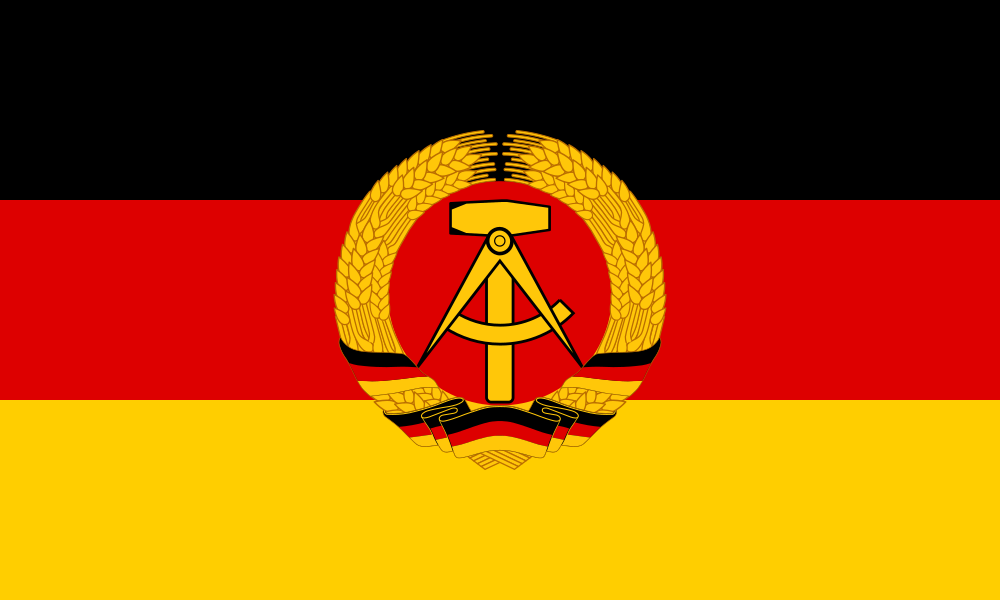
The delegation of the German Democratic Republic considers this fresh dis- cussion of the so-called question of Afghanistan as inadmissible interference in the internal affairs of a State Member of the United Nations and a blatant violation of the basic provisions of the Charter. .
11. We should like to recall that the right of each people to self-determination is one of the main prin- ciples of the Charter. Many peoples invoked that right, which is one of the norms of international law, when they liberated themselves from the bonds of
I: the Governments of the Democratic Republic of 14. If the people of Afghanistan is exercising its right Afghanistan and of the USSR, which, in a joint freely to decide to take advantage of assistance and statement dated 16 October 1980 and issued on the support from a friendly State, then that is its business occasion of the friendly visit of the General Secretary exclusively. The military support of the USSR given of the Central Committee of the People's Democratic to the Democratic Republic of Afghanistan is based Party of Afghanistan, President of the Revolut~onary on the Treaty! that was concluded and is aimed at Council and Prime Minister of the Democratic Re- securing the sovereignty and.territorial i~te~rity ofthat public of Afghanistan, Babrak Karmal, to the USSR, non-aligned State, to defend It.from ~o~tmumg cou~te~- noted in particular that revolutionary interference by imperialist, hegemonistic and other reactionary forces from outside. ••As regards the limited Soviet military contingent on the territory of Afghanistan, at the request of the IS. The support given by the Soviet Union is n.o Government of Afghanistan and in accordance with threat to the peace and security of peo~les. It IS the Soviet-Afghan Treaty,of 1978and with the United especially no obstacle to the process of detente, as Nations Charter, the question of the timing of its the member States of the North Atlantic Treaty withdrawal can be examined only in the context of Organization [NATO] would try to ha~e us be!ieve. a political settlement, and not b~fore the aggression The hostility of those States to the pobcy of detente against the Democratic Repubbc of Afghamstan IS is well known and they are doing their utmost to completely halted and guarantees are .given that plunge the world into a new era of cold war. They subversive activities from outside will not be have been abusing the General Assembly rostrum and resumed against the people of the Democratic Re- the second review session, at Madrid, of the Con- public of Afghanistan and its Govemment'I.! ference on Security and Co-operation in Europe, which is to serve the continuing process ofdetente in Europe, 20. Anyone who, in contradiction of this, demands to sow discord and provoke confrontation without that the Soviet military units be withdrawn from Afghanistan is dangerously turning the question upside- down. The fulfilment of such a demand would be
I Treaty of Friendship, Good-neighbourliness and Co-operati~n between the Union ofSoviet Socialist Republics and the Democratic Republic of Afabanistan of 5 December 1978.
29. Today, what we want to emphasize are the dimensions of the problem-a problem which has become a turning point in the international situation and in international relations in general and which raises questions about the nature ofour understanding of the current balance at the international level and the responsibilities and obligations of the major Powers, as well as the concept of the security needs of States in defending their independence. 30. One of aspects of that problem is the fact that today we are facing a situation marked by a certain pessimism and lack of confidence and by tension in international relations. It is a situation which resembles the one which led to the failure of the League of Nations to discharge its responsibilities and to the Second World War. We are today witnessing an escalation of the use of absolute force in international relations.
41. The security of the Indian Ocean and the imple- mentation of the Declaration of the Indian Ocean as a Zone of Peace [resolution 2832 (XXVI)] cannot be kept apart from what has taken place and continues to take place in Afghanistan. We should be deceiving ourselves were we to believe that we could succeed in establishing the broad lines for the implementation of that Declaration in the shadow ofthe military presence of a big Power in Afghanistan near the warm waters of the Indian Ocean.
42. The unfolding events in Afghanistan have de- monstrated that we are faced with an attemrv "r, destroy the' Islamic character of that country, to ", ,.k its national unity and to impose an ideology maku.g it possible to exercise control over it. But those events have also ;shown that foreign forces have been able to impose only a puppet regime, a regime, that is a prisoner in its own capital and depends on aforeign military presence for its very existence-indeed its every move depends on that presence.
43. The true brother, people of Afghanistan has rejected all foreign interference and has united to face up to that foreign invasion proudly and resolutely, just as it has refused to yield to any attempt at imposing puppet regimes. Throughout the past yt.1r the interna-
46.. The sponsors of the text adopted as resolution ES-6/2 by the overwhelming majority of Member States-just like those of the present draft resolution in document A/35/L.I2-have been very' prudent in the wording they have chosen so that there will be no obstacle placed in the path ofa solution of the problem by peaceful means. We hope that the Soviet Union will take this into account.
47. In this context my delegation would like to make the following clarifications. We are not defending regimes; we are defending the principles to w~i~h we should all be committed. We refuse to grant legitimacy to any regime imposed by military force. We believe that the maintenance of the sovereignty and the identity of Afghanistan as a non-aligned State is an important matter and a major element in any political solution of the problem and that that objective must be reached in the following framework. All the parties concerned should commit themselves to refraining from any interference in Afghanistan and preventing any conflict brought in from outside. The Soviet Union must withdraw all its military forces from Afghanistan unconditionally. The Afghan people should be free to choose its own economic, political and social systems without any foreign interference and, in its turn, the United Nations can have a role to play in this field. The United Nations should support Afghanistan and lend it economic assistance so as to help it to solve its economic problems and make possible the return of the refugees. On the other hand, the Secretary- General is requested to keep Member States informed on the situation and on what he deems necessary to facilitate his task as well as that of other bodies concerned. 48. Mr. ALLAGANY (Saudi Arabia) (interpretation from Arabic): The question of Afghanistan has on two previous occasions been taken up in the Security Council and the General Assembly. The latter, at its sixth emergency special session, adopted resolution
ES~6/2, in which the Assembly, inter alia,
regime in the country does not justify the occupation of the whole country by any foreign State in order to overcome the resistance and to set up and support the sort of regime it favours. 52. We cannot possibly accept the theory advanced by the Soviet Union, namely, that the intervention of the United Nations and its adoption of a stand on this question is contrary to Article 2, paragraph 7, of the Charter, can be considered to be interference in the internal affairs of States and undermines the authority and power of the United Nations. It is the intervention of the Soviet Union that constitutes a clear violation of Article 1, paragraph 2, of the Charter, which emphasizes the right of peoples to self-determination without foreign intervention or pressure, and Article 2, paragraph 4, which emphasizes that it is essential in international relations for all States to refrain from the threat or use of force against the territorial integrity or political independence of any State or in any other manner inconsistent with the purposes of the United Nations. 53. The essential role of the United Nations is to eliminate tension and safeguard international peace and security, and it is impossible to achieve that noble aim without respect for the principles on which the Organization was founded, including respect for the sovereignty, independence and territorial integrity of all States, non-intervention in the internal affairs of States and the right of all States to self-determination and to decide their future in complete freedom.
59. I' find it essential to mention in this respect that it was,theSoviet Union that put forward the proposals concerning the strengthening of international security at thetwenty-fifth session of the General Assembly, the deepening and consolidation of international detente at the thirty-second session, the international treaty concerning the principle of the non-use of force in international relations at the thirty-first session and the non-admissibility of the policy of hegemonism in international relations at the thirty-fourth session. There is no doubt that the international community fully appreciates those initiatives, but it is only natural to wonder whether any State has the right .to call for one thing and to act In the opposite way. 60. My Government believes that it is the duty of all non-aligned countries to act together to put an end to this situation as soon as possible, for the existence ofa large body ofSoviet troops in Afghanistan imposes alignment on that country, and if the presence of such a large number oftroops does not constitute hegemony in Soviet eyes, we cannot possibly understand what the word "hegemony" means to the Soviet Union. 61. At the Sixth Conference of Heads of State or Government of Non-Aligned Countries, which was held at Havana in 1979, some countries claimed that the Soviet Union was the natural ally of non-aligned countries. The events in Afghanistan, however, have given us clear evidence to the contrary. 62. The situation in Afghanistan is of particular concern to us, for close relations between the people of
Afghanistan and the Arab peoples date back more than 1,()()() years, and there are religious, cultural and geographical bonds which unite us and which cause us to feel particular concern at the aggression committed against that people and the massacres to which they are exposed in order to force them to submit to foreign and alien rule and a foreign and alien ideology which is counter to its religion, its culture, its history and its character. 63. We object to the Marxist theory that has been imported by Soviet tanks and we firmly believe that it is the right of the Afghan people to determine its own future without foreign intervention. We cannot possibly accept the Soviet thesis that the regime imposed on the Afghan pepole by force, massacre and destruction is what that people actually desire in order to put an end to social oppression and economic backwardness and reconstruct an independent Afghanistan. That is what was stated by the repre- sentative of the Soviet Union at the sixth emergency special session." 64. The right to self-determination includes the right to choose a government by peaceful means emanating from within the country, not from outside, and such a government cannot possibly be supported by a foreign army or by tanks, aircraft or any other destructive machinery of war. In the light of the principle of self-
68. In his statement yesterday [65th meeting], the representative of the Soviet Union put forward four arguments in defence of his country's position and against the draft resolution. I will examine briefly each of his four arguments.
69. The first argument of the representative of the Soviet Union was that the limited Soviet military contingent in Afghanistan was requested by the Government of Afghanistan in conformity with the
protest against such interference. Aquotation from the Moscow News of 15 April 1980 is extremely revealing. The paper stated: "Non-interference is a good thing, but the 'prin- ciples of international law do not exist in a vacuum. History and politics cannot always be fit into legal formulas. There are situations when non-inter- ference is a shame and betrayal. Such a situation developed in Afghanistan". 72. Finally, the Soviet Union has criticized the draft resolution on the ground that the solution to the situa- tion in Afghanistan cannot be achieved in the manner envisaged in operative paragraph 4. In the Soviet view the problem should be solved through bilateral negotiations between the regime of Babrak Karmal and the Governments of Pakistan and Iran. I should like to explain briefly why we cannot accept the Soviet prescription. We cannot accept it because the problem of Afghanistan is not a bilateral one between Afghani- stan and its two neighbours, Pakistan and Iran. The problem of Afghanistan lies in the unjustifiable inter- vention by the Soviet Union in the internal affairs of Afghanistan. It is a problem of concern to the entire international community.
76. Thirdly, the Soviet Union is claiming tha, it has the right to intervene in the internal affairs of States in order to safeguard "the fruits of revolution". That is a dangerous doctrine which is contrary to the Charter and must be rejected.
77. Fourthly, the problem of Afghanistan does not arise from any bilateral dispute between Afghanistan, on the one hand, and Pakistan and Iran, on the other. The crux of the problem is the Soviet military occupa- tion of Afghanistan and continued Soviet interference in the internal affairs of that country.
78. Draft resolution A/35/L.12 is conciliatory in its tone and moderate in its substance. It does not refer to the Soviet Union by name. It does not concemn or deplore the continuing Soviet occupation of and inter- ference in Afghanistan. It does not refer to the repre- hensible tactics used and weaponry employed by the well-armed troops of the Soviet Union against the freedom fighters of Afghanistan. It merely calls upon all parties concerned to work for the urgent achieve- ment of a political solution
79.' If the Soviet Union, which calls itselfthe "natural ally" and "reliable friend" of the non-aligned coun- tries, wishes to redeem its shattered credibility, it should PaY heed to the voice of the third world and co-operate with the Secretary-General in the imple- mentation of this draft resolution. If, on the other hand; the Soviet Union continues its military occupa- tion of Afghanistan, continues its interference in the internal' affiars of Afghanistan, then the countries of the third world must conclude that, far from being our "natural ally" and "reliable friend", the Soviet Union is a danger to the third world.


Mydelegation recalls vividly the intense debate that took place in this very hall in January this year, when the General Assembly met in an emergency special session to consider the serious situation in Afghanistan arising out of the Soviet intervention in that country. What stood out most glaringly during the debate was the expression of indignation, anger and disappointment at the Soviet action. The introduction of thousands of Soviet troops into Afghanistan, backed by tanks and aircraft, in order to subdue the Afghan people into accepting a g"l,'p,rnment which they had no desire to support, had u.ought with it dangerous consequences for the region, as well as the world at large.
82. At the same time, the spillover effects of the Soviet intervention in Afghanistan, in the form of over 1 million Afghan refugees who fled their homes for fear of oppression and intimidation, have placed a heavy burden on neighbouring Pakistan. We in Malaysia, havingexperienced the influxofVietnamese refugees onto our shores, clearly understand what it means for Pakistan to be saddled with such a large number of Afghan refugees.
83. To us in South-East Asia the events in Afghani- stan closely resembled what had taken place in Kampu- chea-a big, powerful country sending its troops into a weak neighbouring State, removing the neighbour's legitimateGovernment and setting up in its placea sub- servient puppet regime. Even the justifications used in both instances are similar: foreign troops were invited into the country by a Government under the terms of a friendship and co-operation treaty for the purpose of defending the country against external threats. But the irony was that the Government that was supposed to have issued witation was not even in existence when the in ,il was made. My delegation considers that there I~ a definite link between the events in Kampuchea and Afghanistan; clearly the two events are part of a larger big-Power strategy to gain advantages and domination in various parts of the world. We the small developing nations have real cause to worry at this trend, which must be checked at all cost.
84. The General Assembly at its sixth emergency special session in January this year had over- whelmingly deplored the Soviet action in Afghanistan and demanded that all foreign troops be withdrawn so that the Afghan people could determine their future on their own, free fromexternal interference and coercion. A similar appeal was made by the Organization of the Islamic Conference at its extraordinary sessions at Islamabad in January and May this year. All these appeals remain unheeded and Soviet troops continue to be reinforced and deployed against the Afghan people, who are intent on preserving their indepen- dence and sovereignty. Asthe Soviet militaryoperation continues, so does the flow of Afghan refugees into Pakistan. The Soviet Union and the authorities in Kabul have also spurned the efforts of the Islamic Conference to bring about a peaceful solution of the Afghan conflict by refusing to co-operate with the Committee established for this purpose.
90. The invasions and occupations of Afghanistan and Kampuchea are acts of defiance of the funda- mental principles of the Charter, of non-alignment and ofinternational relations and run counter to the inalien- able right ofpeoples to decide their own future without foreign interference of any kind against the indepen- dence and sovereignty of States, in particular of the weak, small and medium-sized ones. They imperil international peace and security.
6 See ODicial Records ofthe Economic and Social Council, 1980, Supplement No. 3, chap. XXVI, sect. A.
110. After more than 10 years of propaganda about detente and disarmament, the expansionist great Power has attained supremacy in conventional weapons and is in the process of acquiring it in nuclear weapons. At the same time, it is spreading its tentacles, first through the intermediary of regional expansionists in Africa, Latin America and Asia-including in Kam- puchea-and then directly in Afghanistan. Ill. In Kampuchea it has used the Hanoi authorities and their expansionist ambitions in South-East Asia to extend its hold in that sensitive region and to control the strategic sea lanes and the Strait of Malacca, which is the umbilical cord linking the Pacific Ocean with the Indian Ocean. Bydirect military intervention to impose a puppet regime on the Afghan people, it aims to extend its influence and domination to the Persian Gulf, the Middle East and the Indian Ocean. It is certain that if it were to consolidate these conquests with impunity, it would advance other pawns, whose victims would be the neighbouring States.
112. The years 1938and 1980show a certain similarity of situations. The decade of the 1980s looks bleak. Some are already speaking of the possibility of a third world conflagration towards the middle of the decade. In fact, the development of the situation does not depend only on the expansionists. It also depends on the stance of solidarity adopted by all peace-loving and justice-loving countries with regard to world and regional expansionism and to the heroic struggles of its victims. The bitter lessons of the past have shown that Munich only encouraged conquest, and that only a resolution and dogged struggle and staunch and unflinching resistance can halt the thrusts of the expansionists and foil their ambitions for world domination. In that way each people and each nation can affirm its identity and its will to maintain it. It is by not giving in to threats that one can prevent a third-world conflagration being touched off.
113. My delegation has been most encouraged by the determination of all peace-loving and justice-loving peoples and countries and by the Organization firmly to defend the principles of the Charter and of interna- tional relations. The relevant resolutions which have been adopted on this subject strengthen the front of international solidarity against the dangers of expan- sionism and have encouraged the' struggles of all countries and peoples-Democratic Kampuchea and
116. Confronted with this global concern, the General Assembly, which was convened in an emergency special session at the beginning of January of this year on a new development, the situation in Afghani- stan, following the failure of the Security Council to resolve the issue, adopted resolution ES-6/2 which, it was hoped, would lead to the normalization of the situation in Afghanistan. In the resolution, adopted by an overwhelming majority-it gained 104 votes in favour-the Assembly expressed concern at the de- velopments in Afghanistan and recognized the urgent need for the termination of armed foreign intervention to enable the Afghan people to determine its destiny without outside interference or coercion. It there- fore called for the immediate and total withdrawal of all foreign troops and urged the parties concerned to seek a speedy settlement in accordance with the prin- ciples of the Charter.
117. However, it is deeply to be regretted that almost one year has elapsed and no progress has been made in implementing that resolution. In consequence, the continued presence of foreign troops in Afghanistan has led to the aggravation of tension in the region and has been a serious setback to the cause of peace, detente and disarmament. It has intensified super- Power rivalry and has created a climate ofmistrust and suspicion. All these developments, coupled with the massive exodus of refugees, constitute a grave threat not only to regional peace, but also to international security.
118. The Government of Indonesia joined the many countries which requested the inclusion in the provi- sional agenda of the current session of the item on the situation in Afghanistan and its implications for international peace and security [A/35/144 and Add./]. It did so because of its deep concern regarding the grave developments that have taken place and continue to take place in a fellow non-aligned country in clear infringement of the Charter, the Declaration on Prin- ciples of International Law concerning Friendly Rela- tions and Co-operation among States in accordance with the Charter [resolution 2625 (XXV)], the Declara- tion on the Strengthening of International Security
7 See A/34/542. • See As;all-Aj'r;can Conference, April/8~24, /955, New Delhi, Government of India Press, pp. 36-38.
142. In conclusion, we should like to recall what occurred exactly 44 years ago in the Palace of the League of Nations at Geneva. There the Head of State of a small developing country, Abyssinia, condemned the brutal invasion of his country by an army equipped with the most modem weapons ofits day-Mussolini's Fascist troops. That aggression was as unjustifiable as that against Afghanistan, and both had the same origin-the imperialism of totalitarian concepts.
143. On that occasion the League of Nations sup- poned the small country concerned in very heartfelt terms, speaking among otherthings ofsanctions against the aggressor; but it did not go much further. The consequences of this went far beyond the subjugation of a small country. It was one of the decisive causes of the total loss of prestige of the League of Nations and its consequent unlamented demise.
J44. We can only hope that that will not constitute a precedent in the case of Afghanistan.
J45. Mr. BHAIT (Nepal): During the emergency special session convened last January my delegation associated itself with the majority of the countries present in expressing its apprehension over the events in Afghanistan. We voted in favour of resolution ES-6/2, which evidently formed an appropriate response to meet the situation.
151. Another dimension of the Afghan situation is its potential for disturbing the peace and stability of the countries in and around the region. As we see it, the area is faced with the menace of greater involve- ment of various other outside forces. 152. In view of all these implications, my delegation deems it imperative that a political solution to the Afghan problem should be earnestly sought without further delay. The elements of such a solution should include primarily the immediate withdrawal of foreign troops from that country in order to enable the Afghan people to exercise its right to determine its internal system free from the involvement of foreign troops
178. Somalia associates itself closely with the effort to exert the full force of the moral pressure of the General Assembly on behalf of the people of Afghani- stan.We hope that the vast majority of Member States will demand the immediate and unconditional withdrawal of all Soviet forces from Afghanistan. Indeed, no State should remain aloof when the sovereignty, territorial integrity and political inde- pendence of a Member State have been wantonly violated, and when the right of a people to choose its own political system in freedom has been sup- pressed by foreign military. intervention.
179. In the view of my delegation, the Afghanistan situation calls for the sustained application of such provisions of the Charter as relate to the peaceful settlement of disputes and for removing threats to international peace and security. In this regard we place great importance on the efforts undertaken by the Organization of the Islamic Conference and by the Secretary-General to promote a political solution based on the principles of the Charter. We believe also that the appointment of a special representative of the Secretary-General would be a valuable step in this direction.
180. Somalia, which has the largest refugee popula- tion in the world, fully understands the sufferings caused by the uprooting of families from their homes and also the problems faced by the host country, Pakistan. We hope that the international community will be generous in extending humanitarian assistance to the Afghan refugees in co-operation with UNHCR.
181. In conclusion, I wish to pay a tribute to the heroic people ofAfghanistan, who are carrying on their historic tradition of opposing domination and fighting for the freedom and independence of their country. In doing so they serve as an inspiration for all freedom- loving peoples who are engaged in the struggle against tyranny. In the circumstances, my delegation fully supports the draft resolution before us of which we are a sponsor.