S/PV.1828 Security Council
▶ This meeting at a glance
8
Speeches
3
Countries
0
Resolutions
Topics
Southern Africa and apartheid
Global economic relations
General statements and positions
Security Council deliberations
UN procedural rules
General debate rhetoric
T H I R T I E T H Y E A R
The meeting was called to order at 3.45 p.m.
Adoption of the agenda
The agenda was adopted.
At the invitation of the President, Mr.
Gheleti (Bulgaria), Mr. Mikanagu (Burundi), Mr.
Alar&n (Cuba), Mr.
Adjibade’ (Dahomey), Mr. Neugebauer (German
Demticratic Republic), Mr.
Boaten (Ghana), Mr. Jaipal (India), Mr. Dennis (Liberia), Mr. Ogbu (Nigeria). Mr.
Akhund (Pakistan), Mr. Datcu (Romania), Mr. Baroody (Saudi Arabia), Mr. Djigo (Senegal), Mr. Blyden (Sierra Leone), Mr. Hussein (Somalia), Mr.
Humaidan (United Arab Emirates), Mr.
Petrii (Yugoslavia) and Mr.
Mwaanga (Zambia) took the places reserved for them at the side of the Council chamber.

In accordance with a further decision taken at the 1823rd meeting, I now invite the delegation of the United Nations Council for Namibia to take places at the Council table. 3 . The PRESIDENT: I should like to inform members of the Security Council that I have received, in addition, a letter from the representative of Algeria requesting to be invited to participate in the discussion of the question on the Council’s agenda in accordance with the relevant provisions of the Charter and rule 37 of the provisional rules of procedure. Pursuant to the usual practice, I propose, if I hear no objection, to invite the representative of Algeria to participate in the discussion without the right to vote. Owing to the limited numb&r of seats at the Council table, I regret that I must invite the representative of Algeria also to take a place reserved for him at the side of the Council chamber. He will be invited to take a place at the Council table whenever he wishes to address the Council.
At the invitation of the President, Mr. Talvitie (Finland) and other members of the delegation of the United Nations Council for Namibia took places at the Security Council table.
At the invitation
ofthe
Preiident, Mr. Fasla (Algeria) took the place reserved for him at the side of the Council chamber.
I invite
the representative of Senegal to
iake a place at the Council table and to make his statement.
5. Mr. DJIGO
(Senegal)(interpretation from French): The head of my delegation, who has a last-minute obligation, has asked me to extend his apologies to the Security Council and in his place to set forth the position of the Government of Senegal.
6. Mr. President, on behalf of my delegation, I should like to say how very happy we are to see you presiding over this session of the Security Council. Our happiness is all the greater
a$ our two countries both belong to the group
of.
the non-aligned countries where we have often shared the same political position on major international issues.
7 . I should also like to tell the delegation of Guyana how much we appreciated the presence of their
.the agenda
of. the United Nations.
9 . The present series of meetings of the Council is taking place at the expiry of the deadline which the Council set almost a year ago when it adopted resolution 366 (1974). The facts seem to me sufficiently well known, and the international community sufficiently concerned, for it to be unnecessary for me to go back over the history of the Namibian problem.
10. On 17 December 1974
[Z81lth meeting], when you set 30 May last as the date for our next meeting, you aroused hope in the people of Namibia-the hope that finally peace-loving States concerned for peaceful coexistence, whose representation is your formidable responsibility, would shoulder their responsibilities before history.
11. The statement of Vorster in Windhoek [see
S/1/701] will certainly have surprised no one but political neophytes. No one has any doubt that that speech contained nothing new. My delegation, for its part, regards it as one further attempt to perpetuate apartheid by persuading the world to believe that radical changes have taken place, and to reduce the international isolation of South Africa.
12. The Charter of the United Nations proclaims the principle of self-determination, not only in its preamble, but also in Article 1, paragraph 2, which stipulates that one of the purposes of the United Nations is: “To develop friendly relations among nations based on respect for the principle of equal rights and self-determination of peoples”.
13. The General Assembly, by adopting the historic resolution 1514 (XV) by general consensus, made the principle of self-determination an integral part of positive international law, which since that time has been mandatory for all States. How then can a country which refuses so clearly to
recognize that the United Nations has even the slightest right to concern itself with what that country considers “its” territory endorse resolution 1514 (XV), which gives
selfdetermination the nature of an indisputable and irreversible legal principle?
14. I would like to see further thought given to the real intentions of Mr. Vorster when he talks about self-determination, independence and the maintenance of Namibia’s territorial integrity. ‘Even if Vorster’s reference to self-determination is to be regarded as progressive, it must be remembered that what he is offering each of the so-called population groups is an option to choose its own future. Througout his
15. Just as my delegation believes that one needs no special intelligence in order to detect the ambiguities in Vorster’s statement, similarly we cannot tolerate any equivocation concerning the position of the Organization of African Unity (OAU) on contacts with South Africa. .The resolution adopted by the Council of Ministers of the OAU at its Ninth Extraordinary Session, held in Dar es Salaam from 7 to 10 April 1975, which established a special committee to deal with all problems concerning Namibia, poses three prerequisites: first, the right of the Namibian people to self-determination and independence; secondly, respect for the territorial integrity of Namibia; and, thirdly, recognition of the South West Africa People’s Organization (SWAPO) as the sole representative of the Namibian people.
16. But what one seems to overlook on this resolution, and which is basic, is that contacts with South Africa must concern only the transfer of power to the people of Namibia through its lawful representative, SWAPO. That is the meaning which the OAU intends to give to the contacts. Such is the mission it has assigned its committee. That much is clear. The OAU thinking is far removed indeed from that of South Africa. One must look at South Africa’s intention of talking with the OAU from the South African’ point of view to realize-if that were necessary-that the positions are diametrically opposed.
17. How then can there be any discussion with South .
..__ Africa as to whether the missions it is prepared to receive will have as their only task to inquire into the progress made in South Africa’s administration of the international Territory of Namibia? The Pretoria Government is once again attempting to dissimulate its true intentions behind a camouflage of deliberate ambiguities and misleading statements.
.18. To those who counsel us not to allow this opportunity to pass, and to take South Africa at its word, we reply that there can be no question for Africa of bargaining away its dignity. Let it simply be remembered that we are not looking for concessions from South Africa. The present position of South Africa may be the answer to the preoccupations of the Organization 26 years ago but they were dealt with in General Assembly resolution 2145 (XXI).
19. It is nevertheless curious to see the Western Powers taking the easy way out and telling the Africans: “Seize this opportunity; South Africa is ready to receive your committee.” Perhaps the Powers
27. Paragraph 21 of the Declaration of Dar es Salaam contains Africa’s message to the Council, which I would venture to recall:
20. For my part, I am astonished that at this stage of the debate no Western Power has yet specified the role it would play if this dialogue which they want to have us undertake should fail just as all previous attempts of the Organization have failed.
21. That
South Africa should today claim that it does not want a single inch of Namibian Territory is a strategem sufficiently contradicted by the facts for it to be unnecessary to dwell on it.
22. What I should like to emphasize, however, is that the problem of Namibia is now calling in question the credibility of the Security Council, today and for the future-l repeat, the credibility of the Security Council, today and for the future. Make no mistake about it. Resolution 366 (1974) aroused hopes which you have no right to disappoint. A system founded on
That is the meaning of our message. No compromise with these objectives is conceivable.
crprrrtheid cannot be defended or condoned. A system based on contempt for the most elementary human rights must be unflinchingly condemned.
23. More than 60 resolutions have been adopted by the United Nations on Namibia, all without effect. All kinds of solutions have been envisaged,
29. It may seem surprising that those who only a few weeks ago were still attacking the peoples of
both legal and realistic ones. All have failed. The Security Council is the only body of the United Nations where one cannot speak of a mechanical majority. Those who so eloquently decried it in the course of the twenty-ninth session should not conform to it now. Here is an opportunity for them to exercise their sovereignty, their independence, and above all, their impartiality.
24.
“Liberte,
EgalitC,
Fraternite”, “Dieu et mon droit”, “In God We Trust”-these are mottoes full of meaning because they are harbingers of hope. The Namibians hope to espouse them all together in a kind of symbiosis which, I am quite sure, will contribute to understanding on the part of the peoples of the international community of which they expect so much today. These principles must not derive solely from idealism; they must be implemented in practical and realistic terms.
25. Those who, like myself, have faith in the Organization are anxiously expecting you to strengthen the credibility of the United Nations. If I were to express a wish, it would be to see each nation represented around this table live up to its heavy responsibilities before history.
26. To those who claim to be friends of Africa I will simply say that independent Africa cannot conceive of
‘6 . . . the Security Council... is scheduled to convene on or about 30 May 1975 to consider the question of Namibia, [the African States] call upon the Council earnestly request it to take all necessary measures, including the measures envisaged under Chapter VII of the Charter of the United Nations, with a view to effectively overcome South Africa’s defiance and contempt of United Nations decisions.”
28. I should like to remind the Council that it was the Council which undertook to meet today in order to take the appropriate measures under the Charter. For our part we reject the demagogic statements we have heard at this stage of the debate. What we cannot understand is that we should be told that there is no threat to peace and therefore no reason to invoke Chapter VII of the Charter.
Indo- China should deny that the explosive situation in South Africa is a threat to world peace. It is astonishing that it should be considered that there is no threat to peace while South Africa continues its acts of aggression against sovereign States of the subregion under the complacent regard of the great Powers. It is, above all, sad that on behalf of selfish interests people shut their eyes to the threat to the Organization from the continuing violation of the Charter-the Charter of “the peoples of the United Nations”.
30. What we want is not declarations of intent but rather practical action, as follows. First, the United Nations Council for Namibia should be equipped with the necessary resources to establish its presence and exercise its authority in the Territory. Secondly, free elections should be organized within a period of one year under the supervision and control of the United Nations. As the President of SWAP0 has said nweting], it is through the organization of such elec- tions under United Nations auspices that the transfer of power to the people of Namibia shoud be effected. Thirdly, an embargo should be decreed on the sale of arms to South Africa. Fourthly, the Council should call for the unconditional withdrawal of South Africa from the international Territory of Namibia imme- diately following the elections to be organized under United Nations control; and, if South Africa is pre- pared to accede to this request, let it so indicate, first 31. The position taken by independent Africa will depend on the outcome of this debate. In any event independent Africa will continue its support for its brother people of Namibia under the leadership of SWAP0 in its fight to recover its dignity. We are not looking for compassion. We are not looking for tokens of friendship or of sympathy in the corridors. We want effective action. It is by that we shall judge the sovereignty of every State and the effectiveness of the United Nations.
[1823rd
The next speaker is the representative of Pakistan, and I invite him to take a place at the Council table and to make a statement.
33.. Mr. AKHUND (Pakistan): Mr. President, allow me first of all to offer you the congratulations of my delegation on your assumption of the presidency of the Security Council this month. The bonds of brotherhood that link our two countries and peoples together are further strengthened by our admiration for the consistent, principled and resolute support that the Government of
Iraq has always extended to the struggle of freedom-loving peoples against colonial exploitation. The delegation of Pakistan hopes that during your presidency the Security Council will succeed in tackling the situation in Namibia in an effective manner. Allow me to take this occasion also to offer my delegation’s congratulations to your predecessor, the representative of Guyana, on the efficient and skilful manner in which he conducted the affairs of the Council during the month of May. We owe special thanks to the Minister for Foreign
Affairs of Guyana for having travelled to New York to be with the Council when it began its discussion of the Namibian situation.
34. My delegation is grateful to you, Mr. President, and to all members of the Council for having acceded to our request to be heard on
.&this question, a question which we consider to be of great interest and grave importance to the entire international community.
35. The Security Council has resumed discussion of the situation in Namibia in pursuance of a decision taken on 17 December 1974
[1811fh meeting], when, by resolution 366 (1974) adopted unanimously, the Council asked South Africa to respond positively by 30 May 1973 to the earlier decisions of the United Nations concerning
rhe Territory.
36. Much has happened in Africa, particularly in its southern part, since the Council adopted that resolution. Mozambique will achieve independence this very month. Angola is to follow soon thereafter. The dead-
_
_
_
37. Mr. Vorster, as we all know, has been engaged in discussions with a number of eminent African Heads of State. The world has watched these developments with great interest and a certain amount of hope. We should like to pay a tribute to the sagacity of those Heads of State who, despite the strong emotions and feelings aroused by the questions of
opurtheid and self-rule, have agreed to these contacts in a spirit of pragmatic vision and farsightedness.
38. Therefore it is all the more disappointing that South Africa’s response to resolution 366 (1974) . contains nothing which might indicate a readiness to comply with the unanimous decision of the Council. The letter received by the Secretary General from the Minister for Foreign Affairs of South Africa
[set
S/11701], despite its ambiguities, amounts in effect to a rejection of paragraphs 3 and 4 of the resolution of the Council.
39. It is impossible to accept Mr. Muller’s assertion
[ihid.] that South Africa’s sole concern has been to develop the Territory in the best interests of all its inhabitants and to prepare them for their orderly exercise of the right of self determination. The assumption that South Africa has remained in and continues to administer the Territory because the inhabitants wish it to do so is nothing short of ludicrous. Mr. Muller’s letter claims that all options are open to the people of Namibia, including that of independence as one State, if that is what the people should choose. This assumes that there is some doubt about the matter and that the clearly expressed wishes of Namibia’s political organization are to be ignored.
40. Need one mention that the General Assembly, the Security Council and the International Court of Justice’ have all repudiated the legality of South Africa’s presence ‘in Namibia? Everyone here knows that. From time to time the Security Council has expressed its grave concern over this situation.
41. The South African letter asserts that the “peoples of South West Africa”-the use of the plural is noteworthy-must themselves determine their political and constitutional future in accordance with their own freely expressed wishes and that this must take place without interference from South Africa, the United Nations or any other outside entity. This is a most admirable condition. How, one might ask, is it to be ensured that South Africa will indeed carry out its undertaking not to interfere with the process in any manner? There is nothing in the policies or practice that the South African Government has followed hitherto, to inspire confidence. The United Nations, which by the ideals that it upholds and by its vocation
letter specifies, must be acceptable to the South African authorities?
42. It is plain
that the exercise is aimed not at ending South Africa’s illegal presence in Namibia but at providing a respectable cover
46. It
.has been urged that no threat to peace exists to justify action under Chapter VII of the Charter. One might ask, does a threat to peace arise only when a resort to force has either actually taken place or is about to take place? We consider that the situation has the-potential of a threat to peace when the whole world community stands confronted by a persistent and immovable refusal to listen to reason. How long can the Council go on exploring new approaches for accommodation and accord where none seem to exist? How can there be a useful dialogue when the very basis for fruitful contacts are derided and negated by one of the parties?-
.for the pursuit of -its unvarying objectives in the Territory. The notion is put forward or suggested in the letter that not SWAP0 but some anonymous “true leaders” have the authority to speak for the people of Namibia. Who are these “true leaders” and how is it that only the South African authorities seem to be privy to their identities and their intentions?
43. By its authentic articulation of the aspirations of the Namibian people, SWAP0 has earned for itself the right to represent them. The Council for Namibia
recognizes the
organization as such. So do all the African States of the OAU. Attempts to bring into question its authenticity as the liberation movement of the people of Namibia are futile and can only raise questions about the usefulness and purpose of the dialogue which the South African Government professes to advocate. By its refusal to ‘accept reality and by debarring the leaders and members of this liberation movement from moving freely in their own homeland without the threat of arrest and political imprisonment, the Pretoria regime may prolong its occupation but certainly cannot perpetuate it. The full and effective participation of SWAP0 in the process of self determination for Namibia is inevitable and necessary for the Territory’s peaceful transition to freedom and independence; Attempts to play up so-called true leaders are designed to create divisions in’ the Territory and to lay the ground for introducing to it the policy of Bantustans which had failed so conspicuously in South Africa itself. If I may quote the representative of France: “rivalries among population groups, wherever they exist, have never prevented a country from embarking on the course of self-determination and acceding to independence”
47. The Security Council has heard the voice of the people of Namibia through Mr. Sam Nujoma. The President of the United Nations Council for Namibia has expressed the views here
[!823rd meeting] of that body on South Africa’s response to resolution 366 (1974). Many members of the Security Council itself and of the United Nations have addressed the Council. All are of the view, which the Pakistan delegation shares, that this response is totally inadequate, ambiguous and unacceptable. It cannot constitute the basis for a meaningful dialogue. That dialogue requires the acceptance and unequivocal reaffirmation by South
Africa of all United Nations decisions concerning -Namibia and a solemn commitment to the accession. to independence and territorial integrity of its people as one individed. State, under United Nations auspices.
48. The Government and people of Pakistan expect
-
thatthe Security Council will see as its clear duty definitively to assert the rightful and legal responsibility of the United Nations concerning Namibia and to take steps-not excluding those under Chapter VII of the Charter-which might persuade the authorities in Pretoria to withdraw from that Territory at the earliest and to desist from their clear, if concealed, intention to create Bantustans in the Territory. 44. Conditions have changed radically in Africa. Recent developments in Mozambique and Angola should serve as clear indicators that the liberation of Namibia cannot be far off. Will it be achieved in peace or in violent strife? The answer lies, above all and first of all, with Pretoria. If the letter of 27 May 49. .The council should call upon South Africa to abandon the extension of any aspect of apartheid to Namibia and to bring to an end once and for all measures of police brutality and high-handedness and oppression in any other form. The legitimate representatives of the people must be allowed com- plete political freedom of movement, all exiles must be allowed to return home, and political prisoners must be released. [ihid.] is that answer, then it belies the hope-of a new, more wise and farsighted approach that was raised, or that it was sought to raise, by some of that Govem- merit’s recent actions and utterances. Let us at the United Nations, and in the Council above all, provide the only just answer and not be dissuaded by considera- tions of expediency or beguiled by false hopes. 50. The Council must reaffirm its unequivocal commitment to the independence and territorial integrity of Namibia and initiate steps for the conduct 45. My delegation is convinced that the Security Council, the principal organ of the United Nations. 51. In conclusion, I wish to reiterate that Pakistan stands firmly committed to all earlier decisions of the United Nations on the situation in Namibia and urges the faithful implementation of the series of Security Council resolutions, including resolution 366 (1974). We uphold the inalienable right of its people to self- determination and fundamental human rights and the total liberation of Namibia. We shall continue to support their struggle against the occupation of their territory, the usurpation of their basic rights and the exploitation of their land and resources. We call on South Africa to respect the Charter of the United Nations, the Universal Declaration of Human Rights and the basic concepts of human dignity and the right of all peoples under colonial domination to self- determination.
[1824th meeting,
para.
921.
The next speaker is the representative of the German Democratic Republic. I invite him to take a place at the Council table and to make his statement.

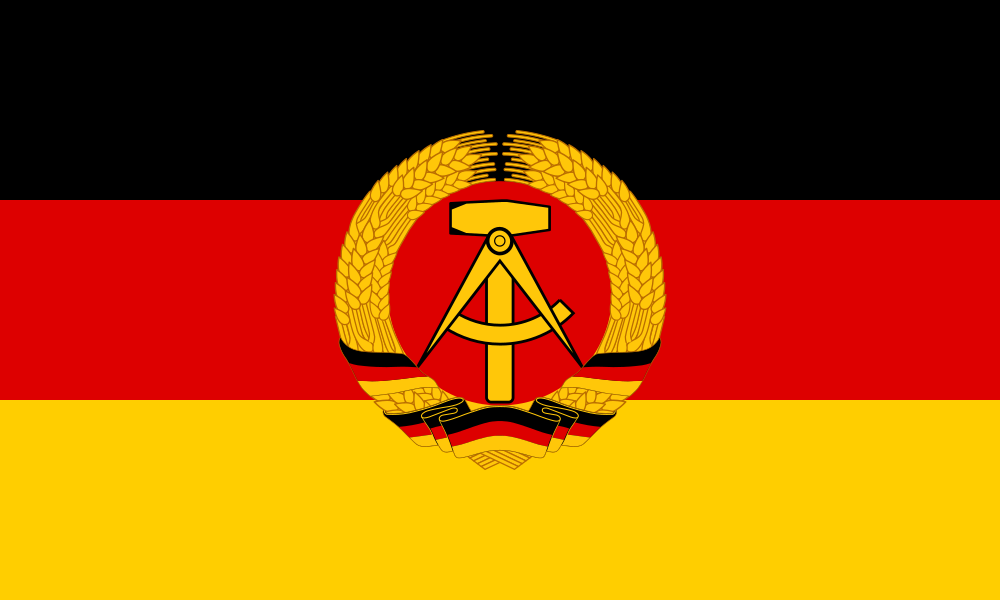
First of all I should like to thank you, Mr. President and members of the Security Council, for giving me the opportunity to address the Council. Permit me to congratulate you, Mr. President, on your assumption of the presidency of the Council. In this connexion, I feel bound to express the satisfaction of my delegation at the fact that the discussion of this very important item of the agenda is directed by the representative of a country with which the German Democratic Republic has maintained close and friendly relations for many years. I wish the Council under your direction much
succsss in dealing with this question which is of great importance for peace and international security.
54. For more than a decade the United Nations has been compelled to deal with the illegality of the occupation of Namibia by the South African apartheid regime. Numerous resolutions relating to this question have been adopted by the Security Council and the General Assembly. Measures have been taken to ensure respect for the principles of the Charter. However, the regime of the white minority in Pretoria has disregarded all the resolutions of the Organization. It has even intensified the terror in Namibia and South Africa in order to maintain its racist power.
uparrheid regime still holds to the view that its crimes can be justified and that it can find allies to support it. This regime, in an effort to hide its intentions, pursues various tactics. Some hours ago, the overseas service of Agence France Presse reported the convening of so-called constitutional talks on the 56. My delegation declares its complete solidarity with the views expressed in this forum by African and other countries and which say that the statements of Vorster concerning the question of Namibia are a plain derision of the Organization and are in direct contradiction not only of the demands of Security Council resolution 366 (1974), but also of the Charter in general. 57. In our time, when the tendency of detente is prevailing ever more all over the world, the policy of a regime oppressing the freedom of other peoples by racist terror and occupying foreign territories cannot be tolerated any.longer. 58. Like the majority of those who have spoken in this forum, my delegation also holds the view that the liquidation of the crimes of apartheid and thus of the threat to peace in the South African region is the concern of all peoples and States, and it is beyond doubt that apartheid is a social plague. 59. The words of the President of SWAP0 [ibid.] have emphatically demonstrated to us the real situation in Namibia. The struggle of SWAPO, the genuine representative of the interests of the Namibian people, is in full conformity with the relevant demands of the resolutions of the United Nations, in particular Council resolution 366 (1974). It is a genuinely just struggle to which we give our wholehearted support. 60. Only a few days ago, during a visit to my country, Mr. Sam Nujoma, President of SWAPO, had an opportunity to see for himself the active solidarity of the people of the German Democratic Republic. For many years, the German Democratic Republic has supported SWAP0 morally, politically and materially, and will continue to do so. Firm solidarity with the southern African peoples fighting for their liberation is a principle of the foreign policy of my country. I should like to emphasize that the German Demo- cratic Republic has always acted in conformity with the decisions of the various organs of the United Nations, including the resolutions of the Security Council regarding Namibia and South Africa. 61. My country has neither diplomatic nor consular relations with South Africa and it does not maintain any representation whatsoever in Namibia. It will hardly be necessary to say that in the German Demo- cratic Republic there are no economic circles which carry on trade with South Africa or Namibia, nor are there any such circles participating, in any form, in the exploitation of the national resources of both those countries. 68. The delegation of the German Democratic Republic supports the demands of the African Govem- ment representatives for a total embargo on arms, for the breaking off of all relations with the Vorster realization of its right to self- determination, national sovereignty and territorial integrity. tigime and for the application of all the possibilities the Charter offers. 63. In conformity with its main responsibility for the safeguarding and consolidation of peace and 69. My delegation is firmly confident that, in spite of the resistance of the inhuman racist intema- tional security, the Security Council has the task of taking effective measures to force the Vorster regime to end immediately the illegal occupation of Namibia or pay the price for its stubbornness. tigime in Pretoria, independence and human rights will be guaranteed for the people of Namibia too and the implementation of the decisions of the Security Council will be ensured. 64. Mindful of their historic experience with Hitlerite fascism, the peoples all over the world expect that, taking into consideration the lessons
55. The
The next speaker is the representative of Algeria. I invite him to take a place at the Council table and to make his statement.
drawn from the victory over fascism and racism 30 years ago in Europe, the biggest anachronism of our epoch will be ended once and for all in southern Africa as well.
71. Mr. FASLA (Algeria) (interpretation
from French): Mr. President, I should like first to tell you how pleased the delegation of Algeria is to see the representative of a fraternal country presiding over the work of the Security Council when it is once again considering the question of Namibia.
65. Together with the Soviet Union and the other States of the socialist community, the German Democratic Republic is among the firm allies of the African States in the struggle for the liquidation of the colonial reign in the south of Africa. The special meetings of the Special Committee against Apartheid which took place in May 1974 in the capital of my country, Berlin, again confirmed and made clear that the United Nations, in its measures against the last bulwarks of colonialism and racism, can rely not only on the majority of States but also on a broad people’s movement. It also proved that the racist regime in Pretoria is
72. I should like also to thank all the members of the Security Council for having allowed the delegation of Algeria to participate in the discussion of this question.
73. Faithful to the principles of freedom, dignity and justice and fully aware of the need to fulfil in every circumstance their duty of’ solidarity towards the peoples struggling against the coalition of systems of foreign domination and exploitation, the nonaligned countries have always given active support to the struggle of the people of Namibia against colonialism and the hateful system of apartheid, which Pretoria has extended to the territory of that people.
condemned by democratic public opinion all over the world.
66. In conclusion, 1 should like to express again the determination of the Government of the German Democratic Republic to support the just struggle of the people of Namibia and its liberation
organization, SWAPO. As the Secretary-General of the Central Committee of the Socialist Unity Party of Germany, Erich Honecker, said on 13 December 1974: “In the struggle for the total liquidation of colonialism, racism and neo-colonialism, the German Democratic Republic firmly sides with the peoples fighting for their national and social liberation’*. That support is given in the spirit of the achievement of the principles and purposes of the Charter of the United Nations and of the Declaration on the Granting of Independence to Colonial Peoples, Countries and as well as in the spirit of the unrestricted and complete implementation of Security Council resolution 366 (1974).
74. That support was recently reaffirmed by the Ministers for Foreign Affairs, members of the coordinating Bureau of Non-Aligned Countries, who, during their last meeting, held in Havana, demanded that
“the. oppressive regime of the white minority in South Africa apply the resolutions and ‘decisions of the United Nations on Namibia. The Bureau
reaffu-ms that it formally rejects the application of the ignoble policy of Bantustans in that Territory. It calls for strict respect for Namibia’s unity and territorial integrity and commits itself to supporting the legitimate struggle of the people of Namibia under the direction of its liberation movement, SWAPO. The Bureau of Co-ordination asks the
67. My delegation is convinced that the time has now come to take more decisive measures leading
of the United
Nations.on Namibia?.
75. The Security
Couticil is meeting to consider the reaction of the racist authorities of South Africa to
resoiutiqn 366
(1974), which was adopted unanimously on
14 December 1974 by the Council, and the
conclusionsto be drawn therefrom.
That resolution demanded of south Africa
that it
underiake by a solemn
declaratidn to
recognize the territorial integrity and the unity of Namibia as a nation,. to withdraw its illegal administration from Namibia and to transfer power to the
Namibiti people with the assistance of the United N a t i o n s .
76.
ihat. resolution constituted new proof of the
g&will and patience of the international community in its final attempt’ to persuade the leaders of Pretoria to comply with United Nations decisions. What was
So@
Af’rica?s reply?
.Its negative, obstructive and indeed pernicious nature, which has been’sufficiently emphasized in the course of this debate, in particular by the representative of SWAP0 [ibid.], represents a new manifestation of the ill
wil1 of the Pretoria authorities and additional defiance by South ‘Africa of the Council and the international community as a whole.
77. Indeed, South Africa, not satisfied with ignoring all United Nations decisions, in particular General Assembly resolution 2145 (XXI), which put an end to its Mandate over Namibia, persists in illegally occupying Namibian territory, in refusing to transfer power to the
Namibian people and in denying
any. role whatever to the United Nations in Namibia.
78. The Pretoria-authorities continue to undermine the unity of the Namibian people since they strive to convince us of the existence of several peoples in Namibia and pursue their abject policy of
balkanization. This comes as no surprise to the non-aligned countries, most of-which have in the past met with such
manoeuvres and have been able to deal with them.
79. Furthermore, South Africa claims it respects the territorial integrity of Namibia, but how can one reconcile that with persistent occupation, with
all its consequent violence and suffering for -the Namibian people?
80. Finally, South Africa continues to deny any representativi character to.
S.WAPO, the legitimacy of which , as a spokesman and sole representative
.of. the
Ntibian’ people, has been
recognized by the OAU, the non-aligned countries
tind the United Nations. How can one be surprised, when history teaches us that such has been the attitude of colonial Powers in regard to liberation movements in countries under their domination?
:_
_..
82.. Faced with this
situatio&‘and in accordance with
paragraph 6 of
resoltiiion 366
(.1974), the
Security Council has a special responsibility conferred on it by the Charter. It would be futile to try tore&edit. past
.resoiutions.
Experience has
@tight. us how
scornfufly Pretoria has always viewed United
Naiions decisions.
83. In order to move in the
dir&tion of hi&y and justice and so as not-to disappoint the expectations of the international community nor betray the cause of the
Namibian people, the Council must
act within the framework of Chapter VII of
th.e Charter by taking the necessary measures to deliver the people. of Nainibia from tyranny, oppression and occupationby
South Africa.
-.
-’
._
8& In this connexion it now becomes necessary strictly to prohibit any sale of arms to South Africa and any co-operation with Pretoria in the manufacture of arms and to adopt appropriate
ecdnomic sanctions so as to bring South Africa to comply. with United Nations decisions.
85. South Africa’s policy of defiance and its flouting of fundamental principles of the United Nations Charter finds encouragement in the passive attitude and, indeed,
the.role of accomplice played by certain Western countries-and not the
least.among
themwhich,
whiie
assdciating their -voices with ours in condemnation of -the. policy of the South Africa, neverthelesscontinue, for strategic, economic and other reasons, to pursue piosperous trade with Pretoria, thus bringing it comfort and
even support in the face of the possibility of
,effective action -by the international community. We should never cease to
emphasize
.and -denounce that contradiction, which is so regrettably detrimental to the credit and esteem of those countries. The time has come for
ihem to make a choice between their interests and their friendships.. The fundamental rights of the Namibian people and our unswerving support for its just cause forbid us to adopt towards those countries an attitude of complacence
which.. would make us their
accompli&s.
:
86. The major ark
makfacturers,. the countries which exploit the natural and human resources of Namibia. through
the,
ttinsnatiotial companies must, in order to convince us
bf.iheir sincerity; cease all
relations with South Africa and
sui’t their actions to their words. It is at
.that price and only at that price that it will be possible for us to be convinced of the
since&y
of their declarations and
,their devotion. to the cause of liberty and justice.
:
_...._. . . . .
93. The necessity to explore every peaceful means to obtain national independence, self-determination, unity and territorial integrity for Namibia is imperative in the view of my Government. The Security Council, in its resolution 366


Mr. President, my delegation wishes to extend to you our congratulations and all good wishes upon the assumption of your high
oftice. We pledge our full support to you in the discharge of your functions. We also want to express our sincere thanks and great appreciation to the delegation of Guyana for the outstanding way in which it led our deliberations last month.
(1974), has specifically set out its immediate demands on South Africa with regard to Namibia. In connexion with those demands the Council further stressed that in the event of non-compliance by South Africa, the Council would meet for the purpose of considering the appropriate measures to be taken under the Charter.
89. The Swedish delegation, speaking for the first time in the Security Council on the Namibian question, would first of all like to use this opportunity to reiterate that Sweden emphatically supports the rights of the people of Namibia to self-determination, national independence and the preservation of Namibia’s unity and territorial integrity. Sweden considers the. South African presence in Namibia illegal. It should be terminated as soon as possible.
94. In the aforementioned resolution the Security Council demanded that South Africa make a solemn declaration that it would comply with the resolutions and decisions of the United Nations and ‘the Advisory Opinion of the International Court of Justice of 21 June 1971’ and that it
recognize the territorial integrity and unity of Namibia as a nation. In his letter of 27 May 1975 [see
90. Sweden
recognizes the full responsibility of the United Nations for Namibia. We strongly reject the shameful policy of apartheid and the South African Government’s policy to consolidate apartheid practices. Sweden further rejects the policy of Bantustans and the so-called homelands, which is designed to prevent
S/I
17011, addressed to the
Secretary- General, the Minister for Foreign Affairs of South Africa answered the Secretary-General’s telegram of 17 December 1974 in which he transmitted the text of resolution 366 (1974). It is clear from this that the South African response is far from the solemn declaration demanded by the Security Council.
.the growth of national consciousness and to forestall the emergence of a Namibian nation. South Africa’s oppressive measures against the people of Namibia must be brought to an end and full human rights must be safeguarded.
95. In its resolution 366
(1974), the Council also demanded that South Africa take the necessary steps to effect withdrawal of its illegal administration maintained in Namibia and to transfer power to the people of Namibia, with the assistance of the United Nations. As no such step has been taken, South Africa has failed to comply with this second demand of the Council.
91. Since the fall of the Portuguese colonial empire in Africa, developments in southern Africa have entered a new phase. The independence of Mozambique and Angola represents a dramatic turning-point. The white minority regime in
.Rhodesia is today facing greater problems than ever before. The brutality manifested a few days ago in the killing of 13 Africans is the most recent example of the increasing weakness of the illegal
%. In paragraph 5 of resolution 366
(1974), the Council demands that South Africa comply fully with the provisions of the Universal Declaration of Human Rights, release all Namibian political prisoners, abolish the application in Namibia of all racially, discriminatory and politically repressive laws and practices, particularly Bantustans and homelands; and accord unconditionally to all Namibians currently in exile for political reasons, full facilities for return to their country without risk of arrest, detention, intimidation or imprisonment. It is obvious that South Africa has not complied with any of these demands of the Security Council.
regime. The persistent South African support for the Smith regime has of late become hesitant. Hopes have increased that it should be possible to explore a peaceful path towards majority rule in a free Zimbabwe. My Government still supports the efforts to employ peaceful means to find a solution to the Rhodesian problem. But, obviously, the sanctions against Rhodesia should still be applied and, if necessary, strengthened.
92. While we thus see movement in the Rhodesian question, there has been a standstill in Namibia. It is in the interest of the suppressed people of Namibia and of the international community as a whole now to maintain the prevailing political and psychological momentum and to increase the pressure on South
97. Although it is thus clearly established that South Africa has not complied with the demands
.of the Council as set forth in its resolution 366
(1974), the various statements coming from Pretoria seem to indicate that there may, however, be certain new
9& But all the South African statements, taken together, are so ambiguous and so contradictory that they raise the most serious doubts as to the intentions of the South African Government. No assurances have been given that it is prepared to give up its present policy with regard to Namibia.
99. The first duty of the United Nations is to explore
all possible means to find a peaceful solution. We hold that the Council must decide to make arrangements for taking up discussions with the South African Government. These discussions must be clearly directed towards the necessary steps, including the conduct of free elections under United Nations control and supervision, that have to be taken in order to secure the termination without delay of South Africa’s illegal occupation of Namibia. During these discussions Pretoria should be confronted with the inconsistencies and ambiguities in its statements and be pressed to accept a firm
plan for the rapid achievement of independence by the
people of Namibia. In the view of past experience of the relations between South Africa and the United Nations, it is necessary to make it absolutely clear from the beginning, to the South African Government, that the discussions will deal only with the modalities for reaching this goal. At the same time the Security Council must continue to act in such a way so as to make South Africa understand the seriousness of the concern of the international community.
100. My Government has carefully considered the question of how to increase the pressure against South Africa and whether the ultimate step should now be contemplated: that is, action according to Chapter VII of the Charter. We have found that several circumstances would warrant the conclusion that Article 39 is applicable, that is, that the situation in Namibia constitutes a threat to international peace and security. I refer here to the continued illegal occupation of South Africa of this international Territory and the application of apartheid and the homelands policy. These South African policies create a situation of dangerous tension in Africa, a situation which, if allowed to continue,
will
graduahy become aggravated. We are therefore prepared to support the imposition of a mandatory embargo on the delivery of armaments to South Africa.
101. In regard to no other issue does the United Nations have a greater responsibility than the one of which the Council is seized today. The General Assembly, the Security Council and the International Court of Justice
all have assumed this responsibility.


Sir, permit me first of all to express to you the sincerest congratulations of my delegation on your assumption of the presidency of the Security Council for the current month. My delegation is all the more pleased at this accession because you represent a country which, like Guyana, is dedicated in both precept and practice to the ideals of non-alignment. For periods of history, your country has had to face the tribulation of colonial oppression and economic
aggrandizement, and my delegation feels that this experience eminently qualifies you to bring to bear in your new task an appreciation of the issues at stake here today-an appreciation which is nourished by the accumulated wisdom of the ages.
103. My delegation also wishes to take this opportunity to express its thanks for the many kind remarks that have been made concerning our modest efforts when we presided over the Council during the month of May.
104. The Security Council meets at a time when the apparent stalemate in southern Africa which culminated in the Escher-Vorster dialogue has been irrevocably reversed and when the suffering majorities in that historic region, having tasted the sweet fruit of success are now thinking of how best to exploit the victories of the liberation movements in Angola and Mozambique. Their attention is now almost wholly concentrated on Zimbabwe and Namibia and the vile conditions within South Africa itself. They do not see the problem of Namibia as one isolated from the mainstream of South African perfidy. Above ah, they appreciate that whatever success they have obtained so far has been won in spite of the efforts of some major powers, members of this very Council, and indeed they have often laid their
plans on the basis
.of an expectation of obstruction by those members. They have embraced the conclusion that Vorster enters into meaningful negotiation only when the threats of military casualty, economic dislocation and strategic reverse make the alternative to peaceful negotiation “too ghastly to contemplate”.
105. When the Council last considered the question of Namibia in December 1974 1812th meetings], it was against the background of years of persistent efforts by the people of Namibia, led by SWAPO, whose President addressed us on 30 May meer&]. It was also against the background of relentless endeavour by the OAU and by the United 106. The result of those deliberations in December 1974 was the unanimous adoption of resolution 366 (1974), which set out in clear and unambiguous terms the Council’s expectations of South Africa’s behaviour within a specified period. But the resolution went further. It stated that the Security Council would meet again: ‘I . . . for the purpose of reviewing South Africa’s compliance with [its] terms . . . and, in the event of non-compliance by South Africa, for the purpose of considering the appropriate measures to be taken under the Charter of the United Nations.‘* 111. It may be that, in responding to international pressure and to the logic of unfolding events in southern Africa generally, Vorster acknowledges, in his own restricted conceptual framework, the necessity to appear to accommodate some movement in relation to Namibia. But when he asserts that “all options are open”, it is clear, in the view of my delegation, that his strategy is to so order and control the affairs of Namibia that the essential underpinnings of the 107. In reviewing South Africa’s reaction to the resolution, the Council needs to go beyond the communication from Mr. Muller, the Minister for Foreign Af&irs of South Africa, to the Secretary- General [see S///701]. It needs to take account as well of the debates of the Council in October 1974 [/796rh to 1798th. 1800th to 1804th strrtus ylro are maintained under a facade of compliance with the right of self-determination. nzeetings] concerning the continued relationship of South Africa with the United Nations and the state- ment Vorster is purported to have made in the Transvaal some days after that debate, to the effect that South Africa should be given a chance of about six months to implement major changes in its racist policies. 112. I believe that it would be naive to assume that the Government of an independent Namibia would not endeavour to reorient the structure of the present economic system and to redirect economic activities for the benefit of the people of Namibia. The vast majority of these people have not been beneficiaries of the present system. Indeed, although their forced and inhuman participation has been crucial to the development of the existing economic system, they have remained on the periphery, strangers, in the distribution of its rewards. 108. It is, I believe, neither necessary to catalogue once again South Africa’s ridiculous postures in relation to Namibia nor profitable to spell out the details of its contemptuous attitude to the United Nations over the years, for these are matters of public record, and they are universally recognized. 113. In the circums&ces which exist in Namibia today, with a knowledge of South Africa’s record in that Territory, which it continues to occupy illegally, and with a keen appreciation of Vorster’s strategic objectives, what expectations can one harbour about the alleged “constitutional discussions” about which he speaks? The question is not merely one of credi- bility. South Africa, an occupying Power, is most hypocritical in speaking about non-interference by others in the affairs of Namibia. 109. Previous speakers have commented on the terms of the South African letter of 27 May to the Secretary- General and the extracts of a statement made by Vorster in Windhoek on 20 May [see S/11701] while addressing white businessmen in that African city. To put it simply, those statements fall far short of the expectations of most members of the international community and, indeed, contain no indication of the “major changes” that Vorster had led us to believe were in the offing. The statements are as disappointing as they are defiant. 114. The position of the Security Council on the question of Namibia has been made abundantly clear. In resolution 366 (1974), the Council, inter 110. As has already been observed in the course of this debate, nowhere in the statements is there a clear reference to the people of Namibia. The future of the Territory is projected in terms of relations between “Dcmt~nds that South Africa take the necessary steps to effect the withdrawal . . . of its illegal administration maintained in Namibia, and to 1 1 AfriCa should be aimed solely at the transfer of power to the Namibian people”. 116. In the view of my delegation, neither statement by the authorities of the minority regime leads us to hope that that regime is yet willing to comply with this and other fundamental requirements. In such circumstances, Guyana is not sanguine about the prospects for a fruitful outcome, at this stage, of the opening of any new lines of communication by the United Nations with the racists in Pretoria. 117. The critical question is: what action can the Security Council now contemplate and undertake to bring about the changes that in December last was unanimously agreed were both necessary and desir- able? As the Minister for Foreign AfTairs of Zambia observed in his statement before the Council on 2 June: “Council resoitition 366 (1974), the last one on Namibia, went further than any of the previous resolutions, short of applying Chapter VII of the Charter” 118. My delegation has always held the view that the logic South Africa understands best is the logic of local armaments and international pressure, axid we believe that the time has come to intensify both the armed struggle and international pressure. 119. There are certain steps which, in the light of its own clearly articulated position, the Council cannot take. It cannot accept the South African assertion of a circumscribed involvemen’t of the United Nations in relation to Namibia. It cannot accept an option that can result in the fragmentation of Namibia. It 120. In its consideration of the question of Namibia over the years, the Securtiy Council has twice described, in paragraphs 9 of resolution 301 (1971) and 6 of resolution 310 (1972), the situation there as creating conditions “detrimental to the maintenance of peace and security in the region”. Further,. my delegation believes that the continuance in time of the present situation constitutes a threat to intema- tional peace and security and that the application of measures under Chapter VII of the Charter to deal with it is well merited. 121. My delegation feels that there has’ been non- compliance on the part of South Africa with the reasonable demands made of it by virtue of resolu- tion 366 (1974). We feel that the Council must now consider what measures indicated by the Charter of the United Nations are now appropriate. There must be a further advance in the just cause of the Namibian people for freedom and independence and for the preservation of their national unity and territorial integrity. The supervision and control of the processes leading to independence in Namibia must be kept firmly in the hands of the United Nations. Mandatory sanctions, including a total arms embargo, must be directed now against South Africa. We must no longer allo)ll South Africa to assume robes of legality by offering experiments ‘in further contact and dialogue as a substitute for meaningful advance. We must shoulder our responsibility to .the international community in such .a way that, we. do not. make ourselves allies of inhumanity; criminality and oppression. . 1 .- - . .‘. HOW TO OBTAIN UNTTED NATIONS PUBLICATIONS United Nations publications may he obtained from bnokstorcs and distributors throughout the world. Consult your bookstore or write to: United Nations. COMMENT BE PROCURER LES PUBLICATIONS DE8 NATIONS Les pubtitions des Nations Unies sont en vente depositaims du mondc entia. Informer-vuus auprts de votre libraim ou dcs vwttes. New York ou GC&T. COMO CONSEGUIR PUBLlCACtONE!! DE LAS taS publicacioncs de ias Naciones Unidas estan en Cons&e a su libmro o todas pates dft mnndo. Nueva York o Gin&a. Litho in United Nations. New York 00300 82-6 Sales Section. New York or Geneva. UNIEB dans ks libtaities et les agcnccs adressez-vous 1: Nations Unia. Section NACIONEB UNIDAS wmta en hbrerias y casas distribuidoras en ditijax a: Nacicmcs U&as. Sea%n de Ventas. 1202-November 1983-2.200
[18llth and
[1823rd
cd 1806th to 1808th
aliu,
[1824th meeting,
puru.
411.
The meeting rose
ut 5.15 p.m.
1.
Notes
’
Legal
Conxequences for
Stutes of the Continued Presence of South
Afticcr in
Aftiu)
Numibiu (South West
notuithstunding Security
Counril
resoiution 276 (1970). Advisory Opinion, i.C.J. Reports
1971,
p. 16.
▶ Cite this page
UN Project. “S/PV.1828.” UN Project, https://un-project.org/meeting/S-PV-1828/. Accessed .