S/PV.1842 Security Council
▶ This meeting at a glance
19
Speeches
7
Countries
0
Resolutions
Topics
General statements and positions
Arab political groupings
Global economic relations
Security Council deliberations
East Asian regional relations
UN procedural rules

The provisional agenda for this meeting has been distributed to Security Council members in document S/Agenda/1842. In this connexion, I should like to recall that two communications dealing with the question of the admission of new Members have recently been received. The first is a letter dated I9 September 1975 from the President of the General Assembly [S/11826] in which he transmits the text of resolution 3366 (XXX), which the General Assembly had adopted that same day. The second is a note by the Secretary-General dated 22 September 1975, transmitting a letter dated 21 September 1975 from the Minister for Foreign Affairs of the Republic of Korea [S/11828]. Both these communications have been made available to all members of the Security Council in accordance with rule 6 of the provisional rules of procedure.
2. The provisional agenda for this afternoon’s meeting was drawn up in accordance with the provisions of rule 7 of the provisional rules of procedure and takes into account the wishes expressed in my presence by some members of the Security Council during earlier consultations. Those members clearly
expressed their points of view, in particular, in a letter which reached me yesterday afternoon in which the representative of the United States expressed his conviction that the agenda for the next meeting should include the request of the Republic of Korea for admission to membership in the United Nations, and in the aforementioned letter from the President of the General Assembly of 19 September 1975 containing the text of General Assembly resolution 3366 ‘(XXX) entitled “Admission of new Members to the United Nations”.
3. I am certainly aware of the fact that the provisional agenda is not entirely in accordance with the wishes of’every member of the Council, but it is, of course, for the Council itself, to adopt the agenda at each meeting, as stated in rule 9 of the provisional rules of procedure. I therefore suggest that we proceed now to the adoption of this provisional agenda, and I intend, for my part, to put items 2 and 3 of the provisional agenda to the vote separately. If there is no. objection, I shall take it that the Council agrees to that procedure.
4. I recognize the representative of the United Kingdom.


I am not disagreeing with that procedure but, on a point of clarification and order, I assume that .we shall be following the same procedure as we followed when similar matters were considered last time, namely that you will put items 2 and 3 to the vote as you suggested, and that there will then be a vote on the provisional agenda, ‘if it has been amended, as a whole.
Since there is no objection, it is my intention to proceed in that way.
/t was so decided.
In accordance with the procedure we have just adopted, I shall first put to the vote -item 2 of the provisional agenda: “Letter dated 19 September 1975 from the President of the General Assembly to the President of the Security Council (S/11826)“.
A vote was taken by show of hands.
In favour: Byelorussian Soviet Socialist Republic, China, Costa Rica, France, Guyana, Iraq, Italy,
Against: None.
Abstaining: United States of America.
The inclusion of item 2 in the agenda was approved by I4 votes to none, with I abstention.
I shall now put to the vote item 3 of the provisional agenda, which is entitled “Note by the Secretary- General transmitting a letter dated 21 September 1975 from the Minister for Foreign Affairs of the Republic of Korea addressed to the Secretary-General (S/l 1828)”
A vote was taken by show of hands.
In favour: Costa Rica, France, Italy, Japan, Sweden, United Kingdom of Great Britain and Northern Ireland, United States of America.
Against: Byelorussian Soviet Socialist Republic, China, Guyana, Iraq,’ Mauritania, Union of Soviet Socialist Republics, United Republic of Tanzania.
Abstaining: United Republic of Cameroon.
The result of the vote was 7 in favour, 7 against and I abstention.
The inclusion of item 3 in the agenda was not approved, having failed to obtain the affirmative vote of nine members.
I suggest that members of the Council now proceed to vote on the adoption of the provisional agenda as amended by the preceding votes.
A vote was taken by show of hands.
In fuvow: Byelorussian Soviet Socialist Republic, China, Costa Rica, France, Guyana, Iraq, Italy, Japan, Mauritania, Sweden, Union of Soviet Socialist Republics, United Republic of Cameroon, United Republic of Tanzania.
Against: None.
Abstaining: United Kingdom of Great Britain and Northern Ireland, United States of America.
The agenda us a whole, as amended, was adopted by 13 votes in favour, none against, with 2 abstentions.
Letter dated 19 September 1975 from the President of the General Assembly to the President of the Security Council (S/11826)
11. Members of the Council wil recall, however, that a short time ago, at its 47th and 48th meetings, held on 7 and 8 August, the Committee on the Admission of New Members considered the membership applications of the Republic of South Viet-Nam and the Democratic Republic of Viet-Nam and submitted a report to the Security Council [S/f 17941. For that reason I propose, taking into account also the provisions of General Assembly resolution 3366 (XXX), that the Council agree to reconsider those applications for membership without referring them once again to the Committee on the Admission of New Members. If there is no objection, I shall consider that the Security Council agrees to this procedure.
It was so decided.
A number of representatives of Member States that are not members of the Council have addressed letters to me requesting that they be invited to participate in the discussion of the question before the Security Council. They are the .representatives of Algeria, Cuba, Czechoslovakia, Dahomey, the German Democratic Republic, India, Poland, Senegal and Yugoslavia. In conformity with the provisions of Article 31 of the Charter and in accordance with rule 37 of the provisional rules of procedure and the usual practice of the Council, I propose to invite the representatives I have just mentioned to participate in the Council’s discussion without the right to vote. In view of the limited number of seats available at the Council table, I request the representatives I have mentioned to take the places reserved for them at the side of the Council chamber. They will be invited to take places at the Council table when it is their turn to speak.
At the invitation of the President, Mr. Rahal (Algeria), Mr. Alar&n (Cuba), Mr. Smid (Czechoslovakia), Mr. Adjibade (Dahomey), Mr. Florin (German Democratic Republic), Mr. Jaipal (India), Mr. Jaroszek (Poland), Mr. Fall (Senegal) and Mr. Job (Yugoslavia) took the places reserved for them at the side of the Council chamber.
The Security Council has been convened urgently -despite the many pressing commitments of all its members-in order to respond to the urgent request addressed to it by the.General Assembly. In his letter dated 19 September 1975 [S/11826], which is on the agenda for today, the President of the Assembly submitted to the Council the text of resolution 3366 (XXX), in which the Assembly requests the Council to recon-
14. Members of the Council will recall that the Security Council considered those requests last month [1834th-1836th meetings] and that it submitted a special report to the General Assembly on this subject.’ The Security Council will now examine once again the question on its agenda, and I shall call on those speakers who have inscribed their names for this afternoon’s meeting.
19. When the Security Council first considered the requests for admission of the two Vietnamese States, none of its members challenged the view that those States satisfactorily met the conditions laid down in Article 4 of the Charter. Not even the delegation of the United States did so, since that delegation gave as the reason for its negative attitude only that the Council had refused to discuss the request for admission of the Republic of Korea.
15. The first name on my list is that of the representative of Algeria. I invite him to take a place at the Council table and to make his statement.


Mr. President, I am particularly grateful to. you and to the other members of the Council for having made it possible for me to participate in today’s discussion. There are several reasons why we are pleased at seeing you presiding over the deliberations of the Council on a subject which is so important to all of us, namely, the admission to the United Nations of the Republic of South Viet-Nam and the Democratic Republic of Viet-Nam. We are convinced that, as the representative of Mauritania, you are in a position to have the clearest possible understanding of this problem. Your personal qualities and the effective and able way in which you have exercised them in your delicate role assure us in advance of your ability to discharge the responsibilities incumbent upon you particularly in a debate such as this one, in which patience and wisdom are not sufficient to ensure success. Paraphrasing Article 4 of the Charter, of which the Council will surely be reminded more than once, I shoud like to add that you, Mr. President, “are able and willing to carry out these obligations”. That gives us hope that our discussions, under your competent guidance, will achieve the satisfactory outcome that we are awaiting.
20. By establishing a conditional link between the admission of the Vietnamese States, on the one hand, and the admission of the Republic of Korea, on the other hand, this attitude has a certain tinge of illegality, which is further borne out by the advisory opinion of 28 May 1948 of the International Court of Justice,* which makes it abundantly clear that the admission of a new Member shall not be made contingent upon conditions other than those provided in Article 4 of the Charter. We are all aware of the circumstances in which the International Court of Justice was requested to render that opinion. And for us, members of the third world, which for the most part were at that time still outside these bad games of international politics, it appears to us an ill omen that one of the most important protagonists of detente should today attempt to revive the ways that were deserving of criticism even during the period of the cold war.
21. I do not think I need to expatiate on the immorality involved in making the merits of one State to become a Member of the Organization dependent on recognition of the claims of some other State to the same favour. In the case of both Vietnamese States, this immorality becomes such a flagrant and blatant injustice that it is scarcely possible to believe it. We shall refrain from cast.ing any judgements about the behaviour of any parties involved, but we cannot let the occasion go by without stating how much we regret this lack of generosity on the part of a country which could a easily behave magnanimously and that justice finally be done to a people which so richly deserves it.
17. The Council once again has before it the question of the admission to the United Nations of the Republic of South Viet-Nam and the Democratic Republic of Viet-Nam. Resolution 3366 (XXX), in which the General Assembly requests that the Council reconsider this question immediately and favourably, was adopted by such a majority-and without any opposition-that it no longer seems necessary here to prove the justice of the right of the two Vietnamese States to become Members of the Organization. Since it was owing to the opposition of the United States of America-an isolated opposition but one fraught with consequences-that the requests for admission were rejected, it would doubtless be more appropriate to turn to the arguments presented by the representative of the United States and to discuss their true basis.
22. But it was by referring to the principle of universality that the representative of the United States explained his position. We should say in passing that we do not grasp how that principle can be served by
23. The first condition for it to be proved valid is that its application should not depend on transitory circumstances, because in that case it would be a purely circumstantial argument devoid of any legal content. Now if the United States today invokes the principle of the universality of the United Nations, why-one might ask oneself-were they so little convinced of it when for more than 25 years they spared no effort to prevent the People’s Republic of China from taking its legitimate place within the Organization?
24. That being so, it would be erroneous to conclude that we are opposed to the idea of the universality of the United Nations. On the contrary, we hav,ebeen constant and convinced defenders of that idea, since we are certain that it is only by embracing the.entire membership of the international community that the Organization can effectively discharge the .mission which has been entrusted to it by the Charter. But that presupposes one essential condition which is, furthermore, explicitly stated in the Charter, namely, that the Members of the Organization should accept the obligations of the Charter and that in their conduct they should contribute to its strengthening and not to its destruction. In the same way as all human societies preserve their cohesiveness by eliminating all elements which act against their laws, the universality of the Organization cannot include those who contravene its fundamental principles and whose actions run counter to its .most important decisions.
25. -Furthermoce, the principle of <the absolute universality, of the Organization is not written into the Charter of the United Nations. If that -had been the case, why should restrictive conditions for’adherence have been included, why should provisions also have been made for steps to suspend or exclude Members? Of course;the circumstances are not the same as those which prevailed when the Charter was actually .drawn up. The traumas of that era have been mitigated, the distrust that was felt has been transformed or displaced. The desire for universality of the United Nations is without doubt a sign of progress, which we welcome in .relations among nations. But if it is to be inscribed in the Charter, then it will be necessary to accept the idea, which we support, that a revision of the Charter is essential. But this is quite obviously a different problem and one which I do not think it opportune to take up in the course.,of this discussion.
26. Having thus discussed-I would not dare to say refuted-the line of argument of the United States delegation, I must say something about its attitude: in other words, the veto that it exercised against the admission of the Republic of South Viet-Nam and the
27. We all know the reasons for which the permanent members of the Security Council were given the right of veto, and, without wishing to go into those reasons today, I merely wish to stress the fact that, in its spirit if not in its.letter, the Charter did not intend to make of the right of veto a tool for absolutely arbitrary action by the great Powers. Furthermore, in their quadripartite statement of 8 June 1945, the great Powers gave certain assurances regarding the use of that excessive privilege. In paragraph 8 of that statement they declared, in effect, that they would not resort ‘to their right of veto with the deliberate purpose of obstructing the operation of the Council.3 The veto used by the United States during the meeting of the Council held on 11 August last was, therefore, in open contradiction with the spirit of the Charter and of the commitments undertaken by the great Powers themselves, including the United States.
28. The right of veto was granted to the permanent members of the Security Council by virtue of their particular responsibilities in the maintenance of international peace. The position they occupy in the world .and the superiority they enjoy over the rest of the international community in all fields made it completely pointless to grant them the advantage of a new privilege which confirms their primacy. The right of veto is therefore abused when it enables a Member of the Organization, however important it may be, to go against all ‘the other Members. Such use of the veto arises unquestionably from the most absolute arbitrariness, condemnation of which is rightly one of the very.foundations of the Charter.
29. The fact that the General Assembly adopted resolution 3366 (XXX) without opposition-which is the reason for the convening of this meeting of the’ Council-is a reflection of the will of the internationai community.
30. Even if we leave out of account all the legal considerations that I have put forward, how can we hope to maintain a minimum of harmony among nations. if such a unanimous decision can be thwarted by a single one of them? No one can be right against everyone else. It is for that reason that we wish to continue to hope that the delegation of the United States will, at the end of this debate, find it possible to give concrete form to the keen awareness it must have of the primary responsibilities its country bears in -strengthening solidarity, among nations and understanding among peoples.
32. Before calling on the next speaker on my list, I wish to inform the members of the Council that I have just received letters from the representatives of Hungary and Sri Lanka requesting that they be permitted, under the terms of Article 31 of the Charter, to participate, without the right to vote, in the Council’s discussions. If there is no objection, I intend, in accordance with the practice of the Council and rule 37 of the provisional rules of procedure, to invite the representatives of Hungary and Sri Lanka to participate, without the right to vote, in the Council’s discussions. There being no objections, I now invite those representatives to take the seats reserved for them at the side of the Council chamber, it being understood that they will be invited to take a seat at the Council table when their turn comes to speak.
37. First, it is fitting to recall the precise nature of the matter to be considered by the Council. The Council is meeting today specifically and exclusively at the request of the General Assembly and in response to its resolution 3366 (XXX) the text of which, adopted by 123 countries with not a single vote.against, could not be clearer.
38. The General Assembly has said, in unequivocal terms, that the Democratic Republic of Viet-Nam and the Republic of South Viet-Nam should be admitted as Members of the United Nations. It has requested the Council to reconsider immediately and favourably their applications for admission. The Assembly specified something which would perhaps be unnecessary were it not for the obtusestrength of one member of the Council, namely, that this matter should be taken up in accordance with Article 4, paragraph 1, of the Charter, the only legitimate standard for determining the eligibility of any applicant, which, in the opinion of the vast majority of the Assembly, makes it possible to state that the representatives of the Vietnamese people fully meet the necessary requirements for membership in the Organization.
At the invitation of the President, Mr. Hollai (Hungary) and Mr. Amerasinghe (Sri Lanka) took the seats reservedfor them at the side of the Council chamber.
The next speaker on my list is the representative of Cuba, whom I invite to take a place at the Council table and ‘tq make his statement.


Mr. President, just I should like to thank you and the members of the Security Council for having given me this opportunity to participate in the imp&ant discussions that the Council has now begun. It is a particular pleasure for me to take part in this meeting of the Council under your wise and competent guidance. It is particularly gratifying because of the close ties of friendship and co-operation which exist between Mauritania and Cuba, joined as our countries are by a common dedication to the cause of the peoples struggling for their emancipation. The fact that the representative of Mauritania is serving as President augurs well for the Council’s desire to reach a just settlement of the important problem the consideration of which we are once more taking up today.
39. The Council must, therefore, reach a decision with regard to the requests of the Democratic Republic of Viet-Nam and the Republic of South Viet-Nam, which now, strictly speaking, are not merely the requests of those States but, rather, come before the Council in the form of a stated petition of the General Assembly.
40. The General Assembly did not include in its resolution any reference whatsoever to any other application or any oth& question except the admission of the Vietnamese States. The Council, therefore, does not have before it, in this debate, any other request. .Hence, it would not be right to attempt to make any connexion whatsoever between these two requests and any claims to membership, whether real or imaginary, that other States might advance.
35. I should also like to express our support for the very clear statement just made to the Council by M. Rahal, the representative of Algeria. He i’s a capable and worthy spokesman of the non-aligned countries in the United Nations.
41. Furthermore, as the Assembly recalled, requests for membership are governed by Article 4 of the Charter, which clearly indicates that each request
36. The Council is once again discussing the request for admission to the United Nations of the Demo-
42. Article 4 of the Charter refers to three requirements: the first, that the applicants be “peace-living States”; the second, that they “accept the obligations contained in the present Charter”; and, the third, that “in the judgement of the Organization, [they] are able and willing to carry out these obligations”. The applicants-the Democratic Republic of Viet-Nam and the Republic of South Viet Nam-have formally and solemnly demonstrated that they accept the obligations embodied in the Charter and that they are ready to fulfil them. The Organization, by the vote of almost all its Members, has already said that, in its judgement, the Democratic Republic of Viet-Nam and the Republic of South Viet-Name are able to fulfil these obligations. It has gone further and has indicated to the Council that the applicants meet the other requirements and are sufftciently qualified to become Members of the Organization.
43. With regard to the first requirement, it should be said that no one has demonstrated a deeper or more unselfish love of peace than has the Vietnamese people; no one has defended the right of all peoples to true peace as has, with unparalleled heroism, the Vietnamese people; no one has done as much for the cause of liberty, independence and peace. For 30 years, with unequalled self-denial, the Vietnamese people faced up to colonialist and imperialist aggression, it met all tests, it resisted all obstacles, it made sacrifice upon sacrifice, until it won its sacred right to liberty and independence.
44. During the last decade the struggle of the Vietnamese people acquired particularly edifying dimensions. Against it the American imperialists unleashed the most barbarous and cowardly aggression. On its small territory more bombs were dropped than all those used during the Second World War. Its cities were demolished by gunfire; its rice fields and its forests destroyed by defoliants and herbicides; its women and children grew familiar with the effects of napalm, anti-personnel bombs and toxic chemical substances which formed the daily news of a cruel war of genocide. But no one was able to bend its indomitable will to struggle. It resisted, it was able to fight and it won in the most difficult circumstances. Guided by the inspiration of the immortal example of President Ho Chi Minh, the Vietnamese people was able to persevere in its struggle until it won a complete victory. Thus, it became the most exalted symbol of the liberation movements in Africa, Asia and Latin America-their most cherished banner..
46. The peoples of the world have contracted an immense debt of gratitude with the courageous people of Viet-Nam. For many people, the outstanding resistance of the Vietnamese people meant that they too could preserve their own independence and live in peace. Had the Vietnamese been vanquished, other peoples also would have been victims of the ferocious imperialist aggression. Each one of the bloody struggles in the heroic land of Viet-Nam was fought in the name of the independence and peace of all peoples of the third world. Each one of its fighters fought for all of us. Each one of its martyrs died for all of us. Their blood was shed generously for us all.
47. We therefore rejoice with them in the hour of their glorious victory, which we shall always think of as ours as well. In the new phase that begins today, in order to heal the wounds and to build a Viet-Nam 10 times more beautiful that the one President Ho Chi Minh had hoped for, the Vietnamese people must also be able to count upon the full and effective help of all peoples of the world.
48. The question of admitting to the United Nations the Democratic Republic of Viet-Nam and the Republic of South Viet-Nam is of great importance to all progressive forces. It will also define the future of the Organization. The position taken by the Government of the United States when it cast its veto to impede the decision of the Council, has been categorically rejected by the international community in General Assembly resolution 3366 (XXX). The pretext given by the United States delegation as it attempted to link the acceptance of the Vietnamese request to the simultaneous admission of the so-called “Republic of Korea” is absurd, inadmissible and contrary to the Charter.
49. Above all, it must be recognized that the question of Korea has nothing whatsoever to do with the admission of the two Vietnamese States to the United Nations. The Korean problem has been and will be studied in its various aspects and at the appropriate time by the General Assembly. In no way whatsoever is it related to the discussion taking place in the Council today or to the decision which the Council must adopt in regard to the admission of Viet-Nam to the United Nations. Therefore, my delegation will refrain from expressing views now on the so-called request for the admission of the alleged Republic of South Korea. But we would like it recorded that we understand the effort to relate the two topics as a capricious attempt to distort logic and a proof a disrespect for the se-
54. Those who hold positions of privilege which enable them to assume arrogant attitudes on the margin of history and of the unanimous will of peoples should not involve themselves in the sterile exercise of transitory power. The veto cannot get for them in this room what they were unable to get with billions of dollars, half a million soldiers and immeasurable tons of bombs on the battlefield. It is simple to raise one’s hand in the Council chamber to cast a negative vote, but no one, and nothing, can veto the peoples’ will to fight. It is high time that it-be understood that the peoples of the world have used their veto, against which there is no appeal, against the imperialist policy, and it is they, the peoples, who wi1.l count in the final vote.
51. This irrational attitude can be contrasted with the generous offer of the Democratic Republic of Viet-Nam and the Republic of South Viet-Nam to normalize their .relations with the United States on the basis of the Paris Agreements.4 The American authorities would do well to accept that noble message from a people which, while its wounds are still fresh, is able to judge history with a wisdom and an objectivity that one might also expect from the authorities of a powerful nation which is preparing to celebrate the bicentenary of its independence. The United States should recognize that its aggressive policy against the Vietnamese people is already a total failure.
I have just been told that the Minister for Foreign Affairs of the Byelorussian SSR and .the Minister of External Relations of the Republic of Costa Rica are present. I should like to welcome them to the Council. 1 am certain that the Council can only benefit. from their contributions to our discussions.
56. I now invite the representative of the %erman Democratic Republic to take a place at .the Coui~il table and to make his statement.
52. The international community for its part has the duty to co-operate with the Vietnamese people throughout this new stage of national reconstruction it is embarking on. The United Nations has an important role to play in this phase by offering its brdadest, unconditional and unreserved co-operation. Public opinion throughout the world, including the United States, must be mobilized and must maintain solidarity through permanent vigilance until all manifestations of the policy of imperialist aggression against the people of Viet-Nam have been totally eliminated. Thus, we must unswervingly and energetically condemn the embargo imposed by the United States upon Viet-Nam and the prohibition on American religious organizations giving humanitarian aid to the Vietnamese people. The United States should abide by article 21 of the Paris Agreements dn Viet-Nam concerning the contribution .of the United States towards healing the wounds of war in Viet-Nam and throughout lndo-China.”

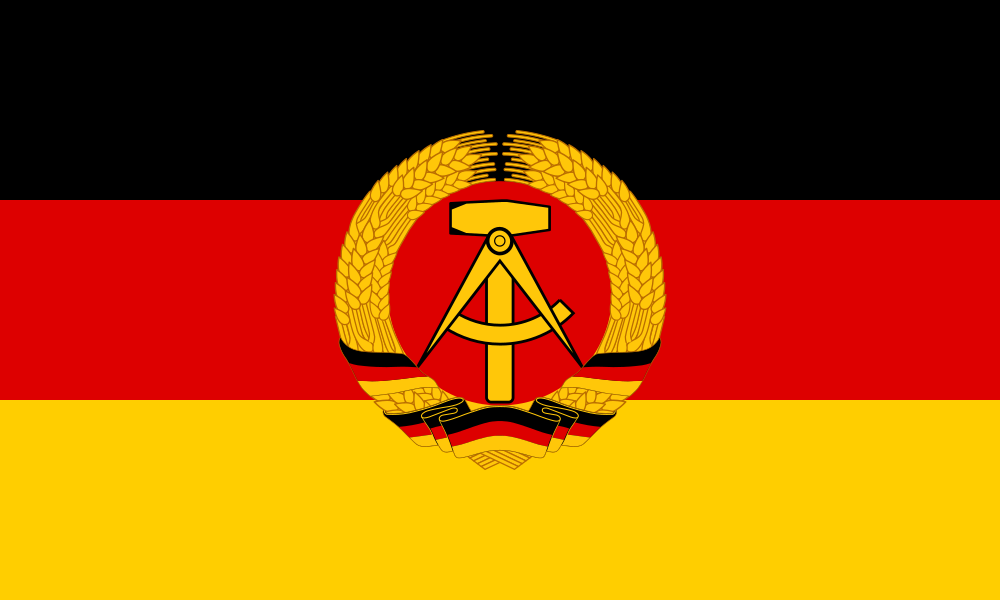
Mr. President) I should like to thank you for having given t!ne an opportunity to speak before this important organ of the United Nations. On behalf of my delegation, may I congratulate you, Mr. President, as the representative of a country with which the German Democratic Republic enjoys friendly relations, on your assumption of your important and responsible position.
58. My delegation has already had frequent opportunities to explain the position of the German Democratic Republic on the question of the admission of the Democratic Republic of Viet-Nam and the Republic of South Viet-Nam to membership in the United Nations. We are particularly gratified that the applications of these States are being reconsidered, pursuant to General Assembly resolution 3366 (XXX), adopted-by an overwhelming majority of States Members of the United Nations. This resolution confirmed the legitimate right of the Democratic Republic of Viet-Nam and the Republic of South Viet-Nam to become full Members of the United Nations’, and consequently requested the Security Council to ‘reconsider immediately and favourably the applications of those two States.
53. We know that members of the Security Council, without ideological distinctions, are ready to adopt a favourable decision on the admission of the Democratic Republic of Viet-Nam and the Republic of South Viet-Nam to the United Nations. The only obstacle which the Council might meet in carrying out its duty would be a new veto by the United States. If
60. The German Democratic Republic. and other States belonging to the socialist community have always stood squarely on the side of the Vietnamese people and have given them active and total support in their just struggle. It gave us great satisfaction and great joy to welcome the historic victory of the South Vietnamese patriots. That victory has opened before the entire population of South Viet-Nam the road to a bright future, peace, democracy and social progress. The significance of that victory far transcends national boundaries and is indeed an important contribution to the consolidation of peace and security in South-East Asia and in the entire world. This fact alone should give reason for all States which believe in peace in Asia and throughout the world to support.the immediate admission’of the Democratic Republic of Viet- Nam and the Republic,‘of South Viet-Nam to, membership in the United Nations., ” /
61. In, supporting the admission of both Vietnamese States to membership in the Organization we are advocating the implementation of the principles enshrined in the Charter of the’ United Nations in favour of improving and increasing the universality of the Organization and of the further strengthening of international peace and security in order to encourage an,d develop co-operation on a basis of equality between all States. The applications of the Governments of the ‘Democratic Rep&lid of VietiNam and the’ Republic of’ South Viet-‘Nam for admission to membership in the ,United Nations are in full conformity with the Charter. Both of those States pursue a policy of peace and have frequently expressed their readiness and ability to fulfil all the obligations involved in membership in the United Nations.
62. The result of the relevant discussions at “the thirtieth session of the Genera1 Assembly is striking proof of the fact that both Vietnamese States are morally, politically and juridically-entitled to become full Members of the Organization. For, those who so far have been impeding the membership of the two Vietnamese States, such a ,clear and unequivocal manifestation of sympathy for the people of Viet-Nam should give them cause ,to review their position. One cannot be in favour of peace and international detente and at the same time ignore resolutions adopted by the General Assembly.
63. In this connexion, the Minister for Foreign Affairs of the German Democratic Republic, Mr. Oskar Fischer, stated on 24 September this year, during the general debate in the Genera1 Assembly:
64. In the course of the general debate, representatives of a number of States at the thirtieth session of the Genera1 Assembly made it quite clear that the admission of the Democratic Republic of Viet-Nam and the Republic of South Viet-Nam to membership in the United Nations would serve both to consolidate peace and international security and to enhance the universality and authority of the Organization. We fully subscribe to that view.
65. In the past, and particularly in recent years, the process of international detente has made considerable headway. That was very clearly illustrated in the solemn signing ,at HeIsinki of the Final’ Act of the. Conference on Security and Co-operation in Europe, by the leaders of 33 European States, the United States and Canada. Thus in Europe, after a lengthy period of overt confrontation and cold war, a historic turning point has been reached. We are profoundly convinced that this process of detente should be extended to other areas of the world as well. The admission of the Democratic Republic of Viet-Nam and the Republic of South VietGNam to membership in the United Nations would also strengthen international security in South-East Asia and on the Asian continent, which would undoubtedly have a beneficial influence on other parts of the world.
66. I should like to reiterate that my delegation considers it absolutely inadmissible arbitrarily to connect with other matters the consideration of ap’plications received from the Democratic Republic of Viet-Nam and the Republic of South Viet-Nam to membership in the United Nations. Such stratagems are completely devoid of logic and in the final analysis are directed against the Charter of the United Nations, a point which has been made by previous speakers.
67, In the matter before us we ‘are not discussing the right of veto as such. The principle of the unanimity of the permanent members of the Security Council is a fundamental one for the Organization, corresponding as it does to the need for co-operation among States with differing social systems on the basis of the application of the principles of peaceful coexistence. Rather, .what we are talking about today is whether all States are observing the Charter and whether there are any abuses of the right pf veto.
68. The question is,. has not the Vietnamese people already suffered immeasurably because it has been treated in a way which violates the most elementary principles of international law? One of the conclusions that should be drawn from the tragic events of recent decades in Indo-China is that an end must finally be put to all efforts to create obstacles to both Vietnamese States’moving forward to broad international co-operation.
75. The entire third world was impressid and moved by the gesture made by the United States during the seventh special session of the General Assembly when, departing from its customary practice, it made, plain to the international community its desire for dialogue and co-operation and to that end offered concrete pioposals, thanks to which the proceedings of that session were brought to an outstandingly successful conclusion. In my delegation’s view; that gesture on the part of the United States marks a turning point in the history of international economic relations, and hence in international political relations as well. That is why Dahomey believes that the requested reconsideration’ by the Council of this question of the admission of the two Viet-Nams should fall within the framework of the new era which we have just mentioned., ‘, ’
69. ‘The beginning ‘of the thirtieth session of the General .Assembly has been a striking illustration of the new major changes which have occurred in the world. The activities of the United Nations should be in accordance with the public opinion which has emerged as a result of those changes. The admission of the Democratic Republic of Viet-Nam and the Republic of South Viet-Nam to membership in the United Nations is a moral, political and juridical requirement of our times. At the same time it is a requirement expressed by.the world community: We are convinced that, sooner or later, all Member States must meet these .dematids. For the sake of present and future generations, ‘it would be advisable to do so as soon as possible, here and now.
76. Moreover, one peed only refer to the statements’, made by the rep&entatives of the parties concerned. during the discussion of this matter in the General Assembly’ to be convinced that, if political ‘&iii can only be made to prevail over all other conqiderations, there is no reason why the Council cannot conclude its work successfully to the satisfaction of all parties concerned. .
70. On behalf of the Government of the German Democratic Republic, I would appeal io all members of the Security Council to approve the admission of the Democratic Republic of. Viet-Nam and of the Republic of South Viet-Nam to membership in the United Nations.
The next speaker iS the representative of Dahomey, whom.1 invite to take a place at the Council table and to make his statement.
77. During ‘the General ASsembly debate on this matiter on 19 Se’ptember, the observer for’ the Republic of South Viet-Nam provided a better illustration of the fact that the peoples of the third world, are capable not only of achieving victory btit also of benefiting from that ;vi&iry, when. he said:
72. Mr. ADJIBADl? (Dahbmey) (inferpretution from French): Mr. President, the delegation of Dahomey feels real satisfaction at seeing Mauritania, a sister country of Africa and of the third world, guiding the work of the Security Council this month, at a time when the Council has been requested to reconsider the important question of the admission of the two Viet-Nams to the United Nations. Being familiar with your personal qualities and talents, my delegatiqn is convinced that your perfect mastery of the question upon the Council’s agenda; and your tact and negotiating ability will be major assets ,that will help the Council in its deliberations and enable it ‘not to dis-
“The Re$ublic of South Viet-Nam has always’ pursued a foreign policy of peace and non-alignment. It is always willing to establish with all countries, without any distinction as to political or social rkgime, relations of friendship based on mutual respect for independence and sovereignty and reciprocal non-intervention in the internal affairs of either side.
“With respect to the United States, in spite of the neo-colonial war wtich that country waged
78. For his part, the Observer for the Democratic Republic of Viet-Nam on the same day stated:
“We are establishing and expanding normal economic, cultural, scientific and technological relations .with all the other countries on the basis of the principles of mutual respect for independence and sovereignty, non-interference in internal affairs, equality and mutual advantage. In that spirit, the Democratic Republic of Viet-Nam is prepared to establish normal relations with the United States on the basis of the Paris Agreements. There can be no doubt that the majority of the American people .and broad segments of political circles in the United States will support that positive trend”.’
79. Knowing as we do the catastrophes the peoples of both Viet-Nams suffered in the war, we can only welcome the conciliatory attitude shown by their delegations towards the country that bears the heaviest responsibility for the wars which were neither wished nor hoped for by the Vietnamese people. Members of the ,Security Council must be mindful of’ these facts and call upon the United States not to refuse to shake the hands ‘that have been stretched out to it.
80. Dahomey might have detected a favourable response to the appeals of the Vietnamese peoples in the ‘statement of the representative of the United States that “the United States is not opposed to the admission of the two Vietnamese ,States,“’ were it not for the following “but”, which actually is the very crux of the problem.
81. The admission of the two Viet-Nams must be viewed in the light of the conditions laid down in the Charter, and also bearing in mind that they form a divided country. Both Viet-Nams have met the provisions of Article 4, paragraph 1, of the Charter. In the case of the admission of divided States, the only example which we have is that of the two Germanys. For them to be admitted to membership, the request for the admission of the two Germanys had to be based on the consent, the joint agreement of both parties. All those conditions which accompanied the precedent that we have in such a matter are, amply met here. Therefore, objectively speaking, nothing should stand in the way of a favourable decision being taken by this body.
82. However, the United States has its own views on the question, views which we respect and which
83. Secondly, the United States warned the world public at a certain time to protect itself from the socalled tyranny of the majority. If the United States maintained its original position now in the Security Council, it would be tantamount to imposing on practically all the States Members of the United Nations the tyranny of the veto. There is no good tyranny. Any form of tyranny must be avoided. Hence, although the Charter gives it this right, the United States Government must avoid the abuse of the veto which in the case of most Member States could simply cause frustration.
84. Thirdly, to attempt to link the admission of Korea with the admission of the two Viet-Nams recalls actions of the cold war worthy of the 1960’s, and such practices are no longer in accordance with the realities of 1975.
85. Fourthly, to block once again the admission of the two Viet-Nams might be construed as indicating resentment on the part of the United States Government against the Vietnamese people. We believe that the United States is not anxious to expose itself to such facile criticism.
86. It is for all these reasons that my delegation reiterates its appeal to the delegation of the United States and asks it to support the admission of the two Viet-Nams, thus displaying that magnanimity which is worthy of the drafters of the Constitution of the United States. My delegation also reiterates its appeal to the other members of the Council to vote unreservedly in favour of the admission of the two Viet- Nams, in accordance with the wish of almost all the members of the General Assembly.


Costa Rica hopes that all independent States of the world will become Members of the United Nations. Our adherence to the ideal of universality within the Organization allows for no exceptions other than those set out in the Charter relating to the exclusion of Governments which persistently violate its principles. Therefore, my delegation voted in favour of General Assembly resolution 3366 (XXX) requesting the Security Council to reconsider the applications of the two Vietnamese States for admission to membership.
89. While South Viet-Nam had a different system of government from that in North Viet-Nam, the North Vietnamese and their supporters opposed the entry of the two States because they argued that that would perpetuate the division of the Vietnamese people. But now that the Government in the south has the same ideological orientation as that in the north, the two States and their supporters have forgotten the argument about perpetuating the division and are fervently requesting the admission of the two pro-communist States to the United Nations,
90. Although my delegation points out this inconsistency, we favour now, as we did before, the admission of the two Vietnamese States to membership in the United Nations. We do so because we do not apply the principle of universality selectively. As true partisans of that principle, we do not link the admission of a new Member to its having the same ideology or the same political system as we have in Costa Rica.
91. For that very reason we favoured and shall continue to favour the admission of the two States into which Korea has been divided. We know that North Korea uses and has used the same argument which was earlier used by North Viet-Nam to oppose the simultaneous admission of the two Korean States, that it would perpetuate the division. However, the fact that North Korea does not yet wish to enter the United Nations is not a good reason to prevent the entry of South Korea. The attitude of the .members of the Security Council that prevented the inclusion of the request for membership of the Republic of Korea in the agenda constitutes a discriminatory act and runs counter to the principle of universality. Consequently, Costa Rica expressed its disagreement with that attitude by abstaining in the vote-a position which we do not feel it is necessary to repeat.
93. In Costa Rica we note with alarm the trend towards the application of the principle of political pluralism to assist and accept States that tend to totalitarian socialism, while it is not applied in regard to States which, with disrespect, are tailed appendages of capitalist imperialism. I believe that, particularly with regard to many countries in the third world, this situation originates in .a confusion of concepts which should be clarified.
94. The solidarity of countries of the third world -of which Costa Rica is an active partner-is indispensable to us. Only by means of that solidarity shall we be able to pursue the struggle which has already successfully begun to establish a new international economic order. But this struggle does not in any way whatsoever require the rejection of and-even less-attacks on the political system of representative democracy that prevails in the most’ developed countries of Europe, the Americas and Asia.
95. Freedom and democracy are not incompatible with economic development and social justice. Nor would their existence in each of the countries of the third world in any way ‘hamper the union of efforts needed to achieve a more just international economic order. For those of us who believe in representative democracy, the only legitimate source. of power for the State is the people’s will, periodically expressed in free elections. However, we do respect the principle of international political pluralism, and this means that we have never tried to impose our democratic view of things on the legitimate origin of any Government. We have not done this here nor have we done it in our direct relations with other States. On the same basis, we believe that those who do not practise ideological and political piuialism internally -although they proclaim the need for it for peaceful international coexistence-should not attempt to impose their systems upon us. They should not attempt to adjust the principle of universality to their own anti-democratic political views; even less should they attempt using those criteria’ to pass any judgement on the legitimacy of Governments represented in the United Nations.
I should like to inform the Council that I have received letters from the representatives of Bulgaria, Cambodia, Mongolia and Madagascar requesting that they be invited, under Article 31 of the Charter, to participate in the Council’s debate on the item ,.on its agenda without the right to.vote. If there are no objections, and in conformity with the Council’s ,practice and rule 37 of the provisional rules of procedure, I propose to invite those representatives to take the. places reserved for them at the side of‘the Council chamber. They will be invited to take places ‘at the Council table when their turn comes to address the Council.
At the invitation of the President, Mr. +win’Chhuk (Cumhodiu), Mr. Ruhetufiku ~(Muduguscur) and Mr. Puntsugnorov (Mongolia) took the places reserved from them at the side o;f the Council chamber.


Mr. President, I could not hope in my remarks to equal the intellectual vigour or the authority with which the Minister of External Relations of Costa Rica has just spoken. I would only hope it.be understood that .I wholly endorse what he said. This de’rives from an understanding of the nature of democratic societies which, I think, is shared by some members ,of the Council and about which we do not have to consult with one another in advance in order to know that we agree on fundamental principles. We have heard them from a man of authority and conviction and, if little else was to be hoped for from this meeting of the Security, Council, that at least has been gained. Nor need I recapitulate the statement I made to the Council on 11 August [18.36th meeting]. I only wish to assure the members that there has been no change in my Government’s basic position on the applications before us.
99. In 1948 the United States sought a ruling from the International Court of Justice on the propriety of “linkage” of applications for membership in the United Nations. The reply of the Court* made it clear that “package deals”-as they were termed-are not in order. Each application”should be considered on its merits, on the basis of established criteria. In our view the Republic of Korea fully meets these criteria. Justice and procedure-procedure perhaps being the more important of those matters-require Ithat this
100. We are, of course, prepared to see North Korea enter the .United Nations along ‘with the Republic of Korea: Equally, it is North -Korea’s privilege to stay outside the United Nations community if it does not wish to assume the obligations of membership at this time. However, the one third of the Korean people living in North Korea have no right to stand in ,the way of the desires of the two thirds of the Korean people who live in the Republic of Korea to assume the privileges and the duties and the .responsibilities of United Nations membership; Niether, in’our view, is the Security Council entitled, authorized or wise in linking those two matters in the face of the judgement of the Court and, indeed, of our recent well-established practice.
101. The principle of universality is, not divisible. My delegation is not prepared to see it flouted in the case of the Republic of Korea only to be hailed in the case of the Viet-Nams. It is not my Government’s desire in any way to stand in the way of admission of the Democratic Republic of Viet-Nam and the Republic of South Viet Nam,, but my Government ‘will continue to support in every feasible way the desire of the Republic.of Korea to participate as asMember in the United Nations.
102. The General Assembly has on four separate occasions found the Republic of Korea qualified for United Nations membership. At the ,request of the Assembly{ the Security Council has repeatedly considered the application of the Republic of Korea, but its admission has been prevented by repeated,vetoes. Now, with the Security Council about to reconsider, after a parallel finding and request from the Assembly, the applications of .the two Vietnamese Republics, my Government must insist. that all three applicants be treated equally. If this necessitates a second ,veto of the applications of the two Viet-Nams; my Government, though with regret, can only act accordingly.’
103. ‘Allow me, Mr. ‘President, to emphasize one more point. We believe that the ,goal of unification can best be sought through the framework of the United Nations. We find it hard to follow the argument that to assume the responsibility of membership in the United Nations would somehow diminish the prospect for peaceful reunification. On the,contrary, it should enhance that prospect.
104. Finally, let me simply refer to the thought which I left with the General Assembly in my comments on the occasion on which the resolution before us was adopted. It may have come to pass that the United Nations is made up principally of one-party States, but it cannot come to pass that we shall have a oneparty United Nations. I accept, Mr. President, that there may be members of the Council that do not
I invite the representative of Hungary to take a place at the Council table and to make his statement.


May I thank you, Mr. President, and the members of the Council for giving the opportunity to my delegation to participate in the discussions of the Security Council on this important question of the admission of the Democratic Republic of Viet-Nam and the Republic of South Viet-Nam to membership in the United Nations. It is a matter. of great satisfaction to me and to my delegation that you, Sir, are presiding over these deliberations and discussions in which a great issue is at stake. I.regret to note, at the outset, that from the position of the United States which we have just .heard from Mr. Moynihan we can foresee the probable outcome of this discussion.
107. We. have had the privilege of expressing our viewpoint on the question of the admission of the two Vietnamese States here’ in the Security Council at its 1836th meeting on 11 August 1975, and in the General Assembly on 19 September of this year.’ The reasons why the Hungarian delegation requested to speak again at this time are well known to all members of the Council. I feel bound, however, to state once again before this august body, the highest organ of the United Nations, that the Government and the people of the Hungarian People’s Republic firmly support and urge the immediate admission of the Democratic Republic of Viet-Nam and the Republic of. South Viet-Nam to the United .Nations.
108. We welcome whole-heartedly the convening of the Security Council to reconsider its decision on the question of the admission of the two Vietnamese States on the basis of General Assembly resolution 3366 (XXX), adopted with the support of the overwhelming.majority of the Member States and with no vote against it. The Hungarian People’s Republic is
1 ..’ ,, 13’ ‘.’
109. The General Assembly resolution met the wish and the expectation of all those who want to see the spirit and the letter of the Charter implemented, and justice done to the two States, the heroic people of which fought for three decades to be able to live in peace and independence. Not only does the request for admission of the two Vietnamese States deserve the support of all of us here, but, I would add, the prestige of the United Nations could only be strengthened by the admission of those two States.
110. We know very well the negative effects of such tactics which until now have prevented the admission of the Democratic Republic of Viet-Nam and the Republic of South Viet-Nam. The past history and the political roots of those tactics were correctly recalled by the representative of the Soviet Union, Mr. Malik, in the General Assembly on 1.9 September. .*
111. Today we .look forward to the decision of the Security Council in the conviction that, history and progress cannot be halted and that justice will always prevail, as is reflected in the annals of the Organization. We firmly believe that the members of the Security Council should make their decision on the admission of the two Vietnamese States in full awareness of their great responsibility, as the resolution to be adopted should be in strict conformity with the relevant provisions of the Charter of the United Nations.
The meeting rose at 5.50 pm:
Notes
Plenary Meetings,- 2360th meeting. ’ Ibid.. Plenary Meetings, 2354th meeting.
._(. ,, ,
HOW TO OBTAIN UNITED NATIONS PUBLICATIONS
United Nations publications may be obtained from bookstores and distributors throughout the world. Consult your bookstore or write to: United Nations, Sales Section, New York or Geneva.
COMMENT SE PROCURER LES PUBLICATIONS DES NATIONS UNIES
Les publications des Nations Unies sont en vente dam les librairies et les agences dtpositaires du monde entier. Informez-vous aupres de votre libraire ou adrefsez-vous a : Nations Unies. Section
‘. des ventes, New York ou Get&e.
COMO CONSEGUlR PUBLICACIONES DE LAS NACIONES UNIDAS
Las publicaciones de las Naciones Unidas estan en venta en librerias y casas distribuidoras en todas partes &I mundo. Cons&e a su librero o dirijase a: Naciones Unidas, Section de Ventas, Nueva York o Ginebra.
Litho in United Nations, New York 00300 82-61202-November 1983-2.200
▶ Cite this page
UN Project. “S/PV.1842.” UN Project, https://un-project.org/meeting/S-PV-1842/. Accessed .