S/PV.2016 Security Council
▶ This meeting at a glance
4
Speeches
2
Countries
0
Resolutions
Topics
Southern Africa and apartheid
Security Council deliberations
War and military aggression
Global economic relations
Foreign ministers' statements
Law of the sea

The next speaker is the Minister for Higher Education and Scientific Research of Algeria. I welcome him and invite him to take a place at the Council table and to make his statement.


Mr, President, I have not been away from this Organization long enough to have forgotten its customs and traditions. I should therefore like, with your leave, to begin by addressing to you my congratulations and those of my delegation on the effective manner in which you are conducting this debate, one which is marked by a sense of gravity and urgency and which is being followed with the keenest interest by the entire African continent. I should like also to thank the Council for having so promptly acceded to the request of Mozambique and for having allowed the African delegations, in accordance with the mandate they received from the Council of Ministers of the Organization of African Unity, to participate in this discussion and to make known the concerns and the aspirations of their continent. By way of striking a personal note in my statement, I should like, lastly, to express to all the members of the Council and to you, Mr. President, my feelings of gratitude and friendship, a friendship which was born and has grown in strength as a result of our long years of working together in this great Organization.
26. The aggression-or, rather, the many acts of aggression-committed by Rhodesia against Mozambique is motivated by two reasons, first, that Mozambique does not wish to have any relations with Rhodesia and, secondly, that it is giving to the Zimbabwe liberation movement. assistance which is profoundly displeasing to the racists at Salisbury. That aggression is in fact being directed by an illegal government not recognized by the United Nations and the subject of the economic sanctions imposed by the Security Council against a State Member of the Organization which only seeks to abide by those decisions and other resolutions of the United Nations. Thus it is apparent that the only reason Mozambique is exposed to the repeated acts of aggression on the part of Rhodesia is because the former is implementing the decisions of the Organization.
27. The complaint of the People’s Republic of Mozambique is therefore one which puts to the test the authority of the Security Council, whose mission of maintaining peace in the world would not be credible without the foundation of authority and respect given it by the common adherence to its decisions of the permanent members. Our purpose in coming before the Council today is to convey to members our anxiety, to give them some idea of the degree of our impatience, but at the same time to gain assurance of their desire and willingness to command respect for all the principles on which we all, both great and small, have agreed to base international relations.
23. The events which led to the convening of the Council have already been discussed in detail by previous speakers, particularly by our friend Marcelino dos Santos, Vice- President of the People’s Republic of Mozambique [2014th meeting/. I do not wish to prolong this statement needlessly by repeating what has already been said, but I should like in turn to emphasize the gravity of the aggression which has been perpetrated by the illegal rCgime of Rhodesia against Mozambique, not only because of the extent of the damage and the number of the victims it created but, above all, because of the fact that we are concerned here with repeated acts of aggression which may well recur in future, This situation represents a permanent threat to the security and independence of Mozambique, a country which, it must be recalled, succeeded in winning its freedom scarcely two years ago after a long struggle for national liberation.
28. In this discussion today of the aggression against Mozambique, the Council has been induced once again to reopen the file on the Rhodesian problem, because it is the very persistence and the worsening of this problem which have led and undoubtedly will continue to lead to ever-growing tension throughout that region. This situation has been going on for 12 years now, that is, since independence was unilaterally declared by Ian Smith’s racist group. For 12 years the Zimbabwe Africans have been struggling to free themselves from a domination which deprives them of their freedom, their property and their dignity. For 12 years efforts have been made to convince
24. The dangers which Mozambique must face undoubtedly stem from its geographical location which leaves it exposed almost without any defence to the attacks of the racist rCgimes of Rhodesia and South Africa, It is that same geographical location which explains the difficulties which Mozambique has freely undertaken to bear in complying
29. Of course, we are not fanatically bent on violence; we are as devoted as anyone to developing understanding among peoples and preserving peace in the world. But violence has been and remains the last resort of peoples who are persistently deprived of their most elementary rights. It is deprivation of that sort which the people of Zimbabwe have had to encounter for the last 12 years. Who can blame them, then, for seeking to show in their turn that they are capable of dying for their freedom?
30. But this situation in Rhodesia is itself closely linked with that which prevails throughout southern Africa, We have already had occasion to emphasize here and elsewhere the obvious connexions existing between the problem of Rhodesia, that of Namibia and the apartheid regime in South Africa. The political and economic aspects of those problems derive from the same anxiety of the white minorities in those areas to preserve their power in order to maintain their economic privileges. It is not surprising, therefore, that an analysis of each of those problems will ultimately reveal the same actors, the same interests and the same difficulties. It might appear sensible to try to resolve them separately by concentrating efforts on a more limited range of issues. We wish to express our scepticism about the effectiveness of such a method, which could not eliminate the reciprocal effects exerted on each other by these problems which ultimately call for a more global approach.
31. The aggression of Rhodesia against Mozambique is a direct result of the deteriorating situation throughout southern Africa, not only in Zimbabwe-which has now been drawn into the vicious cycle of violence and repression-but also in Namibia, where prospects appear to be more and more disquieting, and, finally, in South Africa itself, where the Soweto massacres are the harbingers of a tragedy of all too easily foreseeable scope. The concern evinced by the OAU Council ,of Ministers is therefore entirely justified. The delegations of Algeria, Gabon, Lesotho, Nigeria and the United Republic of Tanzania have been instructed to make that concern known to the Security Council in view of the deterioration in a situation which may at any moment get completely out of control and plunge the African continent into an era of violence and chaos from which it is desperately trying to protect itself:
32. We are here to proclaim our solidarity and that of all African countries with the People’s Republic of Mozambique, to assure that country of our total and unflagging
33. Mr. AL GAYED [Libyan Arab Jamahiriya): Sir, I should like first to congratulate you on your assumption of the presidency of the Council. My delegation has had ample opportunity to witness at first hand your skill and wisdom as a diplomat and as a representative of your country, and we are confident that with these abilities you will be able successfully to guide the affairs of the Council this month,
34. May I, on behalf of the delegation of the Socialist People’s Libyan Arab Jamafliriya, also take this opportunity to commen,d your predecessor in this high post, Ambassador Boya of the People’s Republic of Benin. He presided over and skilfully and successfully guided the Security Council last month through a number of debates on some very important issues.
35. I should also like to take this occasion to express the honour felt by my delegation at the presence here in this chamber of the Vice-President of FRELIMO and Minister for Development and Economic Planning of the People’s Republic of Mozambique, as well as that of the Ministers mandated by the Council of Ministers of the Organization of African Unity to assist in this important Council debate.
36. Since the collapse of Portuguese colonialism in Africa a few years ago and the attainment of independence by the people of Mozambique, the eventual fate and downfall of the illegal and racist rCgime at Salisbury has been clear to all. The illegal Ian Smith rCgime depends on the support and assistance of colonialist and imperialist forces for its very survival, and has become frantic in its efforts to maintain itself in power against the force of history and the wiIl of the people of Zimbabwe and of Africa as a whole. The racist Ian Smith rBgime is finally coming to the realization that its own collapse and the termination of its oppression of the indigenous African people of Zimbabwe is more imminent than it had expected.
37. These acts of aggression against sovereign States and the increase in the oppression of the indigenous Zimbabwe people are the desperate acts of a rCgime that has seen its fate and eventual collapse. The steadfast opposition of all African countries and of other peace-loving countries to the continued existence of that illegal racist regime will soon triumph over the forces of racism and imperialism. The international community must confront and put an end to these desperate acts of oppression and aggression perpetrated by the Ian Smith rCgime in its final throes against not only the Zimbabwe people but also sovereign African States.
38. It is an undeniable fact that the inalienable rights of peoples, including the right to self-determination and independence, have been achieved mostly through armed
“The criminal and irresponsible rtgime of Ian Smith has launched a war of aggression against the People’s Republic of Mozambique. Less than 18 months after signing the Peace Agreement with Portugal, the Mozambican people are once again forced to confront the desperate acts of aggression of a colonial Fascist.” [See S/12005,
aiimx./
39. On 3 March 1976, the People’s Republic of Mozambique took the important and courageous decision to comply with and fully implement the United Nations sanctions against the illegal minority rCgime. The courageous decision of the Government of Mozambique to close its borders with Southern Rhodesia in lillfilment of its international obligations deserves the commendation and support of the Council. It should moreover be noted that the courageous decision of the People’s Republic of Mozambique to implement fully the resolutions of both the Council and the General Assembly in regard to the application of sanctions against the illegal Smith regime has not only exposed Mozambique to repeated murderous acts of aggression at the hands of the illegal Smith rCgime but also subjected it to continued economic and other sacrifices. This aggressive threat is evident from the statentent President Machel made as recently as 18 June 1977, when he declared:
43. The people of Zimbabwe have waited more than 11 years for justice and for the attainment of freedom and self-determination. In those long years, the Zimbabwe people have endured racism and numerous acts of murder, violence and oppression. The time has come when only a fundamental solution can meet the just demands of the people of Zimbabwe, Only such a solution and such concrete measures can deal with the deterioration of the situation resulting from the acts of aggression, murder and violence committed by the Smith r6gime against African States Members of the United Nations. In this context, it should be noted that the Council of Ministers of the Organization of African Unity, at its current session being held at Libreville, Gabon, has passed a resolution which in its paragraph I strongly condemns Rhodesia’s naked war of aggression against Mozambique backed by artillery and aircraft and the subsequent massacre of hundreds of innocent civilianslsee S/12352/.
“Between May 1976 and 15 June 197’7, 1,431 civilians were murdered, of whom 875 were refugees from Zimbabwe in Nyazonia, and 527 were wounded. Dozens of small towns and villages where peaceful populations lived and were endeavouring diligently and enthusiastically to rebuild their country, were completely destroyed. Today Massangena, Mapai, Mavonde and Chioco are the mere charred remains of what were dwellings, schools. hospitals, people’s shops, utilities and factories. This damage has constituted a loss to our people amounting to ntore than 400 million escudos.”
44. Steps must be taken to extend support and economic and material assistance to the People’s Republic of Mozambique to enable it to strengthen its defence capabilities, to safeguard its sovereignty and territorial integrity, and to protect its people against the frequent and wanton acts of murder, pillage and violence that they have suffered at the hands of the racist rkgime at Salisbury. The People’s Republic of Mozambique must also be assisted to enable its people to overcome the tremendous material loss incurred as a result of the aggression and devastation committed by the illegal racist minority rkgimc.
In the same speech, President Machel stated that the Mozambican people were in urgent need of material aid if they were to bc able to endure the heavy consequences of those acts of aggression, murder and pillage, and hc appealed to the whole international community to contribute to increasing Mozambique’s defence capacity and to the reconstruction of the areas devastated by the racists.
40. The issues before the Council are clear and straightforward: a sovereign State Member of the United Nations and member of the Organization of African Unity has been subjected to flagrant acts of aggression at the hands of the
45: Furthermore, the Council cannot continue to remain indifferent to the continued defiance of the regime at
41. Over the past 11 years, the Council has adopted numerous resolutions in regard to the situation in Southern Rhodesia. From the very beginning, since the so-called unilateral declaration of independence, the Council has condemned the illegal racist r&me at Salisbury and deplored the deterioration of the peace and security of Africa as a result of the establishment and continued existence of that illegal rCgime. The Council has, moreover, called upon the United Kingdom to quell the rebellion of the racist minority in Southern Rhodesia and to take all other effective measures to eliminate that usurper rbgime. Despite those resolutions, the illegal regime at Salisbury continues to defy the will of the international community. In fact, the Smith rCgime is well aware that those resolutions will not affect its continued existence and its exploitation of the Zimbabwe people so long as certain States continue to have a vested interest in not fully implementing those mandatory sanctions.
42. At this stage in the deterioration of the situation in Southern Rhodesia and in southern Africa as a whole and in view of the atrocious acts of violence, murder and aggression perpetrated by the racist minority regime in its death throes, the Council can no longer delay the adoption and implementation of those concrete measures that will put an end to the domination and exploitation of the Zimbabwe people by a racist illegal rkgime.
46. The Socialist People’s Libyan Arab Jamahiriya considers that the racist rggimes that dominate and exploit the African peoples of South Africa, Southern Rhodesia and Namibia are the enemies of all Africa. Those who aid and support those racist rCgimes must realize that they thereby share the responsibility for the threat to the peace, security and progress of all Africa; they must be made aware and accept the consequences of taking that hostile and unfriendly attitude towards Africa.
47. My delegation takes this occasion to express the support and solidarity of the Socialist People’s Libyan Arab Jamahiriya with the People’s Republic of Mozambique in their just and heroic struggle against the racist and aggressive forces in Southern Rhodesia.
The next speaker is the representative of the German Democratic Republic. I invite him to take a place at the Council table and to make his statement.

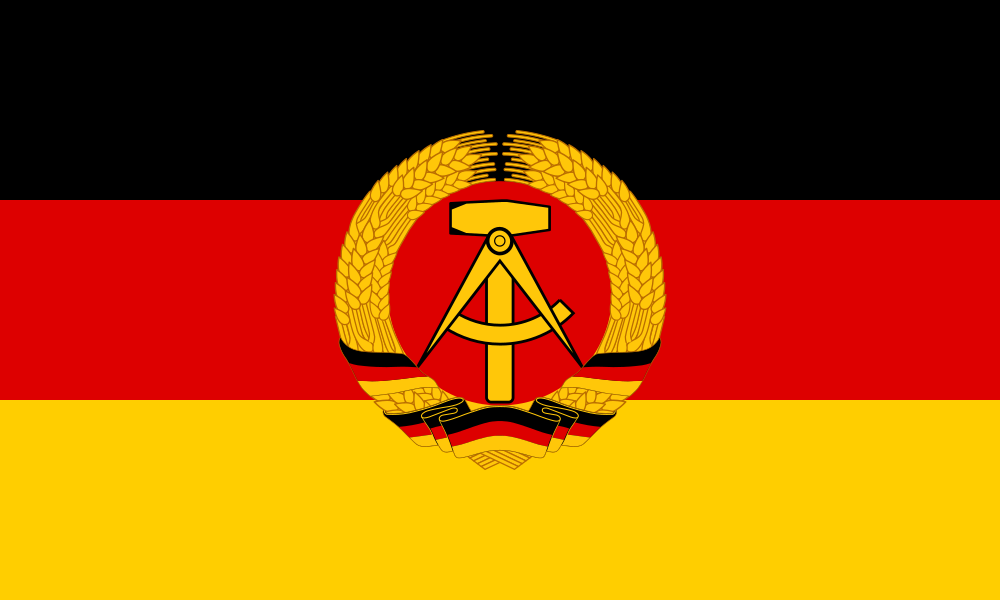
First of all, I should like to congratulate you, Sir, on your assumption of the office of President of the Security Council for the month of June. In you, I welcome the representative of a State with which the German Democratic Republic recently established diplomatic relations which we hope will promote the development of comprehensive relationships between our two countries to our mutual advantage. I should also like to express the hope that the discussion of the serious question on our agenda will, under your presidency, culminate in success.
50. On behalf of the delegation of the German Democratic Republic, I should like to thank you and the members of the Council for giving us the opportunity to speak here today.
51. The principles underlying the foreign policy of the German Democratic Republic, a socialist State which has always been in favour of peace and security and which has always shown unlimited solidarity with those who are victims of aggression, prompt my delegation to address the Council in connexion with the complaint of the People’s Republic of Mozambique.
52. It is a particular honour for me to have this opportunity warmly to welcome the delegation of the People’s Republic of Mozambique, whose people, after many years of struggle, have won their right to self-determination and are now building their future as a sovereign and independent State.
54. The people and Government of the German Democratic Republic firmly condemn the crimes of the racist rigime at Salisbury, this official colony of the United Kingdom, against the people of Mozambique, and demand that an immediate and unconditional halt be put to all acts of aggression directed against the People’s Republic of Mozambique and other neighbouring States.
55. Under the guidance of FRELIMO, the People’s Republic of Mozambique has fully complied with United Nations decisions concerning support for the freedom struggle of the people of Zimbabwe, despite the economic Iosses that may be incurred thereby. It has thus provided an example of consistent anti-colonialist and anti-racist action. For that reason, the people and Government of the People’s Republic of Mozambique have won the deep gratitude of world public opinion.
56. On behalf of the Government of the German Democratic Republic, I should like once again to assure the representatives of the friendly P.eople’s Republic of Mozambique of our profound solidarity with Mozambique’s decisive struggle.
57. The United Nations is aware of the danger which the present overlords of the colony of Southern Rhodesia pose to peace and security in southern Africa, Evidence of that is to be found in the large number of resolutions on the subject which have been adopted by the competent bodies of the Organization. These resolutions condemn the white minority rigime and confirm the right of the oppressed Zimbabwe people to struggle by all means in their power for their freedom and for the enjoyment of their right to self-determination. In conformity with the decisions taken by the Security Council, all States are called upon to apply sanctions against Southern Rhodesia and give assistance to the militant people of Zimbabwe in their just struggle.
58. The Smith rCgime, however, has been reluctant to fulfil the just demands of the international Organization. On the contrary, the present leaders at Salisbury reply to the growing struggle and resistance of the people of Zimbabwe-which sees in the free young African States a magnificent example to follow-with terror within the country and aggression against other countries. The underhanded attacks by the hirelings of the illegal racist rdgime on the territories of independent African States only increase the threat which that regime poses to peace and security. The continuing acts of aggression-which, indeed, are not denied by those responsible For them but, rather, are declared by them publicly to be an integral part of their policy-are fraught with the danger of the outbreak of a general war in southern Africa.
60. Unfortunately, however, powerful forces, those of international monopolistic capital, are operating in an attempt to prevent any suc11 radical change from taking place. Their concern is with raw materials, profits, the exploitation of a cheap labour force. That is one of the explanations for the Security Council’s inability so far to take the necessary effective and energetic steps. Indeed, even the unsatisfactory steps that have been taken have not been implemented by a number of States. Instead of the general isolation of the racist regimes, instead of efforts to weaken those regimes and give all assistance to the national liberation movements, what we see are diplomatic manoeuvres which only help to maintain the spheres of influence of international monopolies and their accomplices in southern Africa.
65. The delegation of the German Democratic Republic has frequently also favoured the adoption of the steps provided for in Chapter VI1 of the Charter against those guilty of breaches of the peace. Today, my delegation again favours this approach, A decision should be taken to impose a general embargo on the supply of weapons to the Republic of South Africa in order to prevent the racist r6gimes from increasing their military strength. On the other hand, the People’s Republic of Mozambique and other threatened African States should be provided with every opportunity to enhance their defence potential so that tbcy can effectively exercise their right to self-defence, as provided for in the Charter,
66. The delegation of the German Democratic Republic would venture to hope that, by its decisions, the Security Council will contribute to the extension of every sort of assistance to the threatened States in southern Africa, to a removal of the threat to peace and security and to the achievement of a radical change in the situation in that area by forcing the racist regimes to implement the resolutions adopted by the international Organization. Undoubtedly, for the achievement of those ends, unflagging assistance will be necessary for those militant peoples still struggling and forced to live under the yoke of racist regimes.
61. The frenzied activity of diplomats of certain States goes to show that the movement of the peoples in that region of the world cannot be halted. Those States wish to set this movement on a certain course. At the same time, they are trying to exert pressure on certain bodies of the United Nations.
62. If the African peoples are extremely mistrustful of the diplomatic d&marches which overlook the decisions of the General Assembly or even conflict with those decisions, that is quite understandable. As is known, the colonial Powers at one time used every means in their power to take action against the national liberation movements, in order to maintain their colonial domination. But, in the case of the rebel regime of Ian Smith, they have been extremely delicate in their actions.
67. I conclude this statement by quoting the words of Mr. Erich Honecker, General Secretary of the Central Committee of the Socialist Unity Party of Germany and Chairman of the Council of State of the German Democratic Republic, pronounced at the World Conference against Apartheid, Racism and Colonialism in Southern Africa, held recently at Lisbon. He said:
63. I would remind the members of a resolution adopted in 1968 by the Security Council. I refer to resolution 253 (1968). In paragraph 2, the Security Council
“The German Democratic Republic has always actively supported the struggle of peoples against racist regimes, against the odious system of apartheid and neocolonialist conspiracies. It has always favoured implementation of Unite’d Nations decisions on the abolition of racism and colonialism, and will continue to give those peoples active solidarity.”
“CalZs upon the United Kingdom as the administering Power in the discharge of its responsibility to take urgently all effective measures to bring to an end the rebellion in Southern Rhodesia, and enable the people to secure the enjoyment of their rights as set forth in the Charter of the United Nations and in conformity with the objectives of General Assembly resolution 15 14 (XV)“.
What has been done-or, rather, what has not been done-in implementation of that paragraph is only too well known.
The meeting rose at 12.05 p. m.
HOW TO OBTAIN UNITED NATIONS PUBLICATIONS
United Nations publications may be obtained from bookstores and distributors throughout the world. Consult your bookstore or write to: United Nations, Sales Section, New York or Geneva.
COMMENT SE PROCURER LES PUBLICATIONS DES NATIONS UNIES
Les publications des Nations Unies sent en vents dans les librairies et les agences depositaires du mondc entier. Informez-vous aupr&s de votre libraire ou adresses-vous a : Nations Unies, Section des ventes, New York ou GenBve.
KAK HOJIYUHTb HBAAHIIR OPI’AHH 3A~HH OB’bEAUHEHHbIX HALUSH
H3~nHtiB Opraauoamiw Ob’beAwweriabrx HaunR MO~~KHO xyna~h a xaanoi~tx mara- 3WHBX H areHTCTBS,X Bo Bcex pai?OHaX Mapa. HaBOAHTe cnpaBKH 06 HSA&HHHX B Bsmet.4 KHWXHOM M*T-B~UH~ HOW nmuwe no a~pecy: Opranxsanria 06’be~mieanbrx Hat@, Cexqaa no IIPOAGWS no~atiaR, HLKI-F~OPK HJIU Xerieaa.
COMO CONSEGUIR PUBLICACIONES DE LAS NACIONES UNIDAS
Las publicaciones de las Naciones Unidas estin en venta en librerfas y casas distribuidoras en to&s partes de1 mundo. Consulte a su librero o dirfjase a: Naciones Unidas, Secci6n de Ventas, Nueva York o Ginebra.
Litho in United Nations, New York Price: $U.S. 1.00 (or equivalent in other currencies) 77-700ol-April 1978-2,288
▶ Cite this page
UN Project. “S/PV.2016.” UN Project, https://un-project.org/meeting/S-PV-2016/. Accessed .