S/PV.2270 Security Council
▶ This meeting at a glance
10
Speeches
3
Countries
0
Resolutions
Topics
Southern Africa and apartheid
Security Council deliberations
UN procedural rules
War and military aggression
Global economic relations
Arab political groupings

I should like to inform members of the Council that I have received a letter from the representative of Brazil, in which he requests to be invited to participate in the discussion of the item on the Council’s agenda. In accordance with the usual practice, I propose, with the consent of the Council. to invite him to participate in the discussion, without the right to vote, in accordance with the relevant provisions of the Charter and rule 37 of the Council’s provisional rules of procedure.
Provlslonal agenda tS/Agenda/22lO)
I. Adoption of the agenda
2. The situation in Namibia: Letter dated IO April 1981 from the Permanent Representative of Uganda to the United Nations addressed to the President of the Security Council (S/14434)
The nwcting IIY~~ culkd to order ut I I .45 u.nt,
Adoption of the a@nda
The ugendu wus adopted.
The situation in Namibia: Letter dated 10 April 1981 from the Pemmaaent Representative of Uganda to the United Natiom i3ddressedtotbePmidentoftheSecurity~ (S/14a4
I. The PRESIDENT: In accordance with the decisions taken at previous meetings 12267th to 2269th
mmvingsj. I invite the representatives of Algeria, Angola, Benin, Canada, Cuba, Ethiopia, the Federal Republic of Germany. Guinea. India. Indonesia, Jamaica, Kenya, Mozambique. Nigeria. Romania, Senegal, Sierra Leone. South Africa, Sri Lanka. Togo, the United Republic of Tanzania, Yugoslavia. Zaire, Zambia and Zimbabwe to participate in the discussion without the right to vote.
At the iwitution of the President. Mr. Corr?a da
Costu (Brazil) took the place reserved for him at the side of the Council &umber.
In accordance with the decision taken at the 2267th meeting, I invite the President of the United Nations Council for Namibia and the delegation of the Council to take places at the Security Council table.
At the invitation of the President, Mr. Lusaka
(President of the United Nations Council for Namibia)
und the other members of the delegation took places ut the Council ruble.
In accordance with the decision taken also at the 2267th meeting, 1 invite Mr. Peter Mueshihange to take a place at the Council table.
At the invitution of the Prrsident. Mr. Peter Mueshihunge took u pluw nt the Council tgblc.
5. ihe PRESIDENT: The first speaker is the Minister of State for External Affairs of Nigeria, Mr. Ali Baba. I welcome him here and invite him to take a place at the Council table and to make his statement.


I wish first ofall to offer you, Sir. on behalf of my delegation, warmest conaratulations on your assumption if the most important ofice of President of the Security Council for this month.
You are the representative if a nation with which my
country has always had excellent relations. and I therefore feel encouraged to hope that your presidency will augur well for the cause of justice. self-determination and national independence for Namibians. Faithful to its instincts and history, Ireland has always been a foe of racial oppression and a friend of Africa’s emancipation. It is therefore most befitting that this historic series of meetings of the Council is being held under your able chairmanship.
7. I also wish to seize this opportunity tocongratulate the Secretary-General for his important report contained in document S/14333. That report faithfully reflected the circumstances surrounding, and the reasons for. the collapse of the pre-implementation talks, which were held at Geneva last January. Considering the slanderous attacks on his person and high office by the authorities of South Africa, who bear full responsibility for the failure of the Geneva talks, one cannot commend him too highly for the remarkable clarity, objectivity and impartiality of his report.
8. On 27 October 1966. the United Nations General Assembly terminated South Africa’s Mandate over Namibia and assumed direct responsibility over the Territory [rr~lrtrion 2145 ,X%‘/jj. In so doing, the General Assembly declared that South Africa had woefully failed to ensure the moral and material well-being of the indigenous pe:ple of Namibia and that it had thereby disavowed its sacred trust for the Territory. That historic decision, that de irrre termination of South Africa’s Mandate, led the General Assembly in 1%7 to establish the United Nations Council for Namibia as the sole legal administering authority in Namibia [rr.colrrfion 2248 fS- Vjj. That -My, currently under the indefatigable leadership of Ambassador Paul Lusaka of Zambia. was to assist Namibia and prepare it for eventual independence.
9. On 2 I June 1971, the International Court of Justice, the principal judicial organ of the United Nations, declared the continuing occupation of Namibia by South Africa illegal. The verdict of that Court in paragraph 133 of its advisory opinion was:
“that the continued presence of SOUL. Africa in Namibia being illegal. South Africa is under obligation to withdraw its administration from Namibia immediately and thus put an end to its occupation of the Territory.“’
10. The Geueral Alsemhly and indeed the Security Council for their part have also adopted a number of resolutions and .decisions reaffirming :he special rc\ponsibilitv of the IJnited Nations for Namibia and
catttng upon South Africa to vacate its iiiegai occupation of the Territory. These resoIut:ons and decisions culminated in Council resokion 385 (1976). on which the plan of the conta t group of Western States
[.S//?h.MJ was bawd. thus paving tht ++a): for the unanimou~ adoption of Council rex&Jtion 435 J 1978). which
ha\ heen unJver\ally accepted as providing a just and
equitable basis for a negotiated settlement of the Namibian question.
I I. The pre-implementation talks last January at Geneva, convened by the Secretary-General of the United Nations after extensive and exhaustive consultations with all concerned, including particularly South Africa, failed solely because the leader of the South African delegation averred that it was “premature” to put into effect a settlement proposal which his own Government and the South West Africa People’s Organization (SWAPO) as well as the contact group and the front-line States had accepted three years earlier. What were the essential elements of that plan? They were: the signing of a cease-fire agreement: the establishment of a demilitarized zone: the deployment of the United Nations Transition Assistance Group (UNTAG); the holding of free and fair elections under the supervision and control of the United Nations; and the rejection of any internal settlement.
12. That South Africa could say after I5 years of openly defying the United Nations, of illegally occupying the T&ritory, of promoting wanton-viole.ice and murder against the innocent civilian population of Namibia, of pressing young Namibians over I4 years of age into conscription in the so-called territorial militia with a view to pitting Namibian brother against Namibian brother, of exporting death and destruction to the neighbouring countries, that the time had not come to end the violence and suffering in Namibia or for it to accept and carry out the decisions of the Security Council concerning Namibia was not only callous and irresponsible but also a brazen challenge to the authority and credibility of the United Nations as a world body devoted to peace and human rights. Up till then the United Nations had been locked in a vicious circle of unending negotiations with the racist regime of South Africa, which deliberately created one obstacle after another to frustrate the implementation of the independence plan for Namibia. What happened at Geneva was therefore quite consistent with South Africa’s international behaviourofdeceit and duplicity. Surprising. however. was the way it treated its own Western friends at Geneva with so much levity and inconsideration.
13. Nigeria accepted the Western plan only out of pragmatic necessity. We had thought that the five Western Powers themselves were committed to it. We had hoped that it would hring an end to the unspcakable hardship to which Namibians were being savagely
and systematically subjected by their racist oppressors. Since Geneva. the racist regime of South Africa has 1 <- -*CL.. !-A..,-:-- :- !.- . _^^__ A -I rurpaassu S,~Cfl “y ,,#““C~ll,~ 11, ‘1) iiGi:GGGCS ‘~C”,” “. broken promises. breaches of faith and perfidy, by
concocting chatges that the United Nations was not
impartial-as if the United Nations were an ahstraction devoid of its membership, which includes South
Africa’s Western friends that support resolution 43;
(19781.
14. South Africa has also been saying that more time would be needed before the implementation of a plan now three years behind schedule could commence. The arrogance displayed by the South African delegation at Geneva aid ihe provocative insults to which SWAP0 and the African delegations to the meeting were subjected have been matched only by the frankly unedifying statement of the South African representative before the Council yesterday [226&h meeting]. That the spokesman of a Government which denies rhe overwhelming majority of its own people political and civil rights could speak so glibly of protecting and guaranteeing “the rights of minority groups”. that the spokesman of a country which is about lo go to the polls for so-called general elections in which every principle of democracy. including majority rute. civil liberty and universal adult suffrage, is being nakedly violated could so lightly call for respect of “fundamental principles of democracy in Namibia” is not oniy a cruel irony but also a towering mockew of the very principles of the United Nations and common decency. We totally reject Mr. Fourie’s fallacious presumptions and pretensions to speak for the oppressed people of Namibia.
denied to Namibians, leading to the implementation of the plan without any pre-condition.
17. This series of meetings of the Council is of special imoortance for the future of the United Nations. The message w’lich more than 22 Ministers for Foreign Affairs of States Members of the United Nations have brought to this meeting should not be underestimated. For when the Co-ordinating Bureau of the Non- Aligned Countries, comprising more than two thirds of ihe membership of ihe United Nations, met at Algiers last week. the Ministers for Foreign Affairs and th& colleagues fully and in a most responsible manner assessed the consequences and implications for world peace and security of the policies of South Africa in Namibia and in the southern region of Africa fn general. They noted that South Africa’s war-planes were engaged in their fiendish pursuit of genocidal missions, bringing death and desolation to the deferceless civilians in the neighbouring Africs,; S&es of b .Igola, Botswana and Mozambique. They noted that the racist illegal forces of occupation inside Namibia itself were stepping up their campaigns of murder and repression in search-and-destroy oFrations. Visitors to the operational area report that there is hardly any family that has not suffered deaths or disappearances. ?%at evidence, if taken literally, would set the number of civilian deaths from killings, mistreatment or detention at probably 20,000 to 50,000. Unless this campaign of genocide is terminated forthwith, the consequences for the future of Namibia and for international peace and security will be very grave.
IS. After South Africa’s most shameless behaviour at Geneva, which could not but seriously embarrass its Western friends. one natural!y expected that the contact group of Western States would take a new positive initiative to put back on track the United Nations independence plan, which, in reality, was their own original plan. Unfortunately, we are confronted by insinuations and pronouncements that the United Nations plan requires some modification or revision. That these calls anC suggestions for the modification of the plan should be coming from quarters which benefit from the obscene exploitation of the natural resources of Namibia must be suspect and, at best, self-serving. What is wrong with the plan?
18. Leaders of SWAPG are being unceremoniously rounded up and incarcerated without any due process. Their supporters have been made targets of indiscriminate htr;lssment, intimidation and brutality; and in recent times Namibian youths have been conscripted into the ethnic armies which South Africa continues to nurture and through which it hopes to subvert the sovereignty of a future Namibian Government.
16. Let me make one point clear: Nigeria will not accept. under any pretext whatsoever, any attempt or manoeuvre to seek a solution of the Namibian question outside the framework of the United Nations. In our view-and this, I believe. is the view of the overwhelming majority of the international community- Namibia is and must remain a Territory over which the United Nations alone has primary responsibility until independence. Resolution 435 (1978) remains valid in all its aspects. We see no reason to change or modify it. The contact group of Western States owes a& obligation to itself :.sd to the international community that has shown that t-roup so much patience anh forbearance to ensure 11 at the aforesaid resolution is i-pJp,~.ec!erj withmtt fi.ihpr delay. South Africa earlier accepted it. It must abide by its word. SWAPO, whirh is the only othc1. party to the conflict, in a re- .sponsible and SVdfesmanJike gesture has accepted it. I am confident that SWAP0 will keep its word to sign a cease-f& agreemer.t and to nive an appropriate undertitking to respect political and human rights !ong
19. Need we wait until we see South Africa complete its genocidal campaign in Namibia? Need we wait until South Africa. through its indiscriminate bombings, reduces the neighbouring African States to rubble reminiscent of Nazi decimations during the Second World War before we determine that South Africa’s acts of aggression abroad and its atrocities within Namibia now constitute a serious threat to intern,~%nal peace and security? Should the Security Cb;oncil, mankind’s last hope for the maintenance and preservation of intemationa: peace and security, remain powerless while South Africa continues to flout with unseemlv impunity the Council’s authority and, b;- implication. the general will of the international cor,*munity?
20. Even to get the Council convened to consider the Jx-rsisem degrading snub Iwhich the entire internarional community has been subjected has not been
easy. South Africa’s Western backers contend, for reasons other than those of accepted norms of morality and justice. that consideration of the Namibian question at this time would not bring the Territory nearer to independence. A racist Government whose main stock-in-trade is the promotion of State terrorism. a Government which, in detiance of the United Nations. continues to occupy Namibia illegally and evc.1 uses the Territory as a springboard for launching criminal incursions into contiguous States in flagrant violation of the Charter, is now being paraded as a sacred cow that should not be touched. We were told IO exercise restraint, but no such counsel was made avaiJabJe to the racists. whose persistent atrocities wet-c not even Tentioned, let alone condemned. The Namibian cause. Lte latest phase in the long struggle for the royal liberation of our continent, transcends any other pt-eoccupation before us.
?I. We have said several times before in this forum, and we repeat today, that it is pointless to contemplate any constructive dialogue with a regime that revels in terrorism and naked force and breeds on human suffering and pain. Having persistently violated the principles of international law for decades, the racist regime of South Africa can at best be described as an international outcast. and considering its ignoble record of aggrcshion against States contiguous to it, it is impossible to avoid the conclusion that South Africa’s behaviour now amounts to a serious breach of international peace and security and that effective measures laid down in Chapter VII of the Charter of the United Nations should be speedily and strictly invoked against South Africa. To plead otherwise is grossly dishonest. To contend that a so-called constructive dialogue with the racists is desirable or even feasible is nai:ve and unrc .listic. As my President. Alhaii Shehu Shagari. President and Commander-in-Chiet of the Armed Forces of the Federal Republic of Nigeria, said at a recent press conference in London:
“The Western Powers have used their position in the United Nations to block all attempts to introduce economic sanctions, which are the only effective mean\ that would induce the racists todismantle the \)-stem of ~rptrr/lrc~ic/ without bloodshed.
“South Africa and their supporters have unfortunatcl~ not yet benefited from the most important Ic\son of history. which is that the will of a people opprcscd will always triumph in the end. It did in hlo~amhiquc. Angola and Zimbabwe. Similarly, the will of the majority African populations in South Afrt ‘;I amI h’amihia will triumph in the end, no matter the odd\. for justice is on their side and the ,,,,,,,a,,,, ,,,Iu I, s-nli ihc r& oijusiice.” A,-_:_L... r 1 :
7, e-. ‘J‘hc prc\;lt-tcation of the South African Governmcot otr the hey i\suc of implementing the indenenucocc pJ;tn for Xamihie is comprehensible onl; tu the ckteru that the Pretoria regime i\ still very unsure ,,f thL. ~~utc,*riic I$ 1, l:nireJ Kations-supervised poll
even after yews of propping up Namibian qutslings in the Democratic Turnhalle Alliance (DTA) and in spite of its relentless policies of repression. harassment and ir: ,nidation of SWAP0 and its supporters. This is all the more significant because the United Nations is slated to play only a supervisory role while South African offtcials will take charge of the actual conduct of the poll itself. it is distressing that those who block a Namibian settlement have not learned any lessons from what happened in Zimbabwe. Namibians. like other patriotic Africans, will not acquiesce in the foisting of a Government of puppets on them.
23. In this connection. the Security Council must rise to the challenge posed by South Africa’s continuing defiance and recalcitrance by brushing aside all diversionary tactics and insisting on justice and freedom for the Namibian people. The Council owes this not only to itself but also to its lingering credibility. which in recent times has been consistently subjected to brazen contempt.
24. If South Africa refuses to recognize the handwriting on the wall, the West must now harness its powers and prestige in support of United Nations efforts for a durable solution of the Namibian question, in accordance with the principles of natural justice and equality. But more important, it must do this not hvwcriticallv. but honestlv. sincerely and faithfully- I; must put pressure on its racist protege. which has now grown by reason of its own inaction or overt support into an overbearing monster. It must invoke sanctions or. better still, support Council measures specified in Chapter VII of the Charter. now that South Africa has taken the path of confrontation rather than co-operation.
25. For our part. we reaffirm our support to SWAP0 in its relentless struggle to rid its country of all vestiges of colonialism and racism. We do hope that members of the Council will always remember that the United Nations has a special responsibility for the Territory. That responsibility will remain undischarged as long as South Africa persists in its reprehensible policies of occupation. The yearnings and aspirations of oppressed Namibians. both inside Namibia and in exile. will also remain unfulfilled until the inhuman apparatus of racist domination in the Territory is dismantled and all Namibians can live in human dignity and with selfrespect.
26. But should :tction in the Council continue at the end of this debate. to hc paralysed hy South Africa.s hackers. I should like IO serve a warning that there are always other alternatirrs open to SWAP0 and Africa for solving this problem. Those alternatives could go beyond the intensification of the armed struggle. I.et there he no illusion a4 to the real nature of the unbending determination of .Africa and the nonaligned countries and their friend\ to continue to give ail kinds of support II) SWAP0 ;md all patriotic ?+;Imihisns until cvcrv in<!1 c~f theirr&d-gi\-en country t’r liheratrd trc*m the t:ui\t c.\plllit:tti\.c ~ir;rn&zhold.
Algiers session to the share of responsibility borne by imperialist Powers for the policy of occupation which South Africa continues to pursue in Namibia [WC S//4458. amcx].

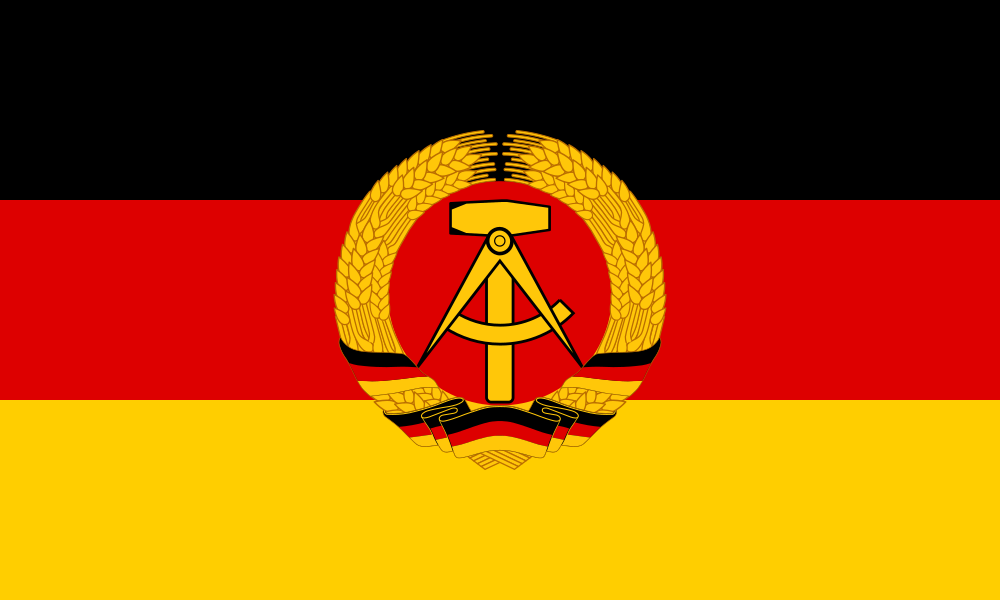
My delegation has bKKn following with appreciation the manner in which you. Mr. President. have been employing your diplomatic skill and wisdom in the fulfilmcnl of your responsible tasks as President of the Security Council. We wish you further success in the discharge of the responsibilities of this office.
34. Profound concern about the critical situation in and around Namibia was expressed by the Group of African States also in its statement of 24 March in which those States came out against the overt SUPPO~ rendered by the United States to the racist regime in South Africa.
28. AI the same time. I should like once again to thank the representatives who have commended the Deputy Minister for Foreign Affairs of the German Democratic Republic. C.mbassador Florin. for the way in which ho discharged the responsibilities of the office of President of the Council during the month of March, for their warm words and the appreciation they have voiced.
35. With full justification the Minister for Foreign Affairs of Zimbabwe stated the following during this debate:
“We at the OAU are greatly disappointed at the apparent unwillingness and half-hearted effort of the contact group of Western States to exert concerted pressure on the Pretoria rkgime to co-operate with the Secretary-General in the implementation of the United Nations plan for the independence of Namibia.” [2269rh mwiug, pcm. 144. ]
29. The current meetings of lhe Security Council are being followed with great attention throughout the world. The participation in these meetings of many Ministers for Foreign ~i!?%irS of flOn-aligned States
-to whom I wish to extend a warm welcome on behalf of my delegation-underscores the significance of the deliberations. The delegation of the German Demo-
36. The position of the German Democratic Republic is Clear and unequivocal. Only a few days ago it was outlined once again. in the message w&ch the Minister for Foreign Affairs of the German Democratic Republic, Oskar Fischer, addressed to the extraordinary ministerial meeting of the Co-ordinating Bureau of the Non-Aligned Countries at Algiers. That message reads, inrrr dirt:
cratic Republic hdS emphalically voiced its SUppOrt for the concerns of the African States. as they have been outlined in decisions adopted by the Organization of African Unity (OAU) and formulated in the letter of the representative of Uganda. Chairman of the Group of African States at the United Nations, of 10 April lS//JL?11.
30. Today. 20 years after the adoption of the Declaration on the Granting of Independence to Colonial Countries and Peoples [G‘e,rc~nr/ A.ssc,r&/~ rc~sol~rrion 1514 tXb’,l. the persistent denial of the ;ight to selfdetermination of the people of Namibia constitutes a challenge to the United Nations and to the entire international community.
“The German Democratic Republic advocates an early and just solution to the Namibia issue on the basis of the Unitsd Nations Security Council resolutions.
“A solution to the Namibia issue can be attained only if the Republic of South Africa is forced to abandon its ill&al occupation of Namibia and if its allies cease their aid to the racist regime. Therefore the German Democratic Republic demands that comprehensive mandatory measures be imposed against the Republic of South Africa in accordance with Chapter VII of the Charter of the United Nations, including an oil embargo as well as a stricter arms embargo.”
31. The delegation of the German Democratic Republic regards the consideration of the Namibia issue in the Council as urgent and imperative. It is in favour of adopting effective measures in the Council and of taking such decisions as will be helpful in bringing about a speedy solution of the Namibia issue.
32. In view of the position held by South Africa and as a resu~l of the ensuing failure of the Geneva talks at the beginning of Ihi.s year. the non-aligned States at the Conference of their Ministers for Foreign .+ffairs at NKW Delhi called upon the Security Council of the United Nation\ to coni~nK an urgent meeting in order lo adopt comprehensive mandatory measures against SouIh Africa in the economic flcld. in accordance with
37. In the recent past there has been no lack of attempts by certain imperialist circles to orevent or at least to put off a debate on the question of Namibia in the Security Council. They include the submission of so-called new proposals. Such tactics are not a new thing at all. and are rather tral. +arent at that. They are meant to undercut resolution 435 (1978)-that is. the United Nation5 plan for the independence of Namibia-to delay further a comprehensive settlement of the question ot Namibia and IO prevent the adoption of effective measures in order to call a halt to South Africa’s illegal occupation of Namibia. At the same time thcrc is. as could hr Icarnrd frr,m ~C\CI:II r-cpurt\
Chapter VII of Ihe Charlcr. and thu; tc: compel South Africa to end its illegal occupation of h;amibia.-
in the mass rn:dia. a scheme to impose a constitution upon the Namibian people and thus to safeguard imperialist interests. This policy is conducted through
puppets that are patronized by South Africa and on no account represent the people of Namibia.
38. All this is happening against the backdrop of the illegal racist rule which South Africa maintains in that country through tens of thousands of its mercenILlles who are greedy for terror and bent on aggression. The so-called proposals represent yet another defiance of the will of the miority of States Members of the United Nations as already expressed in resolutions and decisions adopted by the Organization. As a consequence. all the endeavnl:rs the United Nations has undertaken so far with a view to achieving Namibia’s independence would be frustrated. These manoeuvres cause deep concern on the part of all those who are interested in the speedy granting of independence to Namibia.
39. It is precisely those who defame the struggle for national and social liberation as terrorism, who support racist. pro-Fascist and other brutal rkgimes and al1r.w racial oppression and discrimination to subsist in tneir territory, who today are arrogating to themselves the right of prescribing to :he people of Namibia and the international community how this problem should be solved.
40. The Namibian people. which under the leadership of SWAP0 is struggling to win its independence and freedom. has. like other peoples, the right freely to choose the form of the countrj’s future political, economic and social order, thl:? exercising true selfdetermination. The so-called . -~posal that a constitution be drawn for Namibi:. even before that country achieves independence is tantamount to curtailing that right.
41. As far back as 1%6, the United Nations stripped the South African occupation rkgime of its Mandate as Administering Authority for Namibia and assumed direct responsibility for titat Territory until genuine self-determination and national independence were achieved there [&nrrct/ A.5 rcnrh/y r~solurir~~ 2145
lxx/J]. In pertinent resolutions and decisions the Uniteh Nati& has :peatedly expressed its support for the Deople of Namibia and SWAPO, which is internatibnaily recognized as the only legitimate representative of that people. and has demanded rigorous measures to enable Namibia to achieve independence as soon as passihle.
42. The Tenth Congress of the Socialist Unity Party of Germany. held in mid-April. launched an appeal
tsaiiifrnirlg uu~ coulliIy’s CIiiierll~i aud iilm hoiidariiy
with all revolutionaries and patriots in their struggle for national and social liberation. The appeal closes as
follows:
“The Socialist Iinity Party and the people of the Gcrm;rn I)cmi>cl-;itir Kcpublic will continue 10
consistently fulfil their internationalist commitments and exercise fraternal solidarity with all fighters for peace, democracy, national independence and social progress.”
Thus the socialist German State consistently carries on the great anti-imperialist and anti-colonialist traditions of the revolutionary German working class.
43. As in the past, the German Democratic Republic will in the future render active solidarity to SWAPO, the sole and authentic representative of the Namibian people, just as we will keep on providing assistance to the front-line States.
44. My delegation is prepared to continue its constructive endeavours tdwaids the implemenia!ion of the Namibian people’s right to self-determination. thereby living ;p to its responsibility as a non-permanent member of the Security Council.
The next speaker is the Prcsident of the United Nations Council for Namibia. upon whom I now call.

May I first of all express the gratitude of the United Nations Council for Namibia for the opportunity accorded it to address the Security Council on the question of Namibia at a very critical moment in the Gstory of this issue in the United Nations.
47. 1 should like also to congr: t&ate you, Mr. President. on your assumption of the presidency of the Council for this month. Your distinguished career as well as your extensive knowledge of United Nations affairs will ensure that the proceedings will be guided with wisdom and a profound understanding of the complexity of the question of Namibia in the United Nations. We extend our deep appreciation to Ambassador Florin of the German Democratic Republic for the very able manner in which he conducted the business of the Council last month.
48. The adoption of resolution 385 0976) by the Council led to several initiatives which increased tt,: expectation of a peaceful settlement of the question of Namibia by the United Nations. Subseuuent resolutions of th; Council. including resolution\ 431 (1978). 432 (1978). 435 (1978) and 439 t 1979). elahorsled the political stand ofthe Security Council in order to ensure a speedy transition to independence in Namibia.
49. The SecretaryGeneral of the United Nations gave much of his time and skill to assist the Council ;” ,.,i,,,,,,,.:~, tLo ran-*;^.:^--. c.... .L- -------- -= _L .,, . . . . . . . ..-.‘.~ I..- .*C~YLt”,1”“., I”, ll,C ,rlL.,c,,\r \,I ,,,F
United Nations in Namibia during the period of transition to independence. A\ a result of hi\ efforts the
United Nations was ready to play its role at short notice during the final stages of negotiation\. which were
deliberately sabotaged hy South Africa’\ action\ at the
Geneva pre-i~plement:cti~;r\ I;tlk\ iii J.tnucsrv rlli-. ~CXI
50. In his efforts the Secretary-General counted on the full support of the OAU, the front-line States. Nigeria, SWAP0 and countries which were also concerned with the continuous threat to international peace and security resulting from South Africa’s illegal occupation of Namibia and its continuous aggressive attacks from Namibian territory against the independent African States.
tion of Namibia and recommended that the strongest possible measures should he taken by the United Nations. The Conference of Ministers for Foreign Affairs of the Non-Aligned Countries, held at New Delhi in February last, reaffirmed the total support Of the movement of non-aligned countries for the Namibian people’s inalienable right to self-determination. freedom, independence and territorial integrity. including Walvis Bay. It further reiterated its support for and solidarity with the heroic struggle of the Namibian people, under the leadership of SWAPO, its sole and authentic representative. The Ministers of the non-aligned countries furthermore called on the Security Council urgently to impose comprehensive mandatory economic sanctions against South Africa, under Chapter VII of the Charter. to compel the Pretoria r&ime to terminate its illegal occupation of Namibia.’
_ I. While a group of Western Powers also contributed to the efforts of the international community to obtain the compliance of South Africa with the resolutions of the Security Council, it has been widely felt that theirs were half-hearted attempts to exert pressure on South Africa and that they were an important factor in promoting South African intransigence.
52. Throughout the negotiations the representatives of SWAP0 have revealed to the world exceptional qualities of statesmanship and political moderation. In spite of the efforts of many of the parties concerned, no fruitful results have been achieved, because of the continued refusal by South Africa to comply with United Nations resolutions on Namibia.
56. Almost without exception, all members of the Security Council, including the three permanent members of the West around this table, have stated, without any equivocation, that South Africa’s presence in Namibia is illegal. Since that is so, why then cannot the Western members. especially, withdraw their support for South Africa’s presence in the Territory and carry out the mandate which was entrusted to the United Nations 15 years ago. in General Assembly resolution 2145 (XXI). which was supported by the United States delegation through its affirmative vote?
53. South Africa has created one obstacle after another to the implementation of the United Nations plan. It has continued to manoeuvre inside Namibia in order to give power to those elements which are well known for their subservience to South African interests in that Territory. In that respect, South Africa undertook the so-callrd elections of December 1978. The so-called electoral process was strongly condemned and declared null and void by the Council in its resolution 439 (1978). Despite that decision by the Council, South Africa subsequently proceeded with its schemes of creating a so-called council of ministers to strenphen further the position of tribal -lements and racist supporters of apurtheid in the Territory. Those initiatives were followed by other measures such as the creation of a “territorial army” and the decree imposing universal military se&ice on the population. Those measures, in violation of United Nations resolutions, were clear attempts by South Africa to increase its corirol over Namibia by frustrating as much as possitle the aspirations of the Namibian people and of SW,?PO; its sole and authentic re?*<sentative, to self-determination and independence.
57. The Assembly of Heads of State and Govemment of the Organization of African Unity, meeting at Freetown. Sierra Leone, from I to 4 July 1980, had already demanded that the Security Council should adopt mandatory sanctions against South Africa to force its compliance with Security Council resolutions on Namibia. At its resumed thirty-fifth session in Marc, last, the General Assembly solemnly called
upon
“the Security Council to convene urgently to impose comprehensive mandatory sanctions against South Africa, as provided for under Chapter VII of the Charter of the United Nations, in order to ensure South Africa’s immediate compliance with the resolutions and decisions of the United Nations relating to Namibia”. {G cm>rcl/ Assumhly resolrction 351227 A. pcrru. 29. ]
54. By its actions South Africa has shown that it does not wish to respond constructively to the initiatives of the international community. ‘The Pretoria r&me is continuing its efforts to perpetuate its exploitation of the people and resources of Namibia. The Pretoria rigime is continuing to harass and kill in cold blood
58. The heads of State of Angola. Botswana, Mozambique, the United Republic of Tanzania and Zambia. and the Minister for Fbreign Affairs of Zimbabwe, mei at Luanda on I5 April. with the participation of the President of SWAPO. Mr. Sam Nujoma. and reviewed the developments in southern Africa. In their communiquC they underiineci particularly their grave concern about the increased number of acts of aggression which have been perpetrated by South Africa against the front-line States. as well as attempts and threats aimed at destabilising and undermining their Governments. They also viewed with deep concern the continued refusal by the South African regime to
SW,%!% !;S!C:E ;iiZ GidiCS iiisiik Zid Uuis& Knmibia. These barbarous acts by the racist rigime in Pretoria must end immediately.
55. Since the collapse of the pre-implementation talks-a collapse caused by South Africa-the nonahgn,d countries and the OAU have taken up the quesimplement Council resolution 435 (1978). Their communique also drew the attention of the international community to the intensification of the repressive measures taken by the dlegal regime inside Namibia and to the creation of newfirirs c~conrptis with the aim of giving a semblance of legitimacy to its puppets. In line with the positions of the OAU and the movement of non-aligned countries. the Luanda summit reaffirmed theiupport of the heads of State for the United Nations plan as provided for in resolution 435 (1978). and stressed the’urgent need to implement that plan without any further delay. prevarication. qualification or modification. They stressed the responsibility of the five Western Powers 10 ensure the implementation of the United Nations plan, of which they are the authors [S//44641.
59. The Ministers for Foreign Affairs of the Coordinating Bureau of the Non-Aligned Countries. who met at Algiers from 16 to 18 April. also supported the demand for United Nations sanctions against the South African rbgime [S//445& ctnnuxl.
60. The international community cannot stand by in silence while the Namibian people are humiliated. brutalized and killed, and their resources plundered. by a rigime which has been condemned by the international community for its brutal, racist and repressive policies. and which continues to defy the well-considered views and decisions of the United Nations. As a matter of fact, for well over a decade--:hat is, since l-the United Nations has been trying !o reach some accommodation with South Africa, aiternately employing criticism, cajolery and mediation. but in vain. Thus, it is evident that a peaceful sdution for Namibia remains eiusive and that United Nations enforcement measures are becoming imperative.
61. It is therefore time for the Security Council, whose resolutions have been ignored by South Africa, to consider measures that would effectively impose compliance with its decisions with respect to Namibia.
62. The United Nations Council for Namibia, established by the General Assembly in I%7 as the sole legal Administering Authority for the Territory until Namibia’s independence [rr.volrrri~~~r ?I45 ~XX/J I. has given careful consideration to the formulation of draft resolutions on sanctions to be imposed on South Africa in accordance with Chepter VII of the Charter of the United Nations. In consultation with other parties concerned. the Council for Namibia strongly believes that the ideas which were exchanged will greatly contribute to the draft resolutions to be considered during the current debate.
63. The Charter clearly specifies the responsdMlty
of the Security Council to act with respect to threats
to the peace, breaches ofthe peace. and acts of aggressinn. of which the South African position is typical.
M. lt is nut nccrsshry fur me tu review in detail the
act, of the Pretoria rtic:~rr;c which ccrn~titute a cleat
violation of Article 39 of the Charter. It is sufficient to recall that South Africa has repeatedly used the Ten+- tory of Namibia, which is under United Na:ioys reTPunsibility. to carry out acts of aggression agamst mdependent African States. This situation Is very well documented bv Governments and by the United Nations informatibn media. I should like. however, to cite one example: On 6 May 1978. by its reSOlUtiOn 428 (1978). the Security Council condemned the South African attack on Angola. The Council additionally decided that. in the event of further violation of Angolan territory. it would meet again to consider the adoption of “more effective measures, in accordance with the appropriate provisions of the Charter of the United Nations, including Chapter VII thereof.” Since then, Angola and other front-line States. particularly Mozambique, Botswana and Zambia. have been raided by racist troops. Those raids continue. and therefore the threat to peace also continues. Is it not the responsibility of the Security Council to arrest this threat to peace in the area?
65. South Africa’s policy of developing a nuclear capability, and its racist policies, defined as a crime against humanity by the international community’s International Convention on the Suppression and Punishment of the Crime of Apctrlhrid, adopted by the General Assembly on 30 November 1973 [rcdrrtion 3068 (XXV///)], constitute an unchallengeable basis for Security Council action. It is undeniable that South Africa’s illegal occupation of Namibia. and its repression of Namibian patriots. in violation of United Nations resolutions, constitute a breach of the peace in the area.
66. Other detention laws, including the notorious section 6 of South Africa’s Terrorism Act of 1967, remain in force in Namibia, and Namibians can be and are seized without compliance with the next-of-kin notification provisions of the proclamation. It is against that background that the Council should consider the draft resolutions, which contain recommendations for appropriate action in conformity with the Charter in order to force South Africa to comply with United Nations resolutions regarding its illegal occupation of Namibia.
67. The time for decisive action is now. Those who wish to prevent the necessary initiatives 10 force South Africa’s compliance with United Nations decisions should ponder the gravity of their stand. Namibia is under theresponsibility of the United Nations. which has a solemn commitment to assist the Namibian
people to achieve self-determination, freedom and nationu! independence in a united Namibia.
68. Member States must not fail to meet this commitment.
The next speaker is Mr. Peter Mueshihanpe. Secretary for Foreign Relations of the
South Wr\t Afric:a People’\ organi/arit,lr. trl whom
x
the Council has extended an invitation under rule 39 of its provisional rules of procedure. I invite him 10 make his statement.
ous over the years lo be accidental. The meeting in London to which I have just referred is, in terms of both its timing and its import, no exception. Rather, it is a well-calculated strategy to win yet another stay of execution for the Fascist South African r&me and to continue to safeguard the vested interests of the capitalist Powers and their giant transnational corporations in southern Africa.
70. Mr. MUESHIHANGE: At the outset of the intervention. which you, Mr. President. and the other members of the Council have so graciously allowed me lo make in this crucial debate on the question of Namibia, may I say how extremely delighted and inspired SWAP0 and the fighting patriots of Namibia are lo see that the Security Council is at last actively seized of the grave situation in Namibia.
76. Looking around this chamber, 1 cannot help but feel-despite the sinister plots and diatribe that are being hatched up-invigorated by the participation of so many Ministers for Foreign Affairs and other high-ranking political personalities from friendly countries in the current debate. This is indeed a source of great satisfaction lo us and a manifest sign of support for and solidarity with our national cause for Namibia’s speedy liberation and total emancipation.
71. This is the first debate ofthe Council on the thorny problem of Namibia since 1978, when the Council unanimously adopted resolution 439 (1978). relating to the illegal and bogus election held in December of that year, and dealing also with the unilateral measures and impositions in Namibia by the criminal racist South African usurpers.
77. The past four years, perhaps more than any other period during our long association with the IJnited Nations. have severely tested our patience as both leaders and activists in the struggle. These have turned out to be years of serious trials and tribulations requiring of us at all times Lo know that the price of liberty always involves suffering and sacrifices. We have had to maintain even higher standards of political leadership and statesmanship in the face of constant provocations, including frequent loss of human lives and destruction of valuable property.
72. To us, the very fact that the Council is meeting is a political victory for SWAP0 and the other progressive forces which together have been waging a multifarious struggle in various combat zones and at different levels against imperialist domination, colonial oppression and racist reaction. These very same forces of death, destruction and darkness have, over the past four years, used all kinds of manoeuvres and disinformation lo pre-empt and deflect all efforts aimed at bringing the crimes and injustice being perpetrated against the peoples and countries of southern Africa by the racists and their collaborators before the Security Council.
78. Ironically, it was during this period, starting with the launching of the widely publicized and much talked about “Western initiative” [S/f2636J-which was supposed to have led to the holding of free and fair elections under the supervision and control of the United Nations leading to Namibia’s independence and national sovereignty--that not only has the trust been betrayed and the promise broken once again, but the unique responsibility of the United Nations over Namibia and its people has also been seriously eroded and distorted. South Africa was rescued by its friends with a triple veto.
73. Consequently. the Council has been immobilized and an impasse has deliberately been created. which has only encouraged the Pretoria rkgime 10 carry on with its State terrorism, political repression and all other illegal acts of intimidation and neo-colonialism in occupied Namibia.
74. That has been the strategy of the North Atlantic Treaty Organization (NATO) Powers. those that are the major trading partners and collaborators of apgrr- Iwid South Africa. In this connection. it has not escaped our notice that a counter-meeting of the key NATO Powers, the five Western Powers, had been scheduled lo take place on 22 April in London. supposedly “lo consider future courses of action” on Namibia. This has been very characteristic of the Western approach. Each time that a Security Council meeting has been called, either a new Western move has been announced or it has been said that African States and their friends should refrain from-allegedly-calling for confronta- !ic~p and inctend m-operate towards finding a peaceful solution-so-called-regarding Namibia.
79. in the first instance, the question of Namibia is a concrete and straightforward question of decolonization and of illegal occupation. The Namibian patriots and all other anti-colonial sectors of our population are demanding nothing more or less than speedy and unfettered freedom and the national and social liberation of all of our Namibia, including our Walvis Bay and the Penguin and all other offshore islands. That. in essence, is the demand which a long time ago became a sacred cause of the United Nations. For the principles and purposes of the Charter, the resolutions and decisions of the Organization. the advisorv ooinions of the International Court of Justice and th; emerging body of principles of international law relating to decolonization and the exercise by all oppressed countries and peoples of their inalienable right to self-determination enjoin the Member States of this great institution to support SWAP0 and the Namihian patriots who ilre
75. Cunninply. i: is the national liberation mover.lents and tneir supporter* that must be urged to .‘defer” or “moderate” their demands for Security Council action. These incidents have been too numrrresisting in their country foreign, colonial domination and illegal occupation by the Afrikaner junta.
80. In a solemn undertaking entered into about I5 years ago. after terminating all administrative powers exercised before by South Africa over Namibia, the United Nations pledged to stand behind the oppressed people of Namibia until genuine independence was achieved in the Territory Irc~sulrrrbn 2145 (XXI)]. Thus it seems axiomatic to us that that solemn undertaking remains valid and calls for implementation.
81. This is no longer a bone of contention and should never give rise to any further debate as to whose aurhority and responsibility are being sabotaged and challenged: it is that of the United Nations. It is equally clear and well known who the culprit is: it is uparrheid South Africa, which continues defiantly to obstruct Namibia’s decolonization. perpetuates the illegal occupation and Stale terrorism in occupied Namibia and perpetrates repeated acts of aggression and unprovoked military attacks against independent African States in the region.
82. Already in 1976 the international community, encouraged by SWAP0 and the friendly countries in the forefront of those supporting us, called for a worldwide campaign to punish the Boer rkgime for its ruthless suppression of the political aspirations of the peoples of Namibia and South Africa, its violations of their human and national rights and its maintenance of iliegal rule in Namibia, as well as for the victimization of the majority of the South African people under the brutal policies and practices of the apartheid system.
83. At that time-in 1976the valiant people of Namibia had already lived through 56 years of the cruellest and most dehumanizing and degrading racist colonial system, which was further aggravated by the seizure of power by (he neo-Hitlerite. all-white National Party, spearheaded by the clandestine Broederbond.
84. The campaign to which I have referred was aimed at isolating and punishing racist South Africa: it was aimed at imposing against it total economic sanctions under Chapter VI I oft he Charter of the United Nations.
85. The victories rcored in indo-China, and those scored in Africa hy the revolutionary forces in the former colonies of f;ascist Portugal. and the advancement of the struggles of the peoples in southern Africa had at that rime created a pogilive political climate for concerted international nC?ion m h+o frnAr\m *A-A .D ..-- --... -.... liberation to the rest of Africa and arrest the plunder of natural resource\ by foreign business interests to the detriment of the African masise:,.
86. Frankly and stric’tl) speaking. today it would he an understatement to \a) that the racist usurpers. around whose nrzk\ a nntr\c ~a\ :lhout to be tightened
four years ago through the collective will of interirdtional public opinion, have been allowed to slip out of that noose; they are cynically boasting about, hpw indispensable they are for the viability of extsttng international and regional economic relations.
87. We can now say. with the hindsight of the past four years, that what was put forward originally as a well-intentioned diplomatic initiative by the five Western Powers has in fact turned out to be-it seems more by calculation than by default-a contrived public relations exercise in the service of South Africa. South Africa, which. without any exaggeration. is obviously the front-line manager and police of the combined interests of the major capitalist Powers and their military-industrial and nuclear centres. has so far managed to escape the wrath of progressive mankind.
88. Earlier on I mentioned the unprecedented participation of so many Ministers in this debate. I wish to add at this juncture that the current debate. which is obviously an epoch-making event under the circumstances, is taking place in the aftermath of some major developments that have taken place recently in Africa.
89. On 15 March, the leaders of the front-line Stat.:s and the President of SWAP0 held a summit meeting at Luanda. The leaders reviewed the ctirrent situation in southern Africa in general and in Namibia in particular. The latest attempts to destroy Security Council resolution435 (1978) on Namibia and those aimed at the destabilization and subsersion of the lawful Government of the People’s Republic of Angola were strongly denounced and rejected. The reported intentions of Washington to provide assistance to Angolan puppet and traitor groups in the service of the Pretoria regime were character&d as a hostile act not only against Angola but also against (he whole of Africa and peace. loving mankind. SWAP0 associated itself fully with thosegraveconcerns expressed hy the African leaders.
90. Only a few days ago in Algiers the extraordinary ministerial meeting of the Co-ordinating fh.iR!dU of the Non-Aligned Countries concluded its deliberations on Namibia in the context of the critical situation in,pohcd upon the peoples of southern Africa by the fic\ci\rli and aggressive operations of Sotlth Africa !hroughout the region.
91. That meeting of the Co-ordinating Iturc:m was attended by more than 3t linistcrs for Foteigr: hffdirs and other senior officials of memhelcounlrie\. It was a historic meeting which madr crucial decision\ for h,ek,La .8.nrn.., ,.-, 1 .Lr . . . .._.. ----I .‘.L- --- * IV... ..A_ y.-..C.‘L “#a” ,I.G lUl”,C ,lCC”I ,,I 111L ..,,“g&,c 11, southern Africa. For us in SWAP0 it ~a\ a unique demonstration of friendship and \olid;Gty with the s:ruggling people of Namlhia hy I~II- I;,* .:ht \egmcnt of tne world community.
92. We sakite the Mini<rel-\ ti):- I-‘olcign Arail\ c)rtlrcnon-aligned countrie\ tar h;lviu;l 1’ .;lded ;it thr: 5,~
Delhi Conference to hold the extraordinary meeting of the Co-ordinating Bureau. which, as SWAP0 President. Comrade Sam Nujoma. intimated at the conclusion of hi\ major address at Algiers, ended with “a resounding success heard loud and clear by friend and foe alike in all corners of the world”.
existence constitutes a serious threat to international peace alid security /S//445& pnrcr. 191.
97. I should also like to recall here a strong view expressed in Algiers. In view of the deteriorating situation in southern Africa arising out of the continued illegal occupation of Namibia and in view of the numerous obstacles created by South Africa to thwart the search for a negotiated solution of the question of Namibia, the Ministers further undertook to stnvt‘ actively to oppose all the attempts aimed at dist:)rtill!! the substance of the question of Namibia, which IS specifically a problem of decolonisation and of illegn! occupation [i/k/.. purer. /RI. The front-line leaders and the President of SWAP0 issued astrong warning in this regard when they reaffirmed in the aforementioned Luanda communique of 15 April their continued support for the United Nations plan as provided for under Security Council r-solution 435 (1978) and stressed the urgent need to implement that plan without any further delay. prevarication, qualification or modiftcntion [S//4464. pcm. 81.
93. I would be failing in my duty if I did not renew here our thanks and appreciation to Mr. Bendjedid Chadli. President of the People’s Democratic Republic of Algeria, and to the Government and, indeed, tbe fraternal people of Algeria for all that they have done in terms of the elaborate preparations made, the facilities and assistance provided and the customary warm hospitality which ensured that success.
94. i believe the Algiers final communique is now available as an official document of the Security Council ISll4458. cr~c~xl. That communique together with thejoint communiq& of the front-Iin; Stat& issued on I5 April at Luanda-which, I believe, should also be an of&l doct.ment of the Council (S//4464, artnt>.rI-- expi’esses the serious sense of indignation at and condemnation of the policies and recalcitrance of racist South Africa and certain key NATO Powers that are responsible for the grave situation in southern Africa.
98. In the same vein, the Co-ordinating Burw condemned and rejected the current attempts m present the Namibian issue as a regional conflict with the aim of depriving it of its universal dimensions and underplaying the defiance by the illegal occupation regime of the legitimate demands of the oppressed people of Namibia, the will of the United Nations, the OAU. the non-aligned movement and the intemationd community at large [S/14458. u~tnbx. puru. 181.
95. In the communiquC of the Algiers meeting. the friendly countries of the non-aligned movement, of which SWAP0 is a proud member. expressed a clear. categorical, systematic and principled position concerning the question of Namibia. and who our domestic and foreign enemies were. and adopted a Programme of Action for ending colonial oppression and ilkgal occupation in Namibia. Increased support for and assistance to SWAPO. the sole and authentic representative of the oppressed people of Namibia, were further stressed. In this connection. the Ministers undertook to bolster material. military, political and diplomatic support for SWAP0 in order :o enable it to intenGfy the armed struggle in the face of South Africa’s persistent rejection of a negotiated settlement of the Namibian problem.
99. Like the front-line summit, the Bureau rejectd the idea of tampering with Council resolution 433 (1978) through either modification, qualifiition or dilution of its provisions [ihid.. puru. 91,
100. Accordingly, it is our patriotic duty strongly to condemn and reject the latest hostik moves againsl SWAP0 and the lawful Government of the People’s Republic of Angola. whose only crime is that of haviq decided to resist naked imperialist and racist aggression and the covert operations against Angola and the colonial oppression and illegal occupation in Namibia. We know that both Angola and SWAP0 enjoy the unflinching and overwhelming support of progressive, peace-loving and justice-upholding mankind. We shall go forth. The struggle will continue, no matter whd the sacrifices may be. for we know that in the end the oppressed masses will prevail. No amount of State t&rorism. police brutaliiy. attempts at destabilization or vetoes will for ever impede Namibia’s total liberation and national independence. it is also our convirtinn that thr urill and tirtrrminatinn nf ntw nntrid~ . _ . . _ . , . .- . . _ . . . -. . - - - . _ . . . . . I _ . . - -. r--------. cannot be killed by vetoes. No peopie has been kept for ever in a permanent state of bondage. Victory shall be ours because that is the only logical and inevitabk outcome of the heroic struggle we are waging in Namibia to free the land. to re-establish ownership and control over the natural resources under the sioil and sea-bed all over Namibian territory.
96. Similarly. the Ministers concluded that the aggressive policies and unprovoked military attacks by the terr,)rist and racist Pretoria regime against the frontline States and its intransigence and prevarication in the face of the universal condemnation-of its continued illegal occupation of Namibia stem from the Fascist nature of that colonial-settler State based on rrprrrflrcG/ and th: denial to the African people of South Africa of the exercise of their inalienable right to self-determination and to the e\tahlishment of a democratic State. A ..,...,.,l ;..^I.. ,L^ u .,-_..... :“r..eA ,%,. ..mnnt .Inn.an, tn ,hO . .SG”, -s,,fi,, . ‘,I& .,“I..“” I.I..Yb” ‘.a. L..e.s.. ..ry .,... .I .‘... wider world community. including certain permanent members of the Security Council. to reinforce the strupglc of the South African pcoplr against cr[~rrr//rcGd and ICI contlntlc giving. or to start now to give. their full support IO ihK liberation m:>vement. which rn SWAPO‘> sic\< mc;mx ~tit: African National C’ongress ofSouth ifrt<i~. 1111- thcer;~dic;rtion of the s)stcm whose
101. Now I wish to come back to the tragic situation which the racist Boer rkgime has created in Namibia as the Western Powers concerned. instead of exerting pressure on South Africa, have encouraged it to carry out a long chain of illegzl and unilateral acts in the Territory.
102. Namibia has been put high on the agenda of the imperialist for:es, not as a sign of retribution or repentance by racist South Africa’s supporters and allies. The intentions are clear: they are, on the one hand, to sabotage and undermine the-armed liberation struggle being waged by the People’s Liberation Army of Namibia (PLAN), SWAP6’s military wing, and, on the other hand, to c;lt the United Nations out of the question of Namibia or to turn it into a mere rubber stamp. That should not be accepted.
103. For nearly four years now. the United Nations and various other sectors of the international community have been caugSt in a serious dilemma in the question of Namibia. The five Western Powers, contrary to their solemn undertaking in the spring of 1977, have not yet delivered South Africa and may never have the political will to do so.
104. Security Council resolution 435 ( 1978). like all the other previous relevant resolutions and decisions of the United Nations. has been aborted by the Pretoria Fascists and reneged on by the Western Powers themselves, in spite of the fact that it was they who launched the initiative with fanfare and great promises.
105. What it all amounts to is that still mr,re years of suffering and victimization of the Namibian people have been added to the already sordid maladministration over Namibia by the successive Boer racist regimes, making it 61 years of uninterrupted colonial oppression, political repression and ruthless exploitation. It is a matter of record that the Pretoria racists have repeatedly flouted the decisions of the United Nations and the world Court and have refused to cooperate with the Organization in carrying out its responsibility towards Namibia and its people.
106. The so-called contact group of Western States, rather than persuading racist South Africa to relinquish its illegal occupation of Namibia. ended upencouraging South Africa in setting up unilaterally. in December 1978. a bogus political and con=.titutional entity, namely. a constituent assembly. preceded by an illegal election financed. organized and manipulated by the racist. colonial agents in Namibia.
107. Today the situation in Namibia has developed from bad to worse. Indeed. the situation is grave. Violence and coercion are the order of the day. Accordmg to 7Irt~ S/r~r~/rr,~ ‘li~k*~ro//~h of 22 March 198 1. “the number of South African troops and paramilitary police in Namibia is now thought to have reached lo’).ooO. apart from locally recruited fixices”. On I April 1981. a ~‘N;lmihianization” ;Irocess was
launched. A seoarate so.called territorial army. buttressed by a l&al police force and administrative agencies. has been installed in Windhoek. Additional powers have been devolved on the bogus national assembly and on an ethnically based council of ministers to exercise legislative and executive functions respectively. This creeping but well-calculated sinister scheme has thus assumed an appearance of some legitimacy. But we remain convinced that the masses will not be fooled. They can clearly see through this farce. which will surely vanish when the day of reckoning arrives.
108. in addition. the familiar. infamous colonial policy of divide and rule has been reactivated, involving the conscription of the Namibian youth at gunpoint to shoot and kill their brothers and sisters fighting under the banner of the patriotic PLAN. SWAPO’s military wing.
a
109. The objective is to transform the essentially colonial conflict into acivil one between good and evil, as perceived by the wicked minds of the racists and their mentors. What is more, the entire country has become a theatre of war. A state of emergency has been in existence throughout the country for nearly a decade. This state of affairs was reinforced by a martial law which empowers the army and the police to shoot and kill those Namibians believed or suspected to be SWAP0 followers. Furthermore, the racist colonial governor appointed by the P,ztoriajunta has been giver extraordinary powers to rule by decree and has been promulgating a chain of illegal and repressive acts.
110. In a vain .Ittempt to silence the revolutionary voice of the people, SWAP0 of Namibia, a fascistic campaign of terror and intimidation has been unleashed against SWAP0 leaders and activists, thousands of whom are languishing in hellish detention centres, concentration camps and other cruel torture chambers in various parts of South Africa and Namibia.
111. To show the limitless propensity of the racist Boers to promote criminality. it is necessary to point out that puppets and other colonial ager.ts are used to carry out dirty tricks and terrorism against the local popi4ation by destroying their livestock, property and harvest. When the local population resists such acts of intimidation. they are forcibly removed to different localities in an attempt to cow them into submission. For the defiant ones all opportunities for employment are foreclosed.
112. Of course. the continued illegal occupation of Namibia by the leaders ofthe clandestine Broederbond creates uniquely favourable opportunities for the ruthless depletion of the mineral wealth under the soil and the sea-bed of our country. not for present use but for stockpiling. The transnational corporations expropriate all the super-profits which go to South Africa and abroad, leaving the Namihian peasants and workers with nothing hut their chains. sweat ;ind toil.
I?
were sponsored by a particular group of COUnttieS iS reminiscent of the Muzorewa scandal and clear testimony as to who they are and whose interests they serve.
in violation of United Nations resolutions and Decree No. 1 for the Protection of the Natural Resources of Namibia.’
113. It is an oft-repeated charge that occupied Namibia is bcina used time and again as a springbcard for military attacks and other acts-of aggression against the front-line States, especially the People’s Republic of Angola and the Republic of Zambia. In carrying out those hostile acts of provocation and destruction the Boer Fascists enlist the active participation of mercenaries from Australia. France, the Federal Republic of Germany, the United Kingdom and the United States.
117. SWAPD is astounded that responsible Governments should have sought to re-enact the Geneva fiasco where puppets were unleashed to insult. vilify and reproach the United Nations, including the illustrious Secretary-General, the OAU and SWAPO. In this context, we took note of the following glib comment by the representative of the United States on the elections called for under resolution 435 (19781: “if . they can ever be arranged” (2267rk nteefing.
pcm. -741. We shall leave it at that.
114. The renegade and counter-revolutionary bandits of the National Union for the Total Independence of Angola. who are housed on military bases inside Namibia along with the so-called South Afri :an Defence Force. are also used for subversion and destabilization in the region. Consequently, agrave situation seriously threatening international peace and security has been brought about not only in Namibia but in the entire southern Africa region.
118. SWAP0 is grateful that the puppets were rebuffed and the request on their behalf rejected. We are reinforced by that.
119. Before concluding may I inform the Council and the world at large that at this very time our people are being subjected to killing. abduction and intimidation by the racist army and police in the northern part of Namibia. The reports reaching us tell of a very grave situation in the general area of Oshakati, Ombalantu. Kaokoveld and Okavango. This is the nature of the strategy of military onslaught and coercive dip!omacy. South Africa’s friends are having a meeting in London, seeking to counter this debate. At the same time the Fascist forces of the occupation regime are killing and maiming the oppressed people of Namibia.
I IS. Against that background loaded with a time bomb, it must be clear to all of us that racist South Africa, encouraged and supported by the major Powers of NATO, has nearly completed the creation of a neocolonial administration in Namibia. But this puppet entity consisting of the bogus council of ministers, led by an ex-colonial offtcial and a wealthy Afrikaner farmer who has enriched himself thanks io his privileged position as a white man in a land governed on the basis of the discriminatory and repressive laws and policies of the crpurrlwid system, will vanish just the same way that the Smith-Muzorewa group vanished in Zimbabwe in spite of the enormous financial and logistical backing by the racists and other foreign supporters.
120. The Namibian patriots and all progressive and peace-Irving mankind are watching the deliberations of the Security Council and waiting to see whether the decisions to be taken here this time will ‘*e commensurate with the present grave situatiou in and around Namibia.
121. In conclusion. we have come back before the Council bringing with us these charges and a long catalogue of crimes and violations to urge the members around this table to find a redress of grievances. It is in the final analysis the historic and special responsibility of the United Nations that is flouted and rejected in Namibia. The Council must take the lead to rectify the situation in Namibia.
116. At the outset of this debate we witnessed a strange spectacle: the Council was presented with a dilemma in the form of a request to allow the DTA puppet group sponsored by South Africa and the Western permanent members to participate in this debate. We were dismayed. It was a political act presented as a procedural matter. Any distinction between DTA. the bogus National Assembly and the ethnically based council of ministers in Namibia is merely hypothetical. They a;F all one and the same thing-that is. illegal. neocolonial creations serving the interests of the exponents ofnpnrrlrrid. colonialism and the foreign business interests. SWAP0 fully concurs in the convincing and irrefutable z:guments mn,ln =_ G.” :- *I... A-L.,.- ---.I.. .I--. -at-..-:-- AL- . ..--.. .,” .Y. #,I ,,a&. “&,“a,%* t,mr,r,)r. LllPl a,wlv,l‘& L11G puppet traitors to address the Security Council would indeed violate the provisions of resolutions 439 t 19781, according to which those entities are illegal. null and void. It is n,Jct regrettable that discussions about that non-representative group were introduced in the Council through tile hack door. The fact that those elements
It?. Wejoin in the chor?rs of the majority of mankind in calling for the imposition of comprehensive mandatory sanctions. including an oil embargo. against South Africa under Chapter VII of the Charter of the United Nations. We are aware of the threats expressed or implied in this regard. but we are convinced that the ii-i&es uf iiic- III&II ii) in iilr founcii cannot aiways be obstructed by the arrogance of power exercised more often than not hy a minority which supports the .YIDIU.Y yr,~ in southern Africa. Therefore we see good sense in the call for :m emergency special session of the General AIsemhl! should the Security- Council fail to adopt the measures heing proposed.
use ofcurrent international tensions in order to prolong its occupation of Namibia and its domination in southem Africa.
123. I am grateful to YOU. Ur. President. and to the Security Council for alioHtng me to speak on behalf of SWAP0 and in the name of the struggling patriots of Namibia.
132. It is our profound belief that such an attempt must be resolutely rejected because its acceptance could divert us to an erroneous and dangerous path. In our view the Council took the right decision in not admitting DTA’s representatives to sit at this table. Otherwise there would have been a kind of gameplaying: democracy against democracy.
124. The struggle continues. Victory is certain.
The next speaker is the Federal Secretary for Foreign Affairs of Yugoslavia, Mr. Josip Vrhov&. I welcome him here, and I invite him to take a place at the Council table and to make a statement.
133. I believe that none of us entertains any doubt that there is an international consensus on the need for genuine independence for Namibia. However. verbal support is not suff&nt. What is needed now is concrete steps and measures ens&ring the implementation of the decisions of the Security Council and the General Assembly.


Mr. President. I should like to join the preceding speakers who have expressed confidence that your wisdom, diplomatic skill and experience will contribute to the successful consideration of this very important and complex question on the agenda of the Security Council. Needless to say, you represent a country with which my country maintains very good and friendly relations.
134. We are deeply concerned over certain intentions to prevent realization of the internationally agreed obligations towards Namibia.
127. We attach particular importance to these meetings of the Council. The theme C~ rlr discussion involves a question of threat to interna .anal peace and security. As is known, in such cases all the organs of the world Organization must act effectively in accordance with their obligations under the Charter of the United Nations. The international community is rightly expecting that.
135. As is known, in 1966, by General Assembly resolution 2145 (XXI), the United Nations had already terminated South Africa’s Mandate over Namibia. The following year the United Nations assumed direct responsibility for Namibia by establishing the United Nations Council for Namibia, giving it rhe mandate to administer the Territory [G<~m~rn/ Assc,nrh!\ rcsolrrliOl1 -7248 (S- V! ] *
128. The non-aligned movement was guided by those considerations in entrusting the extraordinary ministerial meeting of the Co-ordinating Bureau at Algiers to deal with the question of Namibia and to adopt appropriate decisions.
136. That decision was adopted in accordance with the principles of the Charter and the Declaration on the Granting of Independence to Colonia! Countries and Peoples. Many years have passed since then. In the mean time, the United Nations has adopted a number of decisions and recommendations with a view to creating conditions for the achievement of independence by the people of Namibia.
129. I have come to these meetings, together with other Ministers. directly from the meeting of the Coordinating Bureau held last week at Algiers. The nonaligned countries, which have always given full support to the decisions of the United Nations on Namibia, have once again given proof of their responsible and constructive approach to the solving of international problems. The meeting at Algiers adopted a final communique based on full respect for the decisions of the United Nations and recommended measures for accelerating their implementation [S//4458, (mm’.r]].
137. By its resolutions the United Nations has subsequently: confirmed the inalienable right of the NopIe of Namibia to self-determination and independence: recognized the legitimacy of the slruggle waged by the people of Namibia. with all the means at its disposal, against the illegal occupation of the country: recognizcd SWAP0 as the sole and authentic repre-
130. With the Council’s permission I would now refer to some essential elements of this problem which are in our view relevant to its consideration by the Council. I should also like to state the views of my country concerning the role and obligations of the Council in this regard.
sentative of the Namibian people and granted it observer status in the United Nations: demanded respect
for the national unity and territorial inteprity of Na- -nibia and the preservation of its natural resource\;:
proclaimed null and void the sham elections aimed ‘It implementing so-called internal solutions: and
&opic:j a IIU&~I pi &.ciaiun% and Icc0mmentiaricms
131. In I ,e case of Namibia we are undoubtedly faced
calling upon Member States to contribute to the isolation of Souh, Africa by imposing an emhargo and sancwith a problem of decolonization. Its final solution constitutes adebt ofthe interxtional community to the
tions against it.
principles of the Charter. Tne attempt to portray this problem as part of East-West confrontation constitutes a manoeur-re b) South Africa aimed ar mahinp
of 1971.1 which proclaimed South Africa’s presence in Namibia to be illegal and advised that all the States Members of the Uuitcd Nations should refrain from any act likely to result in c/c~.fuc.~o recognition of the
perpetrate acts that cannot be described otherwise than as serious threats to international peace and security.
145. South Africa continues the illegal occupation of Namibia, committing acts of repression and atroc: ities against the Namibian people. By means of socalled internal solutions it is trying to install a puppet regime and to give it a semblance of legality, soliciting the support of Western countries.
occupation.
139. The Gcncral Assembly and the Security Council have thus far adopted doiens of resolutions on the question of Namibia. Finally the Security Council detincd. in its resolutions 383 (1976) and 435 (1978). the United Nations plan for the independence of Namibia. II is important to emphasize here that that plan was initiated by the so-called contact group of five Western States \S/1?636]. The plan called for the holding of elections under the supervision and control of the United Nations. entrusting the elected representatives of the Namibian people with forming a constitutional assembly which would adopt the constitution of the new nation.
146. South Africa continues to exploit the natural resources of Namibia, in collusion with transnational monopolies. It is exploiting the uranium of Namibia for the development of nuclear technology for military purposes, thus posing a new threat to international peace and security. The racist regime is trying to disrupt the national unitv of Namibia through bantustani;ation and its ter&orial integrity through detachina Walvis Bav and the Namibian islands. It continues to pursue its brutal policy of racism and upurthrid against the majority of the people in South Africa, depriving them of their fundamental national and human rights.
140. The outcome of all those efforts of the United Nations. which enjoyed the full support of its Membcrs. is known. Three years later, instead of fair and free elections, we witnessed total failure at the preimplementation conference held at Geneva in January.
147. South Africa continues to use the Territory of Namibia as a stronghold for launching acts of aggression against the neighbouring front-line States. pursuing a policy of State terrorism and sowing fear in an attempt to undermine the stability of those countries and their firm resolve to resist the aggressive policies and domination of the racist regime. In so doing, the South African racist regime continues persistently and arrogantly to ignore the United Nations and the whole international community. There is no doubt that such a policy is fraught with dangerous and far-reaching consequences, not only for the stability and security of Africa but also more widely in the world. That can only open the door to a further exacerbation of tensions in international relations and push us nearer to the brink of a new cold war.
141. Now we are confronted to an even greater extent w-ith the arrogant defiance of the United Nations and the world community by the racist regime of South Africa, which continues its blatant and ruthless illegal occupation of Namibia. Moreover, we are faced with various attempts to avoid and dilute the United Nations plan for Namibia. such as suggestions that a constitutional corference should be held before elections. That is. in our view. in contradiction of the obligations assumed by the United Nations as well as of the sovereign right of peoples to decide free!y their own &tiny.
142. The question arises. therefore, why is the principle of fair and free elections to be sacrificed in the case of Namibia. when this principle is otherwise exalted as one of the highest values of genuine dernocrdcy? All tnis is fraught with the danger of the United Nations plan for Namibia becoming a mere scrap of paper.
148. We are deeply concerned over these developments. We must not allow ourselves to be blackmailed by the racist regime of South Africa.
149. Africa wants to be sure that the old colonialism, together with racism andupa&Gd, will not be replaced by new forms of domination and exploitation. In that resgec!. Africa and the OAU can count cn the full and resolute support of the movement of nJn-aligned countries. The liquidation of colonialism was already assigned a high priority in the political programme of the movement at its first conference. held at Belgrade 20 years ago-a priority that it still retains.
143. We cannot avoid the question of why the United Nations has not been able to act in a case SO clearly involving its own responsibility. Having legal authority over Namibia, the United Nations is called on to ensure its independence. The United Nations Council for Namibia has become. dc* jttrc, a body entrusted with the task of administering Namibia. This clearly shows that the question of the independence of Namibia must be solved within the framework of the United h:ations. Consequently. any attempt at solving this question outside the (!nitcd Nations is contrary to the principles of the Charter and relevant decisions of the Organization. Such attempt., are therefore unacceptable.
150. The demands for comprehensive mandatory sanctions under Chapter Vii oi the (‘t-tarter must therefore be viewed as clear proof of the determination of the Council and indeed of the United Nations as a whole to fulfil its obligation with respect to the inalienable right of the Namibian people to self-determination and independence. as well a\ it\ ohligation to safeguard international peace and security-.
144. Houcvcr. in\rcad of complt;ing with the decision.. of III,: l’nitrd N:ttiou\. South Africa continues to
151. The international community cannot tolerate any longer the existing state of crisis in Namibia, which is prolonging the suffering of the Namibian people and has the effect of destabilizing the whole African continent. Any further postponement of indispensable measures would only give South Africa more time to consolidate its internal solutions.
152. As against this, SWAP0 has given ample proof of statesmanship and political wisdom by endorsing the United Nations plan and by its readiness to accept a political process conducive to the genuine indepcndence of Namibia. The support of the United Nations for SWAP0 is part of the efforts to implement the principles on which the United Nations is founded.
153. World history-and the history of the struggle for decoionization in particular-has proved that all attempts at solving problems without taking into account the true aspirations of peoples have been doomed to failure. Such attempts unavoidably lead to an aggravation of the situation in the region and beyond. They give rise to interference by non-African Powers. The independence of Namibia, in harmony with the genuine aspirations of its people, is therefore historically inexorable. It is the legitimate right of the Namibian people to achieve its freedom through armed struggle.
154. That truth is fully borne out by the example of Zimbabwe. The victorious liberation struaale of its people created all the necessary conditions f~ensuring the genuine independence of Zimbabwe and its independent development. At the same time, the accession of Zimbabwe to independence has contributed to strengthening security and stability in that region and in Africa as a whole.
155. The United Nations is also under an obligation to the front-line States, which are subjected to constant acts of aggression committed by the South African racist regime. The final solution of the problem of
Namibia would represent the best contribution to the security of the front-line States. Until that aim is achieved. it is indispensable to lend full SuPpOrt and assistance to those countries.
156. Before concluding my statement, 1 should like to pay tribute to the Secretary-General for his tireless efforts to promote the implementation of the United Nations plan for Namibia.
157. The international community expects that at the present series of meetings the Council will adopt measures leading to a resolute and consistent implementation of its resolution 435 (19733. All the measures that the Council decides to adopt on this occasion should be such as to contribute to the speedy independence of Namibia under the auspices of the United Nations.
158. As far as Yugoslavia is concerned, we have come here in good will. and we are ready to participate fully in the implementation of United Nations resolutions. My country will continue to give full support and assistance to SWAP0 in its just struggle for the lelfdetermination of the people of Namibia, and will also actively support all the measures that the Council may adopt towards that end.
The mvlin~~ rose NI ! .55 p.m.
NOTES
▶ Cite this page
UN Project. “S/PV.2270.” UN Project, https://un-project.org/meeting/S-PV-2270/. Accessed .