S/PV.2277 Security Council
▶ This meeting at a glance
20
Speeches
6
Countries
0
Resolutions
Topics
Southern Africa and apartheid
Security Council deliberations
Arab political groupings
General statements and positions
Peace processes and negotiations
Global economic relations

In accordance with decisions taken at previous meetings [2267th to 2272nd, 2274th and 2275th meetings], I invite the representatives of Algeria, Angola, Bangladesh, Benin, Brazil, Burundi, Canada, Cuba, Democratic Yemen, Ethiopia, the Federal Republic of Germany, Guinea, Guyana, India, Indonesia, Jamaica, Kenya, the Libyan Arab Jamahiriya, Mozambique, Nigeria, Pakistan, Romania, Senegal, Sierra Leone, Singapore, South Africa, Sri Lanka, Togo, the United Republic of Tanzania, Yugoslavia, Zaire, Zambia and Zimbabwe to participate in the discussion without the right, to vote.
At the invitation qf the President, Mr. Benyahia (Algeria), Mr. Jorge (Angola), Mr. Kaiser (Bangladesh), Mr. Houngavou (Benin), Mr. CorrPa da Costa (Brazil), Mr. Simbananiye (Burundi), Mr. Dupuy (Canada), Mr. R&a Kouri (Cuba), Mr. Ashtal (Democratic Yemen), Mr. Gedle-Giorgis (Ethiopia), Mr. Jelonek (Federal Republic of Germany), Mr. Coumbassa
(Guinea), Mr. Sinclair (Guyana), Mr. Rao (India), Mr. Kusumaatmadja (Indonesia), Mr. Shearer (Jamaica), Mr. Kasina (Kenya), Mr. Burwin (Li bljan Arab Jamahiriya), Mr. Monteiro (Mozambique), Mr. Baba (Nigeria), Mr. Shahi (Pakistan), Mr. Marinescu (Romania), Mr. Niasse (Senegal), Mr. Conteh (Sierra Leone), Mr. Koh (Singapore), Mr. Fourie (South Africa), Mr. Balasubramaniam {Sri Lanka), Mr. Akakpo-Ahianyo (Togo), Mr. Salim (United Republic of Tanzania), Mr. Vrhovec (Yugoslavia), Mr. Katnanda wa Kamanda (Zaire), Mr. Goma (Zambia) and Mr. Mangwende (Zimbabwe) took the places reserved for them at the side of the Council chamber.
In accordance with the decision taken at the 2267th meeting, I invite the Acting President of the ‘United Nations Council for Namibia and the delegation of the Council to take places at the Security Council table.
At the invitation of the President, Mr. Bedjaoui (Acting President of the United Nations Council for Namibia) and the other members of the delegation took places at the Council table.
In accordance with another decision taken at the 2267th meeting, I invite Mr. Peter Mueshihange to take a place at the Council table.
At the invitation of the President, Mr. Mueshihange took a place at the Council table.
In accordance with the decision taken at the 2275th meeting, I invite the Chairman of the Special Committee on the Situation with regard to the Implementation of the Declaration on the Granting of Independence to Colonial Countries and Peoples to take the place reserved for him at the side of the Council chamber.
At the invitation of thi> President, Mr. Abdulah (Chairman, Special Committee on the Situation with regard to the Implementation of the Declaration on the Granting of Independence to Colonial Countries and Peoples) took a place at the side of the Council chamber.
I should like to draw the attention of members of the Council to document S/14460/Rev.l, which contains the revised text of a
7. In the course of consultations, members of the Council have requested that the five draft resolutions be put to the vote. Unless I hear any objection, I shall put those draft resolutions to the vote.
In order to facilitate the voting procedure, I would request that those members of the Council who wish to make statements before the voting do so before the voting on the first text, and that those who wish to make statements following the voting do so after the voting on the last text,
9. I shall first call upon those members of the Council who wish to make statements before the voting.
10. Mr. de PINXES (Spain) (i,ltPlp~~~,tation ,fiwu Spanisk): Two days ago, in my statement to the Security Council [2275tlr owetirrg], I expressed the view of Spain with regard to the item before us and the unshakeable support of my country for the right of the people of Namibia to independence with full territorial integrity, in accordance with the guidelines set forth in various resolutions of the Council, and in particular resolution 435 (1978).
11. Although we still believe that the parties concerned should continue on the course of negotiation to find a just solution to the problem of Namibia, the persistent refusal of South Africa to comply with the ’ Council’s resolutions with regard to the illegal occupation of the Territory of Namibia, its cantinued delaying tactics and the challenge to the international community’ constituted by the many acts of aggression perpetrated against neighbouring African countries compel us today to take upon ourselves the painful duty of considering those measures that might induce South Africa to reconsider its position on Namibia and ensure respect for international law and the resolutions of the Security Council,
12. For that reason, we shall vote in favour of draft resolutions S/14461 and S/14462, which call for the oil embargo and we shall strengthen the arms embargo, already in existence. In connection with operative paragraph 3 of draft resolution S/14461 and operative paragraph 12 of draft resolution S/14462, my delegation regards its affirmative votes as a commitment to adopt whatever measures are possible to Put an end to the illegal occupation of Namibia by South Africa,
14. We shall also vote in favour of draft resolution S/14463, since it deals with the establishment of a committee entrusted with the task of supervising the embargo measures for which Spain intends to vote.
15. In my statement two days ago I pointed out chat the application of indiscriminate drastic measures would perhaps not constitute the best means of achieving the solution we advocate. We believe that any form of political discrimination towards a State Member of the Organization or the interruption of communications, which presupposes isolation from the rest of the international community, would be counterproductive. For that reason, we shall abstain in the vote on draft resolution S/144S9, particularly because of the reference in its preamble to Article 6 of the Charter and the reference in operative paragraph 5 (N) to indiscriminate political sanctions.
16. We shall also abstain in the vote on draft resolution S/14460/Rev.l, which calls for the severance on all diplomatic, consular and trade relations and advocates measures that would imply the interruption of communications with South Africa-measures which, I repeat, do not seem to us to be the best way for ihe international community to put pressure on South Africa to comply with its obligations.

In the course of this debate [227&h I~Kx~~~H~ ] the representative of Mexico, Mr, Muiioz Ledo, quite rightly pointed out that Namibia has become a symbol, in the light of which the foreign policy of States and the commitment of each one to Ihe principles of the United Nations become absolutely clear.
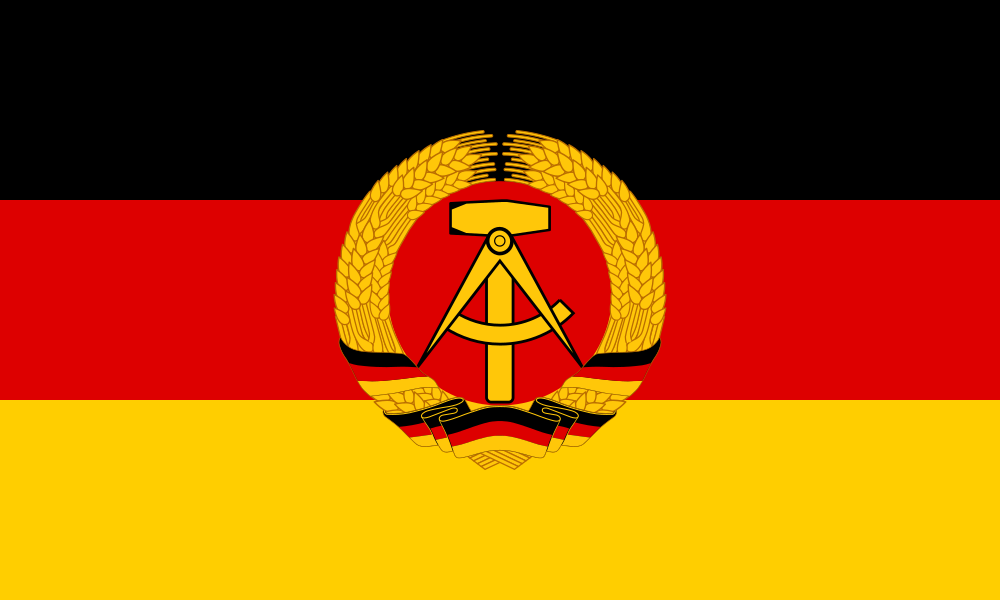
18. In so far as concerns the German Democratic Republic, we unreservedly support the exercise by the people of Namibia of its right to self-determination. The delegation of the German Democratic Republic therefore welcomes the draft resolutions introduced by the Chairman of the African Group and will vote in favour of them.
19. I should like to assure the Council that the German Democratic Republic will comply strictly with the decisions of the Security Council and the General Assembly, just as we have done hitherto with regard to South Africa and on the question of Namibia.
20. In deciding to vote in favour of the draft resolutions, we have been guided by the fact that the continuing illegal occupation of Namibia by the crpc~r-
21. The assertion that the application of sanctions against South Africa contradicts the solution of the question of Namibia by means of negotiations is untenable, from both a theoretical and a practical standpoint. The purpose of sanctions is to compel South Africa to carry out the relevant decisions of the Security Council and the General Assembly and to engage in negotiations on the subject.
22. We fail to understand how the representative of the so-called contact group, a country which maintains very broad economic relations with the apartheid rdgime, could declare that the ‘imposition of sanctions would turn the south of Africa into a region of instability, as a result of whidh international conflicts of unforeseeable dimensiofis might arise. The question arises, is this the threat to which we have become accustomed from South Africa, or is it the idea that the threat from South Africa is going to grow even greater? In that ca.se, logic itself dictates the imposition of sanctions against South, Africa. Or are these statements being made under the influence of one of the great Powers, which openly supports dictatorships like the one which exists in South Africa?
23. The delegation of the German Democratic Republic, in its decision t.o vote in favour of the draft resolutions which have been submitted, has based itself exclusively upon the need for the people of Namibia to be able to exercise its right to self-determination and to be given independence, and for the situation in that region, which poses a threat to peace, to be eliminated.
I now put to the vote draft resolution S/14459, sponsored by Mexico, the Niger, Panama, the Philippines, Tunisia and Uganda.
A vote H’NS taken by show yf hands.
In fcIvo~/~*: China, German Democratic Republic, ’ Mexico, Niger, Panama, Philippines, Tunisia, Uganda, Union of Soviet Socialist Republics
Against: France, United Kingdom of Great Britain and Northern Ireland, United States of America
Abstuining: Ireland, Japan, Spain
The wsult of the vote was 9 infc0’onr, 3 against und 3 abstentions. The drqft resolution was not udopted, the negutive votes being those of permanent members of the Council.
In ~NVOLII’: China, German Democratic Republic, Mexico, Niger, Panama, Philippines, Tunisia, Uganda, Union of Soviet Socialist Republics
Against: France, United Kingdom of Great Britain and Northern Ireland, United States of America
Abstuining: Ireland, Japan, Spain
The result of the vote was 9 in favor, 3 against and 3 abstentions. The druft resolution was not adopted, the negative votes being those of permanent members of the Council.
I now put to the vote draft resolution S/14461, sponsored by the Niger, Tunisia and Uganda.
A vote was taken by show of hands.
In fcrvou~: China, German Democratic Republic, Ireland, Mexico, Niger, Panama, Philippines, Spain, Tunisia, Uganda, Union of Soviet Socialist Republics
Against: France, United Kingdom of Great Britain and Northern Ireland, United States of America
Abstaining: Japan
The result qf the vote was 11 in frrvous, 3 agoinst and I abstention. The draft sesolution was not adopted, the negative votes being those of permanent members of the Council.
I shall now put to the vote draft resolution S/14462, sponsored by the Niger, Tunisia and Uganda.
A vote was taken by show of hands.
111 fuvow: China, German Democratic Republic, Ireland, Japan, Mexico, Niger, Panama, Philippines, Spain, Tunisia, Uganda, Union of Soviet Socialist Republics
Against: France, United Kingdom of Great Britain and Northern Ireland, United States of America
The result qf the vote was 12 in favour und3 against. The druft resolution was not adopted, the negative votes being those oj’ permanent members of the Council.
As draft resolution S/14463 depends on the adoption of the preceding draft resolutions, I am advised that it would seem unnecessary t0
30. There being no objection, it is so decided, and accordingly the draft resolution contained in document S/14463 will not be voted on by the Council.
31. I shall now call upon those representatives who have asked to be allowed to make statements after the voting.


The United Kingdom has from the outset been vigorously involved in the effort to achieve internationally . recognized independence for Namibia-this effort that has been in progress since 1977. We were one of the authors of the Western proposal [S/12636] which formed. the basis for Security Council resolution 435 (1978).
33. Throughout this arduous and protracted negotiation, the five Western Powers have drawn strength and confidence from the united support demonstrated by the Security Council, support which has also been a crucial factor in the strenuous efforts exerted by the Secretary-General and his staff to achieve the implementation of that resolution.
34. We bitterly regretted the failure of the preimplemen8atidn: meeting at Geneva last January, and we sympathized with the feelings of frustration and impatience which that setback inevitably produced on the continent o,f Africa, and indeed in the international community as a whole. Nevertheless, my delegation profoundly regrets the fact that the previous unity of the Council has been broken by the deep division which we have just experienced in the voting on the draft resolutions which were before us.
35. My delegation had worked until the very last minute to reach a compromise which would have preserved the unity of the Council. We and other delegations-including, notably, your own, Mr. President-which worked to the same end have, I am sad to say, failed. I state without reservation that a negotiated settlement leading to internationally accepted independence for Namibia remains the first objective of my Government-and, we trust, the first objective of all countries concerned for the future of Namibia and of the region.% is our intention to keep open, if at all possible, the prospects for such a negotiated settlement.
36, But it is our firm view that the imposition of comprehensive mandatory sanctions could not fail to hamper efforts to reach such a settlement. It was for that reason that we voted as we did. We voted against the draft resolutions before us because we believed
37. To those who have been tempted in the past, or who may be tempted in the future, to frustrate progress towards a peaceful, negotiated settlement, I say that the imperative of internationally acceptable independence for Namibia will not go away. The concern and the responsibility of the United Nations for Namibia will not go away. A continued denial of independence to the people of Namibia will perpetuate instability and bloodshed in the region. Only a settlement offers hope for peace and for stability.
38. Notwithstanding what has happened in the Council today, my Government will continue actively, with our partners in the contact group of five Western Powers, to develop ways to enhance the possibilities of the implementation of Council resolution 435 (1978). The search for peace and justice must continue, and the consensus of the Council on which we have all depended for so long must be re-established as soon as possible.


In my statement on 28 April [2275rh nzeering], I explained the position of my Government on the problem of Namibia and on the means for finding a solution to it. We are very disappointed at the delays and complications which have so far impeded the implementation of resolution 435 (1978). However, we remain attached to the United Nations settlement plan because we believe that the only reasonable and truly effective course is the search for a negotiated settlement which would be agreed to by all parties and acceptable to the international community.
40. As we have stated, we do not believe that recourse to comprehensive mandatory sanctions against South Africa would promote progress in the desired direction, Indeed, we believe that the adoption of such measures would run counter to the goal we seek, which is the resumption and intensification of negotiations designed to ensure that Namibia accedes peacefully to independence.
41. That is why we voted against the texts submitted, The way in which they were prepared, submitted and, as it were-let me be quite frank about it-imposed did not make their adoption at all likely, In such complicated subjects having such important and diverse consequences, rigidity and haste and the absence of negotiations on substance could only doom to failure even attempts that seemed to have some aspects that. merited more detailed study. A different approach was followed by the sponsors of resolution 418 (1977)l in November 1977, when the Council adopted that reso-t lution on the embargo on arms to South Africa. That resolution, I wish to stress, is still in force. The votes
43. South Africa should understand that very clearly, The French delegation expressed itself unequivocally on this subject also in the course of its statement of 28 April.
44. May I be allowed, at the end of your term of office, Mr. President, to pay a tribute to your perseverance, to your prudence and to your even humour -in short, to your devotion to your task, Up to the very last day you have sought, at a time which everyone will recognize was particularly trying, to preserve understanding and harmony in the Council. You have succeeded in large measure, and my regret will be that your efforts at conciliation have not won the success they deserved.
45. Namibia, I repeat, is one of the distressing problems which torment Africa and which, on all continents, trouble consciences. We understand and share the feelings of impatience of the Namibians, of Africans and of the whole international community. We are determined, for our part, to pursue indefatigably, with our partners in the group of five Powers and by maintaining contact with all the parties concerned, the action undertaken to emancipate Namibia. We want as soon as possible to see and welcome here amongst us in the United Nations an independent and sovereign Namibia, united and prosperous, at peace with itself and its neighbours; we shall not allow ourselves to be diverted from that goal.


Japan has on every occasion strongly condemned the illegal occupation of Namibia by the Government of South Africa. It has repeatedly stressed the need to achieve, as soon as possible, Namibia’s independence through South Africa’s withdrawal and through free and fair elections held under the supervision of the United Nations, as envisaged in Security Council resolution 435 (1978).
47. My delegation holds South Africa responsible for the failure of the Geneva meeting and for the consequent standstill in the implementation of the United Nations plan for enabling Namibia to achieve its independence within this year.
48. We fully understand the feeling among many delegations-particularly those of the African Statesthat too much time has already elapsed, with too little progress made towards a solution to the Namibia question, We share their sense of frustration at the seemingly endless succession of obstacles which have been thrown up to impede progress towards a solution.
51. As for the other draft resolutions, my delegation abstained in the voting because it has certain doubts, under the present circumstances, as to whether such sanctions would in fact be the most effective and expeditious means of achieving the desired end.
52. Before concluding my remarks, I should just like to say a word about the outcome of the vote on these four draft resolutions. Although each delegation will interpret the results in its own way, I am convinced that all members of the Council are earnestly and sincerely seeking to achieve an early solution of the question of Namibia. It is simply in considering which approach would be most effective in realizing this commonly cherished goal that a divergence of views arises. For its part, Japan is ready to continue to cooperate with all constructive efforts towards a peaceful solution of this problem so that the Namibian people will be able to gain their independence in the near future.
,53, Mrs. KIRKPATRICK (United States of America): In the previous discussions it was suggested that here in the public consultations the world could observe the attitudes of Security Council members towards Namibia, most especially towards the independence of Namibia. But the votes which have been registered here did not reflect attitudes towards Namibia, least of all towards the achievement of an independent, stable and democratic Namibia. Those votes reflected, rather, the views of members about quite different questions. Neither did those votes reflect the intentions of members about the future, or their future actions, concerning the independence of Namibia.
54. The voting here today in no way affects the determination of the United States or our firm intention to make every possible effort to find a way to achieve an early internationally accepted independence for Namibia, My Government has set that as a prime goal. We have already undertaken consultations in Africa, and we have met at a high level with other members of the contact group in London. With these actions we continue a process begun years ago by our predecessors. We will continue that process in the next few days with discussions of the Namibia problem at the ministerial level with our colleagues in the contact group in Rome. The next step will be the preparation
56. Following the meeting of the contact group in London last week, my Government participated in a joint statement [S/14457, annex] that Security Council resolution 435 (1978) continues to provide a solid basis for a transition to an independent, stable Namibia. Throughout the past week we have repeatedly restated that view. My Government is firmly committed to make every effort to achieve an internationally accepted, lasting settlement in Namibia which will bring Namibia finally the stability, democracy and independence it deserves.
57. It is for that reason that we could not support the draft resolutions contained in documents S/14459 through S/14463. Each of those drafts one way or another relates to sanctions, and therefore represents what we are persuaded is the wrong course towards the achievement of our common goal of independence for Namibia. We do not believe that economic sanctions are an effective means of influencing political policy. We believe the study of history supports our view that they were not effective when applied against Italy in the 1930s nor against Rhodesia in the 1970s. I might mention that my Government’s low regard for economic ,sanctions as an instrument of policy was reflected in our recent decision concerning the grain embargo,
58. I feel that I should make special mention of draft resolution S/14462, which would have imposed an arms embargo on South Africa. There is already such an embargo in existence as mandated by resolution 418 (1977). The United States voted for resolution 418 (1977) and supports the measures imposed under that resolution. We will continue to enforce the embargo. We do not at this time accept the need to adopt, in addition to resolution 418 (1977), the provisions of draft resolution S/14462.
59. I should like to close with an appeal to all present, and to the Governments of the front-line States and to South Africa, to strengthen their own efforts to find a peaceful, negotiated solution to the Namibia problem. The people of Namibia have a right to self-determination to be achieved by free and fair elections. The parties most directly involved have agreed to those principles for a solution. We must all now find a way to
61. The decisions of the Council were blocked primarily by the United States, but also by the Uniterd Kingdom and France, who sided by so doing not with free Africa, not with the Namibian people, but with the Pretoria racists.
62. Once again, we have today witnessed a glaring injustice done to the Namibian people. We have witnessed a further manifestation of the policy of indulging the South African racists, who once agaiin have won time and the opportunity to strengthen the puppet rCgime in Namibia. Even now, Prime Minister Botha has been saying that South Africa will never permit SWAP0 to come to power in Namibia. Behind those words there lies a whole strategy on the part of South Africa. That strategy is designed to preserve in Namibia the colonial, racist order as a bastion against the national liberation movements of southern Africa and as a springboard for the carrying out of furthler acts of aggression against neighbouring countries.
63. It is quite clear now that the Pretoria racists have no intention of leaving Namibia voluntarily. :In the circumstances, the expansion of intensification of efforts aimed at forcing South Africa to leave Namibia have now acquired particular significance in regard to forcing those who support the South African racists to refrain from such support. Everything possiblle must be done to intensify political and other kinds of pressure on South Africa and those who are in practice its allies.
64. In circumstances where decisions on Namibia are being blocked and thus the possibilities for bringing about a political settlement are being narrowed, tlhe Namibian people are left no other choice but to continue the armed struggle under the leadership of the South West Africa People’s Organization (SWAPO), That is a conclusion to which the front-line States and Nigeria came at the Lusaka meeting back in February Of this year when they stated that SWAP0 had lno alkrnative but to step up the liberation struggle in Namibia. They also appealed to all “freedomand , . peace-loving countries of the world to support SWAI’O i in all areas, including the provision of Dolitical. ec:o. I nomic and military a&stance.” 1


The people of Africa, in a document which has come to be known as the Lusaka Manifesto,’ addressed themselves soberly and squarely to the matter of liberation in southern Africa. They clearly stated that Africa’s preference would be to achieve liberation in southern Africa through peaceful means, that we would like to see the people of that region enjoy self-determination and freedom through a negotiated process. That was made ‘very clear. However, the people of Africa naturally said that in the event that other forces within and outside the continent of Africa obstructed the process of peaceful change, then the oppressed people of southern Africa and the rest of the peoples of the world who stand in solidarity with them would be left no choice but to employ other methods.
70. In spite of that we did not come to the Council to ask for a commitment of troops. We did not come to the Council to ask that an ounce of blood be spilled. In the spirit of the first principle of the Lusaka Manifesto we came to the Council asking for peaceful methods of change: asking that peaceful pressure be applied in order to dislodge the illegal occupying Power from Namibia, and in order that the people of that Territory may achieve its independence. We have come to the Council because of a global consensus-a global consensus which has been expressed with a clarity, with a forcefulness, with a power unprecedented in the history of the Council.
67. We have therefore come to the Council in the continuing process of implementing the first principle of the Lusaka Manifesto. We have come to the Council on behalf of a people which is aggrieved. We have come to the Council on behalf of a people which is the injured party in this situation. We have come to the Council after having waited for 100 years. We have come to the Council after having tried every measure outside the context of the United Nations, within the United Nations in the context of the General Assembly and, finally, here at the highest authority of the United Nations; here at the repository, the guardian, of international peace and security-the Security Council. We have tried here for over 15 years every measure to achieve independence and self-determination for the people of Namibia. After that period of waiting, we have come to the Council; and we have come to the Council with every bit of available evidence.
71. We have therefore come to the Council not on behalf of a few delegations around this table; not on behalf of the people of Africa, even though they are numerous; not on behalf of the people of Asia, even though they are the most predominant. No; we have come before the Council to present a clear, unequivocal, global consensus.
72. And what has been the response? The predominant members of the Council have seen the consensus. They have responded in the only way that is right: they have agreed with the verdict of the international community that peaceful pressure be applied against South Africa because of its oppression of the people of Namibia and its continued illegal occupation.
68. We have told the Council and the peoples of the world that there exists today in Namibia and the area surrounding it a breach of international peace and security. We have come to the Council and presented evidence that there have been constant acts of aggression against neighbouring Territories launched from the Territory of Namibia by the illegal occupying Power. We have told of the atrocities, of the bombardment, of the destruction; in short, we have told ofthe suffering of the people of Angola, the people of Botswana, the people of Lesotho, the people of Mozambique, under the fire of the messengers of death sent by South Africa and launched from the Territory of Namibia.
73. That has been the concurring verdict. of the majority of the Council. However, in 1945 there was put into the Charter an element introducing the notion of weighted voting. It was thought then that some members of the international community had greater responsibility for maintaining international peace and security and therefore ought to be given a weighted vote, a heavier vote.
69. We have done more than that. We have indicated to the Council that it has a responsibility under the Charter of the United Nations, which is the highest law on this earth-and maybe even in heaven. We have indicated that the Council has a responsibility under
74. What have we witnessed today? The weight of those votes has been cast not to reinforce the global consensus, not to facilitate the independence of the
76. Therefore, a negative vote in the face of the plea of the people of Namibia means one thing and one thing only: it is to strengthen the hand of the occupying Power. That is the signal. It is to give comfort to the forces that have been intransigent and that have flouted every decision of the Council. A negative vote today does not strengthen international peace and security, A negative vote today does not speak for independence, for freedom and for self-determination.
77. Those are the objective consequences and implications of the negative vote cast here this evening.
78. When we made our plea, when we presented our evidence, it was said that we were seeking confrontation. When a victim has been violated: when somebody has been raped, as the people of Namibia have been raped; when a people has been robbed, as the people of Namibia have been robbed; when such a victim goes before the court asking for redress, asking for a remedy, does the court turn around and say: “You the victim of this crime are seeking confrontation: you are seeking to disturb the peace”? When the victims have come here with the Charter in their hands-with peaceful meansquoting, the prdv’isions of the Charter, does the Council turn around and say: “You are seeking confrontation”?
79. It has been said that we are impatient. I should like to be told in the Council what other people has waited 100 years to have a grave wrong redressed‘? What other peop&has remained calm for 100 years, without fighting to&t.its independence?
80. We have waited, we have waited to a fault, we have waited to the point of absurdity.
81. It has been said that when we come to the Council asking for redress, we are disturbing the unity of the Council. But we came to reinforce the unity of the Councif. We did not choose unilateral methods outside of the Council. We came to the Council asking for collective action. Collective action means unity of the Council. It is the negative votes that have rebuffed the possibility of collective action this evening. It is
82. We have come to seek unity on that basis, and wle have been rebuffed this evening.
83. It has been said that certain documents have been imposed on the Council. It is common knowledge that since the debacle of Geneva we have sat waiting: we have sat discussing; we have discussed for months; we were discussing even a few minutes before thi’s meeting of the Council started. We have left the door open at every stage to listen to every person who had anything positive to contribute to the independence of Namibia. We have not imposed anything on the Council. Measures have been taken by the Council on shorter notice than the notice we have given. We gave notice in January in New York; we continued to give notice in January at Arusha; we gave notice in February at New Delhi; we gave notice at the end of February at Addis Ababa. We came back to the General Assembly and the Assembly with a collective voice gave notice [resolutiwz 3512271. Earlier this month at Algiers we gave notice; and again on 21 April we gave notice when my delegation opened the debate [2267th meeting]. We have given notice; we have given plenty of time to all concerned about our intentions, about our concern and, above all, about our grievance. We have not imposed anything on thie Council.
84. It has been said that sanctions do not,work. Well, if sanctions do not work, why would three permanent Powers on this Council cast the heavy weight of their vote against measures which would not work anyway? Why? Why have those Powers since 1966 been fighting tooth and nail to prevent discussions of these measures in the Council? If the measures do not work anyway, why have we been consulting even, at one-half second to the twelfth hour? Why have we been consulting if those measures do not work?
85. Those are inconceivable notions both in logic and in political terms and, above all, in terms of the independence and ,freedom of the people of Namibia!.
86. On behalf of the people of Africa, on behalf of the global consensus, to which ,I referred earlier, and, above all, on behalf of the aggrieved people of Namibia, we reiterate that Namibia continues to be the responsibility of the United Nations. It continues to be the unique responsibility of the United Nations, and no amount of words, no amount of vetoes can shake awa.y that responsibility.
87. In that connection, I reiterate to the Counc:il -in the name of that global consensus-that we view
95. This evening, to my regret, we reached the stage where it was necessary to cast our votes on those draft resolutions, and I want to make a statement on the positions we have taken.
89. It was Prime Minister Botha-the racist Prime Minister of South Africa, whose hand has been strengthened this evening-who said yesterday, in the open and in public, that under no circumstances would they sit back and watch SWAP0 take over government in Namibia. The message is clear. It is clear to everybody, including the scientific researchers of South African intelligence, that if free and fair elections were held today in Namibia, and tomorrow, and the day after, SWAP0 would sweep the slates. SWAPO, the representative of the Namibian people would lead them to independence,
96. Ireland believes that South Africa’s illegal occupation of Namibia and the consequences that flow from that occupation do indeed constitute a threat to international peace and security, We believe that South Africa must be obliged to respect the decisions of the Council and to carry out what are clearly its obligations under the Charter of the United Nations and its obligations in general in international law.
90. We are committed to any party leading the people of Namibia through the democratic process. For that reason we are committed to the implementation of resolution 435 (1978). And that is the reason why we have come before the Council. We shall continue to use every possible method to ensure that South Africa is compelled to comply with the provisions of that resolution.
97. My delegation has no doubts about the points I have just stated. Nevertheless, we thought it right to make a sustained effort to avoid division in the Council. At this, my last meeting as President for this month, I make no apology for this effort, I felt it to be my duty to do so as representative of Ireland and also-although I do not now speak in that capacity-as President of the Council for this month. In our effort we were motivated solely by the desire that the Council send a clear signal to South Africa of a continuing unity of purpose here and a common determination to see Namibia independent in accordance with .the previous decisions of the Council.
91. May I finally say on behalf of the people of Africa and the international global consensus, and in the name of the people of Namibia, that we are most grateful for the remarkable work which has been done by the United Nations Council for Namibia. We are grateful for the high contribution which has been made by the Secretary-General in a continuous attempt to speed the process of independence for the people of Namibia.
98. In working, over several days, to see how division in the Council might be avoided, my delegation tried to establish whether we would arrive at a common position, whether there were certain principles and elements on which all delegations could, even with difficulty, agree, so that a common position might be established. The ideas we put forward in discussion did not necessarily represent what Ireland itself would have put forward as its own preferred national position, but rather what we hoped might be a focus of agreement for the Council as a whole. Since it did not prove possible to reach such a general agreement, we have proceeded to the vote on the draft resolutions before us, and my delegation has expressed its national position in voting on those draft resolutions. That position is based on the belief that when it comes to a vote each, member of the Council should by its vote send South Africa a signal of firmness of purpose here and of the will of the Council that its past resolutions should be implemented. Accordingly, we voted for two of the draft resolutions before us-draft resolution S/14461, which if adopted would have imposed an oil embargo, and draft resolution S/14462, which would have strengthened the arms embargo already
92, Above all, we pay a tribute this day-even in the face of the negative vote-to SWAPO, the sole and legitimate leader of the Namibian people. I say on behalf of this global consensus to the people of Namibia and to SWAPO, “Do not fear. History is on your side. The same momentum that,defeated the Nazi Powers, the same momentum that removed occupying Powers from Europe in the 1940s-that same historic momentum is on your side, It will remove the occupying Power which is today boasting in the Territory of Namibia. Justice is on your side. Your cause is right.” And because it is right we must pursue it relentlessly, all of us, and I invite my distinguished friends, those with the wei,ghted vote, those with the heavy hands, to join us in the global consensus.
I have received requests to speak from three delegations that have been invited under rules 37 and 39. However, as a member of the
99. However, because such measures, had they been adopted, would have been binding on all member States, I must say that my delegation would have welcomed adequate consultations in advance on these important texts. In particular, we believe that the Council could have indicated in advance its intention to honour its obligations under Article 50 of the Charter -that is, its obligations to States which might be confronted with special economic problems in carrying out those measures.
100. Draft resolution S/14460/Rev.l, if it had been adopted, would have imposed comprehensive economic sanctions as well as sanctions of a political nature. My delegation abstained on that draft resolution, In doing so we took account of what we believe is a widespread feeling among members of the Council that further immediate efforts to bring about the implementation of resolution 435 (1978) are required. We do not believe that the imposition of comprehensive sanctions at this time would necessarily advance those hopes, We believe, rather, that it was appropriate for the Council to indicate to South Africa the seriousness with which it would view further delay but to retain for possible later decision certain other measures under Article 41 which might be used if South Africa should remain wholly intransigent and unwilling to meet its clear obligations in international law.’
101. Furthermoya, I must say that, while Ireland itself does not have diplomatic relations with South Africa, it is our view that proposals to terminate all diplomatic relations at this stage do not seem to be consistent with continuing diplomatic efforts to implement resolution 435 (1978).
102. For those reasons we abstained on draft resolution S/14460/Rev.l. I would wish to emphasize, however, that our abstention does not necessarily mean that we are opposed in principle to many of the measures proposed. Indeed, some of the provisions-for example, operative paragraph 13, on investmentcorrespond closely to proposals which we ourselves have advocated elsewhere.
103. In consequence of its decision to abstain on draft resolution S/14460/Rev.l, my delegation also felt obliged to abstain on draft resolution S/ 14459, since operative paragraph 5 of that draft resolution involved a decision to adopt comprehensive economic and political sanctions at this time,
104. I must conclude this statement by expressing the strong hope of my Government and my own hope as representative of Ireland that despite the outcome of the voting this evening and despite the division in the
105. That is the end of my statement as representative of Ireland. I shall now resume my role as PRESI- DENT of the Council.
106. The Council has at this stage concluded the voting procedure. There are, however, a number of requests to make statements and I shall now call on speakers in the order in which their names are inscribed.
107. The first speaker is the Acting President of the United Nations Council for Namibia, to which the Council has extended an invitation under rule 39 of the provisional rules of procedure.

In making a statement in my capacity as Acting President, I should like to express the gratitude of the delegation of the United Nations Council for Namibia for the opportunity which has been given us to speak at the end of this debate on the question of Namibia.
109. The participation in this debate of a large number of Ministers for Foreign Affairs from African and nonaligned countries is a striking expression of the very deep concern of those countries at the,refusal of South Africa to comply with resolutions of the Security Council, in particular its resolutions 385 (1976), 4.35 (1978) and 439 (1978).
110. The tragedy of Namibia has been examined in all its facets during this debate. A broad convergence of views emerged in the analysis and the evaluation of the situation. The same convergence of vie,ws appeared in regard to the need for the Security Council to adopt comprehensive mandatory sanctions which / would compel South Africa to put an end to its illegal occupation of Namibia and to abide by international / law.
111. The United Nations Council for Namibia deeply regrets the fact that the Security Council today lost the opportunity offered to it to carry out its mission of maintaining international peace and security because of the negative votes cast by permanent members of the Security Council. This fact has made it impossible for the Security Council to take the measures dictated by the persistently defiant attitude of South Africa, measures through which the Security Council would have given shape to the warning which it had already given the Government of South Africa in 1978, in its resolution 439 (1978).
113. The adoption by the Council of comprehensive mandatory sanctions against South Africa would have formed a natural and logical part of that warning. It would also have been an expression of the strong determination of the Council to bring about the implementation of the United Nations settlement plan for Namibia, which South Africa continues to defy.
114. All those who had expected those countries to act in keeping with their special responsibilities, in keeping with their influence over the Government of South Africa and in keeping with the commitments they had solemnly made vi&vis the international community, are deeply disappointed by their attitude today.
11.5. Likewise, all the members of the international community which have mobilized to bring about the triumph of the cause of the self-determination, the freedom and the independence of a united Namibia have experienced deep disappointment and express their disapproval.
116. The Namibian people, embarked upon a legitimate struggle to regain its national rights, will use the measures of the scope and the level of the debates to judge the impact made by its cause on the international community and the determination of that international community to support its just struggle for the independence of its homeland.
117. Since permanent members of the Council have cast their veto, it has not been possible to translate the draft resolutions containing comprehensive mandatory sanctions against South Africa into formal decisions that would be binding upon the international community as a whole. But that in no way diminishes their moral significance or even their political weight.
Mr. Peter Mueshihange, Secretary for Foreign Relations of the South West Africa People’s Organization, to which the Council has extended an invitation under rule 39 of its provisional rules of procedure, has asked to make a statement. I now call on him.
119. Mr. MUESHIHANGE: I thank the members of the Council for granting me the opportunity to speak once again; I shall make a brief concluding statement.
120. I should like to begin by saying that, in our view, this has been one of the most substantive and polit-
12 1. Moreover, it was stressed and repeated time and again that there is nothing wrong with the United Nations plan for Namibia, and that consequently there is absolutely no need to amend, modify, qualify or dilute resolution 435 (1978). Africans, and the rest of the representatives of the countries of the non-aligned movement-as well, indeed, as the representatives of the other friendly countries-insisted that the aforesaid resolution should be implemented without any further delay.
122. Nearly all the delegations which participated, with the obvious exception of the veto-mongers, called the attention of the international community, and of the Council in particular, to the gravity of the situation in Namibia because of the persistent acts of aggression and breaches of the peace being perpetrated in and around the illegally occupied Namibia by terrorist South Africa, and to the consequent serious threat to international peace and security.
123. An urgent call was issued urging the Security Council, acting under Chapter VII of the Charter of the United Nations, to impose comprehensive mandatory sanctions against the defiant South African rCgime in order to force it to vacate Namibia forthwith. It was said that these special meetings of the Council were to intensify political and economic pressures against South Africa in a concerted international effort, in which States Members of the United Nations, the specialized agencies, and the rest of the international community would actively participate so as to bring maximum pressure to bear on the racist apartheid rCgime.
124. In clear and categorical statements, representatives underscored the obvious, but often distorted, fact that the problem of Namibia is a problem of decolonization and illegal occupation, and that the Namibian patriots, under the leadership of SWAPO, their sole and authentic representative, are waging a heroic and legitimate struggle to liberate by all means available, including in particular armed struggle, their beloved fatherland, Namibia.
126. The South West Africa People’s Organization itself would not have been necessary had it not been for South Africa’s policies of colonial oppression, political repression and military aggression in our country. The armed struggle being waged today in Namibia by the gallant combatants of the People’s Liberation Army of Namibia (PLAN) has been necessitated by the victimization, terrorism and intimidation to which our people are daily subjected by the Fascist army and police serving the combined interests of racism and imperialism. Our people die daily to make Namibia safe for ruthless exploitation of its human and natural resources by South Africa and by the major Western Powers whose representatives are sitting around this table.
127. I should like to say that this is not the first time we have been treated to vetoes by the Western permanent members of the Council. There have been other vetoes in the past. Routinely, the major Western Powers which are involved in business, military and nuclear collaboration with racist South Africa have always opposed, in the Council and in other United Nations bodies, all serious efforts to isolate and punish South Africa. Their actions speak louder than their deceptive a,nd hollow words, and their actions are always intended to protect their imperialist treasures in southern Africa.
128. It is not,,my inten$ion to try to summarize the excellent stat&~fits:,m~de by various’ speakers in this debate by,$0hthiit.. matter, to restate S WAPO’s position, which is well known. Suffice it to say that on 6 June 1975 [1829fh /neeri/zg], the delegations of Guyana, Iraq,’ Mauritania, the United Republic of Cameroon and the United Republic of Tanzania submitted a draft resolution in document S/11713. For the first time on the question of Namibia, the three Western permanent members cast a triple veto, killing the wish of the democratic majority in the Council. Sixteen months later, on 15 October 1976, the delegations of Benin, Guyana, the Libyan Arab Republic, Pakistan, Panama, Romania and the United Republic of Tanzania submitted another draft resolution, in document S/1221 1. Again, the United States, the United Kingdom and France ganged up to cast a triple veto [/963rd meeting].
129. Now we have come back to the same Council, again charging the occupationist rbgime with continued illegal occupation and other illegal acts of aggression, terrorism and brutality, charging it also with wanton acts of repression and intimidation, charging it further with an open challenge to the United Nations, which has assumed a direct legal responsibility over Namibia,
I 12
130. We have listened most attentively to all the speeches, including, Mr. President, your own most inspiring and courageous speech. The weight is unmistakably in favour of those who called for punitive measures against the Pretoria racist rkgime. Four years have passed, and we have heard the same sterile reasoning and empty promises repeated by South Africa’s friends. Four years have passed, and we have just witnessed another round of the triple veto. Again, the arrogance of power of a minority has undermined the actions of the majority of the Security Council and-it must be said-has again rendered it impotent,
131. In 1975 and 1976, SWAP0 spokesmen declared and reiterated in the Council that vetoes can only delay our final victory but cannot, and will not, forever defer that victory. We said that vetoes cannot, and will not, destroy the will and determination of our patriots and combatants to carry on with the struggle. We shall continue to intensify the armed struggle, and we know that support and assistance to SWAP0 from our friends will be continued and increased. How can they veto our will to fight for freedom and liberation? They cannot, and they will not.
132. Before I conclude, may I, in complete loyalty to my own convictions, and with an acute sense of satisfaction, thank all our African brothers and non-aligned 1 friends and the other delegations on the Council for their total devotion to the cause of Namibia and its ’ independence. I feel a. strong sense of pride in extending, congratulations and good wishes to Ambassador Otunnu of Uganda for the exceptional skill and leadership which he brought to bear in the public and private a.ctivities during this debate relating to Namibia; He is my brother, the tallest and the biggest tree among us,
133. We owe a debt of gratitude to all the Ministers for Foreign Affairs and other high officials who have ’ come here to make their outstanding contributions. To 1 South Africa’s friends, some of whom, without - knowing us, or without exchanging as much as a hollow 1 “How are you?“, call us either “terrorists” or “a I mixed bag”-whatever that means-we say once ; again: the onus is on you to demonstrate the courage of your convictions if you want to see a genuinely indei pendent, stable and democratic Namibia-which is ! certainly to be, with or without you. Now, as always in the past, your actions speak for themselves. YOUI F steadfastly remain in cahoots with South Afriqa; pou have, by your actions, omissions and commissions; I
turned us into your adversaries, We know you are very I . powerful, but we assure you that one thing that you or 1 racist Boers cannot take away from us is the love for our fatherland and the commitment to our people. For r these ends we are ready, prepared and willing to /
134. When Namibia achieves liberation, then we shall differentiate between those who stood with us during the days of the bitter struggle and those who actively participated in the depletion of our mineral resources, armed and supported our enemy and belittled our sacred cause.
135. We-and, if not we, then future generations of Namibia-will live to record the attitude and behaviour of the major NATO Powers towards the cause of the oppressed people of Namibia. SWAP0 strongly denounces and rejects this hostility against our legitimate struggle by the imperialist Powers.
136. In conclusion, Mr. President, we want you to know that your presidency as it related to the debate on the question of Namibia was exemplary and imaginative, I thank you personally for your kind consideration and co-operation in this regard.
137. From here we proceed to the combat zones, fortified in the knowledge that the majority of humankind supports our cause and that it is indeed the cause of the international community. In this context, I wish to renew SWAPO’s commitment to continue to cooperate with the ‘Secretary-General of the United Nations in iris tireless efforts to hasten Namibia’s independence.
138, Victory is certain.
The next speaker is the representative of Cuba. I invite him to take a place at the Council table and to make his statement.


Mr. President, I should like to thank you and the members of the Security Council for allowing me to speak at the end of this historic day.
141. I speak in my capacity as Chairman of the Group of Non-Aligned States at the United Nations in order to state clearly their position in the face of the veto cast by the representatives of the United States of America, the United Kingdom and France regarding the call for sanctions against the racist, terrorist regime of South Africa because of its defiance of the majority will of the international community by its refusal to put an end to its illegal occupation of the Territory of Namibia and to abide by the decisions and resolutions of the Council and of the General Assembly.
142. All that is relevant with regard to the delinquent conduct of the Pretoria racist regime which makes it an international outlaw and a violator of the principles
143. The indisputable truth of the facts stated by them in the Council should have given us reason to hope for a result different from that of the voting which took place earlier here. We should have thought that the political and moral weight of the grave criminal, terrorist and aggressive acts perpetrated by the Pretoria racists against the Namibian people and the frontline States, as well as the barbaric oppression of the black people of South Africa, would be sufficient to dispel any doubt, should any reason for doubt still have remained. Regrettably, the veto was once again resorted to against the freedom, self-determination and independence of the people of Namibia. And it is those very Governments which, because of their close links with the South African regime, can use their influence on that regime to compel it to comply with United Nations decisions and resolutions that have used their veto to give validity to the illegal occupation of Namibia, the acts of aggression against Angola, Mozambique, Botswana and Zambia and the very survival of the South African regime’s monstrous system of apartheid.
144. Thus, the Security Council-the supreme organ charged with the maintenance of international peace and security-far from putting an end to the reprehensible acts of the Pretoria regime, which have been condemned by the overwhelming majority of mankind, encourages that regime’s policy of aggression and terrorism by fanning the flames of war in southern Africa. It is indeed a heavy responsibility for this principal organ in the United Nations to have its hands tied even when it comes to implementing the tenets of the Charter.
145. There should be no hesitation in the minds of the members of the Council about the scope of what has happened to human rights and to principles that are the very basis for the existence of the United Nations. This is not, nor could it be, the way to establish peace and security in the southern part of Africa, nor to bring about justice in international relations, nor to guarantee the independence, sovereignty and territorial integrity of the States of the region; and even less to ensure that they live together in peace and friendship. On the contrary, the use of the veto pushes further away the time when an end will be put to the causes of instability, insecurity, war and oppression in southern Africa.
146. In fact, the only universally respected course that can be taken in this case is strict compliance with Security Council resolution 435 (1978): the United
147. The non-aligned movement-which, from its very first summit conference held at Belgrade in 1961, has expressed complete solidarity with the struggle of the African peoples to achieve national independence and to rid themselves of colonialism and which in every international body has repeatedly stated its firm support for the peoples of Namibia and South Africa-cannot fail to repeat once again on this occasion its resolute support for SWAPO, the sole and legitimate representative of the Namibian people, in its struggle to obtain national independence, and to the liberation movement of South Africa, in its just struggle against the apartheid regime.
148. But at the same time, I feel in duty bound to reject most energetically-because of its injustice and because of the serious consequences that it might have-the veto exercised today against the legitimate demands not only of the majority of Member States, not only against the Security Council, but also against the United Nations. These sanctions should have been applied to the racist, aggressive and terrorist rCgime of South Africa, but the voice of the people will never be silenced, and the people of Namibia can rest assured that it will take its proper place in the concert of free, independent and sovereign nations.
NOTE 149. The PRESIDENT: There are no further speakers. The Security Council has thus concluded the
Litho in United Nations, New York 00300 86-611034une 1988-2,050
151. In my capacity as President I had hoped to preside fairly and courteously over the decisions and work of this Council. I confess freely that I had a second hope: to maintain unity in the Council on this issue. I regret that we have not been able to achieve that second aim and I hope that the members of the Council will understand and extend tolerance and forbearance to my efforts to achieve it. I should like to thank all of them for their co-operation during our presidency.
I See Offiinl Records of t/w Cctwrtrl A.ssc~tddy, Tworry-forrrfh Sessiotr, A~wxes, agenda item 106, document A/7754.
▶ Cite this page
UN Project. “S/PV.2277.” UN Project, https://un-project.org/meeting/S-PV-2277/. Accessed .