S/PV.2302 Security Council
▶ This meeting at a glance
19
Speeches
11
Countries
1
Resolution
Resolution:
S/RES/491(1981)
Topics
Global economic relations
Diplomatic expressions and remarks
Security Council deliberations
General statements and positions
UN procedural rules
War and military aggression

The Council will now consider the report of the Committee on the Admission of New Members concerning the application of Belize for membership in the United Nations [S/147031.
Provisional agenda (S/Agenda/2302)
4. The first speaker is the representative of Guatemala, whom I now invite to take a place at the Council table and to make his S~ak3kIIcn~.
1. Adoption of the agenda
2. Admission of new Members: Report of the Committee on the Admission of New Members concerning the application of Belize for membership in the United Nations (S/14703)
5. Mr. CASTILLO ARRIOLA (Guatemala) (ittterpwtatiott jkrtt Spanish ,. The delegation of the Republic of Guatemala wishes to thank the Council for inviting it to participate in the discussion concerning the admission of Belize lo membership in the United Nations. The Council has thus recognized that this matter affects the interests of Guatemala as a State Member, pursuant to rule 37 of the provisional rules of procedure of the Security Council. Belize’s application for admission’ is beink considered in accordance with chapter X of those rules.
Thr tttwtittg wus culled to order ut 5.20 p.ttr.
Adoption of the agenda
Thr agrudu wts udopwd.
6. On 10 September, Guatemala requested the President of the Council [S//4683] to draw its attention to the territorial dispute between the United Kingdom and my country with regard to Belize. We did so in the conviction that the turn of events with regard to the independence of Belize could lead to international friction and, according to developments, might even lead to a threat to the maintenance of international peace and security. The Council, through a procedure of informal consultations, decided at that time not to be seized of the matter before the independence of Belize, and we were so informed by &he President of the Council and by the Secretary-General. We were led to believe that that decision rested on a legal criterion according to which the procedures for the admission of a new State to the United Nations cannot be interrupted.
Admission of new Members: Report of the Committee on the Admission of New Men&xx concerning the application of Belize for membership in the United Nations (S/14703)
Vote:
S/RES/491(1981)
Recorded Vote
✓ 15
✗ 0
0 abs.














In accordance with the decision taken at the 2301st meeting, I invite the representative of Guatemala lo take the place reservel for him at the side of the Council chamber.
I wish to inform members of the Council that 1 have received letters from the representatives of Barbados, Nicaragua and Saint Lucia, in which they request to be invited to participate in the discussion of the item on the Council’s agenda. In conformity with the usual practice, I propose, with the consent of the Council, to invite those representatives to participate in the discussion, without the right to vote, in accordance with the relevant provisions of the Charter and rule 37 of the Council’s provisional rules of procedure.
7. We found that position of the Council strange. Of course, our request did not refer precisely to the admission of Belize, since when we submitted it to the Council, Belize had not yet become independent. So the Council was considerably anticipating events.
8. The situation I have described led Guatemala to lodge a protest with the Council, because it understood
that rule 3 of the Council’s provisional rules of procedure had not been complied with, since a meeting was not called but, rather, informal consultations were held. In that protest we stated that our only alternative was to express the opposition of the Republic of Guatemala to the admission of Belize. By that act, formally and Ilnder instructions from OUI Governmsnt. we ratified i Jr categorical opposition to the admisoion of Belize.
9. Despite the aforementioned considerations, we believe that what is essential at this time is to record the damage done to the interests of Guatemala, damage which is now recognized by the Council, since it has invited us to participate in this discussion.
10. This is not the right time for a new and complete presentation of the controversv between Guatemala and the United Kingdom, but we shall refer to it briefly for the information of the Council. Many United Nations documents contain an account of our rights. Year after year during thq general debate with which every Assembly begins, our Ministers for External Relations or our other representatives have put our case and have consistently, regardless of the ideology of the Government in Guatemala. entered exoress reservations with regard to our rig&s and made-their voices heard in calling for justice. The records of the Fourth Committee of the Assembly are also filled with statements of our representatives about this problem. I must also say that from the moment the United Nations was founded in San Francisco in 1945. the delegation of Guatemala has drawn attention to the existence of this question and has indicated our position as a country which had become the victim of plunder by a stronger opponent.
11. The present Government of the Renublic of Guatemala; presided over by General Pemando Romeo Lucas Garcia, has declared since the beginning of its administration that it would seek a solution to the problem of Belize through civilized and oeaceful means. That statement has served as the basih for the policy to be pursued by Guatemala. Thus, fully in keeping with the Charter of the United Nations, Article 33, it decided on the procedure of direct negotiations with the United Kingdom. Through that procedure we subscribed to the Heads of Agreement which we agreed to in London on 11 March 1981, containing a complete programme of points to be developed, in which Guatemala saw not only a solution to the problem of Belize, but also an instrument that would lead to the consolidation of international peace and security in the northern part of Central America. Guatemala believed that, since there were already so many situations of disturbance, unrest and hostilities in the Central American isthmus, the best action that we could take for the benefit of the population of our countries was to ensure peace in an important sector of the region, In order to do so, we had to sacrifice part of our national interests, but it was considered that the safeguarding of peace was paramount. The Heads of
Agreement, with their 16 points, form a pact which, had it been complied with and implemented, might possibly have led to the realization of the ideal of peace.
12. As is well known, the treaties which should have implemented the Heads of Agreement could not be signed. Questions of petty politics, incidental points devoid of substance when compared with the magnitude of the achievement which could have been undertaken, prevented that. Guatemala is blameless in that respect. We have at all times and consistently observed the clear and specific text of the terms of the Heads of Agreement, It was others who distorted them and put forward specious interpretations and tried to subject what had already been agreed to new negotiations of haggling and distortion.
13. In view of the failure to comply with the Heads of Agreement, a compliance which was a pre-condition for ending the dispute and which could have led to an independent Belize recognized by Guatemala and therefore to recognition of the borders enshrined in the treaties, Guatemala fears that a new centre of tension may have been created in Central America. We draw the attention of the Council to, among other things, three points of special importance: the first is the continuing existence of the controversy; the second is the creation of the new State of Belize as an entity capable of joining the United Nations; the third is the position of that new State within the framework of the Central American environment.
14. When we drew the attention of the Council to the controversy regarding Belize, we did so not only on the basis of Article 35 of the Charter, which gives us the right to do so, but also with the hope that the discussions in the Council would shed some light on a situation which was obviously difficult. Moreover, we feared, and apparently rightly so, that by granting Belize independence, the United Kingdom would try to escape its serious historical responsibilities and would claim that the resolution of the dispute would remain outstanding as a matter to be resolved between Guatemala and Belize.
15. To a certain extent that is a familiar situation, since the old colonial Powers always tried to evade the responsibilities which they had incurred after centuries of exploitation and plunder of wealth, which in this case also included territory. We cannot conceive of a more unjust situation than to leave behind the new and feeble State of Belize in a state of continuing confrontation with the Republic of Guatemala. It is obvious that this unbalanckd situation constitutes an invitation to third countries to become the patrons, the genuine or officious protectors of Belize. turning a region of Central America into a happy hunting ground for the bold and ambitious. That is the last thing we wanted. Since the dispute has not been settled, we must continue to search for the means to resolve it, but we must continue this effort, without interruption or change, with the United Kingdom as the inter-
16. We can endol.se the concepts contained in the Secretary-General’s report on the work of the Organization, in which he urges Governments to make full use of the United Nations “as an instrument placed at the disposal of the international community to help solve, or at least to control” problems of this naturea
17. Our approach to the problem of Belize has been a positive one, and for that very reason it has been .._. _- disappointing for the people of Guatemala to see that the Council has not been seized of the dispute because now, in the face of JMs rccranr~lis, it must evolve together with the policy of Guatemala.
21. A corollary of this juridically abnormal situation was the declaration that the Government of the Republic of Guatemala felt compelled to make on 20 September with regard to the independence of Belize:
18. We note with alarm the irresponsible and selfish attitude of the United Kingdom and we hope that it will not confirm our fears. We are referrir.2 to the phrase contained in the press release of the Security Council dated 18 September, which stated that negotiations must continue between the Governments of Guatemala and Belize with the co-operation of the United Kingdom. That is absolutely unacceptable. The United Kingdom through its actions created the situation which gave rise to the dispute, and the Council cannot now try to cover it with the cloak of a mere benevolent collaborator in the search for solutions. The Council is here trying to cover up the past of the United Kingdom and present it to us as freeof all blame and responsibility.
19. In addition to the fact that Guatemala cannot share that strange point of view, a new State is being created on territory which belongs to someone else, and what it first inherits is a dispute with a neighbour. We are certain that none of the doctrines existing in any institution relative to the succession of States under international law allows for one of the parties to a dispute to run away from the dispute through the skilful use of the procedures of decolonization. That is why Guatemala declares that, since tl?!: dispute has not been settled, it will continue toseek peaceful forms of settlement, but it will always view the United King dom as a primary party, absolutely and directly responsible for the origin of the dispute and its solution.
20. We have said before that it is also necessary to determine by analysis whether Belize, having been given independence, qualifies for admission to the
“The Government of the Republic, given the illegitimate and arbitrary act on the part of Great Britain in granting independence to the Territory of Belize, makes it known to the people of Guatemala:
“That the Constitution of the Republic is clear ;cnd categorical in stating that Belize is part of the territory of Guatemala, and the unilateral proclamation of Belize’s independence in no way changes our position, nor does it diminish our rights over that part of our fatherland, which was usurped by Great Britain many years ago.
“The proclamation of the independence of Belize represents one more tdrce of British colonialism, an effort bv Great Britain to evade its resnonsibilities, leaving behind an unpleasant memorv-and a State of Belize which deoends on British m&tarv power. In that way and under the guise of respeit for the right to self-determination of peoples, Great Britain is maintaining its neocolonialist presence on the American continent.
“Pursuant to the Constitution of the Kepublic. which provides that ihe executive must take whatever steps are available to it to resolve the situation of Belize in conformity with the national interest, the Government of Guatemala has been consistent
in ilh conjuror rognrding the solution of that problem nnJ considers that the best way to safeguard the inlcrssts of [he nation is to preserve peace and take *\cpb in keeping with the norms and principles of inlcrni~tioniil Iuw.
“‘l’hc process of direct negotiations with Great Hrilain 11:?1 to the signing of the so-called Heads of Agrccmcnt. As everybody knows, Great Britain rricd to distort what had been clearly agreed upon.
“The Government of the Republic rejected that unworthy action and thus the Heads of Agreement have not been put into effect.
“Given the announcement by Great Britain that it would grant unilateral independence to Belize on 21 September, the Government of the Republic tlecirled to end consular relations with Great Britain, ordered the closing of Guatemalan consulates in IIelize. withdrew recognition from the British consul in Guatemala and demanded the closing of British consulates in the Republic. It decided to treat as closed border the lines maintained by British military forces. It banned all air and maritime traffic between Guatemala and Belize and established a deadline for British officials and consular employees and Belizean students on Government scholarships to leave the country.
“Great Britain, by means of this farce, is tryhlg to evac’- its responsibility by taking something away from Guatemala, +onsoring a State that is weak in every sense and claiming that it is that State that faces the just claims of G,uatemala.
“Guatemala will firmly continue to struggle in support of its claim over this part of its territory by all peaceful means available to it under international law and practice.
“Guatemala fosters the best of intentions towards the people of Belize, which it considers to be a brother people and for that reason it deplores the possibility of that people being deceived and led down a dubious path.
“The Government reiterates its solemn and patriotic commitment not to tolerate anything that might be detrimental to the rights of the people of Guatemala and will continue to protect all national intercbts.
“The Government enters a formal reservation with regard to the rights of Guatemala over that territory and does not recognize so-called frontiers with it. lr confirms its decision not to invade Belize
INI. in the exercise of the right of self-defence, it will iidopt and apply any action that it may deem ;npprtlpri;ltc in repulsing any aggression that, under II.C plclcncc of defending the independence of I!V~I/C. rnily cntlangcr the tranquillity, peace and
-.W,II~II~ I)( Ihc (;n;llcmalan people.
-Lastly, the Government of the Republic remains certain that our indisputable rights and our faith in God WitI lead US to a just SOhItiOn. as is hoped fol by the entire people of Guatemala.”
22, We must say that we are aware of the fact that statements and precepts of the internal law of a cotmtry do not excuse that country from its obligations under international law that are agreed to, accepted and ratified in formal conventions or treaties. However, it is also true that a unilateral act on the part of the United Kingdom in granting independence to a disputed territory, within the norms of its law, does not excuse it eiiher from its international obligations.
23, Since Guatemala is a State Member whose Constitution has been implemented by the will of its people, declarations of any kind, from States or organizations-including a possible admission of Belize to membership of the Organization, in violation of Article 2, paragraph 4 of the Charter-could not change the Constitution of a sovereign country, Guatemala, and this fundamental la -1 will continue to provide that Belize is part of the territory of Guatemala and all Guatemalan authorities will continue to do whatever they can to reclaim that territory. In other words, under our laws our jurisdiction extends to the territory of Belize, and it is only the phenomenon of force that is preventing the implementation and enforcement of the laws of Guatemala in that territory.
74. We should recall that Guatemala, as a matter deriving from the Heads of Agreement, stated that it was fully willing to use the necessary organs and to consult the people in a democratic and entirely legal manner regarding a reform of the Constitution with respect to Belize. Since the Heads of Agreement werr? not complied with owing to the United Kingdom’s attitude, that opportunity was precluded and the people of Guatemala, in exercise of their sovereignty and under the Constitution that governs them, have sovereignty over the territory of Belize.
25. In view of the foregoing, we now categorically reiterate our express reservation with regard to the rights of the Republic of Guatemala over the territory of Belize. There is not nor has there been any act that can change the statement in the Constitution, since only the people of Guatemala hold sovereignty over that territory. The Heads of Agreement were not complied with, and the consequences of this must rest with the colonizing Yower which was incapable of keeping its word.
26. A final Xpect that I should like to mentior is that of the position of Belize, supposedly independent, within Central America. Let us not enter into considerations as to the unique form of sovereigntv and independence which was generated by the -process of British decolonization. We would point out how incredible it is at this stage in the twentieth century to find a monarchical State-if we can all it a State-on
the American continent. We have already stated that since Belize lacks its own territory, which is a fundamental attribute of a State, it cannot be considered a State: but now we find that the ultimate depositary of its sovereignty, expressed in a head of State, is the British Crown, that its highest court ofjusticeis British, that there is a representative of the Crown there whose signature will enact laws, and its defence rests with British expeditionary forces which act as a veritable army of occupation. Given this set of circumstances, it is impossible to regard Belize as an independent State, and if it is not possible to reach that legal conclusion, we see that it is also impossible to conceive how the role it is called upon to play in Central America could be rational.
27. Throughout the area, not only is the rkgime of law threatened, but the whole democratic system also, since totalitarian forces and intermediaries are threatening, through the use of arms, to distort democracy for their own ideological requirements-which at times are subject to influences alien to the autonomous wishes of Central America.
28. It is difficult to find tranquil elements in the introduction of Belize to the Central American environment. It would appear that political groups in Belize wish to behave as if Belize were an island in the West Indies. This maladjustment to geographical reality will cause them to behave abnormally, and they will therefore become one more source of disturbances. We do not understand how, in view of the hotbeds of tension and fighting existing in Central America, a new one should be artificially fabricated, one that could become one of the greatest sources of distortion and misunderstanding. This element in the background in the creation of the State of Belize is the source of its obvious weakness, since if Belize now finds itself resting on British arms, in the future it will always have to find sponsors and protectors, thus introducing into the Central American isthmus intervention by other States.
29. The creation of Belize in the above.mentioned circumstances not only has impinged on the integrity of the State of Guatemala but could also constitute a real threat to the other States in the area. The eager search throughout the world by Belizean politicians for support and friends may be detrimental to all the peop!es of the region. Guatemala is not the only one which may be damaged; it is all the countries of the region, whose relationships, balance and ties are now being changed through the introduction of an unstable State in the region, a State which lacks tradition.
30. In conclusion, as 1 have said, we see no justification for the moment for admitting Belize to membership to the United Nations, because it la , territory of its own, since that territory is subject to a claim by Guatemala that has led to a controversy between Guatemala and the United Kingdom which is subject to settlement through the procedures for the peaceful settlement of
disputes provided for in Article 33 of the Charter of the United Nations.

I should like first, Sir, to congratulate you most warmly on your assumption of the presidency of the Council for the month of September, and I thank the Minister for External Relations of Panamaand his delegation for having guided our work so ably in the month of August. It is a particular honour for us now, Mr. President, to be working under your leadership. Your influence has been felt throughout the United Nations since its very earliest days, as we all know, and my delegation is confident that your wisdom, your skill and your experience will guide the Council towards the right decisions in the execution of its mandate.
32. Today we consider the application for United Nations membership of newly independent Belize. I hope that the Council will shortly adopt unanimously the draft resolution before it. However, I feel obliged at this point to reply to the statement just made by the representative of Guatemala, both to set the record straight and to ensure that unfair allegations do not stand unchallenged to cloud what is a happy occasion, the admission of a new Member to our Organization.
33. It is, in my judgement, unfortunate to say the least that the representative of Guatemala should have used in reference to my Government such terms as “mockery”, a “farce of British colonialism”, “neo-coloni&t”, “irresponsible”, “selfish”, the presence of an “army ofoccupation”, and so forth-all in reference to our action in bringing about self-determination and sovereign independence for Belize.
34. It goes without saying that I utterly reject these terms of abuse, and I can assure you, Mr. President, and, through you, the other members of the Council that I shall not draw in my own statement on that kind of vocabulary.
35. The fundamental issue of Belize’s independence is quite clear. We have never accepted the territorial claim of neighbouring Guatemala. As in all other British dependent territories which have come to independence, our guiding principle has been selfdetermination. By the early 1960% the people of Belize had developed their own representative political institutions. Their major political parties had been elected to office on the platform of achieving independence as soon as this was possible. A new Constitution in 1964 provided for full internal self-government as a prelude to the grant of independence. The Government of the United Kingdom indicated willingness to start the constitutional procedures leading to independence whenever the Government and people of Belize so wished. However, as members of the Council know, because of purely external reasons, the people of Belize were unable to exercise their right to selfdetermination in 1964. Indeed, for 16 years they were inhibited from achieving the independence they
36, In 1975, the General Assembly took up the question for the first time and adonted by an overwhehnhig mdority resolution 3432 (-XXX) supporting the right of Belize to self-determination. Subsequent General Assembly resolutions repeated this principle, and resolution 35/20, adopted last year, called on the -United Kingdom to grant independence before the end of the thirtv-sixth session. Bach of these resolutions also called-for negotiations to achieve the earliest nossible resolution of differences. The United Kingdom has not been inactive and intensive negotiations have been pursued throughout this period, The British Government put forward proposals in September 1978 which were designed to meet the primary concerns of the Guatemala Government, but these did not prove acccatable. A further hitensive round of negotiations was jnitiated by Mr. Ridley, Mhiister of St& in the Foreign and ~o~~onW~kh Office with responsibility for Belize, when he met the Minister for External Relations of Guatemala in New York in the autumn of 1979. At each stage of the negotiations which followed, the United Kingdom delegation, including representatives of the Government of Belize, made -ever?, effort to meet Guatemala’s difficulties. At the sami time, the United Kingdom was quite open with ~Guatemala in insisting that Belizean independence could not be postponed indefinitely. The existence of this dispute should not, we made clear, enable the Guatemalan Government to exercise a continuing .veto on Belize’s independence, which had been repeatedly demanded by the Belizean people and endorsed by the international community.
37. My Government was, above all, aware of its responsibility to the people of Belize and also, because of the General Assembly’s resolutions on the matter, to the United Nations and to the international community. We therefore went forward with the procedures necessary to bring about Belizean independence, though still in the hope that a comprehensive settlement with Guatemala could be achieved before independence. At every stage of this process the Guatemalan Government was informed of what was done and prior notification was given of all significant steps forward, such as the calling of a Constitutional Conference and the setting of a date for illdependence. It must therefore be clear that my Government has acted in good faith throughout, and we are shocked and disappointed that accusations of bad faith should be made in this chamber when we have tried so hard to build on the common ground between us and the Government of Guatemala in ensuring a secure future for Belize.
38. We have consistently tried to achieve a settlement of the dispute with Guatemala over Belize, and
Belizean teams made it clear that they remailled fully commi!ted to the Heads of Agreement.
39. I do not propose at this meeting to debate point for point with the representative of Guatemala his interpretation and mine of the Heads of Agreement. 1 do not consider that the public airing of the differences between us will contribute to the objective which we all share of reaching a negotiated settlement. Let me simply say that, on the mahi points of difficulty, the British and Belizean Governments did not seek to depart in any way from the terms of the Heads of Agreement, which recognized that further discussion of these issues would be necessary.
.40. It remains .ne hope of my Government that negotiations will be resumed on the basis of the Heads of Agreement. The role which the British Government should now play will clearly be different following Belize’s independence, but we are ready to co-operate with those concerned in the continued search for a settlement, ifthat is their wish. But we are disappointed that the Government of Guatemala should have used this occasion to give such a partisan and, indeed, remarkable interpretation of the negotiations, ‘both in the light of Belize’s proud achievement of independence this week and after such strenuous efforts on the part of all the parties involved to find a fair and equitable solution to the dispute.
If no other member of the Council wishes to speak at this point, I shall take it that the Council is ready to vote on the draft resolution contained in paragraph 4 of the report of the Committee on the Admission of New Members.
I shall immediately convey this decision to the Secretary-General for transmission to the General Assembly in accordance with the provisions of rule 60 of the provisional rules of procedure.
43. A number of representatives have asked to be allowed to speak after the voting and I shall now call on them.
Last Sunday, 20 September, in complete darkness, the Union Jack was hauled down at Government House at Belize City. The next moment, the lights were
48. For my Government, Belizean independence is the cuhnination of a long association with Belize which goes back some 200 years. Independence has come about in the spirit of close friendshin which has characterized the relations between the cnited Kingdom aid Belize over the whole of these two centuries. But this is not the end of relations between our two countries; it is, rather, the beginning of a new and an even more fruitful phase. The Government and people of Belize know that we stand ready to give any help that
50. Mr. de PINIl% (Spain) ~i/lrc~,p~a/n/io,? fkm Spcrrrislr): Mr. President, permit me first of all to convey to you our warmest congratulations on your assumption of the presidency of the Council. In this case the traditional-words of-welcome pale before the deep respect and love that we feel for YOU as the representative of a nation united with Spain by so many-ties and as an experienced diplomat and friend who so worthily presides over diplomacy for the nation of the Philippines.
51. I also wish to convey our congratulations to the Minister for External Kelations of Panama, Mr. Jorge lllueca, who during the month of August presided over this Council with his proven experience and his unequalled diplomatic skills.
52. I consider it particularly fortunate that today the Council is considkring the application of Belize for admission to membership in the United Nations since the people of the Philippines and the people of Belize both have Spanish roots. My delegation has carefully read the telegram of the Prime Minister of Belize’ hiforming the Secretary-General that on 21 September Belize had become an independent State and requesting admission to membership in the United Nations, accepting the obligations embodied in the Charter and formally comyitting himself to compliance.
53. We have also considered the report of the Council’s Committee on the Admission of New Members on the application for the admission of Belize. Spain took part in the discussions of the Committee, which unanimously decided to recommend to the Council that Belize be admitted to membership in the United Nations, and we have just voted in favour of the draft resolution recommending to the General Assembly the admission of Belize.
54. Spain welcomes the incorporation of the new State, which joins the Organization as the 156th Member, thus enriching the international community as a new country which joins the ranks of States that defend justice and love peace and will make positive contributions to the implementation of the purposes and principles of the Charter.
55. That incorporation, we are sorry to see, is not taking place in a climate of unanimity among all Mem-
56. Mr. MU&X LED0 (Mexico) (i/~tc~~p~c~/~rlio~r liu,,r Sp~tli~h): Mr. President, permit me to congratulate you on your assumption of the presidency of the Council. We wish to make known to all the very high esteem in which you are held in Mexico. You not only embody the original spirit of the Organization but you are also one of the most active and valuable personalities in the, international community today. :
57. I wish to vav a tribute to the Minister for External Relations of @aiama, Mr. Jorge Enrique Illueca, for the talent and subtlety with which he led our work during the month of August, a period during which some of the serious conflicts of our world of today assumed critical proportions.
58. This is an important date for the United Nations. The fraternal people of Belize, who throughout the years have fought for their freedom, are now acquiring the most valuable,of rights; those granted by independence, That is cause for deep satisfaction for all those who have put an end to colonial domination or to foreign tutelage. It is also reason for satisfaction among those of us who in good faith support the principles of the Charter and who believe that universality is the primordial asset of the Organization. :
59. Putting an end to colonial subjugation has almost never been easy or swift. Bloodshed and heroic deeds were required before countries like mine and so many others gained our national rights. That is why no State, under whatever pretext or for whatever reason, can attempt to delay another nation’s access to independence or to have such a nation come into existence encumbered by alleged historical debts to its former metropolitan country,
60. Mexico believes that the right to self-determination is the cornerstone of international coexistence because it provides the basis on which the other rights and obligations of States come to life and develop. That is why in the case of Belize, as in any other, we have set aside circumstantial considerations, including the historical background, and have placed ourselves openly and categorically at the side of peoples seeking independence.
61. From the first days ofthe United Nations, Mexico has invariably endeavoured to promote the decolonization process, and it will continue to do so as long as there exists on earth a people subject to colonial domination. In every case, we have rejected attempts to impose on a country’s independence preconditions that might legally, physically or economically
62. The Minister for External Relations Of my COUntrY has in the general debate’ just emphasized the importance of United Nations support throughout the process of independence of Belize, and in particular the resolution adopted by the General Assembly last year. This has been not merely the victory of a people, but also the result of vast collective action, which is proof of the effectiveness of the United Nations when an overwhelming majority of countries decides to act in gccordance with the principles of the Charter.
63. Belize’s attainment of independence and its accession to membership in the Organization is of particular significance to us in Mexico. It brings to an end a chapter of controversies with regard to which our country has always upheld international law and ,respect for the people of Falize over all other considerations.
64. It also turns a new page in the history of Latin America, which to date has not been stained by fratricidal violence and on which our neighbour to the south-east will itself have to inscribe the events that will confirm its independence. We extend to the people of Belize our brotherly greetings and our best wishes for their prosperity. They can rest assured that Mexico will always remain a disinterested and loyal friend, as it has been to its other neighbour to the south, the sister people of Guatemala.
65. In joining the Organization, Belize falls under the protection of the Charter. This gives rise to new -duties for all States Members, the first of which is to .‘guarantee to the emerging country full enjoyment of its sovereign rights: its territorial integrity, its security, lits political and economic autonomy, as well as its right to development. I. 66. For all these reasons, my delegation requested that this Council give immediate consideration to ;Belize’s application and that we begin our consultations on the very day of the proclamation of its independence, and asked the President of the General Assembly to hold the meeting in which this process would be completed as soon as possible. That is why the Mexican people also celebrate the independence of Belize as if it were their own.
67. Mr. SLIM (Tunisia) fi,ltev/~lc’tcrtiort~o,,l Fwm*h): The Tunisian delegation is happy to see that the Security Council has been called upon, for the second time in the space of a few months, to inscribe on its agenda the application for admission of a new State.
68. My delegation is especially pleased that today’s meeting is being held under your presidency, Sir:
69. To your predecessor, the Minister for External Relations of Panama, Mr. Jorge Enrique Illueca, I should like to pay a well-deserved tribute for the wisdom, mastery and great competence with which he guided our work during the particularly busy month of August. :
70. In adopting resolution 35/20, of which my country was a sponsor, the General Assemuly stated that Belize was to become an independent State before the conclusion of the thirty-sixth session; it also welcomed Belize’s stated intention to apply for admission to the United Nations as soon as it acceded to independence, in accordance with Article 4 of the Charter.
71. My delegation is happy to note that, pursuant to that resolution, the independence of Belize was officially proclaimed on 21 September and that a mere two days thereafter, the Security Council has met to act on the request of the Government of Belize and to recommend unan%imously its admission to the Organization.
72. Faithful to its principles, and in the interest of the goals of self-determination and universality to which our Organization is committed, Tunisia has always followed a policy of full support to any State applying for admission to the United Nations. We did so today with the same determination and the same faith, in the conviction, first, that Belize fully nieets all criteria applicable to Members States and, secondly, that no pretext, no reason of any kind whatsoever, should hamper the implementation of the sacred principle of self-determination or in any way delay the process leading to the independence of peoples.
73. Tunisia thus welcomes the unanimous decision just made by the Council. We support the proposal to include an additional item on the agenda of the current session of the General Assembly in order to guarantee, as soon as possible, Belize’s admission as the 156th Member of the United Nations.
74. In so doing, we shall have come another step closer to completing the decolonization process throughout the world, but we shall, at the same time, have reminded ourselves of the fact that this irreversible process continues to suffer grave setbacks, particularly in the Middle East and in Africa. The
75. In conclusion, may I renew our heartfelt congratulations to the new state of Belize, whose representatives aresent in this chamber I cordially welcome. We assurethem of our entire co-operation and wish them a prosperous future in peace, serenity, harmony and concord.
76. 1 should like to take this opportunity also to extend our congratulations to the United Kingdom, the former administering Power, for having fulfilled within the agreed timetable its commitments to the people and State of Belize.

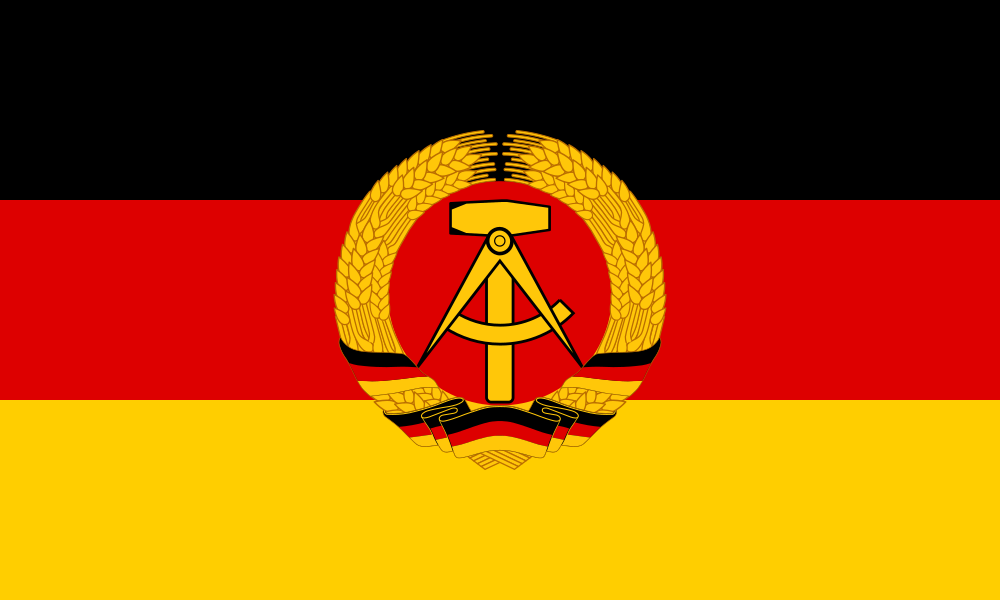
Sir, my delegation is happy to congratulate you, the Minister for Foreign Affairs of the Republic of the Philippines-a country with which the German Democratic Republic enjoys ever closer relations of friendly co-operation-on discharging the duties of President of the Security Council for September. Your great diplomatic skill, your great experience in United Nations work as one of the founding members, is having a rfavourable influence on the solution of problems at present facing us in the Council. The Minister for Foreign Affairs of the German Democratic Republic recently expressed his gratitude to you in person.
78. I should like to take this opportunity tp thank the Minister for External Relations of Panama, Mr. Jorge Illueca, for his substantial and careful work as President of the Council during the busy month of August.
79. We were happy to vote in favour of the decision taken by the Security Council to recommend to the General Assembly of the United Nations that Belize be admitted to membership in the world Organization. On the occasion of the proclamation of the national independence of Belize on 21 September, the General Secretary of the Central Committee of the Socialist Unity P&y of Germany, Chairman of the State Council of the German Democratic Republic, -Mr. Erich Honecker, conveyed to the leaderi of Belize heartfelt congratulations and stated that the German Democratic Republic, on the basis of the principles of equality, and self-determination of peoples, recognizes Belize as a sovereign, independent State and expresses its readiness to establish diplomatic relations. The German Democratic Republic in acting in that manner bases itself on the goals of its foreign policy, which is aimed at strengthening international peace and security and at respecting the equality and self-determination of States and on its aspirations to establish an atmosphere of friendship and co-operation among States.
80. The independence won by Belize is part of the outstanding results of the relentless struggle of peoples for national and social self-determination and for the
81. The German Democratic Republic has always sided with those who consistently uphold the right of peoples to national sovereignty and self-determination, It has always been sympathetic to development in Latin America and in the Caribbean region and to the aspirations of the peoples of that region for freedom. Anti-imperialist solidarity with all peoples fighting for their national and social liberation ,is. an integral part of our socialist fore@ policy.
82. It is a fact that, because of policies pursued by imperialist forces seeking to establish military bases, a number of peoples are still deprived of the right to independence and to an independent development. My delegation once again reaffirms in this chamber its boundless solidarity with the struggle of those peoples and also with the struggle of the people of Namibia. The liberation of those peoples is an inevitable process in this historical development.
83. In conclusion, we should like once more to congratulate the youtlg independent State of Belize and ‘its oeoale and wish them prosperity and success in ’ their national developmeni. Wk are convinced that Belize wiil conscientiously fulfil its obligation: under the Charter in the spirit of the purposes and princidies of the United Nations and will make its contribution towards implementing the basic task, namely, supporting and strengthening international peace and security.
84. Mr. LING Qing (China) fitrturpre/u/iotr fronr Chirrcw): Mr. President, at the outset, I wish to congratulate you warmly on behalf of the Chinese delegation on your assumption of the presidency of the Security Council for this month. You are a renowned statesman on the international scene and one of the first to take part in the activities of the United Nations. Your oersonal stewardship, therefore, of the deliberations-of the Council during the current month bestows honour on us and inspires our admiration. Mr, President, I am convinced that under your skilful guidance the Council will discharge its responsibilities successfullv. At the same time, I also wish to express our appreciation to your predecessor, the Minister for External Relations of Panama, Mr. Illueca, under whose brilliant and patient guidance the Council was able to achieve frui:ful results in its work during the previous month.
86. The people of Belize have won independence after protracted struggle. The Chinese Government and people are sincerely happy for them and wish them success in safeguarding national independence and carrying out natiopal development.
87. On the occasion of the independence of Belize, the Prime Minister of the People’s Republic of China, Zhao Ziyang, sent a message to Prime Minister George Price, expressing the warm congratulations of the Chinese Government and people to the Government and people of Belize and &n&ncing the decision of the Chinese Government to recognize Belize. Both China and Belize are developing countries with similal experiences in the past, and both face the task of national development. We earnestly hope that the relations between our two countries and the friendship between our two peoples will develop steadily. We also hope that, with its admission to the United Nations, Belize will join all justice-upholding and peace-loving countries in making its positive contribution to the realization of the purposes and principles of the Charter. :

First, permit me to offer you, Mr. President, my congratulations on your accession to the presidency. When I assure you of the satisfaction and pride with which my delegation sees you presiding over the Council, I do much more than show respect for a tradition, I give expression to the bonds of solidarity and friendship that unite the Governments and peoples of the Philippines and of Uganda. I also voice my delegation’s recognition and appreciation of the historic contribution to the cause of international peace and security your country, and you personally, have made. We are confident that under your presidency, with the influence of your wisdom and experience and your resourcefulness, the Council will successfully discharge its duties.
89. I should also like to take this opportunity to pay a well-deserved tribute to your predecessor, Mr. Illueca, the Minister for External Relations of Panama. During his term of office, the Council had before it very grave problems. He guided the Council with great skill, wisdom and dedication. It was a pleasure for my delegation to work under his leadership.
IO
96. The Council has just unanimously recommended to the General Assembly the admission of Belize to the United Nations. My country associated itself with that recommendation with pleasure. As soon as Belize fulfilled the conditions required by the Charter and pledged to respect its provisions, the French delegation, in accordance with its consistently held posiiion, was duty-bound to pronounce i:self ;n favobr of its admission, Belize’s admission to membership in the Organization brings us ever closer to the goal of universality to which we are deeply committed.
91. Uganda has supported the admission of Belize into the United Nations. We believe that Belize meets the criteria for membership spelled out in Article 4 of the Charter. It is a peace-loving State with an elected Government. The Prime Minister, Mr. George Price, has already given an undertaking to accept the obligations contained in the Charter. My delegation is convinced that Belize is able and willing to carry out those obligations.
97. Having been placed for mnre than a century within the sphere of influence of the United Kingdom, Belize is now broaching another stage in its history. Now, as an independent sovereign State, it will make its own contribution to the activities of the world community. There is no doubt that in applying for membership in the United Nations, Belize is showing its determination to work for international peace and co-operation in accordance with the purposes and principles of the Charter.
92. The admission of Belize is also in line with the objectives of the Organization, namely, to maintain the principle of universality. We view the accession of Belize to independence as yet another important stage in the decolonization process, We view it as further inspiration for the international community to redouble its efforts to help those still under colonial domination and racist oppression.
98. It is in the same spirit, we sincerely hope, that soon negotiations can be embarked upon between the Governments of Guatemala and Belize in order to find ways to resolve the dispute between the two countries. My delegation is convinced that a reasonable solution in accordance with the interests of the two parties can be reached on the basis of the Heads of Agreement signed on 11 March.
93. Belize’s independence is a sombre reminder to all members of the Council that Namibia, which is a unique responsibility of the United Nations, should have been independent this year under the United Nations plan. Ijnfortunately;Namibia is still under occupation by racist South Africa, The occasion of Belize‘s independence, therefore, is a sharp reminder to the Council of the consequences of its failure to take decisive action when faced with South Africa’s intransigence, but to the people of Namibia and the people of Palestine we say that the independence of Belize is testimony that a just cause will, in the end, be vindicated.
99. It is therefore with Rope that I voice my wishes for a peaceful future of Belize, for the prosperity of its people and for the success and personal happiness of its new leaders.

Sir, my delegation is happy to see you presiding over the Security Council for the month of September, which is traditionally a particularly significant month for the United Nations. The opening of the work of the General Assembly’s session nrovides during this period more activities-and intereit, which is not without its effect on the vigilance and availability that the Council must show d;ring the examination by the international community of so many problems of concern to the world.
94. My delegation offers its warm congratulations to the Government and people of Belize for that proud achievement. We look forward to fruitful co-operation between our two countries.

Mr. President, first I should like to thank you for having accepted, in addition to your onerous duties as Minister for Foreign Affairs of the Philippines, the presidency of our Council for the month of Sep-
101. But you, Sir, are an exceptional president. The Minister for Foreign Affairs of your country, the
102. I should also like ‘,o compliment most sincerely your predecessor, the Minister for External Relations of Panama, Mr. Jorge Illueca, who presided over our work with competence 9”d wisdom during August,
103. In recommending to the General Assembly that Belize be admitted to the Unhed Nations, the Council has just accomplished ap act that Niger approves and welcomes unreservedly. We see here an act that not only brings us closer to the universality of the Organization but in particular is a fresh confirmation of the principle of the right of .all peoples to self-determination and independence. We have no doubt that the General Assembly will very shortly endorse the unanimous vote cast toqay. / 104. The independence of Belize has now been achieved but, having a few moments ago heard neighbouring Guatemala contest the sovereignty of the new State, my delegation thinks it useful to recall certain principles and rules to which the Niger has regularly adhered and which it ha? always staunchly defended.
105. There is above all the principle of the immutable nature of borders. Any internationally recognized colonial territory must be able, once liberated, to live, to organize itself and to develop in a sovereign manner within the frontiers it had before the departure of the colonial Power.
106. There is, also. the principle of the settlement of disputes between States by peaceful means in accordance with the clear provisions of the Charter. We hope Guatemala anq Belize will act accordingly.
107. There is. linally. respect for the rules of goodneighbourliness, which exclude the interference by any State in the internal affairs of another State,
108. It is with confidence in respect for these principles and rules by all that Nigel’ warmly welcomes Belize as the 156th Member of the United Nations. We hope that the new State may develop in peace, concord and str%ty. We impatientiy await the day when the Council can as unanimously recr.nmend to the General Assembly the admission of Namibia.

I should like first of all, Sir, to convey to you my delegation’s warmest congratulations on ‘our assumption of the presidency of the Council for this month. My delegation, and indeed
110. I should also like to take this opportunity to express our sincere appreciation to Mr. Jorge Illueca, Panama’s distinguished Minister for External Relations, who conducted the Council’s business so ably last month.
111. On behalf of the Government and people of Japan, I wish heartily to congratulate the Government and people of Belize on its achievement of independence two days ago. My delegation firmly supports the adrrission of Belize as the 156th Member of the United Nations and has just voted in favour of the resolution on its admission. We are confident that, as Prime Minister Price clearlv stated in his cable addressed to the Secretary-General, Belize will fulfil all the obligations connected with membership and that it will make valuable contributions as a peaceloving nation to the activities of the United Nations. Further, its membership will advance the Organization’s principle of universality.
112. My country hopes to develop a relationship of close friendship and co-operation with this new State both within and outside the United Nations. My delegation thus looks forward to collaborathlg with the delegation of Belize in various forums of the United Nations in the pursuit of our common goals, namely, the maintenance of international peace and security and the building of a just and peaceful world.
113. I should like to take this opportunity also to congratulate the Government of the United Kingdom on having fulfilled its commitment to achieve the independence of Belize by the target date.
I14. Before I conclude, I should like to express my delegation’s earnest hope that the dispute between Belize and Guatemala will be settled peacefully and expeditiously through negotiations between the States concerned.

Sir, it is an honour to sit in this Council under so distinguished, indeed so venerable, a President. I congratulate you on the
116, 1 should also like to thank your predecessor, the Minister for External Relations of Panama, Mr. Illueca, and to congratulate him and his delegation on the way in which the duties of thpresidency were carried out during the month of August.
122. Ireland is confident that Belize will make a valuable contribution to the activities of the United Nations. My delegation looks forward to working closely with the delegation of Belize in the years ahead.
117. On 11 November last year. the General Assembly, in its resolution X/20, reaffirmed the inalienable riaht of the oeoale of Belize to self-determination, independence and’ territorial integrity. It furthel declared that Belize should become an independent State before the conclusion of its thirty-sixth session. That resolution was adopted by the Assembly by a vote of 139 to none, with 7 abstentions. That in our view was a clear expression of the overwhelming -indeed, virtually unanimous-support of the international community for the early independence of Belize.
123. Mr. OZORES TYPALDOS (Panama) (irrfarprefcrrioa fior)l Spcrrlish): Mr. President, I should like, first of all, to say how pleased my delegation is at seeing you presiding over the Council for the month of September, since we know of your talents and your skills as a well-seasoned diplomat and also because you represent a country for which.Panamanians feel deep admiration and respect.
124. The Council has met formally-at one of those times which should be considered historic-in order first to consider Belize’s request for membership in the Organization, and then to recommend to the General Assembly that it be admitted as the 156th State Member of the Organization and the thirty-first of the Latin American Group.
118. Ireland voted for that resolution. We are happy that Belize did in fact become independent on 21 September, and we welcome its decision to apply immediately for membership in the Organization. Ireland wishes well to this newest member of the family of nations, and we extend our good wishes to its GOVernment and people, which have at last emerged to independence after a long colonial history.
125. The Government and the people of Panama have at all times identified themselves with the aspirations of the people of Belize to achieve full independence, and the late General Omar Torrijos and President Aristides Royo have always defended the cause of that brother country with the enthusiasm with which one defends noble and just objectives.
119. In the Council today, Ireland voted in favour of the recommendation to ihe Assembly to admit the new State to membership. We believe that Belize will carry out fully its obligations and responsibilities under the Charter, and we are pleased that the United Nations, by admitting Belize Ho soon after Vanuatu, will take yet another step towards universality.
126. That Belize did not attain independence years ago was not the fault of the Government in London; it was because of the claims of one of the parties throughout the lengthy and complicated negotiations. However, Belize as an independent State recognized by the international community is a reality, and we hope that the Government of Guatemala will change its position and accept the emergence of a new nation in the Central American isthmus which finds inspiration in the good wishes of co-operation and which can make important contributions in a region where, unfortunately, violence and mistrust prevail among brothers.
120. We are well aware that while Belize progressed towards full independence, there were discussions designed to ensure that the newly independent State would enjoy goodwill and co-operation from all its neighbours. We were encouraged by the discussions in London last March between the Governments of the United Kingdom, Belize and Guatemala. We regret that subsequent discussions have not heen fully successful so far. But we hope that the spirit of good faith which seemed to characterize the earlier discussions can be restored and that negotiations will continue in accordance with the terms of the resolution the General Assembly adopted last year, which urged the three Governments to continue their efforts to reach agreement, but without prejudice to the exercise by the people of Belize of their inalienable rights.
127. The Government of Panama, which has friendly relations with both Belize and Guatemala, and which is fully aware of the significance of negotiation as a means to settle differences, is willing to serve as a vehicle in the continuance of a dialogue between the parties aimed at achieving understanding through which two neighbouring peoples can live as such in a climate where peace and co-operation prevail.
121, For our part, we want to see no shadows cast over Belize’s newly-won independence. It is our hope that Guatemala and its Government will show restraint and goodwill towards the newly independent State and
128. Without entering into rhetoric, we consider it appropriate to recall that Belize, both historically
129. I wish to conclude by expressing to the GOVernment and the people of Belize the joy all Panamanians feel at seeing a long effort crowned with justice. It is true that they emerged to independent life with great difficulty, but at the same time with many friends, and we are certain that the people and the Government of Guatemala will at the appropriate time join with the other States Members in recognizing a contiguous peace-loving State,

Pirst. the Soviet delegation would like to convey to you, Sir, the Minister for Foreign Affairs of the Philippines, our congratulations on your assumption of the responsible duties as President of the Council. Your great diplomatic experience will doubtless promote the successful discharge of the tasks confronting you as President-and I say this with particular pleasure, since we have known each other for more than 30 years.
131. At the same time, we should like to express our gratitude to the Minister for External Relations of Panama for the great contribution which, as President of the Security Council, he made to the Council’s work during August.
132. Today we are witnesses to an important event in the history of the United Nations. The Council has just considered the application of Belize-the youngest independent State-for admission to membership in the Organization. The application of the Prime Minister of Belize for that country’s admission contains a statement that Belize acknowledges the obligations contained in the Charter and solemnly pledges to discharge them. In our opinion, that State meets the requirements and criteria demanded of States in order to become Members of the United Nations, and the delegation of the USSR was happy to support the positive recommendation of the Security Council on ihis matter. In so doing, we believe that this recommendation will be another step towards the complete, total elimination of the colonial system, that it once again demonstrates the historic importance of the Declaration on the Granting of Independence to Colonial Countries and Peoples, which was adopted by the Organization 011 the initiative of our country, and that it will serve to implement the principle of universality in the United Nations.
“On the occasion of this important event, the proclamation of the independence of Belize, accept our heartfelt congratulations and best wishes for success and progress by the people of Belize towards their ,independent development as a State.
“The Soviet Government is constantly guided by the principles of equality and self-determination of peoples, mutual respect for the sovereignty and territorial integrity of States and non-interference in the internal affairs of other States and attaches great importance to the development of relations of friendship and co-operation between all countries. It hereby states its recognition of Belize as an independent and sovereign State and is real:: to establish diplomatic relations with it and to exchange diplomatic representatives at the ambassadorial level.
“I express the hope that friendly and fruitful relations to the benefit of ou; peoples and the cause of peace will develop between the Soviet Union and Belize.”
134. Belize’s achievement of independence opens up a new page in the history of its people, which for many decades languished under colonial domination. I should like to take this opportunity to congratulate the independent State and people of Belize on the positive decision taken by the Council in respect of its application for membership in the United Nations and to wish it peace and success.

It is a special honour, Sir, to participate in deliberations under your presidency. I offer no routine compliment when I say that your distinguished career embodies the very highe.H standards of international statesmanship. Speaking 1, you and, more especially, listening to you, as 1 did today, recall to us the high ideals which inspired the foundation of this institution and its Charter. I take it to be a good omen that YOUI presidency should have coincided with the opening of this session of the General Assembly-a symbol, I hope, that the Assembly will be inspired by the values that originally inspired the Organization itself, ideals that are so clearly reflected in your distinguished career: ideals of freedom, peace, co-operation, selfdetermination and self-government.
136. I might add that, because 1 was out of the city during the month of August, I did not personally experience the benefit of Panama’s presidency. But I have been informed by my colleague about the high competence and good judgement which characterized the conduct of the presidency of Mr. Jorge Illueca.
138. The United States and Belize are related by ties that extend back over 200 years when trading links were established between our two countries. Thousands of Belizeans have made the United States their home in the intervening years, and more than a thousand Americans now reside and work in Belize. The Governments of Belize and the United States work together on a variety of programmes that have contributed to the development and better understanding of Belize and the region. One of the earliest Peace Corps programmes, for example, was established in Belize and continues to this day to our mutual benefit. This cultural and eacial interchange has contributed to the establishment of a special relationship between our peoples that is reflected in our many common traditions and values.
139. In recognition of Belize’s indeuendent status, the United States intends to establish-now full diplo: matic relations with Belize. We look forward to working closely and harmoniously with the Government and people of Belize bilaterally, in regional organizations and across the full spectrum of international affairs.
140. Jurisdictional disputes grounded in a colonial past are all too common in this hemisphere. They constitute a source of chronic irritation; their successful resolution often proves exceedingly difficult and requires persistence, flexibility and especially the goodwill of the various parties. Naturally, the United States hopes that in the interest of regional peace and harmony the representatives of Belize and Guatemala will be able to arrive at an early mutually acceptable resolution of their differences. The United States is prepared to co-operate in all appropriate ways in this undertaking.
141. Belize begins its life as a fully independent nation with democratic institutions, a free press and all the associated liberties. We take special pleasure in welcol .ng a new democldtic neighbour. Finally, we extend once more to the people and Government of Belize our warm greetings and best wishes on this happy occasion.
142. The PKESIDENT: The next speaker is the representative of Nicaragua. I invite him to take a place at the Council table and to make his statement.


On behalf of the delegation of Nicaragua, I congratulate YOU, Sir, 011 your assumption of the presidency of the Council for this month.
144. Similarly, we wish to congratulate our friends, Minister Jorge Illueca and Ambassador Carlos OZOreS of Panama, on the excellent work done in the Presidency of the Council last month, when once again they gave proof of the experience and maturity which are typical of them and of their Government in handling international problems.
145. It is an honour for me to convey the sincere joy felt by the people and Government of Nicaragua on the occasion of the recommendation for admission of the sister nation of Belize to the United Nations, a natural exercise of the right of a people freely to decide their destiny, a right for which thousands of Nicaraguans shed their blood only a little over two years ago. Once again, a Central American people have gained respect for their inalienable rights to self-determination and independence, and in standing for those rights the sovereignty of the great Central American nation and of our own country have become even stronger.
146. In this context, Nicaragua was represented at the highest level in the new Central American nation at the time when the British flag was lowered forever and when the flag of the sovereign State of Belize was proudly hoisted. We have thus faithfully complied with the provisions and recommendations of the international community clearly expressed in General Assembly resolution 35/20. We stand ready, together with that community, to co-operate with the Government and people of Belize in the attainment of their highest ideals and for the defence of their sovereignty, self-determination and territorial integrity.
147. There is no doubt that Belize, owing to the specific circumstances in which it has gained its independence, as well as by virtue of its geographical location in an area highly charged with tensions, will face difficult days. At present there are political forces which do not consider legitimate or representative the efforts being made in Central America to secure liberation. That is why in this case the principle of self-determination of peoples must be defended with particular energy by the international community on the occasion of granting iadependence in a region where that principle is being challenged and undermined.
148. The independence of Belize is synonymous with the process of change ir\ Central America, In that context the United Nations should be satisfied, since it was the firm will of the international community and the heroic efforts of the people of Belize that brought about independence through peaceful means,
149. We believe that the vigilance and persistence of the United Nations together with the responsibility shown by the former administering Power were factors
150. The United Nations played a basic role in the international recognition of the legitimate wish& of the Belizean people, The lessons to be drawn from that happy coincidence, which has eased the pains of violence, must be pondered by all countries, especially when a!tcmpts are being made to deny the rcpresentative nature of the liberution forces in Central America. Namibia and the ‘.liddle Eas& They are being labelled extremists and terrorists.
151. Neither threats nor pressures nor military manoeuvring can halt the progress uf peoples towards independence and liberation. That is why Nicaragua today shares the victory of the people of Belize and is pleased to see that the Council pledges itself to extend to the seventh Central American nation all the rights and guarantees that are aspired to by countries which, like Nicaragua, seek to preserve their independence and security free from foreign intervention.
152. In conclusion, we express the wish that this Council bear its full responsibility in the face.of any violation of the rights now enjoyed by Belize, for the benefit not only of that nation but also of regional peace and ge.curity.
The next speaker is!he representative of Saint Lucia. I invite him to take a place at the Council table and to make his statement,.
154. Mr. ‘AUGUSTE (Saint Lucia): Sir, may I first congratulate you on your assumption of the presidency of the Council for the month of September. I am sure that under your able guidance, as is marked in this instance, there will be speedy consideration of matters put before the Council. ‘.. I
155. I should also like to convey my appreciation to you, Sir, and to the other members of the Council for the kind hlvitation to address this august body on behalf of both the Government of Saint Lucia and the Governments of the other members of the Organization of Eastern Caribbean States In welcoming the adoption of the resolution on the applicntion of Belize for membership in the United Nations. However, the record must be set straight.
156. On I1 November 1980, the General Assembly adopted resolution 35/20, its sixth resolution on the question, reaffirming the inalienable right of the people _ of Belize to self-determination, independence and territorial integrity. The General Assembly is convinced-as, I am sure, is the Security Council--that the differences that exist between the United Kingdom and the Republic of Guatemala do not in any way derogate from the inalienable right of the people of Belize to self-determination, independence and territorial integrity, and hence the continuiog inability
157. While the history of international relations records no dearth of territorial disputes between nation States. this miasma of anguish and agony thrust upon the Belizean people by-this 122-yeai-old Treaty, which was declared null and void by the Republic of Guatoma!? only 35 years ago, is indefensible.
158. While Saint Lucia has no desire to cast itself into the legal conundrum of article 7 of the 1859 Anglo- Guatemalan Treaty or the subsequent Convention of 1863, we have to point out that neitherthe perpetuity of usufruct concessions, of which Guatemala accuses the United Kingdom, or the specious doctrine of lrri possidetis, which Guatemala originally invoked, are recognized as general~principles-of international law.
159. Without being tendentious in favour of either
GUdteUIah or the United Kingdom, I should like to point out that Belize, or British-Honduras, as the territory in question was then known, was formally created as a British colony with its own Lieuter. nt Governor under the authority of the Governor of Jamaica in 1862, only three years after Charles Lennox Wyke, the British representative, and Pedro de Aycinena, the representative of Guatemala, signed the Treaty. I point out this important fact not necessarily as Jr jlrre justification of British sovereignty over Belize for almost 122 years, though there is obviously a connection between the signing of the Treaty and the creation of the colony, but rather to indicate that the people of Belize have been colonials for over a century and no specious principles can even begin to justify the sword of Damocies which continues to hang over the head of that newly independent nation.
160. On 25 July 1980, the House of Representatives of Belize, exercising the mandate duly given it by the people of Belize, passed a resolution calling upon the Government of Belize to initiate the measures necessary to bring Belize to a safe and secure independence, with or without the agreement of the Government of Guatemala. Three months later, the Deputy Prime Minister of Belize, Mr. Rogers, addressing the Decolonization Committee,4 made it quite clear that the GOVernment of Belize had participated in the Anglo- Guatemalan negotiations for I9 years not because it recognized any rights whatsoever of Guatemala in or over Belize or its future but only because, faced with Guatemala’s military threat to their territory, and in an effort to preserve peace and stability in an area already plagued with conflict, they were trying to help the United Kingdom and Guatemala to settle their differences without prejudice to Belizean sovereignty and territorial integrity.
161. The Government of Saint Lucia welcomed the I6 points outlined in the Heads of Agreement
162. But no interpretation of the Heads of Agreement in any way vitiates General Assembly resolution 1514 (XV), containing the Declaration on the Granting of Independence to Colonial Countries and Peoples. Therefore, the Government of Saint Lucia reiects Guatemala’s contention that the burden of this dispute -if it is indeed that-is now transferred to Belize on its independence.
163. Independence, once constitutionally granted, cannot be revoked. The long-awaited independence of Belize is now a legal&it accompli. The international legal rules which govern the inheritance of onerous burdens by a nation-State are not so different from those which govern human relations under municipal law. Independent children may not be made to assume the contractual obligations of their former guardians, particularly when those guardians are still extant. The child will not bear the stigma of the mother. The age for that ignominious perspective is past.
164. The crux of the matter is not whether there is a justifiable dispute concerning the violation of treaty provisions between Guatemala and the United Kingdom, but w:lether the people of Belize will be held to ransom over a situation in which it played no part. It was an observer expected only “to stand and wait”.
165. Belize is demographically, though not geographically, a small country. But its people have earned the respect and friendship of almost all of the Governments and people of the world, including Central America.
166. At their Sixth Conference, the Heads of State or Government of Non-Aligned Countries. meeting in Cuba in September 1979; reiterated their unconditional support for the Belizean people’s inalienable right to s&determination, independence p.1,’ .erritorial integrity; condemned all pressure or threats to prevent full exercise of that right: and supported the right of the Belizean Government and people to make whatever agreements they consider necessary to counteract effectively this threat.
167. Independence, while marking the end of an era, also signals the beginning of another. There is much work to be done before the 145,000 people of Belize can look towards a future of meaningful economic and social development. This is the ultimate aim of independence, and sovereignty is the means by which this is attained. But the ominous shadow of Guatemala
168, Consequently, the Government of Saint Lucia is gratified that Mr. Nicholas Ridley, Minister of State at the United Kingdom Foreign and Commonwealth Office, has already stated that the United Kingdom will do whatever is necessary to ensure the security of an independent Belize. The metropolitan Power will not leave its child to the mercy of its apparent enemies. The Commonwealth Caribbean will also play a meaninnful role in this respect. But the significance of this family of nations is that, within its circumference, nations will find the wherewithal to solve their differences amicably. For what separated Belize and Guatemala today are differences-differences over the manner by which one unravels the unfortunate circumstance of the Guatemala-United Kingdom entanglement over the then British Honduras.
169. In conclusion, Saint Lucia welcomes the unanimous support of the Council for the Government and people of Belize, and eagerly looks forward to the transmission of its recommendation to the General Assembly.
The next speaker is the Minister for Foreign Affairs of Barbados, whom I invite to take a place at the Council table and to make his statement.


Mr. President, I am very thankful to you, and the Council, for allowing me this oooortunitv and privilege of addressing the Council. dn behalf of my own ddegation and those of Trinidad and Tobago, Guyana and Jamaica, permit me, Sir, to congratulate you on your election as President of the Council for this month of September. I feel sure tha: you will bring your great wisdom, wide knowledge and experience to bear on the deliberations of this Council.
172. 1 am very pleased that my first official statement in any organ of the United Nations since my assumption of office as Minister for Foreign Affairs of Barbados is being made on the occasion of the consideration of the admission of Belize as a Member of the Organization.
173. The Government and people of Barbados have always supported the struggle towards independence of the brave people of Belize. During the thirty-fifth session of the General Assembly, the delegations on whose behalf I speak were in the vanguard of those calling, in resolution 35/20, for the independence of Belize before the end of 198 I. That dream has now been realized.
174. I sincerely believe that we in this family of nations can justly congratulate ourselves on this achieve-
175. 011 behalf of the Government and people of Barbados, I welcome the decision of the Security Council to recommend to the General Assembly the admission of Belize as the 156th Mcmbcr of the United Nations. 1 have no hesitation in commending that resolution for favourable consicleration. with the firm assurance that Belize will contribute significantly to the work of the United Nations system.
176. The independence of Belize has shown to the unbelievers and doubters the effectiveness of the United Nations in so far as the process of self-determination is concerned.
177. There is some indication that the emergence of Bclizc to full independence might provide another opportunity for the Council to exercise its special responsibility for maintaining international peace and security. It is the hope of my Government that the Council’s competence in this regard will not be tested, but I have every confidence that, if it is, the Council, with the co-operation of friendly and peace-loving Covcrnments in the region, will be able to reach a satisfactory and fair settlement.
179. We voted for the recommendation of the Committee on the Admission of New Members because we believe that the admission of Belize into the family of nations will mark another important step in the attainment of two ofthe great goals of the Organization. It signifies, first of all, progress in the continuing process of decolonization-a three-decade-long process which happily is nearing completion. Secondly, it constitutes another forward step in the reatization of the principle of universality, a forward step in the progress of the United Nations as a world organization.
180. As Belize enters the community of nations, we entertain every hope that it will contribute in constructive fashion to our patient and endless quest for world peace, security and~progress. I extend the hand of welcome to Belize.
NOTES
a Special Committee on the Situ&n with regard to the implemcnlalion of the Declaralion on the Granting of Independence IO Colonial Counlrics and Peoples (Comlniltee on Decolonization).
▶ Cite this page
UN Project. “S/PV.2302.” UN Project, https://un-project.org/meeting/S-PV-2302/. Accessed .