S/PV.2416 Security Council
▶ This meeting at a glance
17
Speeches
9
Countries
0
Resolutions
Topics
War and military aggression
Global economic relations
African conflict situations
General debate rhetoric
Security Council deliberations
Peace processes and negotiations


The American people, who yesterday 1 celebrated the birthday of their first President, George Washington, a man who, in the not so distant past, embodied the aspirations of the American people for the liquidation of colonialism in their own land, are witnessing new and wide-scale American military movements designed to undermine the territorial integrity of an Arab State with a view to enhancing American hegemony and expanding its sphere of influence in Africa, Asia and other parts of the world.
Provisional agenda (S/Agenda/2416)
1. Adoption of the agenda
2. Letter dated 19 February 1983 from the Permanent Representative of the Libyan Arab Jamahiriya to the United Nations addressed to the President of the Security Council (S/15615)
The meeting was called to order at 4.40 p.m.
5. How ironic! While the American people celebrate the values and principles advocated by George Washington in favour of independence, liberation and selfdetermination, they once more witness their Government pursuing a policy in contravention of those principles and seeking through intimidation, the threat of force, and direct and indirect aggression, to contravene the sovereignty of States and the rights of their peoples. It is certain that the American people today see the chasm between the principles advocated by George Washington and the reality that prevails. The American people have, in our view, begun to realize the danger their Government’s policy poses to their interests, on the one hand, and to international peace and security, on the other.
Adoption of the agenda
The agenda was adopted.
Letter dated 19 February 1983 from the Permanent Representative of the Libyan Arab Jamabiriya to the United Nations addressed to the President of the Security Council (S/15615)

In accordance with the decision taken by the Council at the previous meeting [2415th meeting], I invite the representative of the Libyan Arab Jamahiriya to take a place at the Council table; I invite the representatives of Benin, Democratic Yemen, Egypt, Ghana, the Islamic Republic of Iran, Sudan and the Syrian Arab Republic to take the places reserved for them at the side of the Council chamber,
6. The Council is meeting for the second time in a month to hear peoples and Governments yearning for genuine independence and freedom registering their condemnation of the American policies which stem from a strategy aimed against the Arab people throughout its homeland.
At the invitation of the President, Mr. Treiki (Libyan Arab Jamahiriya) took a place at the Council table; Mr. Soglo (Benin), Mr. AI-Ashtal (Democratic Yemen), Mr. Khalil (Egypt), Mr. Hayford (Ghana), Mr. Rajaie- Khorassani (Islamic Republic of Iran), Mr. Abdalla (Sudan) and Mr. El-Fattal (Syrian Arab Republic) took the places reserved for them at the side of the Council chamber.
7, After the aggression carried out against Lebanon and its occupation by proxy at the hands of the most vicious enemy of the Arabs, that is, the Zionists, we see American hands now extending to a young Arab State known for its glorious struggle against Fascist settler colonialism for half a century, since that colonialism resorted to all means to liquidate the Libyan Arab people physically. Then, following the Second World War, the imperialists attempted to undermine the unity of Libya,
I should like to inform members of the Council that I have
to dismember its people and to distribute its natural resources among the old and the neo-colonialists. Libya and its Arab neighbours suffered the presence of foreign military bases on the land of Arab Libya, but eventually the Libyan people rejected this formal independence and thus the people’s revolution broke out and did away with those bases, But the imperialists considered Libya’s genuine independence, which stemmed from the revolution of 1 September and the solidarity of that revolution with all peoples in Africa, Asia and Latin America, to be a threat to their interests. Thus, the American imperialists began to fight against the Libyan Arab Jamahiriya by all means.
8. We have to take into account that the modern history of Libya is in fact a continuous struggle between the exploiting forces alien to the area and the African and Arab nationalist forces which feel that their interests are linked to those of the struggling peoples of the third world. Hence, world imperialism and its Zionist ally have plotted to frustrate the nationalist and liberation aspirations of the Libyan Arab Jamahiriya. In order to camouflage this frenzied offensive, American imperialist circles have been waging blatant, misleading economic, political and media campaigns. Thus, Libya’s legitimate support for national liberation movements in Africa and etsewhere is labelled as support for international terrorism, while the bloody Israeli aggression has been upgraded by American imperialism and those same circles to the highest level of international legitimacy.
9. We are participating in this discussion because we are convinced that the United States is now putting the final touches on the implementation of its schemes embodied in strategic alliances, whose implementation would be facilitated by striking at the aspirations of the Libyan people, its revolutionary institutions and progressive positions.
10. These American provocations and acts of aggression against the Libyan Arab Jamahiriya, which have tended to multiply in the past two years, have drawn our attention to the following. First, they coincide with Washington’s vicious military and economic offensives to reimpose its hegemony on the region as a whole through its naval fleets and air and land forces within the concept of strategic co-ordination among Washington, Tel Aviv and the Pretoria rtgime. Secondly, these direct American provocations by sea and air came on the heels of the Israeli occupation of Lebanon and the aggression against the Arab deterrence forces, which proves that these provocations fall within the context of Camp David and of a strategic alliance established to implement all the economic, geographical and political dimensions of Camp David. Thirdly, these provocations fall within the world-wide American policy aimed at creating tension at the international, regional, national and domestic levels within a geographical belt extending from Latin America to Asia. By way of example, it suffices to cite the plots hatched against Nicaragua, Cuba and other Latin American countries, the intensified aggression against the peoples of southern Africa and the imperialist
onslaught against Asia and the Middle East, where Israel wreaks havoc in co-operation with Washington.
11. The Syrian Arab Republic is not afraid of American manoeuvres, be they in the form of rapid deployment forces or those that stem from the concept of the American-Israeli strategic alliance, because the Syrian Arab Republic, together with the other States of the Arab Front of Steadfastness and Confrontation, is resolved to defend Arab rights whenever, wherever and however they may be threatened.
12. The Syrian Arab Republic is certain that this latest threat to the Libyan Arab Jamahiriya is but another desperate attempt to subjugate the Arabs to the Camp David logic. As part of the Arab people, we have taken it upon ourselves to foil these threats regardless of the cost.
13. Finally, we urge the Council to consider the complaint by the Libyan Arab Jamahiriya with much concern and seriousness, since escalating American threats and the accompanying military manoeuvres, which are condemned by the Arab nations from the Gulf to the Ocean, carry within them the seeds of explosions jeopardizing world peace and security.
14. Today we heard a statement by the United States representative [ibid.] who affirmed once more that the United States will persist in the same policy: to lay siege to Libya, deprive it of the ability to defend itself and biro it into a battle in interests of a super-Power, the United States. Acknowledgement of this policy by United States officials is simply more evidence that the logic of force and the threat of force govern American policy, which, as the Council knows, must be confronted here in the Council. The Council must assume its full responsibilities, in accordance with the Charter of the United Nations, in order to deter the aggressor and put an end to the threat menacing the Libyan Arab Jamahiriya and the entire region.
15. We call upon the Council to warn the parties to Camp David and their allies that their actions, lies and resort to Washington to protect them from the wrath of the Arab people, and the problems they have created for that people as a result of their compromising Arab and Palestinian rights and their squandering of those rights by departing from Arab consensus, will lead to their bearing the same responsibility already borne by the United States Government if they persist in implementing these suspect designs under the American umbrella.


Mr. President, in conveying our greetings to you we would also like to welcome the new representative of Jordan and assure him of the cooperation and friendship of the Nicaraguan delegationco-operation and friendship which characterize relations between our peoples.
17. We have met here to consider the complaint of the Government of the Libyan Arab Jamahiriya regarding
the latest threat levelled against that country by the United States of America.
23. This history of slander and hostility against Libya is today taking on a special character because even the United States press has assumed the task of casting doubt on the validity of the reasons underlying the United States military mobilization. The facts show that there has been no threat to the Sudan. No United States official has brought forward concrete facts which prove such a cIaim. High-ranking Egyptian military officers, according to the international press, have denied being aware of any such threats, and some officials of the same Government have gone so far as to reject the existence of such a threat.
18. The Libyan representative, in his letter dated 19 February, urgently called for this meeting and drew our attention to
“the provocative military actions of the United States Administration by moving its aircraft-carrier Nimitz with some naval vessels close to the Libyan coast and sending four AWACS aircraft to one of the neighbouring countries of the Libyan Arab Jamahiriya to spy and work against Libya”.
24. How, then, can we explain this deployment of military forces? How can we explain this political attitude?
19. The attitudes adopted by the United States Government against the people and Government of Libya have become a part of contemporary history. The actions taken against that people have assumed a wide range of manifestations: abrasive and derogatory rhetoric against Libyan leaders, destabilization plans, zealous and interminable international propaganda campaigns, attempts at economic blockades and technology boycotts, and threats and acts of military aggression.
25. In view of this latest incident, and at the risk of seeming politically ingenuous, one might conclude that there was a hasty over-reaction on the part of the United States Administration as a result of distorted and unconfirmed intelligence reports. But such a conclusion entails great danger when we recall that those who are resorting to the use of force in an irrational fashion and without taking the slightest care to verify their facts represent a great Power with an atomic potential capable of destroying mankind. We can only hope that the same haste will not prevail, or will not be demonstrated, in those areas where the use of nuclear weapons is decided upon.
20. The Co-ordinating Bureau of the Non-Aligned Countries, in an extraordinary meeting held in New York on 28 August 1981, declared, in regard to the events which were taking place at that time:
26. But if we want to seem less ingenuous and to seek an explanation for the history and the present state of the animosity of the United States Administration towards the Libyan Government and people, we should recall that the refurbishing and strengthening of the American “Old Right” is reaching its heyday these days under the policy of the present United States Administration. Santa Fe, the Heritage Foundation and the like look on with pleasure as they see the implementation of their foreign policy schemes. Terrible doctrines are being turned into reality: military supremacy, respect for imperial power, decisions to try out one’s strength in areas where it seems appropriate, and obsession with military confrontation with the peoples of the third world who are struggling to achieve or to preserve their political independence.
“This action by the United States against Libya, which resulted in two Libyan surveillance aircraft being shot down by United States naval forces, represents a new event in a series of threats and provocations by the authorities of the United States which have been broadly covered by the press.”
21. Similarly, in view of these events, the Group of Arab States adopted a declaration of support which was circulated as an official document of the Council [S/14638/Rev,l]; the relevant part reads as follows:
“The Group of Arab States . , , in declaring its total solidarity with Libya, calls on all international groups, especially the Movement of Non-Aligned Countries, to stand fast in the face of the provocations and challenges that constitute a most dangerous precedent in international relations, particularly when such a challenge is issued by a major Power which, as a permanent member of the Security Council, carries a special and definitive responsibility to maintain international peace and security.”
27. This motley array of concepts and policies being applied by the United States in its foreign policy is what in recent days has made military manoeuvres throughout the world the focus and the keystone of that policy. It is not that we are only now discovering gunboat diplomacy: what is occurring is that today’s gunboats are aircraft carriers and are often carrying nuclear weapons.
28. This is why we are witnessing fantastic war games being conducted against other non-aligned peoples; against the Democratic People’s Republic of Korea the “Team Spirit ‘83” manoeuvres have taken on scandalous proportions and are being conducted in a region which is militarily and politically highly sensitive.
22. History is once again repeating itself. Fortunately,
SO far the consequences have been less grave. What is disquieting, however, is the repetition of the aggressive attitude which seems to ignore or disregard the fundamental principle embodied in Article 2, paragraph 4, of the Charter of the United Nations Charter, which, inter ah, calls upon us to “refrain . , , from the threat or use of force against the territorial integrity or political independence of any State”.
29. On a more modest scale, but also appropriate for intimidation according to United States military calculations, are manoeuvres such as “Halcon Vista” or “Pino Grande”, which are also being conducted in other politically and militarily sensitive areas such as the territory of Honduras neighbouring the Nicaraguan frontier where the counter-revolutionary bands financed by the United States are operating.
30. But the peoples of the third world are on the alert and are mobilizing firmly and resolutely to defend their independence and territorial integrity, Mobilization of the organized and aware masses has occurred in the same manner in Libya, Korea and Nicaragua, in Africa, Asia and Latin America, the areas where imperialism carries on its acts of depredation.
3 1. Our peoples are also expecting the United Nations and the Security Council to play their role.
32. The lofty and fundamental mission of this body to preserve peace places on our shoulders the heavy responsibility of responding ditigently to these expectations of our peoples.


Yet again, after just a few days have passed, this body is seized of another issue which has a direct influence on the peace and security of the region I come from, the Mediterranean.
34. Malta’s commitment to peace and security in the Mediterranean forms a fundamental element of its foreign policy. It is this commitment which has prompted my Government on frequent occasions to bring forcefully to the attention of the world at large the tensions and conflicts which harass our region.
35. It is this commitment which has inspired Malta’s many, and continuing, initiatives on the bilateral, regional and international levels, in the United Nations, in the Movement of Non-Aligned Countries and at the Conference on Security and Co-operation in Europe, to promote and enhance the prospects for peace and cooperation among Mediterranean countries. Our latest initiative in this respect has been our proposal at the Madrid meeting of the Conference on Security and Cooperation in Europe for the convening in Malta later this year of a meeting of experts to discuss questions relating to security in the Mediterranean as embodied in the Helsinki Final Act. We expect that all participating countries will support this initiative.
36. Malta’s commitment to peace and security in the Mediterranean has led my country to adopt a status of neutrality, based strictly on the principle of nonalignment, as the centre-piece of its continuing role in this process.
37. We have made it abundantly clear that we consider our membership of the CounciI as providing a unique opportunity for us to continue to fulfil this role.
38. We are assured that our policies enjoy the respect and support of all peace-loving States, both in our region and beyond it. The two super-Power themselves and
many of their allies have openly recognized our role far peace in the Mediterranean-in the case of the Soviet Union through a formal agreement with us, signed in October 198 1, and in the case of the United States in the words of President Reagan in September 1981, reiterated by Secretary of State Shultz to our Foreign Minister during their meeting last week. This recognition strengthens us in our conviction that, together with other countries in our region, we have a major responsibility to meet the challenges posed by the tensions and conflicts which arise in our midst and to play a positive role in seeking means for their peaceful resolution.
39. The complaint brought to the Council by Libya constitutes such a challenge. The facts of which we have been apprised raise very serious preoccupations for my Government. These go beyond the obvious concern that any Government feels in the face of a dispute between two friendly countries, one of them a neighbour with which it harbours close ties of co-operation. Malta is particularly worried by the active deployment, in close proximity to its territory, of warships and other military equipment whose potential for destruction, even in the case of accident, is incalculable. We are even more worried and concerned by the implications for regional security in general, and Mediterranean security in particular. which arise out of the incidents which have just been reported to us.
40. These implications go to the heart of the whole
question of regional security. We are led to ask: who in the first place has the prime responsibility for defining the security issues in any given region? Upon whom falls the major obligation to safeguard this security? And whCp has the ultimate responsibility of determining which course of action is most likely to reduce tension and remove the threat of the use of force which may arise 011 any given moment?
41. For Malta, and we believe for the majority of the members of the international community, the answers tea these questions are clear: it is the regional States themselves which bear the main responsibility for safeguarding the peace and security of their region. We say this n0t out of any sense of antagonism to any party in a specific dispute; our record of action, as well as our expresxd policies, makes it clear that we would react in the same manner whichever super-Power were involved. Rather. we say it in the firm belief that it is the regional S~MEL~ themselves which are principally interested in solving P problem which arises in their midst without superimpc%- ing upon it extraneous elements which might exacerbate rather than abate the local tensions that exist.
42. NO country, least’of all a non-aligned country, CSC~ tolerate a state of active confrontation between a super- Power and a neighbouring country. In a regional co+ text, especially in a region as troubled as tha Mediterranean, such a confrontation not only is dangcr- 0us in itself, but also poses the daunting threat of a direct confrontation between the super-Powers themselves.
.43. In the Mediterranean we have a dramatic manifestation of the complications which arise when States from outside the region assume a primary, if not an exclusive, role in defining and safeguarding the security issues of a region. Our sea has become an arena of confrontation between two massively armed navies which have imported into our region the dangerous polarization which exists at the global level, Any action by one party, however localized or specific the intent in which it may be conceived, cannot but add to this dangerous polarization.
Republic of Malta to the Yugoslav press agency Tunjung. In assessing the situation in the Mediterranean region, she stated that
“One of the pillars of the Maltese socialist Government’s foreign policy is to turn the Mediterranean into a zone of peace and co-operation.
“With this in mind, we have used every possible international and regional forum to promote this idea, and we are pleased to say that other non-aligned countries in this region share this view and have helped us promote it.
44, As a neutral country in the heart of the Mediterranean, we feel a special responsibility in seeking to engender a process of relaxation of tensions, which would lessen and eventually halt the need for the massive military deployment in our region, a region which might soon be in the unenviable position of having mediumrange nuclear missiles sited in it. We strongly believe that the brandishing of military hardware, however limited in scope and objective, does not help in this process.
“Regrettably, the influence of the super-Powers in this very important region is still manifest, and unless their military forces withdraw from the Mediterranean we shall have to work hard and long to turn our sea into a peaceful, denuclearized region.”
50. This is the very message which my delegation would like to echo today. Malta is committed to stability, peace and security in the world as a whole, and in particular in the Mediterranean region.
45. When local problems arise-and Mediterranean countries are the last to ignore the frightening and painful reality of the existence of local conflicts-the tools which must be utilized to solve these problems must be scrupulously tailored to suit the local situation, In this context, we have urged and continue to urge collective responsibility by the regional States themselves. We have based our own status of neutrality on this concept of collective responsibility by seeking acceptance of it and support for it from all our neighbours. We have every asssurance that such a collective effort is the best guarantee that our region can have of evolving into the zone of peace we all strive for.


At the outset, I should like, in the name of the Chinese delegation and on my own behalf, to extend a warm welcome to Mr. Abdullah Salah, the new representative of Jordan, on his joining us in the Council and to wish him success in the discharge of his important responsibilities. We look forward to friendly COoperation with him.
52. The tension near the Gulf of Sidra in theMediterranean has been a matter of public concern in the past few days.
46. From the outside Powers, especially the super- Powers, we seek genuine co-operation to enable us to evolve this collective effort, The choices to be made in any given instance might not always be self-evident. However, what must invariably be evident is the readiness to utilize the pro:Fss of peaceful persuasion, in preference to the process of the threat of armed force, and the readiness to permit the regional States themselves to define and mould these peaceful processes.
53. The situation around this region has been continuously turbulent for some time now. The recent show of force and resort to military intimidation by a super- Power have brought about a further deterioration there.
54. All the countries of that region belong to the third world. We have always maintained that there are no fundamental conflicts of interest between third-world countries and that they should and can find fair and reasonable solutions to their differences through peaceful consultations. No foreign infringement of the independence, sovereignty and territorial integrity of these countries, including the Libyan Arab Jamahiriya, should be allowed, nor is any outside interference in their internal affairs permissible. It is our hope that the Organization of African Unity [0.4q and the League of Arab States can play an active role in the mediation of their differences.
47. Tragically, this has not yet been done for the Mediterranean, as the case before us amply demonstrates. We must also recall that this has not been the first incident of its kind and that we have no guarantee whatsoever that it will be the last. Herein lie the deepest roots of Malta’s preoccupation.
48. As a small country, one without any military backup forces, the only weapon we possess to convince other countries to desist from destructive confrontation is our determination and our political will. Our task is not easy. It is time that we acted, and acted quickly and decisively, in order to eradicate the ills which are besetting our countries and our peoples.
55. Any meddling or fishing in troubled waters by super-Powers would only aggravate the tension and jeopardize the peace and security of the region or even of the whole world. This is something we must guard against.
49. At this point, it is relevant to quote from a statement made last month by the Head of State of the
The next speaker is the representative of the Islamic Republic of Iran. I invite him to take a place at the Council table and to make his statement.


Thank you, Mr. President, for having convened this important series of meetings, which is being held in order to discuss the American aggression against the Libyan Arab Jamahiriya. You have just adjourned another series of meetings about American-inspired crimes against the Palestinians and, before having reached a draft resolution on those crimes, you are now opening another series of meetings, again to discuss yet another incident of American aggression, How many meetings did the Council have last year, and how many will be needed this year, to discuss major American attempts against the peace and security of some regions of the world?
58. There is American intervention in Latin America, there are American military units on the coasts of Africa and American Zionists in the Middle East, there is an American military presence in the Far East, there are American forces in the Indian Ocean and American devouring forces against the oppressed all over the entire world, yet, ironically enough, there is United States permanent membership in the Security Council. In this context, it is most appropriate, therefore, to say: “I take refuge in God from Satan, the accursed”.
59. The United States, of course, claims that the presence of its fingers in the pies in every troubled part of the world is due to its particular interest both in international peace and security and in the security of some “friendly” regimes. The historic crimina1 war of America in Viet Nam, of course, gives evidence of the United States role in international peace and security. As for the American concern for “friendly” regimes, the Muslims of Iran know the exact meaning of American support for its “friendly” clients, because we still remember the effects of the 40,000 American military advisers, as well as the close co-operation of the Central Intelligence Agency of the United States (CIA) with the dirty regime of the Shah, who happened to enjoy quite a lot of American support as an American friend up to the last moment of his life,
60. Why is it that all regimes “friendly” to the United States are usually hated by their own people7 Why is it that without United States support the “friends” of America cannot remain in power? Why is it that whenever a regime really friendly to American imperialism ia toppled, the people of that country feel a great relief? Why is it that the third-world countries identify their liberation from a pro-American regime with the exact meaning of freedom and independence?
61, Just for the sake of argument-only, Mr. Treiki, for the sake of argument-let us suppose that the American allegations against Libya are correct. Let us suppose that Libya is really threatening some of its neighbouring . regimes. Do you not think that the peoples under those
“friendly” regimes can defend their Governments and regimes if they want to? There is no need for United States AWACS and naval forces to substitute themselves by force for the patriotic people of those countries. Why do the American forces not give the peoples of those neighbouring countries a chance to enjoy defending their country and their probably democratically elected Governments which just happen to be American friend&? How long can those “friendly” kings and presidents be kept on the throne by American AWACS, fleets and air forces against the will of their own peoples?
62. Even the people of the United States cannot accept such fallacious allegations as those produced by the United States against Libya. The entire population of
Libya, which has allegedly threatened American.inter: ests, is slightly over 3 million and definitely below 3.5 million; the number of unemployed in the United States is four times greater than the entire population of Libya. Yet, amazingly enough, the threat comes from Libya, does it not? The number of alcoholics and other addicts in the United States is definitely over four times the total population of Libya, and yet the threat comes from Libya. My delegation does not really have the exact statistics on the number of criminals who are free and walking in the streets of the United States-thanks, probably. to the Justice Department-but the number is definitely high enough to turn the country into a garrison State. Yet Libya, with a population of less than 3.5 million, is considered such a serious threat that it requires the deployment of AWACS and an aircraft carrier to the area.
63. American media claim-and the United States Administration has not yet denied-that a dozen Libyans have been captured in the Sudan and that, therefore, the crisis is over; hence the AWACS have been ordered to withdraw from Egypt all the way back to the United States, and the aircraft carrier has been ordered back towards where it had been before-near the fh~ez Canal. In other words, a dozen Libyans, according to the American estimation, can overthrow the regime in the Sudan. Such a representation of President Nimeiri’s regime by the United States-definitely a friendly country-does not sound too complimentary. I am sure that if the President of the United States were in President Nimeiri’s shoes, he would be embarrassed to see how poorly the President of the United States thinks of a friendly country. Quite unfriendly of him, is it not?
64. This is not the first time that American military forces and propaganda machines have threatened regional peace and security in various parts of the world under the guise of supporting some “friendly” regimes against others. It is the policy of imperialist forces to create differences, to sow agitation, to intervene in the affairs of other countries and to keep the oppressed nations under subjugation. It is the same forces which imposed the Zionist base upon Palestine; it is the same policy which has divided the Muslim world in order to rule it; and it is the same policy which is supporting the South African regime against the oppressed people of
patched from there for a spying mission against Libya, while the aircraft-carrier Nimitz steamed towards Libyan territorial waters.
Africa. Not to forget our own case, it is the same policy which imposed the war of aggression against us.
65, The position of the Muslim people and the Government of the Islamic Republic of Iran vis-&vis, this situation is quite clear, We support the oppressed and their struggles for independence from imperialist blocs. We beiieve that it is the masses that make the final decision, and it is their decision which is effective.
71. At first the American authorities declared that the surveillance aircraft had been dispatched to Cairo to engage in joint military manoeuvres with the Egyptian air force, Then they stated that the Nimitz had steamed to Libyan shores and that that military movement was aimed at deterring the Libyan forces, which were said to be preparing to interfere in the internal affairs of the Sudan. Now the United States authorities have declared that their mission has been concluded and that the AWACS, as well as their naval force, have all returned to their bases.
66. Thus, in spite of the military superiority of the super-Powers-and, in this case that of the United States-the victory is actually that of the masses, the people of Libya, and imperialist plots are bound to fail. We condemn American military presence and intervention in the Middle East in general, and the recent American threat to the people and Government of the Socialist People’s Libyan Arab Jamahiriya in particular. We strongly condemn all United States acts of aggression and the American campaign against the Libyan Arab Jamahiriya. Such American attempts are always made with the excuse that America has interests in such-andsuch parts of the world. American authorities must fully realize that people in the different parts of the world are definitely more entitled to their own interests than is the United States. And so long as the United States cannot give up its illegal interests in various parts of the world, it will be impossible to maintain international peace and security. The people and Government of the Islamic Republic of Iran are happy to see that the people and Government of the Socialist People’s Libyan Arab Jamahiriya have remained firm in defending their country bravely and decisively. We hope that their model will be followed by some others in the area who have unfortunately made their homeland a base for American military and political forces.
72, That is the brief scenario produced and directed by the United States Administration. Actually, it is part and parcel of a series of scenarios to which we have become accustomed, the most recent of which was that of the so-called Libyan assassination squads, which Washington stated had come to assassinate President Reagan. The American media went to work on those Libyan “assassination squads”, which were a figment of the imagination. According to both previous and subsequent reports, American intelligence has not stopped the intimidation and distortion campaigns to which Libya has been subjected: American newspapers publish information to the effect that American intelligence had hatched a plot to get rid of the Libyan President and negate the Libyan revolution. In addition, the United States launched a widespread campaign in African and Arab capitals to bring pressure to bear on Libya and to undermine the African summit conference scheduled to be held in Tripoli.
73. Those foolhardy provocations against the Libyan Arab Jamahiriya were but one manifestation of the aggressive policy pursued by the United States Administration,
67. It is deplorable that any country wishing to maintain its independence has to face some form of American aggression. It is deplorable that no revolutionary people or Government can be immune from American conspiracies.
74. After forming the rapid deployment forces, the United States stated that it had organized a special military command for the Middle Rast. That took place simultaneously with the military manoeuvres conducted by United States forces in collaboration with its puppets in the area. One of those manoeuvres took place near the shores of Democratic Yemen.
68, My delegation sincerely hopes that the Council can demonstrate its independence and its commitment to the Charter of the United Nations so as to exert pressure upon one of its own permanent members in order to prevent that member from following such destructive policies in different parts of the world-indeed, in the third world particularly-which are detrimental to the cause of peace.
75. In other parts of the world, United States forces continue their military manoeuvres aimed at intimidating peoples and propping up puppet r6gimes. In Central America, United States military manoeuvres aim at reinforcing pressure against the Sandinist revolution; m the Far East, American forces continue their grand manoeuvres with the forces of South Korea, thus jeopardizing peace and security in that area.
(interpretation J?YII~ Russian): The next speaker is the representative of Democratic Yemen, whom I invite to take a place at the Council table and to make his statement.

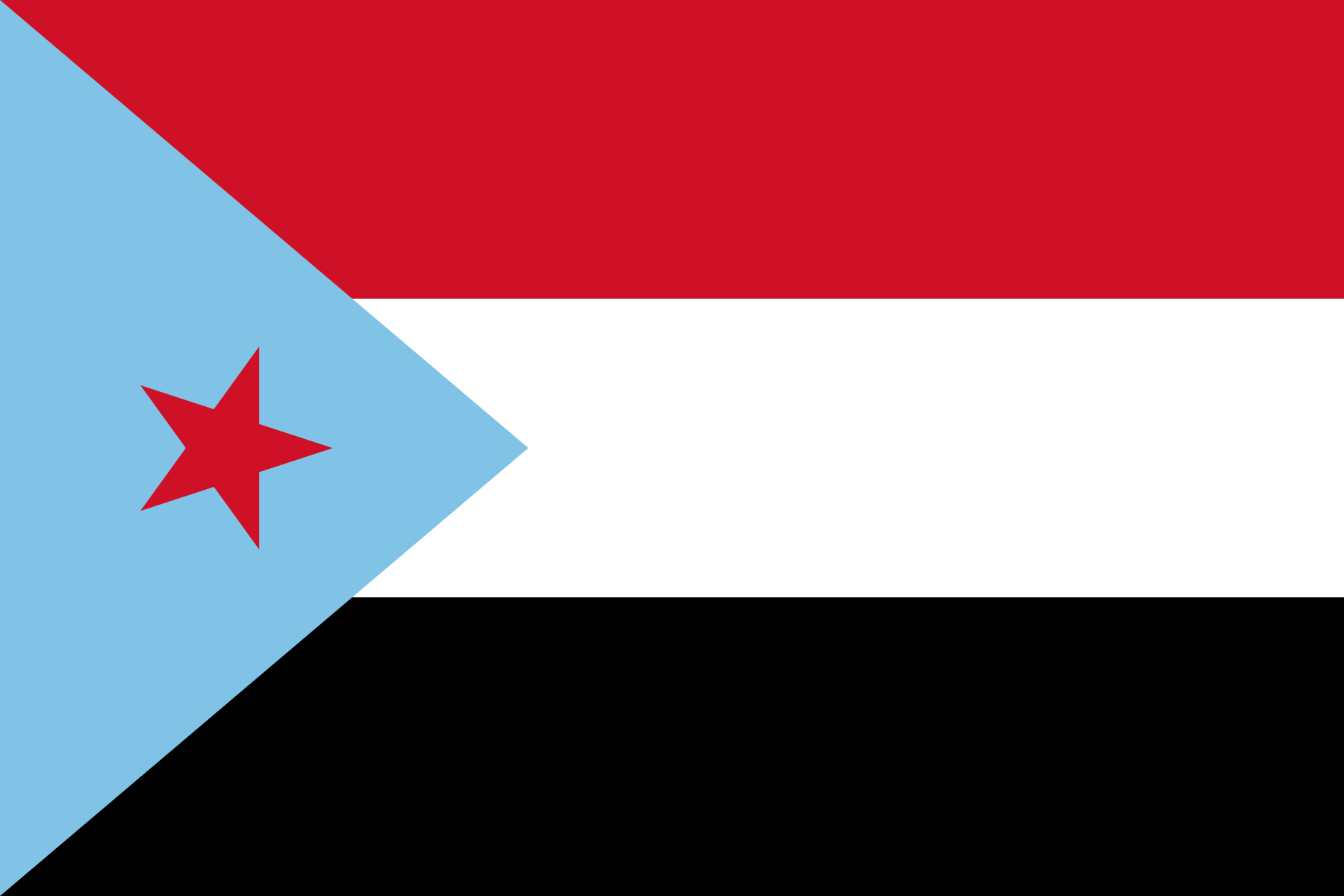
The Council is meeting today in the wake of the grave developments resulting from the movements of contingents of United States air and naval military forces on the borders of the Libyan Arab Jamahiriya. Four AWACS were sent to Cairo to be dis-
76. There has been differing speculation about the real significance of these American provocative acts. There are those who believe that the United States Administration’s aim is to convince American public opinion of the necessity for increasing militaryexpenditures at a time
when that policy is facing general indignation, owing to its adverse effect on social-welfare allocations, which are diminishing, thereby harming the poor and those with a limited income. There are those who say that these military scenarios constitute a continuation of the United States Administration’s policy aimed at winning votes in the forthcoming elections. But those fairly familiar with United States policy confirm that the campaign being waged by the United States against Libya, on the eve of the Seventh Conference of Heads of State or Government of Non-Aligned Countries, is but an American attempt to affect the proceedings of that conference and to deflect it from confronting United States aggressive policy. There are those supporters of the United States who are preparing today to undermine the policy of the Movement of Non-Aligned Countries, which is opposed to imperialism and neo-colonialism.
77. Whatever the reason, we have witnessed with grave concern one of the permanent members of the Security Council tampering with its obligations under the Charter of the United Nations. In addition to immobilizing the proceedings of the Council, as well as the implementation of its powers, the United States is jeopardizing international peace and security by its threats to use force. What has taken place in Libyan airspace is one such threat, The United States tried that policy during the cotd-war period when it involved itself in a military intervention in South-East Asia, but then it withdrew in defeat. Does the United States want to repeat the same tragedy in the Middle East?
78. Democratic Yemen declares its full solidarity with the Libyan revolution. It stands steadfastly against United States provocations. President Ali Nasser Mohammed sent the following cable to his brother Colonel Muammar Qaddafi:
“We in the People’s Democratic Yemen are following with grave concern the provocations faced by the Libyan Arab Jamahiriya stemming from the military forces of American imperialism in the Mediterranean, in co-ordination with Zionism and its allied forces. These provocative acts are but an attempt to prevent the fraternal Libyan people from exercising its effective role on the side of all progressive Arab forces and regimes in confronting the imperialist and Zionist designs that are aimed at dealing blows against the progressive Arab forces and regimes and imposing imperialist, military, political and economic hegemony on the Arab States and peoples. At the same time, we in Democratic Yemen commend your glorious steadfastness against these provocative acts and confirm our confidence in the continued steadfastness of the Libyan people and its ability to defeat all the imperialist and Zionist conspiracies.”
(interprerarion from Russian): The next speaker is the representative of the Sudan. I invite him to take a place at the Council table and to make his statement.


It gives me pleasure to address the Council in Arabic. As I do so, I am truly happy to extend thanks to the Council for adopting its historic decision to introduce Arabic as an official and working language in its deliberations and work [resolution 528 (1982)]. I extend warm congratulations to you, Sir, on your assumption of the presidency. We are completely confident that your political wisdom and diplomatic experience and know-how will enable the Council to fulfil all its duties and functions.
81. I wish also to extend thanks to your predecessor, brother Amega, the representative of Togo, for his worthy efforts last month.
82. May I also extend sincere congratulations to the new members of the Council, fully confident that their membership in the Council will enrich its work and help it to assume its role in the interests of international peace and security. My thanks go also to the outgoing members of the Council, who spared no effort in promoting the objectives which form the basis of the United Nations.
83. The Council has been convened today on Libya’s request. I need not explain or stress the common cultural links between the Sudanese and Libyan peoples; these links have been strengthened throughout history by neighbourliness. Each of these links could have supported fruitful and sound relations between Libya and the Sudan but for the refusal of the Libyan leadership to allow the Sudan to exercise full sovereignty over its territory and to adopt the economic and political approaches and the foreign and domestic policies stemming from the aspirations and hopes of its people. To that one cod
add Libya’s disregard of the principles governing normal conduct among nations, including the principle of nonintervention in their internal affairs and the principle of the non-use or threat or force in international relations. Here lies the bone of contention and the source of tension in the relations between the two countries.
84. The Council has already been informed of Libya’s numerous hostile practices and of its provocations against our people and land, provocations which extended to invasion and the use of mercenaries in July 1976 to carry out its designs. The defeat of that invasion in 1976 was not the end. Libya proceeded to a series of vioIations of the independence, sovereignty and territorial integrity of the Sudan. In 1981 there were severa Libyan violations of Sudanese airspace as well as the bombardment of villages along the borders of the Sudan and Chad. Libya intensified its aggressive actions against the social and economic infrastructure and continued ary anti-Sudan campaign in all its mass media.
85. Last week’s events, which have been extensively covered by all news agencies and by the world mass media, are a continuation of Libya’s violations of all international rules and instruments governing the relations of States with one another and good-neighbourly relations in particular. Last week we witnessed the escalation of the armed Libyan presence on our north-western frontier by the use of MiG-23s and long-range bombers, The competent Sudanese authorities obtained information from some agents arrested in Khartoum which confirmed the existence of a Libyan scheme to overthrow the legitimate Government of the country, to undermine its constitutional institutions and to impose Libyan trusteeship on the Sudanese people.
makes it incumbent upon the Council to follow the situation closely and to take all necessary measures to put an end to such practices.
91. Before I conclude I should like to say that the Sudan would not have brought its differences with Libya to the Council today had it not been for our concern to place things in their proper perspective and to settle such differences, which should have been done within the framework of the regional organizations to which the two countries belong. However, I had to do this because the matter had been given a partial treatment which did not reflect the full reality in the region.
86. Faced by these grave events, which jeopardize the security, unity and stability of the Sudan and not only are aimed at destabilizing the area but also have grave implications for international peace and security, the Sudan took preventive measures to thwart that scheme and to preserve its own independence and territorial integrity.
92. In concluding, I should like to appeal to the Council to follow developments in our area caused by Libya’s policy of intervening in the internal affairs of its neighbouring countries, a policy which has adverse international and regional effects on and negative consequences for the programmes for development and progress required by the countries of the region. I also call upon the Council to make the necessary arrangements to restore peace, stability and security there.
87. In the face of such an extremely dangerous situation, the Sudan could not but use all ways and means to defend itself and its people’s safety, its sovereignty, its territorial integrity and its airspace, in co-operation with all friendly and fraternal countries, in the context of international law and the Charter of the United Nations, as well as the charters of the regional organizations to which my country has the honour to belong, and also within the context of bilateral measures, foremost among which is the Egyptian-Sudanese Defence Treaty.
The next speaker is the representative of Egypt. I invite him to take a place at the Council table and to make his statement.
88. On the instructions of my Government, I should like to inform the Council of the following: first, the measures taken by the United States Administration were necessary to thwart the massive Libyan concentrations against the Sudan; secondly, following the response of the United States, it has been proved beyond doubt that there were increasing Libyan concentrations along the north-western frontier of the Sudan; thirdly, many violations by Libyan aircraft and bombers of Sudanese airspace were monitored, and our forces took preventive measures and compelled the Libyan aircraft to withdraw; and, fourthly, these joint efforts were highly effective in thwarting the Libyan scheme.


The delegation of Egypt, in making its contribution to the debate today through this short statement, is proceeding from its concern that the facts be clarified and matters put in their true perspective. Indeed, after the detailed, clear and moderate statement of the representative of the Sudan, it is unnecessary for my country’s delegation to deal with details of which the Sudanese delegation is well aware.
95. At the outset I wish to state that we shall not be lured into verbal clashes that are of no use. We have heard comments here and there and we see that it is wise, reasonable and logical to ignore such comments altogether.
89. I need not reaffirm Sudan’s whole-hearted faith in the principles and objectives which form the basis of the United Nations and in the principles of the regional organization to which both Libya and the Sudan belong. The good-neighbour policy has always been one of the corner-stones of the Sudan’s foreign policy, as witnessed by the bilateral and multilateral instruments of cooperation binding the Sudan and its neighbours, which, without a doubt, constitute important tributaries of international co-operation and of the strengthening of international peace and security. On that basis, we call upon Libya to comply with these principles and to refrain from its policy of intervening in the internal affairs of other nations, particularly neighbouring countries.
96. The statements issued in Cairo concerning the latest developments were committed to refraining completely from opening the door to the possibility of using these developments to escalate the situation or raise tension needlessly, Cairo adopted this stance deliberately, out of its concern not to escalate matters, especially since the profiteers had failed to achieve their designs.
97. At the same time, it behoves us to make it clear before the Council that Egypt is fully committed to defending fraternal Sudan, in response to its request and to the extent that would be agreed upon. There is no ambiguity concerning this matter. The mutual defence treaty between our two countries is not a dead letter. It commits the two fraternal countries to the full implementation of all its provisions. The security of the Sudan is part and parcel of Egypt’s national security and vice
90, We were recently informed by the mass media that suicide squads were formed in Libya to assassinate some presidents whose pictures were burned in public squares in Tripoli. Among them was my own President. This sheds further light on Libya’s persistent resort to the threat and use of force in international relations and
versa The two countries are fully entitled to exercise the right of sovereignty over the national territories inside their borders and also to take the measures they see fit for self-defence against any aggression or threat of aggression.
98. That is what my delegation wishes to put on record. We need not go into detail and cite examples of attempts at interference in the internal affairs of neighbouring countries. All we wish from the Libyan Arab Jamahiriya is that it commit itself in fact to what is stated by its representative in document S/15614-that is, to work for the consolidation of peace and security in the area and the peaceful settlement of disputes.
99. As everybody knows, Egypt has not raised any weapon against any Arab country. It has not shot one bullet against any Arab citizen. Throughout its long history, Egypt has been a shield and a pillar of support for the Arab nation, in both its western and its eastern flanks.
I should like to inform members of the Council that I have received a letter dated 22 February from the representative of Jordan [S/15619], which reads as follows:
“I have the honour to request the Security Council to invite Mr. Clovis Maksoud, Permanent Observer of the League of Arab States to the United Nations, to participate in the consideration of the item entitled ‘Letter dated 19 February 1983 from the Permanent Representative of the Libyan Arab Jamahiriya to the United Nations addressed to the President of the Security Council [S/15615’j’, under rule 39 of the provisional rules of procedure.”
If I hear no objection, I shall take it that the Council decides to grant this request.
11 was so decided.
101 I The PRESIDENT (interpretation from Russicm): I invite Mr. Maksoud to take a place at the Council tabIe and to make his statement.
102. Mr. MAKSDUD (interpretationfram Arabic}: Mr. President, on behalf of the League of Arab States and its delegation, I wish to express our thanks to the Council for having granted our request to speak at this meeting. On this occasion I wish also to express the warm appreciation of the Arab nation for your personal role, as well as that of the Soviet Union, in supporting Arab issues of paramount importance to the fate of the Arab nation.
103. The convening of the Council with regard to this development on the eve of a non-aligned summit conference sheds clear light on the tremendous importance of the reaffirmation of the States of the third world to commit themselves to the policy of non-alignment and widen the constituency for peace in the world in order that the Arab, African, Asian and other States of the South may not all be a stage for confrontations in attempts to dictate
their destiny. We wish to find the necessary guarantees for the independence of these States and the possibility for their societies to determine their own destiny without the pitfalls of military alliances that may undermine genuine independence and weaken the ability to launch initiatives and take decisions.
104. What cuts us to the quick is to see the effects of outstanding disputes which would have been better dealt with on the legal bases on which regional organizations are founded. The League of Arab States and the OAU are examples of such organizations. Actually, this makes us feel the necessity for strengthening these regional organizations, in accordance with the Charter of the United Nations. All these disputes are historically transient and not perennial in our beings or in our consciences.
105. The convening of the Council to consider the military show-down in the Mediterranean leads US to the realization of what goes beyond in importance and what is deeper in effect in our contemporary history. We find that the destinies of many of the countries of the third world have been blown about by the wind. Instead, our efforts and ideas should have been focused on the priorities of genuine peace and development and progress, especially as we in the Arab nation and the third world have a vested interest in achieving international peace and detente. This peace does not constitute only a morat commitment on our part. It also constitutes for us the proper climate for the development of our societies from backwardness to advancement. In all the communities of the third world, we are suffering from economic and technological crises and from attempts by hegemonistic forces to dominate our political destinies and economic opportunities. If we do not have a definite opinion about some of the things mentioned in the course of these meetings, we, as a regional organization which seeks to ct+ystallize and to state the Arab views of the matter, hope the United Nations will work to support the ability of the regional organizations to fulfil their tasks and to participate in the task of maintaining international peace and security.
106. The plight that we are witnessing today must be an incentive for all the third-world communities, whatever their differences may be, whether ideological or intellectual or political, to settle those differences. They have to realize that their destinies are interrelated to a large extent and that the bitter experience that we are undergoing today should lead us to rise above it in order that we may be able to discover that the factors which bring US together in the communities of the third world, as well as the challenges that unify us, are much bigger and much more effective than the factors of dissension and conflict. Such factors reduce the number of our opportunities for real independence, block our way towards unity and impair our steadfastness in progress and development.
107. Therefore, we stand today before this reality. We had hoped that this reality would have become a precedent that would prevent the pattern of intervention in the
destiny of the third world, that this would be an incentive for us in the future.
for 24 hours. Then we witnessed the press conference held by President Reagan in which he asserted that there was no movement by the fleet and that the AWACS were conducting joint training manoeuvres with Egypt.
108. Thus, we hope that the arguments we have heard today, whether or not they are based on right, will enable us to rise above the climate of dissension and to benefit from them. We hope that this experience will act as an incentive for us all in the Arab and third-world nations to make the policy of non-alignment a reality in our conduct and a reality in our relations together, before we are subject once more to being used as pawns in the cold war and the arms race.
115. We had hoped to hear from the representative of Egypt, after the confirmation by his Government that there were no joint manoeuvres, whether or not this is true. I shall return to this point later.
116. The United States Departments of State and Defense immediately stated that there were indeed movements by the fleet and the AWACS were there because of the so-called Libyan threat: the threat posed by 3 million Libyans against 50 million Egyptians and 20 million Sudanese, The Egyptian army alone amounts to more than one third of the population of Libya. As the representative of Iran said: even if there were a threat-and that is not true, for such a threat does not exist-where does the United States come in? Has it arrogated to itself the role of the Security Council or the League of Arab States or the OAU? It has no such role.
109. We therefore hope that, at a moment of awareness during this stage of the development of the Arab nation, this afternoon’s events will serve as a prelude, giving us a sense of direction to confirm our independence of decision and our resolute will to contribute towards genuine and effective peace and to liberate the third world from the dangers of acute polarization and international tension, as well as from the attempts of fleets directly or indirectly to dictate their will on our ability to move forward.
117. The representative of the United States stated that her country is concerned with the maintenance of good relations among neighbours and that it intervened because Libya had intervened in the affairs of its neighbours, We wish that this permanent member of the Council, the United States, would employ such rational and reasonable words against Israel, which did not merely intervene but occupied: it occupied the territory of Lebanon, a neighbouring country. It has occupied a portion of Syria and annexed Syrian territory. It has occupied and annexed Jerusalem. But no, there were no such words, because Israel is the strategic ally of the United States. The Israeli aggression could not have taken place had it not been for United States intervention.
110. Thus, the challenge we face today should be an impetus enabling us to affirm the common denominators we possess so that the differences that may arise between us, the nations of the third world, may be transient and not permanent divisions which can be exploited for more polarization and tension.
111, The PRESIDENT (interpretation from Russian): The representative of the Libyan Arab Jamahiriya wishes to speak in exercise of his right of reply. I now call on him.


We heard this morning the statement of the distinguished representative of the United States [2415th meeting’l. I say the “distinguished representative”, and I wish she were here so that she could hear these polite terms and so that she would refrain from the terms she has become accustomed to using even in such an august body as this.
118. IS the United States concerned about the Egyptian people? Members of the Council will recall the massacre of schoolchildren in Bahar al-Baqar, in Egypt. Was that school not destroyed with United States weapons? Was not the Egyptian army destroyed again and again with United States weapons? The people of Egypt do not like the United States, and they will never be an ally of the United States-never, When the United States came to the realization that there had been a rapprochement between Egypt and the rest of the Arab nation and that Egypt was joining the Arab ranks, the United States wished to intervene and to intimidate the Egyptian Government, because it realized that the Camp David accords were finished once and for all with the Beirut massacre.
113. I believe members of the Council had all expected to hear something-something important-although personally I was certain that she would repeat the words of the American mass media and the accusations made by the Zionist-controlled American media against Libya and against the leadership of its revolution, We had expected to hear proof or to be provided with evidence concerning the so-called Libyan threat. But we heard the representative of the United States quoting Radio Sudan. Do the super-Powers not have other sources of information? We thought only we small countries were in that position.
119. In the final analysis, therefore, all these manoeuvres are designed to intimidate Egypt or to hatch a plot against it from within.
114. If we analyse the American position from the beginning-that is, before the press conference held by the President-we see that, in a broadcast, ABC referred to the United States intervention and stated that the Administration had asked it to postpone the broadcast
120. The United States Secretary of State has said that a victory has been won: a victory by a super-Power-as though Libya were the Soviet Union or China- So the
United States has triumphed over Libya. How did it triumph? The Sudanese regime managed to arrest 12 Sudanese plotters, and thus the United States triumphed and achieved its aim. So the United States Sixth Fleet returns, along with the AWACS. This is the victory won by the United States; that, regrettably, is the logic of a super- Power which hold the fate of the world in its hands. It is incredible that a Leadership with such a mentality has assumed the responsibility for the security of the world. In my view, that is the most dangerous problem facing the Security Council, which bears the responsibility for the maintenance of peace.
121. They talk about Libya’s terrorism. Does Libya need certification from the United States? For my part, if the United States were to praise Qaddafi, I would be the first to oppose him, because that would mean that Qaddafi was a traitor. But it is my honour to be a soldier in my leader’s army because he is against United States imperialism.
122. Who has given a certificate of good conduct to whom? In its decisions, the Sixth Conference of Heads of State or Government of the Non-Aligned Countries, held in Havana in 1979, unanimously condemned the positions of the United States. It has not condemned Libya or Muammar Qaddafi but has condemned the United States Administration. The resolutions of Arab summit conferences held at Baghdad in 1978, Tunis in 1979 and Amman in 1980-with the participation of the Sudan and, at Tunis, with the participation of President Nimeiri personally-unanimously condemned the United States policy of aggression against the Arab nation. The Third Islamic Summit Conference, held at Mecca-Taif in 1981, condemned the imperialist policy of the United States. That policy has also been condemned by the Arab Front of Steadfastness and Confrontation, by the conferences of heads of State or Government of non-aligned court; tries and by the Conference of Ministers for Foreign Affairs of Non-Aligned Countries held at Belgrade in 1978.
123. Who has been condemned by the United Nations and by other international organizations? We are all Members of the United Nations, and you have witnessed this year that the United States has been isolated along with Israel from the rest of the world; concerning South Africa, sometimes other States have joined them in their isolation. Who is practising terrorism against the people of El Salvador? Against the people of Nicaragua? Who is practising intervention and terrorism against the people of Poland? Against the people of Viet Nam? Who murdered hundreds of thousands of Vietnamese? Can the United States hand out certificates of good conduct regarding terrorism while it is leading international terrorism?
124. I say to the United States that the winds of change are blowing. Somoza is gone. So is Bat&a. All the lackeys considered friendly by the United States will met with the same fate, and no political leader will consider himself honoured by the friendship of the United States,
because that would make him the friend of imperialism, of monopolies, of colonialism.
125. Muammar Qaddafi is anti-imperialism; he is antimonopolies and anti-Zionism, and he will remain so; and this redounds to his honour. Muammar Qaddafi would cherish a certificate from the people of Nicaragua, or of Cuba, or of Viet Nam, but not from the United States Administration. We in the Arab nation, including the people of the Sudan, feel that any friend of the United States is a lackey. The United States does not accept friends; it only accepts lackeys. When the question of the AWACS was considered in Congress, Senator Jackson said that the United States had one friend in the region of the Middle East and that the rest were lackeys. The United States Administration does not accept friends or semi-lackeys; it wants full lackeys. When these lackeys are asked to accuse Libya, they accuse Libya; when they are asked to accuse the Soviet Union, they accuse the Soviet Union,
126, The New York Times of 16 January stated that the CIA had indicated that some States-including El Salvador, Guatemala, Honduras and the Sudan-were in jeopardy. Since then, the CIA has been preparing for some action against Libya. We know of contacts with the CIA and we know that the Agency’s directors have made V~Sits to the area, but we would have liked to be furnished one piece of proof of their claims. We challenge the allegation that there has been even one single Libyan intervention in the affairs of the Sudan. If there are internal problems in the Sudan, they have nothing to do with us. There have been 19 attempted coups in the Sudan since the May revolution; as everyone is aware, in one of those attempted coups, Libya saved President Nimeiri and sprang him from gaol, The internal problems of the Sudan have nothing to do with us. We are a fraternal people of the people of the Sudan and we want to live in peace and prosperity with that people. We shall always be close. Our real enemies will remain the Americans.
127. We have had differences with the Sudan in the past, and we have severed relations and resumed relations. Now, we have differences that we will soon reconciIe because we are Arabs, because we are Africans, and because our enemy is Israel and our enemy is the United States. We really have no enemy other than the United States, which ‘provides Israel with weapons, which
murders our children, which stands behind the massacres of Deir Yassin and those of Sabra and Shatila. With American napalm and American cluster bombs and American weapons, the children of Sabra and Shatila were murdered. How, then, can Americans be friends of the Arabs? That cannot be. Cairo was bombed with American planes and so was Aswan. Ismailia was destroyed with American planes. Egypt was almost destroyed by American planes, and Egypt will not be a friend of America. He who tries to be a friend of America in Egypt will meet the same fate as did Sadat, not at the hands of Libya but at the hands of the Egyptian people.
128. Libya will not intervene in the affairs of any State. The diatribes and falsehoods that we have listened to
today from the representative of the United States are an open secret. The responsibility of a super-Power, a permanent member of the Security Council, is a very grave one. The representative of the United States stated that what had happened to Libya will be repeated and that the United States is prepared to indulge in more provocation and to continue the aggression. This is evident from the statement of the United States representative. However, we say that if this is to be repeated, then let it be repeated. Let there be another Viet Nam in the Arab region. The will of the peoples is invincible. It is part of the will of God. No matter how great the United States is ‘and no matter how strong it is militarily, our people will not kneel. The Arab peoples, including the Egyptian and Sudanese peoples, stand by the side of Libya. We are certain that if America were to commit an aggression, the Sudanese would be the first to fight at the side of the people of the Jamahiriya.
The representative of the United States wishes to speak in exercise of his right of reply, and I now call upon him.
13 1. Mr. LICHENSTEIN (United States of America): I shall indeed be brief, as Mrs. Kirkpatrick tried earlier today to be brief, clear, precise and factual.
132. I want to assure the representative of Libya that I will convey to Mrs. Kirkpatrick his uncharacteristically kind opening statement. I shall also convey to her the unfortunately all-too-characteristic tenor of the balance of his remarks.
133. Two points only: indeed, we have many sources of information, many excellent sources of information. One of them is the radio service of the Sudan. We believe that it is a reliable and authoritative source in very great part because it is the radio service of a brave, courageous, honourable and independent people. As for our relationship with Egypt, it is the earnest hope of my Government and of the American people that we will be bound to the country and to the people of Egypt with the bonds of strong friendship. These are bonds that consist in great part of shared concerns and shared values, pre-eminent among which, in my view, is belief in non-interference in the affairs of one’s neighbours and non-use of force in the resolution of international conflict, thus serving the goal of international peace and security and fulfilment of the enduring principles of the Charter of the United Nations.
129. I apologize for having spoken at some length, but I think this issue is a very grave one and that it requires numerous details and great accuracy, as well as a sense of collective responsibility-the responsibility of the Council for the maintenance of peace, not the responsibility of America. America is not God. The age when the United States used atom bombs because others did not have them is over. The age when it destroyed the people of Japan is over. The age when it annihilated the Red Jndians is over. The age when the United States monopolized Latin America is over. All of those ages are over. Although ours is a small people, it will not capitulate. Hence, we must say to American imperialism: “No, you are not responsible for maintaining peace. You are not the policeman of the United Nations.” We must condemn it, and we must combine our efforts, as we did against nazism in the past, to spare humanity nazism’s scourge.
The meeting rose at 6.40 p.m.
Litho in United Nations, New York 00300 6020S-October IWO-2,050
▶ Cite this page
UN Project. “S/PV.2416.” UN Project, https://un-project.org/meeting/S-PV-2416/. Accessed .