S/PV.2417 Security Council
▶ This meeting at a glance
15
Speeches
8
Countries
0
Resolutions
Topics
Global economic relations
War and military aggression
Security Council deliberations
Diplomatic expressions and remarks
General statements and positions
Israeli–Palestinian conflict

The first speaker is the representative of Benin. I invite him to take a place at the Council table and to make his statement.
The meeting was called to order at 11.30 a-m.


Mr. President, I should like first of all to tell you how grateful I am for the great honour you have confered on me by allowing me to address the representatives of the States members of the Council on behalf of the People’s Republic of Benin.
Adoption of the agenda
The agenda was adopted.
Letter dated 19 February 1983 from the Permanent Representative of the Libyan Arab Jamahiriya to the United Nations addressed to the President of the Security Council (S/15615)
5. I am also pleased that this debate, on the deterioration of the situation off the Libyan coast, in the Gulf of Sidra, is taking place under your competent leadership. Indeed, you are the distinguished representative of a great country, the Soviet Union, with which my country is gratified to have the closest and most cordial relations, a country which more than 64 years ago raised high the banner of the glorious October revolution and thus gave to all the proletarians, all the oppressed and all the damned of the earth the hope for a new dawn of freedom, dignity and prosperity. I am therefore convinced that, with your outstanding qualities and your firmness, our debates will bring successful results.
In accordance with the decision taken by the Council at its 2415th meeting, I invite the representative of the Libyan Arab Jamahiriya to take a place at the Council table; I invite the representatives of Benin, Democratic Yemen, Egypt, Ghana, the Islamic Republic of Iran, the Sudan and the Syrian Arab Republic to take the places reserved for them at the side of the Council chamber.
At the invitation of the President, Mr. Treiki (Libyan Arab Jamahiriya) took a place at the Council table; Mr. SogIo (Benin), Mr. Al-Ashtal (Democratic Yemen), Mr. Khalil (Egypt), Mr. Gbeho (Ghana), Mr. Rajaie- Khorassani (Islamic Republic of Iran), Mr. Abdalla (Sudan) and Mr, El-Fattal (Syrian Arab Republic) took the places reserved for them at the side of the Council chamber,
6. I should also like to tell your predecessor, the representative of Togo, our brother Atsu Koffi Amega, how grateful we are for the very remarkable way in which he conducted the work of the Council last month. No less could have been expected of such a seasoned diplomat, who combines a complete knowledge of the facts with an innate vitality and dynamism.
7. The people and the Government of Benin could not fail to be concerned at the situation which, since 16 February, has prevailed in the Mediterranean off the coast of
I would like to inform members of the Council that I have received letters from the representatives of Czechoslovakia,
“The news which has just reached us concerning the military manoeuvres now in progress in the Mediterranean and in the regions adjoining the Socialist People’s Libyan Arab Jamahiriya is a matter of great concern to us.
“There can now be no doubt that these military manoeuvres constitute a threat to the security, peace and stability of the peoples and States of the region,
“In that connection, we should like, on behalf of the Beninese people, of their leading party, the People’s Revolutionary Party of Benin, of their National Executive Council, and on our own behalf, to assure you of our total support and our active solidarity in your determination to defend the Socialist People’s Libyan Arab Jamahiriya and the achievements of its revolution.
“We reiterate our unfailing dedication to the ideals of peace, equality and social justice so dear to our two peoples.
“Now and in the future, as in the past, the Beninese people will militantly support any action designed to safeguard peace, cohesion and good understanding in all corners of Africa so that the peoples of these regions may devote themselves whole-heartedly to the national tasks of construction and development,”
8. By its participation in this debate, my delegation wishes only to reaffirm the immutable principles on the basis of which the United Nations was founded and to which we have al1 declared our commitment.
9. In fact, non-interference in the internal affairs of other States and the peaceful settlement of disputes have always constituted the key principles on which the foreign policy of my country has been based. This is why the Government of Benin has always deplored any policy based on force or the threat of force, from any source, in international relations.
10. If the Council were able to invite the various parties to the conflict to heed these principles, it would discharge the primary task incumbent upon it and protect the peoples of the region from a situation which threatens not only their efforts at construction and development but also international peace and security.
11. Ready for the revolution, the struggle continues!


At the very outset, I wish to associate myself with the cordial words of welcome extended to our new colleague, Mr. Abdullah Salah, of Jordan. My delegation wishes him every success in discharging his duties.
14. For a few days the world has been watching the development of the situation with grave concern and attention. AWACS aircraft were dispatched by the United States to a country neighbouring Libya. The United States aircraft-carrier Nimitz, accompanied bY some naval vessels, was deployed close to the Libyan coast.
15. Coupled with those military moves was a press campaign maintained at a high pitch, as well as unfriendly if not openly hostile statements addressed to Libya.
16. These actions of the United States were unprovoked. There is no justification for them. The Libyan Arab Jamahiriya has on numerous occasions, both in the past and now, confirmed that it has no intention whatsoever of interfering in the internal affairs of any country and that it is anxious to see security and peace prevail in the area. Such confirmation was given once again in the statement delivered yesterday by the representative of Libya [2415th meeting], who also presented a long list Of self-evident facts testifying to the hostile steps against Libya taken by the United States. The efforts to prove the allegations, accusations and false suggestions that the moves were connected with “plotting to overthrow” one of the neighbouring Governments are condemned to failure. They will not be found credible by world public opinion, It will not be easy to believe claims that the depioyment of naval vessels and the air force in the region had been planned beforehand as a training exercise. Neither can one easily accept charges that the Libyan policy towards its neighbours posed a threat to the security of the region. Interestingly, none of its neighbours has requested a meeting of the Council.
17. The provocations against Libya stem from the policy of confrontation based on military threats, intimidation and coercion that is being pursued by the United States Administration. It is this very policy that is airned at influencing events and at interfering in the internal affairs of others whenever they are not to the liking of that Administration. The efforts to apply this policy are well known in other regions of the world also, and in many countries, including my own.
18. My country attaches particular importance to the question of the consolidation of peace. Not so long ago, in the Political Declaration adopted at the meeting of the Political Consultative Committee of the States Parties to the Warsaw Treaty, held at Prague on 4 and 5 January, Poland, together with other socialist members of the defensive alliance, noted, inter &a, that:
“the improvement of the situation in the world is to a great extent connected with the elimination of existing
19. Hence, my delegation has followed the present debate with keen interest and attention. We took note, inter aliu, of the statement made yesterday by the representative of Malta, [2416rh meeting], in which he spoke about the responsibility of the regional Powers for building the structures of peace and security in their region, including the possibility of changing the Mediterranean into a zone of peace.
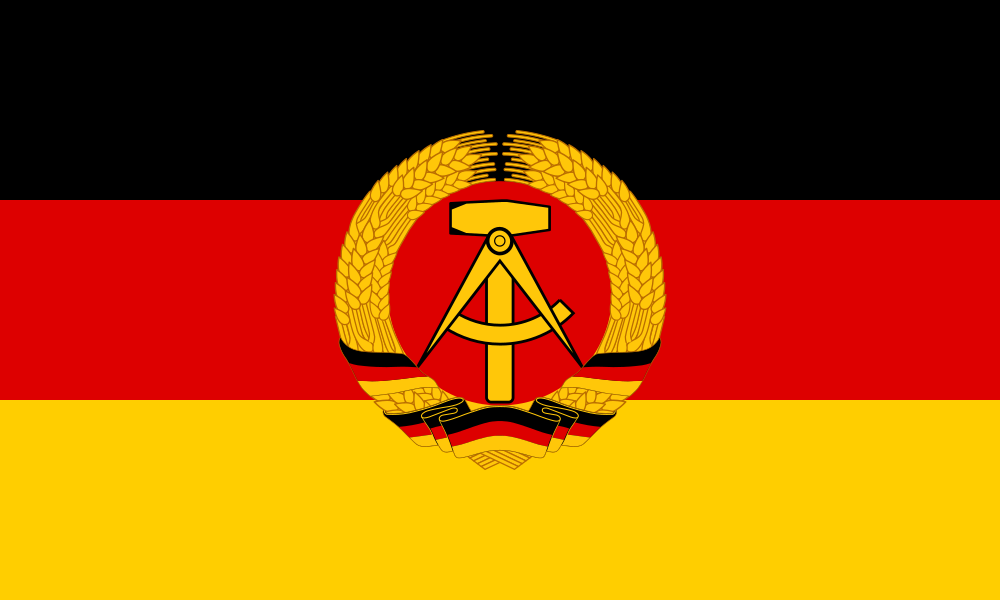
26. The peoples of the non-aligned countries in Africa, as well as in Asia and Latin America, have embarked upon a road of independent development. They resolutely oppose all attempts by imperialist Powers to interfere in their internal affairs and attempts by those Powers to achieve their neo-colonialist aims through pressure and blackmail, through threats and use of force. The German Democratic Republic holds the view that the peoples and States in the Middle East also are able to solve their problems by their own sovereign decisions. To this end, they need neither an imperialist world gendarme nor a self-appointed arbitrator who wants to dictate law and order to them through gunboat politics. Many people concerned about the maintenance of peace in the world rightly wonder why the United States is once again demonstrating its policy of strength thousands of miles away from its own territory on the pretext of safeguarding its so-called vital interests. This is obviously an element of the imperialist course of confrontation and super-armament, of the crusade against social progress and national liberation in the world. It is also no secret that imperialism is pursuing the aim of extending its military presence in the Middle East and of implementing its hegemonistic endeavours in that region.
20. At this point, may I recall that it has been the States Parties to the Warsaw Treaty which have for years consistently been putting forward proposals concerning the lowering of the level of deployment of the naval forces of the opposing military blocks in the Mediterranean. In the above-mentioned Political Declaration, they called for the opening of talks on the limitation of naval activities, on the limitation and reduction of naval equipment and on the application of confidence-building measures to seas and oceans. They were in favour of withdrawing nuclear-equipped vessels from the Mediterranean and of renouncing the deployment of nuclear weapons on the territory of Mediterranean non-nuclear countries [S/155.56, annex, sect. If/.
21. If the other parties concerned had responded to these proposals constructively, we could now have been much closer to attaining the objective set forth in the statements of Malta, Libya and other countries of the region.
27. The “strategic alliance” between the United States and Israel and the refusal to contribute to a comprehensive, just and lasting solution to the Middle East problem serve that purpose, Also aimed at achieving this purpose is the creation of a so-called rapid deployment force which can now already be moved in full strength to the region of the Middle East and the Near East within the shortest possible time. A United States central military command for this region has the task of setting up new military bases and of conducting and co-ordinating military action, The true causes of the persistent increase in tensions in the region of the Middle East and the Mediterranean, as well as in other areas of the world, can be found in this imperialist policy.
22. In accordance with the provisions of the Ch-ter of the United Nations, the Council is.responsible for maintaining peace and security. Today, in discharging this duty, we focus our attention on the unprovoked actions which bring potential dangers. The Charter places an obligation on all Members to
“refrain in their international relations from the threat or use of force against the territorial integrity or political independence of any State, or in any other manner inconsistent with the purposes of the United Nations .”
28. This is becoming visible on the European continent, where, because of the planned deployment of new American medium-range nuclear missiles, peace and security are greatly threatened. In Latin America and the Caribbean, new provocations are persistently launched against the independence and sovereignty of the States and peoples of those regions. In southern Africa, the apartheid rtgime is encouraged to perpetrate new acts of aggression against sovereign States. In many regions of Asia, new tensions are provoked by the imperialist policy of confrontation.
23. We wish to point out that these provisions should be strictly observed by all Members of the United Nations, including the United States, a permanent member of the Security Council.
The next speaker is the representative of the German Democratic Republic. I invite him to take a place at the Council table and to make his statement.
29. Faithful to the principles of its socialist foreign policy and devoted to the principles and purposes of the Charter of the United Nations, the German Democratic Republic opposes military and political actions which dangerously increase tensions, and unswervingly supports a peaceful solution of all international issues. The

The Council must again deal with problems in the region of the Middle East and the Mediterranean. My delegation understands the request made by the Libyan Arab Jamahiriya for the convening of an urgent meeting of the


I wish first of all, Sir, to add my own voice to those of the many who have already congratulated you on your assumption of the presidency for this month. Because of your wellknown diplomatic qualities and wide experience, as well as your personal charm, the current deliberations of the Council are already assured of a successful outcome.
31. Through you, Mr. President, I wish to pay a richly deserved tribute also to your predecessor, the representative of Togo, Mr. Amega, for the exemplary manner in which he presided over the business of the Council during the month of January.
32. On my own behalf, and on behaIf of the Zimbabwe delegation, I should also like warmly to welcome the new representative of the Hashemite Kingdom of Jordan, Mr. Abdullah Salah. My delegation looks forward to an excellent working relationship with him, as we have always had with his predecessor.
33, The current meetings of the Council have been convened at the request of the Government of the Socialist People’s Libyan Arab Jamahiriya to “consider the deteriorating situation near the Libyan shores that could jeopardize the security and peace of the region and the world”, to quote from the letter which the Libyan representative addressed to the President of the Council on 19 February. The letter, further, attributed this deterioration of the situation to what it called the “provocative military actions of the United States Administration”, which moved its nuclear-powered aircraft-carrier Nimitz and some other naval vessels too close to the Libyan coast. It is also reported that, in addition, the United States dispatched four air-force airborne warning and control system planes, called AWACS, to Libya’s eastern neighbour, Egypt. These very sophisticated planes, we are told, have been sent there for the purpose of carrying out spying and surveillance activities over the already troubled and dangerously sensitive Libyan territory and waters.
34. The Libyan charges, however, have been rejected as “false and malicious” by the representative of the United States in a letter of 22 February addressed to the President of the Council. The United States representative, further, made counter-accusations against Libya, whose policies, she said, posed a threat to international peace and security [see S/15617].
35. In his statement before the Council on 22 February [2415rh meeting], the Libyan representative catalogued numerous acts of aggression and destabilization perpetrated by the United States Government against his country.
36. Although, for her part, the United States representative maintained [ibid.] that the United States Govern-
37. The United States representative further warned that her country would intervene wherever and whenever it felt that Libya was threatening a country which is friendly to the United States. Indeed, she affirmed her country’s rights in that regard. Accordingly, it has been argued that the dispatching of hideous and sophisticated military equipment to North Africa last week was done in pursuit of this objective. That is all in spite of the assurances by both Egypt and the Sudan that neither of them had been threatened by Libya. It would appear lo us, therefore, that last week’s events, which naturally caused so much consternation and outrage in Libya and other parts of the world, including the United States itself, were prompted by motives other than the protection of a friendly country or countries. In our view, it would appear that last week’s events were prompted by a desire on the part of the United States to settle some undisclosed scores with Libya.
38. The Council must make it clear to all concerned that no country, no matter how powerful, has any right or authority to arrogate to itself the role of policing the world; that while countries have every right to define their national interests and aspirations as they perceive them, no country has any right to pursue its rights in a manner which endangers regional or international stability, peace and security. There can be no doubt that the dispatching of hideous and sophisticated military equip ment to North Africa last week by the United States dangerously threatened regional and world peace and security. The Council must particularly deplore and denounce such reckless actions and violations of the Charter of the United Nations, especially when the perpetrators are its members, indeed its permanent members, which should be aware of their special responsibility under the Charter.
39. The events of last week must have surprised and, indeed, shocked all the members of the Council, as they did us of the Zimbabwe delegation, taking place as they did at a time when the Council is carrying out serious consultations on the report of the Secretary-Genera1 on the work of the Organization in order to make the Council more effective in its role as the guarantor of international peace and security.
40. Finally, because of the by now all-too-familiar and long history of unhappy United States-Libyan relations caused in part by United States military manoeuvres in the disputed region and also because of the likely threat of those unhappy relations to international peace and security if allowed to persist-and also partly because the United States has only partially withdrawn its sophisti-
The next speaker is the representative of Viet Nam. I invite him to take a place at the Council table and to make his statement.
48. It is appropriate to take note of the fact that the new acts of provocation by the United States against the Libyan Arab Jamahiriya represent the culminating point in a premeditated and hostile campaign of subversion, intimidation and destruction that has been waged for a long time against the people’s socialist rCgime in Libya, as well as against other progressive non-aligned countries in the region, a campaign intended both to divide the Arab States in order to subjugate them and to impose United States imperialist domination throughout the Middle East region.


I should like to begin by extending to you, Sir, on behalf of the Socialist Republic of Viet Nam, our warm congratulations on your assuming the presidency for this month and to wish you every success in the discharge of your weighty responsibilities in the interest of maintaining international peace and security.
43. I should also like to convey my best wishes to all the members of the Council, and particularly to the newly elected members.
49. Of particular gravity is the fact that such brazen acts are being perpetrated by the United States itself, a permanent member of the Security Council and therefore a country bearing the main responsibility for the maintenance of international peace and security. This is a threat to use the force of arms against a peace-loving Arab State, a member of the Movement of Non-Aligned Countries and a Member of the United Nations, in absolute violation of the fundamental principles of the Charter of the United Nations and international law, as well as of the elementry rules governing the conduct of equal and sovereign States. Such arrogance is particularly intolerable in that it was blatantly displayed yesterday, in a solemn meeting of the Council, by the representative of the United States [24/5th meeting], who reaffirmed that her country was prepared to repeat similar acts of military provocation.
44. Lastly, I should like to thank members of the Council for having given me this opportunity to address the Council at this time.
45. Scarcely had the Council terminated the meetings that were convened to consider the danger inherent in the policy of annexation practised by Israel in the occupied Arab and Palestinian territories than it has been called upon to meet once again post-haste today to examine the serious situation that has been created by the acts of military threat and provocation perpetrated by the United States against the Socialist People’s Libyan Arab Jamahiriya.
46. After having fabricated a so-called Libyan threat against the Sudan, the United States Government was emboldened to send large naval and air forces to the immediate vicinity of the sea and land frontiers of the Jamahiriya, to engage in activities there extremely hostile to that country. The Jamahiriya has thus had to confront a serious threat of aggression against its sovereignty and its territorial integrity, a threat likely to generate explosive situations that will militate against the peace and security of the entire Mediterranean region.
50. This, however, reveals the international-policeman mentality and acts that the United States has not hesitated to employ in other circumstances in various parts of the world in order to impose its diktat and its hegemony upon peoples of countries that are resolutely struggling to safeguard their dignity, their freedom and their independence.
47. In his letter dated 18 February, addressed to the President of the Council [S/15614], the representative of the Libyan Arab Jamahiriya reaffirmed his country’s policy of peace and good-neighbourliness and demonstrated that there was no valid justification for such farreaching acts, responsibility for which must be borne solely by the United States. We can get a better idea of the serious nature of the threat that has been posed by these new acts of provocation if we recall the anachronistic position of the United States with regard to the extent of the territorial waters of coastal States. Indeed, pointedly ignoring the new United Nations Convention on the Law of the Sea,’ which has fixed the extent of territorial waters at 12 nautical miles, the United States Government persists in recognizing a limit of only 3 miles. It was in the light of that concept that the United States deliber-
51. In this connection, I would invite representatives to recall the famous so-called Gulf of Tonkin incident, an incident that was entirely trumped up by the United States in 1964 as a pretext for unleashing its war of destruction against what was then North Viet Nam. May I here stated parenthetically that there is in fact a striking similarity between the present situation obtaining on the Libyan maritime borders and that which then prevailed off the coast of Viet Nam. Indeed, the Gulf of Tonkin is the virtual counterpart of the Jamahiriya’s Gulf of Sidra, for in 1964 American warships defiantly penetrated parts of that Gulf that are within our domestic waters in order to indulge in acts of provocation and to create a pretext for undertaking punitive acts of aggression against our country.
53. In conclusion, I should like to read out the following statement made on 21 February by the spokesman for the Ministry of Foreign Affairs of the Socialist Republic of Viet Nam in connection with the United States acts of provocation against the Libyan Arab Jamahiriya.
“The people and Government of the Socialist Republic of Viet Nam vehemently condemn the aforementioned acts of provocation and demand that the Government of the United States immediately put an end to all its threats and to all its acts of intervention and aggression against the Socialist People’s Libyan Arab Jamahiriya and other Arab States. The people and Government of the Socialist Republic of Viet Nam reaffirm their militant solidarity with and firm support for the people of the Jamahiriya, as well as for the peoples of Palestine and other Arab countries in their struggle against American imperialism and Israeli Zionism in order to secure their fundamental sacred and inviolable national rights.”
54. I have been requested by my Government to ask the Council, after urgent consideration of the present serious situation that has been created by the United States on the sea and land borders of the Socialist People’s Libyan Arab Jamahiriya, to take the necessary steps commensurate with the weighty responsibility incumbent upon it under the Charter to prevent a recurrence of United States acts of provocation and aggression against the Jamahiriya and to preserve the independence, sovereignty and territorial integrity of that country, as well as peace and security throughout the Mediterranean region.
The next speaker is the representative of Czechoslovakia, whom I invite to take a place at the Council table and to make his statement,
57. I should like also to express our appreciation to your predecessor, Mr. Amega of Togo, for his responsible and eloquent guidance of this body during the month of January.
58. Let me also congratulate the new members of the Council and wish them success in their very responsible work.
59. Czechoslovakia is following with grave concern the tense situation that has arisen in connection with the activity of United States military forces in the immediate vicinity of the territory belonging to the Socialist Peapie’s Libyan Arab Jamahiriya. The convening of the Council at Libya’s request to consider this problem is fully justified, since Libya is entitled to exercise its right to defend its existence pursuant to Article 2, paragraph 4, of the Charter of the United Nations.
60. The need for a thorough consideration of the problem is multiplied by the fact that this is not the first instance within a short period of time when the United States has threatened to use force against Libya for the purpose of asserting its military-political interests. The case under consideration offers another example of how far the policy of acting from a position of strength can go. As numerous speakers before me have stated, the allegation concerning a so-called Libyan threat to the territorial integrity of another State is not based on reality, as is confirmed by statements of official representatives of some countries in that region.
61. Whatever the assertions of the parties might bc, there is no norm in international law that would entitle anybody to threaten to use force to achieve changes in the relations between other subjects of international la\v. May I be permitted to recall that the Charter provides for sufficient peaceful means of resolving possible disputti among States on the bilateral and regional, as well as world-wide, levels. It is well known that under Chapters VI and VII of the Charter, an exceptionally important role is ascribed to the Security Council. It is to be expected, particularly of a permanent member of the Council, that it assert and use in practice only those means which strengthen international peace and security and enhance the role of the United Nations.
62. Obviously, what we are dealing with here is, in sub. stance, as act of pressure designed to weaken the international standing of Libya, a country which consistently stands up against imperialism and for the definitive elimi-
63. Similar attempts directed against the Arab States are aimed at artificially creating further conditions for a settlement of the problems of the Middle East in the spirit of the Camp David negotiations and against the interests of the Arab countries and the Palestinian Arab people.
64. However, this provocation is also another dangerous manifestation of the current militaristic policy of the United States in the entire strategic region of the Middle East, including the Gulf, as well as in the region of the Indian Ocean-in other words, in the operational area of the newly established central military command of the United States; in that area where, as is known, the infrastructures for the rapid deployment forces are being completed. In this case, too, it is again borne out that agreements for American military bases in the territories of other States thousands of kilometres away from the United States serve in practice as a spring-board for the systematic escalation of its military force in critical areas of the world, for military manoeuvres and command exercises and for demonstrations of strength to independent countries in those areas.
69. This military threat offers further proof of the pressing need to adopt without delay effective international instruments that would eliminate any use of force, both nuclear and conventional, as well as the threat of the use of such force also in respect of third countries. That, too, as is known, was suggested at the abovementioned Prague session of the highest organ of the Warsaw Treaty on 5 January, but so far the United States has not responded to that proposal.
70. Czechoslovakia, which in September last year concluded a treaty of friendship and co-operation with Libya, fully supports the justified demands of that country for the safeguarding of peace, sovereignty and security in keeping with the principles of the Charter of the United Nations.
65. The fact that this course of action is in direct contravention of the inalienable rights of the respective States and that it ignores the basic principles of the Charter is rightly a matter of concern to the international community. Nor can there be any doubt that this threat of force in respect of Libya is obviously related to American-Israeli strategic co-operation. Therefore, the activity of the United States near Libya’s borders not only represents a direct threat to Libya itself but also endangers peace and stability in the entire region, a region the problems of which can be solved only by collective and constructive efforts of all interested States, particularly by utilizing the relevant United Nations instruments.
7 1. The PRESIDENT (interpretation from Russian): The next speaker is the representative of Madagascar. I invite him to take a place at the Council table and to make his statement.


The excellent relations that exist between our two peoples and Governments prompt me to associate the delegation of the Democratic Republic of Madagascar with all those which have congratulated you, Sir, on your assumption of the presidency, Your great experience within the United Nations and your mastery of international affairs are a guarantee of the success of the present debates of the Council.
66. As emphasized in the Political Declaration of the States Parties to the Warsaw Treaty, adopted at Prague on 5 January:
“It is most important for all to recognize the legitimate right of the people of every country to decide its own internal affairs, without external interference, and to . . . respect the independence, territorial integrity and inviolability of the borders of States, observe the principle of the renunciation of the use of force or threat of force; and that no Power try to pursue a policy of hegemony or to establish ‘spheres of interest’ or ‘spheres of influence”’ [S/15.556, annex, sect. Iv].
73. We extend our fraternal and sincere thanks to the representative of Togo for the responsible and effective way in which he presided over the Council last month.
74. Lastly, I should like through you, Mr. President, to thank the members of the Council for having agreed to allow my delegation to participate in this debate.
75. In its capacity as a member of the Organization of African Unity [MAUI, the Democratic Republic of Madagascar is always concerned when the security, independence and sovereignty of a country which belongs to that
67. The decision to dispatch military units to the zone adjacent to the sovereign territory of Libya cannot be regarded other than as a gross violation of the cogent norms of international law.
76. Every country is entitled to its own interpretation of circumstances, and we know that some not only downplay the scope of the request made by the Libyan Government but even go so far as to see in the present debate little more than a pointless verbal conflict,
77. But is it possible to say that the Libyan accusations are pointless, that there was no threat, no intimidation or provocation against that country7
78. We do not wish in this statement to repeat on our own behalf what The New York Times, on 22 February, revealed concerning the existence of a plan aimed at provoking Libya and then of destroying all or part of the Libyan air force; indeed, this was mentioned here by the representative of the Libyan Arab Jamahiriya [2415th meeting, para. 2.51. That newspaper is responsible for the news it prints; it is a newspaper which we have come to consider as one of the symbols of a free and independent press, the pride and pillar of American democracy.
79. Suffice it for US to point out that there is a certain contradiction in, on the one hand, denying all the Libyan accusations and, on the other, proclaiming that the mission of the AWACS and the aircraft-carrier Nimitz yielded the planned-for results.
80. On the basis of the latter affirmation, it seems to us impossible to escape the conclusion that there is at least one point of agreement between the American side and the Libyan side-namely, that there was a desire on the part of one to inffuence the other and to dictate certain behaviour to it.
81. A certain number of considerations come to mind in light of the latter observation,
82. The first concerns the fact that the Charter of the United Nations prohibits the threat or use of force in international relations. This is an obligation incumbent upon States regardless of the nature of the problems they have to solve and whether or not they have normal diplomatic relations. It is also the duty of those that have particular responsibility for the maintenance of international peace and security. In any event, a demonstration of force in no way becomes legitimate just because it produced the desired effect.
83. The second consideration involves the regional aspect of the situation to be resolved. Clearly, if a question involving the security or alleged security of a region or subregion arises, the responsibility to define the nature and scope of the question belongs first and foremost to the countries belonging to that region and, if they so desire, to the Security Council.
85. The third consideration, and the last that comes to mind, stems from that arbitrary division and from the role that foreign Powers try to play in regions that fall within their spheres of influence.
86. Unfortuhately, as in the present case, it happens that, on the basis of ideological analysis, which is not always correct, certin Powers tend to impose their views and have their own interests prevail over the interests of the countries of the region in the search for solutions to local conflicts.
87. In the view of the Government of the Democratic Republic of Madagascar, the military demonstration that is at the root of the present crisis was a manoeuvre which did not contribute to the establishment of stable and harmonious relations among the countries of the region. On the contrary, it pointlessly endangered the peace and security of the region since, as indicated by the press, recurrence of the serious incidents of August 1981 was even envisaged. It has become a source of division among African countries and has exacerbated tensions to the detriment of international peace and security.
88.. The Libyan Arab Jamahiriya, for its part, affirms that there is no situation in the region that warrants this military provocation on the part of the United States. It has proclaimed before the Council and before other bodies its commitment to peace and security in the region and has indicated at the highest political level its intention not to intervene in the internal affairs of its neighbours.
89. We, for our part, are convinced that it is in no way the intention of the Libyan Arab Jamahiriya to declare any kind of war against any of its neighbours.
90. The Government of the Democratic Republic of Madagascar has no doubt that the resources of regional agreement could help the Libyan Arab Jamahiriya’s neighbours to find, together with the Jamahiriya, the arrangements that are most in keeping with their common interests. This is why the Democratic Republic of’ Madagascar solemnly appeals for an end to the policy of confrontation, provocation and pointless intimidation and appeals to the super-Powers in particular to refrain from that policy, whether it be in Africa, as is the case


I should like, first of all, to join with previous speakers in welcoming the representative of Jordan, Mr. Abdullah Salah. My delegation looks forward to working very closely with him, as we did with his distinguished predecessor, Mr. Nuseibeh.
The next speaker is the representative of Ghana. I invite him to take a place at the Council table and to make his statement.
93. We are meeting at the request of the Government of the Libyan Arab Jamahiriya to consider “the deteriorating situation near the Libyan shores that could jeopard; ize the security and peace of the region and the world”. My delegation supports the call for this series of meetings, for it is within this forum that conflict situations ought to be examined with a view to defusing tensions.


At the outset, Sir, I should like to offer you my Government’s congratulations and my own on your assumption of the presidency.
101. Similarly, our congratulations go to the new members of the Council on their having been called upon to play a role in bringing international peace and security to a troubled world.
94. The international community has been calling for the creation of zones of peace in various regions of the world, with the emphasis on the establishment of friendly relations among States. In inter-State relations, nations must pursue action that would lead to stability and peace; they must respect political independence, sovereignty and territorial integrity and must refrain from acts of provocation and aggression against other States, for such acts jeopardize peace and lead to instability and tension.
102. I should also like to thank you, Sir, for giving me the opportunity to participate in the debate on this serious occasion when the Council is dealing with a threat to international peace and security in the eastern Mediterranean. Ghana, as a Member of the United Nations, shares the international community’s concern about any situation which poses a potential or actual threat to international peace and security. When the situation involves fellow members of the OAU and the Movement of Non-Aligned Countries with which Ghana has friendly relations, our anxiety is substantially increased. It is also a matter of considerable embarrassment for us when the situation involves a super-Power with which we are friendly and to which we look to use its undisputed leverage and leadership to ensure international peace and harmony.
95. Guyana reaffirms the right of every sovereign State to choose its own political, economic and social systems without outside interference or threat.
96. These fundamental principles are embodied in the Declaration on Principles of International Law concerning Friendly Relations and Co-operation among States in accordance with the Charter of the United Nations,’ and in the Declaration on the Strengthening of International Security.3 More recently, these principles have been elaborated by the Movement of Non-Aligned Countries in the Declaration on the Inadmissibility of Intervention and Interference in the Internal Affairs of States.” This most recent declaration, which was adopted by the General Assembly in 1981, is the culmination of several years of work by the Non-Aligned Movement and is subscribed to by the parties concerned in this matter. It is therefore incumbent upon States to abide by these principles, which are not contrary to the principles embodied in the Charter.
103. It is in this context that my country is intervening in the debate occasioned by the letter dated 19 February from the representative of the Libyan Arab Jamahiriya addressed to the President of the Council.
104. Our concern about recent events in the eastern Mediterranean stems from the awareness that, unless prompt and effective action is taken to deal with simmering tensions, there is always the danger of escalation into a full-scale crisis. It is therefore timely and appropriate that the Council has taken up the issue,
105. It is our fervent hope that urgent action will be taken to remove any risk of further tensions. In this regard, Ghana would like to remind the Council that all States Members of the United Nations are enjoined to conduct their affairs so as to promote international peace.
97. My delegation is particularly concerned over the tendency of some States to arrogate to themselves the role of the Security Council, the body charged with the
107. We have listened carefully to the statements by the representatives of both the Libyan Arab Jamahiriya and the United States [2415th meeting]. We find the catalogue of unfriendly actions against the Libyan Arab Jamahiriya which its representative described to be very disturbing.
108. The statement by the representative of the United States provided an explanation which, while clearly demonstrating that the United States acted in its own selfinterest, did not in itself contribute to a lessening of international tension. We have come to that regrettable conclusion after having carefully studied statements attributed to the President of the United States, the Secretary of State, George P. Shultz, and State Department officials. Their statements, both official and private, have not only contradicted one another in some cases but also have failed to establish clearly, for the benefit of the international community, the so-called Libyan threat to which the United States reacted.
109. One would have thought that, in such a serious situation that warranted the rush of a super-Power to the rescue of African countries in the region, the protected would themselves be clearly convinced of the so-called threat, This waas obviously not the case, as reported in The Washington Post of 21 February. That newspaper reported official Government sources in Khartoum as stating that there had been no coup attempt and that only 25 persons had been arrested over the past three months. The same newspaper quoted the Egyptian Defence Minister, Abdelhalim Abu-Ghazala, as telling reporters that he did not see any signs of crisis or a possible aggression against the Sudan at present. A Foreign Ministry spokesman in Cairo was also reported as having said that Egypt did not see any real threat against President Nimeiri. Even more significant is the report that the Sudan confirmed that no joint manoeuvres were taking place or planned between the two armies for the time being. In such circumstances, it is difficult to comprehend the manner in which the danger was determined or the justification for what has turned out to be an over-reaction on the part of the United States.
110. But it seems that the real purpose of the rapid deployment of forces by the United States in the area was revealed in The New York Times of 22 February, when it stated that:
“The plan, according to the American officials, was to lure Libya into striking and then to destroy as much
111. If this indeed is the story, then it was a serious threat to the sovereignty of a State Member of the United Nations and other States in the area which the Council should deprecate and seek to prevent in the future.
112. The Charter of the United Nations contains provisions for dealing with perceived threats to international security, but none of these provisions authorizes the unilateral diversion by a State Member, or the dispatch, of its aircraft-carriers and sophisticated military aircraft to an area of tension,
113. Ghana would like to draw attention to the inherent dangers of such actions. It would be unfortunate if the world community discerned or condoned the notion of a super-Power provoking or threatening a small country. Ghana, as a small country, cannot but look with concern at actions which might carry such implications, or at the very least convey that impression,
114. As a member of the OAU, Ghana cannot rejoice in military activities off the coast of the continent which were intended to provoke and threaten a sister country. It is against the concept of our collective unity and should not be allowed to recur. It is also important for me to state the position of my country, as a member of the Movement of Non-Aligned Countries, that we cannot be silent over the injustice nor tolerate the threat that was involved in the active confrontation between a super- Power and a small and weak fellow non-aligned country. It is a fact that if the international community is to assure itself of peace and security, then the objectives of such regional organizations should not be needlessly disregarded, as was the case last week.
115. Furthermore, it should be underscored that the security of a region, particularly the explosive Mediterranean area, should first and foremost be the responsibility of the countries of the region and not the unilateral and desperate decision of a country outside the region, however militarily significant.
116. In this context, the United States Administration should take friendly cognizance of the extreme sensitivity of all developing countries to strong-arm tactics by the great Powers. Our memories are too painfully full of such actions taken in the past in all the regions of the world against weaker countries by the stronger nations of the world.
117. The incidents of last week clearly bear out the concern expressed last year by the Secretary-General, when he called for greater support for the United Nations in order to avert international anarchy. The United Nations has the machinery for dealing swiftly and meaningfully with such matters, and it must be relied upon, especially by its Member States, rather than be set aside
118. Ghana, which has traditionally been a strong advocate of dialogue and the peaceful resolution of disputes between States, would like at this point to launch an appeal to all parties to this situation to avoid military brinkmanship and find peaceful methods to resolve their differences. In this regard, we note that in his statement the representative of the Libyan Arab Jamahiriya mentioned the willingness of his country to enter into dialogue with the United States [ibid.]. We hope this offer will be taken up with a view to seeking a peaceful solution.
The meeting rose at 12.5.5 p.m.
NOTES
’ Ojjiccilrl Records of die Third Unifed Notions Conference on the Law of the Sea, vol. XVlI
(United Nations publication, Snles No. E.84.V.2). document A/CONF.62/122.
‘General Assembly resolution 2625 (XXV), annex.
119. Ghana appeals to all parties to act with restraint and, to make the fullest possible use of existing regional
‘General Assembly resolution 2734 (XXV).
‘General Assembly resolution 36/103. annex.
Litho in United Nations, New York 60205-November 1990-2,050
▶ Cite this page
UN Project. “S/PV.2417.” UN Project, https://un-project.org/meeting/S-PV-2417/. Accessed .