S/PV.2523 Security Council
▶ This meeting at a glance
4
Speeches
4
Countries
0
Resolutions
Topics
War and military aggression
Global economic relations
Southern Africa and apartheid
General debate rhetoric
African conflict situations
General statements and positions


At the outset of my statement, I wish first of all to convey to the people and the Government of Guinea, as well as to the bereaved family, the condolences and words of profound grief of my delegation on the untimely passing away of President Stkou Tour& a great statesman and African leader.
33. May I now extend to you, Sir, the felicitations of my delegation on your assumption of the presidency of the Council for the current month. We are gratified to see the representative of a country with which my own country has traditionally enjoyed friendly and cordial relations presiding over these meetings. Your high diplomatic skill and experience are well known, and we are confident that under your leadership the Council will be able to discharge its responsibilities successfully.
34. I should also like to congratulate your predecessor, Mr. Shah Nawaz of Pakistan for the exemplary and efficient manner in which he guided the proceedings of the Council in the month of February.
35. The item on the agenda today is the letter dated 22 March 1984 from the representative of the Libyan Arab Jamahiriya addressed to the President of the Security Council. In this letter, as well as in a previous letter circulated on 21 March [S/26425], the attention of the Council and all the Member States is drawn to the dangers stemming from the grave situation currently prevailing on Libya’s eastern frontiers as a result of political and military actions by the United States,. including such actions as the continuous violations of Libyan airspace and territorial waters.
36. It is not the first time that the Council is considering a deteriorating situation near Libyan shores and frontiers.
42. It is the Council’s duty to consider fully the dan- 37. Not very long ago-last year-the Council was seized of a similar complaint by Libya. As we all recall, in February 1983 the world watched with great attention and concern the dispatch of AWACS aircraft to a country neighbouring on Libya. It witnessed the deployment of the United States aircraft-carrier Nimitz accompanied by some other naval vessels. It saw other unprovoked acts that were coupled with unfriendly or openly hostile statements and a press campaign replete with false suggestions and alleged accusations dissem-
38. Today AWACS aircraft are again flying reconnaissance missions. They are backed up by a group of fighter planes. Once again unfriendly statements are being intensified. Some of them were heard only recently in this chamber. And, as before, a campaign is being developed with the objective of dividing the Arab and African countries and to paint Libya black in the eyes of public opinion and accuse it of wrongdoing without proof.
39. Today, as before, we should like to point out that the United States is arrogating to itself the right to pass judgement on what is right and what is wrong in the conduct of other peoples and Governments. Since its record of gross violations of the norms of international law, including interference in the internal affairs of other States and acts of open aggression, such as in Central America, is well known, one might say that the moral qualifications of the judge are, to say the least, in doubt.
40. Beyond the shadow of a doubt, all these unfounded allegations constitute an integral part of a broadly designed propaganda offensive and discriminatory action that includes an economic boycott directed and concerted by some Western countries against Libya because of its determined and anti-imperialist policy. These actions and practices serve the United States objective of further strengthening its military presence, which has already been beefed up in the region, in order to make up for the failure of its policies in the Middle East. These acts illustrate the United States policy of dealing from a position of strength, a policy which is also being pursued in other regions of the world, such as in Central America, to name but one.
41. The policy of military threats, intimidation, flexing of military muscle, economic boycott and coercion that is being carried out by the United States cannot but cause us profound concern, for it poses a serious threat to peace and security not only in the region but also throughout the world.
gers stemming from these activities, which are inconsistent with.the provisions of the Charter of the United Nations and designed to serve strategic interests at the expense of others.
43. In conclusion, Mr. President, I wish to thank you and the other members of the Council for having granted my delegation’s request to participate in this important debate and present our Government’s point of view on the situation created by the continuing escalation of
44. The PRESIDENT [interprefutionfiom Spanish]: I should like to inform the members of the Council that I have received a letter dated 28 March [S/26443] from the representative of the Upper Volta. It reads as follows:
“I have the honour to request, in accordance with rule 39 of the Security Council’s provisional rules of procedure, that the Council extend an invitation to the representative of the Pan Africanist Congress of Azania in connection with the Council’s consideration of the item before it.”
If there are no objections, I shall take it that the Council agrees to extend an invitation to Mr. Gora Ebrahim under rule 39 of the provisional rules of procedure.
It was so decided.
45. The PRESIDENT [interpretation from Spanish]: I invite Mr. Ebrahim to take a place at the Council table and to make his statement.
46. Mr, EBRAHIM: Mr. President, allow me first and foremost most sincerely to thank you for giving me the opportunity to represent the oppressed, exploited and dispossessed people of Azania-a territory known by its colonial name, South Africa-to be present here this afternoon to participate in this important discussion in the Council.
47. I should also like to take this opportunity to congratulate you, Sir, on your assumption of the presidency-of this Council for the current month. We, the oppressed people of South Africa, have been grateful to your country, Peru, for your stand against apartheid and racism.
48. The Pan Africanist Congress of Azania, the custodian of the genuine aspirations of the oppressed, exploited and dispossessed people of Azania, asked to address the Council during the current debate precisely because American involvement in Africa has been detrimental to the cause of liberation. Ever since the tide of independence began to surge on the African continent with the independence of Ghana-then known by its colonial name, the Gold Coast-Africans have pledged to rid the continent once and for all of all forms of colonialism, neocolonialism, imperialism and racism. The tide of the African liberation struggle has been decisively and positively expanding in territory to free Africa, Today only Namibia and Azania remain under colonial domination.
49. Although Africa scored great gains in the anticolonial struggle, the struggle was not an easy one, nor is it over. Moreover the burden of the struggle was borne by the people and their liberation movements in their respective countries. But those countries would
50. The just struggle waged by the national liberation movements recognized by OAU was entirely within the scope and ideals of the Charter of the United Nations. The Charter upholds the right of all peoples to independence and self-determination.
51. Throughout the two decades of the just struggle forindependence and self-determination of the African continent, a struggle supported by the United Nations and all peaceand justice-loving peoples the world over, what was the position assumed by the respective American Administrations?
52. None of the recognized liberation movements received any moral or material support from successive American Administrations. On the contrary, those genuine liberation movements, fighting for the same ideals that the founding fathers of the United States fought for, were branded, and continue to be branded, as terrorists.
53. In apartheid South Africa, every conceivable human right is being violated by law, and the connection between the present racist rulers and nazism is not only well known but documented. The United States, instead of totally isolating that international criminal, has been conniving with that Nazi-oriented regime. It claims that it follows a policy of “constructive engagement” with that regime. Under this so-called constructive engagement, the racist regime is pursuing with arrogance, and ,with this support, its aggressive destabilizing policy and compelling front-line and independent and neighbouring States to sign so-called non-aggression pacts. Moreover, the so-called constitutional proposals which the racists have come up with are not a step in the right direction, as is claimed by members of the Reagan Administration, but a move from institutionalized apartheid to constitutionalized apartheid.
54, The policy of the Reagan Administration in Africa has been either to protect colonialists or racists or to replace them politically and economically. United States policies never take into account the legitimate rights and aspirations of the wronged peoples of the continent. If they did, that country would long ago have invaded occupied Namibia and liberated the colonized people of Namibia from racist tyranny. Instead, the Reagan Administration chose to invade Grenada under the guise that the population of the island was oppressed or posed a threat to the United States, a super-Power. We fail to see how the people of Grenada, who could be easily accommodated in two apartment buildings on Manhattan island, could.seriously threaten a super-Power unless it was very vulnerable.
56. On the southern tip of the African continent, we are faced with the most vicious and discredited enemy the world has known since nazism. The Reagan Administration is engaged in a policy which is designed to assist that Nazi-like regime in breaking out of its total isolation, instead of championing the just rights of the oppressed, exploited and dispossessed people of Azania and Ngmibia. Instead of putting military, political and economic pressure on the racists, as called for by the international community, the Reagan Administration is busy undermining staunch supporters of the liberation struggles in Africa such as the Libyan Arab Jamahiriya. If the Reagan Administration is concerned about peace and stability in Africa, it should direct its attacks against the enemies of peace in Africa, the racist colonial regime of South Africa, and not against independent African States.
57. The PRESIDENT [interpretationfrom Spanish]: The next speaker is the representative of the German Democratic Republic. I invite him to take a place at the Council table and to make his statement.

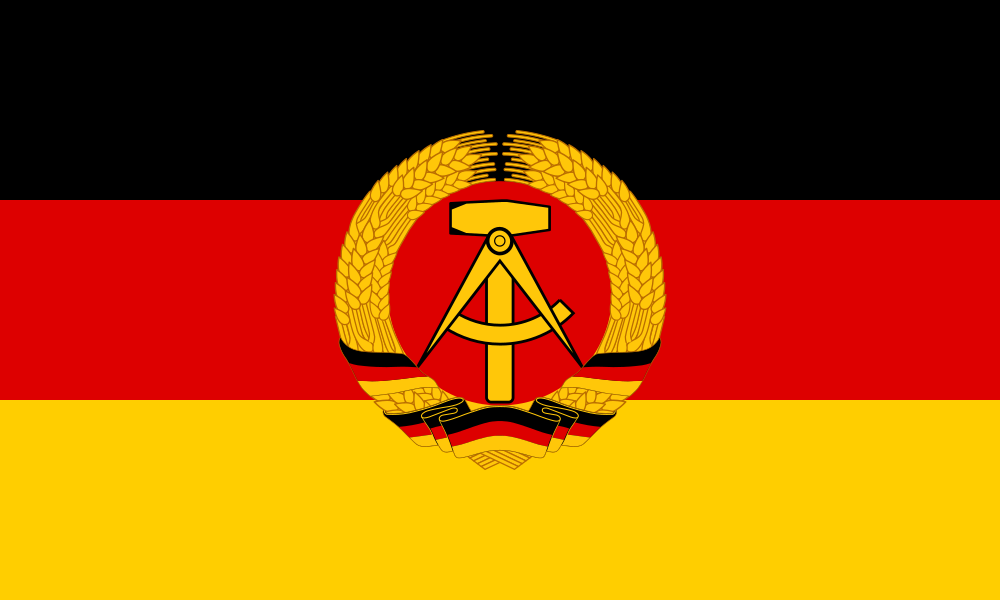
Deeply moved and full of grief, I desire at the very outset to express my sorrow at the decease of the President of Guinea, Ahmed SCkou Tour& The unforgettable contribution made by that outstanding statesman in the cause of peace, the unity of African States and progress deserves our highest appreciation. His resolute actions against all forms of colonialism and neo-colonialism and for the elimination of the crime of apartheid are a striking example of an African policy that is tit-m in its principles. In President Ahmed SCkou Tour6 we have lost a good friend of the German Democratic Republic. His memory will always be held in honour by the people and Government of my country.
59. Permit me to congratulate you, Sir, on your assumption of the presidency of the Council for the month of March and to wish you success in the discharge of this responsible offrce. We have the expectation that under your able guidance this important body will achieve a positive result in the deliberation of the issue on its agenda.
60. The appreciation of the delegation of the German Democratic Republic goes also to your predecessor,
61. And. finallv. I should like through vou. Mr. Pres-
WI , ident, to extend my thanks to the members of the Council for giving me this opportunity to explain the point of view of the German Democratic Republic on the issue which is before us.
62. The German .Democratic Republic follows with great concern the events and developments in the world which constitute a danger to international peace and security. At the same time, it directs all its efforts towards contributing to the improvement of intemational relations, the settlement of conflicts and the prevention of new ones. Today this task is much more urgent than ever before, in the light of the dangerously aggravated situation in the world. We therefore resolutely reject all attempts to exacerbate further this situation and stir up new tensions. Such peace-endangering attempts are nothing less than the expression of a policy pursued by the most aggressive circles of imperialism, in particular the United States, which is aimed at implementing hegemonic ambitions in whole regions of the world and obtaining arbitrarily fixed spheres of interest.
63. The sovereign rights of peoples in those regions are thus’ entirely denied to them, even trampled upon. The goal is the impediment and, if possible, the liquidation of social progress in developing countries, the guarantee of maintaining influence in the form of economic, military and political diktat. In this connection, quite often an attempt is made to aggravate problems existing in the relationship between individual States and to exploit them in the interest of imperialist policy.
64. The escalation of demonstrations of military might by the United States not only threatens sovereign developing countries and national -liberation ‘movements but is also directed against the socialist States. Its purpose is to divert simultaneously attention from the dangers arising from the stationing of medium-range missiles in Western Europe.
65. Mankind is thereby entering a new, perhaps the most dangerous, phase of its development. The deployment of nuclear first-strike weapons,’ whose range includes also the region of the Middle and Near East, is the expression of Washington’s openly proclaimed goal of achieving strategic military superiority. Let me point to the fact that in Sicily, only a few hundred miles away from the Libyan coast, United States cruise missiles will become operational at the end of this month.
66. In the view of the German Democratic Republic, the most recent campaign launched against the Libyan Arab Jamahiriya also goes along those lines. ‘It tits: completely into the global concept of Washington and of the North Atlantic’ Treaty Organization. Those attacks against an Arab State again testify td the fact
73. Mr. IBRAHIM (Ethionial: Yesterdav the world learned of the sad news of the untimely death of one of the elder statesmen of Africa, President Ahmed SCkou Tout-e of the People’s Revolutionary Republic of Guinea. Though the condolences of the people and Government of Ethiopia have already been offered to the people and Government of Guinea, as well as to the bereaved family, I feel it my duty to reiterate at this juncture and from this forum Africa’s sense of loss.
67. Since Washington has not been able to achieve its envisaged objectives in Lebanon, it now attempts to stir up fresh conflicts in other Arab areas. Obviously, the sending of AWACS spy planes and combat aircraft to the north-eastern African region is designed to suit that purpose. The concern of the Libyan Arab Jamahiriya with that threat is therefore shared by many States.
74. On a happier note, I should like to congratulate you, Sir, on your assumption of the high office of President of the Council. Your performance and that of your predecessor, Mr. Shah Nawaz, the representative of Pakistan, who had provided the Council with wise and effective leadership, have earned both of you our admiration and respect.
68. The adventurous actions undertaken by the United States in that region fit into the global policy of threat, and stir up tensions as well as efforts to stifle liberation movements. Repeated provocations against the Libyan Arab Jamahiriya are characteristic of such actions, as are the expansion of the military presence in the Middle East-that is, the naval presence off the coast of Lebanon-the military manoeuvres in Central America and the Caribbean, as well as the machinations against sovereign States in Africa and Asia.
75. Once again, the Libyan Arab Jamahiriya has come to the Council to complain of threats to its security and stability. This, as we all know, is not the first time that the Council has been seized of similar threats from the same sources against Libya. Again, this is not the first time many of us have participated in such debates in order to extend our solidarity to the people and Government of the Jamahiriya.
69. How else could such action by the United States be described than as unconcealed implementation of the “big stick” or “gunboat” policy towards developing countries? Such a policy, as proved by historical experiences and the development of international relations at present, is doomed to failure. This is guaranteed by the anti-imperialist struggle of the peoples in the Caribbean and Central America, of Namibia and South Africa, of the Arab States and other regions of the world. The socialist States firmly stand at the side of all those who struggle against imperialist hegemony and all forms of colonialism and neocolonialism and for social progress, freedom from any exploitation,‘for independence and a life in peace. .
76. In view of the fact that the principle of the non-use or threat of use of force in the conduct of international relations as well as that of the peaceful settlement of disputes are firmly entrenched in the Charter of the United Nations and constitute the bedrock of the present system of inter-State relations, one would have hoped-indeed, expected-that those principles would be respected and followed in the situation under consideration. To our dismay, however, the preferred course of action appears to be to resort to a modem version of gunboat diplomacy, which some have characterized as AWACS diplomacy, the motivation of which is nothing but the intensely anti-Libyan stance of the present United States Administration.
70. The German Democratic Republic continues persistently to follow a policy of peaceful co-operation and the peaceful settlement of disputes. This corresponds to a position that has been repeatedly expressed in proposals of the socialist States for the solution of conflicts. I may be permitted to recall that the States Parties to the Warsaw Treaty in their Prague Political Declaration have advocated the transformation of “the Mediterranean Sea into a zone of peace and co-operation” [see S/15556, annex, ZZfl.
77. As you, Sir, and the Council very well know and as the debates here yesterday and in the past have demonstrated, the state of relations among the countries of the north-eastern region of Africa is far from cordial. The imperatives of international peace and security dictate that under such circumstances each and all should exercise maximum restraint and reject foreign intervention. Nothing should therefore be done to aggravate the already tense and difficult situation. To our regret, however, what has so far taken place is directly contrary to what is dictated by the situation.
71. In concluding my statement, 1 should like to assure the Libyan Arab Jamahiriya of the firm solidarity of the German’ Democratic Republic in the resolute rejection of all imperialist provocations and in the struggle for the preservation of its independence and national sovereignty.
78. Instead of an easing of tension, we observe the exacerbation of tension through intensive propaganda campaigns and diplomatic confrontations. In place of the search for a peaceful solution, we see attempts at military solutions through the introduction of massive
72. The PRESIDENT [interpretationfrom Spanish]: The next speaker is the representative of Ethiopia.
79. Those preparations, coupled with the active military intervention of the United States in the region, is a source of great concern to Ethiopia and we believe it is aimed not only against Libya but against other States as well. As what happens there affects my country directly, we in Ethiopia therefore cannot remain indifferent to recent events in the region. Indeed, it is these same concerns that have prompted us to take part in the present debate and call upon one and all once again to exercise maximum restraint and seek the solution of their differences without the intervention of extraregional Powers.
80. We have been told that the need for foreign intervention and the further aggravation of the tense situation in the region arose as a result of the bombing incident in Omdurman. As we all know, the Sudanese Government has charged the Libyan Government with responsibility. Libya, for its part, has categorically denied these charges. Fortunately or unfortunately, the contours of this debate have been blurred by reports in the international press. Even though this may not be the proper context to comment on the merits of the complaint of the Sudan against Libya, we are of the view that the Sudanese and Libyan complaints have an organic link. What the Council does on the Sudanese complaint, we believe, is bound to have an effect on the complaint by Libya.
8 1. We therefore believe it our duty to emphasize the need for caution and for any action by the Council to be based on adequate and verifiable data. We are also duty-bound to call upon our brothers in both the Sudan and Libya to settle their differences either bilaterally or through the good offices of the regional organizations in which they enjoy common membership. The militarization of those differences and the unwelcome intervention of an extra-regional Power is in the best interest of neither the Sudan nor Libya and indeed poses a threat to regional peace and security.
82. Mr. KRAVETS (Ukrainian Soviet Socialist Republic) [interpretation from Russian]: The delegation of the Ukrainian SSR would like to express its deeply felt condolences at the death of the President of the Republic of Guinea, Mr. SCkou Tour& an eminent son of Africa, who devoted his life to the liberation of his and other peoples of Africa from colonial domination, and was one of the founding members of OAU and the Movement of Non-Aligned Countries.
83. Mr. President, your country has been the first of the,newly elected members of the Council to have had the honour to preside it, and for us your experience is particularly valuable. Observing carefully how skilfully
84. This is not the first time that the Government of the Libyan Arab Jamahiriya has had to request the convening of the Security Council. Because of the constant threats, the policy of blackmaii and the hostile actions by the United States toward the Libyan Arab Jamahiriya, that State has been forced to make such requests many times in the past. We need only remember the events of 1981, when United States fighter aircraft shot down two Libyan aircraft over the Gulf of Sidra, or the intimidating show of force by the United States Sixth Fleet off the coast of Libya last year.
85. Today, taking its out and out anti-Libyan campaign one step further, the United States has used a dubious pretext-if, indeed, this is not a pre-planned and pre-executed act of provocation-to bomb Omdurman, in the Sudan, a neighbour of Libya. It is absolutely typical that on the very day after this shocking act, which cost innocent lives, the skies of the Libyan Arab Jamahiriya and the airspace of neighbouring countries were darkened by sophisticated, modem electronic reconnaissance AWACS aircraft. Conjuring up the spectre of a so-called Libyan danger, the United States has created an air corridor into a country next to the Libyan Arab Jamahiriya, through which it has funnelled a great deal of modem weapons, military mat&iel and detachments of troops-all of which represent a serious threat to peace and security in that region and throughout the world. Brazen acts of espionage are taking place over the entire territory of the Libyan Arab Jamahiriya.
86. It was really quite astonishing to hear the representative of the United States revealing yesterday [2521sr meeting] how well informed she was about when, how many and what kind of Libyan aircraft were flying over Libya’s sovereign airspace.’
87. Unfortunately, actions like these on the part of the United States are by no means isolated instances: they are simply links in a vast chain of aggressive military acts that form the policy of the present United States Administration. In the Persian Gulf, the United States ensures so-called freedom of navigation by threatening to shoot down aircraft which approach within five miles of its warships. Approaches to the ports of Nicaragua have been thickly strewn with magnetic mines. Yesterday, the representative of Nicaragua [ibid.] referred to the tens of millions of dollars that have been allocated by the United States Government for military assistance to those bandits whose sworn purpose is to topple the legitimate Government of Nicaragua. All this is being done under the guise of so-called humanitarian assistance to other countries. Humanitarianism American-style, like democracy American-style, apparently
88. One could go on listing such actions by the United States in all parts of the world-be it the Near East or the Far East, northern or southern Africa, Central America or the Caribbean.
89. The United States Administration has coolly arrogated to itself the right to determine whether the Government of any particular non-aligned country does or does not square with its concept of democracy. If it does not, then that Government is immediately ostracized. Governments that are bold enough to have their own positions and policies, differing from those of Washington, are more and more frequently now becoming subjects of pressure, malicious propaganda campaigns, provocation and even direct military intervention.
90. In practice, this imperialist policy of the United States is based on the already tried and tested organizational, material and technical foundations which facilitate intervention in the internal affairs of other countries. As an example, we need only refer to such organs and structures as the United States Rapid Deployment Forces and the recently formed united central military command. The sphere of duties of this central command comprises a considerable part of the Indian Ocean and the Persian Gulf and, in addition, 19 States of the Near East and North Africa. This is a threat which also directly affects the Libyan Arab Jamahiriya.
91. The delegation of the Ukrainian Soviet Socialist Republic fully shares the alarm voiced by the Libyan Arab Jamahiriya at this further deterioration of the situation in that area as a result of the hostile and provocative actions of the United States there. We support the Libyan people in their efforts to offset foreign intervention in the internal affairs of their country. An end must be put to these constant threats and blatant military actions against that country,
92. The PRESIDENT [interprerationfiom Spanish]: The next speaker is the representative of the Islamic Republic of Iran. I invite him to take a place at the Council table and to make his statement.


As this is the first time my delegation has participated in Council deliberations under your presidency, Sir, I should like to congratulate you on the way in which you have been presiding over the Council. In spite of all the complicated problems usually created by the very nature of the Council, I am confident that the difftcult task of presiding over the Council and handling its affairs will become very easy in your skilful hands,
94. I should like also to thank and congratulate your predecessor, Mr. Shah Nawaz, representative of Pakistan, on the masterly manner in which he conducted the affairs of the Council during the month of February.
95. The Council is meeting today in order to consider another stage in United States aggression and intervention against the Libyan Arab Jamahiriya. The Libyan Arab Jamahiriya is just one of the many countries in the world which are the targets of imperialist aggression. No one is better informed than you, Mr. President, about the role of the United States in Central America and in Latin America in general.
96. International crime is not confined simply to the resort to prohibited weapons. Intervention in the affairs of other nations; the imposition of puppet regimes upon other peoples, thereby trespassing upon and violating all their rights and prerogatives of sovereignty and independence; provocative military and intelligence operations which disturb the peace and security of innocent people-in which the United States is definitely a record-breaker; conspiratorial attempts against revolutionary and popular regimes such as that of Nicaragua; addressing other people by pointing guns at them; sending helicopter gunships to various parts of the world, as in the case of Tabas; dispatching naval terrorist groups; and resort to sophisticated modem piracy, as in the cases of Grenada and Lebanon: all of these acts are criminal acts, which, due to their magnitude, are often far beyond due consideration within international norms.
97. In order to get a general picture of the criminal record of the United States, I should like members to consider the records of the Security Council over the past two years. In 1982, the Council dealt with 29 items, 18 of which were related to direct or indirect involvement of the United States. In other words, more than 62 per cent of the year’s work of the Council in 1982 consisted of nothing but consideration of the involvement of the foreign policy of the United States. The records of the Council show that in the year 1983, out of 32 items, 23 were related to the same American involvement. In other words, 7 1.85 per cent of the cases referred to the Council in 1983 concerned American foreign policy. This increase of about 10 per cent in United States involvement in international crimes is slightly higher than the annual rate of inflation in the United States. In other words, in spite of the billions of dollars of deficit, and in spite of unemployment and inflation, the record of the foreign policy makers is even more miserable than that of those who have been defining the economic policy of the United States. Despite this remarkable criminal record, United States officials still shamelessly accuse Libya of being behind every problem in the Middle East..
99. Take another couple of sentences. Sentence one: Libya is behind every international problem in Central America and the rest of Latin America. Sentence two: The United States is behind every international problem in Central America and the rest of Latin America.
100. We might, if we wish, consider another couple of sentences. Sentence one: Libya is alone responsible for major international problems in the Far East. Sentence two: The United States is alone responsible for major international problems in the Far East.
101. I am sure that every individual in this Chamber could produce many more pairs of sentences which would be as illuminating and as informative as the three pairs I have just put forward. Therefore, we really do not need to go into the details of political events and military occurrences in every part of the’world; we only need to be very simple, ordinary people who can use their common sense. Very little knowledge is required to appreciate the criminal record of imperialism.
102. One asks oneself: What is the role of the United States AWACS in the Middle East? What are United States naval forces doing near Libyan waters? What are United States terrorist forces doing around the Persian Gulf and near the Arabian Sea? Please remember that the foregoing examples are merely a few cases of direct American military presence and involvement. We have not yet touched on any of the numerous examples of United States-orchestrated plots, conspiracies and provocations, which are usually carried out by surrogate regimes and American lackeys, at work against popular regimes, revolutionary Governments and liberation movements.
103. Can any member of the Council name one popular revolution-towards which the United States has not been antagonistic and for the eradication of which the United States has not mobilized its sinister military, paramilitary and intelligence forces? Why is it that in the vicinity of every revolutionary country there is a neighbour which, in conformity with the foreign policy of the United States, does not miss any chance to act against that revolutionary, popular regime? In this context, Libya is not the only country which has such “friendly” neighbours: I am sure that the cases of Nicaragua and the Islamic Republic of Iran will not be forgotten.
104.. With the present composition of the Security Council, it is far from practical to anticipate any con-
105. We have no doubt that American plots and intrigues against the Islamic countries of North Africa, the Middle East and elsewhere will lead only to further American defeats and frustrations. We condemn all conspiracies, involvements, interventionist policies, provocations and the ill-fated, sinister military presence of the United States in our part of the world. We want all foreign forces, whether they be Russian or American, out of our area, and if the Council cannot meet this very important requirement, our people will do it.
106. We believe that the United States leaders must return to honesty and wisdom. Wisdom requires them to stop ‘their interventions in other countries, to end their hegemony and to reconsider their foreign policies, instead of simply reviewing their plans and projects for supporting and preserving their puppets. Wisdom requires them to stop distorting facts and to stop misinforming and misleading their own people. The American public is suffering from misinformation. ,* 107. I submitted a questionnaire to a group of Amer- ” ican intellectuals who have a very important role in that society. I do not need to name them, and probably I cannot do so, because the names are not on the questionnaire. I asked them to name five countries in the Middle East and North Africa which are known to be pro-American, which maintain very good relations with the American Government and whose regimes enjoy popular support. It was a very difficult question, was it not? The answers that some of those intellectuals gave me were very interesting. They named the following countries: Egypt, the Sudan, Jordan, Morocco and -interestingly enough-Syria. They simply don’t know that Syria is well known for its anti-American position and is a member of the front-line countries, and therefore cannot be regarded as a pro-American country. From the viewpoint of these American intellectuals, Syria is a very pro-American country which has very good relations with the United States and therefore has popular support. That is the level of the political knowledge of some highly important personalities in the United States who, I can assure the Council, have a determining role in that country’s policies. It
114. We are also’aware of Libya’s concern that there exists a dangerous situation along its eastern frontiers as a result of the aggressive practices of the United States against the Libyan Arab Jamahiriya.
108. Finally, the Islamic Republic of Iran fully supports the people and the Government of Libya in their just struggle against American imperialism. We expect at least some members of the Council to side with the revolutionary people of Libya against the United States and its lackeys. We expect at least some members of the Council honestly to adhere to the principles of the Charter of the United Nations and to condemn the American interventionist policies as a major threat to international peace and security. Therefore, I expect all those good members not to curtail their full and unreserved support for the Libyan Arab Jamahiriya.
115. Of course, the Council is also aware of the fact that Libya brought a legitimate complaint before it last year, when United States actions threatened its sovereignty and independence.
116. The Council is now convened as a result of yet another dangerous development that obviously transcends its local geographical character and has, in my delegation’s view, a direct bearing on the extremely tense situation prevailing in the Middle East. What we are witnessing at present is yet another attempt of the imperialist forces to destabilize the Arab world, to exert pressure on those who consistently, and as a matter of principle, oppose new colonialist machinations and Zionist acts of aggression. It is no accident that once again the Libyan Arab Jamahiriya.has been *selected as the target because it steadfastly defends the just cause of the Arab people.
109. The PRESIDENT [interpretation from Spanish]: The next speaker is the representative of Bulgaria, whom I invite to take a place at the Council table and to make his statement.


At the very beginning, I should like to express the sincere and profound sympathy and condolences of the Bulgarian delegation on the untimely passing away of President Ahmed SCkou Tout-e of Guinea. I should like to’ tell you, Mr. President, and through you the people and the Government of Guinea, that President SCkou Tour& who was one of the founders of the Movement of Non- Aligned Countries, will remain in our hearts and will always be remembered as a steadfast and indefatigable fighter against the remnants of colonialism in Africa and as a true son of its heroic people.
117. Libya has for some time now; and rightly so, been complaining to the Council about the provocative and aggressive actions of the United States against it, including continuous violations of Libyan airspace and territorial waters, economic boycott and misleading information campaigns. Those hostile acts against the Libyan Arab Jamahiriya are a clear violation of the principles and norms of international law.
111. Although this is the end of the current month, I should like to extend to you, Sir, my most heartfelt congratulations and express my satisfaction at seeing you preside over the work of the Council. Your extensive knowledge in the realm of international affairs and your well-proven professional qualifications are making a valuable contribution to solving the problems facing the Council. You represent a country with which my country maintains relations of great cordiality and co-operation.
118. The history of the Middle East question-and particularly its most recent history-unequivocally shows that the.imperiaiist forces have been making all efforts to split the unity of the Arab nations and to impose on them their economic, military and political diktat. Their behind-the-scenes diplomacy goes hand in hand with the policies of open aggression and military blackmail, as practised by the United States and Israel.
119. The latest imperialist action against Libya is a logical sequence of this approach. Its aim is to foster the military psychosis in a sensitive region’which is in close proximity to other regions with hotbeds of tension. And, of course, a basic objective of the imperialist forces is to divert the attention of the international community from their recent fiasco in the Middle East and to counteract that failure by increasing their military presence and exerting pressure upon States and nations in that part of the world that are not to their liking. The almost automatic decision to send sophisticated new American weapons and other military equipment, including two AWACS aircraft, to be used against Libya cannot but be construed as yet another
112. I should like also to express my gratitude to the President of the Security Council for the month of February, the representative of Pakistan, Mr. Shah Nawaz, for the exemplary way in which he conducted the Council’s proceedings.
113. The Bulgarian delegation is grateful to you, Sir, and the other members of the Council for having allowed it to participate in the current debate. We are acquainted with the letter of the representative of the Libyan Arab Jamahiriya drawing the attention of the Council
120. This military, political and propaganda operation clearly stands out against the background of the defeat of the military intervention in Lebanon. Naturally, this is not an incidental action prompted by various circumstances. Rather, it is an offtcial policy predicated on the use of brutal military force. The shelling of Lebanese villages by a United States naval force, massive air raids, the Marines’ landings in Lebanon and Grenada, the aggressive actions against Nicaragua and Cuba and in the Horn of Africa-all are most eloquent examples of that official policy. The current campaign against the Libyan Arab Jamahiriya is a link in the same chain. It is inspired by the same vested interests and is part of the well-known mechanism of aggression.
121. The Bulgarian delegation believes that this serious situation-which the Libyan Minister for Foreign Affairs, Mr. Ah Treiki, brought to the attention of the Council in all seriousness and in a most responsible manner-is a threat to peace and security in the region and in the world as well.
122. As far as the position of the People’s Republic of Bulgaria on this question of principle is concerned, it was only recently reiterated by the Secretary-General of the Central Committee of the Bulgarian Communist Party and President of the Council of State of the People’s Republic of Bulgaria, Todor Zhivkov, on 8 March last during his official visit to the Libyan Arab Jamahiriya at the invitation of the leader of the Revolution of 1 September, Colonel Muammar Qaddafi. In his speech Todor Zhivkov said, among other things:
“The critical situation in the Middle East and the vital interests of the Arab nations require strengthening the unity and united action of all the Arab countries and forces fighting against imperialism and Zionism.”
123. Guided by the desire to see that this military threat hanging over the Libyan people and other peoples in the region is removed, the Bulgarian delegation supports the request of the Libyan Arab Jamahiriya that the Security Council, which bears primary responsibility for the maintenance of international peace and security in the world, “must draw the attention of the United States Administration to the dangerousness of its aggressive and provocative policy towards the Jamahiriya and in the region” [see S/26425].
124. The Bulgarian delegation also shares the view that what is needed at present is common sense, goodwill and concerted efforts by all States concerned, as well as by the international community, in order to prevent a new military confrontation in the region the consequences of which might indeed be unpredictable.
125. The PRESIDENT [i&erpretation from Spun- &h]: The next speaker is the representative of the Lao
126. Mr. KITTIKHOUN (Lao People’s Democratic Republic) [interpretation from French]: It was with great regret and sadness that we learned of the sudden death of President Ahmed Stkou TourC, the eminent head of State of the People’s Revolutionary Republic of Guinea. We should like, through you, Sir, to convey our sincere condolences to the Government and the people of Guinea, as well as to the family of the late President.
127. Since this is the first time I have spoken in the Council, we congratulate you, Sir, on your assumption of the presidency for this month. Aware as we are of your broad experience and your great qualities as a diplomat, we are sure that the Council’s work under your guidance will provide successful results.
128. We also take this opportunity to congratulate your predecessor, the representative of Pakistan, on the competent manner in which he guided the Council’s deliberations last month.
129; We cannot begin setting forth our delegation’s point of view without first sincerely thanking all the members of the Council who were kind enough to afford us this opportunity to participate in this very important debate.
130. The dangerous situation that has arisen along the eastern border of the Libyan Arab Jamahiriya following the sending there of two AWACS radar aircraft and fighter planes by the Government of the United States to carry out espionage activities in Libyan territory requires the attention of the Council. The speedy dispatching of such sophisticated aircraft to carry out activities of this kind over the territory of a Member State is a violation of the Charter of the United Nations and will only further exacerbate the tension prevailing in that sensitive part of the world.
131. As the Secretary of the People’s Committee . of the People’s Bureau for Foreign Liaison of the Libyan Arab Jamahiriya reminded us this morning [2522nd meeting] this is not the first time the Libyan Government has come to the Council to reveal to the world the policies of aggression of a great imperialist Power. Those policies have been pursued against his Government and people since 1969, since the great September revolution.
132. In responding to that policy of aggression, the Libyan Arab Jamahiriya is not alone, as some circles might believe or wish it to be. At a special meeting on 28 August 1981, at which it considered the serious situation arising from provocative naval manoeuvres conducted by the United States Navy off the Libyan coast, the Co-ordinating Bureau of the Movement of Non-Aligned Countries expressed its full solidarity with the Jamahiriya and made an appeal to all non-
133. Not so very long ago we too were victims of American aggression, and for that reason we thoroughly sympathize with the Libyan complaint. Under the leadership of the Lao People’s Revolutionary Party, our people inflicted a humiliating defeat on the occupying forces and their lackeys in 1975 and succeeded in liberating our country completely and establishing a new regime. We had hoped that a new era of peace, freedom and justice would result. But since then our people, like the Libyan people, have become a target for the reprehensible plans for subversion and sabotage being perpetrated by the imperialists in collusion with the hegemonists.
137. Arguments are valid only when based on concrete facts, and, frankly, my delegation has considerable difficulty understanding or following the logic that has been used in speedily providing every support, including military support, to the -plaintiff, whose accusations against the Libyan Arab Jamahiriya are based on unlikely hypotheses. The Libyan Arab Jamahiriya is a small country that cherishes peace and is proud of its independence and its steadfast support for the movements of peoples struggling to be free.
138. The United States is often placed in an awkward position because of its warlike behaviour, and there are good reasons to believe that the United States, in its dispute with the small but courageous Libyan Arab Jamahiriya, is engaged in exploiting to the maximum in its favour the complaint of the Sudan in order to score political and diplomatic points. The startling announcement of the dispatch of the AWACS radar aircraft and support interceptors near the Libyan Arab Jamahiriya, which is very revealing of the attitude of the United States that it should be policeman to the world, has therefore very little to do with the attack in the southern Sudan that has been referred to. This rapid dispatch of AWACS radar aircraft is actually an integral part of America’s policy against the Libyan Arab Jamahiriya and is not an isolated act or one of happenstance.
134. The imperialist strategy to dominate the world -and there can be no doubt about this-has been and indeed always will be perfectly clear. To carry out this treacherous strategy, imperialism strikes-or waits for a right opportunity to strike-all peoples that are unwilling to accept its policies and to serve its interests. No campaign of disinformation or calumny can hide that insatiable appetite. But the winds of change continue to blow, and peoples remain unswerving in defence of their freedom and in their struggle for emancipation.
135. We are supposed to believe that the’sending of AWACS radar aircraft and American fighter planes was linked to an alleged Libyan attack in the southern part of a neighbouring country. This old argument, which has been trotted out once again, is all too familiar to the members of the Council. It will be recalled that those in charge of American defence declared last year that the movements of the American Sixth Fleet and AWACS aircraft were linked to the alleged, mobilization of Libyan forces along its border with the Sudan and a planned intervention in that country and that the movements of AWACS aircraft were part of joint manoeuvres with Egyptian troops. Curiously, following that declaration, the Egyptian Government denied the existence of any such manoeuvres. On 18 February 1983, The Christian Science Monitor even declared that Egyptian leaders had said that they knew nothing about any recent Libyan mobilization against the Sudan. That is the kind of fabrication that has been concocted against Libya. Imperialism has been trying to deceive the world with such fabrications to prepare it for its attacks on the Libyan Arab Jamahiriya.
139. In support of his thesis-which we consider to be quite likely-in his statement in the Council in February 1983, when presenting his complaint, the representative of Libya quoted the following passage from The New York Times: “The plan, according to American officials, was to lure Libya into striking and then to destroy as much of its air force as possible” [2415th meeting, para. 261.
140. In the final analysis, the Government of the United States has long been persistently preparing American and world public opinion for its acts of aggression against the Libyan Arab Jamahiriya. But the world will not be taken in by this. Neither eloquence nor demagoguery can possibly conceal the truth. In view of its military power and harassed by its deepseated hatred of the peoples of the world which refuse to bow to its will, the United States Government, to the surprise of all peace-loving States, has already launched a serious invasion against the small island of Grenada, after long years of patient and active preparation. Hence, there is every reason to believe that, encouraged by this legendary victory over Grenada, the United States Government,,in its machiavellian plans, to put down with the use of force any hint of resistance anywhere, is now eyeing another target-the Libyan people-as it tries to realize its ambition for world hegemony.
136. Yesterday, when the Council was considering the Sudan’s complaint, which enjoys the vigorous support of the United States, my delegation did not intend to participate in the debate. As a small country with a population of nearly 4 million, it is our strong intention vigorously to defend the sacrosanct principles of the Charter, in particular the non-use of force and noninterference in the internal affairs of other countries. But in that particular case, notwithstanding the long but
142. In support of the struggle of the Libyan people, we would ask the Council, which is resuonsible for the maintenance of international peace and security, to take appropriate action to put an end to these imperialist adventurous machinations. That would pave the way for the Libyan people to pursue its development and national reconstruction in peace, freedom and honour.
143. The PRESIDENT [interpretation from Spanish]: I should like to inform the members of the Council that I have just received a letter from the representative .of the Sudan in which ,he requests to be invited to participate in the discussion of the item on the agenda. In accordance with the usual practice, I propose, with the consent of the Council, to invite that representative to participate in the discussion without the right to vote, in conformity with the relevant’provisions of the Charter and rule 37 of the provisional rules of procedure.
At the invitation of the President, Mr. Birido (Sudan) took a place at the Council table.
144. The PRESIDENT [interpretation from Spunish]: I call on the representative of the Sudan, who wishes to exercise the right of reply.
145. Mr. BIRIDO (Sudan) [interpretation from Arabic]: We have asked to be allowed to speak in exercise of the right of reply because of the references made to the Sudan by Mr. Ah Treiki, the Secretary of the People’s Committee of the People’s Bureau for Foreign Liaison, and others speakers, and should like to make the following observations.
146. First, having listened yesterday to the statement by the Minister for Foreign Affairs of my country in the Council [252&h meeting] concerning the aggression launched by the Libyan Arab Jamahiriya-an air raid against our national capital-I need not dwell at length on the subject. The Sudan, with all objectivity and tranquillity, has presented the full facts to the representatives of the international community in this forum. The statements by some members of the Council and other friendly and fraternal countries have shed more light on the seriousness of the air raid as an act of
147. Secondly, the complaint by Libya was lodged immediately after the complaint by the Sudan to the Council in, which it, having conclusive evidence, charged Libya with responsibility for the air raid against Omdurman. Therefore Libya requested the convening of the Council in order to divert attention from its aggression against the Sudan and to create a smoke-screen to hide the facts in a desperate attempt to let its aggression pass unheeded and to deceive world public opinion.
148. Thirdly. this is not the first time that Libva has resorted to such a practice. The records of the Council prove beyond any doubt how, for the same reasons we have just mentioned, Libya attempted, after Chad’s complaint against it last year, to call for the convening of the Council to consider its complaint against a permanent member of the Council. Today is just like yesterday and we are fully confident that the representatives of the international community will not be deceived by such methods and practices.
149. Fourthly, Sudan’s resort to friendly sister countries for the provision of the means to defend its territory and citizens is a legitimate right ensured by the charters of regional organizations, the Charter of the United Nations and the principles of international law, particularly as it has become evident that the flagrant intervention in its internal affairs is part of the ongoing efforts to undermine its security, national unity and . stability, as well as the development projects on its territory.
150. In conclusion, the Sudan, which has reiterated its belief in the priorities of reconstruction and development, in the necessity to mobilize energy for comprehensive development objectives and in the rejection of aggression and interference in the internal affairs of others, emphasizes that the observance by others of those priorities will contribute to achieving the necessary potential and ensuring the benefit of ail people. If Libya had adhered to these principles and objectives, there would have been no need to have convened a meeting of the Council yesterday and there would never have been any justification for convening a meeting today, because the whole question is one offlagrant and continued aggression and a desperate attempt to hide it.
151. The PRESIDENT [interpretation from Spunish]: The Secretary of the People’s Committee of the People’s Bureau for Foreign Liaison of the Libyan Arab Jamahiriya has asked to speak. I invite him to make his statement.
153. What he said this morning in such a cavalier way-that the AWACS aircraft are unarmed planes, spy planes that are being sent to other countries to spy on them and to prepare the ground for aggression, and that the Security Council should condone such behaviour-reminded me of the time when, after the General Assembly passed a resolution condemning the United States invasion of Grenada, President Reagan said that he suffered no loss of appetite as a result. That reminded me to what extent the United States or its Administration cares about the United Nations or the Security Council.
154. Many friends here have referred to the long list of condemnations of the United States Administration by the Council and by the United Nations in general, but pride of its military force and the desire to dominate have prevented that Administration from seeing things as they are and from respecting the United Nations. The United States seems to have forgotten that even though the United Nations, because of circumstances and in spite of the scores of resolutions condemning that country, is incapable of deterring its aggression, the people themselves can bring this about. I should like to remind the representative of the United States of what happened in Viet Nam, in Iran, in Cuba and in Lebanon.
155. He may also recall that when the United States tried to invade Libya in 1805 and sent in its destroyer Philadelphia, under the command of Captain Bainbridge, that ship was destroyed off the Libyan coast, thus putting an end to United States aggression. To this very day, however, the anthem of the United States Marines contains the words “From the halls of Montezuma to the shores of Tripoli”. I should like to remind him-perhaps he was in the United States Marinesthat the anthem still exists. May I remind him also that when, in the same year, the United States tried to invade Libya from the east in an expedition led by General Eaton, the expedition was destroyed at Dema. History can repeat itself.
156. We are a small people. We have resort to the United Nations, whose Charter and resolutions we respect, but we are determined to live in freedom and to die with our boots on. We shall not bow to threats or aggression. Let our enemies realize that we are fully determined to thwart any American aggression against any Arab territory. The defeat inflicted upon the United States by the small heroic people of Lebanon will be suffered by it again, this time at the hands of the people of the Sudan and of Libya and by all the Arab peoples.
157. As the representative of the Islamic Republic of Iran said, we know that although the Council is well
158. This recklessness and nonchalance, these constant acts of aggression against small countries and peoples are part of an invariable, systematic policy pursued by the United States Administration. What would the world be like if that Administration were the only one having any strength? That would mean .the total destruction of our world. The people of Japan are still suffering from the destructive consequences of the nuclear attack which occurred when the United States was the only country possessing the nuclear weapon. What would happen today in the world if the United States Administration were still the only one possessing the nuclear weapon?
159. I should now like to comment on something said by my brother, the representative of the Sudan-I say “my brother” because, while one chooses one’s friends, one cannot choose one’s brother. He said that the complaint of the Libyan Arab Jamahiriya had been presented as a reaction to the complaint made by the Sudan. That is quite true. We did present our complaint after the dispatching of American forces and the AWACS aircraft to the Sudan. But we did not do that to hide the truth in any way. In conformity with the mutual defence pact of the League of Arab States, both the Sudan and the Libyan Arab Jamahiriya are duty-bound to struggle against the United States aggression.
160. The reuresentative of the Sudan referred to’the assistance of-friendly, fraternal countries. He did not, however, say that the United States was a friendly country. He could not say that, because the United States is in fact an enemy of the Sudan, just as it is an enemy of Palestine, the Libyan Arab Jamahiriya, Nicaragua and other countries. What friendly countries did he have in mind? Was he referring to those who helped the Zionists to occupy Palestine? Was he referring to those who bombed the Egyptian people and tried to destroy them? Was he referring to those who helped the Zionist entity to occupy southern Lebanon? Have these enemies suddenly become the friends of the Arab nation? They wilt become friends only if they change their policy and choose a policy serving justice.
161. The representative of the Sudan says they are friends because they gave assistance to the Sudan. But assistance against whom? I consider that a regime is doomed that cannot defend itself from its own people but seeks help from a foreign country which is an enemy of its country and people; it certainly does not deserve to represent the people that it claims to represent.
162. Is it compatible with the policy of non-alignment to ask for assistance from the United States, a country friendly to South Africa and Israel and which is stirring up antagonism against a sister Arab country? I put that
163. The hostile United States policy of aggression against the Arabs, Muslims, Africans, and other people
The meeting rose at 7 p.m.
HOW TO OBTAIN UNITED NATIONS PUBLICATIONS
United Nations publications may be obtained from bookstores and distributors throughout the world. Consult your bookstore or write to: United Nations. Sales Section. New York or Geneva.
COMMENT SE PROCURER LES PUBLICATIONS DES NATIONS UNIES
Les publications des Nations Unies sent en vente dam les librairies et les agences dipositaires du monde entier. Informez-vous aup& de votre libraire ou adressez-vous a : Nations Unies, Section des ventes. New York ou Gentive.
KAK HOXY’IHTh ZIBAAHHJi OPrAHUB.SIXHU OI;?.E:lAHEHHhIX HAILHR
COMO CONSEGUfR PUBLICACIONES DE LAS NACIONES UNIDAS
Las publicaciones de las Naciones Unidas e&n en venta en librerias y casas distribuidoras en todas partes de1 mundo. Cons&e a su librero o dirljase a: Naciones Unidas. Section de Yentas. Nueva York o Ginebra.
Litho in United Nations, New York 00400 90-61313~January 1993-2.050
▶ Cite this page
UN Project. “S/PV.2523.” UN Project, https://un-project.org/meeting/S-PV-2523/. Accessed .